|
|

Search for ker again, using less strict matching (44 results)
|
Source: Torp, page b0105, entry 7 View original page image as: [TIFF] [PNG] [View previous entry] [View next entry] |
[Comment on this entry] [View comments] |
The following entry has been hand-corrected once. |

(hrô)
rühmen.
Vgl.
harmian.
Ig.
Wz.
ker ,
ker.
Vgl.
skr.
carkarti
erwähnt
rühmend,
kîrtí
f.
Erwähnung,
Kunde,
Ruhm.
-
gr.
[kh'ruc]
,
ker.
Vgl.
skr.
carkarti
erwähnt
rühmend,
kîrtí
f.
Erwähnung,
Kunde,
Ruhm.
-
gr.
[kh'ruc]
[Translate the German words]
|
Source: Torp, page b0115, entry 11 View original page image as: [TIFF] [PNG] [View previous entry] [View next entry] |
[Comment on this entry] [View comments] |
The following entry has been hand-corrected once. |
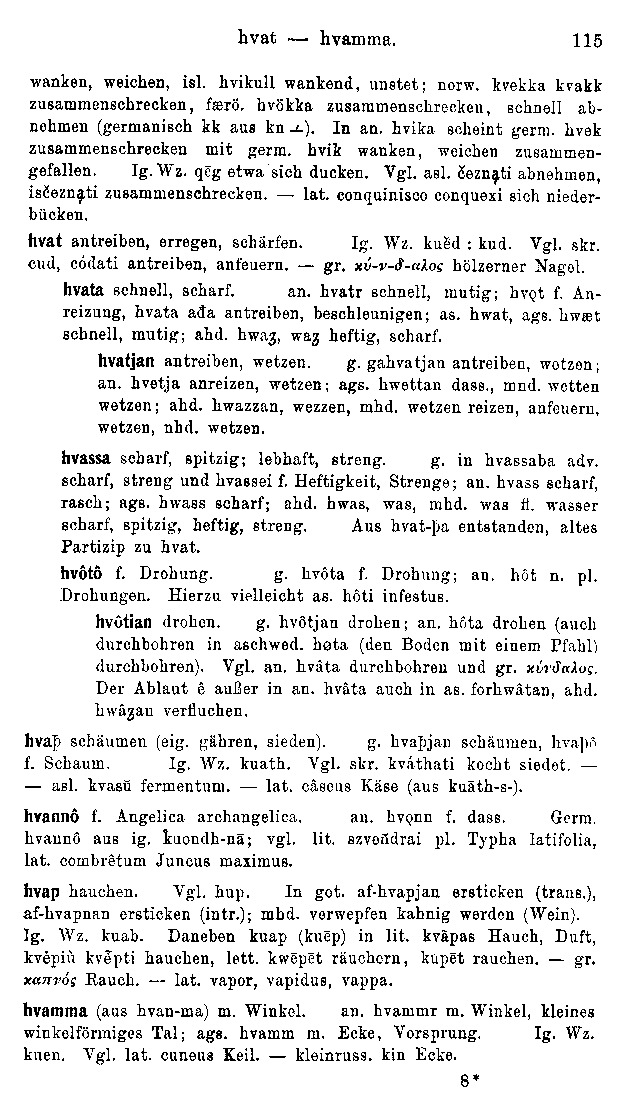
hvamma
(aus
hvan-ma)
m.
Winkel.
an.
hvammr
m.
Winkel,
kleines
winkelförmiges
Tal;
ags.
hvamm
m.
Ecke,
Vorsprung.
Ig.
Wz.
kuen.
Vgl.
lat.
cuneus
Keil.
-
kleinruss.
kin
Ecke.
[Translate the German words]
|
Source: Torp, page b0116, entry 3 View original page image as: [TIFF] [PNG] [View previous entry] [View next entry] |
[Comment on this entry] [View comments] |
The following entry has been hand-corrected once. |
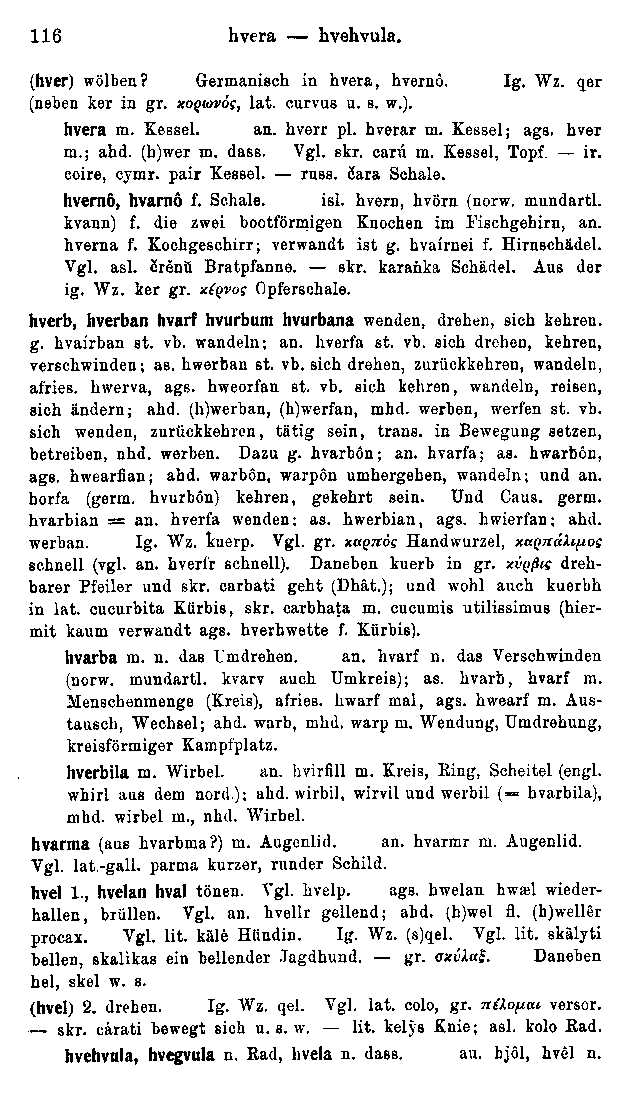
hvernô,
hvarnô
f.
Schale.
isl.
hvern,
hvörn
(norw.
mundartl.
kvann)
f.
die
zwei
bootförmigen
Knochen
im
Fischgehirn,
an.
hverna
f.
Kochgeschirr;
verwandt
ist
g.
hvaírnei
f.
Hirnschädel.
Vgl.
asl.
 r
r n
n Bratpfanne.
-
skr.
kara
Bratpfanne.
-
skr.
kara ka
Schädel.
Aus
der
ig.
Wz.
ker
gr.
[ke'rnos]
Opferschale.
ka
Schädel.
Aus
der
ig.
Wz.
ker
gr.
[ke'rnos]
Opferschale.
[Translate the German words]
|
Source: Torp, page b0128, entry 2 View original page image as: [TIFF] [PNG] [View previous entry] [View next entry] |
[Comment on this entry] [View comments] |
The following entry has been hand-corrected once. |

gera, geraga, gerîga begierig, geran begehren. an. Geri der Name des einen von den Wölfen Odins; ahd. ger, ker, mhd. ger verlangend, begehrend; as. gerôn, afries. geria, ieria; ahd. gerôn, gerên, mhd. geren, gern begehren; as. gerag; ahd. girîg, kirîg, mhd. girig, nhd. gierig.
[Translate the German words]
|
Source: Torp, page b0455, entry 6 View original page image as: [TIFF] [PNG] [View previous entry] [View next entry] |
[Comment on this entry] [View comments] |
The following entry has been hand-corrected once. |
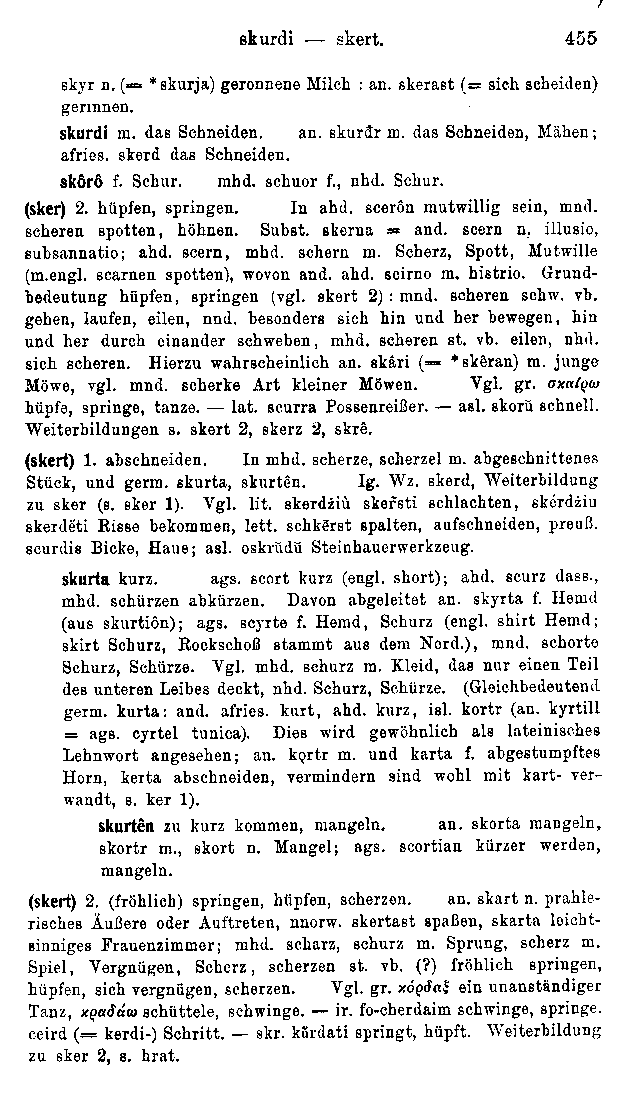
skurta
kurz.
ags.
scort
kurz
(engl.
short);
ahd.
scurz
dass.,
mhd.
schürzen
abkürzen.
Davon
abgeleitet
an.
skyrta
f.
Hemd
(aus
skurtiôn);
ags.
scyrte
f.
Hemd,
Schurz
(engl.
shirt
Hemd;
skirt
Schurz,
Rockschoß
stammt
aus
dem
Nord.),
mnd.
schorte
Schurz,
Schürze.
Vgl.
mhd.
schurz
m.
Kleid,
das
nur
einen
Teil
des
unteren
Leibes
deckt,
nhd.
Schurz,
Schürze.
(Gleichbedeutend
germ.
kurta:
and.
afries.
kurt,
ahd.
kurz,
isl.
kortr
(an.
kyrtill
=
ags.
cyrtel
tunica).
Dies
wird
gewöhnlich
als
lateinisches
Lehnwort
angesehen;
an.
k rtr
m.
und
karta
f.
abgestumpftes
Horn,
kerta
abschneiden,
vermindern
sind
wohl
mit
kart-
verwandt,
s.
ker
1).
rtr
m.
und
karta
f.
abgestumpftes
Horn,
kerta
abschneiden,
vermindern
sind
wohl
mit
kart-
verwandt,
s.
ker
1).
[Translate the German words]
|
Source: Torp, page b0472, entry 6 View original page image as: [TIFF] [PNG] [View previous entry] [View next entry] |
[Comment on this entry] [View comments] |
The following entry has been hand-corrected once. |

(skreþ)
=
skrenþ.
In
germ.
skratta,
und
in
norw.
mundartl.
skreda
Schwächling
(vielleicht
auch
isl.
skræ ur
f.
pl.
Talggrieben);
mnd.
schrade
dünn,
mager,
kümmerlich
(norw.
krea,
gleichbedeutend
mit
skreda,
isl.
kreda,
wohl
etymologisch
verschieden,
urverwandt
mit
kart-
(s.
ker
1),
vgl.
ostfries.
krete
Runzel,
kleine
Pflaume,
kret
verschrumpftes
Obst).
ur
f.
pl.
Talggrieben);
mnd.
schrade
dünn,
mager,
kümmerlich
(norw.
krea,
gleichbedeutend
mit
skreda,
isl.
kreda,
wohl
etymologisch
verschieden,
urverwandt
mit
kart-
(s.
ker
1),
vgl.
ostfries.
krete
Runzel,
kleine
Pflaume,
kret
verschrumpftes
Obst).
[Translate the German words]
|
Source: Bosworth/Toller, page b0113, entry 12 View original page image as: [TIFF] [PNG] [View previous entry] [View next entry] |
[Comment on this entry] [View comments] |
The following entry has been hand-corrected once. |
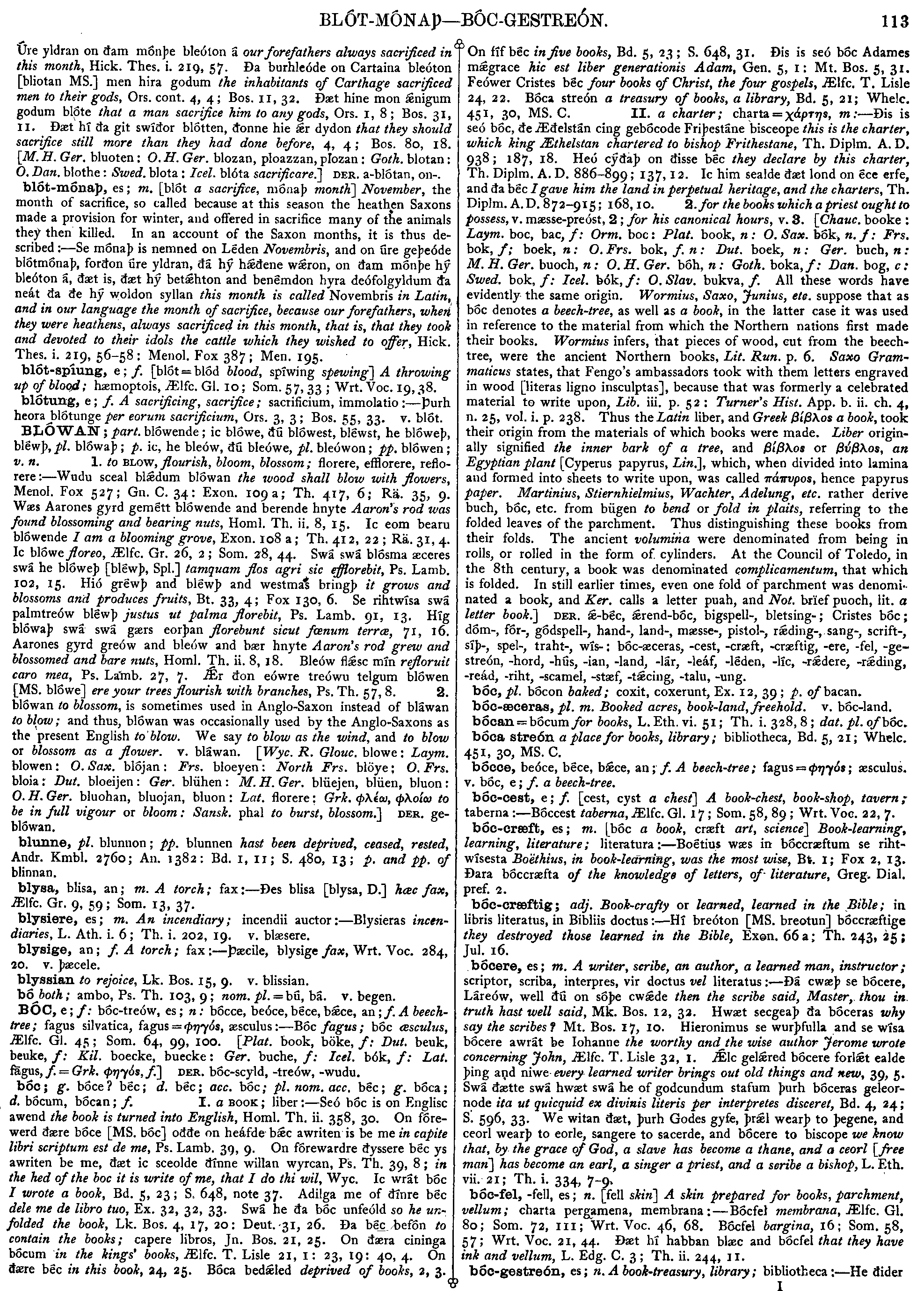
bóc;
g.
bóce?
béc;
d.
béc;
acc.
bóc;
pl.
nom.
acc.
béc;
g.
bóca;
d.
bócum,
bócan;
f.
I.
a
BOOK;
liber
:--
Seó
bóc
is
on
Englisc
awend
the
book
is
turned
into
English,
Homl.
Th.
ii.
358,
30.
On
fórewerd
ðære
bóce
[MS.
bóc]
oððe
on
heáfde
b c
awriten
is
be
me
in
capite
libri
scriptum
est
de
me,
Ps.
Lamb.
39,
9.
On
fórewardre
ðyssere
béc
ys
awriten
be
me,
ðæt
ic
sceolde
ðínne
willan
wyrcan,
Ps.
Th.
39,
8;
in
the
hed
of
the
boc
it
is
write
of
me,
that
I
do
thi
wil,
Wyc.
Ic
wrát
bóc
I
wrote
a
book,
Bd.
5,
23;
S.
648,
note
37.
Adilga
me
of
ðínre
béc
dele
me
de
libro
tuo,
Ex.
32,
32,
33.
Swá
he
ða
bóc
unfeóld
so
he
unfolded
the
book,
Lk.
Bos.
4,
17,
20:
Deut.
31,
26.
Ða
béc
befón
to
contain
the
books;
capere
libros,
Jn.
Bos.
21,
25.
On
ðæra
cininga
bócum
in
the
kings'
books,
Ælfc.
T.
Lisle
21,
1:
23,
19:
40,
4.
On
ðære
béc
in
this
book,
24,
25.
Bóca
bedled
deprived
of
books,
2,
3.
On
fíf
béc
in
five
books,
Bd.
5,
23;
S.
648,
31.
Ðis
is
seó
bóc
Adames
mgrace
hic
est
liber
generationis
Adam,
Gen.
5,
1:
Mt.
Bos.
5,
31.
Feówer
Cristes
béc
four
books
of
Christ,
the
four
gospels,
Ælfc.
T.
Lisle
24,
22.
Bóca
streón
a
treasury
of
books,
a
library,
Bd.
5,
21;
Whelc.
451,
30,
MS.
C.
II.
a
charter;
charta
=
c
awriten
is
be
me
in
capite
libri
scriptum
est
de
me,
Ps.
Lamb.
39,
9.
On
fórewardre
ðyssere
béc
ys
awriten
be
me,
ðæt
ic
sceolde
ðínne
willan
wyrcan,
Ps.
Th.
39,
8;
in
the
hed
of
the
boc
it
is
write
of
me,
that
I
do
thi
wil,
Wyc.
Ic
wrát
bóc
I
wrote
a
book,
Bd.
5,
23;
S.
648,
note
37.
Adilga
me
of
ðínre
béc
dele
me
de
libro
tuo,
Ex.
32,
32,
33.
Swá
he
ða
bóc
unfeóld
so
he
unfolded
the
book,
Lk.
Bos.
4,
17,
20:
Deut.
31,
26.
Ða
béc
befón
to
contain
the
books;
capere
libros,
Jn.
Bos.
21,
25.
On
ðæra
cininga
bócum
in
the
kings'
books,
Ælfc.
T.
Lisle
21,
1:
23,
19:
40,
4.
On
ðære
béc
in
this
book,
24,
25.
Bóca
bedled
deprived
of
books,
2,
3.
On
fíf
béc
in
five
books,
Bd.
5,
23;
S.
648,
31.
Ðis
is
seó
bóc
Adames
mgrace
hic
est
liber
generationis
Adam,
Gen.
5,
1:
Mt.
Bos.
5,
31.
Feówer
Cristes
béc
four
books
of
Christ,
the
four
gospels,
Ælfc.
T.
Lisle
24,
22.
Bóca
streón
a
treasury
of
books,
a
library,
Bd.
5,
21;
Whelc.
451,
30,
MS.
C.
II.
a
charter;
charta
=
 &alpha-tonos;

 s,
m
:--
Ðis
is
seó
bóc,
ðe
Æðelstán
cing
gebócode
Friþestáne
bisceope
this
is
the
charter,
which
king
Æthelstan
chartered
to
bishop
Frithestane,
Th.
Diplm.
A.
D.
938;
187,
18.
Heó
cýðáþ
on
ðisse
béc
they
declare
by
this
charter,
Th.
Diplm.
A.
D.
886-899;
137,
12.
Ic
him
sealde
ðæt
lond
on
éce
erfe,
and
ða
béc
I
gave
him
the
land
in
perpetual
heritage,
and
the
charters,
Th.
Diplm.
A.
D.
872-915;
168,
10.
2.
for
the
books
which
a
priest
ought
to
possess,
v.
mæsse-preóst,
2;
for
his
canonical
hours,
v.
3.
[Chauc.
booke:
Laym.
boc,
bac,
f:
Orm.
boc:
Plat.
book,
n:
O.
Sax.
bók,
n.
f:
Frs.
bok,
f;
boek,
n:
O.
Frs.
bok,
f.
n:
Dut.
boek,
n:
Ger.
buch,
n:
M.
H.
Ger.
buoch,
n:
O.
H.
Ger.
bóh,
n:
Goth.
boka,
f:
Dan.
bog,
c:
Swed.
bok,
f:
Icel.
bók,
f:
O.
Slav.
bukva,
f.
All
these
words
have
evidently
the
same
origin.
Wormius,
Saxo,
Junius,
ete.
suppose
that
as
bóc
denotes
a
beech-tree,
as
well
as
a
book,
in
the
latter
case
it
was
used
in
reference
to
the
material
from
which
the
Northern
nations
first
made
their
books.
Wormius
infers,
that
pieces
of
wood,
cut
from
the
beech-tree,
were
the
ancient
Northern
books,
Lit.
Run.
p.
6.
Saxo
Grammaticus
states,
that
Fengo's
ambassadors
took
with
them
letters
engraved
in
wood
[literas
ligno
insculptas],
because
that
was
formerly
a
celebrated
material
to
write
upon,
Lib.
iii.
p.
52;
Turner's
Hist.
App.
b.
ii.
ch.
4,
n.
25,
vol.
i.
p.
238.
Thus
the
Latin
liber,
and
Greek
s,
m
:--
Ðis
is
seó
bóc,
ðe
Æðelstán
cing
gebócode
Friþestáne
bisceope
this
is
the
charter,
which
king
Æthelstan
chartered
to
bishop
Frithestane,
Th.
Diplm.
A.
D.
938;
187,
18.
Heó
cýðáþ
on
ðisse
béc
they
declare
by
this
charter,
Th.
Diplm.
A.
D.
886-899;
137,
12.
Ic
him
sealde
ðæt
lond
on
éce
erfe,
and
ða
béc
I
gave
him
the
land
in
perpetual
heritage,
and
the
charters,
Th.
Diplm.
A.
D.
872-915;
168,
10.
2.
for
the
books
which
a
priest
ought
to
possess,
v.
mæsse-preóst,
2;
for
his
canonical
hours,
v.
3.
[Chauc.
booke:
Laym.
boc,
bac,
f:
Orm.
boc:
Plat.
book,
n:
O.
Sax.
bók,
n.
f:
Frs.
bok,
f;
boek,
n:
O.
Frs.
bok,
f.
n:
Dut.
boek,
n:
Ger.
buch,
n:
M.
H.
Ger.
buoch,
n:
O.
H.
Ger.
bóh,
n:
Goth.
boka,
f:
Dan.
bog,
c:
Swed.
bok,
f:
Icel.
bók,
f:
O.
Slav.
bukva,
f.
All
these
words
have
evidently
the
same
origin.
Wormius,
Saxo,
Junius,
ete.
suppose
that
as
bóc
denotes
a
beech-tree,
as
well
as
a
book,
in
the
latter
case
it
was
used
in
reference
to
the
material
from
which
the
Northern
nations
first
made
their
books.
Wormius
infers,
that
pieces
of
wood,
cut
from
the
beech-tree,
were
the
ancient
Northern
books,
Lit.
Run.
p.
6.
Saxo
Grammaticus
states,
that
Fengo's
ambassadors
took
with
them
letters
engraved
in
wood
[literas
ligno
insculptas],
because
that
was
formerly
a
celebrated
material
to
write
upon,
Lib.
iii.
p.
52;
Turner's
Hist.
App.
b.
ii.
ch.
4,
n.
25,
vol.
i.
p.
238.
Thus
the
Latin
liber,
and
Greek
 &iota-tonos;
 os
a
book,
took
their
origin
from
the
materials
of
which
books
were
made.
Liber
originally
signified
the
inner
bark
of
a
tree,
and
&iota-tonos;
os
a
book,
took
their
origin
from
the
materials
of
which
books
were
made.
Liber
originally
signified
the
inner
bark
of
a
tree,
and
&iota-tonos; os
or
&upsilon-tonos;os,
an
Egyptian
plant
[Cyperus
papyrus,
Lin.],
which,
when
divided
into
lamina
and
formed
into
sheets
to
write
upon,
was
called
os
or
&upsilon-tonos;os,
an
Egyptian
plant
[Cyperus
papyrus,
Lin.],
which,
when
divided
into
lamina
and
formed
into
sheets
to
write
upon,
was
called


 os,
hence
papyrus
paper.
Martinius,
Stiernhielmius,
Wachter,
Adelung,
etc.
rather
derive
buch,
bóc,
etc.
from
bügen
to
bend
or
fold
in
plaits,
referring
to
the
folded
leaves
of
the
parchment.
Thus
distinguishing
these
books
from
their
folds.
The
ancient
volumina
were
denominated
from
being
in
rolls,
or
rolled
in
the
form
of
cylinders.
At
the
Council
of
Toledo,
in
the
8th
century,
a
book
was
denominated
complicamentum,
that
which
is
folded.
In
still
earlier
times,
even
one
fold
of
parchment
was
denominated
a
book,
and
Ker.
calls
a
letter
puah,
and
Not.
brïef
puoch,
lit.
a
letter
book.]
DER.
-béc,
rend-bóc,
bigspell-,
bletsing-;
Cristes
bóc;
dóm-,
fór-,
gódspell-,
hand-,
land-,
mæsse-,
pistol-,
rding-,
sang-,
scrift-,
síþ-,
spel-,
traht-,
wís-:
bóc-æceras,
-cest,
-cræft,
-cræftig,
-ere,
-fel,
-gestreón,
-hord,
-hús,
-ian,
-land,
-lár,
-leaf,
-léden,
-líc,
-rdere,
-rding,
-reád,
-riht,
-scamel,
-stæf,
-tcing,
-talu,
-ung.
os,
hence
papyrus
paper.
Martinius,
Stiernhielmius,
Wachter,
Adelung,
etc.
rather
derive
buch,
bóc,
etc.
from
bügen
to
bend
or
fold
in
plaits,
referring
to
the
folded
leaves
of
the
parchment.
Thus
distinguishing
these
books
from
their
folds.
The
ancient
volumina
were
denominated
from
being
in
rolls,
or
rolled
in
the
form
of
cylinders.
At
the
Council
of
Toledo,
in
the
8th
century,
a
book
was
denominated
complicamentum,
that
which
is
folded.
In
still
earlier
times,
even
one
fold
of
parchment
was
denominated
a
book,
and
Ker.
calls
a
letter
puah,
and
Not.
brïef
puoch,
lit.
a
letter
book.]
DER.
-béc,
rend-bóc,
bigspell-,
bletsing-;
Cristes
bóc;
dóm-,
fór-,
gódspell-,
hand-,
land-,
mæsse-,
pistol-,
rding-,
sang-,
scrift-,
síþ-,
spel-,
traht-,
wís-:
bóc-æceras,
-cest,
-cræft,
-cræftig,
-ere,
-fel,
-gestreón,
-hord,
-hús,
-ian,
-land,
-lár,
-leaf,
-léden,
-líc,
-rdere,
-rding,
-reád,
-riht,
-scamel,
-stæf,
-tcing,
-talu,
-ung.
|
Source: Bosworth/Toller, page b0235, entry 48 View original page image as: [TIFF] [PNG] [View previous entry] [View next entry] |
[Comment on this entry] [View comments (3)] |
The following entry has been hand-corrected once. |
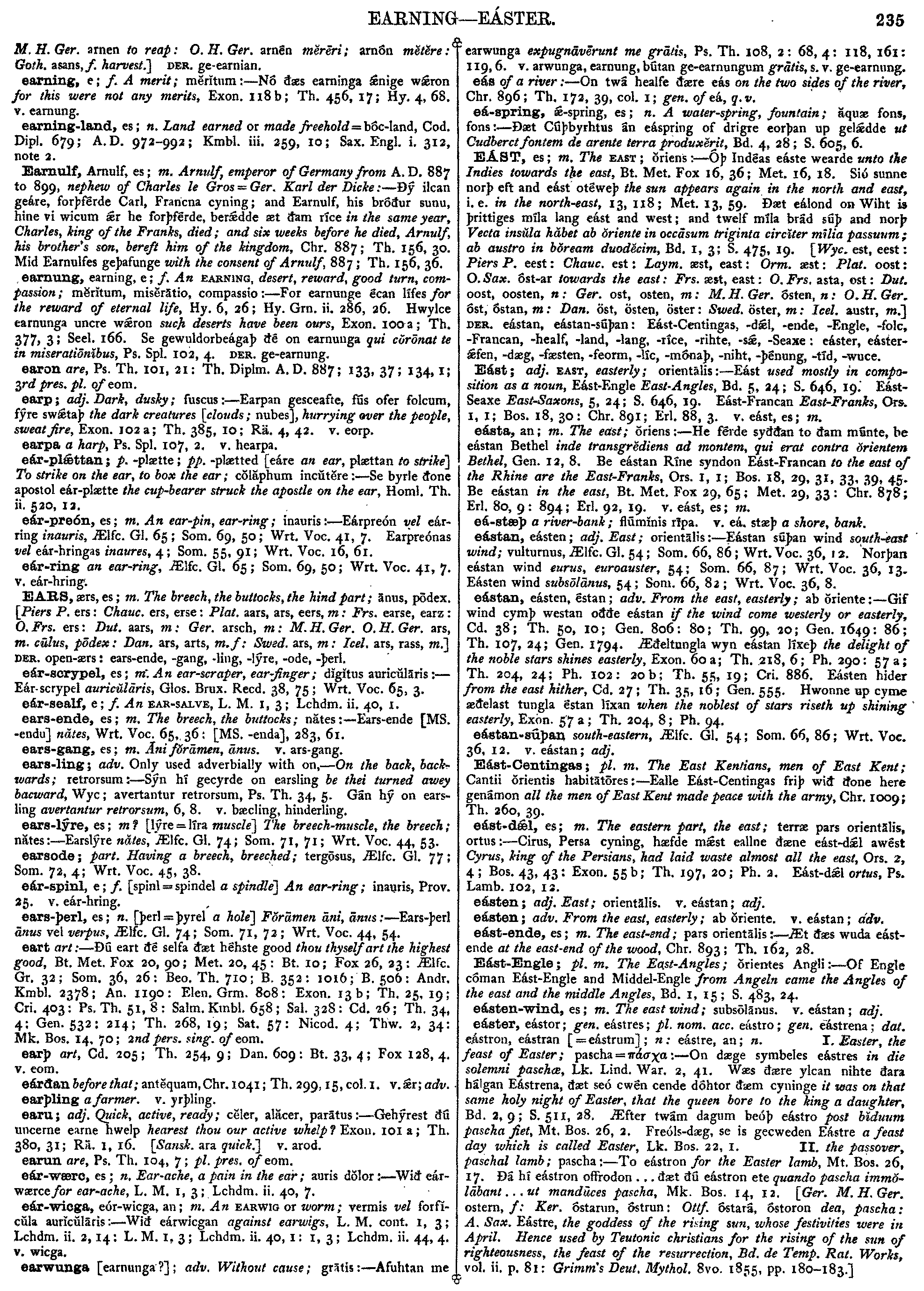
eáster,
eástor;
gen.
eástres;
pl.
nom.
acc.
eástro;
gen.
eástrena;
dat.
eástron,
eástran
[
=
eastrum];
n:
eástre,
an;
n.
I.
Easier,
the
feast
of
Easter;
pascha
=
GREEK:--
On
dæge
symbeles
eástres
in
die
solemni
paschœ,
Lk.
Lind.
War.
2,
41.
Wæs
ðære
ylcan
nihte
ðara
hálgan
Eástrena,
ðæt
seó
cwén
cende
dóhtor
ðæm
cyninge
it
was
on
that
same
holy
night
of
Easter,
that
the
queen
bore
to
the
king
a
daughter,
Bd.
2,
9;
S.
511,
28.
Æfter
twám
dagum
beóþ
eástro
post
b duum
pascha
fiet.
Mt.
Bos.
26,
2.
Freóls-dæg,
se
is
gecweden
Eástre
a
feast
day
which
is
called
Easter,
Lk.
Bos.
22,
l.
II.
the
passover,
paschal
lamb;
pascha:--
To
eástron
for
the
Easter
lamb,
Mt.
Bos.
26,
17.
Ðá
hí
eástron
offrodon
.
.
.
ðæt
ðú
eástron
ete
quando
pascha
imm
duum
pascha
fiet.
Mt.
Bos.
26,
2.
Freóls-dæg,
se
is
gecweden
Eástre
a
feast
day
which
is
called
Easter,
Lk.
Bos.
22,
l.
II.
the
passover,
paschal
lamb;
pascha:--
To
eástron
for
the
Easter
lamb,
Mt.
Bos.
26,
17.
Ðá
hí
eástron
offrodon
.
.
.
ðæt
ðú
eástron
ete
quando
pascha
imm lbant.
.
.
ut
mandces
pascha.
Mk.
Bos.
14,
12.
[Ger.
M.
H.
Ger.
ostern,
f;
Ker.
óstarun,
óstrun:
Ottf.
óstará,
óstoron
dea,
pascha:
A.
Sax.
Eástre,
the
goddess
of
the
rising
sun,
whose
festivities
were
in
April.
Hence
used
by
Teutonic
christians
for
the
rising
of
the
sun
of
righteousness,
the
feast
of
the
resurrection,
Bd.
de
Temp.
Rat.
Works,
vol.
ii.
p.
81:
Grimm's
Deut.
Mythol.
8vo.
1855,
pp.
180-183.]
lbant.
.
.
ut
mandces
pascha.
Mk.
Bos.
14,
12.
[Ger.
M.
H.
Ger.
ostern,
f;
Ker.
óstarun,
óstrun:
Ottf.
óstará,
óstoron
dea,
pascha:
A.
Sax.
Eástre,
the
goddess
of
the
rising
sun,
whose
festivities
were
in
April.
Hence
used
by
Teutonic
christians
for
the
rising
of
the
sun
of
righteousness,
the
feast
of
the
resurrection,
Bd.
de
Temp.
Rat.
Works,
vol.
ii.
p.
81:
Grimm's
Deut.
Mythol.
8vo.
1855,
pp.
180-183.]
|
Source: Cleasby/Vigfusson, page b0005, entry 1 View original page image as: [TIFF] [PNG] [View previous entry] [View next entry] |
[Comment on this entry] [View comments] |
The following entry has been hand-corrected once. |
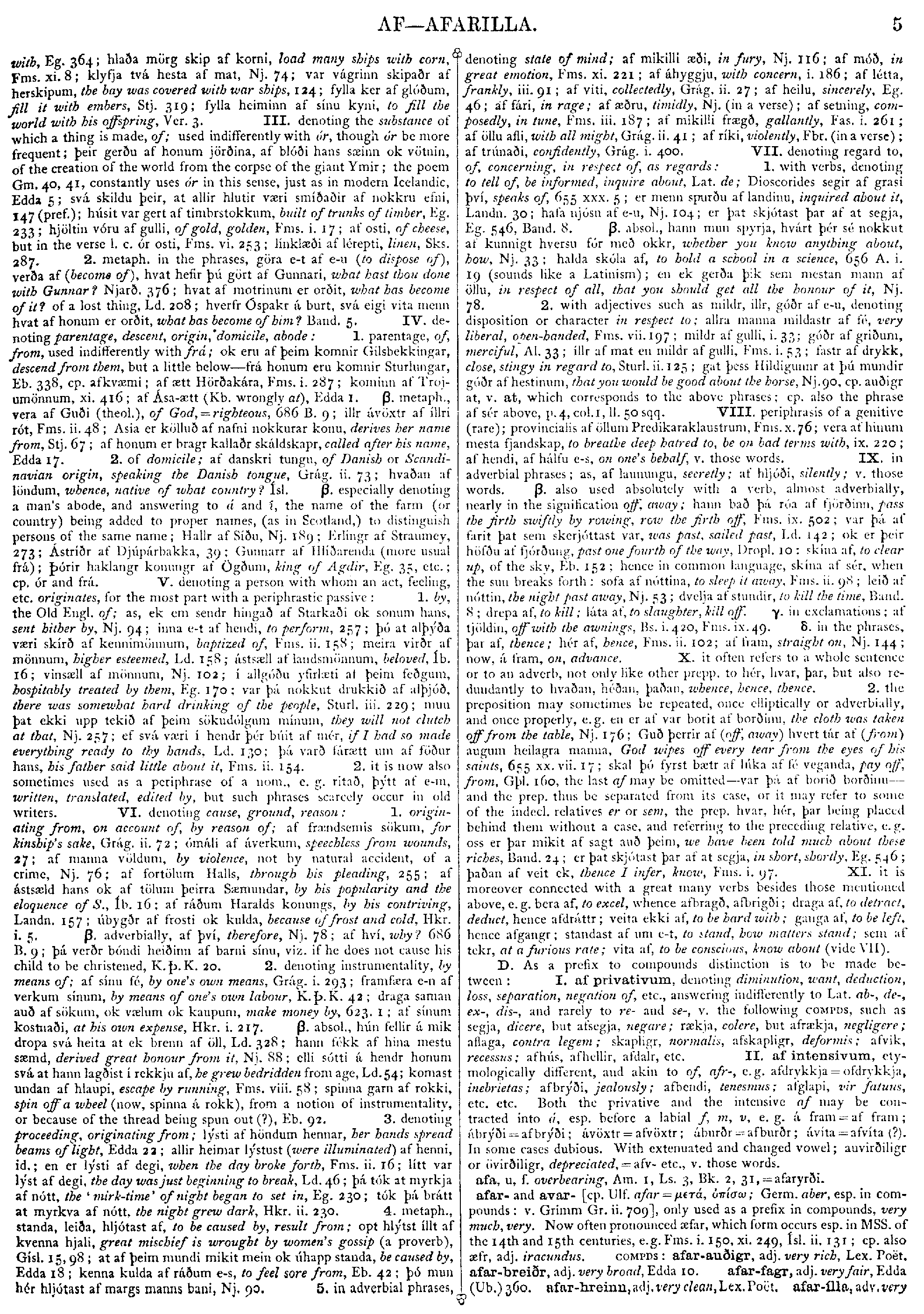
with,
Eg.
364;
hlaða
mörg
skip
af
korni,
load
many
ships
with
corn,
Fms.
xi.
8;
klyfja
tvá
hesta
af
mat,
Nj.
74;
var
vágrinn
skipaðr
af
herskipum,
the
bay
was
covered
with
war
ships,
124;
fylla
ker
af
glóðum,
fill
it
with
embers,
Stj.
319;
fylla
heiminn
af
sínu
kyni,
to
fill
the
world
with
his
offspring,
Ver.
3.
III.
denoting
the
substance
of
which
a
thing
is
made,
of;
used
indifferently
with
ór,
though
ór
be
more
frequent;
þeir
gerðu
af
honum
jörðina,
af
blóði
hans
sæinn
ok
vötnin,
of
the
creation
of
the
world
from
the
corpse
of
the
giant
Ymir;
the
poem
Gm.
40,
41,
constantly
uses
ór
in
this
sense,
just
as
in
modern
Icelandic,
Edda
5;
svá
skildu
þeir,
at
allir
hlutir
væri
smíðaðir
af
nokkru
efni,
147
(pref.);
húsit
var
gert
af
timbrstokkum,
built
of
trunks
of
timber,
Eg.
233;
hjöhin
vóru
af
gulli,
of
gold,
golden,
Fms.
i.
17;
af
osti,
of
cheese,
but
in
the
verse
1.
c.
ór
osti,
Fms.
vi.
253;
línklæði
af
lérepti,
linen,
Sks.
287.
2.
metaph.
in
the
phrases,
göra
e-t
af
e-ti
(to
dispose
of),
verða
af
(become
of),
hvat
hefir
þú
gört
af
Gunnari,
what
hast
thou
done
with
Gunnar?
Njarð.
376;
hvat
af
motrinuni
er
orðit,
what
has
become
of
it?
of
a
lost
thing,
Ld.
208;
hverfr
Óspakr
á
burt,
svá
eigi
vita
menn
hvat
af
honum
er
orðit,
what
has
become
of
him?
Band.
5.
IV.
de-
noting
parentage,
descent,
origin,
domicile,
abode:
1.
parentage,
of,
from,
used
indifferently
with
frá;
ok
eru
af
þeim
komnir
Gilsbekkingar,
descend
from
them,
but
a
little
below
--
frá
honum
eru
konmir
Sturlungar,
Eb.
338,
cp.
afkvæmi;
af
ætt
Hörðakára,
Fms.
i.
287;
kominn
af
Troj-
umönnum,
xi.
416;
af
Ása-ætt
(Kb.
wrongly
at),
Edda
I.
.
metaph.,
vera
af
Guði
(theol.),
of
God,
=
righteous,
686
B.
9;
illr
ávöxtr
af
íllri
rót,
Fms.
ii.
48;
Asia
er
kölluð
af
nafni
nokkurar
konu,
derives
her
name
from,
Stj.
67;
af
honum
er
bragr
kallaðr
skáldskapr,
called
after
his
name,
Edda
17.
2.
of
domicile;
af
danskri
tungu,
of
Danish
or
Scandi-
navian
origin,
speaking
the
Danish
tongue,
Grág.
ii.
73;
hvaðan
af
löndum,
whence,
native
of
what
country?
Ísl.
.
especially
denoting
a
man's
abode,
and
answering
to
á
and
í,
the
name
of
the
farm
(or
country)
being
added
to
proper
names,
(as
in
Scotland,)
to
distinguish
persons
of
the
same
name;
Hallr
af
Síðu,
Nj.
189;
Erlingr
af
Straumey,
273;
Ástríðr
af
Djúpárbakka,
39;
Gunnarr
af
Hlíðarenda
(more
usual
frá);
þorir
haklangr
konungr
af
Ögðum,
king
of
Agdir,
Eg.
35,
etc.;
cp.
ór
and
frá.
V.
denoting
a
person
with
whom
an
act,
feeling,
etc.
originates,
for
the
most
part
with
a
periphrastic
passive:
1.
by,
the
Old
Engl.
of;
as,
ek
em
sendr
hingað
af
Starkaði
ok
sonum
hans,
sent
hither
by,
Nj.
94;
inna
e-t
af
hendi,
to
perform,
257;
þó
at
alþýða
væri
skírð
af
kennimönnum,
baptized
of,
Fms.
ii.
158;
meira
virðr
af
mönnum,
higher
esteemed,
Ld.
158;
ástsæll
af
landsmönnum,
beloved,
íb.
16;
vinsæll
af
mönnum,
Nj.
102;
í
allgóðu
yfirlæti
af
þeim
feðgum,
hospitably
treated
by
them,
Eg.
170;
var
þá
nokkut
drukkið
af
alþjóð,
there
was
somewhat
hard
drinking
of
the
people,
Sturl.
iii.
229;
mun
þat
ekki
upp
tekið
af
þeim
sükudólgum
mínum,
they
will
not
clutch
at
that,
Nj.
257;
ef
svá
væri
í
hendr
þér
búit
af
mér,
if
í
had
so
made
everything
ready
to
thy
hands,
Ld.
130;
þá
varð
fárætt
um
af
föður
hans,
his
father
said
little
about
it,
Fms.
ii.
154.
2.
it
is
now
also
sometimes
used
as
a
periphrase
of
a
nom.,
e.
g.
ritað,
þýtt
af
e-m,
written,
translated,
edited
by,
but
such
phrases
scarcely
occur
in
old
writers.
VI.
denoting
cause,
ground,
reason:
1.
origin-
ating
from,
on
account
of,
by
reason
of;
af
frændsemis
sökum,
for
kinship's
sake,
Grág.
ii.
72;
ómáli
af
áverkum,
speechless
from
wounds,
27;
af
manna
völdum,
by
violence,
not
by
natural
accident,
of
a
crime,
Nj.
76;
af
fortölum
Halls,
through
his
pleading,
255;
af
ástsæld
hans
ok
af
tölum
þeirra
Sæmundar,
by
his
popularity
and
the
eloquence
of
S.,
Íb.
16;
af
ráðum
Haralds
konungs,
by
his
contriving,
Landn.
157;
úbygðr
af
frosti
ok
kulda,
because
of
frost
and
cold,
Hkr.
i.
5.
.
adverbially,
af
því,
therefore,
Nj.
78;
af
hví,
why?
686
B.
9;
þá
verðr
bóndi
heiðinn
af
barni
sínu,
viz.
if
he
does
not
cause
his
child
to
be
christened,
K.
þ.
K.
20.
2.
denoting
instrumentality,
by
means
of;
af
sinu
fé,
by
one's
own
means,
Grág.
i.
293;
framfæra
e-n
af
verkum
sinum,
by
means
of
one's
own
labour,
K.
þ.
K.
42;
draga
saman
auð
af
sökum,
ok
vælum
ok
kaupum,
make
money
by,
623.
I;
af
sínum
kostnaði,
at
hi
s
own
expense,
Hkr.
i.
217.
.
absol.,
hún
fellir
á
mik
dropa
svá
heita
at
ek
brenn
af
öll,
Ld.
328;
hann
fékk
af
hina
mestu
sæmd,
derived
great
honotur
from
it,
Nj.
88;
elli
sótti
á
hendr
honum
svá
at
hann
lagðist
í
rekkjn
af,
he
grew
bedridden
from
age,
Ld.
54;
komast
undan
af
hlaupi,
escape
by
running,
Fms.
viii.
58;
spinna
garn
af
rokki,
spin
off
a
wheel
(now,
spinna
á
rokk),
from
a
notion
of
instrumentality,
or
because
of
the
thread
being
spun
out
(?),
Eb.
92.
3.
denoting
proceeding,
originating
from;
lýsti
af
höndum
hennar,
her
hands
spread
beams
of
light,
Edda
22;
allir
heimar
lýstust
(were
illuminated)
af
henni,
id.;
en
er
lýsti
af
degi,
when
the
day
broke
forth,
Fms.
ii.
16;
lítt
var
lýst
af
degi,
the
day
was
just
beginning
to
break,
Ld.
46;
þá
tók
at
myrkja
af
nótt,
the
'mirk-time'
of
night
began
to
set
in,
Eg.
230;
tók
þá
brátt
at
myrkva
af
nótt,
the
night
grew
dark,
Hkr.
ii.
230.
4.
metaph.,
standa,
leiða,
hljótast
af,
to
be
caused
by,
result
from;
opt
hlýtst
íllt
af
kvenna
hjali,
great
mischief
is
wrought
by
women's
gossip
(a
proverb),
Gísl.
15,
98;
at
af
þeim
mundi
mikit
mein
ok
úhapp
standa,
be
caused
by,
Edda
18;
kenna
kulda
af
ráðum
e-s,
to
feel
sore
from,
Eb.
42;
þó
mun
her
hljótast
af
margs
manns
bani,
Nj,
90.
5.
in
adverbial
phrases,
denoting
state
of
mind;
af
mikilli
æði,
in
fury,
Nj.
116;
af
móð,
in
great
emotion,
Fms.
xi.
221;
af
áhyggju,
with
concern,
i.
186;
af
létta,
frankly,
iii.
91;
af
viti,
collectedly,
Grág.
ii.
27;
af
heilu,
sincerely,
Eg.
46;
áf
fári,
in
rage;
af
æðru,
timidly,
Nj.
(in
a
verse);
af
setning,
com-
posedly,
in
tune,
Fms.
iii.
187;
af
mikilli
frægð,
gallantly,
Fas.
i.
261;
af
öllu
afli,
with
all
might,
Grág.
ii.
41;
af
riki,
violently,
Fbr.
(in
a
verse);
af
trúnaði,
confidently,
Grág.
i.
400.
VII.
denoting
regard
to,
of,
concerning,
in
respect
of,
as
regards:
1.
with
verbs,
denoting
to
tell
of,
be
informed,
inquire
about,
Lat.
de;
Dioscorides
segir
af
grasi
því,
speaks
of,
655
xxx.
5;
er
menu
spurðu
af
landinu,
inquired
about
it,
Landn.
30;
halda
njósn
af
e-u,
Nj.
104;
er
þat
skjótast
þar
af
at
segja,
Eg.
546,
Band.
8.
.
absol.,
hann
mun
spyrja,
hvárt
þér
sé
nokkut
af
kunnigt
hversu
for
með
okkr,
whether
you
know
anything
about,
how,
Nj.
33;
halda
skóla
af,
to
hold
a
school
in
a
science,
656
A.
i.
19
(sounds
like
a
Latinism);
en
ek
gerða
þik
sera
mestan
mann
af
öllu,
in
respect
of
all,
that
you
should
get
all
the
honour
of
it,
Nj.
78.
2.
with
adjectives
such
as
mildr,
illr,
góðrafe-u,
denoting
disposition
or
character
in
respect
to;
alira
manna
mildastr
af
fo,
very
liberal,
often-banded,
Fms.
vii.
197;
mildr
af
gulli,
i.
33;
góðr
af
griðum,
merciful,
Al.
33;
íllr
af
mat
en
mildr
af
gulli,
Fms.
i.
53;
fastr
af
drykk,
close,
stingy
in
regard
to,
Sturl.
ii.
125;
gat
þess
Hildigunnr
at
þú
mundir
góðr
af
hestinum,
that
you
would
be
good
about
the
horse,
Nj.
90,
cp.
auðigr
at,
v.
at,
which
corresponds
to
the
above
phrases;
cp.
also
the
phrase
af
sér
above,
p.
4,
col.
I,
ll.
50
sqq.
VIII.
periphrasis
of
a
genitive
(rare);
provincialis
af
öllum
Predikaraklaustrum,
Fms.
x.
76;
vera
af
hinum
mesta
fjandskap,
to
breathe
deep
hatred
to,
be
on
bad
terms
with,
ix.
220;
af
hendi,
af
hálfu
e-s,
on
one's
behalf,
v.
those
words.
IX.
in
adverbial
phrases;
as,
af
launungu,
secretly;
at"
hljóði,
silently;
v.
those
words.
.
also
used
absolutely
with
a
verb,
almost
adverbially,
nearly
in
the
signification
off,
away;
hann
bað
þá
róa
af
fjörðinn,
pass
the
firth
swiftly
by
rowing,
row
the
firth
off,
Fms.
ix.
502;
var
pá
af
farit
þat
seni
skerjóttast
var,
was
past,
sailed
past,
Ld.
142;
ok
er
þeir
höfðu
af
fjórðung,
past
one
fourth
of
the
way,
Dropl.
10:
skína
af,
to
clear
up,
of
the
skv,
Eb.
152;
hence
in
common
language,
skína
af
sér,
when
the
sun
breaks
forth:
sofa
af
nóttina,
to
sleep
it
away,
Fms.
ii.
98;
leið
af
nóttin,
the
night
past
away,
Nj.
53;
dvelja
af
stundir,
to
kill
the
time,
Band.
8;
drepa
af,
to
kill;
láta
af,
to
slaughter,
kill
off;
 .
in
exclamations;
af
tjöldin,
off
with
the
awnings,
Bs.
i.
420,
Fins,
ix.
49.
.
in
exclamations;
af
tjöldin,
off
with
the
awnings,
Bs.
i.
420,
Fins,
ix.
49.
 .
in
the
phrases,
þar
af,
thence;
hér
af,
hence,
Fms.
ii.
102;
af
fram,
straight
on,
Nj.
144;
now,
á
fram,
on,
advance.
X.
it
often
refers
to
a
whole
sentence
or
to
an
adverb,
not
only
like
other
prepp.
to
hér,
hvar,
þar,
but
also
re-
dundantly
to
héðan,
ru'-ðan,
þaðan,
whence,
hence,
thence.
2.
the
preposition
may
sometimes
be
repeated,
once
elliptically
or
adverbially,
and
once
properly,
e.
g.
en
er
af
var
borit
at
borðinu,
the
cloth
was
taken
off
from
the
table,
Nj.
176;
Guð
þerrir
af
(off,
away)
hvert
tár
af
(from)
augum
heilagra
manna,
God
wipes
off
every
tear
from
the
eyes
of
his
saints,
655
xx.
vii.
17;
skal
þó
fyrst
bætr
af
lúka
af
fé
vegaiula,
pay
off,
from,
Gþl.
160,
the
last
af
may
be
omitted
--
var
þá
af
borið
borðinu
--
and
the
prep.
thus
be
separated
from
its
case,
or
it
may
refer
to
some
of
the
indecl.
relatives
er
or
sem,
the
prep.
hvar,
hér,
þar
being
placed
behind
them
without
a
case,
and
referring
to
the
preceding
relative,
e.
g.
oss
er
þar
mikit
af
sagt
auð
þeim,
we
have
been
told
much
about
these
riches,
Band.
24;
er
þat
skjótast
þar
af
at
segja,
in
short,
shortly.
Eg.
546;
þaðan
af
veit
ek,
thence
í
infer,
know,
Fms.
i.
97.
XI.
it
is
moreover
connected
with
a
great
many
verbs
besides
those
mentioned
above,
e.
g.
bera
af,
to
excel,
whence
afbragð,
afbrigði;
draga
af,
to
detract,
deduct,
hence
afdráttr;
veita
ekki
af,
to
be
hard
with;
ganga
at,
to
be
left,
hence
afgangr;
standast
af
um
e-t,
to
stand,
how
matters
stand;
sem
af
tekr,
at
a
furious
rate;
vita
af,
to
be
conscious,
know
about
(vide
VII).
D.
As
a
prefix
to
compounds
distinction
is
to
be
made
be-
tween:
I.
af
privativum,
denoting
diminution,
want,
deduction,
loss,
separation,
negation
of,
etc.,
answering
indifferently
to
Lat.
ab-,
de-,
ex-,
dis-,
and
rarely
to
re-
and
se-,
v.
the
following
COMPDS,
such
as
segja,
dicere,
but
afsegja,
negare;
rækja,
colere,
but
afrækja,
negligere;
aflaga,
contra
legem;
skapligr,
normalis,
afskapligr,
deformis;
afvik,
recessus;
afhús,
afhellir,
afdalr,
etc.
II.
af
intensivum,
ety-
mologically
different,
and
akin
to
of,
afr-,
e.
g.
afdrykkja
=
ofdrykkja,
inebrietas;
afbrýði,
jealously;
afbendi,
tenesmus;
afglapi,
vir
fatuus,
etc.
etc.
Both
the
privative
and
the
intensive
af
may
be
con-
tracted
into
á,
esp.
before
a
labial
f,
m,
v,
e.
g.
á
fram
=
af
fram;
ábrýði
=
afbrýði;
ávöxtr
=
afvöxtr;
áburðr
=
afburðr;
ávíta
=
afvíta
(?).
In
some
cases
dubious.
With
extenuated
and
changed
vowel;
auvirðiligr
or
övirðiligr,
depreciated,
=
afv-
etc.,
v.
those
.
in
the
phrases,
þar
af,
thence;
hér
af,
hence,
Fms.
ii.
102;
af
fram,
straight
on,
Nj.
144;
now,
á
fram,
on,
advance.
X.
it
often
refers
to
a
whole
sentence
or
to
an
adverb,
not
only
like
other
prepp.
to
hér,
hvar,
þar,
but
also
re-
dundantly
to
héðan,
ru'-ðan,
þaðan,
whence,
hence,
thence.
2.
the
preposition
may
sometimes
be
repeated,
once
elliptically
or
adverbially,
and
once
properly,
e.
g.
en
er
af
var
borit
at
borðinu,
the
cloth
was
taken
off
from
the
table,
Nj.
176;
Guð
þerrir
af
(off,
away)
hvert
tár
af
(from)
augum
heilagra
manna,
God
wipes
off
every
tear
from
the
eyes
of
his
saints,
655
xx.
vii.
17;
skal
þó
fyrst
bætr
af
lúka
af
fé
vegaiula,
pay
off,
from,
Gþl.
160,
the
last
af
may
be
omitted
--
var
þá
af
borið
borðinu
--
and
the
prep.
thus
be
separated
from
its
case,
or
it
may
refer
to
some
of
the
indecl.
relatives
er
or
sem,
the
prep.
hvar,
hér,
þar
being
placed
behind
them
without
a
case,
and
referring
to
the
preceding
relative,
e.
g.
oss
er
þar
mikit
af
sagt
auð
þeim,
we
have
been
told
much
about
these
riches,
Band.
24;
er
þat
skjótast
þar
af
at
segja,
in
short,
shortly.
Eg.
546;
þaðan
af
veit
ek,
thence
í
infer,
know,
Fms.
i.
97.
XI.
it
is
moreover
connected
with
a
great
many
verbs
besides
those
mentioned
above,
e.
g.
bera
af,
to
excel,
whence
afbragð,
afbrigði;
draga
af,
to
detract,
deduct,
hence
afdráttr;
veita
ekki
af,
to
be
hard
with;
ganga
at,
to
be
left,
hence
afgangr;
standast
af
um
e-t,
to
stand,
how
matters
stand;
sem
af
tekr,
at
a
furious
rate;
vita
af,
to
be
conscious,
know
about
(vide
VII).
D.
As
a
prefix
to
compounds
distinction
is
to
be
made
be-
tween:
I.
af
privativum,
denoting
diminution,
want,
deduction,
loss,
separation,
negation
of,
etc.,
answering
indifferently
to
Lat.
ab-,
de-,
ex-,
dis-,
and
rarely
to
re-
and
se-,
v.
the
following
COMPDS,
such
as
segja,
dicere,
but
afsegja,
negare;
rækja,
colere,
but
afrækja,
negligere;
aflaga,
contra
legem;
skapligr,
normalis,
afskapligr,
deformis;
afvik,
recessus;
afhús,
afhellir,
afdalr,
etc.
II.
af
intensivum,
ety-
mologically
different,
and
akin
to
of,
afr-,
e.
g.
afdrykkja
=
ofdrykkja,
inebrietas;
afbrýði,
jealously;
afbendi,
tenesmus;
afglapi,
vir
fatuus,
etc.
etc.
Both
the
privative
and
the
intensive
af
may
be
con-
tracted
into
á,
esp.
before
a
labial
f,
m,
v,
e.
g.
á
fram
=
af
fram;
ábrýði
=
afbrýði;
ávöxtr
=
afvöxtr;
áburðr
=
afburðr;
ávíta
=
afvíta
(?).
In
some
cases
dubious.
With
extenuated
and
changed
vowel;
auvirðiligr
or
övirðiligr,
depreciated,
=
afv-
etc.,
v.
those
|
Source: Cleasby/Vigfusson, page b0091, entry 3 View original page image as: [TIFF] [PNG] [View previous entry] [View next entry] |
[Comment on this entry] [View comments] |
The following entry has been hand-corrected once. |
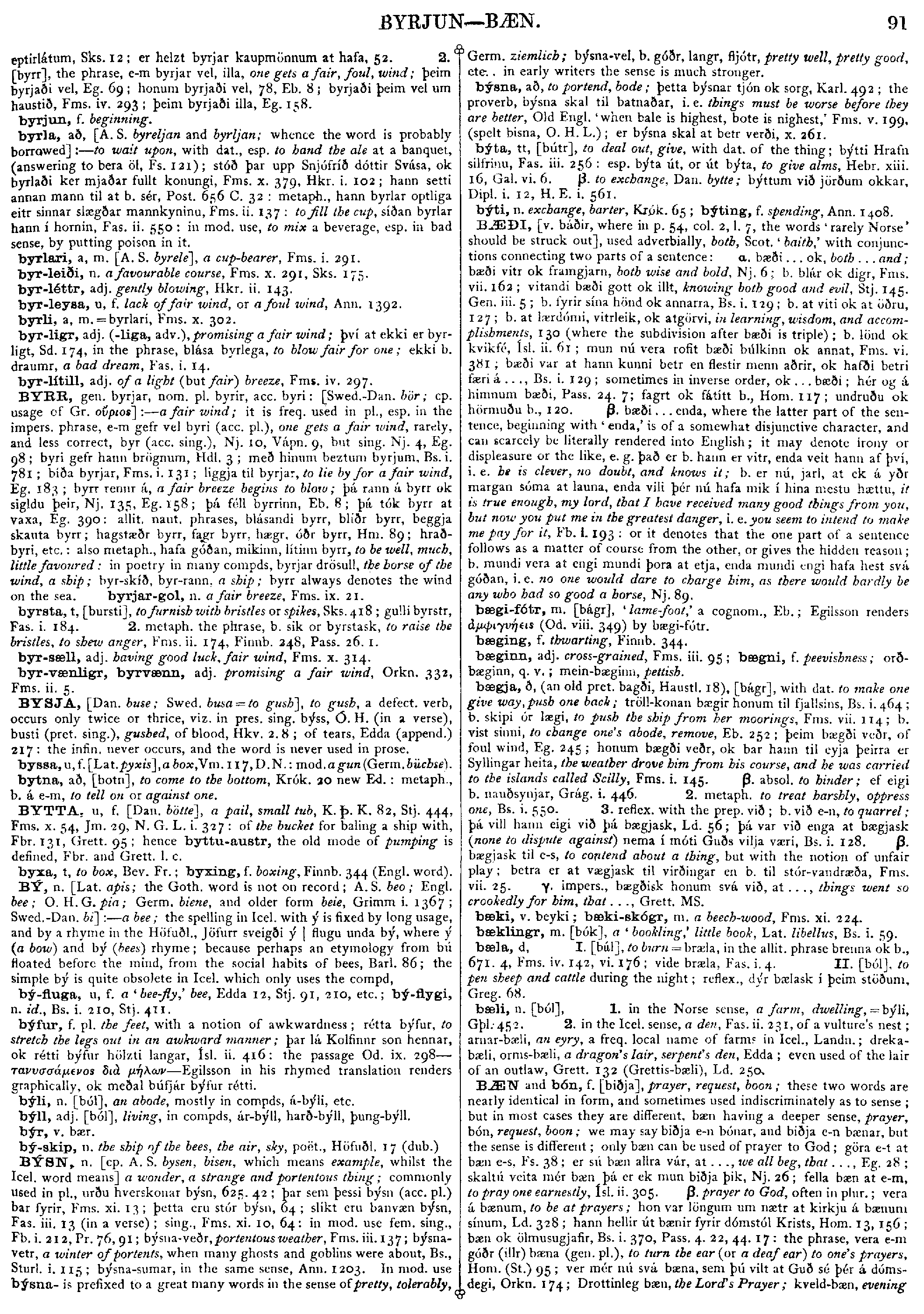
byrla, að, [A. S. byreljan and byrljan; whence the word is probably borrowed] :-- to wait upon, with dat., esp. to hand the ale at a banquet, (answering to bera öl, Fs. 121); stóð þar upp Snjófrið dóttir Svása, ok byrlaði ker mjaðar fullt konungi, Fms. x. 379, Hkr. i. 102; hann setti annan mann til at b. sér, Post. 656 C. 32: metaph., hann byrlar optliga eitr sinnar slægðar mannkyninu, Fms. ii. 137: to fill the cup, síðan byrlar hann í hornin, Fas. ii. 550: in mod. use, to mix a beverage, esp. in bad sense, by putting poison in it.
| Result Page: |  |
Previous | 1 2 3 4 | Next |  |
Germanic Lexicon Project (main page)
This search system was written by
Sean Crist
Please consider
volunteering
to correct the data in these online dictionaries.
No rights reserved. Feel free to use these data in any way you please.