|
|

Tip: In the search results, you can click on any word or abbreviation for more information.
|
Source: Cleasby/Vigfusson, page b0025, entry 8 View original page image as: [TIFF] [PNG] [View previous entry] [View next entry] |
[Comment on this entry] [View comments] |
The following entry has been hand-corrected once. |
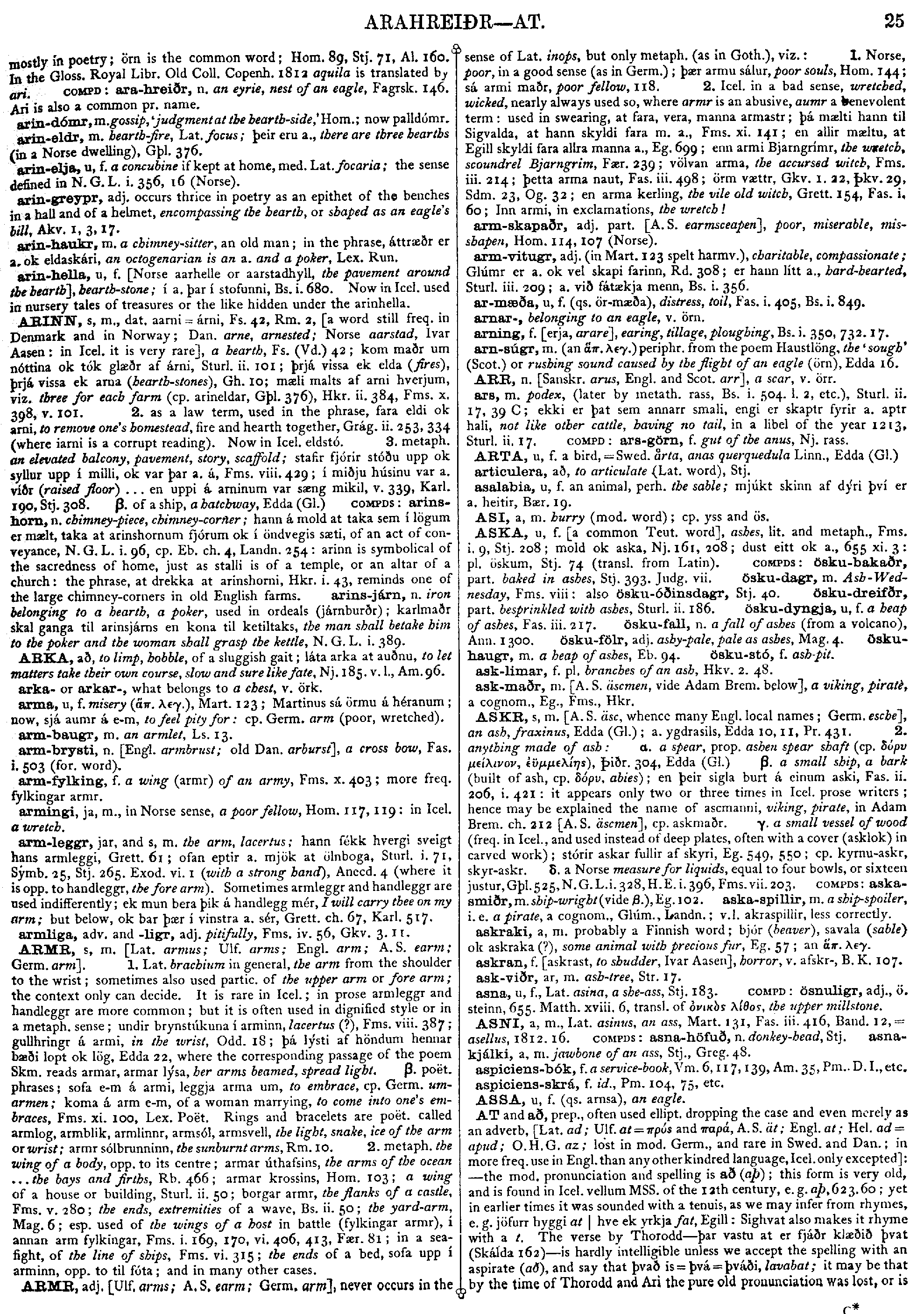
ARINN
s,
m.,
dat.
aarni
=
árni,
Fs.
42,
Rm.
2,
[a
word
still
freq.
in
Denmark
and
in
Norway;
Dan.
arne,
arnested;
Norse
aarstad,
Ivar
Aasen:
in
Icel.
it
is
very
rare],
a
hearth,
Fs.
(Vd.)
42;
kom
maðr
um
nóttina
ok
tók
glæðr
af
árni,
Sturl.
ii.
101;
þrjá
vissa
ek
elda
(fires),
þrjá
vissa
ek
arna
(hearth-stones),
Gh.
10;
mæli
malts
af
arni
hverjum,
viz.
three
for
each
farm
(cp.
arineldar,
Gþl.
376),
Hkr.
ii.
384,
Fms.
x.
398,
v.
101.
2.
as
a
law
term,
used
in
the
phrase,
fara
eldi
ok
arni,
to
remove
one's
homestead,
fire
and
hearth
together,
Grág.
ii.
253,
334
(where
iarni
is
a
corrupt
reading).
Now
in
Icel.
eldstó.
3.
metaph.
an
elevated
balcony,
pavement,
story,
scaffold;
stafir
fjórir
stóðu
upp
ok
syllur
upp
í
milli,
ok
var
þar
a.
á,
Fms.
viii.
429;
í
miðju
húsinu
var
a.
víðr
(raised
floor)
...
en
uppi
á
arninum
var
sæng
mikil,
v.
339,
Karl.
190,
Stj.
308.
 .
of
a
ship,
a
hatchway,
Edda
(Gl.)
COMPDS:
arins-horn,
n.
chimney-piece,
chimney-corner;
hann
á
mold
at
taka
sem
í
lögum
er
mælt,
taka
at
arinshornum
fjórum
ok
í
öndvegis
sæti,
of
an
act
of
conveyance,
N.
G.
L.
i.
96,
cp.
Eb.
ch.
4,
Landn.
254:
arinn
is
symbolical
of
the
sacredness
of
home,
just
as
stalli
is
of
a
temple,
or
an
altar
of
a
church:
the
phrase,
at
drekka
at
arinshorni,
Hkr.
i.
43,
reminds
one
of
the
large
chimney-corners
in
old
English
farms.
arins-járn,
n.
iron
belonging
to
a
hearth,
a
poker,
used
in
ordeals
(járnburðr);
karlmaðr
skal
ganga
til
arinsjárns
en
kona
til
ketiltaks,
the
man
shall
betake
him
to
the
poker
and
the
woman
shall
grasp
the
kettle,
N.
G.
L.
i.
389.
.
of
a
ship,
a
hatchway,
Edda
(Gl.)
COMPDS:
arins-horn,
n.
chimney-piece,
chimney-corner;
hann
á
mold
at
taka
sem
í
lögum
er
mælt,
taka
at
arinshornum
fjórum
ok
í
öndvegis
sæti,
of
an
act
of
conveyance,
N.
G.
L.
i.
96,
cp.
Eb.
ch.
4,
Landn.
254:
arinn
is
symbolical
of
the
sacredness
of
home,
just
as
stalli
is
of
a
temple,
or
an
altar
of
a
church:
the
phrase,
at
drekka
at
arinshorni,
Hkr.
i.
43,
reminds
one
of
the
large
chimney-corners
in
old
English
farms.
arins-járn,
n.
iron
belonging
to
a
hearth,
a
poker,
used
in
ordeals
(járnburðr);
karlmaðr
skal
ganga
til
arinsjárns
en
kona
til
ketiltaks,
the
man
shall
betake
him
to
the
poker
and
the
woman
shall
grasp
the
kettle,
N.
G.
L.
i.
389.
|
Source: Cleasby/Vigfusson, page b0027, entry 2 View original page image as: [TIFF] [PNG] [View previous entry] [View next entry] |
[Comment on this entry] [View comments] |
The following entry has been hand-corrected once. |
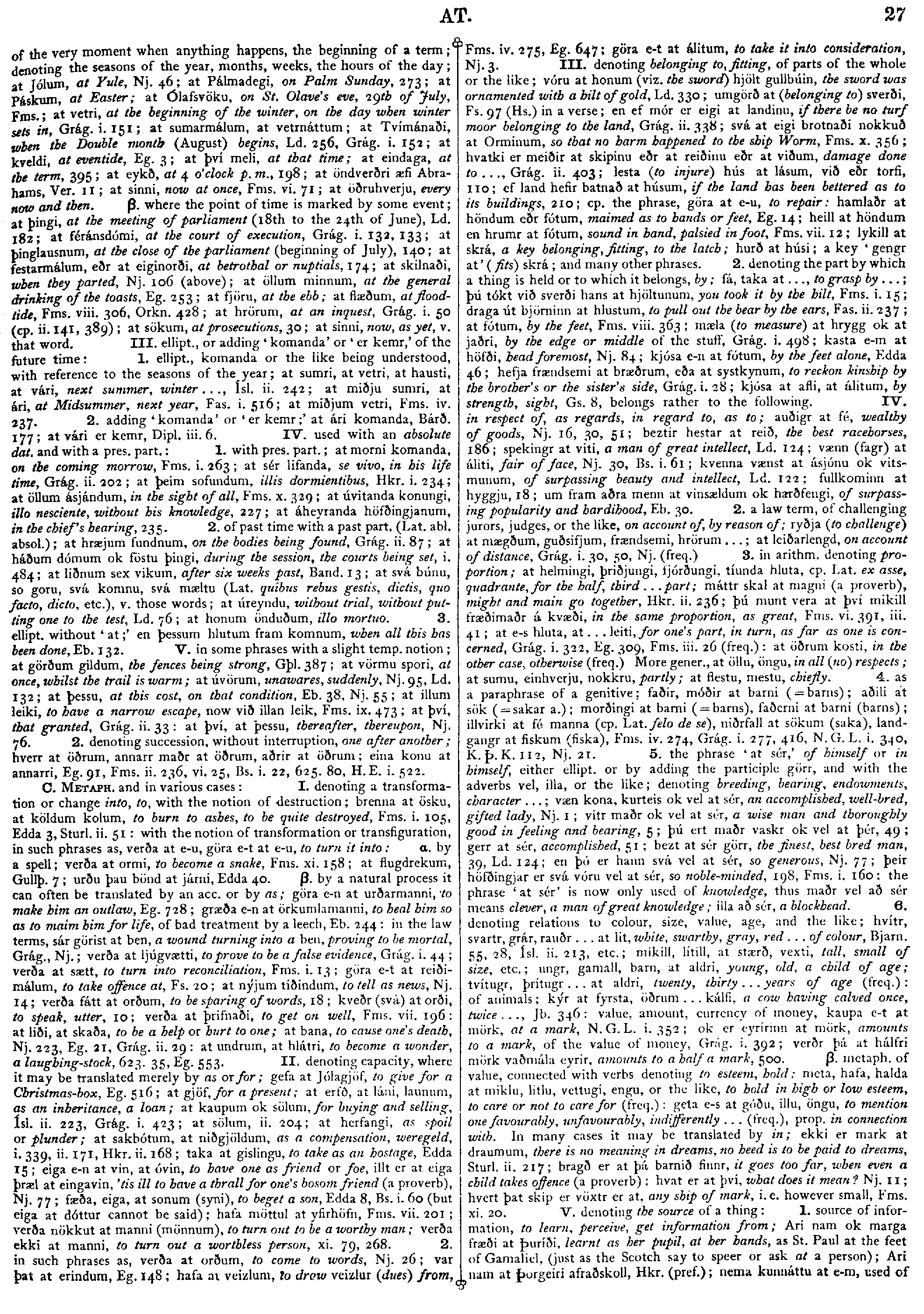
C.
METAPH.
and
in
various
cases:
I.
denoting
a
transforma-
tion
or
change
into,
to,
with
the
notion
of
destruction;
brenna
at
ösku,
at
köldum
kolum,
to
burn
to
ashes,
to
be
quite
destroyed,
Fms.
i.
105,
Edda
3,
Sturl.
ii.
51:
with
the
notion
of
transformation
or
transfiguration,
in
such
phrases
as,
verða
at
e-u,
göra
e-t
at
e-u,
to
turn
it
into:
a.
by
a
spell;
verða
at
ormi,
to
become
a
snake,
Fms.
xi.
158;
at
flugdrekum,
Gullþ.
7;
urðu
þau
bönd
at
járni,
Edda
40.
P.
by
a
natural
process
it
can
often
be
translated
by
an
acc.
or
by
as;
göra
e-n
at
urðarmanni,
'
t
o
make
him
an
outlaw,
Eg.
728;
græða
e-n
at
orkumlamanni,
to
heal
him
so
as
to
maim
him
for
life,
of
bad
treatment
by
a
leech,
Eb.
244:
in
the
law
terms,
sár
görist
at
ben,
a
wound
turning
into
a
ben,
proving
to
be
mortal,
Grág.,
Nj.;
verða
at
ljúgvætti,
to
prove
to
be
a
false
evidence,
Grág.
i.
44;
verða
at
sætt,
to
turn
into
reconciliation,
Fms.
i.
13;
göra
e-t
at
reiði
málum,
to
take
offence
at,
Fs.
20;
at
nýjum
tíðindum,
to
tell
as
news,
Nj.
14;
verða
fátt
at
orðum,
to
be
sparing
of
words,
18;
kveðr
(svá)
at
orði,
to
speak,
utter,
10;
verða
at
þrifnaði,
to
geton
well,
Fms.
vii.
196:
at
liði,
at
skaða,
to
be
a
help
or
hurt
to
one;
at
bana,
to
cause
one's
death,
Nj.
223,
Eg.
21,
Grág.
ii.
29:
at
undrum,
at
hlátri,
to
become
a
wonder,
a
laughing-stock,
623.
35,
Eg.
553.
II.
denoting
capacity,
where
it
may
be
translated
merely
by
as
or
for;
gefa
at
Jólagjöf,
to
give
for
a
Christmas-box,
Eg.
516;
at
gjöf,
for
a
present;
at
erfð,
at
láni,
launum,
as
an
inheritance,
a
loan;
at
kaupum
ok
sökum,
for
buying
and
selling,
Ísl.
ii.
223,
Grág.
i.
423;
at
solum,
ii.
204;
at
herfangi,
as
spoil
or
plunder;
at
sakbótum,
at
niðgjöldum,
as
a
compensation,
weregeld,
i.
339,
ii.
171,
Hkr.
ii.
168;
taka
at
gíslingu,
to
take
as
an
hostage,
Edda
15;
eiga
e-n
at
vin,
at
óvin,
to
have
one
as
friend
or
foe,
illt
er
at
eiga
þræl
at
eingavin,
'tis
ill
to
have
a
thrall
for
one's
bosom
friend
(a
proverb),
Nj.
77;
fæða,
eiga,
at
sonum
(syni),
to
beget
a
son,
Edda
8,
Bs.
i.
60
(but
eiga
at
dóttur
cannot
be
said);
hafa
möttul
at
yfirhöfn,
Fms.
vii.
201;
verða
nökkut
at
manni
(mönnum),
to
turn
out
to
be
a
worthy
man;
verða
ekki
at
manni,
to
turn
out
a
worthless
person,
xi.
79,
268.
2.
in
such
phrases
as,
verða
at
orðum,
to
come
towards,
Nj.
26;
var
þat
at
erindum,
Eg.
148;
hafa
at
veizlum,
to
draw
veizlur
(dues)
from,
'Fms.
iv.
275,
Eg.
647;
gora
e-t
at
álitum,
to
take
it
into
consideration,
Nj-3.
III.
denoting
belonging
to,
fitting,
of
parts
of
the
whole
or
the
like;
vóru
at
honum
(viz.
the
sword)
hjölt
gullbúin,
the
sword
was
ornamented
with
a
hilt
of
gold,
Ld.
330;
umgörð
at
(belonging
to)
sverði,
Fs.
97
(Hs.)
in
a
verse;
en
ef
mór
er
eigi
at
landinu,
if
there
be
no
turf
moor
belonging
to
the
land,
Grág.
ii.
338;
svá
at
eigi
brotnaði
nokkuð
at
Orminum,
so
that
no
harm
happened
to
the
ship
Worm,
Fms.
x.
356;
hvatki
er
meiðir
at
skipinu
eðr
at
reiðinu
eðr
at
viðum,
damage
done
t
o
...,
Grág.
ii.
403;
lesta
(to
injure)
hús
at
lásum,
við
eðr
torfi,
110;
ef
land
hefir
batnað
at
húsum,
if
the
land
has
been
bettered
as
to
its
buildings,
210;
cp.
the
phrase,
göra
at
e-u,
to
repair:
hamlaðr
at
höndum
eðr
fótum,
maimed
as
to
hands
or
feet,
Eg.
14;
heill
at
höndum
en
hrumr
at
fótum,
sound
in
band,
palsied
in
foot,
Fms.
vii.
12;
lykill
at
skrá,
a
key
belonging,
fitting,
to
the
latch;
hurð
at
húsi;
a
key
'gengr
at'
(fits)
skrá;
and
many
other
phrases.
2.
denoting
the
part
by
which
a
thing
is
held
or
to
which
it
belongs,
by;
fá,
taka
at...,
to
grasp
by
...;
þú
tókt
við
sverði
hans
at
hjöltunum,
you
took
it
by
the
bill,
Fms.
i.
15;
draga
út
björninn
at
hlustum,
to
pull
out
the
bear
by
the
ears,
Fas.
ii.
237;
at
fótum,
by
the
feet,
Fms.
viii.
363;
mæla
(to
measure)
at
hrygg
ok
at
jaðri,
by
the
edge
or
middle
of
the
stuff,
Grág.
i.
498;
kasta
e-m
at
höfði,
head
foremost,
Nj.
84;
kjósa
e-n
at
fótum,
by
the
feet
alone,
Edda
46;
hefja
frændsemi
at
bræðrum,
eða
at
systkynum,
to
reckon
kinship
by
the
brother's
or
the
sister's
side,
Grág.
i.
28;
kjósa
at
afli,
at
álitum,
by
strength,
sight,
Gs.
8,
belongs
rather
to
the
following.
IV.
in
respect
of,
as
regards,
in
regard
to,
as
to;
auðigr
at
fé,
wealthy
of
goods,
Nj.
16,
30,
51;
beztir
hestar
at
reið,
the
best
racehorses,
186;
spekingr
at
viti,
a
man
of
great
intellect,
Ld.
124;
vænn
(fagr)
at
áliti,
fair
of
face,
Nj.
30,
Bs.
i.
61;
kvenna
vænst
at
ásjónu
ok
vits
munum,
of
surpassing
beauty
and
intellect,
Ld.
122;
fullkominn
at
hyggju,
18;
um
fram
aðra
menn
at
vinsældum
ok
harðfengi,
of
surpass-
ing
popularity
and
hardihood,
Eb.
30.
2.
a
law
term,
of
challenging
jurors,
judges,
or
the
like,
on
account
of,
by
reason
of;
ryðja
(to
challenge)
at
mægðum,
guðsifjum,
frændsemi,
hrörum
...;
at
leiðarlengd,
on
account
of
distance,
Grág.
i.
30,
50,
Nj.
(freq.)
3.
in
arithm.
denoting
pro
portion;
at
helmingi,
þriðjungi,
fjórðungi,
tíunda
hluta,
cp.
Lat.
ex
asse,
quadrante,
for
the
half,
third...
part;
máttr
skal
at
magni
(a
proverb),
might
and
main
go
together,
Hkr.
ii.
236;
þú
munt
vera
at
því
mikill
fræðimaðr
á
kvæði,
in
the
same
proportion,
as
great,
Fms.
vi.
391,
iii.
41;
at
e-s
hluta,
at...
leiti,
for
one's
part,
in
turn,
as
far
as
one
is
con
cerned,
Grág.
i.
322,
Eg.
309,
Fms.
iii.
26
(freq.):
at
öðrum
kosti,
in
the
other
case,
otherwise
(freq.)
More
gener.,
at
öllu,
öngu,
in
all
(no)
respects;
at
sumu,
einhverju,
nokkru,
partly;
at
flestu,
mestu,
chiefly.
4.
as
a
paraphrase
of
a
genitive;
faðir,
móðir
at
barni
(=
barns);
aðili
at
sök
(=
sakar
a.);
morðingi
at
barni
(=
barns),
faðerni
at
barni
(barns);
illvirki
at
fé
manna
(cp.
Lat.
felo
de
se),
niðrfall
at
sökum
(saka),
land
gangr
at
fiskum
(fiska),
Fms.
iv.
274,
Grág.
i.
277,
416,
N.
G.
L.
i.
340,
K.
Þ.
K.
112,
Nj.
21.
5.
the
phrase
'at
sér,'
of
himself
or
in
himself,
either
ellipt.
or
by
adding
the
participle
görr,
and
with
the
adverbs
vel,
ilia,
or
the
like;
denoting
breeding,
bearing,
endowments,
character
...;
væn
kona,
kurteis
ok
vel
at
sér,
an
accomplished,
well-bred,
gifted
lady,
Nj.
I;
vitr
maðr
ok
vel
at
sér,
a
wise
man
and
thoroughly
good
in
feeling
and
bearing,
5;
þú
ert
maðr
vaskr
ok
vel
at
þér,
49;
gerr
at
sér,
accomplished,
51;
bezt
at
sér
görr,
the
finest,
best
bred
man,
39,
Ld.
124;
en
þó
er
hann
svá
vel
at
sér,
so
generous,
Nj.
77;
þeir
höfðingjar
er
svá
vóru
vel
at
sér,
so
noble-minded,
198,
Fms.
i.
160:
the
phrase
'at
sér'
is
now
only
used
of
knowledge,
thus
maðr
vel
að
sér
means
clever,
a
man
of
great
knowledge;
illa
að
sér,
a
blockhead.
6.
denoting
relations
to
colour,
size,
value,
age,
and
the
like;
hvitr,
svartr,
grár,
rauðr
...
at
lit,
white,
swarthy,
gray,
red
...
of
colour,
Bjarn.
55,
28,
Ísl.
ii.
213,
etc.;
mikill,
litill,
at
stærð,
vexti,
tall,
small
of
size,
etc.;
ungr,
gamall,
barn,
at
aldri,
young,
old,
a
child
of
age;
tvítugr,
þrítugr
...
at
aldri,
twenty,
thirty
...
years
of
age
(freq.):
of
animals;
kyr
at
fyrsta,
öðrum
...
kálfi,
a
cow
having
calved
once,
twice...,
Jb.
346:
value,
amount,
currency
of
money,
kaupa
e-t
at
mörk,
at
a
mark,
N.
G.
L.
1.
352;
ok
er
eyririnn
at
mörk,
amounts
to
a
mark,
of
the
value
of
money,
Grág.
i.
392;
verðr
þá
at
hálfri
murk
vaðmála
eyrir,
amounts
to
a
half
a
mark,
500.
.
metaph.
of
value,
connected
with
verbs
denoting
to
esteem,
hold;
meta,
hafa,
halda
at
miklu,
litlu,
vettugi,
engu,
or
the
like,
to
hold
in
high
or
low
esteem,
to
care
or
not
to
care
for
(freq.):
geta
e-s
at
góðu,
illu,
öngu,
to
mention
one
favourably,
unfavourably,
indifferently
...
(freq.),
prop,
in
connection
with.
In
many
cases
it
may
be
translated
by
in;
ekki
er
mark
at
draumum,
there
is
no
meaning
in
dreams,
no
heed
is
to
be
paid
to
dreams,
Sturl.
ii.
217;
bragð
er
at
þá
barnið
finnr,
it
goes
too
far,
when
even
a
child
takes
offence
(a
proverb):
hvat
er
at
því,
what
does
it
mean?
Nj.
11;
hvert
þat
skip
er
vöxtr
er
at,
any
ship
of
mark,
i.
e.
however
small,
Fms.
xi.
2O.
V.
denoting
the
source
of
a
thing:
1.
source
of
infor
mation,
to
learn,
perceive,
get
information
from;
Ari
nam
ok
marga
fræði
at
Þuríði,
learnt
as
her
pupil,
at
her
hands,
as
St.
Paul
at
the
feet
of
Gamaliel,
(just
as
the
Scotch
say
to
speer
or
ask
at
a
person);
Ari
nam
at
Þorgeiri
afraðskoll,
Hkr.
(pref.);
nema
kunnáttu
at
e-m,
used
of
|
Source: Cleasby/Vigfusson, page b0036, entry 26 View original page image as: [TIFF] [PNG] [View previous entry] [View next entry] |
[Comment on this entry] [View comments] |
The following entry has been hand-corrected once. |
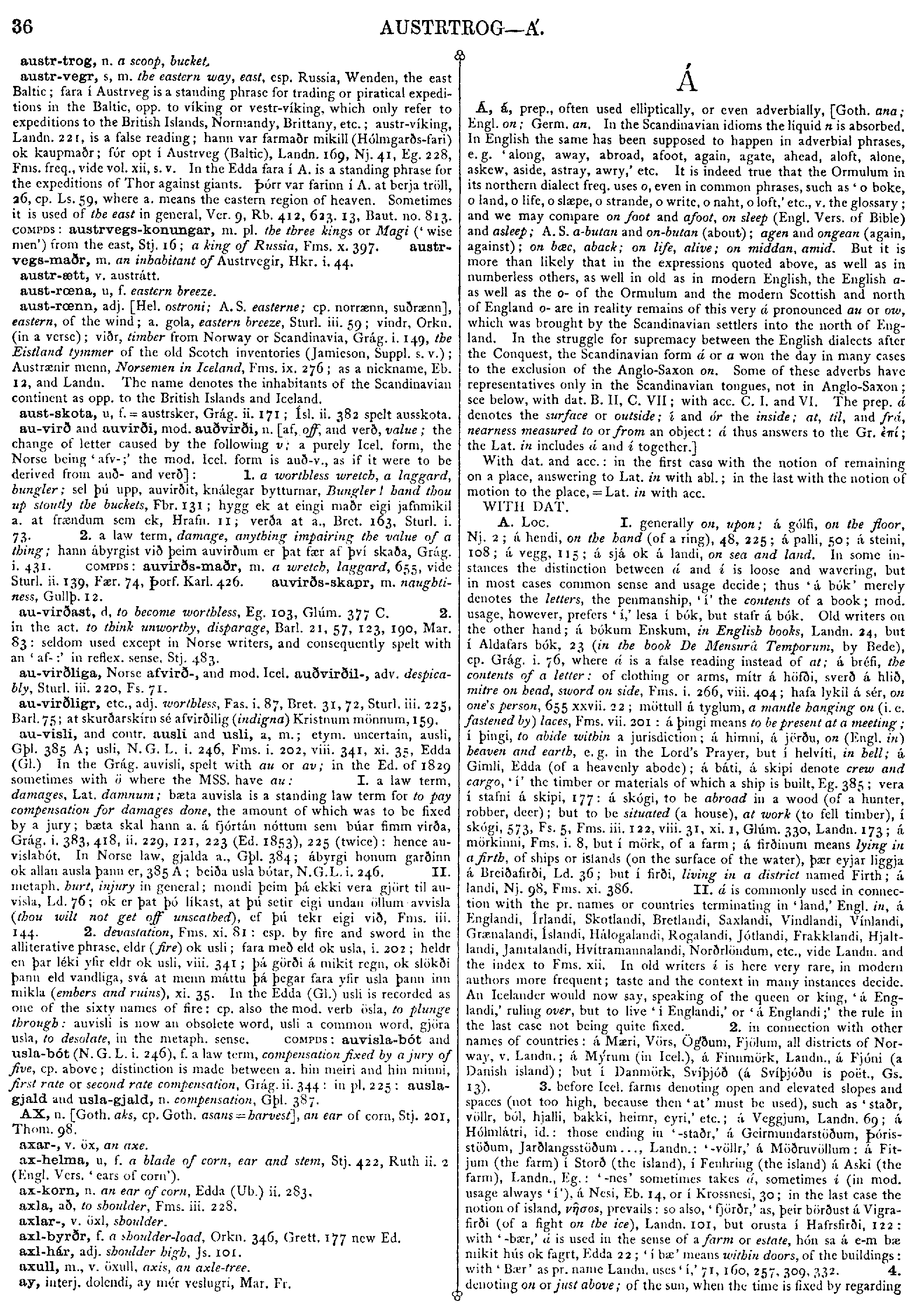
A. Loc. I. generally on, upon; á gólfi, on the floor, Nj. 2; á hendi, on the hand (of a ring), 48, 225; á palli, 50; á steini, 108; á vegg, 115; á sjá ok á landi, on sea and land. In some instances the distinction between d and i is loose and wavering, but in most cases common sense and usage decide; thus 'á bók' merely denotes the letters, the penmanship, 'í' the contents of a book; mod. usage, however, prefers 'í,' lesa í bók, but stafr á bók. Old writers on the other hand; á bókum Enskum, in English books, Landn. 24, but í Aldafars bók, 23 (in the book De Mensurâ Temporum, by Bede), cp. Grág. i. 76, where á is a false reading instead of at; á bréfi, the contents of a letter: of clothing or arms, mítr á höfði, sverð á hlið, mitre on head, sword on side, Fms. i. 266, viii. 404; hafa lykil á sér, on one's person, 655 xxvii. 22; möttull á tyglum, a mantle hanging on (i.e. fastened by) laces, Fms. vii. 201: á þingi means to be present at a meeting; í þingi, to abide within a jurisdiction; á himni, á jörðu, on (Engl. in) heaven and earth, e. g. in the Lord's Prayer, but í helviti, in hell; á Gimli, Edda (of a heavenly abode); á báti, á skipi denote crew and cargo, ' í' the timber or materials of which a ship is built, Eg. 385; vera í stafni á skipi, 177: á skógi, to be abroad in a wood (of a hunter, robber, deer); but to be situated (a house), at work (to fell timber), í skógi, 573, Fs. 5, Fms. iii. 122, viii. 31, xi. 1, Glúm. 330, Landn. 173; á mörkinni, Fms. i. 8, but í mörk, of a farm; á firðinum means lying in a firth, of ships or islands (on the surface of the water), þær eyjar liggja á Breiðafirði, Ld. 36; but í firði, living in a district named Firth; á landi, Nj. 98, Fms. xi. 386. II. á is commonly used in connection with the pr. names or countries terminating in 'land,' Engl. in, á Englandi, Írlandi, Skotlandi, Bretlandi, Saxlandi, Vindlandi, Vínlandi, Grænalandi, Íslandi, Hálogalandi, Rogalandi, Jótlandi, Frakklandi, Hjaltlandi, Jamtalandi, Hvítramannalandi, Norðrlöndum, etc., vide Landn. and the index to Fms. xii. In old writers í is here very rare, in modern authors more frequent; taste and the context in many instances decide. An Icelander would now say, speaking of the queen or king, 'á Eng- landi,' ruling over, but to live 'í Englandi,' or 'á Englandi;' the rule in the last case not being quite fixed. 2. in connection with other names of countries: á Mæri, Vörs, Ögðum, Fjölum, all districts of Norway, v. Landn.; á Mýrum (in Icel.), á Finnmörk, Landn., á Fjóni (a Danish island); but í Danmörk, Svíþjóð (á Svíþjóðu is poët., Gs. 13). 3. before Icel. farms denoting open and elevated slopes and spaces (not too high, because then 'at' must be used), such as 'staðr, völlr, ból, hjalli, bakki, heimr, eyri,' etc.; á Veggjum, Landn. 69; á Hólmlátri, id.: those ending in '-staðr, ' á Geirmundarstöðum, Þórisstöðum, Jarðlangsstöðum..., Landn.: '-völlr,' á Möðruvöllum: á Fitjum (the farm) í Storð (the island), í Fenhring (the island) á Aski (the farm), Landn., Eg.: '-nes' sometimes takes á, sometimes í (in mod. usage always 'í'), á Nesi, Eb. 14, or í Krossnesi, 30; in the last case the notion of island, GREEK, prevails: so also, 'fjörðr,' as, þeir börðust á Vigrafirði (of a fight o n the ice), Landn. 101, but orusta í Hafrsfirði, 122: with '-bær,' á is used in the sense of a farm or estate, hón sa á e-m bæ mikit hús ok fagrt, Edda 22; 'í bæ' means within doors, of the buildings: with 'Bær' as pr. name Landn. uses 'í,' 71, 160, 257, 309, 332. 4. denoting on or just above; of the sun, when the time is fixed by regarding
|
Source: Cleasby/Vigfusson, page b0038, entry 3 View original page image as: [TIFF] [PNG] [View previous entry] [View next entry] |
[Comment on this entry] [View comments] |
The following entry has been hand-corrected once. |
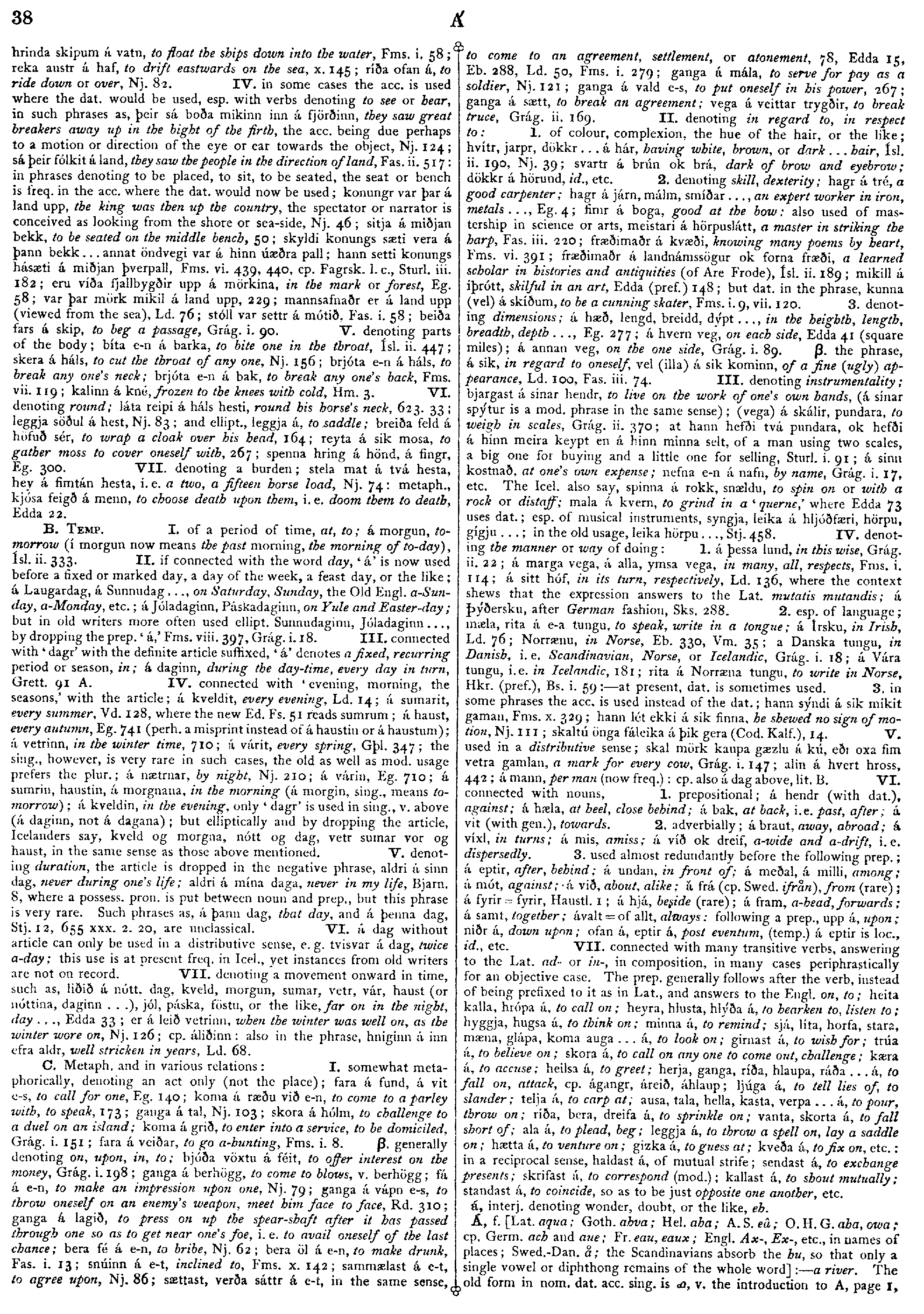
C.
Metaph.
and
in
various
relations:
I.
somewhat
metaphorically,
denoting
an
act
only
(not
the
place);
fara
á
fund,
á
vit
e-s,
to
call
for
one,
Eg.
140;
koma
á
ræðu
við
e-n,
to
come
to
a
parley
with,
to
speak,
173;
ganga
á
tal,
Nj.
103;
skora
á
hólm,
to
challenge
to
a
duel
on
an
island;
koma
á
grið,
to
enter
into
a
service,
to
be
domiciled,
Grág.
i.
151;
fara
á
veiðar,
to
go
a-hunting,
Fms.
i.
8.
.
generally
denoting
on,
upon,
in,
to;
bjóða
vöxtu
á
féit,
to
offer
interest
on
the
money,
Grág.
i.
198;
ganga
á
berhögg,
to
come
to
blows,
v.
berhögg;
fá
á
e-n,
to
make
an
impression
upon
one,
Nj.
79;
ganga
á
vápn
e-s,
to
throw
oneself
on
an
enemy's
weapon,
meet
him
face
to
face,
Rd.
310;
ganga
á
lagið,
to
press
on
up
the
spear-shaft
after
it
has
passed
through
one
so
as
to
get
near
one's
foe,
i.e.
to
avail
oneself
of
the
last
chance;
bera
fé
á
e-n,
to
bribe,
Nj.
62;
bera
öl
á
e-n,
to
make
drunk,
Fas.
i.
13;
snúinn
á
e-t,
inclined
to,
Fms.
x.
142;
sammælast
á
e-t,
to
agree
upon,
Nj.
86;
sættast,
verða
sáttr
á
e-t,
in
the
same
sense,
to
come
to
an
agreement,
settlement,
or
atonement,
78,
Edda
15,
Eb.
288,
Ld.
50,
Fms.
i.
279;
ganga
á
mála,
to
serve
for
pay
as
a
soldier,
Nj.
121;
ganga
á
vald
e-s,
to
put
oneself
in
his
power,
267;
ganga
á
sætt,
to
break
an
agreement;
vega
á
veittar
trygðir,
to
break
truce,
Grág.
ii.
169.
II.
denoting
in
regard
to,
in
respect
to:
1.
of
colour,
complexion,
the
hue
of
the
hair,
or
the
like;
hvítr,
jarpr,
dökkr
...
á
hár,
having
white,
brown,
or
dark
...
hair,
Ísl.
ii.
190,
Nj.
39;
svartr
á
brún
ok
brá,
dark
of
brow
and
eyebrow;
dökkr
á
hörund,
id.,
etc.
2.
denoting
skill,
dexterity;
hagr
á
tré,
a
good
carpenter;
hagr
á
járn,
málm,
smíðar
...,
an
expert
worker
in
iron,
metals
...,
Eg.
4;
fimr
á
boga,
good
at
the
bow:
also
used
of
mastership
in
science
or
arts,
meistari
á
hörpuslátt,
a
master
in
striking
the
harp,
Fas.
iii.
220;
fræðimaðr
á
kvæði,
knowing
many
poems
by
heart,
Fms.
vi.
391;
fræðimaðr
á
landnámssögur
ok
forna
fræði,
a
learned
scholar
in
histories
and
antiquities
(of
Are
Frode),
Ísl.
ii.
189;
mikill
á
íþrótt,
skilful
in
an
art,
Edda
(pref.)
148;
but
dat.
in
the
phrase,
kunna
(vel)
á
skíðum,
to
be
a
cunning
skater,
Fms.
i.
9,
vii.
120.
3.
denoting
dimensions;
á
hæð,
lengd,
breidd,
dýpt
...,
in
the
heighth,
length,
breadth,
depth
...,
Eg.
277;
á
hvern
veg,
on
each
side,
Edda
41
(square
miles);
á
annan
veg,
on
the
one
side,
Grág.
i.
89.
.
the
phrase,
á
sik,
in
regard
to
oneself,
vel
(illa)
á
sik
kominn,
of
a
fine
(ugly)
appearance,
Ld.
100,
Fas.
iii.
74.
III.
denoting
instrumentality;
bjargast
á
sínar
hendr,
to
live
on
the
work
of
one's
own
hands,
(á
sínar
spýtur
is
a
mod.
phrase
in
the
same
sense);
(vega)
á
skálir,
pundara,
to
weigh
in
scales,
Grág.
ii.
370;
at
hann
hefði
tvá
pundara,
ok
hefði
á
hinn
meira
keypt
en
á
hinn
minna
selt,
of
a
man
using
two
scales,
a
big
one
for
buying
and
a
little
one
for
selling,
Sturl.
i.
91;
á
sinn
kostnað,
at
one's
own
expense;
nefna
e-n
á
nafn,
by
name,
Grág.
i.
17,
etc.
The
Icel.
also
say,
spinna
á
rokk,
snældu,
to
spin
on
or
with
a
rock
or
distaff;
mala
á
kvern,
to
grind
in
a
'querne,'
where
Edda
73
uses
dat.;
esp.
of
musical
instruments,
syngja,
leika
á
hljóðfæri,
hörpu,
gígju
...;
in
the
old
usage,
leika
hörpu
...,
Stj.
458.
IV.
denoting
the
manner
or
way
of
doing:
1.
á
þessa
lund,
in
this
wise,
Grág.
ii.
22;
á
marga
vega,
á
alla,
ymsa
vega,
in
many,
all,
respects,
Fms.
i.
114;
á
sitt
hóf,
in
its
turn,
respectively,
Ld.
136,
where
the
context
shews
that
the
expression
answers
to
the
Lat.
mutatis
mutandis;
á
Þýðersku,
after
German
fashion,
Sks.
288.
2.
esp.
of
language;
mæla,
rita
á
e-a
tungu,
to
speak,
write
in
a
tongue;
á
Írsku,
in
Irish,
Ld.
76;
Norrænu,
in
Norse,
Eb.
330,
Vm.
35;
a
Danska
tungu,
in
Danish,
i.e.
Scandinavian,
Norse,
or
Icelandic,
Grág.
i.
18;
á
Vára
tungu,
i.e.
in
Icelandic,
181;
rita
á
Norræna
tungu,
to
write
in
Norse,
Hkr.
(pref.),
Bs.
i.
59
:--
at
present,
dat.
is
sometimes
used.
3.
in
some
phrases
the
acc.
is
used
instead
of
the
dat.;
hann
sýndi
á
sik
mikit
gaman,
Fms.
x.
329;
hann
lét
ekki
á
sik
finna,
he
shewed
no
sign
of
motion,
Nj.
111;
skaltú
önga
fáleika
á
þik
gera
(Cod.
Kalf.),
14.
V.
used
in
a
distributive
sense;
skal
mörk
kaupa
gæzlu
á
kú,
eðr
oxa
fim
vetra
gamlan,
a
mark
for
every
cow,
Grág.
i.
147;
alin
á
hvert
hross,
442;
á
mann,
per
man
(now
freq.):
cp.
also
á
dag
above,
lit.
B.
VI.
connected
with
nouns,
1.
prepositional;
á
hendr
(with
dat.),
against;
á
hæla,
at
heel,
close
behind;
á
bak,
at
back,
i.e.
past,
after;
á
vit
(with
gen.),
towards.
2.
adverbially;
á
braut,
away,
abroad;
á
víxl,
in
turns;
á
mis,
amiss;
á
víð
ok
dreif,
a-wide
and
a-drift,
i.e.
dispersedly.
3.
used
almost
redundantly
before
the
following
prep.;
á
eptir,
after,
behind;
á
undan,
in
front
of;
á
meðal,
á
milli,
among;
á
mót,
against;
á
við,
about,
alike;
á
frá
(cp.
Swed.
ifrån),
from
(rare);
á
fyrir
=
fyrir,
Haustl.
1;
á
hjá,
beside
(rare);
á
fram,
a-head,
forwards;
á
samt,
together;
ávalt
=
of
allt,
always:
following
a
prep.,
upp
á,
upon;
niðr
á,
down
upon;
ofan
á,
eptir
á,
post
eventum,
(temp.)
á
eptir
is
loc.,
id.,
etc.
VII.
connected
with
many
transitive
verbs,
answering
to
the
Lat.
ad-
or
in-,
in
composition,
in
many
cases
periphrastically
for
an
objective
case.
The
prep.
generally
follows
after
the
verb,
instead
of
being
prefixed
to
it
as
in
Lat.,
and
answers
to
the
Engl.
on,
to;
heita
kalla,
hrópa
á,
to
call
on;
heyra,
hlusta,
hlyða
á,
to
hearken
to,
listen
to;
hyggja,
hugsa
á,
to
think
on;
minna
á,
to
remind;
sjá,
líta,
horfa,
stara,
mæna,
glápa,
koma
auga
...
á,
to
look
on;
girnast
á,
to
wish
for;
trúa
á,
to
believe
on;
skora
á,
to
call
on
any
one
to
come
out,
challenge;
kæra
á,
to
accuse;
heilsa
á,
to
greet;
herja,
ganga,
ríða,
hlaupa,
ráða
...
á,
to
fall
on,
attack,
cp.
ágangr,
áreið,
áhlaup;
ljúga
á,
to
tell
lies
of,
to
slander;
telja
á,
to
carp
at;
ausa,
tala,
hella,
kasta,
verpa
...
á,
to
pour,
throw
on;
ríða,
bera,
dreifa
á,
to
sprinkle
on;
vanta,
skorta
á,
to
fall
short
of;
ala
á,
to
plead,
beg;
leggja
á,
to
throw
a
spell
on,
lay
a
saddle
on;
hætta
á,
to
venture
on;
gizka
á,
to
guess
at;
kveða
á,
to
fix
on,
etc.:
in
a
reciprocal
sense,
haldast
á,
of
mutual
strife;
sendast
á,
to
exchange
presents;
skrifast
á,
to
correspond
(mod.);
kallast
á,
to
shout
mutually;
standast
á,
to
coincide,
so
as
to
be
just
opposite
one
another,
etc.
|
Source: Cleasby/Vigfusson, page b0039, entry 27 View original page image as: [TIFF] [PNG] [View previous entry] [View next entry] |
[Comment on this entry] [View comments] |
The following entry has not been hand-corrected. However, the page is reserved and someone is correcting it. |
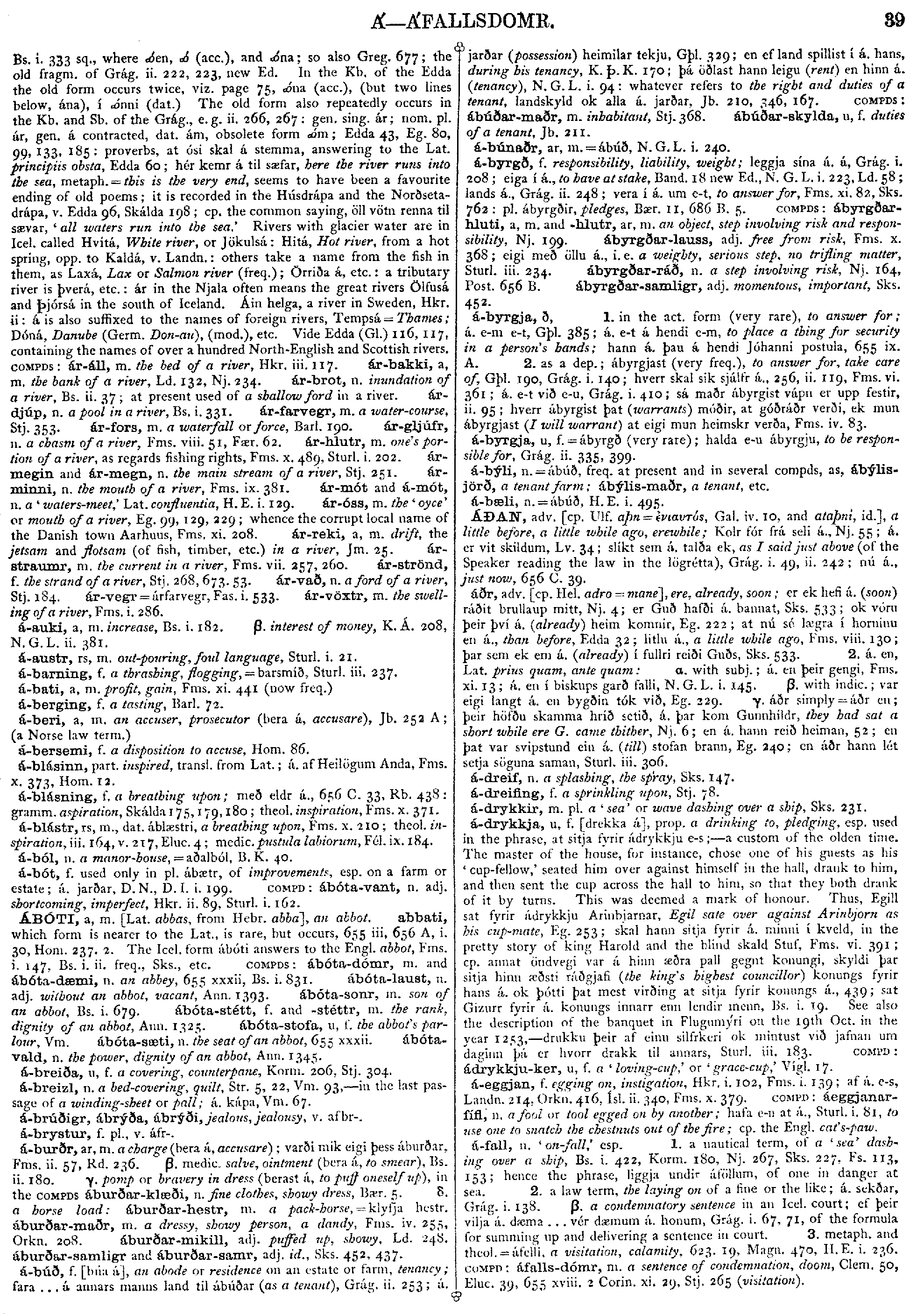
ÁÐAN, adv. [cp. Ulf. apn = ivtavrós, Gal. iv. 10, and atapni, id.], a little before, a little while ago, erewhile; Kolr for frá seli á., Nj. 55; á. er vit skildum, Lv. 34; slíkt sem á. talða ek, a s 7 said just above (of the Speaker reading the law in the lögrétta), Grág. i. 49, ii. 242; nu a., just now, 656 G. 39.
|
Source: Cleasby/Vigfusson, page b0047, entry 20 View original page image as: [TIFF] [PNG] [View previous entry] [View next entry] |
[Comment on this entry] [View comments] |
The following entry has been hand-corrected once. |
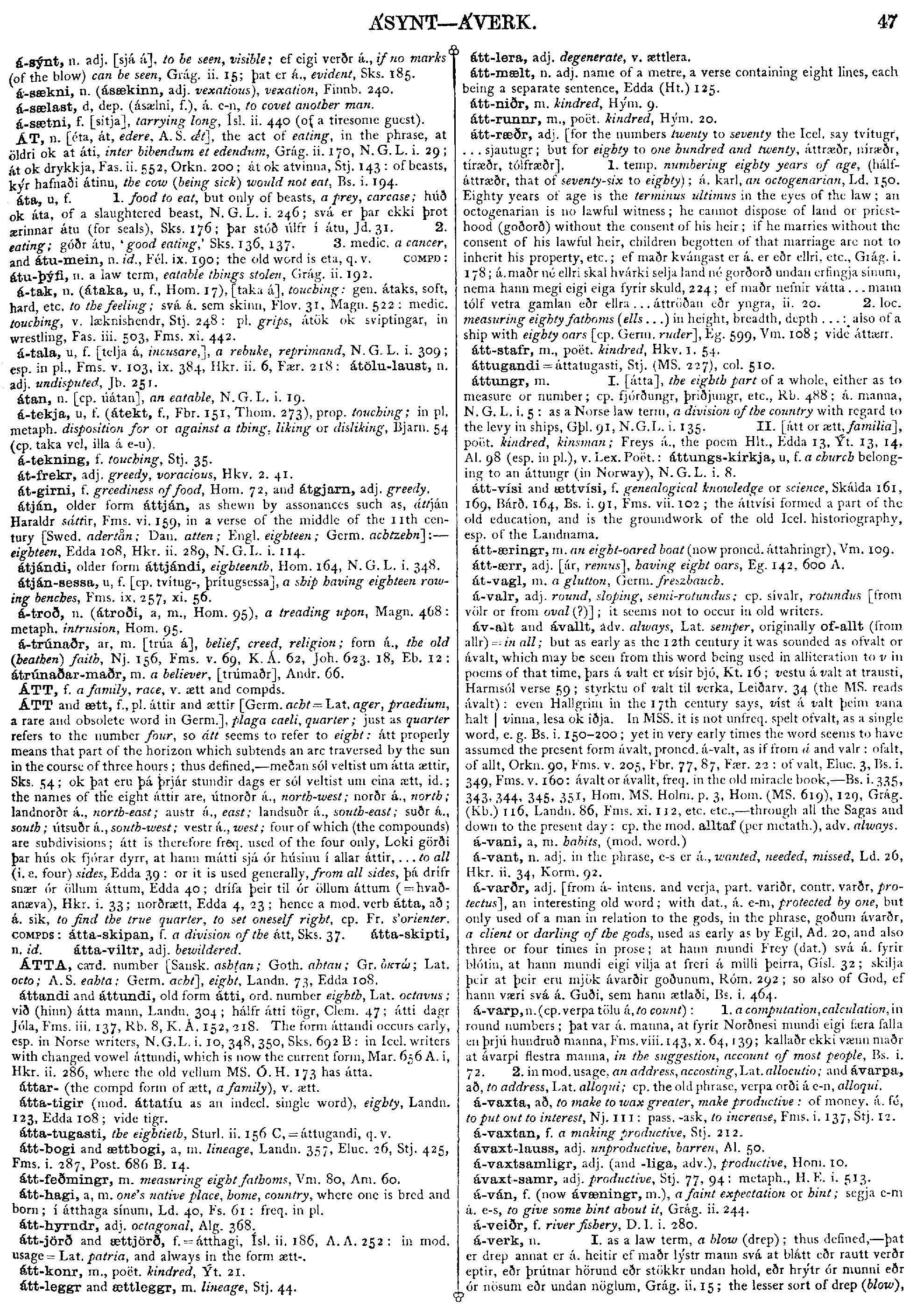
ÁTT and ætt, f., pl. áttir and ættir [Germ. acht = Lat. ager, praedium, a rare and obsolete word in Germ.], plaga caeli, quarter; just as quarter refers to the number four, so átt seems to refer to eight: átt properly means that part of the horizon which subtends an arc traversed by the sun in the course of three hours; thus defined, -- meðan sól veltist urn átta ættir, Sks. 54; ok þat eru þá þrjár stundir dags er sól veltist um eina sett, id.; the names of the eight áttir are, útnorðr á., north-west; norðr á., north; landnorðr á., north-east; austr a., east; landsuðr á., south-east; suðr á., south; útsuðr á., south-west; vestr á., west; four of which (the compounds) are subdivisions; átt is therefore freq. used of the four only, Loki görði þar hús ok fjórar dyrr, at hann mátti sjá ór húsinu í allar áttir, ... to all (i. e. four) sides, Edda 39: or it is used generally, from all sides, þá drífr snær ór öllum áttum, Edda 40; drífa þeir til ór öllum áttum (= hvað- anæva), Hkr. i. 33; norðrætt, Edda 4, 23; hence a mod. verb átta, að; á. sik, to find the true quarter, to set oneself right, cp. Fr. s'orienter. COMPDS: átta-skipan, f. a division of the átt, Sks. 37. átta-skipti, n. id. átta-viltr, adj. bewildered.
|
Source: Cleasby/Vigfusson, page b0049, entry 4 View original page image as: [TIFF] [PNG] [View previous entry] [View next entry] |
[Comment on this entry] [View comments] |
The following entry has been hand-corrected once. |
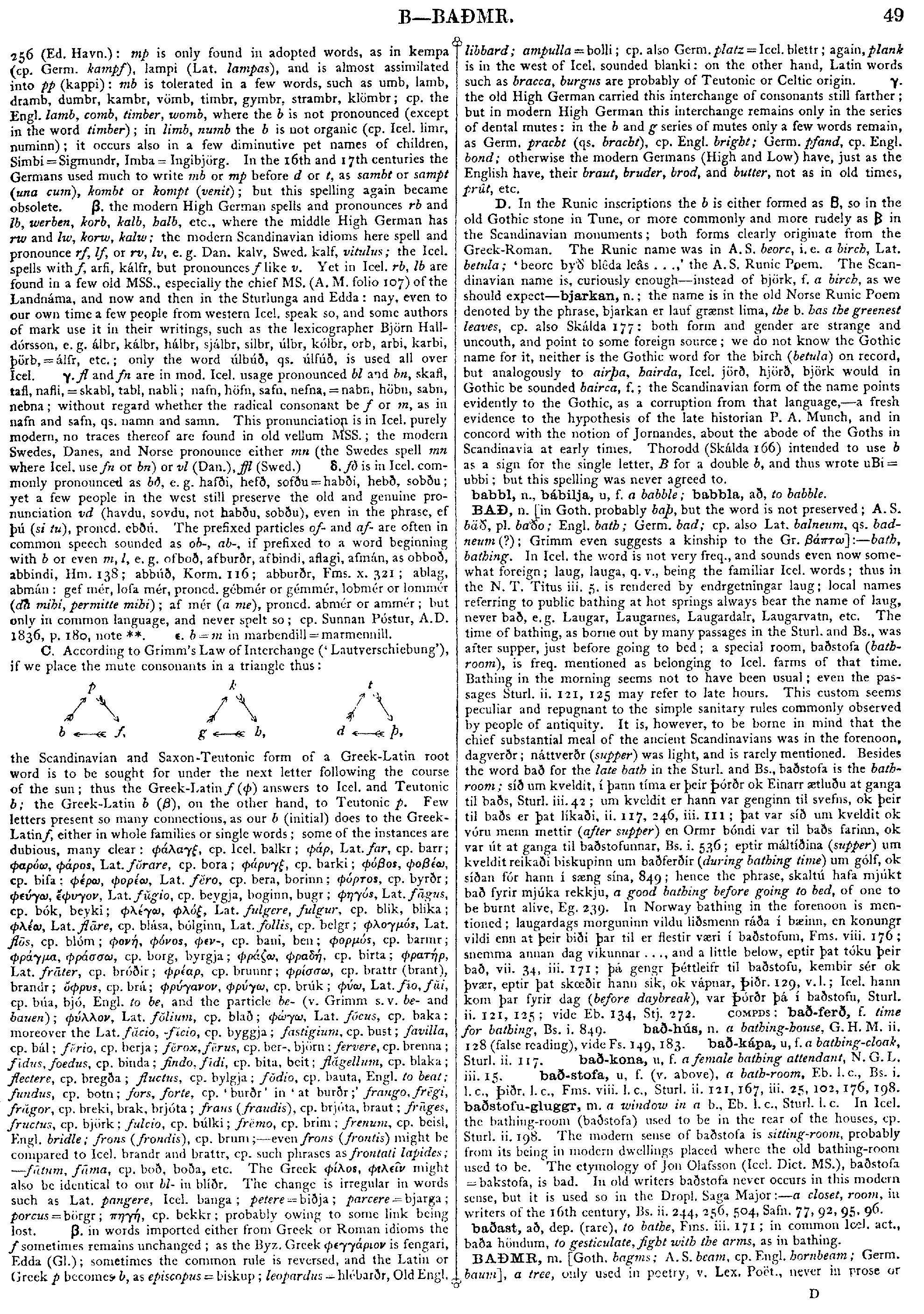
the
Scandinavian
and
Saxon-Teutonic
form
of
a
Greek-Latin
root
word
is
to
be
sought
for
under
the
next
letter
following
the
course
of
the
sun;
thus
the
Greek-Latin
f
( )
answers
to
Icel.
and
Teutonic
b;
the
Greek-Latin
b
(),
on
the
other
hand,
to
Teutonic
p.
Few
letters
present
so
many
connections,
as
our
b
(initial)
does
to
the
Greek-Latin
f,
either
in
whole
families
or
single
words;
some
of
the
instances
are
dubious,
many
clear:
GREEK,
cp.
Icel.
balkr;
GREEK,
Lat.
far,
cp.
barr;
GREEK,
GREEK,
Lat.
f
)
answers
to
Icel.
and
Teutonic
b;
the
Greek-Latin
b
(),
on
the
other
hand,
to
Teutonic
p.
Few
letters
present
so
many
connections,
as
our
b
(initial)
does
to
the
Greek-Latin
f,
either
in
whole
families
or
single
words;
some
of
the
instances
are
dubious,
many
clear:
GREEK,
cp.
Icel.
balkr;
GREEK,
Lat.
far,
cp.
barr;
GREEK,
GREEK,
Lat.
f rare,
cp.
bora;
GREEK,
cp.
barki;
GREEK,
GREEK,
cp.
bifa;
GREEK,
GREEK,
Lat.
f
rare,
cp.
bora;
GREEK,
cp.
barki;
GREEK,
GREEK,
cp.
bifa;
GREEK,
GREEK,
Lat.
f ro,
cp.
bera,
borinn;
GREEK,
cp.
byrðr;
GREEK,
GREEK,
Lat.
f
ro,
cp.
bera,
borinn;
GREEK,
cp.
byrðr;
GREEK,
GREEK,
Lat.
f gio,
cp.
beygja,
boginn,
bugr;
GREEK,
Lat.
f
gio,
cp.
beygja,
boginn,
bugr;
GREEK,
Lat.
f gus,
cp.
bók,
beyki;
GREEK,
GREEK,
Lat.
fulgere,
fulgur,
cp.
blik,
blika;
GREEK,
Lat.
flre,
cp.
blása,
bólginn,
Lat.
follis,
cp.
belgr;
GREEK,
Lat.
fl
gus,
cp.
bók,
beyki;
GREEK,
GREEK,
Lat.
fulgere,
fulgur,
cp.
blik,
blika;
GREEK,
Lat.
flre,
cp.
blása,
bólginn,
Lat.
follis,
cp.
belgr;
GREEK,
Lat.
fl s,
cp.
blóm;
GREEK,
GREEK,
GREEK,
cp.
bani,
ben;
GREEK,
cp.
barmr;
GREEK,
GREEK,
cp.
borg,
byrgja;
GREEK,
GREEK,
cp.
birta;
GREEK,
Lat.
frter,
cp.
bróðir;
GREEK,
cp.
brunnr;
GREEK,
cp.
brattr
(brant),
brandr;
GREEK,
cp.
brá;
GREEK,
GREEK,
cp.
brúk;
GREEK,
Lat.
f
s,
cp.
blóm;
GREEK,
GREEK,
GREEK,
cp.
bani,
ben;
GREEK,
cp.
barmr;
GREEK,
GREEK,
cp.
borg,
byrgja;
GREEK,
GREEK,
cp.
birta;
GREEK,
Lat.
frter,
cp.
bróðir;
GREEK,
cp.
brunnr;
GREEK,
cp.
brattr
(brant),
brandr;
GREEK,
cp.
brá;
GREEK,
GREEK,
cp.
brúk;
GREEK,
Lat.
f o,
fi,
cp.
búa,
bjó,
Engl.
to
be,
and
the
particle
be-
(v.
Grimm
s.v.
be-
and
bauen);
GREEK,
Lat.
flium,
cp.
blað;
GREEK,
Lat.
fcus,
cp.
baka:
moreover
the
Lat.
f
o,
fi,
cp.
búa,
bjó,
Engl.
to
be,
and
the
particle
be-
(v.
Grimm
s.v.
be-
and
bauen);
GREEK,
Lat.
flium,
cp.
blað;
GREEK,
Lat.
fcus,
cp.
baka:
moreover
the
Lat.
f cio,
-f
cio,
-f cio,
cp.
byggja;
fastigium,
cp.
bust;
favilla,
cp.
bál;
frio,
cp.
berja;
frox,
frus,
cp.
ber-,
björn;
fervere,
cp.
brenna;
fdus,
foedus,
cp.
binda;
findo,
fdi,
cp.
bíta,
beit;
flgellum,
cp.
blaka;
flectere,
cp.
bregða;
fluctus,
cp.
bylgja;
fdio,
cp.
bauta,
Engl.
to
beat;
fundus,
cp.
botn;
fors,
forte,
cp.
'burðr'
in
'at
burðr;'
frango,
fr
cio,
cp.
byggja;
fastigium,
cp.
bust;
favilla,
cp.
bál;
frio,
cp.
berja;
frox,
frus,
cp.
ber-,
björn;
fervere,
cp.
brenna;
fdus,
foedus,
cp.
binda;
findo,
fdi,
cp.
bíta,
beit;
flgellum,
cp.
blaka;
flectere,
cp.
bregða;
fluctus,
cp.
bylgja;
fdio,
cp.
bauta,
Engl.
to
beat;
fundus,
cp.
botn;
fors,
forte,
cp.
'burðr'
in
'at
burðr;'
frango,
fr gi,
frgor,
cp.
breki,
brak,
brjóta;
fraus
(fraudis),
cp.
brjóta,
braut;
fr
gi,
frgor,
cp.
breki,
brak,
brjóta;
fraus
(fraudis),
cp.
brjóta,
braut;
fr ges,
fructus,
cp.
björk;
fulcio,
cp.
búlki;
frmo,
cp.
brim;
frenum,
cp.
beisl,
Engl.
bridle;
frons
(frondis),
cp.
brum;
--
even
frons
(frontis)
might
be
compared
to
Icel.
brandr
and
brattr,
cp.
such
phrases
as
frontati
lapides;
--
ftum,
fma,
cp.
boð,
boða,
etc.
The
Greek
GREEK,
GREEK
might
also
be
identical
to
our
bl-
in
blíðr.
The
change
is
irregular
in
words
such
as
Lat.
pangere,
Icel.
banga;
petere
=
biðja;
parcere
=
bjarga;
porcus
=
börgr;
GREEK,
cp.
bekkr;
probably
owing
to
some
link
being
lost.
.
in
words
imported
either
from
Greek
or
Roman
idioms
the
f
sometimes
remains
unchanged;
as
the
Byz.
Greek
GREEK
is
fengari,
Edda
(Gl.);
sometimes
the
common
rule
is
reversed,
and
the
Latin
or
Greek
p
becomes
b,
as
episcopus
=
biskup;
leopardus
=
hlébarðr,
Old
Engl.
libbard;
ampulla
=
bolli;
cp.
also
Germ.
platz
=
Icel.
blettr;
again,
plank
is
in
the
west
of
Icel.
sounded
blanki:
on
the
other
hand,
Latin
words
such
as
bracca,
burgus
are
probably
of
Teutonic
or
Celtic
origin.
ges,
fructus,
cp.
björk;
fulcio,
cp.
búlki;
frmo,
cp.
brim;
frenum,
cp.
beisl,
Engl.
bridle;
frons
(frondis),
cp.
brum;
--
even
frons
(frontis)
might
be
compared
to
Icel.
brandr
and
brattr,
cp.
such
phrases
as
frontati
lapides;
--
ftum,
fma,
cp.
boð,
boða,
etc.
The
Greek
GREEK,
GREEK
might
also
be
identical
to
our
bl-
in
blíðr.
The
change
is
irregular
in
words
such
as
Lat.
pangere,
Icel.
banga;
petere
=
biðja;
parcere
=
bjarga;
porcus
=
börgr;
GREEK,
cp.
bekkr;
probably
owing
to
some
link
being
lost.
.
in
words
imported
either
from
Greek
or
Roman
idioms
the
f
sometimes
remains
unchanged;
as
the
Byz.
Greek
GREEK
is
fengari,
Edda
(Gl.);
sometimes
the
common
rule
is
reversed,
and
the
Latin
or
Greek
p
becomes
b,
as
episcopus
=
biskup;
leopardus
=
hlébarðr,
Old
Engl.
libbard;
ampulla
=
bolli;
cp.
also
Germ.
platz
=
Icel.
blettr;
again,
plank
is
in
the
west
of
Icel.
sounded
blanki:
on
the
other
hand,
Latin
words
such
as
bracca,
burgus
are
probably
of
Teutonic
or
Celtic
origin.
 .
the
old
High
German
carried
this
interchange
of
consonants
still
farther;
but
in
modern
High
German
this
interchange
remains
only
in
the
series
of
dental
mutes:
in
the
b
and
g
series
of
mutes
only
a
few
words
remain,
as
Germ.
pracht
(qs.
bracht),
cp.
Engl.
bright;
Germ.
pfand,
cp.
Engl.
bond;
otherwise
the
modern
Germans
(High
and
Low)
have,
just
as
the
English
have,
their
braut,
bruder,
brod,
and
butter,
not
as
in
old
times,
prût,
etc.
.
the
old
High
German
carried
this
interchange
of
consonants
still
farther;
but
in
modern
High
German
this
interchange
remains
only
in
the
series
of
dental
mutes:
in
the
b
and
g
series
of
mutes
only
a
few
words
remain,
as
Germ.
pracht
(qs.
bracht),
cp.
Engl.
bright;
Germ.
pfand,
cp.
Engl.
bond;
otherwise
the
modern
Germans
(High
and
Low)
have,
just
as
the
English
have,
their
braut,
bruder,
brod,
and
butter,
not
as
in
old
times,
prût,
etc.
|
Source: Cleasby/Vigfusson, page b0049, entry 7 View original page image as: [TIFF] [PNG] [View previous entry] [View next entry] |
[Comment on this entry] [View comments] |
The following entry has been hand-corrected once. |
BAÐ, n. [in Goth. probably baþ, but the word is not preserved; A. S. bäð, pl. baðo; Engl. bath; Germ. bad; cp. also Lat. balneum, qs. badneum (?); Grimm even suggests a kinship to the Gr. GREEK] :-- bath, bathing. In Icel. the word is not very freq., and sounds even now somewhat foreign; laug, lauga, q.v., being the familiar Icel. words; thus in the N. T. Titus iii. 5. is rendered by endrgetningar laug; local names referring to public bathing at hot springs always bear the name of laug, never bað, e.g. Laugar, Laugarnes, Laugardalr, Laugarvatn, etc. The time of bathing, as borne out by many passages in the Sturl. and Bs., was after supper, just before going to bed; a special room, baðstofa (bathroom), is freq. mentioned as belonging to Icel. farms of that time. Bathing in the morning seems not to have been usual; even the passages Sturl. ii. 121, 125 may refer to late hours. This custom seems peculiar and repugnant to the simple sanitary rules commonly observed by people of antiquity. It is, however, to be borne in mind that the chief substantial meal of the ancient Scandinavians was in the forenoon, dagverðr; náttverðr (supper) was light, and is rarely mentioned. Besides the word bað for the late bath in the Sturl. and Bs., baðstofa is the bathroom; síð um kveldit, í þann tíma er þeir Þórðr ok Einarr ætluðu at ganga til baðs, Sturl. iii. 42; um kveldit er hann var genginn til svefns, ok þeir til baðs er þat líkaði, ii. 117, 246, iii. 111; þat var síð um kveldit ok vóru menn mettir (after supper) en Ormr bóndi var til baðs farinn, ok var út at ganga til baðstofunnar, Bs. i. 536; eptir máltíðina (supper) um kveldit reikaði biskupinn um baðferðir (during bathing time) um gólf, ok síðan for hann í sæng sína, 849; hence the phrase, skaltú hafa mjúkt bað fyrir mjúka rekkju, a good bathing before going to bed, of one to be burnt alive, Eg. 239. In Norway bathing in the forenoon is mentioned; laugardags morguninn vildu liðsmenn ráða í bæinn, en konungr vildi enn at þeir biði þar til er flestir væri í baðstofum, Fms. viii. 176; snemma annan dag vikunnar ..., and a little below, eptir þat tóku þeir bað, vii. 34, iii. 171; þá gengr Þéttleifr til baðstofu, kembir sér ok þvær, eptir þat skœðir hanu sik, ok vápnar, Þiðr. 129, v.l.; Icel. hann kom þar fyrir dag (before daybreak), var Þórðr þá í baðstofu, Sturl. ii. 121, 125; vide Eb. 134, Stj. 272. COMPDS: bað-ferð, f. time for bathing, Bs. i. 849. bað-hús, n. a bathing-house, G. H. M. ii. 128 (false reading), vide Fs. 149, 183. bað-kápa, u, f. a bathing-cloak, Sturl. ii. 117. bað-kona, u, f. a female bathing attendant, N. G. L. iii. 15. bað-stofa, u, f. (v. above), a bath-room, Eb. l.c., Bs. i. l.c., Þiðr. l.c., Fms. viii. l.c., Sturl. ii. 121, 167, iii. 25, 102, 176, 198. baðstofu-gluggr, m. a window in a b., Eb. l.c., Sturl. l.c. In Icel. the bathing-room (baðstofa) used to be in the rear of the houses, cp. Sturl. ii. 198. The modern sense of baðstofa is sitting-room, probably from its being in modern dwellings placed where the old bathing-room used to be. The etymology of Jon Olafsson (Icel. Dict. MS.), baðstofa = bakstofa, is bad. In old writers baðstofa never occurs in this modern sense, but it is used so in the Dropl. Saga Major :-- a closet, room, in writers of the 16th century, Bs. ii. 244, 256, 504, Safn. 77, 92, 95, 96.
|
Source: Cleasby/Vigfusson, page b0051, entry 18 View original page image as: [TIFF] [PNG] [View previous entry] [View next entry] |
[Comment on this entry] [View comments] |
The following entry has been hand-corrected once. |
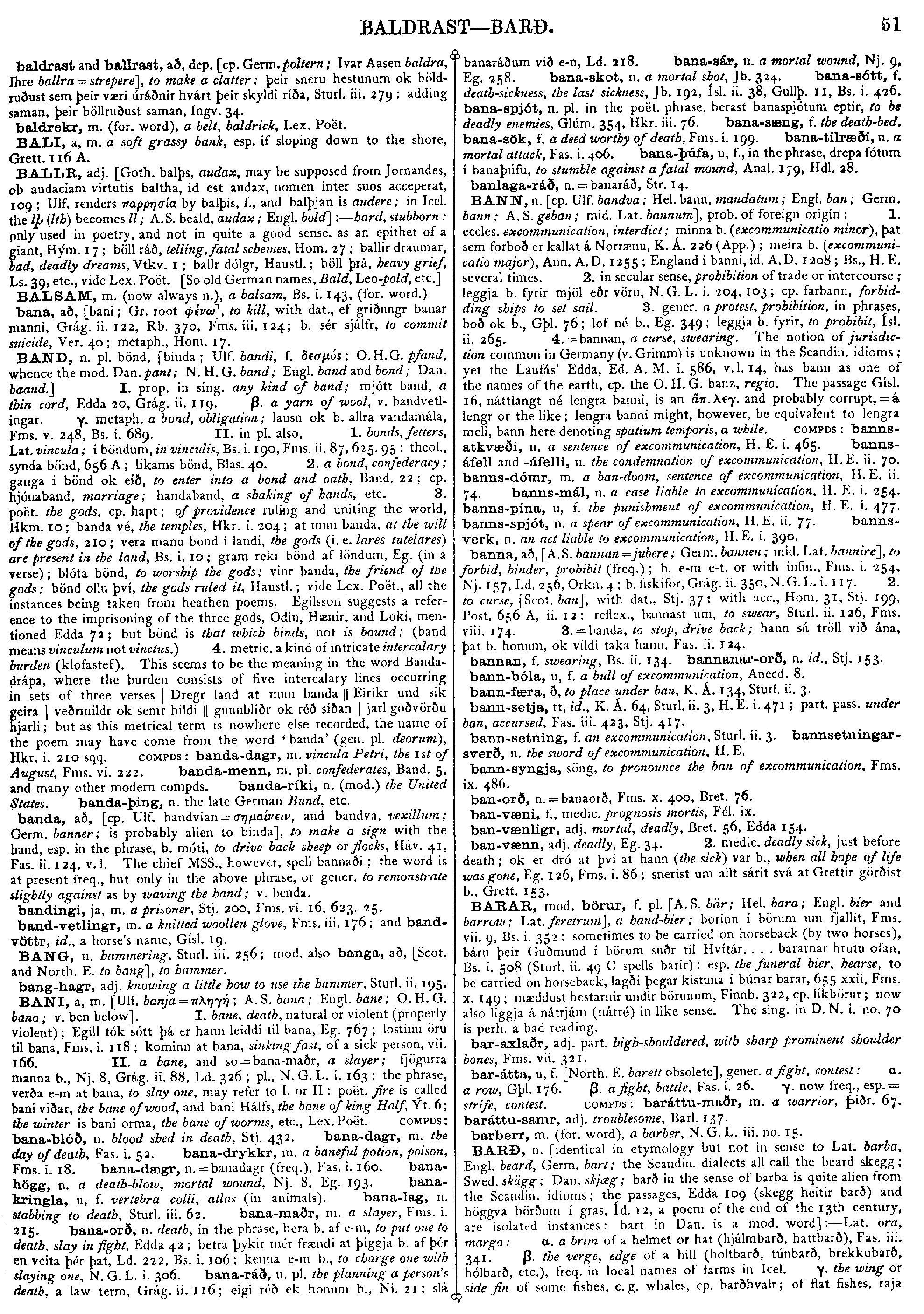
ban-orð, n. = banaorð, Fms. x. 400, Bret. 76. ban-væni, f., medic, prognosis mortis, Fcl. ix. ban-vænligr, adj. mortal, deadly, Bret. 56, Edda 154. ban-vænn, adj. deadly, Eg. 34. 2. medic, deadly sick, just before death; ok er dró at því at hann (the sick) var b., when all hope of life was gone, Eg. 126, Fms. i. 86; snerist um allt sárit svá at Grettir görðist b., Grett. 153.
|
Source: Cleasby/Vigfusson, page b0056, entry 7 View original page image as: [TIFF] [PNG] [View previous entry] [View next entry] |
[Comment on this entry] [View comments] |
The following entry has not been hand-corrected. However, the page is reserved and someone is correcting it. |
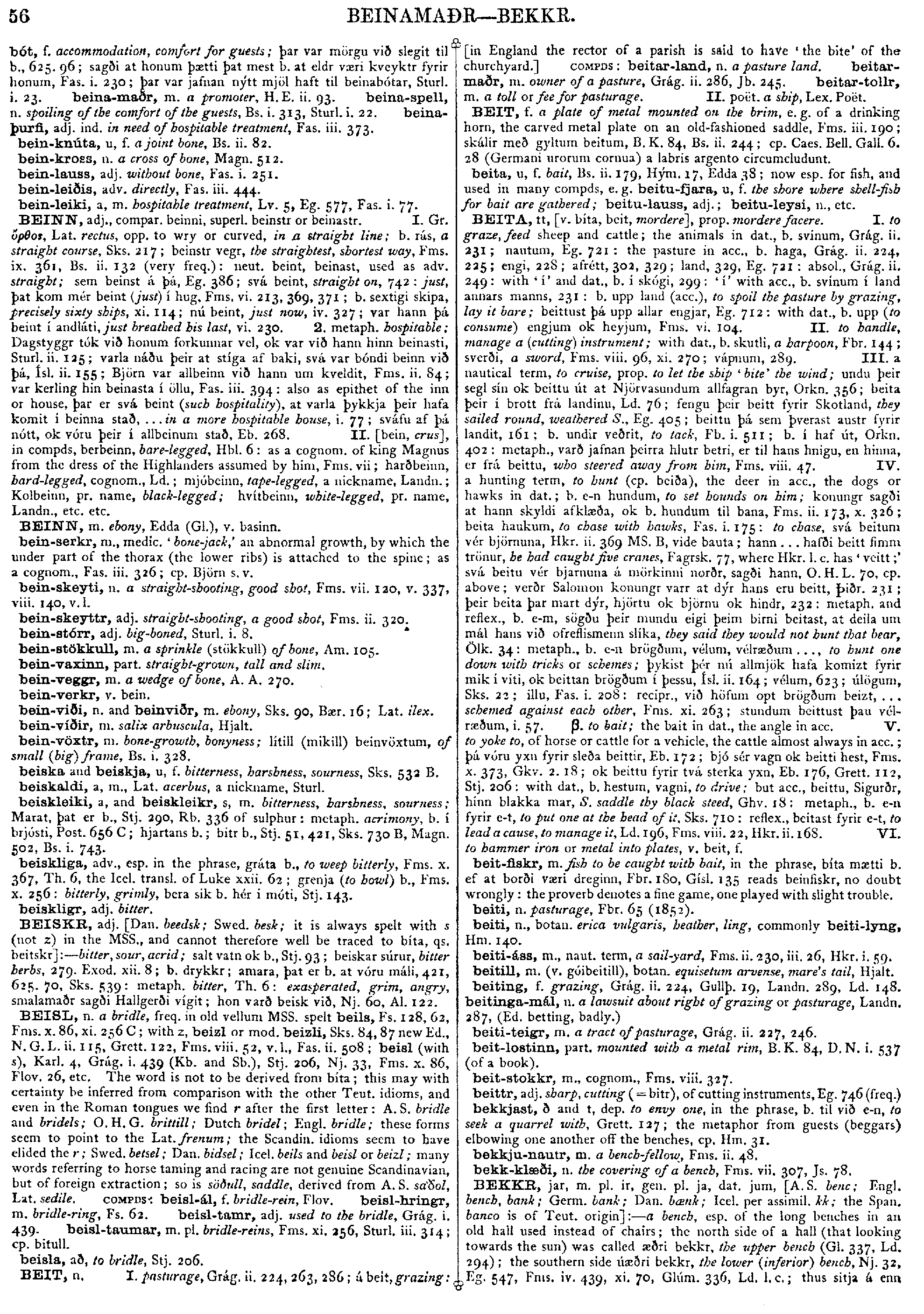
BEINN, adj., compar. beinni, superl. beinstr or beinastr. I. Gr. öpøos, Lat. rectits, opp. to wry or curved, in a straight line; b. rás, a straight course, Sks. 217; beinstr vegr, the straigbtest, shortest way, Fms. ix. 361, Bs. ii. 132 (very freq.): ueut. beint, beinast, used as adv. straight; sem beinst á þá, Eg. 386; svá beint, straight on, 742: just, þat kom mér beint (just) i hug, Fms. vi. 213, 369, 371; b. sextigi skipa, precisely sixty ships, xi. 114; mi beint, just now, iv. 327; var hann þá beint í undlati, just breathed his last, vi. 230. 2. metaph. hospitable; Dagstyggr tok við honum forkunnar vel, ok var við hana hinn beinasti, Sturl. ii. 125; varla náðu þeir at stíga af baki, svá var bóndi beinn við þá, Ísl. ii. 155; Björn var allbeinn við hann um kveldit, Fms. ii. 84; var kerling hin beinasta í öllu, Fas. iii. 394: also as epithet of the inn or house, þar er svá beint (suc h hospitality), at varla þykkja þeir hafa komit í beinna stað, ... in a more hospitable botise, i. 77; sváfu af þá nótt, ok vóru þeir í allbcinum stað, Eb. 268. II. [bein, crus] , in compds, berbeinn, bare-legged, Hbl. 6: as a cognom. of king Magnus from the dress of the Highlanders assumed by him, Fms. vii; harðbeinn, hard-legged, cognom., Ld.; mjóbeinn, tape-legged, a nickname, Landn.; Kolbeinn, pr. name, black-legged; hvitbeinn, white-legged, pr. name, Landn., etc.
| Result Page: |  |
Previous | 8 9 10 11 12 13 14 15 16 17 18 19 20 21 22 23 24 25 26 | Next |  |
Germanic Lexicon Project (main page)
This search system was written by
Sean Crist
Please consider
volunteering
to correct the data in these online dictionaries.
No rights reserved. Feel free to use these data in any way you please.