|
|

Tip: In the search results, you can click on any word or abbreviation for more information.
|
Source: Cleasby/Vigfusson, page b0093, entry 7 View original page image as: [TIFF] [PNG] [View previous entry] [View next entry] |
[Comment on this entry] [View comments] |
The following entry has been hand-corrected once. |
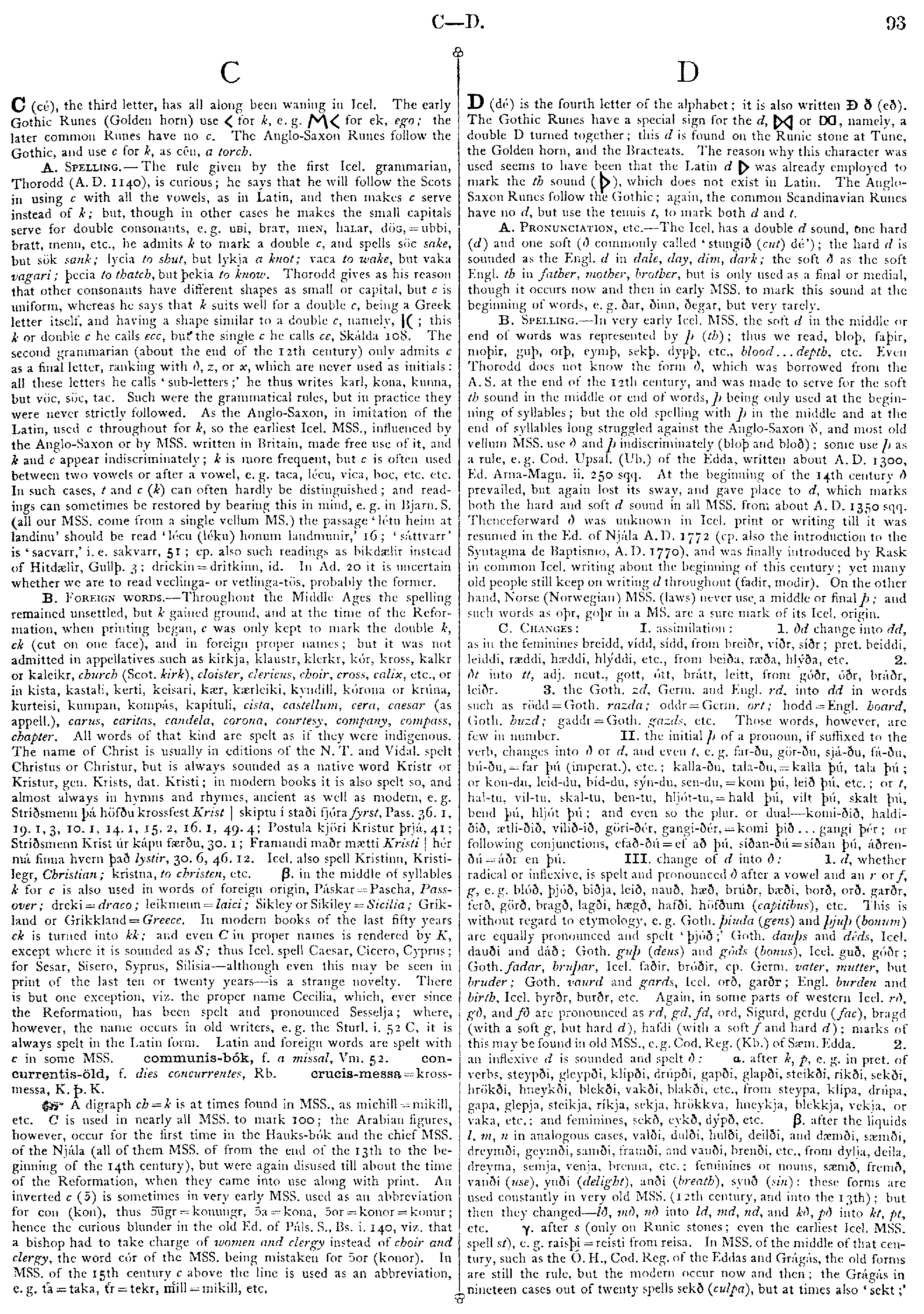
kð, pð were first abolished; the liquids kept the soft d till the end of the century, and lð, mð, nð is still the rule in the Hauksbók; though even the chief vellum MS. of the Njála (Arna-Magn. no. 468) almost constantly uses the modern ld, md, nd. As to kt and pt, the case is peculiar; in early times the Icel. pronounced dýpð or dýpþ etc. exactly as the English at present pronounce depth; but as the Icel. does not allow the concurrence of two different tenues, the modern pt and kt are only addressed to the eye; in fact, when ð became t, the p and k were at once changed into f and g. The Icel. at present says dýft, segt, just as he spells September, October, but is forced to pronounce 'Seft-,' 'Ogt-.' The spelling in old MSS. gives sometimes a clear evidence as to the etymology of some contested words, e.g. the spelling eykð (q.v.) clearly shews that the word is not akin to Lat. octo, but is derived from auka (augere), because else it would have been formed like nótt, átta, dóttir, Lat. noct-, octo, Gr. GREEK so anði, synð, shew that the d in both cases is inflexive, not radical, and that an, syn are the roots, cp. Gr. GREEK and Germ, sühnen; but when editors or transcribers of Icel. MSS. -- and even patriotic imi- tators of the old style -- have extended the ð to radical ld, nd, and write lanð, banð, hönð, valð, etc., they go too far and trespass against the law of the language. It is true that 'land' is in Icel. MSS. spelt 'lð,' but the stroke is a mark of abbreviation, not of a soft d.
|
Source: Cleasby/Vigfusson, page b0093, entry 9 View original page image as: [TIFF] [PNG] [View previous entry] [View next entry] |
[Comment on this entry] [View comments] |
The following entry has been hand-corrected once. |
&hand; In very early Icel. MSS. we find the old Latin form d, which sometimes occurs in the Kb. of the Sæm. Edda, but it is commonly UNKNOWN, whence ð is formed by putting a stroke on the upper part, A.S. ð this shews that the ð is in form a d, not a þ (th); vide more on this subject in the introduction to þ Thorodd calls the capital D edd, the d dé.
|
Source: Cleasby/Vigfusson, page b0093, entry 28 View original page image as: [TIFF] [PNG] [View previous entry] [View next entry] |
[Comment on this entry] [View comments] |
The following entry has been hand-corrected once. |
dag-mál, n. (vide dagr), prop. 'day-meal,' one of the divisions of the day, usually about 8 or 9 o'clock A. M.; the Lat. hora tertia is rendered by 'er vér köllum dagmál, 'which we call d., Hom. 142; cnn er ekki liðit af dagmálum, Hom. (St.) 10. Acts ii. 15; in Glúm. 342 we are told that the young Glum was very lazy, and lay in bed till day-meal every morning, cp. also 343; Hrafn. 28 and O.H.L. 18 -- á einum morni milli rismála ok dagmála -- where distinction is made between rismál (rising time) and dagmál, so as to make a separate dagsmark (q.v.) of each of them; and again, a distinction is made between 'midday' and dagmal, Ísl. ii. 334. The dagmal is thus midway between 'rising' and 'midday,' which accords well with the present use. The word is synonymous with dagverðarmál, breakfast-time, and denotes the hour when the ancient Icel. used to take their chief meal, opposed to náttmál, night-meal or supper-time, Fms. viii. 330; even the MSS. use dagmál and dagverðarmál indiscriminately; cp. also Sturl. iii. 4 C; Rb. 452 says that at full moon the ebb takes place 'at dagmálum.' To put the dagmál at 7.30 A.M., as Pál Vídalin does, seems neither to acccord with the present use nor the passage in Glum or the eccl. hora tertia, which was the nearest hour answering to the Icel, calculation of the day. In Fb. i. 539 it is said that the sun set at 'eykð' (i.e. half-past three o'clock), but rose at 'dagmál' which puts the dagmal at 8.30 A.M. COMPDS: dagmála- staðr, m. the place of d. in the horizon, Fb. I. dagmala-tið, f. morning terce, 625. 176.
|
Source: Cleasby/Vigfusson, page b0093, entry 30 View original page image as: [TIFF] [PNG] [View previous entry] [View next entry] |
[Comment on this entry] [View comments] |
The following entry has been hand-corrected once. |
DAGR,
m.,
irreg.
dat.
degi,
pl.
dagar:
[the
kindred
word
dœgr
with
a
vowel
change
from
ó
(dóg)
indicates
a
lost
root
verb
analogous
to
ala,
ól,
cp.
dalr
and
dælir;
this
word
is
common
to
all
Teutonic
dialects;
Goth.
dags;
A.S.
dag;
Engl.
day;
Swed.-Dan.
dag;
Germ,
tag;
the
Lat.
dies
seems
to
be
identical,
although
no
interchange
has
taken
place]
:--
a
day;
in
different
senses:
1.
the
natural
day
:--
sayings
referring
to
the
day,
at
kveldi
skal
dag
leyfa,
at
eventide
shall
the
day
be
praised,
Hm.
80
;
allir
dagar
eiga
kveld
um
síðir;
mörg
eru
dags
augu,
vide
auga;
enginn
dagr
til
enda
tryggr,
no
day
can
be
trusted
till
its
end;
allr
dagr
til
stefnu,
Grág.
i.
395,
443,
is
a
law
phrase,
--
for
summoning
was
lawful
only
if
performed
during
the
day;
this
phrase
is
also
used
metaph.
=
'plenty
of
time'
or
the
like:
popular
phrases
as
to
the
daylight
are
many
--
dagr
rennr,
or
rennr
upp,
and
kemr
upp,
the
day
rises,
Bm.
1;
dagr
í
austri,
day
in
the
east,
where
the
daylight
first
appears;
dagsbrún,
'day's
brow,'
is
the
first
streak
of
daylight,
the
metaphor
taken
from
the
human
face;
lysir
af
degi,
it
brightens
from
the
day,
i.e.
daylight
is
appearing;
dagr
ljómar,
the
day
gleams;
fyrir
dag,
before
day;
móti
degi,
undir
dag,
about
daybreak;
komið
at
degi,
id.,
Fms.
viii.
398;
dagr
á
lopti,
day
in
the
sky;
árla,
snemma
dags,
early
in
the
morning,
Pass.
15.
17;
dagr
um
allt
lopt,
etc.;
albjartr
dagr,
hábjartr
d.,
full
day,
broad
daylight;
hæstr
dagr,
high
day;
önd-verðr
d.,
the
early
day
=
forenoon,
Am.
50;
miðr
dagr,
midday,
Grág.
i.
413,
446,
Sks.
217,
219;
áliðinn
dagr,
late
in
the
day,
Fas.
i.
313;
hallandi
dagr,
declining
day;
at
kveldi
dags,
síð
dags,
late
in
the
day,
Fms.
i.
69.
In
the
evening
the
day
is
said
to
set,
hence
dag-sett,
dag-setr,
and
dagr
setzt;
in
tales,
ghosts
and
spirits
come
out
with
nightfall,
but
dare
not
face
the
day;
singing
merry
songs
after
nightfall
is
not
safe,
það
kallast
ekki
Kristnum
leyft
að
kveða
þegar
dagsett
er,
a
ditty;
Syrpuvers
er
mestr
galdr
er
í
fólginn,
ok
eigi
er
lofat
at
kveða
eptir
dagsetr,
Fas.
iii.
206,
Ísl.
Þjóðs.
ii.
7,
8:
the
daylight
is
symbolical
of
what
is
true
or
clear
as
day,
hence
the
word
dagsanna,
or
satt
sem
dagr,
q.v.
2.
of
different
days;
í
dag,
to-day,
Grág.
i.
16,
18,
Nj.
36,
Ld.
76,
Fms.
vi.
151;
í
gær-dag,
yesterday;
í
fyrra
dag,
the
day
before
yesterday,
Háv.
50;
í
hinni-fyrra
dag,
the
third
day;
annars
dags,
Vígl.
23,
Pass.
50.
I;
hindra
dags,
the
hinder
day,
the
day
after
to-mor-
row,
Hm.
109;
dag
eptir
dag,
day
after
day,
Hkr.
ii.
313;
dag
frá
degi,
from
day
to
day,
Fms.
ii.
230;
hvern
dag
frá
öðrum,
id.,
Fms.
viii.
182;
annan
dag
frá
öðrum.
id.,
Eg.
277;
um
daginn,
during
the
day;
á
dögunum.
the
other
day;
nótt
ok
dag,
night
and
day;
liðlangan
dag,
the
'life-long'
day;
dögunum
optar,
more
times
than
there
are
days,
i.e.
over
and
over
again,
Fms.
x.
433;
á
deyjanda
degi,
on
one's
day
of
death,
Grág.
i.
402.
 .
regu-dagr,
a
rainy
day:
sólskins-dagr,
a
sunny
day;
sumar-
dagr,
a
summer
day;
vetrar-dagr,
a
winter
day;
hátíðis-dagr,
a
feast
day;
fegins-dagr,
a
day
of
joy;
dóms-dagr,
the
day
of
doom,
judgment
day,
Gl.
82,
Fms.
viii.
98;
hamingju-dagr,
heilla-dagr,
a
day
of
happiness;
gleði-
dagr,
id.;
brúðkaups-dagr,
bridal-day;
burðar-dagr,
a
birthday.
3.
in
pl.
days
in
the
sense
of
times;
aðrir
dagar,
Fms.
i.
216;
ek
ætlaða
ekki
at
þessir
dagar
mundu
verða,
sem
nú
eru
orðnir,
Nj.
171;
góðir
dagar,
happy
days,
Fms.
xi.
286,
270;
sjá
aldrei
glaðan
dag
(sing.),
never
to
see
glad
days.
.
á
e-s
dögum,
um
e-s
daga
eptir
e-s
daga,
esp.
of
the
lifetime
or
reign
of
kings,
Fms.;
but
in
Icel.
also
used
of
the
lög-
sögumaðr,
Jb.
repeatedly;
vera
á
dögum,
to
be
alive;
eptir
minn
dag,
'after
my
day,'
i.e.
when
I
am
dead.
.
regu-dagr,
a
rainy
day:
sólskins-dagr,
a
sunny
day;
sumar-
dagr,
a
summer
day;
vetrar-dagr,
a
winter
day;
hátíðis-dagr,
a
feast
day;
fegins-dagr,
a
day
of
joy;
dóms-dagr,
the
day
of
doom,
judgment
day,
Gl.
82,
Fms.
viii.
98;
hamingju-dagr,
heilla-dagr,
a
day
of
happiness;
gleði-
dagr,
id.;
brúðkaups-dagr,
bridal-day;
burðar-dagr,
a
birthday.
3.
in
pl.
days
in
the
sense
of
times;
aðrir
dagar,
Fms.
i.
216;
ek
ætlaða
ekki
at
þessir
dagar
mundu
verða,
sem
nú
eru
orðnir,
Nj.
171;
góðir
dagar,
happy
days,
Fms.
xi.
286,
270;
sjá
aldrei
glaðan
dag
(sing.),
never
to
see
glad
days.
.
á
e-s
dögum,
um
e-s
daga
eptir
e-s
daga,
esp.
of
the
lifetime
or
reign
of
kings,
Fms.;
but
in
Icel.
also
used
of
the
lög-
sögumaðr,
Jb.
repeatedly;
vera
á
dögum,
to
be
alive;
eptir
minn
dag,
'after
my
day,'
i.e.
when
I
am
dead.
 .
calendar
days,
e.g.
Hvita-
dagar,
the
White
days,
i.e.
Whitsuntide;
Hunda-dagar,
the
Dog
days;
Banda-dagr,
Vincula
Petri;
Höfuð-dagr,
Decap.
Johannis;
Geisla-dagr,
Epiphany;
Imbru-dagar,
Ember
days;
Gang-dagar,
'Ganging
days,'
Ro-
gation
days;
Dýri-dagr,
Corpus
Christi;
etc.
4.
of
the
week-
days;
the
old
names
being
Sunnu-d.
or
Drottins-d.,
Mána-d.,
Týs-d.,
Öðins-d.,
Þórs-d.,
Frjá-d.,
Laugar-d.
or
Þvátt-d.
It
is
hard
to
understand
how
the
Icel.
should
be
the
one
Teut.
people
that
have
disused
the
old
names
of
the
week-days;
but
so
it
was,
vide
Jóns
S.
ch.
24;
fyrir
bauð
hann
at
eigna
daga
vitrum
mönnum
heiðnum,
svá
sem
at
kalla
Týrsdag
.
calendar
days,
e.g.
Hvita-
dagar,
the
White
days,
i.e.
Whitsuntide;
Hunda-dagar,
the
Dog
days;
Banda-dagr,
Vincula
Petri;
Höfuð-dagr,
Decap.
Johannis;
Geisla-dagr,
Epiphany;
Imbru-dagar,
Ember
days;
Gang-dagar,
'Ganging
days,'
Ro-
gation
days;
Dýri-dagr,
Corpus
Christi;
etc.
4.
of
the
week-
days;
the
old
names
being
Sunnu-d.
or
Drottins-d.,
Mána-d.,
Týs-d.,
Öðins-d.,
Þórs-d.,
Frjá-d.,
Laugar-d.
or
Þvátt-d.
It
is
hard
to
understand
how
the
Icel.
should
be
the
one
Teut.
people
that
have
disused
the
old
names
of
the
week-days;
but
so
it
was,
vide
Jóns
S.
ch.
24;
fyrir
bauð
hann
at
eigna
daga
vitrum
mönnum
heiðnum,
svá
sem
at
kalla
Týrsdag
|
Source: Cleasby/Vigfusson, page b0095, entry 1 View original page image as: [TIFF] [PNG] [View previous entry] [View next entry] |
[Comment on this entry] [View comments] |
The following entry has been hand-corrected once. |
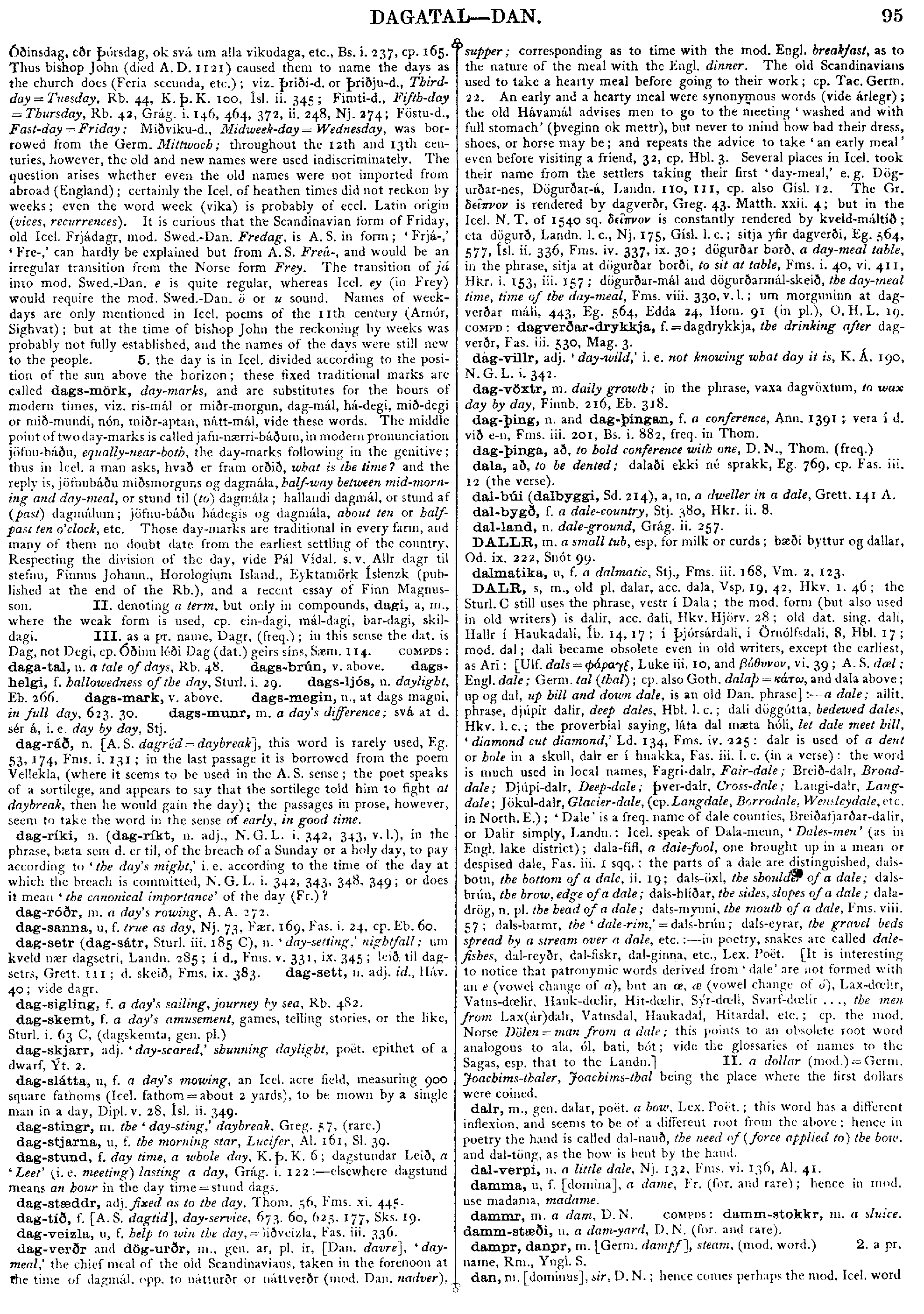
Óðinsdag, eðr Þórsdag, ok svá um alla vikudaga, etc., Bs. i. 237, cp. 165. Thus bishop John (died A.D. 1121) caused them to name the days as the church does (Feria sccunda, etc.); viz. Þriði-d. or Þriðju-d., Third-day = Tuesday, Rb. 44, K.Þ.K. 100, Ísl. ii. 345; Fimti-d., Fifth-day -- Thursday, Rb. 42, Grág. i. 146, 464, 372, ii. 248, Nj. 274; Föstu-d., Fast-day = Friday; Miðviku-d., Midweek-day = Wednesday, was borrowed from the Germ. Mittwoch; throughout the 12th and 13th centuries, however, the old and new names were used indiscriminately. The question arises whether even the old names were not imported from abroad (England); certainly the Icel. of heathen times did not reckon by weeks; even the word week (vika) is probably of eccl. Latin origin (vices, recurrences). It is curious that the Scandinavian form of Friday, old Icel. Frjádagr, mod. Swed.-Dan. Fredag, is A.S. in form; 'Frjá-,' 'Fre-,' can hardly be explained but from A.S. Freâ-, and would be an irregular transition from the Norse form Frey. The transition of ja into mod. Swed.-Dan. e is quite regular, whereas Icel. ey (in Frey) would require the mod. Swed.-Dan. ö or u sound. Names of weekdays are only mentioned in Icel. poems of the 11th century (Arnór, Sighvat); but at the time of bishop John the reckoning by weeks was probably not fully established, and the names of the days were still new to the people. 5. the day is in Icel. divided according to the posi- tion of the sun above the horizon; these fixed traditional marks are called dags-mörk, day-marks, and are substitutes for the hours of modern times, viz. ris-mál or miðr-morgun, dag-mál, há-degi, mið-degi or mið-mundi, nón, miðr-aptan, nátt-mál, vide these words. The middle point of two day-marks is called jafn-nærri-báðum, in modern pronunciation jöfnu-báðu, equally-near-both, the day-marks following in the genitive; thus in Icel. a man asks, hvað er fram orðið, what is the time? and the reply is, jöfnubáðu miðsmorguns og dagmála, half-way between mid-morn- ing and day-meal, or stund til (to) dagmála; hallandi dagmál, or stund af (past) dagmálum; jöfnu-báðu hádegis og dagmúla, about ten or half- past ten o'clock, etc. Those day-marks are traditional in every farm, and many of them no doubt date from the earliest settling of the country. Respecting the division of the day, vide Pál Vídal. s.v. Allr dagr til stefnu, Finnus Johann., Horologium Island., Eyktamörk Íslenzk (published at the end of the Rb.), and a recent essay of Finn Magnusson. II. denoting a term, but only in compounds, dagi, a, m., where the weak form is used, cp. ein-dagi, mál-dagi, bar-dagi, skil- dagi. III. jis a pr. name, Dagr, (freq.); in this sense the dat. is Dag, not Degi, cp. Óðinn léði Dag (dat.) geirs síns, Sæm. 114. COMPDS: daga-tal, n. a tale of days, Rb. 48. dags-brun, v. above. dags- helgi, f. hallowedness of the day, Sturl. i. 29. dags-ljós, n. daylight, Eb. 266. dags-mark, v. above. dags-megin, n., at dags magni, in full day, 623. 30. dags-munr, m. a day's difference; svá at d. sér á, i.e. day by day, Stj.
|
Source: Cleasby/Vigfusson, page b0095, entry 2 View original page image as: [TIFF] [PNG] [View previous entry] [View next entry] |
[Comment on this entry] [View comments] |
The following entry has been hand-corrected once. |
dag-ráð, n. [A.S. dagrêd = daybreak], this word is rarely used, Eg. 53, 174, Fms. i. 131; in the last passage it is borrowed from the poem Vellekla, (where it seems to be used in the A.S. sense; the poet speaks of a sortilege, and appears to say that the sortilege told him to fight at daybreak, then he would gain the day); the passages in prose, however, seem to take the word in the sense of early, in good time.
|
Source: Cleasby/Vigfusson, page b0095, entry 3 View original page image as: [TIFF] [PNG] [View previous entry] [View next entry] |
[Comment on this entry] [View comments] |
The following entry has been hand-corrected once. |
dag-ríki, n. (dag-rikt, n. adj., N. G. L. i. 342, 343, v.l.), in the phrase, bæta sem d. er til, of the breach of a Sunday or a holy day, to pay according to 'the day's might,' i.e. according to the time of the day at which the breach is committed, N.G.L. i. 342, 343, 348, 349; or does it mean 'the canonical importance' of the day (Fr.) ?
|
Source: Cleasby/Vigfusson, page b0095, entry 18 View original page image as: [TIFF] [PNG] [View previous entry] [View next entry] |
[Comment on this entry] [View comments] |
The following entry has been hand-corrected once. |
dag-villr, adj. 'day-wild,' i. e. not knowing what day it is, K. Á. 190, N. G. L. i. 342.
|
Source: Cleasby/Vigfusson, page b0095, entry 28 View original page image as: [TIFF] [PNG] [View previous entry] [View next entry] |
[Comment on this entry] [View comments] |
The following entry has been hand-corrected once. |
DALR, s, m., old pl. dalar, acc. dala, Vsp. 19, 42, Hkv. i. 46; the Sturl. C still uses the phrase, vestr í Dala; the mod. form (but also used in old writers) is dalir, acc. dali, Hkv. Hjörv. 28; old dat. sing, dali, Hallr í Haukadali, Íb. 14, 17; í Þjórsárdali, í Örnólfsdali, 8, Hbl. 17; mod. dal; dali became obsolete even in old writers, except the earliest, as Ari: [Ulf. dais = GREEK Luke iii. 10, and GREEK vi. 39; A.S. dæl; Engl. dale; Germ, tal (thal); cp. also Goth, dalaþ = GREEK and dala above; up og dal, up hill and down dale, is an old Dan. phrase] :-- a dale; allit. phrase, djúpir dalir, deep dales, Hbl. 1. c.; dali döggótta, bedewed dales, Hkv. 1. c.; the proverbial saying, láta dal mæta hóli, let dale meet hill, 'diamond cut diamond,' Ld. 134, Fms. iv. 225: dalr is used of a dent or hole in a skull, dalr er í hnakka, Fas. iii. 1. c. (in a verse): the word is much used in local names, Fagri-dalr, Fair-dale; Breið-dalr, Broad- dale; Djúpi-dalr, Deep-dale; Þver-dalr, Cross-dale; Langi-dalr, Lang- dale; Jökul-dalr, Glacier-dale, (cp. Langdale, Borrodale. Wensleydale, etc. in North. E.); 'Dale' is a freq. name of dale counties, Breiðatjarðar-dalir, or Dalir simply, Landn.: Icel. speak of Dala-menn, 'Dales-men' (as in Engl. lake district); dala-fífi, a dale-fool, one brought up in a mean or despised dale, Fas. iii. 1 sqq.: the parts of a dale are distinguished, dals- botn, the bottom of a dale, ii. 19; dals-öxl, the shoulder of a dale; dals- brún, the brow, edge of a dale; dals-hlíðar, the sides, slopes of a dale; dala- drög, n. pl. the head of a dale; dals-mynni, the mouth of a dale, Fms. viii. 57; dals-barmr, the 'dale-rim,' = dals-brun; dals-eyrar, the gravel beds spread by a stream over a dale, etc. :-- in poetry, snakes are called dale- fishes, dal-reyðr, dal-fiskr, dal-ginna, etc., Lex. Poët. [It is interesting to notice that patronymic words derived from 'dale' are not formed with an e (vowel change of a), but an œ, æ (vowel change of ó), Lax-drœlir, Vatns-dœlir, Hauk-dœlir, Hit-dœlir, Sýr-drœll, Svarf-dœlir ..., the men from Lax(ár)dalr, Vatnsdal, Haukadal, Hitardal, etc.; cp. the mod. Norse Dölen = man from a dale; this points to an obsolete root word analogous to ala, ól, bati, bót; vide the glossaries of names to the Sagas, esp. that to the Landn.] II. a dollar (mod.) = Germ. Joachims-thaler, Joachims-thal being the place where the first dollars were coined.
|
Source: Cleasby/Vigfusson, page b0096, entry 2 View original page image as: [TIFF] [PNG] [View previous entry] [View next entry] |
[Comment on this entry] [View comments] |
The following entry has been hand-corrected once. |
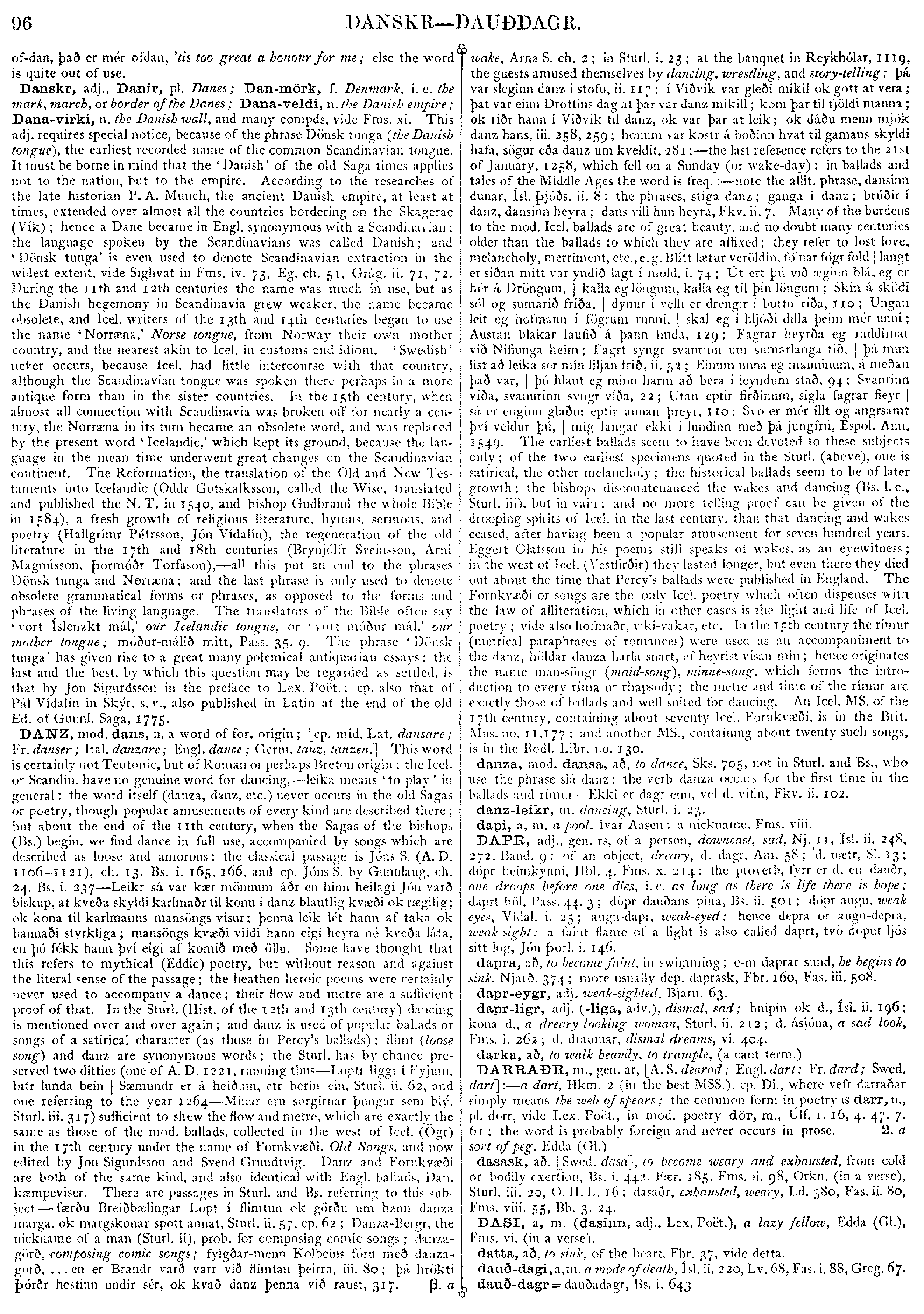
Danskr, adj., Danir, pl. Danes; Dan-mörk, f. Denmark, i.e. the mark, march, or border of the Danes; Dana-veldi, n. the Danish empire; Dana-virki, n. the Danish wall, and many compds, vide Fms. xi. This adj. requires special notice, because of the phrase Dönsk tunga (the Danish tongue), the earliest recorded name of the common Scandinavian tongue. It must be borne in mind that the 'Danish' of the old Saga times applies not to the nation, but to the empire. According to the researches of the late historian P.A. Munch, the ancient Danish empire, at least at times, extended over almost all the countries bordering on the Skagerac (Vík); hence a Dane became in Engl. synonymous with a Scandinavian; the language spoken by the Scandinavians was called Danish; and 'Dönsk tunga' is even used to denote Scandinavian extraction in the widest extent, vide Sighvat in Fms. iv. 73, Eg. ch. 51, Grág. ii. 71, 72. During the 11th and 12th centuries the name was much in use, but as the Danish hegemony in Scandinavia grew weaker, the name became obsolete, and Icel. writers of the 13th and 14th centuries began to use the name 'Norræna,' Norse tongue, from Norway their own mother country, and the nearest akin to Icel. in customs and idiom. 'Swedish' never occurs, because Icel. had little intercourse with that country, although the Scandinavian tongue was spoken there perhaps in a more antique form than in the sister countries. In the 15th century, when almost all connection with Scandinavia was broken off for nearly a century, the Norræna in its turn became an obsolete word, and was replaced by the present word 'Icelandic,' which kept its ground, because the language in the mean time underwent great changes on the Scandinavian continent. The Reformation, the translation of the Old and New Testaments into Icelandic (Oddr Gotskalksson, called the Wise, translated and published the N.T. in 1540, and bishop Gudbrand the whole Bible in 1584), a fresh growth of religious literature, hymns, sermons, and poetry (Hallgrímr Pétrsson, Jón Vídalín), the regeneration of the old literature in the 17th and 18th centuries (Brynjólfr Sveinsson, Arni Magnússon, Þormóðr Torfason), -- all this put an end to the phrases Dönsk tunga and Norræna; and the last phrase is only used to denote obsolete grammatical forms or phrases, as opposed to the forms and phrases of the living language. The translators of the Bible often say 'vort Íslenzkt mál,' our Icelandic tongue, or 'vort móður mál,' our mother tongue; móður-málið mitt, Pass. 35. 9. The phrase 'Dönsk tunga' has given rise to a great many polemical antiquarian essays: the last and the best, by which this question may be regarded as settled, is that by Jon Sigurdsson in the preface to Lex. Poët.; cp. also that of Pál Vídalín in Skýr. s.v., also published in Latin at the end of the old Ed. of Gunnl. Saga, 1775.
| Result Page: |  |
Previous | 262 263 264 265 266 267 268 269 270 271 272 273 274 275 276 277 278 279 280 | Next |  |
Germanic Lexicon Project (main page)
This search system was written by
Sean Crist
Please consider
volunteering
to correct the data in these online dictionaries.
No rights reserved. Feel free to use these data in any way you please.