|
|

Tip: In the search results, you can click on any word or abbreviation for more information.
|
Source: Bosworth/Toller, page b0909, entry 15 View original page image as: [TIFF] [PNG] [View previous entry] [View next entry] |
[Comment on this entry] [View comments] |
The following entry has been hand-corrected once. |
stæþ-hlipe;
adj.
Running
to
the
shore(?),
steeply
sloping,
precipitous
:--
Stæþhlépe
divexum,
i.
inclinatum,
pronum,
Wrt.
Voc.
ii.
141,
52.
Hí
ne
mihton
ofer
ðæt
scræf
swá
swæðhlýpe
(stæþ-?)
[wæs]
d r
hí
gongan
[sceoldon]
r
ðon
hié
gerýmdon
ðone
upgang
and
geworhtan
they
could
not
pass
the
cave,
so
steep
was
it
where
they
had
to
go,
before
they
had
cleared
and
constructed
the
ascent,
Blickl.
Homl.
201,
16.
v.
next
word.
r
hí
gongan
[sceoldon]
r
ðon
hié
gerýmdon
ðone
upgang
and
geworhtan
they
could
not
pass
the
cave,
so
steep
was
it
where
they
had
to
go,
before
they
had
cleared
and
constructed
the
ascent,
Blickl.
Homl.
201,
16.
v.
next
word.
|
Source: Bosworth/Toller, page b0909, entry 25 View original page image as: [TIFF] [PNG] [View previous entry] [View next entry] |
[Comment on this entry] [View comments] |
The following entry has been hand-corrected once. |
stafian; p. ode To direct, dictate :-- Se geréfa ðone áð him swór swá hé hyne sylf stafode the steward swore the oath to Abraham, as Abraham himself dictated it, Gen. 24, 9. Abraham ðurh wítegunge stafode ðone að, Homl. Th. ii. 234, 34. [O. H. Ger. stabén dirigere: Icel. stafa eið to dictate an oath to a person.]
|
Source: Bosworth/Toller, page b0913, entry 23 View original page image as: [TIFF] [PNG] [View previous entry] [View next entry] |
[Comment on this entry] [View comments] |
The following entry has been hand-corrected once. |
steám,
stém,
stiém,
es;
m.
I.
steam,
hot
exhalation,
hot
breath
:--
Him
(Herod)
stód
stincende
steám
of
ðam
múðe,
Homl.
Th.
i.
86,
14.
Forlt
wynsumne
réc
ástígan
...
Ðá
of
ðære
stówe
steám
up
árás
swylce
réc,
Elen.
Kmbl.
1603;
El.
803.
Stenc
út
cymeþ
of
ðam
wongstede,
wynsumra
steám
swæcca
gehwylcum,
Exon.
Th.
358,
14;
Pa.
45.
Man
píntreów
bærne
tó
glédum
...
wende
his
neb
tó
and
onfó
ðam
stéme
(the
heat
proceeding
from
the
embers),
Lchdm.
ii.
284,
16.
Of
hómena
æþme
and
stiéme
cymþ
eágna
mist,
26,
26.
Fleó
ða
mettas
ða
ðe
him
stiém
on
innan
wyrcen,
226,
10.
II.
that
which
emits
hot
vapour,
blood
:--
Forléton
mé
standan
steáme
bedrifenne
they
left
me
(the
cross)
standing
bespattered
with
blood,
Rood
Kmbl.
123;
Kr.
62.
[A
stem
als
it
were
a
sunnebem,
Havel.
591.
Steem
or
lowe
of
fyre
flamma,
steem
of
hothe
lycure
vapor,
Prompt.
Parv.
473.]
|
Source: Bosworth/Toller, page b0914, entry 7 View original page image as: [TIFF] [PNG] [View previous entry] [View next entry] |
[Comment on this entry] [View comments] |
The following entry has been hand-corrected once. |
stearclice;
adv.
Strongly,
vigorously,
vehemently,
fiercely
:--
Ðá
gewende
se
here
tó
Lundene
and
ða
buruh
útan
embsæt
and
hyre
stearclíce
(cf
stranglíce,
MS.
E.)
on
feaht
gðer
ge
be
wætere
ge
be
lande
made
a
vigorous
assault
upon
it
by
land
and
water,
Chr.
1016;
Erl.
156,
32.
|
Source: Bosworth/Toller, page b0915, entry 20 View original page image as: [TIFF] [PNG] [View previous entry] [View next entry] |
[Comment on this entry] [View comments] |
The following entry has been hand-corrected once. |
stel-scofl (?), e; f. The word apparently should mean a shovel with a long handle (v. stela), but it glosses faselus :-- Steolscofle faselo, Germ. 400, 498.
|
Source: Bosworth/Toller, page b0916, entry 9 View original page image as: [TIFF] [PNG] [View previous entry] [View next entry] |
[Comment on this entry] [View comments] |
The following entry has been hand-corrected once. |
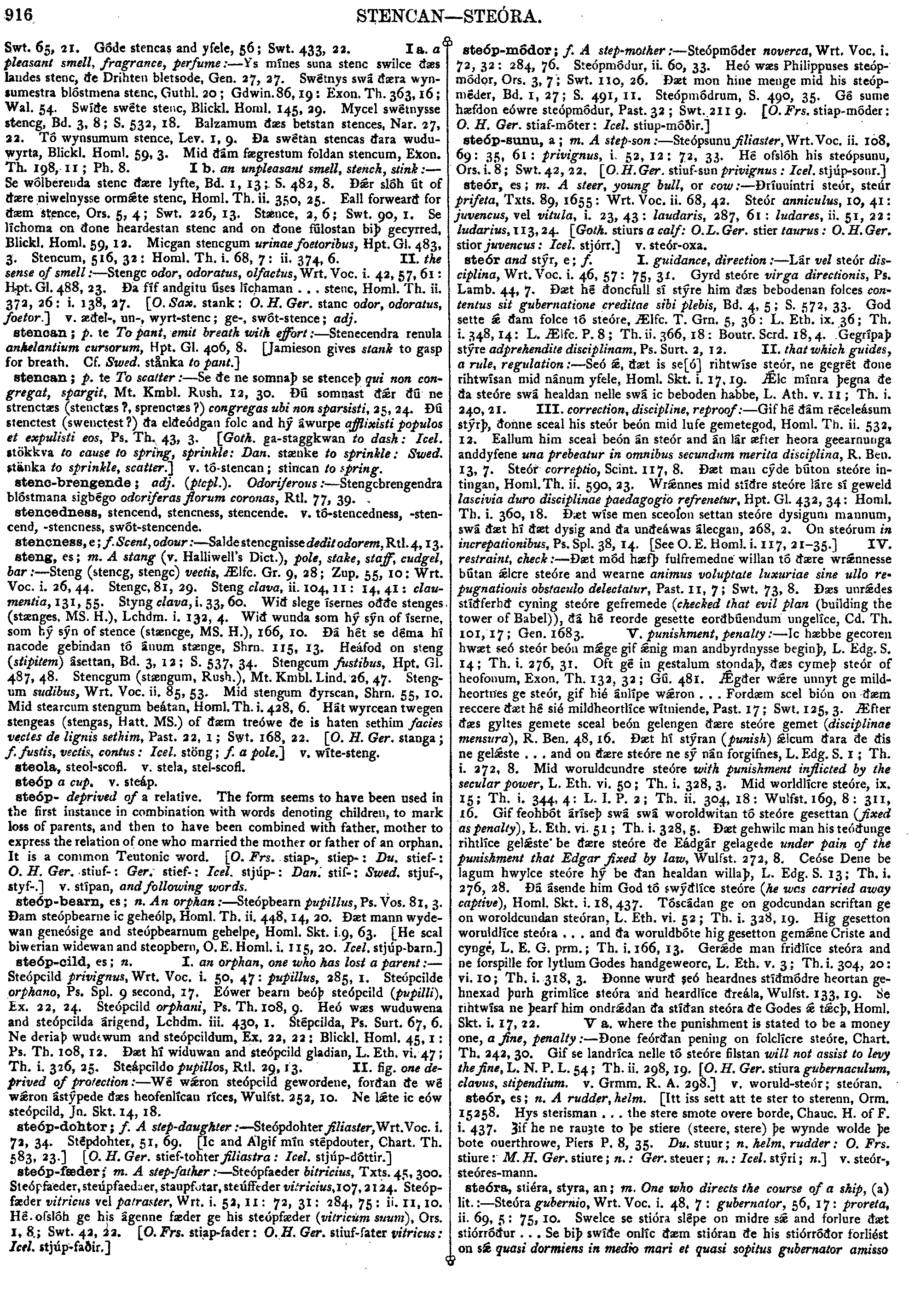
steóp- deprived of a relative. The form seems to have been used in the first instance in combination with words denoting children, to mark loss of parents, and then to have been combined with father, mother to express the relation of one who married the mother or father of an orphan. It is a common Teutonic word. [O. Frs. stiap-, stiep-: Du. stief-: O. H. Ger. stiuf-: Ger. stief-: Icel. stjúp-: Dan. stif-: Swed. stjuf-, styf-.] v. stípan, and following words.
|
Source: Bosworth/Toller, page b0919, entry 1 View original page image as: [TIFF] [PNG] [View previous entry] [View next entry] |
[Comment on this entry] [View comments] |
The following entry has been hand-corrected once. |
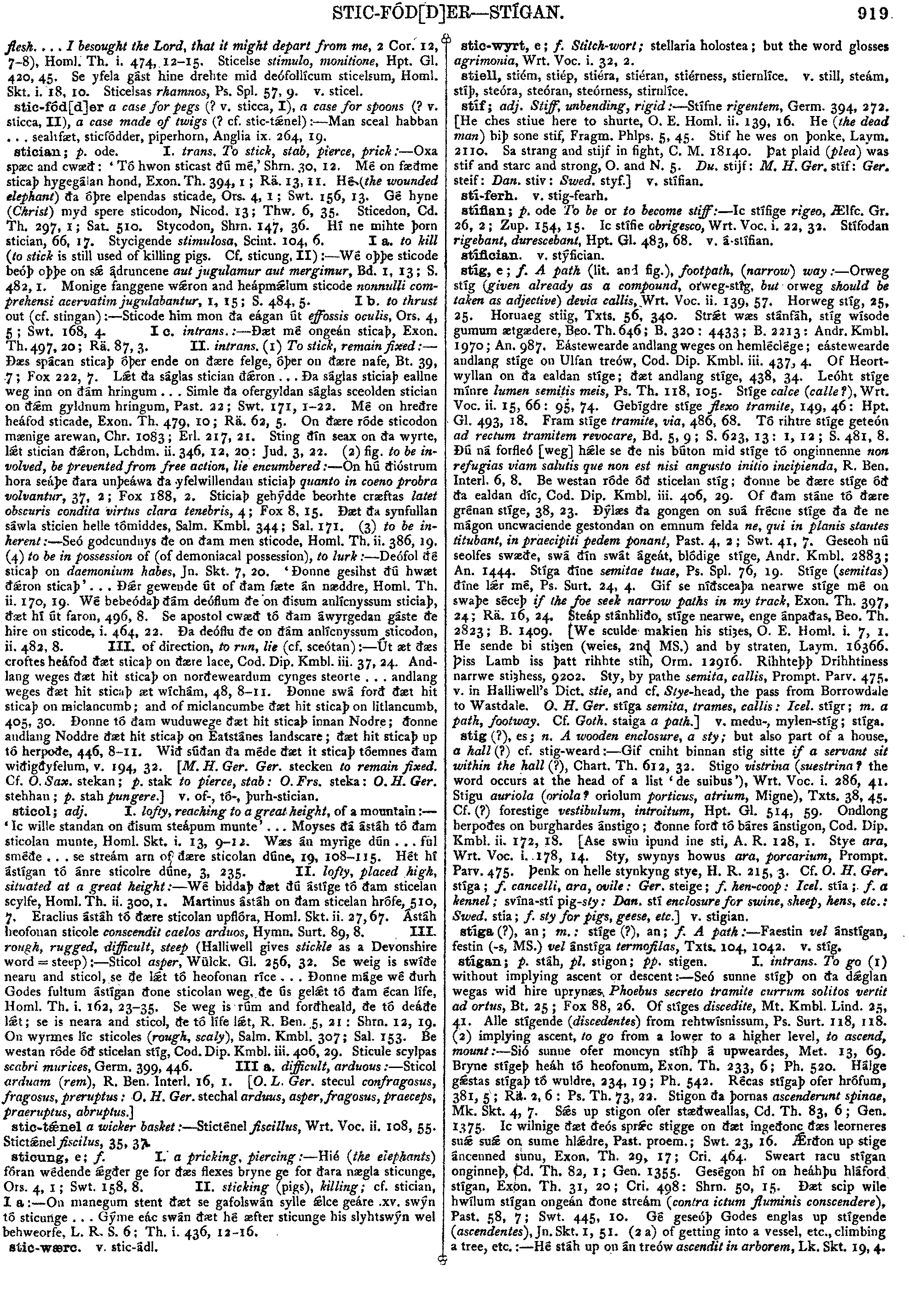
flesh. . . . I besought the Lord, that it might depart from me, 2 Cor. 12, 7-8), Homl. Th. i. 474, 12-15. Sticelse stimulo, monitione, Hpt. Gl. 420, 45. Se yfela gást hine drehte mid deófollícum sticelsum, Homl. Skt. i. 18, 10. Sticelsas rhamnos, Ps. Spl. 57, 9. v. sticel.
|
Source: Bosworth/Toller, page b0919, entry 3 View original page image as: [TIFF] [PNG] [View previous entry] [View next entry] |
[Comment on this entry] [View comments] |
The following entry has been hand-corrected once. |
stician;
p.
ode.
I.
trans.
To
stick,
stab,
pierce,
prick:--Oxa
spæc
and
cwæð:
'Tó
hwon
sticast
ðú
mé,'
Shrn.
30,
12.
Mé
on
fæðme
sticaþ
hygegálan
hond,
Exon.
Th.
394,
1;
Rä.
13,
11.
Hé(the
wounded
elephant)
ða
óþre
elpendas
sticade,
Ors.
4,
1;
Swt.
156,
13.
Gé
hyne
(Christ)
myd
spere
sticodon,
Nicod.
13;
Thw.
6,
35.
Sticedon,
Cd.
Th.
297,
1;
Sat.
510.
Stycodon,
Shrn.
147,
36.
Hí
ne
mihte
þorn
stician,
66,
17.
Stycigende
stimulosa,
Scint.
104,
6.
I
a.
to
kill
(to
stick
is
still
used
of
killing
pigs.
Cf.
sticung,
II):--Wé
oþþe
sticode
beóþ
oþþe
on
s
ádruncene
aut
jugulamur
aut
mergimur,
Bd.
1,
13;
S.
482,
1.
Monige
fanggene
wron
and
heápmlum
sticode
nonnulli
comprehensi
acervatim
jugulabantur,
1,
15;
S.
484,
5.
I
b.
to
thrust
out
(cf.
stingan):--Sticode
him
mon
ða
eágan
út
efossis
oculis,
Ors.
4,
5;
Swt.
168,
4.
I
c.
intrans.:--Ðæt
mé
ongeán
sticaþ,
Exon.
Th.
497,
20;
Rä.
87,
3.
II.
intrans.
(1)
To
stick,
remain
fixed:--Ðæs
spácan
sticaþ
óþer
ende
on
ðære
felge,
óþer
on
ðære
nafe,
Bt.
39,
7;
Fox
222,
7.
Lt
ða
ságlas
stician
ðron
.
.
.
Ða
ságlas
sticiaþ
eallne
weg
inn
on
ðám
hringum
.
.
.
Simle
ða
ofergyldan
ságlas
sceolden
stician
on
ðm
gyldnum
hringum,
Past.
22;
Swt.
171,
1-22.
Mé
on
hreðre
heáfod
sticade,
Exon.
Th.
479,
10;
Rä.
62,
5.
On
ðære
róde
sticodon
mænige
arewan,
Chr.
1083;
Erl.
217,
21.
Sting
ðín
seax
on
ða
wyrte,
lt
stician
ðron,
Lchdm.
ii.
346,
12,
20:
Jud.
3,
22.
(2)
fig.
to
be
involved,
be
prevented
from
free
action,
lie
encumbered:--On
hú
ðióstrum
hora
seáþe
þara
unþeáwa
ða
yfelwillendan
sticiaþ
quanto
in
coeno
probra
volvantur,
37,
2;
Fox
188,
2.
Sticiaþ
gehýdde
beorhte
cræftas
latet
obscuris
condita
virtus
clara
tenebris,
4;
Fox
8,
15.
Ðæt
ða
synfullan
sáwla
sticien
helle
tómiddes,
Salm.
Kmbl.
344;
Sal.
171.
(3)
to
be
inherent:--Seó
godcundnys
ðe
on
ðam
men
sticode,
Homl.
Th.
ii.
386,
19.
(4)
to
be
in
possession
of
(of
demoniacal
possession),
to
lurk:--Deófol
ðé
sticaþ
on
daemonium
habes,
Jn.
Skt.
7,
20.
'Ðonne
gesihst
ðú
hwæt
ðron
sticaþ'
.
.
.
Ðr
gewende
út
of
ðam
fæte
án
næddre,
Homl.
Th.
ii.
170,
19.
Wé
bebeódaþ
ðám
deóflum
ðe
on
ðisum
anlícnyssum
sticiaþ,
ðæt
hí
út
faron,
496,
8.
Se
apostol
cwæð
tó
ðam
áwyrgedan
gáste
ðe
hire
on
sticode,
i.
464,
22.
Ða
deóflu
ðe
on
ðám
anlícnyssum
sticodon,
ii.
482,
8.
III.
of
direction,
to
run,
lie
(cf.
sceótan):--Út
æt
ðæs
croftes
heáfod
ðæt
sticaþ
on
ðære
lace,
Cod.
Dip.
Kmbl.
iii.
37,
24.
Andlang
weges
ðæt
hit
sticaþ
on
norðeweardum
cynges
steorte.
.
.
andlang
weges
ðæt
hit
sticaþ
æt
wíchám,
48,
8-11.
Ðonne
swá
forð
ðæt
hit
sticaþ
on
miclancumb;
and
of
miclancumbe
ðæt
hit
sticaþ
on
litlancumb,
405,
30.
Ðonne
tó
ðam
wuduwege
ðæt
hit
sticaþ
innan
Nodre;
ðonne
andlang
Noddre
ðæt
hit
sticaþ
on
Eatstánes
landscare;
ðæt
hit
sticaþ
up
tó
herpoðe,
446,
8-11.
Wið
súðan
ða
méde
ðæt
it
sticaþ
tóemnes
ðam
wiðigðyfelum,
v.
194,
32.
[M.
H.
Ger.
Ger.
stecken
to
remain
fixed.
Cf.
O.
Sax.
stekan;
p.
stak
to
pierce,
stab:
O.
Frs.
steka:
O.
H.
Ger.
stehhan;
p.
stah
pungere.]
v.
of-,
tó-,
þurh-stician.
|
Source: Bosworth/Toller, page b0920, entry 14 View original page image as: [TIFF] [PNG] [View previous entry] [View next entry] |
[Comment on this entry] [View comments] |
The following entry has been hand-corrected once. |
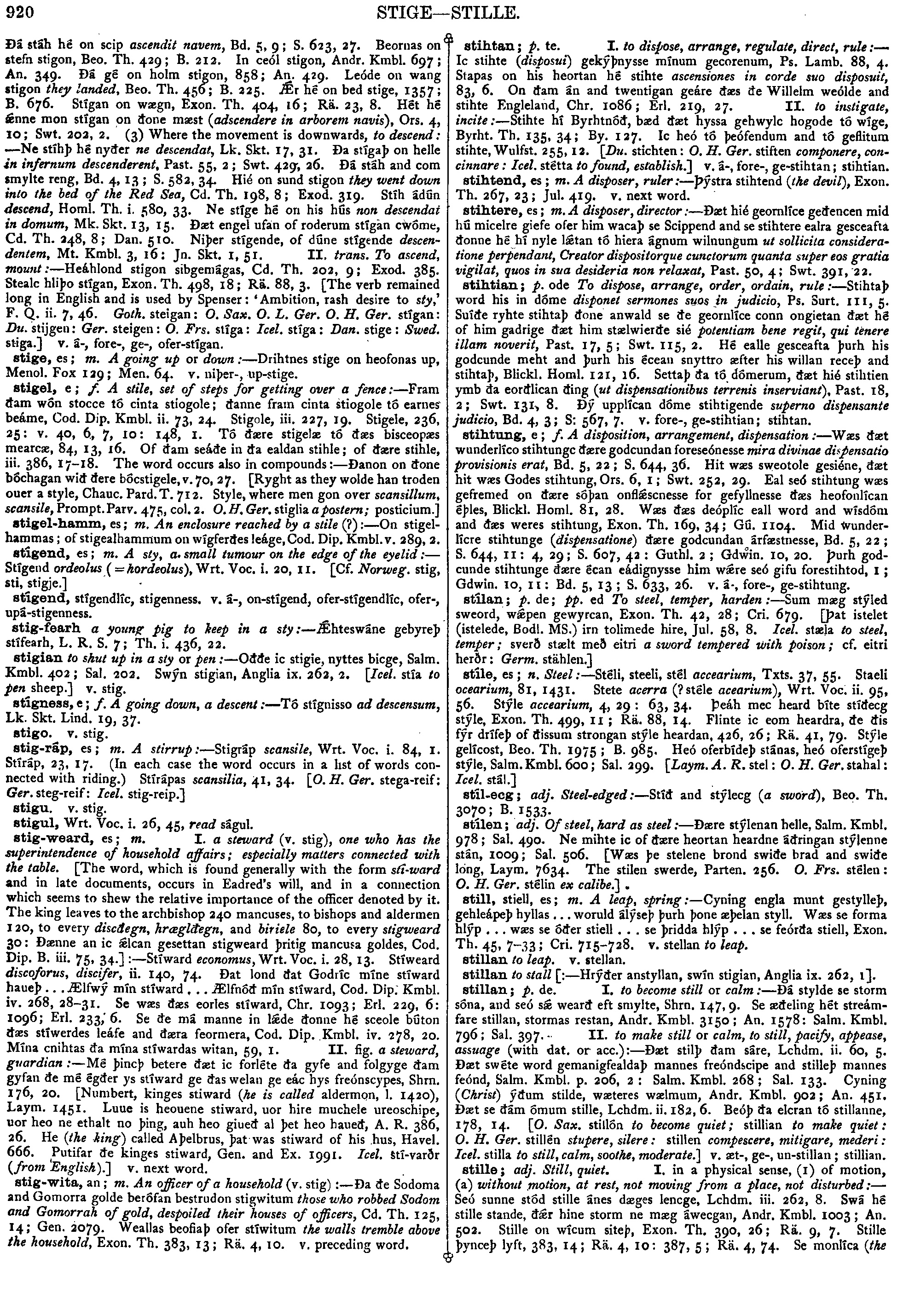
stig-weard,
es
;
m.
I.
a
steward
(v.
stig),
one
who
has
the
superintendence
of
household
affairs
;
especially
matters
connected
with
the
table.
[The
word,
which
is
found
generally
with
the
form
stí-ward
and
in
late
documents,
occurs
in
Eadred's
will,
and
in
a
connection
which
seems
to
shew
the
relative
importance
of
the
officer
denoted
by
it.
The
king
leaves
to
the
archbishop
240
mancuses,
to
bishops
and
aldermen
120,
to
every
discðegn,
hræglðegn,
and
biriele
80,
to
every
stigweard
30
:
Ðænne
an
ic
lcan
gesettan
stigweard
þritig
mancusa
goldes,
Cod.
Dip.
B.
iii.
75,
34.]
:--Stíward
economus,
Wrt.
Voc.
i.
28,
13.
Stíweard
discoforus,
discifer,
ii.
140,
74.
Ðat
lond
ðat
Godríc
míne
stíward
haueþ.
.
.
Ælfwý
mín
stíward
.
.
.
Ælfnóð
mín
stíward,
Cod.
Dip.
Kmbl.
iv.
268,
28-31.
Se
wæs
ðæs
eorles
stíward,
Chr.
1093
;
Erl.
229,
6
:
1096
;
Erl.
233,
6.
Se
ðe
má
manne
in
lde
ðonne
hé
sceole
búton
ðæs
stíwerdes
leáfe
and
ðæra
feormera,
Cod.
Dip.
Kmbl.
iv.
278,
20.
Mína
cnihtas
ða
mína
stíwardas
witan,
59,
1.
II.
fig.
a
steward,
guardian
:--Mé
þincþ
betere
ðæt
ic
forléte
ða
gyfe
and
folgyge
ðam
gyfan
ðe
mé
égðer
ys
stíward
ge
ðas
welan
ge
eác
hys
freónscypes,
Shrn.
176,
20.
[Numbert,
kinges
stiward
(he
is
called
aldermon,
l.
1420),
Laym.
1451.
Luue
is
heouene
stiward,
uor
hire
muchele
ureoschipe,
uor
heo
ne
ethalt
no
þing,
auh
heo
giueð
al
þet
heo
haueð,
A.
R.
386,
26.
He
(the
king)
called
Aþelbrus,
þat
was
stiward
of
his
hus,
Havel.
666.
Putifar
ðe
kinges
stiward,
Gen.
and
Ex.
1991.
Icel.
stí-varðr
(from
English).]
v.
next
word.
|
Source: Bosworth/Toller, page b0921, entry 5 View original page image as: [TIFF] [PNG] [View previous entry] [View next entry] |
[Comment on this entry] [View comments] |
The following entry has been hand-corrected once. |
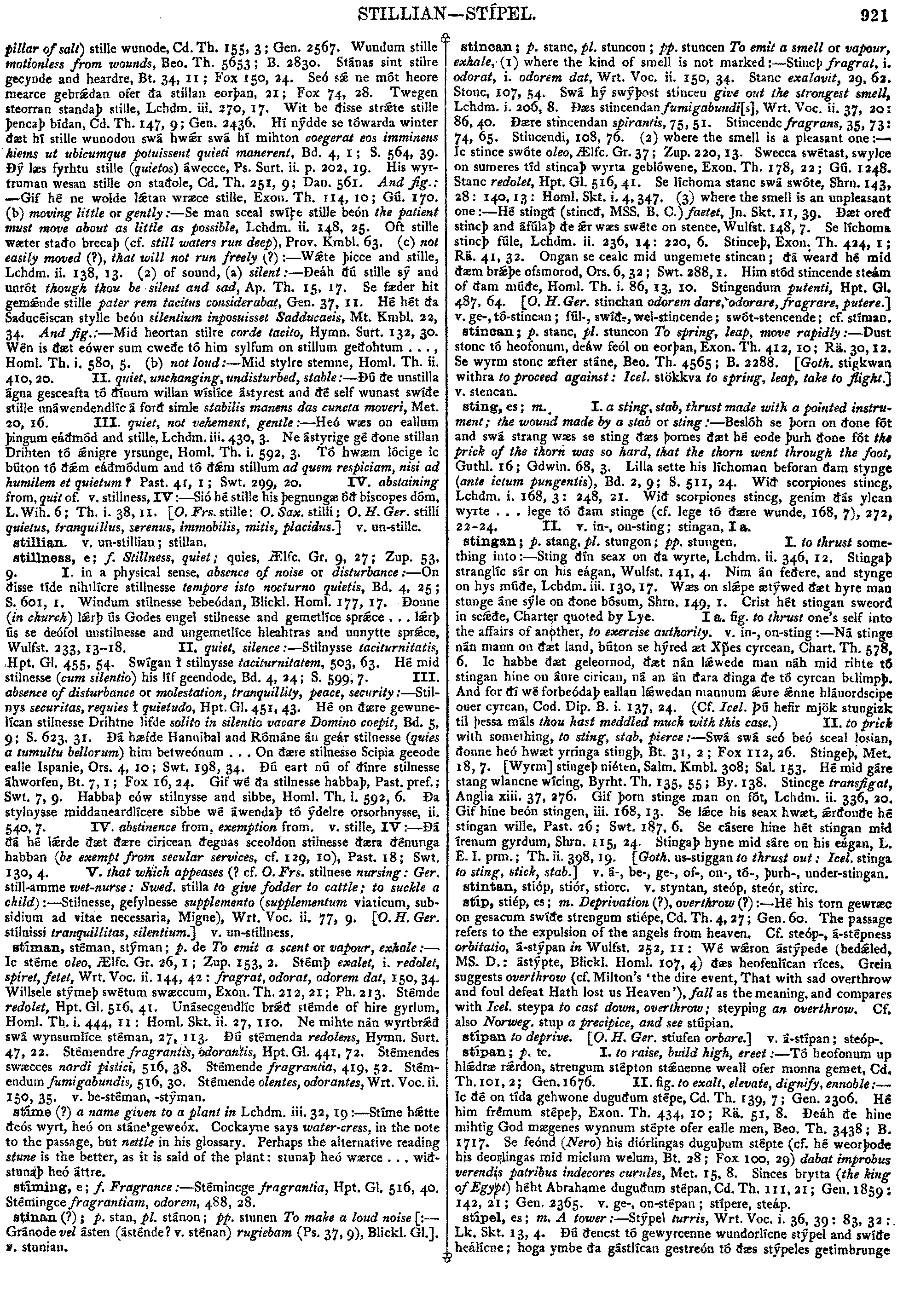
stíme
(?)
a
name
given
to
a
plant
in
Lchdm.
iii.
32,
19
:--Stíme
htte
ðeós
wyrt,
heó
on
stáne
geweóx.
Cockayne
says
water-cress,
in
the
note
to
the
passage,
but
nettle
in
his
glossary.
Perhaps
the
alternative
reading
stune
is
the
better,
as
it
is
said
of
the
plant
:
stunaþ
heó
wærce
.
.
.
wið stunaþ
heó
áttre.
stunaþ
heó
áttre.
| Result Page: |  |
Previous | 165 166 167 168 169 170 171 172 173 174 175 176 177 178 179 180 181 182 183 | Next |  |
Germanic Lexicon Project (main page)
This search system was written by
Sean Crist
Please consider
volunteering
to correct the data in these online dictionaries.
No rights reserved. Feel free to use these data in any way you please.