|
|

Tip: In the search results, you can click on any word or abbreviation for more information.
|
Source: Bosworth/Toller, page b0652, entry 21 View original page image as: [TIFF] [PNG] [View previous entry] [View next entry] |
[Comment on this entry] [View comments] |
The following entry has been hand-corrected once. |
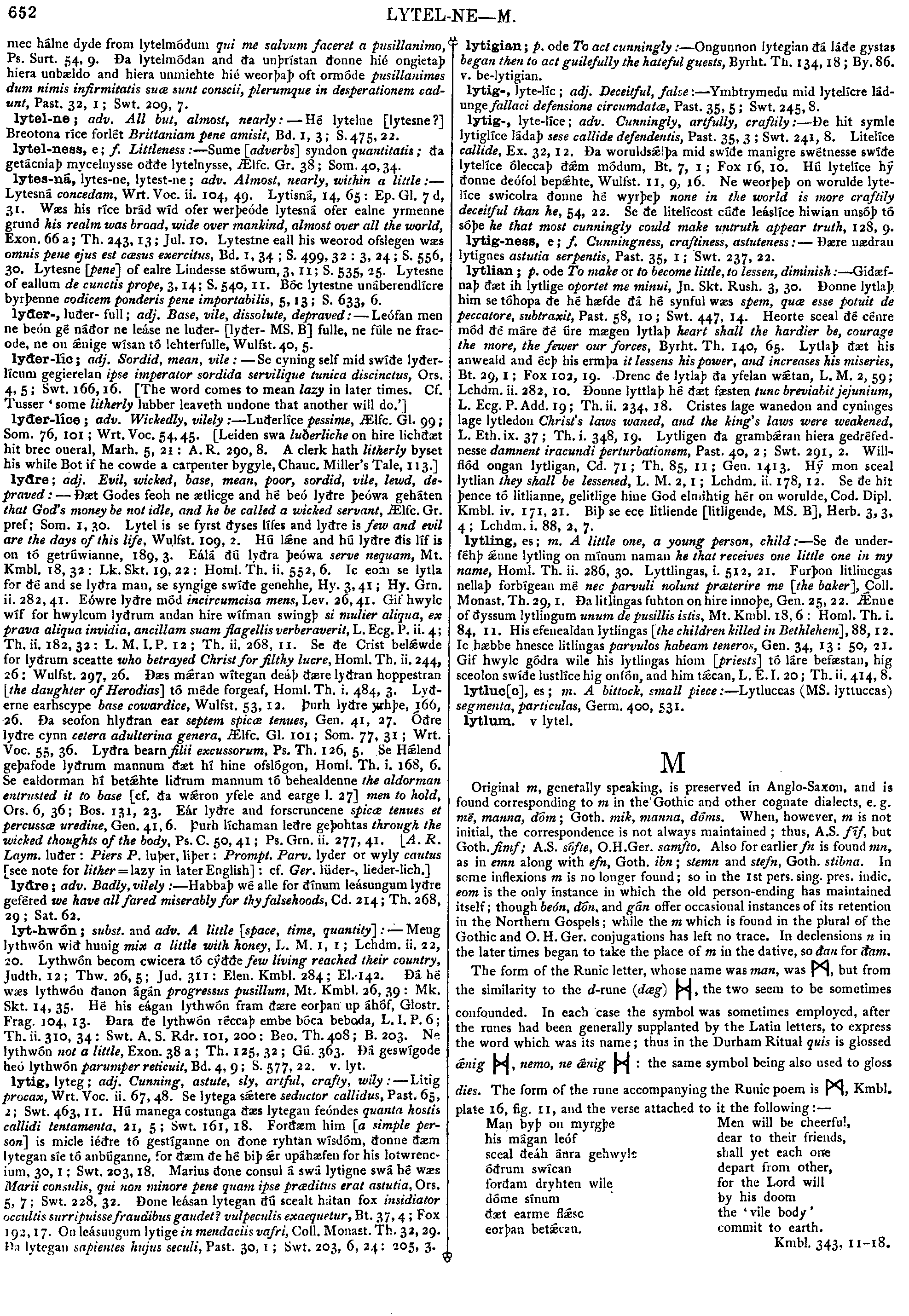
Original m, generally speaking, is preserved in Anglo-Saxon, and is found corresponding to m in the Gothic and other cognate dialects, e.g. mé, manna, dóm; Goth. mik, manna, dóms. When, however, m is not initial, the correspondence is not always maintained; thus, A. S. fíf, but Goth. fimf; A. S. sófte, O. H. Ger. samfto. Also for earlier fn is found mn, as in emn along with efn, Goth. ibn; stemn and stefn, Goth. stibna. In some inflexions m is no longer found; so in the 1st pers. sing. pres. indic. eom is the only instance in which the old person-ending has maintained itself; though beón, dón, and gán offer occasional instances of its retention in the Northern Gospels; while the m which is found in the plural of the Gothic and O. H. Ger. conjugations has left no trace. In declensions n in the later times began to take the place of m in the dative, so ðan for ðam.
|
Source: Bosworth/Toller, page b0840, entry 6 View original page image as: [TIFF] [PNG] [View previous entry] [View next entry] |
[Comment on this entry] [View comments] |
The following entry has been hand-corrected once. |
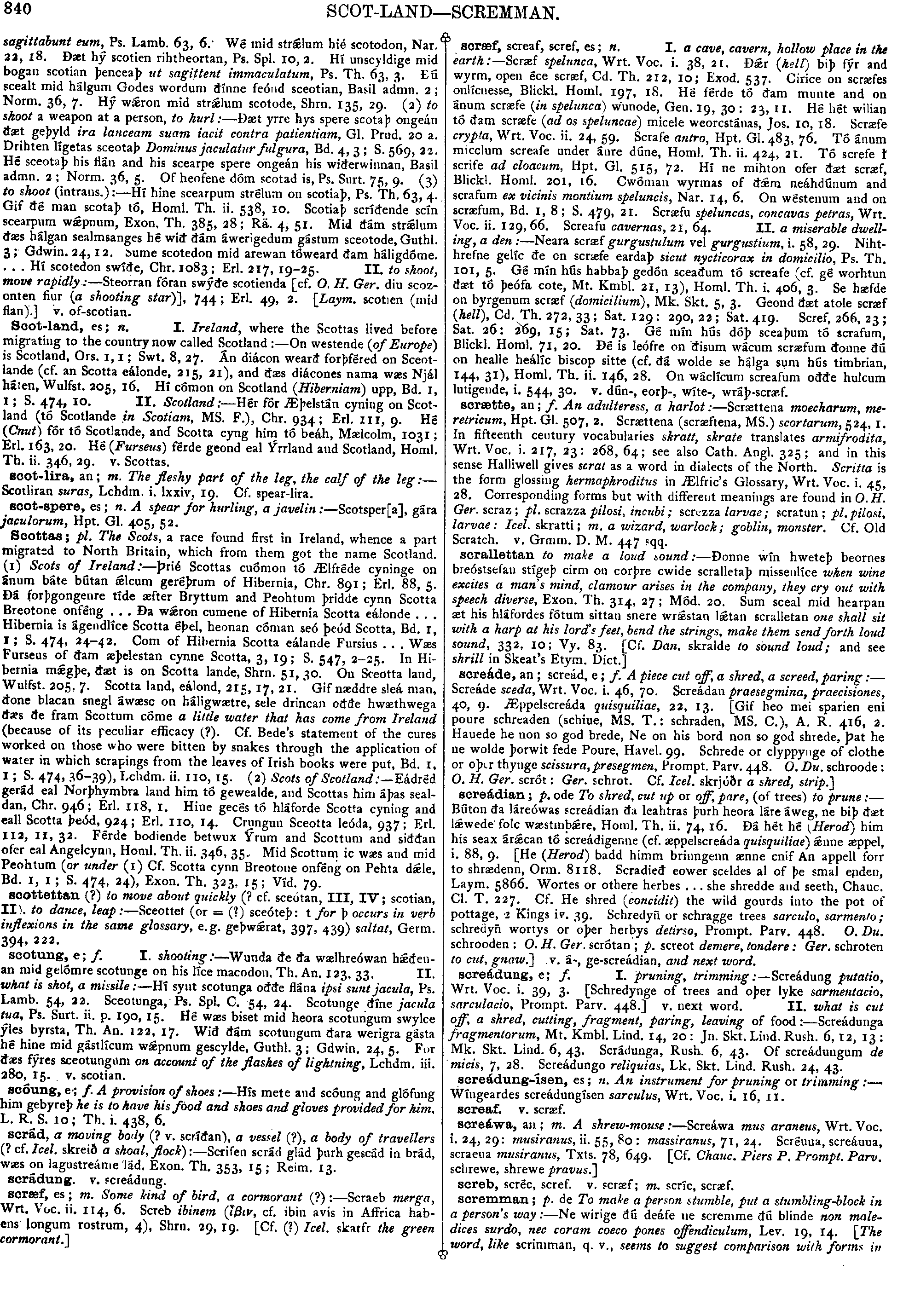
scottettan
(?)
to
move
about
quickly
(?
cf.
sceotan,
III,
IV;
scotian,
II).
to
dance,
leap:--Sceottet
(or
=
(?)
sceóteþ:
t
for
þ
occurs
in
verb
inflexions
in
the
same
glossary,
e.
g.
geþw rat,
397,
439)
saltat,
Germ.
394,
222.
rat,
397,
439)
saltat,
Germ.
394,
222.
|
Source: Bosworth/Toller, page b1023, entry 7 View original page image as: [TIFF] [PNG] [View previous entry] [View next entry] |
[Comment on this entry] [View comments] |
The following entry has been hand-corrected once. |
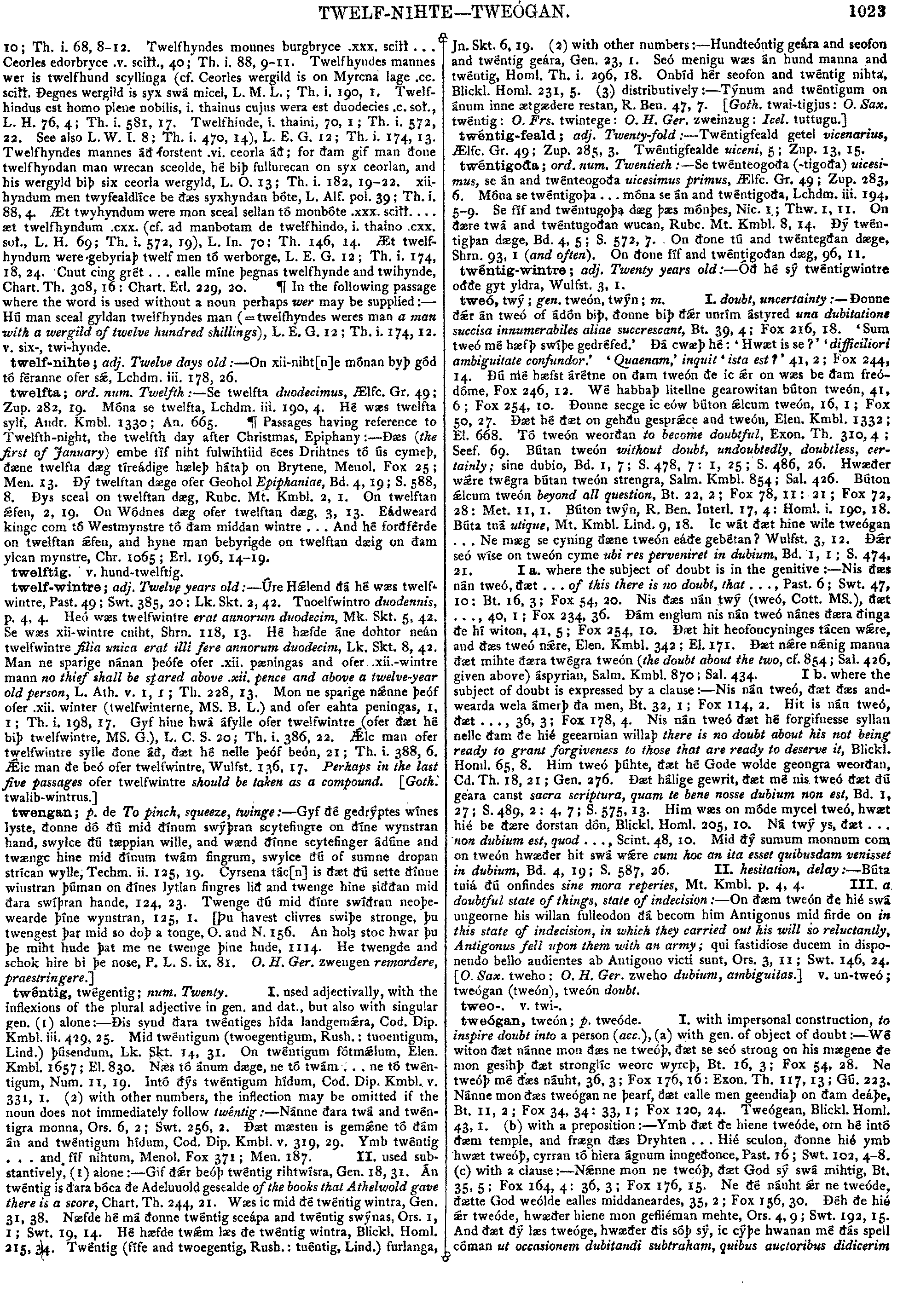
twéntig,
twégentig;
num.
Twenty.
I.
used
adjectivally,
with
the
inflexions
of
the
plural
adjective
in
gen.
and
dat.,
but
also
with
singular
gen.
(1)
alone:--Ðis
synd
ðara
twéntiges
hída
landgemra,
Cod.
Dip.
Kmbl.
iii.
429,
25.
Mid
twéntigum
(twoegentigum,
Rush.:
tuoentigum,
Lind.)
þúsendum,
Lk.
Skt.
14,
31.
On
twéntigum
fótmlum,
Elen.
Kmbl.
1657;
El.
830.
Næs
tó
ánum
dæge,
ne
tó
twám
.
.
.
ne
tó
twéntigum,
Num.
11,
19.
Intó
ðýs
twéntigum
híd?m,
Cod.
Dip.
Kmbl.
v.
331,
1.
(2)
with
other
numbers,
the
inflection
may
be
omitted
if
the
noun
does
not
immediately
follow
twébrig:--Nánne
ðara
twá
and
twéntigra
monna,
Ors.
6,
2;
Swt.
256,
2.
Ðæt
mæsten
is
gemne
tó
ðám
án
and
twéntigum
hídum,
Cod.
Dip.
Kmbl.
v.
319,
29.
Ymb
twéntig
.
.
.
and
fíf
nihtum,
Menol.
Fox
371;
Men.
187.
II.
used
substantively,
(1)
alone:--Gif
ðr
beóþ
twéntig
rihtwísra,
Gen.
18,
31.
Án
twéntig
is
ðara
bóca
ðe
Adeluuold
gesealde
of
the
books
that
Athelwold
gave
there
is
a
score,
Chart.
Th.
244,
21.
Wæs
ic
mid
ðé
twéntig
wintra,
Gen.
31,
38.
Næfde
hé
má
ðonne
twéntig
sceápa
and
twéntig
swýnas,
Ors.
1,
1;
Swt.
19,
14.
Hé
hæfde
twm
læs
ðe
twéntig
wintra,
Blickl.
Homl.
215,
34.
Twéntig
(fífe
and
twoegentig,
Rush.:
tuéntig,
Lind.)
furlanga,
Jn.
Skt.
6,
19.
(2)
with
other
numbers:--Hundteóntig
geára
and
seofon
and
twéntig
geára,
Gen.
23,
1.
Seó
menigu
wæs
án
hund
manna
and
twéntig,
Homl.
Th.
i.
296,
18.
Onbíd
hér
seofon
and
twéntig
nihta,
Blickl.
Homl.
231,
5.
(3)
distributively:--Týnum
and
twéntigum
on
ánum
inne
ætgædere
restan,
R.
Ben.
47,
7.
[Goth.
twai-tigjus:
O.
Sax.
twéntig:
O.
Frs.
twintege:
O.
H.
Ger.
zweinzug:
Icel.
tuttugu.]
|
Source: Cleasby/Vigfusson, page b0001, entry 1 View original page image as: [TIFF] [PNG] [View previous entry] [View next entry] |
[Comment on this entry] [View comments] |
The following entry has been hand-corrected once. |
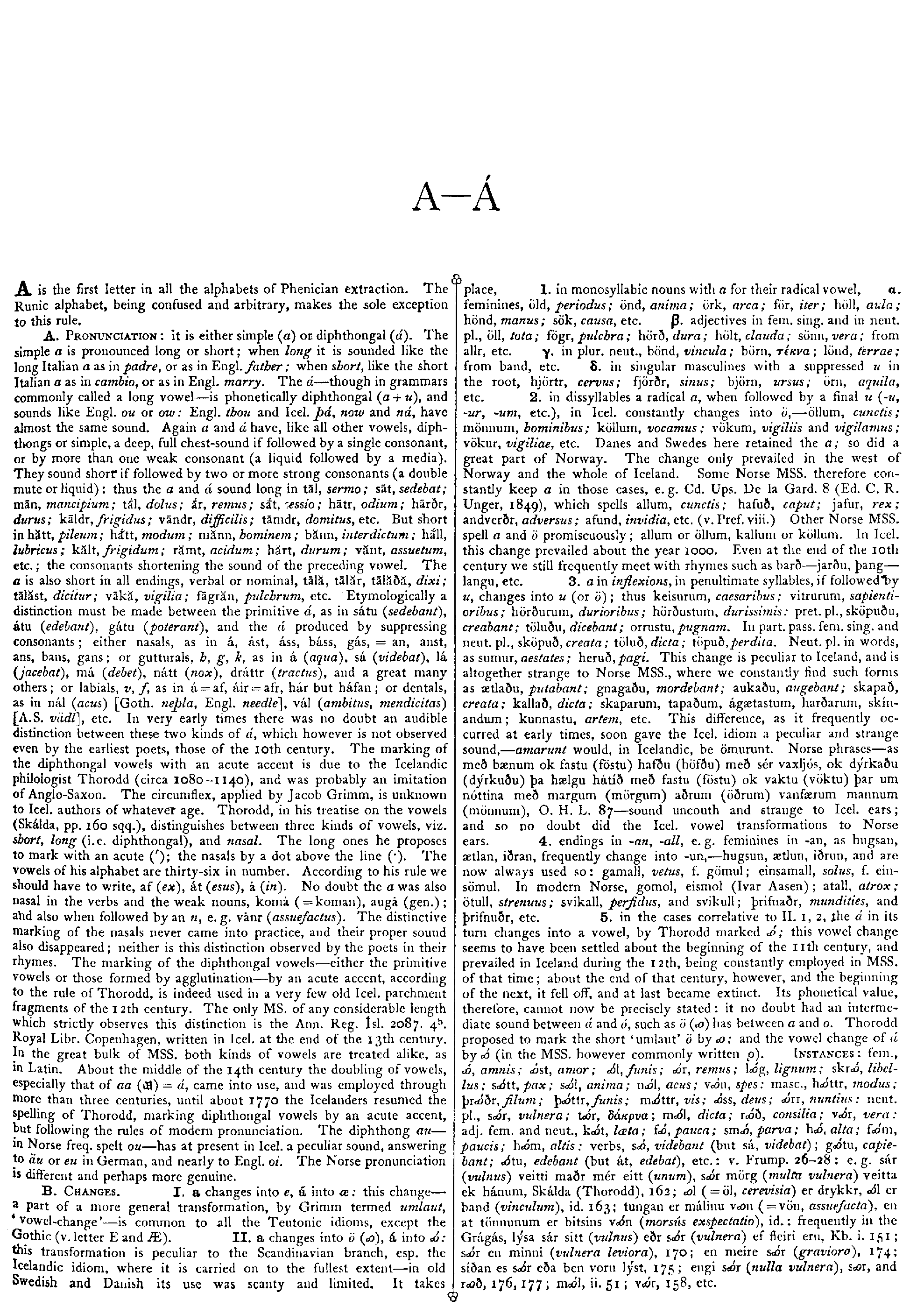
A.
is
the
first
letter
in
all
the
alphabets
of
Phenician
extraction.
The
Runic
alphabet,
being
confused
and
arbitrary,
makes
the
sole
exception
to
this
rule.
A.
PRONUNCIATION:
it
is
either
simple
(a)
or
diphthongal
(á).
The
simple
a
is
pronounced
long
or
short;
when
long
it
is
sounded
like
the
long
Italian
a
as
in
padre,
or
as
in
Engl.
father;
when
short,
like
the
short
Italian
a
as
in
cambio,
or
as
in
Engl.
marry.
The
á
--
though
in
grammars
commonly
called
a
long
vowel
--
is
phonetically
diphthongal
(a
+
u),
and
sounds
like
Engl.
ou
or
ow:
Engl.
thou
and
Icel.
þá,
now
and
ná,
have
almost
the
same
sound.
Again
a
and
á
have,
like
all
other
vowels,
diph-
thongs
or
simple,
a
deep,
full
chest-sound
if
followed
by
a
single
consonant,
or
by
more
than
one
weak
consonant
(a
liquid
followed
by
a
media).
They
sound
short
if
followed
by
two
or
more
strong
consonants
(a
double
mute
or
liquid):
thus
the
a
and
á
sound
long
in
tál,
sermo;
sát,
sedebat;
mán,
mancipium;
tál,
dolus;
ár,
remits;
sát,
sessio,
hátr,
odium;
hárðr,
durus;
káldr,
frigidus;
vándr,
difficilis;
támdr,
domitus,
etc.
But
short
in
hátt,
pileum;
hátt,
modum;
mánn,
bominem;
bánn,
interdictum;
háll,
lubricus;
kált,
frigidum;
rámt,
acidum;
hárt,
durum;
vánt,
assuetum,
etc.;
the
consonants
shortening
the
sound
of
the
preceding
vowel.
The
a
is
also
short
in
all
endings,
verbal
or
nominal,
tala,
talar,
talaða,
dixi;
talast,
dicitur;
vaka,
vigilia;
fagran,
pulchrum,
etc.
Etymologically
a
distinction
must
be
made
between
the
primitive
á,
as
in
sátu
(sedebant),
átu
(edebant),
gátu
(poterant),
and
the
á
produced
by
suppressing
consonants;
either
nasals,
as
in
á,
ást,
áss,
báss,
gás,
=
an,
anst,
ans,
bans,
gans;
or
gutturals,
h,
g,
k,
as
in
á
(aqua),
sá
(videbat),
lá
(jacebat),
má
(debet),
nátt
(nox),
dráttr
(tractus),
and
a
great
many
others;
or
labials,
v,
f,
as
in
á
=
af,
áir
=
afr,
hár
but
háfan;
or
dentals,
as
in
nál
(acus)
[Goth.
nepla,
Engl.
needle],
vál
(ambitus,
mendicitas)
[A.
S.
vädl],
etc.
In
very
early
times
there
was
no
doubt
an
audible
distinction
between
these
two
kinds
of
á,
which
however
is
not
observed
even
by
the
earliest
poets,
those
of
the
10th
century.
The
marking
of
the
diphthongal
vowels
with
an
acute
accent
is
due
to
the
Icelandic
philologist
Thorodd
(circa
1080-1140),
and
was
probably
an
imitation
of
Anglo-Saxon.
The
circumflex,
applied
by
Jacob
Grimm,
is
unknown
to
Icel.
authors
of
whatever
age.
Thorodd,
in
his
treatise
on
the
vowels
(Skálda,
pp.
160
sqq.),
distinguishes
between
three
kinds
of
vowels,
viz.
short,
long
(i.
e.
diphthongal),
and
nasal.
The
long
ones
he
proposes
to
mark
with
an
acute
( );
the
nasals
by
a
dot
above
the
line
(•).
The
vowels
of
his
alphabet
are
thirty-six
in
number.
According
to
his
rule
we
should
have
to
write,
af
(ex),
át
(esus),
ä
(in).
No
doubt
the
a
was
also
nasal
in
the
verbs
and
the
weak
nouns,
komå
(=
koman),
augä
(gen.);
and
also
when
followed
by
an
n,
e.
g.
vänr
(assuefactus).
The
distinctive
marking
of
the
nasals
never
came
into
practice,
and
their
proper
sound
also
disappeared;
neither
is
this
distinction
observed
by
the
poets
in
their
rhymes.
The
marking
of
the
diphthongal
vowels
--
either
the
primitive
vowels
or
those
formed
by
agglutination
--
by
an
acute
accent,
according
to
the
rule
of
Thorodd,
is
indeed
used
in
a
very
few
old
Icel.
parchment
fragments
of
the
12th
century.
The
only
MS.
of
any
considerable
length
which
strictly
observes
this
distinction
is
the
Ann.
Reg.
Ísl.
2087.
4b.
Royal
Libr.
Copenhagen,
written
in
Icel.
at
the
end
of
the
13th
century.
In
the
great
bulk
of
MSS.
both
kinds
of
vowels
are
treated
alike,
as
in
Latin.
About
the
middle
of
the
14th
century
the
doubling
of
vowels,
especially
that
of
aa
()
=
á,
came
into
use,
and
was
employed
through
more
than
three
centuries,
until
about
1770
the
Icelanders
resumed
the
spelling
of
Thorodd,
marking
diphthongal
vowels
by
an
acute
accent,
but
following
the
rules
of
modern
pronunciation.
The
diphthong
au
--
in
Norse
freq.
spelt
ou
--
has
at
present
in
Icel.
a
peculiar
sound,
answering
to
äu
or
eu
in
German,
and
nearly
to
Engl.
oi.
The
Norse
pronunciation
is
different
and
perhaps
more
genuine.
B.
CHANGES.
I.
a
changes
into
æ,
á
into
Æ:
this
change
--
a
part
of
a
more
general
transformation,
by
Grimm
termed
umlaut,
'vowel-change'
--
is
common
to
all
the
Teutonic
idioms,
except
the
Gothic
(v.
letter
E
and
Æ).
II.
a
changes
into
ö
(),
á
into
:
this
transformation
is
peculiar
to
the
Scandinavian
branch,
esp.
the
Icelandic
idiom,
where
it
is
carried
on
to
the
fullest
extent
--
in
old
Swedish
and
Danish
its
use
was
scanty
and
limited.
It
takes
place,
1.
in
monosyllabic
nouns
with
a
for
their
radical
vowel,
);
the
nasals
by
a
dot
above
the
line
(•).
The
vowels
of
his
alphabet
are
thirty-six
in
number.
According
to
his
rule
we
should
have
to
write,
af
(ex),
át
(esus),
ä
(in).
No
doubt
the
a
was
also
nasal
in
the
verbs
and
the
weak
nouns,
komå
(=
koman),
augä
(gen.);
and
also
when
followed
by
an
n,
e.
g.
vänr
(assuefactus).
The
distinctive
marking
of
the
nasals
never
came
into
practice,
and
their
proper
sound
also
disappeared;
neither
is
this
distinction
observed
by
the
poets
in
their
rhymes.
The
marking
of
the
diphthongal
vowels
--
either
the
primitive
vowels
or
those
formed
by
agglutination
--
by
an
acute
accent,
according
to
the
rule
of
Thorodd,
is
indeed
used
in
a
very
few
old
Icel.
parchment
fragments
of
the
12th
century.
The
only
MS.
of
any
considerable
length
which
strictly
observes
this
distinction
is
the
Ann.
Reg.
Ísl.
2087.
4b.
Royal
Libr.
Copenhagen,
written
in
Icel.
at
the
end
of
the
13th
century.
In
the
great
bulk
of
MSS.
both
kinds
of
vowels
are
treated
alike,
as
in
Latin.
About
the
middle
of
the
14th
century
the
doubling
of
vowels,
especially
that
of
aa
()
=
á,
came
into
use,
and
was
employed
through
more
than
three
centuries,
until
about
1770
the
Icelanders
resumed
the
spelling
of
Thorodd,
marking
diphthongal
vowels
by
an
acute
accent,
but
following
the
rules
of
modern
pronunciation.
The
diphthong
au
--
in
Norse
freq.
spelt
ou
--
has
at
present
in
Icel.
a
peculiar
sound,
answering
to
äu
or
eu
in
German,
and
nearly
to
Engl.
oi.
The
Norse
pronunciation
is
different
and
perhaps
more
genuine.
B.
CHANGES.
I.
a
changes
into
æ,
á
into
Æ:
this
change
--
a
part
of
a
more
general
transformation,
by
Grimm
termed
umlaut,
'vowel-change'
--
is
common
to
all
the
Teutonic
idioms,
except
the
Gothic
(v.
letter
E
and
Æ).
II.
a
changes
into
ö
(),
á
into
:
this
transformation
is
peculiar
to
the
Scandinavian
branch,
esp.
the
Icelandic
idiom,
where
it
is
carried
on
to
the
fullest
extent
--
in
old
Swedish
and
Danish
its
use
was
scanty
and
limited.
It
takes
place,
1.
in
monosyllabic
nouns
with
a
for
their
radical
vowel,
 .
feminines,
öld,
periodus;
önd,
anima;
örk,
arca;
för,
iter;
höll,
aula;
hönd,
manus;
sök,
causa,
etc.
.
feminines,
öld,
periodus;
önd,
anima;
örk,
arca;
för,
iter;
höll,
aula;
hönd,
manus;
sök,
causa,
etc.
 .
adjectives
in
fem.
sing,
and
in
neut.
pl.,
öll,
tota;
fögr,
pulchra;
hörð,
dura;
hölt,
clauda;
sönn,
vera;
from
allr,
etc.
.
adjectives
in
fem.
sing,
and
in
neut.
pl.,
öll,
tota;
fögr,
pulchra;
hörð,
dura;
hölt,
clauda;
sönn,
vera;
from
allr,
etc.
 .
in
plur.
neut.,
bönd,
vincula;
börn,
GREEK;
lönd,
terrae;
from
band,
etc.
.
in
plur.
neut.,
bönd,
vincula;
börn,
GREEK;
lönd,
terrae;
from
band,
etc.
 .
in
singular
masculines
with
a
suppressed
u
in
the
root,
hjörtr,
cervus;
fjörðr,
sinus;
björn,
ursus;
örn,
aquila,
etc.
2.
in
dissyllables
a
radical
a,
when
followed
by
a
final
u
(-u,
-ur,
-um,
etc.),
in
Icel.
constantly
changes
into
ö,
--
öllum,
cunctis;
mönnum,
hominibus;
köllum,
vocamus;
vökum,
vigiliis
and
vigilamus;
vökur,
vigiliae,
etc.
Danes
and
Swedes
here
retained
the
a;
so
did
a
great
part
of
Norway.
The
change
only
prevailed
in
the
west
of
Norway
and
the
whole
of
Iceland.
Some
Norse
MSS.
therefore
con-
stantly
keep
a
in
those
cases,
e.
g.
Cd.
Ups.
De
la
Gard.
8
(Ed.
C.
R.
Unger,
1849),
which
spells
allum,
cunctis;
hafuð,
caput;
jafur,
rex;
andverðr,
adversus;
afund,
invidia,
etc.
(v.
Pref.
viii.)
Other
Norse
MSS.
spell
a
and
ö
promiscuously;
allum
or
öllum,
kallum
or
köllum.
In
Icel.
this
change
prevailed
about
the
year
1000.
Even
at
the
end
of
the
loth
century
we
still
frequently
meet
with
rhymes
such
as
barð
--
jarðu,
þang
--
langu,
etc.
3.
a
in
inflexions,
in
penultimate
syllables,
if
followed
by
u,
changes
into
u
(or
ö);
thus
keisurum,
caesaribus;
vitrurum,
sapienti-
oribus;
hörðurum,
durioribus;
hörðustum,
durissimis:
pret.
pl.,
sköpuðu,
creabant;
töluðu,
dicebant;
orrustu,
pugnam.
In
part.
pass.
fem.
sing,
and
neut.
pl.,
sköpuð,
creata;
töluð,
dicta;
töpuð,
perdi/
a.
Neut.
pl.
in
words,
as
sumur,
aestates;
heruð,
pagi.
This
change
is
peculiar
to
Iceland,
and
is
altogether
strange
to
Norse
MSS.,
where
we
constantly
find
such
forms
as
ætlaðu,
putabant;
gnagaðu,
mordebant;
aukaðu,
augebant;
skapað,
creata;
kallað,
dicta;
skaparum,
tapaðum,
ágætastum,
harðarum,
skín-
andum;
kunnastu,
artem,
etc.
This
difference,
as
it
frequently
oc-
curred
at
early
times,
soon
gave
the
Icel.
idiom
a
peculiar
and
strange
sound,
--
amarunt
would,
in
Icelandic,
be
ömurunt.
Norse
phrases
--
as
með
bænum
ok
fastu
(fostu)
hafðu
(höfðu)
með
sér
vaxljós,
ok
dýrkaðu
(dýrkuðu)
þa
hælgu
hátíð
með
fastu
(föstu)
ok
vaktu
(vöktu)
þar
um
nóttina
með
margum
(mörgum)
aðrum
(öðrum)
vanfærum
mannum
(monnum),
O.
H.
L.
87
--
sound
uncouth
and
strange
to
Icel.
ears;
and
so
no
doubt
did
the
Icel.
vowel
transformations
to
Norse
ears.
4.
endings
in
-an,
-all,
e.
g.
feminines
in
-an,
as
hugsan,
ætlan,
iðran,
frequently
change
into
-un,
--
hugsun,
ætlun,
iðrun,
and
are
now
always
used
so:
gamall,
vetus,
f.
gömul;
einsamall,
solus,
f.
ein-
sömul.
In
modern
Norse,
gomol,
eismol
(Ivar
Aasen);
atall,
atrox;
ötull,
strenuus;
svikall,
perfidus,
and
svikull;
þrifnaðr,
mundities,
and
þrifnuðr,
etc.
5.
in
the
cases
correlative
to
II.
1,
2,
the
á
in
its
turn
changes
into
a
vowel,
by
Thorodd
marked
;
this
vowel
change
seems
to
have
been
settled
about
the
beginning
of
the
11th
century,
and
prevailed
in
Iceland
during
the
12th,
being
constantly
employed
in
MSS.
of
that
time;
about
the
end
of
that
century,
however,
and
the
beginning
of
the
next,
it
fell
off,
and
at
last
became
extinct.
Its
phonetical
value,
therefore,
cannot
now
be
precisely
stated:
it
no
doubt
had
an
interme-
diate
sound
between
á
and
ó,
such
as
ö
(oo)
has
between
a
and
o.
Thorodd
proposed
to
mark
the
short
'umlaut'
ö
by
;
and
the
vowel
change
of
á
by
(in
the
MSS.
however
commonly
written
).
INSTANCES:
fcm.,
,
amnis;
st,
amor;
l,
funis;
r,
remits;
lg,
lignum;
skr,
libel-
lus;
stt,
pax;
sl,
anima;
nl,
acus;
vn,
spes:
masc.,
httr,
modus;
þrðr,
fîlum;
þttr,
funis;
mttr,
vis;
ss,
deus;
rr,
nuntius:
neut.
pl.,
sr,
vulnera;
tr,
GREEK;
ml,
dicta;
rð,
consilia;
vr,
vera:
adj.
fem,
and
neut.,
koát,
læta;
f,
pauca;
sm,
parva;
h,
alta;
fm,
paucis;
hm,
altis:
verbs,
s,
videbant
(but
sá,
videbat);
gtu,
capie-
bant;
tu,
edebant
(but
at,
edebat),
etc.:
v.
Frump.
26-28:
e.
g.
sár
(vulnus)
veitti
maðr
mer
eitt
(unum),
sr
mörg
(multa
vulnera)
veitta
ek
hánum,
Skálda
(Thorodd),
162;
l
(=
öl,
cerevisia)
er
drykkr,
l
er
band
(vinculum),
id.
163;
tungan
er
málinu
vn
(=
vön,
assuefacta),
en
at
tönnunum
er
bitsins
vn
(morsils
exspectatio),
id.:
frequently
in
the
Grágás,
lýsa
sár
sitt
(vulnus)
eðr
sr
(vulnera)
ef
fleiri
eru,
Kb.
i.
151;
sr
en
minni
(vulnera
leviora),
170;
en
meire
sr
(graviora),
174;
síðan
es
sr
eða
ben
voru
lýst,
175;
engi
sr
(nulla
vulnera),
sr,
and
rð,
176,
177;
ml,
ii.
51;
vr,
158,
.
in
singular
masculines
with
a
suppressed
u
in
the
root,
hjörtr,
cervus;
fjörðr,
sinus;
björn,
ursus;
örn,
aquila,
etc.
2.
in
dissyllables
a
radical
a,
when
followed
by
a
final
u
(-u,
-ur,
-um,
etc.),
in
Icel.
constantly
changes
into
ö,
--
öllum,
cunctis;
mönnum,
hominibus;
köllum,
vocamus;
vökum,
vigiliis
and
vigilamus;
vökur,
vigiliae,
etc.
Danes
and
Swedes
here
retained
the
a;
so
did
a
great
part
of
Norway.
The
change
only
prevailed
in
the
west
of
Norway
and
the
whole
of
Iceland.
Some
Norse
MSS.
therefore
con-
stantly
keep
a
in
those
cases,
e.
g.
Cd.
Ups.
De
la
Gard.
8
(Ed.
C.
R.
Unger,
1849),
which
spells
allum,
cunctis;
hafuð,
caput;
jafur,
rex;
andverðr,
adversus;
afund,
invidia,
etc.
(v.
Pref.
viii.)
Other
Norse
MSS.
spell
a
and
ö
promiscuously;
allum
or
öllum,
kallum
or
köllum.
In
Icel.
this
change
prevailed
about
the
year
1000.
Even
at
the
end
of
the
loth
century
we
still
frequently
meet
with
rhymes
such
as
barð
--
jarðu,
þang
--
langu,
etc.
3.
a
in
inflexions,
in
penultimate
syllables,
if
followed
by
u,
changes
into
u
(or
ö);
thus
keisurum,
caesaribus;
vitrurum,
sapienti-
oribus;
hörðurum,
durioribus;
hörðustum,
durissimis:
pret.
pl.,
sköpuðu,
creabant;
töluðu,
dicebant;
orrustu,
pugnam.
In
part.
pass.
fem.
sing,
and
neut.
pl.,
sköpuð,
creata;
töluð,
dicta;
töpuð,
perdi/
a.
Neut.
pl.
in
words,
as
sumur,
aestates;
heruð,
pagi.
This
change
is
peculiar
to
Iceland,
and
is
altogether
strange
to
Norse
MSS.,
where
we
constantly
find
such
forms
as
ætlaðu,
putabant;
gnagaðu,
mordebant;
aukaðu,
augebant;
skapað,
creata;
kallað,
dicta;
skaparum,
tapaðum,
ágætastum,
harðarum,
skín-
andum;
kunnastu,
artem,
etc.
This
difference,
as
it
frequently
oc-
curred
at
early
times,
soon
gave
the
Icel.
idiom
a
peculiar
and
strange
sound,
--
amarunt
would,
in
Icelandic,
be
ömurunt.
Norse
phrases
--
as
með
bænum
ok
fastu
(fostu)
hafðu
(höfðu)
með
sér
vaxljós,
ok
dýrkaðu
(dýrkuðu)
þa
hælgu
hátíð
með
fastu
(föstu)
ok
vaktu
(vöktu)
þar
um
nóttina
með
margum
(mörgum)
aðrum
(öðrum)
vanfærum
mannum
(monnum),
O.
H.
L.
87
--
sound
uncouth
and
strange
to
Icel.
ears;
and
so
no
doubt
did
the
Icel.
vowel
transformations
to
Norse
ears.
4.
endings
in
-an,
-all,
e.
g.
feminines
in
-an,
as
hugsan,
ætlan,
iðran,
frequently
change
into
-un,
--
hugsun,
ætlun,
iðrun,
and
are
now
always
used
so:
gamall,
vetus,
f.
gömul;
einsamall,
solus,
f.
ein-
sömul.
In
modern
Norse,
gomol,
eismol
(Ivar
Aasen);
atall,
atrox;
ötull,
strenuus;
svikall,
perfidus,
and
svikull;
þrifnaðr,
mundities,
and
þrifnuðr,
etc.
5.
in
the
cases
correlative
to
II.
1,
2,
the
á
in
its
turn
changes
into
a
vowel,
by
Thorodd
marked
;
this
vowel
change
seems
to
have
been
settled
about
the
beginning
of
the
11th
century,
and
prevailed
in
Iceland
during
the
12th,
being
constantly
employed
in
MSS.
of
that
time;
about
the
end
of
that
century,
however,
and
the
beginning
of
the
next,
it
fell
off,
and
at
last
became
extinct.
Its
phonetical
value,
therefore,
cannot
now
be
precisely
stated:
it
no
doubt
had
an
interme-
diate
sound
between
á
and
ó,
such
as
ö
(oo)
has
between
a
and
o.
Thorodd
proposed
to
mark
the
short
'umlaut'
ö
by
;
and
the
vowel
change
of
á
by
(in
the
MSS.
however
commonly
written
).
INSTANCES:
fcm.,
,
amnis;
st,
amor;
l,
funis;
r,
remits;
lg,
lignum;
skr,
libel-
lus;
stt,
pax;
sl,
anima;
nl,
acus;
vn,
spes:
masc.,
httr,
modus;
þrðr,
fîlum;
þttr,
funis;
mttr,
vis;
ss,
deus;
rr,
nuntius:
neut.
pl.,
sr,
vulnera;
tr,
GREEK;
ml,
dicta;
rð,
consilia;
vr,
vera:
adj.
fem,
and
neut.,
koát,
læta;
f,
pauca;
sm,
parva;
h,
alta;
fm,
paucis;
hm,
altis:
verbs,
s,
videbant
(but
sá,
videbat);
gtu,
capie-
bant;
tu,
edebant
(but
at,
edebat),
etc.:
v.
Frump.
26-28:
e.
g.
sár
(vulnus)
veitti
maðr
mer
eitt
(unum),
sr
mörg
(multa
vulnera)
veitta
ek
hánum,
Skálda
(Thorodd),
162;
l
(=
öl,
cerevisia)
er
drykkr,
l
er
band
(vinculum),
id.
163;
tungan
er
málinu
vn
(=
vön,
assuefacta),
en
at
tönnunum
er
bitsins
vn
(morsils
exspectatio),
id.:
frequently
in
the
Grágás,
lýsa
sár
sitt
(vulnus)
eðr
sr
(vulnera)
ef
fleiri
eru,
Kb.
i.
151;
sr
en
minni
(vulnera
leviora),
170;
en
meire
sr
(graviora),
174;
síðan
es
sr
eða
ben
voru
lýst,
175;
engi
sr
(nulla
vulnera),
sr,
and
rð,
176,
177;
ml,
ii.
51;
vr,
158,
|
Source: Cleasby/Vigfusson, page b0046, entry 5 View original page image as: [TIFF] [PNG] [View previous entry] [View next entry] |
[Comment on this entry] [View comments (1)] |
The following entry has been hand-corrected once. |
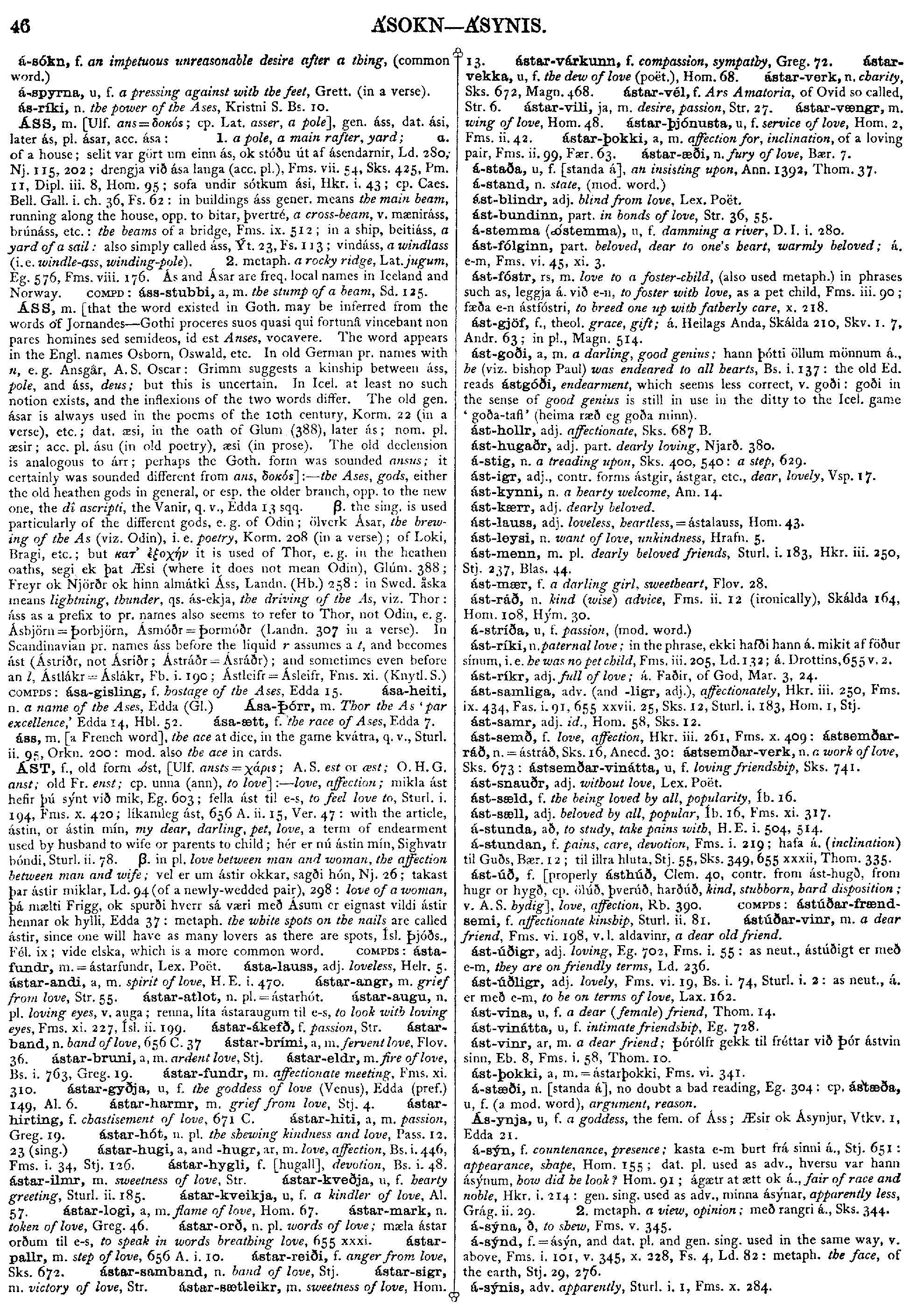
ÁSS,
m.
[that
the
word
existed
in
Goth,
may
be
inferred
from
the
words
of
Jornandes--Gothi
proceres
suos
quasi
qui
fortunâ
vincebant
non
pares
homines
sed
semideos,
id
est
Anses,
vocavere.
The
word
appears
in
the
Engl.
names
Osborn,
Oswald,
etc.
In
old
German
pr.
names
with
n,
e.
g.
Ansgâr,
A.
S.
Oscar:
Grimm
suggests
a
kinship
between
áss,
pole,
and
áss,
deus;
but
this
is
uncertain.
In
Icel.
at
least
no
such
notion
exists,
and
the
inflexions
of
the
two
words
differ.
The
old
gen.
asar
is
always
used
in
the
poems
of
the
10th
century,
Korm.
22
(in
a
verse),
etc.;
dat.
æsi,
in
the
oath
of
Glum
(388),
later
ás;
nom.
pl.
æsir;
acc.
pl.
ásu
(in
old
poetry),
æsi
(in
prose).
The
old
declension
is
analogous
to
árr;
perhaps
the
Goth,
form
was
sounded
ansus;
it
certainly
was
sounded
different
from
ans,
GREEK]:--the
Ases,
gods,
either
the
old
heathen
gods
in
general,
or
esp.
the
older
branch,
opp.
to
the
new
one,
the
dî
ascripti,
the
Vanir,
q.
v.,
Edda
13
sqq.
.
the
sing,
is
used
particularly
of
the
different
gods,
e.
g.
of
Odin;
ölverk
Ásar,
the
brewing
of
the
As
(viz.
Odin),
i.
e.
poetry,
Korm.
208
(in
a
verse);
of
Loki,
Bragi,
etc.;
but
GREEK
it
is
used
of
Thor,
e.
g.
in
the
heathen
oaths,
segi
ek
þat
Æsi
(where
it
does
not
mean
Odin),
Glúm.
388;
Freyr
ok
Njörðr
ok
hinn
almátki
Áss,
Landn.
(Hb.)
258:
in
Swed.
åska
means
lightning,
thunder,
qs.
ás-ekja,
the
driving
of
the
As,
viz.
Thor:
áss
as
a
prefix
to
pr.
names
also
seems
to
refer
to
Thor,
not
Odin,
e.
g.
Ásbjörn
=
Þorbjörn,
Asmóðr
=
Þormóðr
(Landri.
307
in
a
verse).
In
Scandinavian
pr.
names
áss
before
the
liquid
r
assumes
a
t,
and
becomes
ást
(Ástríðr,
not
Ásríðr;
Ástráðr
=
Ásráðr);
and
sometimes
even
before
an
l,
Ástlákr
--
Áslákr,
Fb.
i.
190;
Ástleifr
--
Ásleifr,
Fms.
xi.
(Knytl.
S.)
COMPDS:
ása-gisling,
f.
hostage
of
the
Ases,
Edda
15.
ása-heiti,
n.
a
name
of
the
Ases,
Edda
(Gl.)
Ása-Þorr,
m.
Thor
the
As
'par
excellence,'
Edda
14,
Hbl.
52.
ása-ætt,
f.
the
race
of
Ases,
Edda
7.
|
Source: Cleasby/Vigfusson, page b0048, entry 28 View original page image as: [TIFF] [PNG] [View previous entry] [View next entry] |
[Comment on this entry] [View comments] |
The following entry has been hand-corrected once. |
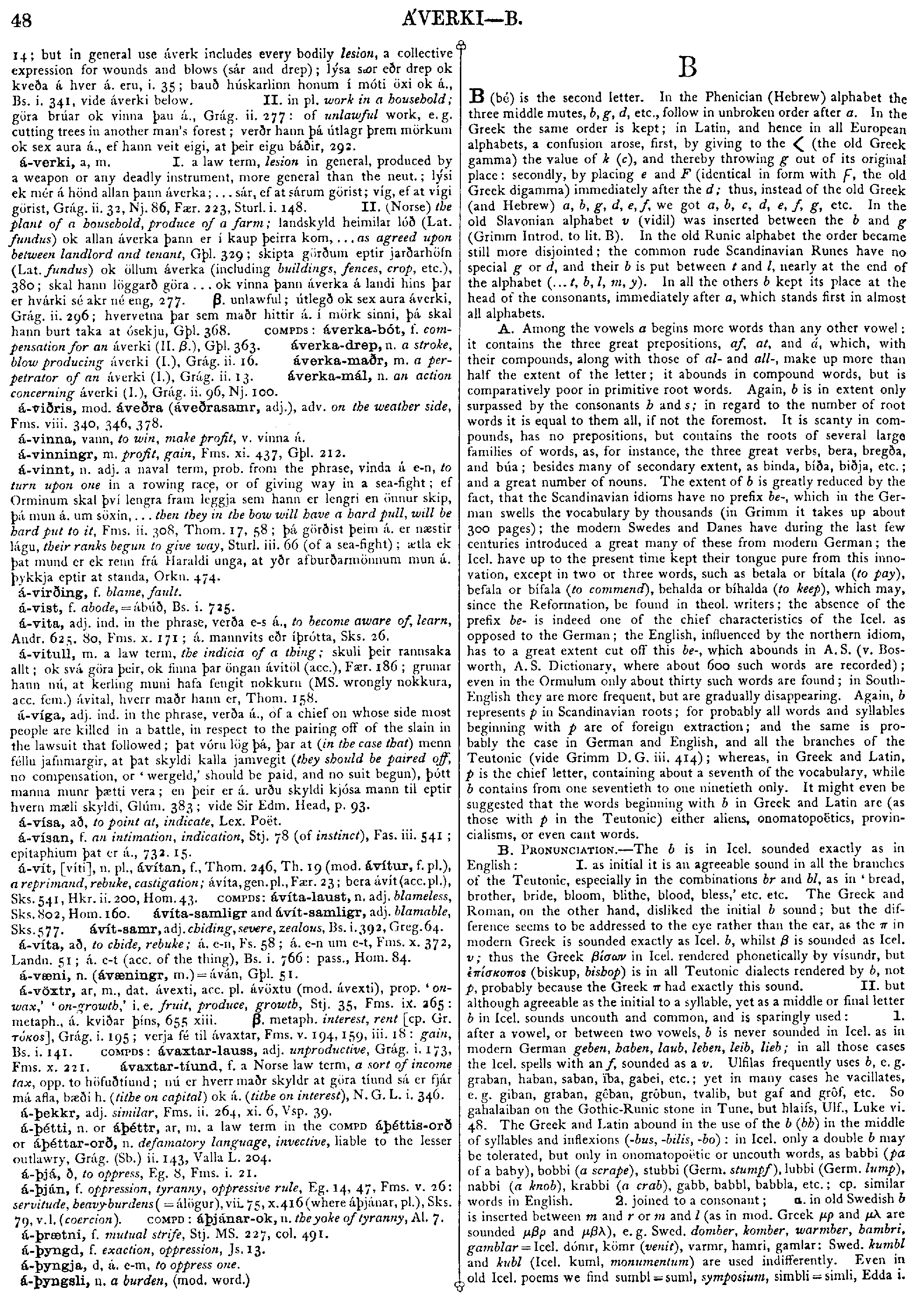
B.
PRONUNCIATION.
--
The
b
is
in
Icel.
sounded
exactly
as
in
English:
I.
as
initial
it
is
an
agreeable
sound
in
all
the
branches
of
the
Teutonic,
especially
in
the
combinations
br
and
bl,
as
in
'bread,
brother,
bride,
bloom,
blithe,
blood,
bless,'
etc.
etc.
The
Greek
and
Roman,
on
the
other
hand,
disliked
the
initial
b
sound;
but
the
difference
seerns
to
be
addressed
to
the
eye
rather
than
the
ear,
as
the
 in
modern
Greek
is
sounded
exactly
as
Icel.
b,
whilst
is
sounded
as
Icel.
v;
thus
the
Greek
GREEK
in
Icel.
rendered
phonetically
by
vísundr,
but
GREEK
(biskup,
bishop)
is
in
all
Teutonic
dialects
rendered
by
b,
not
p,
probably
because
the
Greek
had
exactly
this
sound.
II.
but
although
agreeable
as
the
initial
to
a
syllable,
yet
as
a
middle
or
final
letter
b
in
Icel.
sounds
uncouth
and
common,
and
is
sparingly
used:
1.
after
a
vowel,
or
between
two
vowels,
b
is
never
sounded
in
Icel.
as
in
modern
German
geben,
haben,
laub,
leben,
leib,
lieb;
in
all
those
cases
the
Icel.
spells
with
an
f,
sounded
as
a
v.
Ulfilas
frequently
uses
b,
e.g.
graban,
haban,
saban,
ïba,
gabei,
etc.;
yet
in
many
cases
he
vacillates,
e.g.
giban,
graban,
gêban,
grôbun,
tvalib,
but
gaf
and
grôf,
etc.
So
gahalaiban
on
the
Gothic-Runic
stone
in
Tune,
but
hlaifs,
Ulf.,
Luke
vi.
48.
The
Greek
and
Latin
abound
in
the
use
of
the
b
(bh)
in
the
middle
of
syllables
and
inflexions
(-bus,
-bills,
-bo):
in
Icel.
only
a
double
b
may
be
tolerated,
but
only
in
onomatopoëtic
or
uncouth
words,
as
babbi
(pa
of
a
baby),
bobbi
(a
scrape),
stubbi
(Germ.
stumpf),
lubbi
(Germ.
lump),
nabbi
(a
knob),
krabbi
(a
crab),
gabb,
babbl,
babbla,
etc.;
cp.
similar
words
in
English.
2.
joined
to
a
consonant;
.
in
old
Swedish
b
is
inserted
between
m
and
r
or
m
and
l
(as
in
mod.
Greek
in
modern
Greek
is
sounded
exactly
as
Icel.
b,
whilst
is
sounded
as
Icel.
v;
thus
the
Greek
GREEK
in
Icel.
rendered
phonetically
by
vísundr,
but
GREEK
(biskup,
bishop)
is
in
all
Teutonic
dialects
rendered
by
b,
not
p,
probably
because
the
Greek
had
exactly
this
sound.
II.
but
although
agreeable
as
the
initial
to
a
syllable,
yet
as
a
middle
or
final
letter
b
in
Icel.
sounds
uncouth
and
common,
and
is
sparingly
used:
1.
after
a
vowel,
or
between
two
vowels,
b
is
never
sounded
in
Icel.
as
in
modern
German
geben,
haben,
laub,
leben,
leib,
lieb;
in
all
those
cases
the
Icel.
spells
with
an
f,
sounded
as
a
v.
Ulfilas
frequently
uses
b,
e.g.
graban,
haban,
saban,
ïba,
gabei,
etc.;
yet
in
many
cases
he
vacillates,
e.g.
giban,
graban,
gêban,
grôbun,
tvalib,
but
gaf
and
grôf,
etc.
So
gahalaiban
on
the
Gothic-Runic
stone
in
Tune,
but
hlaifs,
Ulf.,
Luke
vi.
48.
The
Greek
and
Latin
abound
in
the
use
of
the
b
(bh)
in
the
middle
of
syllables
and
inflexions
(-bus,
-bills,
-bo):
in
Icel.
only
a
double
b
may
be
tolerated,
but
only
in
onomatopoëtic
or
uncouth
words,
as
babbi
(pa
of
a
baby),
bobbi
(a
scrape),
stubbi
(Germ.
stumpf),
lubbi
(Germ.
lump),
nabbi
(a
knob),
krabbi
(a
crab),
gabb,
babbl,
babbla,
etc.;
cp.
similar
words
in
English.
2.
joined
to
a
consonant;
.
in
old
Swedish
b
is
inserted
between
m
and
r
or
m
and
l
(as
in
mod.
Greek

 and
and
 are
sounded
and
,
e.g.
Swed.
domber,
komber,
warmber,
hambri,
gamblar
=
Icel.
dómr,
komr
(venit),
varmr,
hamri,
gamlar:
Swed.
kumbl
and
kubl
(Icel.
kuml,
monumentum)
are
used
indifferently.
Even
in
old
Icel.
poems
we
find
sumbl
=
suml,
symposium,
simbli
=
simli,
Edda
i.
are
sounded
and
,
e.g.
Swed.
domber,
komber,
warmber,
hambri,
gamblar
=
Icel.
dómr,
komr
(venit),
varmr,
hamri,
gamlar:
Swed.
kumbl
and
kubl
(Icel.
kuml,
monumentum)
are
used
indifferently.
Even
in
old
Icel.
poems
we
find
sumbl
=
suml,
symposium,
simbli
=
simli,
Edda
i.
|
Source: Cleasby/Vigfusson, page b0114, entry 1 View original page image as: [TIFF] [PNG] [View previous entry] [View next entry] |
[Comment on this entry] [View comments] |
The following entry has not been hand-corrected. However, the page is reserved and someone is correcting it. |
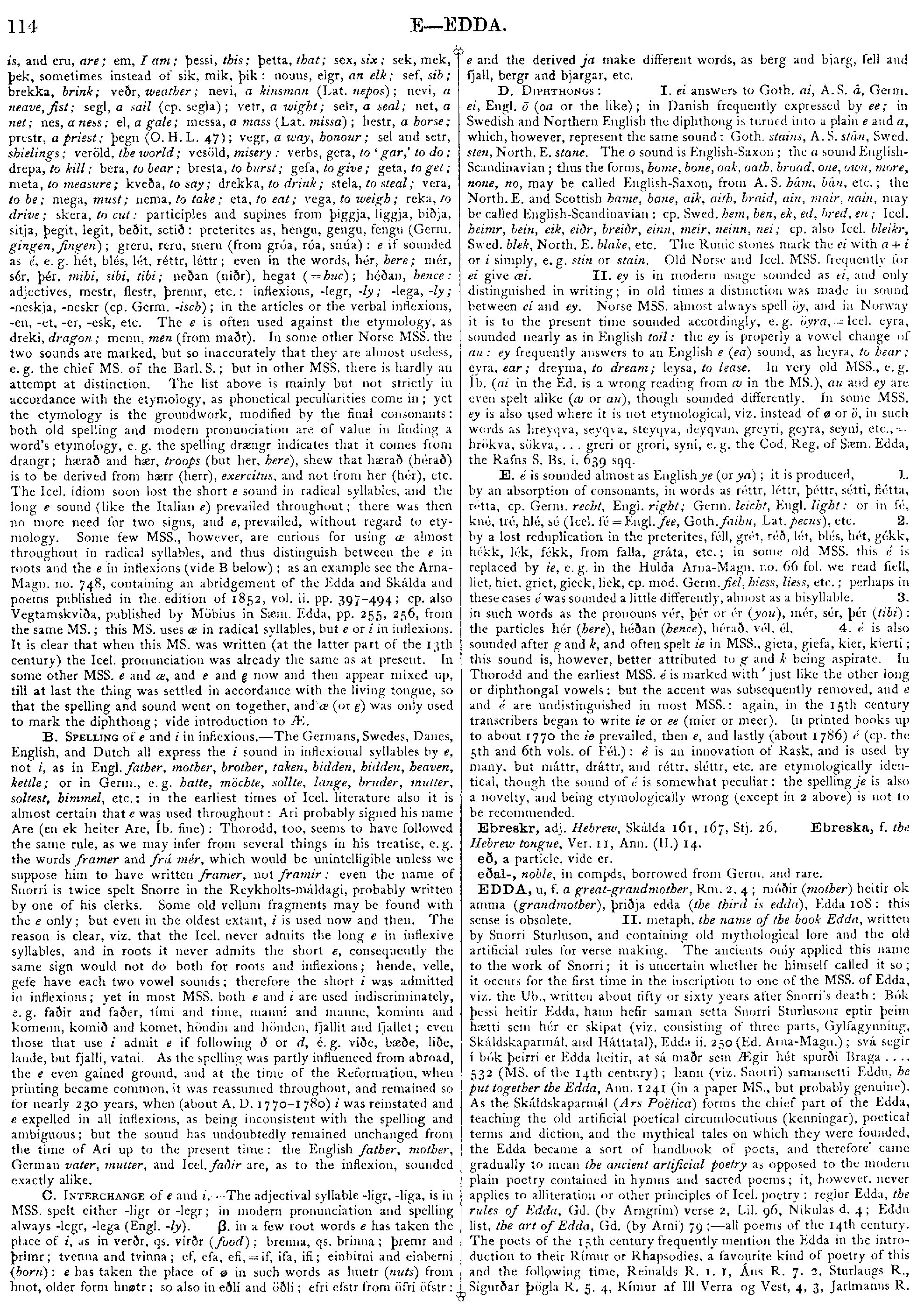
i s, and em, are; em, lam; þessi, thi s; þetta, that; sex, s i x: sek, mek, þek, sometimes instead of sik, mik, þik: nouns, elgr, an elk; sef, s ib; brekka, brink; veðr, weather; nevi, a kinsman (Lat. nepos); nevi, a neave, fist; segl, a sail (cp. segla); vetr, a wight; selr, a se a l; net, a net; nes, a ne ss; el, a gale; messa, a mass (Lat. missa); hestr, a horse; prtstr, a priest; þegn (O. H. L. 47); vegr, a way, honour; sel and setr, shielings; verold, the world; vesold, misery: verbs, gera, to ' gar, ' to do; drepa, to kill; bera, to bear; bresta, to burst; gefa, to give; geta, to get; meta, to measure; kveða, to say; drekka, to drink; stela, to steal; vera, to be; mega, must; nema, to take; eta, to e a t; vega, to weigh; reka, t o drive; skera, to cut: participles and supines from þiggja, liggja, biðja, sitja, þegit, legit, beðit, setið: preterites as, hengu, gengu, fengu (Germ. gingen, fingen); greru, reru, srxeru (from gróa, róa, snúa): e if sounded as é, e. g. hot, blés, let, réttr, léttr; even in the words, her, here; mér, scr, þér, mihi, sibi, tibi; neðan (niðr), hegat ( -- hue); héðan, hence: adjectives, mestr, flestr, þrennr, etc.: inflexions, -legr, - ly; -lega, - ly; -neskja, -neskr (cp. Germ, - i sc h); in the articles or the verbal inflexions, -en, -et, -er, -esk, etc. The e is often used against the etymology, as dreki, dragon; menu, men (from maðr). In some other Norse MSS. the two sounds are marked, but so inaccurately that they are almost useless, e. g. the chief MS. of the Bad. S.; but in other MSS. there is hardly an attempt at distinction. The list above is mainly but not strictly in accordance with the etymology, as phonetical peculiarities come in; yet the etymology is the groundwork, modified by the final consonants: both old spelling and modern pronunciation are of value in finding a word's etymology, e. g. the spelling drsengr indicates that it comes from drangr; hærað and haer, troops (but her, here), shew that hærað (hérað) is to be derived from hærr (herr), exercitus, and not from her (her), etc. The Icel. idiom soon lost the short e sound in radical syllables, and the long e sound (like the Italian e) prevailed throughout; there was then no more need for two signs, and e, prevailed, without regard to ety- mology. Some few MSS., however, are curious for using æ almost throughout in radical syllables, and thus distinguish between the e in roots and the e in inflexions (vide B below); as an example see the Arna- Magn. no. 748, containing an abridgement of the Edda and Skálda and poems published in the edition of 1852, vol. ii. pp. 397-494; cp. also Vegtamskviða, published by Mubius in Sæm. Edda, pp. 255, 256, from the same MS.; this MS. uses æ in radical syllables, but e or i in inflexions. It is clear that when this MS. was written (at the latter part of the i^th century) the Icel. pronunciation was already the same as at present. In some other MSS. e and ce, and e and g now and then appear mixed up, till at last the thing was settled in accordance with the living tongue, so that the spelling and sound went on together, and CE (or g) was only used to mark the diphthong; vide introduction to Æ. B. SPELLING of e and i in inflexions. -- The Germans, Swedes, Danes, English, and Dutch all express the i sound in inflexional syllables by e, not i, as in Engl. y a í her, mother, brother, taken, bidden, hidden, heaven, kettle; or in Germ., e. g. hatte, möchte, sollte, lange, bruder, mutter, soltesf, himmel, etc.: in the earliest times of Icel. literature also it is almost certain that e was used throughout: Ari probably signed his name Are (en ek heitcr Are, tb. fine): Thorodd, too, seems to have followed the same rule, as we may infer from several things in his treatise, e. g. the words framer and frá mér, which would be unintelligible unless we suppose him to have written framer, not framir: even the name of Snorri is twice spelt Snorre in the Reykholts-máldagi, probably written by one of his clerks. Some old vellum fragments may be found with the e only; but even in the oldest extant, i is used now and then. The reason is clear, viz. that the Icel. never admits the long e in inflexive syllables, and in roots it never admits the short e, consequently the same sign would not do both for roots and inflexions; hende, velle, gefe have each two vowel sounds; therefore the short i was admitted in inflexions; yet in most MSS. both e and i are used indiscriminately, a. g. faðir and faðer, tími and time, manni and manne, kominn and komenn, komið and komet, hihidin and hundcn, fjallit and fjallet; even those that use i admit e if following ð or d, é. g. viðe, bæðe, liðe, lande, but fjalli, vatni. As the spelling was partly influenced from abroad, the e even gained ground, and at the time of the Reformation, when printing became common, it was rcassmned throughout, and remained so for nearly 230 years, when (about A. D. 1770-1/80) i was reinstated and e expelled in all inflexions, as being inconsistent with the spelling and ambiguous; but the sound has undoubtedly remained unchanged from the time of Ari up to the present time: the English father, mother, German vater, mutter, and lcd. fadir are, as to the inflexion, sounded exactly alike. C. INTERCHANGE of e and i. -- The adjectival syllable -ligr, -liga, is in MSS. spelt either -ligr or -legr; in modern pronunciation and spelling always -legr, -lega (Engl. -ly). |3. in a few root words e has taken the place of i, as in verðr, qs. virðr (food); brenna, qs. brinna; þremr and þrimr; tvenna and tvinna; ef, efa, efi, = if, ifa, ifi; einbirni and einberni (horn): e has taken the place of a in such words as hnetr (nuts) from hnot, older form hnøtr: so also in eðli and öðli; efri efstr from öfri öfstr: e and the derived ja make different words, as berg and bjarg, fell and fjall, bergr and bjargar, etc. D. DIPHTHONGS: I. ei answers to Goth, ai, A. S. â, Germ. ei, Engl. a (oa or the like); in Danish frequently expressed by ee; in Swedish and Northern English the diphthong is turned into a plain e and a, which, however, represent the same sound: Goth, stains, A. S. stan, Swed. sten, North. E. s to ne. The o sound is English-Saxon; the a sound English- Scandinavian; thus the forms, home, bone, oak, oath, broad, one, own, more, none, no, may be called English-Saxon, from A. S. ham, ban, etc.; the North. E. and Scottish harne, bane, aik, ai/h, braid, ain, mair, /tain, may be called English-Scandinavian: cp. Swed. hem, ben, ek, ed. bred, en; Icel. heimr, bein, eik, eidr, breidr, einn, meir, neinn, nei; cp. also Icel. bleikr, Swed. blek, North. E. blake, etc. The Runic stones mark the ei with a + i or i simply, e. g. sti w or s tain. Old Norse and Icel. MSS. frequently for ei give Æ i. II. ey is in modern usage sounded as ei, and only distinguished in writing; in old times a distinction was made in sound between ei and ey. Norse MSS. almost always spell 'ôy, and in Norway it is to the present time sounded accordingly, e. g. iiyra, -- Icel. eyra, sounded nearly as in English toil: the ey is properly a vowel change of au: ey frequently answers to an English e (ea) sound, as heyra, to hear; eyra, e ar; dreyma, to dream; leysa, to lease. In very old MSS., e. g. Ib. (ai in the Ed. is a wrong reading from aj in the MS.), au and ey are even spelt alike (aj or a;^), though sounded differently. In some MSS. ey is also used where it is not etymological, viz. instead of ø or o, in such words as hreyqva, seyqva, stcyqva, deyqvan, greyri, geyra, seyni, etc., = hrökva, sökva, ... greri or grori, syni, e. g. the Cod. Reg. of S;em. Edda, the Rafns S. Bs. i. 639 E. é is sounded almost as English y e (or y a); it is produced, 1. by an absorption of consonants, in words as réttr, léttr, þéttr, sétti, flétta, n'-tta, cp. Germ, recht, Engl. right; Germ. Icicht, Engl. light: or in fo, kno, tré, hit:, sc (Icel. fe = Engl. / ee, Goth. / aih w, Lat. pe cws), etc. 2. by a lost reduplication in the preterites, fell, grot, réð, h-t, blús, hot, gékk, hékk, Ick, fékk, from falla, grata, etc.; in some old MSS. this é is replaced by ie, e. g. in the Hulda Arna-Magn. no. 66 fol. we read fiell, liet, hiet, griet, gieck, liek, cp. mod. Geim. fíel. hiess, Hess, etc.; perhaps in these cases e was sounded a little differently, almost as a bisyllable. 3. in such words as the pronouns vt'-r, þér or ér (you), niér, sér, þér (tibi): the particles her (here), héðan (hence), hérað, vi'-l, el. 4. t' is also sounded after g and k, and often spelt ie in MSS., gieta, giefa, kier, kierti; this sound is, however, better attributed to g and k being aspirate. In Thorodd and the earliest MSS. é is marked with ' just like the other long or diphthongal vowels; but the accent was subsequently removed, and e and é are undistinguished in most MSS.: again, in the 15th century transcribers began to write ie or ee (mier or meer). In printed books up to about 1770 the ie- prevailed, then e, and lastly (about 1786) (; (cp. the 5th and 6th vols. of Eél.): ë is an innovation of Rask, and is used by many, but máttr, dráttr, and rettr, sléttr, etc. are etymologically iden- tical, though the sound of K is somewhat peculiar: the spelling~/e is also a novelty, and being etymologically wrong (except in 2 above) is not to be recommended.
|
Source: Cleasby/Vigfusson, page b0227, entry 2 View original page image as: [TIFF] [PNG] [View previous entry] [View next entry] |
[Comment on this entry] [View comments] |
The following entry has been hand-corrected once. |
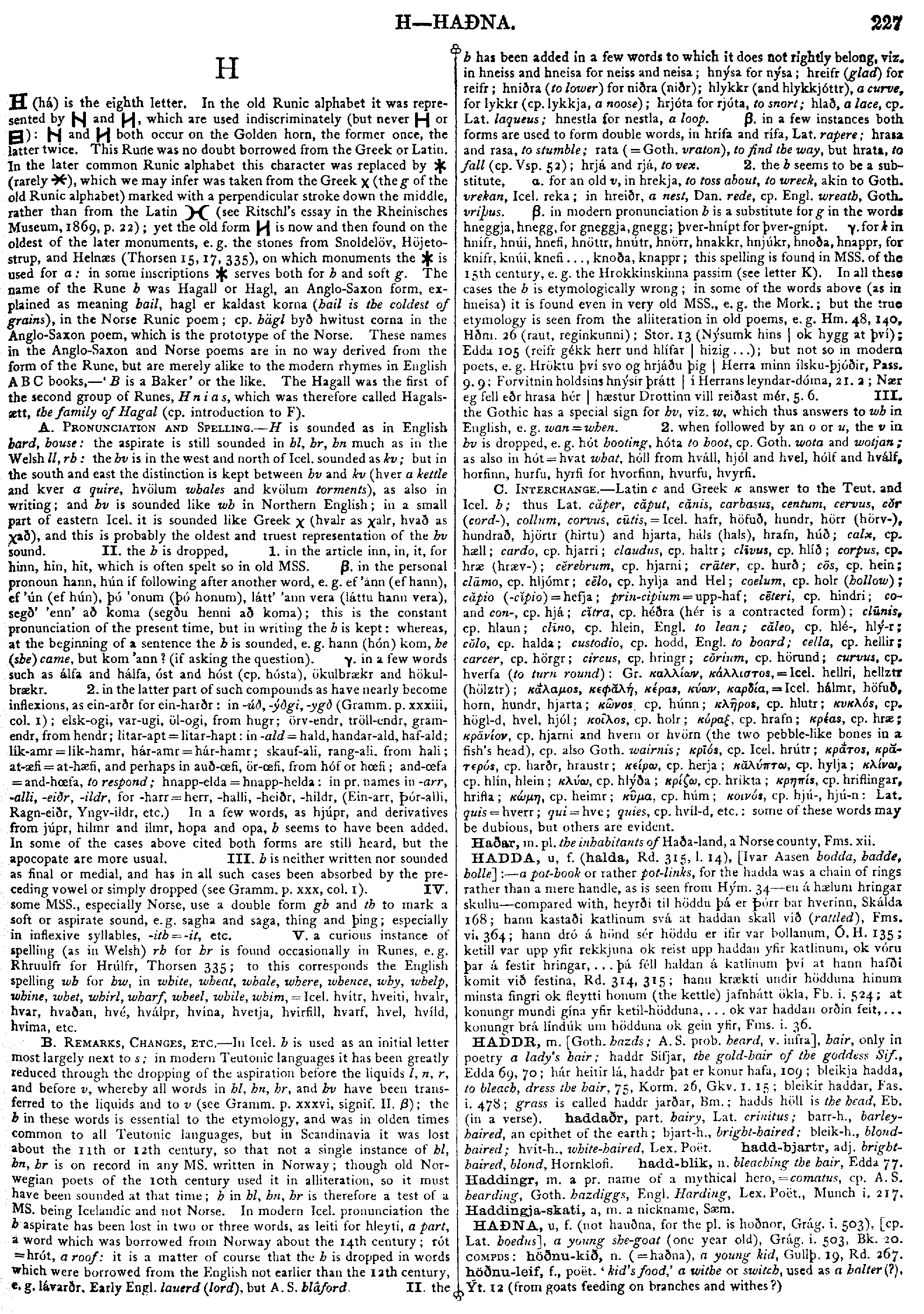
A.
PRONUNCIATION
AND
SPELLING.
--
H
is
sounded
as
in
English
hard,
house:
the
aspirate
is
still
sounded
in
hl,
hr,
hn
much
as
in
the
Welsh
ll,
rh:
the
hv
is
in
the
west
and
north
of
Icel.
sounded
as
kv;
but
in
the
south
and
east
the
distinction
is
kept
between
hv
and
kv
(hver
a
kettle
and
kver
a
quire,
hvölum
whales
and
kvölum
torments),
as
also
in
writing;
and
hv
is
sounded
like
wh
in
Northern
English;
in
a
small
part
of
eastern
Icel.
it
is
sounded
like
Greek
 (hvalr
as
alr,
hvað
as
að),
and
this
is
probably
the
oldest
and
truest
representation
of
the
hv
sound.
II.
the
h
is
dropped,
1.
in
the
article
inn,
in,
it,
for
hinn,
hin,
hit,
which
is
often
spelt
so
in
old
MSS.
.
in
the
personal
pronoun
hann,
hún
if
following
after
another
word,
e.g.
ef
'ann
(ef
hann),
ef
'ún
(ef
hún),
þó
'onum
(þó
honum),
látt'
'ann
vera
(láttu
hann
vera),
segð'
'enn'
að
koma
(segðu
henni
að
koma);
this
is
the
constant
pronunciation
of
the
present
time,
but
in
writing
the
h
is
kept:
whereas,
at
the
beginning
of
a
sentence
the
h
is
sounded,
e.g.
hann
(hón)
kom,
he
(she)
came,
but
kom
'ann
?
(if
asking
the
question).
.
in
a
few
words
such
as
álfa
and
hálfa,
óst
and
host
(cp.
hósta),
ökulbrækr
and
hökulbraekr.
2.
in
the
latter
part
of
such
compounds
as
have
nearly
become
inflexions,
as
ein-arðr
for
ein-harðr:
in
-úð,
-ýðgi,
-ygð
(Gramm.
p.
xxxiii,
col.
1);
elsk-ogi,
var-ugi,
öl-ogi,
from
hugr;
örv-endr,
tröll-endr,
gram-endr,
from
hendr;
litar-apt
=
litar-hapt:
in
-ald
=
hald,
handar-ald,
haf-ald;
lík-amr
=
lík-hamr,
hár-amr
=
hár-hamr;
skauf-ali,
rang-ali,
from
hali;
at-æfi
=
at-hæfi,
and
perhaps
in
auð-œfi,
ör-œfi,
from
hóf
or
hœfi;
and-œfa
=
and-hœfa,
to
respond;
hnapp-elda
=
hnapp-helda:
in
pr.
names
in
-arr,
-alli,
-eiðr,
-ildr,
for
-harr
=
herr,
-halli,
-heiðr,
-hildr,
(Ein-arr,
Þór-alli,
Ragn-eiðr,
Yngv-ildr,
etc.)
In
a
few
words,
as
hjúpr,
and
derivatives
from
júpr,
hilmr
and
ilmr,
hopa
and
opa,
h
seems
to
have
been
added.
In
some
of
the
cases
above
cited
both
forms
are
still
heard,
but
the
apocopate
are
more
usual.
III.
h
is
neither
written
nor
sounded
as
final
or
medial,
and
has
in
all
such
cases
been
absorbed
by
the
preceding
vowel
or
simply
dropped
(see
Gramm.
p.
xxx,
col.
1).
IV.
some
MSS.,
especially
Norse,
use
a
double
form
gh
and
th
to
mark
a
soft
or
aspirate
sound,
e.g.
sagha
and
saga,
thing
and
þing;
especially
in
inflexive
syllables,
-ith
=
-it,
etc.
V.
a
curious
instance
of
spelling
(as
in
Welsh)
rh
for
hr
is
found
occasionally
in
Runes,
e.g.
Rhruulfr
for
Hrúlfr,
Thorsen
335;
to
this
corresponds
the
English
spelling
wh
for
hw,
in
white,
wheat,
whale,
where,
whence,
why,
whelp,
whine,
whet,
whirl,
wharf,
wheel,
while,
whim,
=
Icel.
hvítr,
hveiti,
hvalr,
hvar,
hvaðan,
hvé,
hválpr,
hvína,
hvetja,
hvirfill,
hvarf,
hvel,
hvíld,
hvima,
etc.
(hvalr
as
alr,
hvað
as
að),
and
this
is
probably
the
oldest
and
truest
representation
of
the
hv
sound.
II.
the
h
is
dropped,
1.
in
the
article
inn,
in,
it,
for
hinn,
hin,
hit,
which
is
often
spelt
so
in
old
MSS.
.
in
the
personal
pronoun
hann,
hún
if
following
after
another
word,
e.g.
ef
'ann
(ef
hann),
ef
'ún
(ef
hún),
þó
'onum
(þó
honum),
látt'
'ann
vera
(láttu
hann
vera),
segð'
'enn'
að
koma
(segðu
henni
að
koma);
this
is
the
constant
pronunciation
of
the
present
time,
but
in
writing
the
h
is
kept:
whereas,
at
the
beginning
of
a
sentence
the
h
is
sounded,
e.g.
hann
(hón)
kom,
he
(she)
came,
but
kom
'ann
?
(if
asking
the
question).
.
in
a
few
words
such
as
álfa
and
hálfa,
óst
and
host
(cp.
hósta),
ökulbrækr
and
hökulbraekr.
2.
in
the
latter
part
of
such
compounds
as
have
nearly
become
inflexions,
as
ein-arðr
for
ein-harðr:
in
-úð,
-ýðgi,
-ygð
(Gramm.
p.
xxxiii,
col.
1);
elsk-ogi,
var-ugi,
öl-ogi,
from
hugr;
örv-endr,
tröll-endr,
gram-endr,
from
hendr;
litar-apt
=
litar-hapt:
in
-ald
=
hald,
handar-ald,
haf-ald;
lík-amr
=
lík-hamr,
hár-amr
=
hár-hamr;
skauf-ali,
rang-ali,
from
hali;
at-æfi
=
at-hæfi,
and
perhaps
in
auð-œfi,
ör-œfi,
from
hóf
or
hœfi;
and-œfa
=
and-hœfa,
to
respond;
hnapp-elda
=
hnapp-helda:
in
pr.
names
in
-arr,
-alli,
-eiðr,
-ildr,
for
-harr
=
herr,
-halli,
-heiðr,
-hildr,
(Ein-arr,
Þór-alli,
Ragn-eiðr,
Yngv-ildr,
etc.)
In
a
few
words,
as
hjúpr,
and
derivatives
from
júpr,
hilmr
and
ilmr,
hopa
and
opa,
h
seems
to
have
been
added.
In
some
of
the
cases
above
cited
both
forms
are
still
heard,
but
the
apocopate
are
more
usual.
III.
h
is
neither
written
nor
sounded
as
final
or
medial,
and
has
in
all
such
cases
been
absorbed
by
the
preceding
vowel
or
simply
dropped
(see
Gramm.
p.
xxx,
col.
1).
IV.
some
MSS.,
especially
Norse,
use
a
double
form
gh
and
th
to
mark
a
soft
or
aspirate
sound,
e.g.
sagha
and
saga,
thing
and
þing;
especially
in
inflexive
syllables,
-ith
=
-it,
etc.
V.
a
curious
instance
of
spelling
(as
in
Welsh)
rh
for
hr
is
found
occasionally
in
Runes,
e.g.
Rhruulfr
for
Hrúlfr,
Thorsen
335;
to
this
corresponds
the
English
spelling
wh
for
hw,
in
white,
wheat,
whale,
where,
whence,
why,
whelp,
whine,
whet,
whirl,
wharf,
wheel,
while,
whim,
=
Icel.
hvítr,
hveiti,
hvalr,
hvar,
hvaðan,
hvé,
hválpr,
hvína,
hvetja,
hvirfill,
hvarf,
hvel,
hvíld,
hvima,
etc.
|
Source: Cleasby/Vigfusson, page b0243, entry 17 View original page image as: [TIFF] [PNG] [View previous entry] [View next entry] |
[Comment on this entry] [View comments] |
The following entry has been hand-corrected once. |
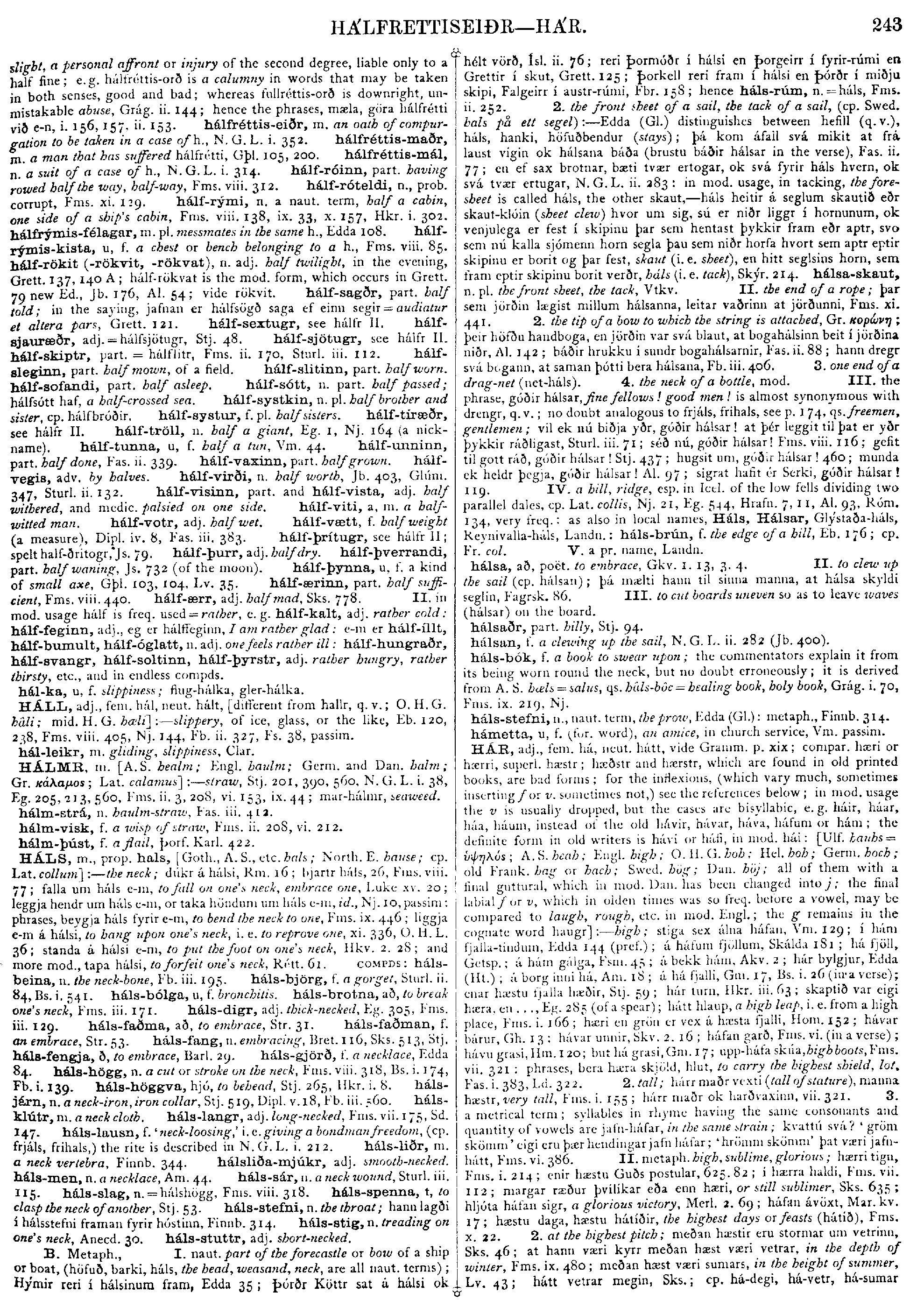
HÁR, adj., fem. há, neut. hátt, vide Gramm. p. xix; compar. hæri or hærri, superl. hæstr; hæðstr and hærstr, which are found in old printed books, are bad forms; for the inflexions, (which vary much, sometimes inserting f or v, sometimes not,) see the references below; in mod. usage the v is usually dropped, but the cases are bisyllabic, e.g. háir, háar, háa, háum, instead of the old hávir, hávar, háva, háfum or hám; the definite form in old writers is hávi or háfi, in mod. hái: [Ulf. hauhs = GREEK; A. S. heah; Engl. high; O. H. G. hoh; Hel. hoh; Germ. hoch; old Frank, hag or hach; Swed. hög; Dan. höj; all of them with a final guttural, which in mod. Dan. has been changed into j; the final labial f or v, which in olden times was so freq. before a vowel, may be compared to laugh, rough, etc. in mod. Engl.; the g remains in the cognate word haugr] :-- high; stiga sex álna háfan, Vm. 129; í hám fjalla-tindum, Edda 144 (pref.); á háfum fjöllum, Skálda 181; há fjöll, Getsp.; á hám gálga, Fsm. 45; á bekk hám, Akv. 2; hár bylgjur, Edda (Ht.); á borg inni há, Am. 18; á há fjalli, Gm. 17, Bs. i. 26 (in a verse); enar hæstu fjalla hæðir, Stj. 59; hár turn, Hkr. iii. 63; skaptið var eigi hæra, en ..., Eg. 285 (of a spear); hátt hlaup, a high leap, i.e. from a high place, Fms. i. 166; hæri en grön er vex á hæsta fjalli, Hom. 152; hávar bárur, Gh. 13: hávar unnir, Skv. 2. 16; háfan garð, Fms. vi. (in a verse); hávu grasi, Hm. 120; but há grasi. Gm. 17; upp-háfa skúa, high boots, Fms. vii. 321: phrases, bera hæra skjöld, hlut, to carry the highest shield, lot, Fas. i. 383, Ld. 322. 2. tall; hárr maðr vexti (tall of stature), manna hæstr, very tall, Fms. i. 155; hárr maðr ok harðvaxinn, vii. 321. 3. a metrical term; syllables in rhyme having the same consonants and quantity of vowels are jafn-háfar, in the same strain; kvattú svá? 'gröm skömm' eigi eru þær hendingar jafn háfar; 'hrömm skömm' þat væri jafnhátt, Fms. vi. 386. II. metaph. high, sublime, glorious; hærri tign, Fms. i. 214; enir hæstu Guðs postular, 625. 82; í hærra haldi, Fms. vii. 112; margar ræður þvílíkar eða enn hæri, or still sublimer, Sks. 635; hljóta háfan sigr, a glorious victory, Merl. 2. 69; háfan ávöxt, Mar. kv. 17; hæstu daga, hæstu hátíðir, the highest days or feasts (hátíð), Fms. x. 22. 2. at the highest pitch; meðan hæstir eru stormar um vetrinn, Sks. 46; at hann væri kyrr meðan hæst væri vetrar, in the depth of winter, Fms. ix. 480; meðan hæst væri sumars, in the height of summer, Lv. 43; hátt vetrar megin, Sks.; cp. há-degi, há-vetr, há-sumar
|
Source: Cleasby/Vigfusson, page b0312, entry 23 View original page image as: [TIFF] [PNG] [View previous entry] [View next entry] |
[Comment on this entry] [View comments] |
The following entry has been hand-corrected once. |
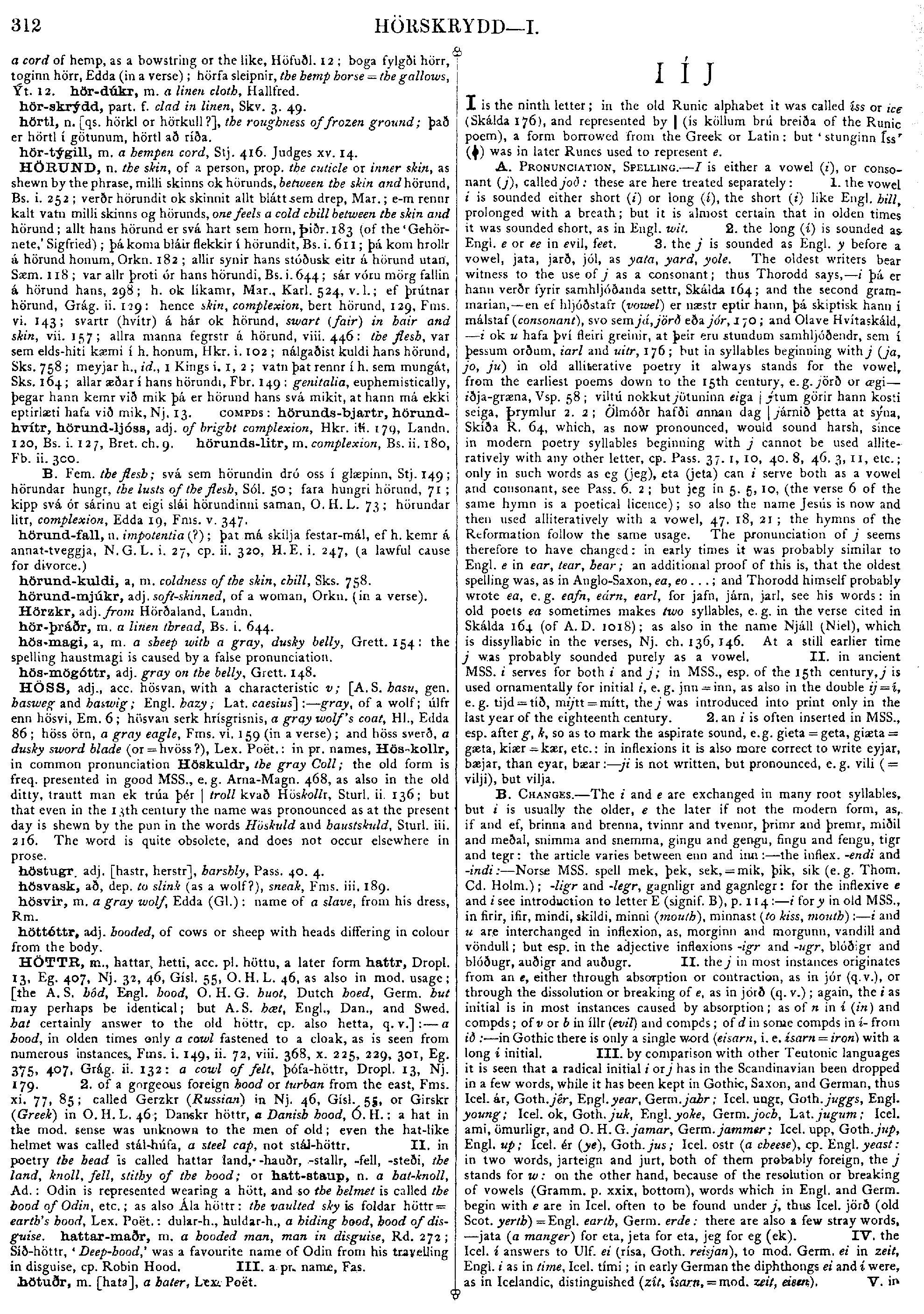
A. PRONUNCIATION, SPELLING. -- I is either a vowel (i), or consonant (j), called joð: these are here treated separately: 1. the vowel i is sounded either short (i) or long (í), the short (i) like Engl. hill, prolonged with a breath; but it is almost certain that in olden times it was sounded short, as in Engl. wit. 2. the long (í) is sounded as Engl. e or ee in evil, feet. 3. the j is sounded as Engl. y before a vowel, jata, jarð, jól, as yata, yard, yole. The oldest writers bear witness to the use of j as a consonant; thus Thorodd says, -- i þá er hann verðr fyrir samhljóðanda settr, Skálda 164; and the second grammarian, -- en ef hljóðstafr (vowel) er næstr eptir hann, þá skiptisk hann í málstaf (consonant), svo sem já, jörð eða jór, 170; and Olave Hvítaskáld, -- i ok u hafa því fleiri greinir, at þeir eru stundum samhljóðendr, sem í þessum orðum, iarl and uitr, 176; but in syllables beginning with j (ja, jo, ju) in old alliterative poetry it always stands for the vowel, from the earliest poems down to the 15th century, e.g. jörð or ægi -- iðja-græna, Vsp. 58; viltú nokkut jötuninn eiga | ýtum görir hann kosti seiga, Þrymlur 2. 2; Ölmóðr hafði annan dag | járnið þetta at sýna, Skíða R. 64, which, as now pronounced, would sound harsh, since in modern poetry syllables beginning with j cannot be used alliteratively with any other letter, cp. Pass. 37. 1, 10, 40. 8, 46. 3, 11, etc.; only in such words as eg (jeg), eta (jeta) can i serve both as a vowel and consonant, see Pass. 6. 2; but jeg in 5. 5, 10, (the verse 6 of the same hymn is a poetical licence); so also the name Jesús is now and then used alliteratively with a vowel, 47. 18, 21; the hymns of the Reformation follow the same usage. The pronunciation of j seems therefore to have changed: in early times it was probably similar to Engl. e in ear, tear, hear; an additional proof of this is, that the oldest spelling was, as in Anglo-Saxon, ea, eo ...; and Thorodd himself probably wrote ea, e.g. eafn, eárn, earl, for jafn, járn, jarl, see his words: in old poets ea sometimes makes two syllables, e.g. in the verse cited in Skálda 164 (of A.D. 1018); as also in the name Njáll (Niel), which is dissyllabic in the verses, Nj. ch. 136, 146. At a still earlier time j was probably sounded purely as a vowel. II. in ancient MSS. i serves for both i and j; in MSS., esp. of the 15th century, j is used ornamentally for initial i, e.g. jnn = inn, as also in the double ij = í, e.g. tijd = tíð, mijtt = mítt, the j was introduced into print only in the last year of the eighteenth century. 2. an i is often inserted in MSS., esp. after g, k, so as to mark the aspirate sound, e.g. gieta = geta, giæta = gæta, kiær = kær, etc.: in inflexions it is also more correct to write eyjar, bæjar, than eyar, bæar :-- ji is not written, but pronounced, e.g. vili ( = vilji), but vilja.
| Result Page: | 1 2 | Next |  |
Germanic Lexicon Project (main page)
This search system was written by
Sean Crist
Please consider
volunteering
to correct the data in these online dictionaries.
No rights reserved. Feel free to use these data in any way you please.