|
|

|
Source: Bosworth/Toller, page b0352, entry 31 View original page image as: [TIFF] [PNG] [View previous entry] [View next entry] |
[Comment on this entry] [View comments] |
The following entry has been hand-corrected once. |
fyrd-wíse,
an;
f.
A
military
manner
:--
Se
mon
se
ne
w re
mid
his
wpnum
æfter
fyrdwíson
gegered
qui
non
legitimis
indutus
insignibusque
armis,
Nar.
9,
28.
re
mid
his
wpnum
æfter
fyrdwíson
gegered
qui
non
legitimis
indutus
insignibusque
armis,
Nar.
9,
28.
|
Source: Bosworth/Toller, page b0396, entry 15 View original page image as: [TIFF] [PNG] [View previous entry] [View next entry] |
[Comment on this entry] [View comments] |
The following entry has been hand-corrected once. |
ge-gerelad, -gerlad; part. Clothed; indutus :-- Gegerlad is Drihten mid stræncþe indutus est Dominus fortitudinem, Ps. Lamb. 92, 1. Gegerelad vestitus, Mk. Skt. Lind. 1, 6.
|
Source: Bosworth/Toller, page b0438, entry 4 View original page image as: [TIFF] [PNG] [View previous entry] [View next entry] |
[Comment on this entry] [View comments] |
The following entry has been hand-corrected once. |
ge-scrýdan, -scrídan; p. -scrýdde; pp. -scrýd, -scýrd To clothe; induere, vestire :-- God gescrídde hí God clothed them, Gen. 3, 21. Mann hnescum gyrlum gescrýdne; nú ða ðe synt hnescum gyrlum gescrýdde synt on cyninga húsum hominem mollibus vestitum? ecce qui mollibus vestiuntur in domibus regum sunt, Mt. Bos. 11, 8. Mid wlite gescýrd is gescýrd is driht strangnysse decore indutus est, indutus est dominus fortitudinem, Ps. Spl. 92, 1. Myrce gescýrded shrouded in darkness, Andr. Kmbl. 2628; An. 1315.
|
Source: Bosworth/Toller, page b0662, entry 6 View original page image as: [TIFF] [PNG] [View previous entry] [View next entry] |
[Comment on this entry] [View comments] |
The following entry has been hand-corrected once. |
mæssian;
p.
ode
To
say
mass
:--
Be
ðam
sacerde
ðonne
hé
mæssaþ
hwæt
hé
on
him
hæbbe
de
iis
quibus
indutus
esse
debet
sacerdos,
cum
missarn
celebrat,
L.
Edg.
C.
tit.
ix.;
Th.
ii.
128,
19.
Mæssode
se
apostol
ðam
folce.
Homl.
Th.
ii.
478,
14.
For
mé
gelómlíce
mæssaþ
pro
me
missas
crebras
facit.
Bd.
4,
22;
S.
591,
29.
For
hreówsigendne
man
man
mót
mæssian
ymb.
xxx
nihta,
L.
Ecg.
C.
36;
Th.
ii.
160,
21.
Hý
mihton
wel
habban
wíf
on
ðám
dagum
forðan
ðe
hý
nfre
ne
mæssodon,
L.
Ælfc.
C.
7;
Th.
ii.
346,
8.
Wé
lraþ
ðæt
preóst
on
nigum
húse
ne
mæssige,
búton
on
gehálgodre
cirican,
L.
E.
B.
30;
Th.
ii.
250,
18.
(For
other
regulations
see
§§
31-33,
35,
37;
and
L.
N.
P.
L.
13,
14,
16,
18;
Th.
ii.
292,
16-24.)
Benedictus
ásende
áne
ofeletan,
and
hét
mid
ðære
mæssian,
Homl.
Th.
ii.
174,
27.
Ymbe
underntíd
ðá
ðá
se
bróðor
wæs
gewunod
tó
mæssigenne,
358,
21.
[Icel.
messa.]
|
Source: Bosworth/Toller, page d0202, entry 19 View original page image as: [TIFF] [PNG] [View previous entry] [View next entry] |
[Comment on this entry] [View comments] |
The following entry has been hand-corrected once. |
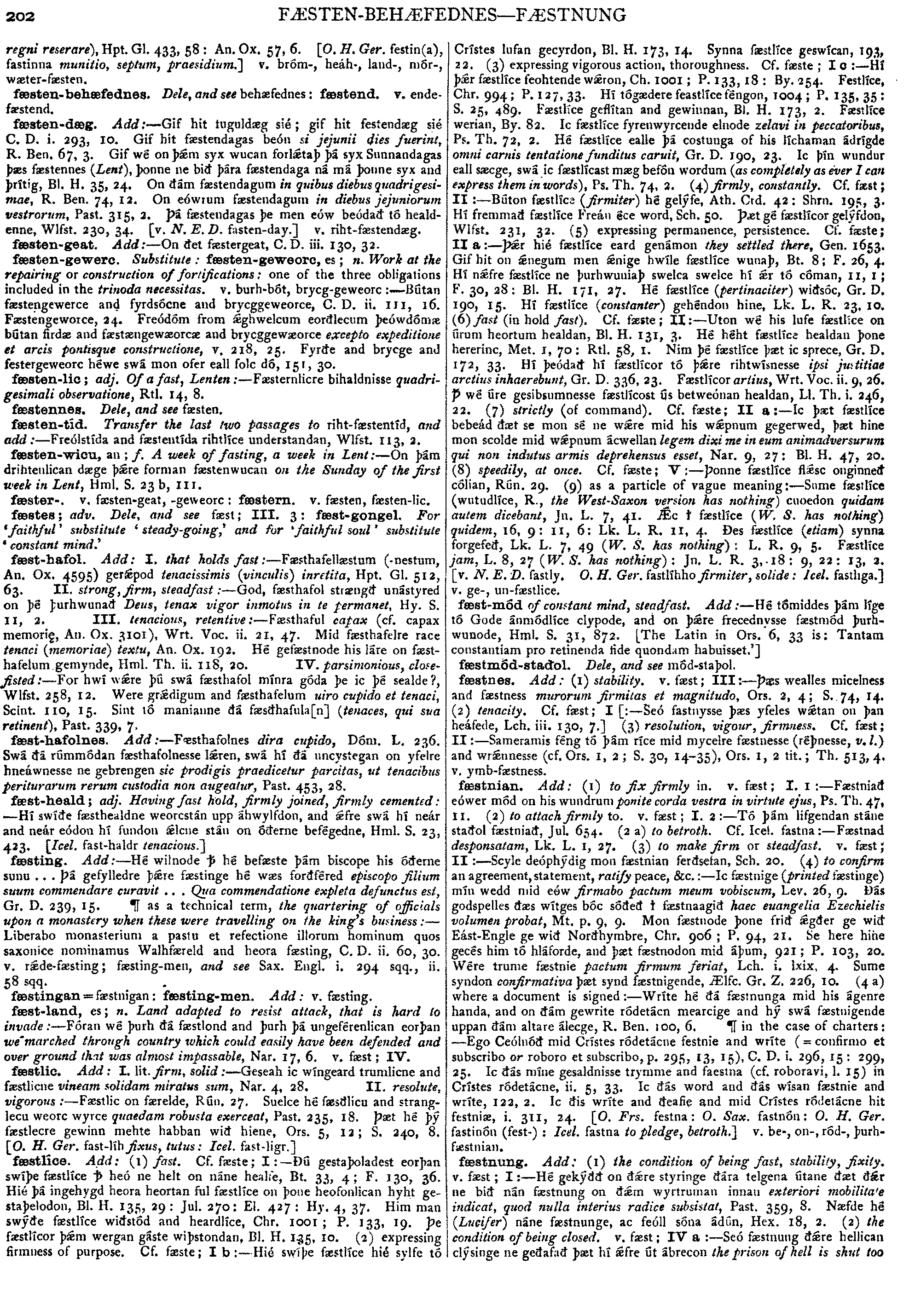
fæstlíce.
Add:
(1)
fast.
Cf.
fæste;
I
:--
Ðú
gestaþoladest
eorþan
swíþe
fæstlíce
 heó
ne
helt
on
náne
healfe,
Bt.
33,
4;
F.
130,
36.
Hié
þá
ingehygd
heora
heortan
ful
fæstlíce
on
þone
heofonlican
hyht
gestaþelodon,
Bl.
H.
135,
29
:
Jul.
270:
El.
427
:
Hy.
4,
37.
Him
man
swýðe
fæstlíce
wiðstód
and
heardlíce,
Chr.
1001
;
P.
133,
19.
Þe
fæstlícor
þm
wergan
gáste
wiþstondan,
Bl.
H.
135,
10.
(2)
expressing
firmness
of
purpose.
Cf.
fæste;
I
b
:--
Hié
swíþe
fæstlíce
hié
sylfe
tó
Crístes
lufan
gecyrdon,
Bl.
H.
173,
14.
Synna
fæstlíce
geswícan,
193,
22.
(3)
expressing
vigorous
action,
thoroughness.
Cf.
fæste
;
I
c
:--
Hí
þr
fæstlíce
feohtende
wron,
Ch.
1001;
P.
133,
18
:
By.
254.
Festlíce,
Chr.
994;
P.
12
7,
33.
Hí
tógædere
feastlíce
féngon,
1004
;
P.
135,
35
:
S.
25,
489.
Fæstlíce
geflítan
and
gewinnan,
Bl.
H.
173,
2.
Fæstlíce
werian,
By.
82.
Ic
fæstlíce
fyrenwyrcende
elnode
zelavi
in
peccatoribus,
Ps.
Th.
72,
2.
Hé
fæstlíce
ealle
þá
costunga
of
his
líchaman
ádrígde
omni
carnis
tentatione
funditus
caruit,
Gr.
D.
190,
23.
Ic
þín
wundur
eall
sæcge,
swá
ic
fæstlícast
mæg
befón
wordum
(as
completely
as
ever
I
can
express
them
in
words),
Ps.
Th.
74,
2.
(4)
firmly,
constantly.
Cf.
fæst;
II
:--
Búton
fæstlíce
(firmiter)
hé
gelýfe,
Ath.
Crd.
42:
Shrn.
195,
3.
Hí
fremmað
fæstlíce
Freán
éce
word,
Sch.
50.
Þæt
gé
fæstlícor
gelýfdon,
Wlfst.
231,
32.
(5)
expressing
permanence,
persistence.
Cf.
fæste;
II
a
:--
Þr
hié
fæstlíce
eard
genámon
they
settled
there,
Gen.
1653.
Gif
hit
on
negum
men
nige
hwíle
fæstlíce
wunaþ,
Bt.
8;
F.
26,
4.
Hí
nfre
fæstlíce
ne
þurhwuniaþ
swelca
swelce
hí
r
tó
cóman,
11,
1
;
F.
30,
28:
Bl.
H.
171,
27.
Hé
fæstlíce
(pertinaciter)
wiðsóc,
Gr.
D.
190,
15.
Hí
fæstlíce
(constanter)
gehéndon
hine,
Lk.
L.
R.
23,
10.
(6)
fast
(in
hold
fast).
Cf.
fæste;
II
:--
Uton
wé
his
lufe
fæstlíce
on
úrum
heortum
healdan,
Bl.
H.
131,
3.
Hé
héht
fæstlíce
healdan
þone
hererinc,
Met.
1,
70
:
Rtl.
58,
1.
Nim
þé
fæstlíce
þæt
ic
sprece,
Gr.
D.
172,
33.
Hí
þeódað
hí
fæstlícor
tó
þre
rihtwísnesse
ipsi
justitiae
arctius
inhaerebunt,
Gr.
D.
336,
23.
Fæstlícor
artius,
Wrt.
Voc.
ii.
9,
26.
Þ-bar;
wé
úre
gesibsumnesse
fæstlícost
ús
betweónan
healdan,
Ll.
Th.
i.
246,
22.
(7)
strictly
(of
command).
Cf.
fæste;
II
a
:--
Ic
þæt
fæstlíce
bebeád
ðæt
se
mon
sé
ne
wre
mid
his
wpnum
gegerwed,
þæt
hine
mon
scolde
mid
wpnum
ácwellan
legem
dixi
me
in
eum
animadversurum
qui
non
indutus
armis
deprehensus
esset,
Nar.
9,
27:
Bl.
H.
47,
20.
(8)
speedily,
at
once.
Cf.
fæste;
V
:--
Þonne
fæstlíce
flsc
onginneð
cólian,
Rún.
29.
(9)
as
a
particle
of
vague
meaning
:--
Sume
fæstlíce
(wutudlíce,
R.,
the
West-Saxon
version
has
nothing)
cuoedon
quidam
autem
dicebant,
Jn.
L.
7,
41.
Æ-acute;c
heó
ne
helt
on
náne
healfe,
Bt.
33,
4;
F.
130,
36.
Hié
þá
ingehygd
heora
heortan
ful
fæstlíce
on
þone
heofonlican
hyht
gestaþelodon,
Bl.
H.
135,
29
:
Jul.
270:
El.
427
:
Hy.
4,
37.
Him
man
swýðe
fæstlíce
wiðstód
and
heardlíce,
Chr.
1001
;
P.
133,
19.
Þe
fæstlícor
þm
wergan
gáste
wiþstondan,
Bl.
H.
135,
10.
(2)
expressing
firmness
of
purpose.
Cf.
fæste;
I
b
:--
Hié
swíþe
fæstlíce
hié
sylfe
tó
Crístes
lufan
gecyrdon,
Bl.
H.
173,
14.
Synna
fæstlíce
geswícan,
193,
22.
(3)
expressing
vigorous
action,
thoroughness.
Cf.
fæste
;
I
c
:--
Hí
þr
fæstlíce
feohtende
wron,
Ch.
1001;
P.
133,
18
:
By.
254.
Festlíce,
Chr.
994;
P.
12
7,
33.
Hí
tógædere
feastlíce
féngon,
1004
;
P.
135,
35
:
S.
25,
489.
Fæstlíce
geflítan
and
gewinnan,
Bl.
H.
173,
2.
Fæstlíce
werian,
By.
82.
Ic
fæstlíce
fyrenwyrcende
elnode
zelavi
in
peccatoribus,
Ps.
Th.
72,
2.
Hé
fæstlíce
ealle
þá
costunga
of
his
líchaman
ádrígde
omni
carnis
tentatione
funditus
caruit,
Gr.
D.
190,
23.
Ic
þín
wundur
eall
sæcge,
swá
ic
fæstlícast
mæg
befón
wordum
(as
completely
as
ever
I
can
express
them
in
words),
Ps.
Th.
74,
2.
(4)
firmly,
constantly.
Cf.
fæst;
II
:--
Búton
fæstlíce
(firmiter)
hé
gelýfe,
Ath.
Crd.
42:
Shrn.
195,
3.
Hí
fremmað
fæstlíce
Freán
éce
word,
Sch.
50.
Þæt
gé
fæstlícor
gelýfdon,
Wlfst.
231,
32.
(5)
expressing
permanence,
persistence.
Cf.
fæste;
II
a
:--
Þr
hié
fæstlíce
eard
genámon
they
settled
there,
Gen.
1653.
Gif
hit
on
negum
men
nige
hwíle
fæstlíce
wunaþ,
Bt.
8;
F.
26,
4.
Hí
nfre
fæstlíce
ne
þurhwuniaþ
swelca
swelce
hí
r
tó
cóman,
11,
1
;
F.
30,
28:
Bl.
H.
171,
27.
Hé
fæstlíce
(pertinaciter)
wiðsóc,
Gr.
D.
190,
15.
Hí
fæstlíce
(constanter)
gehéndon
hine,
Lk.
L.
R.
23,
10.
(6)
fast
(in
hold
fast).
Cf.
fæste;
II
:--
Uton
wé
his
lufe
fæstlíce
on
úrum
heortum
healdan,
Bl.
H.
131,
3.
Hé
héht
fæstlíce
healdan
þone
hererinc,
Met.
1,
70
:
Rtl.
58,
1.
Nim
þé
fæstlíce
þæt
ic
sprece,
Gr.
D.
172,
33.
Hí
þeódað
hí
fæstlícor
tó
þre
rihtwísnesse
ipsi
justitiae
arctius
inhaerebunt,
Gr.
D.
336,
23.
Fæstlícor
artius,
Wrt.
Voc.
ii.
9,
26.
Þ-bar;
wé
úre
gesibsumnesse
fæstlícost
ús
betweónan
healdan,
Ll.
Th.
i.
246,
22.
(7)
strictly
(of
command).
Cf.
fæste;
II
a
:--
Ic
þæt
fæstlíce
bebeád
ðæt
se
mon
sé
ne
wre
mid
his
wpnum
gegerwed,
þæt
hine
mon
scolde
mid
wpnum
ácwellan
legem
dixi
me
in
eum
animadversurum
qui
non
indutus
armis
deprehensus
esset,
Nar.
9,
27:
Bl.
H.
47,
20.
(8)
speedily,
at
once.
Cf.
fæste;
V
:--
Þonne
fæstlíce
flsc
onginneð
cólian,
Rún.
29.
(9)
as
a
particle
of
vague
meaning
:--
Sume
fæstlíce
(wutudlíce,
R.,
the
West-Saxon
version
has
nothing)
cuoedon
quidam
autem
dicebant,
Jn.
L.
7,
41.
Æ-acute;c
 fæstlíce
(W.
S.
has
nothing)
quidem,
16,
9:
11,
6:
Lk.
L.
R.
11,
4.
Ðes
fæstlíce
(etiam)
synna
forgefeð,
Lk.
L.
7,
49
(W.
S.
has
nothing)
:
L.
R.
9,
5.
Fæstlíce
jam,
L.
8,
27
(W.
S.
has
nothing):
Jn.
L.
R.
3,
18
:
9,
22:
13,
2.
[v.
N.
E.
D.
fastly.
O.
H.
Ger.
fastlíhho
firmiter,
solide:
Icel.
fastliga.
UNCERTAIN
]
v.
ge-,
un-fæstlice.
fæstlíce
(W.
S.
has
nothing)
quidem,
16,
9:
11,
6:
Lk.
L.
R.
11,
4.
Ðes
fæstlíce
(etiam)
synna
forgefeð,
Lk.
L.
7,
49
(W.
S.
has
nothing)
:
L.
R.
9,
5.
Fæstlíce
jam,
L.
8,
27
(W.
S.
has
nothing):
Jn.
L.
R.
3,
18
:
9,
22:
13,
2.
[v.
N.
E.
D.
fastly.
O.
H.
Ger.
fastlíhho
firmiter,
solide:
Icel.
fastliga.
UNCERTAIN
]
v.
ge-,
un-fæstlice.
|
Source: Bosworth/Toller, page d0334, entry 11 View original page image as: [TIFF] [PNG] [View previous entry] [View next entry] |
[Comment on this entry] [View comments] |
The following entry has been hand-corrected once. |
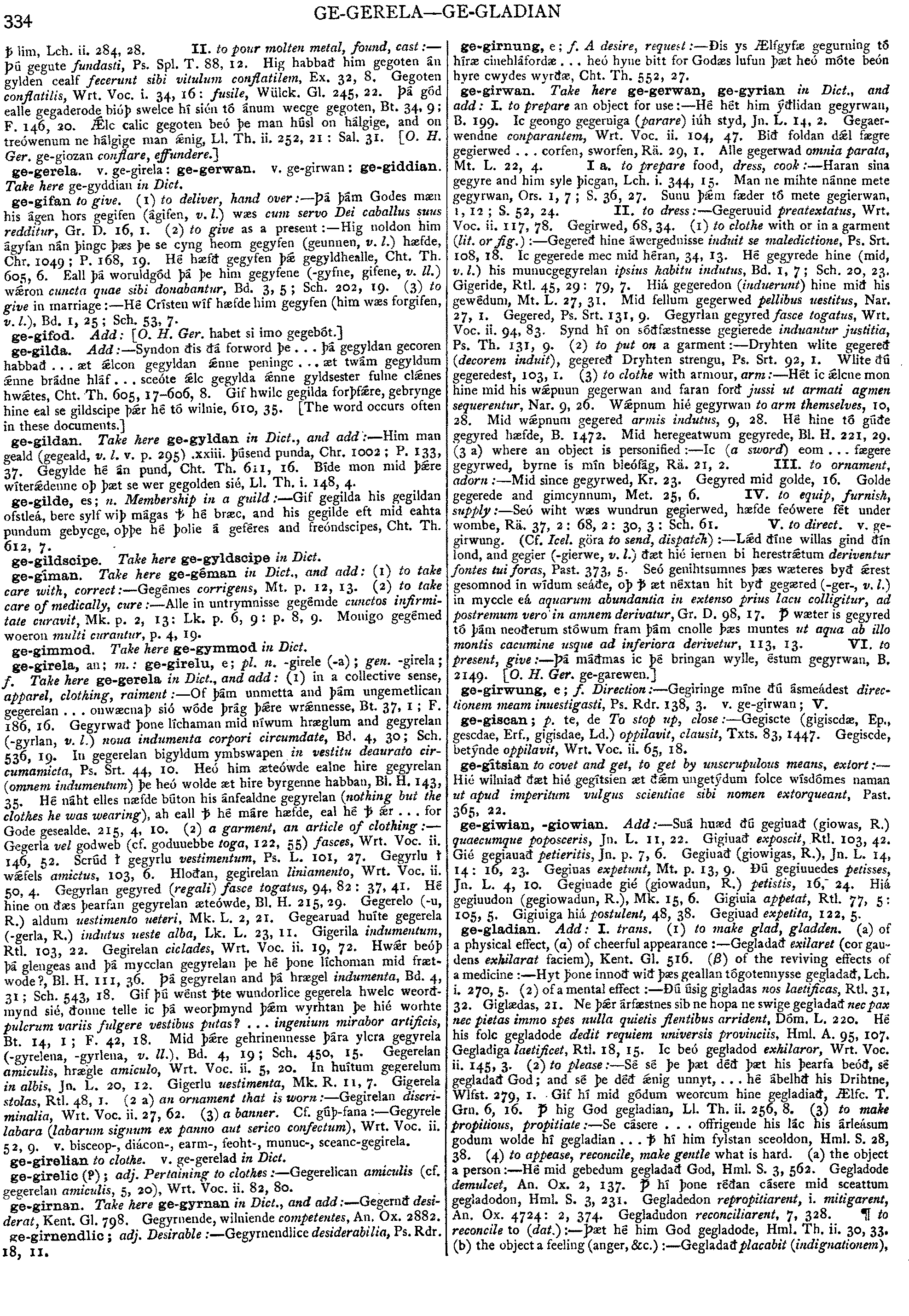
ge-girela,
an;
m.:
ge-girelu,
e;
pl.
n.
-girele
(-a);
gen.
-girela;
f.
Take
here
ge-gerela
in
Dict.,
and
add:
(1)
in
a
collective
sense,
apparel,
clothing,
raiment:--Of
þám
unmetta
and
þám
ungemetlican
gegerelan
.
.
.
onwæcnaþ
sió
wóde
þrág
þre
wrnnesse,
Bt.
37,
1;
F.
186,
16.
Gegyrwað
þone
líchaman
mid
níwum
hræglum
and
gegyrelan
(-gyrlan,
v.
l.)
noua
indumenta
corpori
circumdate,
Bd.
4,
30;
Sch.
536,
19.
In
gegerelan
bigyldum
ymbswapen
in
vestitu
deaurato
circumamicta,
Ps.
Srt.
44,
10.
Heó
him
æteówde
ealne
hire
gegyrelan
(omnem
indumentum)
þe
heó
wolde
æt
hire
byrgenne
habban,
Bl.
H.
143,
35.
Hé
náht
elles
næfde
búton
his
ánfealdne
gegyrelan
(nothing
but
the
clothes
he
was
wearing),
ah
eall
hé
máre
hæfde,
eal
hé
r
.
.
.
for
Gode
gesealde,
215,
4,
10.
(2)
a
garment,
an
article
of
clothing:--Gegerla
vel
godweb
(cf.
goduuebbe
toga,
122,
55)
fasces,
Wrt.
Voc.
ii.
146,
52.
Scrúd
gegyrlu
vestimentum,
Ps.
L.
101,
27.
Gegyrlu
wfels
amictus,
103,
6.
Hloðan,
gegirelan
liniamento,
Wrt.
Voc.
ii.
50,
4.
Gegyrlan
gegyred
(regali)
fasce
togatus,
94,
82:
37,
41.
Hé
hine
on
ðæs
þearfan
gegyrelan
æteówde,
Bl.
H.
215,
29.
Gegerelo
(-u,
R.)
aldum
uestimento
ueteri,
Mk.
L.
2,
21.
Gegearuad
huíte
gegerela
(-gerla,
R.)
indutus
ueste
alba,
Lk.
L.
23,
11.
Gigerila
indumentum,
Rtl.
103,
22.
Gegirelan
ciclades,
Wrt.
Voc.
ii.
19,
72.
Hwr
beóþ
þá
glengeas
and
þá
mycclan
gegyrelan
þe
hé
þone
líchoman
mid
frætwode?,
Bl.
H.
111,
36.
Þá
gegyrelan
and
þá
hrægel
indumenta,
Bd.
4,
31;
Sch.
543,
18.
Gif
þú
wénst
te
wundorlice
gegerela
hwelc
weorðmynd
sié,
ðonne
telle
ic
þá
weorþmynd
þm
wyrhtan
þe
hié
worhte
pulcrum
variis
fulgere
vestibus
putas
?
.
.
.
ingenium
mirabor
artificis,
Bt.
14,
1;
F.
42,
18.
Mid
þre
gehrinennesse
þára
ylcra
gegyrela
(-gyrelena,
-gyrlena,
v.
ll.),
Bd.
4,
19;
Sch.
450,
15.
Gegerelan
amiculis,
hrægle
amiculo,
Wrt.
Voc.
ii.
5,
20.
In
huítum
gegerelum
in
albis,
Jn.
L.
20,
12.
Gigerlu
uestimenta,
Mk.
R.
11,
7.
Gigerela
stolas,
Rtl.
48,
1.
(2
a)
an
ornament
that
is
worn:--Gegirelan
discriminalia,
Wrt.
Voc.
ii.
27,
62.
(3)
a
banner.
Cf.
gúþ-fana:--Gegyrele
labara
(labarum
signum
ex
panno
aut
serico
confectum),
Wrt.
Voc.
ii.
52,
9.
v.
bisceop-,
diácon-,
earm-,
feoht-,
munuc-,
sceanc-gegirela.
|
Source: Bosworth/Toller, page d0334, entry 17 View original page image as: [TIFF] [PNG] [View previous entry] [View next entry] |
[Comment on this entry] [View comments] |
The following entry has been hand-corrected once. |
ge-girwan.
Take
here
ge-gerwan,
ge-gyrian
in
Dict.,
and
add:
I.
to
prepare
an
object
for
use:--Hé
hét
him
ýðlidan
gegyrwan,
B.
199.
Ic
geongo
gegerniga
(parare)
iúh
styd,
Jn.
L.
14,
2.
Gegaerwendne
conparantem,
Wrt.
Voc.
ii.
104,
47.
Bið
foldan
dl
fægre
gegierwed
.
.
.
corfen,
sworfen,
Rä.
29,
1.
Alle
gegerwad
omnia
parata,
Mt.
L.
22,
4.
I
a.
to
prepare
food,
dress,
cook:--Haran
sina
gegyre
and
him
syle
þicgan,
Lch.
i.
344,
15.
Man
ne
mihte
nánne
mete
gegyrwan,
Ors.
1,
7;
S.
36,
27.
Sunu
þm
fæder
tó
mete
gegierwan,
1,
12;
S.
52,
24.
II.
to
dress:--Gegeruuid
preatextatus,
Wrt.
Voc.
ii.
117,
78.
Gegirwed,
68,
34.
(1)
to
clothe
with
or
in
a
garment
(lit.
or
fig.):--Gegereð
hine
áwergednisse
induit
se
maledictions,
Ps.
Srt.
108,
18.
Ic
gegerede
mec
mid
héran,
34,
13.
Hé
gegyrede
hine
(mid,
v.
l.)
his
munucgegyrelan
ipsius
habitu
indutus,
Bd.
1,
7;
Sch.
20,
23.
Gigeride,
Rtl.
45,
29:
79,
7.
Hiá
gegeredon
(induerunt)
hine
mið
his
gewédum,
Mt.
L.
27,
31.
Mid
fellum
gegerwed
pellibus
uestitus,
Nar.
27,
1.
Gegered,
Ps.
Srt.
131,
9.
Gegyrlan
gegyred
fasce
togatus,
Wrt.
Voc.
ii.
94,
83.
Synd
hí
on
sóðfæstnesse
gegierede
induantur
justitia,
Ps.
Th.
131,
9.
(2)
to
put
on
a
garment:--Dryhten
wlite
gegereð
(decorem
induit),
gegereð
Dryhten
strengu,
Ps.
Srt.
92,
1.
Wlite
ðú
gegeredest,
103,
1.
(3)
to
clothe
with
armour,
arm:--Hét
ic
lcne
mon
hine
mid
his
wpnun
gegerwan
and
faran
forð
jussi
ut
armati
agmen
sequerentur,
Nar.
9,
26.
Wpnum
hié
gegyrwan
to
arm
themselves,
10,
28.
Mid
wpnum
gegered
armis
indutus,
9,
28.
Hé
hine
tó
gúðe
gegyred
hæfde,
B.
1472.
Mid
heregeatwum
gegyrede,
Bl.
H.
221,
29.
(3
a)
where
an
object
is
personified:--Ic
(a
sword)
eom
.
.
.
fægere
gegyrwed,
byrne
is
mín
bleófág,
Rä.
21,
2.
III.
to
ornament,
adorn:--Mid
since
gegyrwed,
Kr.
23.
Gegyred
mid
golde,
16.
Golde
gegerede
and
gimcynnum,
Met.
25,
6.
IV.
to
equip,
furnish,
supply:--Seó
wiht
wæs
wundrun
gegierwed,
hæfde
feówere
fét
under
wombe,
Rä.
37,
2:
68,
2:
30,
3:
Sch.
61.
V.
to
direct.
v.
gegirwung.
(Cf.
Icel.
göra
to
send,
dispatch):--Ld
ðíne
willas
gind
ðín
lond,
and
gegier
(-gierwe,
v.
l.)
ðæt
hié
iernen
bi
herestrtum
deriventur
fontes
tui
foras,
Past.
373,
5.
Seó
genihtsumnes
þæs
wæteres
byð
rest
gesomnod
in
wídum
seáðe,
oþ
æt
néxtan
hit
byð
gegæred
(-ger-,
v.
l.)
in
myccle
eá
aquarum
abundantia
in
extenso
prius
lacu
colligitur,
ad
postremum
vero
in
amnem
derivatur,
Gr.
D.
98,
17.
Þ-bar;
wæter
is
gegyred
tó
þám
neoðerum
stówum
fram
þám
cnolle
þæs
muntes
ut
aqua
ab
illo
montis
cacumine
usque
ad
inferiora
derivetur,
113,
13.
VI.
to
present,
give:--Þá
máðmas
ic
þé
bringan
wylle,
éstum
gegyrwan,
B.
2149.
[O.
H.
Ger.
ge-garewen.?
|
Source: Bosworth/Toller, page d0637, entry 32 View original page image as: [TIFF] [PNG] [View previous entry] [View next entry] |
[Comment on this entry] [View comments] |
The following entry has been hand-corrected once. |
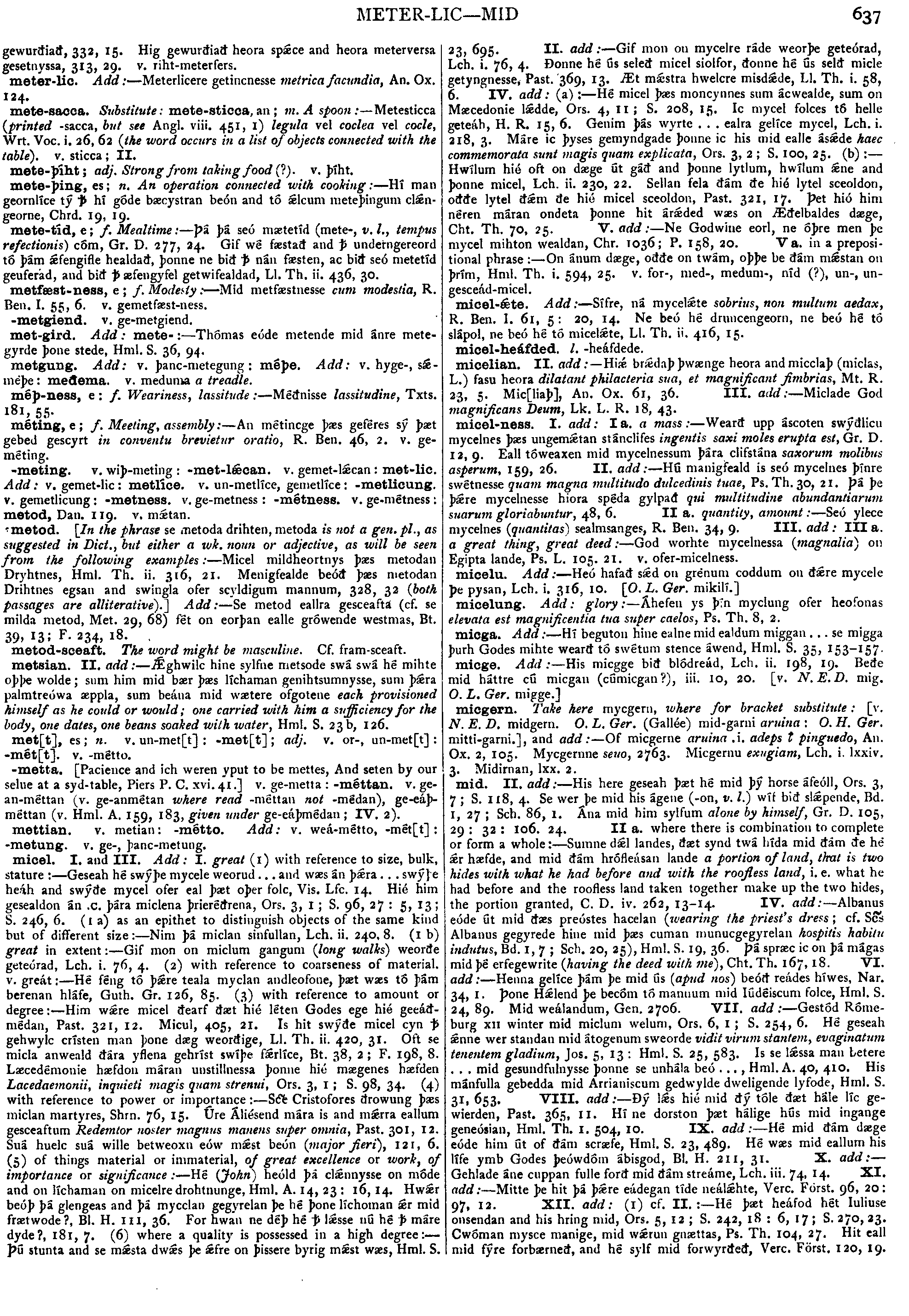
mid.
II.
add
:--
His
here
geseah
þæt
hé
mid
þý
horse
áfeóll,
Ors.
3,
7
;
S.
118,
4.
Se
wer
þe
mid
his
ágene
(-on,
v.
l.)
wíf
bið
slpende,
Bd.
1,
27
;
Sch.
86,
1.
Ána
mid
him
sylfum
alone
by
himself,
Gr.
D.
105,
29
:
32
:
106.
24.
II
a.
where
there
is
combination
to
complete
or
form
a
whole
:--
Sumne
dl
landes,
ðæt
synd
twá
hída
mid
ðám
ðe
hé
r
hæfde,
and
mid
ðám
hrófleásan
lande
a
portion
of
land,
that
is
two
hides
with
what
he
had
before
and
with
the
roofless
land,
i.
e.
what
he
had
before
and
the
roofless
land
taken
together
make
up
the
two
hides,
the
portion
granted,
C.
D.
iv.
262,
13-14.
IV.
add
:--
Albanus
eóde
út
mid
ðæs
preóstes
hacelan
(wearing
the
priest's
dress;
cf.
S
UNCERTAIN
s
Albanus
gegyrede
hine
mid
þæs
cuman
munucgegyrelan
hospitis
habitu
indutus,
Bd.
1,
7
;
Sch.
20,
25),
Hml.
S.
19,
36.
Þá
spræc
ic
on
þá
mágas
mid
þé
erfegewrite
(having
the
deed
with
me),
Cht.
Th.
167,
18.
VI.
add
:--
Henna
gelíce
þám
þe
mid
ús
(
apud
nos
)
beóð
reádes
híwes,
Nar.
34,
1.
Þone
Hlend
þe
becóm
tó
mannum
mid
Iúdéiscum
folce,
Hml.
S.
24,
89.
Mid
weálandum,
Gen.
2706.
VII.
add
:--
Gestód
Róme burg
xii
winter
mid
miclum
welum,
Ors.
6,
1;
S.
254,
6.
Hé
geseah
nne
wer
standan
mid
átogenum
sweorde
vidit
virum
stantem,
evaginatum
tenentem
gladium,
Jos.
5,
13
:
Hml.
S.
25,
583.
Is
se
lssa
man
betere
.
.
.
mid
gesundfulnysse
þonne
se
unhála
beó
.
.
.
,
Hml.
A.
40,
410.
His
mánfulla
gebedda
mid
Arrianiscum
gedwylde
dweligende
lyfode,
Hml.
S.
31,
653.
VIII.
add
:--
Ðý
ls
hié
mid
ðý
tóle
ðæt
hále
líc
gewierden,
Past.
365,
11.
Hí
ne
dorston
þæt
hálige
hús
mid
ingange
geneósian,
Hml.
Th.
i.
504,
10.
IX.
add
:--
Hé
mid
ðám
dæge
eóde
him
út
of
ðám
scræfe,
Hml.
S.
23,
489.
Hé
wæs
mid
eallum
his
lífe
ymb
Godes
þeówdóm
ábisgod,
Bl.
H.
211,
31.
X.
add
:--
Gehlade
áne
cuppan
fulle
forð
mid
ðám
streáme,
Lch.
iii.
74,
14.
XI.
add
:--
Mitte
þe
hit
þá
þre
eádegan
tíde
neálhte,
Verc.
Först.
96,
20:
97,
12.
XII.
add:
(l)
cf.
II.
:--
Hé
þæt
heáfod
hét
Iuliuse
onsendan
and
his
hring
mid,
Ors.
5,
12
;
S.
242,
18
:
6,
17;
S.
270,
23.
Cwóman
mysce
manige,
mid
wrun
gnættas,
Ps.
Th.
104,
27.
Hit
eall
mid
fýre
forbærneð,
and
hé
sylf
mid
forwyrðeð,
Verc,
Först,
120,
19.
burg
xii
winter
mid
miclum
welum,
Ors.
6,
1;
S.
254,
6.
Hé
geseah
nne
wer
standan
mid
átogenum
sweorde
vidit
virum
stantem,
evaginatum
tenentem
gladium,
Jos.
5,
13
:
Hml.
S.
25,
583.
Is
se
lssa
man
betere
.
.
.
mid
gesundfulnysse
þonne
se
unhála
beó
.
.
.
,
Hml.
A.
40,
410.
His
mánfulla
gebedda
mid
Arrianiscum
gedwylde
dweligende
lyfode,
Hml.
S.
31,
653.
VIII.
add
:--
Ðý
ls
hié
mid
ðý
tóle
ðæt
hále
líc
gewierden,
Past.
365,
11.
Hí
ne
dorston
þæt
hálige
hús
mid
ingange
geneósian,
Hml.
Th.
i.
504,
10.
IX.
add
:--
Hé
mid
ðám
dæge
eóde
him
út
of
ðám
scræfe,
Hml.
S.
23,
489.
Hé
wæs
mid
eallum
his
lífe
ymb
Godes
þeówdóm
ábisgod,
Bl.
H.
211,
31.
X.
add
:--
Gehlade
áne
cuppan
fulle
forð
mid
ðám
streáme,
Lch.
iii.
74,
14.
XI.
add
:--
Mitte
þe
hit
þá
þre
eádegan
tíde
neálhte,
Verc.
Först.
96,
20:
97,
12.
XII.
add:
(l)
cf.
II.
:--
Hé
þæt
heáfod
hét
Iuliuse
onsendan
and
his
hring
mid,
Ors.
5,
12
;
S.
242,
18
:
6,
17;
S.
270,
23.
Cwóman
mysce
manige,
mid
wrun
gnættas,
Ps.
Th.
104,
27.
Hit
eall
mid
fýre
forbærneð,
and
hé
sylf
mid
forwyrðeð,
Verc,
Först,
120,
19.
|
Source: Cleasby/Vigfusson, page b0082, entry 17 View original page image as: [TIFF] [PNG] [View previous entry] [View next entry] |
[Comment on this entry] [View comments] |
The following entry has been hand-corrected once. |
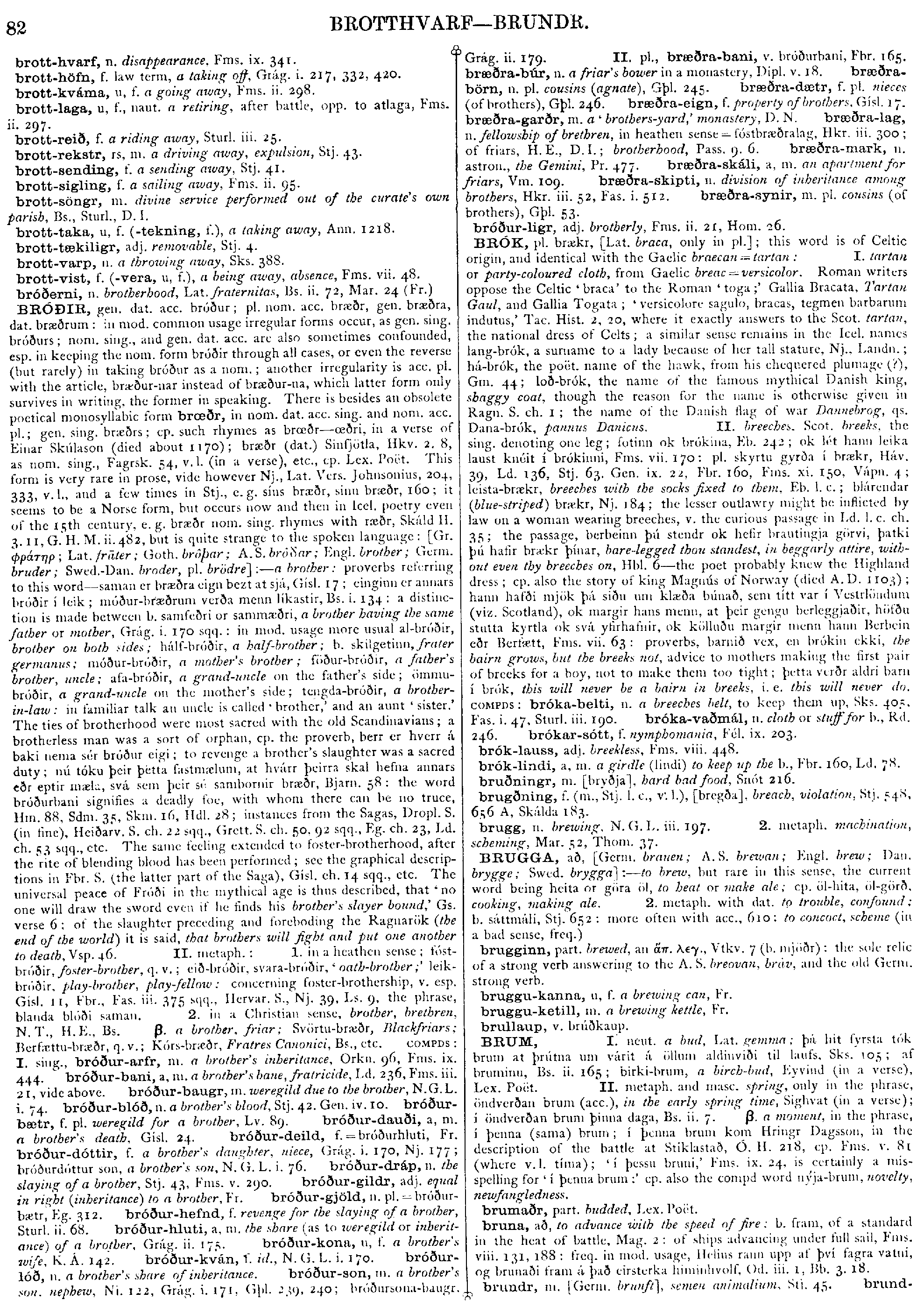
BRÓK, pl. brækr, [Lat. braca, only in pl.]; this word is of Celtic origin, and identical with the Gaelic braecan = tartan: I. tartan or party-coloured cloth, from Gaelic breac = versicolor. Roman writers oppose the Celtic 'braca' to the Roman 'toga;' Gallia Bracata, Tartan Gaul, and Gallia Togata; 'versicolore sagulo, bracas, tegmen barbarum indutus,' Tac. Hist. 2, 20, where it exactly answers to the Scot, tartan, the national dress of Celts; a similar sense remains in the Icel. names lang-brók, a surname to a lady because of her tall stature, Nj., Landn.; há-brók, the poët. name of the hawk, from his chequered plumage (?), Gm. 44; loð-brók, the name of the famous mythical Danish king, shaggy coat, though the reason for the name is otherwise given in Ragn. S. ch. I; the name of the Danish flag of war Dannebrog, qs. Dana-brók, pannus Danicus. II. breeches. Scot, breeks, the sing, denoting one leg; fótinn ok brókina, Eb. 242; ok let hann leika laust knæt í brókinni, Fms. vii. 170: pl. skyrtu gyrða í brækr, Háv. 39, Ld. 136, Stj. 63. Gen. ix. 22, Fbr. 160, Fms. xi. 150, Vápn. 4; leista-brækr, breeches with the socks fixed to them. Eb. 1. c.; blárendar (blue-striped) brækr, Nj. 184; the lesser outlawry might be inflicted by law on a woman wearing breeches, v. the curious passage in Ld. 1. c. ch. 35; the passage, berbeinn þú stendr ok hefir brautingja görvi, þatkiþú hafir brækr þínar, bare-legged thou standest, in beggarly attire, without even thy breeches on, Hbl. 6 -- the poet probably knew the Highland dress; cp. also the story of king Magnús of Norway (died A. D. 1103); hann hafði mjök þá siðu um klæða búnað, sem títt var í Vestrlöndum (viz. Scotland), ok margir hans menn, at þeir gengu berleggjaðir, höfðu stutta kyrtla ok svá yfirhafnir, ok kölluðu margir menn hann Berbein eðr Berfætt, Fms. vii. 63: proverbs, barnið vex, en brókin ekki, the bairn grows, but the breeks not, advice to mothers making the first pair of breeks for a boy, not to make them too tight; þetta verðr aldri barn í brók, this will never be a bairn in breeks, i. e. this will never do. COMPDS: bróka-belti, n. a breeches belt, to keep them up, Sks. 405. Fas. i. 47, Sturl. iii. 190. bróka-vaðmál, n. cloth or stuff for b., Rd. 246. brókar-sótt, f. nymphomania, Fél. ix.
Germanic Lexicon Project (main page)
This search system was written by
Sean Crist
Please consider
volunteering
to correct the data in these online dictionaries.
No rights reserved. Feel free to use these data in any way you please.