|
|

|
Source: Cleasby/Vigfusson, page b0293, entry 12 View original page image as: [TIFF] [PNG] [View previous entry] [View next entry] |
[Comment on this entry] [View comments] |
The following entry has been hand-corrected once. |
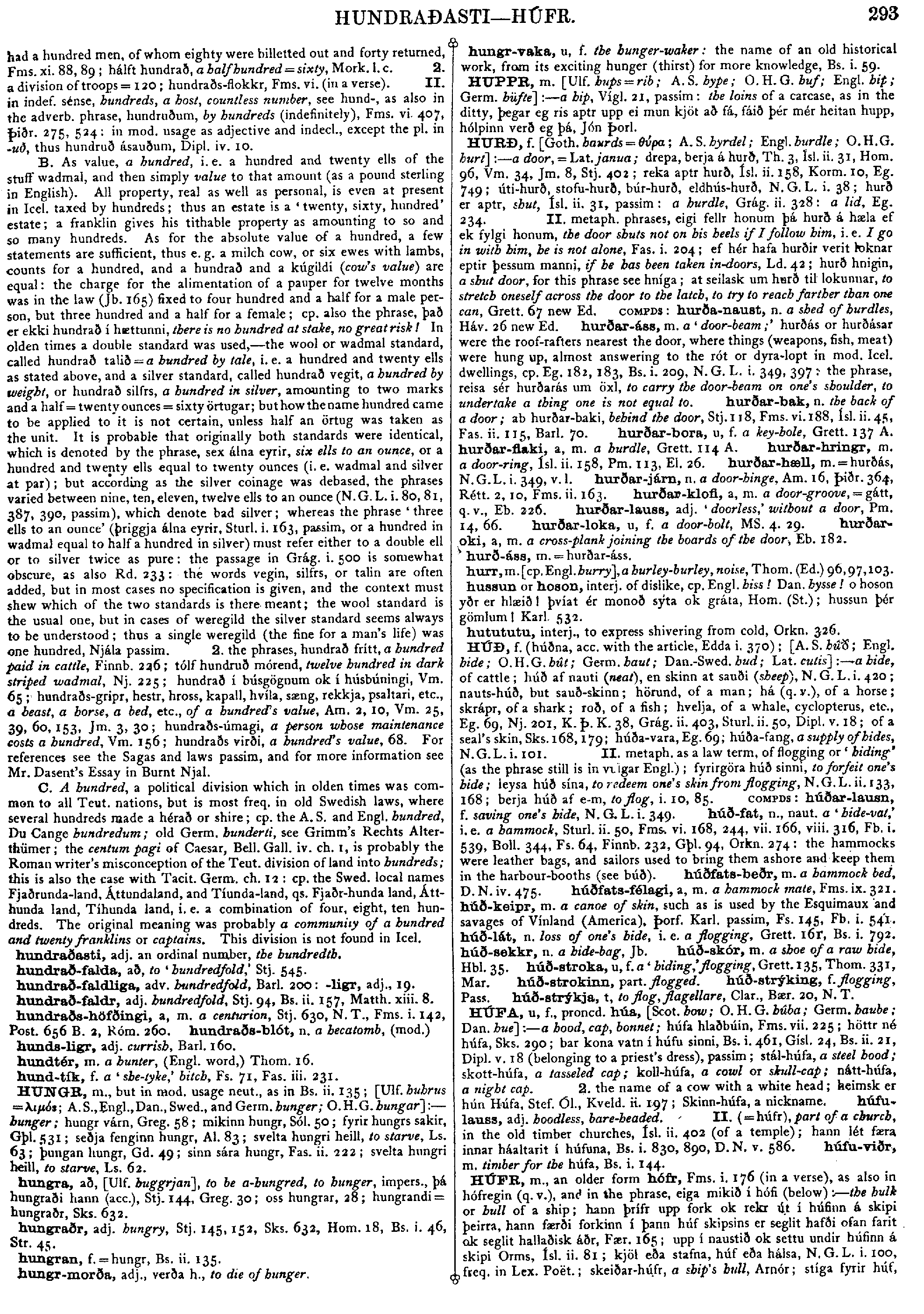
HUNGR, m., but in mod. usage neut., as in Bs. ii. 135; [Ulf. huhrus = GREEK; A. S., Engl., Dan., Swed., and Germ. hunger; O. H. G. hungar] :-- hunger; hungr várn, Greg. 58; mikinn hungr, Sól. 50; fyrir hungrs sakir, Gþl. 531; seðja fenginn hungr, Al. 83; svelta hungri heill, to starve, Ls. 63; þungan hungr, Gd. 49; sinn sára hungr, Fas. ii. 222; svelta hungri heill, to starve, Ls. 62.
|
Source: Torp, page b0070, entry 6 View original page image as: [TIFF] [PNG] [View previous entry] [View next entry] |
[Comment on this entry] [View comments] |
The following entry has been hand-corrected once. |
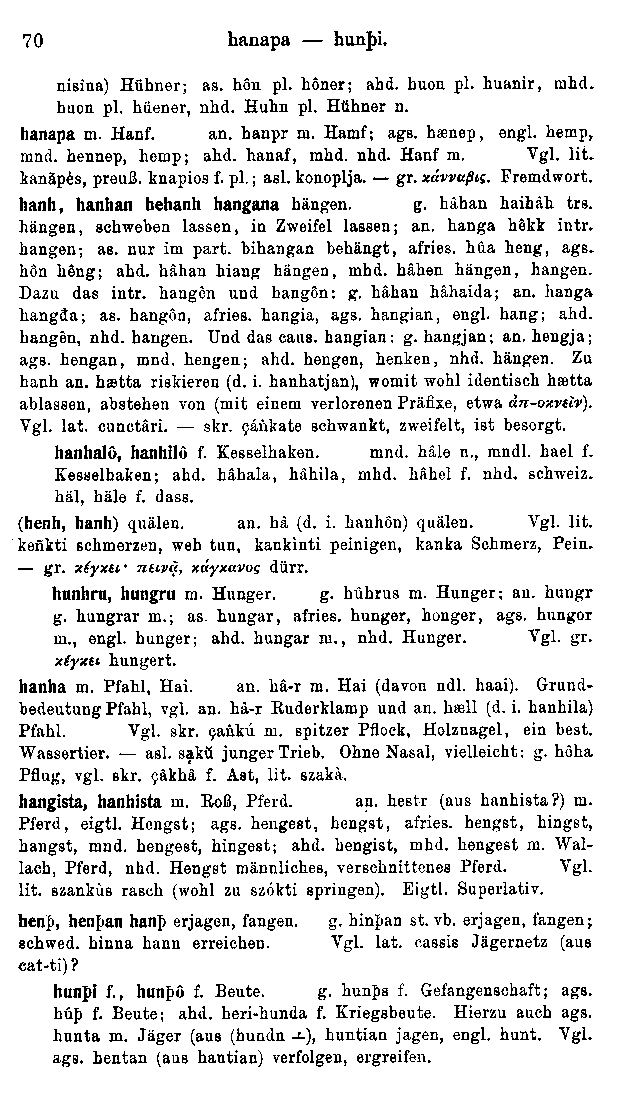
hunhru, hungru m. Hunger. g. hûhrus m. Hunger; an. hungr g. hungrar m.; as. hungar, afries. hunger, honger, ags. hungor m., engl. hunger; ahd. hungar m., nhd. Hunger. Vgl. gr. [ke'gkei] hungert.
[Translate the German words]
|
Source: Bosworth/Toller, page b0567, entry 10 View original page image as: [TIFF] [PNG] [View previous entry] [View next entry] |
[Comment on this entry] [View comments] |
The following entry has been hand-corrected once. |
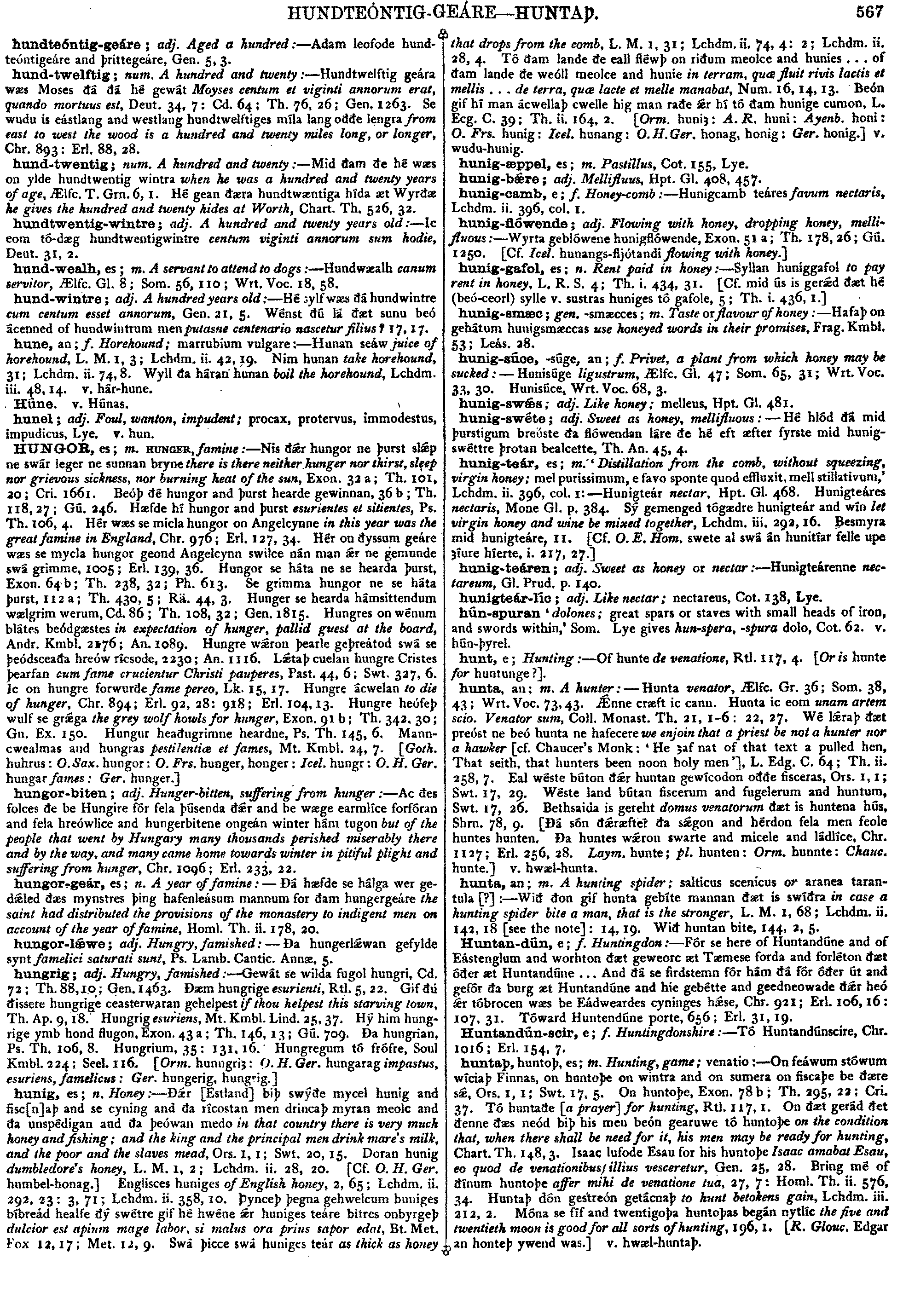
HUNGOR
es;
m.
HUNGER,
famine
:--
Nis
ð r
hungor
ne
þurst
slp
ne
swár
leger
ne
sunnan
bryne
there
is
there
neither
hunger
nor
thirst,
sleep
nor
grievous
sickness,
nor
burning
heat
of
the
sun,
Exon.
32
a;
Th.
101,
20;
Cri.
1661.
Beóþ
ðé
hungor
and
þurst
hearde
gewinnan,
36
b;
Th.
118,
27;
Gú.
246.
Hæfde
hí
hungor
and
þurst
esurientes
et
silientes,
Ps.
Th.
106,
4.
Hér
wæs
se
micla
hungor
on
Angelcynne
in
this
year
was
the
great
famine
in
England,
Chr.
976;
Erl.
127,
34.
Hér
on
ðyssum
geáre
wæs
se
mycla
hungor
geond
Angelcynn
swilce
nán
man
r
ne
gemunde
swá
grimme,
1005;
Erl.
139,
36.
Hungor
se
háta
ne
se
hearda
þurst,
Exon.
64
b;
Th.
238,
32;
Ph.
613.
Se
grimma
hungor
ne
se
háta
þurst,
112
a;
Th.
430,
5;
Rä.
44,
3.
Hunger
se
hearda
hámsittendum
wælgrim
werum,
Cd.
86;
Th.
108,
32;
Gen.
1815.
Hungres
on
wénum
blátes
beódgæstes
in
expectation
of
hunger,
pallid
guest
at
the
board,
Andr.
Kmbl.
2176;
An.
1089.
Hungre
wron
þearle
geþreátod
swá
se
þeódsceaða
hreów
rícsode,
2230;
An.
1116.
Ltaþ
cuelan
hungre
Cristes
þearfan
cum
fame
crucientur
Christi
pauperes,
Past.
44,
6;
Swt.
327,
6.
Ic
on
hungre
forwurðe
fame
pereo,
Lk.
15,
17.
Hungre
ácwelan
to
die
of
hunger,
Chr.
894;
Erl.
92,
28:
918;
Erl.
104,
13.
Hungre
heófeþ
wulf
se
grga
the
grey
wolf
howls
for
hunger,
Exon.
91
b;
Th.
342,
30;
Gn.
Ex.
150.
Hungur
heaðugrimne
heardne,
Ps.
Th.
145,
6.
Manncwealmas
and
hungras
pestilentiæ
et
fames,
Mt.
Kmbl.
24,
7.
[Goth.
huhrus:
O.
Sax.
hungor:
O.
Frs.
hunger,
honger:
Icel.
hungr:
O.
H.
Ger.
hungar
fames:
Ger.
hunger.]
r
hungor
ne
þurst
slp
ne
swár
leger
ne
sunnan
bryne
there
is
there
neither
hunger
nor
thirst,
sleep
nor
grievous
sickness,
nor
burning
heat
of
the
sun,
Exon.
32
a;
Th.
101,
20;
Cri.
1661.
Beóþ
ðé
hungor
and
þurst
hearde
gewinnan,
36
b;
Th.
118,
27;
Gú.
246.
Hæfde
hí
hungor
and
þurst
esurientes
et
silientes,
Ps.
Th.
106,
4.
Hér
wæs
se
micla
hungor
on
Angelcynne
in
this
year
was
the
great
famine
in
England,
Chr.
976;
Erl.
127,
34.
Hér
on
ðyssum
geáre
wæs
se
mycla
hungor
geond
Angelcynn
swilce
nán
man
r
ne
gemunde
swá
grimme,
1005;
Erl.
139,
36.
Hungor
se
háta
ne
se
hearda
þurst,
Exon.
64
b;
Th.
238,
32;
Ph.
613.
Se
grimma
hungor
ne
se
háta
þurst,
112
a;
Th.
430,
5;
Rä.
44,
3.
Hunger
se
hearda
hámsittendum
wælgrim
werum,
Cd.
86;
Th.
108,
32;
Gen.
1815.
Hungres
on
wénum
blátes
beódgæstes
in
expectation
of
hunger,
pallid
guest
at
the
board,
Andr.
Kmbl.
2176;
An.
1089.
Hungre
wron
þearle
geþreátod
swá
se
þeódsceaða
hreów
rícsode,
2230;
An.
1116.
Ltaþ
cuelan
hungre
Cristes
þearfan
cum
fame
crucientur
Christi
pauperes,
Past.
44,
6;
Swt.
327,
6.
Ic
on
hungre
forwurðe
fame
pereo,
Lk.
15,
17.
Hungre
ácwelan
to
die
of
hunger,
Chr.
894;
Erl.
92,
28:
918;
Erl.
104,
13.
Hungre
heófeþ
wulf
se
grga
the
grey
wolf
howls
for
hunger,
Exon.
91
b;
Th.
342,
30;
Gn.
Ex.
150.
Hungur
heaðugrimne
heardne,
Ps.
Th.
145,
6.
Manncwealmas
and
hungras
pestilentiæ
et
fames,
Mt.
Kmbl.
24,
7.
[Goth.
huhrus:
O.
Sax.
hungor:
O.
Frs.
hunger,
honger:
Icel.
hungr:
O.
H.
Ger.
hungar
fames:
Ger.
hunger.]
|
Source: Cleasby/Vigfusson, page b0021, entry 25 View original page image as: [TIFF] [PNG] [View previous entry] [View next entry] |
[Comment on this entry] [View comments] |
The following entry has been hand-corrected once. |
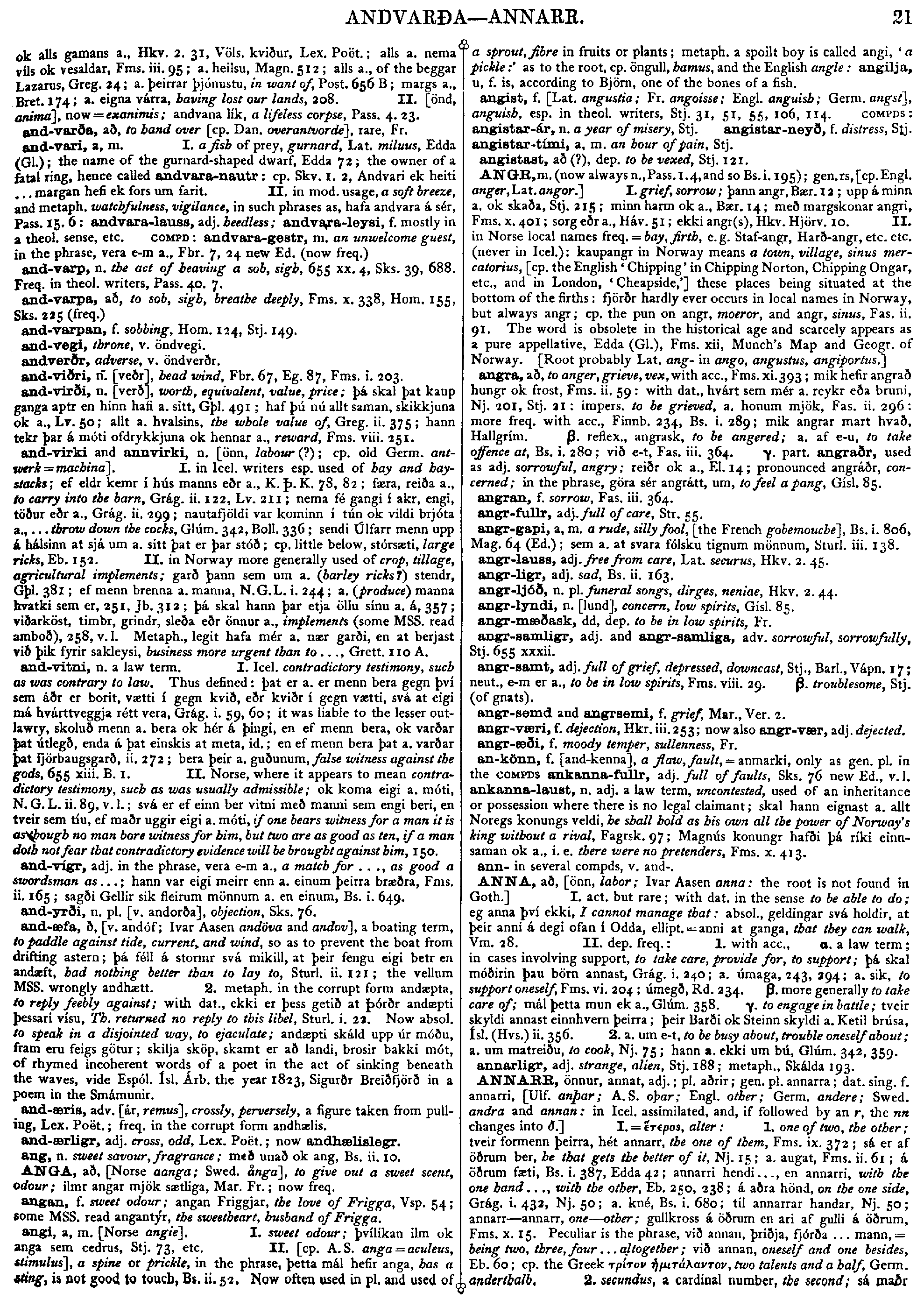
angra,
að,
to
anger,
grieve,
vex,
with
acc.,
Fms.
xi.
393;
mik
hefir
angrað
hungr
ok
frost,
Fms.
ii.
59:
with
dat.,
hvárt
sem
mér
a.
reykr
eða
bruni,
Nj.
201,
Stj.
21:
impers.
to
be
grieved,
a.
honum
mjök,
Fas.
ii.
296:
more
freq.
with
acc.,
Finnb.
234,
Bs.
i.
289;
mik
angrar
mart
hvað,
Hallgrím.
 .
reflex.,
angrask,
to
be
angered;
a.
af
e-u,
to
take
offence
at,
Bs.
i.
280;
við
e-t,
Fas.
iii.
364.
.
reflex.,
angrask,
to
be
angered;
a.
af
e-u,
to
take
offence
at,
Bs.
i.
280;
við
e-t,
Fas.
iii.
364.
 .
part.
angraðr,
used
as
adj.
sorrowful,
angry;
reiðr
ok
a.,
El.
14;
pronounced
angráðr,
con-
cerned;
in
the
phrase,
göra
sér
angrátt,
um,
to
feel
a
pang,
Gísl.
85.
.
part.
angraðr,
used
as
adj.
sorrowful,
angry;
reiðr
ok
a.,
El.
14;
pronounced
angráðr,
con-
cerned;
in
the
phrase,
göra
sér
angrátt,
um,
to
feel
a
pang,
Gísl.
85.
|
Source: Cleasby/Vigfusson, page b0133, entry 4 View original page image as: [TIFF] [PNG] [View previous entry] [View next entry] |
[Comment on this entry] [View comments] |
The following entry has been hand-corrected once. |
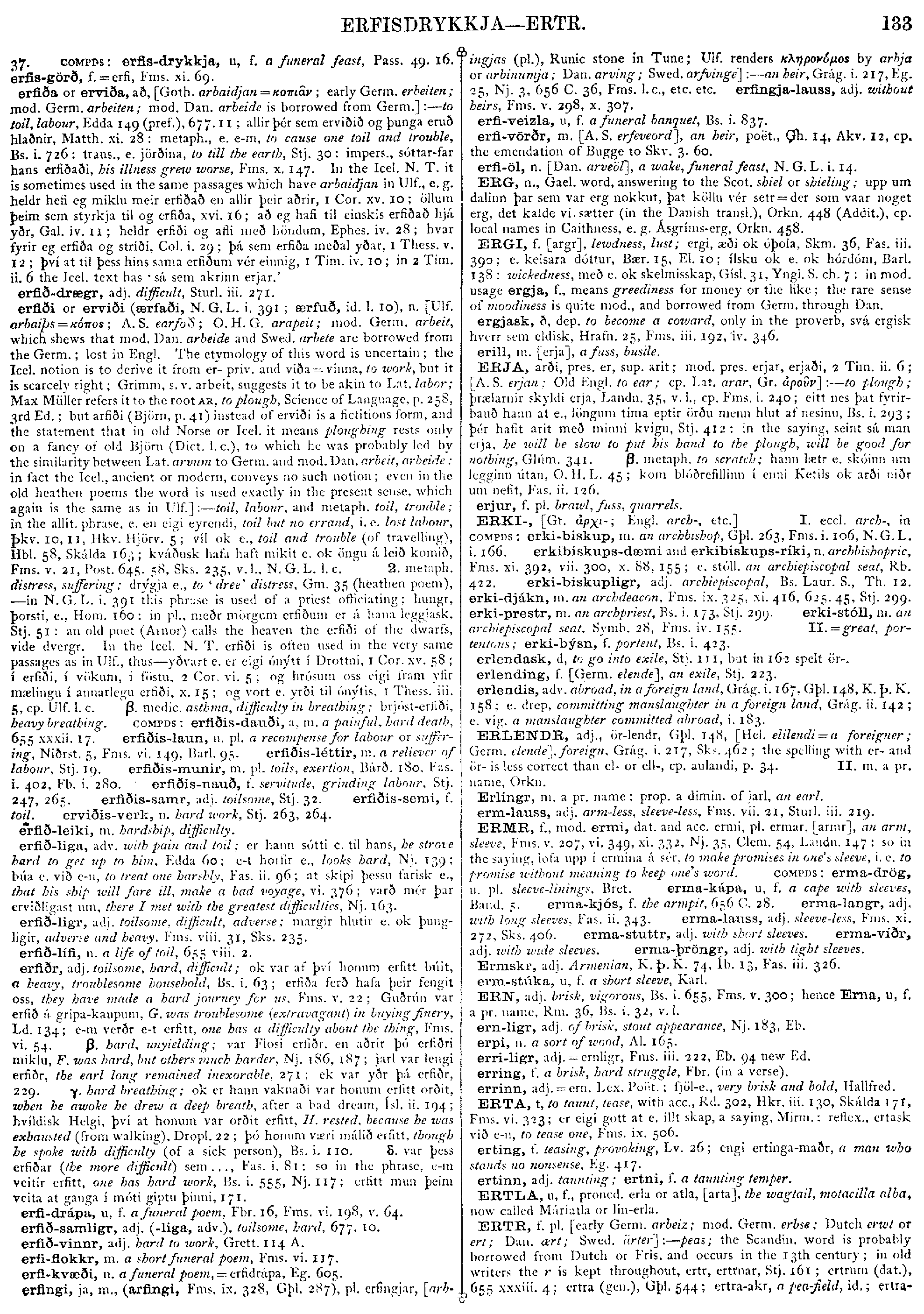
erfiði
or
erviði
(ærfaði,
N.
G.
L.
i.
391;
ærfuð,
id.
I.
10),
n.
[Ulf.
arbaiþs
=
GREEK;
A.
S.
earfoð;
O.
H.
G.
arapeit;
mod.
Germ.
arbeit,
which
shews
that
mod.
Dan.
arbeide
and
Swed.
arbete
are
borrowed
from
the
Germ.;
lost
in
Engl.
The
etymology
of
this
word
is
uncertain;
the
Icel.
notion
is
to
derive
it
from
er-
priv.
and
viða
=
vinna,
to
work,
but
it
is
scarcely
right;
Grimm,
s.v.
arbeit,
suggests
it
to
be
akin
to
Lat.
labor;
Max
Müller
refers
it
to
the
root
AR,
to
plough,
Science
of
Language,
p.
258,
3rd
Ed.;
but
arfiði
(Björn,
p.
41)
instead
of
erviði
is
a
fictitious
form,
and
the
statement
that
in
old
Norse
or
Icel.
it
means
ploughing
rests
only
on
a
fancy
of
old
Björn
(Dict.
l.c.),
to
which
he
was
probably
led
by
the
similarity
between
Lat.
arvum
to
Germ.
and
mod.
Dan.
arbeit,
arbeide:
in
fact
the
Icel.,
ancient
or
modern,
conveys
no
such
notion;
even
in
the
old
heathen
poems
the
word
is
used
exactly
in
the
present
sense,
which
again
is
the
same
as
in
Ulf.]
:--
toil,
labour,
and
metaph.
toil,
trouble;
in
the
allit.
phrase,
e.
en
eigi
eyrendi,
toil
but
no
errand,
i.e.
lost
labour,
Þkv.
10,
11,
Hkv.
Hjörv.
5;
víl
ok
e.,
toil
and
trouble
(of
travelling),
Hbl.
58,
Skálda
163;
kváðusk
hafa
haft
mikit
e.
ok
öngu
á
leið
komið,
Fms.
v.
21,
Post.
645.
58,
Sks.
235,
v.l.,
N.
G.
L.
l.c.
2.
metaph.
distress,
suffering;
drýgja
e.,
to
'dree'
distress,
Gm.
35
(heathen
poem),--in
N.
G.
L.
i.
391
this
phrase
is
used
of
a
priest
officiating;
hungr,
þorsti,
e.,
Hom.
160:
in
pl.,
meðr
mörgum
erfiðum
er
á
hana
leggjask,
Stj.
51:
an
old
poet
(Arnor)
calls
the
heaven
the
erfiði
of
the
dwarfs,
vide
dvergr.
In
the
Icel.
N.
T.
erfiði
is
often
used
in
the
very
same
passages
as
in
Ulf.,
thus--yðvart
e.
er
eigi
ónýtt
í
Drottni,
1
Cor.
xv.
58;
í
erfiði,
í
vökum,
í
föstu,
2
Cor.
vi.
5;
og
hrósum
oss
eigi
tram
yfir
mælingu
í
annarlegu
erfiði,
x.
15;
og
vort
e.
yrði
til
ónýtis,
1
Thess.
iii.
5,
cp.
Ulf.
l.c.
.
medic.
asthma,
difficulty
in
breathing;
brjóst-erfiði,
heavy
breathing.
COMPDS:
erfiðis-dauði,
a,
m.
a
painful,
hard
death,
655
xxxii.
17.
erfiðis-laun,
n.
pl.
a
recompense
for
labour
or
suffering,
Niðrst.
5,
Fms.
vi.
149,
Barl.
95.
erfiðis-léttir,
m.
a
reliever
of
labour,
Stj.
19.
erfiðis-munir,
m.
pl.
toils,
exertion,
Bárð.
180,
Fas.
i.
402,
Fb.
i.
280.
erfiðis-nauð,
f.
servitude,
grinding
labour,
Stj.
247,
265.
erfiðis-samr,
adj.
toilsome,
Stj.
32.
erfiðis-semi,
f.
toil.
erviðis-verk,
n.
hard
work,
Stj.
263,
264.
|
Source: Cleasby/Vigfusson, page b0263, entry 5 View original page image as: [TIFF] [PNG] [View previous entry] [View next entry] |
[Comment on this entry] [View comments] |
The following entry has been hand-corrected once. |
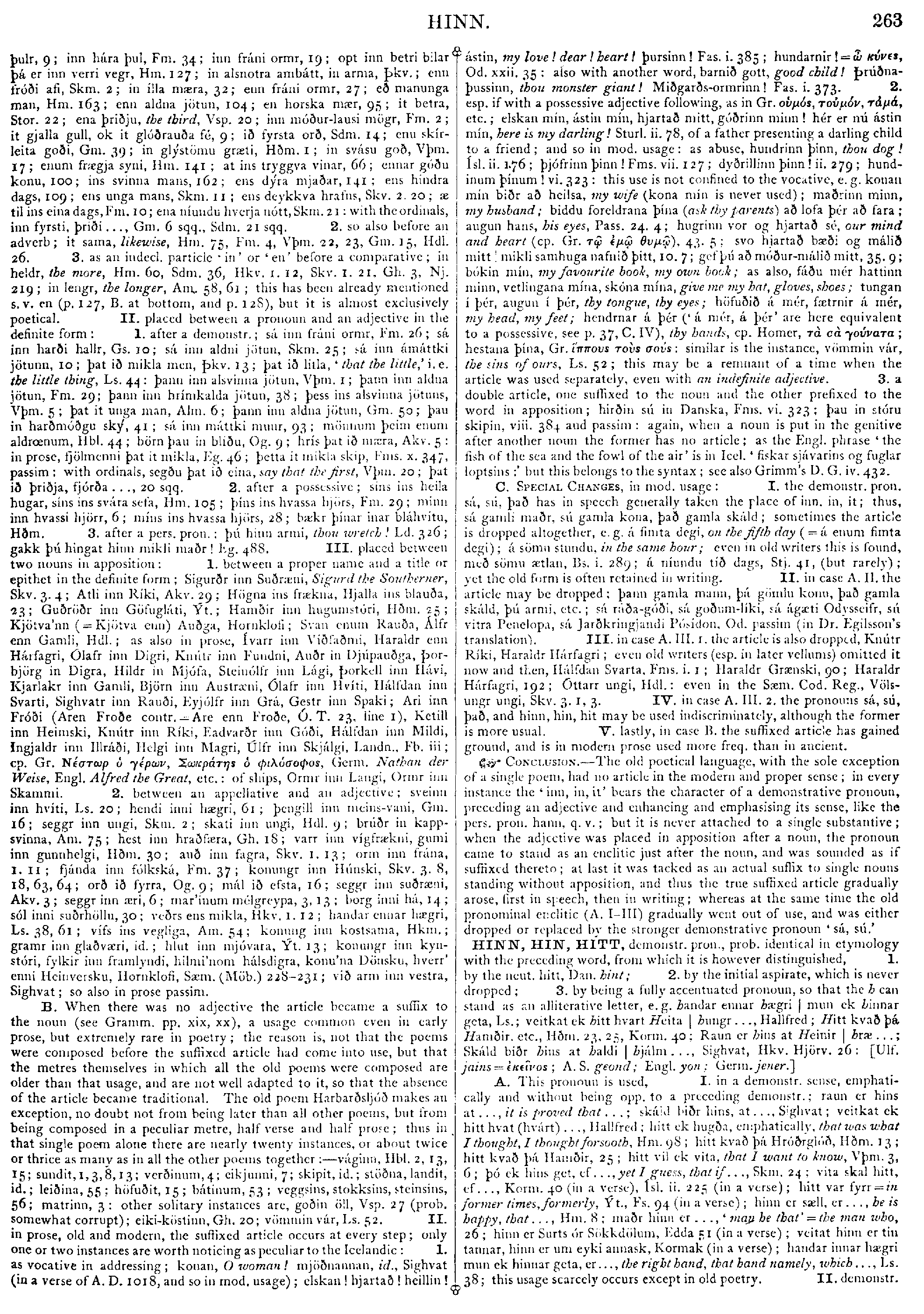
HINN, HIN, HITT, demonstr. pron., prob. identical in etymology with the preceding word, from which it is however distinguished, 1. by the neut. hitt, Dan. hint; 2. by the initial aspirate, which is never dropped; 3. by being a fully accentuated pronoun, so that the h can stand as an alliterative letter, e.g. handar ennar hægri | mun ek hinnar geta, Ls.; veitkat ek hitt hvart Heita | hungr ..., Hallfred; Hitt kvað þá Hamðir, etc., Hom. 23, 25, Korm. 40; Raun er hins at Heinir | hræ ...; Skáld biðr hins at haldi | hjálm ..., Sighvat, Hkv. Hjörv. 26: [Ulf. jains = GREEK; A. S. geond; Engl. yon; Germ. jener.]
|
Source: Cleasby/Vigfusson, page b0293, entry 15 View original page image as: [TIFF] [PNG] [View previous entry] [View next entry] |
[Comment on this entry] [View comments] |
The following entry has been hand-corrected once. |
hungran, f. = hungr, Bs. ii. 135.
|
Source: Cleasby/Vigfusson, page b0312, entry 6 View original page image as: [TIFF] [PNG] [View previous entry] [View next entry] |
[Comment on this entry] [View comments] |
The following entry has been hand-corrected once. |
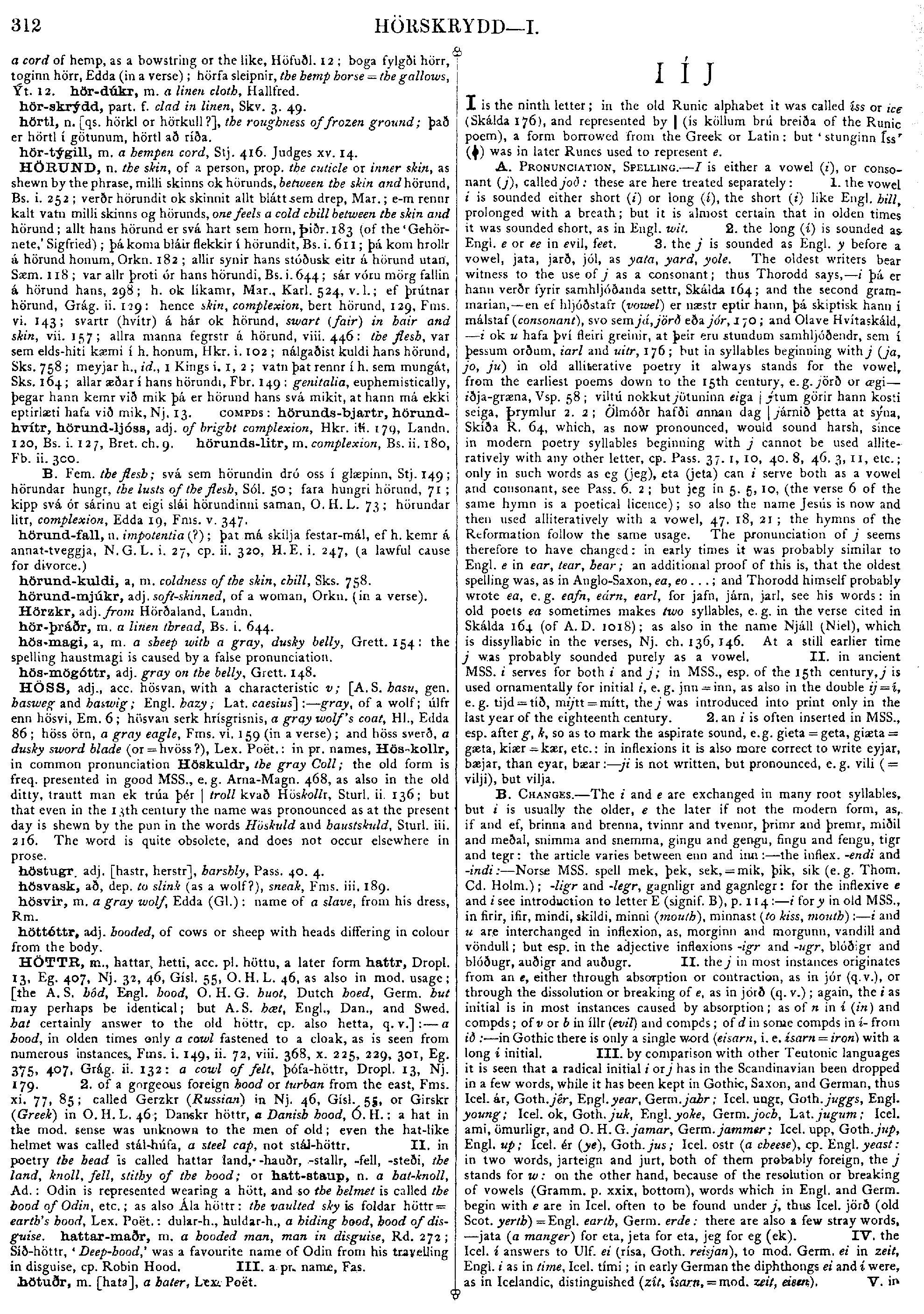
B. Fem. the flesh; svá sem hörundin dró oss í glæpinn, Stj. 149; hörundar hungr, the lusts of the flesh, Sól. 50; fara hungri hörund, 71; kipp svá ór sárinu at eigi slái hörundinni saman, O. H. L. 73; hörundar litr, complexion, Edda 19, Fms. v. 347.
|
Source: Cleasby/Vigfusson, page b0346, entry 24 View original page image as: [TIFF] [PNG] [View previous entry] [View next entry] |
[Comment on this entry] [View comments] |
The following entry has been hand-corrected once. |
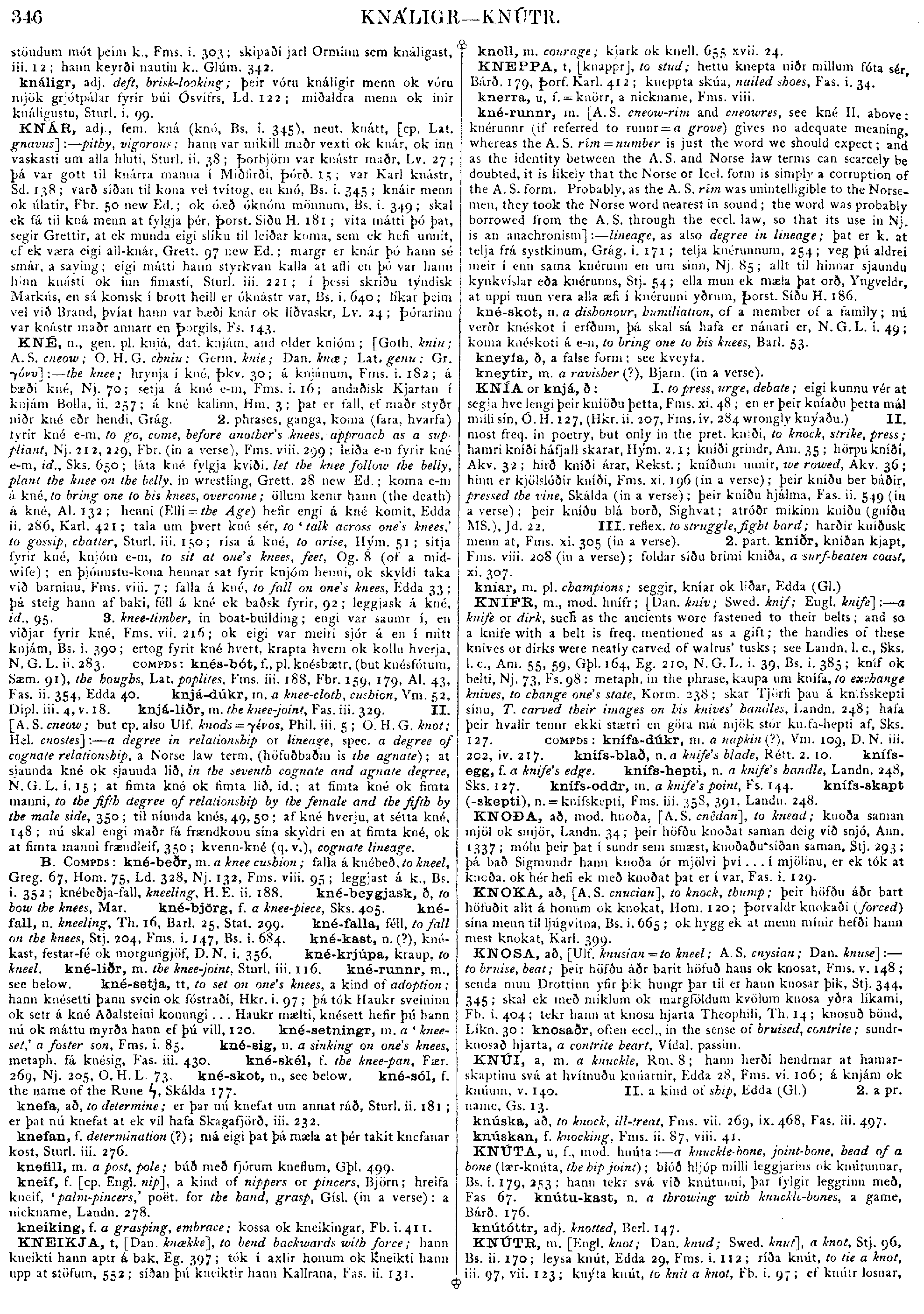
KNOSA, að, [Ulf. knusian = to kneel; A. S. cnysian; Dan. knuse] :-- to bruise, beat; þeir höfðu áðr barit höfuð hans ok knosat, Fms. v. 148; senda mun Drottinn yfir þik hungr þar til er hann knosar þik, Stj. 344, 345; skal ek með miklum ok margföldum kvölum knosa yðra líkami, Fb. i. 404; tekr hann at knosa hjarta Theophili, Th. 14; knosuð bönd, Líkn. 30: knosaðr, often eccl., in the sense of bruised, contrite; sundrknosað hjarta, a contrite heart, Vídal. passim.
|
Source: Cleasby/Vigfusson, page b0352, entry 20 View original page image as: [TIFF] [PNG] [View previous entry] [View next entry] |
[Comment on this entry] [View comments] |
The following entry has been hand-corrected once. |
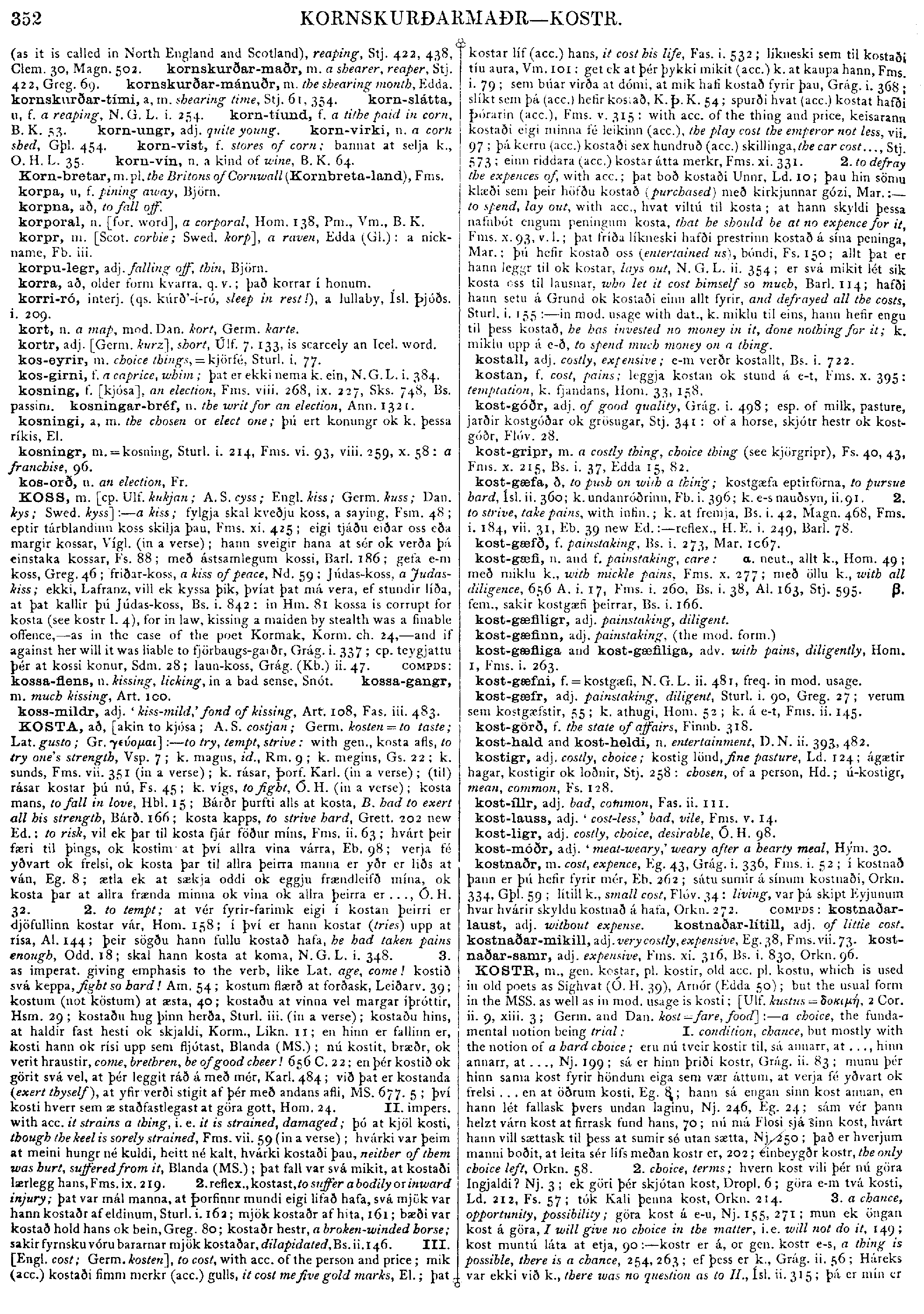
KOSTA, að, [akin to kjósa; A. S. costjan; Germ. kosten = to taste; Lat. gusto; Gr. GREEK] :-- to try, tempt, strive: with gen., kosta afls, to try one's strength, Vsp. 7; k. magns, id., Rm. 9; k. megins, Gs. 22; k. sunds, Fms. vii. 351 (in a verse); k. rásar, Þorf. Karl. (in a verse); (til) rásar kostar þú nú, Fs. 45; k. vígs, to fight, Ó. H. (in a verse); kosta mans, to fall in love, Hbl. 15; Bárðr þurfti alls at kosta, B. had to exert all his strength, Bard. 166; kosta kapps, to strive hard, Grett. 202 new Ed.: to risk, vil ek þar til kosta fjár föður míns, Fms. ii. 63; hvárt þeir færi til þings, ok kostim at því allra vina várra, Eb. 98; verja fé yðvart ok frelsi, ok kosta þar til allra þeirra manna er yðr er liðs at ván, Eg. 8; ætla ek at sækja oddi ok eggju frændleifð mína, ok kosta þar at allra frænda minna ok vina ok allra þeirra er ..., Ó. H. 32. 2. to tempt; at vér fyrir-farimk eigi í kostan þeirri er djöfullinn kostar vár, Hom. 158; í því er hann kostar (tries) upp at rísa, Al. 144; þeir sögðu hann fullu kostað hafa, he had taken pains enough, Odd. 18; skal hann kosta at koma, N. G. L. i. 348. 3. as imperat. giving emphasis to the verb, like Lat. age, come! kostið svá keppa, fight so hard! Am. 54; kostum flærð at forðask, Leiðarv. 39; kostum (not köstum) at æsta, 40; kostaðu at vinna vel margar íþróttir, Hsm. 29; kostaðu hug þinn herða, Sturl. iii. (in a verse); kostaðu hins, at haldir fast hesti ok skjaldi, Korm., Líkn. 11; en hinn er fallinn er, kosti hann ok rísi upp sem fljótast, Blanda (MS.); nú kostit, bræðr, ok verit hraustir, come, brethren, be of good cheer! 656 C. 22; en þér kostið ok görit svá vel, at þér leggit ráð á með mér, Karl. 484; við þat er kostanda (exert thyself), at yfir verði stigit af þér með andans afli, MS. 677. 5; því kosti hverr sem æ staðfastlegast at göra gott, Hom. 24. II. impers. with acc. it strains a thing, i.e. it is strained, damaged; þó at kjöl kosti, though the keel is sorely strained, Fms. vii. 59 (in a verse); hvárki var þeim at meini hungr né kuldi, heitt né kalt, hvárki kostaði þau, neither of them was hurt, suffered from it, Blanda (MS.); þat fall var svá mikit, at kostaði lærlegg hans, Fms. ix. 219. 2. reflex., kostast, to suffer a bodily or inward injury; þat var mál manna, at Þorfinnr mundi eigi lifað hafa, svá mjök var hann kostaðr af eldinum, Sturl. i. 162; mjök kostaðr af hita, 161; bæði var kostað hold hans ok bein, Greg. 80; kostaðr hestr, a broken-winded horse; sakir fyrnsku vóru bararnar mjök kostaðar, dilapidated, Bs. ii. 146. III. [Engl. cost; Germ. kosten], to cost, with acc. of the person and price; mik (acc.) kostaði fimm merkr (acc.) gulls, it cost me five gold marks, El.; þat kostar líf (acc.) hans, it cost his life, Fas. i. 532; líkneski sem til kostaði tíu aura, Vm. 101: get ek at þér þykki mikit (acc.) k. at kaupa hann, Fms. i. 79; sem búar virða at dómi, at mik hafi kostað fyrir þau, Grág. i. 368; slíkt sem þá (acc.) hefir kostað, K. Þ. K. 54; spurði hvat (acc.) kostat hafði Þórarin (acc.), Fms. v. 315: with acc. of the thing and price, keisarann kostaði eigi minna fé leikinn (acc.), the play cost the emperor not less, vii. 97; þá kerru (acc.) kostaði sex hundruð (acc.) skillinga, the car cost ..., Stj. 573; einn riddara (acc.) kostar átta merkr, Fms. xi. 331. 2. to defray the expences of, with acc.; þat boð kostaði Unnr, Ld. 10; þau hin sömu klæði sem þeir höfðu kostað (purchased) með kirkjunnar gózi, Mar. :-- to spend, lay out, with acc., hvat viltú til kosta; at hann skyldi þessa nafnbót engum peningum kosta, that he should be at no expence for it, Fms. x. 93, v.l.; þat fríða líkneski hafði prestrinn kostað á sína peninga, Mar.; þú hefir kostað oss (entertained us), bóndi, Fs. 150; allt þat er hann leggr til ok kostar, lays out, N. G. L. ii. 354; er svá mikit lét sik kosta oss til lausnar, who let it cost himself so much, Barl. 114; hafði hann setu á Grund ok kostaði einn allt fyrir, and defrayed all the costs, Sturl. i. 155 :-- in mod. usage with dat., k. miklu til eins, hann hefir engu til þess kostað, he has invested no money in it, done nothing for it; k. miklu upp á e-ð, to spend much money on a thing.
| Result Page: | 1 2 | Next |  |
Germanic Lexicon Project (main page)
This search system was written by
Sean Crist
Please consider
volunteering
to correct the data in these online dictionaries.
No rights reserved. Feel free to use these data in any way you please.