|
|

|
Source: Cleasby/Vigfusson, page b0281, entry 42 View original page image as: [TIFF] [PNG] [View previous entry] [View next entry] |
[Comment on this entry] [View comments] |
The following entry has been hand-corrected once. |
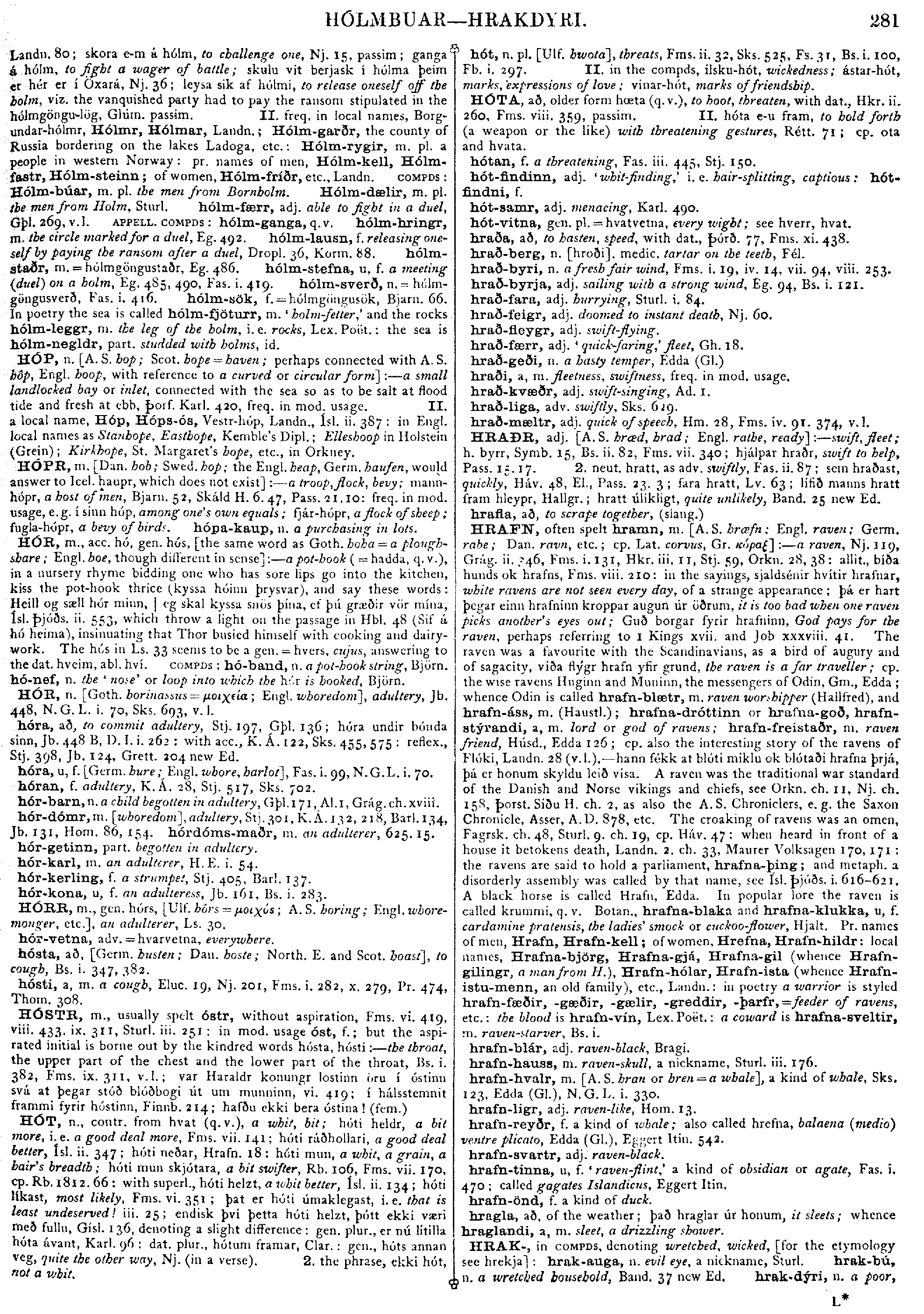
HRAFN, often spelt hramn, m. [A. S. hræfn; Engl. raven; Germ. rabe; Dan. ravn, etc.; cp. Lat. corvus, Gr. GREEK] :-- a raven, Nj. 119, Grág. ii. 346, Fms. i. 131, Hkr. iii. 11, Stj. 59, Orkn. 28, 38: allit., bíða hunds ok hrafns, Fms. viii. 210: in the sayings, sjaldsénir hvítir hrafnar, white ravens are not seen every day, of a strange appearance; þá er hart þegar einn hrafninn kroppar augun úr öðrum, it is too bad when one raven picks another's eyes out; Guð borgar fyrir hrafninn, God pays for the raven, perhaps referring to 1 Kings xvii. and Job xxxviii. 41. The raven was a favourite with the Scandinavians, as a bird of augury and of sagacity, víða flýgr hrafn yfir grund, the raven is a far traveller; cp. the wise ravens Huginn and Muninn, the messengers of Odin, Gm., Edda; whence Odin is called hrafn-blætr, m. raven worshipper (Hallfred), and hrafn-áss, m. (Haustl.); hrafna-dróttinn or hrafna-goð, hrafn-stýrandi, a, m. lord or god of ravens; hrafn-freistaðr, m. raven friend, Húsd., Edda 126; cp. also the interesting story of the ravens of Flóki, Landn. 28 (v.l.), -- hann fékk at blóti miklu ok blótaði hrafna þrjá, þá er honum skyldu leið vísa. A raven was the traditional war standard of the Danish and Norse vikings and chiefs, see Orkn. ch. 11, Nj. ch. 158, Þorst. Síðu H. ch. 2, as also the A. S. Chroniclers, e.g. the Saxon Chronicle, Asser, A.D. 878, etc. The croaking of ravens was an omen, Fagrsk. ch. 48, Sturl. 9. ch. 19, cp. Háv. 47: when heard in front of a house it betokens death, Landn. 2. ch. 33, Maurer Volksagen 170, 171: the ravens are said to hold a parliament, hrafna-þing; and metaph. a disorderly assembly was called by that name, see Ísl. Þjóðs. i. 616-621. A black horse is called Hrafn, Edda. In popular lore the raven is called krummi, q.v. Botan., hrafna-blaka and hrafna-klukka, u, f. cardamine pratensis, the ladies' smock or cuckoo-flower, Hjalt. Pr. names of men, Hrafn, Hrafn-kell; of women, Hrefna, Hrafn-hildr: local names, Hrafna-björg, Hrafna-gjá, Hrafna-gil (whence Hrafn-gilingr, a man from H.), Hrafn-hólar, Hrafn-ista (whence Hrafnistu-menn, an old family), etc., Landn.: in poetry a warrior is styled hrafn-fæðir, -gæðir, -gælir, -greddir, -þarfr, = feeder of ravens, etc.: the blood is hrafn-vín, Lex. Poët.: a coward is hrafna-sveltir, m. raven-starver, Bs. i.
|
Source: Torp, page b0103, entry 5 View original page image as: [TIFF] [PNG] [View previous entry] [View next entry] |
[Comment on this entry] [View comments] |
The following entry has been hand-corrected once. |
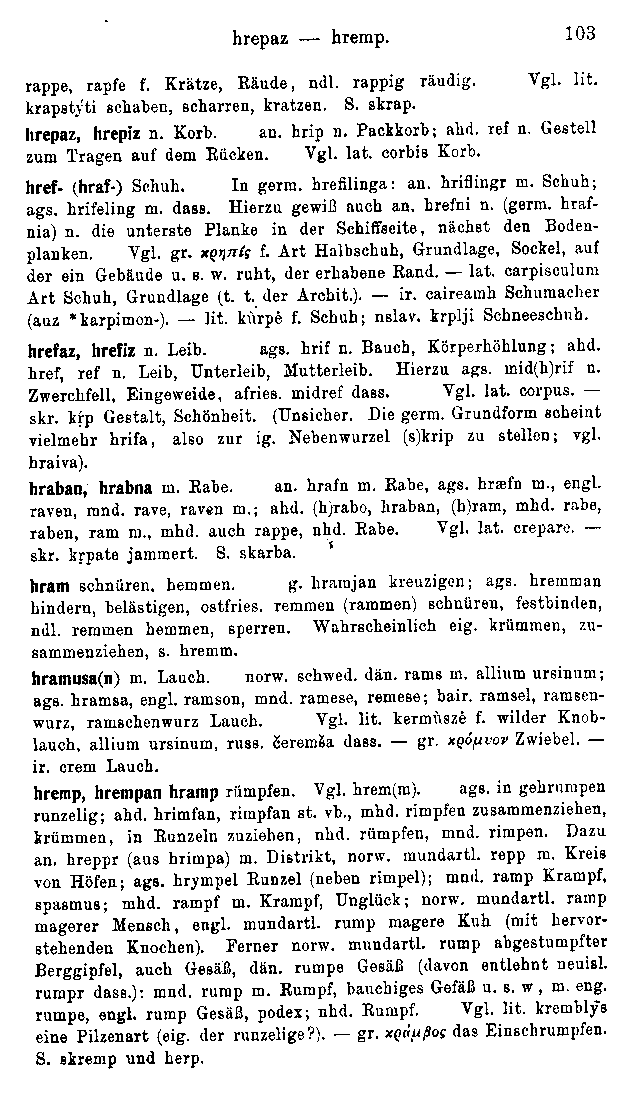
hraban,
hrabna
m.
Rabe.
an.
hrafn
m.
Rabe,
ags.
hræfn
m.,
engl.
raven,
mnd.
rave,
raven
m,;
ahd.
(h)rabo,
hraban,
(h)ram,
mhd.
rabe,
raben,
ram
m.,
mhd.
auch
rappe,
nhd.
Rabe.
Vgl.
lat.
crepare.
-
skr.
k pate
jammert.
S.
skarba.
pate
jammert.
S.
skarba.
[Translate the German words]
|
Source: Bosworth/Toller, page b0555, entry 22 View original page image as: [TIFF] [PNG] [View previous entry] [View next entry] |
[Comment on this entry] [View comments] |
The following entry has been hand-corrected once. |
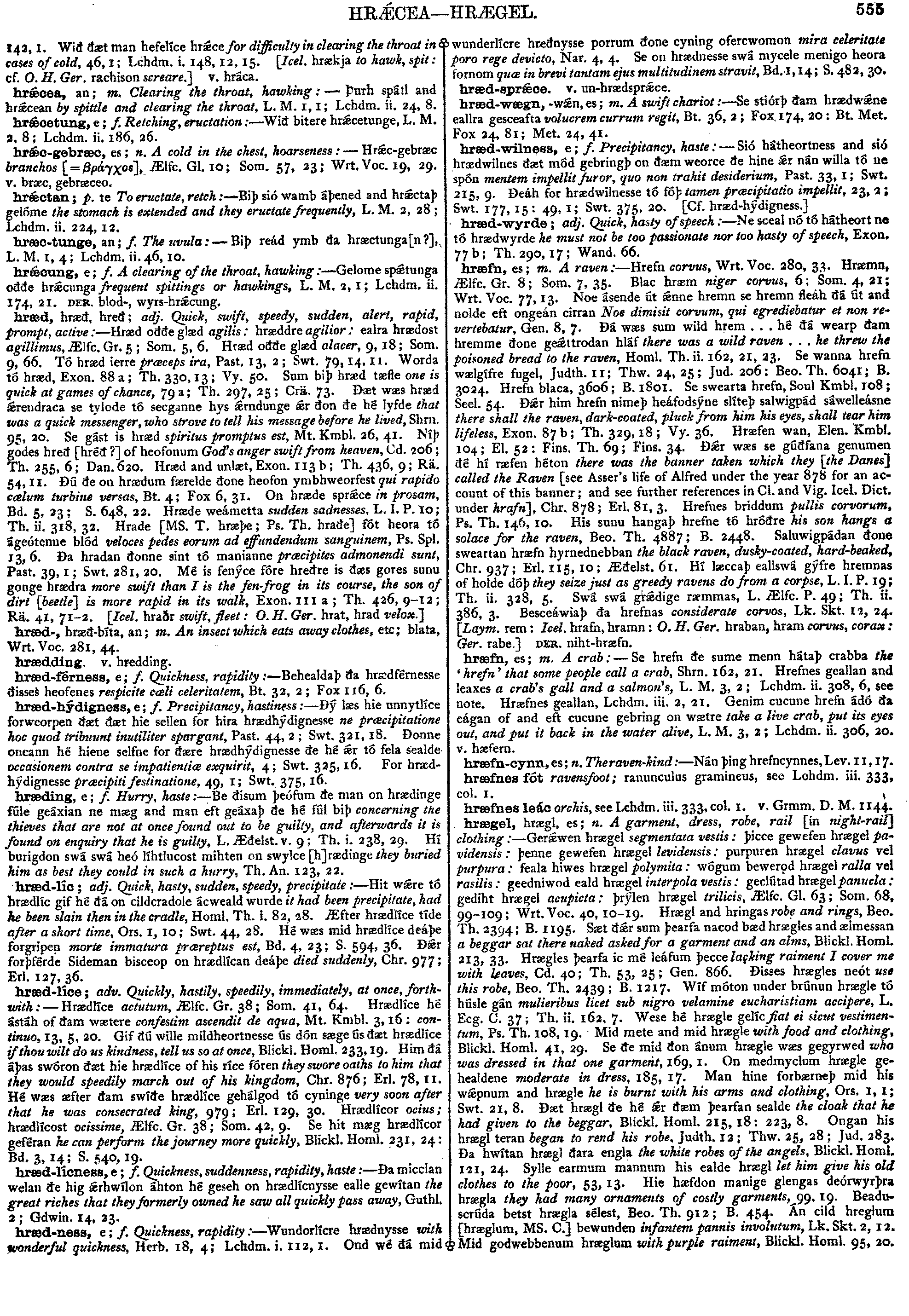
hræfn,
es;
m.
A
raven
:--
Hrefn
corvus,
Wrt.
Voc.
280,
33.
Hræmn,
Ælfc.
Gr.
8;
Som.
7,
35.
Blac
hræm
niger
corvus,
6;
Som.
4,
21;
Wrt.
Voc.
77,
13.
Noe
ásende
út
 nne
hremn
se
hremn
fleáh
ðá
út
and
nolde
eft
ongeán
cirran
Noe
dimisit
corvum,
qui
egrediebatur
et
non
revertebatur,
Gen.
8,
7.
Ðá
wæs
sum
wild
hrem
...
hé
ðá
wearp
ðam
hremme
ðone
gettrodan
hláf
there
was
a
wild
raven
...
he
threw
the
poisoned
bread
to
the
raven,
Homl.
Th.
ii.
162,
21,
23.
Se
wanna
hrefn
wælgífre
fugel,
Judth.
11;
Thw.
24,
25;
Jud.
206:
Beo.
Th.
6041;
B.
3024.
Hrefn
blaca,
3606;
B.
1801.
Se
swearta
hrefn,
Soul
Kmbl.
108;
Seel.
54.
Ðr
him
hrefn
nimeþ
heáfodsýne
slíteþ
salwigpád
sáwelleásne
there
shall
the
raven,
dark-coated,
pluck
from
him
his
eyes,
shall
tear
him
lifeless,
Exon.
87
b;
Th.
329,
18;
Vy.
36.
Hræfen
wan,
Elen.
Kmbl.
104;
El.
52:
Fins.
Th.
69;
Fins.
34.
Ðr
wæs
se
gúðfana
genumen
ðé
hí
ræfen
héton
there
was
the
banner
taken
which
they
[the
Danes]
called
the
Raven
[see
Asser's
life
of
Alfred
under
the
year
878
for
an
account
of
this
banner;
and
see
further
references
in
Cl.
and
Vig.
Icel.
Dict.
under
hrafn],
Chr.
878;
Erl.
81,
3.
Hrefnes
briddum
pullis
corvorum,
Ps.
Th.
146,
10.
His
sunu
hangaþ
hrefne
tó
hróðre
his
son
hangs
a
solace
for
the
raven,
Beo.
Th.
4887;
B.
2448.
Saluwigpádan
ðone
sweartan
hræfn
hyrnednebban
the
black
raven,
dusky-coated,
hard-beaked,
Chr.
937;
Erl.
115,
10;
Æðelst.
61.
Hí
læccaþ
eallswá
gýfre
hremnas
of
holde
dóþ
they
seize
just
as
greedy
ravens
do
from
a
corpse,
L.
I.
P.
19;
Th.
ii.
328,
5.
Swá
swá
grdige
ræmmas,
L.
Ælfc.
P.
49;
Th.
ii.
386,
3.
Besceáwiaþ
ða
hrefnas
considerate
corvos,
Lk.
Skt.
12,
24.
[Laym.
rem:
Icel.
hrafn,
hramn:
O.
H.
Ger.
hraban,
hram
corvus,
corax:
Ger.
rabe.]
DER.
niht-hræfn.
nne
hremn
se
hremn
fleáh
ðá
út
and
nolde
eft
ongeán
cirran
Noe
dimisit
corvum,
qui
egrediebatur
et
non
revertebatur,
Gen.
8,
7.
Ðá
wæs
sum
wild
hrem
...
hé
ðá
wearp
ðam
hremme
ðone
gettrodan
hláf
there
was
a
wild
raven
...
he
threw
the
poisoned
bread
to
the
raven,
Homl.
Th.
ii.
162,
21,
23.
Se
wanna
hrefn
wælgífre
fugel,
Judth.
11;
Thw.
24,
25;
Jud.
206:
Beo.
Th.
6041;
B.
3024.
Hrefn
blaca,
3606;
B.
1801.
Se
swearta
hrefn,
Soul
Kmbl.
108;
Seel.
54.
Ðr
him
hrefn
nimeþ
heáfodsýne
slíteþ
salwigpád
sáwelleásne
there
shall
the
raven,
dark-coated,
pluck
from
him
his
eyes,
shall
tear
him
lifeless,
Exon.
87
b;
Th.
329,
18;
Vy.
36.
Hræfen
wan,
Elen.
Kmbl.
104;
El.
52:
Fins.
Th.
69;
Fins.
34.
Ðr
wæs
se
gúðfana
genumen
ðé
hí
ræfen
héton
there
was
the
banner
taken
which
they
[the
Danes]
called
the
Raven
[see
Asser's
life
of
Alfred
under
the
year
878
for
an
account
of
this
banner;
and
see
further
references
in
Cl.
and
Vig.
Icel.
Dict.
under
hrafn],
Chr.
878;
Erl.
81,
3.
Hrefnes
briddum
pullis
corvorum,
Ps.
Th.
146,
10.
His
sunu
hangaþ
hrefne
tó
hróðre
his
son
hangs
a
solace
for
the
raven,
Beo.
Th.
4887;
B.
2448.
Saluwigpádan
ðone
sweartan
hræfn
hyrnednebban
the
black
raven,
dusky-coated,
hard-beaked,
Chr.
937;
Erl.
115,
10;
Æðelst.
61.
Hí
læccaþ
eallswá
gýfre
hremnas
of
holde
dóþ
they
seize
just
as
greedy
ravens
do
from
a
corpse,
L.
I.
P.
19;
Th.
ii.
328,
5.
Swá
swá
grdige
ræmmas,
L.
Ælfc.
P.
49;
Th.
ii.
386,
3.
Besceáwiaþ
ða
hrefnas
considerate
corvos,
Lk.
Skt.
12,
24.
[Laym.
rem:
Icel.
hrafn,
hramn:
O.
H.
Ger.
hraban,
hram
corvus,
corax:
Ger.
rabe.]
DER.
niht-hræfn.
|
Source: Cleasby/Vigfusson, page b0003, entry 7 View original page image as: [TIFF] [PNG] [View previous entry] [View next entry] |
[Comment on this entry] [View comments] |
The following entry has been hand-corrected once. |
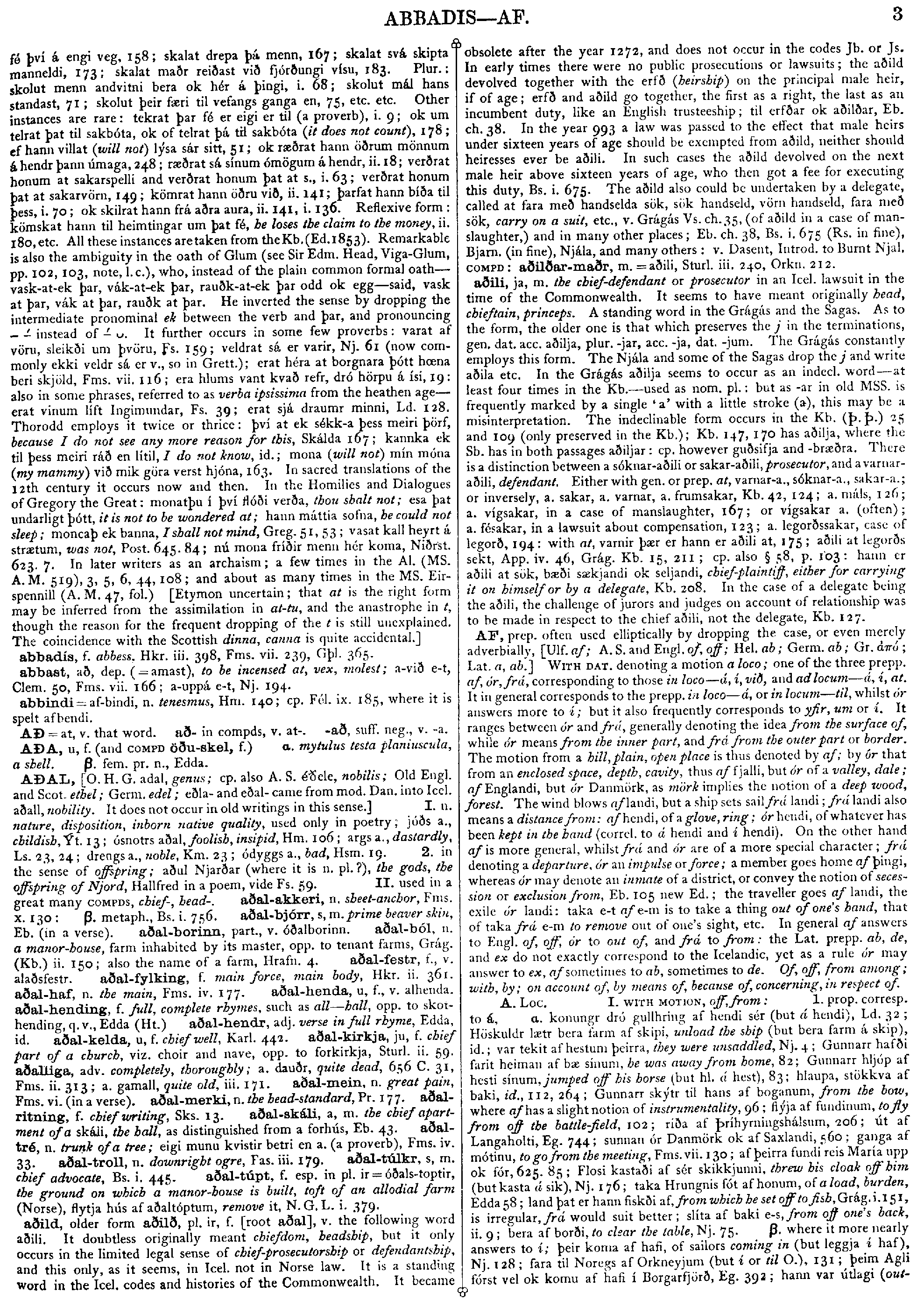
AÐAL,
[O.
H.
G.
adal,
genus;
cp.
also
A.
S.
éðele,
nobilis;
Old
Engl.
and
Scot,
ethel;
Germ,
edel;
eðla-
and
eðal-
came
from
mod.
Dan.
into
Icel.
aðall,
nobility.
It
does
not
occur
in
old
writings
in
this
sense.]
I.
n.
nature,
disposition,
inborn
native
quality,
used
only
in
poetry;
jóðs
a.,
childish,
Ýt.
13;
ósnotrs
aðal,
foolish,
insipid,
Hm.
106;
args
a.,
dastardly,
Ls.
23,
24;
drengs
a.,
noble,
Km.
23;
ódyggs
a.,
bad,
Hsm.
19.
2.
in
the
sense
of
offspring;
aðul
Njarðar
(where
it
is
n.
pl.?),
the
gods,
the
offspring
of
Njord,
Hallfred
in
a
poem,
vide
Fs.
59.
II.
used
in
a
great
many
COMPDS,
chief-,
head-.
aðal-akkeri,
n.
sheet-anchor,
Fms.
x.
130:
 .
metaph.,
Bs.
i.
756.
aðal-bjórr,
s,
m.
prime
beaver
skin,
Eb.
(in
a
verse).
aðal-borinn,
part.,
v.
óðalborinn.
aðal-ból,
n.
a
manor-house,
farm
inhabited
by
its
master,
opp.
to
tenant
farms,
Grág.
(Kb.)
ii.
150;
also
the
name
of
a
farm,
Hrafn.
4.
aðal-festr,
f.,
v.
alaðsfestr.
aðal-fylking,
f.
main
force,
main
body,
Hkr.
ii.
361.
aðal-haf,
n.
the
main,
Fms.
iv.
177.
aðal-henda,
u,
f.,
v.
alhenda.
aðal-hending,
f.
full,
complete
rhymes,
such
as
all
--
hall,
opp.
to
skot-
hending,
q.
v.,
Edda
(Ht.)
aðal-hendr,
adj.
verse
in
full
rhyme,
Edda,
id.
aðal-kelda,
u,
f.
chief
well,
Karl.
442.
aðal-kirkja,
ju,
f.
chief
part
of
a
church,
viz.
choir
and
nave,
opp.
to
forkirkja,
Sturl.
ii.
59.
aðalliga,
adv.
completely,
thoroughly;
a.
dauðr,
quite
dead,
656
C.
31,
Fms.
ii.
313;
a.
gamall,
quite
old,
iii.
171.
aðal-mein,
n.
great
pain,
Fms.
vi.
(in
a
verse),
aðal-merki,
n.
the
head-standard,
Pr.
177.
aðal-
ritning,
f.
chief
writing,
Sks.
13.
aðal-skáli,
a,
m.
the
chief
apart-
ment
of
a
skáli,
the
hall,
as
distinguished
from
a
forhús,
Eb.
43.
aðal-
tré,
n.
trunk
of
a
tree;
eigi
munu
kvistir
betri
en
a.
(a
proverb),
Fms.
iv.
33.
aðal-troll,
n.
downright
ogre,
Fas.
iii.
179.
aðal-túlkr,
s,
m.
chief
advocate,
Bs.
i.
445.
aðal-túpt,
f.
esp.
in
pl.
ir
=
óðals-toptir,
the
ground
on
which
a
manor-bouse
is
built,
toft
of
an
allodial
farm
(Norse),
flytja
hús
af
aðaltóptum,
remove
it,
N.
G.
L.
i.
.
metaph.,
Bs.
i.
756.
aðal-bjórr,
s,
m.
prime
beaver
skin,
Eb.
(in
a
verse).
aðal-borinn,
part.,
v.
óðalborinn.
aðal-ból,
n.
a
manor-house,
farm
inhabited
by
its
master,
opp.
to
tenant
farms,
Grág.
(Kb.)
ii.
150;
also
the
name
of
a
farm,
Hrafn.
4.
aðal-festr,
f.,
v.
alaðsfestr.
aðal-fylking,
f.
main
force,
main
body,
Hkr.
ii.
361.
aðal-haf,
n.
the
main,
Fms.
iv.
177.
aðal-henda,
u,
f.,
v.
alhenda.
aðal-hending,
f.
full,
complete
rhymes,
such
as
all
--
hall,
opp.
to
skot-
hending,
q.
v.,
Edda
(Ht.)
aðal-hendr,
adj.
verse
in
full
rhyme,
Edda,
id.
aðal-kelda,
u,
f.
chief
well,
Karl.
442.
aðal-kirkja,
ju,
f.
chief
part
of
a
church,
viz.
choir
and
nave,
opp.
to
forkirkja,
Sturl.
ii.
59.
aðalliga,
adv.
completely,
thoroughly;
a.
dauðr,
quite
dead,
656
C.
31,
Fms.
ii.
313;
a.
gamall,
quite
old,
iii.
171.
aðal-mein,
n.
great
pain,
Fms.
vi.
(in
a
verse),
aðal-merki,
n.
the
head-standard,
Pr.
177.
aðal-
ritning,
f.
chief
writing,
Sks.
13.
aðal-skáli,
a,
m.
the
chief
apart-
ment
of
a
skáli,
the
hall,
as
distinguished
from
a
forhús,
Eb.
43.
aðal-
tré,
n.
trunk
of
a
tree;
eigi
munu
kvistir
betri
en
a.
(a
proverb),
Fms.
iv.
33.
aðal-troll,
n.
downright
ogre,
Fas.
iii.
179.
aðal-túlkr,
s,
m.
chief
advocate,
Bs.
i.
445.
aðal-túpt,
f.
esp.
in
pl.
ir
=
óðals-toptir,
the
ground
on
which
a
manor-bouse
is
built,
toft
of
an
allodial
farm
(Norse),
flytja
hús
af
aðaltóptum,
remove
it,
N.
G.
L.
i.
|
Source: Cleasby/Vigfusson, page b0004, entry 1 View original page image as: [TIFF] [PNG] [View previous entry] [View next entry] |
[Comment on this entry] [View comments (1)] |
The following entry has been hand-corrected once. |
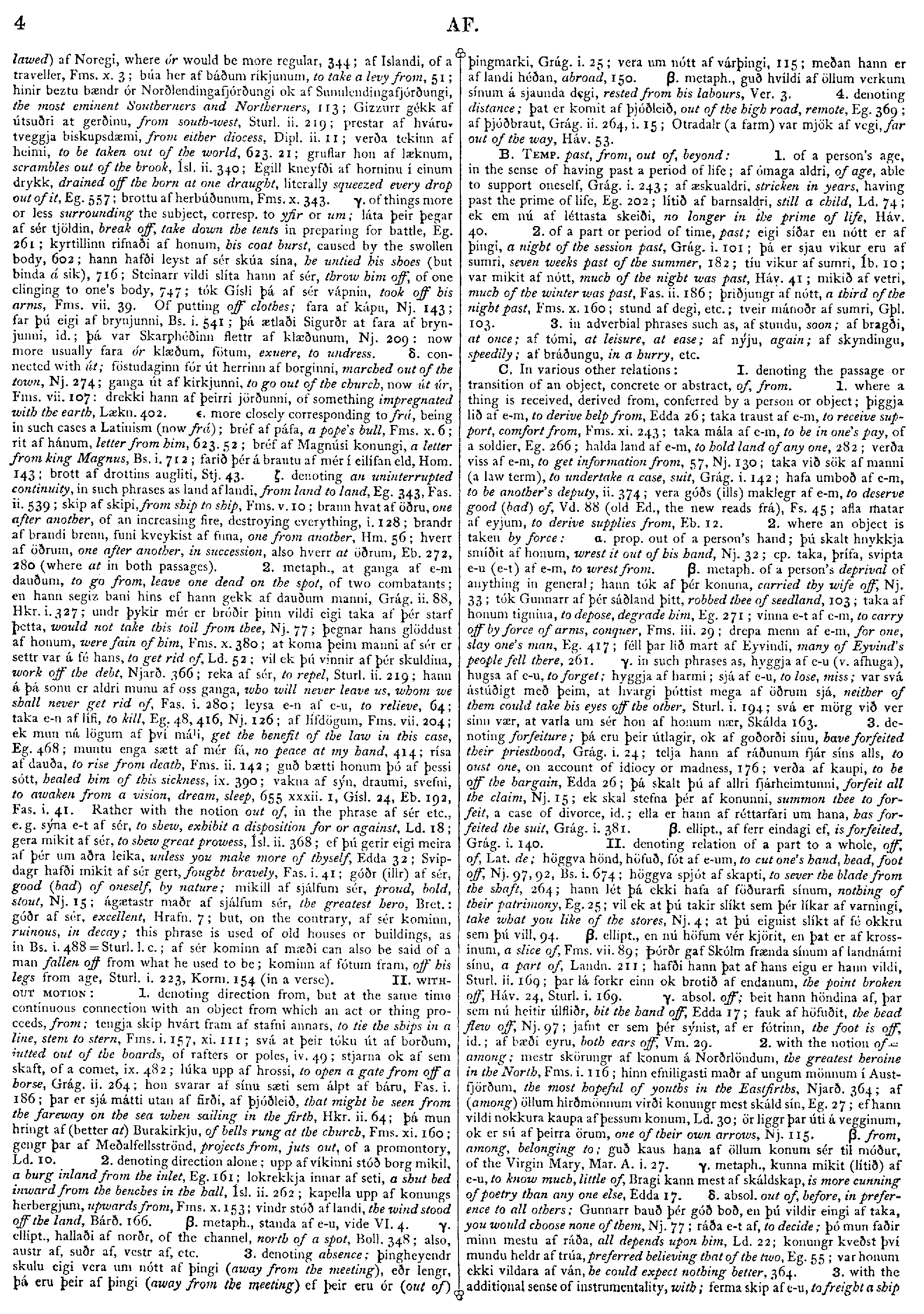
lawed)
af
Noregi,
where
ór
would
be
more
regular,
344;
af
Islandi,
of
a
traveller,
Fms.
x.
3;
búa
her
af
báðum
ríkjunum,
to
take
a
levy
from,
51;
hinir
beztu
bændr
ór
Norðlendingafjórðungi
ok
af
Sunnlendingafjórðungi,
the
most
eminent
Southerners
and
Northerners,
113;
Gizzurr
gékk
af
útsuðri
at
gerðinu,
from
south-west,
Sturl.
ii.
219;
prestar
af
hváru-
tveggja
biskupsdæmi,
from
either
diocess,
Dipl.
ii.
11;
verða
tekinn
af
heimi,
to
be
taken
out
of
the
world,
623.
21;
gruflar
hon
af
læknum,
scrambles
out
of
the
brook,
Ísl.
ii.
340;
Egill
kneyfði
af
horninu
í
einum
drykk,
drained
off
the
horn
at
one
draught,
literally
squeezed
every
drop
out
of
it,
Eg.
557;
brottuaf
herbúðunurn,
Fms.
x.
343.
 of
things
more
or
less
surrounding
the
subject,
corresp.
to
yfir
or
um;
láta
þeir
þegar
af
sér
tjöldin,
break
off,
take
down
the
tents
in
preparing
for
battle,
Eg.
261;
kyrtillinn
rifnaði
af
honum,
his
coat
burst,
caused
by
the
swollen
body,
602;
hann
hafði
leyst
af
sér
skúa
sína,
he
untied
his
shoes
(but
binda
á
sik),
716;
Steinarr
vildi
slíta
hann
af
sér,
throw
him
off,
of
one
clinging
to
one's
body,
747;
tók
Gísli
þá
af
sér
vápnin,
took
off
his
arms,
Fms.
vii.
39.
Of
putting
off
clothes;
fara
af
kápu,
Nj.
143;
far
þú
eigi
af
brynjunni,
Bs.
i.
541;
þá
ætlaði
Sigurðr
at
fara
af
bryn-
junni,
id.;
þá
var
Skarphóðinn
flettr
af
klæðunum,
Nj.
209:
now
more
usually
fara
or
klæðum,
fötum,
exuere,
to
undress.
of
things
more
or
less
surrounding
the
subject,
corresp.
to
yfir
or
um;
láta
þeir
þegar
af
sér
tjöldin,
break
off,
take
down
the
tents
in
preparing
for
battle,
Eg.
261;
kyrtillinn
rifnaði
af
honum,
his
coat
burst,
caused
by
the
swollen
body,
602;
hann
hafði
leyst
af
sér
skúa
sína,
he
untied
his
shoes
(but
binda
á
sik),
716;
Steinarr
vildi
slíta
hann
af
sér,
throw
him
off,
of
one
clinging
to
one's
body,
747;
tók
Gísli
þá
af
sér
vápnin,
took
off
his
arms,
Fms.
vii.
39.
Of
putting
off
clothes;
fara
af
kápu,
Nj.
143;
far
þú
eigi
af
brynjunni,
Bs.
i.
541;
þá
ætlaði
Sigurðr
at
fara
af
bryn-
junni,
id.;
þá
var
Skarphóðinn
flettr
af
klæðunum,
Nj.
209:
now
more
usually
fara
or
klæðum,
fötum,
exuere,
to
undress.
 .
con-
nected
with
út;
föstudaginn
for
út
herrinn
af
borginni,
marched
out
of
the
town,
Nj.
274;
ganga
út
af
kirkjunni,
to
go
out
of
the
church,
now
út
úr,
Fms.
vii.
107:
drekki
hann
af
þeirri
jörðunni,
of
something
impregnated
with
the
earth,
Laekn.
402.
.
con-
nected
with
út;
föstudaginn
for
út
herrinn
af
borginni,
marched
out
of
the
town,
Nj.
274;
ganga
út
af
kirkjunni,
to
go
out
of
the
church,
now
út
úr,
Fms.
vii.
107:
drekki
hann
af
þeirri
jörðunni,
of
something
impregnated
with
the
earth,
Laekn.
402.
 .
more
closely
corresponding
to
frá,
being
in
such
cases
a
Latinism
(now
frá);
bréf
af
páfa,
a
pope's
bull,
Fms.
x.
6;
rit
af
hánum,
letter
from
him,
623.
52;
bréf
af
Magnúsi
konungi,
a
letter
from
king
Magnus,
Bs.
i.
712;
farið
þér
á
brautu
af
mér
í
eilífan
eld,
Hom.
143;
brott
af
drottins
augliti,
Stj.
43.
.
more
closely
corresponding
to
frá,
being
in
such
cases
a
Latinism
(now
frá);
bréf
af
páfa,
a
pope's
bull,
Fms.
x.
6;
rit
af
hánum,
letter
from
him,
623.
52;
bréf
af
Magnúsi
konungi,
a
letter
from
king
Magnus,
Bs.
i.
712;
farið
þér
á
brautu
af
mér
í
eilífan
eld,
Hom.
143;
brott
af
drottins
augliti,
Stj.
43.
 .
denoting
an
uninterrupted
continuity,
in
such
phrases
as
land
aflandi,
from
land
to
land,
Eg.
343,
Fas.
ii.
539;
skip
af
skipl.
from
ship
to
ship,
Fms.
v.
10;
brann
hvat
af
öðru,
one
after
another,
of
an
increasing
fire,
destroying
everything,
i.
128;
brandr
af
brandi
brenn,
funi
kveykist
af
funa,
one
from
another,
Hm.
56;
hverr
af
öðrum,
one
after
another,
in
succession,
also
hverr
at
öðrum,
Eb.
272,
280
(where
at
in
both
passages).
2.
metaph.,
at
ganga
af
e-m
dauðum,
to
go
from,
leave
one
dead
on
the
spot,
of
two
combatants;
en
hann
segiz
bani
hins
ef
hann
gekk
af
dauðum
manni,
Grág.
ii.
88,
Hkr.
1.
327;
undr
þykir
mér
er
bróðir
þinn
vildi
eigi
taka
af
þér
starf
þetta,
would
not
take
this
toil
from
thee,
Nj.
77;
þegnar
hans
glöddust
af
honum,
were
fain
of
him,
Fms.
x.
380;
at
koma
þeim
manni
af
sér
er
settr
var
á
fé
hans,
to
get
rid
of,
Ld.
52;
vil
ek
þú
vinriir
af
þér
skuldina,
work
off
the
debt,
Njarð.
366;
reka
af
sér,
to
repel,
Sturl.
ii.
219;
hann
á
þá
sonu
er
aldri
munu
af
oss
ganga,
who
will
never
leave
us,
whom
we
shall
never
get
rid
of,
Fas.
i.
280;
leysa
e-n
af
e-u,
to
relieve,
64;
taka
e-n
af
lífi,
to
kill,
Eg.
48,
416,
Nj.
126;
af
lífdögum,
Fms.
vii.
204;
ek
mun
ná
lögum
af
því
???,
get
the
benefit
of
the
law
in
this
case,
Eg.
468;
muntu
enga
sætt
af
mér
fá,
no
peace
at
my
hand,
414;
rísa
af
dauða,
to
rise
from
death,
Fms.
ii.
142;
guð
bætti
honum
þó
af
þessi
sótt,
healed
him
of
this
sickness,
ix.
390;
vakna
af
sýn,
draumi,
svefni,
to
awaken
from
a
vision,
dream,
sleep,
655
xxxii.
I,
Gísl.
24,
Eb.
192,
Fas.
i.
41.
Rather
with
the
notion
out
of,
in
the
phrase
af
sér
etc.,
e.
g.
sýna
e-t
af
scr,
to
shew,
exhibit
a
disposition
for
or
against,
Ld.
18;
gera
mikit
af
sér,
to
shew
great
prowess,
Ísl.
ii.
368;
éf
þú
gerir
eigi
meira
af
þér
um
aðra
leika,
unless
you
make
more
of
thyself,
Edda
32;
Svip-
dagr
hafði
mikit
af
sér
gert,
fought
bravely,
Fas.
i.
41;
góðr
(illr)
af
sér,
good
(bad)
of
oneself,
by
nature;
mikill
af
sjálfum
sér,
proud,
bold,
stout,
Nj.
15;
ágætastr
maðr
af
sjálfum
sér,
the
greatest
hero,
Bret.:
góðr
af
ser,
excellent,
Hrafn.
7;
but,
on
the
contrary,
af
sér
kominn,
ruinous,
in
decay;
this
phrase
is
used
of
old
houses
or
buildings,
as
in
Bs.
i.
488
=
Sturl.
l.
c.;
af
sér
kominn
af
mæði
can
also
be
said
of
a
man
fallen
off
from
what
he
used
to
be;
kominn
af
fotum
fram,
off
his
legs
from
age,
Sturl.
i.
223,
Korm.
154
(in
a
verse).
II.
WITH-
OUT
MOTION:
1.
denoting
direction
from,
but
at
the
same
time
continuous
connection
with
an
object
from
which
an
act
or
thing
pro-
ceeds,
from;
tengja
skip
hvárt
fram
af
stafni
annars,
to
tie
the
ships
in
a
line,
stem
to
stern,
Fms.
i.
157,
xi.
111;
svá
at
þeir
tóku
út
af
borðum,
jutted
out
of
the
boards,
of
rafters
or
poles,
iv.
49;
stjarna
ok
af
sem
skaft,
of
a
comet,
ix.
482;
lúka
upp
af
hrossi,
to
open
a
gate
from
off
a
horse,
Grág.
ii.
264;
hon
svarar
af
sínu
sæti
sem
álpt
af
baru,
Fás.
i.
186;
þar
er
sjá
mátti
utau
af
firði,
af
þjóðleið,
that
might
be
seen
from
the
fareway
on
the
sea
when
sailing
in
the
firth,
Hkr.
ii.
64;
þá
mun
hringt
af
(better
at)
Burakirkju,
of
bells
rung
at
the
church,
Fms.
xi.
160;
gengr
þar
af
Meðalfellsströnd,
projects
from,
juts
out,
of
a
promontory,
Ld.
10.
2.
denoting
direction
alone;
upp
af
víkinni
stóð
borg
mikil,
a
burg
inland
from
the
inlet,
Eg.
161;
lokrekkja
innar
af
seti,
a
shut
bed
inward
from
the
benches
in
the
hall,
Ísl.
ii.
262;
kapella
upp
af
konungs
herbergjum,
upwards
from,
Fms.
x.
153;
vindr
stóð
af
landi,
the
wind
stood
off
the
land,
Bárð.
166.
.
metaph.,
stauda
af
e-u,
vide
VI.
4.
.
ellipt.,
hallaði
af
norðr,
of
the
channel,
north
of
a
spot,
Boll.
348;
also,
austr
af,
suðr
af,
vestr
af,
etc.
3.
denoting
absence;
þingheyendr
skulu
eigi
vera
um
nótt
af
þingi
(away
from
the
meeting),
eðr
lengr,
þá
eru
þeir
af
þingi
(away
from
(be
meeting)
ef
þeir
eru
or
(out
of)
þingmarki,
Grág.
i.
25;
vera
um
nótt
af
várþingi,
115;
meðan
hann
er
af
landi
héðan,
abroad,
150.
.
metaph.,
gud
hvíldi
af
öllum
verkum
sínum
á
sjaunda
degi,
rested
from
his
labours,
Ver.
3.
4.
denoting
distance;
þat
er
komit
af
þjóðleið,
out
of
the
high
road,
remote,
Eg.
369;
af
þjóðbraut,
Grág.
ii.
264,
i.
15;
Otradalr
(a
farm)
var
mjök
af
vegi,
far
out
of
the
way,
Háv.
53.
B.
TEMP,
past,
from,
out
of,
beyond:
1.
of
a
person's
age,
in
the
sense
of
having
past
a
period
of
life;
af
ómaga
aldri,
of
age,
able
to
support
oneself,
Grág.
i.
243;
af
aeskualdri,
stricken
in
years,
having
past
the
prime
of
life,
Eg.
202;
lítið
af
barnsaldri,
still
a
child,
Ld.
74;
ek
em
nú
af
léttasia
skeiði,
no
longer
in
the
prime
of
life,
Háv.
40.
2.
of
a
part
or
period
of
time,
past;
eigi
síðar
en
nótt
er
af
þingi,
a
night
of
the
session
past,
Grág.
i.
101;
þá
er
sjau
vikur
eru
af
sumri,
seven
weeks
past
of
the
summer,
182;
tíu
vikur
af
sumri,
Íb.
10;
var
mikit
af
nótt,
much
of
the
night
was
past,
Háv.
41;
mikið
af
vetri,
much
of
the
winter
was
past,
Fas.
ii.
186;
þriðjungr
af
nótt,
a
third
of
the
night
past,
Fms.
x.
160;
stund
af
degi,
etc.;
tveir
mánoðr
af
sumri,
Gþl.
103.
3.
in
adverbial
phrases
such
as,
af
stundu,
soon;
af
bragði,
at
once;
af
tómi,
at
leisure,
at
ease;
af
nýju,
again;
af
skyndingu,
speedily;
af
bráðungu,
in
a
hurry,
etc.
C.
In
various
other
relations:
I.
denoting
the
passage
or
transition
of
an
object,
concrete
or
abstract,
of,
from.
1.
where
a
thing
is
received,
derived
from,
conferred
by
a
person
or
object;
þiggja
lið
af
e-m,
to
derive
help
from,
Edda
26;
taka
traust
af
e-m,
to
receive
sup-
port,
comfort
from,
Fms.
xi.
243;
taka
mála
af
e-m,
to
be
in
one's
pay,
of
a
soldier,
Eg.
266;
halda
land
af
e-m,
to
hold
land
of
any
one,
282;
verða
viss
af
e-m,
to
get
information
from,
57,
Nj.
130;
taka
við
sök
af
manni
(a
law
term),
to
undertake
a
case,
suit,
Grág.
i.
142;
hafa
umboð
af
e-m,
to
be
another's
deputy,
ii.
374;
vera
góðs
(ills)
maklegr
af
e-m,
to
deserve
good
(bad)
of,
Vd.
88
(old
Ed.,
the
new
reads
frá),
Fs.
45;
afla
matar
af
eyjum,
to
derive
supplies
from,
Eb.
12.
2.
where
an
object
is
taken
by
force:
.
denoting
an
uninterrupted
continuity,
in
such
phrases
as
land
aflandi,
from
land
to
land,
Eg.
343,
Fas.
ii.
539;
skip
af
skipl.
from
ship
to
ship,
Fms.
v.
10;
brann
hvat
af
öðru,
one
after
another,
of
an
increasing
fire,
destroying
everything,
i.
128;
brandr
af
brandi
brenn,
funi
kveykist
af
funa,
one
from
another,
Hm.
56;
hverr
af
öðrum,
one
after
another,
in
succession,
also
hverr
at
öðrum,
Eb.
272,
280
(where
at
in
both
passages).
2.
metaph.,
at
ganga
af
e-m
dauðum,
to
go
from,
leave
one
dead
on
the
spot,
of
two
combatants;
en
hann
segiz
bani
hins
ef
hann
gekk
af
dauðum
manni,
Grág.
ii.
88,
Hkr.
1.
327;
undr
þykir
mér
er
bróðir
þinn
vildi
eigi
taka
af
þér
starf
þetta,
would
not
take
this
toil
from
thee,
Nj.
77;
þegnar
hans
glöddust
af
honum,
were
fain
of
him,
Fms.
x.
380;
at
koma
þeim
manni
af
sér
er
settr
var
á
fé
hans,
to
get
rid
of,
Ld.
52;
vil
ek
þú
vinriir
af
þér
skuldina,
work
off
the
debt,
Njarð.
366;
reka
af
sér,
to
repel,
Sturl.
ii.
219;
hann
á
þá
sonu
er
aldri
munu
af
oss
ganga,
who
will
never
leave
us,
whom
we
shall
never
get
rid
of,
Fas.
i.
280;
leysa
e-n
af
e-u,
to
relieve,
64;
taka
e-n
af
lífi,
to
kill,
Eg.
48,
416,
Nj.
126;
af
lífdögum,
Fms.
vii.
204;
ek
mun
ná
lögum
af
því
???,
get
the
benefit
of
the
law
in
this
case,
Eg.
468;
muntu
enga
sætt
af
mér
fá,
no
peace
at
my
hand,
414;
rísa
af
dauða,
to
rise
from
death,
Fms.
ii.
142;
guð
bætti
honum
þó
af
þessi
sótt,
healed
him
of
this
sickness,
ix.
390;
vakna
af
sýn,
draumi,
svefni,
to
awaken
from
a
vision,
dream,
sleep,
655
xxxii.
I,
Gísl.
24,
Eb.
192,
Fas.
i.
41.
Rather
with
the
notion
out
of,
in
the
phrase
af
sér
etc.,
e.
g.
sýna
e-t
af
scr,
to
shew,
exhibit
a
disposition
for
or
against,
Ld.
18;
gera
mikit
af
sér,
to
shew
great
prowess,
Ísl.
ii.
368;
éf
þú
gerir
eigi
meira
af
þér
um
aðra
leika,
unless
you
make
more
of
thyself,
Edda
32;
Svip-
dagr
hafði
mikit
af
sér
gert,
fought
bravely,
Fas.
i.
41;
góðr
(illr)
af
sér,
good
(bad)
of
oneself,
by
nature;
mikill
af
sjálfum
sér,
proud,
bold,
stout,
Nj.
15;
ágætastr
maðr
af
sjálfum
sér,
the
greatest
hero,
Bret.:
góðr
af
ser,
excellent,
Hrafn.
7;
but,
on
the
contrary,
af
sér
kominn,
ruinous,
in
decay;
this
phrase
is
used
of
old
houses
or
buildings,
as
in
Bs.
i.
488
=
Sturl.
l.
c.;
af
sér
kominn
af
mæði
can
also
be
said
of
a
man
fallen
off
from
what
he
used
to
be;
kominn
af
fotum
fram,
off
his
legs
from
age,
Sturl.
i.
223,
Korm.
154
(in
a
verse).
II.
WITH-
OUT
MOTION:
1.
denoting
direction
from,
but
at
the
same
time
continuous
connection
with
an
object
from
which
an
act
or
thing
pro-
ceeds,
from;
tengja
skip
hvárt
fram
af
stafni
annars,
to
tie
the
ships
in
a
line,
stem
to
stern,
Fms.
i.
157,
xi.
111;
svá
at
þeir
tóku
út
af
borðum,
jutted
out
of
the
boards,
of
rafters
or
poles,
iv.
49;
stjarna
ok
af
sem
skaft,
of
a
comet,
ix.
482;
lúka
upp
af
hrossi,
to
open
a
gate
from
off
a
horse,
Grág.
ii.
264;
hon
svarar
af
sínu
sæti
sem
álpt
af
baru,
Fás.
i.
186;
þar
er
sjá
mátti
utau
af
firði,
af
þjóðleið,
that
might
be
seen
from
the
fareway
on
the
sea
when
sailing
in
the
firth,
Hkr.
ii.
64;
þá
mun
hringt
af
(better
at)
Burakirkju,
of
bells
rung
at
the
church,
Fms.
xi.
160;
gengr
þar
af
Meðalfellsströnd,
projects
from,
juts
out,
of
a
promontory,
Ld.
10.
2.
denoting
direction
alone;
upp
af
víkinni
stóð
borg
mikil,
a
burg
inland
from
the
inlet,
Eg.
161;
lokrekkja
innar
af
seti,
a
shut
bed
inward
from
the
benches
in
the
hall,
Ísl.
ii.
262;
kapella
upp
af
konungs
herbergjum,
upwards
from,
Fms.
x.
153;
vindr
stóð
af
landi,
the
wind
stood
off
the
land,
Bárð.
166.
.
metaph.,
stauda
af
e-u,
vide
VI.
4.
.
ellipt.,
hallaði
af
norðr,
of
the
channel,
north
of
a
spot,
Boll.
348;
also,
austr
af,
suðr
af,
vestr
af,
etc.
3.
denoting
absence;
þingheyendr
skulu
eigi
vera
um
nótt
af
þingi
(away
from
the
meeting),
eðr
lengr,
þá
eru
þeir
af
þingi
(away
from
(be
meeting)
ef
þeir
eru
or
(out
of)
þingmarki,
Grág.
i.
25;
vera
um
nótt
af
várþingi,
115;
meðan
hann
er
af
landi
héðan,
abroad,
150.
.
metaph.,
gud
hvíldi
af
öllum
verkum
sínum
á
sjaunda
degi,
rested
from
his
labours,
Ver.
3.
4.
denoting
distance;
þat
er
komit
af
þjóðleið,
out
of
the
high
road,
remote,
Eg.
369;
af
þjóðbraut,
Grág.
ii.
264,
i.
15;
Otradalr
(a
farm)
var
mjök
af
vegi,
far
out
of
the
way,
Háv.
53.
B.
TEMP,
past,
from,
out
of,
beyond:
1.
of
a
person's
age,
in
the
sense
of
having
past
a
period
of
life;
af
ómaga
aldri,
of
age,
able
to
support
oneself,
Grág.
i.
243;
af
aeskualdri,
stricken
in
years,
having
past
the
prime
of
life,
Eg.
202;
lítið
af
barnsaldri,
still
a
child,
Ld.
74;
ek
em
nú
af
léttasia
skeiði,
no
longer
in
the
prime
of
life,
Háv.
40.
2.
of
a
part
or
period
of
time,
past;
eigi
síðar
en
nótt
er
af
þingi,
a
night
of
the
session
past,
Grág.
i.
101;
þá
er
sjau
vikur
eru
af
sumri,
seven
weeks
past
of
the
summer,
182;
tíu
vikur
af
sumri,
Íb.
10;
var
mikit
af
nótt,
much
of
the
night
was
past,
Háv.
41;
mikið
af
vetri,
much
of
the
winter
was
past,
Fas.
ii.
186;
þriðjungr
af
nótt,
a
third
of
the
night
past,
Fms.
x.
160;
stund
af
degi,
etc.;
tveir
mánoðr
af
sumri,
Gþl.
103.
3.
in
adverbial
phrases
such
as,
af
stundu,
soon;
af
bragði,
at
once;
af
tómi,
at
leisure,
at
ease;
af
nýju,
again;
af
skyndingu,
speedily;
af
bráðungu,
in
a
hurry,
etc.
C.
In
various
other
relations:
I.
denoting
the
passage
or
transition
of
an
object,
concrete
or
abstract,
of,
from.
1.
where
a
thing
is
received,
derived
from,
conferred
by
a
person
or
object;
þiggja
lið
af
e-m,
to
derive
help
from,
Edda
26;
taka
traust
af
e-m,
to
receive
sup-
port,
comfort
from,
Fms.
xi.
243;
taka
mála
af
e-m,
to
be
in
one's
pay,
of
a
soldier,
Eg.
266;
halda
land
af
e-m,
to
hold
land
of
any
one,
282;
verða
viss
af
e-m,
to
get
information
from,
57,
Nj.
130;
taka
við
sök
af
manni
(a
law
term),
to
undertake
a
case,
suit,
Grág.
i.
142;
hafa
umboð
af
e-m,
to
be
another's
deputy,
ii.
374;
vera
góðs
(ills)
maklegr
af
e-m,
to
deserve
good
(bad)
of,
Vd.
88
(old
Ed.,
the
new
reads
frá),
Fs.
45;
afla
matar
af
eyjum,
to
derive
supplies
from,
Eb.
12.
2.
where
an
object
is
taken
by
force:
 .
prop.
out
of
a
person's
hand;
þú
skalt
hnykkja
smíðit
af
honum,
wrest
it
out
of
his
hand,
Nj.
32;
cp.
taka,
þrífa,
svipta
e-u
(e-t)
af
e-m,
to
wrest
from.
.
metaph.
of
a
person's
deprival
of
anything
in
general;
hann
tók
af
þér
konuna,
carried
thy
wife
off,
Nj.
33;
tók
Gunnarr
af
þér
sáðland
þitt,
robbed
thee
of
seedland,
103;
taka
af
honum
tignina,
to
depose,
degrade
him,
Eg.
271;
vinna
e-t
af
e-m,
to
carry
off
by
force
of
arms,
conquer,
Fms.
iii.
29;
drepa
menu
af
e-m,
for
one,
slay
one's
man,
Eg.
417;
fell
þar
lið
mart
af
Eyvindi,
many
of
Eyvind's
people
fell
there,
261.
.
in
such
phrases
as,
hyggja
af
e-u
(v.
afhuga),
hugsa
af
e-u,
to
forget;
hyggja
af
harmi;
sjá
af
e-u,
to
lose,
miss;
var
svá
ástúðigt
með
þeim,
at
livargi
þóttist
mega
af
öðrum
sjá,
neither
of
them
could
take
his
eyes
off
the
other,
Sturl.
i.
194;
svá
er
mörg
við
ver
sinn
vær,
at
varla
um
sér
hon
af
hoiuun
nær,
Skálda
163.
3.
de-
noting
forfeiture;
þá
eru
þeir
útlagir,
ok
af
goðorði
sínu,
have
forfeited
their
priesthood,
Grág.
i.
24;
telja
hann
af
ráðunum
fjár
síns
alls,
to
oust
one,
on
account
of
idiocy
or
madness,
176;
verða
af
kaupi,
to
be
off
the
bargain,
Edda
26;
þá
skalt
þú
af
allri
fjárheimtunni,
forfeit
all
the
claim,
Nj.
15;
ek
skal
stefna
þér
af
konunni,
summon
thee
to
for-
feit,
a
case
of
divorce,
id.;
ella
er
hann
af
rettarfari
um
hana,
has
for-
feited
the
suit,
Grág.
i.
381.
.
ellipt.,
af
ferr
eindagi
ef,
is
forfeited,
Grág.
i.
140.
II.
denoting
relation
of
a
part
to
a
whole,
off,
of,
Lat.
de;
höggva
hönd,
höfuð,
fót
af
e-um,
to
cut
one's
hand,
head,
foot
off,
Nj.
97,
92,
Bs.
i.
674;
höggva
spjót
af
skapti,
to
sever
the
blade
from
the
shaft,
264;
hann
lét
þá
ekki
hafa
af
föðurarfi
sínum,
nothing
of
their
patrimony,
Eg.
25;
vil
ek
at
þú
takir
slíkt
sem
þér
líkar
af
varningi,
take
what
you
like
of
the
stores,
Nj.
4;
at
þú
eignist
slíkt
af
fé
okkru
sem
þú
vili,
94.
.
ellipt.,
en
nú
höfum
vér
kjörit,
en
þat
er
af
kross-
inum,
a
slice
of,
Fms.
vii.
89;
þórðr
gaf
Skólm
frænda
sínum
af
landnámi
sínu,
a
part
of,
Landn.
211;
hafði
hann
þat
af
hans
eigu
er
hann
vildi,
Sturl.
ii.
169;
þar
lá
forkr
einn
ok
brotið
af
endanum,
the
point
broken
off,
Háv.
24,
Sturl.
i.
169.
.
absol.
off;
beit
hann
höndina
af,
þar
sem
nú
heitir
úlfliðr,
bit
the
hand
off,
Edda
17;
fauk
af
höfuðit,
the
head
flew
off,
Nj.
97;
jafnt
er
sem
þér
synist,
af
er
fótrinn,
the
foot
is
off,
id.;
af
bæði
eyru,
both
ears
off,
Vm.
29.
2.
with
the
notion
of
--
among;
mestr
skörungr
af
konum
á
Norðrlöndum,
the
greatest
heroine
in
the
North,
Fms.
i.
116;
hinn
efniligasti
maðr
af
ungum
mönnum
í
Aust-
fjörðum,
the
most
hopeful
of
youths
in
the
Eastfirths,
Njarð.
364;
af
(among)
öllurn
hirðmönnuni
virði
konungr
mest
skáld
sín,
Eg.
27;
ef
hann
vildi
nokkura
kaupa
af
þessum
konum,
Ld.
30;
ör
liggr
þar
útiá
vegginum,
ok
er
sú
af
þeirra
örum,
one
of
their
own
arrows,
Nj.
115.
.
from,
among,
belonging
to;
guð
kaus
hana
af
ollum
konum
sér
til
móður,
of
the
Virgin
Mary,
Mar.
A.
i.
27.
.
metaph.,
kunna
mikit
(lítið)
af
e-u,
to
know
much,
little
of,
Bragi
kann
mest
af
skáldskap,
is
more
cunning
of
poetry
than
any
one
else,
Edda
17.
.
absol.
out
of,
before,
in
prefer-
ence
to
all
others;
Gunnarr
bauð
þér
góð
boð,
en
þú
vildir
eingi
af
taka,
you
would
choose
none
of
them,
Nj.
77;
ráða
e-t
af,
to
decide;
þó
mun
faðir
minn
mestu
af
ráða,
all
depends
upon
him,
Ld.
22;
konungr
kveðst
því
mundu
heldr
af
trúa,
preferred
believing
that
of
the
two,
Eg.
55;
var
honum
ekki
vildara
af
ván,
he
could
expect
nothing
better,
364.
3.
with
the
additional
sense
of
instrumentality,
with;
ferma
skip
af
e-u,
to
freight
a
.
prop.
out
of
a
person's
hand;
þú
skalt
hnykkja
smíðit
af
honum,
wrest
it
out
of
his
hand,
Nj.
32;
cp.
taka,
þrífa,
svipta
e-u
(e-t)
af
e-m,
to
wrest
from.
.
metaph.
of
a
person's
deprival
of
anything
in
general;
hann
tók
af
þér
konuna,
carried
thy
wife
off,
Nj.
33;
tók
Gunnarr
af
þér
sáðland
þitt,
robbed
thee
of
seedland,
103;
taka
af
honum
tignina,
to
depose,
degrade
him,
Eg.
271;
vinna
e-t
af
e-m,
to
carry
off
by
force
of
arms,
conquer,
Fms.
iii.
29;
drepa
menu
af
e-m,
for
one,
slay
one's
man,
Eg.
417;
fell
þar
lið
mart
af
Eyvindi,
many
of
Eyvind's
people
fell
there,
261.
.
in
such
phrases
as,
hyggja
af
e-u
(v.
afhuga),
hugsa
af
e-u,
to
forget;
hyggja
af
harmi;
sjá
af
e-u,
to
lose,
miss;
var
svá
ástúðigt
með
þeim,
at
livargi
þóttist
mega
af
öðrum
sjá,
neither
of
them
could
take
his
eyes
off
the
other,
Sturl.
i.
194;
svá
er
mörg
við
ver
sinn
vær,
at
varla
um
sér
hon
af
hoiuun
nær,
Skálda
163.
3.
de-
noting
forfeiture;
þá
eru
þeir
útlagir,
ok
af
goðorði
sínu,
have
forfeited
their
priesthood,
Grág.
i.
24;
telja
hann
af
ráðunum
fjár
síns
alls,
to
oust
one,
on
account
of
idiocy
or
madness,
176;
verða
af
kaupi,
to
be
off
the
bargain,
Edda
26;
þá
skalt
þú
af
allri
fjárheimtunni,
forfeit
all
the
claim,
Nj.
15;
ek
skal
stefna
þér
af
konunni,
summon
thee
to
for-
feit,
a
case
of
divorce,
id.;
ella
er
hann
af
rettarfari
um
hana,
has
for-
feited
the
suit,
Grág.
i.
381.
.
ellipt.,
af
ferr
eindagi
ef,
is
forfeited,
Grág.
i.
140.
II.
denoting
relation
of
a
part
to
a
whole,
off,
of,
Lat.
de;
höggva
hönd,
höfuð,
fót
af
e-um,
to
cut
one's
hand,
head,
foot
off,
Nj.
97,
92,
Bs.
i.
674;
höggva
spjót
af
skapti,
to
sever
the
blade
from
the
shaft,
264;
hann
lét
þá
ekki
hafa
af
föðurarfi
sínum,
nothing
of
their
patrimony,
Eg.
25;
vil
ek
at
þú
takir
slíkt
sem
þér
líkar
af
varningi,
take
what
you
like
of
the
stores,
Nj.
4;
at
þú
eignist
slíkt
af
fé
okkru
sem
þú
vili,
94.
.
ellipt.,
en
nú
höfum
vér
kjörit,
en
þat
er
af
kross-
inum,
a
slice
of,
Fms.
vii.
89;
þórðr
gaf
Skólm
frænda
sínum
af
landnámi
sínu,
a
part
of,
Landn.
211;
hafði
hann
þat
af
hans
eigu
er
hann
vildi,
Sturl.
ii.
169;
þar
lá
forkr
einn
ok
brotið
af
endanum,
the
point
broken
off,
Háv.
24,
Sturl.
i.
169.
.
absol.
off;
beit
hann
höndina
af,
þar
sem
nú
heitir
úlfliðr,
bit
the
hand
off,
Edda
17;
fauk
af
höfuðit,
the
head
flew
off,
Nj.
97;
jafnt
er
sem
þér
synist,
af
er
fótrinn,
the
foot
is
off,
id.;
af
bæði
eyru,
both
ears
off,
Vm.
29.
2.
with
the
notion
of
--
among;
mestr
skörungr
af
konum
á
Norðrlöndum,
the
greatest
heroine
in
the
North,
Fms.
i.
116;
hinn
efniligasti
maðr
af
ungum
mönnum
í
Aust-
fjörðum,
the
most
hopeful
of
youths
in
the
Eastfirths,
Njarð.
364;
af
(among)
öllurn
hirðmönnuni
virði
konungr
mest
skáld
sín,
Eg.
27;
ef
hann
vildi
nokkura
kaupa
af
þessum
konum,
Ld.
30;
ör
liggr
þar
útiá
vegginum,
ok
er
sú
af
þeirra
örum,
one
of
their
own
arrows,
Nj.
115.
.
from,
among,
belonging
to;
guð
kaus
hana
af
ollum
konum
sér
til
móður,
of
the
Virgin
Mary,
Mar.
A.
i.
27.
.
metaph.,
kunna
mikit
(lítið)
af
e-u,
to
know
much,
little
of,
Bragi
kann
mest
af
skáldskap,
is
more
cunning
of
poetry
than
any
one
else,
Edda
17.
.
absol.
out
of,
before,
in
prefer-
ence
to
all
others;
Gunnarr
bauð
þér
góð
boð,
en
þú
vildir
eingi
af
taka,
you
would
choose
none
of
them,
Nj.
77;
ráða
e-t
af,
to
decide;
þó
mun
faðir
minn
mestu
af
ráða,
all
depends
upon
him,
Ld.
22;
konungr
kveðst
því
mundu
heldr
af
trúa,
preferred
believing
that
of
the
two,
Eg.
55;
var
honum
ekki
vildara
af
ván,
he
could
expect
nothing
better,
364.
3.
with
the
additional
sense
of
instrumentality,
with;
ferma
skip
af
e-u,
to
freight
a
|
Source: Cleasby/Vigfusson, page b0009, entry 16 View original page image as: [TIFF] [PNG] [View previous entry] [View next entry] |
[Comment on this entry] [View comments] |
The following entry has been hand-corrected once. |
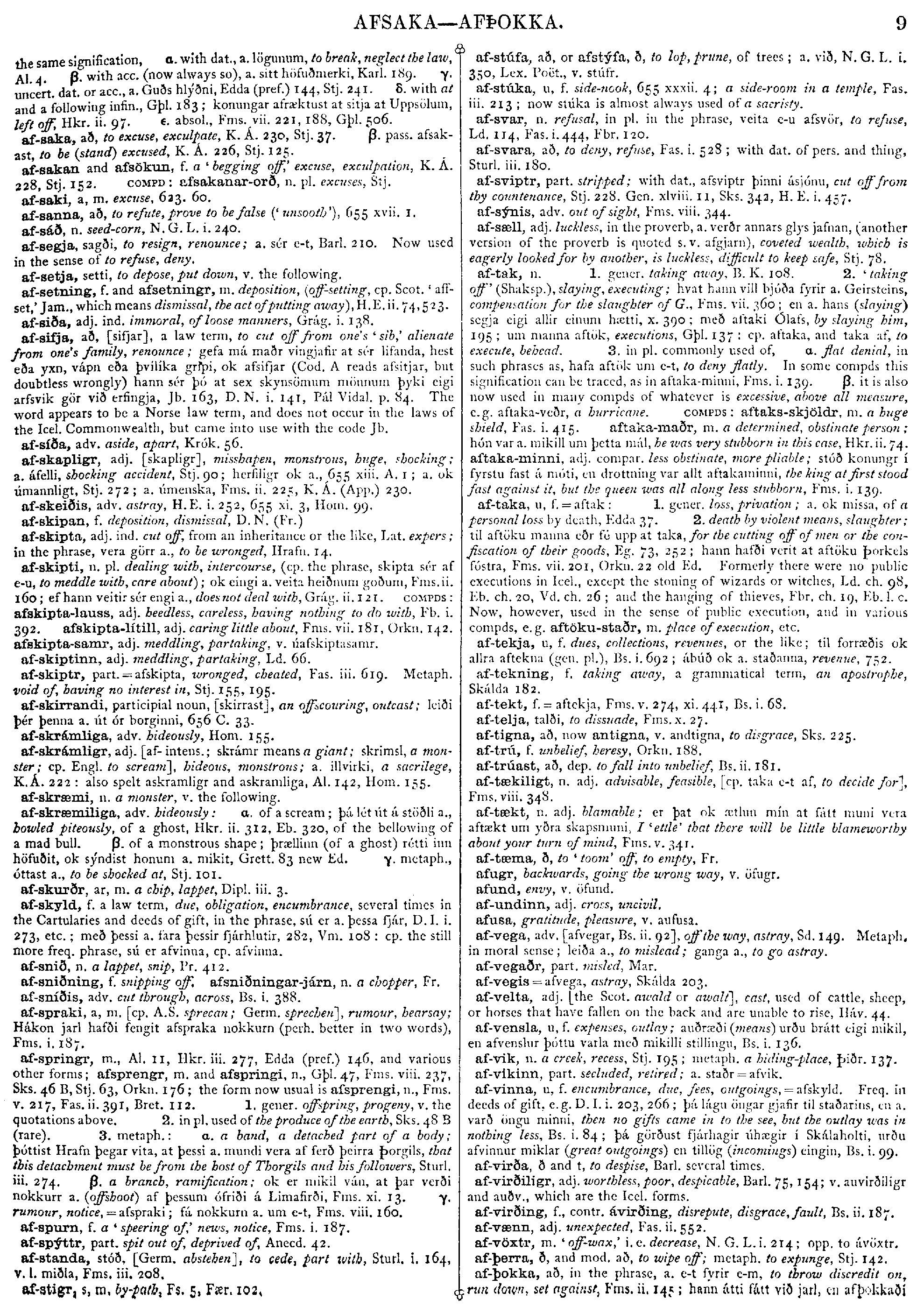
af-skipta, adj. ind. cut off, from an inheritance or the like, Lat. expers; in the phrase, vera görr a., to be wronged, Hrafn. 14.
|
Source: Cleasby/Vigfusson, page b0009, entry 31 View original page image as: [TIFF] [PNG] [View previous entry] [View next entry] |
[Comment on this entry] [View comments] |
The following entry has been hand-corrected once. |
af-springr,
m.,
Al.
11,
Hkr.
iii.
277,
Edda
(pref.)
146,
and
various
other
forms;
afsprengr,
m.
and
afspringi,
n.,
Gþl.
47,
Fms.
viii.
237,
Sks.
46
B,
Stj.
63,
Orkn.
176;
the
form
now
usual
is
afsprengi,
n.,
Fms.
v.
217,
Fas.
ii.
391,
Bret.
112.
1.
gener.
offspring,
progeny,
v.
the
quotations
above.
2.
in
pl.
used
of
the
produce
of
the
earth,
Sks.
48
B
(rare).
3.
metaph.:
.
a
band,
a
detached
part
of
a
body;
þóttist
Hrafn
þegar
vita,
at
þessi
a.
mundi
vera
af
ferð
þeirra
þorgils,
that
this
detachment
must
be
from
the
host
of
Thorgils
and
his
followers,
Sturl.
iii.
274.
.
a
branch,
ramification;
ok
er
mikil
van,
at
þar
verði
nokkurr
a.
(offshoot)
af
þessum
ófriði
á
Limafirði,
Fms.
xi.
13.
.
rumour,
notice,
=
afspraki;
fá
nokkurn
a.
um
e-t,
Fms.
viii.
160.
|
Source: Cleasby/Vigfusson, page b0010, entry 17 View original page image as: [TIFF] [PNG] [View previous entry] [View next entry] |
[Comment on this entry] [View comments] |
The following entry has been hand-corrected once. |
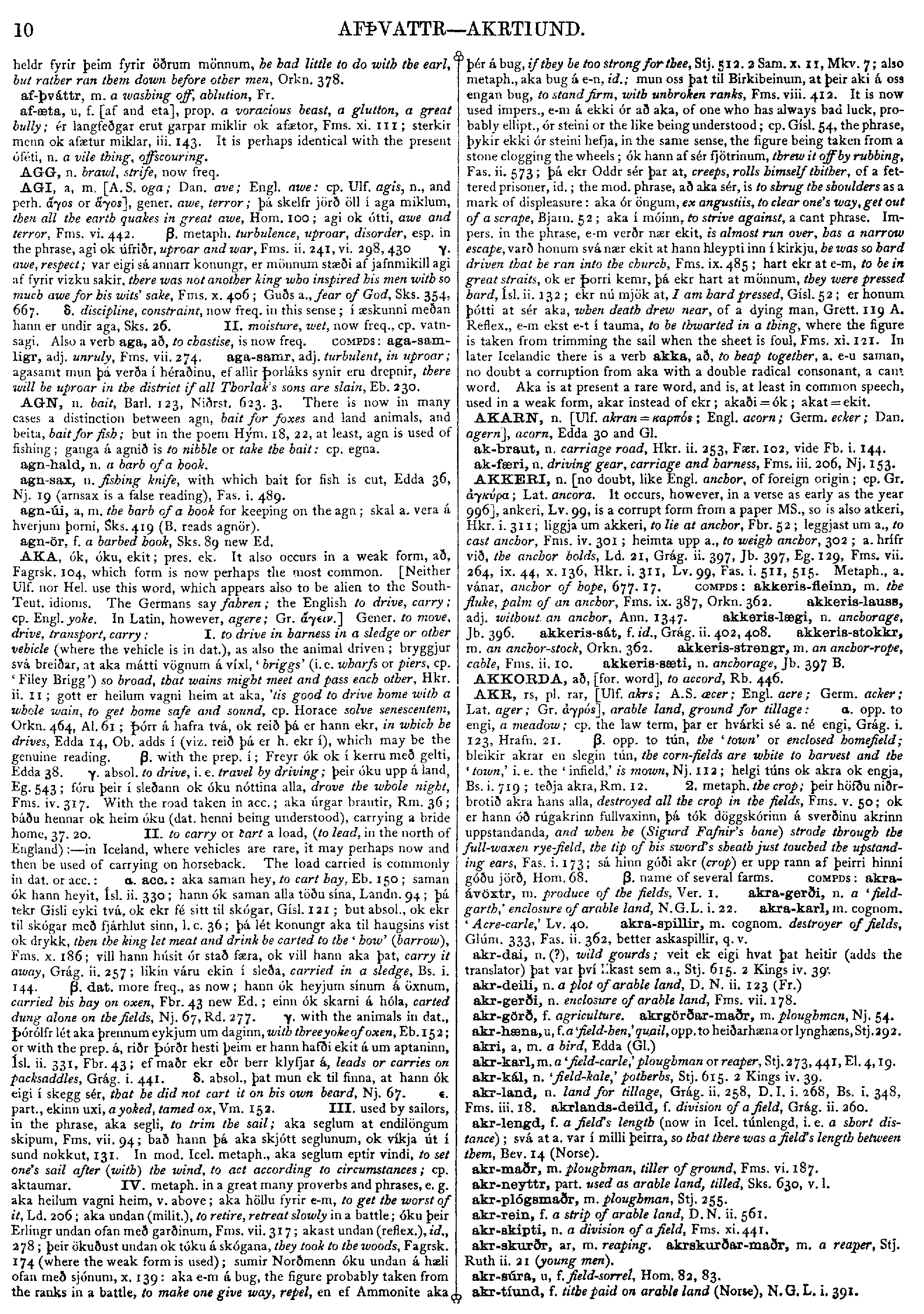
AKR,
rs,
pl.
rar,
[Ulf.
akrs;
A.
S.
œcer;
Engl.
acre;
Germ,
acker;
Lat.
ager;
Gr.
GREEK],
arable
land,
ground
for
tillage:
.
opp.
to
engi,
a
meadow;
cp.
the
law
term,
þar
er
hvárki
sé
a.
ne
engi,
Grág.
i.
123,
Hrafn.
21.
.
opp.
to
tún,
the
'town'
or
enclosed
homefield;
bleikir
akrar
en
slegin
tún,
the
corn-fields
are
white
to
harvest
and
the
'town,'
i.
e.
the
'infield,'
is
mown,
Nj.
112;
helgi
tuns
ok
akra
ok
engja,
Bs.
i.
719;
teðja
akra,
Rm.
12.
2.
metaph.
the
crop;
þeir
höfðu
niðr-
brotið
akra
hans
alla,
destroyed
all
the
crop
in
the
fields,
Fms.
v.
50;
ok
er
hann
óð
rúgakrinn
fullvaxinn,
þá
tók
döggskórinn
á
sverðinu
akrinn
uppstandanda,
and
when
he
(Sigurd
Fafnir's
bane)
strode
through
the
full-waxen
rye-field,
the
tip
of
his
sword's
sheath
just
touched
the
upstand-
ing
ears.
Fas.
i.
173;
sá
hinn
góði
akr
(crop)
er
upp
rann
af
þeirri
hinni
góðu
jörð,
Hom.
68.
.
name
of
several
farms.
COMPDS:
akra-
ávöxtr,
m.
produce
of
the
fields,
Ver.
i.
akra-gerði,
n.
a
'field-
garth,'
enclosure
of
arable
land,
N.
G.
L.
i.
22.
akra-karl,
m.
cognom.
'Acre-carle,'
Lv.
40.
akra-spillir,
m.
cognom.
destroyer
of
fields,
Glúm.
333,
Fas.
ii.
362,
better
askaspillir,
q.
v.
|
Source: Cleasby/Vigfusson, page b0011, entry 25 View original page image as: [TIFF] [PNG] [View previous entry] [View next entry] |
[Comment on this entry] [View comments] |
The following entry has been hand-corrected once. |
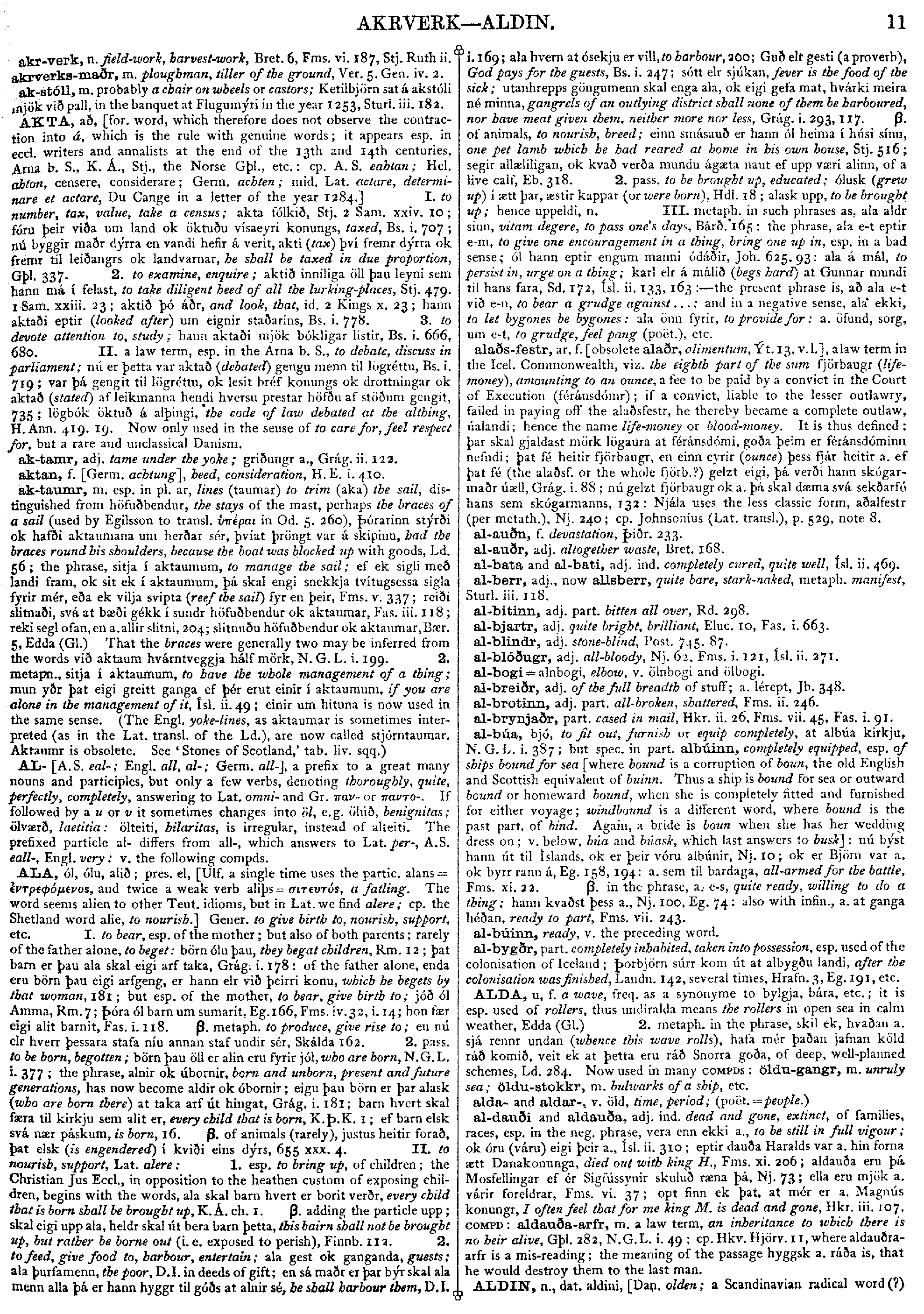
al-bygðr, part, completely inhabited, taken into possession, esp. used of the colonisation of Iceland; þorbjörn súrr kom út at albygðu landi, after the colonisation was finished, Landn. 142, several times, Hrafn. 3, Eg. 191, etc.
|
Source: Cleasby/Vigfusson, page b0015, entry 1 View original page image as: [TIFF] [PNG] [View previous entry] [View next entry] |
[Comment on this entry] [View comments] |
The following entry has been hand-corrected once. |
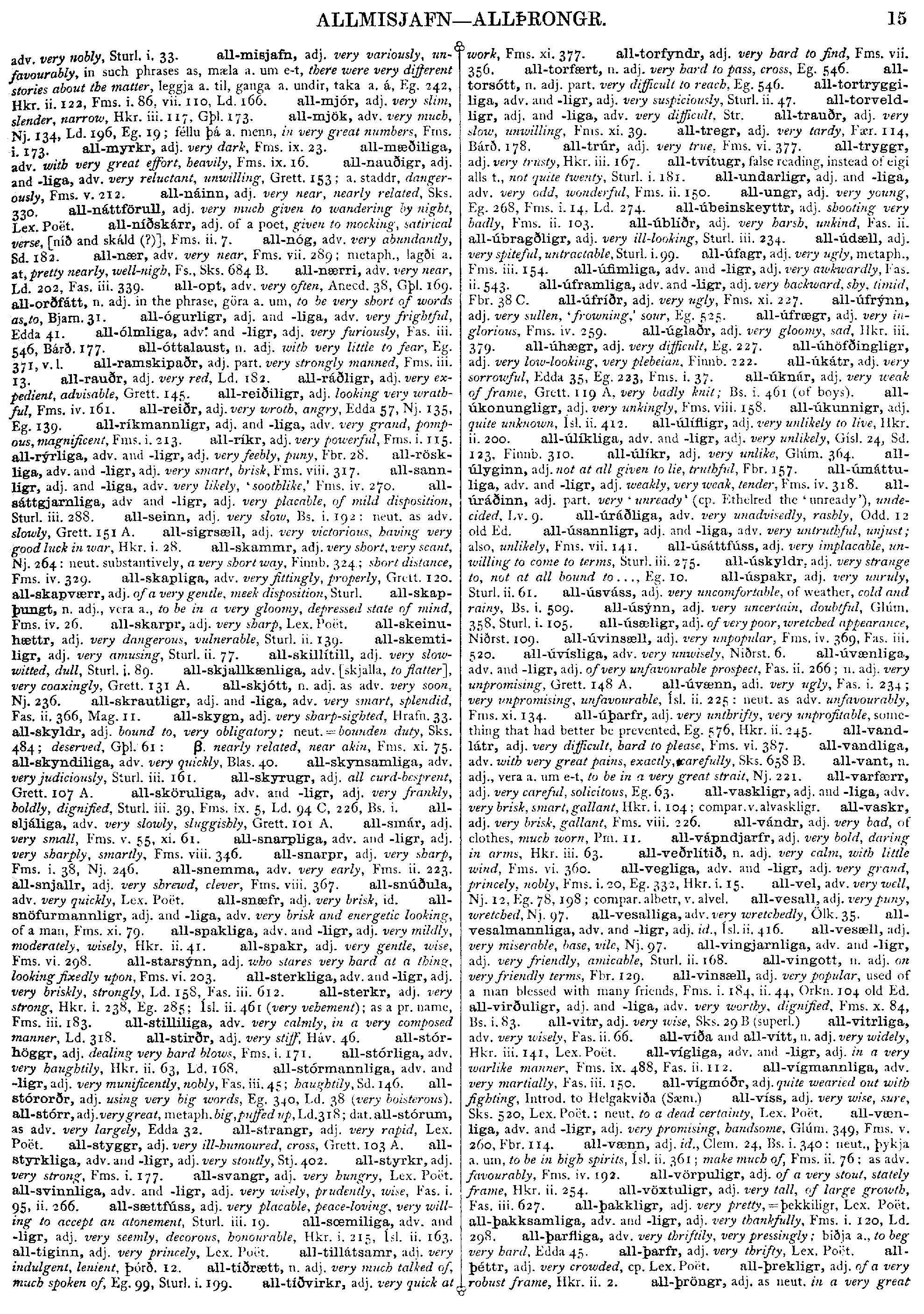
adv.
very
nobly,
Sturl.
i.
33.
all-misjafn,
adj.
very
variously,
un-
favourably,
in
such
phrases
as,
mæla
a.
um
e-t,
there
were
very
different
stories
about
the
matter,
leggja
a.
til,
ganga
a.
undir,
taka
a.
á,
Eg.
242,
Hkr.
ii.
123,
Fms.
i.
86,
vii.
no,
Ld.
166.
all-mjór,
adj.
very
slim,
slender,
narrow,
Hkr.
iii.
117,
Gþl.
173.
all-mjök,
adv.
very
much,
Nj.
134,
Ld.
196,
Eg.
19;
féllu
þá
a.
menn,
in
very
great
numbers,
Fms.
i.
173.
all-myrkr,
adj.
very
dark,
Fms.
ix.
23.
all-mæðiliga,
adv.
with
very
great
effort,
heavily,
Fms.
ix.
16.
all-nauðigr,
adj.
and
-liga,
adv.
very
reluctant,
unwilling,
Grett.
153;
a.
staddr,
danger-
ously,
Fms.
v.
212.
all-náinn,
adj.
very
near,
nearly
related,
Sks.
330.
all-náttförull,
adj.
very
much
given
to
wandering
by
night,
Lex.
Poët.
all-níðskárr,
adj.
of
a
poet,
given
to
mocking,
satirical
verse,
[níð
and
skáld
(?)],
Fms.
ii.
7.
all-nóg,
adv.
very
abundantly,
Sd.
182.
all-nær,
adv.
very
near,
Fms.
vii.
289;
metaph.,
lagði
a.
at,
pretty
nearly,
well-nigh,
Fs.,
Sks.
684
B.
all-nærri,
adv.
very
near,
Ld.
202,
Fas.
iii.
339.
all-opt,
adv.
very
often,
Anecd.
38,
Gþl.
169.
all-orðfátt,
n.
adj.
in
the
phrase,
göra
a.
urn,
to
be
very
short
of
words
as
to,
Bjarn.
31.
all-ógurligr,
adj.
and
-liga,
adv.
very
frightful,
Edda
41.
all-ólmliga,
adv.
and
-ligr,
adj.
very
furiously,
Fas.
iii.
546,
Bárð.
177.
áll-óttalaust,
n.
adj.
with
very
little
to
fear,
Eg.
371,
v.
l.
all-ramskipaðr,
adj.
part,
very
strongly
manned,
Fms.
iii.
13.
all-rauðr,
adj.
very
red,
Ld.
182.
all-ráðligr,
adj.
very
ex-
pedient,
advisable,
Grett.
145.
all-reiðiligr,
adj.
looking
very
wrath-
ful,
Fms.
iv.
161.
all-reiðr,
adj.
very
wroth,
angry,
Edda
57,
Nj.
135,
Eg.
139.
all-ríkmarmligr,
adj.
and
-liga,
adv.
very
grand,
pomp-
ous,
magnificent,
Fms.
i.
213.
all-ríkr,
adj.
very
powerful,
Fms.
i.
115.
all-rýrliga.,
adv.
and
-ligr,
adj.
very
feebly,
puny,
Fbr.
28.
all-rösk-
liga,
adv.
and
-ligr,
adj.
very
smart,
brisk,
Fms.
viii.
317.
all-sann-
ligr,
adj.
and
-liga,
adv.
very
likely,
'soothlike,'
Fms.
iv.
270.
all-
sáttgjarnliga,
adv
and
-ligr,
adj.
very
placable,
of
mild
disposition,
Sturl.
iii.
288.
all-seinn,
adj.
very
slow,
Bs.
i.
192:
neut.
as
adv.
slowly,
Grett.
151
A.
all-sigrsæll,
adj.
very
victorious,
having
very
good
luck
in
war,
Hkr.
i.
28.
all-skammr,
adj.
very
short,
very
scant,
Nj.
264:
neut.
substantively,
a
very
short
way,
Finnb.
324;
short
distance,
Fms.
iv.
329.
all-skapliga,
adv.
very
fittingly,
properly,
Grett.
120.
all-skapværr,
adj.
of
a
very
gentle,
meek
disposition,
Sturl.
all-skap-
þungt,
n.
adj.,
vera
a.,
to
be
in
a
very
gloomy,
depressed
state
of
mind,
Fms.
iv.
26.
all-skarpr,
adj.
very
sharp,
Lex.
Poët.
all-skeinu-
hættr,
adj.
very
dangerous,
vulnerable,
Sturl.
ii.
139.
all-skemti-
ligr,
adj.
very
amusing,
Sturl.
ii.
77.
all-skillítill,
adj.
very
slow-
witted,
dull,
Sturl.
j.
89.
all-skjallkænliga,
adv.
[skjalla,
to
flatter],
very
coaxingly,
Grett.
131
A.
all-skjótt,
n.
adj.
as
adv.
very
soon,
Nj.
236.
all-skrautligr,
adj.
and
-liga,
adv.
very
smart,
splendid,
Fas.
ii.
366,
Mag.
11.
all-skygn,
adj.
very
sharp-sighted,
Hrafn.
33.
all-skyldr,
adj.
bound
to,
very
obligatory;
neut.
==
bounden
duty,
Sks.
484;
deserved,
Gþl.
61:
.
nearly
related,
near
akin,
Fms.
xi.
75.
all-skyndiliga,
adv.
very
quickly,
Blas.
40.
all-skynsamliga,
adv.
very
judiciously,
Stud.
iii.
161.
all-skyrugr,
adj.
all
curd-besprent,
Grett.
107
A.
all-sköruliga,
adv.
and
-ligr,
adj.
very
frankly,
boldly,
dignified,
Sturl.
iii.
39,
Fms.
ix.
5,
Ld.
94
C,
226,
Bs.
i.
all-
sljáliga,
adv.
very
slowly,
sluggishly,
Grett.
101
A.
all-smár,
adj.
very
small,
Fms.
v.
55,
xi.
61.
all-snarpliga,
adv.
and
-ligr,
adj.
very
sharply,
smartly,
Fms.
viii.
346.
all-snarpr,
adj.
very
sharp,
Fms.
i.
38,
Nj.
246.
all-snemma,
adv.
very
early,
Fms.
ii.
223.
all-snjallr,
adj.
very
shrewd,
clever,
Fms.
viii.
367.
all-snúðula,
adv.
very
quickly,
Lex.
Poët.
all-snæfr,
adj.
very
brisk,
id.
all-
snöfurmannligr,
adj.
and
-liga,
adv.
very
brisk
and
energetic
looking,
of
a
man,
Fms.
xi.
79.
all-spakliga,
adv.
and
-ligr,
adj.
very
mildly,
moderately,
wisely,
Hkr.
ii.
41.
all-spakr,
adj.
very
gentle,
wise,
Fms.
vi.
298.
all-starsýnn,
adj.
who
stares
very
hard
at
a
thing,
looking
fixedly
upon,
Fms.
vi.
203.
all-sterkliga,
adv.
and
-ligr,
adj.
very
briskly,
strongly,
Ld.
158,
Fas.
iii.
612.
all-sterkr,
adj.
very
strong,
Hkr.
i.
238,
Eg.
285;
Ísl.
ii.
461
(very
vehement);
as
a
pr.
name,
Fms.
iii.
183.
all-stilliliga,
adv.
very
calmly,
in
a
very
composed
manner,
Ld.
318.
all-stirðr,
adj.
very
stiff,
Háv.
46.
all-stór-
höggr,
adj.
dealing
very
hard
blows,
Fms.
i.
171.
all-stórliga,
adv.
very
haughtily,
Hkr.
ii.
63,
Ld.
168.
all-stórmannliga,
adv.
and
-ligr,
adj.
very
munificently,
nobly,
Fas.
iii.
45;
haughtily,
Sd.
146.
all-
stórorðr,
adj.
using
very
big
words,
Eg.
340,
Ld.
38
(very
boisterous).
all-stórr,
adj.
very
great,
metaph.
big,
puffed
up,
Ld.
318;
dat.
all-stórum,
as
adv.
very
largely,
Edda
32.
all-strangr,
adj.
very
rapid,
Lex.
Poët.
all-styggr,
adj.
very
ill-humoured,
cross,
Grett.
103
A.
all-
styrkliga,
adv.
and
-ligr,
adj.
very
stoutly,
Stj.
402.
all-styrkr,
adj.
very
strong,
Fms.
i.
177.
all-svangr,
adj.
very
hungry,
Lex.
Poët.
all-svinnliga,
adv.
and
-ligr,
adj.
very
wisely,
prudently,
wise,
Fas.
i.
95,
ii.
266.
all-sættfúss,
adj.
very
placable,
peace-loving,
very
will-
ing
to
accept
an
atonement,
Sturl.
iii.
19.
all-sœmiliga,
adv.
and
-ligr,
adj.
very
seemly,
decorous,
honourable,
Hkr.
i.
215,
Ísl.
ii.
163.
all-tiginn,
adj.
very
princely,
Lex.
Poët.
all-tillátsamr,
adj.
very
indulgent,
lenient,
þórð.
12.
all-tíðrætt,
n.
adj.
very
much
talked
of,
much
spoken
of,
Eg.
99,
Sturl.
i.
199.
all-tíðvirkr,
adj.
very
quick
at
work,
Fms.
xi.
377.
all-torfyndr,
adj.
very
hard
to
find,
Fms.
vii.
356.
all-torfært,
n.
adj.
very
hard
to
pass,
cross,
Eg.
546.
all-
torsótt,
n.
adj.
part,
very
difficult
to
reach,
Eg.
546.
all-tortryggi-
liga,
adv.
and
-ligr,
adj.
very
suspiciously,
Sturl.
ii.
47.
all-torveld-
ligr,
adj.
and
-liga,
adv.
very
difficult,
Str.
all-trauðr,
adj.
very
slow,
unwilling,
Fms.
xi.
39.
all-tregr,
adj.
very
tardy,
Fær.
114,
Bárð.
178.
all-trúr,
adj.
very
true.
Fms.
vi.
377.
all-tryggr,
adj.
very
trusty,
Hkr.
iii.
167.
all-tvítugr,
false
reading,
instead
of
eigi
alls
t.,
not
quite
twenty,
Sturl.
i.
181.
all-undarligr,
adj.
and
-liga,
adv.
very
odd,
wonderful,
Fms.
ii.
150.
all-ungr,
adj.
very
young,
Eg.
268,
Fms.
i.
14,
Ld.
274.
all-úbeinskeyttr,
adj.
shooting
very
badly,
Fms.
ii.
103.
all-úblíðr,
adj.
very
harsh,
unkind,
Fas.
ii.
all-úbragðligr,
adj.
very
ill-looking,
Sturl.
iii.
234.
all-údæll,
adj.
very
spiteful,
untractable,
Sturl.
i.
99.
all-úfagr,
adj.
very
ugly,
metaph.,
Fms.
iii.
154.
all-úfimliga,
adv.
and
-ligr,
adj.
very
awkwardly,
Fas.
ii.
543.
all-úframliga,
adv.
and
-ligr,
adj.
very
backward,
shy,
timid,
Fbr.
38
C.
all-úfríðr,
adj.
very
ugly,
Fms.
xi.
227.
all-úfrýnn,
adj.
very
sullen,
'frowning,'
sour,
Eg.
525.
all-úfrægr,
adj.
very
in-
glorious,
Fms.
iv.
259.
all-úglaðr,
adj.
very
gloomy,
sad,
Hkr.
iii.
379.
all-úhægr,
adj.
very
difficult,
Eg.
227.
all-úhöfðingligr,
adj.
very
low-looking,
very
plebeian,
Finnb.
222.
all-úkátr,
adj.
very
sorrowful,
Edda
35,
Eg.
223,
Fms.
i.
37.
all-úknár,
adj.
very
weak
of
frame,
Grett.
119
A,
very
badly
knit;
Bs.
i.
461
(of
boys).
all-
úkonungligr,
adj.
very
unkingly,
Fms.
viii.
158.
all-úkunnigr,
adj.
quite
unknown,
Ísl.
ii.
412.
all-úlífligr,
adj.
very
unlikely
to
live,
Hkr.
ii.
200.
all-úlíkliga,
adv.
and
-ligr,
adj.
very
unlikely,
Gísl.
24,
Sd.
123,
Finnb.
310.
all-úlíkr,
adj.
very
unlike,
Glúm.
364.
all-
úlyginn,
adj.
not
at
all
given
to
lie,
truthful,
Fbr.
157.
all-úmáttu-
liga,
adv.
and
-ligr,
adj.
weakly,
very
weak,
tender,
Fms.
iv.
318.
all-
úráðinn,
adj.
part,
very
'unready'
(cp.
Ethelred
the
'unready'),
unde-
cided,
Lv.
9.
all-úráðliga,
adv.
very
unadvisedly,
rashly,
Odd.
12
old
Ed.
all-úsannligr,
adj.
and
-liga,
adv.
very
untruthful,
unjust;
also,
unlikely,
Fms.
vii.
141.
all-úsáttfúss,
adj.
very
implacable,
un-
willing
to
come
to
terms,
Sturl.
iii.
275.
all-úskyldr.
adj.
very
strange
to,
not
at
all
bound
to...,
Eg.
10.
all-úspakr,
adj.
very
unruly,
Sturl.
ii.
61.
all-úsváss,
adj.
very
uncomfortable,
of
weather,
cold
and
rainy,
Bs.
i.
509.
all-úsýnn,
adj.
very
uncertain,
doubtful,
Glúm.
358,
Sturl.
i.
105.
all-úsæligr,
adj.
of
very
poor,
wretched
appearance,
Niðrst.
109.
all-úvinsæll,
adj.
very
unpopular,
Fms.
iv.
369,
Fas.
iii.
520.
all-úvísliga,
adv.
very
unwisely,
Niðrst.
6.
all-úvænliga.,
adv.
and
-ligr,
adj.
of
very
unfavourable
prospect,
Fas.
ii.
266;
n.
adj.
very
unpromising,
Grett.
148
A.
all-úvænn,
adi.
very
ugly,
Fas.
i.
234;
very
unpromising,
unfavourable,
Ísl.
ii.
225:
neut.
as
adv.
unfavourably,
Fms.
xi.
134.
all-úþarfr,
adj.
very
unthrifty,
very
unprofitable,
some-
thing
that
had
better
be
prevented,
Eg.
576,
Hkr.
ii.
245.
all-vand-
látr,
adj.
very
difficult,
hard
to
please,
Fms.
vi.
387.
all-vandliga,
adv.
with
very
great
pains,
exactly,
carefully,
Sks.
658
B.
all-vant,
n.
adj.,
vera
a.
um
e-t,
to
be
in
a
very
great
strait,
Nj.
221.
all-varfærr,
adj.
very
careful,
solicitous,
Eg.
63.
all-vaskligr,
adj.
and
-liga,
adv.
very
brisk,
smart,
gallant,
Hkr.
i.
104;
compar.
v.
alvaskligr.
all-vaskr,
adj.
very
brisk,
gallant,
Fms.
viii.
226.
all-vandr,
adj.
very
bad,
of
clothes,
much
worn,
Pm.
11.
all-vápndjarfr,
adj.
very
bold,
daring
in
arms,
Hkr.
iii.
63.
all-veðrlítið,
n.
adj.
very
calm,
with
little
wind,
Fms.
vi.
360.
all-vegliga,
adv.
and
-ligr,
adj.
very
grand,
princely,
nobly,
Fms.
i.
20,
Eg.
332,
Hkr.
i.
15.
all-vel,
adv.
very
well,
Nj.
12,
Eg.
78,
198;
compar.
albetr,
v.
alvel.
all-vesall,
adj.
very
puny,
wretched,
Nj.
97.
all-vesalliga,
adv.
very
wretchedly,
Ölk.
35.
all-
vesalmannliga,
adv.
and
-ligr,
adj.
id.,
Ísl.
ii.
416.
all-vesæll,
adj.
very
miserable,
base,
vile,
Nj.
97.
all-vingjarnliga,
adv.
and
-ligr,
adj.
very
friendly,
amicable,
Sturl.
ii.
168.
all-vingott,
n.
adj.
on
very
friendly
terms,
Fbr.
129.
all-vinsæll,
adj.
very
popular,
used
of
a
man
blessed
with
many
friends,
Fms.
i.
184,
ii.
44,
Orkn.
104
old
Ed.
all-virðuligr,
adj.
and
-liga,
adv.
very
worthy,
dignified,
Fms.
x.
84,
Bs.
i.
83.
all-vitr,
adj.
very
wise,
Sks.
29
B
(superl.)
all-vitrliga,
adv.
very
wisely,
Fas.
ii.
66.
all-víða
and
all-vítt,
n.
adj.
very
widely,
Hkr.
iii.
141,
Lex.
Poët.
all-vígliga,
adv.
and
-ligr,
adj.
in
a
very
warlike
manner,
Fms.
ix.
488,
Fas.
ii.
112.
all-vígmannliga,
adv.
very
martially,
Fas.
iii.
150.
all-vígmóðr,
adj.
quite
wearied
out
with
fighting,
Introd.
to
Helgakviða
(Sæm.)
all-víss,
adj.
very
wise,
sure,
Sks.
520,
Lex.
Poët.:
neut.
to
a
dead
certainty,
Lex.
Poët.
all-væn-
liga,
adv.
and
-ligr,
adj.
very
promising,
handsome,
Glúm.
349,
Fms.
v.
260,
Fbr.
114.
all-vænn,
adj.
id.,
Clem.
24,
Bs.
i.
340:
neut.,
þykja
a.
um,
to
be
in
high
spirits,
Ísl.
ii.
361;
make
much
of,
Fms.
ii.
76;
as
adv.
favourably,
Fms.
iv.
192.
all-vörpuligr,
adj.
of
a
very
stout,
stately
frame,
Hkr.
ii.
254.
all-vöxtuligr,
adj.
very
tall,
of
large
growth,
Fas.
iii.
627.
all-þakkligr,
adj.
very
pretty,
=
þekkiligr,
Lex.
Poët,
all-þakksamliga,
adv.
and
-ligr,
adj.
very
thankfully,
Fms.
i.
120,
Ld.
298.
all-þarfliga,
adv.
very
thriftily,
very
pressingly;
biðja
a.,
to
beg
very
hard,
Edda
45.
all-þarfr,
adj.
very
thrifty,
Lex.
Poët.
all-
þéttr,
adj.
very
crowded,
cp.
Lex.
Poët.
all-þrekligr,
adj.
of
a
very
robust
frame,
Hkr.
ii.
2.
all-þröngr,
adj.
as
neut.
in
a
very
great
| Result Page: | 1 2 3 4 5 6 7 8 9 10 | Next |  |
Germanic Lexicon Project (main page)
This search system was written by
Sean Crist
Please consider
volunteering
to correct the data in these online dictionaries.
No rights reserved. Feel free to use these data in any way you please.