|
|

|
Source: Bosworth/Toller, page b0535, entry 3 View original page image as: [TIFF] [PNG] [View previous entry] [View next entry] |
[Comment on this entry] [View comments] |
The following entry has been hand-corrected once. |
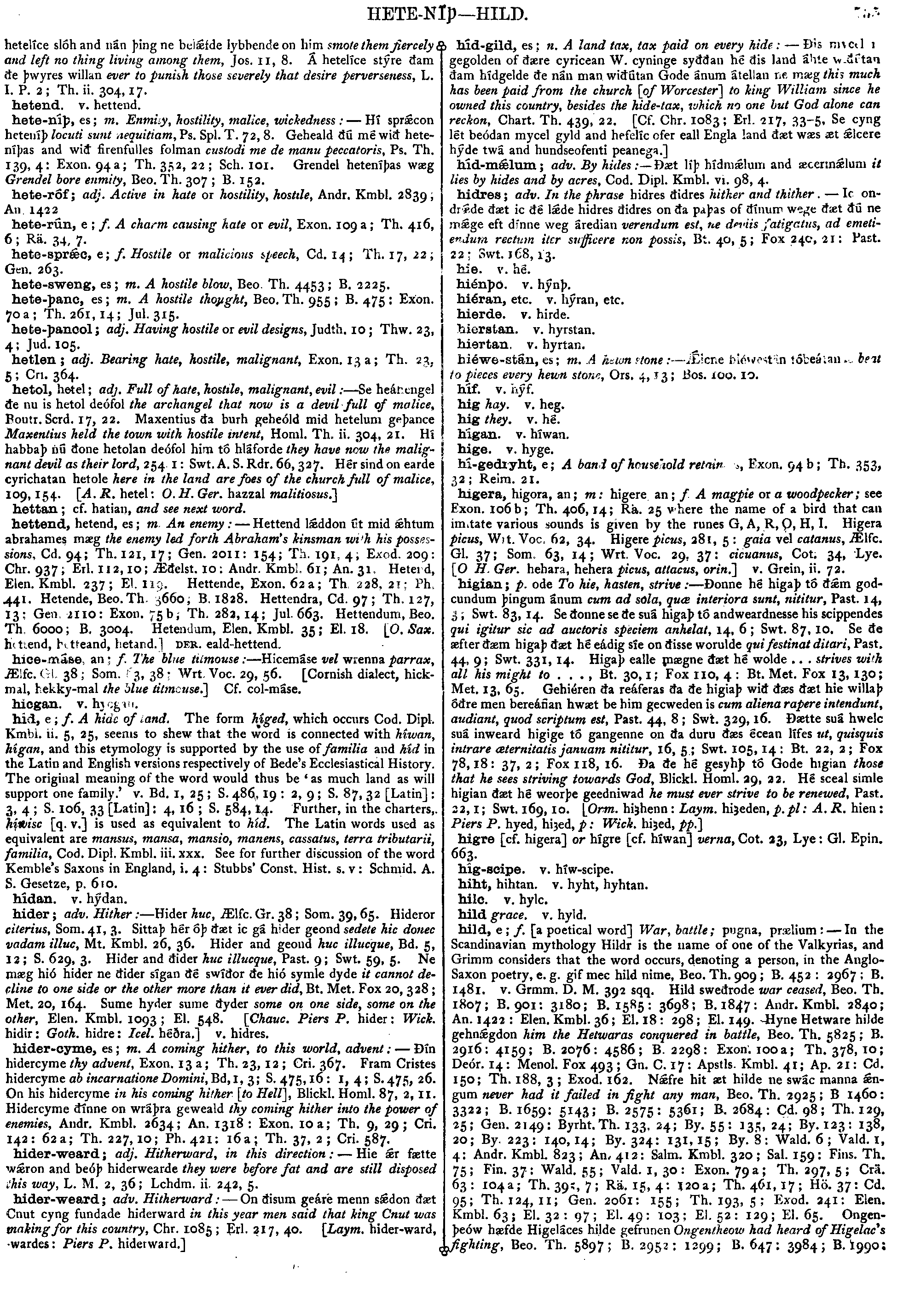
hete-níþ,
es;
m.
Enmity,
hostility,
malice,
wickedness:--
Hí
spr con
heteníþ
locutíi
sunt
nequitiam,
Ps.
Spl.
T.
72,
8.
Geheald
ðú
mé
wið
heteníþas
and
wið
firenfulles
folman
custodi
me
de
manu
peccatoris.
Ps.
Th.
139,
4:
Exon.
94a;
Th.
352,
22;
Sch.
101.
Grendel
heteníþas
wæg
Grendel
bore
enmity,
Beo.
Th.
307;
B.
152.
con
heteníþ
locutíi
sunt
nequitiam,
Ps.
Spl.
T.
72,
8.
Geheald
ðú
mé
wið
heteníþas
and
wið
firenfulles
folman
custodi
me
de
manu
peccatoris.
Ps.
Th.
139,
4:
Exon.
94a;
Th.
352,
22;
Sch.
101.
Grendel
heteníþas
wæg
Grendel
bore
enmity,
Beo.
Th.
307;
B.
152.
|
Source: Bosworth/Toller, page b0535, entry 4 View original page image as: [TIFF] [PNG] [View previous entry] [View next entry] |
[Comment on this entry] [View comments] |
The following entry has been hand-corrected once. |
hete-róf; adj. Active in hate or hostility, hostile, Andr. Kmbl. 2839; An 1422
|
Source: Bosworth/Toller, page b0581, entry 21 View original page image as: [TIFF] [PNG] [View previous entry] [View next entry] |
[Comment on this entry] [View comments] |
The following entry has been hand-corrected once. |
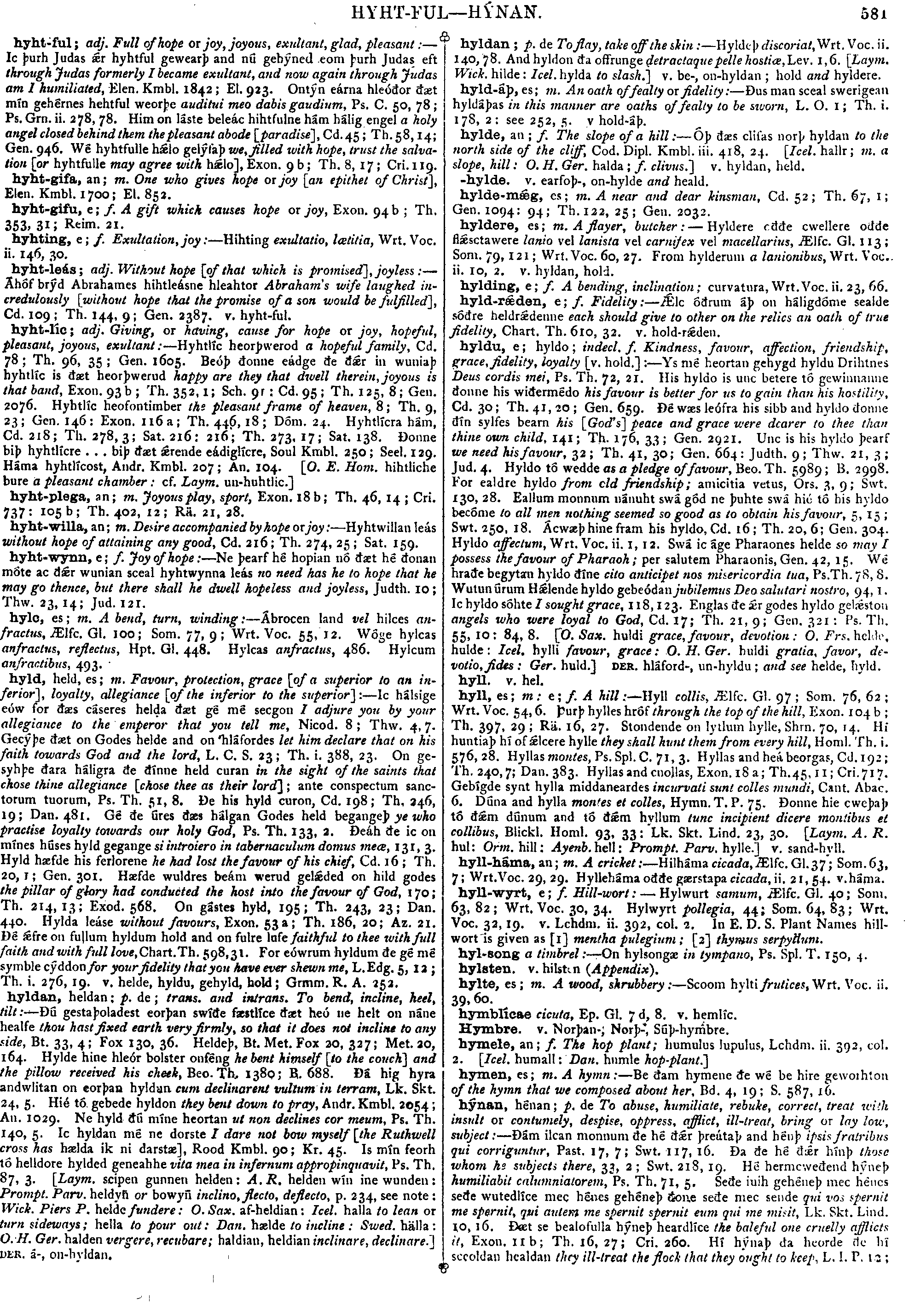
hyldu,
e;
hyldo;
indecl.
f.
Kindness,
favour,
affection,
friendship,
grace,
fidelity,
loyalty
[v.
hold.]
:--
Ys
mé
heortan
gehygd
hyldu
Drihtnes
Deus
cordis
mei,
Ps.
Th.
72,
21.
His
hyldo
is
unc
betere
tó
gewinnanne
ðonne
his
wiðermédo
his
favour
is
better
for
us
to
gain
than
his
hostility,
Cd.
30;
Th.
41,
20;
Gen.
659.
Ðé
wæs
leófra
his
sibb
and
hyldo
ðonne
ðín
sylfes
bearn
his
[God's]
peace
and
grace
were
dearer
to
thee
than
thine
own
child,
141;
Th.
176,
33;
Gen.
292l.
Unc
is
his
hyldo
þearf
we
need
his
favour,
32;
Th.
41,
30;
Gen.
664:
Judth.
9;
Thw.
21,
3;
Jud.
4.
Hyldo
tó
wedde
as
a
pledge
of
favour,
Beo.
Th.
5989;
B.
2998.
For
ealdre
hyldo
from
old
friendship;
amicitia
vetus,
Ors.
3,
9;
Swt.
130,
28.
Eallum
monnum
nánuht
swá
gód
ne
þuhte
swá
hié
tó
his
hyldo
becóme
to
all
men
nothing
seemed
so
good
as
to
obtain
his
favour,
5,
15;
Swt.
250,
18.
Ácwæþ
hine
fram
his
hyldo,
Cd.
16;
Th.
20,
6;
Gen.
304.
Hyldo
affectum,
Wrt.
Voc.
ii.
1,
12.
Swá
ic
áge
Pharaones
helde
so
may
I
possess
the
favour
of
Pharaoh;
per
salutem
Pharaonis,
Gen.
42,
15.
Wé
hraðe
begytan
hyldo
ðíne
cito
anticipet
nos
misericordia
tua,
Ps.
Th.
78,
8.
Wutun
úrum
Hlende
hyldo
gebeódan
jubilemus
Deo
salutari
nostro,
94,
1.
Ic
hyldo
sóhte
I
sought
grace,
118,
123.
Englas
ðe
r
godes
hyldo
gelston
angels
who
were
loyal
to
God,
Cd.
17;
Th.
21,
9;
Gen.
321:
Ps.
Th.
55,
10:
84,
8.
[O.
Sax.
huldi
grace,
favour,
devotion:
O.
Frs.
helde,
hulde:
Icel.
hylli
favour,
grace:
O.
H.
Ger.
huldi
gratia,
favor,
devotio,
fides:
Ger.
huld.]
DER.
hláford-,
un-hyldu;
and
see
helde,
hyld.
|
Source: Bosworth/Toller, page b0630, entry 1 View original page image as: [TIFF] [PNG] [View previous entry] [View next entry] |
[Comment on this entry] [View comments] |
The following entry has been hand-corrected once. |
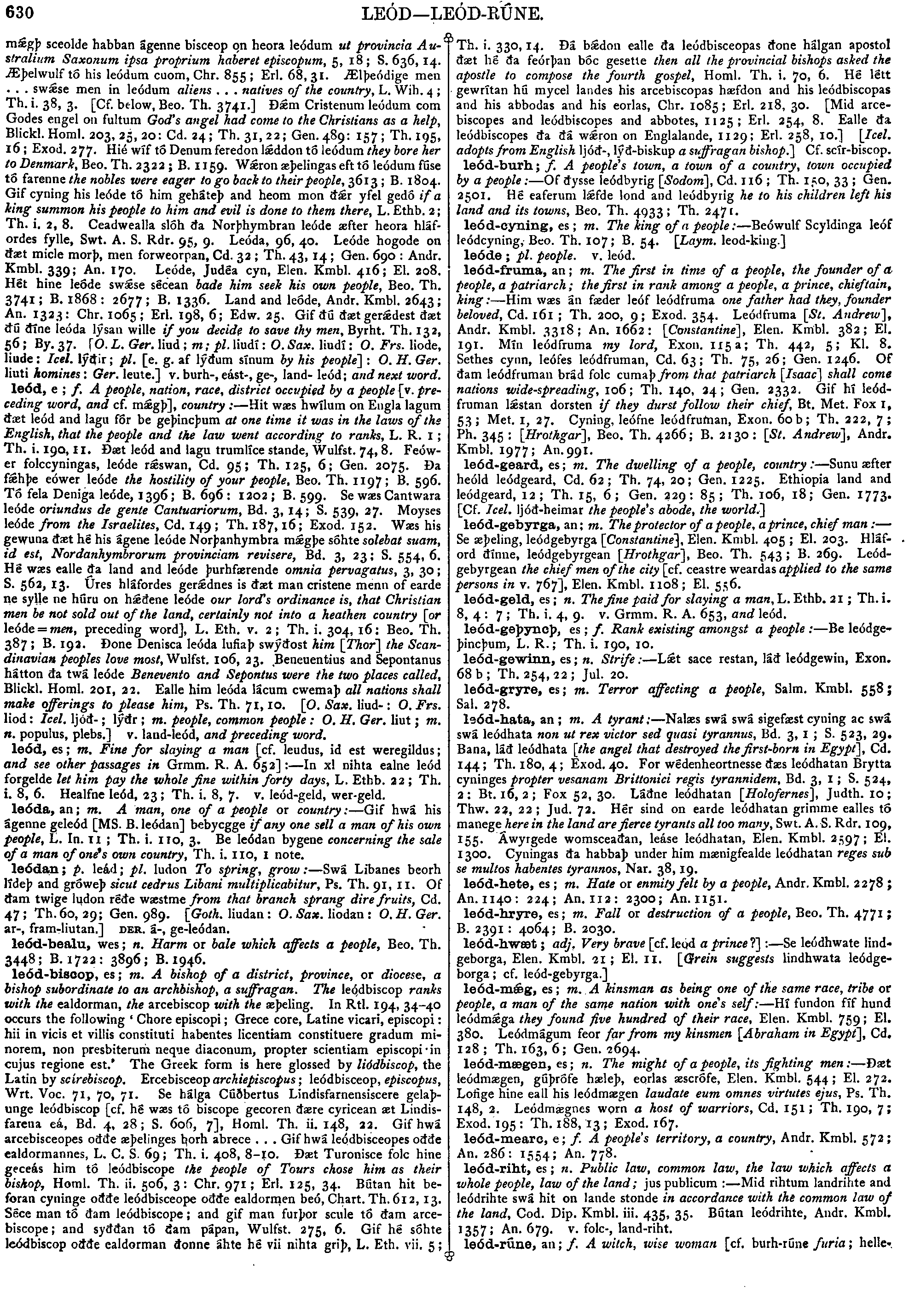
leód,
e;
f,
A
people,
nation,
race,
district
occupied
by
a
people
[v.
preceding
word,
and
cf.
mgþ],
country
:--
Hit
wæs
hwílum
on
Engla
lagum
ðæt
leód
and
lagu
fór
be
geþincþum
at
one
time
it
was
in
the
laws
of
the
English,
that
the
people
and
the
law
went
according
to
ranks,
L.
R.
1;
Th.
i.
190,
11.
Ðæt
leód
and
lagu
trumlíce
stande,
Wulfst.
74,
8.
Feówer
folccyningas,
leóde
rswan,
Cd.
95;
Th.
125,
6;
Gen.
2075.
Ða
fhþe
eówer
leóde
the
hostility
of
your
people,
Beo.
Th.
1197;
B.
596.
Tó
fela
Deniga
leóde,
1396;
B.
696:
1202;
B.
599.
Se
wæs
Cantwara
leóde
oriundus
de
gente
Cantuariorum,
Bd.
3,
14;
S.
539,
27.
Moyses
leóde
from
the
Israelites,
Cd.
149;
Th.
187,
16;
Exod.
152.
Wæs
his
gewuna
ðæt
hé
his
ágene
leóde
Norþanhymbra
mgþe
sóhte
solebat
suam,
id
est,
Nordanhymbrorum
provinciam
revisere,
Bd.
3,
23;
S.
554,
6.
Hé
wæs
ealle
ða
land
and
leóde
þurhfærende
omnia
pervagatus,
3,
30;
S.
562,
13.
Úres
hláfordes
gerdnes
is
ðæt
man
cristene
menn
of
earde
ne
sylle
ne
húru
on
hðene
leóde
our
lord's
ordinance
is,
that
Christian
men
be
not
sold
out
of
the
land,
certainly
not
into
a
heathen
country
[or
leóde
=
men,
preceding
word],
L.
Eth.
v.
2;
Th.
i.
304,
16:
Beo.
Th.
387;
B.
192.
Ðone
Denisca
leóda
lufiaþ
swýðost
him
[Thor]
the
Scandinavian
peoples
love
most,
Wulfst.
106,
23.
Beneuentius
and
Sepontanus
hátton
ða
twá
leóde
Benevento
and
Sepontus
were
the
two
places
called,
Blickl.
HomI.
201,
22.
Ealle
him
leóda
lácum
cwemaþ
all
nations
shall
make
offerings
to
please
him,
Ps.
Th.
71,
10.
[O.
Sax.
liud-:
O.
Frs.
liod:
Icel.
ljóð-;
lýðr;
m.
people,
common
people:
O.
H.
Ger.
liut;
m.
n.
populus,
plebs.]
v.
land-leód,
and
preceding
word.
|
Source: Bosworth/Toller, page b0722, entry 17 View original page image as: [TIFF] [PNG] [View previous entry] [View next entry] |
[Comment on this entry] [View comments] |
The following entry has been hand-corrected once. |
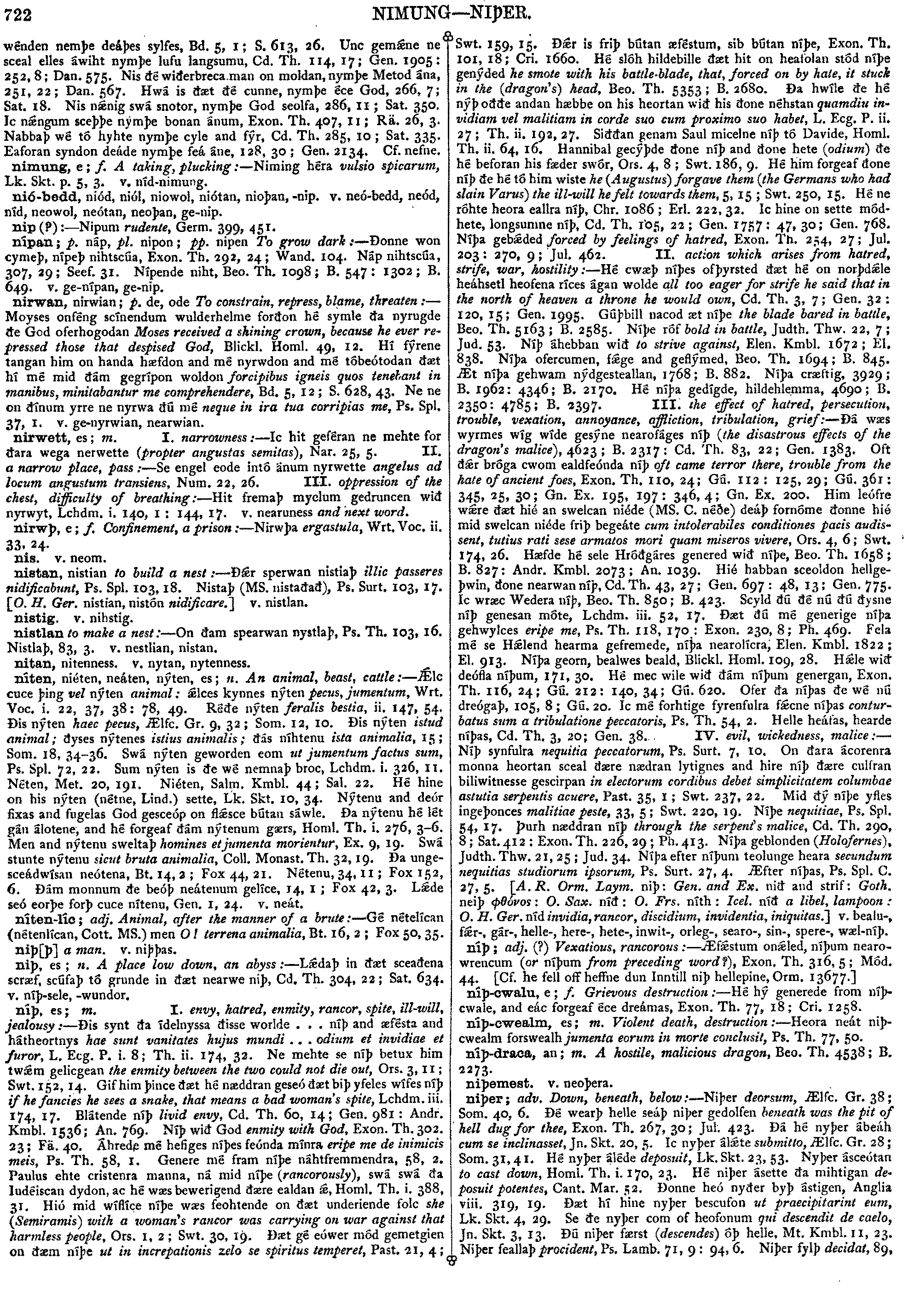
níþ,
es;
m.
I.
envy,
hatred,
enmity,
rancor,
spite,
ill-will,
jealousy
:--
Ðis
synt
ða
ídelnyssa
ðisse
worlde
...
níþ
and
æfésta
and
hátheortnys
hae
sunt
vanitates
hujus
mundi
...
odium
et
invidiae
et
furor,
L.
Ecg.
P.
i.
8
;
Th.
ii.
174,
32.
Ne
mehte
se
níþ
betux
him
twm
gelicgean
the
enmity
between
the
two
could
not
die
out,
Ors.
3,
11;
Swt.
152,
14.
Gif
him
þince
ðæt
hé
næddran
geseó
ðæt
biþ
yfeles
wífes
níþ
if
he
fancies
he
sees
a
snake,
that
means
a
bad
woman's
spite,
Lchdm.
iii.
174,
17.
Blátende
níþ
livid
envy,
Cd.
Th.
60,
14;
Gen.
981
:
Andr.
Kmbl.
1536;
An.
769.
Níþ
wið
God
enmity
with
God,
Exon.
Th.
302.
23;
Fä.
40.
Áhrede
mé
hefiges
níþes
feónda
mínra
eripe
me
de
inimicis
meis,
Ps.
Th.
58,
1.
Genere
mé
fram
níþe
náhtfremmendra,
58,
2.
Paulus
ehte
cristenra
manna,
ná
mid
níþe
(rancorously),
swá
swá
ða
Iudéiscan
dydon,
ac
hé
wæs
bewerigend
ðære
ealdan
,
Homl.
Th.
i.
388,
31.
Hió
mid
wíflíce
níþe
wæs
feohtende
on
ðæt
underiende
folc
she
(Semiramis)
with
a
woman's
rancor
was
carrying
on
war
against
that
harmless
people,
Ors.
1,
2
;
Swt.
30,
19.
Ðæt
gé
eówer
mód
gemetgien
on
ðæm
níþe
ut
in
increpationis
zelo
se
spiritus
temperet,
Past.
21,
4
;
Swt.
159,
15.
Ðr
is
friþ
bútan
æféstum,
sib
bútan
níþe,
Exon.
Th.
l01,
18;
Cri.
1660.
Hé
slóh
hildebille
ðæt
hit
on
heafolan
stód
níþe
genýded
he
smote
with
his
battle-blade,
that,
forced
on
by
hate,
it
stuck
in
the
(dragon's)
head,
Beo.
Th.
5353;
B.
2680.
Ða
hwíle
ðe
hé
nýþ
oððe
andan
hæbbe
on
his
heortan
wið
his
ðone
néhstan
quamdiu
invidiam
vel
malitiam
in
corde
suo
cum
proxima
suo
habet,
L.
Ecg.
P.
ii.
27;
Th.
ii.
192,
27.
Siððan
genam
Saul
micelne
níþ
tó
Davide,
Homl.
Th.
ii.
64,
16.
Hannibal
gecýþde
ðone
níþ
and
ðone
hete
(odium)
ðe
hé
beforan
his
fæder
swór,
Ors.
4,
8
;
Swt.
186,
9.
Hé
him
forgeaf
ðone
níþ
ðe
hé
tó
him
wiste
he
(Augustus)
forgave
them
(the
Germans
who
had
slain
Varus)
the
ill-will
he
felt
towards
them,
5,
15
;
Swt.
250,
15.
Hé
ne
róhte
heora
eallra
níþ,
Chr.
1086
;
Erl.
222,
32.
Ic
hine
on
sette
módhete,
longsumne
níþ,
Cd.
Th.
105,
22
;
Gen.
1757
:
47,
30;
Gen.
768.
Níþa
gebded
forced
by
feelings
of
hatred,
Exon.
Th.
254,
27;
Jul.
203
:
270,
9
;
Jul.
462.
II.
action
which
arises
from
hatred,
strife,
war,
hostility
:--
Hé
cwæþ
níþes
ofþyrsted
ðæt
hé
on
norþdle
heáhsetl
heofena
ríces
ágan
wolde
all
too
eager
for
strife
he
said
that
in
the
north
of
heaven
a
throne
he
would
own,
Cd.
Th.
3,
7;
Gen.
32
:
120,
15;
Gen.
1995.
Gúþbill
nacod
æt
níþe
the
blade
bared
in
battle,
Beo.
Th.
5163;
B.
2585.
Níþe
róf
bold
in
battle,
Judth.
Thw.
22,
7
;
Jud.
53.
Níþ
áhebban
wið
to
strive
against,
Elen.
Kmbl.
1672
;
El.
838.
Níþa
ofercumen,
fge
and
geflýmed,
Beo.
Th.
1694;
B.
845.
Æt
níþa
gehwam
nýdgesteallan,
1768;
B.
882.
Níþa
cræftig,
3929;
B.
1962
:
4346;
B.
2170.
Hé
níþa
gedígde,
hildehlemma,
4690;
B.
2350
:
4785;
B.
2397.
III.
the
effect
of
hatred,
persecution,
trouble,
vexation,
annoyance,
affliction,
tribulation,
grief
:--
Ðá
wæs
wyrmes
wíg
wíde
gesýne
nearofáges
níþ
(the
disastrous
effects
of
the
dragon's
malice),
4623;
B.
2317
:
Cd.
Th.
83,
22;
Gen.
1383.
Oft
ðr
bróga
cwom
ealdfeónda
níþ
oft
came
terror
there,
trouble
from
the
hate
of
ancient
foes,
Exon.
Th.
110,
24;
Gú.
112
:
125,
29;
Gú.
361
:
345,
25,
30;
Gn.
Ex.
195,
197
:
346,
4;
Gn.
Ex.
200.
Him
leófre
wre
ðæt
hié
an
swelcan
niéde
(MS.
C.
néðe)
deáþ
fornóme
ðonne
hié
mid
swelcan
niéde
friþ
begeáte
cum
intolerabiles
conditiones
pacis
audissent,
tutius
rati
sese
armatos
mori
quam
miseros
vivere,
Ors.
4,
6;
Swt.
174,
26.
Hæfde
hé
sele
Hróðgáres
genered
wið
níþe,
Beo.
Th.
1658;
B.
827
:
Andr.
Kmbl.
2073;
An.
1039.
Hié
habban
sceoldon
hellgeþwin,
ðone
nearwan
níþ,Cd.Th.
43,
27;
Gen.
697
:
48,
13;
Gen.
775.
Ic
wræc
Wedera
níþ,
Beo.
Th.
850;
B.
423.
Scyld
ðú
ðé
nú
ðú
ðysne
níþ
genesan
móte,
Lchdm.
iii.
52,
17.
Ðæt
ðú
mé
generige
níþa
gehwylces
eripe
me,
Ps.
Th.
118,
170
:
Exon.
230,
8
;
Ph.
469.
Fela
mé
se
Hlend
hearma
gefremede,
níþa
nearolícra,
Elen.
Kmbl.
1822
;
El.
913.
Níþa
georn,
bealwes
beald,
Blickl.
Homl.
109,
28.
Hle
wið
deófla
níþum,
171,
30.
Hé
mec
wile
wið
ðám
níþum
genergan,
Exon.
Th.
116,
24;
Gú.
212
:
140,
34;
Gú.
620.
Ofer
ða
níþas
ðe
wé
nú
dreógaþ,
105,
8
;
Gú.
20.
Ic
mé
forhtige
fyrenfulra
fcne
níþas
conturbatus
sum
a
tribulatione
peccatoris,
Ps.
Th.
54,
2.
Helle
heáfas,
hearde
níþas,
Cd.
Th.
3,
20;
Gen.
38.
IV.
evil,
wickedness,
malice
:--
Níþ
synfulra
nequitia
peccatorum,
Ps.
Surt.
7,
10.
On
ðara
ácorenra
monna
heortan
sceal
ðære
nædran
lytignes
and
hire
níþ
ðære
culfran
biliwitnesse
gescirpan
in
electorum
cordibus
debet
simplicitatem
columbae
astutia
serpentis
acuere,
Past.
35,
1
;
Swt.
237,
22.
Mid
ðý
níþe
yfles
ingeþonces
malitiae
peste,
33,
5
;
Swt.
220,
19.
Níþe
nequitiae,
Ps.
Spl.
54,
17.
Þurh
næddran
níþ
through
the
serpent's
malice,
Cd.
Th.
290,
8;
Sat.
412
:
Exon.
Th.
226,
29
;
Ph.
413.
Níþa
geblonden
(Holofernes).
Judth.
Thw.
21,
25
;
Jud.
34.
Níþa
efter
níþum
teolunge
heara
secundum
nequitias
studiorum
ipsorum,
Ps.
Surt.
27,
4.
Æfter
níþas,
Ps.
Spl.
C.
27,
5.
[A.
R.
Orm.
Laym.
niþ
:
Gen.
and
Ex.
nið
and
strif
:
Goth.
neiþ

 &omicron-tonos;
 os
:
O.
Sax.
níð
:
O.
Frs.
níth
:
Icel.
níð
a
libel,
lampoon
:
O.
H.
Ger.
níd
invidia,
rancor,
discidium,
invidentia,
iniquitas.]
v.
bealu-,
fr-,
gár-,
helle-,
here-,
hete-,
inwit-,
orleg-,
searo-,
sin-,
spere-,
wæl-níþ.
os
:
O.
Sax.
níð
:
O.
Frs.
níth
:
Icel.
níð
a
libel,
lampoon
:
O.
H.
Ger.
níd
invidia,
rancor,
discidium,
invidentia,
iniquitas.]
v.
bealu-,
fr-,
gár-,
helle-,
here-,
hete-,
inwit-,
orleg-,
searo-,
sin-,
spere-,
wæl-níþ.
|
Source: Bosworth/Toller, page b0751, entry 16 View original page image as: [TIFF] [PNG] [View previous entry] [View next entry] |
[Comment on this entry] [View comments] |
The following entry has been hand-corrected once. |
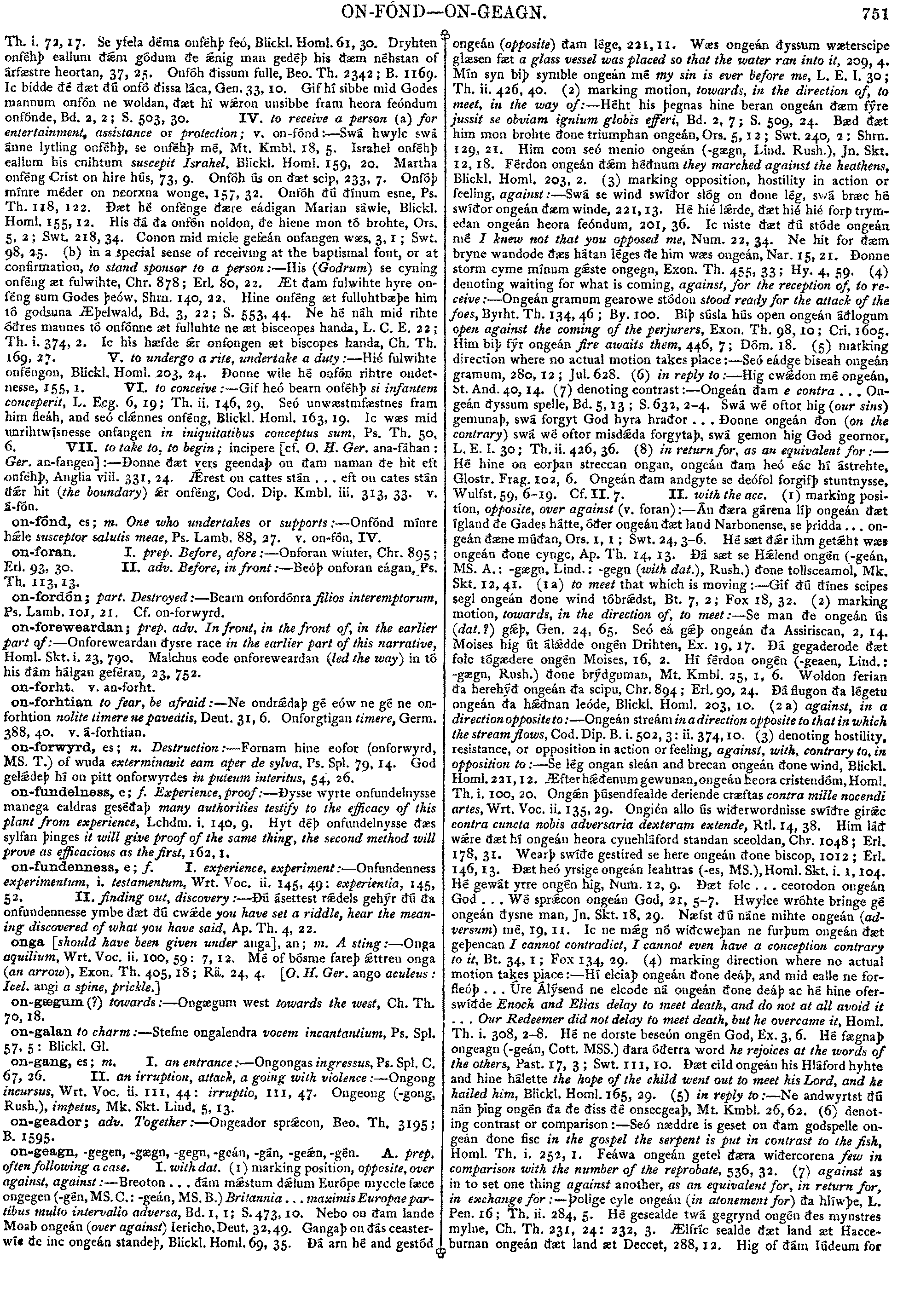
on-geagn,
-gegen,
-gægn,
-gegn,
-geán,
-gán,
-gen,
-gén.
A.
prep.
often
following
a
case.
I.
with
dat.
(l)
marking
position,
opposite,
over
against,
against:--Breoton
.
.
.
ðám
mstum
dlum
Európe
myccle
fæce
ongegen
(-gén,
MS.C.:
-geán,
MS.
B.)
Britannia.
.
.
maximis
Europae
partibus
multo
intervallo
adversa,
Bd.
l,
l;
S.
473,
10.
Nebo
on
ðam
lande
Moab
ongeán
(over
against)
Iericho,
Deut.
32,
49.
Gangaþ
on
ðás
ceaster-wíe
ðe
inc.
ongeán
standeþ,
Blickl.
Homl.
69,
35.
Ðá
arn
hé
and
gestód
ongeán
(opposite)
ðam
lége,
221,
11.
Wæs
ongeán
ðyssum
wæterscipe
glæsen
fæt
a
glass
vessel
was
placed
so
thai
the
water
ran
into
it,
209,
4.
Mín
syn
biþ
symble
ongeán
mé
my
sin
is
ever
before
me,
L.
E.
I.
30;
Th.
ii.
426,
40.
(2)
marking
motion,
towards,
in
the
direction
of,
to
meet,
in
the
way
of:--Héht
his
þegnas
hine
beran
ongeán
ðæm
fýre
jussit
se
obviam
ignium
globis
efferi,
Bd.
2,
7;
S.
509,
24.
Bæd
ðæt
him
mon
brohte
ðone
triumphan
ongeán,
Ors.
5,
12;
Swt.
240,
2:
Shrn.
129,
21.
Him
com
seó
menio
ongeán
(-gægn,
Lind.
Rush.),
Jn.
Skt.
12,
18.
Férdon
ongeán
ðm
héðnum
they
marched
against
the
heathens,
Blickl.
Homl.
203,
2.
(3)
marking
opposition,
hostility
in
action
or
feeling,
against:--Swá
se
wind
swíðor
slóg
on
ðone
lég,
swá
bræc
hé
swíðor
ongeán
ðæm
winde,
221,
13.
Hé
hié
lrde,
ðæt
hié
hié
forþ
trymedan
ongeán
heora
feóndum,
201,
36.
Ic
niste
ðæt
ðú
stóde
ongeán
mé
I
knew
not
that
you
opposed
me,
Num.
22,
34.
Ne
hit
for
ðæm
bryne
wandode
ðæs
hátan
léges
ðe
him
wæs
ongeán.
Nar.
15,
21.
Ðonne
storm
cyme
mínum
gste
ongegn,
Exon.
Th.
455,
33;
Hy.
4,
59.
(4)
denoting
waiting
for
what
is
coming,
against,
for
the
reception
of,
to
receive:--Ongeán
gramum
gearowe
stódon
stood
ready
for
the
attack
of
the
foes,
Byrht.
Th.
134,
46;
By.
100.
Biþ
súsla
hús
open
ongeán
áðlogum
open
against
the
coming
of
the
perjurers,
Exon.
Th.
98,
10;
Cri.
1605.
Him
biþ
fýr
ongeán
fire
awaits
them,
446,
7;
Dóm.
18.
(5)
marking
direction
where
no
actual
motion
takes
place:--Seó
eádge
biseah
ongeán
gramum,
280,
12;
Jul.
628.
(6)
in
reply
to:--Hig
cwdon
mé
ongeán,
St.
And.
40,
14.
(7)
denoting
contrast:--Ongeán
ðam
e
contra
.
.
.
Ongeán
ðyssum
spelle,
Bd.
5,
13;
S.
632,
2-4.
Swá
wé
oftor
hig
(
our
sins)
gemunaþ,
swá
forgyt
God
hyra
hraðor
.
.
.
Ðonne
ongeán
ðon
(on
the
contrary)
swá
wé
oftor
misdda
forgytaþ,
swá
gemon
hig
God
geornor,
L.
E.
I.
30;
Th.
ii.
426,
36.
(8)
in
return
for,
as
an
equivalent
for:--Hé
hine
on
eorþan
streccan
ongan,
ongeán
ðam
heó
eác
hí
ástrehte,
Glostr.
Frag.
102,
6.
Ongeán
ðam
andgyte
se
deófol
forgifþ
stuntnysse,
Wulfst.
59,
6-19.
Cf.
II.
7.
II.
with
the
acc.
(l)
marking
position,
opposite,
over
against
(v.
foran):--Án
ðæra
gárena
líþ
ongeán
ðæt
ígland
ðe
Gades
hátte,
óðer
ongeán
ðæt
land
Narbonense,
se
þridda
.
.
.
ongeán
ðæne
múðan,
Ors.
1,
1;
Swt.
24,
3-6.
Hé
sæt
ðr
ihm
getht
wæs
ongeán
ðone
cyngc,
Ap.
Th.
14,
13.
Ðá
sæt
se
Hlend
ongén
(-geán,
MS.
A.:
-gægn,
Lind.:
-gægn,
Rush.)
ðone
brýdguman,
Mt.
Kmbl.
25,
I.
6.
Woldon
ferian
ða
herehýð
ongeán
ða
scipu,
Chr.
894;
Erl.
90,
24.
Ðá
flugon
ða
légetu
ongeán
ða
hðnan
leóde,
Blickl.
Homl.
203,
10.
(2
a)
against,
in
a
direction
opposite
to:--Ongeán
streám
in
a
direction
opposite
to
that
in
which
the
stream
flows,
Cod.
Dip.
B.
i.
502,
3:
ii.
374,
10.
(3)
denoting
hostility,
resistance,
or
opposition
in
action
or
feeling,
against,
with,
contrary
to,
in
opposition
to:--Se
lég
ongan
sleán
and
brecan
ongeán
ðone
wind,
Blickl.
Homl.
221,
12.
Æfter
hðenum
gewunan,
ongeán
heora
cristendóm,
Homl.
Th.
i.
100,
20.
Ongn
þúsendfealde
deriende
cræftas
contra
mille
nocendi
artes,
Wrt.
Voc.
ii.
135,
29.
Ongién
allo
ús
wiðerwordnisse
swííre
girc
contra
cuncta
nobis
adversaria
dexteram
extende,
Rtl.
14,
38.
Him
láð
wre
ðæt
hí
ongeán
heora
cynehláford
standan
sceoldan,
Chr.
1048
;
Erl.
178,
31.
Wearþ
swíðe
gestired
se
here
ongeán
ðone
biscop,
1012
;
Erl.
146,
13.
Ðæt
heó
yrsige
ongeán
leahtras
(-es,
MS.),
Homl.
Skt.
i.
l,
104.
Hé
gewát
yrre
ongén
hig,
Num.
12,
9.
Ðæt
folc
.
.
.
ceorodon
ongeán
God
.
.
.
Wé
sprcon
ongeán
God,
21,
5-7.
Hwylce
wróhte
bringe
gé
ongeán
ðysne
man,
Jn.
Skt.
18,
29.
Næfst
ðú
náne
mihte
ongeán
(ad-versum)
mé,
19,
ll.
Ic
ne
mg
nó
wiðcweþan
ne
furþum
ongeán
ðæt
geþencan
I
cannot
contradict,
I
cannot
even
have
a
conception
contrary
to
it.
Bt.
34,
l;
Fox
134,
29.
(4)
marking
direction
where
no
actual
motion
takes
place:--Hí
elciaþ
ongeán
ðone
deáþ,
and
mid
ealle
ne
forfleóþ
.
.
.
Úre
Álýsend
ne
elcode
ná
ongeán
ðone
deáþ
ac
hé
hine
oferswíðde
Enoch
and
Elias
delay
to
meet
death,
and
do
not
at
all
avoid
it
.
.
.
Our
Redeemer
did
not
delay
to
meet
death,
but
he
overcame
it,
Homl.
Th.
i.
308,
2-8.
Hé
ne
dorste
beseón
ongén
God,
Ex.
3,
6.
Hé
fægnaþ
ongeagn
(-geán,
Cott.
MSS.)
ðara
óðerra
word
he
rejoices
at
the
words
of
the
others,
Past.
17,
3;
Swt.
111,
10.
Ðæt
cild
ongeán
his
Hláfordhyhte
and
hine
hálette
the
hope
of
the
child
went
out
to
meet
his
Lord,
and
he
hailed
him,
Blickl.
Homl.
165,
29.
(5)
in
reply
to:--Ne
andwyrtst
ðú
nán
þing
ongén
ða
ðe
ðiss
ðé
onsecgeaþ.
Mt.
Kmbl.
26,
62.
(6)
denoting
contrast
or
comparison:--Seó
næddre
is
geset
on
ðam
godspelle
ongeán
ðone
fisc
in
the
gospel
the
serpent
is
put
in
contrast
to
the
fish,
Homl.
Th.
i.
252,
I.
Feáwa
ongeán
getel
ðæra
wiðercorena
few
in
comparison
with
the
number
of
the
reprobate,
536,
32.
(7)
against
as
in
to
set
one
thing
against
another,
as
an
equivalent
for,
in
return
for,
in
exchange
for:--Þolige
cyle
ongeán
(in
atonement
for)
ða
hlíwþe,
L.
Pen.
16;
Th.
ii.
284,
5.
Hé
gesealde
twá
gegrynd
ongén
ðes
mynstres
mylne,
Ch.
Th.
231,
24:
232,
3.
Ælfríc
sealde
ðæt
land
æt
Hacce burnan
ongeán
ðæt
land
set
Deccet,
288,
12.
Hig
of
ðám
lúdeum
for
burnan
ongeán
ðæt
land
set
Deccet,
288,
12.
Hig
of
ðám
lúdeum
for
|
Source: Bosworth/Toller, page b0766, entry 4 View original page image as: [TIFF] [PNG] [View previous entry] [View next entry] |
[Comment on this entry] [View comments] |
The following entry has been hand-corrected once. |
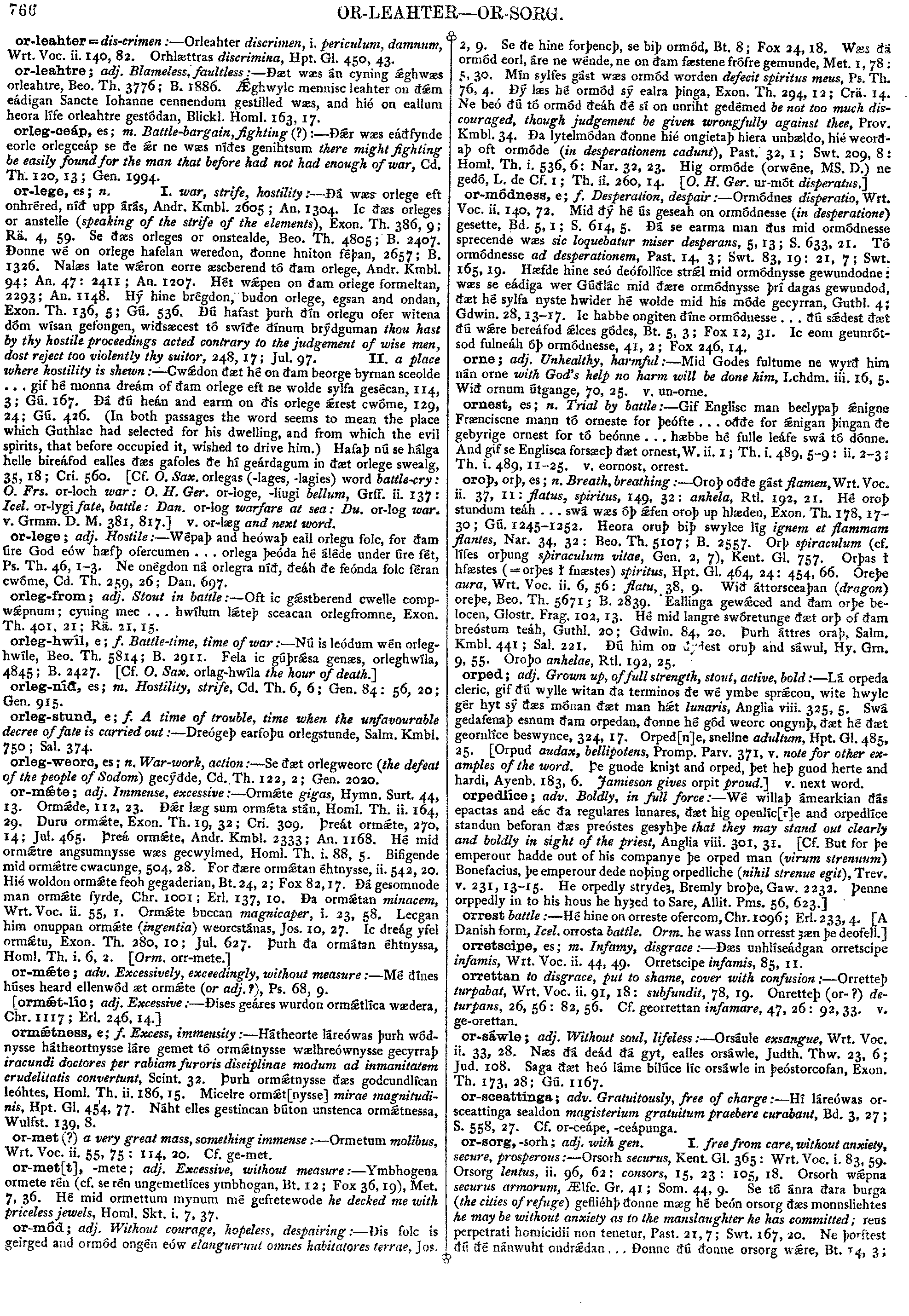
or-lege,
es;
n.
I.
war,
strife,
hostility
:--
Ðá
wæs
orlege
eft
onhréred,
níð
upp
árás,
Andr.
Kmbl.
2605
;
An.
1304.
Ic
ðæs
orleges
or
anstelle
(speaking
of
the
strife
of
the
elements),
Exon.
Th.
386,
9;
Rü.
4,
59.
Se
ðæs
orleges
or
onstealde,
Beo.
Th.
4805;
B.
2407.
Ðonne
wé
on
orlege
hafelan
weredon,
ðonne
hniton
féþan,
2657;
B.
1326.
Nalæs
late
wron
eorre
æscberend
tó
ðam
orlege,
Andr.
Kmbl.
94;
An.
47:
2411;
An.
1207.
Hét
wpen
on
ðam
orlege
formeltan,
2293;
An.
1148.
Hý
hine
brégdon,
budon
orlege,
egsan
and
ondan,
Exon.
Th.
136,
5;
Gú.
536.
Ðú
hafast
þurh
ðín
orlegu
ofer
witena
dóm
wísan
gefongen,
wiðsæcest
tó
swíðe
ðínum
brýdguman
thou
hast
by
thy
hostile
proceedings
acted
contrary
to
the
judgement
of
wise
men,
dost
reject
too
violently
thy
suitor,
248,
17;
Jul.
97.
II.
a
place
where
hostility
is
shewn:--
Cwdon
ðæt
hé
on
ðam
beorge
byrnan
sceolde
.
.
.
gif
hé
monna
dreám
of
ðam
orlege
eft
ne
wolde
sylfa
gesécan,
114,
3;
Gú.
167.
Ðá
ðú
heán
and
earm
on
ðis
orlege
rest
cwóme,
129,
24;
Gú.
426.
(In
both
passages
the
word
seems
to
mean
the
place
which
Guthlac
had
selected
for
his
dwelling,
and
from
which
the
evil
spirits,
that
before
occupied
it,
wished
to
drive
him.
)
Hafaþ
nú
se
hálga
helle
bireáfod
ealles
ðæs
gafoles
ðe
hí
geárdagum
in
ðæt
orlege
swealg,
35,
18
;
Cri.
560.
[Cf.
O.
Sax.
orlegas
(-lages,
-lagies)
word
battle-cry:
O.
Frs.
or-loch
war;
O.
H.
Ger.
or-loge,
-liugi
bellum,
Grff.
ii.
137:
Icel.
or-lygi
fate,
battle:
Dan.
or-log
warfare
at
sea:
Du.
or-log
war.
v.
Grmm.
D.
M.
381,
817.]
v.
or-læg
and
next
word.
|
Source: Bosworth/Toller, page b0766, entry 8 View original page image as: [TIFF] [PNG] [View previous entry] [View next entry] |
[Comment on this entry] [View comments] |
The following entry has been hand-corrected once. |
orleg-níð, es; m. Hostility, strife, Cd. Th. 6, 6; Gen. 84: 56, 20; Gen. 915.
|
Source: Bosworth/Toller, page b0853, entry 11 View original page image as: [TIFF] [PNG] [View previous entry] [View next entry] |
[Comment on this entry] [View comments] |
The following entry has been hand-corrected once. |
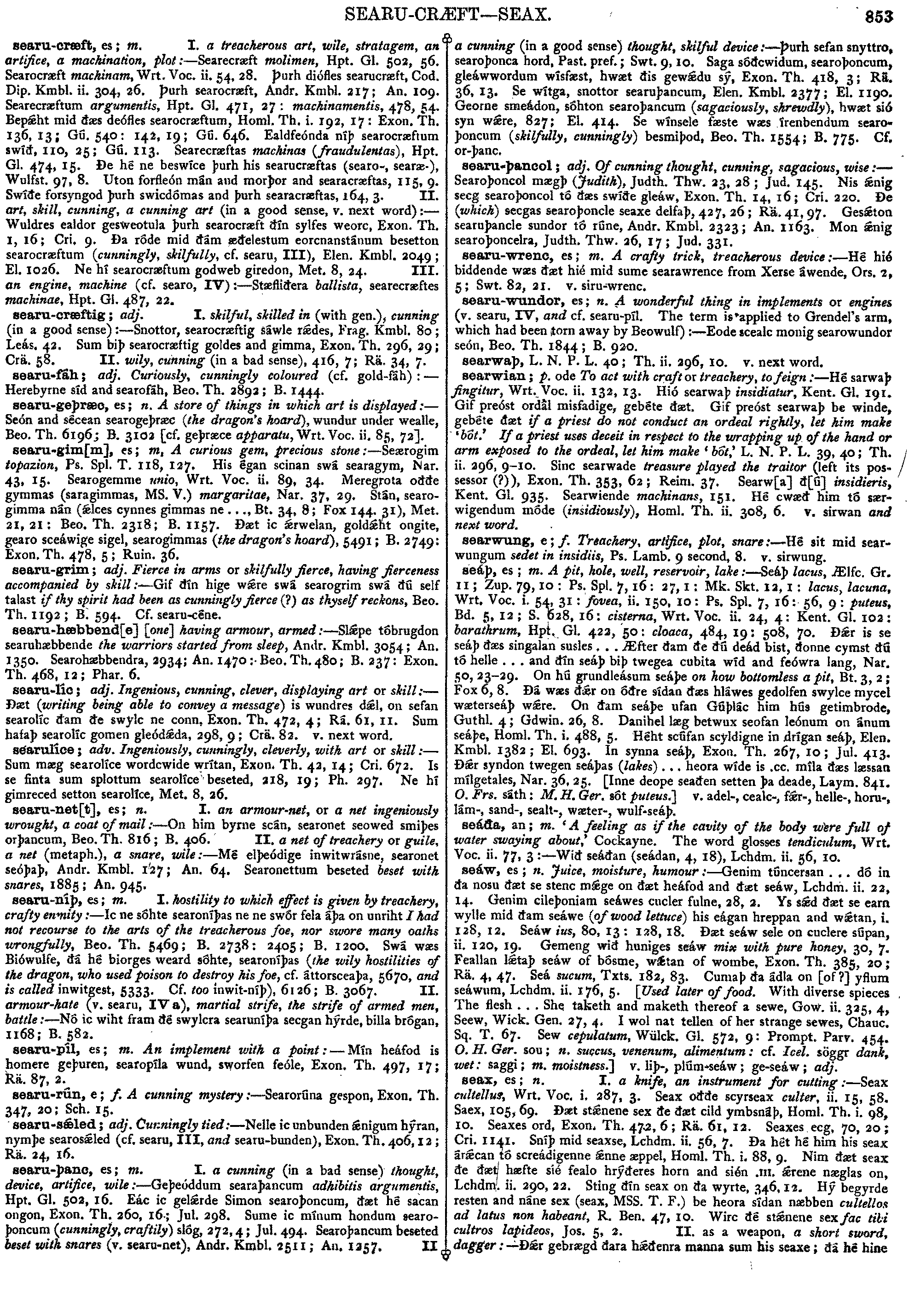
searu-níþ, es; m. I. hostility to which effect is given by treachery, crafty enmity:--Ic ne sóhte searoníþas ne ne swór fela áþa on unriht I had not recourse to the arts of the treacherous foe, nor swore many oaths wrongfully, Beo. Th. 5469; B. 2738: 2405; B. 1200. Swá wæs Biówulfe, ðá hé biorges weard sóhte, searoníþas (the wily hostilities of the dragon, who used poison to destroy his foe, cf. áttorsceaþa, 5670, and is called inwitgest, 5333. Cf. too inwit-níþ), 6126; B. 3067. II. armour-hate (v. searu, IV a), martial strife, the strife of armed men, battle:--Nó ic wiht fram ðé swylcra searuníþa secgan hýrde, billa brógan, 1168; B. 582.
|
Source: Bosworth/Toller, page b0868, entry 9 View original page image as: [TIFF] [PNG] [View previous entry] [View next entry] |
[Comment on this entry] [View comments (1)] |
The following entry has been hand-corrected once. |
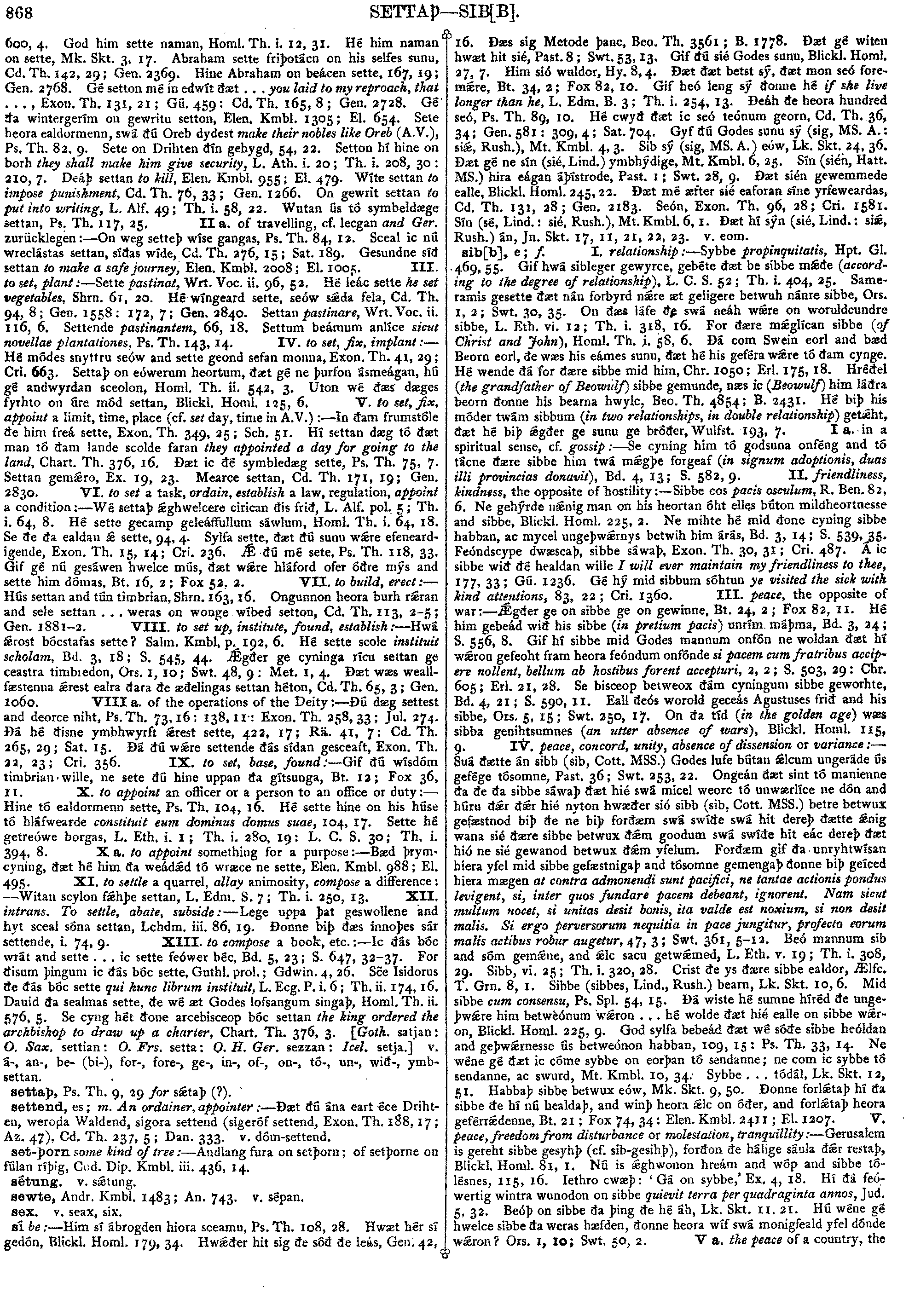
sib[b],
e;
f.
I.
relationship:--
Sybbe
propinquitatis,
Hpt.
Gl.
469,
55.
Gif
hwá
sibleger
gewyrce,
gebéte
ðæt
be
sibbe
mðe
(according
to
the
degree
of
relationship),
L.
C.
S.
52
;
Th.
i.
404,
25.
Sameramis
gesette
ðæt
nán
forbyrd
nre
æt
geligere
betwuh
nánre
sibbe,
Ors.
1,
2;
Swt.
30,
35.
On
ðæs
láfe
ðe
swá
neáh
wre
on
woruldcundre
sibbe,
L.
Eth.
vi.
12;
Th.
i.
318,
16.
For
ðære
mglícan
sibbe
(of
Christ
and
John),
Homl.
Th.
i.
58,
6.
Ðá
com
Swein
eorl
and
bæd
Beorn
eorl,
ðe
wæs
his
eámes
sunu,
ðæt
hé
his
geféra
wre
tó
ðam
cynge.
Hé
wende
ðá
for
ðære
sibbe
mid
him.
Chr.
1050;
Erl.
175,
18.
Hréðel
(the
grandfather
of
Beowulf)
sibbe
gemunde,
næs
ic
(Beowulf)
him
láðra
beorn
ðonne
his
bearna
hwylc,
Beo.
Th.
4854;
B.
2431.
Hé
biþ
his
móder
twám
sibbum
(in
two
relationships,
in
double
relationship)
getht,
ðæt
hé
biþ
gðer
ge
sunu
ge
bróðer,
Wulfst.
193,
7.
I
a.
in
a
spiritual
sense,
cf.
gossip:--
Se
cyning
him
tó
godsuna
onféng
and
tó
tácne
ðære
sibbe
him
twá
mgþe
forgeaf
(in
signum
adoptionis,
duas
illi
provincias
donavit),
Bd.
4,
13;
S.
582,
9.
II.
friendliness,
kindness,
the
opposite
of
hostility
:--
Sibbe
cos
pacis
osculum,
R.
Ben.
82,
6.
Ne
gehýrde
nnig
man
on
his
heortan
&
ellóht
elles
búton
mildheortnesse
and
sibbe,
Blickl.
Homl.
225,
2.
Ne
mihte
hé
mid
ðone
cyning
sibbe
habban,
ac
mycel
ungeþwrnys
betwih
him
árás,
Bd.
3,
14;
S.
539,
35.
Feóndscype
dwæscaþ,
sibbe
sáwaþ,
Exon.
Th.
30,
31;
Cri.
487.
Á
ic
sibbe
wið
ðé
healdan
wille
I
will
ever
maintain
my
friendliness
to
thee,
177,
33;
Gú.
1236.
Gé
hý
mid
sibbum
sóhtun
ye
visited
the
sick
with
kind
attentions,
83,
22
;
Cri.
1360.
III.
peace,
the
opposite
of
war
:--
Æ-acute;gðer
ge
on
sibbe
ge
on
gewinne,
Bt.
24,
2
;
Fox
82,
11.
Hé
him
gebeád
wið
his
sibbe
(in
pretium
pacis)
unrím
máþma,
Bd.
3,
24;
S.
556,
8.
Gif
hí
sibbe
mid
Godes
mannum
onfón
ne
woldan
ðæt
hí
wron
gefeoht
fram
heora
feóndum
onfónde
si
pacem
cum
fratribus
accipere
nollent,
bellum
ab
hostibus
forent
accepturi,
2,
2;
S.
503,
29:
Chr.
605;
Erl.
21,
28.
Se
bisceop
betweox
ðám
cyningum
sibbe
geworhte,
Bd.
4,
21;
S.
590,
11.
Eall
ðeós
worold
geceás
Agustuses
frið
and
his
sibbe,
Ors.
5,
15;
Swt.
250,
17.
On
ða
tíd
(in
the
golden
age)
wæs
sibba
genihtsumnes
(an
utter
absence
of
wars),
Blickl.
Homl.
115,
9.
IV.
peace,
concord,
unity,
absence
of
dissension
or
variance:--
Suá
ðætte
án
sibb
(sib,
Cott.
MSS.)
Godes
lufe
bútan
lcum
ungeráde
ús
gefége
tósomne,
Past.
36;
Swt.
253,
22.
Ongeán
ðæt
sint
tó
manienne
ða
ðe
ða
sibbe
sáwaþ
ðæt
hié
swá
micel
weorc
tó
unwærlíce
ne
dón
and
húru
ðr
ðr
hié
nyton
hwæðer
sió
sibb
(sib,
Cote.
MSS.)
betre
betwux
gefæstnod
biþ
ðe
ne
biþ
forðæm
swá
swíðe
swá
hit
dereþ
ðætte
nig
wana
sié
ðære
sibbe
betwux
ðm
goodum
swá
swíðe
hit
eác
dereþ
ðæt
hió
ne
sié
gewanod
betwux
ðm
yfelum.
Forðæm
gif
ða
unryhtwísan
hiera
yfel
mid
sibbe
gefæstnigaþ
and
tósomne
gemengaþ
ðonne
biþ
geíced
hiera
mægen
at
contra
admonendi
sunt
pacifici,
ne
tantae
actionis
pondus
levigent,
si,
inter
quos
fundare
pacem
debeant,
ignorent.
Nam
sicut
multum
nocet,
si
unitas
desit
bonis,
ita
valde
est
noxium,
si
non
desit
malis.
Si
ergo
perversorum
nequitia
in
pace
jungitur,
profecto
eorum
malis
actibus
robur
augetur,
47,
3;
Swt.
361,
5-12.
Beó
mannum
sib
and
sóm
gemne,
and
lc
sacu
getwmed,
L.
Eth.
v.
19;
Th.
i.
308,
29.
Sibb,
vi.
25;
Th.
i.
320,
28.
Crist
ðe
ys
ðære
sibbe
ealdor,
Ælfc.
T.
Grn.
8,
1.
Sibbe
(sibbes,
Lind.,
Rush.)
beam,
Lk.
Skt.
10,
6.
Mid
sibbe
cum
consensu,
Ps.
Spl.
54,
15.
Ðá
wiste
hé
sumne
híred
ðe
ungeþwre
him
betwéónum
wron
.
.
.
hé
wolde
ðæt
hié
ealle
on
sibbe
wron,
Blickl.
Homl.
225,
9.
God
sylfa
bebeád
ðæt
wé
sóðe
sibbe
heóldan
and
geþwrnesse
ús
betweónon
habban,
109,
15
:
Ps.
Th.
33,
14.
Ne
wéne
gé
ðæt
ic
cóme
sybbe
on
eorþan
tó
sendanne;
ne
com
ic
sybbe
tó
sendanne,
ac
swurd,
Mt.
Kmbl.
10,
34.
Sybbe
.
.
.
tódál,
Lk.
Skt.
12,
51.
Habbaþ
sibbe
betwux
eów,
Mk.
Skt.
9,
50.
Ðonne
forltaþ
hí
ða
sibbe
ðe
hí
nú
healdaþ,
and
winþ
heora
lc
on
óðer,
and
forltaþ
heora
geférrdenne,
Bt.
21;
Fox
74,
34:
Elen.
Kmbl.
2411;
El.
1207.
V.
peace,
freedom
from
disturbance
or
molestation,
tranquillity:--
Gerusalem
is
gereht
sibbe
gesyhþ
(cf.
sib-gesihþ),
forðon
ðe
hálige
sáula
ðr
restaþ,
Blickl.
Homl.
81,
1.
Nú
is
ghwonon
hreám
and
wóp
and
sibbe
tólésnes,
115,
16.
Iethro
cwæþ:
'Gá
on
sybbe,'Ex.
4,
18.
Hí
ðá
feówertig
wintra
wunodon
on
sibbe
quievit
terra
per
quadraginía
annos,
Jud.
5,
32.
Beóþ
on
sibbe
ða
þing
ðe
hé
áh,
Lk.
Skt.
11,
21.
Hú
wéne
gé
hwelce
sibbe
ða
weras
hæfden,
ðonne
heora
wíf
swá
monigfeald
yfel
dónde
wron?
Ors.
1,
10;
Swt.
50,
2.
V
a.
the
peace
of
a
country,
the
| Result Page: |  |
Previous | 1 2 3 4 5 6 7 | Next |  |
Germanic Lexicon Project (main page)
This search system was written by
Sean Crist
Please consider
volunteering
to correct the data in these online dictionaries.
No rights reserved. Feel free to use these data in any way you please.