|
|

Tip: In the search results, you can click on any word or abbreviation for more information.
|
Source: Bosworth/Toller, page b0457, entry 10 View original page image as: [TIFF] [PNG] [View previous entry] [View next entry] |
[Comment on this entry] [View comments] |
The following entry has been hand-corrected once. |
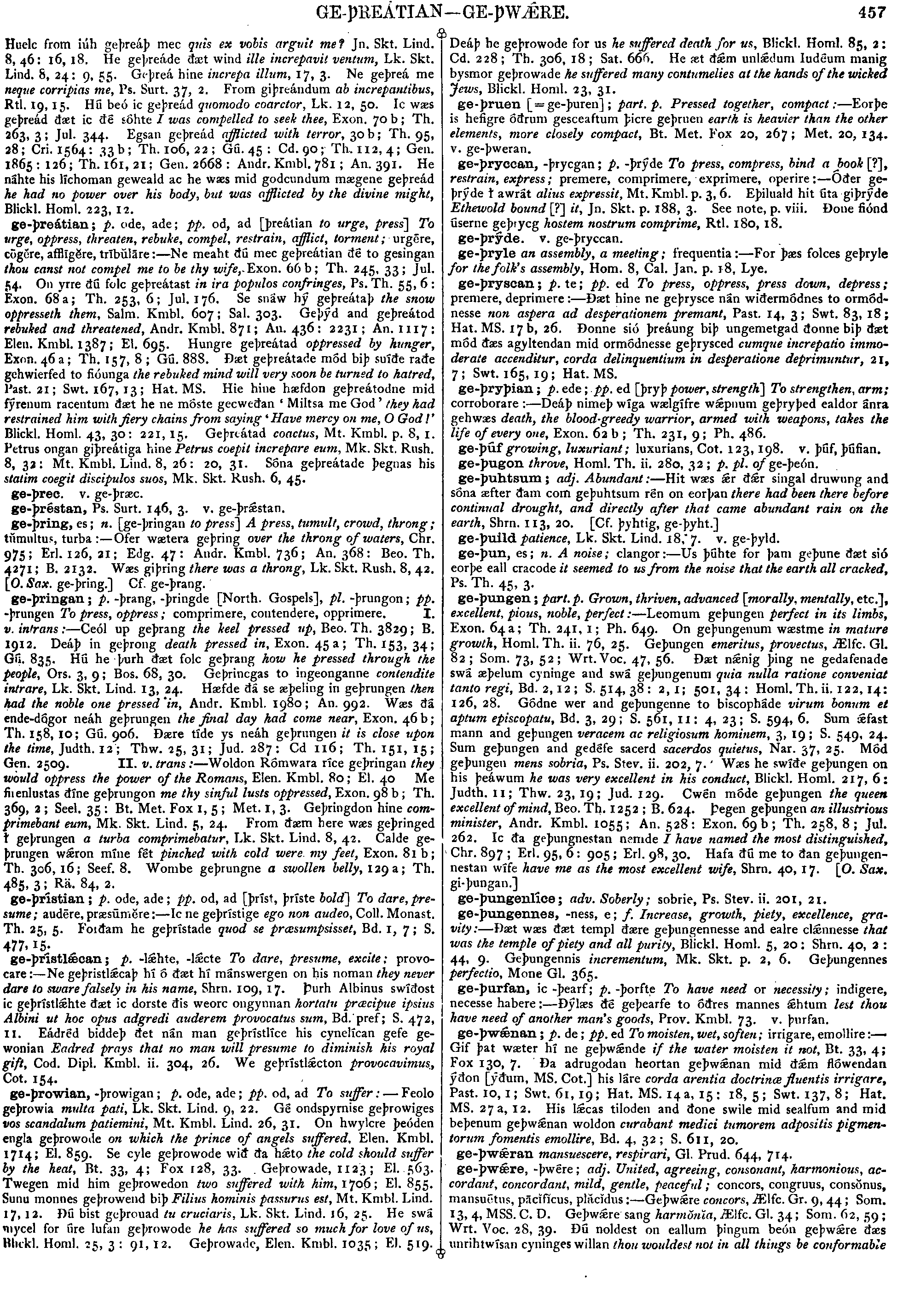
ge-þryccan,
-þrycgan;
p.
-þrýde
To
press,
compress,
bind
a
book[?],
restrain,
express;
premere,
comprimere,
exprimere,
operire
:--
Óðer
ge-þrýde
 awrát
alius
expressit,
Mt.
Kmbl.
p.
3,
6.
Eþiluald
hit
úta
giþrýde
Ethewold
bound[?]
it,
Jn.
Skt.
p.
188,
3.
See
note,
p.
viii.
Ðone
fiónd
úserne
geþrycg
hostem
nostrum
comprime,
Rtl.
180,
18.
awrát
alius
expressit,
Mt.
Kmbl.
p.
3,
6.
Eþiluald
hit
úta
giþrýde
Ethewold
bound[?]
it,
Jn.
Skt.
p.
188,
3.
See
note,
p.
viii.
Ðone
fiónd
úserne
geþrycg
hostem
nostrum
comprime,
Rtl.
180,
18.
|
Source: Bosworth/Toller, page b0507, entry 7 View original page image as: [TIFF] [PNG] [View previous entry] [View next entry] |
[Comment on this entry] [View comments] |
The following entry has been hand-corrected once. |
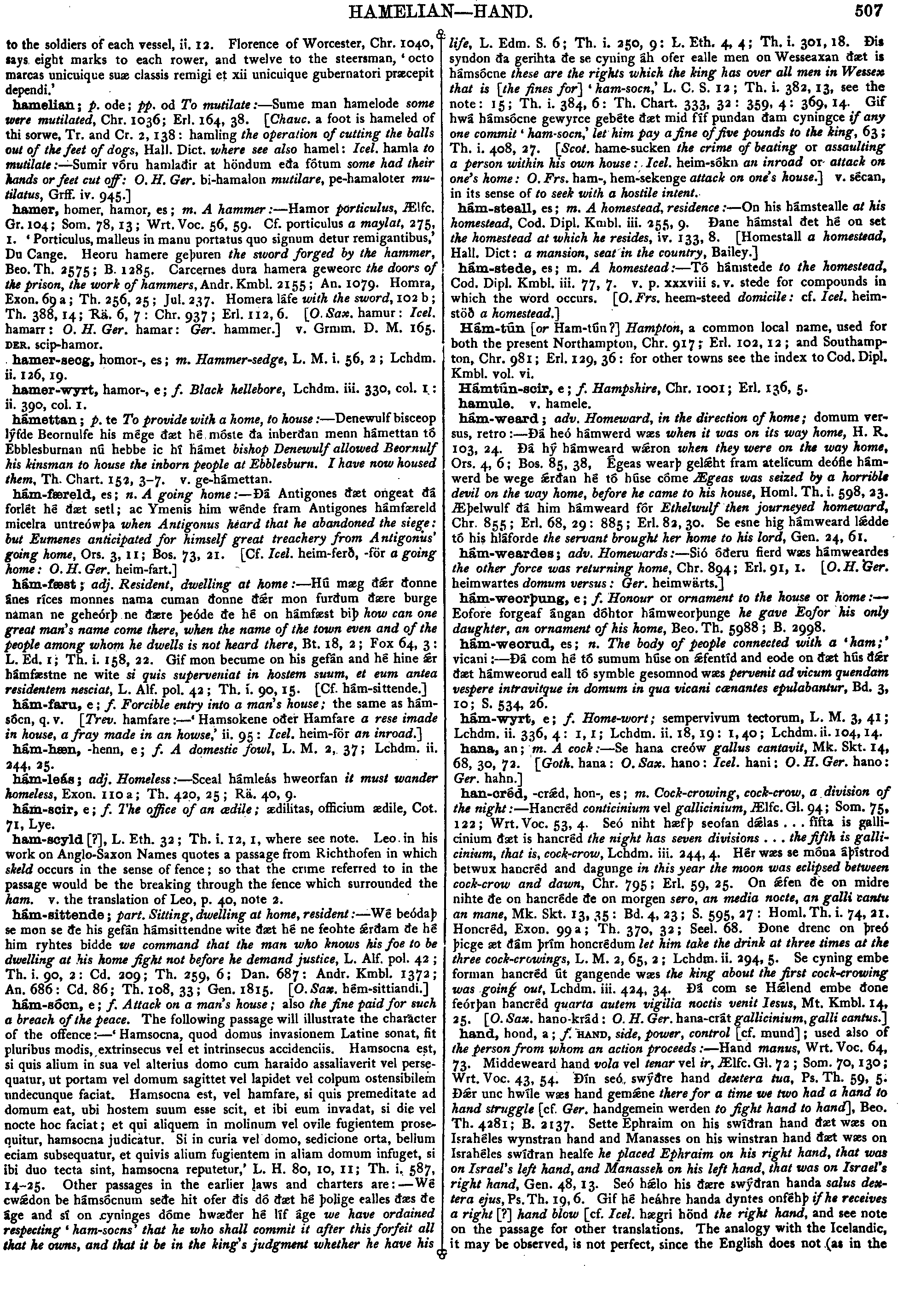
hám-fæst;
adj.
Resident,
dwelling
at
home
:--
Hú
mæg
ð r
ðonne
ánes
ríces
monnes
nama
cuman
ðonne
ðr
mon
furðum
ðære
burge
naman
ne
geheórþ
ne
ðære
þeóde
ðe
he
on
hámfæst
biþ
how
can
one
great
man's
name
come
there,
when
the
name
of
the
town
even
and
of
the
people
among
whom
he
dwells
is
not
heard
there,
Bt.
18,
2;
Fox
64,
3:
L.
Ed.
1;
Th.
i.
158,
22.
Gif
mon
becume
on
his
gefán
and
hé
hine
r
hámfæstne
ne
wite
si
quis
superveniat
in
hostem
suum,
et
eum
antea
residentem
nesciat,
L.
Alf.
pol.
42;
Th.
i.
90,
15.
[Cf.
hám-sittende.]
r
ðonne
ánes
ríces
monnes
nama
cuman
ðonne
ðr
mon
furðum
ðære
burge
naman
ne
geheórþ
ne
ðære
þeóde
ðe
he
on
hámfæst
biþ
how
can
one
great
man's
name
come
there,
when
the
name
of
the
town
even
and
of
the
people
among
whom
he
dwells
is
not
heard
there,
Bt.
18,
2;
Fox
64,
3:
L.
Ed.
1;
Th.
i.
158,
22.
Gif
mon
becume
on
his
gefán
and
hé
hine
r
hámfæstne
ne
wite
si
quis
superveniat
in
hostem
suum,
et
eum
antea
residentem
nesciat,
L.
Alf.
pol.
42;
Th.
i.
90,
15.
[Cf.
hám-sittende.]
|
Source: Bosworth/Toller, page b0507, entry 14 View original page image as: [TIFF] [PNG] [View previous entry] [View next entry] |
[Comment on this entry] [View comments] |
The following entry has been hand-corrected once. |
hám-sócn,
e;
f.
Attack
on
a
man's
house;
also
the
fine
paid
for
such
a
breach
of
the
peace.
The
following
passage
will
illustrate
the
character
of
the
offence
:--
'
Hamsocna,
quod
domus
invasionem
Latine
sonat,
fit
pluribus
modis,
extrinsecus
vel
et
intrinsecus
accidenciis.
Hamsocna
est,
si
quis
alium
in
sua
vel
alterius
domo
cum
haraido
assaliaverit
vel
persequatur,
ut
portam
vel
domum
sagittet
vel
lapidet
vel
colpum
ostensibilem
undecunque
faciat.
Hamsocna
est,
vel
hamfare,
si
quis
premeditate
ad
domum
eat,
ubi
hostem
suum
esse
scit,
et
ibi
eum
invadat,
si
die
vel
nocte
hoc
faciat;
et
qui
aliquem
in
molinum
vel
ovile
fugientem
prosequitur,
hamsocna
judicatur.
Si
in
curia
vel
domo,
sedicione
orta,
bellum
eciam
subsequatur,
et
quivis
alium
fugientem
in
aliam
domum
infuget,
si
ibi
duo
tecta
sint,
hamsocna
reputetur,'
L.
H.
80,
10,
11;
Th.
i.
587,
14-25.
Other
passages
in
the
earlier
laws
and
charters
are
:--
Wé
cwdon
be
hámsócnum
seðe
hit
ofer
ðis
dó
ðæt
hé
þolige
ealles
ðæs
ðe
áge
and
sí
on
cyninges
dóme
hwæðer
hé
líf
áge
we
have
ordained
respecting
'ham-socns'
that
he
who
shall
commit
it
after
this
forfeit
all
that
he
owns,
and
that
it
be
in
the
king's
judgment
whether
he
have
his
life,
L.
Edm.
S.
6;
Th.
i.
250,
9:
L.
Eth.
4,
4;
Th.
i.
301,
18.
Ðis
syndon
ða
gerihta
ðe
se
cyning
áh
ofer
ealle
men
on
Wesseaxan
ðæt
is
hámsócne
these
are
the
rights
which
the
king
has
over
all
men
in
Wessex
that
is
[the
fines
for]
'ham-socn,'
L.
C.
S.
12;
Th.
i.
382,
13,
see
the
note:
15;
Th.
i.
384,
6:
Th.
Chart.
333,
32:
359,
4:
369,
14.
Gif
hwá
hámsócne
gewyrce
gebéte
ðæt
mid
fíf
pundan
ðam
cyningce
if
any
one
commit
'ham-socn,'
let
him
pay
a
fine
of
five
pounds
to
the
king,
63;
Th.
i.
408,
27.
[Scot.
hame-sucken
the
crime
of
beating
or
assaulting
a
person
within
his
own
house:
Icel.
heim-sókn
an
inroad
or
attack
on
one's
home:
O.
Frs.
ham-,
hem-sekenge
attack
on
one's
house.]
v.
sécan,
in
its
sense
of
to
seek
with
a
hostile
intent.
|
Source: Bosworth/Toller, page b0833, entry 16 View original page image as: [TIFF] [PNG] [View previous entry] [View next entry] |
[Comment on this entry] [View comments (1)] |
The following entry has been hand-corrected once. |
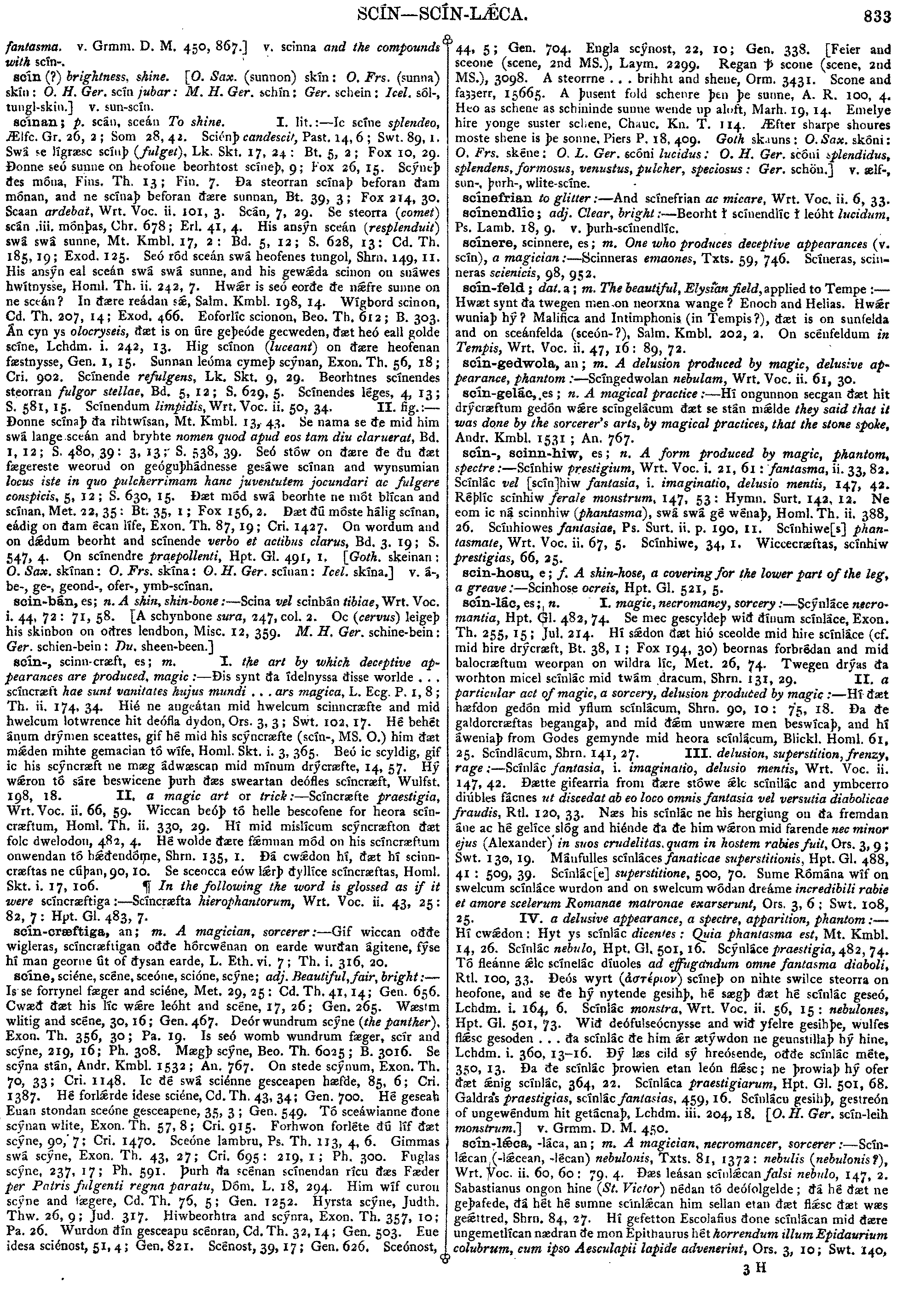
scín-lác,
es;
n.
I.
magic,
necromancy,
sorcery:--
Scýnláce
necro-mantia,
Hpt.
Gl.
482,
74.
Se
mec
gescyldeþ
wið
ðínum
scínláce,
Exon.
Th.
255,
15;
Jul.
214.
Hí
sdon
ðæt
hió
sceolde
mid
hire
scínláce
(cf.
mid
hire
drýcræft.
Bt.
38,
1
;
Fox
194,
30)
beornas
forbrédan
and
mid
balocræftum
weorpan
on
wildra
líc,
Met.
26,
74.
Twegen
drýas
ða
worhton
micel
scínlác
mid
twám
dracum,
Shrn.
131,
29.
II.
a
particular
act
of
magic,
a
sorcery,
delusion
produced
by
magic:--
Hí
ðæt
hæfdon
gedón
mid
yflum
scínlácum,
Shrn.
90,
10
:
75,
18.
Ða
ðe
galdorcræftas
begangaþ,
and
mid
ðm
unwære
men
beswícaþ,
and
hí
áweniaþ
from
Codes
gemynde
mid
heora
scínlácum,
Blickl.
Homl.
61,
25.
Scíndlácum,
Shrn.
141,
27.
III.
delusion,
superstition,
frenzy,
rage:--
Scínlác
fantasia,
i.
imaginatio,
delusio
mentis.
Wrt.
Voc.
ii.
147,
42.
Ðætte
gifearria
from
ðære
stówe
lc
scínilác
and
ymbcerro
diúbles
fácnes
ut
discedat
ab
eo
loco
omnis
fantasia
vel
versutia
diabolicae
fraudis,
Rtl.
120,
33.
Næs
his
scínlác
ne
his
hergiung
on
ða
fremdan
áne
ac
hé
gelíce
slóg
and
hiénde
ða
ðe
him
wron
mid
farende
nec
minor
ejus
(Alexander)
in
suos
crudelitas,
quam
in
hostem
rabies
fuit,
Ors.
3,
9
;
Swt.
130,
19.
Mánfulles
scínláces
fanaticae
superstitionis,
Hpt.
Gl.
488,
41:
509,
39.
Scínlác[e]
superstitione,
500,
70.
Sume
Rómána
wíf
on
swelcum
scínláce
wurdon
and
on
swelcum
wódan
dreáme
incredibili
rabie
et
amore
scelerum
Romanae
matronae
exarserunt,
Ors.
3,
6;
Swt.
108,
25.
IV.
a
delusive
appearance,
a
spectre,
apparition,
phantom:--
Hí
cwdon:
Hyt
ys
scínlác
dicentes:
Quia
phantasma
est,
Mt.
Kmbl.
14,
26.
Scínlác
nebulo,
Hpt.
Gl.
501,
16.
Scýnláce
praestigia,
482,
74.
Tó
fleánne
lc
scínelác
díuoles
ad
effugdndum
omne
fantasma
diaboli,
Rtl.
100,
33.
Ðeós
wyrt
(GREEK)
scíneþ
on
nihte
swilce
steorra
on
heofone,
and
se
ðe
hý
nytende
gesihþ,
hé
sægþ
ðæt
hé
scínlác
geseó,
Lchdm.
i.
164,
6.
Scínlác
monstra,
Wrt.
Voc.
ii.
56,
15:
nebulones,
Hpt.
Gl.
501,
73.
Wið
deófulseócnysse
and
wið
yfelre
gesihþe,
wulfes
flsc
gesoden.
.
.
ða
scínlác
ðe
him
r
ætýwdon
ne
geunstillaþ
hý
hine,
Lchdm.
i.
360,
13-16.
Ðý
læs
cild
sý
hreósende,
oððe
scínlác
méte,
350,
13.
Ða
ðe
scínlác
þrowien
etan
león
flsc;
ne
þrowiaþ
hý
ofer
ðæt
nig
scínlác,
364,
22.
Scínláca
praestigiarum.
Hpt.
Gl.
501,
68.
Galdras
praestigias,
scínlác
fantasias,
459,
16.
Scínlácu
gesihþ,
gestreón
of
ungewéndum
hit
getácnaþ,
Lchdm.
iii.
204,
18.
[O.
H.
Ger.
scín-leih
monstrum.]
V.
Grmm.
D.
M.
450.
|
Source: Bosworth/Toller, page b0835, entry 4 View original page image as: [TIFF] [PNG] [View previous entry] [View next entry] |
[Comment on this entry] [View comments] |
The following entry has been hand-corrected once. |
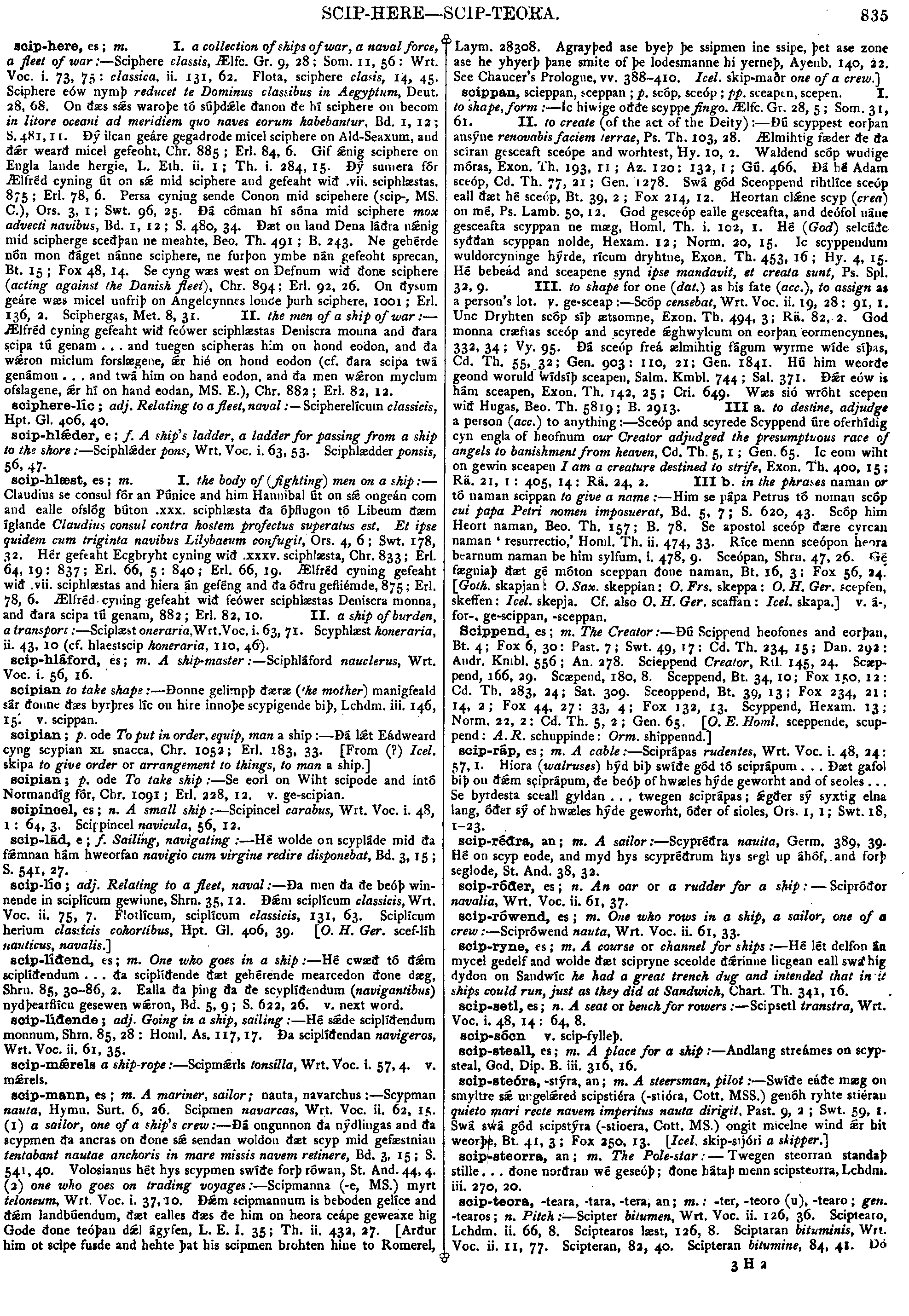
scip-hlæst,
es;
m.
I.
the
body
of
(fighting)
men
on
a
ship:--Claudius
se
consul
fór
an
Púnice
and
him
Hannibal
út
on
s
ongeán
com
and
ealle
ofslóg
búton
.xxx.
sciphlæsta
ða
óþflugon
tó
Libeum
ðæm
íglande
Claudius
consul
contra
hostem
profectus
superatus
est.
Et
ipse
quidem
cum
triginta
navibus
Lilybaeum
confugit,
Ors.
4,
6;
Swt.
178,
32.
Hér
gefeaht
Ecgbryht
cyning
wið
.xxxv.
sciphlæsta,
Chr.
833;
Erl.
64,
19:
837;
Erl.
66,
5:
840;
Erl.
66,
19.
Ælfréd
cyning
gefeaht
wið
.vii.
sciphlæstas
and
hiera
án
geféng
and
ða
óðru
gefliémde,
875;
Erl.
78,
6.
Ælfréd
cyning
gefeaht
wið
feówer
sciphlæstas
Deniscra
monna,
and
ðara
scipa
tú
genam,
882;
Erl.
82,
10.
II.
a
ship
of
burden,
a
transport:--Sciplæst
oneraria,
Wrt.
Voc.
i.
63,
71.
Scyphlæst
honeraria,
ii.
43,
10
(cf.
hlaestscip
honeraria,
110,
46).
|
Source: Bosworth/Toller, page b0881, entry 9 View original page image as: [TIFF] [PNG] [View previous entry] [View next entry] |
[Comment on this entry] [View comments] |
The following entry has been hand-corrected once. |
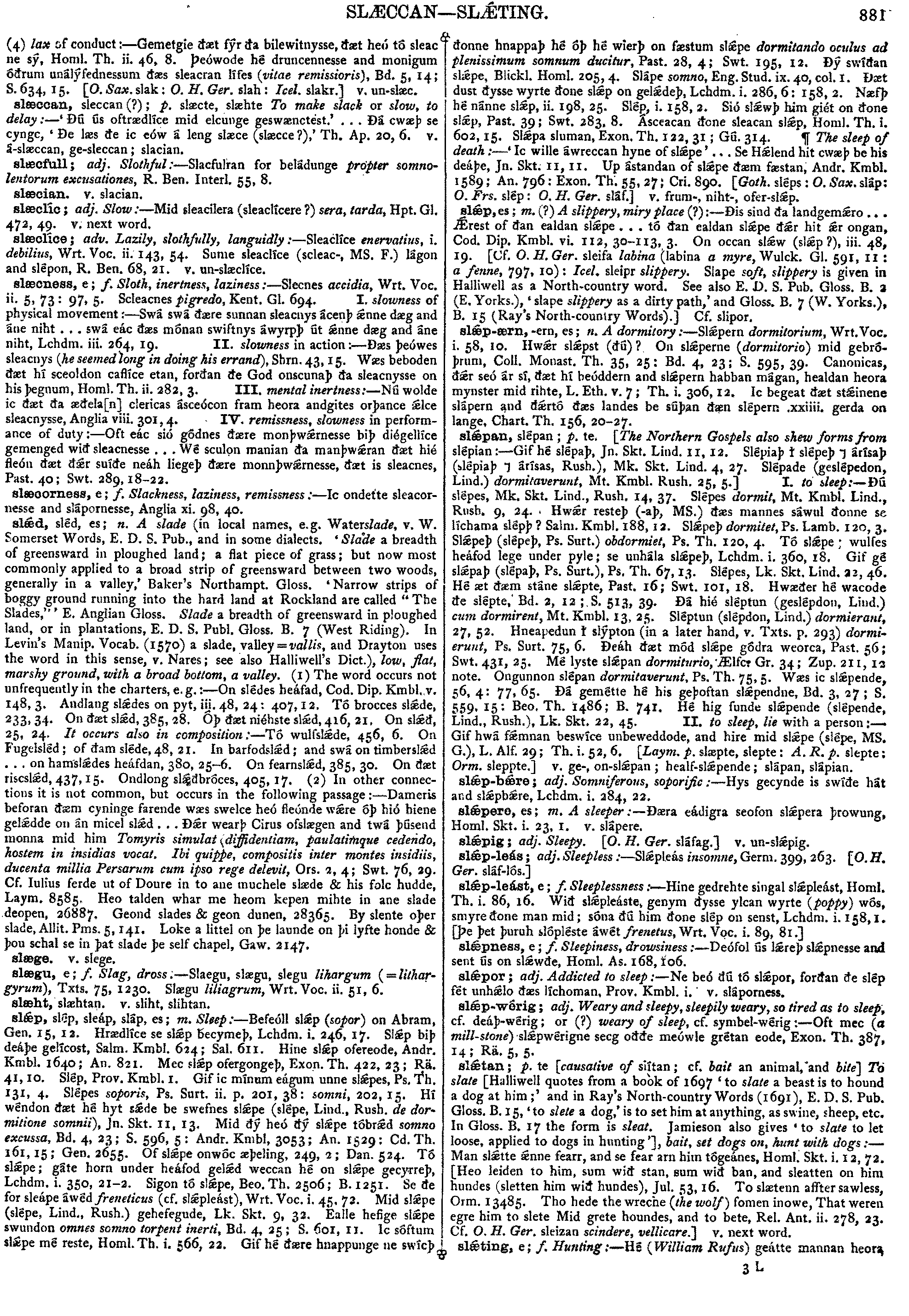
sld,
sléd,
es;
n.
A
slade
in
local
names,
e.
g.
Waterslade,
v.
W.
Somerset
Words,
E.
D.
S.
Pub.
,
and
in
some
dialects.
'
Slade
a
breadth
of
greensward
in
ploughed
land;
a
flat
piece
of
grass;
but
now
most
commonly
applied
to
a
broad
strip
of
greensward
between
two
woods,
generally
in
a
valley,
'
Baker's
Northampt.
Gloss.
Narrow
strips
of
boggy
ground
running
into
the
hard
land
at
Rockland
are
called
"
The
Slades,
"
E.
Anglian
Gloss.
Slade
a
breadth
of
greensward
in
ploughed
land,
or
in
plantations,
E.
D.
S.
Publ.
Gloss.
B.
7
(West
Riding)
In
Levin's
Manip.
Vocab.
-1570-
a
slade,
valley
=
vallis,
and
Drayton
uses
the
word
in
this
sense,
v.
Nares;
see
also
Halliwell's
Dict.
,
low,
flat,
marshy
ground,
with
a
broad
bottom,
a
valley.
The
word
occurs
not
unfrequently
in
the
charters,
e.
g.
:--
On
slédes
heáfad.
Cod.
Dip.
Kmbl.
v.
148,
3.
Andlang
sldes
on
pyt,
iii.
48,
24:
407,
12.
Tó
brocces
slde,
233.
34.
On
ðæt
sld,
385,
28.
Óþ
ðæt
niéhste
sld,
416,
21.
On
slð,
25,
24.
It
occurs
also
in
composition
:--
To
wulfslde,
456,
6.
On
Fugelsléd;
of
ðam
sléde,
48,
21.
In
barfodsld;
and
swá
on
timbersld
.
.
.
on
hamsldes
heáfdan,
380,
25
-
6.
On
fearasld,
385,
30.
On
dæt
riscsld,
437,
15.
Ondlong
sl
ðbróces,
405,
17.
In
other
connections
it
is
not
common,
but
occurs
in
the
following
passage
:--
Dameris
beforan
ðæm
cyninge
farende
wæs
swelce
heó
fleónde
wre
óþ
hió
hiene
geldde
on
án
micel
sld.
.
.
.
Ðr
wearþ
Cirus
ofslægen
and
twá
þ
úsend
monna
mid
him
Tomyris
simulat
diffidentiam,
paulatimque
cedendo,
hostem
in
insidias
vocat.
Ibi
quippe,
compositis
inter
mantes
insidiis,
ducenta
millia
Persarum
cum
ipso
rege
delevit,
Ors.
2,
4;
Swt.
76,
29.
Cf.
Iulius
ferde
ut
of
Doure
in
to
ane
muchele
slæde
&
his
folc
hudde,
Laym.
8585.
Heó
talden
whar
me
heom
kepen
mihte
in
ane
slade
deopen,
26887.
Geond
slades
&
geon
dunen,
28365.
By
slente
oþer
slade,
Allit.
Pms.
5,
141.
Loke
a
littel
on
þe
lannde
on
þi
lyfte
honde
&
þon
schal
se
in
þat
slade
þe
self
chapel,
Gaw.
2147.
|
Source: Bosworth/Toller, page d0066, entry 22 View original page image as: [TIFF] [PNG] [View previous entry] [View next entry] |
[Comment on this entry] [View comments] |
The following entry has been hand-corrected once. |
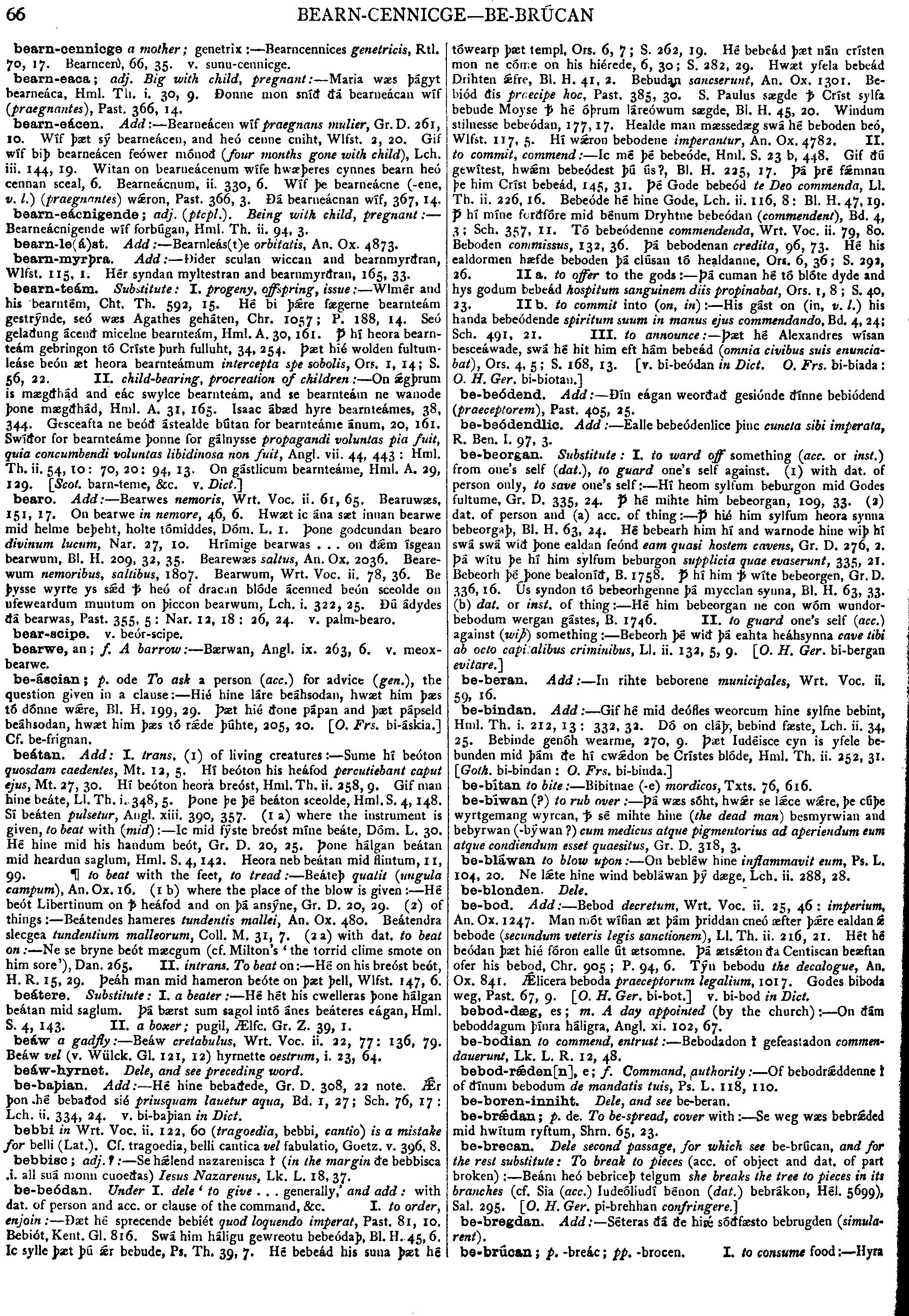
be-beorgan.
Substitute:
I.
to
ward
off
something
(acc.
or
inst.)
from
one's
self
(dat.),
to
guard
one's
self
against.
(1)
with
dat.
of
person
only,
to
save
one's
self:--Hí
heom
sylfum
beburgon
mid
Godes
fultume,
Gr.
D.
335,
24.
Þ-bar;
hé
mihte
him
bebeorgan,
109,
33.
(2)
dat.
of
person
and
(a)
acc.
of
thing:--Þ-bar;
hié
him
sylfum
heora
synna
bebeorgaþ,
Bl.
H.
63,
24.
Hé
bebearh
him
hí
and
warnode
hine
wiþ
hí
swá
swá
wið
þone
ealdan
feónd
eam
quasi
hostem
cavens,
Gr.
D.
276,
2.
Þá
wítu
þe
hí
him
sylfum
beburgon
supplicia
quae
evaserunt,
335,
21.
Bebeorh
þé
þone
bealoníð,
B.
1758.
Þ-bar;
hí
him
 wíte
bebeorgen,
Gr.
D.
336,
16.
Ús
syndon
tó
bebeorhgenne
þá
mycclan
synna,
Bl.
H.
63,
33.
(b)
dat.
or
inst.
of
thing:--Hé
him
bebeorgan
ne
con
wóm
wundor
wíte
bebeorgen,
Gr.
D.
336,
16.
Ús
syndon
tó
bebeorhgenne
þá
mycclan
synna,
Bl.
H.
63,
33.
(b)
dat.
or
inst.
of
thing:--Hé
him
bebeorgan
ne
con
wóm
wundor bebodum
wergan
gástes,
B.
1746.
II.
to
guard
one's
self
(acc.)
against
(wiþ)
something:--Bebeorh
þé
wið
þá
eahta
heáhsynna
cave
tibi
ab
octo
capitalibus
criminibus,
Ll.
ii.
132,
5,
9.
[O.
H.
Ger.
bi-bergan
evitare.]
bebodum
wergan
gástes,
B.
1746.
II.
to
guard
one's
self
(acc.)
against
(wiþ)
something:--Bebeorh
þé
wið
þá
eahta
heáhsynna
cave
tibi
ab
octo
capitalibus
criminibus,
Ll.
ii.
132,
5,
9.
[O.
H.
Ger.
bi-bergan
evitare.]
|
Source: Bosworth/Toller, page d0067, entry 2 View original page image as: [TIFF] [PNG] [View previous entry] [View next entry] |
[Comment on this entry] [View comments] |
The following entry has been hand-corrected once. |
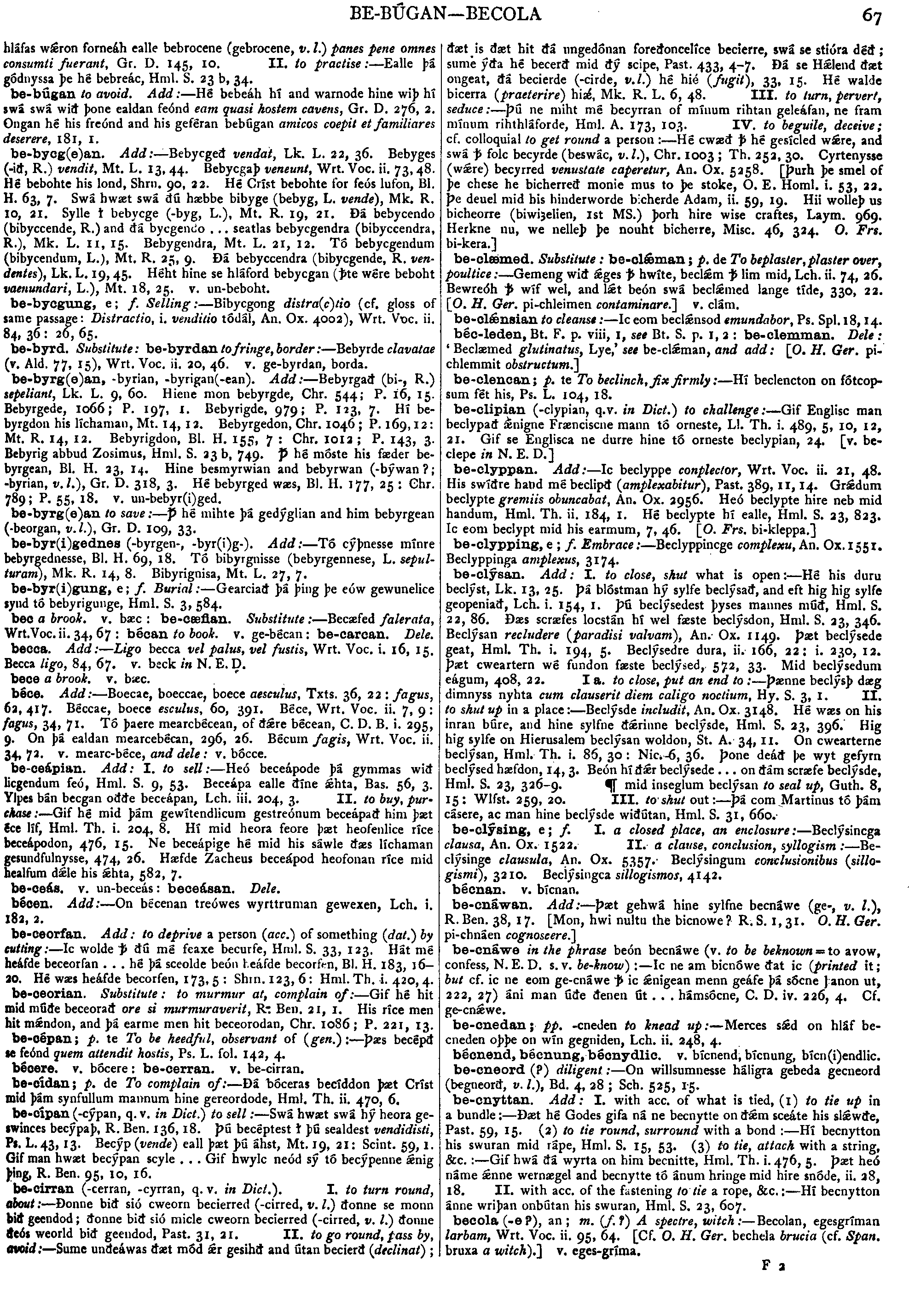
be-búgan to avoid. Add:--Hé bebeáh hí and warnode hine wiþ hí swá swá wið þone ealdan feónd eam quasi hostem cavens, Gr. D. 276, 2. Ongan hé his freónd and his geféran bebúgan amicos coepit et familiares deserere, 181, 1.
|
Source: Bosworth/Toller, page d0082, entry 11 View original page image as: [TIFF] [PNG] [View previous entry] [View next entry] |
[Comment on this entry] [View comments] |
The following entry has been hand-corrected once. |
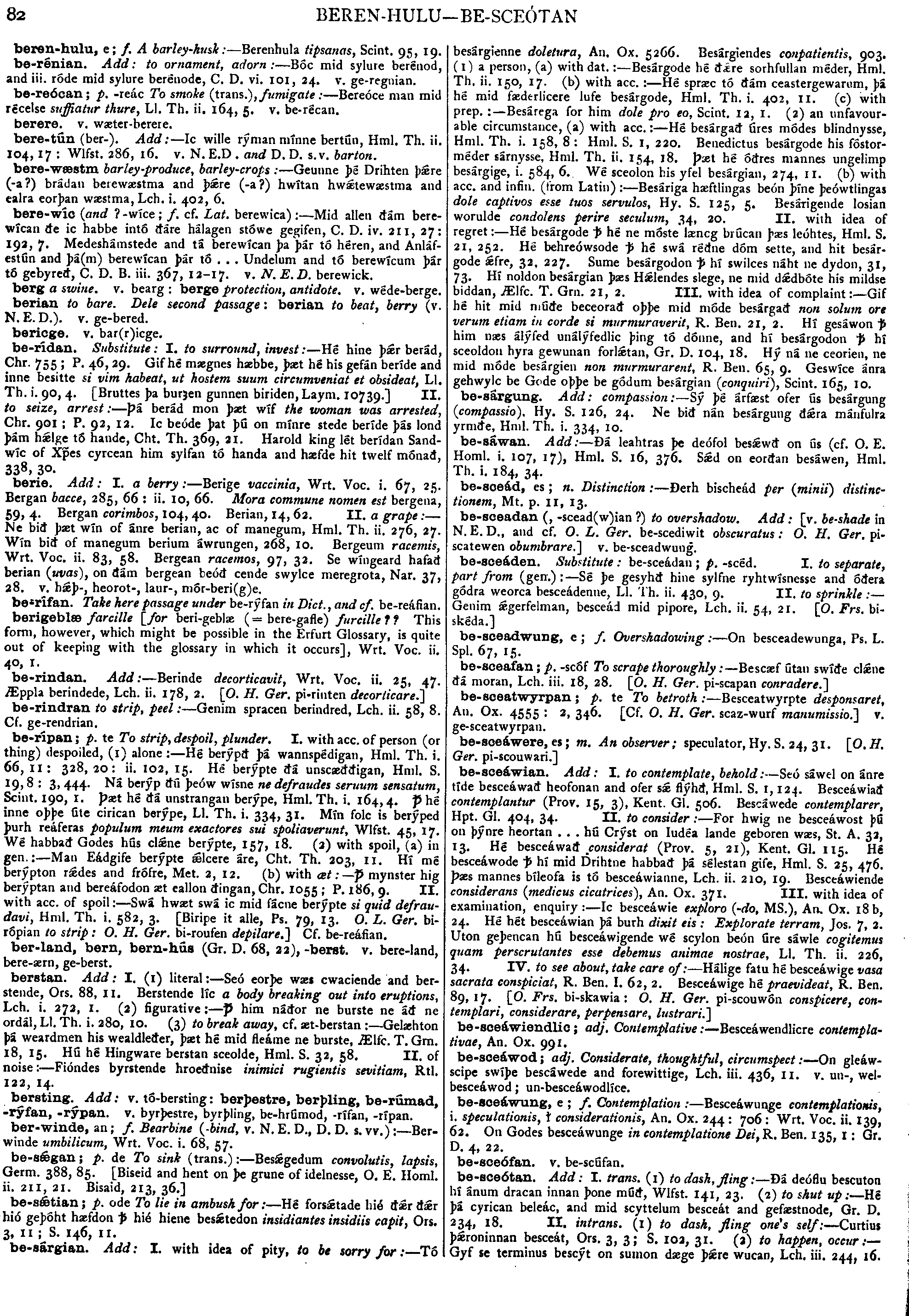
be-rídan.
Substitute:
I.
to
surround,
invest
:--
Hé
hine
þr
berád,
Chr.
755
;
P.
46,
29.
Gif
hé
mægnes
hæbbe,
þæt
hé
his
gefán
beríde
and
inne
besitte
si
vim
habeat,
ut
hostem
suum
circumveniat
et
obsideat,
Ll.
Th.
i.
90,
4.
[Bruttes
þa
bur en
gunnen
biriden,
Laym.
10739.]
II.
to
seize,
arrest
:--
þá
berád
mon
þæt
wíf
the
woman
was
arrested,
Chr.
901
;
P.
92,
12.
Ic
beóde
þat
þú
on
mínre
stede
beríde
þás
lond
þám
hlge
tó
hande,
Cht.
Th.
369,
21.
Harold
king
lét
berídan
Sandwíc
of
Xpes
cyrcean
him
sylfan
to
handa
and
hæfde
hit
twelf
mónað,
338,
30-
en
gunnen
biriden,
Laym.
10739.]
II.
to
seize,
arrest
:--
þá
berád
mon
þæt
wíf
the
woman
was
arrested,
Chr.
901
;
P.
92,
12.
Ic
beóde
þat
þú
on
mínre
stede
beríde
þás
lond
þám
hlge
tó
hande,
Cht.
Th.
369,
21.
Harold
king
lét
berídan
Sandwíc
of
Xpes
cyrcean
him
sylfan
to
handa
and
hæfde
hit
twelf
mónað,
338,
30-
|
Source: Bosworth/Toller, page d0312, entry 23 View original page image as: [TIFF] [PNG] [View previous entry] [View next entry] |
[Comment on this entry] [View comments] |
The following entry has been hand-corrected once. |
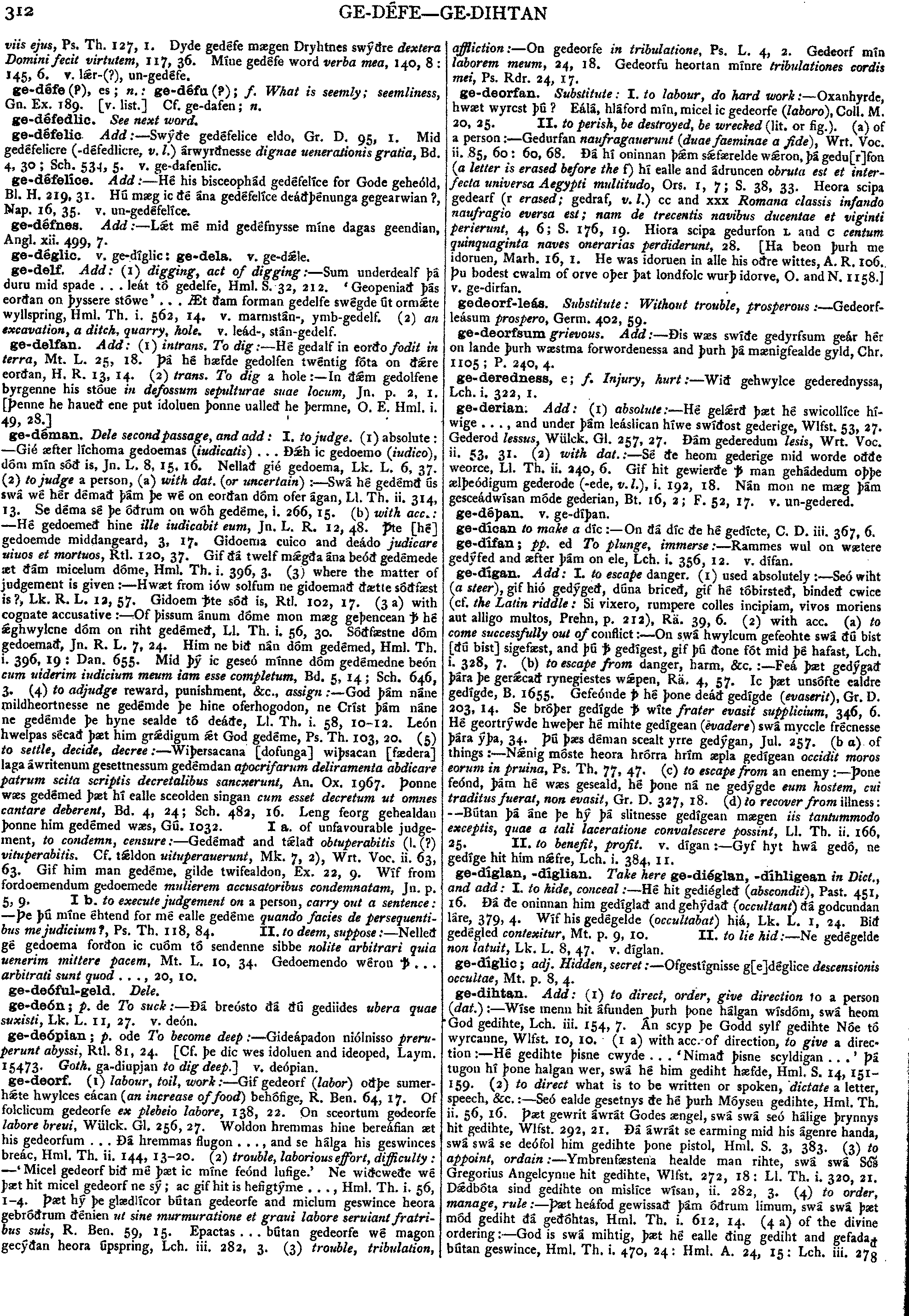
ge-dígan.
Add:
I.
to
escape
danger,
(i)
used
absolutely
:--
Seó
wiht
(a
steer),
gif
hió
gedýgeð,
dúna
briceð,
gif
hé
tóbirsteð,
bindeð
cwice
cf.
the
Latin
riddle:
Si
vixero,
rumpere
colles
incipiam,
vivos
moriens
aut
alligo
multos,
Prehn,
p.
212),
Ra.
39,
6.
(2)
with
acc.
(a)
to
come
successfully
out
of
conflict
:--
On
swá
hwylcum
gefeohte
swá
ðú
bist
[ðú
bist]
sigefæst,
and
þú
gedigest,
gif
þú
ðone
fót
mid
þé
hafast,
Lch.
i.
328,
7.
(b)
to
escape
from
danger,
harm,
&
c.
:--
Feá
þæt
gedýgað
þára
þe
geræcað
rynegiestes
wpen,
Rä.
4,
57.
Ic
þæt
unsófte
ealdre
gedígde,
B.
1655.
Gefeónde
hé
þone
deáð
gedígde
(evaserit),
Gr.
D.
203,
14.
Se
bróþer
gedígde
wíte
frater
evasit
supplicium,
346,
6.
Hé
geortrýwde
hweþer
hé
mihte
gedígean
(évadere)
swá
myccle
frécnesse
þára
ýþa,
34.
Þú
þæs
déman
scealt
yrre
gedýgan,
Jul.
257.
(b
 )
of
things
:--
Nnig
móste
heora
hrórra
hrím
æpla
gedígean
occidit
moros
eorum
in
pruina,
Ps.
Th.
77,
47.
(c)
to
escape
from
an
enemy
:--
Þone
feónd,
þám
hé
wæs
geseald,
hé
þone
ná
ne
gedýgde
eum
hostem,
cui
traditus
fuerat,
non
evasit,
Gr.
D.
327,
18.
(d)
to
recover
from
illness:
--
Bútan
þá
áne
þe
hý
þá
slitnesse
gedígean
mægen
iis
tantummodo
exceptis,
quae
a
tali
laceratione
convalescere
possint,
Ll.
Th.
ii.
166,
25.
II.
to
benefit,
profit,
v.
dígan
:--
Gyf
hyt
hwá
gedó,
ne
gedíge
hit
him
náfre,
Lch.
i.
384,
II.
)
of
things
:--
Nnig
móste
heora
hrórra
hrím
æpla
gedígean
occidit
moros
eorum
in
pruina,
Ps.
Th.
77,
47.
(c)
to
escape
from
an
enemy
:--
Þone
feónd,
þám
hé
wæs
geseald,
hé
þone
ná
ne
gedýgde
eum
hostem,
cui
traditus
fuerat,
non
evasit,
Gr.
D.
327,
18.
(d)
to
recover
from
illness:
--
Bútan
þá
áne
þe
hý
þá
slitnesse
gedígean
mægen
iis
tantummodo
exceptis,
quae
a
tali
laceratione
convalescere
possint,
Ll.
Th.
ii.
166,
25.
II.
to
benefit,
profit,
v.
dígan
:--
Gyf
hyt
hwá
gedó,
ne
gedíge
hit
him
náfre,
Lch.
i.
384,
II.
| Result Page: | 1 2 | Next |  |
Germanic Lexicon Project (main page)
This search system was written by
Sean Crist
Please consider
volunteering
to correct the data in these online dictionaries.
No rights reserved. Feel free to use these data in any way you please.