|
|

Tip: In the search results, you can click on any word or abbreviation for more information.
|
Source: Cleasby/Vigfusson, page b0067, entry 22 View original page image as: [TIFF] [PNG] [View previous entry] [View next entry] |
[Comment on this entry] [View comments] |
The following entry has been hand-corrected once. |
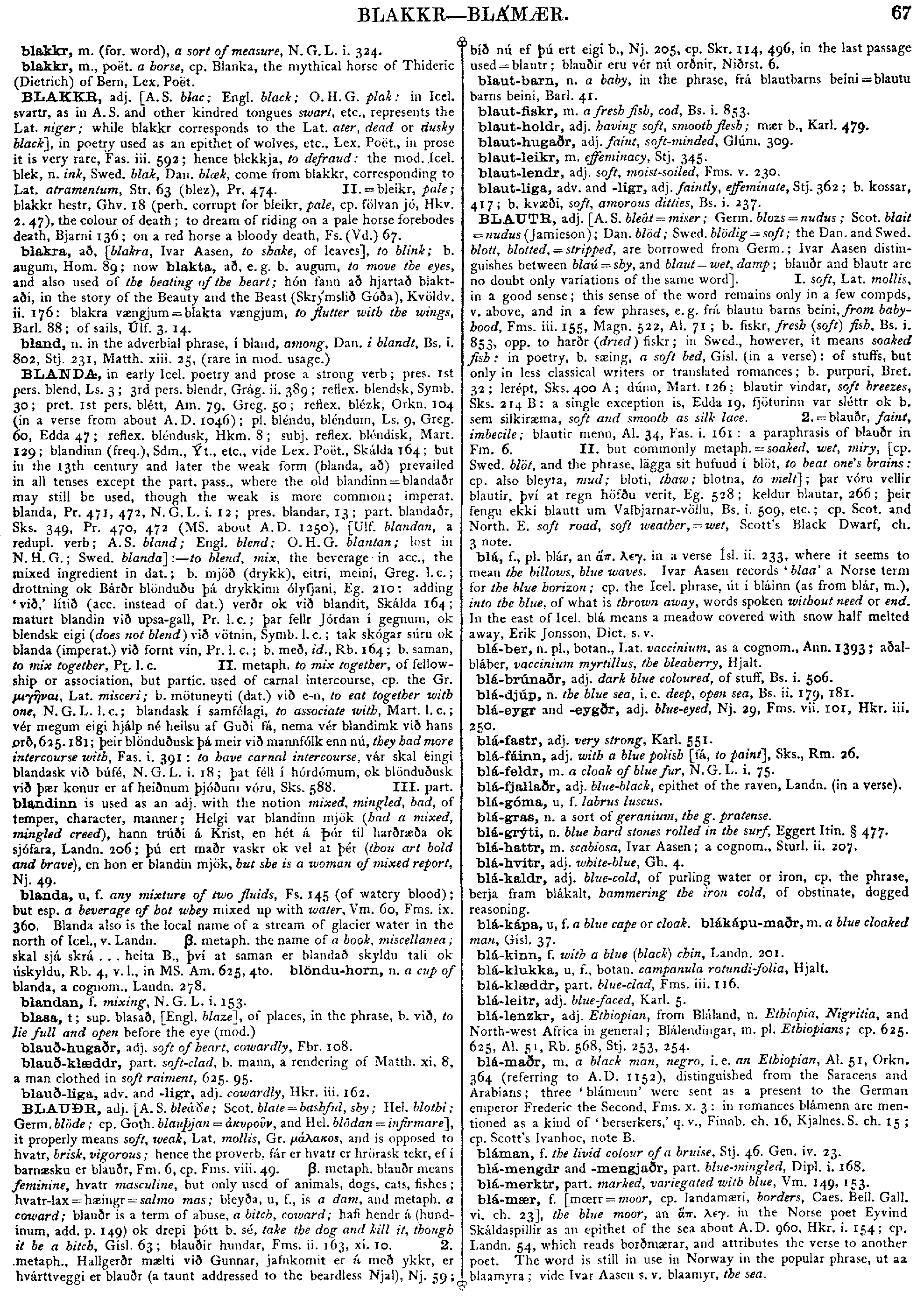
blá, f., pl. blár, an GREEK in a verse Ísl. ii. 233, where it seems to mean the billows, blue waves. Ivar Aasen records 'blaa' a Norse term for the blue horizon; cp. the Icel. phrase, út í bláinn (as from blár, m.), into the blue, of what is thrown away, words spoken without need or end. In the east of Icel. blá means a meadow covered with snow half melted away, Erik Jonsson, Dict. s.v.
|
Source: Cleasby/Vigfusson, page b0093, entry 28 View original page image as: [TIFF] [PNG] [View previous entry] [View next entry] |
[Comment on this entry] [View comments] |
The following entry has been hand-corrected once. |
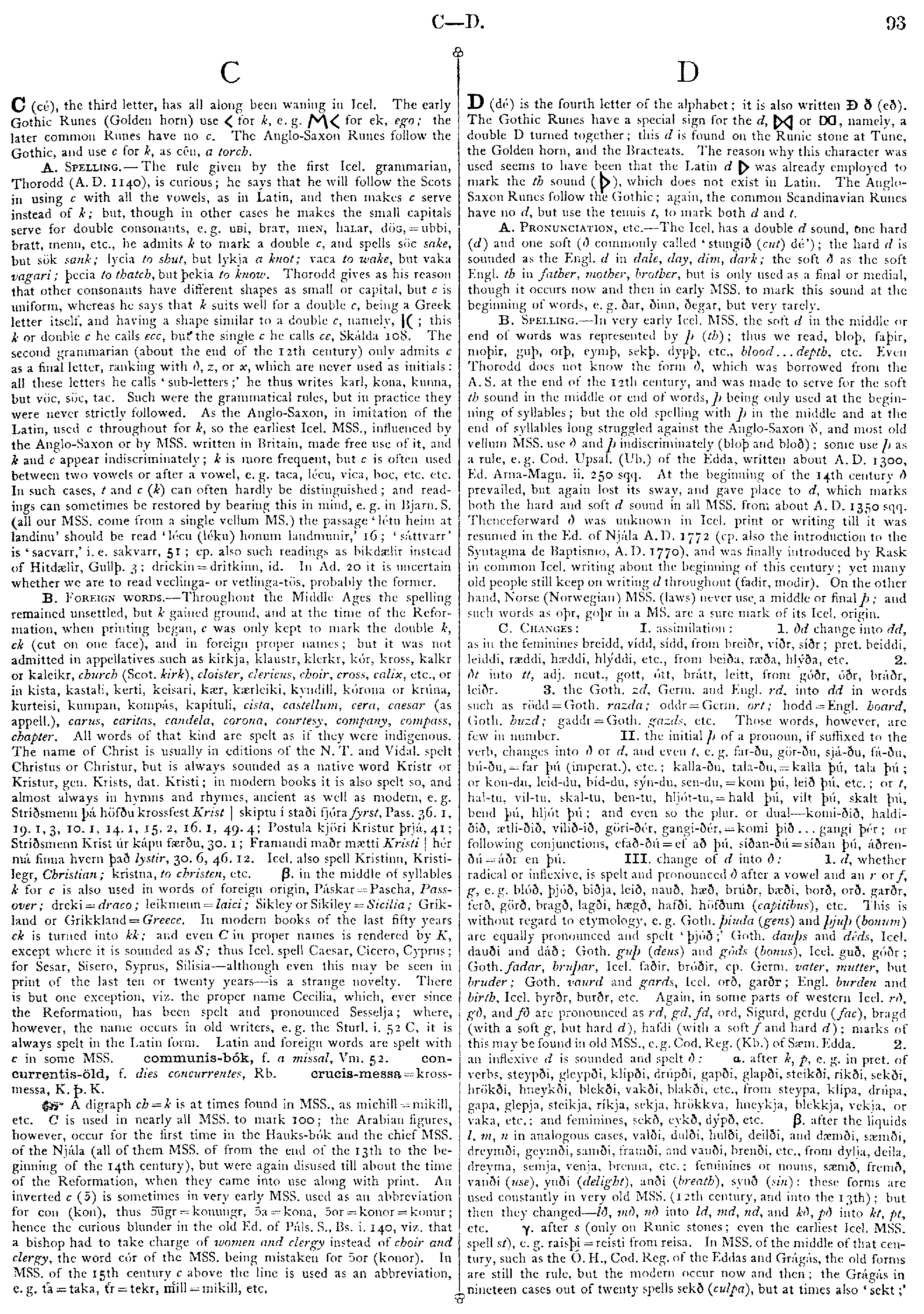
dag-mál, n. (vide dagr), prop. 'day-meal,' one of the divisions of the day, usually about 8 or 9 o'clock A. M.; the Lat. hora tertia is rendered by 'er vér köllum dagmál, 'which we call d., Hom. 142; cnn er ekki liðit af dagmálum, Hom. (St.) 10. Acts ii. 15; in Glúm. 342 we are told that the young Glum was very lazy, and lay in bed till day-meal every morning, cp. also 343; Hrafn. 28 and O.H.L. 18 -- á einum morni milli rismála ok dagmála -- where distinction is made between rismál (rising time) and dagmál, so as to make a separate dagsmark (q.v.) of each of them; and again, a distinction is made between 'midday' and dagmal, Ísl. ii. 334. The dagmal is thus midway between 'rising' and 'midday,' which accords well with the present use. The word is synonymous with dagverðarmál, breakfast-time, and denotes the hour when the ancient Icel. used to take their chief meal, opposed to náttmál, night-meal or supper-time, Fms. viii. 330; even the MSS. use dagmál and dagverðarmál indiscriminately; cp. also Sturl. iii. 4 C; Rb. 452 says that at full moon the ebb takes place 'at dagmálum.' To put the dagmál at 7.30 A.M., as Pál Vídalin does, seems neither to acccord with the present use nor the passage in Glum or the eccl. hora tertia, which was the nearest hour answering to the Icel, calculation of the day. In Fb. i. 539 it is said that the sun set at 'eykð' (i.e. half-past three o'clock), but rose at 'dagmál' which puts the dagmal at 8.30 A.M. COMPDS: dagmála- staðr, m. the place of d. in the horizon, Fb. I. dagmala-tið, f. morning terce, 625. 176.
|
Source: Cleasby/Vigfusson, page b0095, entry 1 View original page image as: [TIFF] [PNG] [View previous entry] [View next entry] |
[Comment on this entry] [View comments] |
The following entry has been hand-corrected once. |
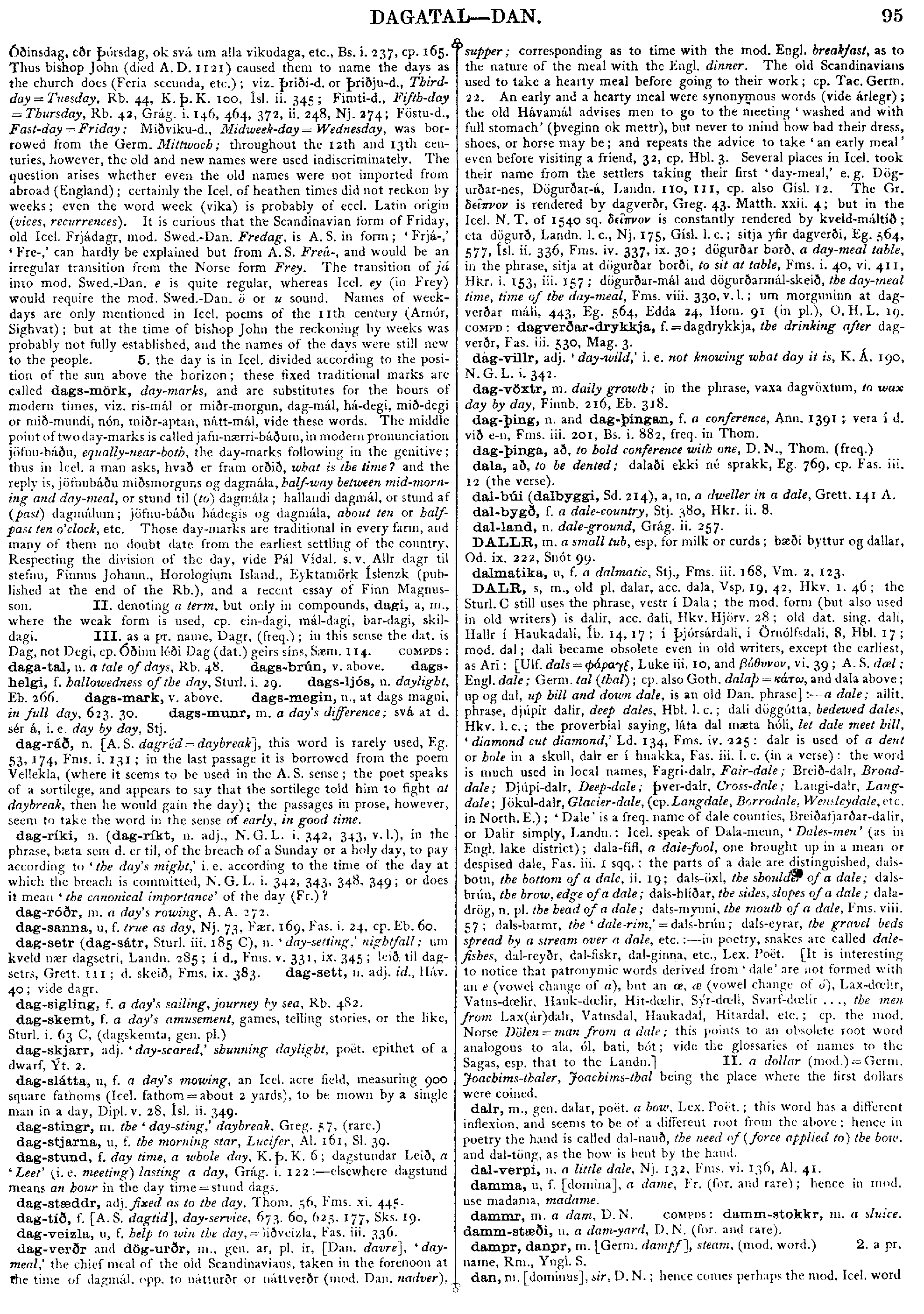
Óðinsdag, eðr Þórsdag, ok svá um alla vikudaga, etc., Bs. i. 237, cp. 165. Thus bishop John (died A.D. 1121) caused them to name the days as the church does (Feria sccunda, etc.); viz. Þriði-d. or Þriðju-d., Third-day = Tuesday, Rb. 44, K.Þ.K. 100, Ísl. ii. 345; Fimti-d., Fifth-day -- Thursday, Rb. 42, Grág. i. 146, 464, 372, ii. 248, Nj. 274; Föstu-d., Fast-day = Friday; Miðviku-d., Midweek-day = Wednesday, was borrowed from the Germ. Mittwoch; throughout the 12th and 13th centuries, however, the old and new names were used indiscriminately. The question arises whether even the old names were not imported from abroad (England); certainly the Icel. of heathen times did not reckon by weeks; even the word week (vika) is probably of eccl. Latin origin (vices, recurrences). It is curious that the Scandinavian form of Friday, old Icel. Frjádagr, mod. Swed.-Dan. Fredag, is A.S. in form; 'Frjá-,' 'Fre-,' can hardly be explained but from A.S. Freâ-, and would be an irregular transition from the Norse form Frey. The transition of ja into mod. Swed.-Dan. e is quite regular, whereas Icel. ey (in Frey) would require the mod. Swed.-Dan. ö or u sound. Names of weekdays are only mentioned in Icel. poems of the 11th century (Arnór, Sighvat); but at the time of bishop John the reckoning by weeks was probably not fully established, and the names of the days were still new to the people. 5. the day is in Icel. divided according to the posi- tion of the sun above the horizon; these fixed traditional marks are called dags-mörk, day-marks, and are substitutes for the hours of modern times, viz. ris-mál or miðr-morgun, dag-mál, há-degi, mið-degi or mið-mundi, nón, miðr-aptan, nátt-mál, vide these words. The middle point of two day-marks is called jafn-nærri-báðum, in modern pronunciation jöfnu-báðu, equally-near-both, the day-marks following in the genitive; thus in Icel. a man asks, hvað er fram orðið, what is the time? and the reply is, jöfnubáðu miðsmorguns og dagmála, half-way between mid-morn- ing and day-meal, or stund til (to) dagmála; hallandi dagmál, or stund af (past) dagmálum; jöfnu-báðu hádegis og dagmúla, about ten or half- past ten o'clock, etc. Those day-marks are traditional in every farm, and many of them no doubt date from the earliest settling of the country. Respecting the division of the day, vide Pál Vídal. s.v. Allr dagr til stefnu, Finnus Johann., Horologium Island., Eyktamörk Íslenzk (published at the end of the Rb.), and a recent essay of Finn Magnusson. II. denoting a term, but only in compounds, dagi, a, m., where the weak form is used, cp. ein-dagi, mál-dagi, bar-dagi, skil- dagi. III. jis a pr. name, Dagr, (freq.); in this sense the dat. is Dag, not Degi, cp. Óðinn léði Dag (dat.) geirs síns, Sæm. 114. COMPDS: daga-tal, n. a tale of days, Rb. 48. dags-brun, v. above. dags- helgi, f. hallowedness of the day, Sturl. i. 29. dags-ljós, n. daylight, Eb. 266. dags-mark, v. above. dags-megin, n., at dags magni, in full day, 623. 30. dags-munr, m. a day's difference; svá at d. sér á, i.e. day by day, Stj.
|
Source: Cleasby/Vigfusson, page b0191, entry 13 View original page image as: [TIFF] [PNG] [View previous entry] [View next entry] |
[Comment on this entry] [View comments] |
The following entry has been hand-corrected once. |
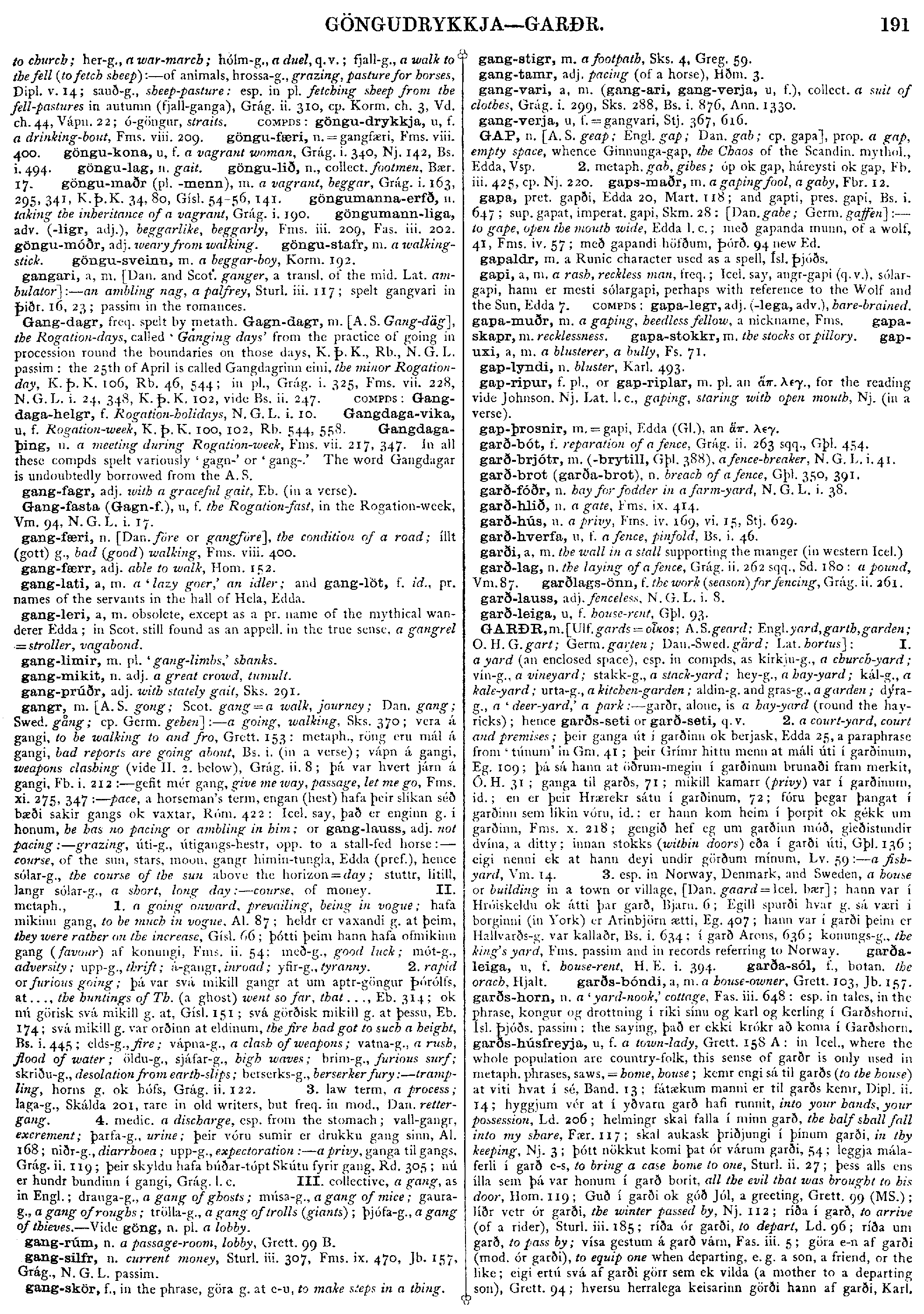
gangr, m. [A. S. gong; Scot. gang = a walk, journey; Dan. gang; Swed. gång; cp. Germ. gehen] :-- a going, walking, Sks. 370; vera á gangi, to be walking to and fro, Grett. 153: metaph., röng eru mál á gangi, bad reports are going about, Bs. i. (in a verse); vápn á gangi, weapons clashing (vide II. 2. below), Grág. ii. 8; þá var hvert járn á gangi, Fb. i. 212 :-- gefit mér gang, give me way, passage, let me go, Fms. xi. 275, 347 :-- pace, a horseman's term, engan (hest) hafa þeir slíkan séð bæði sakir gangs ok vaxtar, Róm. 422: Icel. say, það er enginn g. í honum, he has no pacing or ambling in him; or gang-lauss, adj. not pacing :-- grazing, úti-g., útigangs-hestr, opp. to a stall-fed horse :-- course, of the sun, stars, moon, gangr himin-tungla, Edda (pref.), hence sólar-g., the course of the sun above the horizon = day; stuttr, lítill, langr sólar-g., a short, long day :-- course, of money. II. metaph., 1. a going onward, prevailing, being in vogue; hafa mikinn gang, to be much in vogue, Al. 87; heldr er vaxandi g. at þeim, they were rather on the increase, Gísl. 66; þótti þeim hann hafa ofmikinn gang (favour) af konungi, Fms. ii. 54; með-g., good luck; mót-g., adversity; upp-g., thrift; á-gangr, inroad; yfir-g., tyranny. 2. rapid or furious going; þá var svá mikill gangr at um aptr-göngur Þórólfs, at ..., the huntings of Th. (a ghost) went so far, that ..., Eb. 314; ok nú görisk svá mikill g. at, Gísl. 151; svá görðisk mikill g. at þessu, Eb. 174; svá mikill g. var orðinn at eldinum, the fire had got to such a height, Bs. i. 445; elds-g., fire; vápna-g., a clash of weapons; vatna-g., a rush, flood of water; öldu-g., sjáfar-g., high waves; brim-g., furious surf; skriðu-g., desolation from earth-slips; berserks-g., berserker fury :-- trampling, horns g. ok hófs, Grág. ii. 122. 3. law term, a process; laga-g., Skálda 201, rare in old writers, but freq. in mod., Dan. rettergang. 4. medic. a discharge, esp. from the stomach; vall-gangr, excrement; þarfa-g., urine; þeir vóru sumir er drukku gang sinn, Al. 168; niðr-g., diarrhoea; upp-g., expectoration :-- a privy, ganga til gangs, Grág. ii. 119; þeir skyldu hafa búðar-tópt Skútu fyrir gang, Rd. 305; nú er hundr bundinn í gangi, Grág. l.c. III. collective, a gang, as in Engl.; drauga-g., a gang of ghosts; músa-g., a gang of mice; gaura-g., a gang of roughs; trolla-g., a gang of trolls (giants); þjófa-g., a gang of thieves. -- Vide göng, n. pl. a lobby.
|
Source: Cleasby/Vigfusson, page b0228, entry 1 View original page image as: [TIFF] [PNG] [View previous entry] [View next entry] |
[Comment on this entry] [View comments] |
The following entry has been hand-corrected once. |
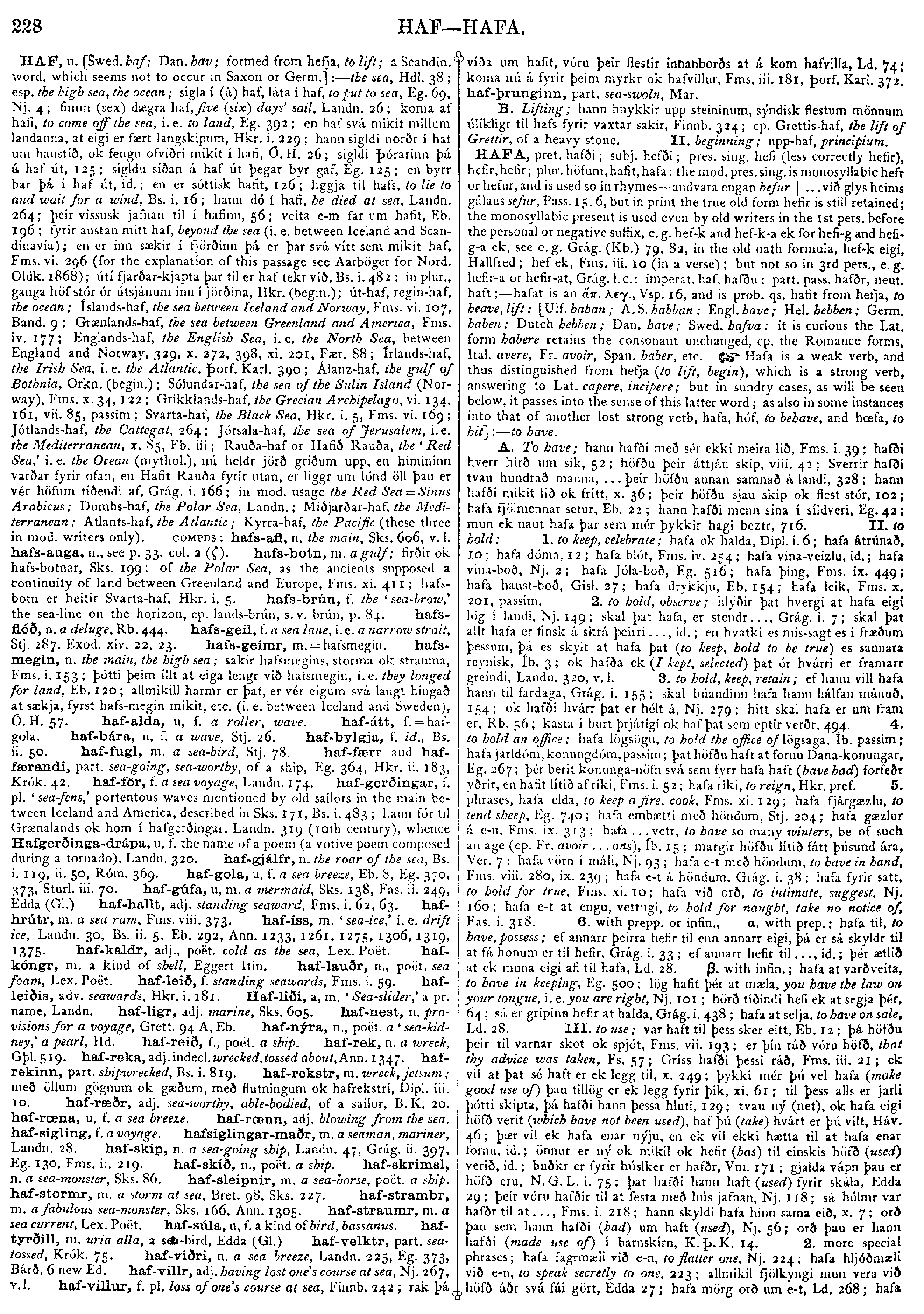
HAF,
n.
[Swed.
haf;
Dan.
hav;
formed
from
hefja,
to
lift;
a
Scandin.
word,
which
seems
not
to
occur
in
Saxon
or
Germ.]
:--
the
sea,
Hdl.
38;
esp.
the
high
sea,
the
ocean;
sigla
í
(á)
haf,
láta
í
haf,
to
put
to
sea,
Eg.
69,
Nj.
4;
fimm
(sex)
dægra
haf,
five
(six)
days'
sail,
Landn.
26;
koma
af
hafi,
to
come
off
the
sea,i.e.
to
land,
Eg.
392;
en
haf
svá
mikit
millum
landanna,
at
eigi
er
fært
langskipum,
Hkr.
i.
229;
harm
sigldi
norðr
í
haf
um
haustið,
ok
fengu
ofviðri
mikit
í
hafi,
Ó.
H.
26;
sigldi
Þórarinn
þá
á
haf
út,
125;
sigldu
síðan
á
haf
út
þegar
byr
gaf,
Eg.
125;
en
byrr
bar
þá
í
haf
út,
id.;
en
er
sóttisk
hafit,
126;
liggja
til
hafs,
to
lie
to
and
wait
for
a
wind,
Bs.
i.
16;
hann
dó
í
hafi,
he
died
at
sea,
Landn.
264;
þeir
vissusk
jafnan
til
í
hafinu,
56;
veita
e-m
far
um
hafit,
Eb.
196;
tyrir
austan
mitt
haf,
beyond
the
sea
(i.e.
between
Iceland
and
Scandinavia);
en
er
inn
sækir
í
fjörðinn
þá
er
þar
svá
vítt
sem
mikit
haf,
Fms.
vi.
296
(for
the
explanation
of
this
passage
see
Aarböger
for
Nord.
Oldk.
1868);
útí
fjarðar-kjapta
þar
til
er
haf
tekr
við,
Bs.
i.
482:
in
plur.,
ganga
höf
stór
ór
útsjánum
inn
í
jörðina,
Hkr.
(begin.);
út-haf,
regin-haf,
the
ocean;
Íslands-haf,
the
sea
between
Iceland
and
Norway,
Fms.
vi.
107,
Band.
9;
Grænlands-haf,
the
sea
between
Greenland
and
America,
Fms.
iv.
177;
Englands-haf,
the
English
Sea,
i.e.
the
North
Sea,
between
England
and
Norway,
329,
x.
272,
398,
xi.
201,
Fær.
88;
Írlands-haf,
the
Irish
Sea,
i.e.
the
Atlantic,
Þorf.
Karl.
390;
Álanz-haf,
the
gulf
of
Bothnia,
Orkn.
(begin.);
Sólundar-haf,
the
sea
of
the
Sulin
Island
(Norway),
Fms.
x.
34,
122;
Grikklands-haf,
the
Grecian
Archipelago,
vi.
134,
161,
vii.
85,
passim;
Svarta-haf,
the
Black
Sea,
Hkr.
i.
5,
Fms.
vi.
169;
Jótlands-haf,
the
Cattegat,
264;
Jórsala-haf,
the
sea
of
Jerusalem,
i.e.
the
Mediterranean,
x.
85,
Fb.
iii;
Rauða-haf
or
Hafið
Rauða,
the
'Red
Sea,'
i.e.
the
Ocean
(mythol.),
nú
heldr
jörð
griðum
upp,
en
himininn
varðar
fyrir
ofan,
en
Hafit
Rauða
fyrir
utan,
er
liggr
um
lönd
öll
þau
er
vér
höfum
tíðendi
af,
Grág.
i.
166;
in
mod.
usage
the
Red
Sea
=
Sinus
Arabicus;
Dumbs-haf,
the
Polar
Sea,
Landn.;
Miðjarðar-haf,
the
Mediterranean;
Atlants-haf,
the
Atlantic;
Kyrra-haf,
the
Pacific
(these
three
in
mod.
writers
only).
COMPDS:
hafs-afl,
n.
the
main,
Sks.
606,
v.l.
hafs-auga,
n.,
see
p.
33,
col.
2
( ).
hafs-botn,
m.
a
gulf;
firðir
ok
hafs-botnar,
Sks.
199:
of
the
Polar
Sea,
as
the
ancients
supposed
a
continuity
of
land
between
Greenland
and
Europe,
Fms.
xi.
411;
hafsbotn
er
heitir
Svarta-haf,
Hkr.
i.
5.
hafs-brún,
f.
the
'sea-brow,'
the
sea-line
on
the
horizon,
cp.
lands-brún,
s.
v.
brún,
p.
84.
hafs-flóð,
n.
a
deluge,
Rb.
444.
hafs-geil,
f.
a
sea
lane,
i.e.
a
narrow
strait,
Stj.
287.
Exod.
xiv.
22,
23.
hafs-geimr,
m.
=
hafsmegin.
hafs-megin,
n.
the
main,
the
high
sea;
sakir
hafsmegins,
storma
ok
strauma,
Fms.
i.
153;
þótti
þeim
íllt
at
eiga
lengr
við
hafsmegin,
i.e.
they
longed
for
land,
Eb.
120;
allmikill
harmr
er
þat,
er
vér
eigum
svá
langt
hingað
at
sækja,
fyrst
hafs-megin
mikit,
etc.
(i.e.
between
Iceland
and
Sweden),
Ó.
H.
57.
haf-alda,
u,
f.
a
roller,
wave.
haf-att,
f.
=
hafgola.
haf-bára,
u,
f.
a
wave,
Stj.
26.
haf-bylgja,
f.
id.,
Bs.
ii.
50.
haf-fugl,
m.
a
sea-bird,
Stj.
78.
haf-færr
and
haf-færandi,
part.
sea-going,
sea-worthy,
of
a
ship,
Eg.
364,
Hkr.
ii.
183,
Krók.
42.
haf-för,
f.
a
sea
voyage,
Landn.
174.
haf-gerðingar,
f.
pl.
'sea-fens,'
portentous
waves
mentioned
by
old
sailors
in
the
main
between
Iceland
and
America,
described
in
Sks.
171,
Bs.
i.
483;
hann
fór
til
Grænalands
ok
hom
í
hafgerðingar,
Landn.
319
(10th
century),
whence
Hafgerðinga-drápa,
u,
f.
the
name
of
a
poem
(a
votive
poem
composed
during
a
tornado),
Landn.
320.
haf-gjálfr,
n.
the
roar
of
the
sea,
Bs.
i.
119,
ii.
50,
Róm.
369.
haf-gola,
u,
f.
a
sea
breeze,
Eb.
8,
Eg.
370,
373,
Sturl.
iii.
70.
haf-gúfa,
u,
m.
a
mermaid,
Sks.
138,
Fas.
ii.
249,
Edda
(Gl.)
haf-hallt,
adj.
standing
seaward,
Fms.
i.
62,
63.
haf-hrútr,
m.
a
sea
ram,
Fms.
viii.
373.
haf-íss,
m.
'sea-ice,'
i.e.
drift
ice,
Landn.
30,
Bs.
ii.
5,
Eb.
292,
Ann.
1233,
1261,
1275,
1306,
1319,
1375.
haf-kaldr,
adj.,
poët.
cold
as
the
sea,
Lex.
Poët.
haf-kóngr,
m.
a
kind
of
shell,
Eggert
Itin.
haf-lauðr,
n.,
poët.
sea
foam,
Lex.
Poët.
haf-leið,
f.
standing
seawards,
Fms.
i.
59.
haf-leiðis,
adv.
seawards,
Hkr.
i.
181.
Haf-liði,
a,
m.
'Sea-slider,'
a
pr.
name,
Landn.
haf-ligr,
adj.
marine,
Sks.
605.
haf-nest,
n.
provisions
for
a
voyage,
Grett.
94
A,
Eb.
haf-nýra,
n.,
poët.
a
'sea-kidney,'
a
pearl,
Hd.
haf-reið,
f.,
poët.
a
ship.
haf-rek,
n.
a
wreck,
Gþl.
519.
haf-reka,
adj.
indecl.
wrecked,
tossed
about,
Ann.
1347.
haf-rekinn,
part.
shipwrecked,
Bs.
i.
819.
haf-rekstr,
m.
wreck,
jetsum;
með
öllum
gögnum
ok
gæðum,
með
flutningum
ok
hafrekstri,
Dipl.
iii.
10.
haf-ræðr,
adj.
sea-worthy,
able-bodied,
of
a
sailor,
B.
K.
20.
haf-rœna,
u,
f.
a
sea
breeze.
haf-rœnn,
adj.
blowing
from
the
sea.
haf-sigling,
f.
a
voyage.
hafsiglingar-maðr,
m.
a
seaman,
mariner,
Landn.
28.
haf-skip,
n.
a
sea-going
ship,
Landn.
47,
Grág.
ii.
397,
Eg.
130,
Fms.
ii.
219.
haf-skíð,
n.,
poët.
a
ship.
haf-skrimsl,
n.
a
sea-monster,
Sks.
86.
haf-sleipnir,
m.
a
sea-horse,
poët.
a
ship.
haf-stormr,
m.
a
storm
at
sea,
Bret.
98,
Sks.
227.
haf-strambr,
m.
a
fabulous
sea-monster,
Sks.
166,
Ann.
1305.
haf-straumr,
m.
a
sea
current,
Lex.
Poët.
haf-súla,
u,
f.
a
kind
of
bird,
bassanus.
haf-tyrðill,
m.
uria
alla,
a
sea-bird,
Edda
(Gl.)
haf-velktr,
part.
sea-tossed,
Krók.
75.
haf-viðri,
n.
a
sea
breeze,
Landn.
225,
Eg.
373,
Bárð.
6
new
Ed.
haf-villr,
adj.
having
lost
one's
course
at
sea,
Nj.
267,
v.l.
haf-villur,
f.
pl.
loss
of
one's
course
at
sea,
Finnb.
242;
rak
þá
víða
um
hafit,
vóru
þeir
flestir
innanborðs
at
á
kom
hafvilla,
Ld.
74;
koma
nú
á
fyrir
þeim
myrkr
ok
hafvillur,
Fms.
iii.
181,
Þorf.
Karl.
372.
haf-þrunginn,
part.
sea-swoln,
Mar.
).
hafs-botn,
m.
a
gulf;
firðir
ok
hafs-botnar,
Sks.
199:
of
the
Polar
Sea,
as
the
ancients
supposed
a
continuity
of
land
between
Greenland
and
Europe,
Fms.
xi.
411;
hafsbotn
er
heitir
Svarta-haf,
Hkr.
i.
5.
hafs-brún,
f.
the
'sea-brow,'
the
sea-line
on
the
horizon,
cp.
lands-brún,
s.
v.
brún,
p.
84.
hafs-flóð,
n.
a
deluge,
Rb.
444.
hafs-geil,
f.
a
sea
lane,
i.e.
a
narrow
strait,
Stj.
287.
Exod.
xiv.
22,
23.
hafs-geimr,
m.
=
hafsmegin.
hafs-megin,
n.
the
main,
the
high
sea;
sakir
hafsmegins,
storma
ok
strauma,
Fms.
i.
153;
þótti
þeim
íllt
at
eiga
lengr
við
hafsmegin,
i.e.
they
longed
for
land,
Eb.
120;
allmikill
harmr
er
þat,
er
vér
eigum
svá
langt
hingað
at
sækja,
fyrst
hafs-megin
mikit,
etc.
(i.e.
between
Iceland
and
Sweden),
Ó.
H.
57.
haf-alda,
u,
f.
a
roller,
wave.
haf-att,
f.
=
hafgola.
haf-bára,
u,
f.
a
wave,
Stj.
26.
haf-bylgja,
f.
id.,
Bs.
ii.
50.
haf-fugl,
m.
a
sea-bird,
Stj.
78.
haf-færr
and
haf-færandi,
part.
sea-going,
sea-worthy,
of
a
ship,
Eg.
364,
Hkr.
ii.
183,
Krók.
42.
haf-för,
f.
a
sea
voyage,
Landn.
174.
haf-gerðingar,
f.
pl.
'sea-fens,'
portentous
waves
mentioned
by
old
sailors
in
the
main
between
Iceland
and
America,
described
in
Sks.
171,
Bs.
i.
483;
hann
fór
til
Grænalands
ok
hom
í
hafgerðingar,
Landn.
319
(10th
century),
whence
Hafgerðinga-drápa,
u,
f.
the
name
of
a
poem
(a
votive
poem
composed
during
a
tornado),
Landn.
320.
haf-gjálfr,
n.
the
roar
of
the
sea,
Bs.
i.
119,
ii.
50,
Róm.
369.
haf-gola,
u,
f.
a
sea
breeze,
Eb.
8,
Eg.
370,
373,
Sturl.
iii.
70.
haf-gúfa,
u,
m.
a
mermaid,
Sks.
138,
Fas.
ii.
249,
Edda
(Gl.)
haf-hallt,
adj.
standing
seaward,
Fms.
i.
62,
63.
haf-hrútr,
m.
a
sea
ram,
Fms.
viii.
373.
haf-íss,
m.
'sea-ice,'
i.e.
drift
ice,
Landn.
30,
Bs.
ii.
5,
Eb.
292,
Ann.
1233,
1261,
1275,
1306,
1319,
1375.
haf-kaldr,
adj.,
poët.
cold
as
the
sea,
Lex.
Poët.
haf-kóngr,
m.
a
kind
of
shell,
Eggert
Itin.
haf-lauðr,
n.,
poët.
sea
foam,
Lex.
Poët.
haf-leið,
f.
standing
seawards,
Fms.
i.
59.
haf-leiðis,
adv.
seawards,
Hkr.
i.
181.
Haf-liði,
a,
m.
'Sea-slider,'
a
pr.
name,
Landn.
haf-ligr,
adj.
marine,
Sks.
605.
haf-nest,
n.
provisions
for
a
voyage,
Grett.
94
A,
Eb.
haf-nýra,
n.,
poët.
a
'sea-kidney,'
a
pearl,
Hd.
haf-reið,
f.,
poët.
a
ship.
haf-rek,
n.
a
wreck,
Gþl.
519.
haf-reka,
adj.
indecl.
wrecked,
tossed
about,
Ann.
1347.
haf-rekinn,
part.
shipwrecked,
Bs.
i.
819.
haf-rekstr,
m.
wreck,
jetsum;
með
öllum
gögnum
ok
gæðum,
með
flutningum
ok
hafrekstri,
Dipl.
iii.
10.
haf-ræðr,
adj.
sea-worthy,
able-bodied,
of
a
sailor,
B.
K.
20.
haf-rœna,
u,
f.
a
sea
breeze.
haf-rœnn,
adj.
blowing
from
the
sea.
haf-sigling,
f.
a
voyage.
hafsiglingar-maðr,
m.
a
seaman,
mariner,
Landn.
28.
haf-skip,
n.
a
sea-going
ship,
Landn.
47,
Grág.
ii.
397,
Eg.
130,
Fms.
ii.
219.
haf-skíð,
n.,
poët.
a
ship.
haf-skrimsl,
n.
a
sea-monster,
Sks.
86.
haf-sleipnir,
m.
a
sea-horse,
poët.
a
ship.
haf-stormr,
m.
a
storm
at
sea,
Bret.
98,
Sks.
227.
haf-strambr,
m.
a
fabulous
sea-monster,
Sks.
166,
Ann.
1305.
haf-straumr,
m.
a
sea
current,
Lex.
Poët.
haf-súla,
u,
f.
a
kind
of
bird,
bassanus.
haf-tyrðill,
m.
uria
alla,
a
sea-bird,
Edda
(Gl.)
haf-velktr,
part.
sea-tossed,
Krók.
75.
haf-viðri,
n.
a
sea
breeze,
Landn.
225,
Eg.
373,
Bárð.
6
new
Ed.
haf-villr,
adj.
having
lost
one's
course
at
sea,
Nj.
267,
v.l.
haf-villur,
f.
pl.
loss
of
one's
course
at
sea,
Finnb.
242;
rak
þá
víða
um
hafit,
vóru
þeir
flestir
innanborðs
at
á
kom
hafvilla,
Ld.
74;
koma
nú
á
fyrir
þeim
myrkr
ok
hafvillur,
Fms.
iii.
181,
Þorf.
Karl.
372.
haf-þrunginn,
part.
sea-swoln,
Mar.
|
Source: Cleasby/Vigfusson, page b0235, entry 1 View original page image as: [TIFF] [PNG] [View previous entry] [View next entry] |
[Comment on this entry] [View comments] |
The following entry has been hand-corrected once. |
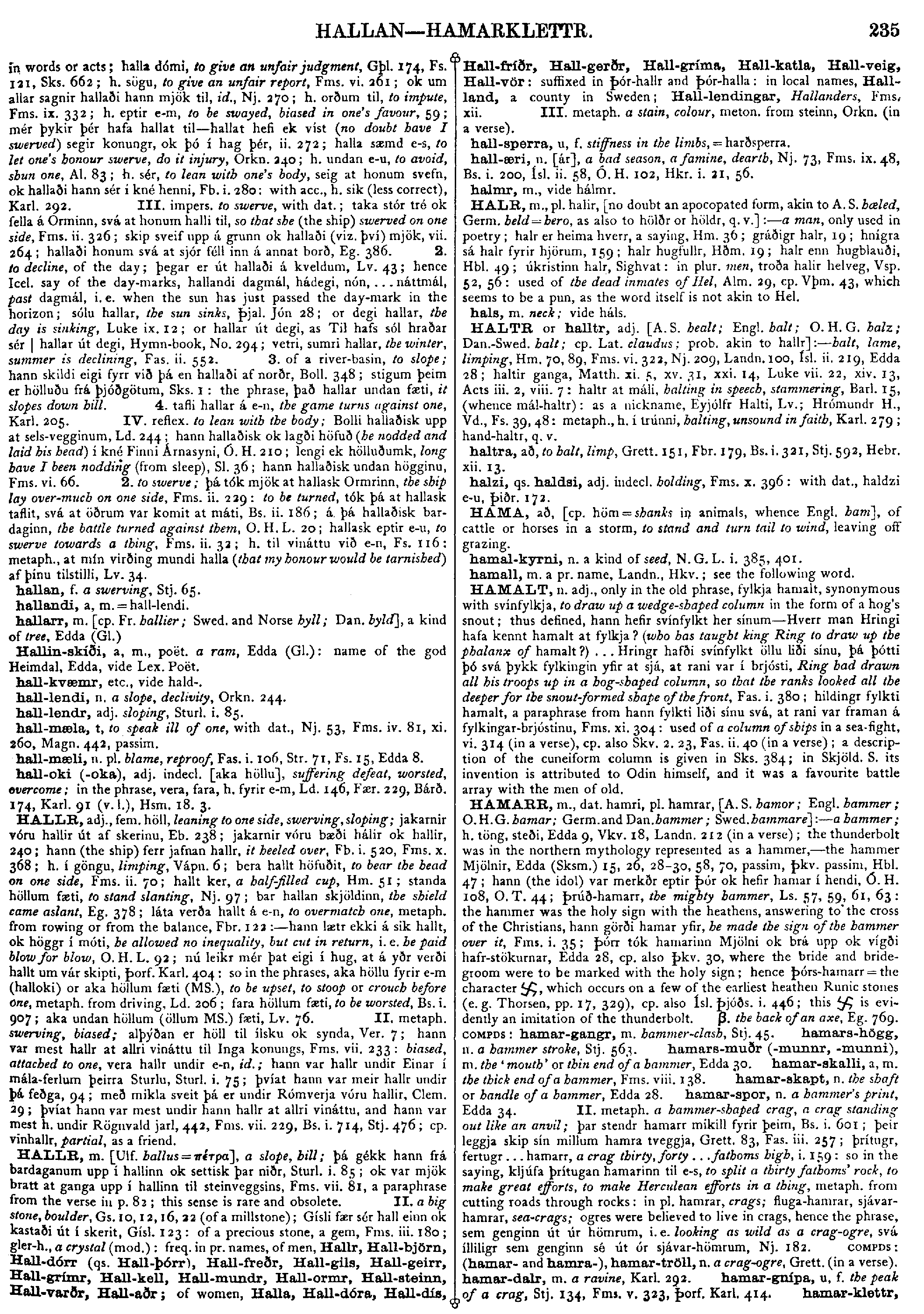
in words or acts; halla dómi, to give an unfair judgment, Gþl. 174, Fs. 121, Sks. 662; h. sögu, to give an unfair report, Fms. vi. 261; ok um allar sagnir hallaði hann mjök til, id., Nj. 270; h. orðum til, to impute, Fms. ix. 332; h. eptir e-m, to be swayed, biased in one's favour, 59; mér þykir þér hafa hallat til -- hallat hefi ek víst (no doubt have I swerved) segir konungr, ok þó í hag þér, ii. 272; halla sæmd e-s, to let one's honour swerve, do it injury, Orkn. 240; h. undan e-u, to avoid, shun one, Al. 83; h. sér, to lean with one's body, seig at honum svefn, ok hallaði hann sér í kné henni, Fb. i. 280: with acc., h. sik (less correct), Karl. 292. III. impers. to swerve, with dat.; taka stór tré ok fella á Orminn, svá at honum halli til, so that she (the ship) swerved on one side, Fms. ii. 326; skip sveif upp á grunn ok hallaði (viz. því) mjök, vii. 264; hallaði honum svá at sjór féll inn á annat borð, Eg. 386. 2. to decline, of the day; þegar er út hallaði á kveldum, Lv. 43; hence Icel. say of the day-marks, hallandi dagmál, hádegi, nón, ... náttmál, past dagmál, i.e. when the sun has just passed the day-mark in the horizon; sólu hallar, the sun sinks, Þjal. Jón 28; or degi hallar, the day is sinking, Luke ix. 12; or hallar út degi, as Til hafs sól hraðar sér | hallar út degi, Hymn-book, No. 294; vetri, sumri hallar, the winter, summer is declining, Fas. ii. 552. 3. of a river-basin, to slope; hann skildi eigi fyrr við þá en hallaði af norðr, Boll. 348; stigum þeim er hölluðu frá þjóðgötum, Sks. 1: the phrase, það hallar undan fæti, it slopes down hill. 4. tafli hallar á e-n, the game turns against one, Karl. 205. IV. reflex. to lean with the body; Bolli hallaðisk upp at sels-vegginum, Ld. 244; hann hallaðisk ok lagði höfuð (he nodded and laid his head) í kné Finni Árnasyni, Ó. H. 210; lengi ek hölluðumk, long have I been nodding (from sleep), Sl. 36; hann hallaðisk undan högginu, Fms. vi. 66. 2. to swerve; þá tók mjök at hallask Ormrinn, the ship lay over-much on one side, Fms. ii. 229: to be turned, tók þá at hallask taflit, svá at öðrum var komit at máti, Bs. ii. 186; á þá hallaðisk bardaginn, the battle turned against them, O. H. L. 20; hallask eptir e-u, to swerve towards a thing, Fms. ii. 32; h. til vináttu við e-n, Fs. 116: metaph., at mín virðing mundi halla (that my honour would be tarnished) af þínu tilstilli, Lv. 34.
|
Source: Cleasby/Vigfusson, page b0244, entry 26 View original page image as: [TIFF] [PNG] [View previous entry] [View next entry] |
[Comment on this entry] [View comments] |
The following entry has been hand-corrected once. |
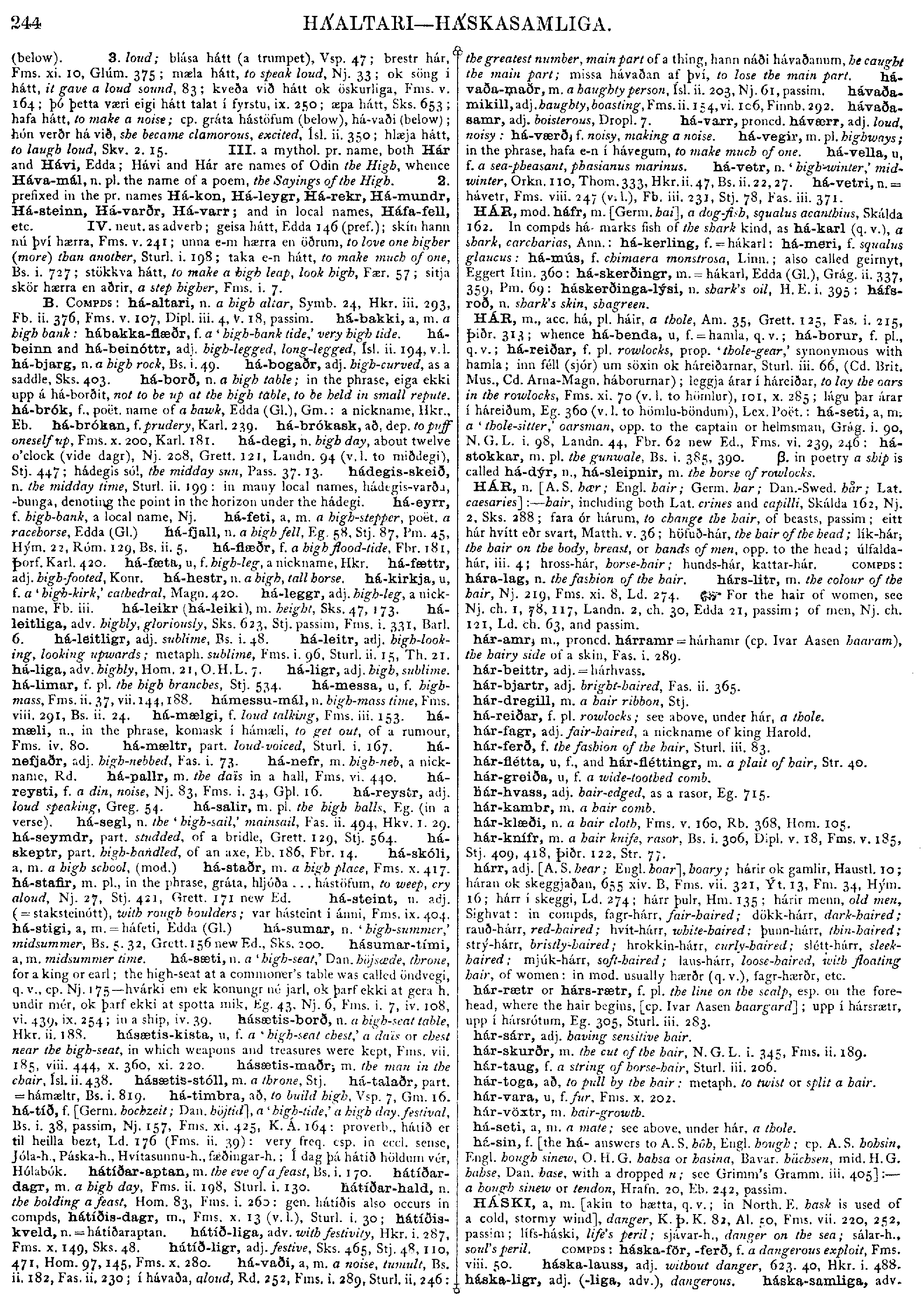
-bunga, denoting the point in the horizon under the hádegi. há-eyrr,
|
Source: Cleasby/Vigfusson, page b0296, entry 9 View original page image as: [TIFF] [PNG] [View previous entry] [View next entry] |
[Comment on this entry] [View comments] |
The following entry has been hand-corrected once. |
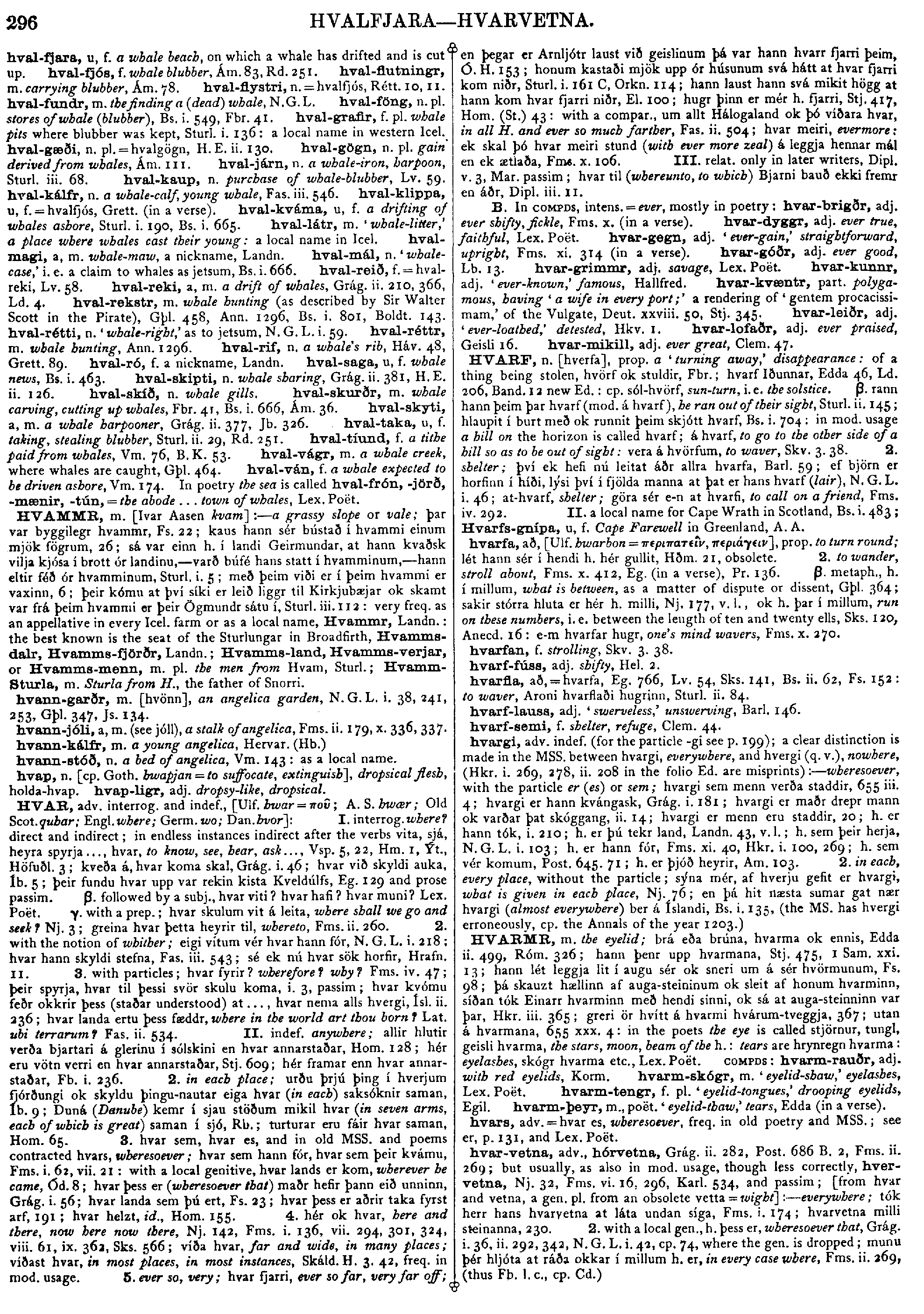
HVARF,
n.
[hverfa],
prop,
a
'turning
away,'
disappearance:
of
a
thing
being
stolen,
hvörf
ok
stuldir,
Fbr.;
hvarf
Iðunnar,
Edda
46,
Ld.
206,
Band.
12
new
Ed.:
cp.
sól-hvörf,
sun-turn,
i.
e.
the
solstice.
 rann
hann
þeim
þar
hvarf
(mod.
á
hvarf),
he
ran
out
of
their
sight,
Sturl.
ii.
145;
hlaupit
í
burt
með
ok
runnit
þeim
skjótt
hvarf,
Bs.
i.
704:
in
mod.
usage
a
hill
on
the
horizon
is
called
hvarf;
á
hvarf,
to
go
to
the
other
side
of
a
hill
so
as
to
be
out
of
sight:
vera
á
hvörfum,
to
waver,
Skv.
3.
38.
2.
shelter;
því
ek
hefi
nú
leitat
áðr
allra
hvarfa,
Barl.
59;
ef
björn
er
horfinn
í
híði,
lýsi
því
í
fjölda
manna
at
þat
er
hans
hvarf
(lair),
N.
G.
L.
i.
46;
at-hvarf,
shelter;
göra
sér
e-n
at
hvarfi,
to
call
on
a
friend,
Fms.
iv.
292.
II.
a
local
name
for
Cape
Wrath
in
Scotland,
Bs.
i.
483;
Hvarfs-gnipa,
u,
f.
Cape
Farewell
in
Greenland,
A.
A.
rann
hann
þeim
þar
hvarf
(mod.
á
hvarf),
he
ran
out
of
their
sight,
Sturl.
ii.
145;
hlaupit
í
burt
með
ok
runnit
þeim
skjótt
hvarf,
Bs.
i.
704:
in
mod.
usage
a
hill
on
the
horizon
is
called
hvarf;
á
hvarf,
to
go
to
the
other
side
of
a
hill
so
as
to
be
out
of
sight:
vera
á
hvörfum,
to
waver,
Skv.
3.
38.
2.
shelter;
því
ek
hefi
nú
leitat
áðr
allra
hvarfa,
Barl.
59;
ef
björn
er
horfinn
í
híði,
lýsi
því
í
fjölda
manna
at
þat
er
hans
hvarf
(lair),
N.
G.
L.
i.
46;
at-hvarf,
shelter;
göra
sér
e-n
at
hvarfi,
to
call
on
a
friend,
Fms.
iv.
292.
II.
a
local
name
for
Cape
Wrath
in
Scotland,
Bs.
i.
483;
Hvarfs-gnipa,
u,
f.
Cape
Farewell
in
Greenland,
A.
A.
|
Source: Cleasby/Vigfusson, page b0320, entry 9 View original page image as: [TIFF] [PNG] [View previous entry] [View next entry] |
[Comment on this entry] [View comments] |
The following entry has been hand-corrected once. |
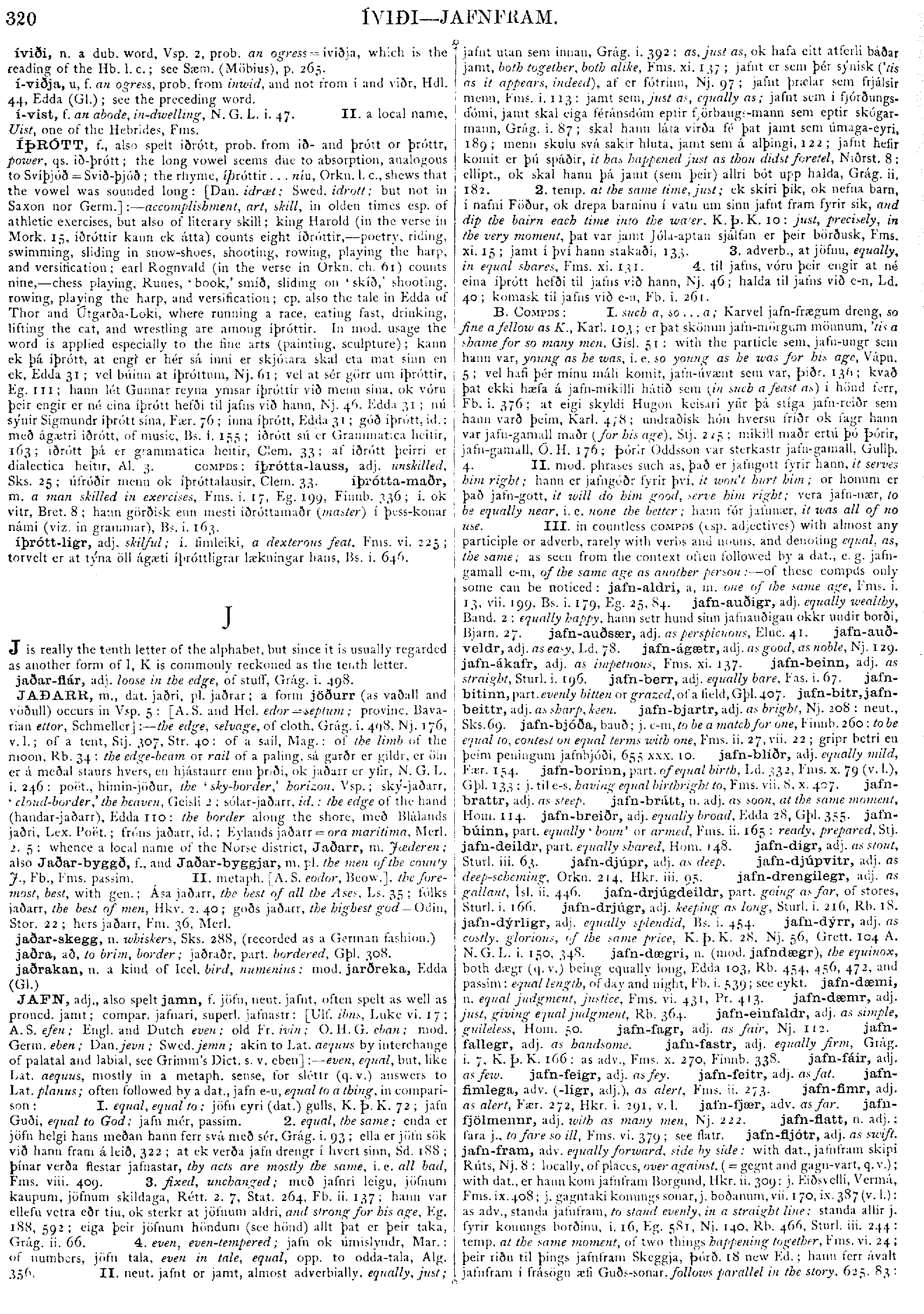
JAÐARR, m., dat. jaðri, pl. jaðrar; a form jöðurr (as vaðall and vöðull) occurs in Vsp. 5: [A. S. and Hel. edor = septum; provinc. Bavarian ettor, Schmeller] :-- the edge, selvage, of cloth, Grág. i. 408, Nj. 176, v.l.; of a tent, Stj. 307, Str. 40: of a sail, Mag.: of the limb of the moon, Rb. 34: the edge-beam or rail of a paling, sá garðr er gildr, er öln er á meðal staurs hvers, en hjástaurr enn þriði, ok jaðarr er yfir, N. G. L. i. 246: poët., himin-jöður, the 'sky-border,' horizon, Vsp.; ský-jaðarr, 'cloud-border,' the heaven, Geisli 2; sólar-jaðarr, id.: the edge of the hand (handar-jaðarr), Edda 110: the border along the shore, með Blálands jaðri, Lex. Poët.; fróns jaðarr, id.; Eylands jaðarr = ora maritima, Merl. 2. 5: whence a local name of the Norse district, Jaðarr, m. Jæderen; also Jaðar-byggð, f., and Jaðar-byggjar, m. pl. the men of the country J., Fb., Fms. passim. II. metaph. [A. S. eodor, Beow.], the foremost, best, with gen.; Ása jaðarr, the best of all the Ases, Ls. 35: fólks jaðarr, the best of men, Hkv. 2. 40; goðs jaðarr, the highest god -- Odin, Stor. 22; hers jaðarr, Fm. 36, Merl.
|
Source: Cleasby/Vigfusson, page b0376, entry 34 View original page image as: [TIFF] [PNG] [View previous entry] [View next entry] |
[Comment on this entry] [View comments] |
The following entry has not been hand-corrected. However, the page is reserved and someone is correcting it. |
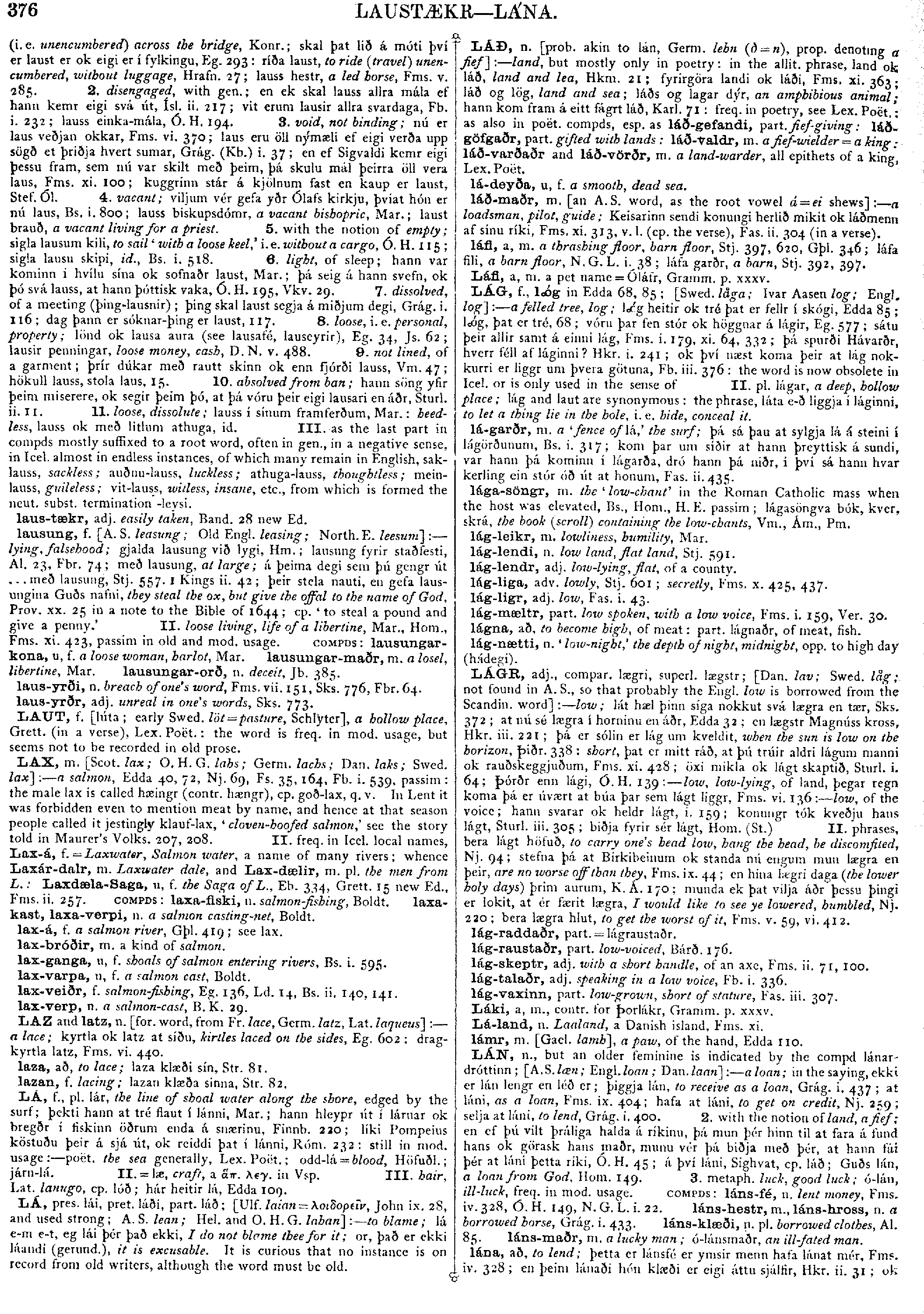
LÁGR, adj., compar. lægri, superl. lægstr; [Dan. lav; Swed. l og; not found in A. S., so that probably the Engl. low is borrowed from the Scandin. word] :-- low; lát hæl þinn síga nokkut svá lægra en tær, Sks. 372; at nti sé lægra í hornínu en áðr, Edda 32; cn lægstr Magnúss kross, Hkr. iii. 221; þá er sólin er lag um kveldit, when the sun is low on the horizon, þiðr. 338: s h or t, þat er mitt ráð, at þú trúir aldri lágum manni ok rauðskeggjuðum, F'ms. xi. 428; öxi mikla ok lágt skaptið, Sturl. i. 64; jjórðr enn lági, Ó. H. 139 :-- low, low-lying, of land, þegar regn koma þá er úvært at biia þar sem lágt liggr, Fms. vi. 136 :-- low, of the voice; hann svarar ok heldr lágt, i. 159; konnngr tók kveðju hans lágt, Sturl. iii. 305; biðja fyrir sér lágt, Hom. (St.) II. phrases, bera lágt höfuð, t o c a rry o ne's head low, hang the head, be discomfited, Nj. 94; stefna þá at Birkibeinum ok standa nu en gum mun laegra en þeir, are noworse off than they, Fms. ix. 44; en hina lægri daga (the lower holy days) þrim aurum, K. Á. 170; munda ek þat vilja áðr þessu þingi er lokit, at ér færit lægra, I would like to see ye lowered, humbled, Nj. 220; bera lægra hlut, t o ^ et the worst of it. Fms. v. 59, vi. 412.
| Result Page: |  |
Previous | 1 2 3 | Next |  |
Germanic Lexicon Project (main page)
This search system was written by
Sean Crist
Please consider
volunteering
to correct the data in these online dictionaries.
No rights reserved. Feel free to use these data in any way you please.