|
|

Search for hold again, using less strict matching (404 results)
|
Source: Cleasby/Vigfusson, page b0034, entry 66 View original page image as: [TIFF] [PNG] [View previous entry] [View next entry] |
[Comment on this entry] [View comments] |
The following entry has been hand-corrected once. |
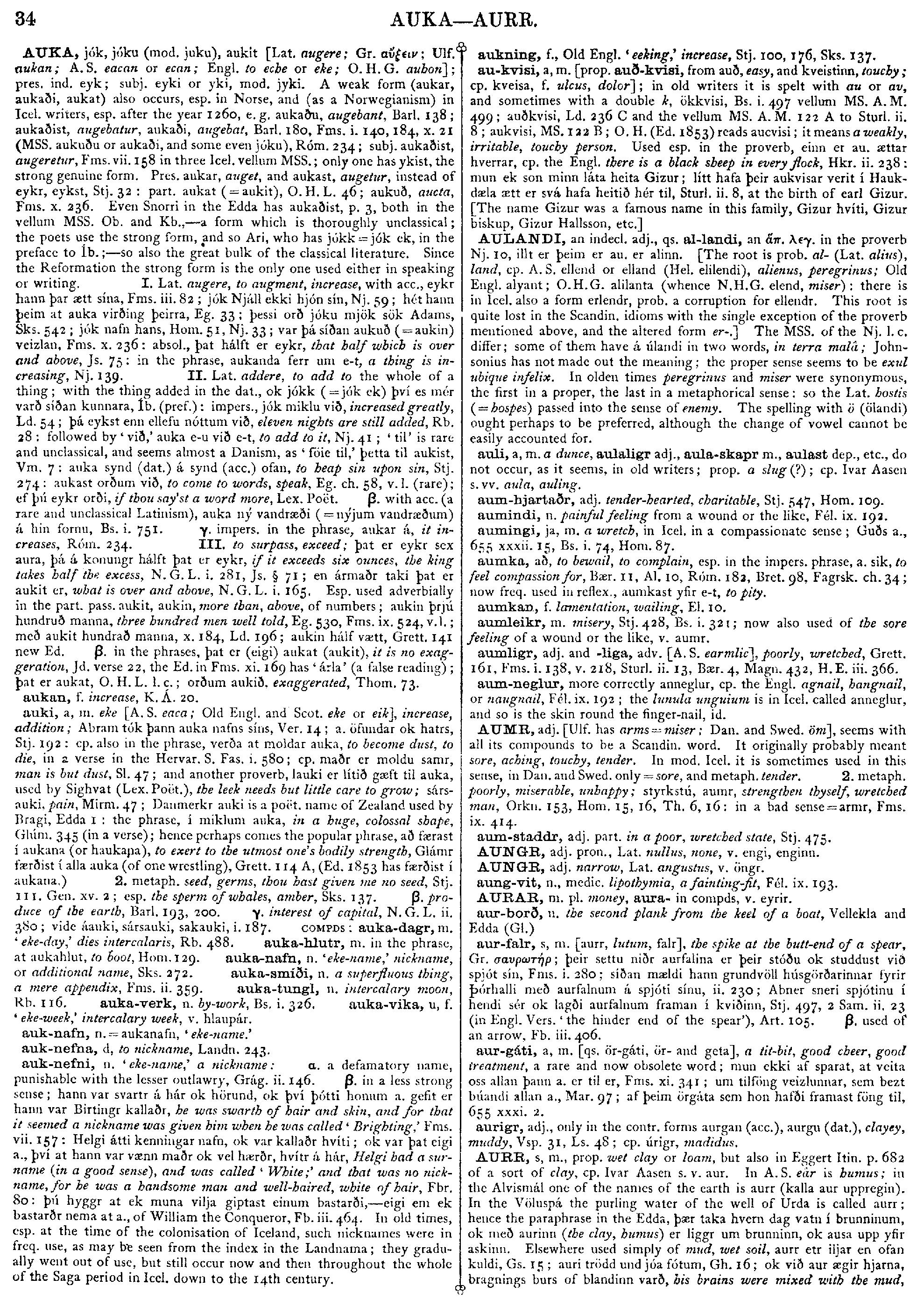
austr-rúm, n. the part of a vessel's hold near the stern where the pump is, Hkr. i. 82, Stj. 57, Fbr. 158, Edda 35; an aft and fore pumping- place (eptra ok fremra austrrúm) is mentioned Fms. viii. 139.
|
Source: Cleasby/Vigfusson, page b0037, entry 1 View original page image as: [TIFF] [PNG] [View previous entry] [View next entry] |
[Comment on this entry] [View comments] |
The following entry has been hand-corrected once. |
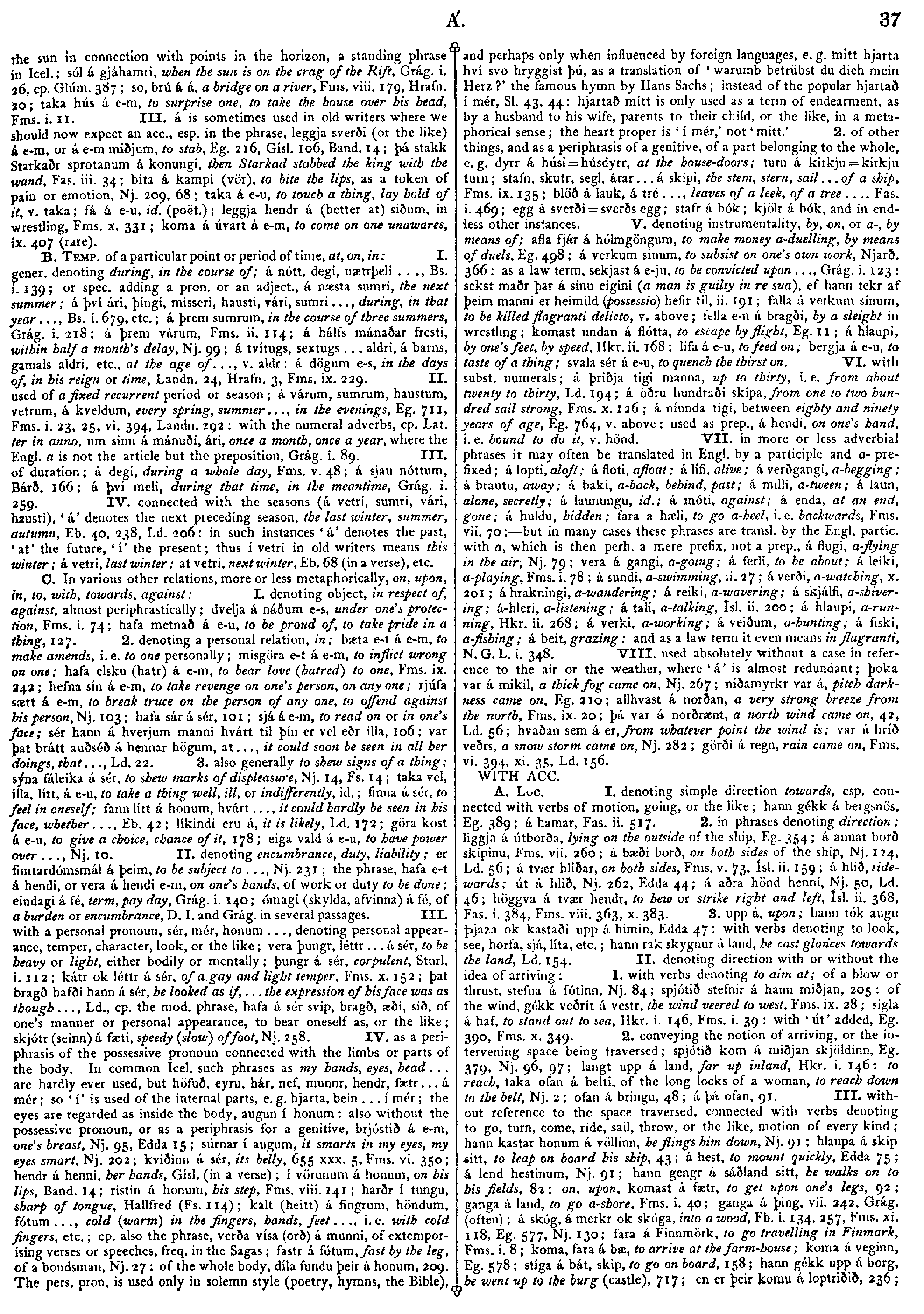
the sun in connection with points in the horizon, a standing phrase in Icel.; sól á gjáhamri, when the sun is on the crag of the Rift, Grág. i. 26, cp. Glúm. 387; so, brú á á, a bridge on a river, Fms. viii. 179, Hrafn. 20; taka hús á e-m, to surprise one, to take the house over his head, Fms. i. 11. III. á is sometimes used in old writers where we should now expect an acc., esp. in the phrase, leggja sverði (or the like) á e-m, or á e-m miðjum, to stab, Eg. 216, Gísl. 106, Band. 14; þá stakk Starkaðr sprotanum á konungi, then Starkad stabbed the king with the wand, Fas. iii. 34; bíta á kampi (vör), to bite the lips, as a token of pain or emotion, Nj. 209, 68; taka á e-u, to touch a thing, lay hold of it, v. taka; fá á e-u, id. (poët.); leggja hendr á (better at) síðum, in wrestling, Fms. x. 331; koma á úvart á e-m, to come on one unawares, ix. 407 (rare).
|
Source: Cleasby/Vigfusson, page b0040, entry 6 View original page image as: [TIFF] [PNG] [View previous entry] [View next entry] |
[Comment on this entry] [View comments] |
The following entry has not been hand-corrected. However, the page is reserved and someone is correcting it. |
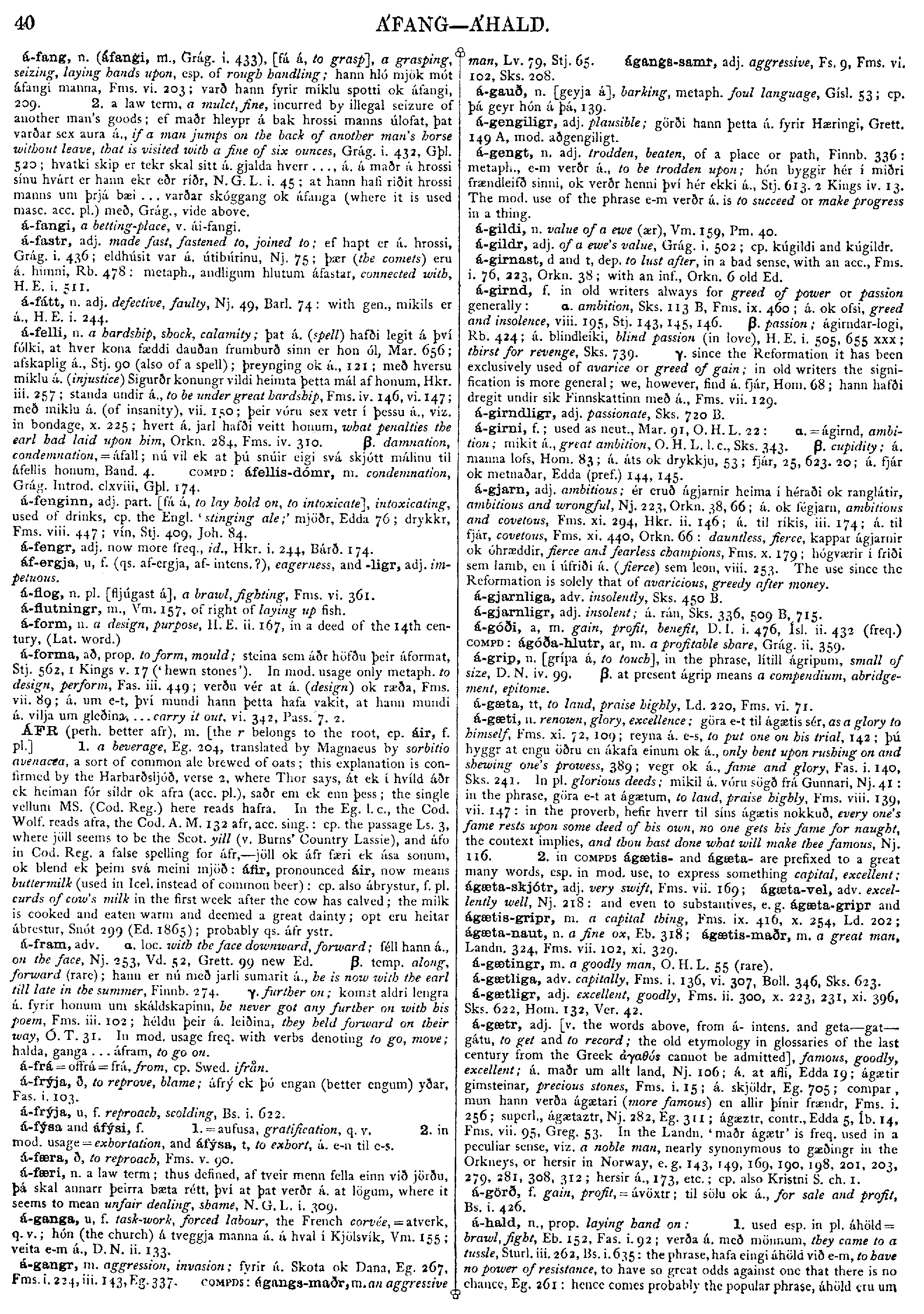
á-fenginn, adj. part, [fá á, to lay hold on, to intoxicate] , intoxicating, used of drinks, cp. the Engl. 'stinging ale;' mjöðr, Edda 76; drykkr, Fms. viii. 447; vin, Stj. 409, Joh. 84.
|
Source: Cleasby/Vigfusson, page b0047, entry 58 View original page image as: [TIFF] [PNG] [View previous entry] [View next entry] |
[Comment on this entry] [View comments] |
The following entry has been hand-corrected once. |
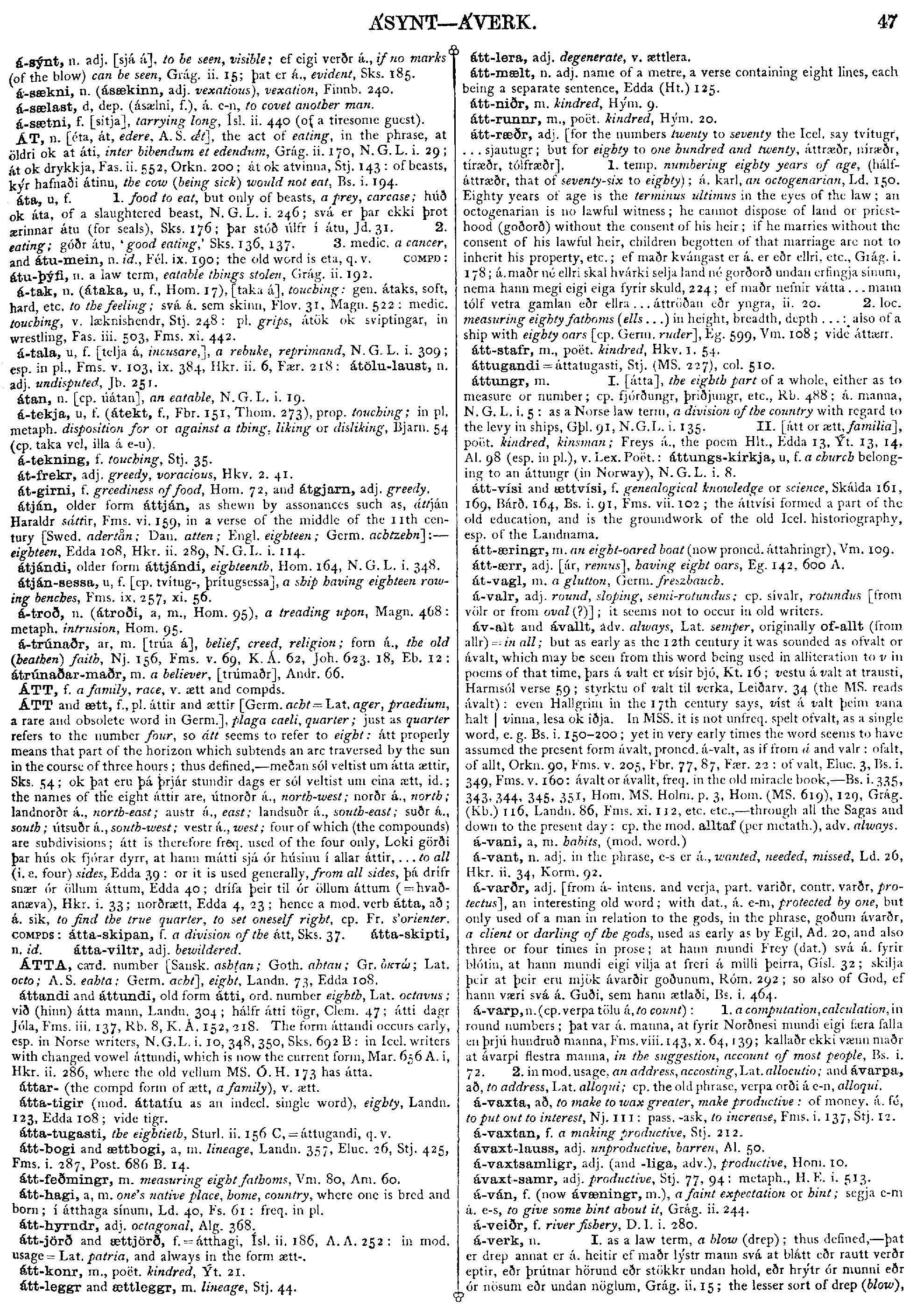
á-verk, n. I. as a law term, a blow (drep); thus defined, -- þat er drep annat er á. heitir ef maðr lýstr mann svá at blátt eðr rautt verðr eptir, eðr þrútnar hörund eðr stökkr undan hold, eðr hrýtr ór munni eðr ór nösum eðr undan nöglum, Grág. ii. 15; the lesser sort of drep (blow),
|
Source: Cleasby/Vigfusson, page b0059, entry 1 View original page image as: [TIFF] [PNG] [View previous entry] [View next entry] |
[Comment on this entry] [View comments] |
The following entry has been hand-corrected once. |
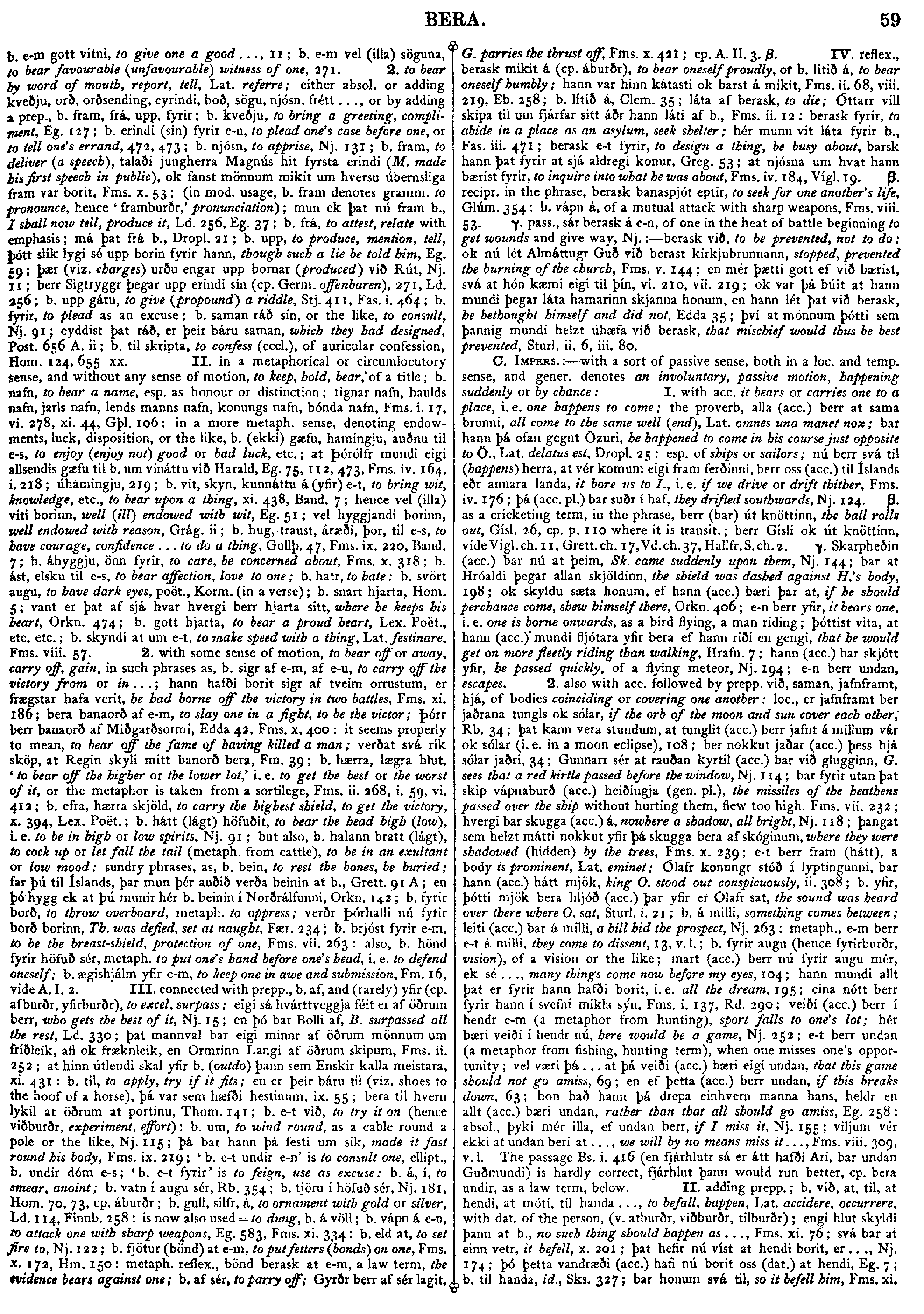
b.
e-m
gott
vitni,
to
give
one
a
good...,
11;
b.
e-m
vel
(illa)
söguna,
to
bear
favourable
(unfavourable)
witness
of
one,
271.
2.
to
bear
by
word
of
mouth,
report,
tell,
Lat.
referre;
either
absol.
or
adding
kveðju,
orð,
orðsending,
eyrindi,
boð,
sögu,
njósn,
frétt...,
or
by
adding
a
prep.,
b.
fram,
frá,
upp,
fyrir;
b.
kveðju,
to
bring
a
greeting,
compliment,
Eg.
127;
b.
erindi
(sín)
fyrir
e-n,
to
plead
one's
case
before
one,
or
to
tell
one's
errand,
472,
473;
b.
njósn,
to
apprise,
Nj.
131;
b.
fram,
to
deliver
(a
speech),
talaði
jungherra
Magnús
hit
fyrsta
erindi
(M.
made
his
first
speech
in
public),
ok
fanst
mönnum
mikit
um
hversu
úbernsliga
fram
var
borit,
Fms.
x.
53;
(in
mod.
usage,
b.
fram
denotes
gramm.
to
pronounce,
hence
'framburðr,'
pronunciation);
mun
ek
þat
nú
fram
b.,
I
shall
now
tell,
produce
it,
Ld.
256,
Eg.
37;
b.
frá,
to
attest,
relate
with
emphasis;
má
þat
frá
b.,
Dropl.
21;
b.
upp,
to
produce,
mention,
tell,
þótt
slík
lygi
sé
upp
borin
fyrir
hann,
though
such
a
lie
be
told
him,
Eg.
59;
þær
(viz.
charges)
urðu
engar
upp
bornar
(produced)
við
Rút,
Nj.
11;
berr
Sigtryggr
þegar
upp
erindi
sín
(cp.
Germ.
ojfenbaren),
271,
Ld.
256;
b.
upp
gátu,
to
give
(propound)
a
riddle,
Stj.
411,
Fas.
i.
464;
b.
fyrir,
to
plead
as
an
excuse;
b.
saman
ráð
sín,
or
the
like,
to
consult,
Nj.
91;
eyddist
þat
ráð,
er
þeir
báru
saman,
which
they
had
designed,
Post.
656
A.
ii;
b.
til
skripta,
to
confess
(eccl.),
of
auricular
confession,
Hom.
124,
655
xx.
II.
in
a
metaphorical
or
circumlocutory
sense,
and
without
any
sense
of
motion,
to
keep,
hold,
bear,
of
a
title;
b.
nafn,
to
bear
a
name,
esp.
as
honour
or
distinction;
tignar
nafn,
haulds
nafn,
jarls
nafn,
lends
manns
nafn,
konungs
nafn,
bónda
nafn,
Fms.
i.
17,
vi.
278,
xi.
44,
Gþl.
106:
in
a
more
metaph.
sense,
denoting
endowments,
luck,
disposition,
or
the
like,
b.
(ekki)
gæfu,
hamingju,
auðnu
til
e-s,
to
enjoy
(enjoy
not)
good
or
bad
luck,
etc.;
at
Þórólfr
mundi
eigi
allsendis
gæfu
til
b.
um
vináttu
við
Harald,
Eg.
75,
112,
473,
Fms.
iv.
164,
i.
218;
úhamingju,
219;
b.
vit,
skyn,
kunnáttu
á
(yfir)
e-t,
to
bring
wit,
knowledge,
etc.,
to
bear
upon
a
thing,
xi.
438,
Band.
7;
hence
vel
(illa)
viti
borinn,
well
(ill)
endowed
with
wit,
Eg.
51;
vel
hyggjandi
borinn,
well
endowed
with
reason,
Grág.
ii;
b.
hug,
traust,
áræði,
þor,
til
e-s,
to
have
courage,
confidence
...
to
do
a
thing,
Gullþ.
47,
Fms.
ix.
220,
Band.
7;
b.
áhyggju,
önn
fyrir,
to
care,
be
concerned
about,
Fms.
x.
318;
b.
ást,
elsku
til
e-s,
to
bear
affection,
love
to
one;
b.
hatr,
to
hate:
b.
svört
augu,
to
have
dark
eyes,
poët.,
Korm.
(in
a
verse);
b.
snart
hjarta,
Hom.
5;
vant
er
þat
af
sjá
hvar
hvergi
berr
hjarta
sitt,
where
he
keeps
his
heart,
Orkn.
474;
b.
gott
hjarta,
to
bear
a
proud
heart,
Lex.
Poët.,
etc.
etc.;
b.
skyndi
at
um
e-t,
to
make
speed
with
a
thing,
Lat.
festinare,
Fms.
viii.
57.
2.
with
some
sense
of
motion,
to
bear
off
or
away,
carry
off,
gain,
in
such
phrases
as,
b.
sigr
af
e-m,
af
e-u,
to
carry
off
the
victory
from
or
in
...;
hann
hafði
borit
sigr
af
tveim
orrustum,
er
frægstar
hafa
verit,
he
had
borne
off
the
victory
in
two
battles,
Fms.
xi.
186;
bera
banaorð
af
e-m,
to
slay
one
in
a
fight,
to
be
the
victor;
Þorr
berr
banaorð
af
Miðgarðsormi,
Edda
42,
Fms.
x.
400:
it
seems
properly
to
mean,
to
bear
off
the
fame
of
having
killed
a
man;
verðat
svá
rík
sköp,
at
Regin
skyli
mitt
banorð
bera,
Fm.
39;
b.
hærra,
lægra
hlut,
'to
bear
off
the
higher
or
the
lower
lot,'
i.
e.
to
get
the
best
or
the
worst
of
it,
or
the
metaphor
is
taken
from
a
sortilege,
Fms.
ii.
268,
i.
59,
vi.
412;
b.
efra,
hærra
skjöld,
to
carry
the
highest
shield,
to
get
the
victory,
x.
394,
Lex.
Poët.;
b.
hátt
(lágt)
höfuðit,
to
bear
the
head
high
(low),
i.
e.
to
be
in
high
or
low
spirits,
Nj.
91;
but
also,
b.
halann
bratt
(lágt),
to
cock
up
or
let
fall
the
tail
(metaph.
from
cattle),
to
be
in
an
exultant
or
low
mood:
sundry
phrases,
as,
b.
bein,
to
rest
the
bones,
be
buried;
far
þú
til
Íslands,
þar
mun
þér
auðið
verða
beinin
at
b.,
Grett.
91
A;
en
þó
hygg
ek
at
þú
munir
hér
b.
beinin
í
Norðrálfunni,
Orkn.
142;
b.
fyrir
borð,
to
throw
overboard,
metaph.
to
oppress;
verðr
Þórhalli
nú
fyrir
borð
borinn,
Th.
was
defied,
set
at
naught,
Fær.
234;
b.
brjóst
fyrir
e-m,
to
be
the
breast-shield,
protection
of
one,
Fms.
vii.
263:
also,
b.
hönd
fyrir
höfuð
sér,
metaph.
to
put
one's
hand
before
one's
head,
i.
e.
to
defend
oneself;
b.
ægishjálm
yfir
e-m,
to
keep
one
in
awe
and
submission,
Fm.
16,
vide
A.
I.
2.
III.
connected
with
prepp.,
b.
af,
and
(rarely)
yfir
(cp.
afburðr,
yfirburðr),
to
excel,
surpass;
eigi
sá
hvárttveggja
féit
er
af
öðrum
berr,
who
gets
the
best
of
it,
Nj.
15;
en
þó
bar
Bolli
af,
B.
surpassed
all
the
rest,
Ld.
330;
þat
mannval
bar
eigi
minnr
af
öðrum
mönnum
um
fríðleik,
afi
ok
fræknleik,
en
Ormrinn
Langi
af
öðrum
skipum,
Fms.
ii.
252;
at
hinn
útlendi
skal
yfir
b.
(outdo)
þann
sem
Enskir
kalla
meistara,
xi.
431:
b.
til,
to
apply,
try
if
it
fits;
en
er
þeir
báru
til
(viz.
shoes
to
the
hoof
of
a
horse),
þá
var
sem
hæfði
hestinum,
ix.
55;
bera
til
hvern
lykil
at
öðrum
at
portinu,
Thom.
141;
b.
e-t
við,
to
try
it
on
(hence
viðburðr,
experiment,
effort):
b.
um,
to
wind
round,
as
a
cable
round
a
pole
or
the
like,
Nj.
115;
þá
bar
hann
þá
festi
um
sik,
made
it
fast
round
his
body,
Fms.
ix.
219;
'b.
e-t
undir
e-n'
is
to
consult
one,
ellipt.,
b.
undir
dóm
e-s;
'b.
e-t
fyrir'
is
to
feign,
use
as
excuse:
b.
á,
í,
to
smear,
anoint;
b.
vatn
í
augu
sér,
Rb.
354;
b.
tjöru
í
höfuð
sér,
Nj.
181,
Hom.
70,
73,
cp.
áburðr;
b.
gull,
silfr,
á,
to
ornament
with
gold
or
silver,
Ld.
114,
Finnb.
258:
is
now
also
used
=
to
dung,
b.
á
völl;
b.
vápn
á
e-n,
to
attack
one
with
sharp
weapons,
Eg.
583,
Fms.
xi.
334:
b.
eld
at,
to
set
fire
to,
Nj.
122;
b.
fjötur
(bönd)
at
e-m,
to
put
fetters
(bonds)
on
one,
Fms.
x.
172,
Hm.
150:
metaph.
reflex.,
bönd
berask
at
e-m,
a
law
term,
the
evidence
bears
against
one;
b.
af
sér,
to
parry
off;
Gyrðr
berr
af
sér
lagit,
G.
parries
the
thrust
off,
Fms.
x.
421;
cp.
A.
II.
3.
 .
IV.
reflex.,
berask
mikit
á
(cp.
áburðr),
to
bear
oneself
proudly,
or
b.
lítið
á,
to
bear
oneself
humbly;
hann
var
hinn
kátasti
ok
barst
á
mikit,
Fms.
ii.
68,
viii.
219,
Eb.
258;
b.
lítið
á,
Clem.
35;
láta
af
berask,
to
die;
Óttarr
vill
skipa
til
um
fjárfar
sitt
áðr
hann
láti
af
b.,
Fms.
ii.
12:
berask
fyrir,
to
abide
in
a
place
as
an
asylum,
seek
shelter;
hér
munu
vit
láta
fyrir
b.,
Fas.
iii.
471;
berask
e-t
fyrir,
to
design
a
thing,
be
busy
about,
barsk
hann
þat
fyrir
at
sjá
aldregi
konur,
Greg.
53;
at
njósna
um
hvat
hann
bærist
fyrir,
to
inquire
into
what
he
was
about,
Fms.
iv.
184,
Vígl.
19.
.
recipr.
in
the
phrase,
berask
banaspjót
eptir,
to
seek
for
one
another's
life,
Glúm.
354:
b.
vápn
á,
of
a
mutual
attack
with
sharp
weapons,
Fms.
viii.
53.
.
IV.
reflex.,
berask
mikit
á
(cp.
áburðr),
to
bear
oneself
proudly,
or
b.
lítið
á,
to
bear
oneself
humbly;
hann
var
hinn
kátasti
ok
barst
á
mikit,
Fms.
ii.
68,
viii.
219,
Eb.
258;
b.
lítið
á,
Clem.
35;
láta
af
berask,
to
die;
Óttarr
vill
skipa
til
um
fjárfar
sitt
áðr
hann
láti
af
b.,
Fms.
ii.
12:
berask
fyrir,
to
abide
in
a
place
as
an
asylum,
seek
shelter;
hér
munu
vit
láta
fyrir
b.,
Fas.
iii.
471;
berask
e-t
fyrir,
to
design
a
thing,
be
busy
about,
barsk
hann
þat
fyrir
at
sjá
aldregi
konur,
Greg.
53;
at
njósna
um
hvat
hann
bærist
fyrir,
to
inquire
into
what
he
was
about,
Fms.
iv.
184,
Vígl.
19.
.
recipr.
in
the
phrase,
berask
banaspjót
eptir,
to
seek
for
one
another's
life,
Glúm.
354:
b.
vápn
á,
of
a
mutual
attack
with
sharp
weapons,
Fms.
viii.
53.
 .
pass.,
sár
berask
á
e-n,
of
one
in
the
heat
of
battle
beginning
to
get
wounds
and
give
way,
Nj.
:--
berask
við,
to
be
prevented,
not
to
do;
ok
nú
lét
Almáttugr
Guð
við
berast
kirkjubrunnann,
stopped,
prevented
the
burning
of
the
church,
Fms.
v.
144;
en
mér
þætti
gott
ef
við
bærist,
svá
at
hón
kæmi
eigi
til
þín,
vi.
210,
vii.
219;
ok
var
þá
búit
at
hann
mundi
þegar
láta
hamarinn
skjanna
honum,
en
hann
lét
þat
við
berask,
he
bethought
himself
and
did
not,
Edda
35;
því
at
mönnum
þótti
sem
þannig
mundi
helzt
úhæfa
við
berask,
that
mischief
would
thus
be
best
prevented,
Sturl.
ii.
6,
iii.
80.
C.
IMPERS.
:--
with
a
sort
of
passive
sense,
both
in
a
loc.
and
temp.
sense,
and
gener.
denotes
an
involuntary,
passive
motion,
happening
suddenly
or
by
chance:
I.
with
acc.
it
bears
or
carries
one
to
a
place,
i.
e.
one
happens
to
come;
the
proverb,
alla
(acc.)
berr
at
sama
brunni,
all
come
to
the
same
well
(end),
Lat.
omnes
una
manet
nox;
bar
hann
þá
ofan
gegnt
Özuri,
he
happened
to
come
in
his
course
just
opposite
to
Ö.,
Lat.
delatus
est,
Dropl.
25:
esp.
of
ships
or
sailors;
nú
berr
svá
til
(happens)
herra,
at
vér
komum
eigi
fram
ferðinni,
berr
oss
(acc.)
til
Íslands
eðr
annara
landa,
it
bore
us
to
I.,
i.
e.
if
we
drive
or
drift
thither,
Fms.
iv.
176;
þá
(acc.
pl.)
bar
suðr
í
haf,
they
drifted
southwards,
Nj.
124.
.
as
a
cricketing
term,
in
the
phrase,
berr
(bar)
út
knöttinn,
the
ball
rolls
out,
Gísl.
26,
cp.
p.
110
where
it
is
transit.;
berr
Gísli
ok
út
knöttinn,
vide
Vígl.
ch.
11,
Grett.
ch.
17,
Vd.
ch.
37,
Hallfr.
S.
ch.
2.
.
Skarpheðin
(acc.)
bar
nú
at
þeim,
Sk.
came
suddenly
upon
them,
Nj.
144;
bar
at
Hróaldi
þegar
allan
skjöldinn,
the
shield
was
dashed
against
H.'s
body,
198;
ok
skyldu
sæta
honum,
ef
hann
(acc.)
bæri
þar
at,
if
he
should
per
chance
come,
shew
himself
there,
Orkn.
406;
e-n
berr
yfir,
it
bears
one,
i.
e.
one
is
borne
onwards,
as
a
bird
flying,
a
man
riding;
þóttist
vita,
at
hann
(acc.)
mundi
fljótara
yfir
bera
ef
hann
riði
en
gengi,
that
he
would
get
on
more
fleetly
riding
than
walking,
Hrafn.
7;
hann
(acc.)
bar
skjótt
yfir,
he
passed
quickly,
of
a
flying
meteor,
Nj.
194;
e-n
berr
undan,
escapes.
2.
also
with
acc.
followed
by
prepp.
við,
saman,
jafnframt,
hjá,
of
bodies
coinciding
or
covering
one
another:
loc.,
er
jafnframt
ber
jaðrana
tungls
ok
sólar,
if
the
orb
of
the
moon
and
sun
cover
each
other,
Rb.
34;
þat
kann
vera
stundum,
at
tunglit
(acc.)
berr
jafht
á
millum
vár
ok
sólar
(i.
e.
in
a
moon
eclipse),
108;
ber
nokkut
jaðar
(acc.)
þess
hjá
sólar
jaðri,
34;
Gunnarr
sér
at
rauðan
kyrtil
(acc.)
bar
við
glugginn,
G.
sees
that
a
red
kirtle
passed
before
the
window,
Nj.
114;
bar
fyrir
utan
þat
skip
vápnaburð
(acc.)
heiðingja
(gen.
pl.),
the
missiles
of
the
heathens
passed
over
the
ship
without
hurting
them,
flew
too
high,
Fms.
vii.
232;
hvergi
bar
skugga
(acc.)
á,
nowhere
a
shadow,
all
bright,
Nj.
118;
þangat
sem
helzt
mátti
nokkut
yfir
þá
skugga
bera
af
skóginum,
where
they
were
shadowed
(hidden)
by
the
trees,
Fms.
x.
239;
e-t
berr
fram
(hátt),
a
body
is
prominent,
Lat.
eminet;
Ólafr
konungr
stóð
í
lyptingunni,
bar
hann
(acc.)
hátt
mjök,
king
O.
stood
out
conspicuously,
ii.
308;
b.
yfir,
þótti
mjök
bera
hljóð
(acc.)
þar
yfir
er
Ólafr
sat,
the
sound
was
heard
over
there
where
O.
sat,
Sturl.
i.
21;
b.
á
milli,
something
comes
between;
leiti
(acc.)
bar
á
milli,
a
hill
hid
the
prospect,
Nj.
263:
metaph.,
e-m
berr
e-t
á
milli,
they
come
to
dissent,
13,
v.
1.;
b.
fyrir
augu
(hence
fyrirburðr,
vision),
of
a
vision
or
the
like;
mart
(acc.)
berr
nú
fyrir
augu
mér,
ek
sé
...,
many
things
come
now
before
my
eyes,
104;
hann
mundi
allt
þat
er
fyrir
hann
hafði
borit,
i.
e.
all
the
dream,
195;
eina
nótt
berr
fyrir
hann
í
svefni
mikla
sýn,
Fms.
i.
137,
Rd.
290;
veiði
(acc.)
berr
í
hendr
e-m
(a
metaphor
from
hunting),
sport
falls
to
one's
lot;
hér
bæri
veiði
í
hendr
nú,
here
would
be
a
game,
Nj.
252;
e-t
berr
undan
(a
metaphor
from
fishing,
hunting
term),
when
one
misses
one's
opportunity;
vel
væri
þá
...
at
þá
veiði
(acc.)
bæri
eigi
undan,
that
this
game
should
not
go
amiss,
69;
en
ef
þetta
(acc.)
berr
undan,
if
this
breaks
down,
63;
hon
bað
hann
þá
drepa
einhvern
manna
hans,
heldr
en
allt
(acc.)
bæri
undan,
rather
than
that
all
should
go
amiss,
Eg.
258:
absol.,
þyki
mér
illa,
ef
undan
berr,
if
I
miss
it,
Nj.
155;
viljum
vér
ekki
at
undan
beri
at...,
we
will
by
no
means
miss
it...,
Fms.
viii.
309,
v.
1.
The
passage
Bs.
i.
416
(en
fjárhlutr
sá
er
átt
hafði
Ari,
bar
undan
Guðmundi)
is
hardly
correct,
fjárhlut
þann
would
run
better,
cp.
bera
undir,
as
a
law
term,
below.
II.
adding
prepp.;
b.
við,
at,
til,
at
hendi,
at
móti,
til
handa
...,
to
befall,
happen,
Lat.
accidere,
occurrere,
with
dat.
of
the
person,
(v.
atburðr,
viðburðr,
tilburðr);
engi
hlut
skyldi
þann
at
b.,
no
such
thing
should
happen
as...,
Fms.
xi.
76;
svá
bar
at
einn
vetr,
it
befell,
x.
201;
þat
hefir
nú
víst
at
hendi
borit,
er...,
Nj.
174;
þó
þetta
vandræði
(acc.)
hafi
nú
borit
oss
(dat.)
at
hendi,
Eg.
7;
b.
til
handa,
id.,
Sks.
327;
bar
honum
svá
til,
so
it
befell
him,
Fms.
.
pass.,
sár
berask
á
e-n,
of
one
in
the
heat
of
battle
beginning
to
get
wounds
and
give
way,
Nj.
:--
berask
við,
to
be
prevented,
not
to
do;
ok
nú
lét
Almáttugr
Guð
við
berast
kirkjubrunnann,
stopped,
prevented
the
burning
of
the
church,
Fms.
v.
144;
en
mér
þætti
gott
ef
við
bærist,
svá
at
hón
kæmi
eigi
til
þín,
vi.
210,
vii.
219;
ok
var
þá
búit
at
hann
mundi
þegar
láta
hamarinn
skjanna
honum,
en
hann
lét
þat
við
berask,
he
bethought
himself
and
did
not,
Edda
35;
því
at
mönnum
þótti
sem
þannig
mundi
helzt
úhæfa
við
berask,
that
mischief
would
thus
be
best
prevented,
Sturl.
ii.
6,
iii.
80.
C.
IMPERS.
:--
with
a
sort
of
passive
sense,
both
in
a
loc.
and
temp.
sense,
and
gener.
denotes
an
involuntary,
passive
motion,
happening
suddenly
or
by
chance:
I.
with
acc.
it
bears
or
carries
one
to
a
place,
i.
e.
one
happens
to
come;
the
proverb,
alla
(acc.)
berr
at
sama
brunni,
all
come
to
the
same
well
(end),
Lat.
omnes
una
manet
nox;
bar
hann
þá
ofan
gegnt
Özuri,
he
happened
to
come
in
his
course
just
opposite
to
Ö.,
Lat.
delatus
est,
Dropl.
25:
esp.
of
ships
or
sailors;
nú
berr
svá
til
(happens)
herra,
at
vér
komum
eigi
fram
ferðinni,
berr
oss
(acc.)
til
Íslands
eðr
annara
landa,
it
bore
us
to
I.,
i.
e.
if
we
drive
or
drift
thither,
Fms.
iv.
176;
þá
(acc.
pl.)
bar
suðr
í
haf,
they
drifted
southwards,
Nj.
124.
.
as
a
cricketing
term,
in
the
phrase,
berr
(bar)
út
knöttinn,
the
ball
rolls
out,
Gísl.
26,
cp.
p.
110
where
it
is
transit.;
berr
Gísli
ok
út
knöttinn,
vide
Vígl.
ch.
11,
Grett.
ch.
17,
Vd.
ch.
37,
Hallfr.
S.
ch.
2.
.
Skarpheðin
(acc.)
bar
nú
at
þeim,
Sk.
came
suddenly
upon
them,
Nj.
144;
bar
at
Hróaldi
þegar
allan
skjöldinn,
the
shield
was
dashed
against
H.'s
body,
198;
ok
skyldu
sæta
honum,
ef
hann
(acc.)
bæri
þar
at,
if
he
should
per
chance
come,
shew
himself
there,
Orkn.
406;
e-n
berr
yfir,
it
bears
one,
i.
e.
one
is
borne
onwards,
as
a
bird
flying,
a
man
riding;
þóttist
vita,
at
hann
(acc.)
mundi
fljótara
yfir
bera
ef
hann
riði
en
gengi,
that
he
would
get
on
more
fleetly
riding
than
walking,
Hrafn.
7;
hann
(acc.)
bar
skjótt
yfir,
he
passed
quickly,
of
a
flying
meteor,
Nj.
194;
e-n
berr
undan,
escapes.
2.
also
with
acc.
followed
by
prepp.
við,
saman,
jafnframt,
hjá,
of
bodies
coinciding
or
covering
one
another:
loc.,
er
jafnframt
ber
jaðrana
tungls
ok
sólar,
if
the
orb
of
the
moon
and
sun
cover
each
other,
Rb.
34;
þat
kann
vera
stundum,
at
tunglit
(acc.)
berr
jafht
á
millum
vár
ok
sólar
(i.
e.
in
a
moon
eclipse),
108;
ber
nokkut
jaðar
(acc.)
þess
hjá
sólar
jaðri,
34;
Gunnarr
sér
at
rauðan
kyrtil
(acc.)
bar
við
glugginn,
G.
sees
that
a
red
kirtle
passed
before
the
window,
Nj.
114;
bar
fyrir
utan
þat
skip
vápnaburð
(acc.)
heiðingja
(gen.
pl.),
the
missiles
of
the
heathens
passed
over
the
ship
without
hurting
them,
flew
too
high,
Fms.
vii.
232;
hvergi
bar
skugga
(acc.)
á,
nowhere
a
shadow,
all
bright,
Nj.
118;
þangat
sem
helzt
mátti
nokkut
yfir
þá
skugga
bera
af
skóginum,
where
they
were
shadowed
(hidden)
by
the
trees,
Fms.
x.
239;
e-t
berr
fram
(hátt),
a
body
is
prominent,
Lat.
eminet;
Ólafr
konungr
stóð
í
lyptingunni,
bar
hann
(acc.)
hátt
mjök,
king
O.
stood
out
conspicuously,
ii.
308;
b.
yfir,
þótti
mjök
bera
hljóð
(acc.)
þar
yfir
er
Ólafr
sat,
the
sound
was
heard
over
there
where
O.
sat,
Sturl.
i.
21;
b.
á
milli,
something
comes
between;
leiti
(acc.)
bar
á
milli,
a
hill
hid
the
prospect,
Nj.
263:
metaph.,
e-m
berr
e-t
á
milli,
they
come
to
dissent,
13,
v.
1.;
b.
fyrir
augu
(hence
fyrirburðr,
vision),
of
a
vision
or
the
like;
mart
(acc.)
berr
nú
fyrir
augu
mér,
ek
sé
...,
many
things
come
now
before
my
eyes,
104;
hann
mundi
allt
þat
er
fyrir
hann
hafði
borit,
i.
e.
all
the
dream,
195;
eina
nótt
berr
fyrir
hann
í
svefni
mikla
sýn,
Fms.
i.
137,
Rd.
290;
veiði
(acc.)
berr
í
hendr
e-m
(a
metaphor
from
hunting),
sport
falls
to
one's
lot;
hér
bæri
veiði
í
hendr
nú,
here
would
be
a
game,
Nj.
252;
e-t
berr
undan
(a
metaphor
from
fishing,
hunting
term),
when
one
misses
one's
opportunity;
vel
væri
þá
...
at
þá
veiði
(acc.)
bæri
eigi
undan,
that
this
game
should
not
go
amiss,
69;
en
ef
þetta
(acc.)
berr
undan,
if
this
breaks
down,
63;
hon
bað
hann
þá
drepa
einhvern
manna
hans,
heldr
en
allt
(acc.)
bæri
undan,
rather
than
that
all
should
go
amiss,
Eg.
258:
absol.,
þyki
mér
illa,
ef
undan
berr,
if
I
miss
it,
Nj.
155;
viljum
vér
ekki
at
undan
beri
at...,
we
will
by
no
means
miss
it...,
Fms.
viii.
309,
v.
1.
The
passage
Bs.
i.
416
(en
fjárhlutr
sá
er
átt
hafði
Ari,
bar
undan
Guðmundi)
is
hardly
correct,
fjárhlut
þann
would
run
better,
cp.
bera
undir,
as
a
law
term,
below.
II.
adding
prepp.;
b.
við,
at,
til,
at
hendi,
at
móti,
til
handa
...,
to
befall,
happen,
Lat.
accidere,
occurrere,
with
dat.
of
the
person,
(v.
atburðr,
viðburðr,
tilburðr);
engi
hlut
skyldi
þann
at
b.,
no
such
thing
should
happen
as...,
Fms.
xi.
76;
svá
bar
at
einn
vetr,
it
befell,
x.
201;
þat
hefir
nú
víst
at
hendi
borit,
er...,
Nj.
174;
þó
þetta
vandræði
(acc.)
hafi
nú
borit
oss
(dat.)
at
hendi,
Eg.
7;
b.
til
handa,
id.,
Sks.
327;
bar
honum
svá
til,
so
it
befell
him,
Fms.
|
Source: Cleasby/Vigfusson, page b0074, entry 1 View original page image as: [TIFF] [PNG] [View previous entry] [View next entry] |
[Comment on this entry] [View comments] |
The following entry has been hand-corrected once. |
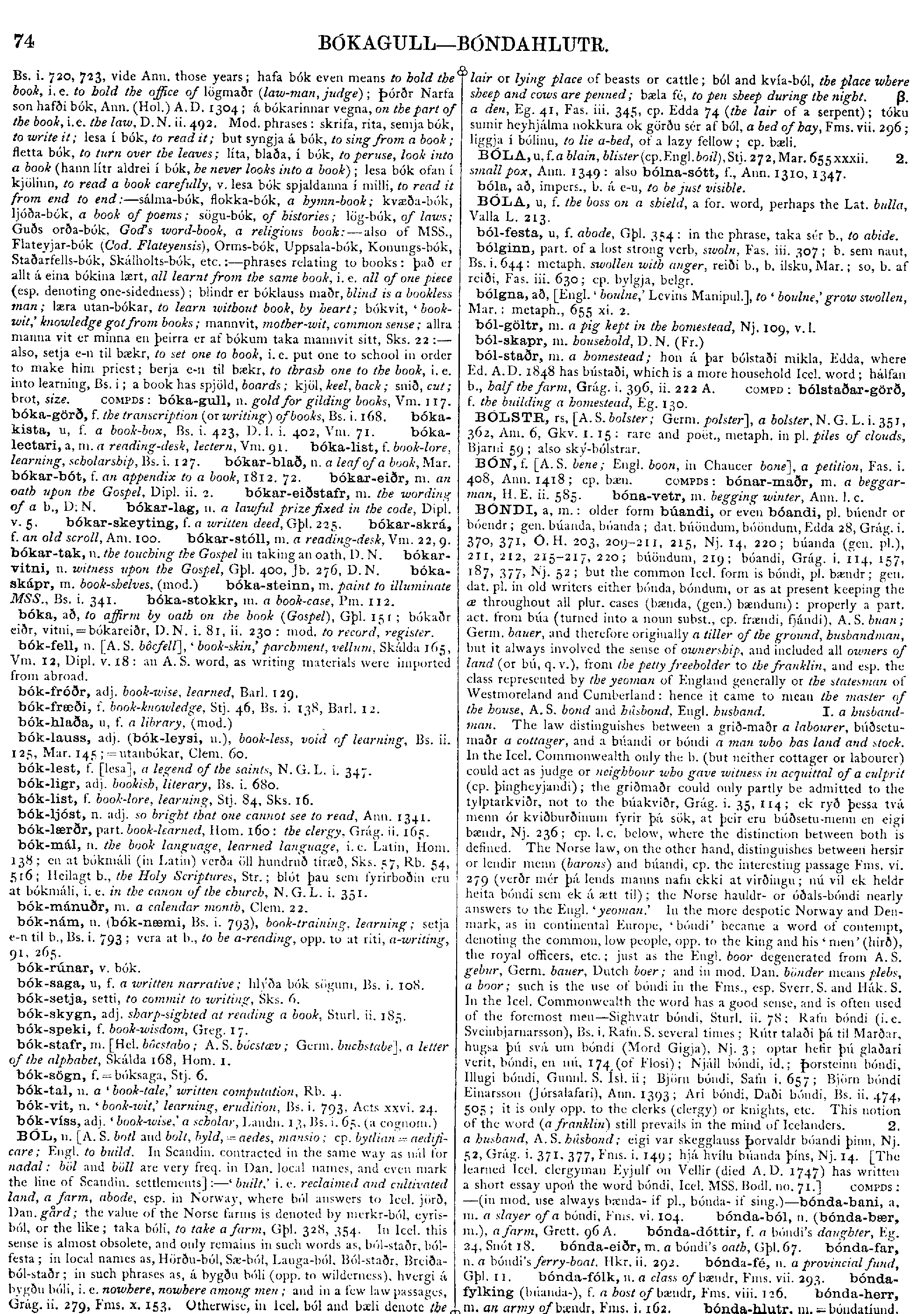
Bs. i. 720, 723, vide Ann. those years; hafa bók even means to hold the book, i.e. to hold the office of lögmaðr (law-man, judge); Þórðr Narfa son hafði bók, Ann. (Hol.) A.D. 1304; á bókarinnar vegna, on the part of the book, i.e. the law, D. N. ii. 492. Mod. phrases: skrifa, rita, semja bók, to write it; lesa í bók, to read it; but syngja á bók, to sing from a book; fletta bók, to turn over the leaves; líta, blaða, í bók, to peruse, look into a book (hann lítr aldrei í bók, he never looks into a book); lesa bók ofan í kjölinn, to read a book carefully, v. lesa bók spjaldanna í milli, to read it from end to end :-- sálma-bók, flokka-bók, a hymn-book; kvæða-bók, ljóða-bók, a book of poems; sögu-bók, of histories; lög-bók, of laws; Guðs orða-bók, God's word-book, a religious book :-- also of MSS., Flateyjar-bók (Cod. Flateyensis), Orms-bók, Uppsala-bók, Konungs-bók, Staðarfells-bók, Skálholts-bók, etc. :-- phrases relating to books: það er allt á eina bókina lært, all learnt from the same book, i.e. all of one piece (esp. denoting one-sidedness); blindr er bóklauss maðr, blind is a bookless man; læra utan-bókar, to learn without book, by heart; bókvit, 'bookwit,' knowledge got from books; mannvit, mother-wit, common sense; allra manna vit er minna en þeirra er af bókum taka mannvit sitt, Sks. 22 :-- also, setja e-n til bækr, to set one to book, i.e. put one to school in order to make him priest; berja e-n til bækr, to thrash one to the book, i.e. into learning, Bs. i; a book has spjöld, boards; kjöl, keel, back; snið, cut; brot, size. COMPDS: bóka-gull, n. gold for gilding books, Vm. 117. bóka-görð, f. the transcription (or writing) of books, Bs. i. 168. bóka-kista, u, f. a book-box, Bs. i. 423, D. I. i. 402, Vm. 71. bóka-lectari, a, m. a reading-desk, lectern, Vm. 91. bóka-list, f. book-lore, learning, scholarship, Bs. i. 127. bókar-blað, n. a leaf of a book, Mar. bókar-bót, f. an appendix to a book, 1812. 72. bókar-eiðr, m. an oath upon the Gospel, Dipl. ii. 2. bókar-eiðstafr, m. the wording of a b., D. N. bókar-lag, n. a lawful prize fixed in the code, Dipl. v. 5. bókar-skeyting, f. a written deed, Gþl. 225. bókar-skrá, f. an old scroll, Am. 100. bókar-stóll, m. a reading-desk, Vm. 22, 9. bókar-tak, n. the touching the Gospel in taking an oath, D. N. bókar-vitni, n. witness upon the Gospel, Gþl. 400, Jb. 276, D. N. bóka-skápr, m. book-shelves, (mod.) bóka-steinn, m. paint to illuminate MSS., Bs. i. 341. bóka-stokkr, m. a book-case, Pm. 112.
|
Source: Cleasby/Vigfusson, page b0077, entry 55 View original page image as: [TIFF] [PNG] [View previous entry] [View next entry] |
[Comment on this entry] [View comments] |
The following entry has been hand-corrected once. |
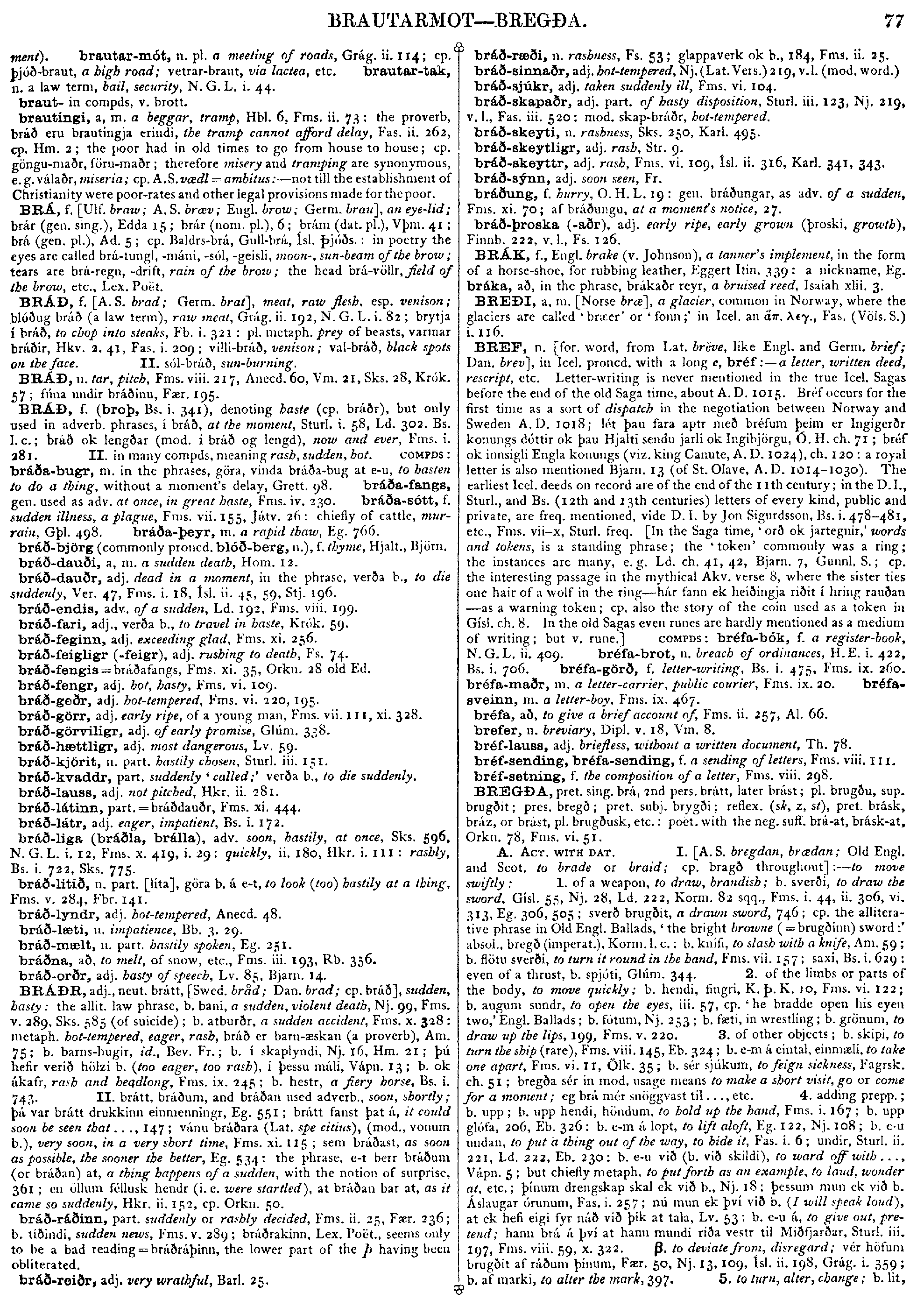
A.
ACT.
WITH
DAT.
I.
[A.
S.
bregdan,
brædan;
Old
Engl.
and
Scot,
to
brade
or
braid;
cp.
bragð
throughout]
:--
to
move
swiftly:
1.
of
a
weapon,
to
draw,
brandish;
b.
sverði,
to
draw
the
sword,
Gísl.
55,
Nj.
28,
Ld.
222,
Korm.
82
sqq.,
Fms.
i.
44,
ii.
306,
vi.
313,
Eg.
306,
505;
sverð
brugðit,
a
drawn
sword,
746;
cp.
the
alliterative
phrase
in
Old
Engl.
Ballads,
'the
bright
browne
(=
brugðinn)
sword:'
absol.,
bregð
(imperat.),
Korm.
l.c.:
b.
knífi,
to
slash
with
a
knife,
Am.
59;
b.
flötu
sverði,
to
turn
it
round
in
the
band,
Fms.
vii.
157;
saxi,
Bs.
i.
629:
even
of
a
thrust,
b.
spjóti,
Glúm.
344.
2.
of
the
limbs
or
parts
of
the
body,
to
move
quickly;
b.
hendi,
fingri,
K.
Þ.
K.
10,
Fms.
vi.
122;
b.
augum
sundr,
to
open
the
eyes,
iii.
57,
cp.
'he
bradde
open
his
eyen
two,'
Engl.
Ballads;
b.
fótum,
Nj.
253;
b.
fæti,
in
wrestling;
b.
grönum,
to
draw
up
the
lips,
199,
Fms.
v.
220.
3.
of
other
objects;
b.
skipi,
to
turn
the
ship
(rare),
Fms.
viii.
145,
Eb.
324;
b.
e-m
á
eintal,
einmæli,
to
take
one
apart,
Fms.
vi.
11,
Ölk.
35;
b.
sér
sjúkum,
to
feign
sickness,
Fagrsk.
ch.
51;
bregða
sér
in
mod.
usage
means
to
make
a
short
visit,
go
or
come
for
a
moment;
eg
brá
mér
snöggvast
til
...,
etc.
4.
adding
prepp.;
b.
upp;
b.
upp
hendi,
höndum,
to
hold
up
the
hand,
Fms.
i.
167;
b.
upp
glófa,
206,
Eb.
326:
b.
e-m
á
lopt,
to
lift
aloft,
Eg.
122,
Nj.
108;
b.
e-u
undan,
to
put
a
thing
out
of
the
way,
to
hide
it,
Fas.
i.
6;
undir,
Sturl.
ii.
221,
Ld.
222,
Eb.
230:
b.
e-u
við
(b.
við
skildi),
to
ward
off
with
...,
Vápn.
5;
but
chiefly
metaph.
to
put
forth
as
an
example,
to
laud,
wonder
at,
etc.;
þínum
drengskap
skal
ek
við
b.,
Nj.
18;
þessum
mun
ek
við
b.
Áslaugar
órunum,
Fas.
i.
257;
nú
mun
ek
því
við
b.
(I
will
speak
loud),
at
ek
hefi
eigi
fyr
náð
við
þik
at
tala,
Lv.
53:
b.
e-u
á,
to
give
out,
pretend;
hann
brá
á
því
at
hann
mundi
ríða
vestr
til
Miðfjarðar,
Sturl.
iii.
197,
Fms.
viii.
59,
x.
322.
.
to
deviate
from,
disregard;
vér
höfum
brugðit
af
ráðum
þínum,
Fær.
50,
Nj.
13,
109,
Ísl.
ii.
198,
Grág.
i.
359;
b.
af
marki,
to
alter
the
mark,
397.
5.
to
turn,
alter,
change;
b.
lit,
|
Source: Cleasby/Vigfusson, page b0084, entry 1 View original page image as: [TIFF] [PNG] [View previous entry] [View next entry] |
[Comment on this entry] [View comments] |
The following entry has been hand-corrected once. |
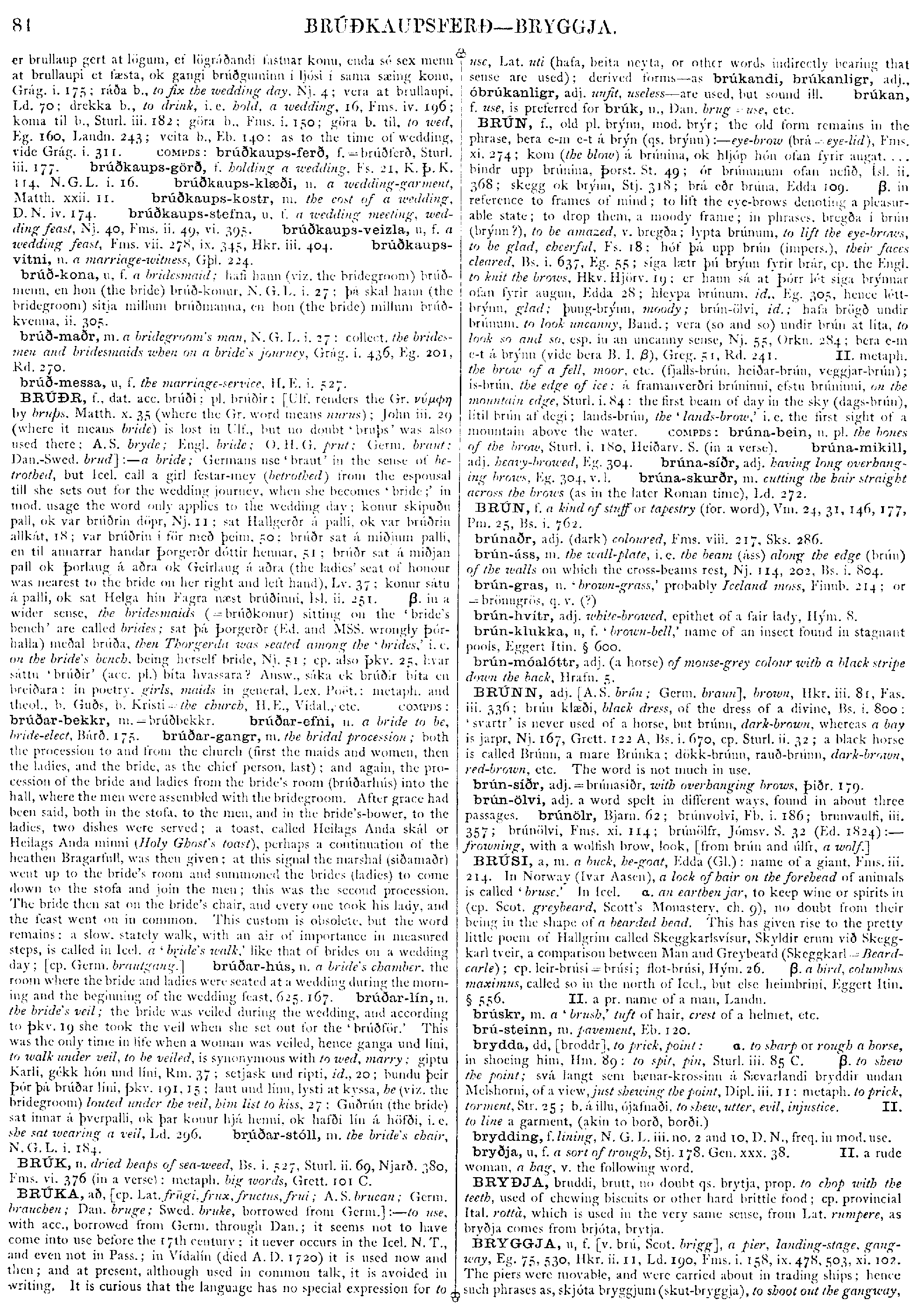
er brullaup gert at lögum, ef lögráðandi fastnar konu, enda sé sex menn at brullaupi et fæsta, ok gangi brúðguminn i ljósi í sama sæing konu, Grág. i. 175; ráða b., to fix the wedding day. Nj. 4; vera at brullaupi, Ld. 70; drekka b., to drink, i. e. hold, a wedding, 16, Fms. iv. 196; koma til b., Sturl. iii. 182; göra b., Fms. i. 150; göra b. til, to wed, Eg. 160, Landn. 243; veita b., Eb. 140: as to the time of wedding, vide Grág. i. 311. COMPDS: brúðkaups-ferð, f. = brúðferð, Sturl. iii. 177. brúðkaups-görð, f. holding a wedding, Fs. 21, K. Þ. K. 114, N. G. L. i. 16. brúðkaups-klæði, n. a wedding-garment, Matth. xxii. ii. brúðkaups-kostr, m. the cost of a wedding, D. N. iv. 174. brúðkaups-stefna, u, f. a wedding meeting, wedding feast, Nj. 40, Fms. ii. 49, vi. 395. brúðkaups-veizla, u, f. a wedding feast, Fms. vii. 278, ix. 345, Hkr. iii. 404. brúðkaups-vitni, n. a marriage-witness, Gþl. 224.
|
Source: Cleasby/Vigfusson, page b0089, entry 12 View original page image as: [TIFF] [PNG] [View previous entry] [View next entry] |
[Comment on this entry] [View comments] |
The following entry has been hand-corrected once. |
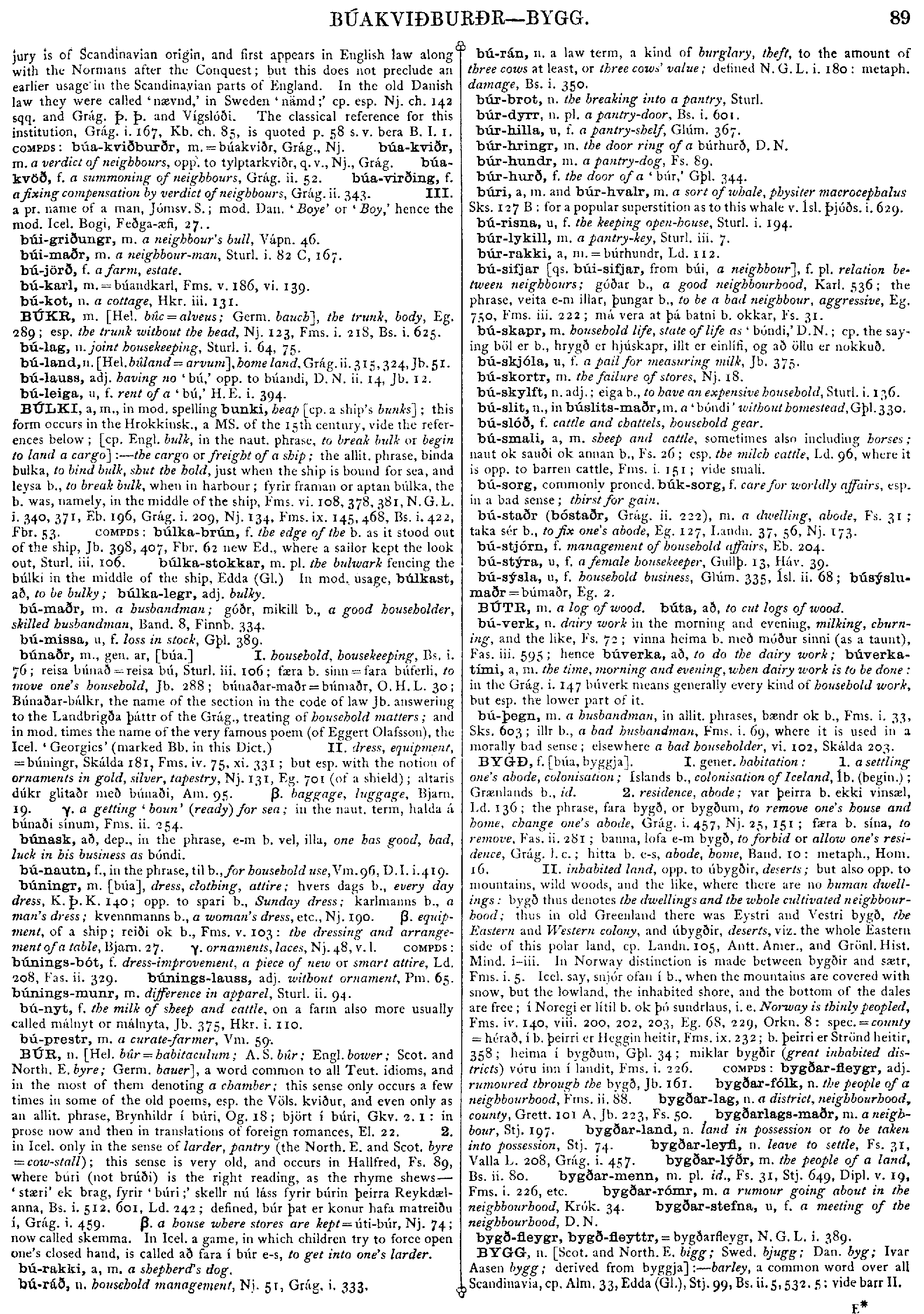
BÚLKI, a, m., in mod. spelling bunki, heap [cp. a ship's bunks]; this form occurs in the Hrokkinsk., a MS. of the 15th century, vide the references below; [cp. Engl. bulk, in the naut. phrase, to break bulk or begin to land a cargo] :-- the cargo or freight of a ship; the allit. phrase, binda bulka, to bind bulk, shut the hold, just when the ship is bound for sea, and leysa b., to break bulk, when in harbour; fyrir framan or aptan búlka, the b. was, namely, in the middle of the ship, Fms. vi. 108, 378, 381, N. G. L. i. 340, 371, Eb. 196, Grág. i. 209, Nj. 134, Fms. ix. 145, 468, Bs. i. 422, Fbr. 53. COMPDS: búlka-brún, f. the edge of the b. as it stood out of the ship, Jb. 398, 407, Fbr. 62 new Ed., where a sailor kept the look out, Sturl. iii. 106. búlka-stokkar, m. pl. the bulwark fencing the búlki in the middle of the ship, Edda (Gl.) In mod. usage, búlkast, að, to be bulky; búlka-legr, adj. bulky.
|
Source: Cleasby/Vigfusson, page b0095, entry 21 View original page image as: [TIFF] [PNG] [View previous entry] [View next entry] |
[Comment on this entry] [View comments] |
The following entry has been hand-corrected once. |
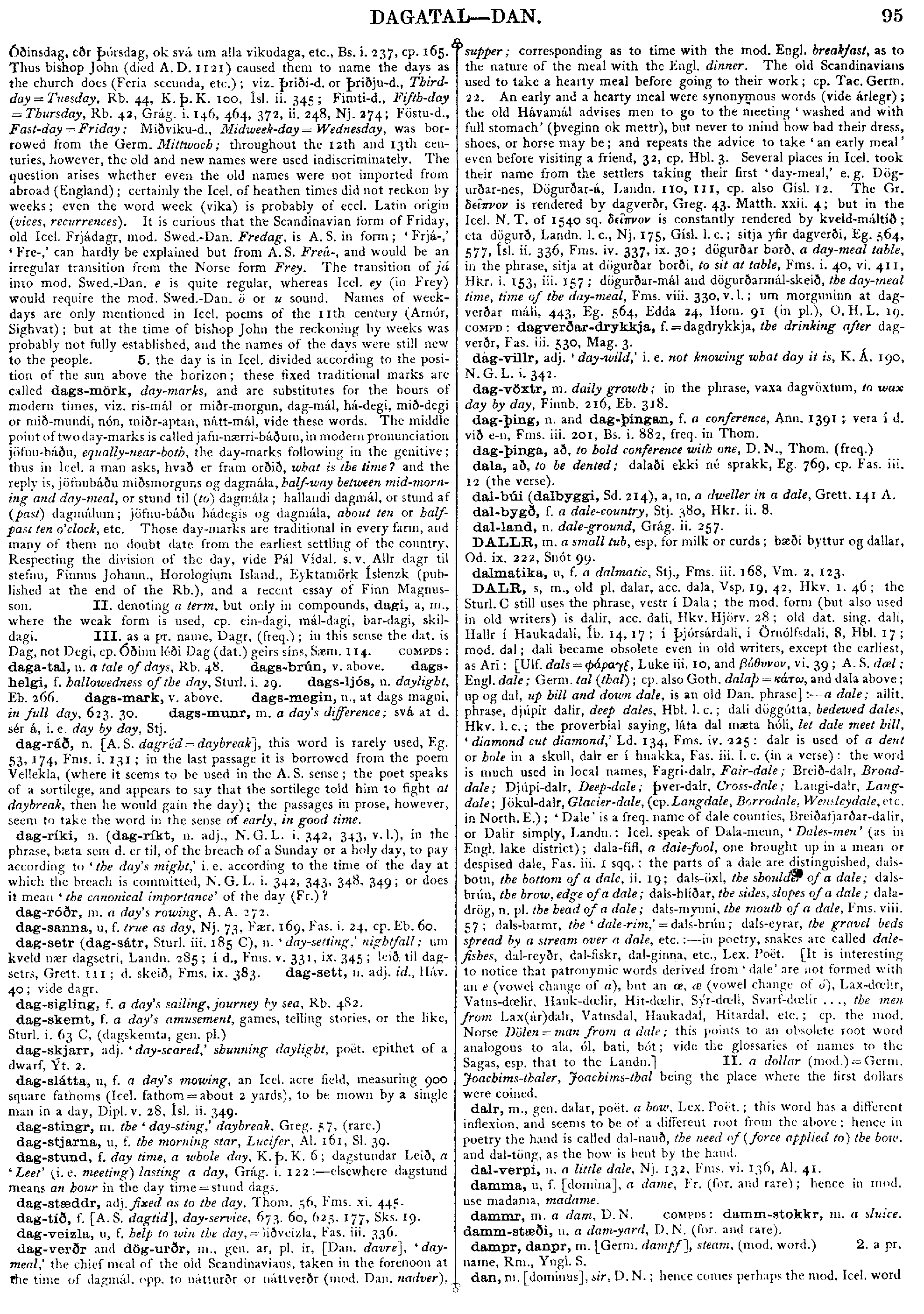
dag-þinga, að, to hold conference with one, D. N., Thom. (freq.)
| Result Page: |  |
Previous | 19 20 21 22 23 24 25 26 27 28 29 30 31 32 33 34 35 36 37 | Next |  |
Germanic Lexicon Project (main page)
This search system was written by
Sean Crist
Please consider
volunteering
to correct the data in these online dictionaries.
No rights reserved. Feel free to use these data in any way you please.