|
|

Search for hof again, using less strict matching (126 results)
|
Source: Cleasby/Vigfusson, page b0160, entry 4 View original page image as: [TIFF] [PNG] [View previous entry] [View next entry] |
[Comment on this entry] [View comments] |
The following entry has been hand-corrected once. |
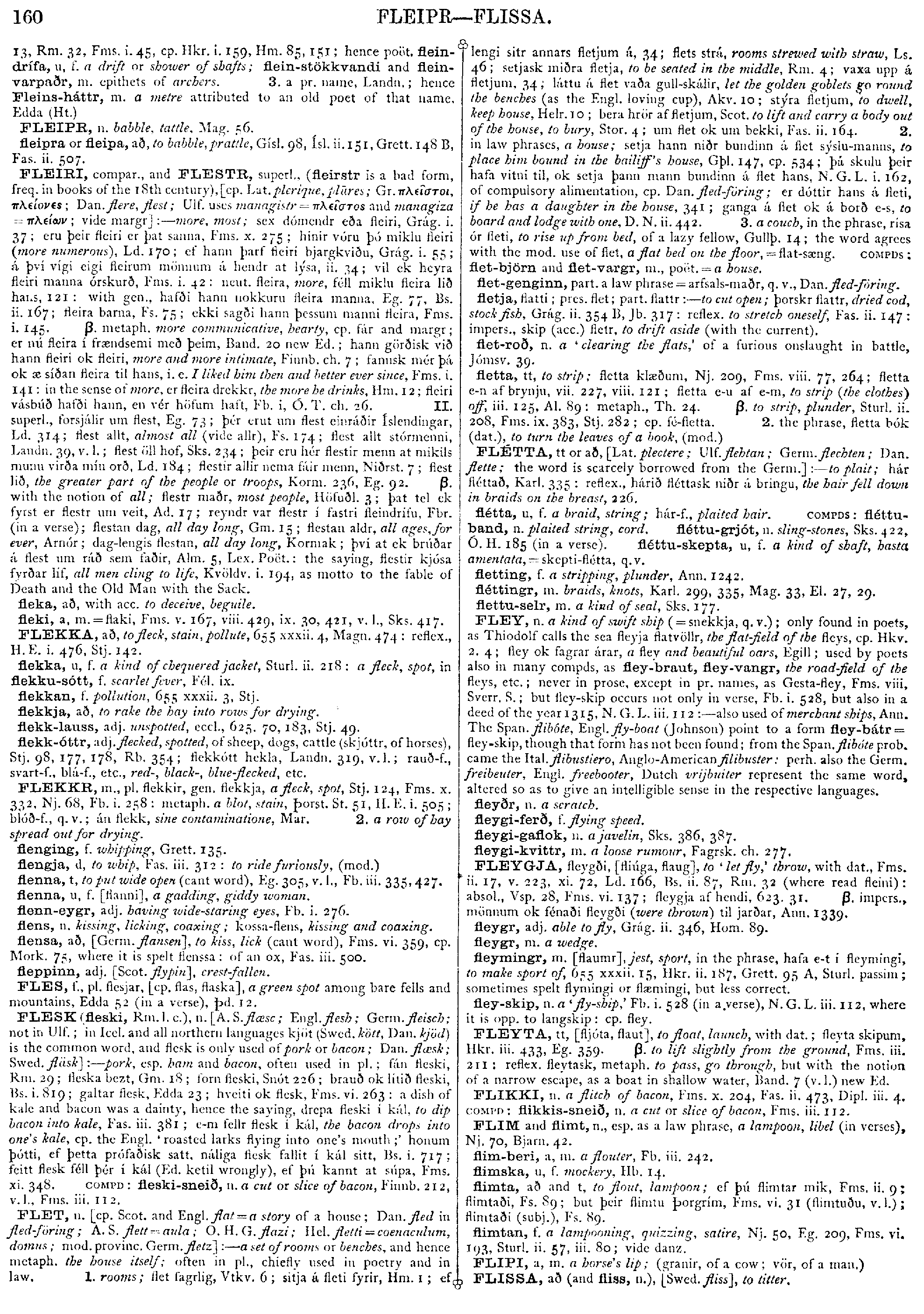
FLEIRI,
compar.,
and
FLESTR,
superl.,
(fleirstr
is
a
bad
form,
freq.
in
books
of
the
18th
century),
[cp.
Lat.
plerique,
pl res;
Gr.
GREEK,
GREEK;
Dan.
flere,
flest;
Ulf.
uses
managistr
=
GREEK
and
managiza
=
GREEK;
vide
margr]
:--
more,
most;
sex
dómendr
eða
fleiri,
Grág.
i.
37;
eru
þeir
fleiri
er
þat
sanna,
Fms.
x.
275;
hinir
vóru
þó
miklu
fleiri
(more
numerous),
Ld.
170;
ef
hann
þarf
fleiri
bjargkviðu,
Grág.
i.
55;
á
því
vígi
eigi
fleirum
mönnum
á
hendr
at
lýsa,
ii.
34;
vil
ek
heyra
fleiri
manna
órskurð,
Fms.
i.
42:
neut.
fleira,
more,
féll
miklu
fleira
lið
hans,
121:
with
gen.,
hafði
hann
nokkuru
fleira
manna,
Eg.
77,
Bs.
ii.
167;
fleira
barna,
Fs.
75;
ekki
sagði
hann
þessum
manni
fleira,
Fms.
i.
145.
res;
Gr.
GREEK,
GREEK;
Dan.
flere,
flest;
Ulf.
uses
managistr
=
GREEK
and
managiza
=
GREEK;
vide
margr]
:--
more,
most;
sex
dómendr
eða
fleiri,
Grág.
i.
37;
eru
þeir
fleiri
er
þat
sanna,
Fms.
x.
275;
hinir
vóru
þó
miklu
fleiri
(more
numerous),
Ld.
170;
ef
hann
þarf
fleiri
bjargkviðu,
Grág.
i.
55;
á
því
vígi
eigi
fleirum
mönnum
á
hendr
at
lýsa,
ii.
34;
vil
ek
heyra
fleiri
manna
órskurð,
Fms.
i.
42:
neut.
fleira,
more,
féll
miklu
fleira
lið
hans,
121:
with
gen.,
hafði
hann
nokkuru
fleira
manna,
Eg.
77,
Bs.
ii.
167;
fleira
barna,
Fs.
75;
ekki
sagði
hann
þessum
manni
fleira,
Fms.
i.
145.
 .
metaph.
more
communicative,
hearty,
cp.
fár
and
margr;
er
nú
fleira
í
frændsemi
með
þeim,
Band.
20
new
Ed.;
hann
görðisk
við
hann
fleiri
ok
fleiri,
more
and
more
intimate,
Finnb.
ch.
7;
fannsk
mér
þá
ok
æ
síðan
fleira
til
hans,
i.e.
I
liked
him
then
and
better
ever
since,
Fms.
i.
141:
in
the
sense
of
more,
er
fleira
drekkr,
the
more
he
drinks,
Hm.
12;
fleiri
vásbúð
hafði
hann,
en
vér
höfum
haft,
Fb.
i,
Ó.
T.
ch.
26.
II.
superl.,
forsjálir
um
flest,
Eg.
73;
þér
erut
um
flest
einráðir
Íslendingar,
Ld.
314;
flest
allt,
almost
all
(vide
allr),
Fs.
174;
flest
allt
stórmenni,
Landn.
39,
v.l.;
flest
öll
hof,
Sks.
234;
þeir
eru
hér
flestir
menn
at
mikils
munu
virða
mín
orð,
Ld.
184;
flestir
allir
nema
fáir
menn,
Niðrst.
7;
flest
lið,
the
greater
part
of
the
people
or
troops,
Korm.
236,
Eg.
92.
.
with
the
notion
of
all;
flestr
maðr,
most
people,
Höfuðl.
3;
þat
tel
ek
fyrst
er
flestr
um
veit,
Ad.
17;
reyndr
var
flestr
í
fastri
fleindrífu,
Fbr.
(in
a
verse);
flestan
dag,
all
day
long,
Gm.
15;
flestan
aldr,
all
ages,
for
ever,
Arnór;
dag-lengis
flestan,
all
day
long,
Kormak;
því
at
ek
brúðar
á
flest
um
ráð
sem
faðir,
Alm.
5,
Lex.
Poët.:
the
saying,
flestir
kjósa
fyrðar
líf,
all
men
cling
to
life,
Kvöldv.
i.
194,
as
motto
to
the
fable
of
Death
and
the
Old
Man
with
the
Sack.
.
metaph.
more
communicative,
hearty,
cp.
fár
and
margr;
er
nú
fleira
í
frændsemi
með
þeim,
Band.
20
new
Ed.;
hann
görðisk
við
hann
fleiri
ok
fleiri,
more
and
more
intimate,
Finnb.
ch.
7;
fannsk
mér
þá
ok
æ
síðan
fleira
til
hans,
i.e.
I
liked
him
then
and
better
ever
since,
Fms.
i.
141:
in
the
sense
of
more,
er
fleira
drekkr,
the
more
he
drinks,
Hm.
12;
fleiri
vásbúð
hafði
hann,
en
vér
höfum
haft,
Fb.
i,
Ó.
T.
ch.
26.
II.
superl.,
forsjálir
um
flest,
Eg.
73;
þér
erut
um
flest
einráðir
Íslendingar,
Ld.
314;
flest
allt,
almost
all
(vide
allr),
Fs.
174;
flest
allt
stórmenni,
Landn.
39,
v.l.;
flest
öll
hof,
Sks.
234;
þeir
eru
hér
flestir
menn
at
mikils
munu
virða
mín
orð,
Ld.
184;
flestir
allir
nema
fáir
menn,
Niðrst.
7;
flest
lið,
the
greater
part
of
the
people
or
troops,
Korm.
236,
Eg.
92.
.
with
the
notion
of
all;
flestr
maðr,
most
people,
Höfuðl.
3;
þat
tel
ek
fyrst
er
flestr
um
veit,
Ad.
17;
reyndr
var
flestr
í
fastri
fleindrífu,
Fbr.
(in
a
verse);
flestan
dag,
all
day
long,
Gm.
15;
flestan
aldr,
all
ages,
for
ever,
Arnór;
dag-lengis
flestan,
all
day
long,
Kormak;
því
at
ek
brúðar
á
flest
um
ráð
sem
faðir,
Alm.
5,
Lex.
Poët.:
the
saying,
flestir
kjósa
fyrðar
líf,
all
men
cling
to
life,
Kvöldv.
i.
194,
as
motto
to
the
fable
of
Death
and
the
Old
Man
with
the
Sack.
|
Source: Cleasby/Vigfusson, page b0194, entry 7 View original page image as: [TIFF] [PNG] [View previous entry] [View next entry] |
[Comment on this entry] [View comments] |
The following entry has been hand-corrected once. |
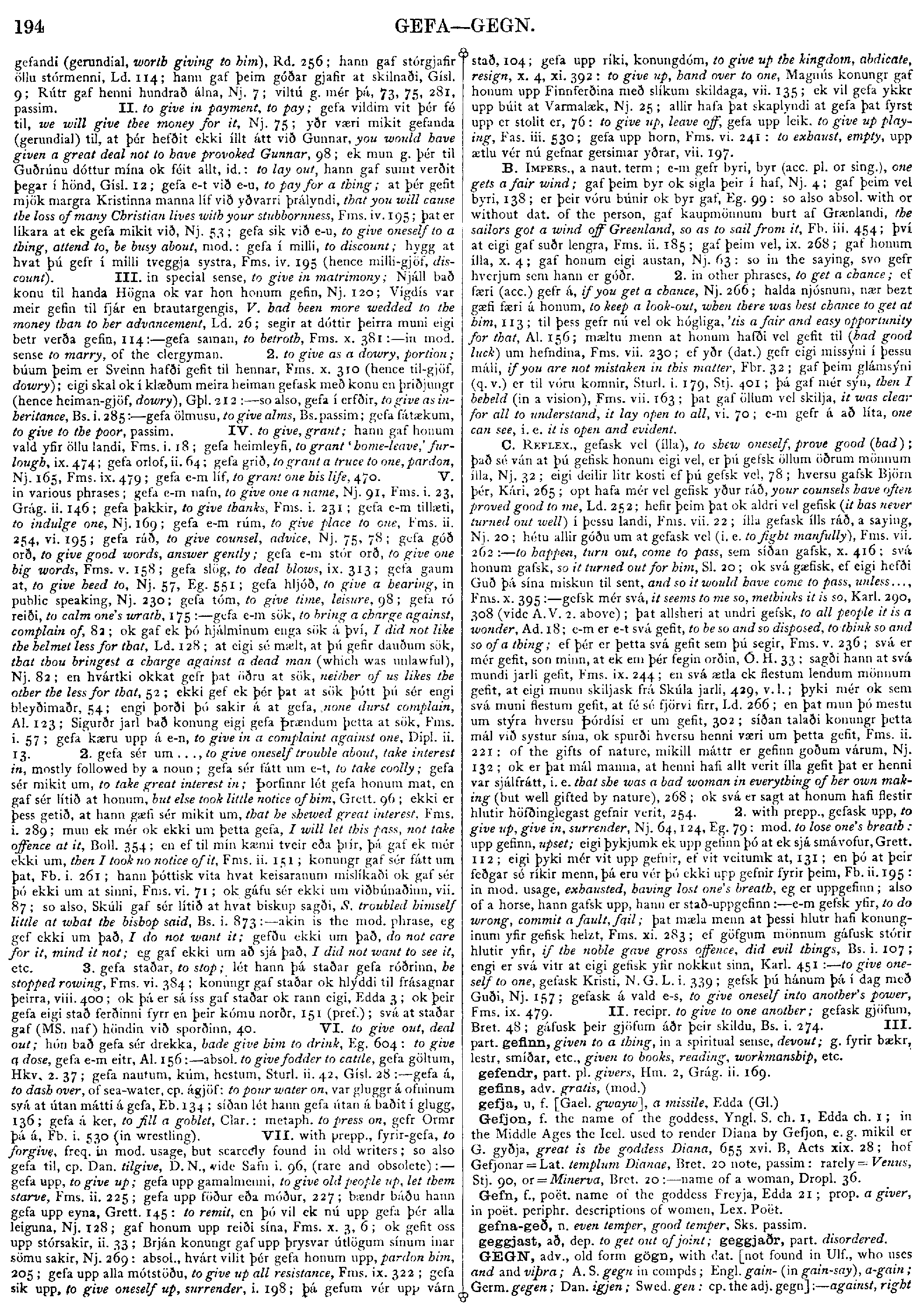
Gefjon, f. the name of the goddess, Yngl. S. ch. 1, Edda ch. 1; in the Middle Ages the Icel. used to render Diana by Gefjon, e.g. mikil er G. gyðja, great is the goddess Diana, 655 xvi. B, Acts xix. 28; hof Gefjonar = Lat. templum Dianas, Bret. 20 note, passim: rarely = Venus, Stj. 90, or = Minerva, Bret. 20 :-- name of a woman, Dropl. 36.
|
Source: Cleasby/Vigfusson, page b0209, entry 1 View original page image as: [TIFF] [PNG] [View previous entry] [View next entry] |
[Comment on this entry] [View comments] |
The following entry has been hand-corrected once. |
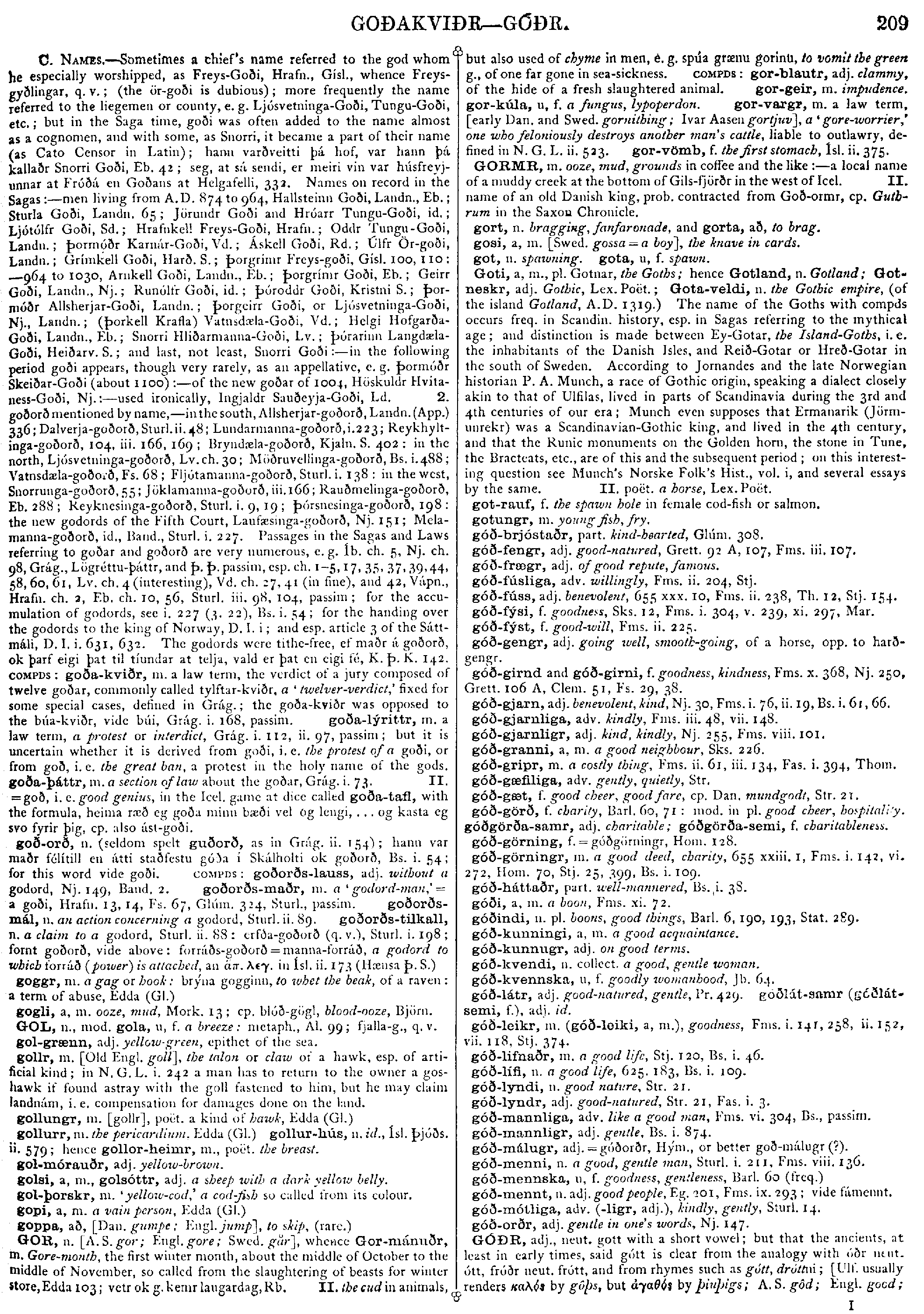
C. NAMES. -- Sometimes a chief's name referred to the god whom he especially worshipped, as Freys-Goði, Hrafn., Gísl., whence Freys-gyðlingar, q.v.; (the ör-goði is dubious); more frequently the name referred to the liegemen or county, e.g. Ljósvetninga-Goði, Tungu-Goði, etc.; but in the Saga time, goði was often added to the name almost as a cognomen, and with some, as Snorri, it became a part of their name (as Cato Censor in Latin); hann varðveitti þá hof, var hann þá kallaðr Snorri Goði, Eb. 42; seg, at sá sendi, er meiri vin var húsfreyjunnar at Fróðá en Goðans at Helgafelli, 332. Names on record in the Sagas :-- men living from A.D. 874 to 964, Hallsteinn Goði, Landn., Eb.; Sturla Goði, Landn. 65; Jörundr Goði and Hróarr Tungu-Goði, id.; Ljótólfr Goði, Sd.; Hrafnkell Freys-Goði, Hrafn.; Oddr Tungu-Goði, Landn.; Þormóðr Karnár-Goði, Vd.; Áskell Goði, Rd.; Úlfr Ör-goði, Landn.; Grímkell Goði, Harð. S.; Þorgrímr Freys-goði, Gísl. 100, 110: -- 964 to 1030, Arnkell Goði, Landn., Eb.; Þorgrímr Goði, Eb.; Geirr Goði, Landn., Nj.; Runólfr Goði, id.; Þóroddr Goði, Kristni S.; Þormóðr Allsherjar-Goði, Landn.; Þorgeirr Goði, or Ljósvetninga-Goði, Nj., Landn.; (Þorkell Krafla) Vatnsdæla-Goði, Vd.; Helgi Hofgarða-Goði, Landn., Eb.; Snorri Hlíðarmanna-Goði, Lv.; Þórarinn Langdæla-Goði, Heiðarv. S.; and last, not least, Snorri Goði :-- in the following period goði appears, though very rarely, as an appellative, e.g. Þormóðr Skeiðar-Goði (about 1100) :-- of the new goðar of 1004, Höskuldr Hvítaness-Goði, Nj. :-- used ironically, Ingjaldr Sauðeyja-Goði, Ld. 2. goðorð mentioned by name, -- in the south, Allsherjar-goðorð, Landn. (App.) 336; Dalverja-goðorð, Sturl. ii. 48; Lundarmanna-goðorð, i. 223; Reykhyltinga-goðorð, 104, iii. 166, 169; Bryndæla-goðorð, Kjaln. S. 402: in the north, Ljósvetninga-goðorð, Lv. ch. 30; Möðruvellinga-goðorð, Bs. i. 488; Vatnsdæla-goðorð, Fs. 68; Fljótamanna-goðorð, Sturl. i. 138: in the west, Snorrunga-goðorð, 55; Jöklamanna-goðorð, iii. 166; Rauðmelinga-goðorð, Eb. 288; Reyknesinga-goðorð, Sturl. i. 9, 19; Þórsnesinga-goðorð, 198: the new godords of the Fifth Court, Laufæsinga-goðorð, Nj. 151; Melamanna-goðorð, id., Band., Sturl. i. 227. Passages in the Sagas and Laws referring to goðar and goðorð are very numerous, e.g. Íb. ch. 5, Nj. ch. 98, Grág., Lögréttu-þáttr, and Þ. Þ. passim, esp. ch. 1-5, 17, 35, 37, 39, 44, 58, 60, 61, Lv. ch. 4 (interesting), Vd. ch. 27, 41 (in fine), and 42, Vápn., Hrafn. ch. 2, Eb. ch. 10, 56, Sturl. iii. 98, 104, passim; for the accumulation of godords, see i. 227 (3, 22), Bs. i. 54; for the handing over the godords to the king of Norway, D. I. i; and esp. article 3 of the Sáttmáli, D. I. i. 631, 632. The godords were tithe-free, ef maðr á goðorð, ok þarf eigi þat til tíundar at telja, vald er þat en eigi fé:, K. Þ. K. 142. COMPDS: goða-kviðr, m. a law term, the verdict of a jury composed of twelve goðar, commonly called tylftar-kviðr, a 'twelver-verdict,' fixed for some special cases, defined in Grág.; the goða-kviðr was opposed to the búa-kviðr, vide búi, Grág. i. 168, passim. goða-lýrittr, m. a law term, a protest or interdict, Grág. i. 112, ii. 97, passim; but it is uncertain whether it is derived from goði, i.e. the protest of a goði, or from goð, i.e. the great ban, a protest in the holy name of the gods. goða-þáttr, m. a section of law about the goðar, Grág. i. 73. II. = goð, i.e. good genius, in the Icel. game at dice called goða-tafl, with the formula, heima ræð eg goða minn bæði vel og lengi, ... og kasta eg svo fyrir þig, cp. also ást-goði.
|
Source: Cleasby/Vigfusson, page b0223, entry 19 View original page image as: [TIFF] [PNG] [View previous entry] [View next entry] |
[Comment on this entry] [View comments] |
The following entry has been hand-corrected once. |
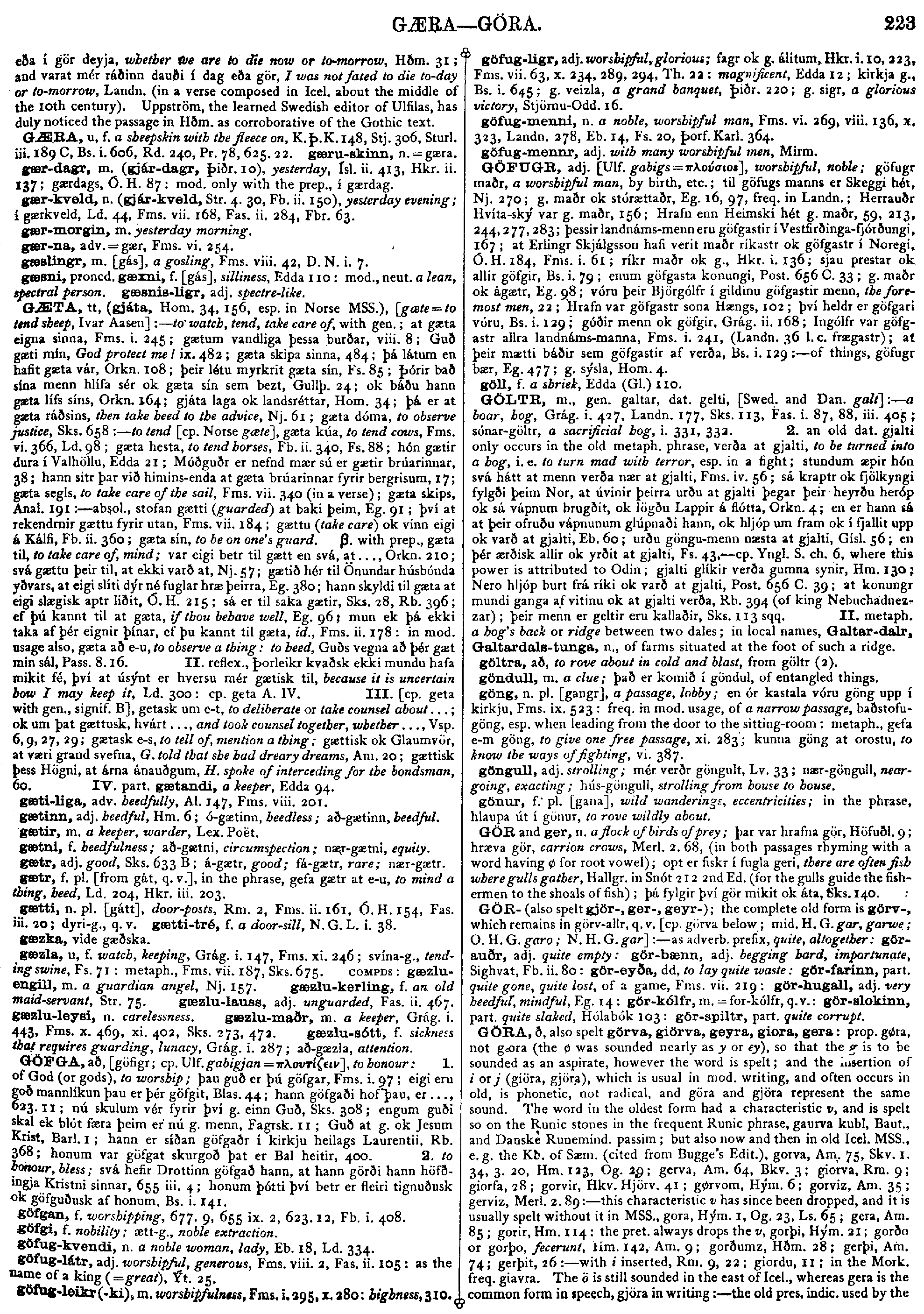
GÖFGA, að, [göfigr; cp. Ulf. gabigjan = GREEK], to honour: 1. of God (or gods), to worship; þau guð er þú göfgar, Fms. i. 97; eigi eru goð mannlíkun þau er þér göfgit, Blas. 44; hann göfgaði hof þau, er ..., 623. 11; nú skulum vér fyrir því g. einn Guð, Sks. 308; engum guði skal ek blót færa þeim ef nú g. menn, Fagrsk. 11; Guð at g. ok Jesum Krist, Barl. 1; hann er síðan göfgaðr í kirkju heilags Laurentii, Rb. 368; honum var göfgat skurgoð þat er Bal heitir, 400. 2. to honour, bless; svá hefir Drottinn göfgað hann, at hann görði hann höfðingja Kristni sinnar, 655 iii. 4; honum þótti því betr er fleiri tignuðusk ok göfguðusk af honum, Bs. i. 141.
|
Source: Cleasby/Vigfusson, page b0254, entry 15 View original page image as: [TIFF] [PNG] [View previous entry] [View next entry] |
[Comment on this entry] [View comments] |
The following entry has been hand-corrected once. |
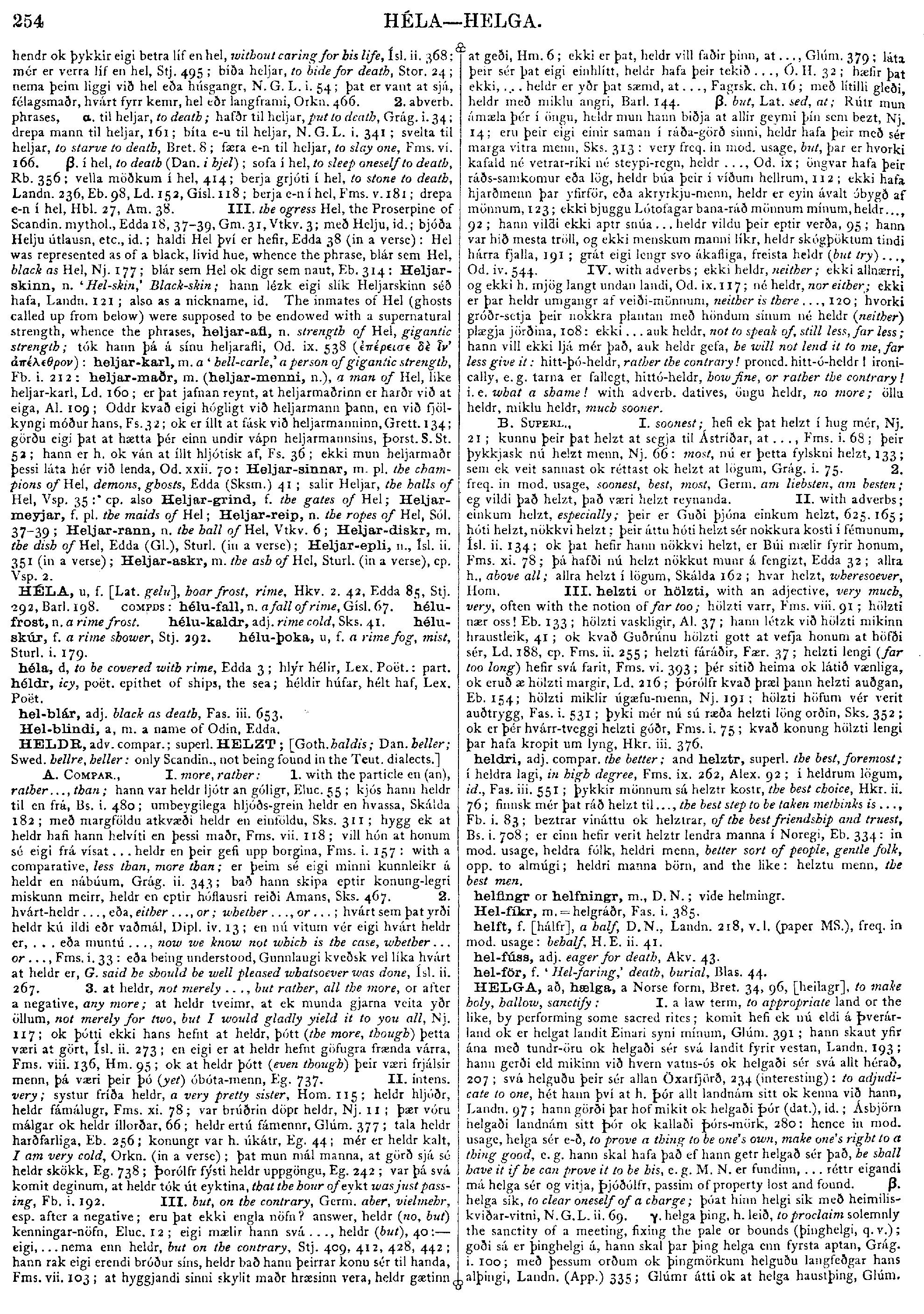
HELGA,
að,
hælga,
a
Norse
form,
Bret.
34,
96,
[heilagr],
to
make
holy,
hallow,
sanctify:
I.
a
law
term,
to
appropriate
land
or
the
like,
by
performing
some
sacred
rites:
komit
hefi
ek
nú
eldi
á
Þverárland
ok
er
helgat
landit
Einari
syni
mínum,
Glúm.
391;
hann
skaut
yfir
ana
með
tundr-öru
ok
helgaði
sér
svá
landit
fyrir
vestan,
Landn.
193;
hann
gerði
eld
mikinn
við
hvern
vatns-ós
ok
helgaði
sér
svá
allt
hérað,
207;
svá
helguðu
þeir
sér
allan
Öxarfjörð,
234
(interesting):
to
adjudicate
to
one,
hét
hann
því
at
h.
Þór
allt
landnám
sitt
ok
kenna
við
hann,
Landn.
97;
hann
görði
þar
hof
mikit
ok
helgaði
Þór
(dat.),
id.;
Ásbjörn
helgaði
landnám
sitt
Þór
ok
kallaði
Þórs-mörk,
280:
hence
in
mod.
usage,
helga
sér
e-ð,
to
prove
a
thing
to
be
one's
own,
make
one's
right
to
a
thing
good,
e.g.
hann
skal
hafa
það
ef
hann
getr
helgað
sér
það,
he
shall
have
it
if
he
can
prove
it
to
be
his,
e.g.
M.
N.
er
fundinn,
...
réttr
eigandi
má
helga
sér
og
vitja,
Þjóðólfr,
passim
of
property
lost
and
found.
.
helga
sik,
to
clear
oneself
of
a
charge;
þóat
hinn
helgi
sik
með
heimiliskviðar-vitni,
N.
G.
L.
ii.
69.
 .
helga
þing,
h.
leið
to
proclaim
solemnly
the
sanctity
of
a
meeting,
fixing
the
pale
or
bounds
(þinghelgi,
q.v.);
goði
sá
er
þinghelgi
á,
hann
skal
þar
þing
helga
enn
fyrsta
aptan,
Grág.
i.
100;
með
þessum
orðum
ok
þingmörkum
helguðu
langfeðgar
hans
alþingi,
Landn.
(App.)
335;
Glúmr
átti
ok
at
helga
haustþing,
Glúm.
.
helga
þing,
h.
leið
to
proclaim
solemnly
the
sanctity
of
a
meeting,
fixing
the
pale
or
bounds
(þinghelgi,
q.v.);
goði
sá
er
þinghelgi
á,
hann
skal
þar
þing
helga
enn
fyrsta
aptan,
Grág.
i.
100;
með
þessum
orðum
ok
þingmörkum
helguðu
langfeðgar
hans
alþingi,
Landn.
(App.)
335;
Glúmr
átti
ok
at
helga
haustþing,
Glúm.
|
Source: Cleasby/Vigfusson, page b0278, entry 1 View original page image as: [TIFF] [PNG] [View previous entry] [View next entry] |
[Comment on this entry] [View comments] |
The following entry has been hand-corrected once. |
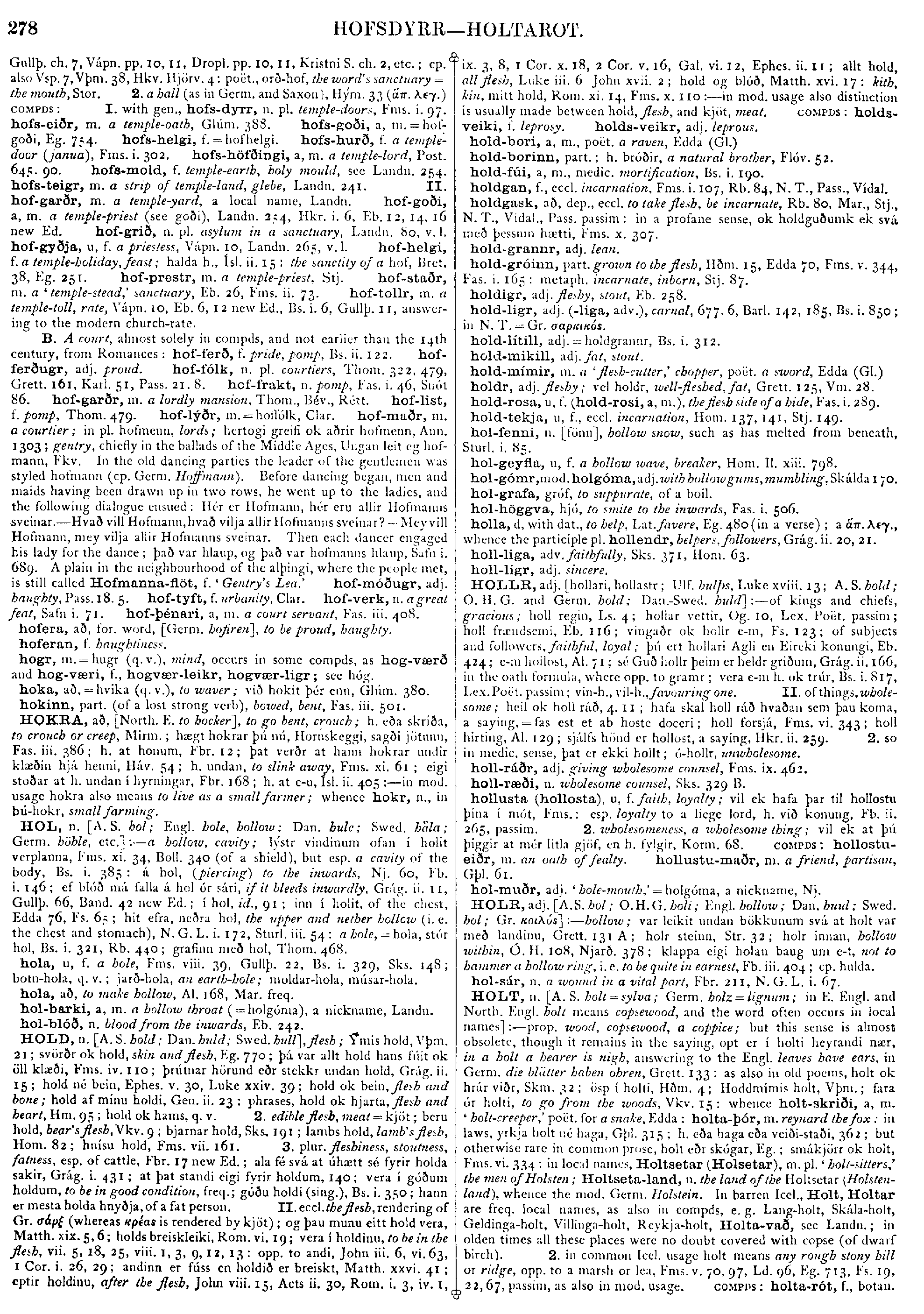
Gullþ. ch. 7, Vápn. pp. 10, 11, Dropl. pp. 10, 11, Kristni S. ch. 2, etc.; cp. also Vsp. 7, Vþm. 38, Hkv. Hjörv. 4: poët., orð-hof, the word's sanctuary = the mouth, Stor. 2. a hall (as in Germ. and Saxon), Hým. 33 (GREEK.) COMPDS: I. with gen., hofs-dyrr, n. pl. temple-doors, Fms. i. 97. hofs-eiðr, m. a temple-oath, Glúm. 388. hofs-goði, a, m. = hofgoði, Eg. 754. hofs-helgi, f. = hofhelgi. hofs-hurð, f. a temple-door (janua), Fms. i. 302. hofs-höfðingi, a, m. a temple-lord, Post. 645. 90. hofs-mold, f. temple-earth, holy mould, see Landn. 254. hofs-teigr, m. a strip of temple-land, glebe, Landn. 241. II. hof-garðr, m. a temple-yard, a local name, Landn. hof-goði, a, m. a temple-priest (see goði), Landn. 254, Hkr. i. 6, Eb. 12, 14, 16 new Ed. hof-grið, n. pl. asylum in a sanctuary, Landn. 80, v.l. hof-gyðja, u, f. a priestess, Vápn. 10, Landn. 265, v.l. hof-helgi, f. a temple-holiday, feast; halda h., Ísl. ii. 15: the sanctity of a hof, Bret. 38, Eg. 251. hof-prestr, m. a temple-priest, Stj. hof-staðr, m. a 'temple-stead,' sanctuary, Eb. 26, Fms. ii. 73. hof-tollr, m. a temple-toll, rate, Vápn. 10, Eb. 6, 12 new Ed., Bs. i. 6, Gullþ. 11, answering to the modern church-rate.
|
Source: Cleasby/Vigfusson, page b0280, entry 20 View original page image as: [TIFF] [PNG] [View previous entry] [View next entry] |
[Comment on this entry] [View comments] |
The following entry has been hand-corrected once. |
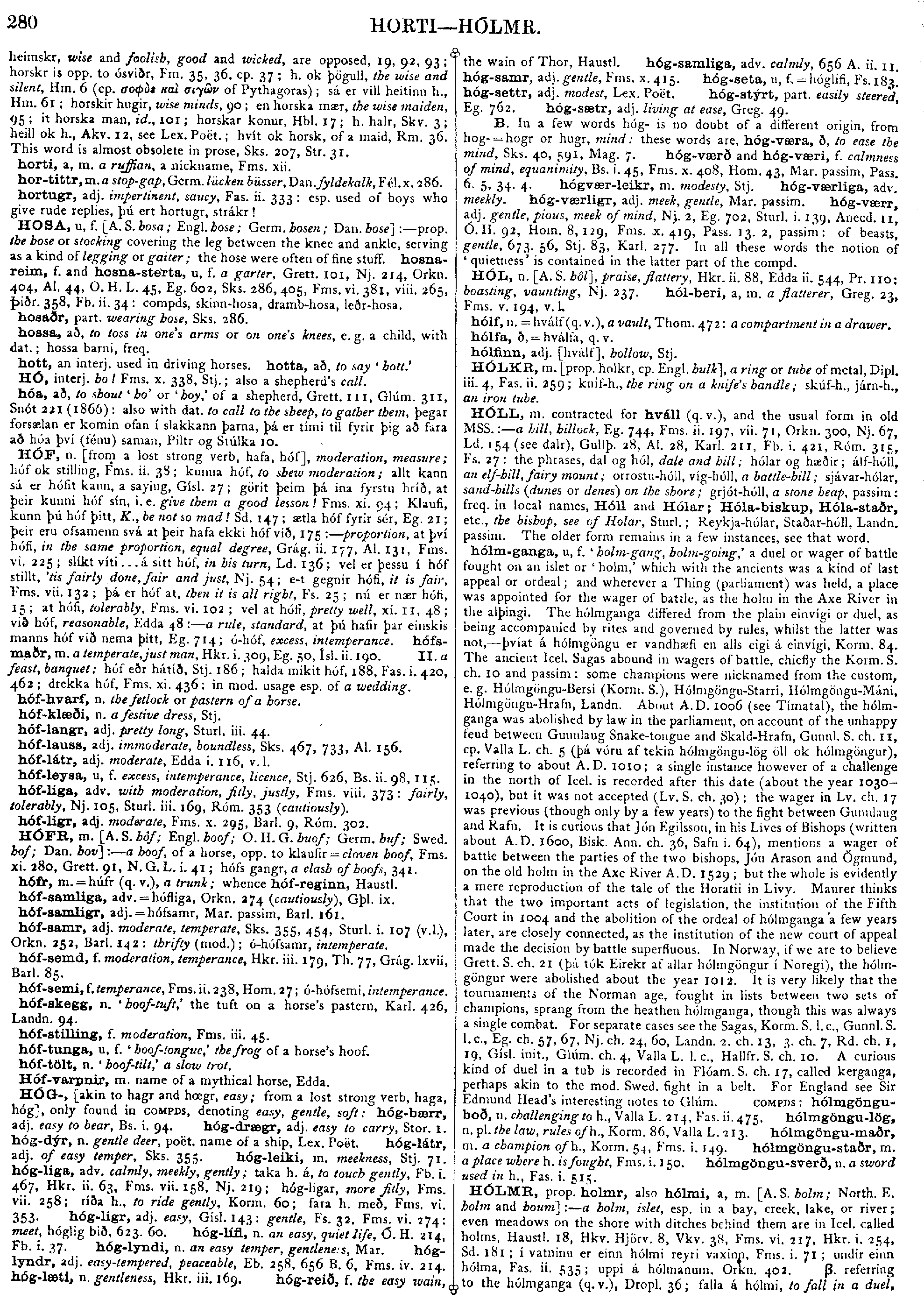
HÓFR, m. [A. S. hôf; Engl. hoof; O. H. G. huof; Germ. huf; Swed. hof; Dan. hov] :-- a hoof, of a horse, opp. to klaufir = cloven hoof, Fms. xi. 280, Grett. 91, N. G. L. i. 41; hófs gangr, a clash of hoofs, 341.
|
Source: Cleasby/Vigfusson, page b0292, entry 18 View original page image as: [TIFF] [PNG] [View previous entry] [View next entry] |
[Comment on this entry] [View comments] |
The following entry has been hand-corrected once. |
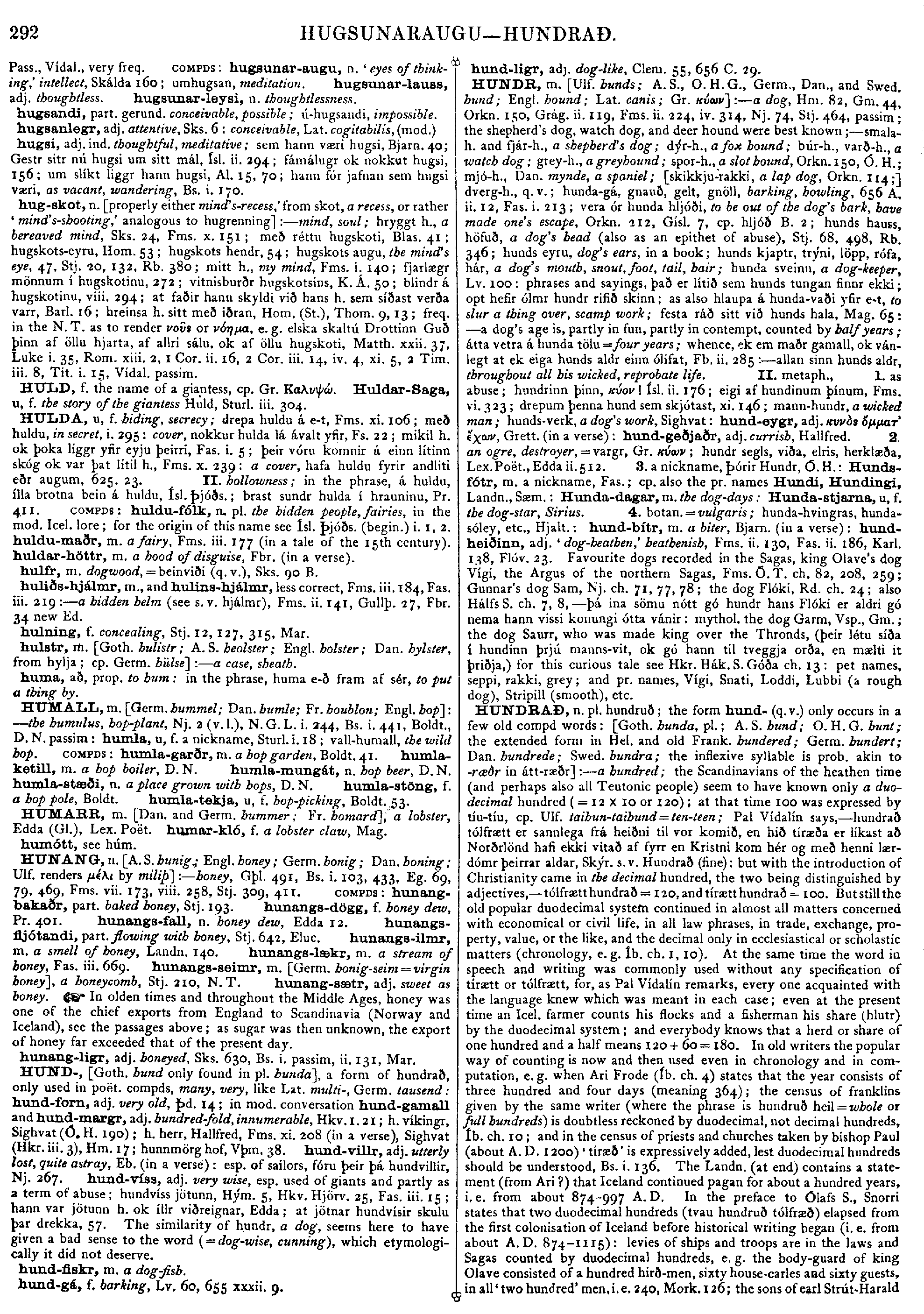
HUND-, [Goth. hund only found in pl. hunda], a form of hundrað, only used in poët. compds, many, very, like Lat. multi-, Germ. tausend: hund-forn, adj. very old, Þd. 14; in mod. conversation hund-gamall and hund-margr, adj. hundred-fold, innumerable, Hkv. 1. 21; h. víkingr, Sighvat (Ó. H. 190); h. herr, Hallfred, Fms. xi. 208 (in a verse), Sighvat (Hkr. iii. 3), Hm. 17; hunnmörg hof, Vþm. 38. hund-villr, adj. utterly lost, quite astray, Eb. (in a verse): esp. of sailors, fóru þeir þá hundvillir, Nj. 267. hund-víss, adj. very wise, esp. used of giants and partly as a term of abuse; hundvíss jötunn, Hým. 5, Hkv. Hjörv. 25, Fas. iii. 15; hann var jötunn h. ok íllr viðreignar, Edda; at jötnar hundvísir skulu þar drekka, 57. The similarity of hundr, a dog, seems here to have given a bad sense to the word ( = dog-wise, cunning), which etymologically it did not deserve.
|
Source: Cleasby/Vigfusson, page b0304, entry 53 View original page image as: [TIFF] [PNG] [View previous entry] [View next entry] |
[Comment on this entry] [View comments] |
The following entry has been hand-corrected once. |
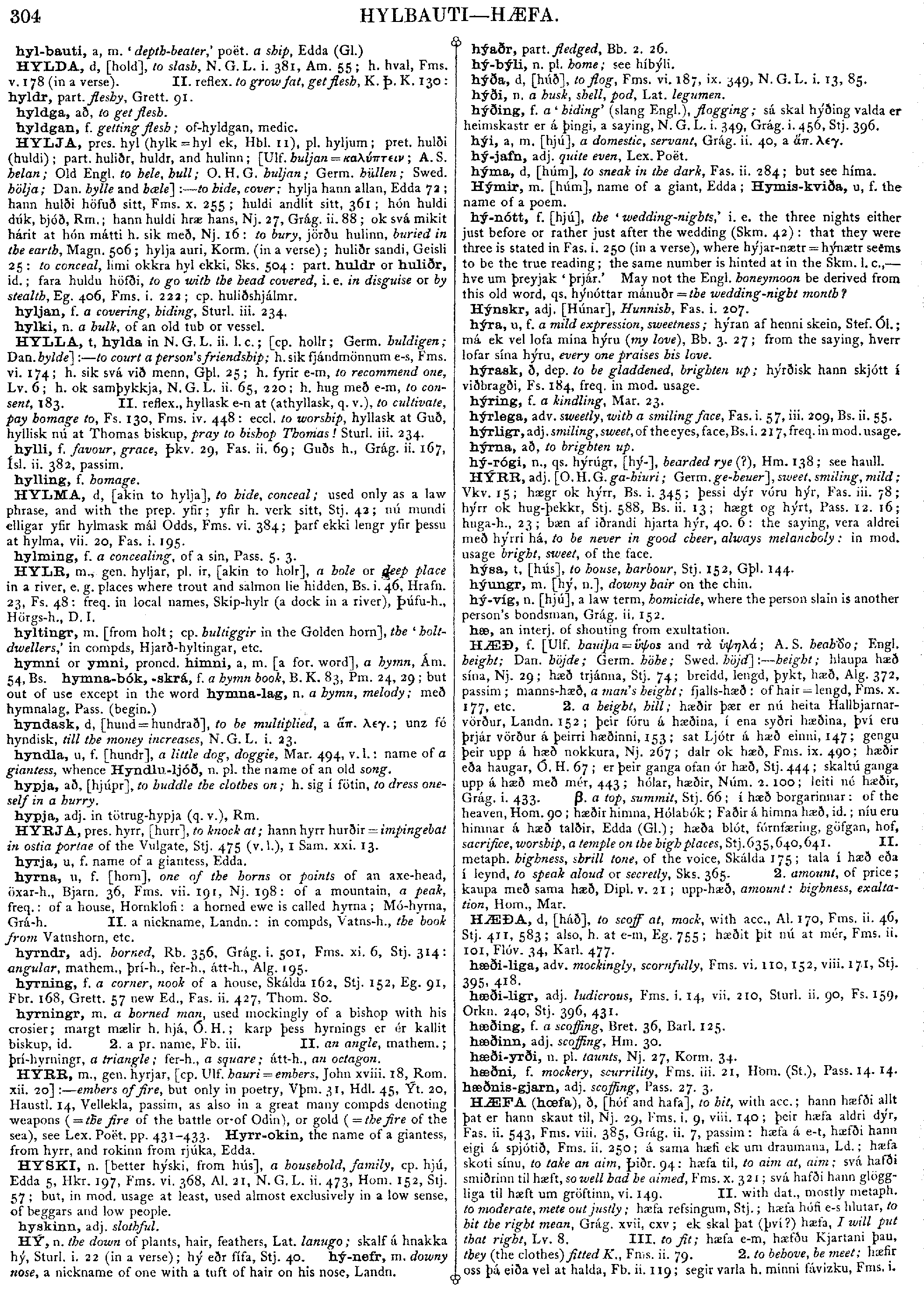
HÆÐ,
f.
[Ulf.
hauiþa
=
GREEK
and
GREEK;
A.
S.
heahðo;
Engl.
height;
Dan.
höjde;
Germ.
höhe;
Swed.
höjd]
:--
height;
hlaupa
hæð
sína,
Nj.
29;
hæð
trjánna,
Stj.
74;
breidd,
lengd,
þykt,
hæð,
Alg.
372,
passim;
manns-hæð,
a
man's
height;
fjalis-hæð:
of
hair
=
lengd,
Fms.
x.
177,
etc.
2.
a
height,
hill;
hæðir
þær
er
nú
heita
Hallbjarnar-vörður,
Landn.
152;
þeir
fóru
á
hæðina,
í
ena
syðri
hæðina,
því
eru
þrjár
vörður
á
þeirri
hæðinni,
153;
sat
Ljótr
á
hæð
einni,
147;
gengu
þeir
upp
á
hæð
nokkura,
Nj.
267;
dalr
ok
hæð,
Fms.
ix.
490;
hæðir
eða
haugar,
Ó.
H.
67;
er
þeir
ganga
ofan
ór
hæð,
Stj.
444;
skaltú
ganga
upp
á
hæð
með
mér,
443;
hólar,
hæðir,
Núm.
2.
100;
leiti
né
hæðir,
Grág.
i.
433.
.
a
top,
summit,
Stj.
66;
í
hæð
borgarinnar:
of
the
heaven,
Hom.
90;
hæðir
himna,
Hólabók;
Faðir
á
himna
hæð,
id.;
níu
eru
himnar
á
hæð
talðir,
Edda
(Gl.);
hæða
blót,
fórnfæring,
göfgan,
hof,
sacrifice,
worship,
a
temple
on
the
high
places,
Stj.
635,
640,
641.
II.
metaph.
highness,
shrill
tone,
of
the
voice,
Skálda
175;
tala
í
hæð
eða
í
leynd,
to
speak
aloud
or
secretly,
Sks.
365.
2.
amount,
of
price;
kaupa
með
sama
hæð,
Dipl.
v.
21;
upp-hæð,
amount:
highness,
exaltation,
Hom.,
Mar.
|
Source: Cleasby/Vigfusson, page b0311, entry 12 View original page image as: [TIFF] [PNG] [View previous entry] [View next entry] |
[Comment on this entry] [View comments] |
The following entry has been hand-corrected once. |
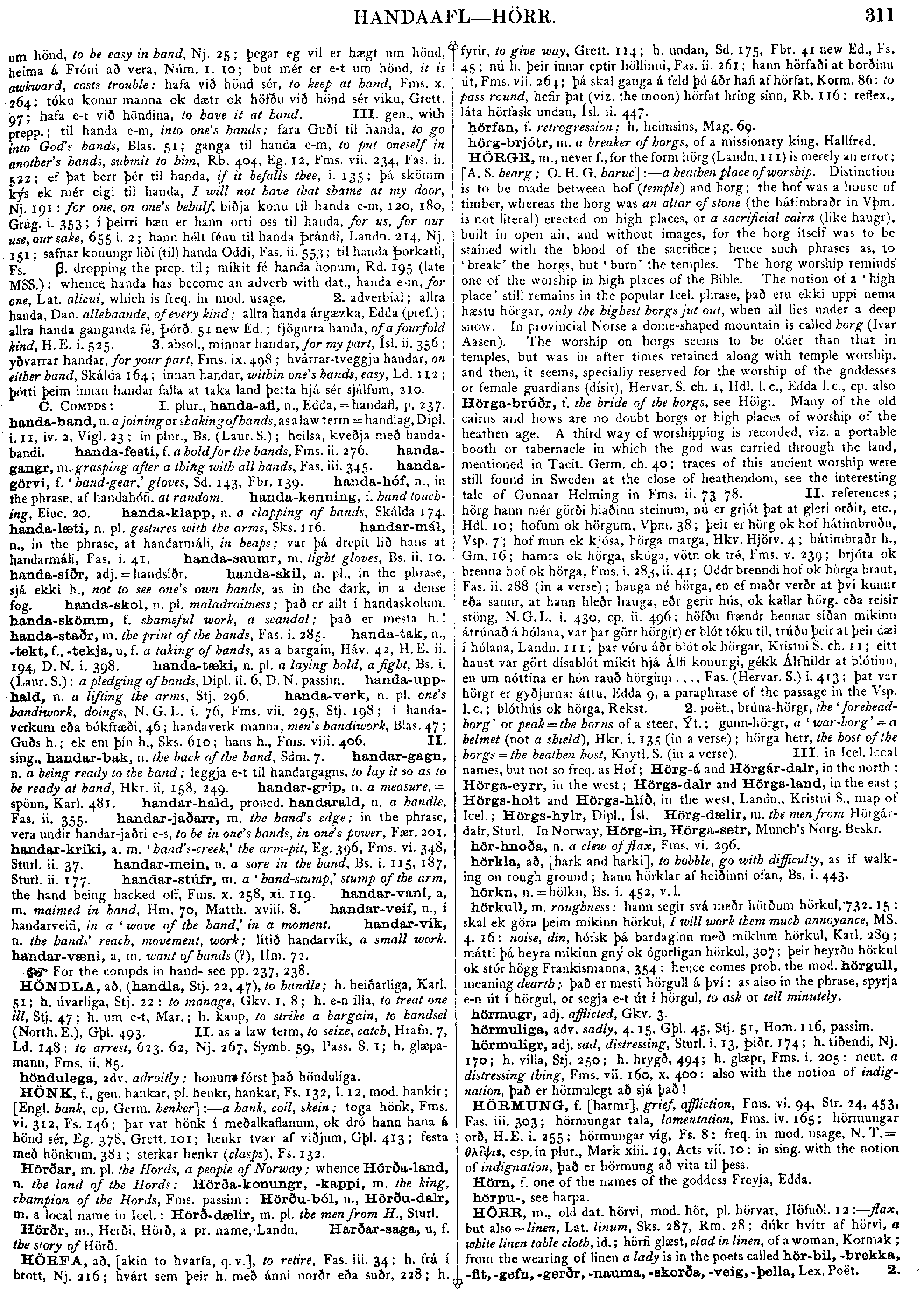
HÖRGR, m., never f., for the form hörg (Landn. 111) is merely an error; [A. S. hearg; O. H. G. haruc] :-- a heathen place of worship. Distinction is to be made between hof (temple) and horg; the hof was a house of timber, whereas the horg was an altar of stone (the hátimbraðr in Vþm. is not literal) erected on high places, or a sacrificial cairn (like haugr), built in open air, and without images, for the horg itself was to be stained with the blood of the sacrifice; hence such phrases as, to 'break' the horgs, but 'burn' the temples. The horg worship reminds one of the worship in high places of the Bible. The notion of a 'high place' still remains in the popular Icel. phrase, það eru ekki uppi nema hæstu hörgar, only the highest horgs jut out, when all lies under a deep snow. In provincial Norse a dome-shaped mountain is called horg (Ivar Aasen). The worship on horgs seems to be older than that in temples, but was in after times retained along with temple worship, and then, it seems, specially reserved for the worship of the goddesses or female guardians (dísir), Hervar. S. ch. 1, Hdl. l.c., Edda l.c., cp. also Hörga-brúðr, f. the bride of the horgs, see Hölgi. Many of the old cairns and hows are no doubt horgs or high places of worship of the heathen age. A third way of worshipping is recorded, viz. a portable booth or tabernacle in which the god was carried through the land, mentioned in Tacit. Germ. ch. 40; traces of this ancient worship were still found in Sweden at the close of heathendom, see the interesting tale of Gunnar Helming in Fms. ii. 73-78. II. references; hörg hann mér görði hlaðinn steinum, nú er grjót þat at gleri orðit, etc., Hdl. 10; hofum ok hörgum, Vþm. 38; þeir er hörg ok hof hátimbruðu, Vsp. 7; hof mun ek kjósa, hörga marga, Hkv. Hjörv. 4; hátimbraðr h., Gm. 16; hamra ok hörga, skóga, vötn ok tré, Fms. v. 239; brjóta ok brenna hof ok hörga, Fms. i. 283, ii. 41; Oddr brenndi hof ok hörga braut, Fas. ii. 288 (in a verse); hauga né hörga, en ef maðr verðr at því kunnr eða sannr, at hann hleðr hauga, eðr gerir hús, ok kallar hörg, eða reisir stöng, N. G. L. i. 430, cp. ii. 496; höfðu frændr hennar síðan mikinn átrúnað á hólana, var þar görr UNCERTAIN hörg(r) er blót tóku til, trúðu þeir at þeir dæi í hólana, Landn. 111; þar vóru áðr blót ok hörgar, Kristni S. ch. 11; eitt haust var gört dísablót mikit hjá Álfi konungi, gékk Álfhildr at blótinu, en um nóttina er hón rauð hörginn ..., Fas. (Hervar. S.) i. 413; þat var hörgr er gyðjurnar áttu, Edda 9, a paraphrase of the passage in the Vsp. l.c.; blóthús ok hörga, Rekst. 2. poët., brúna-hörgr, the 'forehead-horg' or peak = the horns of a steer, Ýt.; gunn-hörgr, a 'war-horg' = a helmet (not a shield), Hkr. i. 135 (in a verse); hörga herr, the host of the horgs = the heathen host, Knytl. S. (in a verse). III. in Icel. local names, but not so freq. as Hof; Hörg-á and Hörgár-dalr, in the north; Hörga-eyrr, in the west; Hörgs-dalr and Hörgs-land, in the east; Hörgs-holt and Hörgs-hlíð, in the west, Landn., Kristni S., map of Icel.; Hörgs-hylr, Dipl., Ísl. Hörg-dælir, m. the men from Hörgárdalr, Sturl. In Norway, Hörg-in, Hörga-setr, Munch's Norg. Beskr.
| Result Page: |  |
Previous | 1 2 3 4 5 6 7 | Next |  |
Germanic Lexicon Project (main page)
This search system was written by
Sean Crist
Please consider
volunteering
to correct the data in these online dictionaries.
No rights reserved. Feel free to use these data in any way you please.