|
|

|
Source: Cleasby/Vigfusson, page b0774, entry 103 View original page image as: [TIFF] [PNG] [View previous entry] [View next entry] |
[Comment on this entry] [View comments] |
The following entry has been hand-corrected once. |
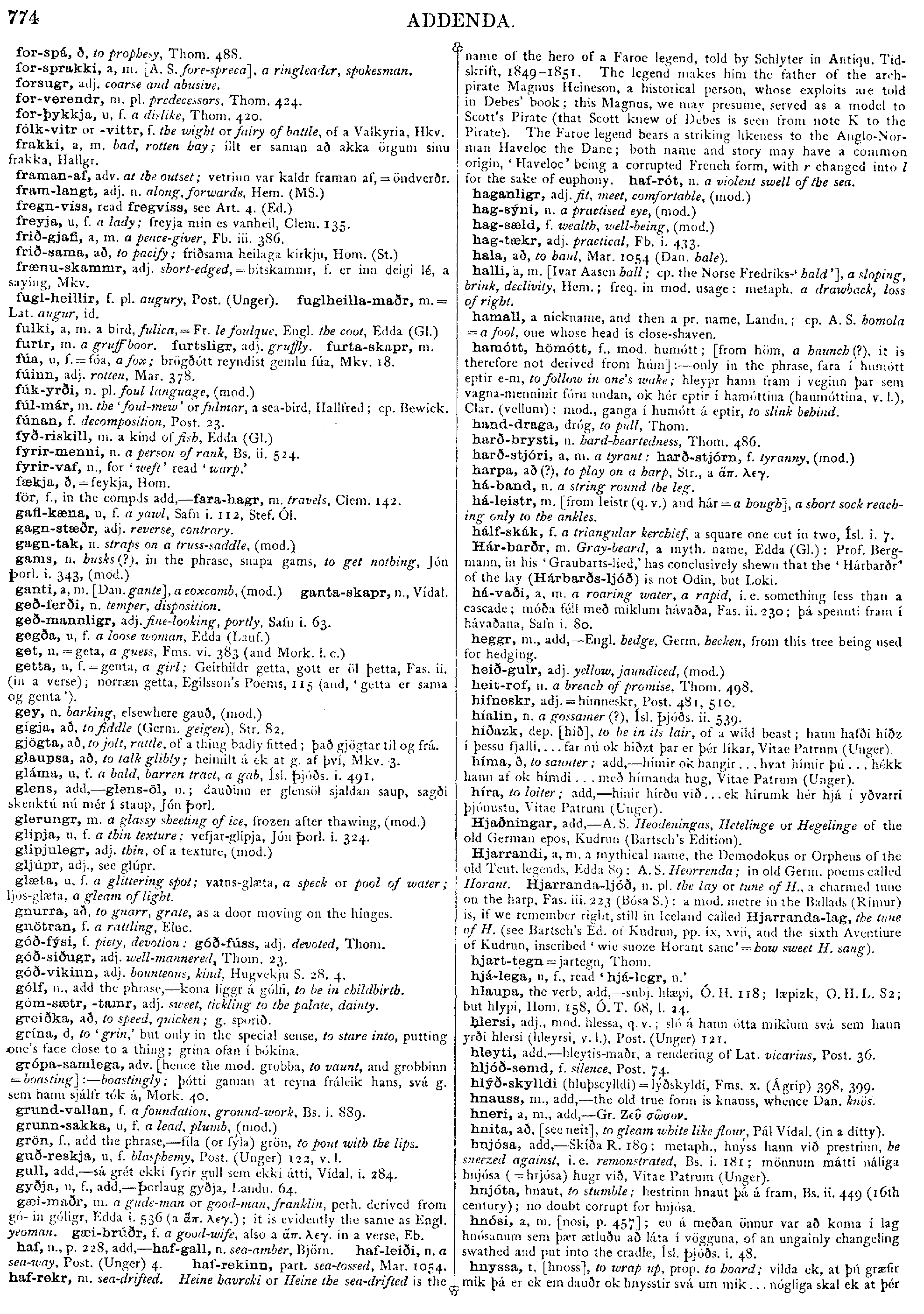
hneri, a, m., add, -- Gr. GREEK.
|
Source: Torp, page b0100, entry 8 View original page image as: [TIFF] [PNG] [View previous entry] [View next entry] |
[Comment on this entry] [View comments] |
The following entry has been hand-corrected once. |
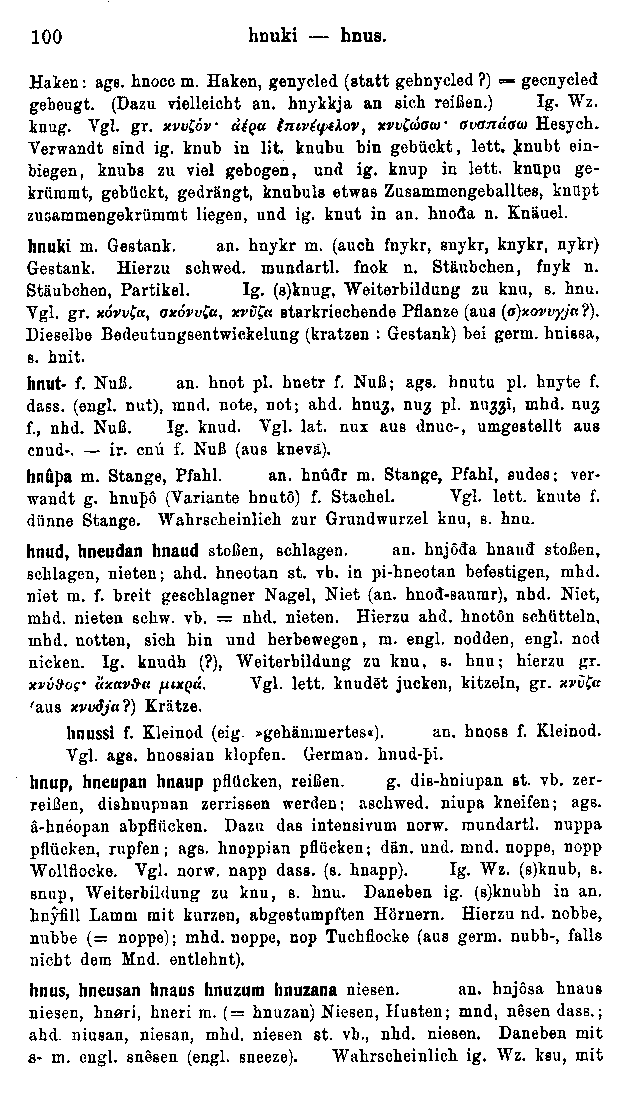
hnus,
hneusan
hnaus
hnuzum
hnuzana
niesen.
an.
hnjôsa
hnaus
niesen,
hnøri,
hneri
m.
(=
hnuzan)
Niesen,
Husten;
mnd.
nêsen
dass.;
ahd.
niusan,
niesan,
mhd.
niesen
st.
vb.,
nhd.
niesen.
Daneben
mit
s-
m.
engl.
snêsen
(engl.
sneeze).
Wahrscheinlich
ig.
Wz.
ksu,
mit

 uti
niest.
Eigentlich
wohl
scharren,
reiben
(vom
scharrenden
Geräusch).
Vgl.
nu.
Umstellung
zu
sk
in
lit.
skiaud
uti
niest.
Eigentlich
wohl
scharren,
reiben
(vom
scharrenden
Geräusch).
Vgl.
nu.
Umstellung
zu
sk
in
lit.
skiaud ti
niesen,
lett.
schkaut.
Möglich
wäre
freilich
auch
ig.
(s)knu-s,
Weiterbildung
zu
knu,
s.
hnu.
Zu
dieser
Wz.
(s)knus
eig.
scharren,
reiben,
gehört
jedenfalls
an.
hnjôskr
und
fnjôskr
m.
Feuerschwamm.
ti
niesen,
lett.
schkaut.
Möglich
wäre
freilich
auch
ig.
(s)knu-s,
Weiterbildung
zu
knu,
s.
hnu.
Zu
dieser
Wz.
(s)knus
eig.
scharren,
reiben,
gehört
jedenfalls
an.
hnjôskr
und
fnjôskr
m.
Feuerschwamm.
[Translate the German words]
|
Source: Cleasby/Vigfusson, page b0275, entry 47 View original page image as: [TIFF] [PNG] [View previous entry] [View next entry] |
[Comment on this entry] [View comments] |
The following entry has been hand-corrected once. |
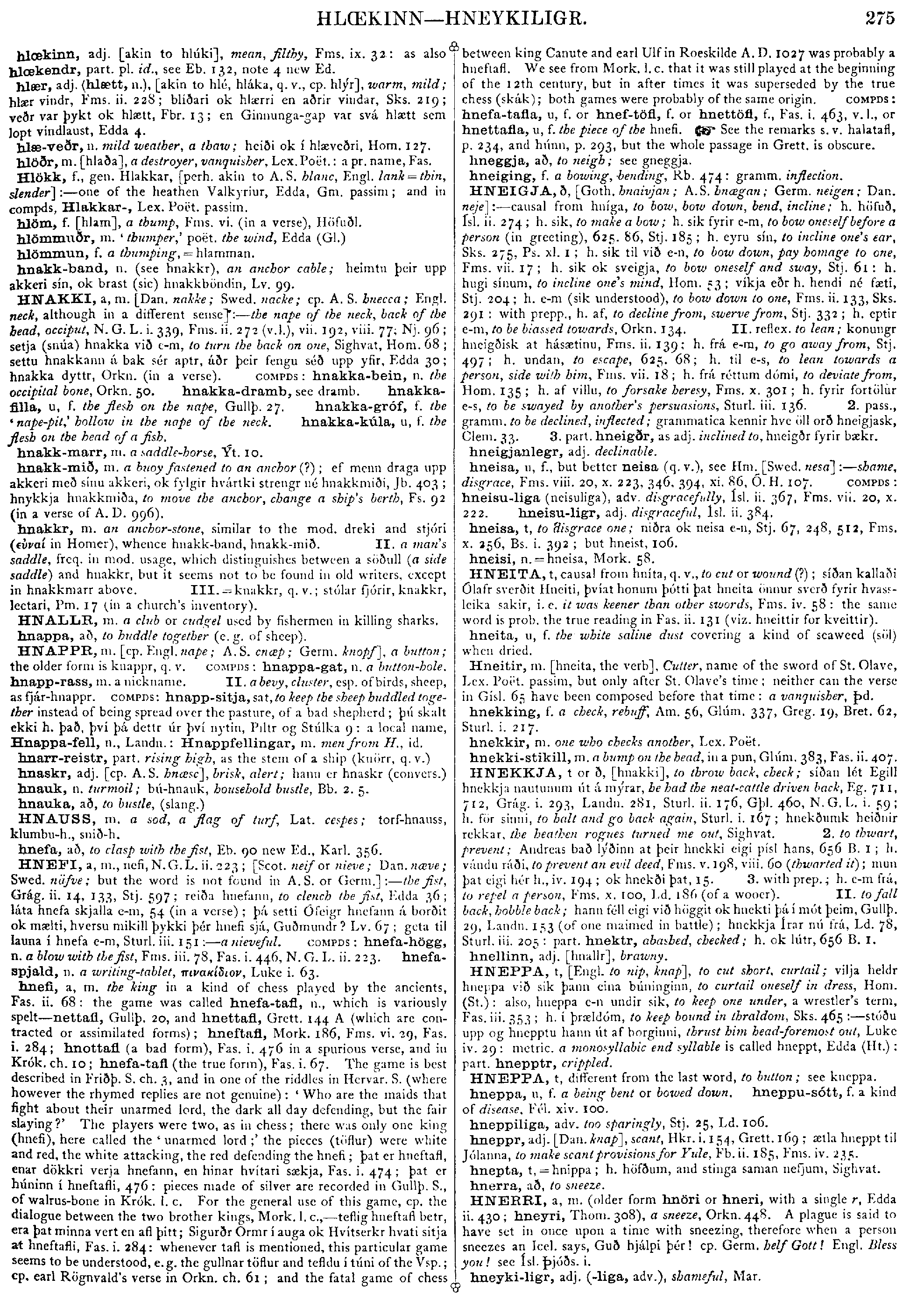
HNERRI, a, m. (older form hnöri or hneri, with a single r, Edda. ii. 430; hneyri, Thom. 308), a sneeze, Orkn. 448. A plague is said to have set in once upon a time with sneezing, therefore when a person sneezes an Icel. says, Guð hjálpi þér! cp. Germ. helf Gott! Engl. Bless you ! see Ísl. Þjóðs. i.
|
Source: Cleasby/Vigfusson, page b0277, entry 2 View original page image as: [TIFF] [PNG] [View previous entry] [View next entry] |
[Comment on this entry] [View comments] |
The following entry has been hand-corrected once. |
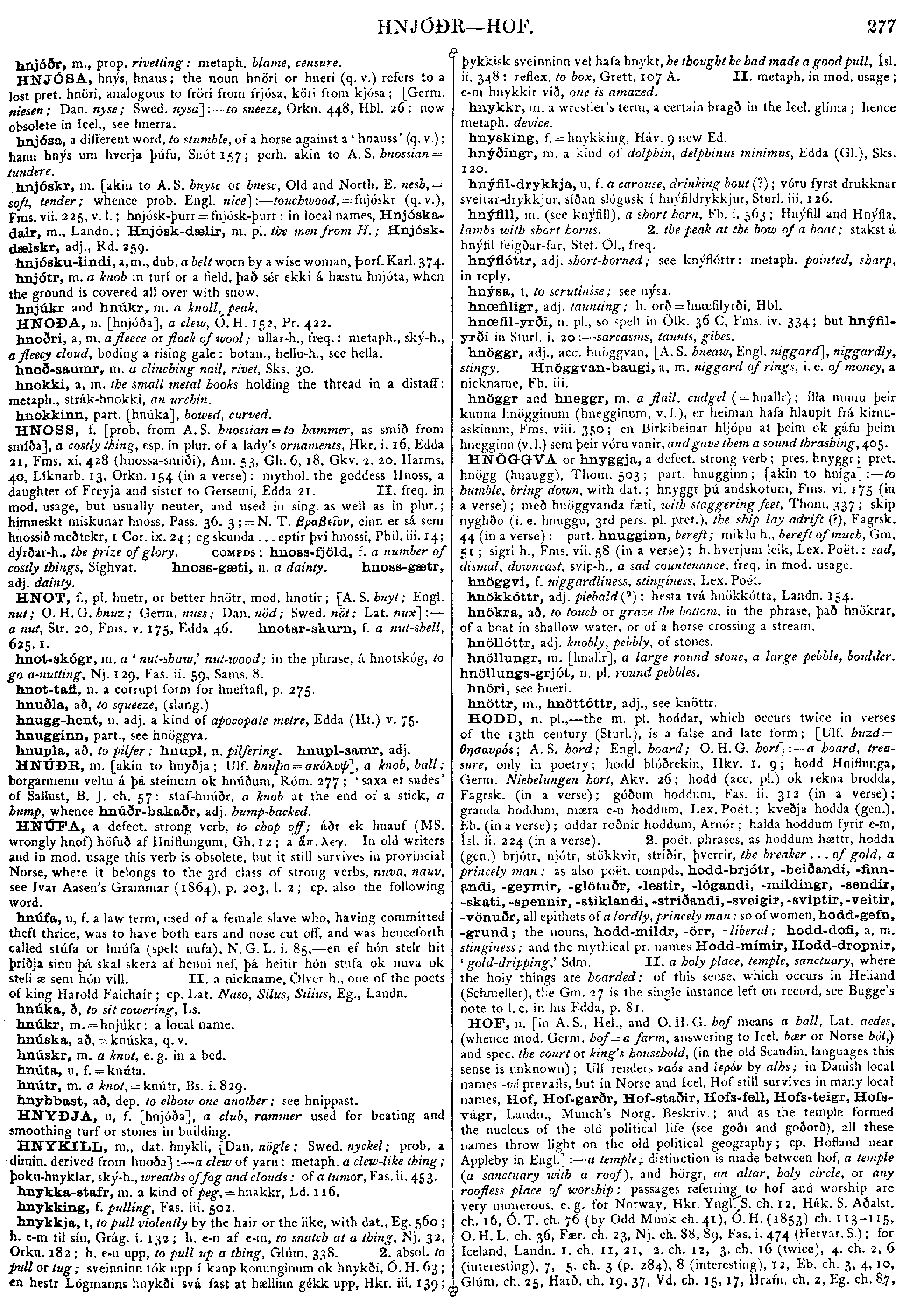
HNJÓSA, hnýs, hnaus; the noun hnöri or hneri (q.v.) refers to a lost pret. hnöri, analogous to fröri from frjósa, köri from kjósa; [Germ. niesen; Dan. nyse; Swed. nysa] :-- to sneeze, Orkn. 448, Hbl. 26: now obsolete in Icel., see hnerra.
|
Source: Cleasby/Vigfusson, page b0277, entry 53 View original page image as: [TIFF] [PNG] [View previous entry] [View next entry] |
[Comment on this entry] [View comments] |
The following entry has been hand-corrected once. |
|
Source: Cleasby/Vigfusson, page b0299, entry 14 View original page image as: [TIFF] [PNG] [View previous entry] [View next entry] |
[Comment on this entry] [View comments] |
The following entry has been hand-corrected once. |
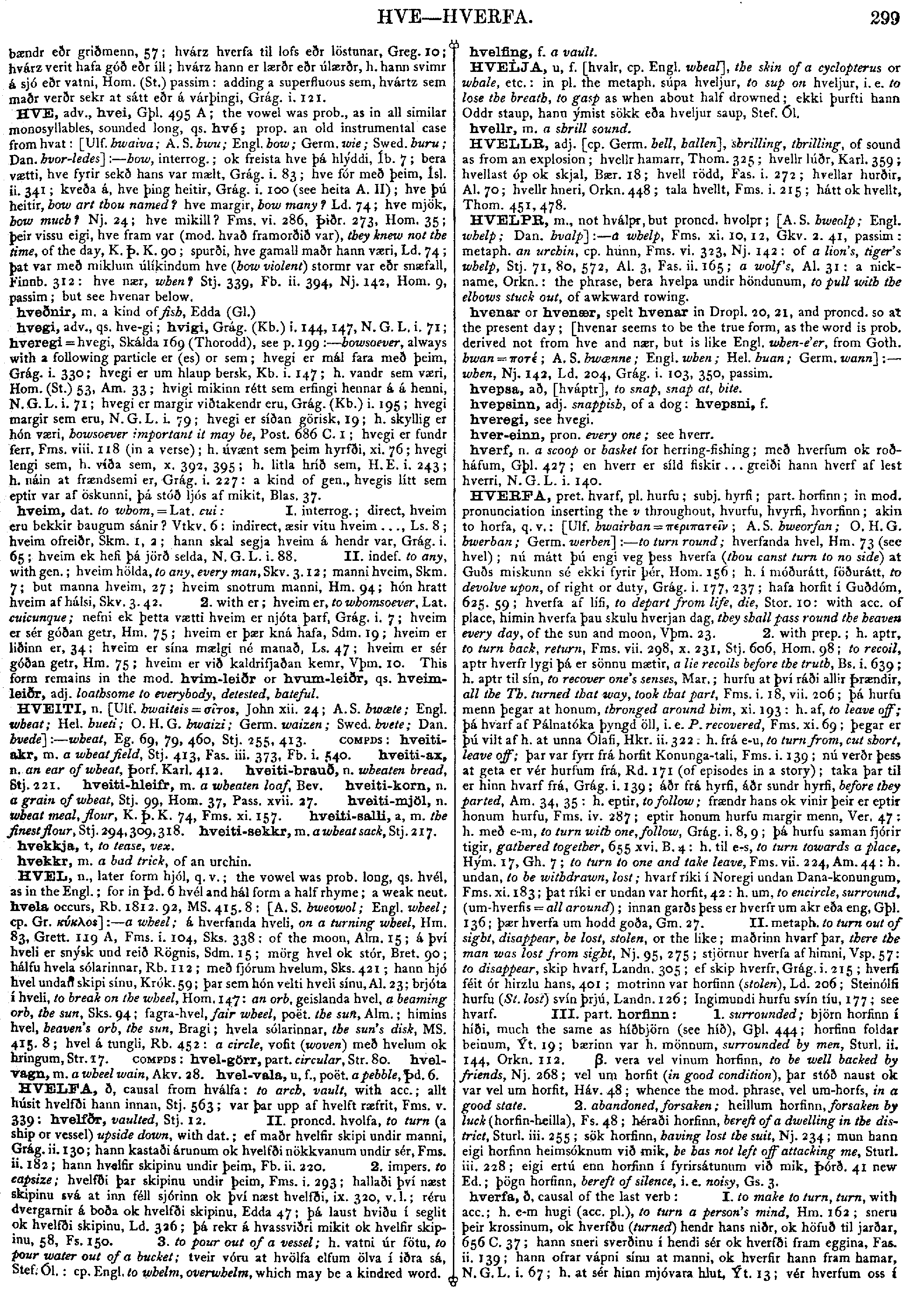
HVELLR, adj. [cp. Germ, hell, hallen], shrilling, thrilling, of sound as from an explosion; hvellr hamarr, Thom. 325; hvellr lúðr, Karl. 359; hvellast óp ok skjal, Bær. 18; hveli rödd, Fas. i. 272; hvellar hurðir, Al. 70; hvellr hneri, Orkn. 448; tala hvellt, Fms. i. 215; hátt ok hvellr, Thom. 451, 478.
|
Source: Cleasby/Vigfusson, page b0761, entry 44 View original page image as: [TIFF] [PNG] [View previous entry] [View next entry] |
[Comment on this entry] [View comments] |
The following entry has been hand-corrected once. |
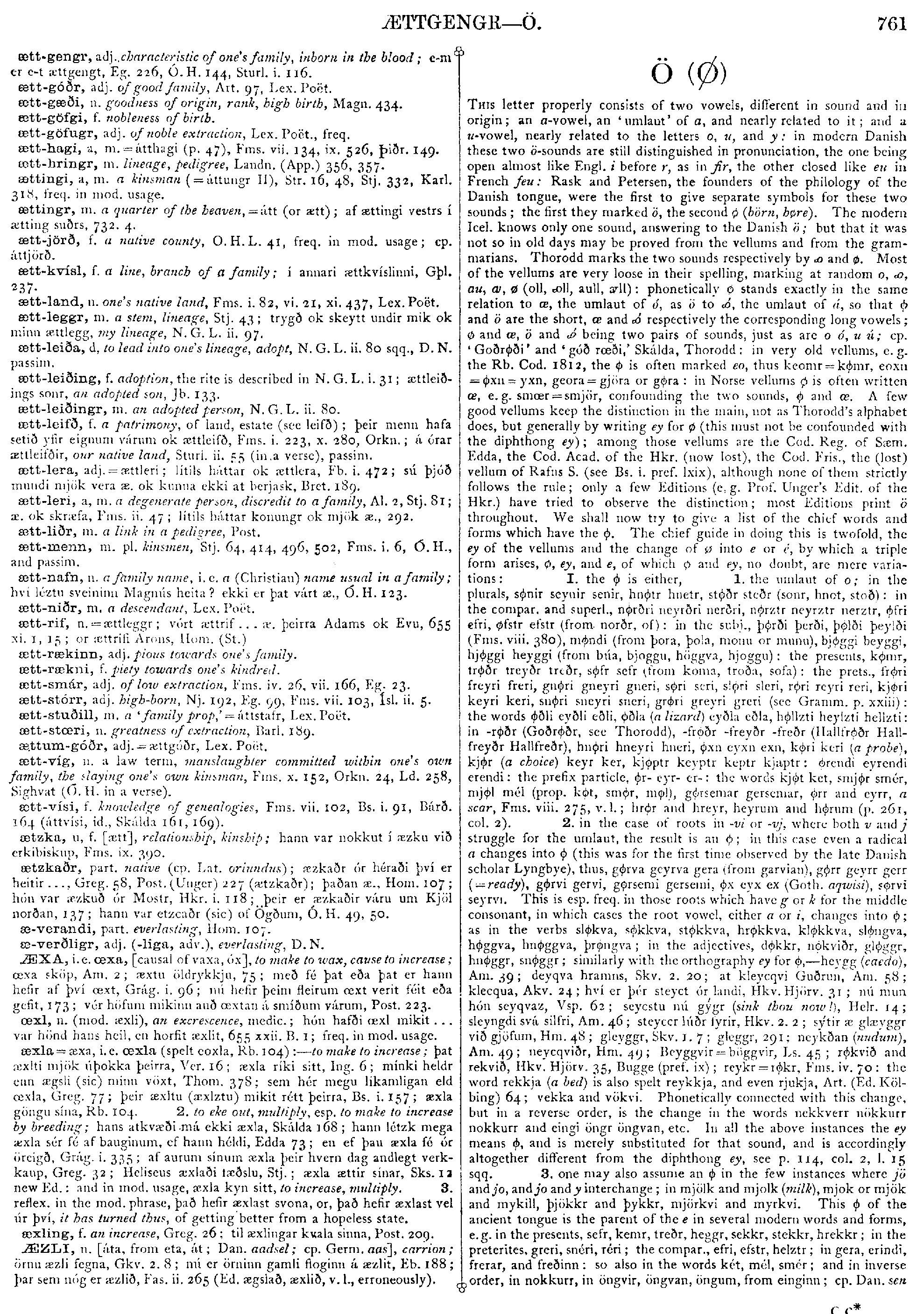
THIS
letter
properly
consists
of
two
vowels,
different
in
sound
and
in
origin;
an
a-vowel,
an
'umlaut'
of
a,
and
nearly
related
to
it;
and
a
u-vowel,
nearly
related
to
the
letters
o,
u,
and
y:
in
modern
Danish
these
two
ö-sounds
are
still
distinguished
in
pronunciation,
the
one
being
open
almost
like
Engl.
i
before
r,
as
in
fir,
the
other
closed
like
eu
in
French
feu:
Rask
and
Petersen,
the
founders
of
the
philology
of
the
Danish
tongue,
were
the
first
to
give
separate
symbols
for
these
two
sounds;
the
first
they
marked
ö,
the
second
ø
(börn,
høre).
The
modern
Icel.
knows
only
one
sound,
answering
to
the
Danish
ö;
but
that
it
was
not
so
in
old
days
may
be
proved
from
the
vellums
and
from
the
grammarians.
Thorodd
marks
the
two
sounds
respectively
by
 and
ø.
Most
of
the
vellums
are
very
loose
in
their
spelling,
marking
at
random
o,
,
au,
(?),
UNCERTAIN
ø
(oll,
ll,
aull,
arll
UNCERTAIN):
phonetically
ø
stands
exactly
in
the
same
relation
to
œ,
the
umlaut
of
ó,
as
ö
to
and
ø.
Most
of
the
vellums
are
very
loose
in
their
spelling,
marking
at
random
o,
,
au,
(?),
UNCERTAIN
ø
(oll,
ll,
aull,
arll
UNCERTAIN):
phonetically
ø
stands
exactly
in
the
same
relation
to
œ,
the
umlaut
of
ó,
as
ö
to
 ,
the
umlaut
of
á,
so
that
ø
and
ö
are
the
short,
œ
and
respectively
the
corresponding
long
vowels;
ø
and
œ,
ö
and
being
two
pairs
of
sounds,
just
as
are
o
ó,
u
ú;
cp.
'Goðrøði'
and
'góð
rœði,'
Skálda,
Thorodd:
in
very
old
vellums,
e.g.
the
Rb.
Cod.
1812,
the
ø
is
often
marked
eo,
thus
keomr
=
kømr,
eoxn
=
øxn
=
yxn,
geora
=
gjöra
or
gøra:
in
Norse
vellums
ø
is
often
written
œ,
e.g.
smœr
=
smjör,
confounding
the
two
sounds,
ø
and
œ.
A
few
good
vellums
keep
the
distinction
in
the
main,
not
as
Thorodd's
alphabet
does,
but
generally
by
writing
ey
for
ø
(this
must
not
be
confounded
with
the
diphthong
ey);
among
those
vellums
are
the
Cod.
Reg.
of
Sæm.
Edda,
the
Cod.
Acad.
of
the
Hkr.
(now
lost),
the
Cod.
Fris.,
the
(lost)
vellum
of
Rafns
S.
(see
Bs.
i.
pref.
lxix),
although
none
of
them
strictly
follows
the
rule;
only
a
few
Editions
(e.g.
Prof.
Unger's
Edit,
of
the
Hkr.)
have
tried
to
observe
the
distinction;
most
Editions
print
ö
throughout.
We
shall
now
try
to
give
a
list
of
the
chief
words
and
forms
which
have
the
ø.
The
chief
guide
in
doing
this
is
twofold,
the
ey
of
the
vellums
and
the
change
of
ø
into
e
or
é,
by
which
a
triple
form
arises,
ø,
ey,
and
e,
of
which
ø
and
ey,
no
doubt,
are
mere
variations:
I.
the
ø
is
either,
1.
the
umlaut
of
o;
in
the
plurals,
sønir
seynir
senir,
hnøtr
hnetr,
støðr
steðr
(sonr,
hnot,
stoð):
in
the
compar.
and
superl.,
nørðri
neyrðri
nerðri,
nørztr
neyrztr
nerztr,
øfri
efri,
øfstr
efstr
(from
norðr,
of):
in
the
subj.,
þørði
þerði,
þølði
þeylði
(Fms.
viii.
380),
møndi
(from
þora,
þola,
monu
or
munu),
bjøggi
beyggi,
hjøggi
heyggi
(from
búa,
bjoggu,
höggva,
hjoggu):
the
presents,
kømr,
trøðr
treyðr
treðr,
søfr
sefr
(from
koma,
troða,
sofa):
the
prets.,
frøri
freyri
freri,
gnøri
gneyri
gneri,
søri
seri,
sløri
sleri,
róri
reyri
reri,
kjøri
keyri
keri,
snøri
sneyri
sneri,
grøri
greyri
greri
(see
Gramm.
p.
xxiii):
the
words
øðli
eyðli
eðli,
øðla
(a
lizard)
eyðla
eðla,
høllzti
heylzti
hellzti:
in
-røðr
(Goðrøðr,
see
Thorodd),
-frøðr
-freyðr
-freðr
(Hallfrøðr
Hallfreyðr
Hallfreðr),
hnøri
hneyri
hneri,
øxn
eyxn
exn,
køri
keri
(a
probe),
kjør
(a
choice)
keyr
ker,
kjøptr
keyptr
keptr
kjaptr:
ørendi
eyrendi
erendi:
the
prefix
particle,
ør-
eyr-
er-:
the
words
kjøt
ket,
smjør
smér,
mjøl
mél
(prop.
køt,
smør,
møl),
gørsemar
gersemar,
ørr
and
eyrr,
a
scar,
Fms.
viii.
275,
v.l.;
hrør
and
hreyr,
heyrum
and
hørum
(p.
261,
col.
2).
2.
in
the
case
of
roots
in
-vi
or
-vj,
where
both
v
and
j
struggle
for
the
umlaut,
the
result
is
an
ø;
in
this
case
even
a
radical
a
changes
into
ø
(this
was
for
the
first
time
observed
by
the
late
Danish
scholar
Lyngbye),
thus,
gørva
geyrva
gera
(from
garvian),
gørr
geyrr
gerr
(=
ready),
gørvi
gervi,
gørsemi
gersemi,
øx
eyx
ex
(Goth.
aqwisi),
sørvi
seyrvi.
This
is
esp.
freq.
in
those
roots
which
have
g
or
k
for
the
middle
consonant,
in
which
cases
the
root
vowel,
either
a
or
i,
changes
into
ø;
as
in
the
verbs
sløkva,
søkkva,
støkkva,
hrøkkva,
kløkkva,
sløngva,
høggva,
hnøggva,
þrøngva;
in
the
adjectives,
døkkr,
nøkviðr,
gløggr,
hnøggr,
snøggr;
similarly
with
the
orthography
ey
for
ø,
--
heygg
(caedo),
Am.
39;
deyqva
hramns,
Skv.
2.
20;
at
kleycqvi
Guðrun,
Am.
58;
klecqua,
Akv.
24;
hví
er
þér
steyct
ór
landi,
Hkv.
Hjörv.
31;
nú
mun
hón
seyqvaz,
Vsp.
62;
seycstu
nú
gýgr
(sink
thou
now!),
Helr.
14;
sleyngdi
svá
silfri,
Am.
46;
steyccr
lúðr
fyrir,
Hkv.
2.
2;
sýtir
æ
glæyggr
við
gjöfum,
Hm.
48;
gleyggr,
Skv.
1.
7;
gleggr,
291;
neykðan
(nudum),
Am.
49;
neycqviðr,
Hm.
49;
Beyggvir
=
böggvir,
Ls.
45;
røkvið
and
rekvið,
Hkv.
Hjörv.
35,
Bugge
(pref.
ix);
reykr
=
røkr,
Fms.
iv.
70:
the
word
rekkja
(a
bed)
is
also
spelt
reykkja,
and
even
rjukja,
Art.
(Ed.
Kölbing)
64;
vekka
and
vökvi.
Phonetically
connected
with
this
change,
but
in
a
reverse
order,
is
the
change
in
the
words
nekkverr
nökkurr
nokkurr
and
eingi
öngr
öngvan,
etc.
In
all
the
above
instances
the
ey
means
ø,
and
is
merely
substituted
for
that
sound,
and
is
accordingly
altogether
different
from
the
diphthong
ey,
see
p.
114,
col.
2,
l.
15
sqq.
3.
one
may
also
assume
an
ø
in
the
few
instances
where
jö
and
jo,
and
jo
and
y
interchange;
in
mjölk
and
mjolk
(milk),
mjok
or
mjök
and
mykill,
þjökkr
and
þykkr,
mjörkvi
and
myrkvi.
This
ø
of
the
ancient
tongue
is
the
parent
of
the
e
in
several
modern
words
and
forms,
e.g.
in
the
presents,
sefr,
kemr,
treðr,
heggr,
sekkr,
stekkr,
hrekkr;
in
the
preterites,
greri,
snéri,
réri;
the
compar.,
efri,
efstr,
helztr;
in
gera,
erindi,
frerar,
and
freðinn:
so
also
in
the
words
két,
mél,
smér;
and
in
inverse
order,
in
nokkurr,
in
öngvir,
öngvan,
öngum,
from
einginn;
cp.
Dan.
sen
,
the
umlaut
of
á,
so
that
ø
and
ö
are
the
short,
œ
and
respectively
the
corresponding
long
vowels;
ø
and
œ,
ö
and
being
two
pairs
of
sounds,
just
as
are
o
ó,
u
ú;
cp.
'Goðrøði'
and
'góð
rœði,'
Skálda,
Thorodd:
in
very
old
vellums,
e.g.
the
Rb.
Cod.
1812,
the
ø
is
often
marked
eo,
thus
keomr
=
kømr,
eoxn
=
øxn
=
yxn,
geora
=
gjöra
or
gøra:
in
Norse
vellums
ø
is
often
written
œ,
e.g.
smœr
=
smjör,
confounding
the
two
sounds,
ø
and
œ.
A
few
good
vellums
keep
the
distinction
in
the
main,
not
as
Thorodd's
alphabet
does,
but
generally
by
writing
ey
for
ø
(this
must
not
be
confounded
with
the
diphthong
ey);
among
those
vellums
are
the
Cod.
Reg.
of
Sæm.
Edda,
the
Cod.
Acad.
of
the
Hkr.
(now
lost),
the
Cod.
Fris.,
the
(lost)
vellum
of
Rafns
S.
(see
Bs.
i.
pref.
lxix),
although
none
of
them
strictly
follows
the
rule;
only
a
few
Editions
(e.g.
Prof.
Unger's
Edit,
of
the
Hkr.)
have
tried
to
observe
the
distinction;
most
Editions
print
ö
throughout.
We
shall
now
try
to
give
a
list
of
the
chief
words
and
forms
which
have
the
ø.
The
chief
guide
in
doing
this
is
twofold,
the
ey
of
the
vellums
and
the
change
of
ø
into
e
or
é,
by
which
a
triple
form
arises,
ø,
ey,
and
e,
of
which
ø
and
ey,
no
doubt,
are
mere
variations:
I.
the
ø
is
either,
1.
the
umlaut
of
o;
in
the
plurals,
sønir
seynir
senir,
hnøtr
hnetr,
støðr
steðr
(sonr,
hnot,
stoð):
in
the
compar.
and
superl.,
nørðri
neyrðri
nerðri,
nørztr
neyrztr
nerztr,
øfri
efri,
øfstr
efstr
(from
norðr,
of):
in
the
subj.,
þørði
þerði,
þølði
þeylði
(Fms.
viii.
380),
møndi
(from
þora,
þola,
monu
or
munu),
bjøggi
beyggi,
hjøggi
heyggi
(from
búa,
bjoggu,
höggva,
hjoggu):
the
presents,
kømr,
trøðr
treyðr
treðr,
søfr
sefr
(from
koma,
troða,
sofa):
the
prets.,
frøri
freyri
freri,
gnøri
gneyri
gneri,
søri
seri,
sløri
sleri,
róri
reyri
reri,
kjøri
keyri
keri,
snøri
sneyri
sneri,
grøri
greyri
greri
(see
Gramm.
p.
xxiii):
the
words
øðli
eyðli
eðli,
øðla
(a
lizard)
eyðla
eðla,
høllzti
heylzti
hellzti:
in
-røðr
(Goðrøðr,
see
Thorodd),
-frøðr
-freyðr
-freðr
(Hallfrøðr
Hallfreyðr
Hallfreðr),
hnøri
hneyri
hneri,
øxn
eyxn
exn,
køri
keri
(a
probe),
kjør
(a
choice)
keyr
ker,
kjøptr
keyptr
keptr
kjaptr:
ørendi
eyrendi
erendi:
the
prefix
particle,
ør-
eyr-
er-:
the
words
kjøt
ket,
smjør
smér,
mjøl
mél
(prop.
køt,
smør,
møl),
gørsemar
gersemar,
ørr
and
eyrr,
a
scar,
Fms.
viii.
275,
v.l.;
hrør
and
hreyr,
heyrum
and
hørum
(p.
261,
col.
2).
2.
in
the
case
of
roots
in
-vi
or
-vj,
where
both
v
and
j
struggle
for
the
umlaut,
the
result
is
an
ø;
in
this
case
even
a
radical
a
changes
into
ø
(this
was
for
the
first
time
observed
by
the
late
Danish
scholar
Lyngbye),
thus,
gørva
geyrva
gera
(from
garvian),
gørr
geyrr
gerr
(=
ready),
gørvi
gervi,
gørsemi
gersemi,
øx
eyx
ex
(Goth.
aqwisi),
sørvi
seyrvi.
This
is
esp.
freq.
in
those
roots
which
have
g
or
k
for
the
middle
consonant,
in
which
cases
the
root
vowel,
either
a
or
i,
changes
into
ø;
as
in
the
verbs
sløkva,
søkkva,
støkkva,
hrøkkva,
kløkkva,
sløngva,
høggva,
hnøggva,
þrøngva;
in
the
adjectives,
døkkr,
nøkviðr,
gløggr,
hnøggr,
snøggr;
similarly
with
the
orthography
ey
for
ø,
--
heygg
(caedo),
Am.
39;
deyqva
hramns,
Skv.
2.
20;
at
kleycqvi
Guðrun,
Am.
58;
klecqua,
Akv.
24;
hví
er
þér
steyct
ór
landi,
Hkv.
Hjörv.
31;
nú
mun
hón
seyqvaz,
Vsp.
62;
seycstu
nú
gýgr
(sink
thou
now!),
Helr.
14;
sleyngdi
svá
silfri,
Am.
46;
steyccr
lúðr
fyrir,
Hkv.
2.
2;
sýtir
æ
glæyggr
við
gjöfum,
Hm.
48;
gleyggr,
Skv.
1.
7;
gleggr,
291;
neykðan
(nudum),
Am.
49;
neycqviðr,
Hm.
49;
Beyggvir
=
böggvir,
Ls.
45;
røkvið
and
rekvið,
Hkv.
Hjörv.
35,
Bugge
(pref.
ix);
reykr
=
røkr,
Fms.
iv.
70:
the
word
rekkja
(a
bed)
is
also
spelt
reykkja,
and
even
rjukja,
Art.
(Ed.
Kölbing)
64;
vekka
and
vökvi.
Phonetically
connected
with
this
change,
but
in
a
reverse
order,
is
the
change
in
the
words
nekkverr
nökkurr
nokkurr
and
eingi
öngr
öngvan,
etc.
In
all
the
above
instances
the
ey
means
ø,
and
is
merely
substituted
for
that
sound,
and
is
accordingly
altogether
different
from
the
diphthong
ey,
see
p.
114,
col.
2,
l.
15
sqq.
3.
one
may
also
assume
an
ø
in
the
few
instances
where
jö
and
jo,
and
jo
and
y
interchange;
in
mjölk
and
mjolk
(milk),
mjok
or
mjök
and
mykill,
þjökkr
and
þykkr,
mjörkvi
and
myrkvi.
This
ø
of
the
ancient
tongue
is
the
parent
of
the
e
in
several
modern
words
and
forms,
e.g.
in
the
presents,
sefr,
kemr,
treðr,
heggr,
sekkr,
stekkr,
hrekkr;
in
the
preterites,
greri,
snéri,
réri;
the
compar.,
efri,
efstr,
helztr;
in
gera,
erindi,
frerar,
and
freðinn:
so
also
in
the
words
két,
mél,
smér;
and
in
inverse
order,
in
nokkurr,
in
öngvir,
öngvan,
öngum,
from
einginn;
cp.
Dan.
sen
Germanic Lexicon Project (main page)
This search system was written by
Sean Crist
Please consider
volunteering
to correct the data in these online dictionaries.
No rights reserved. Feel free to use these data in any way you please.