|
|

|
Source: Cleasby/Vigfusson, page b0262, entry 27 View original page image as: [TIFF] [PNG] [View previous entry] [View next entry] |
[Comment on this entry] [View comments] |
The following entry has been hand-corrected once. |
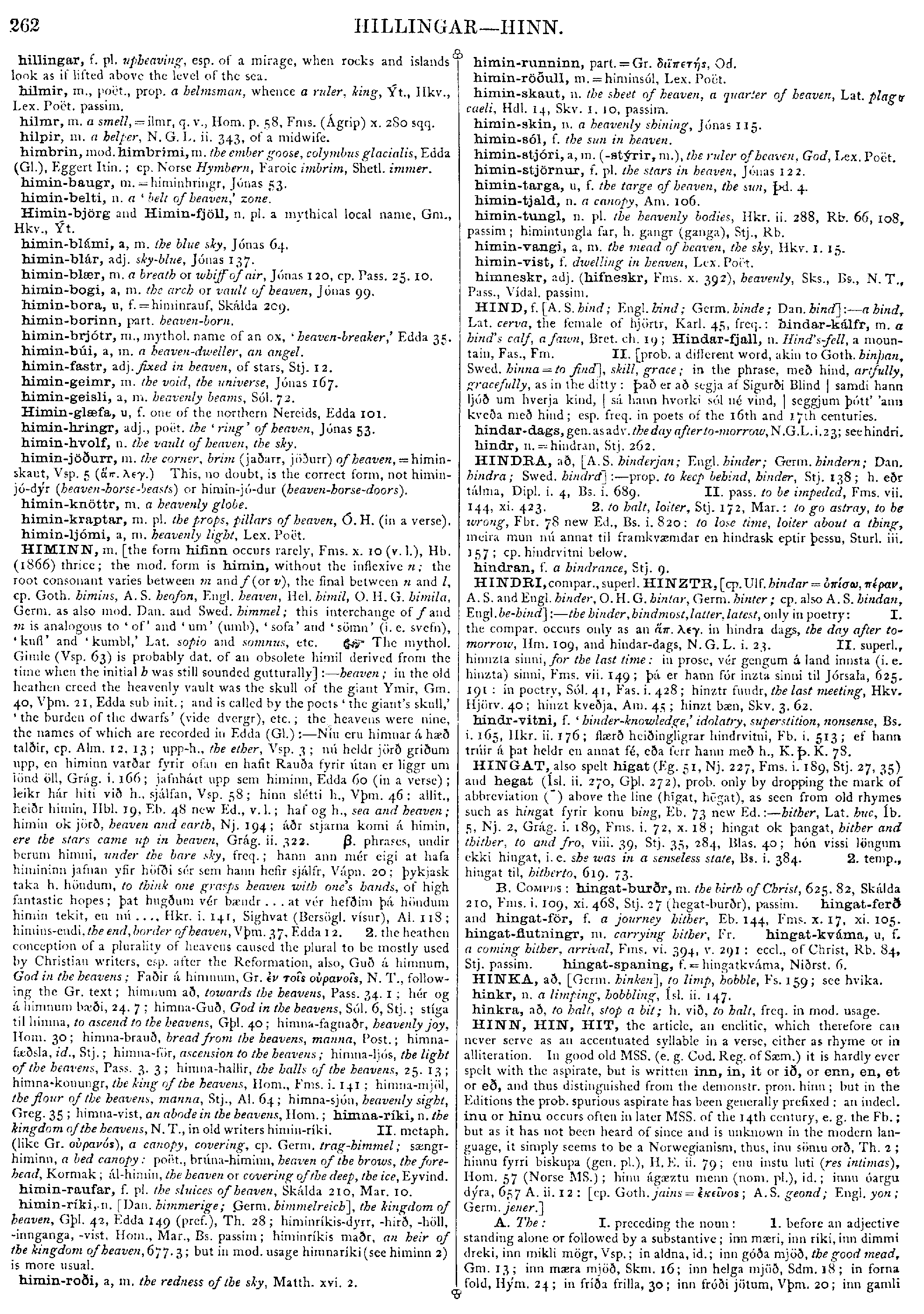
HIMINN,
m.
[the
form
hifinn
occurs
rarely,
Fms.
x.
10
(v.l.),
Hb.
(1866)
thrice;
the
mod.
form
is
himin,
without
the
inflexive
n;
the
root
consonant
varies
between
m
and
f
(or
v),
the
final
between
n
and
l,
cp.
Goth.
himins,
A.
S.
heofon,
Engl.
heaven,
Hel.
himil,
O.
H.
G.
himila,
Germ.
as
also
mod.
Dan.
and
Swed.
himmel;
this
interchange
of
f
and
m
is
analogous
to
'of'
and
'um'
(umb),
'sofa'
and
'sömn'
(i.e.
svefn),
'kufl'
and
'kumbl,'
Lat.
sopio
and
somnus,
etc.
UNCERTAIN
The
mythol.
Gimle
(Vsp.
63)
is
probably
dat.
of
an
obsolete
himil
derived
from
the
time
when
the
initial
h
was
still
sounded
gutturally]
:--
heaven;
in
the
old
heathen
creed
the
heavenly
vault
was
the
skull
of
the
giant
Ymir,
Gm.
40,
Vþm.
21,
Edda
sub
init.;
and
is
called
by
the
poets
'the
giant's
skull,'
'the
burden
of
the
dwarfs'
(vide
dvergr),
etc.;
the
heavens
were
nine,
the
names
of
which
are
recorded
in
Edda
(Gl.)
:--
Níu
eru
himnar
á
hæð
talðir,
cp.
Alm.
12,
13;
upp-h.,
the
ether,
Vsp.
3;
nú
heldr
jörð
griðum
upp,
en
himinn
varðar
fyrir
ofan
en
hafit
Rauða
fyrir
útan
er
liggr
um
lönd
öll,
Grág.
i.
166;
jafnhárt
upp
sem
himinn,
Edda
60
(in
a
verse);
leikr
hár
hiti
við
h.,
sjálfan,
Vsp.
58;
hinn
slétti
h.,
Vþm.
46:
allit.,
heiðr
himin,
Hbl.
19,
Eb.
48
new
Ed.,
v.l.;
haf
og
h.,
sea
and
heaven;
himin
ok
jörð,
heaven
and
earth,
Nj.
194;
áðr
stjarna
komi
á
himin,
ere
the
stars
came
up
in
heaven,
Grág.
ii.
322.
 .
phrases,
undir
berum
himni,
under
the
bare
sky,
freq.;
hann
ann
mér
eigi
at
hafa
himininn
jafnan
yfir
höfði
sér
sem
hann
hefir
sjálfr,
Vápn.
20;
þykjask
taka
h.
höndum,
to
think
one
grasps
heaven
with
one's
hands,
of
high
fantastic
hopes;
þat
hugðum
vér
bændr
...
at
vér
hefðim
þá
höndum
himin
tekit,
en
nú
...,
Hkr.
i.
141,
Sighvat
(Bersögl.
vísur),
Al.
118;
himins-emdi,
the
end,
border
of
heaven,
Vþm.
37,
Edda
12.
2.
the
heathen
conception
of
a
plurality
of
heavens
caused
the
plural
to
be
mostly
used
by
Christian
writers,
esp.
after
the
Reformation,
also,
Guð
á
himnum,
God
in
the
heavens;
Faðir
á
himnum,
Gr.
GREEK,
N.
T.,
following
the
Gr.
text;
himnum
að,
towards
the
heavens,,
Pass.
34.
1;
hér
og
á
himnum
bæði,
24.
7:
himna-Guð,
God
in
the
heavens,
Sól.
6,
Stj.;
stíga
til
himna,
to
ascend
to
the
heavens,
Gþl.
40;
himna-fagnaðr,
heavenly
joy,
Hom.
30;
himna-brauð,
bread
from
the
heavens,
manna,
Post.;
himna-fæðsla,
id.,
Stj.;
himna-för,
ascension
to
the
heavens;
himna-ljós,
the
light
of
the
heavens,
Pass.
3.
3;
hinma-hallir,
the
halls
of
the
heavens,
25.
13;
himna-konungr,
the
king
of
the
heavens,
Hom.,
Fms.
i.
141;
himna-mjöl,
the
flour
of
the
heavens,
manna,
Stj.,
Al.
64;
himna-sjón,
heavenly
sight,
Greg.
35;
himna-vist,
an
abode
in
the
heavens,
Hom.;
himna-ríki,
n.
the
kingdom
of
the
heavens,
N.
T.,
in
old
writers
himin-ríki.
II.
metaph.
(like
Gr.
GREEK),
a
canopy,
covering,
cp.
Germ.
trag-himmel;
sængr-himinn,
a
bed
canopy:
poët.,
brúna-himinn,
heaven
of
the
brows,
the
forehead,
Kormak;
ál-himin,
the
heaven
or
covering
of
the
deep,
the
ice,
Eyvind.
.
phrases,
undir
berum
himni,
under
the
bare
sky,
freq.;
hann
ann
mér
eigi
at
hafa
himininn
jafnan
yfir
höfði
sér
sem
hann
hefir
sjálfr,
Vápn.
20;
þykjask
taka
h.
höndum,
to
think
one
grasps
heaven
with
one's
hands,
of
high
fantastic
hopes;
þat
hugðum
vér
bændr
...
at
vér
hefðim
þá
höndum
himin
tekit,
en
nú
...,
Hkr.
i.
141,
Sighvat
(Bersögl.
vísur),
Al.
118;
himins-emdi,
the
end,
border
of
heaven,
Vþm.
37,
Edda
12.
2.
the
heathen
conception
of
a
plurality
of
heavens
caused
the
plural
to
be
mostly
used
by
Christian
writers,
esp.
after
the
Reformation,
also,
Guð
á
himnum,
God
in
the
heavens;
Faðir
á
himnum,
Gr.
GREEK,
N.
T.,
following
the
Gr.
text;
himnum
að,
towards
the
heavens,,
Pass.
34.
1;
hér
og
á
himnum
bæði,
24.
7:
himna-Guð,
God
in
the
heavens,
Sól.
6,
Stj.;
stíga
til
himna,
to
ascend
to
the
heavens,
Gþl.
40;
himna-fagnaðr,
heavenly
joy,
Hom.
30;
himna-brauð,
bread
from
the
heavens,
manna,
Post.;
himna-fæðsla,
id.,
Stj.;
himna-för,
ascension
to
the
heavens;
himna-ljós,
the
light
of
the
heavens,
Pass.
3.
3;
hinma-hallir,
the
halls
of
the
heavens,
25.
13;
himna-konungr,
the
king
of
the
heavens,
Hom.,
Fms.
i.
141;
himna-mjöl,
the
flour
of
the
heavens,
manna,
Stj.,
Al.
64;
himna-sjón,
heavenly
sight,
Greg.
35;
himna-vist,
an
abode
in
the
heavens,
Hom.;
himna-ríki,
n.
the
kingdom
of
the
heavens,
N.
T.,
in
old
writers
himin-ríki.
II.
metaph.
(like
Gr.
GREEK),
a
canopy,
covering,
cp.
Germ.
trag-himmel;
sængr-himinn,
a
bed
canopy:
poët.,
brúna-himinn,
heaven
of
the
brows,
the
forehead,
Kormak;
ál-himin,
the
heaven
or
covering
of
the
deep,
the
ice,
Eyvind.
|
Source: Torp, page b0073, entry 8 View original page image as: [TIFF] [PNG] [View previous entry] [View next entry] |
[Comment on this entry] [View comments] |
The following entry has been hand-corrected once. |
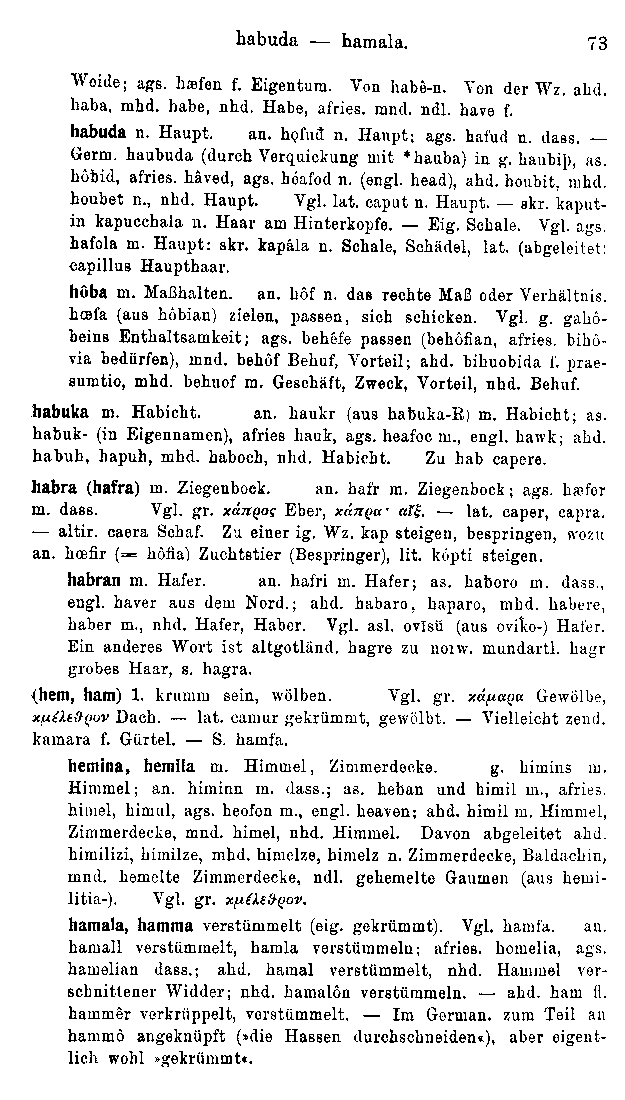
hemina,
hemila
m.
Himmel,
Zimmerdecke.
g.
himins
m.
Himmel;
an.
himinn
m.
dass.;
as.
he an
und
himil
m.,
afries.
himel,
himul,
ags.
heofon
m.,
engl.
heaven;
ahd.
himil
m.
Himmel,
Zimmerdecke,
mnd.
himel,
nhd.
Himmel.
Davon
abgeleitet
ahd.
himilizi,
himilze,
mhd.
himelze,
himelz
n.
Zimmerdecke,
Baldachin,
mnd.
hemelte
Zimmerdecke,
ndl.
gehemelte
Gaumen
(aus
hemilitia-).
Vgl.
gr.
[kme'leqron].
an
und
himil
m.,
afries.
himel,
himul,
ags.
heofon
m.,
engl.
heaven;
ahd.
himil
m.
Himmel,
Zimmerdecke,
mnd.
himel,
nhd.
Himmel.
Davon
abgeleitet
ahd.
himilizi,
himilze,
mhd.
himelze,
himelz
n.
Zimmerdecke,
Baldachin,
mnd.
hemelte
Zimmerdecke,
ndl.
gehemelte
Gaumen
(aus
hemilitia-).
Vgl.
gr.
[kme'leqron].
[Translate the German words]
|
Source: Bosworth/Toller, page b0528, entry 16 View original page image as: [TIFF] [PNG] [View previous entry] [View next entry] |
[Comment on this entry] [View comments] |
The following entry has been hand-corrected once. |
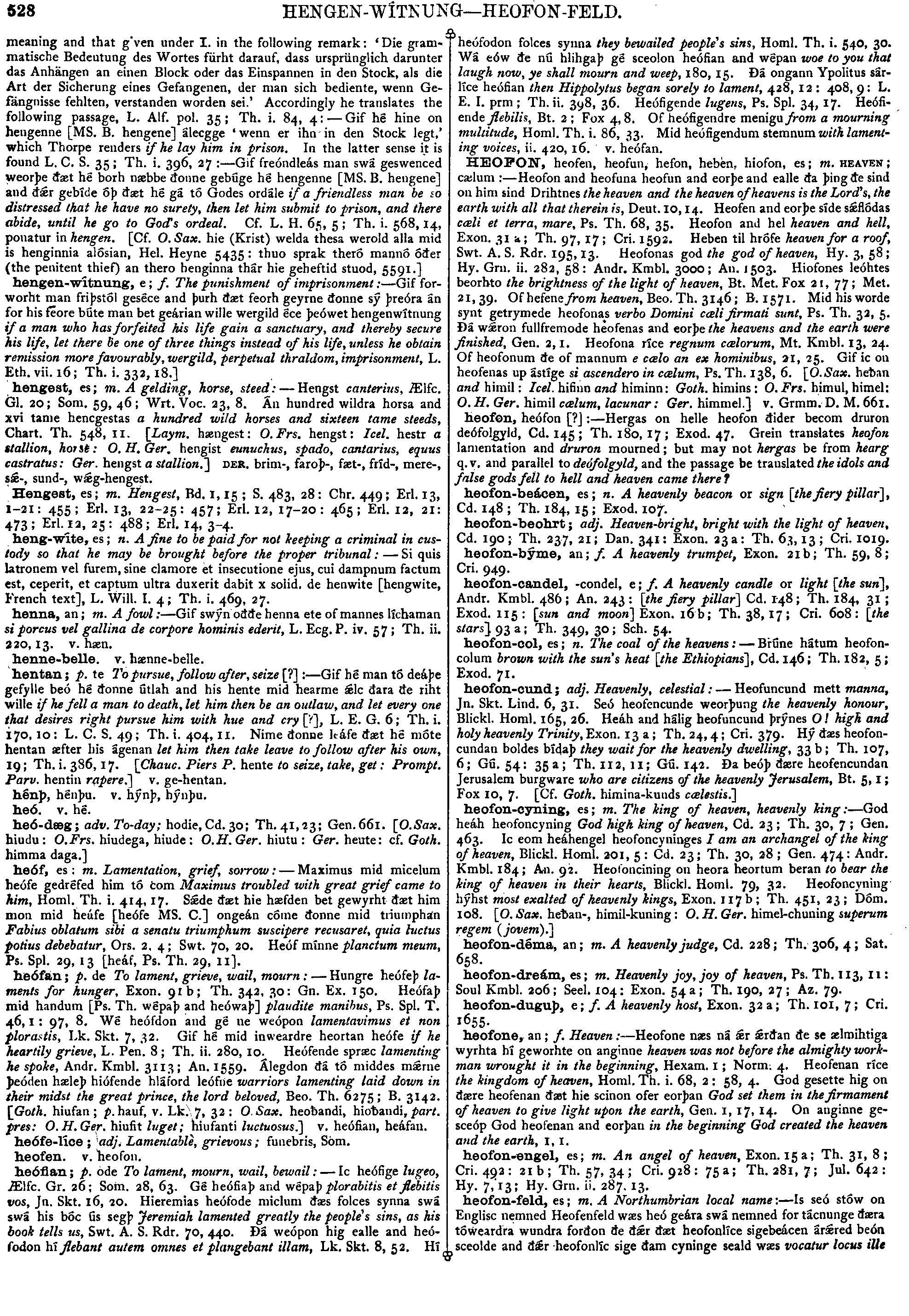
HEOFON,
heofen,
heofun,
hefon,
heben,
hiofon,
es;
m.
HEAVEN;
cælum
:--
Heofon
and
heofuna
heofun
and
eorþe
and
ealle
ða
þing
ðe
sind
on
him
sind
Drihtnes
the
heaven
and
the
heaven
of
heavens
is
the
Lord's,
the
earth
with
all
that
therein
is,
Deut.
10,
14.
Heofen
and
eorþe
síde
s flódas
cæli
et
terra,
mare,
Ps.
Th.
68,
35.
Heofon
and
hel
heaven
and
hell,
Exon.
31
a;
Th.
97,
17;
Cri.
1592.
Heben
til
hrófe
heaven
for
a
roof,
Swt.
A.
S.
Rdr.
195,
13.
Heofonas
god
the
god
of
heaven,
Hy.
3,
58;
Hy.
Grn.
ii.
282,
58:
Andr.
Kmbl.
3000;
An.
1503.
Hiofones
leóhtes
beorhto
the
brightness
of
the
light
of
heaven,
Bt.
Met.
Fox
21,
77;
Met.
21,
39.
Of
hefene
from
heaven,
Beo.
Th.
3146;
B.
1571.
Mid
his
worde
synt
getrymede
heofonas
verbo
Domini
cæli
firmati
sunt,
Ps.
Th.
32,
5.
Ðá
wron
fullfremode
heofenas
and
eorþe
the
heavens
and
the
earth
were
finished,
Gen.
2,
1.
Heofona
ríce
regnum
cælorum,
Mt.
Kmbl.
13,
24.
Of
heofonum
ðe
of
mannum
e
cælo
an
ex
hominibus,
21,
25.
Gif
ic
on
heofenas
up
ástíge
si
ascendero
in
cælum,
Ps.
Th.
138,
6.
[O.
Sax.
hean
and
himil:
Icel.
hifinn
and
himinn:
Goth.
himins:
O.
Frs.
himul,
himel:
O.
H.
Ger.
himil
cælum,
lacunar:
Ger.
himmel.]
v.
Grmm.
D.
M.
661.
flódas
cæli
et
terra,
mare,
Ps.
Th.
68,
35.
Heofon
and
hel
heaven
and
hell,
Exon.
31
a;
Th.
97,
17;
Cri.
1592.
Heben
til
hrófe
heaven
for
a
roof,
Swt.
A.
S.
Rdr.
195,
13.
Heofonas
god
the
god
of
heaven,
Hy.
3,
58;
Hy.
Grn.
ii.
282,
58:
Andr.
Kmbl.
3000;
An.
1503.
Hiofones
leóhtes
beorhto
the
brightness
of
the
light
of
heaven,
Bt.
Met.
Fox
21,
77;
Met.
21,
39.
Of
hefene
from
heaven,
Beo.
Th.
3146;
B.
1571.
Mid
his
worde
synt
getrymede
heofonas
verbo
Domini
cæli
firmati
sunt,
Ps.
Th.
32,
5.
Ðá
wron
fullfremode
heofenas
and
eorþe
the
heavens
and
the
earth
were
finished,
Gen.
2,
1.
Heofona
ríce
regnum
cælorum,
Mt.
Kmbl.
13,
24.
Of
heofonum
ðe
of
mannum
e
cælo
an
ex
hominibus,
21,
25.
Gif
ic
on
heofenas
up
ástíge
si
ascendero
in
cælum,
Ps.
Th.
138,
6.
[O.
Sax.
hean
and
himil:
Icel.
hifinn
and
himinn:
Goth.
himins:
O.
Frs.
himul,
himel:
O.
H.
Ger.
himil
cælum,
lacunar:
Ger.
himmel.]
v.
Grmm.
D.
M.
661.
|
Source: Bosworth/Toller, page b0826, entry 4 View original page image as: [TIFF] [PNG] [View previous entry] [View next entry] |
[Comment on this entry] [View comments] |
The following entry has been hand-corrected once. |
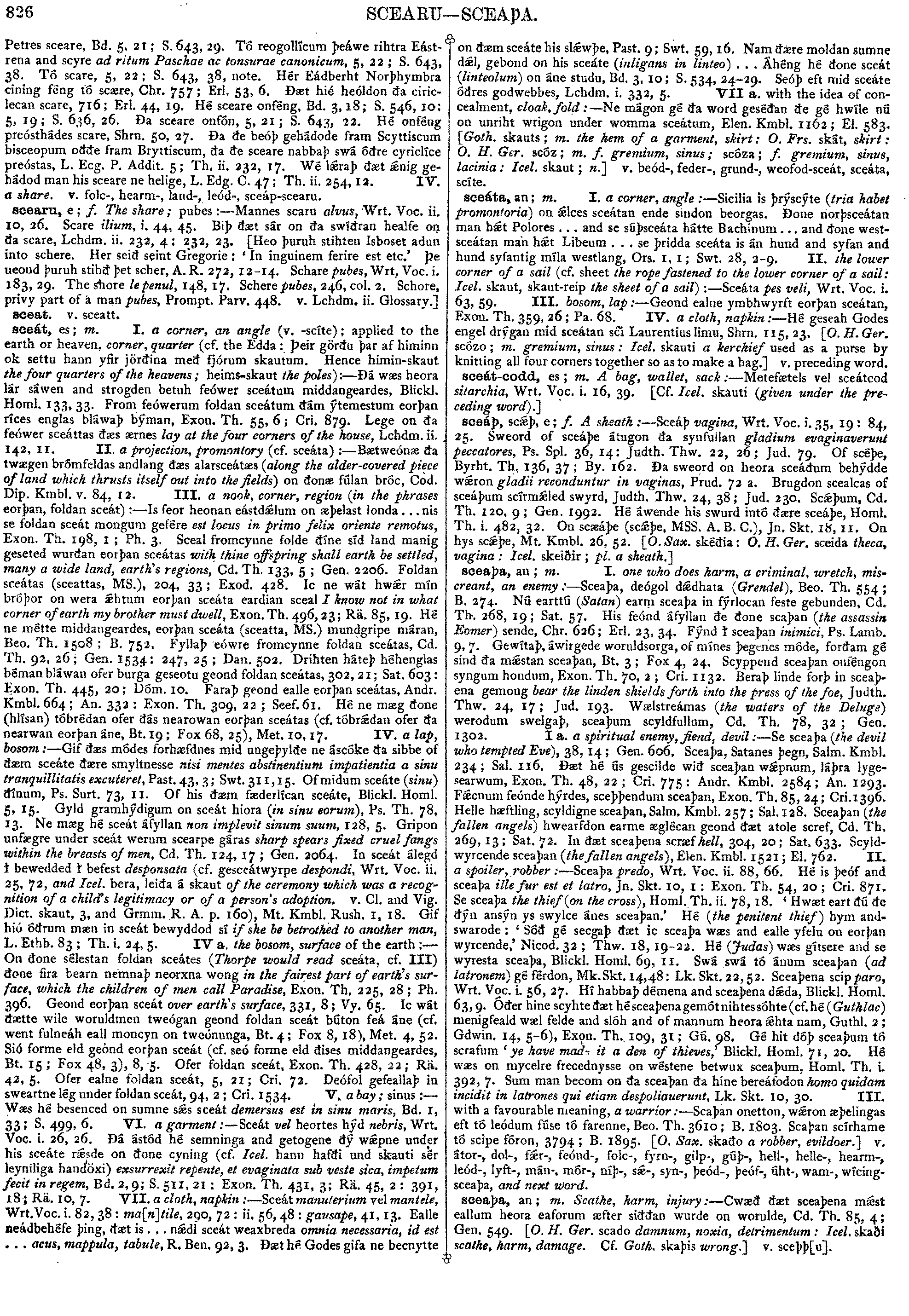
sceát,
es;
m.
I.
a
corner,
an
angle
(v.
-scíte);
applied
to
the
earth
or
heaven,
corner,
quarter
(cf.
the
Edda:
Þeir
görðu
þar
af
himinn
ok
settu
hann
yfir
jörðina
með
fjórum
skautum.
Hence
himin-skaut
the
four
quarters
of
the
heavens;
heims-skaut
the
poles):--Ðá
wæs
heora
lár
sáwen
and
strogden
betuh
feówer
sceátum
middangeardes,
Blickl.
Homl.
133,
33.
From
feówerum
foldan
sceátum
ðám
ýtemestum
eorþan
ríces
englas
bláwaþ
býman,
Exon.
Th.
55,
6;
Cri.
879.
Lege
on
ða
feówer
sceáttas
ðæs
ærnes
lay
at
the
four
corners
of
the
house,
Lchdm.
ii.
142,
11.
II.
a
projection,
promontory
(cf.
sceáta):--Bætweónæ
ða
twægen
brÍmfeldas
andlang
ðæs
alarsceátæs
(along
the
alder-covered
piece
of
land
which
thrusts
itself
out
into
the
fields)
on
ðonæ
fúlan
bróc,
Cod.
Dip.
Kmbl.
v.
84,
12.
III.
a
nook,
corner,
region
(in
the
phrases
eorþan,
foldan
sceát):--Is
feor
heonan
eástdlum
on
æþelast
londa
.
.
.
nis
se
foldan
sceát
mongum
gefére
est
locus
in
primo
felix
oriente
remotus,
Exon.
Th.
198,
1;
Ph.
3.
Sceal
fromcynne
folde
ðíne
síd
land
manig
geseted
wurðan
eorþan
sceátas
with
thine
offspring
shall
earth
be
settled,
many
a
wide
land,
earth's
regions,
Cd.
Th.
133,
5
;
Gen.
2206.
Foldan
sceátas
(sceáttas,
MS.),
204,
33;
Exod.
428.
Ic
ne
wát
hwr
mín
bróþor
on
wera
htum
eorþan
sceáta
eardian
sceal
I
know
not
in
what
corner
of
earth
my
brother
must
dwell,
Exon.
Th.
496,
23;
Rä.
85,
19.
Hé
ne
métte
middangeardes,
eorþan
sceáta
(sceatta,
MS.)
mundgripe
máran,
Beo.
Th.
1508;
B.
752.
Fyllaþ
eówre
fromcynne
foldan
sceátas,
Cd.
Th.
92,
26;
Gen.
1534:
247,
25;
Dan.
502.
Drihten
háteþ
héhenglas
béman
bláwan
ofer
burga
geseotu
geond
foldan
sceátas,
302,
21;
Sat.
603:
Exon.
Th.
445,
20;
Dóm.
10.
Faraþ
geond
ealle
eorþan
sceátas.
Andr.
Kmbl.
664;
An.
332:
Exon.
Th.
309,
22;
Seef.
61.
Hé
ne
mæg
ðone
(hlísan)
tóbrédan
ofer
ðás
nearowan
eorþan
sceátas
(cf.
tóbrdan
ofer
ða
nearwan
eorþan
áne.
Bt.
19;
Fox
68,
25),
Met.
10,
17.
IV.
a
lap,
bosom:--Gif
ðæs
módes
forhæfdnes
mid
ungeþylðe
ne
áscóke
ða
sibbe
of
ðæm
sceáte
ðære
smyltnesse
nisi
mentes
abstinentium
impatientia
a
sinu
tranquillitatis
excuteret,
Past.
43,
3;
Swt.
311,
15.
Of
midum
sceáte
(sinu)
ðínum,
Ps.
Surt.
73,
11.
Of
his
ðæm
fæderlícan
sceáte,
Blickl.
Homl.
5,
15.
Gyld
gramhýdigum
on
sceát
hiora
(in
sinu
eorum).
Ps.
Th.
78,
13.
Ne
mæg
hé
sceát
áfyllan
non
implevit
sinum
suum,
128,
5.
Gripon
unfægre
under
sceát
werum
scearpe
gáras
sharp
spears
fixed
cruel
fangs
within
the
breasts
of
men,
Cd.
Th.
124,
17;
Gen.
2064.
In
sceát
álegd
 bewedded
befest
desponsata
(cf.
gesceátwyrpe
despondi,
Wrt.
Voc.
ii.
25,
72,
and
Icel.
bera,
leiða
á
skaut
of
the
ceremony
which
was
a
recognition
of
a
child's
legitimacy
or
of
a
person's
adoption,
v.
Cl.
and
Vig.
Dict.
skaut,
3,
and
Grmm.
R.
A.
p.
160),
Mt.
Kmbl.
Rush.
1,
18.
Gif
hió
óðrum
mæn
in
sceát
bewyddod
sí
if
she
be
betrothed
to
another
man,
L.
Ethb.
83;
Th.
i.
24,
5.
IV
a.
the
bosom,
surface
of
the
earth:--On
ðone
sélestan
foldan
sceátes
(Thorpe
would
read
sceáta,
cf.
III)
ðone
fira
bearn
nemnaþ
neorxna
wong
in
the
fairest
part
of
earth's
surface,
which
the
children
of
men
call
Paradise,
Exon.
Th.
225,
28;
Ph.
396.
Geond
eorþan
sceát
over
earth's
surface,
331,
8;
Vy.
65.
Ic
wát
ðætte
wile
woruldmen
tweógan
geond
foldan
sceát
búton
feá
áne
(cf.
went
fulneáh
eall
moncyn
on
tweónunga,
Bt.
4;
Fox
8,
18),
Met.
4,
52.
Sió
forme
eld
geond
eorþan
sceát
(cf.
seó
forme
eld
ðises
middangeardes,
Bt.
15;
Fox
48,
3),
8,
5.
Ofer
foldan
sceát,
Exon.
Th.
428,
22;
Rä.
42,
5.
Ofer
ealne
foldan
sceát,
5,
21;
Cri.
72.
Deófol
gefeallaþ
in
sweartne
lég
under
foldan
sceát,
94,
2;
Cri.
1534.
V.
a
bay;
sinus:--Wæs
hé
besenced
on
sumne
ss
sceát
demersus
est
in
sinu
maris,
Bd.
1,
33;
S.
499,
6.
VI.
a
garment:--Sceát
vel
heortes
hýd
nebris,
Wrt.
Voc.
i.
26,
26.
Ðá
ástód
hé
semninga
and
getogene
ðý
wpne
under
his
sceáte
rsde
on
ðone
cyning
(cf.
Icel.
hann
hafði
und
skauti
sér
leyniliga
handöxi)
exsurrexit
repente,
et
evaginata
sub
vests
sica,
impetum
fecit
in
regem,
Bd.
2,
9;
S.
511,
21:
Exon.
Th.
431,
3;
Rä.
45,
2:
391,
18;
Rä.
10,
7.
VII.
a
cloth,
napkin:--Sceát
manuterium
vel
mantele,
Wrt.
Voc.
i.
82,
38:
ma[n]tile,
290,
72:
ii.
56,
48:
gausape,
41,
13.
Ealle
neádbehéfe
þing,
ðæt
is.
.
.
ndl
sceát
weaxbreda
omnia
necessaria,
id
est
.
.
.
acus,
mappula,
tabule,
R.
Ben.
92,
3.
Ðæt
hé
Godes
gifa
ne
becnytte
on
ðæm
sceáte
his
slwþe.
Past.
9;
Swt.
59,
16.
Nam
ðre
moldan
sumne
dl,
gebond
on
his
sceáte
(inligans
in
linteo).
.
.
Áhéng
hé
ðone
sceát
(linteolum)
on
áne
studu.
Bd.
3,
10;
S.
534,
24-29.
Seóþ
eft
mid
sceáte
óðres
godwebbes,
Lchdm.
i.
332,
5.
VII
a.
with
the
idea
of
concealment,
cloak,
fold:--Ne
mágon
gé
ða
word
geséðan
ðe
gé
hwíle
nú
on
unriht
wrigon
under
womma
sceátum,
Elen.
Kmbl.
1162;
El.
583.
[Goth.
skauts;
m.
the
hem
of
a
garment,
skirt:
O.
Frs.
skát,
skirt:
O.
H.
Ger.
scóz;
m.
f.
gremium,
sinus;
scóza;
f
gremium,
sinus,
lacinia:
Icel.
skaut;
n.]
v.
beód-,
feder-,
grund-,
weofod-sceát,
sceáta,
scíte.
bewedded
befest
desponsata
(cf.
gesceátwyrpe
despondi,
Wrt.
Voc.
ii.
25,
72,
and
Icel.
bera,
leiða
á
skaut
of
the
ceremony
which
was
a
recognition
of
a
child's
legitimacy
or
of
a
person's
adoption,
v.
Cl.
and
Vig.
Dict.
skaut,
3,
and
Grmm.
R.
A.
p.
160),
Mt.
Kmbl.
Rush.
1,
18.
Gif
hió
óðrum
mæn
in
sceát
bewyddod
sí
if
she
be
betrothed
to
another
man,
L.
Ethb.
83;
Th.
i.
24,
5.
IV
a.
the
bosom,
surface
of
the
earth:--On
ðone
sélestan
foldan
sceátes
(Thorpe
would
read
sceáta,
cf.
III)
ðone
fira
bearn
nemnaþ
neorxna
wong
in
the
fairest
part
of
earth's
surface,
which
the
children
of
men
call
Paradise,
Exon.
Th.
225,
28;
Ph.
396.
Geond
eorþan
sceát
over
earth's
surface,
331,
8;
Vy.
65.
Ic
wát
ðætte
wile
woruldmen
tweógan
geond
foldan
sceát
búton
feá
áne
(cf.
went
fulneáh
eall
moncyn
on
tweónunga,
Bt.
4;
Fox
8,
18),
Met.
4,
52.
Sió
forme
eld
geond
eorþan
sceát
(cf.
seó
forme
eld
ðises
middangeardes,
Bt.
15;
Fox
48,
3),
8,
5.
Ofer
foldan
sceát,
Exon.
Th.
428,
22;
Rä.
42,
5.
Ofer
ealne
foldan
sceát,
5,
21;
Cri.
72.
Deófol
gefeallaþ
in
sweartne
lég
under
foldan
sceát,
94,
2;
Cri.
1534.
V.
a
bay;
sinus:--Wæs
hé
besenced
on
sumne
ss
sceát
demersus
est
in
sinu
maris,
Bd.
1,
33;
S.
499,
6.
VI.
a
garment:--Sceát
vel
heortes
hýd
nebris,
Wrt.
Voc.
i.
26,
26.
Ðá
ástód
hé
semninga
and
getogene
ðý
wpne
under
his
sceáte
rsde
on
ðone
cyning
(cf.
Icel.
hann
hafði
und
skauti
sér
leyniliga
handöxi)
exsurrexit
repente,
et
evaginata
sub
vests
sica,
impetum
fecit
in
regem,
Bd.
2,
9;
S.
511,
21:
Exon.
Th.
431,
3;
Rä.
45,
2:
391,
18;
Rä.
10,
7.
VII.
a
cloth,
napkin:--Sceát
manuterium
vel
mantele,
Wrt.
Voc.
i.
82,
38:
ma[n]tile,
290,
72:
ii.
56,
48:
gausape,
41,
13.
Ealle
neádbehéfe
þing,
ðæt
is.
.
.
ndl
sceát
weaxbreda
omnia
necessaria,
id
est
.
.
.
acus,
mappula,
tabule,
R.
Ben.
92,
3.
Ðæt
hé
Godes
gifa
ne
becnytte
on
ðæm
sceáte
his
slwþe.
Past.
9;
Swt.
59,
16.
Nam
ðre
moldan
sumne
dl,
gebond
on
his
sceáte
(inligans
in
linteo).
.
.
Áhéng
hé
ðone
sceát
(linteolum)
on
áne
studu.
Bd.
3,
10;
S.
534,
24-29.
Seóþ
eft
mid
sceáte
óðres
godwebbes,
Lchdm.
i.
332,
5.
VII
a.
with
the
idea
of
concealment,
cloak,
fold:--Ne
mágon
gé
ða
word
geséðan
ðe
gé
hwíle
nú
on
unriht
wrigon
under
womma
sceátum,
Elen.
Kmbl.
1162;
El.
583.
[Goth.
skauts;
m.
the
hem
of
a
garment,
skirt:
O.
Frs.
skát,
skirt:
O.
H.
Ger.
scóz;
m.
f.
gremium,
sinus;
scóza;
f
gremium,
sinus,
lacinia:
Icel.
skaut;
n.]
v.
beód-,
feder-,
grund-,
weofod-sceát,
sceáta,
scíte.
|
Source: Cleasby/Vigfusson, page b0248, entry 3 View original page image as: [TIFF] [PNG] [View previous entry] [View next entry] |
[Comment on this entry] [View comments] |
The following entry has not been hand-corrected. However, the page is reserved and someone is correcting it. |
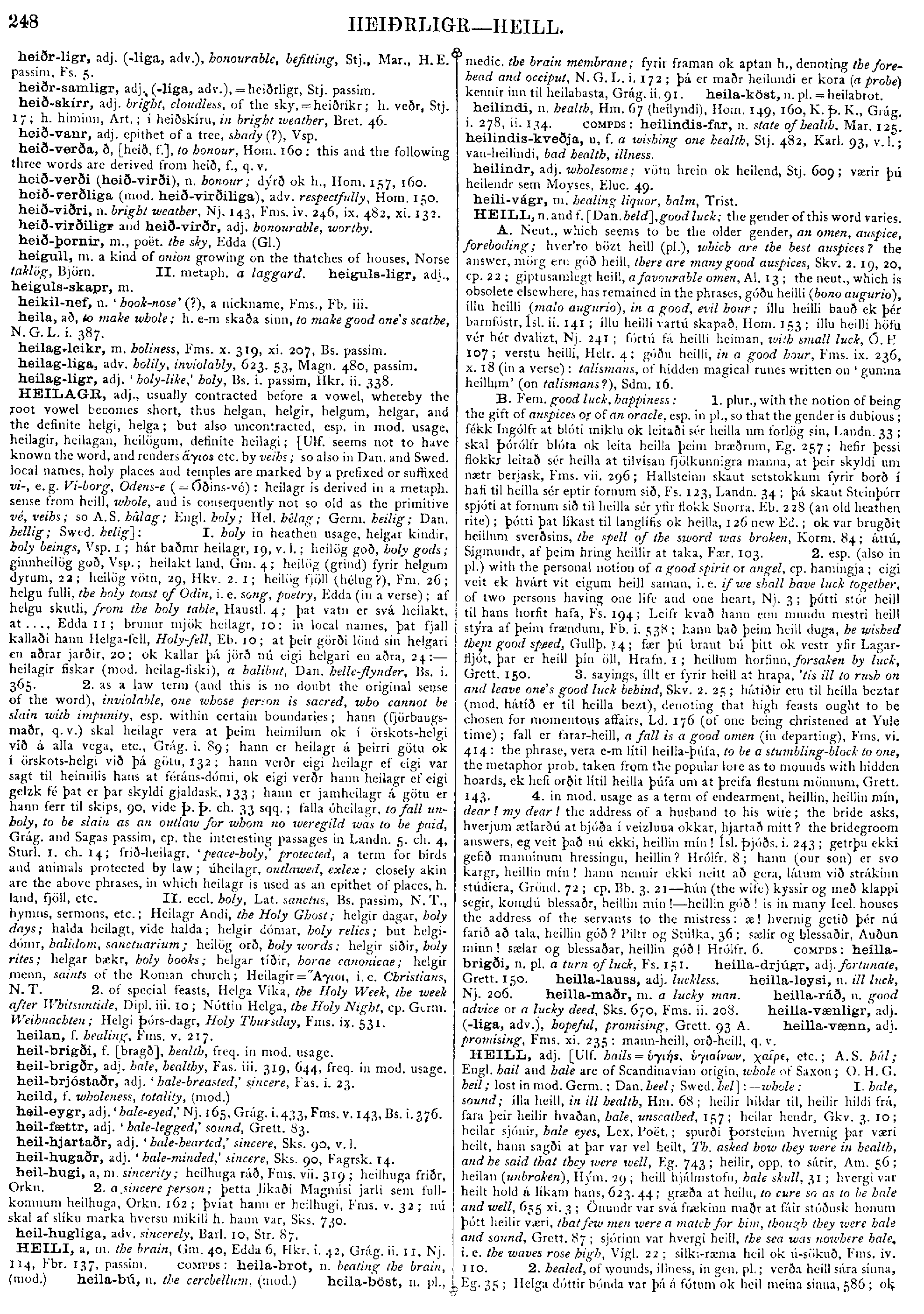
heið-skírr, adj. bright, cloudless, of the sky, = heiðríkr; h. veðr, Stj. 17; h. himinn, Art.; í heiðskíru, in bright weather, Bret. 46.
|
Source: Cleasby/Vigfusson, page b0252, entry 26 View original page image as: [TIFF] [PNG] [View previous entry] [View next entry] |
[Comment on this entry] [View comments] |
The following entry has been hand-corrected once. |
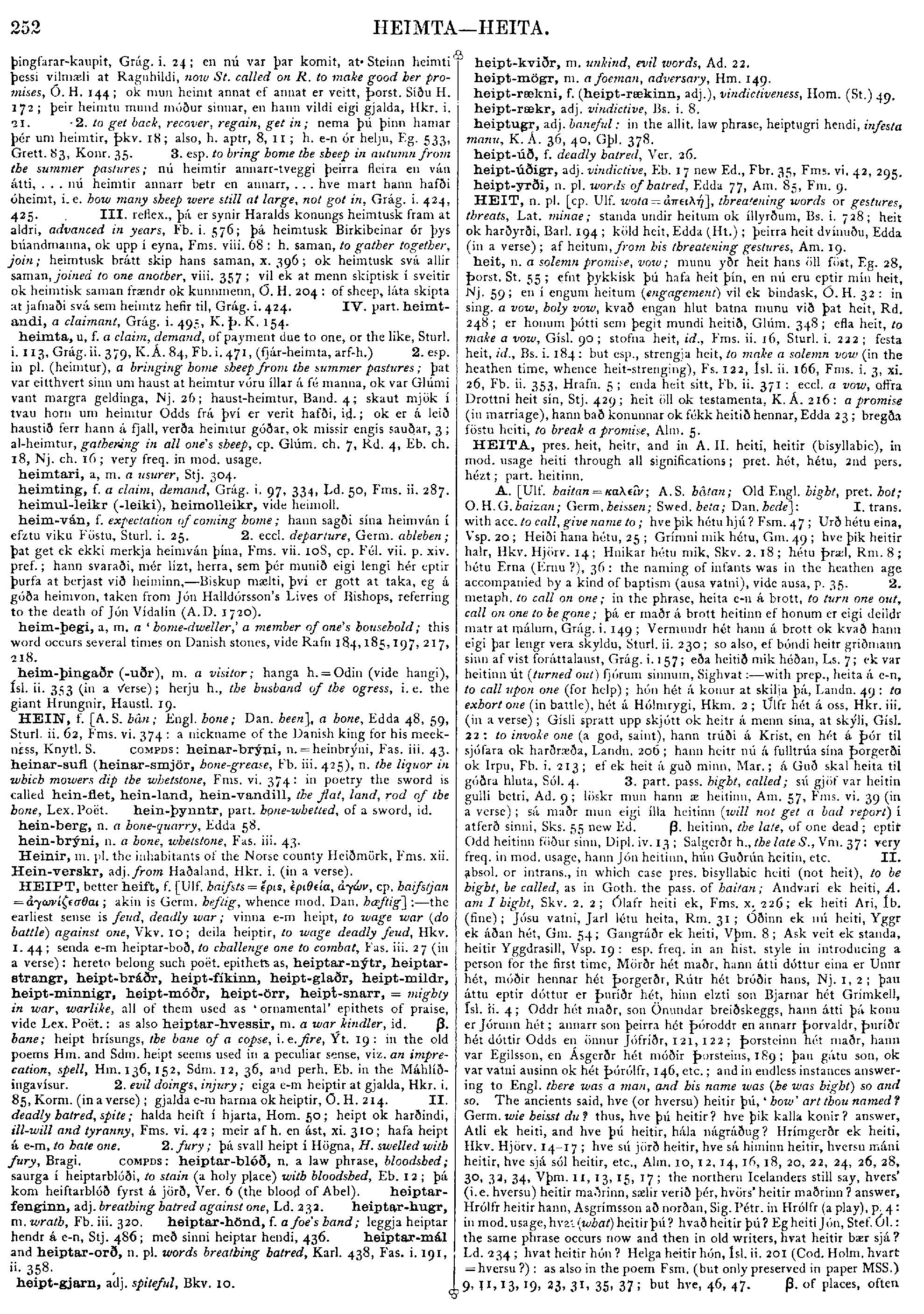
A.
[Ulf.
haitan
=
GREEK;
A.
S.
hâtan;
Old
Engl.
hight,
pret.
hot;
O.
H.
G.
haizan;
Germ.
heissen;
Swed.
heta;
Dan.
hede]:
I.
trans.
with
acc.
to
call,
give
name
to;
hve
þik
hétu
hjú?
Fsm.
47;
Urð
hétu
eina,
Vsp.
20;
Heiði
hana
hétu,
25;
Grímni
mik
hétu,
Gm.
49;
hve
þik
heitir
halr,
Hkv.
Hjörv.
14;
Hnikar
hétu
mik,
Skv.
2.
18;
hétu
Þræl,
Rm.
8;
hétu
Erna
(Ernu?),
36:
the
naming
of
infants
was
in
the
heathen
age
accompanied
by
a
kind
of
baptism
(ausa
vatni),
vide
ausa,
p.
35.
2.
metaph.
to
call
on
one;
in
the
phrase,
heita
e-n
á
brott,
to
turn
one
out,
call
on
one
to
be
gone;
þá
er
maðr
á
brott
heitinn
ef
honum
er
eigi
deildr
matr
at
málum,
Grág.
i.
149;
Vermundr
hét
hann
á
brott
ok
kvað
hann
eigi
þar
lengr
vera
skyldu,
Sturl.
ii.
230;
so
also,
ef
bóndi
heitr
griðmann
sinn
af
vist
foráttalaust,
Grág.
i.
157;
eða
heitið
mik
héðan,
Ls.
7;
ek
var
heitinn
út
(turned
out)
fjórum
sinnum,
Sighvat
:--
with
prep.,
heita
á
e-n,
to
call
upon
one
(for
help);
hón
hét
á
konur
at
skilja
þá,
Landn.
49:
to
exhort
one
(in
battle),
hét
á
Hólmrygi,
Hkm.
2;
Úlfr
hét
á
oss,
Hkr.
iii.
(in
a
verse);
Gísli
spratt
upp
skjótt
ok
heitr
á
menn
sína,
at
skýli,
Gísl.
22:
to
invoke
one
(a
god,
saint),
hann
trúði
á
Krist,
en
hét
á
Þór
til
sjófara
ok
harðræða,
Landn.
206;
hann
heitr
nú
á
fulltrúa
sína
Þorgerði
ok
Irpu,
Fb.
i.
213;
ef
ek
heit
á
guð
minn,
Mar.;
á
Guð
skal
heita
til
góðra
hluta,
Sól.
4.
3.
part.
pass.
hight,
called;
sú
gjöf
var
heitin
gulli
betri,
Ad.
9;
löskr
mun
hann
æ
heitinn,
Am.
57,
Fms.
vi.
39
(in
a
verse);
sá
maðr
mun
eigi
ílla
heitinn
(will
not
get
a
bad
report)
í
atferð
sinni,
Sks.
55
new
Ed.
.
heitinn,
the
late,
of
one
dead;
eptir
Odd
heitinn
föður
sinn,
Dipl.
iv.
13;
Salgerðr
h.,
the
late
S.,
Vm.
37:
very
freq.
in
mod.
usage,
hann
Jón
heitinn,
hún
Guðrún
heitin,
etc.
II.
absol.
or
intrans.,
in
which
case
pres.
bisyllabic
heiti
(not
heit),
to
be
hight,
be
called,
as
in
Goth.
the
pass.
of
haitan;
Andvari
ek
heiti,
A.
am
í
hight,
Skv.
2.
2;
Ólafr
heiti
ek,
Fms.
x.
226;
ek
heiti
Ari,
Íb.
(fine);
Jósu
vatni,
Jarl
létu
heita,
Rm.
31;
Óðinn
ek
nú
heiti,
Yggr
ek
áðan
hét,
Gm.
54;
Gangráðr
ek
heiti,
Vþm.
8;
Ask
veit
ek
standa,
heitir
Yggdrasill,
Vsp.
19:
esp.
freq.
in
an
hist.
style
in
introducing
a
person
for
the
first
time,
Mörðr
hét
maðr,
hann
átti
dóttur
eina
er
Unnr
hét,
móðir
hennar
hét
Þorgerðr,
Rútr
hét
bróðir
hans,
Nj.
1,
2;
þau
áttu
eptir
dóttur
er
Þuríðr
hét,
hinn
elzti
son
Bjarnar
hét
Grímkell,
Ísl.
ii.
4;
Oddr
hét
maðr,
son
Önundar
breiðskeggs,
hann
átti
þá
konu
er
Jórunn
hét;
annarr
son
þeirra
hét
Þóroddr
en
annarr
Þorvaldr,
Þuriðr
hét
dóttir
Odds
en
önnur
Jófriðr,
121,
122;
Þorsteinn
hét
maðr,
hann
var
Egilsson,
en
Ásgerðr
hét
móðir
Þorsteins,
189;
þau
gátu
son,
ok
var
vatni
ausinn
ok
hét
Þórólfr,
146,
etc.;
and
in
endless
instances
answering
to
Engl.
there
was
a
man,
and
his
name
was
(he
was
hight)
so
and
so.
The
ancients
said,
hve
(or
hversu)
heitir
þú,
'how'
art
thou
named?
Germ.
wie
heisst
du?
thus,
hve
þú
heitir?
hve
þik
kalla
konir?
answer,
Atli
ek
heiti,
and
hve
þú
heitir,
hála
nágráðug?
Hrímgerðr
ek
heiti,
Hkv.
Hjörv.
14-17;
hve
sú
jörð
heitir,
hve
sá
himinn
heitir,
hversu
máni
heitir,
hve
sjá
sól
heitir,
etc.,
Alm.
10,
12,
14,
16,
18,
20,
22,
24,
26,
28,
30,
32,
34,
Vþm.
11,
13,
15,
17;
the
northern
Icelanders
still
say,
hvers'
(i.e.
hversu)
heitir
maðrinn,
sælir
verið
þér,
hvörs'
heitir
maðrinn?
answer,
Hrólfr
heitir
hann,
Asgrímsson
að
norðan,
Sig.
Pétr.
in
Hrólfr
(a
play),
p.
4:
in
mod.
usage,
hvat
(what)
heitir
þú?
hvað
heitir
þú?
Eg
heiti
Jón,
Stef.
Ól.:
the
same
phrase
occurs
now
and
then
in
old
writers,
hvat
heitir
bær
sjá?
Ld.
234;
hvat
heitir
hón?
Helga
heitir
hón,
Ísl.
ii.
201
(Cod.
Holm.
hvart
=
hversu?):
as
also
in
the
poem
Fsm.
(but
only
preserved
in
paper
MSS.)
9,
11,
13,
19,
23,
31,
35,
37;
but
hve,
46,
47.
.
of
places,
often
|
Source: Cleasby/Vigfusson, page b0262, entry 29 View original page image as: [TIFF] [PNG] [View previous entry] [View next entry] |
[Comment on this entry] [View comments] |
The following entry has been hand-corrected once. |
himin-ríki, n. [Dan. himmerige; Germ. himmelreich], the kingdom of heaven, Gþl. 42, Edda 149 (pref.), Th. 28; himinríkis-dyrr, -hirð, -höll, -innganga, -vist, Hom., Mar., Bs. passim; himinríkis maðr, an heir of the kingdom of heaven, 677. 3; but in mod. usage himnaríki(see himinn 2) is more usual.
|
Source: Cleasby/Vigfusson, page b0300, entry 1 View original page image as: [TIFF] [PNG] [View previous entry] [View next entry] |
[Comment on this entry] [View comments] |
The following entry has been hand-corrected once. |
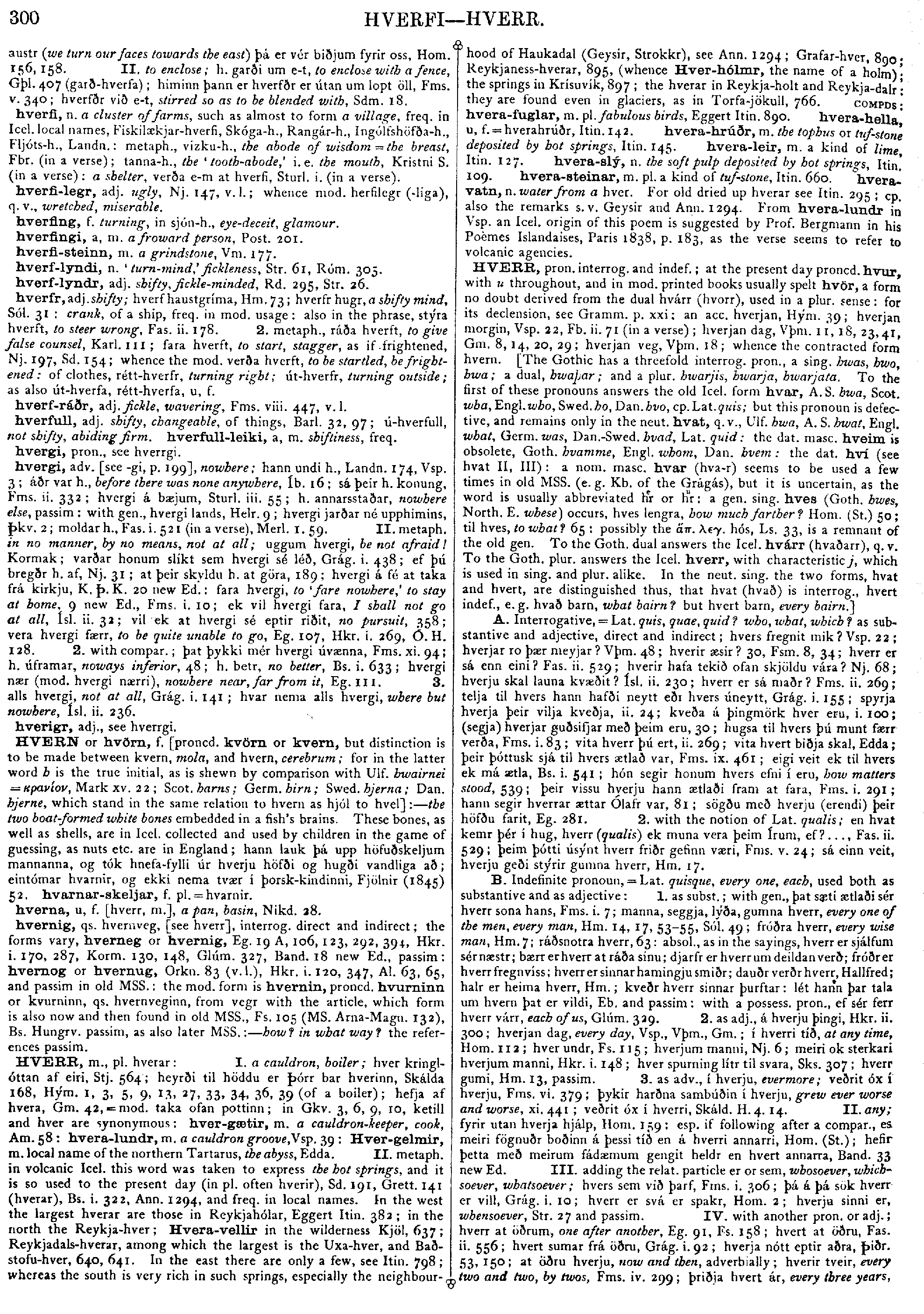
austr (we turn our faces towards the east) þá er vér biðjum fyrir oss, Hom. 156, 158. II. to enclose; h. garði um e-t, to enclose with a fence, Gþl. 407 (garð-hverfa); himinn þann er hverfðr er útan um lopt öll, Fms. v. 340; hverfðr við e-t, stirred so as to be blended with, Sdm. 18.
|
Source: Cleasby/Vigfusson, page b0334, entry 63 View original page image as: [TIFF] [PNG] [View previous entry] [View next entry] |
[Comment on this entry] [View comments] |
The following entry has been hand-corrected once. |
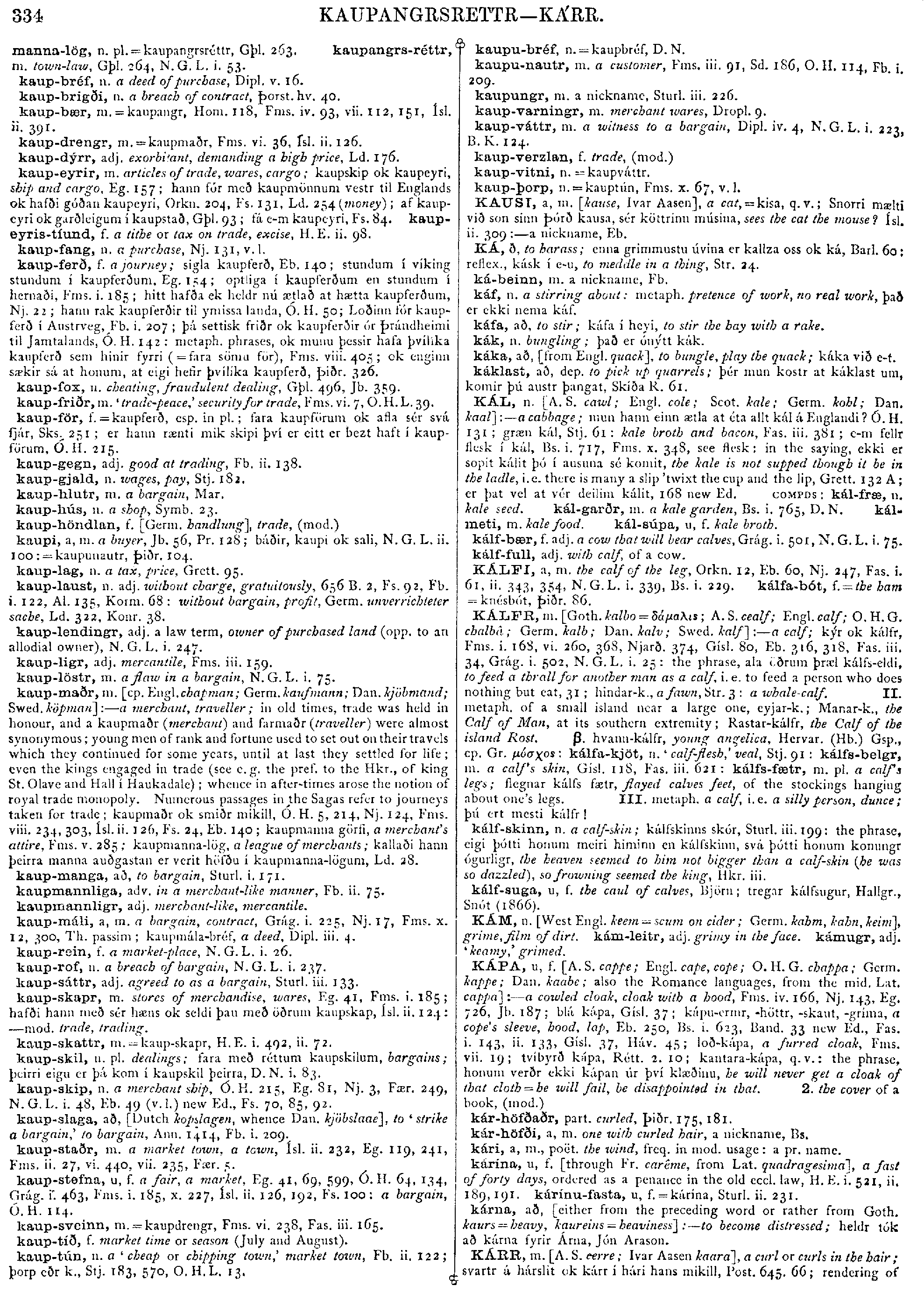
kálf-skinn, n. a calf-skin; kálfskinns skór, Sturl. iii. 199: the phrase, eigi þótti honum meiri himinn en kálfskinn, svá þótti honum konungr ógurligr, the heaven seemed to him not bigger than a calf-skin (he was so dazzled), so frowning seemed the king, Hkr. iii.
|
Source: Cleasby/Vigfusson, page b0398, entry 1 View original page image as: [TIFF] [PNG] [View previous entry] [View next entry] |
[Comment on this entry] [View comments] |
The following entry has not been hand-corrected. However, the page is reserved and someone is correcting it. |
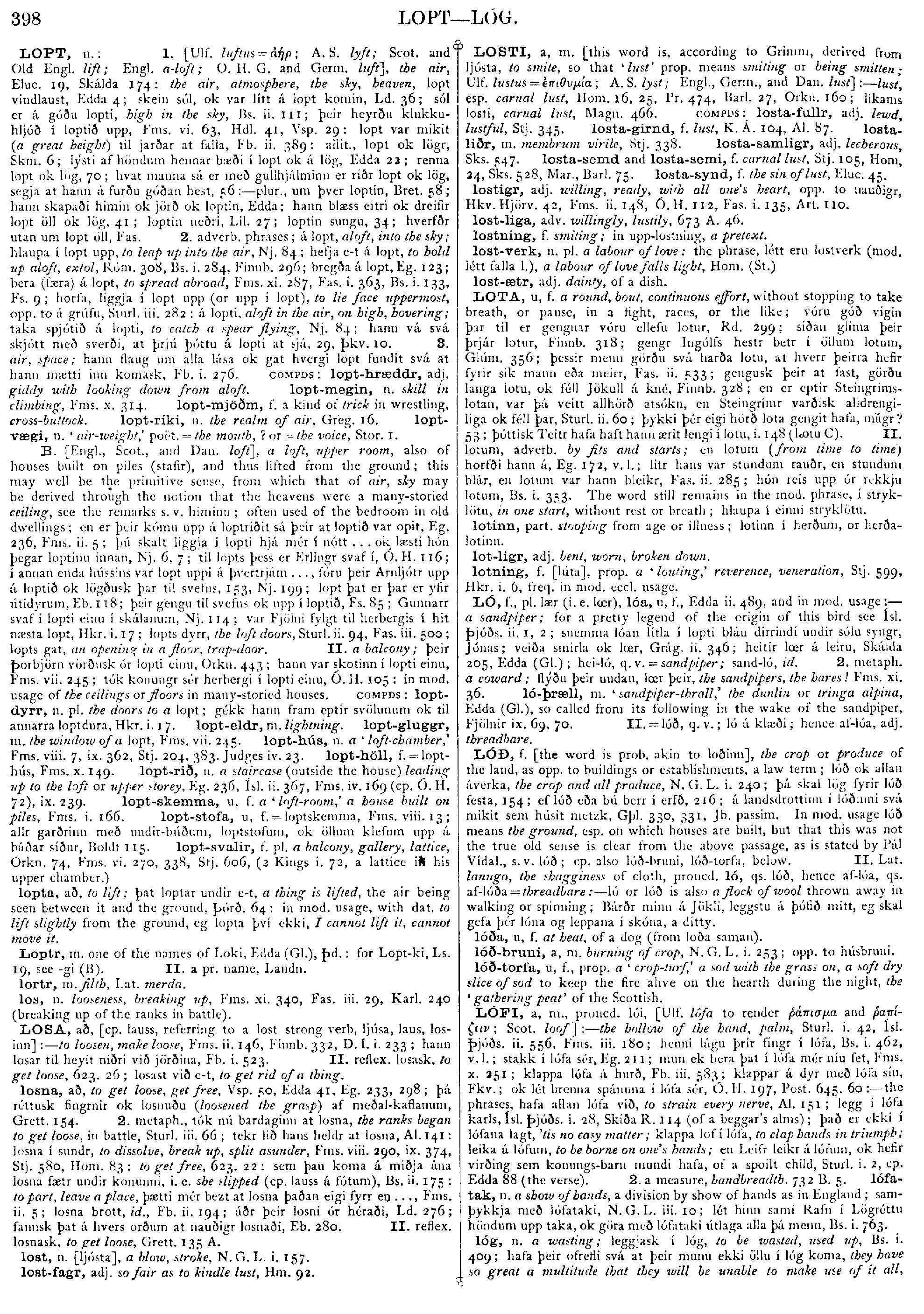
LOPT, n.: 1. [Ulf. luftu s = nijp; A. S. lyft; Scot, and Old Engl. lift; Engl. n- lo/ t; O. H. G. and Germ. ' liifi] , the air, Eluc. 19, Skálda 174: the air, atmosphere, the sky, heaven, lopt vindlaust, Edda 4; skein sol, ok var lítt á lopt komin, Ld. 36; sol er á góðu lopti, high in the s ky, Bs. ii. Ill; þeir heyrðu klukku- hljóð í loptið upp, Fms. vi. 63, Hdl. 41, Ysp. 29: lopt var mikit (a great height) til jarðar at falla, Fb. ii. 389: allit,, lopt ok lögr, Skm. 6; ly'sti af höndum hennar bæði í lopt ok a log, Edda 22; renna lopt ok lüg, "jo; hvat manna sá er með gulihjúlminn er ríðr lopt ok log, segja at harm á furðu góðan best, 56 :-- plur., inn þver loptin, Bret. 58; hann skapaði hirnin ok jörð ok loptin, Edda; hann blaess eitri ok dreifir lopt oil ok log, 41; loptin neðri, Lil. 27; loptin sungu, 34; hverfðr utan um lopt oil, Fas. 2. adverb, phrases; á lopt, aloft, into the sky; hlaupa í lopt upp, io leap up into the air, Nj. 84; hefja e-t A lopt, to hold tip aloft, extol, Róm. 308, Bs. i. 284, Finnb. 296; brcgða á lopt, Eg. 123; bera (færa) á lopt, to spread abroad, Fms. xi. 287, Fas. i. 363, Bs. i. 133, F's. 9; horfa, liggja í lopt upp (or upp í lopt). to lie face uppermost, opp. to a grufu, Stud. iii. 282: á lopti. aloft in the air, on high, hovering; taka spjótið á lopti, to catch a spear flying, Nj. 84; hann vá svá skjótt með sverði, at prjú þóttu á lopti at sja, 29, þkv. IO. 3. fi i r, space; hann flaug um alla l;'isa ok gat hvergi lopt fuudit svá at hann nuetti inn koinask, Fb. i. 276. COMPOS: lopt-hræddr, adj. giddy with looking down from aloft. lopt-megin, n. skill in climbing, Fms. x. 314. lopt-mjöðm, f. a kind of trick in wrestling, cross-buttock. lopt-riki, n. the realm of air, Greg. JÖ. lopt- vægi, n. ' air-weight, ' poi-t. = the mouth, 'tor -- the voice, Stor. I. B. [Engl., Scot., and Dan. loft] , a loft, upper room, also of houses built on piles (stafir), and thus lifted from the ground; this may well be the primitive sense, from which that of n i r, s k y may be derived through the notion that the heavens were a many-storied ceiling, see the remarks s. v. himinn; often used of the bedroom in old dwellings; en er þeir kómu upp ú loptriðit sá þeir at loptið var opit. Eg. 236, Fms. ii. 5; jni skalt liggja í lopti hjá mér í nótt ... ok læsti hón þcgar loptiiui innan, Nj. 6, 7; til lopts þess er Erlingr svaf i, O. H. 116; i annan enda hússins var lopt uppi á þvertrj. im ..., fóru þeir Arnljótr upp ú loptið ok lögðusk þar til svefns, 153, Nj. 199; l()pt þat er þar er yfir útidyrum, Eb. 118; þeir gengu til svefns ok upp í loptið, Fs. 85; Gunnarr svaf í lopti einu í skalanum, Nj. 114; var Fjöliii fylgt til lierbergis í hit næsta lopt, Hkr. 1. 17; lopts dyrr, the loft doom, Sturl. ii. 94, Fas. iii. 500; lopts gat, an opening in a floor, trap-door. II. a balcony; þeir þorbjörn vörðusk ór lopti einu, Orkn. 443; hann var skotinn í lopti einu, Fms. vii. 245; tók konungr sér herbergi í lopti einu, O. H. 105: in mod. usage of the ceilings or floors in many-storied houses. COMPDS: lopt- clyrr, n. pl. the doors to a lopt; gokk hann fram eptir svölunum ok til annarra loptdura, Hkr. i. l 7. lopt-eldr, m. lightning. lopt-gluggr, in. the window of a lopt, Fms. vii. 245. lopt-hús, n. a ' loft-chamber' Fms. viii. 7, ix. 362, Stj. 204, 383. Judges iv. 23. lopt-höll, f. -- lopt- hús, Fms. x. 149. lopt-rið, n. a staircase (outside the house) leading up to the loft or upper storey, Eg. 236, Ísl. ii. 367, Fms. iv. 169 (cp. C). H. 72), ix. 239. lopt-skemma, u, f. a 'loft-room, ' a bouse built on piles, Fms. i. 166. lopt-stofa, u, f. = loptskemma, Fms. viii. 13; allr garðrinn með undir-buðum, loptstofum, ok ölluin klefum npp á báðar siður, Boldt 115. lopt-svalir, f. pl. a balcony, gallery, lattice, Orkn. 74, Fms. vi. 270, 338, Stj. 606, (2 Kings i. 72, a lattice ift his upper
| Result Page: | 1 2 | Next |  |
Germanic Lexicon Project (main page)
This search system was written by
Sean Crist
Please consider
volunteering
to correct the data in these online dictionaries.
No rights reserved. Feel free to use these data in any way you please.