|
|

Search for her again, using less strict matching (1891 results)
|
Source: Bosworth/Toller, page b0477, entry 34 View original page image as: [TIFF] [PNG] [View previous entry] [View next entry] |
[Comment on this entry] [View comments] |
The following entry has been hand-corrected once. |
gingre,
an;
f.
A
female
servant,
maid-servant;
f m
m la
:--
Gingran
sínre
to
her
maid-servant,
Judth.
11;
Thw.
23,
21;
Jud.
132.
la
:--
Gingran
sínre
to
her
maid-servant,
Judth.
11;
Thw.
23,
21;
Jud.
132.
|
Source: Bosworth/Toller, page b0479, entry 15 View original page image as: [TIFF] [PNG] [View previous entry] [View next entry] |
[Comment on this entry] [View comments] |
The following entry has been hand-corrected once. |
GLÆD;
adj.
I.
shining,
bright
:--
Glæd
mid
golde
bright
with
gold,
Exon.
125
a;
Th.
480,
16;
Rä.
64,
3.
Wyrþ
heó
ungladu
ðeáh
heó
 r
gladu
wre
on
to
lócienne
it
[the
sea]
becomes
turbid
though
before
it
was
bright
to
look
at
[cf.
glæshlutru
on
to
seónne,
24],
and
the
Latin
sordida
visibus
obstat],
Bt,
6;
Fox
14,
26:
Bt.
Met.
Fox
5,
21;
Met.
5,
11.
Godes
condelle
glædum
gimme
God's
candle,
the
bright
jewel
[the
sun],
Exon.
57
a;
Th.
204,
3;
Ph.
92:
64
b;
Th.
237,
20;
Ph.
593.
Glad
seolfor
shining
silver,
Cd.
129;
Th.
164,
24;
Gen.
2719.
Óðer
biþ
golde
glædra
óðer
biþ
grundum
sweartra
one
is
brighter
than
gold,
the
other
darker
than
the
depths,
Salm.
Kmbl.
975;
Sal.
488.
Gimma
gladost
brightest
of
jewels,
Exon.
60
a;
Th.
218,
3;
Ph.
289.
II.
glad,
cheerful,
joyous,
bright
:--
Ðá
wærþ
he
swíðe
glæd
then
he
was
very
glad,
Chr.
656;
Erl.
30,
20.
Glæd
wæs
gavisus
est,
Jn.
Skt.
Lind.
8,
56.
Wosaþ
glæd
exultate,
Lk.
Skt.
Lind.
6,
23.
Glædman
hilaris,
Ælfc.
Gl.
88;
Som.
74,
87;
Wrt.
Voc.
50,
67.
Æ-acute;fre
he
biþ
ánes
módes
and
glæd
þurhwunaþ
he
is
ever
of
one
mind
and
continues
cheerful,
Homl.
Th.
i.
456,
25:
72,
27.
He
wearþ
glæd
on
his
ansýne
he
was
bright
of
face,
Guthl.
2;
Gdwin.
12,
20.
Wínes
glæð
merry
with
wine,
Exon.
117
a;
Th.
449,
28;
Dóm.
78.
Glæd
gumena
weorud
a
joyous
band
of
men,
32
a;
Th.
101,
5;
Cri.
1654.
Nolde
gladu
fre
syððan
ætýwan,
she,
joyous,
would
not
ever
afterwards
appear,
Cd.
72;
Th.
89,
14;
Gen.
1480.
Iacob
byþ
on
glædum
slum
exultabit
Jacob,
Ps.
Th.
52,
8.
Sefa
wæs
ðé
glædra
her
mind
was
the
gladder,
Elen.
Kmbl.
1909;
El.
956.
III.
pleasant,
kind,
mild,
courteous
:--
Glæd
man
jucundus
homo,
Ps.
Th.
111,
5.
Glade
fmnan
virgines,
148,
12.
Glædman
Hróþgár
courteous
Hrothgar,
Beo.
Th.
740;
B.
367.
Beó
wið
Geátas
glæd
geofena
gemyndig
be
kind
to
the
Gauts,
mindful
of
gifts,
2350;
B.
1173:
1730;
B.
863.
Mín
Drihten
hine
gedó
glædne
wiþ
eów
may
my
Lord
make
him
kind
towards
you,
Gen.
43.
14.
Ðæt
we
ðone
Hlend
hæbben
us
glædne
that
we
may
have
the
Saviour
propitious
to
us,
Th.
Chart.
240,
26:
Exon.
12
b;
Th.
20,
10;
Cri.
315.
[Icel.
glaðr
bright,
glad:
Dan.
glad
glad:
O.
H.
Ger.
glat
limpidus,
candidus:
Ger.
glatt.]
r
gladu
wre
on
to
lócienne
it
[the
sea]
becomes
turbid
though
before
it
was
bright
to
look
at
[cf.
glæshlutru
on
to
seónne,
24],
and
the
Latin
sordida
visibus
obstat],
Bt,
6;
Fox
14,
26:
Bt.
Met.
Fox
5,
21;
Met.
5,
11.
Godes
condelle
glædum
gimme
God's
candle,
the
bright
jewel
[the
sun],
Exon.
57
a;
Th.
204,
3;
Ph.
92:
64
b;
Th.
237,
20;
Ph.
593.
Glad
seolfor
shining
silver,
Cd.
129;
Th.
164,
24;
Gen.
2719.
Óðer
biþ
golde
glædra
óðer
biþ
grundum
sweartra
one
is
brighter
than
gold,
the
other
darker
than
the
depths,
Salm.
Kmbl.
975;
Sal.
488.
Gimma
gladost
brightest
of
jewels,
Exon.
60
a;
Th.
218,
3;
Ph.
289.
II.
glad,
cheerful,
joyous,
bright
:--
Ðá
wærþ
he
swíðe
glæd
then
he
was
very
glad,
Chr.
656;
Erl.
30,
20.
Glæd
wæs
gavisus
est,
Jn.
Skt.
Lind.
8,
56.
Wosaþ
glæd
exultate,
Lk.
Skt.
Lind.
6,
23.
Glædman
hilaris,
Ælfc.
Gl.
88;
Som.
74,
87;
Wrt.
Voc.
50,
67.
Æ-acute;fre
he
biþ
ánes
módes
and
glæd
þurhwunaþ
he
is
ever
of
one
mind
and
continues
cheerful,
Homl.
Th.
i.
456,
25:
72,
27.
He
wearþ
glæd
on
his
ansýne
he
was
bright
of
face,
Guthl.
2;
Gdwin.
12,
20.
Wínes
glæð
merry
with
wine,
Exon.
117
a;
Th.
449,
28;
Dóm.
78.
Glæd
gumena
weorud
a
joyous
band
of
men,
32
a;
Th.
101,
5;
Cri.
1654.
Nolde
gladu
fre
syððan
ætýwan,
she,
joyous,
would
not
ever
afterwards
appear,
Cd.
72;
Th.
89,
14;
Gen.
1480.
Iacob
byþ
on
glædum
slum
exultabit
Jacob,
Ps.
Th.
52,
8.
Sefa
wæs
ðé
glædra
her
mind
was
the
gladder,
Elen.
Kmbl.
1909;
El.
956.
III.
pleasant,
kind,
mild,
courteous
:--
Glæd
man
jucundus
homo,
Ps.
Th.
111,
5.
Glade
fmnan
virgines,
148,
12.
Glædman
Hróþgár
courteous
Hrothgar,
Beo.
Th.
740;
B.
367.
Beó
wið
Geátas
glæd
geofena
gemyndig
be
kind
to
the
Gauts,
mindful
of
gifts,
2350;
B.
1173:
1730;
B.
863.
Mín
Drihten
hine
gedó
glædne
wiþ
eów
may
my
Lord
make
him
kind
towards
you,
Gen.
43.
14.
Ðæt
we
ðone
Hlend
hæbben
us
glædne
that
we
may
have
the
Saviour
propitious
to
us,
Th.
Chart.
240,
26:
Exon.
12
b;
Th.
20,
10;
Cri.
315.
[Icel.
glaðr
bright,
glad:
Dan.
glad
glad:
O.
H.
Ger.
glat
limpidus,
candidus:
Ger.
glatt.]
|
Source: Bosworth/Toller, page b0479, entry 25 View original page image as: [TIFF] [PNG] [View previous entry] [View next entry] |
[Comment on this entry] [View comments (1)] |
The following entry has been hand-corrected once. |
glm,
es;
m.
Brightness,
splendour,
radiance
:--
Se
æðela
glm
the
noble
brightness
[the
sun],
Exon.
51
b;
Th.
178,
31;
Gú.
1252:
Th.
179,
18;
Gú.1263.
Sunnan
glm
the
sun's
radiance,
59
b:
Th.
215,
15;
Ph.
253.
Mín
se
swétesta
sunnan
scíma
hwæt
ðú
glm
hafast
my
sweetest
sunshine
ah!
thou
halt
radiant
beauty,
68
a;
Th.
252,
23;
Jul,
167.
Ðé
oftíhþ
glmes
gréne
folde
the
green
earth
shall
deny
thee
her
beauty,
Cd.
48;
Th.
62,
22;
Gen.
1018.
[O.
H.
Ger.
gleimo
nitor.]
|
Source: Bosworth/Toller, page b0482, entry 24 View original page image as: [TIFF] [PNG] [View previous entry] [View next entry] |
[Comment on this entry] [View comments] |
The following entry has been hand-corrected once. |
gnyrn, es; m. n[?] Grief, sorrow, evil, wrong :-- Lác weorþade ðe hire brungen wæs gnyrna to geóce the gift she honoured that was brought to her as a consolation of sorrows, Elen. Kmbl. 2275; El. 1139. Þeóda waldend eallra gnyrna [MS. gnymra] leás the ruler of nations, free from all evils, 843; El. 422. Wlance drihtne guldon gód mid gnyrne arrogant, they repaid good to the Lord with evil, Cd. 111; Th. 146, 10; Gen. 2420. [Cf. gyrn.]
|
Source: Bosworth/Toller, page b0483, entry 28 View original page image as: [TIFF] [PNG] [View previous entry] [View next entry] |
[Comment on this entry] [View comments] |
The following entry has been hand-corrected once. |
god-módor; f. A GODMOTHER :-- Æt ðam fulwihte hyre onféng sum godes þeów ðære noma wæs rómána ... heó slép æt ðære godmódor húse a certain servant of God, whose name was Romana, was her sponsor at baptism ... she slept at the godmother's house, Shrn. 140, 24.
|
Source: Bosworth/Toller, page b0484, entry 32 View original page image as: [TIFF] [PNG] [View previous entry] [View next entry] |
[Comment on this entry] [View comments] |
The following entry has been hand-corrected once. |
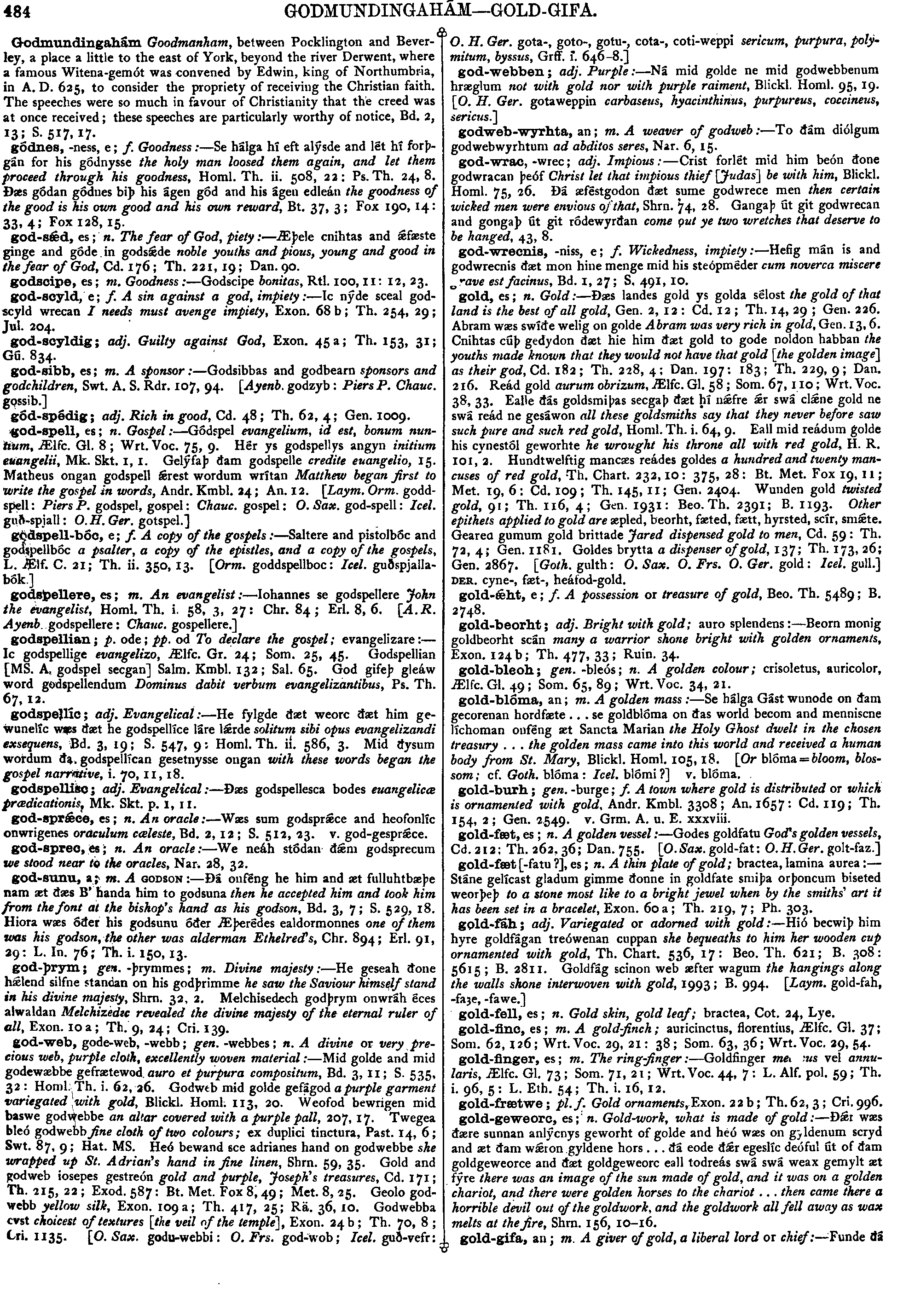
gold-fáh;
adj.
Variegated
or
adorned
with
gold
:--
Hió
becwiþ
him
hyre
goldfágan
treówenan
cuppan
she
bequeaths
to
him
her
wooden
cup
ornamented
with
gold,
Th.
Chart.
536,
17:
Beo.
Th.
621;
B.
308:
5615;
B.
2811.
Goldfág
scinon
web
æfter
wagum
the
hangings
along
the
walls
shone
interwoven
with
gold,
1993;
B.
994.
[Laym.
gold-fah,
-fa e,
-fawe.]
e,
-fawe.]
|
Source: Bosworth/Toller, page b0486, entry 36 View original page image as: [TIFF] [PNG] [View previous entry] [View next entry] |
[Comment on this entry] [View comments] |
The following entry has been hand-corrected once. |
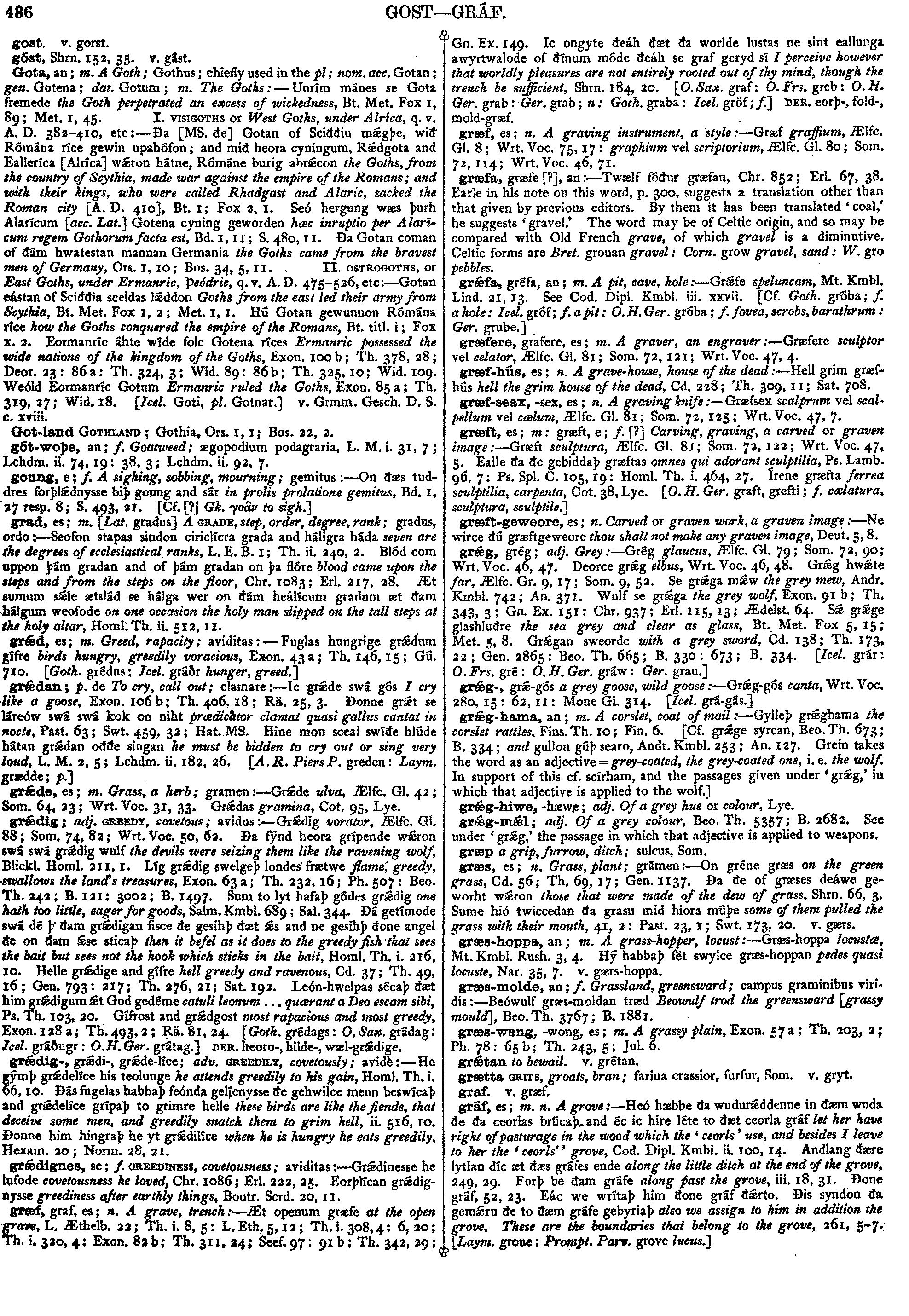
gráf,
es;
m.
n.
A
grove
:--
Heó
hæbbe
ða
wudurddenne
in
ðæm
wuda
ðe
ða
ceorlas
brúcaþ
and
éc
ic
hire
léte
to
ðæt
ceorla
gráf
let
her
have
right
of
pasturage
in
the
wood
which
the
'ceorls'
use,
and
besides
I
leave
to
her
the
'
ceorls'
grove,
Cod.
Dipl.
Kmbl.
ii.
100,
14.
Andlang
ðære
lytlan
díc
æt
ðæs
gráfes
ende
along
the
little
ditch
at
the
end
of
the
grove,
249,
29.
Forþ
be
ðam
gráfe
along
past
the
grove,
iii.
18,
31.
Ðone
gráf,
52,
23.
Eác
we
wrítaþ
him
ðone
gráf
ðrto.
Ðis
syndon
ða
gemru
ðe
to
ðæm
gráfe
gebyriaþ
also
we
assign
to
him
in
addition
the
grove.
These
are
the
boundaries
that
belong
to
the
grove,
261,
5-7.
[Laym.
groue:
Prompt.
Parv.
grove
lucus.]
|
Source: Bosworth/Toller, page b0487, entry 23 View original page image as: [TIFF] [PNG] [View previous entry] [View next entry] |
[Comment on this entry] [View comments] |
The following entry has been hand-corrected once. |
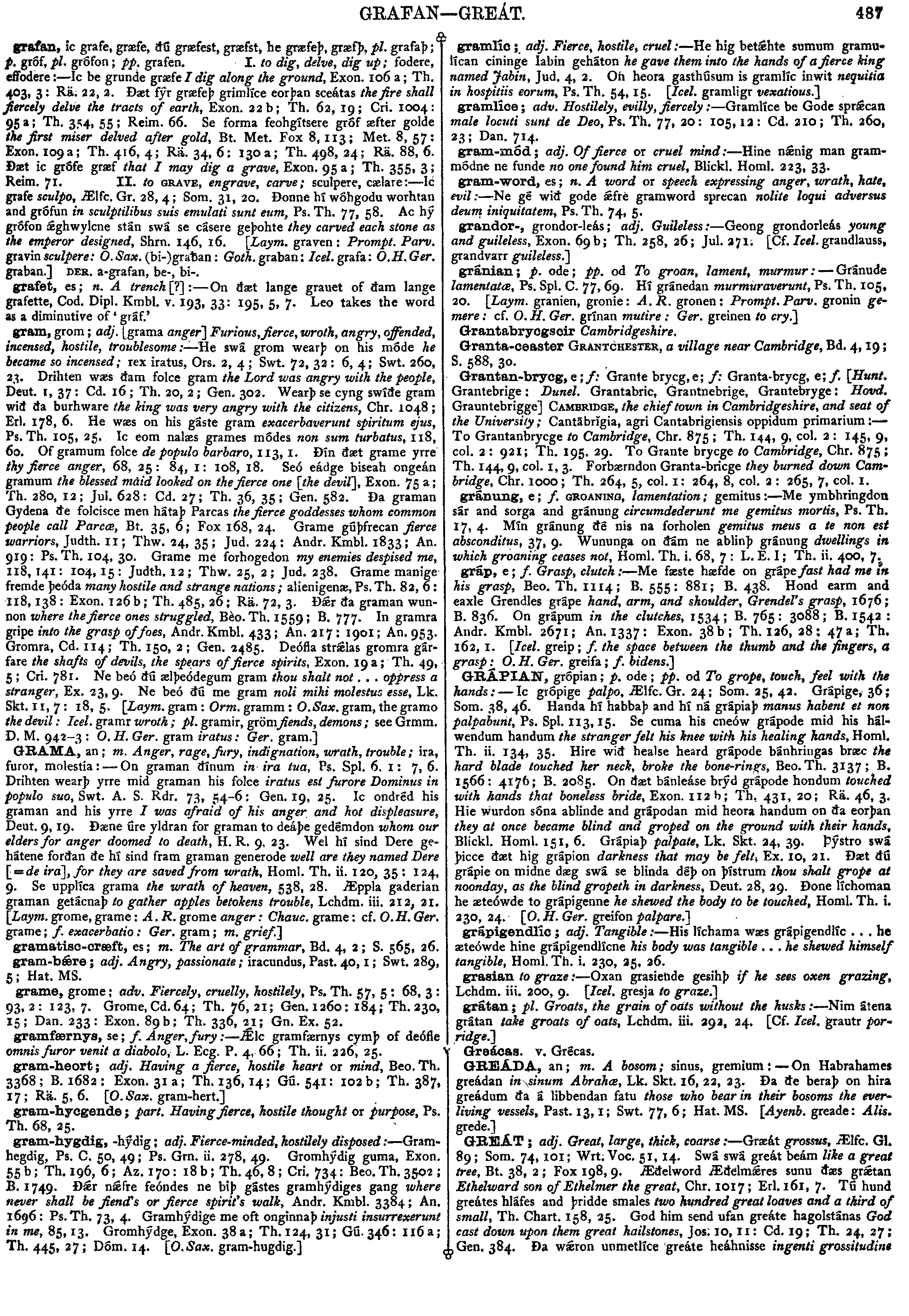
GRÁPIAN, grópian; p. ode; pp. od To grope, touch, feel with the hands :-- Ic grópige palpo. Ælfc. Gr. 24; Som. 25, 42. Grápige, 36; Som. 38, 46. Handa hí habbaþ and hí ná grápiaþ manus habent et non palpabunt, Ps. Spl. 113, 15. Se cuma his cneów grápode mid his hálwendum handum the stranger felt his knee with his healing hands, Homl. Th. ii. 134, 35. Hire wið healse heard grápode bánhringas bræc the hard blade touched her neck, broke the bone-rings, Beo. Th. 3137; B. 1566: 4176; B. 2085. On ðæt bánleáse brýd grápode hondum touched with hands that boneless bride, Exon. 112 b; Th. 431, 20; Rä. 46, 3. Hie wurdon sóna ablinde and grápodan mid heora handum on ða eorþan they at once became blind and groped on the ground with their hands, Blickl. Homl. 151, 6. Grápiaþ palpate, Lk. Skt. 24, 39. Þýstro swá þicce ðæt hig grápion darkness that may be felt, Ex. 10, 21. Ðæt ðú grápie on midne ðæg swá se blinda déþ on þístrum thou shalt grope at noonday, as the blind gropeth in darkness, Deut. 28, 29. Ðone líchoman he æteówde to grápigenne he shewed the body to be touched, Homl. Th. i. 230, 24. [O. H. Ger. greifon palpare.]
|
Source: Bosworth/Toller, page b0489, entry 1 View original page image as: [TIFF] [PNG] [View previous entry] [View next entry] |
[Comment on this entry] [View comments] |
The following entry has been hand-corrected once. |
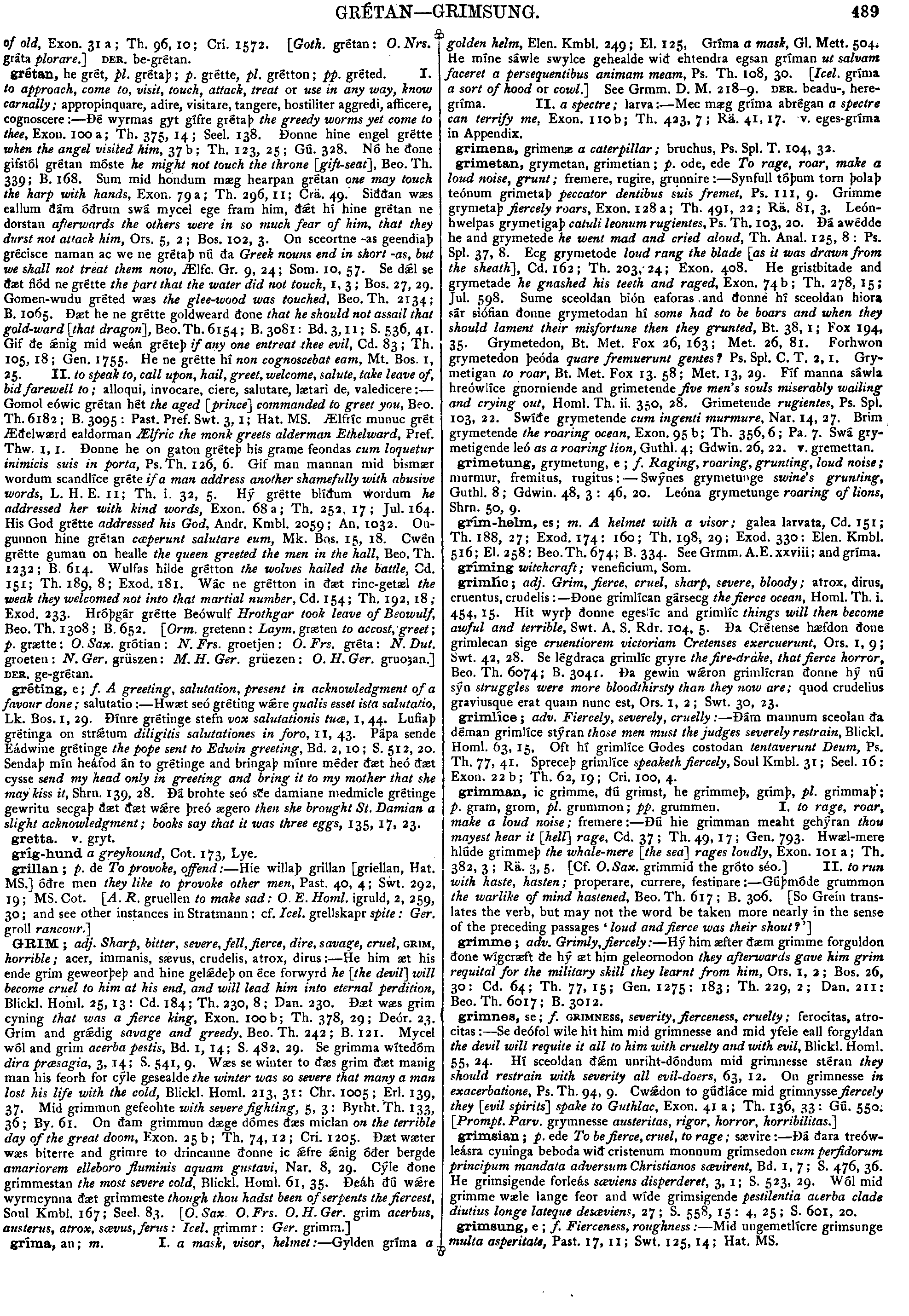
grétan,
he
grét,
pl.
grétaþ;
p.
grétte,
pl.
grétton;
pp.
gréted.
I.
to
approach,
come
to,
visit,
touch,
attack,
treat
or
use
in
any
way,
know
carnally;
appropinquare,
adire,
visitare,
tangere,
hostiliter
aggredi,
afficere,
cognoscere
:--
Ðú
wyrmas
gyt
gífre
grétaþ
the
greedy
worms
yet
come
to
thee,
Exon.
100
a;
Th.
375,
14;
Seel.
138.
Ðonne
hine
engel
grétte
when
the
angel
visited
him,
37
b;
Th.
123,
25;
Gú.
328.
Nó
he
ðone
gifstól
grétan
móste
he
might
not
touch
the
throne
[gift-seat],
Beo.
Th.
339;
B.
168.
Sum
mid
hondum
nsæg
hearpan
grétan
one
may
touch
the
harp
with
hands,
Exon.
79
a;
Th.
296,
11;
Crä.
49.
Siððan
wæs
eallum
ðám
óðrum
swá
mycel
ege
fram
him,
ðt
hí
hine
grétan
ne
dorstan
afterwards
the
others
were
in
so
much
fear
of
him,
that
they
durst
not
attack
him,
Ors.
5,
2;
Bos.
102,
3.
On
sceortne
-as
geendiaþ
grécisce
naman
ac
we
ne
grétaþ
nú
ða
Greek
nouns
end
in
short
-as,
but
we
shall
not
treat
them
now,
Ælfc.
Gr.
9,
24;
Som.
10,
57.
Se
dl
se
ðæt
flód
ne
grétte
the
part
that
the
water
did
not
touch,
1,
3;
Bos.
27,
29.
Gomen-wudu
gréted
wæs
the
glee-wood
was
touched,
Beo.
Th.
2134;
B.
1065.
Ðæt
he
ne
grétte
goldweard
ðone
that
he
should
not
assail
that
gold-ward
[that
dragon],
Beo.
Th.
6154;
B.
3081:
Bd.
3,
11;
S.
536,
41.
Gif
ðe
nig
mid
weán
gréteþ
if
any
one
entreat
thee
evil,
Cd.
83;
Th.
105,
18;
Gen.
1755.
He
ne
grétte
hí
non
cognoscebat
eam,
Mt.
Bos.
1,
25.
II.
to
speak
to,
call
upon,
hail,
greet,
welcome,
salute,
take
leave
of,
bid
farewell
to;
alloqui,
invocare,
ciere,
salutare,
lætari
de,
valedicere
:--
Gomol
eówic
grétan
hét
the
aged
[prince]
commanded
to
greet
you,
Beo.
Th.
6182;
B.
3095:
Past.
Pref.
Swt.
3,
1;
Hat.
MS.
Ælfríc
munuc
grét
Æðelwærd
ealdorman
Ælfric
the
monk
greets
alderman
Ethelward,
Pref.
Thw.
1,
1.
Ðonne
he
on
gaton
gréteþ
his
grame
feondas
cum
loquetur
inimicis
suis
in
porta,
Ps.
Th.
126,
6.
Gif
man
mannan
mid
bismær
wordum
scandlíce
gréte
if
a
man
address
another
shamefully
with
abusive
words,
L.
H.
E.
11;
Th.
i.
32,
5.
Hý
grétte
blíðum
wordum
he
addressed
her
with
kind
words,
Exon.
68
a;
Th.
252,
17;
Jul.
164.
His
God
grétte
addressed
his
God,
Andr.
Kmbl.
2059;
An.
1032.
Ongunnon
hine
grétan
cæperunt
salutare
eum,
Mk.
Bos.
15,
18.
Cwén
grétte
guman
on
healle
the
queen
greeted
the
men
in
the
hall,
Beo.
Th.
1232;
B.
614.
Wulfas
hilde
grétton
the
wolves
hailed
the
battle,
Cd.
151;
Th.
189,
8;
Exod.
181.
Wác
ne
grétton
in
ðæt
rinc-getæl
the
weak
they
welcomed
not
into
that
martial
number,
Cd.
154;
Th.
192,
18;
Exod.
233.
Hróþgár
grétte
Beówulf
Hrothgar
took
leave
of
Beowulf,
Beo.
Th.
1308;
B.
652.
[Orm.
gretenn:
Laym.
græten
to
accost,
greet;
p.
grætte:
O.
Sax.
grótian:
N.
Frs.
groetjen:
O.
Frs.
gréta:
N.
Dut.
groeten:
N.
Ger.
grüszen:
M.
H.
Ger.
grüezen:
O.
H.
Ger.
gruoan.]
DER.
ge-grétan.
|
Source: Bosworth/Toller, page b0494, entry 22 View original page image as: [TIFF] [PNG] [View previous entry] [View next entry] |
[Comment on this entry] [View comments] |
The following entry has been hand-corrected once. |
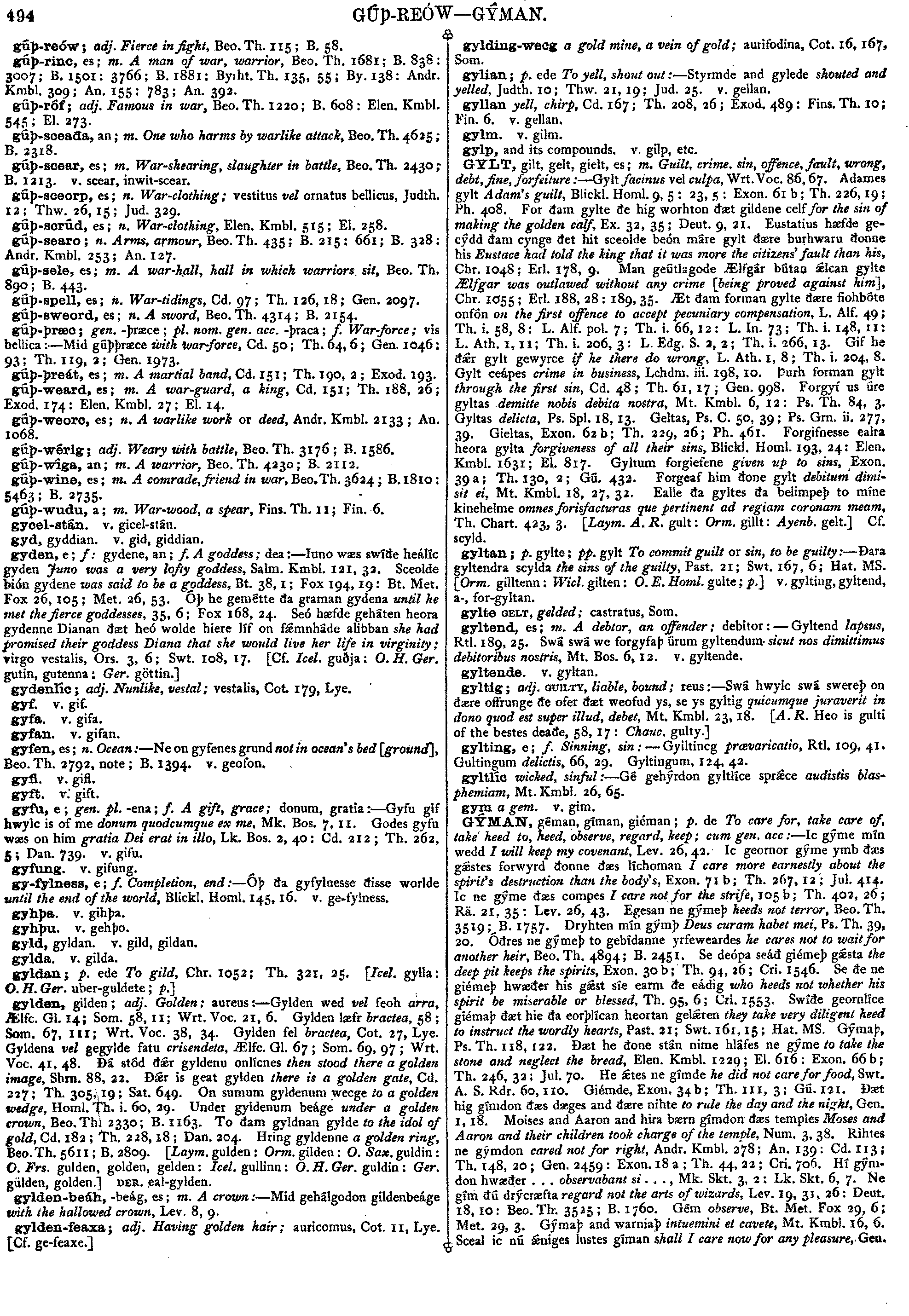
gyden,
e;
f:
gydene,
an;
f.
A
goddess;
dea
:--
Iuno
wæs
swíðe
heálíc
gyden
Juno
was
a
very
lofty
goddess,
Salm.
Kmbl.
121,
32.
Sceolde
bión
gydene
was
said
to
be
a
goddess,
Bt.
38,
1;
Fox
194,
19:
Bt.
Met.
Fox
26,
105;
Met.
26,
53.
Óþ
he
gemétte
ða
graman
gydena
until
he
met
the
fierce
goddesses,
35,
6;
Fox
168,
24.
Seó
hæfde
geháten
heora
gydenne
Dianan
ðæt
heó
wolde
hiere
líf
on
fmnháde
alibban
she
had
promised
their
goddess
Diana
that
she
would
live
her
life
in
virginity;
virgo
vestalis,
Ors.
3,
6;
Swt.
108,
17.
[Cf.
Icel.
guðja:
O.
H.
Ger.
gutin,
gutenna:
Ger.
göttin.]
| Result Page: |  |
Previous | 15 16 17 18 19 20 21 22 23 24 25 26 27 28 29 30 31 32 33 | Next |  |
Germanic Lexicon Project (main page)
This search system was written by
Sean Crist
Please consider
volunteering
to correct the data in these online dictionaries.
No rights reserved. Feel free to use these data in any way you please.