|
|

Search for hem again, using less strict matching (104 results)
|
Source: Bosworth/Toller, page b0987, entry 5 View original page image as: [TIFF] [PNG] [View previous entry] [View next entry] |
[Comment on this entry] [View comments (1)] |
The following entry has been hand-corrected once. |
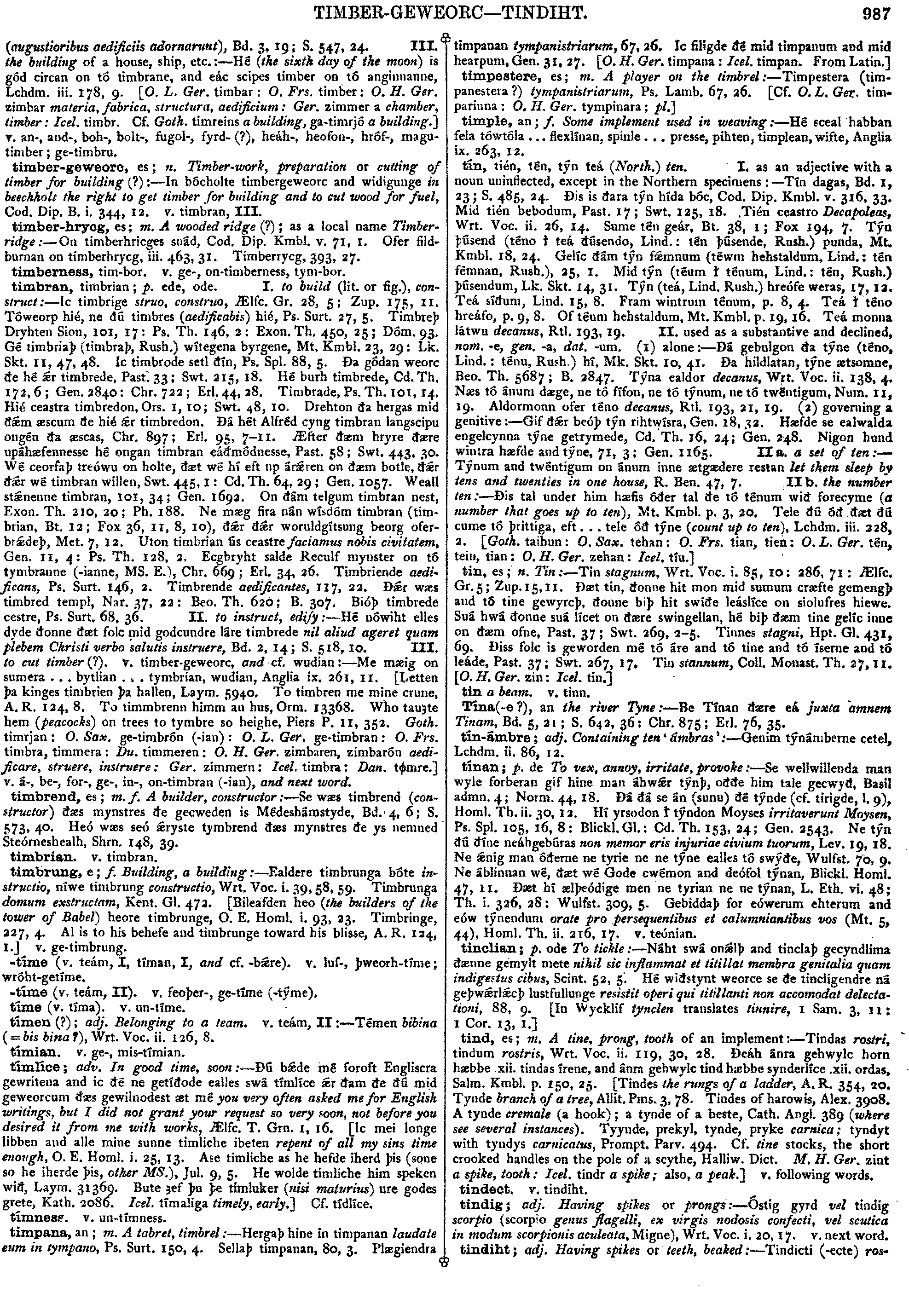
timbran,
timbrian;
p.
ede,
ode.
I.
to
build
(lit.
or
fig.),
construct:--Ic
timbrige
struo,
construo,
Ælfc.
Gr.
28,
5;
Zup.
175,
11.
Tóweorp
hié,
ne
dú
timbres
(aedificabis)
hié,
Ps.
Surt.
27,
5.
Timbreþ
Dryhten
Sion,
101,
17:
Ps.
Th.
146,
2:
Exon.
Th.
450,
25;
Dóm.
93.
Gé
timbriaþ
(timbraþ,
Rush.)
wítegena
byrgene,
Mt.
Kmbl.
23,
29:
Lk.
Skt.
11,
47,
48.
Ic
timbrode
setl
ðín,
Ps.
Spl.
88,
5.
Ða
gódan
weorc
ðe
hé
 r
timbrede,
Past.
33;
Swt.
215,
18.
Hé
burh
timbrede,
Cd.
Th.
172,
6;
Gen.
2840:
Chr.
722;
Erl.
44,
28.
Timbrade,
Ps.
Th.
101,
14.
Hié
ceastra
timbredon,
Ors.
1,
10;
Swt.
48,
10.
Drehton
ða
hergas
mid
ðm
æscum
ðe
hié
r
timbredon.
Ðá
hét
Alfréd
cyng
timbran
langscipu
ongén
ða
æscas,
Chr.
897;
Erl.
95,
7-11.
Æfter
ðæm
hryre
ðære
upáhæfennesse
hé
ongan
timbran
eáðmósnes?e,
Past.
58;
Swt.
443,
30.
Wé
ceorfaþ
treówu
on
holte,
ðæt
wé
hí
eft
up
árren
on
ðæm
botle,
ðr
ðr
wé
timbran
willen,
Swt.
445,
1:
Cd.
Th.
64,
29;
Gen.
1057.
Weall
stnenne
timbran,
101,
34;
Gen.
1692.
On
ðám
telgum
timbran
nest,
Exon.
Th.
210,
20;
Ph.
188.
Ne
mæg
fira
nán
wísdóm
timbran
(timbrian,
Bt.
12;
Fox
36,
11,
8,
10),
ár
ðr
woruldgítsung
beorg
ofer
r
timbrede,
Past.
33;
Swt.
215,
18.
Hé
burh
timbrede,
Cd.
Th.
172,
6;
Gen.
2840:
Chr.
722;
Erl.
44,
28.
Timbrade,
Ps.
Th.
101,
14.
Hié
ceastra
timbredon,
Ors.
1,
10;
Swt.
48,
10.
Drehton
ða
hergas
mid
ðm
æscum
ðe
hié
r
timbredon.
Ðá
hét
Alfréd
cyng
timbran
langscipu
ongén
ða
æscas,
Chr.
897;
Erl.
95,
7-11.
Æfter
ðæm
hryre
ðære
upáhæfennesse
hé
ongan
timbran
eáðmósnes?e,
Past.
58;
Swt.
443,
30.
Wé
ceorfaþ
treówu
on
holte,
ðæt
wé
hí
eft
up
árren
on
ðæm
botle,
ðr
ðr
wé
timbran
willen,
Swt.
445,
1:
Cd.
Th.
64,
29;
Gen.
1057.
Weall
stnenne
timbran,
101,
34;
Gen.
1692.
On
ðám
telgum
timbran
nest,
Exon.
Th.
210,
20;
Ph.
188.
Ne
mæg
fira
nán
wísdóm
timbran
(timbrian,
Bt.
12;
Fox
36,
11,
8,
10),
ár
ðr
woruldgítsung
beorg
ofer brdeþ,
Met.
7,
12.
Uton
timbrian
ús
ceastre
faciamus
nobis
civitatem,
Gen.
11,
4:
Ps.
Th.
128,
2.
Ecgbryht
salde
Reculf
mynster
on
tó
tymbranne
(-ianne,
MS.
E.),
Chr.
669;
Erl.
34,
26.
Timbriende
aedificans,
Ps.
Surt.
146,
2.
Timbrende
aedificantes,
117,
22.
Ðr
wæs
timbred
templ,
Nar.
37,
22:
Beo.
Th.
620;
B.
307.
Bióþ
timbrede
cestre,
Ps.
Surt.
68,
36.
II.
to
instruct,
edify:--Hé
nówiht
elles
dyde
ðonne
ðæt
folc
mid
godcundre
láre
timbrede
nil
aliud
ageret
quam
plebem
Christi
verbo
salutis
instruere,
Bd.
2,
14;
S.
518,
10.
III.
to
cut
timber
(?).
v.
timber-geweorc,
and
cf.
wudian:--Me
mæig
on
sumera
.
.
.
bytlian
.
.
.
tymbrian,
wudian,
Anglia
ix.
261,
11.
[Letten
þa
kinges
timbrien
þa
hallen,
Laym.
5940.
To
timbren
me
mine
crune,
A.
R.
124,
8.
To
timmbrenn
himm
an
hus,
Orm.
13368.
Who
tau
brdeþ,
Met.
7,
12.
Uton
timbrian
ús
ceastre
faciamus
nobis
civitatem,
Gen.
11,
4:
Ps.
Th.
128,
2.
Ecgbryht
salde
Reculf
mynster
on
tó
tymbranne
(-ianne,
MS.
E.),
Chr.
669;
Erl.
34,
26.
Timbriende
aedificans,
Ps.
Surt.
146,
2.
Timbrende
aedificantes,
117,
22.
Ðr
wæs
timbred
templ,
Nar.
37,
22:
Beo.
Th.
620;
B.
307.
Bióþ
timbrede
cestre,
Ps.
Surt.
68,
36.
II.
to
instruct,
edify:--Hé
nówiht
elles
dyde
ðonne
ðæt
folc
mid
godcundre
láre
timbrede
nil
aliud
ageret
quam
plebem
Christi
verbo
salutis
instruere,
Bd.
2,
14;
S.
518,
10.
III.
to
cut
timber
(?).
v.
timber-geweorc,
and
cf.
wudian:--Me
mæig
on
sumera
.
.
.
bytlian
.
.
.
tymbrian,
wudian,
Anglia
ix.
261,
11.
[Letten
þa
kinges
timbrien
þa
hallen,
Laym.
5940.
To
timbren
me
mine
crune,
A.
R.
124,
8.
To
timmbrenn
himm
an
hus,
Orm.
13368.
Who
tau te
hem
(peacocks)
on
trees
to
tymbre
so
heighe,
Piers
P.
11,
352.
Goth.
timrjan:
O.
Sax.
ge-timbrón
(-ian):
O.
L.
Ger.
ge-timbran:
O.
Frs.
timbra,
timmera:
Du.
timmeren:
O.
H.
Ger.
zimbaren,
zimbarón
aedificare,
struere,
instruere:
Ger.
zimmern:
Icel.
timbra:
Dan.
tømre.]
v.
á-,
be-,
for-,
ge-,
in-,
on-timbran
(-ian),
and
next
word.
te
hem
(peacocks)
on
trees
to
tymbre
so
heighe,
Piers
P.
11,
352.
Goth.
timrjan:
O.
Sax.
ge-timbrón
(-ian):
O.
L.
Ger.
ge-timbran:
O.
Frs.
timbra,
timmera:
Du.
timmeren:
O.
H.
Ger.
zimbaren,
zimbarón
aedificare,
struere,
instruere:
Ger.
zimmern:
Icel.
timbra:
Dan.
tømre.]
v.
á-,
be-,
for-,
ge-,
in-,
on-timbran
(-ian),
and
next
word.
|
Source: Bosworth/Toller, page b1006, entry 11 View original page image as: [TIFF] [PNG] [View previous entry] [View next entry] |
[Comment on this entry] [View comments (1)] |
The following entry has been hand-corrected once. |
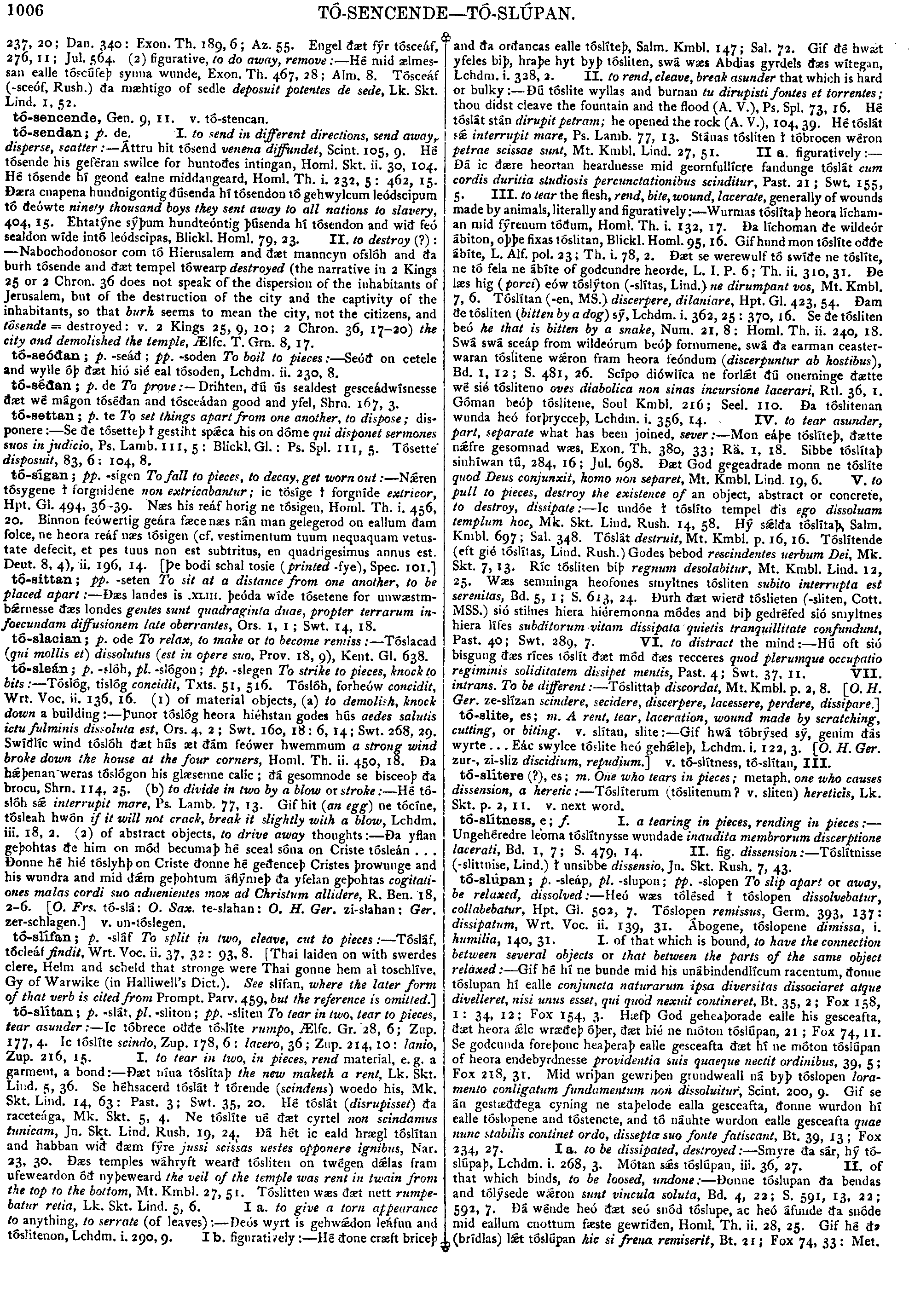
tó-slífan;
p.
-sláf
To
split
in
two,
cleave,
cut
to
pieces
:--
Tósláf,
tócleáf
findit.
Wrt.
Voc.
ii.
37,
32
:
93,
8.
[Thai
laiden
on
with
swerdes
clere,
Helm
and
scheld
that
stronge
were
Thai
gonne
hem
al
toschlíve,
Gy
of
Warwike
(in
Halliwell's
Dict.
).
See
slífan,
where
the
later
form
of
that
verb
is
cited
from
Prompt.
Parv.
459,
but
the
reference
is
omitted.
']
tó-slítan;
p.
-slát,
pl.
-sliton
;
pp.
-sliten
To
tear
in
two,
tear
to
pieces,
tear
asunder
:--
Ic
tóbrece
oððe
tóslíte
rumpo,
Ælfc.
Gr.
28,
6;
Zup.
177,
4.
Ic
tóslíte
scinrio,
Zup.
178,
6
:
lacero,
36;
Zup.
214,
10:
lanio,
Zup.
216,
15.
I.
to
tear
in
two,
in
pieces,
rend
material,
e.
g.
a
garment,
a
bond
:--
Ðæt
níua
tóslítaþ
the
new
maketh
a
rent,
Lk.
Skt.
Lind.
5,
36.
Se
héhsacerd
tóslát
 torende
(scindens)
woedo
his,
Mk.
Skt.
Lind.
14,
63:
Past.
3;
Swt.
35,
20.
Hé
tóslát
(disrupisset)
ða
raceteága,
Mk.
Skt.
5,
4.
Ne
tóslíte
ué
ðæt
cyrtel
non
scindamus
tunicam,
Jn.
Skt.
Lind.
Rush.
19,
24.
Ðá
hét
ic
eald
hrægl
tóslítan
and
habban
wið
ðæm
fýre
jussi
scissas
uestes
opponere
ignibus,
Nar.
23,
30.
Ðæs
temples
wáhryft
wearð
tósliten
on
twégen
dlas
fram
ufeweardon
oð
nyþeweard
the
veil
of
the
temple
was
rent
in
twain
from
the
top
to
the
bottom.
Mt.
Kmbl.
27,
51.
Tóslitten
wæs
ðæt
nett
rumpe-batur
retia,
Lk.
Skt.
Lind.
5,
6.
I
a.
to
give
a
torn
appearance
to
anything,
to
serrate
(of
leaves)
:--
Ðeós
wyrt
is
gehwdon
leáfun
and
tóslitenon,
Lchdm.
i.
290,
9.
I
b.
figuratively
:--
Hé
ðone
cræft
briceþ
and
ða
orðancas
ealle
tóslíteþ.
Salm.
Kmbl.
147;
Sal.
72.
Gif
ðé
hwæt
yfeles
biþ,
hraþe
hyt
byþ
tósliten,
swá
wæs
Abdias
gyrdels
ðæs
wítegan.
Lchdm.
i.
328,
2.
II.
to
rend,
cleave,
break
asunder
that
which
is
hard
or
bulky
:--
Ðú
tóslite
wyllas
and
burnan
tu
dirupisti
fontes
et
torrentes;
thou
didst
cleave
the
fountain
and
the
flood
(A.
V.
),
Ps.
Spl.
73,
16.
Hé
tóslát
stán
dirupit
petram;
he
opened
the
rock
(A.
V.
),
104,
39.
Hé
tóslát
sinterrupit
mare,
Ps.
Lamb.
77,
13.
Stánas
tósliten
tobrocen
wéron
petrae
scissae
sunt,
Mt.
Kmbl.
Lind.
27,
51.
II
a.
figuratively
:--
Ðá
ic
ðære
heortan
heardnesse
mid
geornfullícre
fandunge
tóslát
cum
cordis
duritia
studiosis
percunctationibus
scinditur.
Past.
21;
Swt.
155,
5.
III.
to
tear
the
flesh,
rend,
bite,
wound,
lacerate,
generally
of
wounds
made
by
animals,
literally
and
figuratively
:--
Wurmas
tóslítaþ
heora
líchaman
mid
fýrenum
tóðum,
Homl.
Th.
i.
132,
17.
Ða
líchoman
ðe
wildeór
ábiton,
oþþe
fixas
tóslitan,
Blickl.
Homl.
95,
16.
Gifhund
mon
tóslíte
oððe
ábíte,
L.
Alf.
pol.
23;
Th.
i.
78,
2.
Ðæt
se
werewulf
tó
swíðe
ne
tóslíte,
ne
tó
fela
ne
ábíte
of
godcundre
heorde,
L.
I.
P.
6;
Th.
ii.
310,
31.
Ðe
læs
hig
(porci)
eów
tóslýton
(-slítas,
Lind.
)
ne
dirumpant
vos,
Mt.
Kmbl.
7,
6.
Tóslítan
(-en,
MS.
)
discerpere,
dilaniare.
Hpt.
Gl.
423,
54.
Ðam
ðe
tósliten
(bitten
by
a
dog)
sý,
Lchdm.
i.
362,
25
:
370,
16.
Se
ðe
tósliten
beó
he
that
is
bitten
by
a
snake,
Num.
21,
8:
Homl.
Th.
ii.
240,
18.
Swá
swá
sceáp
from
wildeórum
beóþ
fornumene,
swá
ða
earman
ceasterwaran
tóslitene
wron
fram
heora
feóndum
(discerpuntur
ab
hostibus),
Bd.
1,
12
;
S.
481,
26.
Scípo
diówlíca
ne
forlt
ðú
onerninge
ðætte
wé
sié
tósliteno
oves
diabolica
non
sinas
incursione
lacerari.
Rtl.
36,
1.
Góman
beóþ
tóslitene,
Soul
Kmbl.
216;
Seel.
110.
Ða
tóslitenan
wunda
heó
forþrycceþ,
Lchdm.
i.
356,
14.
IV.
to
tear
asunder,
part,
separate
what
has
been
joined,
sever
:--
Mon
eá
þe
tóslíteþ,
ðætte
nfre
gesomnad
wæs,
Exon.
Th.
380,
33;
Rä.
1.
18.
Sibbe
tóslítaþ
sinhíwan
tú,
284,
16;
Jul.
698.
Ðæt
God
gegeadrade
monn
ne
tóslíte
quod
Deus
conjunxit,
homo
non
separet.
Mt.
Kmbl.
Lind.
19,
6.
V.
to
pull
to
pieces,
destroy
the
existence
of
an
object,
abstract
or
concrete,
to
destroy,
dissipate
:--
Ic
undóe
tóslíto
tempel
ðis
ego
dissoluam
templum
hoc,
Mk.
Skt.
Lind.
Rush.
14,
58.
Hý
slða
tóslítaþ,
Salm.
Kmbl.
697;
Sal.
348.
Tóslát
destruit,
Mt.
Kmbl.
p.
16,
16.
Tóslítende
(eft
gié
tóslítas,
Lind.
Rush.
)
Godes
bebod
rescindentes
uerbum
Dei,
Mk.
Skt.
7,
13.
Ríc
tósliten
biþ
regnum
desolabitur,
Mt.
Kmbl.
Lind.
12,
25.
Wæs
semninga
heofones
smyltnes
tósliten
subito
interrupta
est
serenitas,
Bd.
5,
1
;
S.
613,
24.
Ðurh
ðæt
wierð
tóslieten
(-sliten,
Cott.
MSS.)
sió
stilnes
hiera
hiéremonna
módes
and
biþ
gedréfed
sió
smyltnes
hiera
lífes
subditorum
vitam
dissipata
quietis
tranquillitate
confundunt,
Past.
40;
Swt.
289,
7.
VI.
to
distract
the
mind
:--
Hú
oft
sió
bisgung
ðæs
ríces
tóslít
ðæt
mód
ðæs
recceres
quod
plerumque
occupatio
regiminis
soliditatem
dissipet
mentis,
Past.
4;
Swt.
37,
11.
VII.
intrans.
To
be
different
:--
Tóslittaþ
discordat,
Mt.
Kmbl.
p.
2,
8.
[O.
H.
Ger.
ze-slízan
scindere,
secidere,
discerpere,
lacessere,
perdere,
dissipare.]
tó-slite,
es;
m.
A
rent,
lear,
laceration,
wound
made
by
scratching,
cutting,
or
biting,
v.
slítan,
slite
:--
Gif
hwá
tóbrýsed
sý,
genim
ðás
wyrte
.
.
.
Eác
swylce
tóslite
heó
gehleþ,
Lchdm.
i.
122,
3.
[O.
H.
Ger.
zur-,
zi-sliz
discidium,
repudium.]
v.
tó-slítness,
tó-slítan,
III.
torende
(scindens)
woedo
his,
Mk.
Skt.
Lind.
14,
63:
Past.
3;
Swt.
35,
20.
Hé
tóslát
(disrupisset)
ða
raceteága,
Mk.
Skt.
5,
4.
Ne
tóslíte
ué
ðæt
cyrtel
non
scindamus
tunicam,
Jn.
Skt.
Lind.
Rush.
19,
24.
Ðá
hét
ic
eald
hrægl
tóslítan
and
habban
wið
ðæm
fýre
jussi
scissas
uestes
opponere
ignibus,
Nar.
23,
30.
Ðæs
temples
wáhryft
wearð
tósliten
on
twégen
dlas
fram
ufeweardon
oð
nyþeweard
the
veil
of
the
temple
was
rent
in
twain
from
the
top
to
the
bottom.
Mt.
Kmbl.
27,
51.
Tóslitten
wæs
ðæt
nett
rumpe-batur
retia,
Lk.
Skt.
Lind.
5,
6.
I
a.
to
give
a
torn
appearance
to
anything,
to
serrate
(of
leaves)
:--
Ðeós
wyrt
is
gehwdon
leáfun
and
tóslitenon,
Lchdm.
i.
290,
9.
I
b.
figuratively
:--
Hé
ðone
cræft
briceþ
and
ða
orðancas
ealle
tóslíteþ.
Salm.
Kmbl.
147;
Sal.
72.
Gif
ðé
hwæt
yfeles
biþ,
hraþe
hyt
byþ
tósliten,
swá
wæs
Abdias
gyrdels
ðæs
wítegan.
Lchdm.
i.
328,
2.
II.
to
rend,
cleave,
break
asunder
that
which
is
hard
or
bulky
:--
Ðú
tóslite
wyllas
and
burnan
tu
dirupisti
fontes
et
torrentes;
thou
didst
cleave
the
fountain
and
the
flood
(A.
V.
),
Ps.
Spl.
73,
16.
Hé
tóslát
stán
dirupit
petram;
he
opened
the
rock
(A.
V.
),
104,
39.
Hé
tóslát
sinterrupit
mare,
Ps.
Lamb.
77,
13.
Stánas
tósliten
tobrocen
wéron
petrae
scissae
sunt,
Mt.
Kmbl.
Lind.
27,
51.
II
a.
figuratively
:--
Ðá
ic
ðære
heortan
heardnesse
mid
geornfullícre
fandunge
tóslát
cum
cordis
duritia
studiosis
percunctationibus
scinditur.
Past.
21;
Swt.
155,
5.
III.
to
tear
the
flesh,
rend,
bite,
wound,
lacerate,
generally
of
wounds
made
by
animals,
literally
and
figuratively
:--
Wurmas
tóslítaþ
heora
líchaman
mid
fýrenum
tóðum,
Homl.
Th.
i.
132,
17.
Ða
líchoman
ðe
wildeór
ábiton,
oþþe
fixas
tóslitan,
Blickl.
Homl.
95,
16.
Gifhund
mon
tóslíte
oððe
ábíte,
L.
Alf.
pol.
23;
Th.
i.
78,
2.
Ðæt
se
werewulf
tó
swíðe
ne
tóslíte,
ne
tó
fela
ne
ábíte
of
godcundre
heorde,
L.
I.
P.
6;
Th.
ii.
310,
31.
Ðe
læs
hig
(porci)
eów
tóslýton
(-slítas,
Lind.
)
ne
dirumpant
vos,
Mt.
Kmbl.
7,
6.
Tóslítan
(-en,
MS.
)
discerpere,
dilaniare.
Hpt.
Gl.
423,
54.
Ðam
ðe
tósliten
(bitten
by
a
dog)
sý,
Lchdm.
i.
362,
25
:
370,
16.
Se
ðe
tósliten
beó
he
that
is
bitten
by
a
snake,
Num.
21,
8:
Homl.
Th.
ii.
240,
18.
Swá
swá
sceáp
from
wildeórum
beóþ
fornumene,
swá
ða
earman
ceasterwaran
tóslitene
wron
fram
heora
feóndum
(discerpuntur
ab
hostibus),
Bd.
1,
12
;
S.
481,
26.
Scípo
diówlíca
ne
forlt
ðú
onerninge
ðætte
wé
sié
tósliteno
oves
diabolica
non
sinas
incursione
lacerari.
Rtl.
36,
1.
Góman
beóþ
tóslitene,
Soul
Kmbl.
216;
Seel.
110.
Ða
tóslitenan
wunda
heó
forþrycceþ,
Lchdm.
i.
356,
14.
IV.
to
tear
asunder,
part,
separate
what
has
been
joined,
sever
:--
Mon
eá
þe
tóslíteþ,
ðætte
nfre
gesomnad
wæs,
Exon.
Th.
380,
33;
Rä.
1.
18.
Sibbe
tóslítaþ
sinhíwan
tú,
284,
16;
Jul.
698.
Ðæt
God
gegeadrade
monn
ne
tóslíte
quod
Deus
conjunxit,
homo
non
separet.
Mt.
Kmbl.
Lind.
19,
6.
V.
to
pull
to
pieces,
destroy
the
existence
of
an
object,
abstract
or
concrete,
to
destroy,
dissipate
:--
Ic
undóe
tóslíto
tempel
ðis
ego
dissoluam
templum
hoc,
Mk.
Skt.
Lind.
Rush.
14,
58.
Hý
slða
tóslítaþ,
Salm.
Kmbl.
697;
Sal.
348.
Tóslát
destruit,
Mt.
Kmbl.
p.
16,
16.
Tóslítende
(eft
gié
tóslítas,
Lind.
Rush.
)
Godes
bebod
rescindentes
uerbum
Dei,
Mk.
Skt.
7,
13.
Ríc
tósliten
biþ
regnum
desolabitur,
Mt.
Kmbl.
Lind.
12,
25.
Wæs
semninga
heofones
smyltnes
tósliten
subito
interrupta
est
serenitas,
Bd.
5,
1
;
S.
613,
24.
Ðurh
ðæt
wierð
tóslieten
(-sliten,
Cott.
MSS.)
sió
stilnes
hiera
hiéremonna
módes
and
biþ
gedréfed
sió
smyltnes
hiera
lífes
subditorum
vitam
dissipata
quietis
tranquillitate
confundunt,
Past.
40;
Swt.
289,
7.
VI.
to
distract
the
mind
:--
Hú
oft
sió
bisgung
ðæs
ríces
tóslít
ðæt
mód
ðæs
recceres
quod
plerumque
occupatio
regiminis
soliditatem
dissipet
mentis,
Past.
4;
Swt.
37,
11.
VII.
intrans.
To
be
different
:--
Tóslittaþ
discordat,
Mt.
Kmbl.
p.
2,
8.
[O.
H.
Ger.
ze-slízan
scindere,
secidere,
discerpere,
lacessere,
perdere,
dissipare.]
tó-slite,
es;
m.
A
rent,
lear,
laceration,
wound
made
by
scratching,
cutting,
or
biting,
v.
slítan,
slite
:--
Gif
hwá
tóbrýsed
sý,
genim
ðás
wyrte
.
.
.
Eác
swylce
tóslite
heó
gehleþ,
Lchdm.
i.
122,
3.
[O.
H.
Ger.
zur-,
zi-sliz
discidium,
repudium.]
v.
tó-slítness,
tó-slítan,
III.
|
Source: Bosworth/Toller, page b1011, entry 19 View original page image as: [TIFF] [PNG] [View previous entry] [View next entry] |
[Comment on this entry] [View comments (1)] |
The following entry has been hand-corrected once. |
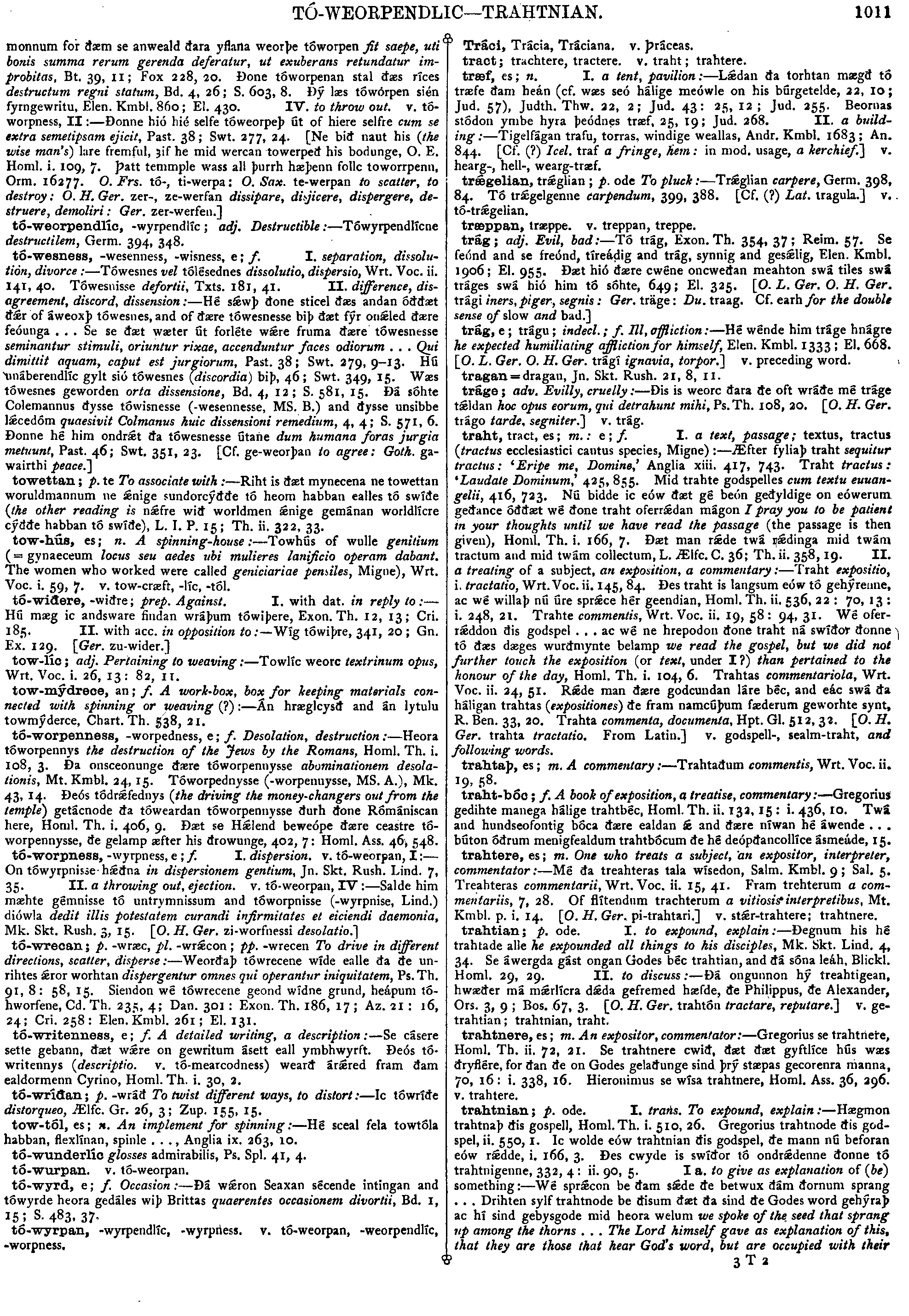
træf,
es;
n.
I.
a
tent,
pavilion
:--
Ldan
ita
torhtan
mægð
tó
træfe
ðam
heán
(cf.
wæs
seó
hálige
meówle
on
his
búrgetelde,
22,
10;
Jud.
57),
Judth.
Thw.
22,
2;
Jud.
43:
25,
12;
Jud.
255.
Beornas
stódon
ymbe
hyra
þeódnes
træf,
25,
19;
Jud.
268.
II.
a
building
:--
Tigelfágan
trafu,
torras,
windige
weallas,
Andr.
Kmbl.
1683;
An.
844.
[Cf.
(?)
Icel.
traf
a
fringe,
hem:
in
mod.
usage,
a
kerchief]
v.
hearg-,
hell-,
wearg-træf.
|
Source: Bosworth/Toller, page b1028, entry 7 View original page image as: [TIFF] [PNG] [View previous entry] [View next entry] |
[Comment on this entry] [View comments] |
The following entry has been hand-corrected once. |
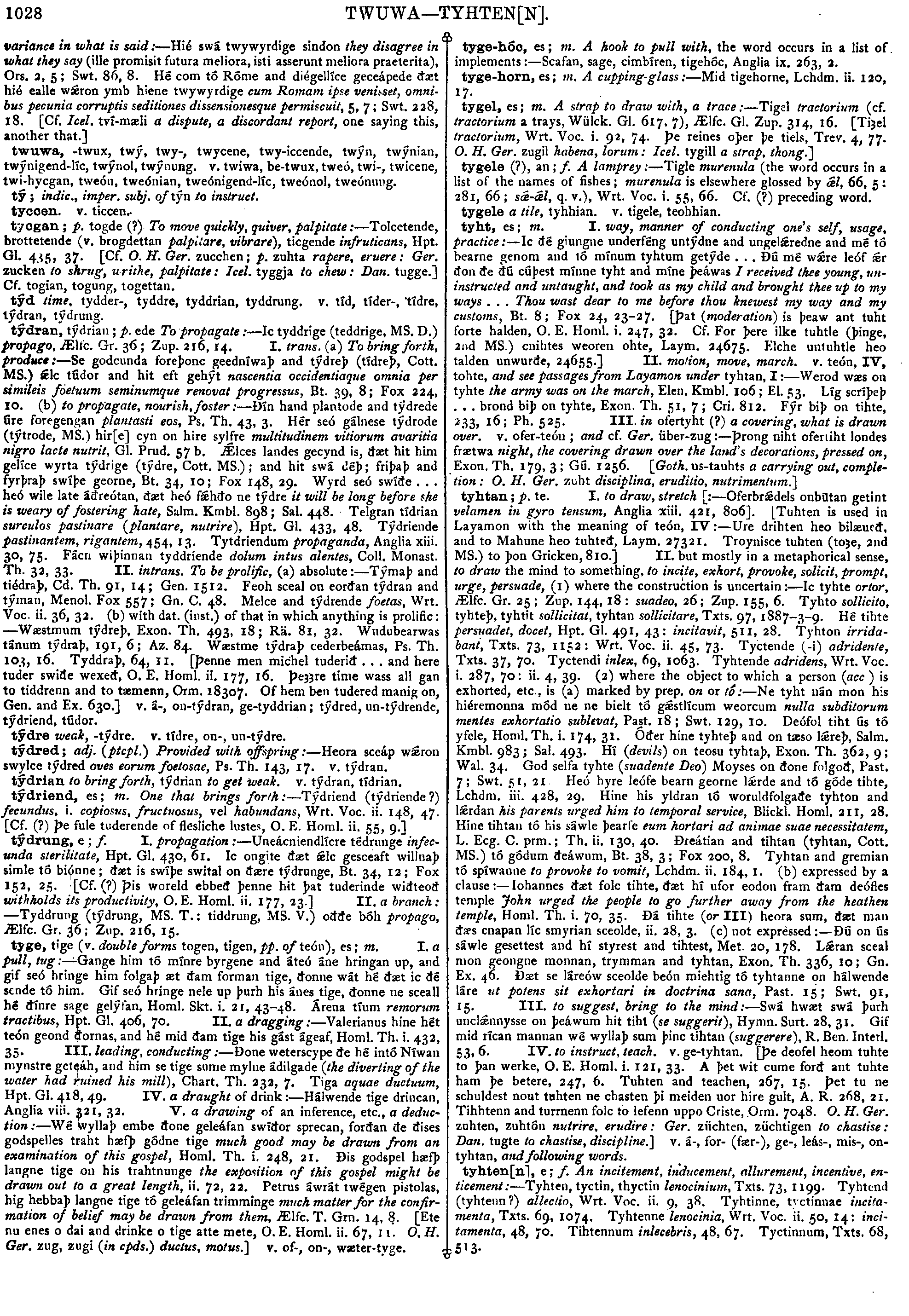
týdran,
týdrian;
p.
ede
To
propagate
:--
Ic
tyddrige
(teddrige,
MS.
D.)
propago,
Ælfc.
Gr.
36;
Zup.
216,
14.
I.
trans.
(a)
To
bring
forth,
produce
:--
Se
godcunda
foreþonc
geedníwaþ
and
týdreþ
(tídreþ,
Cott.
MS.)
lc
túdor
and
hit
eft
gehýt
nascentia
occidentiaque
omnnia
per
simileis
foetuum
seminumque
renovat
progressus,
Bt.
39,
8;
Fox
224,
10.
(b)
to
propagate,
nourish,
foster
:--
Ðin
hand
plantode
and
týdrede
úre
foregengan
plantasti
eos.
Ps.
Th.
43,
3.
Hér
seó
gálnese
týdrode
(týtrode,
MS.)
hir[e]
cyn
on
hire
sylfre
multitudinem
vitiorum
avaritia
nigro
lacte
nutrit,
Gl.
Prud.
57
b.
Æ-acute;lces
landes
gecynd
is,
ðæt
hit
him
gelíce
wyrta
týdrige
(týdre,
Cott.
MS.);
and
hit
swá
déþ;
friþaþ
and
fyrþraþ
swíþe
georne,
Bt.
34,
10;
Fox
148,
29.
Wyrd
seó
swíðe
...
heó
wile
late
áðreótan,
ðæt
heó
fhðo
ne
týdre
it
will
be
long
before
she
is
weary
of
fostering
hate,
Salm.
Kmbl.
898;
Sal.
448.
Telgran
tídrian
surculos
pastinare
(plantare,
nutrire),
Hpt.
Gl.
433,
48.
Týdriende
pastinantem,
rigantem,
454,
13.
Tytdriendum
propaganda,
Anglia
xiii.
30,
75.
Fácn
wiþinnan
tyddriende
dolum
intus
alentes,
Coll.
Monast.
Th.
32,
33.
II.
intrans.
To
be
prolific,
(a)
absolute
:--
Týmaþ
and
tiédraþ,
Cd.
Th.
91,
14;
Gen.
1512.
Feoh
sceal
on
eorðan
týdran
and
týman,
Menol.
Fox
557;
Gn.
C.
48.
Melce
and
týdrende
foetas,
Wrt.
Voc.
ii.
36,
32.
(b)
with
dat.
(inst.)
of
that
in
which
anything
is
prolific:--
Wæstmum
týdreþ,
Exon.
Th.
493,
18;
Rä.
81,
32.
Wudubearwas
tánum
týdraþ,
191,
6;
Az.
84.
Wæstme
týdraþ
cederbeámas,
Ps.
Th.
103,
16.
Tyddraþ,
64,
11.
[Þenne
men
michel
tuderið
...
and
here
tuder
swiðe
wexeð,
O.E.
Homl.
ii.
177,
16.
Þere
time
wass
all
gan
to
tiddrenn
and
to
tæmenn,
Orm.
18307.
Of
hem
ben
tudered
manig
on,
Gen.
and
Ex.
630.]
v.
á-,
on-týdran,
ge-tyddrian;
týdred,
un-týdrende,
týdriend,
túdor.
|
Source: Bosworth/Toller, page b1035, entry 4 View original page image as: [TIFF] [PNG] [View previous entry] [View next entry] |
[Comment on this entry] [View comments] |
The following entry has been hand-corrected once. |
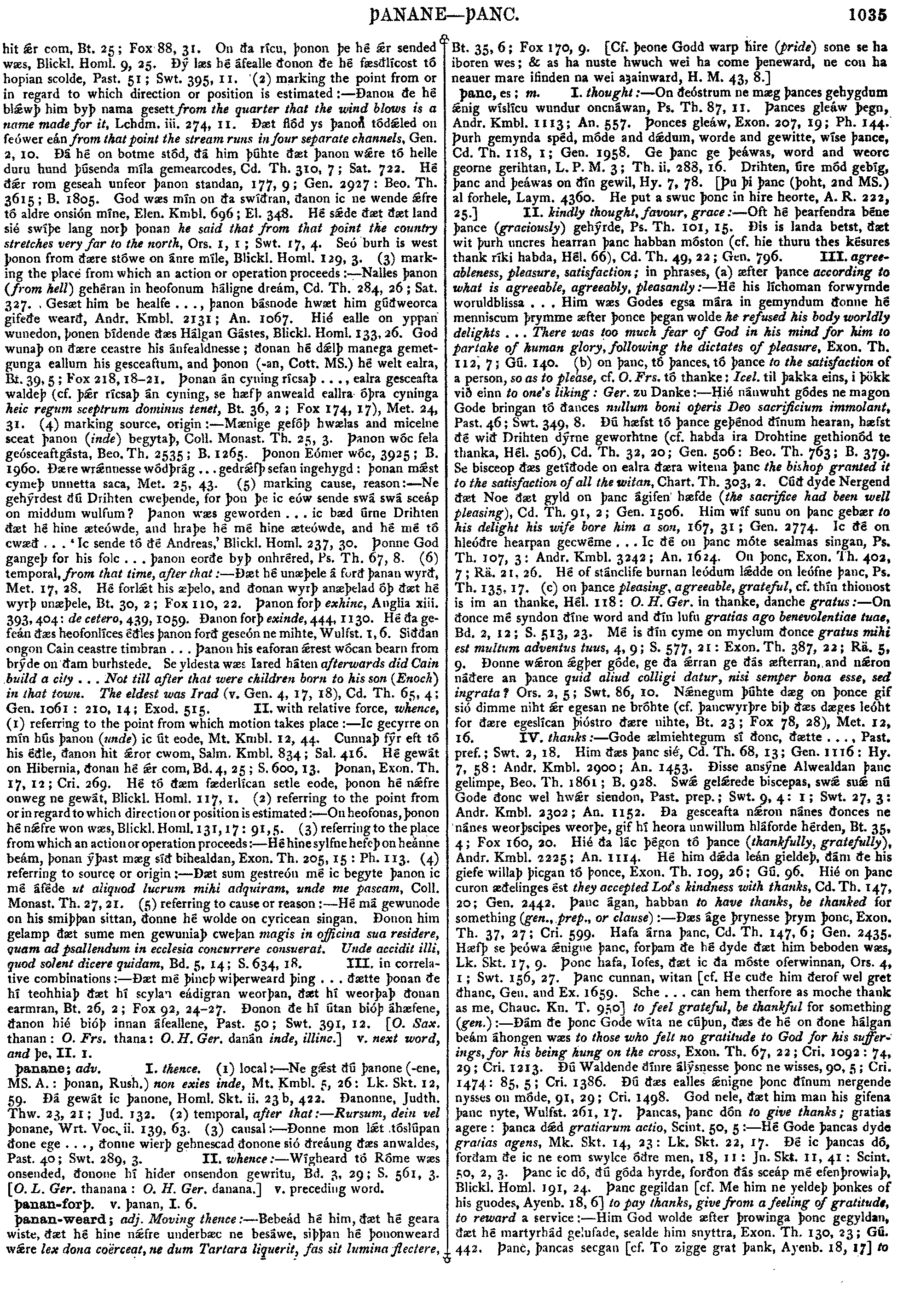
þanc,
es;
m.
I.
thought
:--
On
ðeóstrum
ne
mæg
þances
gehygdum
nig
wíslícu
wundur
oncnáwan,
Ps.
Th.
87,
11.
Þances
gleáw
þegn,
Andr.
Kmbl.
1113;
An.
557.
Þonces
gleáw,
Exon.
207,
19;
Ph.
144.
Þurh
gemynda
spéd,
móde
and
ddum,
worde
and
gewitte,
wíse
þance,
Cd.
Th.
118,
1;
Gen.
1958.
Ge
þanc
ge
þeáwas,
word
and
weorc
georne
gerihtan,
L.
P.
M.
3;
Th.
ii.
288,
16.
Drihten,
úre
mód
gebíg,
þanc
and
þeáwas
on
ðín
gewil,
Hy.
7,
78.
[Þu
þi
þanc
(þoht,
and
MS.)
al
forhele,
Laym.
4360.
He
put
a
swuc
þonc
in
hire
heorte,
A.
R.
222,
25.]
II.
kindly
thought,
favour,
grace
:--
Oft
hé
þearfendra
béne
þance
(graciously)
gehýrde,
Ps.
Th.
101,
15.
Ðis
is
landa
betst,
ðæt
wit
þurh
uncres
hearran
þanc
habban
móston
(cf.
hie
thuru
thes
késures
thank
ríki
habda,
Hél.
66),
Cd.
Th.
49,
22;
Gen.
796.
III.
agreeableness,
pleasure,
satisfaction;
in
phrases,
(a)
æfter
þance
according
to
what
is
agreeable,
agreeably,
pleasantly
:--
Hé
his
líchoman
forwyrnde
woruldblissa
.
.
.
Him
wæs
Godes
egsa
mára
in
gemyndum
ðonne
hé
menniscum
þrymme
æfter
þonce
þegan
wolde
he
refused
his
body
worldly
delights
...
There
was
too
much
fear
of
God
in
his
mind
for
him
to
partake
of
human
glory,
following
the
dictates
of
pleasure,
Exon.
Th.
112,
7;
Gú.
140.
(b)
on
þanc,
tó
þances,
tó
þance
to
the
satisfaction
of
a
person,
so
as
to
please,
cf.
O.
Frs.
tó
thanke
:
Icel.
til
þakka
eins,
i
þökk
við
einn
to
one's
liking
:
Ger.
zu
Danke
:--
Hié
nánwuht
gódes
ne
magon
Gode
bringan
tó
ðances
nullum
boni
operis
Deo
sacrificium
immolant,
Past.
46;
Swt.
349,
8.
Ðú
hæfst
tó
þance
geþénod
ðínum
hearan,
hæfst
ðé
wið
Drihten
dýrne
geworhtne
(cf.
habda
ira
Drohtine
gethionód
te
thanka,
Hél.
506),
Cd.
Th.
32,
20;
Gen.
506
:
Beo.
Th.
763;
B.
379.
Se
bisceop
ðæs
getíðode
on
ealra
ðæra
witena
þanc
the
bishop
granted
it
to
the
satisfaction
of
all
the
witan,
Chart.
Th.
303,
2.
Cúð
dyde
Nergend
ðæt
Noe
ðæt
gyld
on
þanc
ágifen
hæfde
(the
sacrifice
had
been
well
pleasing),
Cd.
Th.
91,
2;
Gen.
1506.
Him
wíf
sunu
on
þanc
gebær
to
his
delight
his
wife
bore
him
a
son,
167,
31;
Gen.
2774.
Ic
ðé
on
hleóðre
hearpan
gecwéme
.
.
.
Ic
ðé
on
þanc
móte
sealmas
singan,
Ps.
Th.
107,
3
:
Andr.
Kmbl.
3242;
An.
1624.
On
þonc,
Exon.
Th.
402,
7;
Rä.
21,
26.
Hé
of
stánclife
burnan
leódum
ldde
on
leófne
þanc,
Ps.
Th.
135,
17.
(c)
on
þance
pleasing,
agreeable,
grateful,
cf.
thín
thionost
is
im
an
thanke,
Hél.
118
:
O.
H.
Ger.
in
thanke,
danche
gratus
:--
On
ðonce
mé
syndon
ðíne
word
and
ðín
lufu
gratias
ago
benevolentiae
tuae,
Bd.
2,
12;
S.
513,
23.
Mé
is
ðín
cyme
on
myclum
ðonce
gratus
mihi
est
multum
adventus
tuus,
4,
9;
S.
577,
21
:
Exon.
Th.
387,
22;
Rä.
5,
9.
Ðonne
wron
gþer
góde,
ge
ða
rran
ge
ðás
æfterran,
and
nron
náðere
an
þance
quid
aliud
colligi
datur,
nisi
semper
bona
esse,
sed
ingrata?
Ors.
2,
5;
Swt.
86,
10.
Nnegum
þúhte
dæg
on
þonce
gif
sió
dimme
niht
r
egesan
ne
bróhte
(cf.
þancwyrþre
biþ
ðæs
dæges
leóht
for
ðære
egeslícan
þióstro
ðære
nihte,
Bt.
23;
Fox
78,
28),
Met.
12,
16.
IV.
thanks
:--
Gode
ælmiehtegum
sí
ðonc,
ðætte
.
.
.
,
Past.
pref.;
Swt.
2,
18.
Him
ðæs
þanc
sié,
Cd.
Th.
68,
13;
Gen.
1116
:
Hy.
7,
58
:
Andr.
Kmbl.
2900;
An.
1453.
Ðisse
ansýne
Alwealdan
þanc
gelimpe,
Beo.
Th.
1861;
B.
928.
Sw
gelrede
biscepas,
sw
su
nú
Gode
ðonc
wel
hwr
siendon,
Past,
prep.
;
Swt.
9,
4
:
1;
Swt.
27,
3
:
Andr.
Kmbl.
2302;
An.
1152.
Ða
gesceafta
nron
nánes
ðonces
ne
nánes
weorþscipes
weorþe,
gif
hí
heora
unwillum
hláforde
hérden,
Bt.
35,
4;
Fox
160,
20.
Hié
ða
lác
þégon
tó
þance
(thankfully,
gratefully),
Andr.
Kmbl.
2225;
An.
1114.
Hé
him
dda
leán
gieldeþ,
ðám
ðe
his
giefe
willaþ
þicgan
tó
þonce,
Exon.
Th.
109,
26;
Gú.
96.
Hié
on
þanc
curon
æðelinges
ést
they
accepted
Lot's
kindness
with
thanks,
Cd.
Th.
147,
20;
Gen.
2442.
Þanc
ágan,
habban
to
have
thanks,
be
thanked
for
something
(gen.,
prep.,
or
clause)
:--
Ðæs
áge
þrynesse
þrym
þonc,
Exon.
Th.
37,
27;
Cri.
599.
Hafa
árna
þanc,
Cd.
Th.
147,
6;
Gen.
2435.
Hæfþ
se
þeówa
nigne
þanc,
forþam
ðe
hé
dyde
ðæt
him
beboden
wæs,
Lk.
Skt.
17,
9.
Þonc
hafa,
Iofes,
ðæt
ic
ða
móste
oferwinnan,
Ors.
4,
1;
Swt.
156,
27.
Þanc
cunnan,
witan
[cf.
He
cuðe
him
ðerof
wel
gret
ðhanc,
Gen.
and
Ex.
1659.
Sche
...
can
hem
therfore
as
moche
thank
as
me,
Chauc.
Kn.
T.
950]
to
feel
grateful,
be
thankful
for
something
(gen.)
:--
Ðám
ðe
þonc
Gode
wíta
ne
cúþun,
ðæs
ðe
hé
on
ðone
hálgan
beám
áhongen
wæs
to
those
who
felt
no
gratitude
to
God
for
his
sufferings,
for
his
being
hung
on
the
cross,
Exon.
Th.
67,
22;
Cri.
1092
:
74,
29;
Cri.
1213.
Ðú
Waldende
ðínre
álýsnesse
þonc
ne
wisses,
90,
5;
Cri.
1474
:
85,
5;
Cri.
1386.
Ðú
ðæs
ealles
nigne
þonc
ðínum
nergende
nysses
on
móde,
91,
29;
Cri.
1498.
God
nele,
ðæt
him
man
his
gifena
þanc
nyte,
Wulfst.
261,
17.
Þancas,
þanc
dón
to
give
thanks;
gratias
agere
:
þanca
dd
gratiarum
actio,
Scint.
50,
5
:--
Hé
Gode
þancas
dyde
gratias
agens,
Mk.
Skt.
14,
23
:
Lk.
Skt.
22,
17.
Ðé
ic
þances
dó,
forðam
ðe
ic
ne
eom
swylce
óðre
men,
18,
11
:
Jn.
Skt.
11,
41
:
Scint.
50,
2,
3.
Þanc
ic
dó,
ðú
góda
hyrde,
forðon
ðás
sceáp
mé
efenþrowiaþ,
Blickl.
Homl.
191,
24.
Þanc
gegildan
[cf.
Me
him
ne
yeldeþ
þonkes
of
his
guodes,
Ayenb.
18,
6]
to
pay
thanks,
give
from
a
feeling
of
gratitude,
to
reward
a
service
:--
Him
God
wolde
æfter
þrowinga
þonc
gegyldan,
ðæt
hé
martyrhád
gelufade,
sealde
him
snyttra,
Exon.
Th.
130,
23;
Gú.
442.
Þanc,
þancas
secgan
[cf.
To
zigge
grat
þank,
Ayenb.
18,
17]
to
express
thanks
for
something
(gen.,
prep.
clause),
give
thanks
:--
Hé
Gode
his
góda
ðanc
sægde
(gratias
agebat),
Bd.
3,
12;
S.
537.
26
:
Cd.
Th.
16,
4;
Gen.
238
:
Andr,
Kmbl.
2937;
An.
1471
:
Blickl.
Homl.
103,
25
:
217,
34.
Ne
sæcgaþ
ús
nénne
þanc,
Homl.
Skt.
i.
3,
332.
Saga
écne
þonc,
ðæt
ic
his
módor
gewearþ,
Exon.
Th.
13,
28;
Cri.
209.
Wé
sculon
simle
secgan
Gode
ðoncas
for
eów,
Past.
32;
Swt.
213,
10.

Þances,
genitive,
used
alone
or
in
combination
with
noun
or
pronoun,
and
having
adverbial
force
(cf.
O.
L.
Ger.
thankis
gratis
:
O.
H.
Ger.
danches
sponte,
ultro,
gratis).
(1)
thanks
to
a
person
on
whom
a
result
depends,
by
(one's)
grace,
favour
:--
Ðæt
næs
ná
eówres
þances
ac
þurh
God
it
was
not
thanks
to
you
but
by
God's
will;
non
vestro
consilio
sed
Dei
voluntate,
Gen.
45,
8.
Sege
mé
hwæþer
se
ðín
wela
ðínes
þances
swá
deóre
seó
ðe
for
his
ágenre
gecynde
tell
me
whether
that
wealth
of
thine
is
so
precious
thanks
to
thee
or
from
its
own
nature,
Bt.
13;
Fox
38,
6.
Hié
rícsedon
næs
ðeáh
mínes
ðonces
ipsi
regnaverunt,
et
non
ex
me,
Past.
1;
Swt.
27,
14.
Godes
þonces
by
God's
grace,
Chr.
897;
Erl.
94,
29
:
883;
Erl.
83,
18.
(2)
where
there
is
voluntary
or
unforced
action,
of
(one's
own)
accord,
with
(a
person's)
consent,
willingly,
voluntarily
:--
Hé
him
hiera
ðonces
gestiéran
ne
meahte
he
could
not
restrain
himself
from
them
(his
vices)
of
his
own
accord,
Past.
3;
Swt.
35,
18.
Gewilde
man
hí
tó
rihte
þances
oþþe
unþances
let
them
be
compelled
to
right
whether
they
will
or
no,
L.
Eth.
ix.
40;
Th.
i;
348,
28.
Hé
nam
sume
mid
him,
sume
þances,
sume
unþances
he
took
some
of
them
with
him,
some
willingly,
others
against
their
will,
Chr.
1066;
Erl.
198,
36.
Ðá
þancodon
hý
ðyses
Gode
and
mé
swýþe
georne,
and
heom
eall
ðis
swýþe
wel
lícode,
and
cwdon
ðæt
heora
þances
ðis
on
écnesse
stande
they
said
that
they
approve
of
the
arrangement
remaining
in
perpetuity,
Chart.
Th.
117,
7.
Ágenes
þances
sponte,
Germ.
395,
64
:
L.
C.
S.
75;
Th.
i.
416,
22.
Gif
hwá
þeóf
geméte
and
hine
his
þances
áweg
lte
búton
hreáme
if
any
one
come
upon
a
thief
and
of
his
own
accord
let
him
get
away
without
hue
and
cry,
29;
Th.
i.
392,
14.
Hwæþer
ðe
ðú
hý
forseó
and
ðínes
ágenes
þonces
hí
forléte
búton
sáre
ðe
ðú
gebíde
hwonne
hí
ðé
sorgiendne
forlétan
whether
thou
despise
them
and
of
thine
own
accord
abandon
them
without
a
pang,
or
wait
till
the
time
comes
when
they
abandon
thee
sorrowing,
Bt.
8;
Fox
26,
12
:
7,
2;
Fox
18,
13.
Ðonne
sió
sául
hire
unðonces
gebdd
wierð
ðæt
yfel
tó
forltanne
ðæt
hió
r
hire
ágnes
ðonces
gedyde,
Past.
36;
Swt.
251,
14.
[Hi
wenden
alle
fra
þe
king,
surge
here
þankes
and
sume
here
unþankes,
Chr.
1140;
Erl.
265,
12.
Bluðeliche
he
wule
herkieu
þet
þe
preost
him
leið
on;
ah
þenne
þe
preost
hine
hat
aefen
þa
ehte
þon
monne
þet
hit
er
ahte,
þet
he
nulle
iheren
his
þonkes
he
will
not
listen
to
that
if
he
can
help
it,
O.
E.
Homl.
i.
31,
8.
Þe
sulve
mose
hire
þonkes
wolde
þe
totose,
O.
and
N.
70.
Lordschipe
wol
not
his
thonkes
han
no
felaweschipe,
Chauc.
Kn.
T.
768.]
(3)
where
there
is
uncontrolled
or
independent
action,
at
(one's)
pleasure
or
will
:--
Ðú
wéndest
ðæt
seó
wyrd
ðás
woruld
wende
heore
ágenes
þonces
búton
Godes
geþeahte
and
his
þafunge
thou
didst
suppose
that
fate
turned
this
world
at
her
own
pleasure
without
the
counsel
and
consent
of
God,
Bt.
5,
1;
Fox
8,
31.
(4)
where
there
is
independent
condition,
in
or
of
itself
:--
Gif
se
weorþscipe
and
se
anweald
ágnes
ðonces
gód
wre,
Bt.
16,
3;
Fox
54,
9.
Se
anweald
his
ágenes
ðonces
gód
næs,
ðá
se
gód
næs
ðe
hé
tó
com,
16,
4;
Fox
58,
19.
(5)
for
(one's)
sake
:--
Wé
biddaþ
ðé
ðæt
ðú
hit
ús
ðínes
fæder
þances
forgife
we
pray
thee
to
forgive
us
it
for
thy
father's
sake,
Gen.
50,
17.
Gedle
hé
ðæt
wurð
Godes
þances
pretium
Dei
gratia
distribuat,
L.
M.
I.
P.
43;
Th.
ii.
276,
23
:
L.
Pen.
14;
Th.
ii.
282,
11
:
L.
E.
I.
25;
Th.
ii.
422,
8,
9
:
L.
Ath.
v.
8,
1;
Th.
i.
236,
8
:
Wulfst.
238,
28
:
Homl.
Skt.
i.
23,
200
:
Lchdm.
i.
400,
9.
Ic
ann
ðæs
landes
intó
mynstre
Sca
Marian
þances,
Chart.
Th.
558,
33.
Ungeniédde
mid
eówrum
ágenum
willan
gé
sculon
ðencean
for
eówre
heorde
Godes
ðonces
nals
na
for
fraceðlecum
gestreónum
providentes
non
coacte,
sed
spontanee
secundum
Deum,
neque
turpis
lucri
gratia,
sed
voluntarie,
Past.
18;
Swt.
137,
20.
Hié
ða
miclan
feorme
þigedon
Cristes
þonces
ðe
hié
r
þigedon
deófla
þonces,
Ors.
6,
21;
Swt.
272,
22-24.
[Goth
thank
fairhaitan
 &alpha-tonos;

 &epsilon-tonos;
 ,
Lk.
17,
9
:
O.
Sax.
thank
grace,
pleasure,
thanks
:
O.
Frs.
thank,
thonk
:
O.
H.
Ger.
danc,
thanc
gratia
:
Icel.
þökk
pleasure,
thanks.]
v.
bealu-,
fore-,
ge-,
hete-,
hyge-,
inge-,
inwit-,
nearu-,
or-,
searu-,
un-þanc;
un-þances.
,
Lk.
17,
9
:
O.
Sax.
thank
grace,
pleasure,
thanks
:
O.
Frs.
thank,
thonk
:
O.
H.
Ger.
danc,
thanc
gratia
:
Icel.
þökk
pleasure,
thanks.]
v.
bealu-,
fore-,
ge-,
hete-,
hyge-,
inge-,
inwit-,
nearu-,
or-,
searu-,
un-þanc;
un-þances.
|
Source: Bosworth/Toller, page b1085, entry 13 View original page image as: [TIFF] [PNG] [View previous entry] [View next entry] |
[Comment on this entry] [View comments] |
The following entry has been hand-corrected once. |
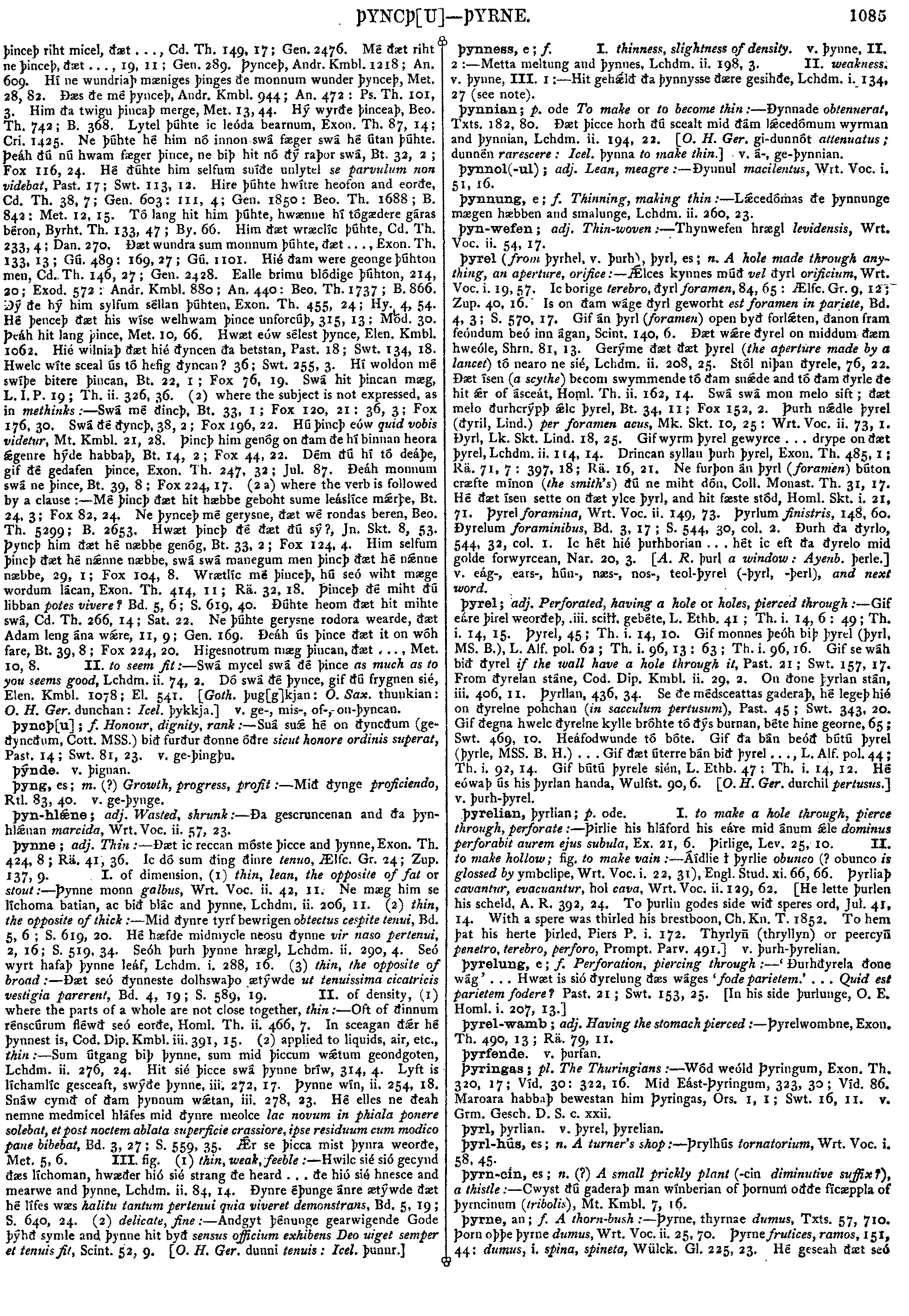
þyrelian,
þyrlian;
p.
ode.
I.
to
make
a
hole
through,
pierce
through,
perforate
:--
Þirlie
his
hláford
his
eáre
mid
ánum
le
dominus
perforabit
aurem
ejus
subula,
Ex.
21,
6.
Þirlige,
Lev.
25,
10.
II.
to
make
hollow;
fig.
to
make
vain
:--
Áídlie
þyrlie
obunco
(?
obunco
is
glossed
by
ymbclipe,
Wrt.
Voc.
i.
22,
31),
Engl.
Stud.
xi.
66,
66.
Þyrliaþ
cavantur,
evacuantur,
hol
cava,
Wrt.
Voc.
ii.
129,
62.
[He
lette
þurlen
his
scheld,
A.
R.
392,
24.
To
þurlin
godes
side
wið
speres
ord,
Jul.
41,
14.
With
a
spere
was
thirled
his
brestboon,
Ch.
Kn.
T.
1852.
To
hem
þat
his
herte
þirled,
Piers
P.
i.
172.
Thyrlyn
(thryllyn)
or
peercyn
penetro,
terebro,
perforo,
Prompt.
Parv.
491.]
v.
þurh-þyrelian.
|
Source: Bosworth/Toller, page b1092, entry 15 View original page image as: [TIFF] [PNG] [View previous entry] [View next entry] |
[Comment on this entry] [View comments] |
The following entry has been hand-corrected once. |
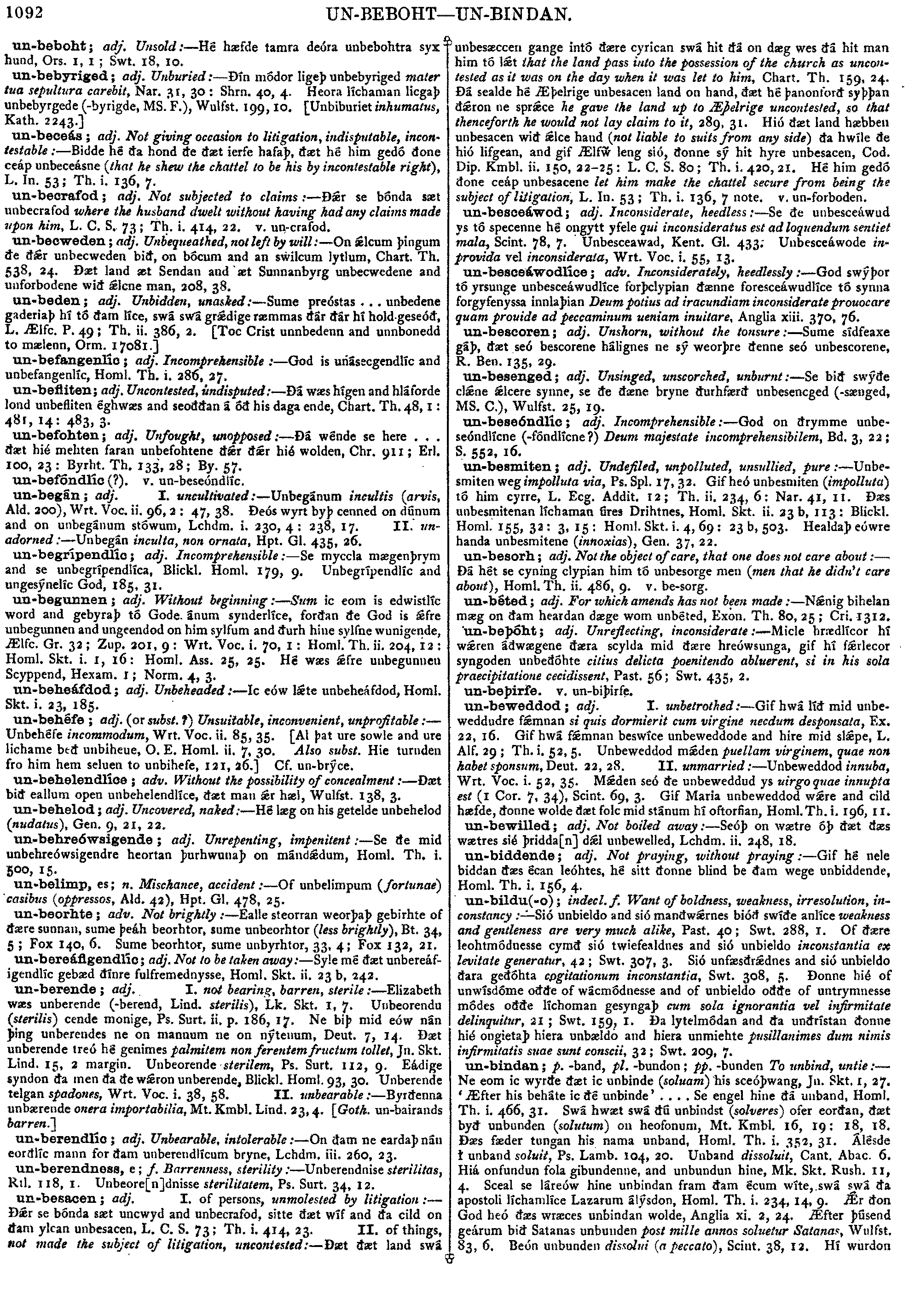
un-behéfe; adj. (or subst.?) Unsuitable, inconvenient, unprofitable :-- Unbehéfe incommodum, Wrt. Voc. ii. 85, 35. [Al þat ure sowle and ure lichame beð unbiheue, O. E. Homl. ii. 7, 30. Also subst. Hie turnden fro him hem seluen to unbihefe, 121, 26.] Cf. un-brýce.
|
Source: Bosworth/Toller, page b1102, entry 1 View original page image as: [TIFF] [PNG] [View previous entry] [View next entry] |
[Comment on this entry] [View comments] |
The following entry has been hand-corrected once. |
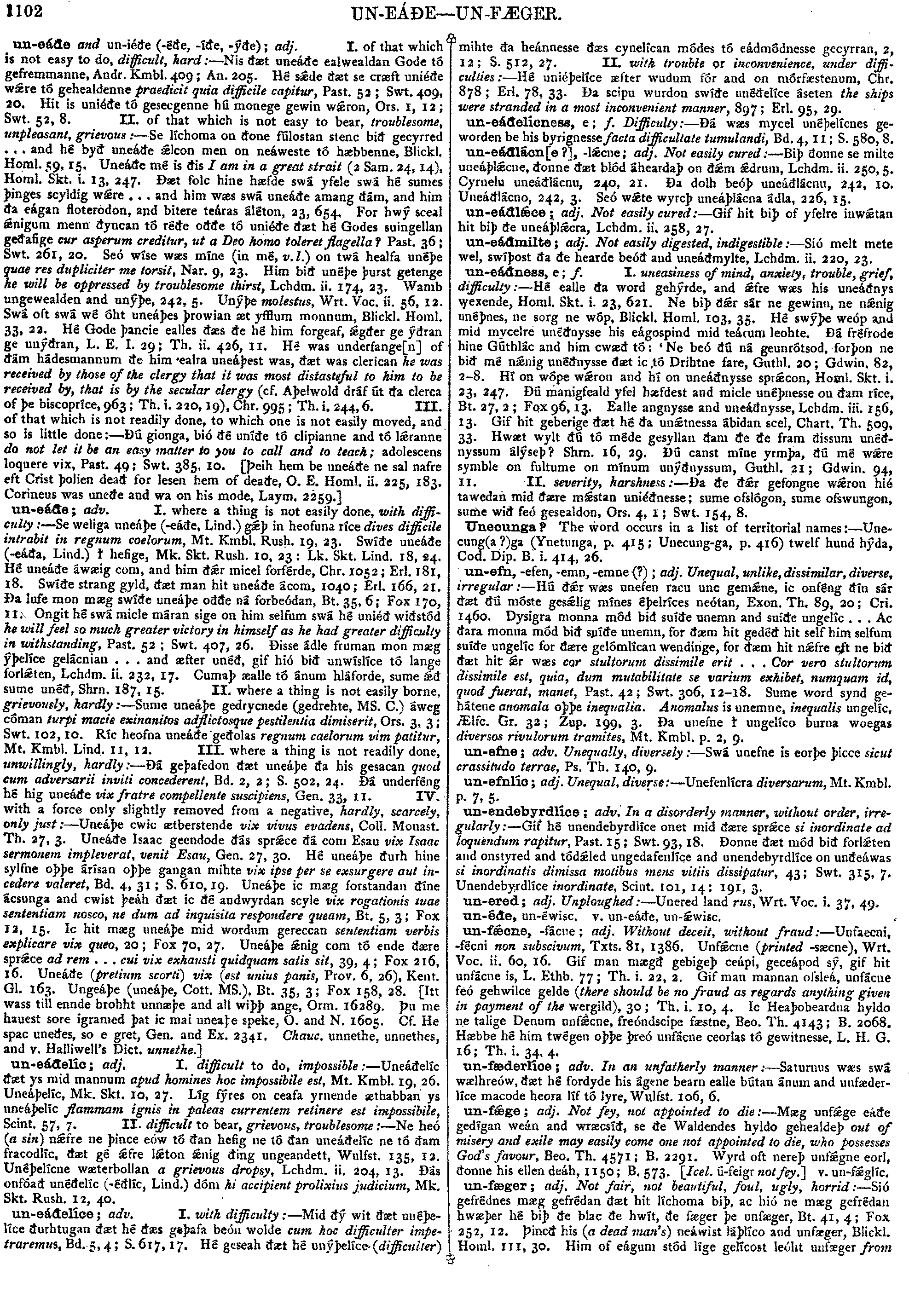
un-eáðe
and
un-iéðe
(-éðe,
-íðe,
-ýðe);
adj.
I.
of
that
which
is
not
easy
to
do,
difficult,
hard
:--
Nis
ðæt
uneáðe
ealwealdan
Gode
tó
gefremmanne,
Andr.
Kmbl.
409;
An.
205.
Hé
sde
ðæt
se
cræft
uniéðe
wre
tó
gehealdenne
praedicit
quia
difficile
capitur,
Past.
52;
Swt.
409,
20.
Hit
is
uniéðe
tó
gesecgenne
hú
monege
gewin
wron,
Ors.
1,
12;
Swt.
52,
8.
II.
of
that
which
is
not
easy
to
bear,
troublesome,
unpleasant,
grievous
:--
Se
líchoma
on
ðone
fúlostan
stenc
bið
gecyrred
...
and
hé
byð
uneáðe
lcon
men
on
neáweste
tó
hæbbenne,
Blickl.
Homl.
59,
15.
Uneáðe
mé
is
ðis
I
am
in
a
great
strait
(2
Sam.
24,
14),
Homl.
Skt.
i.
13,
247.
Ðæt
folc
hine
hæfde
swá
yfele
swá
hé
sumes
þinges
scyldig
wre
...
and
him
wæs
swá
uneáþe
amang
ðám,
and
him
þa
eágan
floterodon,
and
bitere
teáras
áléton,
23,
654.
For
hwý
sceal
nigum
menn
ðyncan
tó
réðe
oððe
tó
uniéðe
ðæt
hé
Godes
suingellan
geðafige
cur
asperum
creditur,
ut
a
Deo
homo
toleret
flagella?
Past.
36;
Swt.
261,
20.
Seó
wíse
wæs
míne
(in
mé,
v.
l.)
on
twá
healfa
unéþe
quae
res
dupliciter
me
torsit,
Nar.
9,
23.
Him
bið
unéþe
þurst
getenge
he
will
be
oppressed
by
troublesome
thirst,
Lchdm.
ii.
174,
23.
Wamb
ungewealden
and
unýþe,
242,
5.
Unýþe
molestus,
Wrt.
Voc.
ii.
56,
12.
Swá
oft
swá
we
óht
uneáþes
þrowian
æt
yfflum
monnum,
Blickl.
Homl.
33,
22.
Hé
Gode
þancie
ealles
ðæs
ðe
hé
him
forgeaf,
gðer
ge
ýðran
ge
unýðran,
L.
E.
I.
29;
Th.
ii.
426,
11.
Hé
was
underfange[n]
of
ðám
hádesmannum
ðe
him
ealra
uneáþest
was,
ðæt
was
clerican
he
was
received
by
those
of
the
clergy
that
it
was
most
distasteful
to
him
to
be
received
by,
that
is
by
the
secular
clergy
(cf.
Aþelwold
dráf
út
ða
clerca
of
þe
biscopríce,
963;
Th.
i.
220,
19),
Chr.
995;
Th.
i.
244,
6.
III.
of
that
which
is
not
readily
done,
to
which
one
is
not
easily
moved,
and
so
is
little
done
:--
Ðú
gionga,
bió
ðé
uníðe
tó
clipianne
and
tó
lranne
do
not
let
it
be
an
easy
matter
to
you
to
call
and
to
teach;
adolescens
loquere
vix,
Past.
49;
Swt.
385,
10.
[Þeih
hem
be
uneáðe
ne
sal
nafre
eft
Crist
þolien
deað
for
lesen
hem
of
deaðe,
O.
E.
Homl.
ii.
225,
183.
Corineus
was
uneðe
and
wa
on
his
mode,
Laym.
2259.]
|
Source: Bosworth/Toller, page b1127, entry 13 View original page image as: [TIFF] [PNG] [View previous entry] [View next entry] |
[Comment on this entry] [View comments] |
The following entry has been hand-corrected once. |
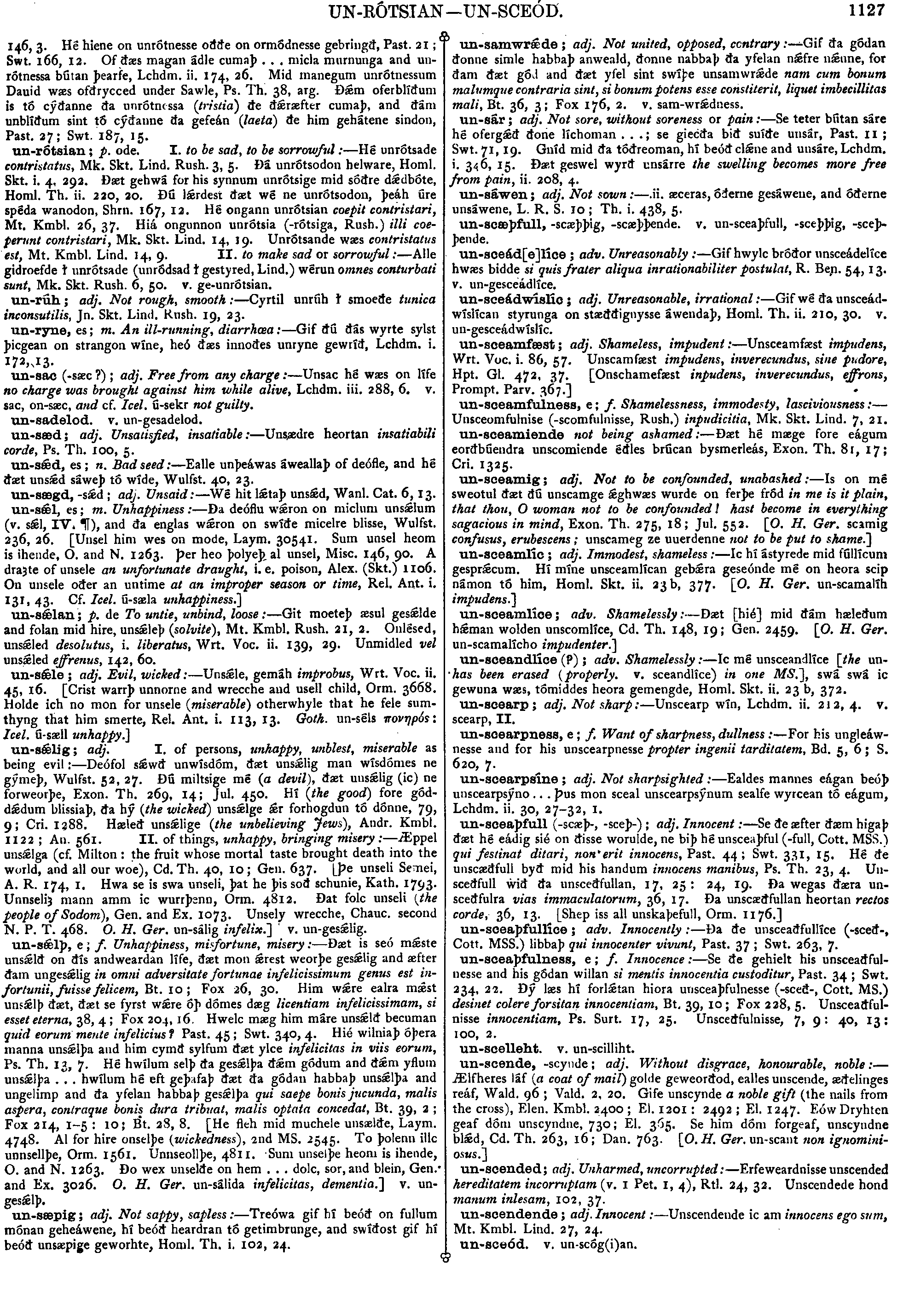
un-slþ,
e;
f.
Unhappiness,
misfortune,
misery
:--
Ðæt
is
seó
mste
unslð
on
ðís
andweardan
lífe,
ðæt
mon
rest
weorþe
geslig
and
æfter
ðam
ungeslig
in
omni
adversitate
fortunae
infelicissimum
genus
est
infortunii,
fuisse
felicem,
Bt.
10;
Fox
26,
30.
Him
wre
ealra
mst
unslþ
ðæt,
ðæt
se
fyrst
wre
óþ
dómes
dæg
licentiam
infelicissimam,
si
esset
eterna,
38,
4;
Fox
204,
16.
Hwelc
mug
him
máre
unslð
becuman
quid
eorum
mente
infelicius?
Past.
45;
Swt.
340,
4.
Hié
wilniaþ
óþera
manna
unslþa
and
him
cymð
sylfum
ðæt
ylce
infelicitas
in
viis
eorum,
Ps.
Th.
13,
7.
Hé
hwílum
selþ
ða
geslþa
ðm
gódum
and
ðm
yflum
unslþa
...
hwílum
hé
eft
geþafaþ
ðæt
ða
gódan
habbaþ
unslþa
and
ungelimp
and
ða
yfelan
habbaþ
geslþa
qui
saepe
bonis
jucunda,
malis
aspera,
contraque
bonis
dura
tribuat,
malis
optata
concedat,
Bt.
39,
2;
Fox
214,
1-5:
10;
Bt.
28,
8.
[He
fleh
mid
muchele
unsælðe,
Laym.
4748.
Al
for
hire
onselþe
(wickedness),
2nd
MS.
2545.
To
þolenn
illc
unnsellþe,
Orm.
1561.
Unnseollþe,
4811.
Sum
unselþe
heom
is
ihende,
O.
and
N.
1263.
Ðo
wex
unselðe
on
hem
...
dolc,
sor,
and
blein,
Gen.
and
Ex.
3026.
O.
H.
Ger.
un-sálida
infelicitas,
dementia.]
v.
un-geslþ.
|
Source: Bosworth/Toller, page b1135, entry 16 View original page image as: [TIFF] [PNG] [View previous entry] [View next entry] |
[Comment on this entry] [View comments] |
The following entry has been hand-corrected once. |
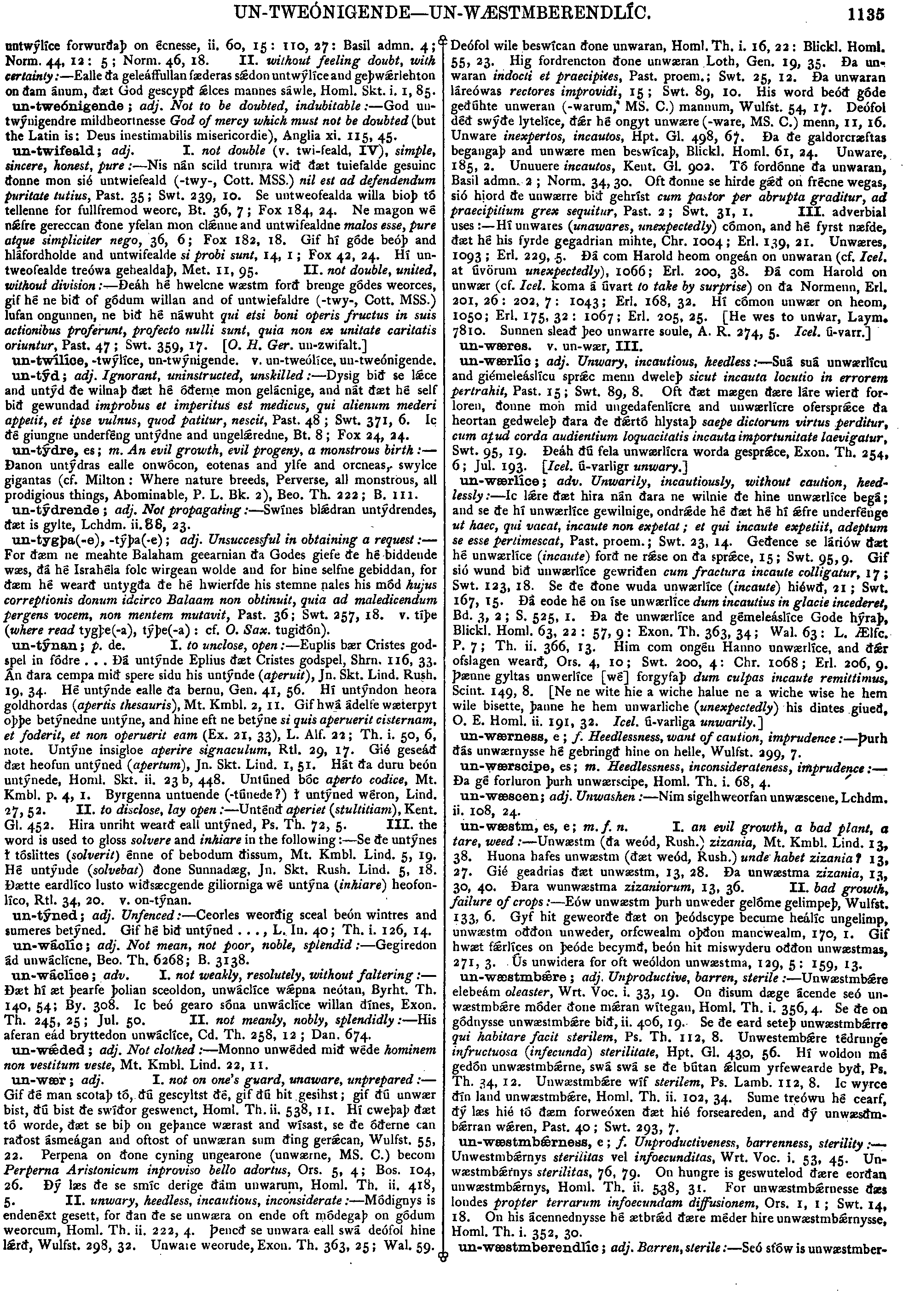
un-wærlíce;
adv.
Unwarily,
incautiously,
without
caution,
heedlessly
:--
Ic
lre
ðæt
hira
nán
ðara
ne
wilnie
ðe
hine
unwærlíce
begá;
and
se
ðe
hí
unwærlíce
gewilnige,
ondrde
hé
ðæt
hé
hí
fre
underfénge
ut
haec,
qui
vacat,
incaute
non
expetat;
et
qui
incaute
expetiit,
adeptum
se
esse
pertimescat,
Past.
proem.;
Swt.
23,
14.
Geðence
se
láriów
ðæt
hé
unwærlíce
(incaute)
forð
ne
rse
on
ða
sprce,
15;
Swt.
95,
9.
Gif
sió
wund
bið
unwærlíce
gewriðen
cum
fractura
incaute
colligatur,
17;
Swt.
123,
18.
Se
ðe
ðone
wuda
unwærlíce
(incaute)
hiéwð,
21;
Swt.
167,
15.
Ðá
eode
hé
on
íse
unwærlíce
dum
incautius
in
glacie
incederet,
Bd.
3,
2;
S.
525,
1.
Ða
ðe
unwærlíce
and
gémeleáslíce
Gode
hýraþ,
Blickl.
Homl.
63,
22:
57,
9:
Exon.
Th.
363,
34;
Wal.
63:
L.
Ælfc.
P.
7;
Th.
ii.
366,
13.
Him
com
ongén
Hanno
unwærlíce,
and
ðr
ofslagen
wearð,
Ors.
4,
10;
Swt.
200,
4:
Chr.
1068;
Erl.
206,
9.
Þænne
gyltas
unwerlíce
[wé]
forgyfaþ
dum
culpas
incaute
remittimus,
Scint.
149,
8.
[Ne
ne
wite
hie
a
wiche
halue
ne
a
wiche
wise
he
hem
wile
bisette,
þanne
he
hem
unwarliche
(unexpectedly)
his
dintes
giueð.
O.
E.
Homl.
ii.
191,
32.
Icel.
ú-varliga
unwarily.]
| Result Page: |  |
Previous | 1 2 3 4 5 6 7 8 9 10 11 | Next |  |
Germanic Lexicon Project (main page)
This search system was written by
Sean Crist
Please consider
volunteering
to correct the data in these online dictionaries.
No rights reserved. Feel free to use these data in any way you please.