|
|

|
Source: Torp, page b0085, entry 2 View original page image as: [TIFF] [PNG] [View previous entry] [View next entry] |
[Comment on this entry] [View comments] |
The following entry has been hand-corrected once. |
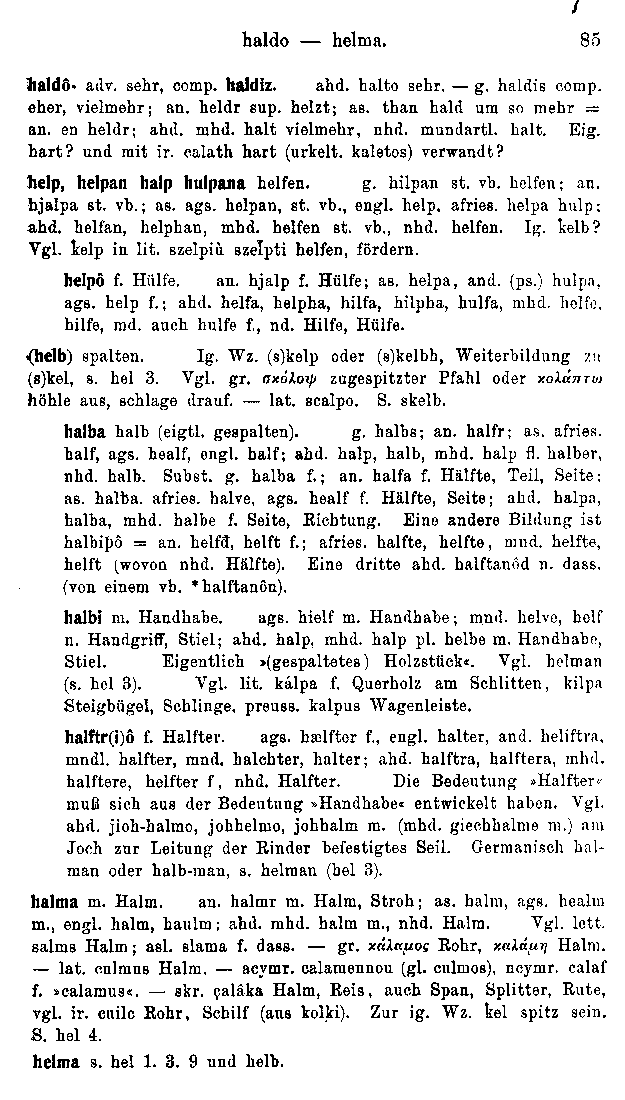
help,
helpan
halp
hulpana
helfen.
g.
hilpan
st.
vb.
helfen;
an.
hjalpa
st.
vb.;
as.
ags.
helpan,
st.
vb.,
engl.
help,
afries.
helpa
hulp:
ahd.
helfan,
helphan,
mhd.
helfen
st.
vb.,
nhd.
helfen.
Ig.
 elb
?
Vgl.
elp
in
lit.
szelpiù
sze
elb
?
Vgl.
elp
in
lit.
szelpiù
sze pti
helfen,
fördern.
pti
helfen,
fördern.
[Translate the German words]
|
Source: Wright's Gothic Grammar, page b0327, entry 16 View original page image as: [TIFF] [PNG] [View previous entry] [View next entry] |
[Comment on this entry] [View comments] |
The following entry has been hand-corrected once. |
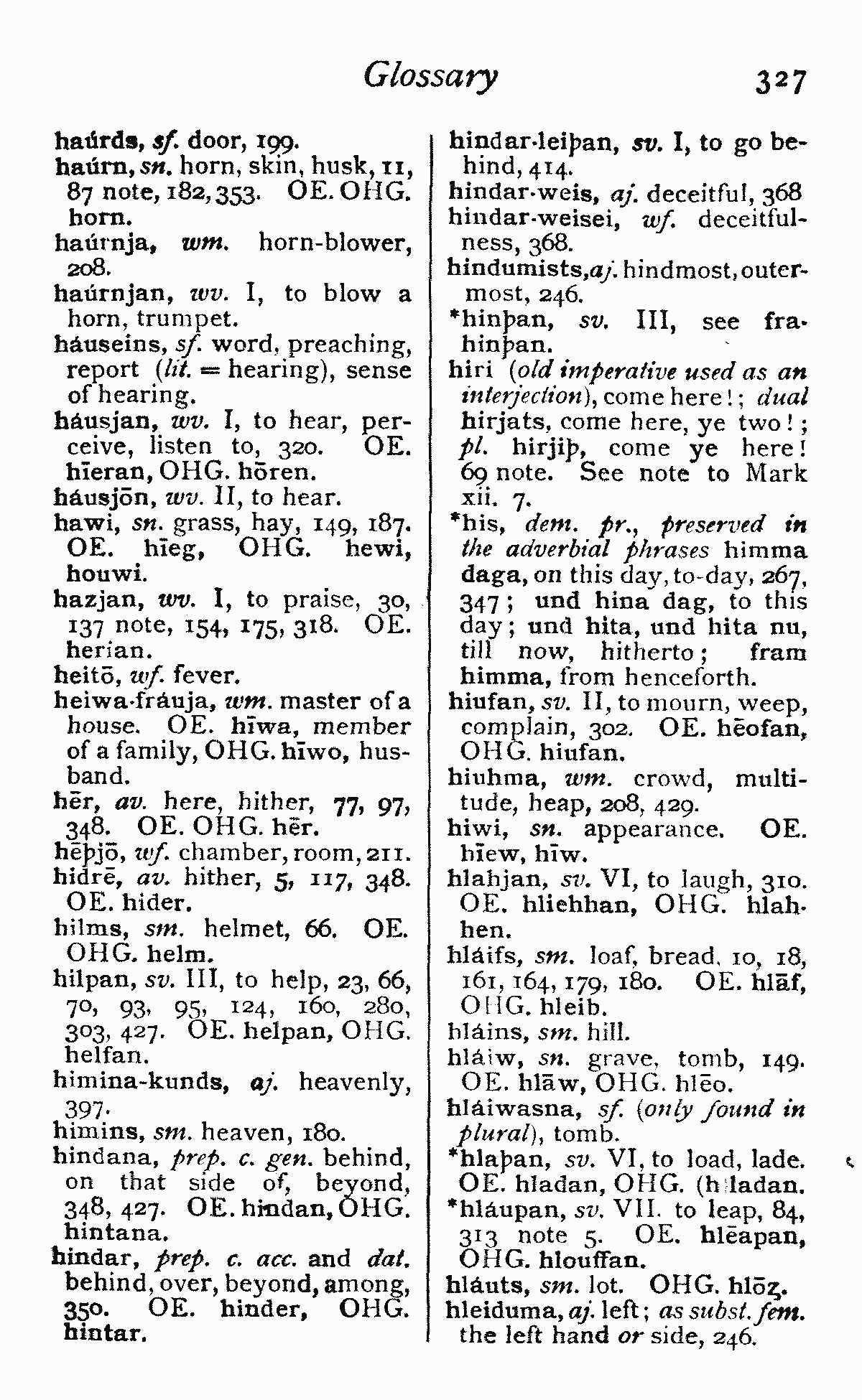
hilpan, sv. III, to help, 23, 66, 70, 93, 95, 124, 160, 280, 303, 427. OE. helpan, OHG. helfan.
|
Source: Bosworth/Toller, page b0527, entry 10 View original page image as: [TIFF] [PNG] [View previous entry] [View next entry] |
[Comment on this entry] [View comments] |
The following entry has been hand-corrected once. |
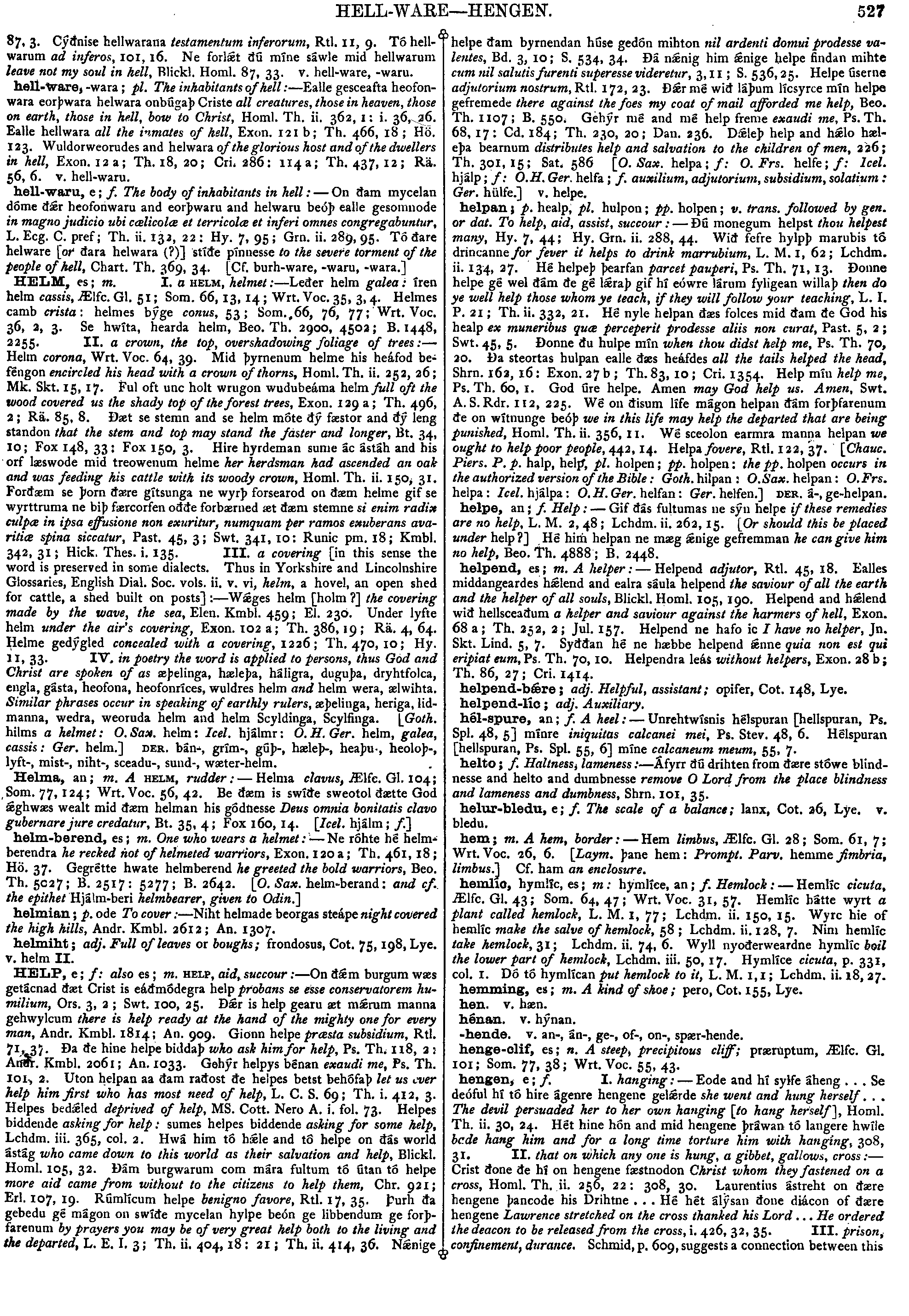
helpan;
p.
healp,
pl.
hulpon;
pp.
holpen;
v.
trans.
followed
by
gen.
or
dat.
To
help,
aid,
assist,
succour
:--
Ðú
monegum
helpst
thou
helpest
many,
Hy.
7,
44;
Hy.
Grn.
ii.
288,
44.
Wið
fefre
hylpþ
marubis
tó
drincanne
for
fever
it
helps
to
drink
marrubium,
L.
M.
1,
62;
Lchdm.
ii.
134,
27.
Hé
helpeþ
þearfan
parcet
pauperi,
Ps.
Th.
71,
13.
Ðonne
helpe
gé
wel
ðám
ðe
gé
l raþ
gif
hí
eówre
lárum
fyligean
willaþ
then
do
ye
well
help
those
whom
ye
teach,
if
they
will
follow
your
teaching,
L.
I.
P.
21;
Th.
ii.
332,
21.
Hé
nyle
helpan
ðæs
folces
mid
ðam
ðe
God
his
healp
ex
muneribus
quæ
perceperit
prodesse
aliis
non
curat,
Past.
5,
2;
Swt.
45,
5.
Ðonne
ðu
hulpe
mín
when
thou
didst
help
me,
Ps.
Th.
70,
20.
Ða
steortas
hulpan
ealle
ðæs
heáfdes
all
the
tails
helped
the
head,
Shrn.
162,
16:
Exon.
27
b;
Th.
83,
10;
Cri.
1354.
Help
mín
help
me,
Ps.
Th.
60,
1.
God
úre
helpe.
Amen
may
God
help
us.
Amen,
Swt.
A.
S.
Rdr.
112,
225.
Wé
on
ðisum
lífe
mágon
helpan
ðám
forþfarenum
ðe
on
wítnunge
beóþ
we
in
this
life
may
help
the
departed
that
are
being
punished,
Homl.
Th.
ii.
356,
11.
Wé
sceolon
earmra
manna
helpan
we
ought
to
help
poor
people,
442,
14.
Helpa
fovere,
Rtl.
122,
37.
[Chauc.
Piers.
P.
p.
halp,
help,
pl.
holpen;
pp.
holpen:
the
pp.
holpen
occurs
in
the
authorized
version
of
the
Bible:
Goth.
hilpan:
O.
Sax.
helpan:
O.
Frs.
helpa:
Icel.
hjálpa:
O.
H.
Ger.
helfan:
Ger.
helfen.]
DER.
á-,
ge-helpan.
raþ
gif
hí
eówre
lárum
fyligean
willaþ
then
do
ye
well
help
those
whom
ye
teach,
if
they
will
follow
your
teaching,
L.
I.
P.
21;
Th.
ii.
332,
21.
Hé
nyle
helpan
ðæs
folces
mid
ðam
ðe
God
his
healp
ex
muneribus
quæ
perceperit
prodesse
aliis
non
curat,
Past.
5,
2;
Swt.
45,
5.
Ðonne
ðu
hulpe
mín
when
thou
didst
help
me,
Ps.
Th.
70,
20.
Ða
steortas
hulpan
ealle
ðæs
heáfdes
all
the
tails
helped
the
head,
Shrn.
162,
16:
Exon.
27
b;
Th.
83,
10;
Cri.
1354.
Help
mín
help
me,
Ps.
Th.
60,
1.
God
úre
helpe.
Amen
may
God
help
us.
Amen,
Swt.
A.
S.
Rdr.
112,
225.
Wé
on
ðisum
lífe
mágon
helpan
ðám
forþfarenum
ðe
on
wítnunge
beóþ
we
in
this
life
may
help
the
departed
that
are
being
punished,
Homl.
Th.
ii.
356,
11.
Wé
sceolon
earmra
manna
helpan
we
ought
to
help
poor
people,
442,
14.
Helpa
fovere,
Rtl.
122,
37.
[Chauc.
Piers.
P.
p.
halp,
help,
pl.
holpen;
pp.
holpen:
the
pp.
holpen
occurs
in
the
authorized
version
of
the
Bible:
Goth.
hilpan:
O.
Sax.
helpan:
O.
Frs.
helpa:
Icel.
hjálpa:
O.
H.
Ger.
helfan:
Ger.
helfen.]
DER.
á-,
ge-helpan.
|
Source: Bosworth/Toller, page d0541, entry 19 View original page image as: [TIFF] [PNG] [View previous entry] [View next entry] |
[Comment on this entry] [View comments] |
The following entry has been hand-corrected once. |
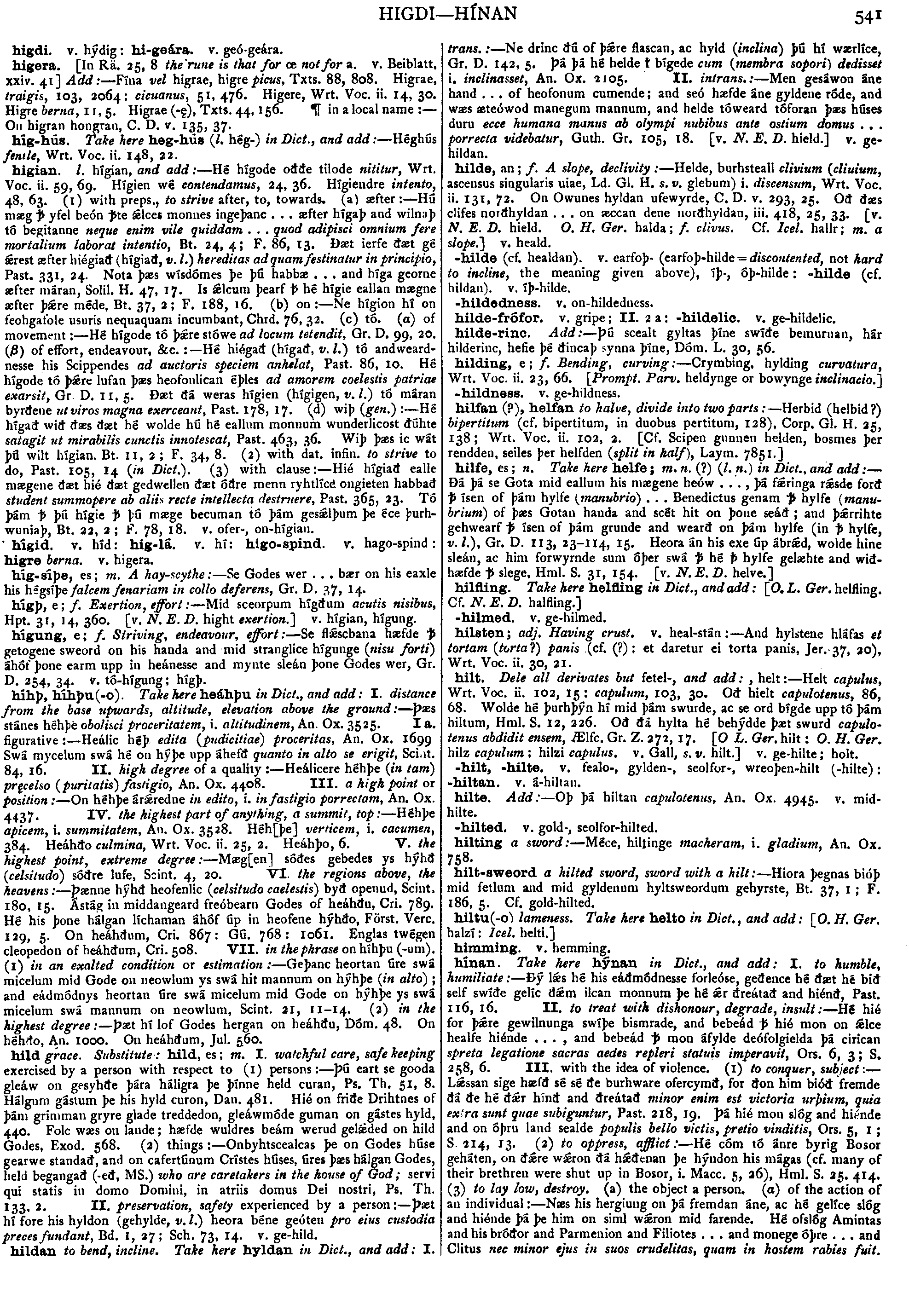
hilfan (?),helfan to halve, divide into two parts :-- Herbid (helbid?) bipertitum (cf. bipertitum, in duobus pertitum, 128), Corp. Gl. H. 25, 138; Wrt. Voc. ii. 102, 2. [Cf. Scipen gunnen helden, bosmes þer rendden, seiles þer helfden (split in half), Laym. 7851.]
|
Source: Cleasby/Vigfusson, page b0267, entry 9 View original page image as: [TIFF] [PNG] [View previous entry] [View next entry] |
[Comment on this entry] [View comments] |
The following entry has been hand-corrected once. |
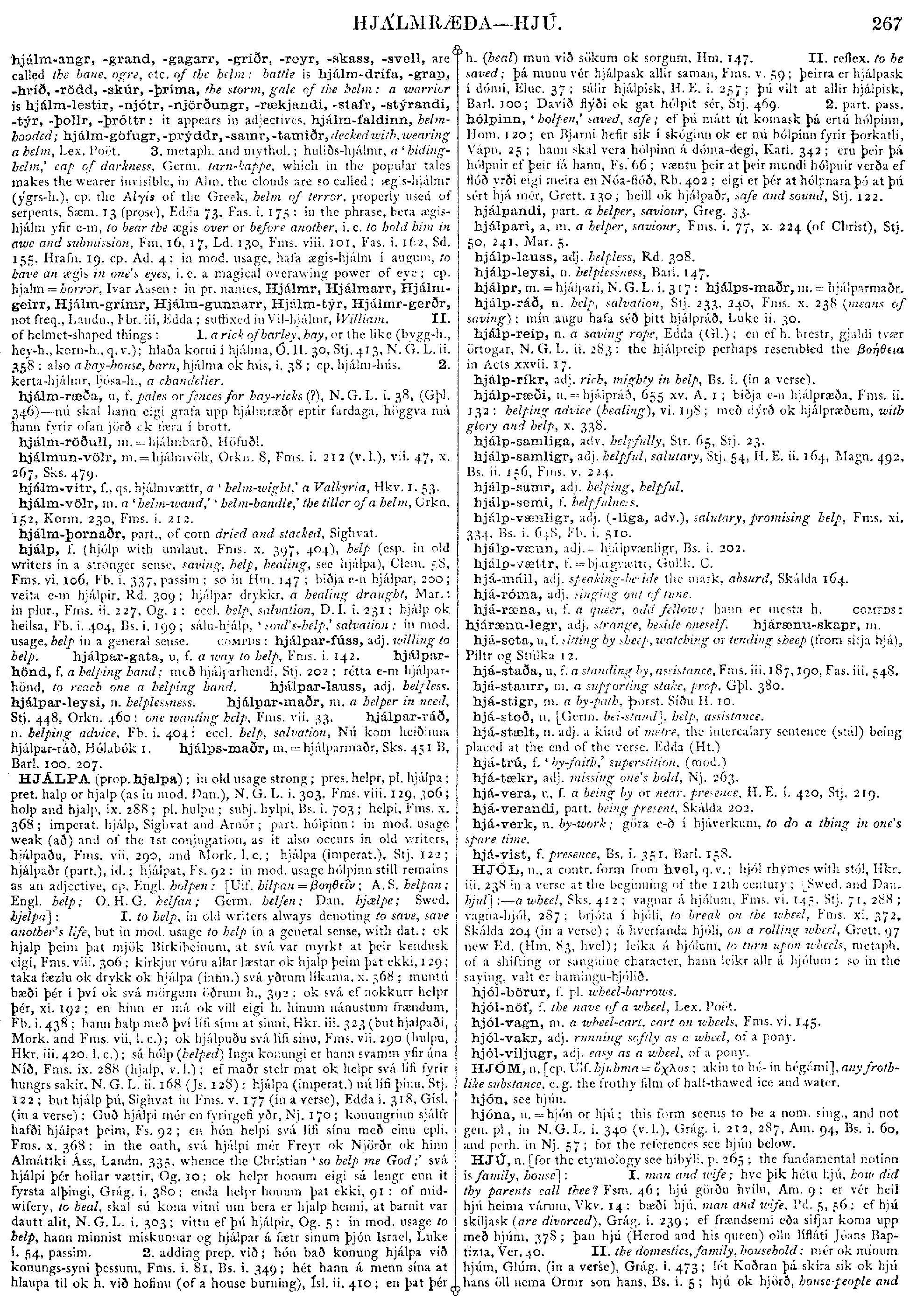
HJÁLPA (prop. hjalpa); in old usage strong; pres. helpr, pl. hjálpa; pret. halp or hjalp (as in mod. Dan.), N. G. L. i. 303, Fms. viii. 129, 306; holp and hjalp, ix. 288; pl. hulpu; subj. hylpi, Bs. i. 703; helpi, Fms. x. 368; imperat. hjálp, Sighvat and Arnór; part. hólpinn: in mod. usage weak (að) and of the 1st conjugation, as it also occurs in old writers, hjálpaðu, Fms. vii. 290, and Mork. l.c.; hjálpa (imperat.), Stj. 122; hjálpaðr (part.), id.; hjálpat, Fs. 92: in mod. usage hólpinn still remains as an adjective, cp. Engl. holpen: [Ulf. hilpan = GREEK; A. S. helpan; Engl. help; O. H. G. helfan; Germ. helfen; Dan. hjælpe; Swed. hjelpa]: I. to help, in old writers always denoting to save, save another's life, but in mod. usage to help in a general sense, with dat.; ok hjalp þeim þat mjök Birkibeinum, at svá var myrkt at þeir kendusk eigi, Fms. viii. 306; kirkjur vóru allar læstar ok hjalp þeim þat ekki, 129; taka fæzlu ok drykk ok hjálpa (infin.) svá yðrum líkama, x. 368; muntú bæði þér í því ok svá mörgum öðrum h., 392; ok svá ef nokkurr helpr þér, xi. 192; en hinn er má, ok vill eigi h. hinum nánustum frændum, Fb. i. 438; hann halp með því lífi sínu at sinni, Hkr. iii. 323 (but hjalpaði, Mork. and Fms. vii, l.c.); ok hjálpuðu svá lífi sínu, Fms. vii. 290 (hulpu, Hkr. iii. 420, l.c.); sá hólp (helped) Inga konungi er hann svamm yfir ána Níð, Fms. ix. 288 (hjalp, v.l.); ef maðr stelr mat ok helpr svá lífi fyrir hungrs sakir, N. G. L. ii. 168 (Js. 128); hjálpa (imperat.) nú lífi þínu, Stj. 122; but hjálp þú, Sighvat in Fms. v. 177 (in a verse), Edda i. 318, Gísl. (in a verse); Guð hjálpi mér en fyrirgefi yðr, Nj. 170; konungrinn sjálfr hafði hjálpat þeim, Fs. 92; en hón helpi svá lífi sínu með einu epli, Fms. x. 368: in the oath, svá hjálpi mér Freyr ok Njörðr ok hinn Almáttki Áss, Landn. 335, whence the Christian 'so help me God;' svá hjálpi þer hollar vættir, Og. 10; ok helpr honum eigi sá lengr enn it fyrsta alþingi, Grág. i. 380; enda helpr honum þat ekki, 91: of midwifery, to heal, skal sú kona vitni um bera er hjalp henni, at barnit var dautt alit, N. G. L. i. 303; vittu ef þú hjálpir, Og. 5: in mod. usage to help, hann minnist miskunnar og hjálpar á fætr sínum þjón Israel, Luke i. 54, passim. 2. adding prep. við; hón bað konung hjálpa við konungs-syni þessum, Fms. i. 81, Bs. i. 349; hét hann á menn sína at hlaupa til ok h. við hofinu (of a house burning), Ísl. ii. 410; en þat þér h. (heal) mun við sökum ok sorgum, Hm. 147. II. reflex. to be saved; þá munu vér hjálpask allir saman, Fms. v. 59; þeirra er hjálpask í dómi, Eluc. 37; sálir hjálpisk, H. E. i. 257; þú vilt at allir hjálpisk, Barl. 100; Davíð flýði ok gat hólpit sér, Stj. 469. 2. part. pass. hólpinn, 'holpen,' saved, safe; ef þú mátt út komask þá ertú hólpinn, Hom. 120; en Bjarni hefir sik í skóginn ok er nú hólpinn fyrir Þorkatli, Vápn. 25; hann skal vera hólpinn á dóma-degi, Karl. 342; eru þeir þá hólpnir ef þeir fá hann, Fs. 66; væntu þeir at þeir mundi hólpnir verða ef flóð yrði eigi meira en Nóa-flóð, Rb. 402; eigi er þér at hólpnara þó at þú sért hjá mér, Grett. 130; heill ok hjálpaðr, safe and sound, Stj. 122.
|
Source: Cleasby/Vigfusson, page b0440, entry 6 View original page image as: [TIFF] [PNG] [View previous entry] [View next entry] |
[Comment on this entry] [View comments] |
The following entry has been hand-corrected once. |
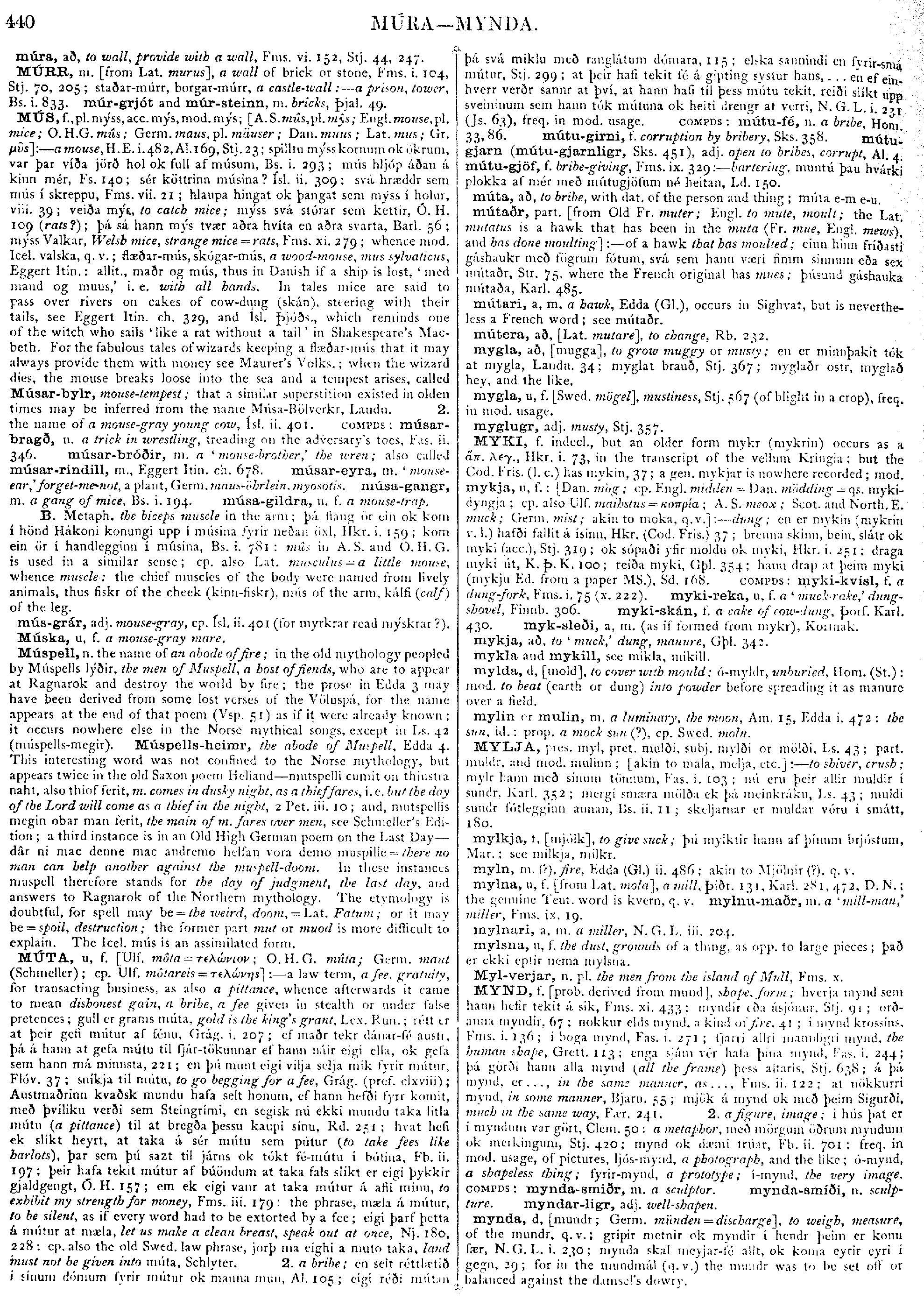
Múspell, n. the name of an abode of fire; in the old mythology peopled by Múspells lýðir, the men of Muspell, a host of fiends, who are to appear at Ragnarok and destroy the world by fire; the prose in Edda 3 may have been derived from some lost verses of the Völuspá, for the name appears at the end of that poem (Vsp. 51) as if it were already known; it occurs nowhere else in the Norse mythical songs, except in Ls. 42 (múspells-megir). Múspells-heimr, the abode of Muspell, Edda 4. This interesting word was not confined to the Norse mythology, but appears twice in the old Saxon poem Heliand -- mutspelli cumit on thiustra naht, also thiof ferit, m. comes in dusky night, as a thief fares, i.e. but the day of the Lord will come as a thief in the night, 2 Pet. iii. 10; and, mutspellis megin obar man ferit, the main of m. fares over men, see Schmeller's Edition; a third instance is in an Old High German poem on the Last Day -- dâr ni mac denne mac andremo helfan vora demo muspille = there no man can help another against the muspell-doom. In these instances muspell therefore stands for the day of judgment, the last day, and answers to Ragnarok of the Northern mythology. The etymology is doubtful, for spell may be = the weird, doom, = Lat. Fatum; or it may be = spoil, destruction; the former part mut or muod is more difficult to explain. The Icel. mús is an assimilated form.
Germanic Lexicon Project (main page)
This search system was written by
Sean Crist
Please consider
volunteering
to correct the data in these online dictionaries.
No rights reserved. Feel free to use these data in any way you please.