|
|

Search for has again, using less strict matching (1400 results)
|
Source: Cleasby/Vigfusson, page b0036, entry 23 View original page image as: [TIFF] [PNG] [View previous entry] [View next entry] |
[Comment on this entry] [View comments] |
The following entry has been hand-corrected once. |
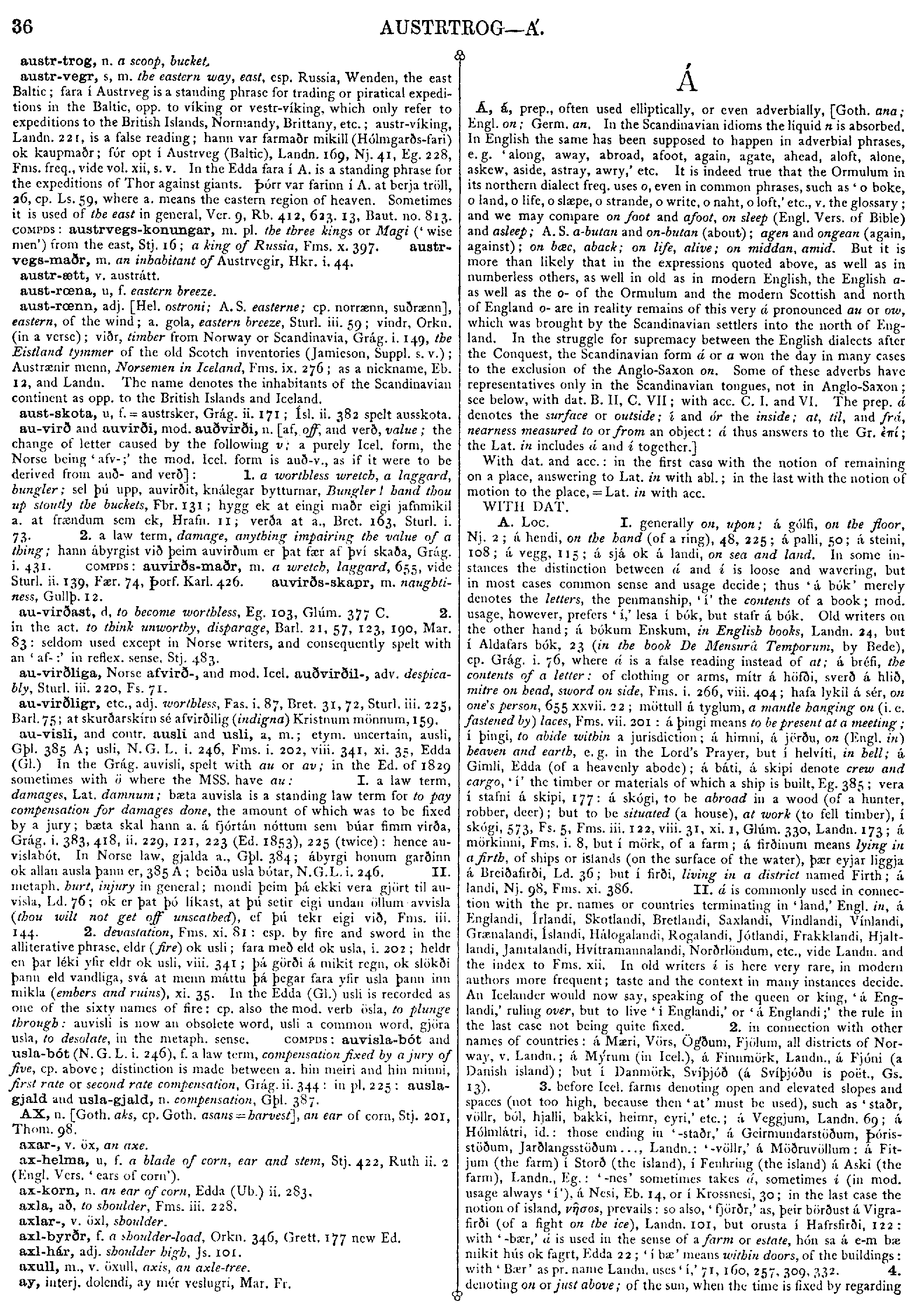
Á, á, prep., often used elliptically, or even adverbially, [Goth, ana; Engl. on; Germ. an. In the Scandinavian idioms the liquid n is absorbed. In English the same has been supposed to happen in adverbial phrases, e. g. 'along, away, abroad, afoot, again, agate, ahead, aloft, alone, askew, aside, astray, awry,' etc. It is indeed true that the Ormulum in its northern dialect freq. uses o, even in common phrases, such as 'o boke, o land, o life, o slæpe, o strande, o write, o naht, o loft,' etc., v. the glossary; and we may compare on foot and afoot, on sleep (Engl. Vers. of Bible) and asleep; A. S. a-butan and on-butan (about); agen and ongean (again, against); on bæc, aback; on life, alive; on middan, amid. But it is more than likely that in the expressions quoted above, as well as in numberless others, as well in old as in modern English, the English a- as well as the o- of the Ormulum and the modern Scottish and north of England o- are in reality remains of this very á pronounced au or ow, which was brought by the Scandinavian settlers into the north of England. In the struggle for supremacy between the English dialects after the Conquest, the Scandinavian form á or a won the day in many cases to the exclusion of the Anglo-Saxon on. Some of these adverbs have representatives only in the Scandinavian tongues, not in Anglo-Saxon; see below, with dat. B. II, C. VII; with acc. C. I. and VI. The prep. á denotes the surface or outside; í and ór the inside; at, til, and frá, nearness measured to or from an object: á thus answers to the Gr. GREEK the Lat. in includes á and i together.]
|
Source: Cleasby/Vigfusson, page b0038, entry 3 View original page image as: [TIFF] [PNG] [View previous entry] [View next entry] |
[Comment on this entry] [View comments] |
The following entry has been hand-corrected once. |
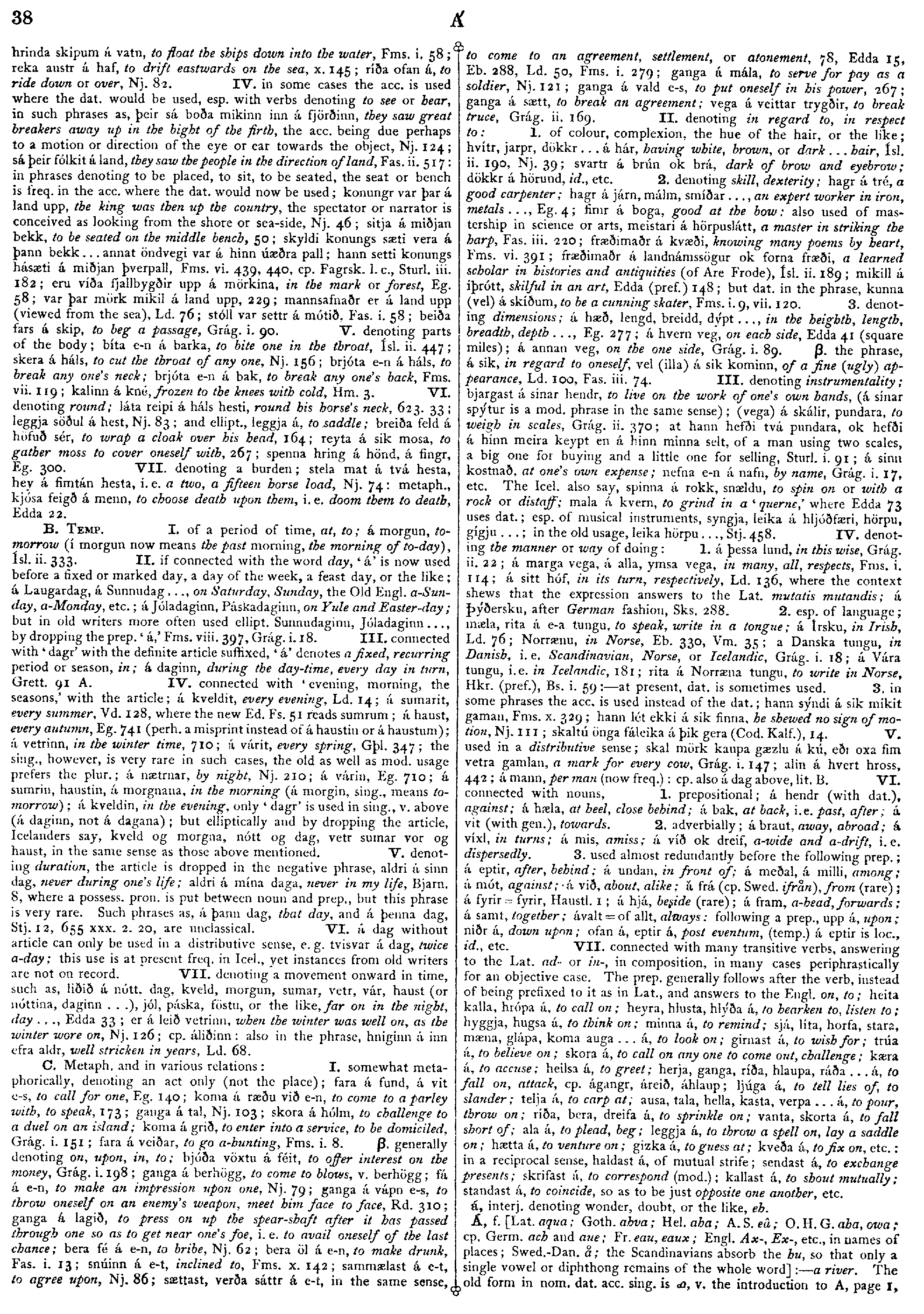
C.
Metaph.
and
in
various
relations:
I.
somewhat
metaphorically,
denoting
an
act
only
(not
the
place);
fara
á
fund,
á
vit
e-s,
to
call
for
one,
Eg.
140;
koma
á
ræðu
við
e-n,
to
come
to
a
parley
with,
to
speak,
173;
ganga
á
tal,
Nj.
103;
skora
á
hólm,
to
challenge
to
a
duel
on
an
island;
koma
á
grið,
to
enter
into
a
service,
to
be
domiciled,
Grág.
i.
151;
fara
á
veiðar,
to
go
a-hunting,
Fms.
i.
8.
 .
generally
denoting
on,
upon,
in,
to;
bjóða
vöxtu
á
féit,
to
offer
interest
on
the
money,
Grág.
i.
198;
ganga
á
berhögg,
to
come
to
blows,
v.
berhögg;
fá
á
e-n,
to
make
an
impression
upon
one,
Nj.
79;
ganga
á
vápn
e-s,
to
throw
oneself
on
an
enemy's
weapon,
meet
him
face
to
face,
Rd.
310;
ganga
á
lagið,
to
press
on
up
the
spear-shaft
after
it
has
passed
through
one
so
as
to
get
near
one's
foe,
i.e.
to
avail
oneself
of
the
last
chance;
bera
fé
á
e-n,
to
bribe,
Nj.
62;
bera
öl
á
e-n,
to
make
drunk,
Fas.
i.
13;
snúinn
á
e-t,
inclined
to,
Fms.
x.
142;
sammælast
á
e-t,
to
agree
upon,
Nj.
86;
sættast,
verða
sáttr
á
e-t,
in
the
same
sense,
to
come
to
an
agreement,
settlement,
or
atonement,
78,
Edda
15,
Eb.
288,
Ld.
50,
Fms.
i.
279;
ganga
á
mála,
to
serve
for
pay
as
a
soldier,
Nj.
121;
ganga
á
vald
e-s,
to
put
oneself
in
his
power,
267;
ganga
á
sætt,
to
break
an
agreement;
vega
á
veittar
trygðir,
to
break
truce,
Grág.
ii.
169.
II.
denoting
in
regard
to,
in
respect
to:
1.
of
colour,
complexion,
the
hue
of
the
hair,
or
the
like;
hvítr,
jarpr,
dökkr
...
á
hár,
having
white,
brown,
or
dark
...
hair,
Ísl.
ii.
190,
Nj.
39;
svartr
á
brún
ok
brá,
dark
of
brow
and
eyebrow;
dökkr
á
hörund,
id.,
etc.
2.
denoting
skill,
dexterity;
hagr
á
tré,
a
good
carpenter;
hagr
á
járn,
málm,
smíðar
...,
an
expert
worker
in
iron,
metals
...,
Eg.
4;
fimr
á
boga,
good
at
the
bow:
also
used
of
mastership
in
science
or
arts,
meistari
á
hörpuslátt,
a
master
in
striking
the
harp,
Fas.
iii.
220;
fræðimaðr
á
kvæði,
knowing
many
poems
by
heart,
Fms.
vi.
391;
fræðimaðr
á
landnámssögur
ok
forna
fræði,
a
learned
scholar
in
histories
and
antiquities
(of
Are
Frode),
Ísl.
ii.
189;
mikill
á
íþrótt,
skilful
in
an
art,
Edda
(pref.)
148;
but
dat.
in
the
phrase,
kunna
(vel)
á
skíðum,
to
be
a
cunning
skater,
Fms.
i.
9,
vii.
120.
3.
denoting
dimensions;
á
hæð,
lengd,
breidd,
dýpt
...,
in
the
heighth,
length,
breadth,
depth
...,
Eg.
277;
á
hvern
veg,
on
each
side,
Edda
41
(square
miles);
á
annan
veg,
on
the
one
side,
Grág.
i.
89.
.
the
phrase,
á
sik,
in
regard
to
oneself,
vel
(illa)
á
sik
kominn,
of
a
fine
(ugly)
appearance,
Ld.
100,
Fas.
iii.
74.
III.
denoting
instrumentality;
bjargast
á
sínar
hendr,
to
live
on
the
work
of
one's
own
hands,
(á
sínar
spýtur
is
a
mod.
phrase
in
the
same
sense);
(vega)
á
skálir,
pundara,
to
weigh
in
scales,
Grág.
ii.
370;
at
hann
hefði
tvá
pundara,
ok
hefði
á
hinn
meira
keypt
en
á
hinn
minna
selt,
of
a
man
using
two
scales,
a
big
one
for
buying
and
a
little
one
for
selling,
Sturl.
i.
91;
á
sinn
kostnað,
at
one's
own
expense;
nefna
e-n
á
nafn,
by
name,
Grág.
i.
17,
etc.
The
Icel.
also
say,
spinna
á
rokk,
snældu,
to
spin
on
or
with
a
rock
or
distaff;
mala
á
kvern,
to
grind
in
a
'querne,'
where
Edda
73
uses
dat.;
esp.
of
musical
instruments,
syngja,
leika
á
hljóðfæri,
hörpu,
gígju
...;
in
the
old
usage,
leika
hörpu
...,
Stj.
458.
IV.
denoting
the
manner
or
way
of
doing:
1.
á
þessa
lund,
in
this
wise,
Grág.
ii.
22;
á
marga
vega,
á
alla,
ymsa
vega,
in
many,
all,
respects,
Fms.
i.
114;
á
sitt
hóf,
in
its
turn,
respectively,
Ld.
136,
where
the
context
shews
that
the
expression
answers
to
the
Lat.
mutatis
mutandis;
á
Þýðersku,
after
German
fashion,
Sks.
288.
2.
esp.
of
language;
mæla,
rita
á
e-a
tungu,
to
speak,
write
in
a
tongue;
á
Írsku,
in
Irish,
Ld.
76;
Norrænu,
in
Norse,
Eb.
330,
Vm.
35;
a
Danska
tungu,
in
Danish,
i.e.
Scandinavian,
Norse,
or
Icelandic,
Grág.
i.
18;
á
Vára
tungu,
i.e.
in
Icelandic,
181;
rita
á
Norræna
tungu,
to
write
in
Norse,
Hkr.
(pref.),
Bs.
i.
59
:--
at
present,
dat.
is
sometimes
used.
3.
in
some
phrases
the
acc.
is
used
instead
of
the
dat.;
hann
sýndi
á
sik
mikit
gaman,
Fms.
x.
329;
hann
lét
ekki
á
sik
finna,
he
shewed
no
sign
of
motion,
Nj.
111;
skaltú
önga
fáleika
á
þik
gera
(Cod.
Kalf.),
14.
V.
used
in
a
distributive
sense;
skal
mörk
kaupa
gæzlu
á
kú,
eðr
oxa
fim
vetra
gamlan,
a
mark
for
every
cow,
Grág.
i.
147;
alin
á
hvert
hross,
442;
á
mann,
per
man
(now
freq.):
cp.
also
á
dag
above,
lit.
B.
VI.
connected
with
nouns,
1.
prepositional;
á
hendr
(with
dat.),
against;
á
hæla,
at
heel,
close
behind;
á
bak,
at
back,
i.e.
past,
after;
á
vit
(with
gen.),
towards.
2.
adverbially;
á
braut,
away,
abroad;
á
víxl,
in
turns;
á
mis,
amiss;
á
víð
ok
dreif,
a-wide
and
a-drift,
i.e.
dispersedly.
3.
used
almost
redundantly
before
the
following
prep.;
á
eptir,
after,
behind;
á
undan,
in
front
of;
á
meðal,
á
milli,
among;
á
mót,
against;
á
við,
about,
alike;
á
frá
(cp.
Swed.
ifrån),
from
(rare);
á
fyrir
=
fyrir,
Haustl.
1;
á
hjá,
beside
(rare);
á
fram,
a-head,
forwards;
á
samt,
together;
ávalt
=
of
allt,
always:
following
a
prep.,
upp
á,
upon;
niðr
á,
down
upon;
ofan
á,
eptir
á,
post
eventum,
(temp.)
á
eptir
is
loc.,
id.,
etc.
VII.
connected
with
many
transitive
verbs,
answering
to
the
Lat.
ad-
or
in-,
in
composition,
in
many
cases
periphrastically
for
an
objective
case.
The
prep.
generally
follows
after
the
verb,
instead
of
being
prefixed
to
it
as
in
Lat.,
and
answers
to
the
Engl.
on,
to;
heita
kalla,
hrópa
á,
to
call
on;
heyra,
hlusta,
hlyða
á,
to
hearken
to,
listen
to;
hyggja,
hugsa
á,
to
think
on;
minna
á,
to
remind;
sjá,
líta,
horfa,
stara,
mæna,
glápa,
koma
auga
...
á,
to
look
on;
girnast
á,
to
wish
for;
trúa
á,
to
believe
on;
skora
á,
to
call
on
any
one
to
come
out,
challenge;
kæra
á,
to
accuse;
heilsa
á,
to
greet;
herja,
ganga,
ríða,
hlaupa,
ráða
...
á,
to
fall
on,
attack,
cp.
ágangr,
áreið,
áhlaup;
ljúga
á,
to
tell
lies
of,
to
slander;
telja
á,
to
carp
at;
ausa,
tala,
hella,
kasta,
verpa
...
á,
to
pour,
throw
on;
ríða,
bera,
dreifa
á,
to
sprinkle
on;
vanta,
skorta
á,
to
fall
short
of;
ala
á,
to
plead,
beg;
leggja
á,
to
throw
a
spell
on,
lay
a
saddle
on;
hætta
á,
to
venture
on;
gizka
á,
to
guess
at;
kveða
á,
to
fix
on,
etc.:
in
a
reciprocal
sense,
haldast
á,
of
mutual
strife;
sendast
á,
to
exchange
presents;
skrifast
á,
to
correspond
(mod.);
kallast
á,
to
shout
mutually;
standast
á,
to
coincide,
so
as
to
be
just
opposite
one
another,
etc.
.
generally
denoting
on,
upon,
in,
to;
bjóða
vöxtu
á
féit,
to
offer
interest
on
the
money,
Grág.
i.
198;
ganga
á
berhögg,
to
come
to
blows,
v.
berhögg;
fá
á
e-n,
to
make
an
impression
upon
one,
Nj.
79;
ganga
á
vápn
e-s,
to
throw
oneself
on
an
enemy's
weapon,
meet
him
face
to
face,
Rd.
310;
ganga
á
lagið,
to
press
on
up
the
spear-shaft
after
it
has
passed
through
one
so
as
to
get
near
one's
foe,
i.e.
to
avail
oneself
of
the
last
chance;
bera
fé
á
e-n,
to
bribe,
Nj.
62;
bera
öl
á
e-n,
to
make
drunk,
Fas.
i.
13;
snúinn
á
e-t,
inclined
to,
Fms.
x.
142;
sammælast
á
e-t,
to
agree
upon,
Nj.
86;
sættast,
verða
sáttr
á
e-t,
in
the
same
sense,
to
come
to
an
agreement,
settlement,
or
atonement,
78,
Edda
15,
Eb.
288,
Ld.
50,
Fms.
i.
279;
ganga
á
mála,
to
serve
for
pay
as
a
soldier,
Nj.
121;
ganga
á
vald
e-s,
to
put
oneself
in
his
power,
267;
ganga
á
sætt,
to
break
an
agreement;
vega
á
veittar
trygðir,
to
break
truce,
Grág.
ii.
169.
II.
denoting
in
regard
to,
in
respect
to:
1.
of
colour,
complexion,
the
hue
of
the
hair,
or
the
like;
hvítr,
jarpr,
dökkr
...
á
hár,
having
white,
brown,
or
dark
...
hair,
Ísl.
ii.
190,
Nj.
39;
svartr
á
brún
ok
brá,
dark
of
brow
and
eyebrow;
dökkr
á
hörund,
id.,
etc.
2.
denoting
skill,
dexterity;
hagr
á
tré,
a
good
carpenter;
hagr
á
járn,
málm,
smíðar
...,
an
expert
worker
in
iron,
metals
...,
Eg.
4;
fimr
á
boga,
good
at
the
bow:
also
used
of
mastership
in
science
or
arts,
meistari
á
hörpuslátt,
a
master
in
striking
the
harp,
Fas.
iii.
220;
fræðimaðr
á
kvæði,
knowing
many
poems
by
heart,
Fms.
vi.
391;
fræðimaðr
á
landnámssögur
ok
forna
fræði,
a
learned
scholar
in
histories
and
antiquities
(of
Are
Frode),
Ísl.
ii.
189;
mikill
á
íþrótt,
skilful
in
an
art,
Edda
(pref.)
148;
but
dat.
in
the
phrase,
kunna
(vel)
á
skíðum,
to
be
a
cunning
skater,
Fms.
i.
9,
vii.
120.
3.
denoting
dimensions;
á
hæð,
lengd,
breidd,
dýpt
...,
in
the
heighth,
length,
breadth,
depth
...,
Eg.
277;
á
hvern
veg,
on
each
side,
Edda
41
(square
miles);
á
annan
veg,
on
the
one
side,
Grág.
i.
89.
.
the
phrase,
á
sik,
in
regard
to
oneself,
vel
(illa)
á
sik
kominn,
of
a
fine
(ugly)
appearance,
Ld.
100,
Fas.
iii.
74.
III.
denoting
instrumentality;
bjargast
á
sínar
hendr,
to
live
on
the
work
of
one's
own
hands,
(á
sínar
spýtur
is
a
mod.
phrase
in
the
same
sense);
(vega)
á
skálir,
pundara,
to
weigh
in
scales,
Grág.
ii.
370;
at
hann
hefði
tvá
pundara,
ok
hefði
á
hinn
meira
keypt
en
á
hinn
minna
selt,
of
a
man
using
two
scales,
a
big
one
for
buying
and
a
little
one
for
selling,
Sturl.
i.
91;
á
sinn
kostnað,
at
one's
own
expense;
nefna
e-n
á
nafn,
by
name,
Grág.
i.
17,
etc.
The
Icel.
also
say,
spinna
á
rokk,
snældu,
to
spin
on
or
with
a
rock
or
distaff;
mala
á
kvern,
to
grind
in
a
'querne,'
where
Edda
73
uses
dat.;
esp.
of
musical
instruments,
syngja,
leika
á
hljóðfæri,
hörpu,
gígju
...;
in
the
old
usage,
leika
hörpu
...,
Stj.
458.
IV.
denoting
the
manner
or
way
of
doing:
1.
á
þessa
lund,
in
this
wise,
Grág.
ii.
22;
á
marga
vega,
á
alla,
ymsa
vega,
in
many,
all,
respects,
Fms.
i.
114;
á
sitt
hóf,
in
its
turn,
respectively,
Ld.
136,
where
the
context
shews
that
the
expression
answers
to
the
Lat.
mutatis
mutandis;
á
Þýðersku,
after
German
fashion,
Sks.
288.
2.
esp.
of
language;
mæla,
rita
á
e-a
tungu,
to
speak,
write
in
a
tongue;
á
Írsku,
in
Irish,
Ld.
76;
Norrænu,
in
Norse,
Eb.
330,
Vm.
35;
a
Danska
tungu,
in
Danish,
i.e.
Scandinavian,
Norse,
or
Icelandic,
Grág.
i.
18;
á
Vára
tungu,
i.e.
in
Icelandic,
181;
rita
á
Norræna
tungu,
to
write
in
Norse,
Hkr.
(pref.),
Bs.
i.
59
:--
at
present,
dat.
is
sometimes
used.
3.
in
some
phrases
the
acc.
is
used
instead
of
the
dat.;
hann
sýndi
á
sik
mikit
gaman,
Fms.
x.
329;
hann
lét
ekki
á
sik
finna,
he
shewed
no
sign
of
motion,
Nj.
111;
skaltú
önga
fáleika
á
þik
gera
(Cod.
Kalf.),
14.
V.
used
in
a
distributive
sense;
skal
mörk
kaupa
gæzlu
á
kú,
eðr
oxa
fim
vetra
gamlan,
a
mark
for
every
cow,
Grág.
i.
147;
alin
á
hvert
hross,
442;
á
mann,
per
man
(now
freq.):
cp.
also
á
dag
above,
lit.
B.
VI.
connected
with
nouns,
1.
prepositional;
á
hendr
(with
dat.),
against;
á
hæla,
at
heel,
close
behind;
á
bak,
at
back,
i.e.
past,
after;
á
vit
(with
gen.),
towards.
2.
adverbially;
á
braut,
away,
abroad;
á
víxl,
in
turns;
á
mis,
amiss;
á
víð
ok
dreif,
a-wide
and
a-drift,
i.e.
dispersedly.
3.
used
almost
redundantly
before
the
following
prep.;
á
eptir,
after,
behind;
á
undan,
in
front
of;
á
meðal,
á
milli,
among;
á
mót,
against;
á
við,
about,
alike;
á
frá
(cp.
Swed.
ifrån),
from
(rare);
á
fyrir
=
fyrir,
Haustl.
1;
á
hjá,
beside
(rare);
á
fram,
a-head,
forwards;
á
samt,
together;
ávalt
=
of
allt,
always:
following
a
prep.,
upp
á,
upon;
niðr
á,
down
upon;
ofan
á,
eptir
á,
post
eventum,
(temp.)
á
eptir
is
loc.,
id.,
etc.
VII.
connected
with
many
transitive
verbs,
answering
to
the
Lat.
ad-
or
in-,
in
composition,
in
many
cases
periphrastically
for
an
objective
case.
The
prep.
generally
follows
after
the
verb,
instead
of
being
prefixed
to
it
as
in
Lat.,
and
answers
to
the
Engl.
on,
to;
heita
kalla,
hrópa
á,
to
call
on;
heyra,
hlusta,
hlyða
á,
to
hearken
to,
listen
to;
hyggja,
hugsa
á,
to
think
on;
minna
á,
to
remind;
sjá,
líta,
horfa,
stara,
mæna,
glápa,
koma
auga
...
á,
to
look
on;
girnast
á,
to
wish
for;
trúa
á,
to
believe
on;
skora
á,
to
call
on
any
one
to
come
out,
challenge;
kæra
á,
to
accuse;
heilsa
á,
to
greet;
herja,
ganga,
ríða,
hlaupa,
ráða
...
á,
to
fall
on,
attack,
cp.
ágangr,
áreið,
áhlaup;
ljúga
á,
to
tell
lies
of,
to
slander;
telja
á,
to
carp
at;
ausa,
tala,
hella,
kasta,
verpa
...
á,
to
pour,
throw
on;
ríða,
bera,
dreifa
á,
to
sprinkle
on;
vanta,
skorta
á,
to
fall
short
of;
ala
á,
to
plead,
beg;
leggja
á,
to
throw
a
spell
on,
lay
a
saddle
on;
hætta
á,
to
venture
on;
gizka
á,
to
guess
at;
kveða
á,
to
fix
on,
etc.:
in
a
reciprocal
sense,
haldast
á,
of
mutual
strife;
sendast
á,
to
exchange
presents;
skrifast
á,
to
correspond
(mod.);
kallast
á,
to
shout
mutually;
standast
á,
to
coincide,
so
as
to
be
just
opposite
one
another,
etc.
|
Source: Cleasby/Vigfusson, page b0040, entry 13 View original page image as: [TIFF] [PNG] [View previous entry] [View next entry] |
[Comment on this entry] [View comments] |
The following entry has not been hand-corrected. However, the page is reserved and someone is correcting it. |
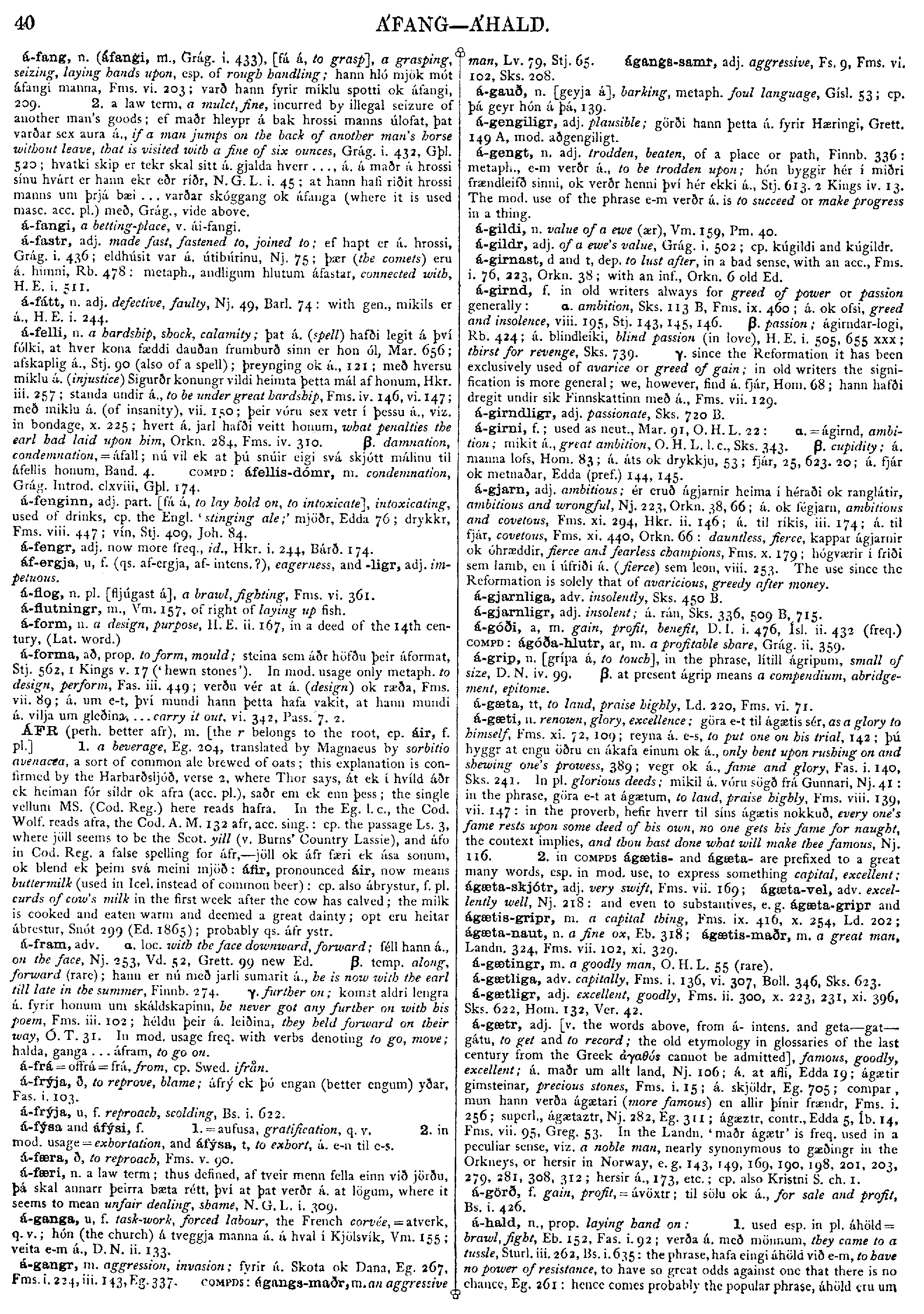
ÁFR (peril, better afr), m. [the r belongs to the root, cp. air, f. pl.] 1. a beverage, Eg. 204, translated by Magnaeus by sorbitio avenacea, a sort of common ale brewed of oats; this explanation is con- firmed by the Harbarðsljóð, verse 2, where Thor says, át ek í hvíld áðr ek heiman for sildr ok afra (acc. pl.), saðr em ek enn þess; the single vellum MS. (Cod. Reg.) here reads hafra. In the Eg. 1. c., the Cod. Wolf, reads afra, the Cod. A. M. 132 afr, acc. sing.: cp. the passage Ls. 3, where jöll seems to be the Scot, yill (v. Burns' Country Lassie), and úfo in Cod. Reg. a false spelling for áfr, -- jöll ok áfr færi tk ása sonum, ok blend ek þeini svá meini mjöð: áftr, pronounced áir, now means buttermilk (used in Icel. instead of common beer): cp. also ábrystur, f. pl. curds of cow's milk in the first week after the cow has calved; the milk is cooked and eaten warm and deemed a great dainty; opt eru heitar úbrcstur, Snot 299 (Ed. 1865); probably qs. áfr ystr.
|
Source: Cleasby/Vigfusson, page b0040, entry 29 View original page image as: [TIFF] [PNG] [View previous entry] [View next entry] |
[Comment on this entry] [View comments] |
The following entry has not been hand-corrected. However, the page is reserved and someone is correcting it. |
a-girnd, f. in old writers always for greed of power or passion generally: a. ambition, Sks. 113 B, Fms. ix. 460; á. ok ofsi, greed and insolence, viii. 195, Stj. 143, 145, 146. 0. passion; ágirndar-logi, Rb. 424; á. blindleiki, bli n d passion (in love), H. E. i. 505, 655 xxx; thirst for revenge, Sks. 739. -y- since the Reformation it has been exclusively used of avarice or greed of gain; in old writers the signi- fication is more general; we, however, find á. fjár, Hom. 68; hann hafði dregit undir sik Finnskattinn með á., Fms. vii. 129.
|
Source: Cleasby/Vigfusson, page b0041, entry 105 View original page image as: [TIFF] [PNG] [View previous entry] [View next entry] |
[Comment on this entry] [View comments] |
The following entry has been hand-corrected once. |
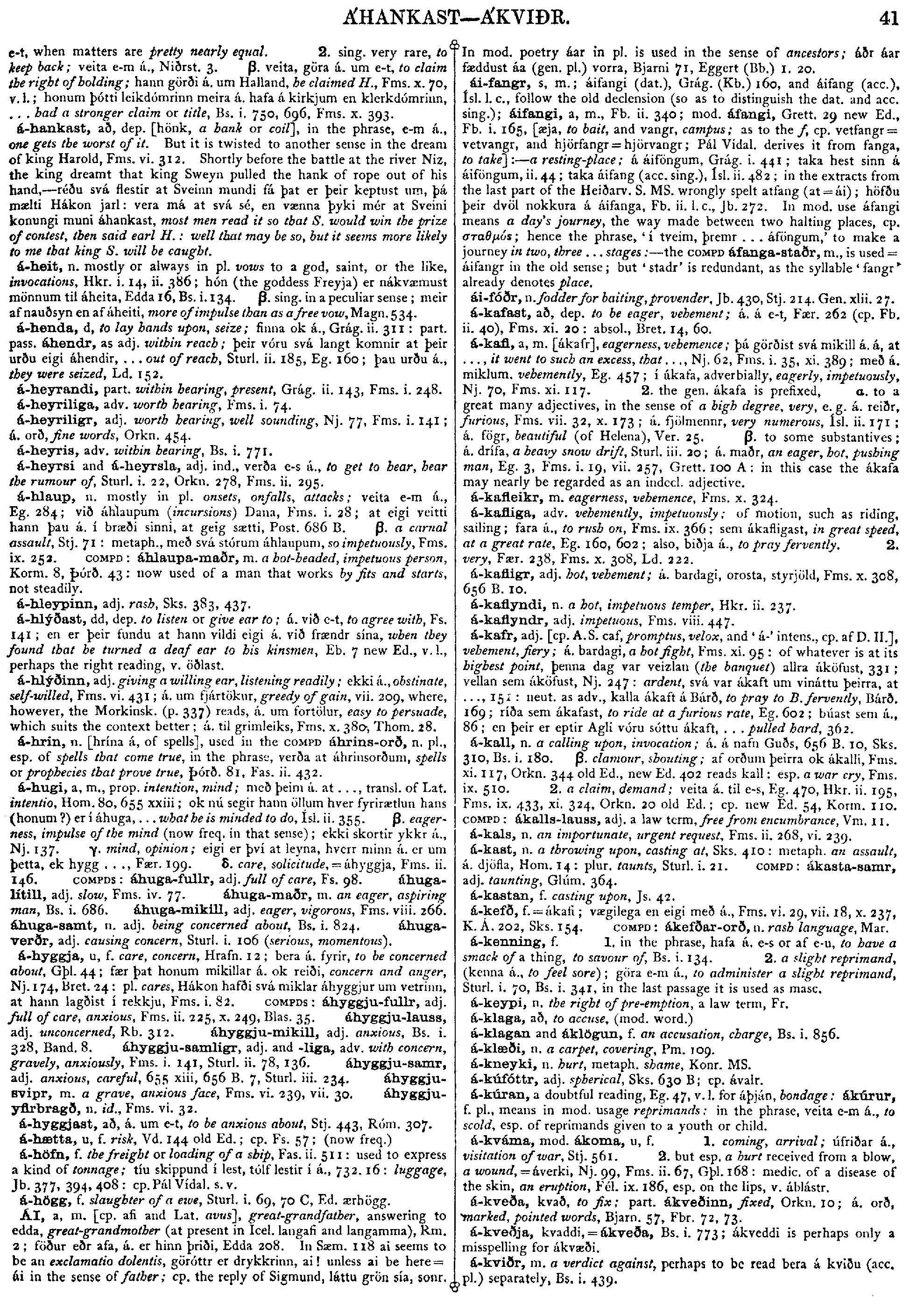
ÁMA, u, f. (and ámu-sótt, f.) erysipelas, Sturl. ii. 116; in common talk corrupted into heimakona or heimakoma. 2. poët, a giantess, Edda (Gl.); hence the play of words in the saying, gengin er gygr or fæti en harðsperra aptr komin, gone is the giantess (erysipelas), but a worse (sceloturbe) has come after. 3. a tub, awme, Germ. ahm. 4. in Norse mod. dialects the larva is called aama (v. Ivar Aasen); and ámu-maðkr, spelt ánu-maðkr, a kind of maggot, lumbricus terrestris, is probably rightly referred to this. Fél. ix. states that it has this name from its being used to cure erysipelas.
|
Source: Cleasby/Vigfusson, page b0041, entry 115 View original page image as: [TIFF] [PNG] [View previous entry] [View next entry] |
[Comment on this entry] [View comments] |
The following entry has been hand-corrected once. |
ÁN, prep. [Goth, inuh; Hel. and O. H. G. ano; Germ, ohne; Gr. GREEK] , without: the oldest form in MSS. is ón, Eluc. 25, Greg. Dial, (freq.), 655 xxvii. 2, Fms. xi. in, 153; aon, Hom. 19 sqq.; the common form is án; with gen. dat. and acc.; at present only with gen. I. with gen., þess máttu Gautar ilia án vera, Hkr. ii. 70. Ó. H. 49 has 'þat;' án manna valda, Fms. iii. 98; á. allra afarkosta, x. 7; mættim vér vel þess án vera, Ísl. ii. 339; in the proverb, án er ills gengis nema heiman hafi, Gísl. 63, but án er illt gengi (acc.), 149, Nj. 27, Ísl. ii. 142, l. c..; án allra klæða, Al. 171; án allrar vægðar, Sks. 229; ón lasta synda, Eluc. 25. II. with dat., esp. in translations or eccles. Writings, perh. in imitation of the Lat., and now quite out of use; esp. In the phrase, án e-s ráði, without (against) one's will, Nj. 38, Bjarn. 71, Korm. 142, Fms. xi. 153, 111; ón góðum verkum, Greg. 13; án úfláti, incessantly, Bs. i. 97; ón dómi, Eluc. 39; sannr ok on gildingi, 655 xxvii. 2. III. with acc., esp. freq. in the Grág., án er illt gengi, v. above; þá skal hann án vera liðit, Grág. i. 276; án ráð lögráðanda, 334; hann mun þik ekki þykjast mega án vera, Fms. vii. 26; án allan verma, Sks. 210; án alla flærð, 522 B; ón líkamligan breyskleik, ok on dóm, Eluc. 38; án leyfi, without leave, Fms. vii. 141. IV. ellipt. without case, or adverbially, hvatki es betra es at hafa en ón at vera (to be without), 677. 8; þau er mönnum þykir betr at hafa en án at vera, Gþl. 379; eiga vilja heldr en ón vera þat hit mjallhvíta man, Alvm. 7 : acc. with inf., án við löst at lifa, sine culpâ vivere, Hm. 68; used substantively, in the proverb, alls áni (omnium expers) verðr sá er einskis biðr, Sl. 38: Egilsson also, on Hdl. 23, suggests a form án, n.; but the passage (the poem is only left in the Fb.) is no doubt a corrupt one. Probably 'ani ómi' is a corruption from Arngrími (arngmi, the lower part of the g being blotted out: Arngrími | óru bornir | (öflgir ?) synir | ok Eyfuru, or the like).
|
Source: Cleasby/Vigfusson, page b0041, entry 131 View original page image as: [TIFF] [PNG] [View previous entry] [View next entry] |
[Comment on this entry] [View comments] |
The following entry has been hand-corrected once. |
ÁR, n. [Goth. jêr; A. S. gear; Engl. year; Germ. jabr; the Scandin. idioms all drop the j, as in ungr, young; cp. also the Gr. GREEK; Lat. hora; Ulf. renders not only GREEK but also sometimes GREEK and GREEK by jêr]. I. a year, = Lat. annus, divided into twelve lunar months, each of 30 days, with four intercalary days, thus making 364 days; as the year was reckoned about the middle of the 10th century (the original calculation probably only reckoned 360 days, and made up the difference by irregular intercalary months). About the year 960 Thorstein Surt introduced the sumarauki (intercalary week), to be inserted every seventh year, thus bringing the year up to 365 days. After the introduction of Christianity (A. D. 1000) the sumarauki was made to harmonize with the Julian calendar; but from A. D. 1700 with the Gregorian calendar; v. the words sumarauki, hlaupár, mánuðr, vika, etc., Íb. ch. 4, Rb. 6, Fms. i. 67; telja árum, to count the time by years, Vsp. 6; í ári, used adverb., at present, as yet, Ó. H. 41, 42 (in a verse). II. = Lat. annona, plenty, abundance, fruitfulness; the phrase, friðr ok ár, Fms. vii. 174, Hkr. Yngl. ch. 8-12; ár ok fésæla, Hkr. l. c.; þá var ár urn öll lönd, id.; létu hlaða skip mörg af korni ok annarri gæzku, ok flytja svá ár í Dan- mörku, Fms. xi. 8, Sks. 323, Fas. i. 526, Hom. 68; gott ár, Eg. 39; blota til árs, Fms. i. 34. III. the name of the Rune RUNE (a), Skálda 176; in the A. S. and Goth. Runes the j has the name jêr, gêr, according to the Germ. and Engl. pronunciation of this word; vide p. 2, col. 1. COMPDS: ára-tal, n. and ára-tala, u, f. number of years; fimtugr at áratali, Stj. 110, Rb. 484, Mar. 656 A. i. 29; hann (Ari Frodi) hafði áratal fyrst til þess er Kristni kom á Ísland, en síðan allt til sinna daga, Hkr. (pref.), seems to mean that Ari in respect of chronology divided his Íslendingabók into two periods, that before and that after the introduction of Christianity; Stj. 112 (periode). árs-bót, f. = árbót, Bs. i. 343, q. v.
|
Source: Cleasby/Vigfusson, page b0047, entry 22 View original page image as: [TIFF] [PNG] [View previous entry] [View next entry] |
[Comment on this entry] [View comments] |
The following entry has been hand-corrected once. |
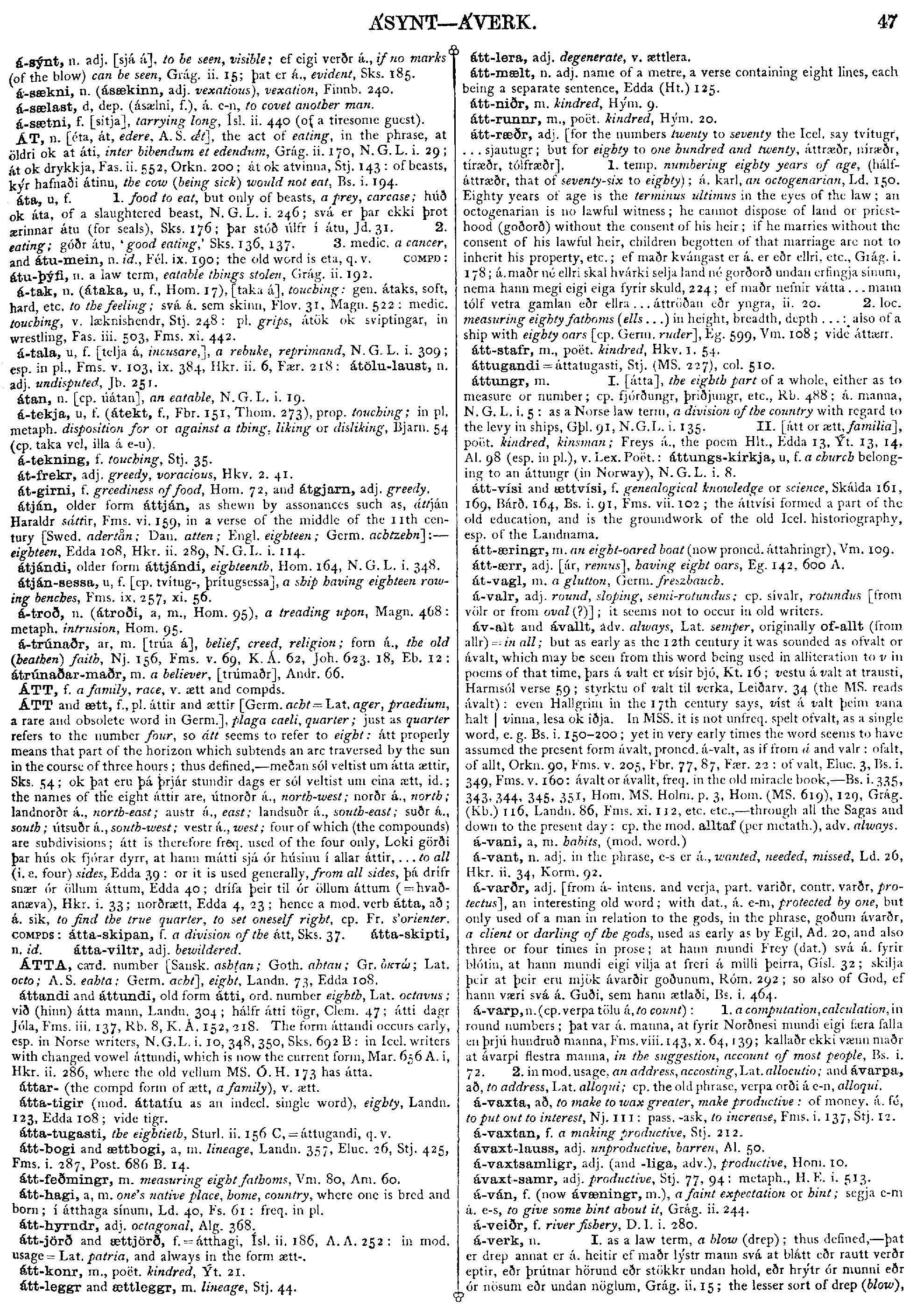
áttandi and áttundi, old form átti, ord. number eighth, Lat. octavus; við (hinn) átta mann, Landn. 304; hálfr átti tögr, Clem. 47; átti dagr Jóla, Fms. iii. 137, Rb. 8, K. Á. 152, 218. The form áttandi occurs early, esp. in Norse writers, N. G. L. i. 10, 348, 350, Sks. 692 B: in Icel. writers with changed vowel áttundi, which is now the current form, Mar. 656 A. i, Hkr. ii. 286, where the old vellum MS. Ó. H. 173 has átta.
|
Source: Cleasby/Vigfusson, page b0048, entry 27 View original page image as: [TIFF] [PNG] [View previous entry] [View next entry] |
[Comment on this entry] [View comments] |
The following entry has been hand-corrected once. |
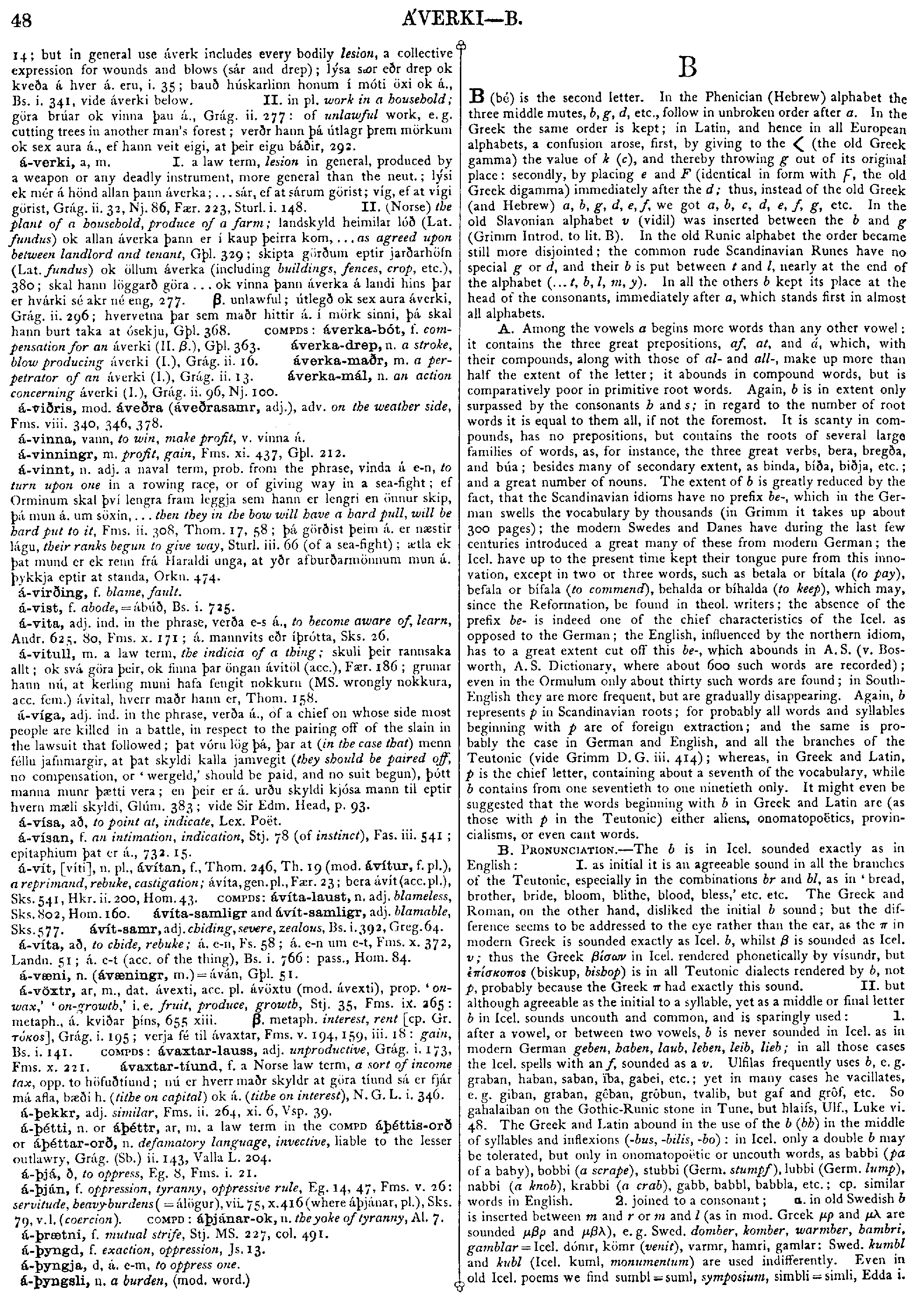
A. Among the vowels a begins more words than any other vowel: it contains the three great prepositions, af, at, and á, which, with their compounds, along with those of al- and all-, make up more than half the extent of the letter; it abounds in compound words, but is comparatively poor in primitive root words. Again, b is in extent only surpassed by the consonants h and s; in regard to the number of root words it is equal to them all, if not the foremost. It is scanty in compounds, has no prepositions, but contains the roots of several large families of words, as, for instance, the three great verbs, bera, bregða, and búa; besides many of secondary extent, as binda, bíða, biðja, etc.; and a great number of nouns. The extent of b is greatly reduced by the fact, that the Scandinavian idioms have no prefix be-, which in the German swells the vocabulary by thousands (in Grimm it takes up about 300 pages); the modern Swedes and Danes have during the last few centuries introduced a great many of these from modern German; the Icel. have up to the present time kept their tongue pure from this innovation, except in two or three words, such as betala or bítala (to pay), befala or bífala (to commend), behalda or bíhalda (to keep), which may, since the Reformation, be found in theol. writers; the absence of the prefix be- is indeed one of the chief characteristics of the Icel. as opposed to the German; the English, influenced by the northern idiom, has to a great extent cut off this be-, which abounds in A. S. (v. Bosworth, A. S. Dictionary, where about 600 such words are recorded); even in the Ormulum only about thirty such words are found; in South-English they are more frequent, but are gradually disappearing. Again, b represents p in Scandinavian roots; for probably all words and syllables beginning with p are of foreign extraction; and the same is probably the case in German and English, and all the branches of the Teutonic (vide Grimm D. G. iii. 414); whereas, in Greek and Latin, p is the chief letter, containing about a seventh of the vocabulary, while b contains from one seventieth to one ninetieth only. It might even be suggested that the words beginning with b in Greek and Latin are (as those with p in the Teutonic) either aliens, onomatopoëtics, provincialisms, or even cant words.
|
Source: Cleasby/Vigfusson, page b0049, entry 1 View original page image as: [TIFF] [PNG] [View previous entry] [View next entry] |
[Comment on this entry] [View comments] |
The following entry has been hand-corrected once. |
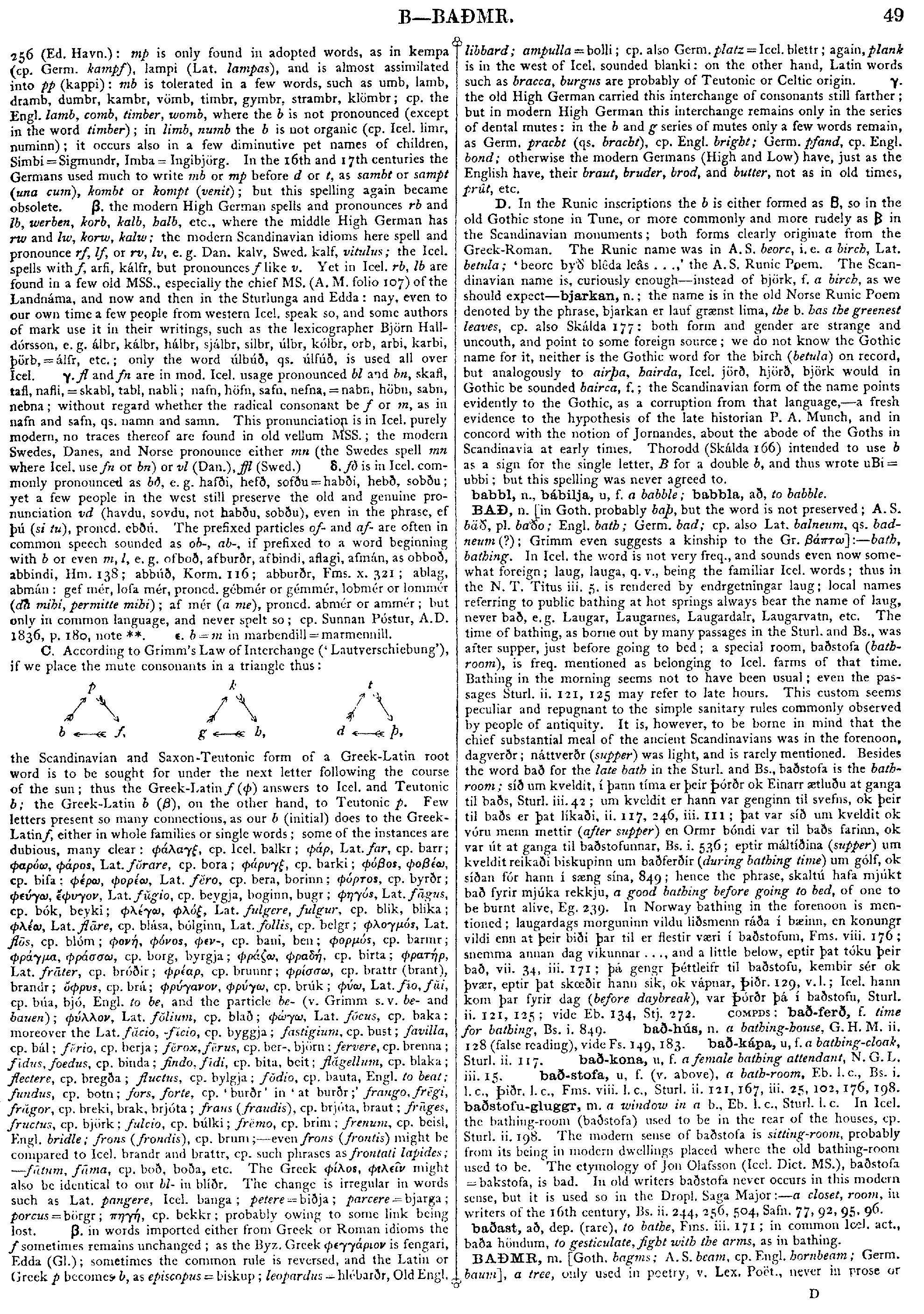
256
(Ed.
Havn.):
mp
is
only
found
in
adopted
words,
as
in
kempa
(cp.
Germ.
kampf),
lampi
(Lat.
lampas),
and
is
almost
assimilated
into
pp
(kappi):
mb
is
tolerated
in
a
few
words,
such
as
umb,
lamb,
dramb,
dumbr,
kambr,
vömb,
timbr,
gymbr.
strambr,
klömbr;
cp.
the
Engl.
lamb,
comb,
timber,
womb,
where
the
b
is
not
pronounced
(except
in
the
word
timber);
in
limb,
numb
the
b
is
not
organic
(cp.
Icel.
limr,
numinn);
it
occurs
also
in
a
few
diminutive
pet
names
of
children,
Simbi
=
Sigmundr,
Imba=
Ingibjörg.
In
the
16th
and
17th
centuries
the
Germans
used
much
to
write
mb
or
mp
before
d
or
t,
as
sambt
or
sampt
(una
cum),
kombt
or
kompt
(venit);
but
this
spelling
again
became
obsolete.
.
the
modern
High
German
spells
and
pronounces
rb
and
lb,
werben,
korb,
kalb,
halb,
etc.,
where
the
middle
High
German
has
rw
and
lw,
korw,
kalw;
the
modern
Scandinavian
idioms
here
spell
and
pronounce
rf,
lf,
or
rv,
lv,
e.g.
Dan.
kalv,
Swed.
kalf,
vitulus;
the
Icel.
spells
with
f,
arfi,
kálfr,
but
pronounces
f
like
v.
Yet
in
Icel.
rb,
lb
are
found
in
a
few
old
MSS.,
especially
the
chief
MS.
(A.
M.
folio
107)
of
the
Landnáma,
and
now
and
then
in
the
Sturlunga
and
Edda:
nay,
even
to
our
own
time
a
few
people
from
western
Icel.
speak
so,
and
some
authors
of
mark
use
it
in
their
writings,
such
as
the
lexicographer
Björn
Halldórsson,
e.g.
álbr,
kálbr,
hálbr,
sjálbr,
silbr,
úlbr,
kólbr,
orb,
arbi,
karbi,
þörb,
=
álfr,
etc.;
only
the
word
úlbúð,
qs.
úlfúð,
is
used
all
over
Icel.
 .
fl
and
fn
are
in
mod.
Icel.
usage
pronounced
bl
and
bn,
skafl,
tafl,
nafli,
=
skabl,
tabl,
nabli;
nafn,
höfn,
safn,
nefna,
=
nabn,
höbn,
sabn,
nebna;
without
regard
whether
the
radical
consonant
be
f
or
m,
as
in
nafn
and
safn,
qs.
namn
and
samn.
This
pronunciation
is
in
Icel.
purely
modern,
no
traces
thereof
are
found
in
old
vellum
MSS.;
the
modern
Swedes,
Danes,
and
Norse
pronounce
either
mn
(the
Swedes
spell
mn
where
Icel.
use
fn
or
bn)
or
vl
(Dan.),
ffl
(Swed.)
.
fl
and
fn
are
in
mod.
Icel.
usage
pronounced
bl
and
bn,
skafl,
tafl,
nafli,
=
skabl,
tabl,
nabli;
nafn,
höfn,
safn,
nefna,
=
nabn,
höbn,
sabn,
nebna;
without
regard
whether
the
radical
consonant
be
f
or
m,
as
in
nafn
and
safn,
qs.
namn
and
samn.
This
pronunciation
is
in
Icel.
purely
modern,
no
traces
thereof
are
found
in
old
vellum
MSS.;
the
modern
Swedes,
Danes,
and
Norse
pronounce
either
mn
(the
Swedes
spell
mn
where
Icel.
use
fn
or
bn)
or
vl
(Dan.),
ffl
(Swed.)
 .
fð
is
in
Icel.
commonly
pronounced
as
bð,
e.g.
hafði,
hefð,
sofðu
=
habði,
hebð,
sobðu;
yet
a
few
people
in
the
west
still
preserve
the
old
and
genuine
pronunciation
vd
(havdu,
sovdu,
not
habðu,
sobðu),
even
in
the
phrase,
ef
þú
(si
tu),
proncd.
ebðú.
The
prefixed
particles
of-
and
af-
are
often
in
common
speech
sounded
as
ob-,
ab-,
if
prefixed
to
a
word
beginning
with
b
or
even
m,
l,
e.g.
ofboð,
afburðr,
afbindi,
aflagi,
afmán,
as
obboð,
abbindi,
Hm.
138;
abbúð,
Korm.
116;
abburðr,
Fms.
x.
321;
ablag,
abmán:
gef
mér,
lofa
mér,
proncd.
gébmér
or
gémmér,
lobmér
or
lommér
(da
mihi,
permitte
mihi);
af
mér
(a
me),
proncd.
abmér
or
ammér;
but
only
in
common
language,
and
never
spelt
so;
cp.
Sunnan
Póstur,
A.D.
1836,
p.
180,
note
*
*.
.
fð
is
in
Icel.
commonly
pronounced
as
bð,
e.g.
hafði,
hefð,
sofðu
=
habði,
hebð,
sobðu;
yet
a
few
people
in
the
west
still
preserve
the
old
and
genuine
pronunciation
vd
(havdu,
sovdu,
not
habðu,
sobðu),
even
in
the
phrase,
ef
þú
(si
tu),
proncd.
ebðú.
The
prefixed
particles
of-
and
af-
are
often
in
common
speech
sounded
as
ob-,
ab-,
if
prefixed
to
a
word
beginning
with
b
or
even
m,
l,
e.g.
ofboð,
afburðr,
afbindi,
aflagi,
afmán,
as
obboð,
abbindi,
Hm.
138;
abbúð,
Korm.
116;
abburðr,
Fms.
x.
321;
ablag,
abmán:
gef
mér,
lofa
mér,
proncd.
gébmér
or
gémmér,
lobmér
or
lommér
(da
mihi,
permitte
mihi);
af
mér
(a
me),
proncd.
abmér
or
ammér;
but
only
in
common
language,
and
never
spelt
so;
cp.
Sunnan
Póstur,
A.D.
1836,
p.
180,
note
*
*.
 .
b
=
m
in
marbendill
=
marmennill.
.
b
=
m
in
marbendill
=
marmennill.
| Result Page: |  |
Previous | 84 85 86 87 88 89 90 91 92 93 94 95 96 97 98 99 100 101 102 | Next |  |
Germanic Lexicon Project (main page)
This search system was written by
Sean Crist
Please consider
volunteering
to correct the data in these online dictionaries.
No rights reserved. Feel free to use these data in any way you please.