|
|

Search for has again, using less strict matching (1400 results)
|
Source: Cleasby/Vigfusson, page b0404, entry 59 View original page image as: [TIFF] [PNG] [View previous entry] [View next entry] |
[Comment on this entry] [View comments] |
The following entry has been hand-corrected once. |
lög-fóstri, a, m. one who has given lögfóstr to another, Grág. ii. 45.
|
Source: Cleasby/Vigfusson, page b0404, entry 100 View original page image as: [TIFF] [PNG] [View previous entry] [View next entry] |
[Comment on this entry] [View comments] |
The following entry has been hand-corrected once. |
lög-maðr, m. [old Swed. lagman; the president of the supreme court formerly held in Orkney was called the lagman] :-- ' law-man. ' In the ancient Scandinavian kingdoms each legal community or state (log) had its own laws, its own parliament (lögþing), and its own 'law-man' (lagh- mann, logmaðr); the lagman was the first commoner and the spokesman of the people against the king and court at public assemblies or else- where; he was also the guardian of the law, and the president of the legis- lative body and of the law courts. As in the heathen time laws were not written, the lagman had to sry what was the law of the laud in any case of doubt; in the general assemblies, at least in Iceland, he had to ' say the law (from memory) to the assembled people from the Law-hill (LogbergiJ; hence in the Icelandic Commonwealth he was called lög-sögu- jnaðr (q. v.), the ' law-speaker, ' ' law-sayer, ' ' speaker of the law, ' and his office log-saga or lög-sögn =' law-speaking:' 1. Sweden and Gothland in olden times were the classical lands of lagmen, for the whole kingdom was a confederation of commonwealths, each with its parliament, law- speaker, and laws, who were all of them united under one king; see the Various records in the old Swedish laws, Sveriges Gamla Lagar, as edited by Schlyter, as also the classical account given of lagman Thorgny in O. H. ch. 60 sqq. -- í hverri þessi deild landsins er sitt lögþing, ok sin log, yfir hverjum lögum er lögmaðr, ... þat skulu log vera sem hann réð upp at kveða; en ef konungr, eða jarl, eða byskupar fara yfir land ok eigu þing við búendr, þá svarar lögmaðr af hendi búenda ...; aðrir lögmenn allir skulu vera undir-menn þess lögmanns er á Tíunda-landi er, Ö. H. 65. 2. in Norway the political institutions of the old patriarchal ages were greatly disturbed through the wars and conquest of Harald Fairhair; the ancient laws of Norway too have been preserved in a much more fragmentary state than those of Sweden; of some of the most interest- ing laws only the eccl. section has been preserved, often in Icelandic transcripts or abridged. The most interesting records of the lagmen are therefore not to be found in the Norse laws, but in the Sagas, e. g. the debates in the Hák. S. Gamla, ch. 71-80, 85-97 (in the Flatey book), as also in the þinga-þáttr in Fms. vii. 123-150, and in stray passages in the Icelandic Sagas, in such phrases as lögmenn ok konungr, logmenn ok dómendr, lenda menn ok logmenn ok alla aiþyðu, Eg. 352. 3. in the later Middle Age in Norway, and in Icel. after 1280, the lagman was a justice, who presided in the court lögrétta, at the lögþing (II), cp. jb. passim. 4. in the Icelandic Commonwealth, the officer whose duties have been described above was specially called lögsögu- maðr, and lögmaðr is only used = lagamaðr = a lawyer, -- þat er ok, at lögsögumaðí skal svá görla þáttu alla upp segja, at engi viti einna miclogi görr, en ef honum vinsk eigi fróðleikr til þess, þá skal hann eiga stefnu via fimm logmenn (lawyers, men skilled in law), en næstu dægr áðr, eðr fleiri, Grág. i. 2, 3; þat skal allt hafa er finnsk á skrdO þeirri er Hafiiði lét göra ... en þat eitt af annarra lögmajma fyrirsögn (of other lawyers) er eigi mæli því í gegn, 7; Njáll var lögmaðr svá mikill (so ^ reat a lawyer), at eingi fannsk hans jafningi, Nj. 30. At the union with Nor- way (A. D. 1272) the lögsögu-maðr of the Commonwealth was replaced by two lagmen of the Norse kind, so that in the Sagas composed after that date (e. g. the Grettla) or in Sagas preserved in later transcripts, the terms were now and then confounded, and 'lögmaðr' was, by way of anachronism, used of the lögsögu-maðr of the old Commonwealth, cp. Grett. 64, 115, 173, 191 new Ed., Nj. 24, 164, 237 (v. 1.), Eg. 597, Ísl. (Gunnl. S.) ii. 208, 238, 256, Bs. i. (Hungrv.) 62, Fms. iv. 115, 176, where the 0. H. edition has the true reading, being made from a vel- lum of the Commonwealth time. P. two instances are recorded referring to the loth century in Iceland, where a lögmaðr occurs as a kind of county- sheriff" or officer, viz. in the Háv. S. (begin.) and the Svarfdæla S. ch. 10; but both records seem to be spurious and adapted to the state of things in Norway, for neither Saga is preserved in its pure original state, but remoulded after the union; see Maurqr's Entstehung des Ísl. Staates, Beitrage, 136 sqq. In Scandinavia during the Middle Ages, as the power of the king increased, so that of the old lagman sank, and at last died away. In England it is preserved in the Speaker of the House of Commons, whose very name recalls to mind the law- speaker of the old Scandinavian communities. II. a pr. name, Lög-maðr, Orkn. COMPDS: lögmanns-dæmi, n. the jurisdiction of a lagman, Fms. v. 266. lögmanns-eiðr, m. an oath of homage to the king, Gþl. 66. logmarms-lauss, adj. without a lagman, Ann. I39O- lögmanns-úrskurðr, m. a logman's decree, Jb. 170.
|
Source: Cleasby/Vigfusson, page b0406, entry 1 View original page image as: [TIFF] [PNG] [View previous entry] [View next entry] |
[Comment on this entry] [View comments] |
The following entry has not been hand-corrected. However, the page is reserved and someone is correcting it. |
lög-ræningr, m. a person who has been wronged or cheated of his ^ lawful right, Eg. 526, Fms, vii. 65.
|
Source: Cleasby/Vigfusson, page b0407, entry 2 View original page image as: [TIFF] [PNG] [View previous entry] [View next entry] |
[Comment on this entry] [View comments] |
The following entry has not been hand-corrected. However, the page is reserved and someone is correcting it. |
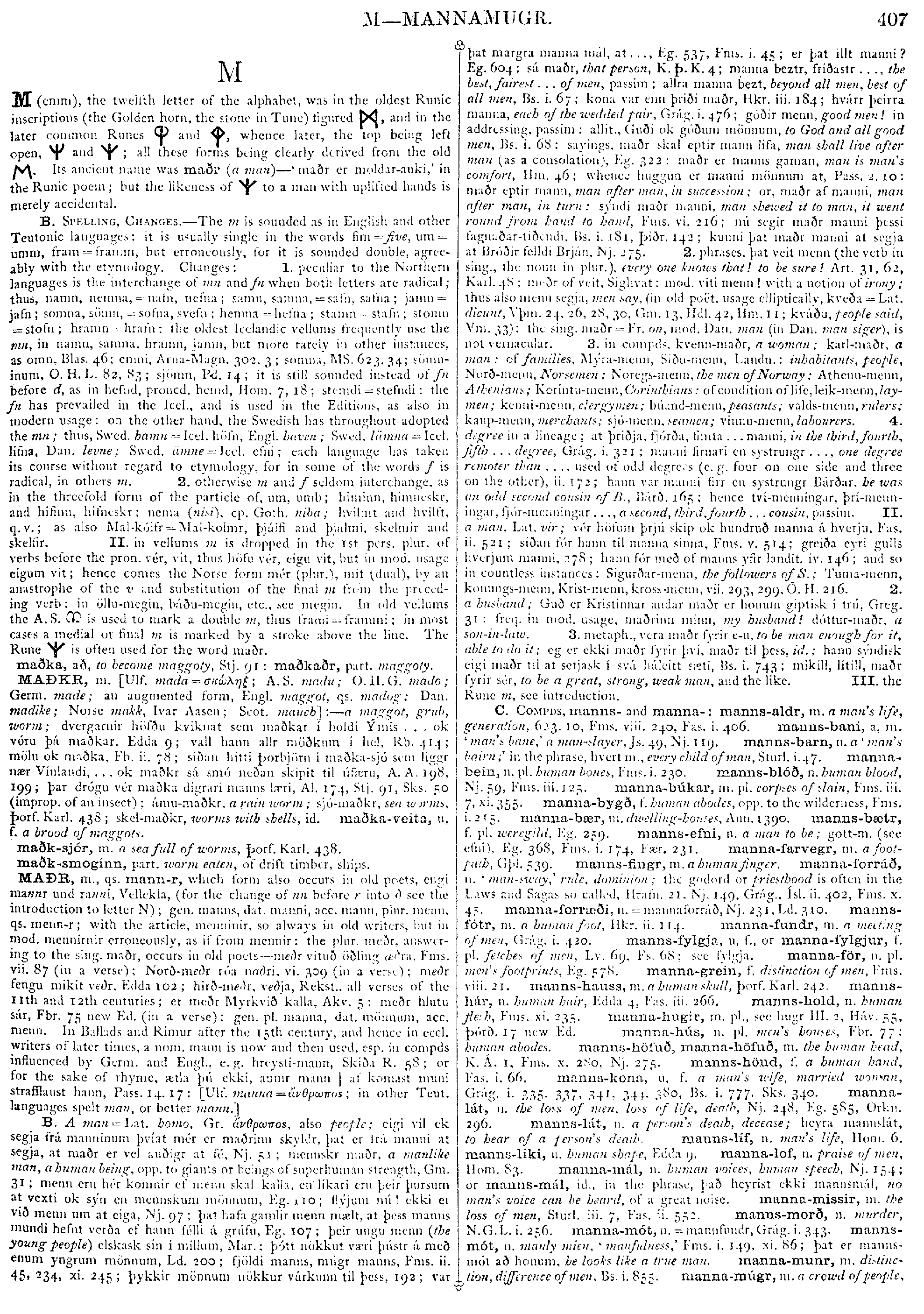
M (enim), the twelfth letter of the alphabet, was in the oldest Runic inscriptions (the Golden horn, the stone in Tune) ligr. red p^j and in the later common Runes Sp and ^, whence later, the top being left open, ^P and Y ! a" these forms being clearly derived from the old /V^. Its ancient name was maðr (a man) -- ' nuiðr er moldar-auki, ' in the Runic poem; but the likeness of Y to a Inai1 NV'tn uplifted hands is merely accidental. B. SrKLLiNG, CHANGES. -- The m is sounded as in English and other Teutonic languages: it is usually single in the words tun -- five, um = unim, fram -- framm, but erroneously, for it is sounded double, agree- ably with the etymology. Changes: 1. peculiar to the Northern languages is the interchange of mn and fn when both letters are radical; thus, namn, neinna, = uafn, nefna; satnn, sainna, = safn, safna; jamn = jafn; somna, sömn, -- sofna, svefn; hemna -- hefna; stamn- stafn; stomii = stofn; hranm •••- lira in: the oldest Icelandic vellums frequently use the mn, in namn, sanma. hr. imn, jamn, but more rarely in other instances, as omn. Blas. 46; emni, Arna-Magn. 301. 3; somna. MS. 623. 34; somn- inum, O. H. L. 82, 83; sjiinm, P*J. 14; it is still sounded instead u(fn before d, as in hefnd, proncd. hemd, Hom. 7, iS: stcmdi = stefndi: the fn has prevailed in the Icel., and is used in the Editions, as also in modern usage: on the other hand, the Swedish lias throughout adopted the mn; thus, Swed. hamn -- Icel. hiifu, Enjrl. haven; Swed. liim/ia -- Icel. lifna, Dan. levrie; Sved. dmne -- -Icel. cfni; each language has taken its course without regard to etymology, for in some of the words / is radical, in others in. 2. otherwise m and / seldom interchange, as in the threefold form of the particle of, nm, umb; himinn, himncskr, and hifinn, hifneskr; neina (nisi), cp. Go;h. niba; hvilnit and hvilft, q. v.; as also Mal-kolfr -- Mai-kolmr, þjáiti and þiuhni, skelmir and skelrir. II. in vellums m is dropped in the 1st pers. plur. of verbs bctore the pron. vér, vit, thus hiifu vér, eigu vit, but in mod. usage eigum vit; hence comes the Norse form nu'r (plur.), mil (dual), by an anastrophe of the v and substitution of the final m from the preced- ing verb: in ollu-megin, báðu-megin, etc., see megiii. In old vellums the A. S. CÏ- is used to mark a double m, thus frami -- -- -frammi; in most cases a medial or final m is marked by a stroke above the line. The Rune Y 's often used for the word maðr.
|
Source: Cleasby/Vigfusson, page b0409, entry 12 View original page image as: [TIFF] [PNG] [View previous entry] [View next entry] |
[Comment on this entry] [View comments] |
The following entry has not been hand-corrected. However, the page is reserved and someone is correcting it. |
MAN, n., does not occur in piur. unless it be in gen. pl. niana, Stor. 13 (ni in MS.); [man is an ancient word only used in old laws and poetry, it remains in the compd man-sal, and in the Icel. local name Man-heimar; 'man' (åvðpáiroSov'), being neuter and having but one;;, is prob. of different origin from maim (iii'Opcurros, avrjp), which is. masc. and has a double final n. The etymology of this word is lost in the remotest antiquity; it appears in the O. M. G. m a n a -b o ulnt -- -- -a bondman's bead, a 'serf's bead;' (Grimm in R. A. expresses a doubt as to the current ety- mology of Lat. man-cipium from mann-capere; peril, man and capnt"!). In early Swed. law the- word occurs twice or thrice, næmpna' man, naempnæ quicfic, Schlyter i. 134; in Cïutalagen -- kauper tu mans man i garth thin (i. e. mans-mann -- -- a bond/nan, cp. maus-manna and mans- inaðr, see Schly'. er's Glossary).] B. A bondman, prob. originally of prisoners of war who were sold as slaves (Irish in the west, Finns and Slaves in the east), see Ld. ch. 12, O. T. (Fms. i. ch. 92); svá ok ef hann vill i mani gjalda, tva aura fyrir einn, ok a hann lausn á maninu en i;æ. stn misseri ef haun heiir upp alit, Gr;i. g. i. 396; kaupa man ok gefa frelsi, N. G. L. i. 5, 6; ok þat ie skal liáift vera í gulli ok i silfri en hálit i mani herru'nu (n a tive bondmen) eigi cilia en fertogu, ne yngra en iimmtan vetra, SS; mans leiga, 224; ok heiiuta hann sein annan mans-mann, K. þ. K. 58; mani aiistrænu, eastern s lave s, Hornkloii; maukar nicyjar at mani hal'ðar, Gs. 1, 15; er |m man keyptir, 8; hálta aðra alin íyrir trjúlsgiafa, penning veginn fyrir man-manna, N. G. L. i, 347; næst kiikju-garði skal grata man-manna, 345; maðr manna, no doubt false for man-manna, 388; er hann réttlauss við hann ok hans konu ok man hans allt, 36, Am. 66; J-ar koin mart man fait, þar sá Loðinn konu nokkura er seld hafði verit mansali, Fms. i. 185: allit., mold ok man, N. G. L. iii. 92, v. 1. II. a girl, maid, as also in a worse sense, a mistress, for bondwomen often became their master's mistresses (see Ld. ch. 12), so that this sense grew out of the preceding one; liki ley fa ens Ijosa mans, Hm. 91; í myrkri skal við man spjalla, 81; et horska man, 101; et manunga man, 163; bat et unga man, þat et mjallhvita man, Aim. 6, 7; bjarthaddað man, Skv. I. 33; harðúðigt man, 27; tostr-man, a bondwoman mine, 3. 67; mans at kosta, Hbl. 16; live ek at andspilli komumk ens unga mans, Skm. 11; hve ek fyrir-banna manna glaum mani, manna nyt mani, bow I ban her from all concourse with men, 34; Ylfinga man, Hkv. 2. 3; Yggjar man, the beloved of Ygg (Odin) -- the Earth, Lex. l'oi-t.; HOðins man = Hilda, the beloved of lied in, Fms. ix. (in a verse); bjarnar man, a giantess, Stor. 13. It is probable that in some law phrases the obso- lete ' man' has been replaced by the common ' maim, ' e. g. in gefa manni frelsi (mani? cp. manfrelsi), N. G. L. i. 5: as also in mana-kaup in the Swed. law, see Schlyter's introd. to the loth vol. of Sver. (Manila Lag. ir. COMPDS: man-frelsi., n. a granting of freedom to a bondman, manu- mission (as a vow), Orkn. 198, 200, Gr;ig. i. 357, where it is wrongly spelt mannfrelsi. Man-heimar, in. pl. (thus pronounce;! on the spot, not Mann-heimar, as it is often spelt), the name of a farm in western Icel.; the local legend attributes the name to English captives kept there by lady Olo'f, for having slain her husband, during the Fnglish trade (1467). But at that time the word man had become quite obsolete, and so the name must be older, prob. dating from the time of the first settler Geirmund, who had been a freebooter in the British waters before he came to Icel.; he may have had his house- hold of bondmen at this farm, see Safn i. 353 (foot-note). man- kynni, n. pl.; gócî in., luck in love affairs, Hbl. 31. man-manna, n. (?) -- •- mansmaðr, N. G. L. i. 345, 347; see the references above. man-runar, f. pl. 'love-runes, ' love-spells, Eg. 587. man-sal, n. n 'man-sale. ' slave trade; selia e-n mansali, Fær. 117, Fms. i. 185, Fb. ii. 79. mansals-maðr, in. a bondman, Fms. i. 78, 22:. mans-maðr, m. [earh Swed. mam-man'', a bondman, (îrúg. i. 271. Eg. 89, K. p. K. 58. man-scmgr, m. a love song, Fig. 325. Bs. i. 165, Edda 16; esp. in the old law a kind of loi-f libel, liable to outlawry, Grug. ii. 150, Fb. ui. 242: in mod. usage the lyrical introduction to the epic rhap- sodies or ballads (rimur) is called manscingr, tor originally they were addressed to the poet's lady-love, Skald H. 6. i, SkíðaK. i, and in count- less instances, e. g. Ú If. I. H, 2. 8, 3. 8, 4, 8, 5. 7, 7. 9, 9. 11, cp. ii. 10. mansöngs-drápa, u, f., -kvœði, n., -visa, u, f. a love encomium, love song, lore di. 'ty. Eg. 5, Bs. i. 165, Fb. iii. 241, 242, Oik. 36, Fs. 60, 87.
|
Source: Cleasby/Vigfusson, page b0410, entry 22 View original page image as: [TIFF] [PNG] [View previous entry] [View next entry] |
[Comment on this entry] [View comments] |
The following entry has been hand-corrected once. |
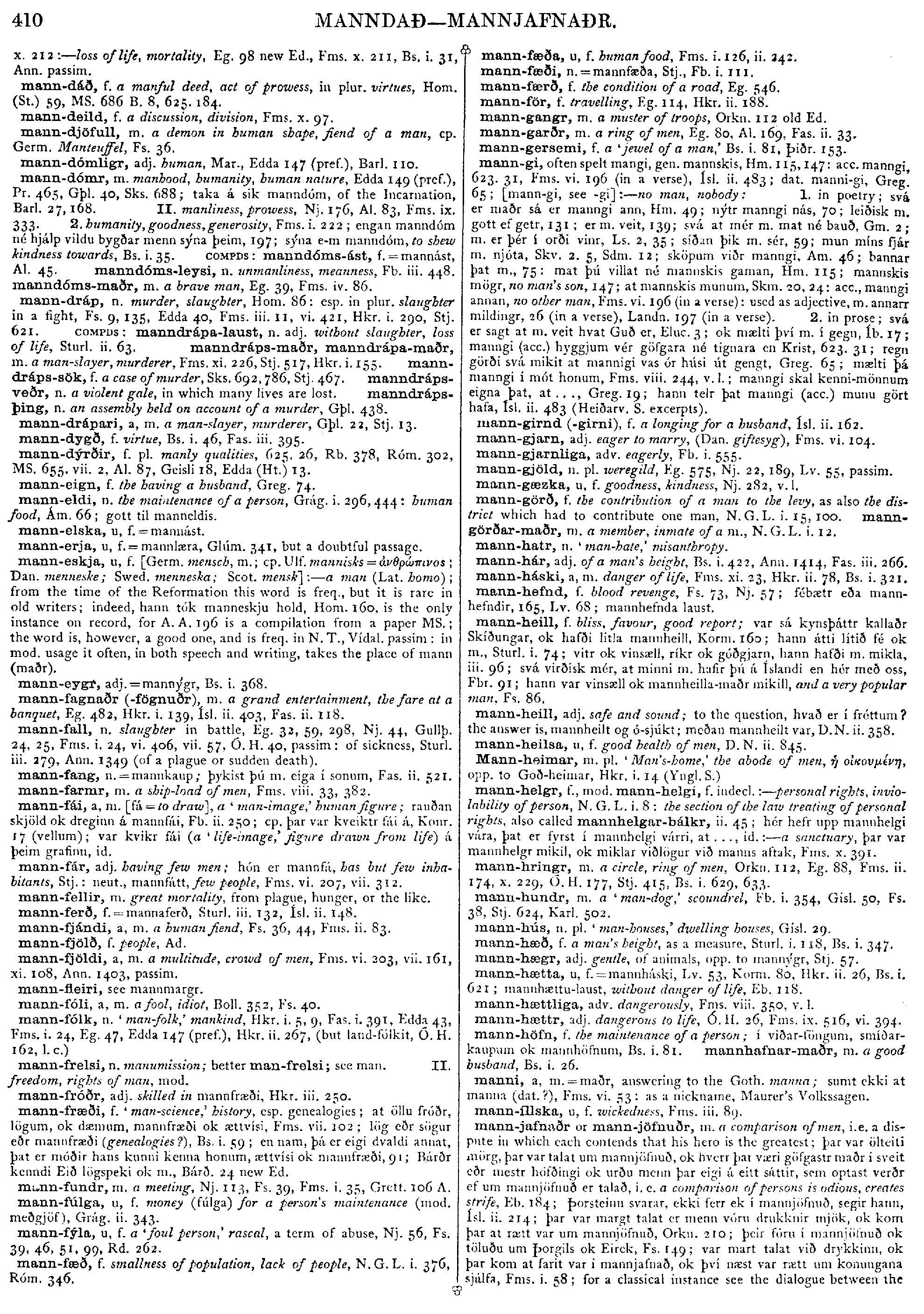
mann-fár, adj. having few men; hón er mannfá, has but few inhabitants, Stj.: neut., mannfátt, few people, Fms. vi. 207, vii. 312.
|
Source: Cleasby/Vigfusson, page b0412, entry 23 View original page image as: [TIFF] [PNG] [View previous entry] [View next entry] |
[Comment on this entry] [View comments] |
The following entry has been hand-corrected once. |
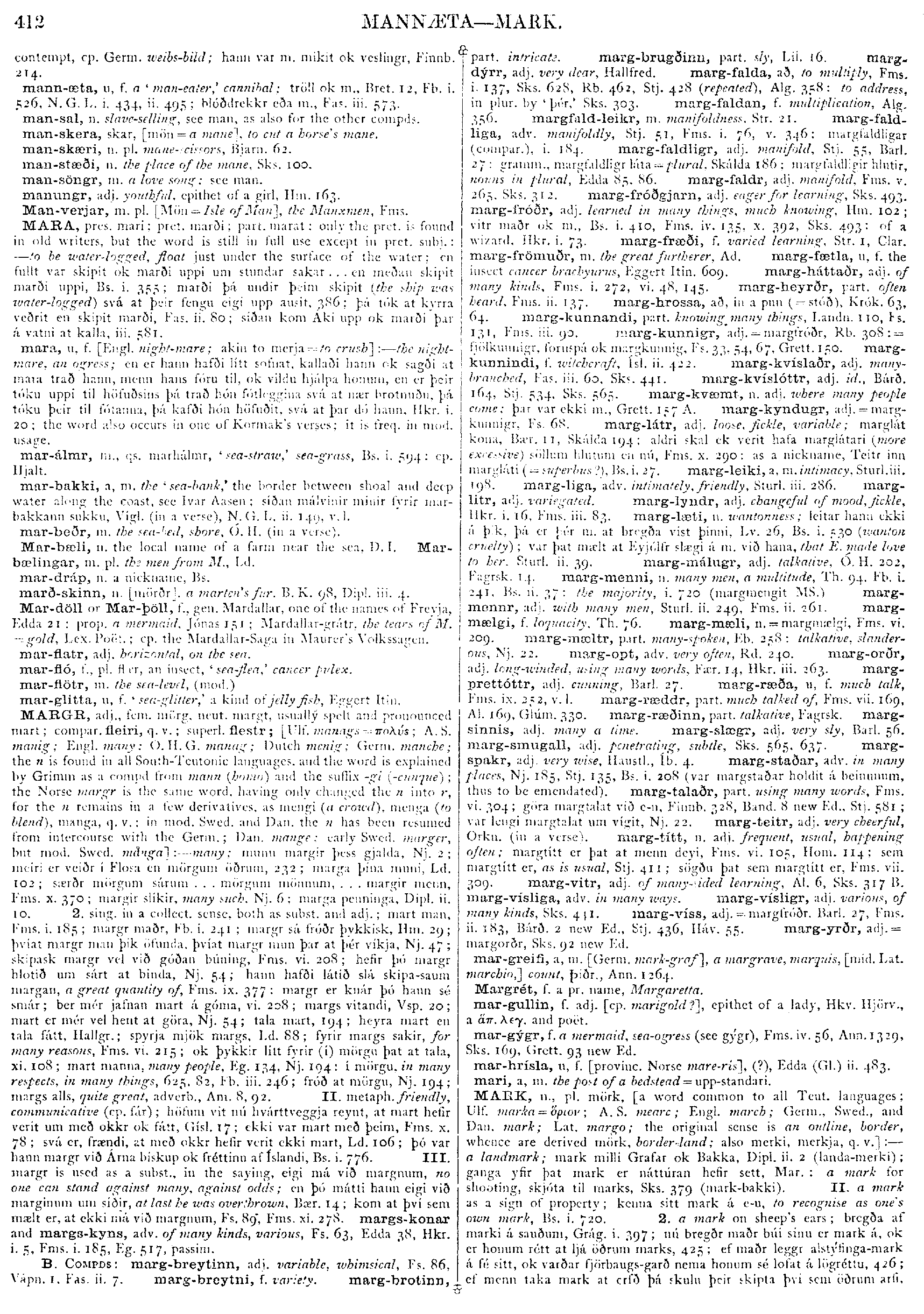
MARGR, adj., fem. mörg. neut. margt, usually spelt and pronounced mart; compar. fleiri, q.v.; superl. flestr; [Ulf. manags = GREEK; A.S. manig; Engl. many: O.H.G. manag; Dutch mennig; Germ. manche; the n is found in all South-Teutonic languages, and the word is explained by Grimm as a compd from mann (homo) and the suffix -gi (-cunque); the Norse margr is the same word, having only changed the n into r, for the n remains in a few derivatives, as mengi (a crowd), menga (to blend), manga, q.v.: in mod. Swed. and Dan. the n has been resumed from intercourse with the Germ.; Dan. mange; early Swed. marger, but mod. Swed. mânga] :-- -many; munu margir þess gjalda, Nj. 2; meiri er veiðr í Flosa en mörgum öðrum, 232; marga þína muni, Ld. 102; særðr mörgum sárum ... mörgum mönnum, ... margir menn, Fms. x. 370; margir slíkir, many such. Nj. 6; marga penninga, Dipl. ii. 10. 2. sing. in a collect. sense, both as subst. and adj.; mart man, Fms. i. 185; margr maðr, Fb. i. 241; margr sá fróðr þvkkisk, Hm. 29; þviat margr man þik öfunda, þvíat margr mun þar at þér víkja, Nj. 47; skipask margr vel við góðan búning, Fms. vi. 208; hefir þó margr hlotið um sárt at binda, Nj. 54; hann hafði látið slá skipa-saum margan, a great quantity of, Fms. ix. 377: margr er knár þó hann sé smár; ber mér jafnan mart á góma, vi. 208; margs vitandi, Vsp. 20; mart er mér vel hent at göra, Nj. 54; tala mart, 194; heyra mart en tala fátt, Hallgr.; spyrja mjök margs, Ld. 88; fyrir margs sakir, for many reasons, Fms. vi. 215; ok þykkir lítt fyrir (í) mörgu þat at tala, xi. 108; mart manna, many people, Eg. 134, Nj. 194: í mörgu, in many respects, in many things, 625. 82, Fb. iii. 246; fróð at mörgu, Nj. 194; margs alls, quite great, adverb., Am. 8, 92. II. metaph. friendly, communicative (cp. fár); höfum vit nú hvarttveggja reynt, at mart hefir verit um með okkr ok fátt, Gísl. 17; ekki var mart með þeim, Fms. x. 78; svá er, frændi, at með okkr hefir verit ekki mart, Ld. 106; þó var hann margr við Árna biskup ok fréttinn af Íslandi, Bs. i. 776. III. margr is used as a subst., in the saying, eigi má við margnum, no one can stand against many, against odds; en þó mátti hann eigi við marginum um síðir, at last he was overthrown, Bær. 14; kom at því sem mælt er, at ekki má við margnum, Fs. 89, Fms. xi. 278. margs-konar and margs-kyns, adv. of many kinds, various, Fs. 63, Edda 38, Hkr. i. 5, Fms. i. 185, Eg. 517, passim. B. COMPDS: marg-breytinn, adj. variable, whimsical, Fs. 86, Vápn. 1. Fas. ii. 7. marg-breytni, f. variety, marg-brotinn, part. intricate. marg-brugðinn, part. sly, Lil. 16. marg-dýrr, adj. very dear, Hallfred. marg-falda, að, to multiply, Fms. i. 137, Sks. 628, Rb. 462, Stj. 428 (repeated), Alg. 358: to address, in plur. by 'þér,' Sks. 303. marg-faldan, f. multiplication, Alg. 356. margfald-leikr, m. manifoldness. Str. 21. marg-faldliga, adv. manifoldly, Stj. 51, Fms. i. 76, v. 346: margfaldligar (compar.), i. 184. marg-faldligr, adj. manifold, Stj. 55, Barl. 27: gramm., margfaldligr láta = plural, Skálda 186; margfaldligar hlutir, nouns in plural, Edda 85. 86. marg-faldr; adj. manifold, Fms. v. 265. Sks. 312. marg-fróðgjarn, adj. eager for learning, Sks. 493. marg-fróðr, adj. learned in many things, much knowing, Hm. 102; vitr maðr ok m., Bs. i. 410, Fms. iv. 135, x. 392, Sks. 493: of a wizard, Hkr. i. 73. marg-fræði, f. varied learning, Str. 1, Clar. marg-frömuðr, m. the great furtherer. Ad. marg-fætla, u, f. the insect cancer brachyurus, Eggert Itin. 609. marg-háttaðr, adj. of many kinds, Fms. i. 272, vi. 48. 145. marg-heyrðr, part. often heard. Fms. ii. 137. marg-hrossa, að, in a pun (= stóð), Krók. 63, 64. marg-kunnandi, part. knowing many things, Landn. 110, Fs. 131, Fms. iii. 90. marg-kunnigr, adj. = margfróðr, Rb. 308: = fjölkunnigr, foruspá ok margkunnig, Fs. 33. 54, 67, Grett. 150. marg-kunnindi, f. witchcraft, Ísl. ii. 422. marg-kvíslaðr, adj. many-branched, Fas. iii. 60, Sks. 441. marg-kvíslóttr, adj. id., Bárð. 164, Stj. 534, Sks. 565. marg-kvæmt, n. adj. where many people come; þar var ekki m., Grett. 157 A. marg-kyndugr, adj. = margkunnigr, Fs. 68. marg-látr, adj. loose, fickle, variable; marglát kona, Bær. 11, Skálda 194; aldri skal ek verit hafa marglátari (more excessive) söllum hlutum en nú, Fms. x. 290: as a nickname, Teitr inn margláti (= superbus?), Bs. i. 27. marg-leiki, a. m. intimacy, Sturl. iii. 198. marg-liga, adv. intimately, friendly, Sturl. iii. 286. marg-litr, adj. variegated. marg-lyndr, adj. changeful of mood, fickle, Hkr. i. 16, Fms. iii. 83. marg-læti, n. wantonness; leitar hann ekki á þik, þá er þér m. at bregða vist þinni, Lv. 26, Bs. i. 530 (wanton cruelty); var þat mælt at Eyjólfr slægi á m. við hana, that E. made love to her. Sturl. ii. 39. marg-málugr, adj. talkative, Ó.H. 202, Fagrsk. 14. marg-menni, n. many men, a multitude, Th. 94, Fb. i. 241, Bs. ii. 37: the majority, i. 720 (margmengit MS.) marg-mennr, adj. with many men, Sturl. ii. 249, Fms. ii. 261. marg-mælgi, f. loquacity. Th. 76. marg-mæli, n. = margmælgi, Fms. vi. 209. marg-mæltr, part. many-spoken, Eb. 258: talkative, slanderous, Nj. 22. marg-opt, adv. very often, Rd. 240. marg-orðr, adj. long-winded, using many words. Fær. 14, Hkr. iii. 263. marg-prettóttr, adj. cunning, Barl. 27. marg-ræða, u, f.; much talk, Fms. ix. 252, v.l. marg-ræddr, part. much talked of, Fms. vii. 169, Al. 169, Glúm. 330. marg-ræðinn, part. talkative, Fagrsk. marg-sinnis, adj. many a time. marg-slægr, adj. very sly, Barl. 56. marg-smugall, adj. penetrating, subtle, Sks. 565. 637. marg-spakr, adj. very wise, Haustl., Íb. 4. marg-staðar, adv. in many places, Nj. 185, Stj. 135, Bs. i. 208 (var margstaðar holdit á beinunum, thus to be emendated). marg-talaðr, part. using many words, Fms. vi. 304; göra margtalat við e-n, Finnb. 328, Band. 8 new Ed., Stj. 581; var lengi margtalat um vígit, Nj. 22. marg-teitr, adj. very cheerful, Orkn. (in a verse). marg-títt, n. adj. frequent, usual, happening often; margtítt er þat at menn deyi, Fms. vi. 105, Hom. 114: sem margtítt er, as is usual, Stj. 411; sögðu þat sem margtítt er, Fms. vii. 309. marg-vitr, adj. of many-sided learning, Al. 6, Sks. 317 B. marg-vísliga, adv. in many ways. marg-vísligr, adj. various, of many kinds, Sks. 411. marg-víss, adj. = margfróðr. Barl. 27, Fms. ii. 183, Bárð. 2 new Ed., Stj. 436, Háv. 55. marg-yrðr, adj. = margorðr, Sks. 92 new Ed.
|
Source: Cleasby/Vigfusson, page b0413, entry 25 View original page image as: [TIFF] [PNG] [View previous entry] [View next entry] |
[Comment on this entry] [View comments] |
The following entry has been hand-corrected once. |
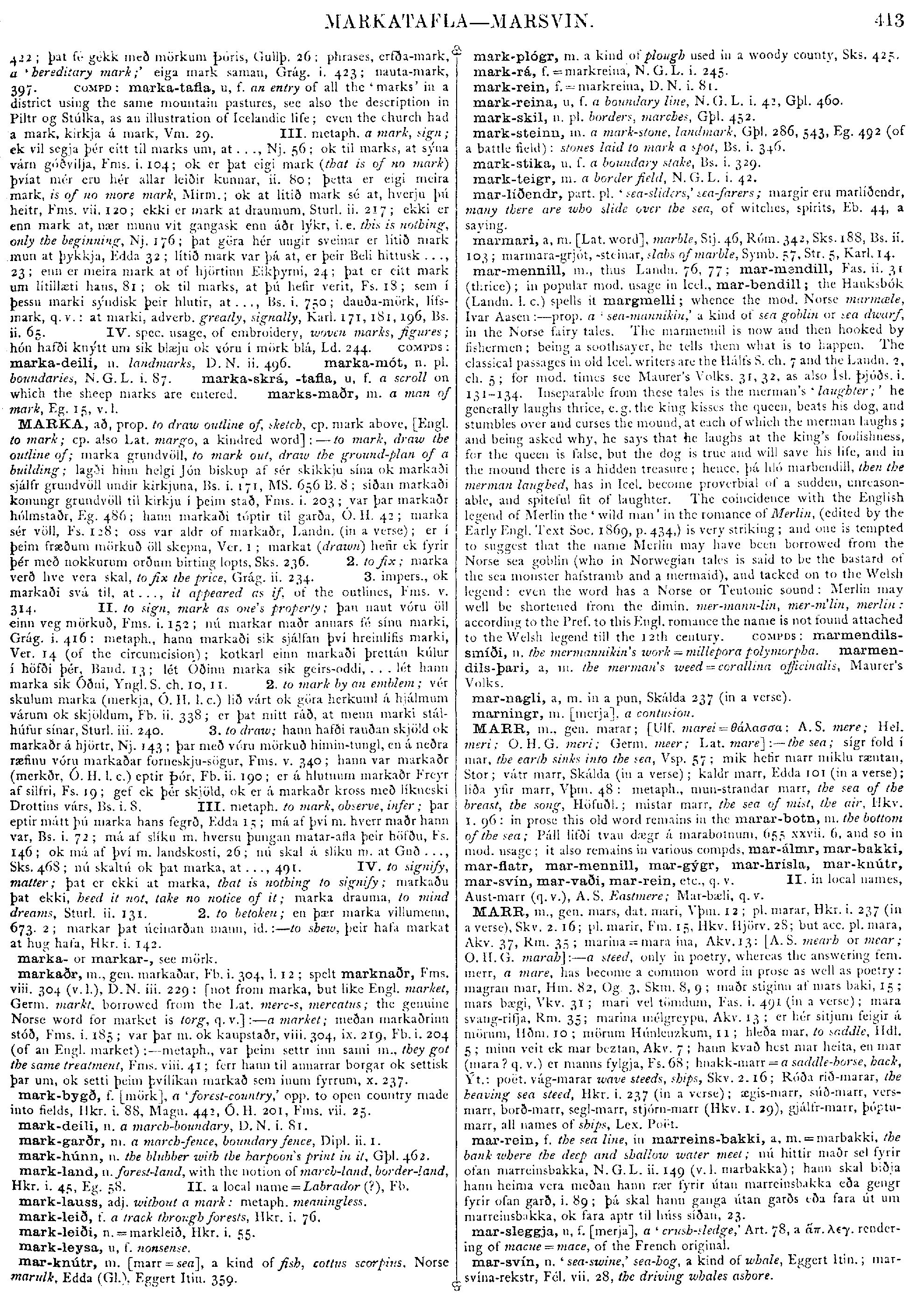
mar-mennill, m., thus Landn. 76, 77; mar-mandill, Fas. ii. 31 (thrice); in popular mod. usage in Icel., mar-bendill; the Hauksbok (Landn. l.c.) spells it margmelli; whence the mod. Norse marmæle, Ivar Aasen :-- prop. a 'sea-mannikin,' a kind ot sea goblin or sea dwarf, in the Norse fairy tales. The marmennil is now and then hooked by fishermen; being a soothsayer, he tells them what is to happen. The classical passages in oid Icel. writers are the Hálf's S. ch. 7 and the Landn. 2, ch. 5; for mod. times see Maurer's Volks. 31, 32, as also Ísl. Þjóðs. i. 131-134. Inseparable from these tales is the merman's 'laughter;' he generally laughs thrice, e.g. the king kisses the queen, beats his dog, and stumbles over and curses the mound, at each of which the merman laughs; and being asked why, he says that he laughs at the king's foolishness, for the queen is false, but the dog is true and will save his life, and in the mound there is a hidden treasure; hence, þá hló marbendill, then the merman laughed, has in Icel. become proverbial of a sudden, unreasonable, and spiteful fit of laughter. The coincidence with the English legend of Merlin the 'wild man' in the romance of Merlin, (edited by the Early Engl. Text Soc. 1869, p. 434,) is very striking; and one is tempted to suggest that the name Merlin may have been borrowed from the Norse sea goblin (who in Norwegian tales is said to be the bastard of the sea monster hafstramb and a mermaid), and tacked on to the Welsh legend: even the word has a Norse or Teutonic sound: Merlin may well be shortened from the dimin. mer-mann-lin, mer-m'lin, merlin: according to the Pref. to this Engl. romance the name is not found attached to the Welsh legend till the 12th century. COMPDS: marmendils-smíði, n. the mermannikins work = millepora polymorpha. marmendils-þari, a, m. the merman's weed = corallina officinalis, Maurer's Volks.
|
Source: Cleasby/Vigfusson, page b0413, entry 29 View original page image as: [TIFF] [PNG] [View previous entry] [View next entry] |
[Comment on this entry] [View comments] |
The following entry has been hand-corrected once. |
MARR, m., gen. mars, dat. mari, Vþm. 12; pl. marar, Hkr. i. 237 (in a verse), Skv. 2. 16; pl. marir, Fm. 15, Hkv. Hjörv. 28; but acc. pl. mara, Akv. 37, Rm. 35; marina = mara ina, Akv. 13: (A.S. mearh or mear; O.H.G. marah] :-- a steed, only in poetry, whereas the answering fem. merr, a mare, has become a common word in prose as well as poetry: magran mar, Hm. 82, Og. 3, Skm. 8, 9; maðr stiginn af mars baki, 15; mars bægi, Vkv. 31; mari vel tömdum, Fas. i. 491 (in a verse); mara svang-rifja, Rm. 35; marina mélgreypu, Akv. 13; er hér sitjum feigir á mörum, Hðm. 10; mörum Húnlenzkum, 11; hleða mar, to saddle, Hdl. 5; minn veit ek mar beztan, Akv. 7; hann kvað hest mar heita, en mar (mara? q.v.) er manns fylgja, Fs. 68; hnakk-marr = a saddle-horse, hack, Ýt.: poët, vág-marar wave steeds, ships, Skv. 2. 16; Róða rið-marar, the heaving sea steed, Hkr. i. 237 (in a verse); ægis-marr, súð-marr, vers-marr, borð-marr, segl-marr, stjórn-marr (Hkv. 1. 29), gjálfr-marr, þóptu-marr, all names of ships. Lex. Poët.
|
Source: Cleasby/Vigfusson, page b0415, entry 11 View original page image as: [TIFF] [PNG] [View previous entry] [View next entry] |
[Comment on this entry] [View comments] |
The following entry has been hand-corrected once. |
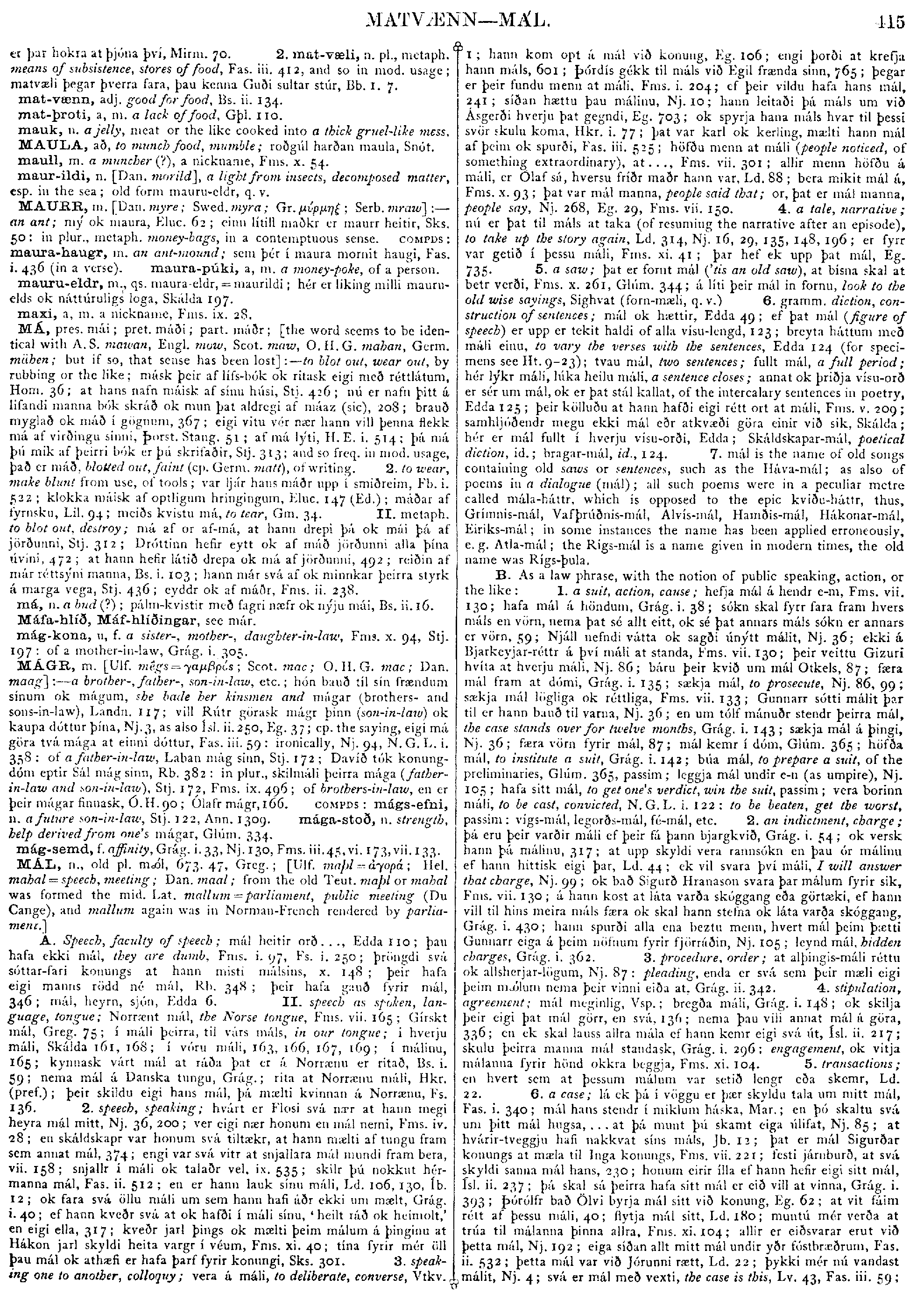
MÁ, pres. mái; pret. máði; part. máðr; [the word seems to be identical with A.S. mawan, Engl. mow, Scot. maw, O.H.G. mahan, Germ. mähen; but if so, that sense has been lost] :-- to blot out, wear out, by rubbing or the like; másk þeir af lífs-bók ok ritask eigi með réttlátum, Hom. 36; at hans nafn máisk af sínu húsi, Stj. 426; nú er nafn þitt á lifandi manna bók skráð ok mun þat aldregi af máaz (sic), 208; brauð myglað ok máð í gögnum, 367; eigi vitu vér nær hann vill þenna flekk má af virðingu sinni, Þorst. Stang. 51; af má lýti, H.E. i. 514; þá má þú mik af þeirri bók er þú skrifaðir, Stj. 313; and so freq. in mod. usage, það er máð, blotted ont, faint (cp. Germ. matt), of writing. 2. to wear, make blunt from use, of tools; var ljár hans máðr upp í smiðreim, Fb. i. 522; klokka máisk af optligum hringingum, Eluc. 147 (Ed.); máðar af fyrnsku, Lil. 94; meiðs kvistu má, to tear, Gm. 34. II. metaph. to blot out, destroy; má af or af-má, at hann drepi þá ok mái þá af jörðunni, Stj. 312; Dróttinn hefir eytt ok af máð jörðunni alla þína úvini, 472; at hann hefir látið drepa ok má af jörðunni, 492; reiðin af már réttsýni manna, Bs. i. 103; hann már svá af ok minnkar þeirra styrk á marga vega, Stj. 436; eyddr ok af máðr, Fms. ii. 238.
| Result Page: |  |
Previous | 109 110 111 112 113 114 115 116 117 118 119 120 121 122 123 124 125 126 127 | Next |  |
Germanic Lexicon Project (main page)
This search system was written by
Sean Crist
Please consider
volunteering
to correct the data in these online dictionaries.
No rights reserved. Feel free to use these data in any way you please.