|
|

Search for hali again, using less strict matching (22 results)
|
Source: Cleasby/Vigfusson, page b0234, entry 14 View original page image as: [TIFF] [PNG] [View previous entry] [View next entry] |
[Comment on this entry] [View comments] |
The following entry has been hand-corrected once. |
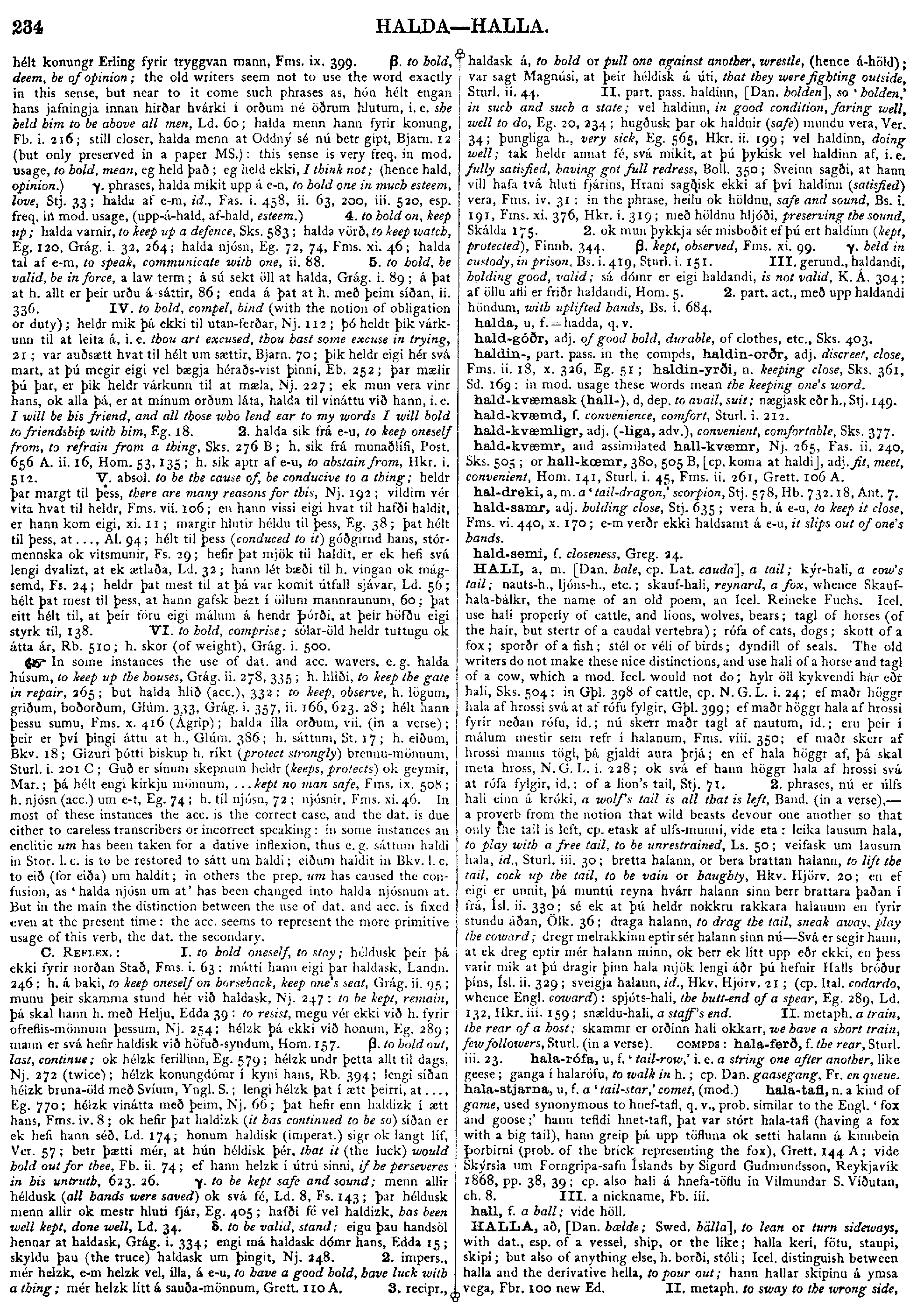
HALI, a, m. [Dan. hale, cp. Lat. cauda], a tail; kýr-hali, a cow's tail; nauts-h., ljóns-h., etc.; skauf-hali, reynard, a fox, whence Skaufhala-bálkr, the name of an old poem, an Icel. Reineke Fuchs. Icel. use hali properly of cattle, and lions, wolves, bears; tagl of horses (of the hair, but stertr of a caudal vertebra); rófa of cats, dogs; skott of a fox; sporðr of a fish; stél or véli of birds; dyndill of seals. The old writers do not make these nice distinctions, and use hali of a horse and tagl of a cow, which a mod. Icel. would not do; hylr öll kykvendi hár eðr hali, Sks. 504: in Gþl. 398 of cattle, cp. N. G. L. i. 24; ef maðr höggr hala af hrossi svá at af rófu fylgir, Gþl. 399; ef maðr höggr hala af hrossi fyrir neðan rófu, id.; nú skerr maðr tagl af nautum, id.; eru þeir í málum mestir sem refr í halanum, Fms. viii. 350; ef maðr skerr af hrossi manns tögl, þá gjaldi aura þrjá; en ef hala höggr af, þá skal meta hross, N. G. L. i. 228; ok svá ef hann höggr hala af hrossi svá at rófa fylgir, id.: of a lion's tail, Stj. 71. 2. phrases, nú er úlfs hali einn á króki, a wolf's tail is all that is left, Band. (in a verse), -- a proverb from the notion that wild beasts devour one another so that only the tail is left, cp. etask af ulfs-munni, vide eta: leika lausum hala, to play with a free tail, to be unrestrained, Ls. 50; veifask um lausum hala, id., Sturl. iii. 30; bretta halann, or bera brattan halann, to lift the tail, cock up the tail, to be vain or haughty, Hkv. Hjörv. 20; en ef eigi er unnit, þá muntú reyna hvárr halann sinn berr brattara þaðan í frá, Ísl. ii. 330; sé ek at þú heldr nokkru rakkara halanum en fyrir stundu áðan, Ölk. 36; draga halann, to drag the tail, sneak awav, play the coward; dregr melrakkinn eptir sér halann sinn nú -- Svá er segir hann, at ek dreg eptir mér halann minn, ok berr ek lítt upp eðr ekki, en þess varir mik at þú dragir þinn hala mjök lengi áðr þú hefnir Halls bróður þíns, Ísl. ii. 329; sveigja halann, id., Hkv. Hjörv. 21; (cp. Ital. codardo, whence Engl. coward): spjóts-hali, the butt-end of a spear, Eg. 289, Ld. 132, Hkr. iii. 159; snældu-hali, a staff's end. II. metaph. a train, the rear of a host; skammr er orðinn hali okkarr, we have a short train, few followers, Sturl. (in a verse). COMPDS: hala-ferð, f. the rear, Sturl. iii. 23. hala-rófa, u, f. 'tail-row,' i.e. a string one after another, like geese; ganga í halarófu, to walk in h.; cp. Dan. gaasegang, Fr. en queue. hala-stjarna, u, f. a 'tail-star,' comet, (mod.) hala-tafl, n. a kind of game, used synonymous to hnef-tafl, q.v., prob. similar to the Engl. 'fox and goose;' hann tefldi hnet-tafl, þat var stórt hala-tafl (having a fox with a big tail), hann greip þá upp töfluna ok setti halann á kinnbein Þorbirni (prob. of the brick representing the fox), Grett. 144 A; vide Skýrsla um Forngripa-safn Íslands by Sigurd Gudmundsson, Reykjavík 1868, pp. 38, 39; cp. also hali á hnefa-töflu in Vilmundar S. Viðutan, ch. 8. III. a nickname, Fb. iii.
|
Source: Torp, page b0082, entry 7 View original page image as: [TIFF] [PNG] [View previous entry] [View next entry] |
[Comment on this entry] [View comments] |
The following entry has been hand-corrected once. |
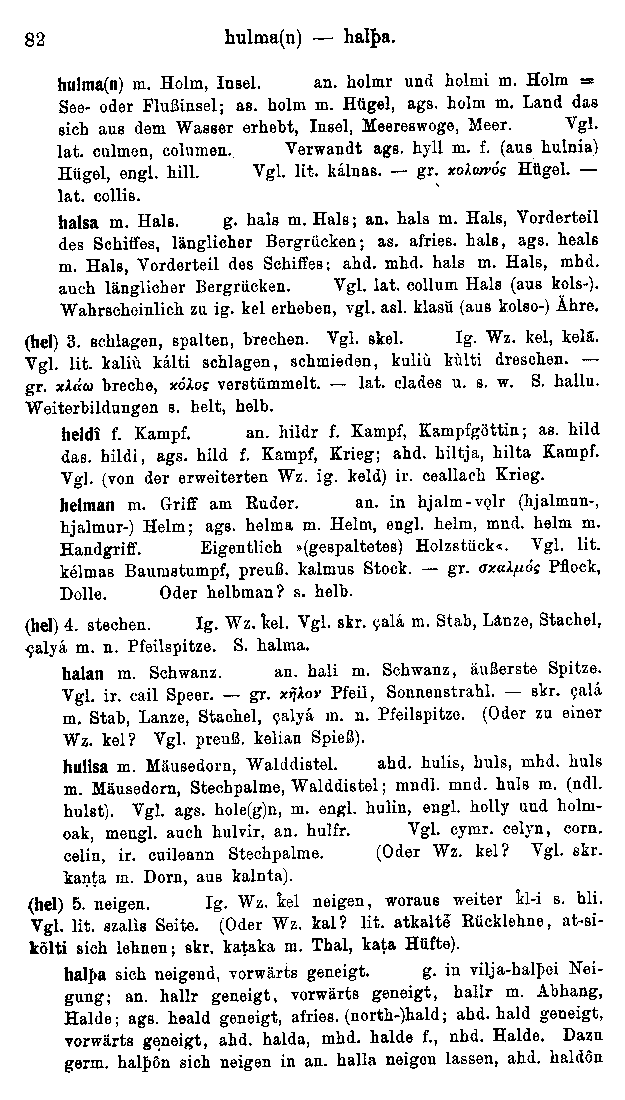
halan m. Schwanz. an. hali m. Schwanz, äußerste Spitze. Vgl. ir. cail Speer. - gr. [kh=lon] Pfeil, Sonnenstrahl. - skr. çalá m. Stab, Lanze, Stachel, çalyá m. n. Pfeilspitze. (Oder zu einer Wz. kel? Vgl. preuß. kelian Spieß).
[Translate the German words]
|
Source: Torp, page b0084, entry 5 View original page image as: [TIFF] [PNG] [View previous entry] [View next entry] |
[Comment on this entry] [View comments] |
The following entry has been hand-corrected once. |
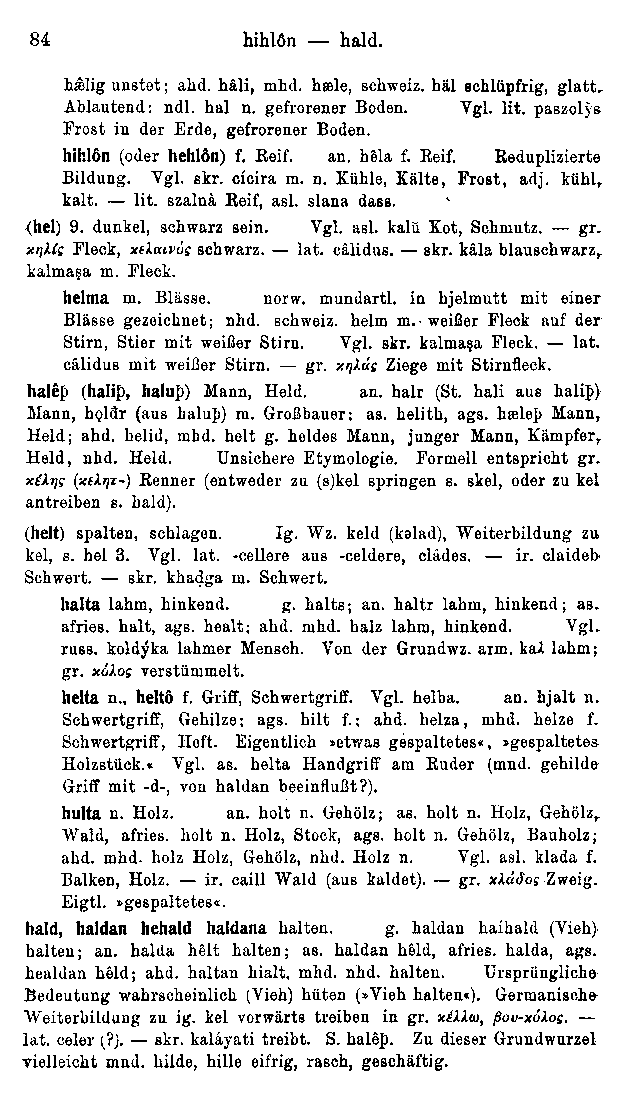
halêþ
(haliþ,
haluþ)
Mann,
Held.
an.
halr
(St.
hali
aus
haliþ)
Mann,
h l
l r
(aus
haluþ)
m.
Großbauer;
as.
helith,
ags.
hæleþ
Mann,
Held;
ahd.
helid,
mhd.
helt
g.
heldes
Mann,
junger
Mann,
Kämpfer,
Held,
nhd.
Held.
Unsichere
Etymologie.
Formell
entspricht
gr.
[ke'lhs]
([kelht-])
Renner
(entweder
zu
(s)kel
springen
s.
skel,
oder
zu
kel
antreiben
s.
hald).
r
(aus
haluþ)
m.
Großbauer;
as.
helith,
ags.
hæleþ
Mann,
Held;
ahd.
helid,
mhd.
helt
g.
heldes
Mann,
junger
Mann,
Kämpfer,
Held,
nhd.
Held.
Unsichere
Etymologie.
Formell
entspricht
gr.
[ke'lhs]
([kelht-])
Renner
(entweder
zu
(s)kel
springen
s.
skel,
oder
zu
kel
antreiben
s.
hald).
[Translate the German words]
|
Source: Bosworth/Toller, page b0505, entry 3 View original page image as: [TIFF] [PNG] [View previous entry] [View next entry] |
[Comment on this entry] [View comments] |
The following entry has been hand-corrected once. |
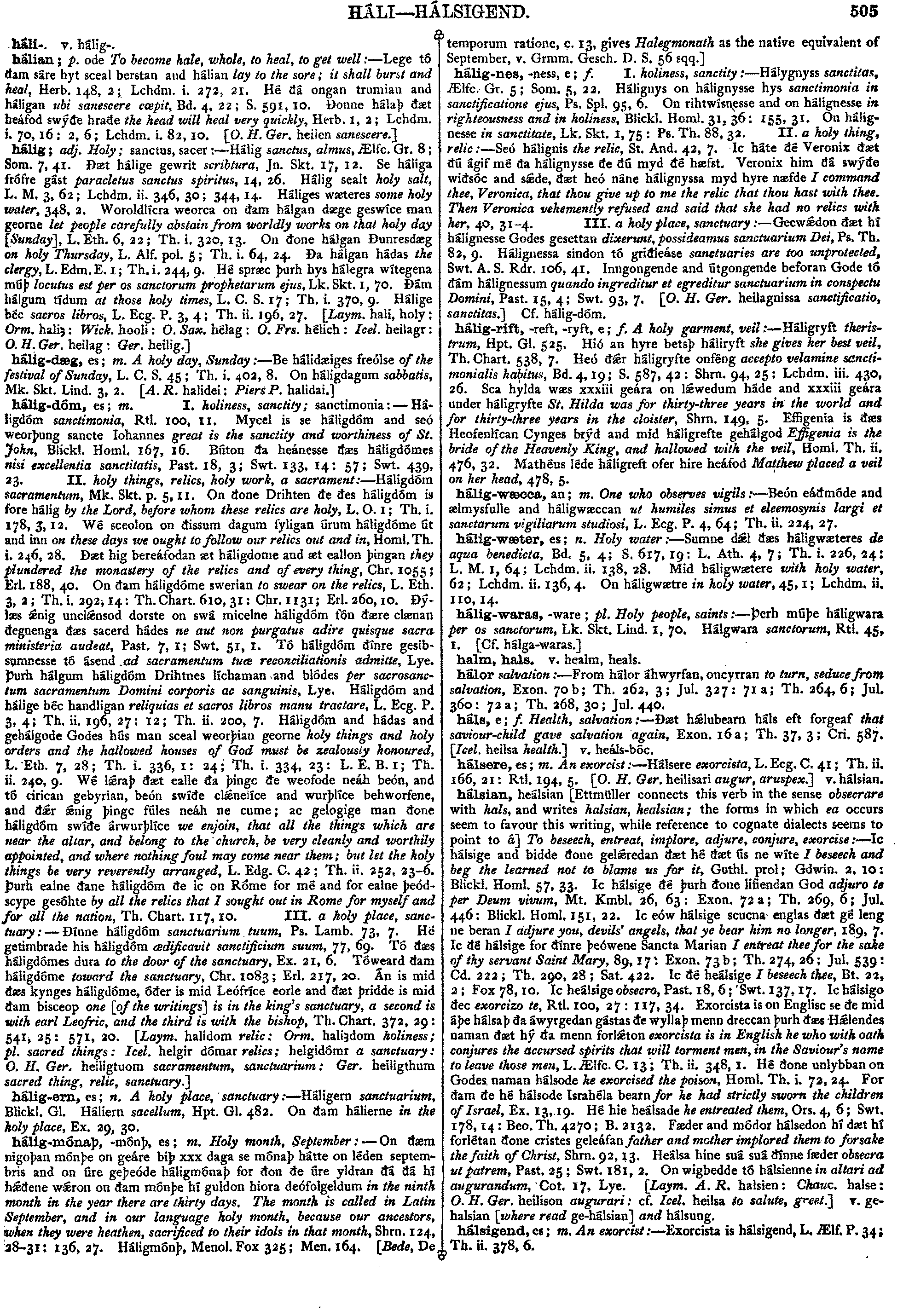
hálig;
adj.
Holy;
sanctus,
sacer
:--
Hálig
sanctus,
almus,
Ælfc.
Gr.
8;
Som.
7,
41.
Ðæt
hálige
gewrit
scribtura,
Jn.
Skt.
17,
12.
Se
háliga
frófre
gást
paracletus
sanctus
spiritus,
14,
26.
Hálig
sealt
holy
salt,
L.
M.
3,
62;
Lchdm.
ii.
346,
30;
344,
14.
Háliges
wæteres
some
holy
water,
348,
2.
Woroldlícra
weorca
on
ðam
hálgan
dæge
geswíce
man
georne
let
people
carefully
abstain
from
worldly
works
on
that
holy
day
[Sunday],
L.
Eth.
6,
22;
Th.
i.
320,
13.
On
ðone
hálgan
Ðunresdæg
on
holy
Thursday,
L.
Alf.
pol.
5;
Th.
i.
64,
24.
Ða
hálgan
hádas
the
clergy,
L.
Edm.
E.
1;
Th.
i.
244,
9.
Hé
spræc
þurh
hys
hálegra
wítegena
múþ
locutus
est
per
os
sanctorum
prophetarum
ejus,
Lk.
Skt.
1,
70.
Ðám
hálgum
tídum
at
those
holy
times,
L.
C.
S.
17;
Th.
i.
370,
9.
Hálige
béc
sacros
libros,
L.
Ecg.
P.
3,
4;
Th.
ii.
196,
27.
[Laym.
hali,
holy:
Orm.
hali :
Wick.
hooli:
O.
Sax.
hélag:
O.
Frs.
hélich:
Icel.
heilagr:
O.
H.
Ger.
heilag:
Ger.
heilig.]
:
Wick.
hooli:
O.
Sax.
hélag:
O.
Frs.
hélich:
Icel.
heilagr:
O.
H.
Ger.
heilag:
Ger.
heilig.]
|
Source: Bosworth/Toller, page b0905, entry 7 View original page image as: [TIFF] [PNG] [View previous entry] [View next entry] |
[Comment on this entry] [View comments (1)] |
The following entry has been hand-corrected once. |
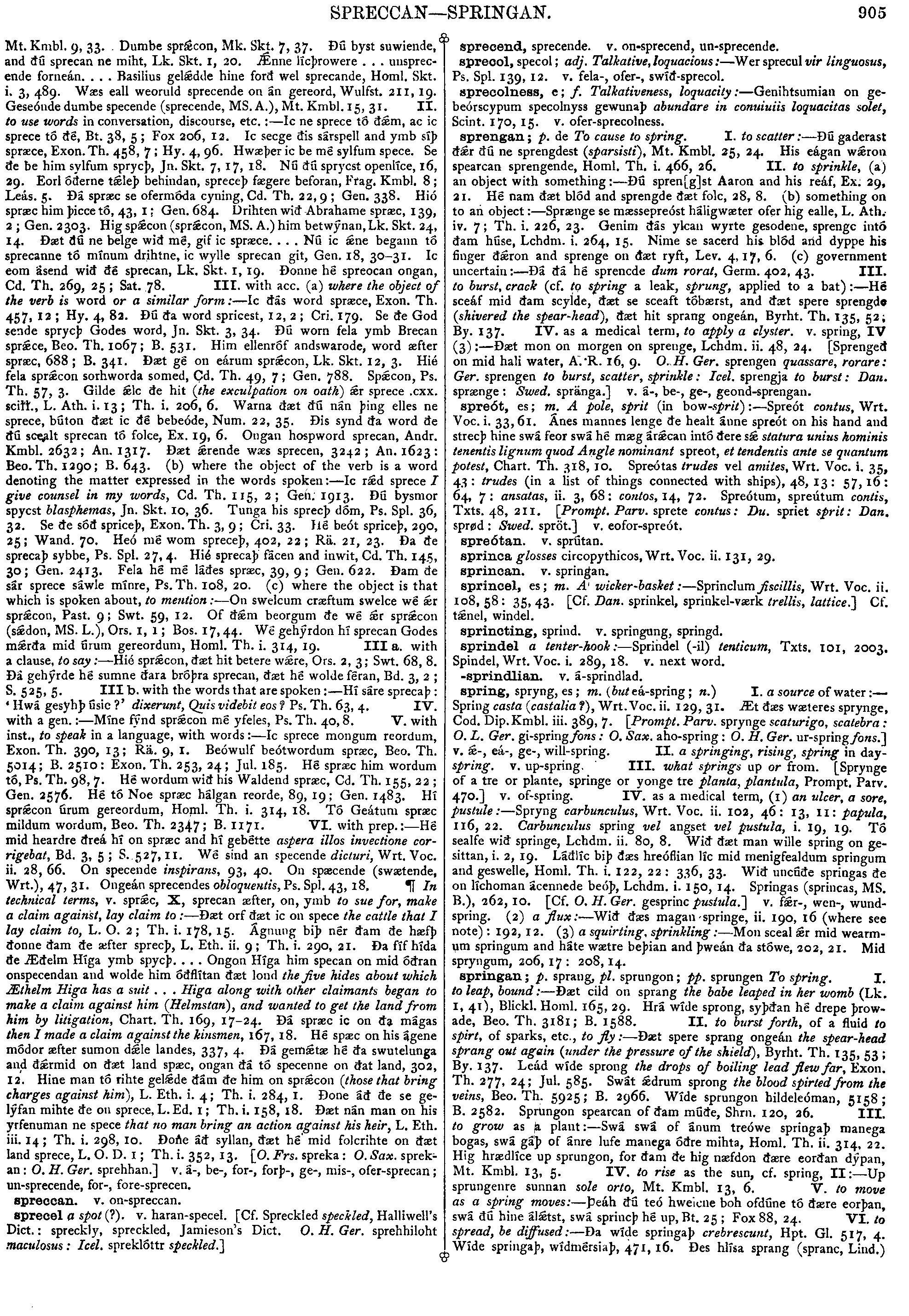
sprengan;
p.
de
To
cause
to
spring.
I.
to
scatter:--Ðú
gaderast
ð r
ðú
ne
sprengdest
(sparsisti),
Mt.
Kmbl.
25,
24.
His
eágan
wron
spearcan
sprengende,
Homl.
Th.
i.
466,
26.
II.
to
sprinkle,
(a)
an
object
with
something:--Ðú
spren[g]st
Aaron
and
his
reáf,
Ex.
29,
21.
Hé
nam
ðæt
blód
and
sprengde
ðæt
folc,
28,
8.
(b)
something
on
to
an
object:--Sprænge
se
mæssepreóst
háligwæter
ofer
hig
ealle,
L.
Ath.
iv.
7;
Th.
i.
226,
23.
Genim
ðás
ylcan
wyrte
gesodene,
sprengc
intó
ðam
húse,
Lchdm.
i.
264,
15.
Nime
se
sacerd
his
blód
arid
dyppe
his
finger
ðron
and
sprenge
on
dæt
ryft,
Lev.
4,
17,
6.
(c)
government
uncertain:--Ðá
ðá
hé
sprencde
dum
rorat,
Germ.
402,
43.
III.
to
burst,
crack
(cf.
to
spring
a
leak,
sprung,
applied
to
a
bat):--Hé
sceáf
mid
ðam
scylde,
ðæt
se
sceaft
tóbærst,
and
ðæt
spere
sprengde
(shivered
the
spear-head),
ðæt
hit
sprang
ongeán,
Byrht.
Th.
135,
52;
By.
137.
IV.
as
a
medical
term,
to
apply
a
clyster,
v.
spring,
IV
(3):--Ðæt
mon
on
morgen
on
sprenge,
Lchdm.
ii.
48,
24.
[Sprengeð
on
mid
hali
water,
A.
R.
16,
9.
O.
H.
Ger.
sprengen
quassare,
rorare:
Ger.
sprengen
to
burst,
scatter,
sprinkle:
Icel.
sprengja
to
burst:
Dan.
sprænge:
Swed.
spränga.]
v.
á-,
be-,
ge-,
geond-sprengan.
r
ðú
ne
sprengdest
(sparsisti),
Mt.
Kmbl.
25,
24.
His
eágan
wron
spearcan
sprengende,
Homl.
Th.
i.
466,
26.
II.
to
sprinkle,
(a)
an
object
with
something:--Ðú
spren[g]st
Aaron
and
his
reáf,
Ex.
29,
21.
Hé
nam
ðæt
blód
and
sprengde
ðæt
folc,
28,
8.
(b)
something
on
to
an
object:--Sprænge
se
mæssepreóst
háligwæter
ofer
hig
ealle,
L.
Ath.
iv.
7;
Th.
i.
226,
23.
Genim
ðás
ylcan
wyrte
gesodene,
sprengc
intó
ðam
húse,
Lchdm.
i.
264,
15.
Nime
se
sacerd
his
blód
arid
dyppe
his
finger
ðron
and
sprenge
on
dæt
ryft,
Lev.
4,
17,
6.
(c)
government
uncertain:--Ðá
ðá
hé
sprencde
dum
rorat,
Germ.
402,
43.
III.
to
burst,
crack
(cf.
to
spring
a
leak,
sprung,
applied
to
a
bat):--Hé
sceáf
mid
ðam
scylde,
ðæt
se
sceaft
tóbærst,
and
ðæt
spere
sprengde
(shivered
the
spear-head),
ðæt
hit
sprang
ongeán,
Byrht.
Th.
135,
52;
By.
137.
IV.
as
a
medical
term,
to
apply
a
clyster,
v.
spring,
IV
(3):--Ðæt
mon
on
morgen
on
sprenge,
Lchdm.
ii.
48,
24.
[Sprengeð
on
mid
hali
water,
A.
R.
16,
9.
O.
H.
Ger.
sprengen
quassare,
rorare:
Ger.
sprengen
to
burst,
scatter,
sprinkle:
Icel.
sprengja
to
burst:
Dan.
sprænge:
Swed.
spränga.]
v.
á-,
be-,
ge-,
geond-sprengan.
|
Source: Bosworth/Toller, page b1230, entry 22 View original page image as: [TIFF] [PNG] [View previous entry] [View next entry] |
[Comment on this entry] [View comments] |
The following entry has been hand-corrected once. |
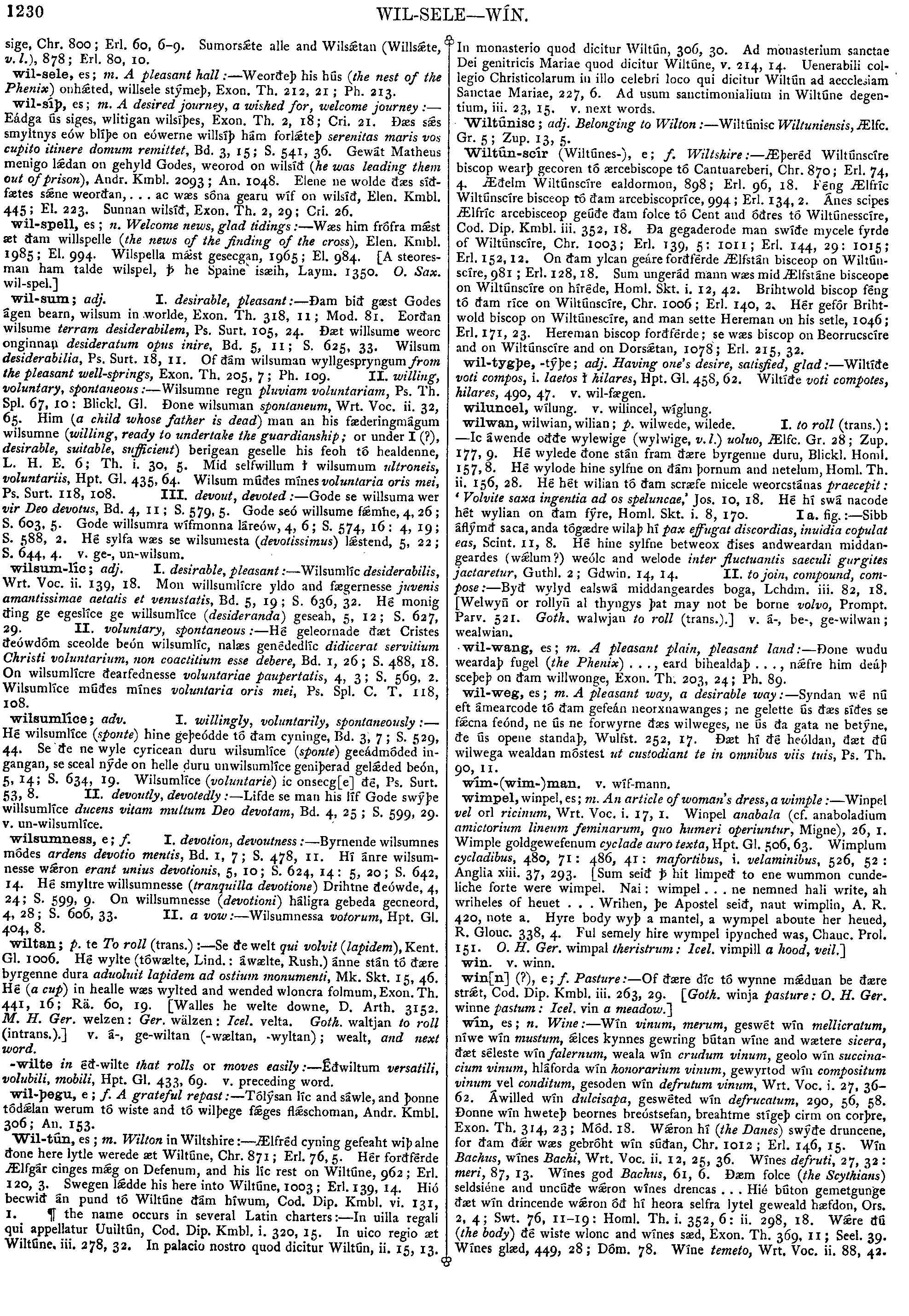
wimpel,
winpel,
es;
m.
An
article
of
woman's
dress,
a
wimple
:--
Winpel
vel
orl
ricinum,
Wrt.
Voc.
i.
17,
I.
Winpel
anabala
(cf.
anaboladium
amictorium
lineum
feminarum,
quo
humeri
operiuntur,
Migne),
26,
I.
Wimple
goldgewefenum
cyclade
auro
texta,
Hpt.
Gl.
506,
63.
Wimplum
cycladibus,
480,
71:
486,
41:
mafortibus,
i.
velaminibus,
526,
52
:
Anglia
xiii.
37,
293.
[Sum
seið
 hit
limpeð
to
ene
wummon
cundeliche
forte
were
wimpel.
Nai:
wimpel.
.
.
ne
nemned
hali
write,
ah
wriheles
of
heuet
.
.
.
Wrihen,
þe
Apostel
seið,
naut
wimplin,
A.
R.
420,
note
a.
Hyre
body
wyþ
a
mantel,
a
wympel
aboute
her
heued,
R.
Glouc.
338,
4.
Ful
semely
hire
wympel
ipynched
was,
Chauc.
Prol.
151.
O.
H.
Ger.
wimpal
theristrum:
Icel.
vimpill
a
hood,
veil.]
hit
limpeð
to
ene
wummon
cundeliche
forte
were
wimpel.
Nai:
wimpel.
.
.
ne
nemned
hali
write,
ah
wriheles
of
heuet
.
.
.
Wrihen,
þe
Apostel
seið,
naut
wimplin,
A.
R.
420,
note
a.
Hyre
body
wyþ
a
mantel,
a
wympel
aboute
her
heued,
R.
Glouc.
338,
4.
Ful
semely
hire
wympel
ipynched
was,
Chauc.
Prol.
151.
O.
H.
Ger.
wimpal
theristrum:
Icel.
vimpill
a
hood,
veil.]
|
Source: Cleasby/Vigfusson, page b0025, entry 27 View original page image as: [TIFF] [PNG] [View previous entry] [View next entry] |
[Comment on this entry] [View comments] |
The following entry has been hand-corrected once. |
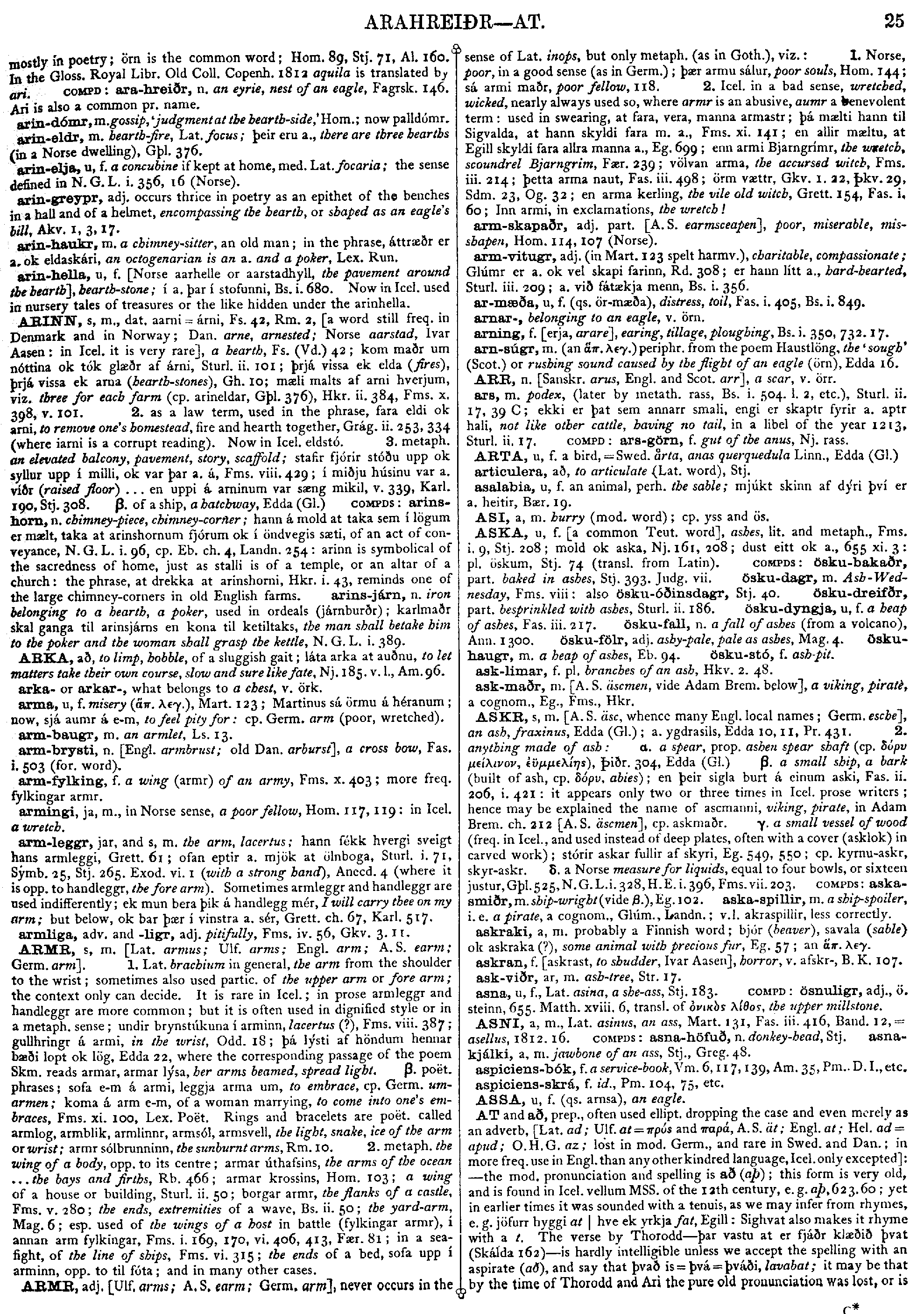
ars, m. podex, (later by metath. rass, Bs. i. 504. l. 2, etc.), Sturl. ii. 17, 39 C; ekki er þat sem annarr smali, engi er skaptr fyrir a. aptr hali, not like other cattle, having no tail, in a libel of the year 1213, Sturl. ii. 17. COMPD: ars-görn, f. gut of the anus, Nj. rass.
|
Source: Cleasby/Vigfusson, page b0081, entry 6 View original page image as: [TIFF] [PNG] [View previous entry] [View next entry] |
[Comment on this entry] [View comments] |
The following entry has been hand-corrected once. |
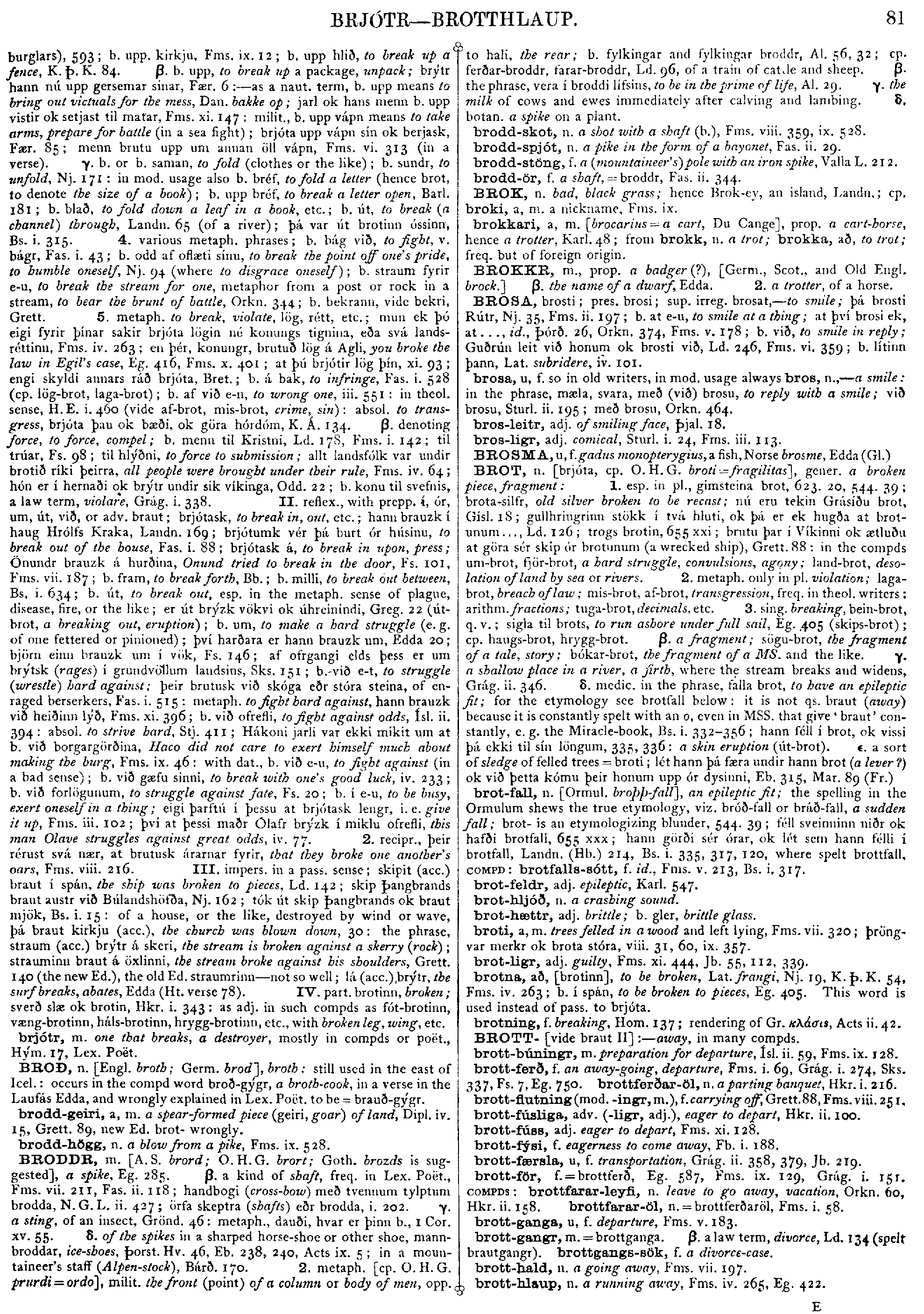
BRODDR,
m.
[A.
S.
brord;
O.
H.
G.
brort;
Goth.
brozds
is
suggested],
a
spike,
Eg.
285.
 .
a
kind
of
shaft,
freq.
in
Lex.
Poët.,
Fms.
vii.
211,
Fas.
ii.
118;
handbogi
(cross-bow)
með
tvennum
tylptum
brodda,
N.
G.
L.
ii.
427;
örfa
skeptra
(shafts)
eðr
brodda,
i.
202.
.
a
kind
of
shaft,
freq.
in
Lex.
Poët.,
Fms.
vii.
211,
Fas.
ii.
118;
handbogi
(cross-bow)
með
tvennum
tylptum
brodda,
N.
G.
L.
ii.
427;
örfa
skeptra
(shafts)
eðr
brodda,
i.
202.
 .
a
sting,
of
an
insect,
Grönd.
46:
metaph.,
dauði,
hvar
er
þinn
b.,
1
Cor.
xv.
55.
.
a
sting,
of
an
insect,
Grönd.
46:
metaph.,
dauði,
hvar
er
þinn
b.,
1
Cor.
xv.
55.
 .
of
the
spikes
in
a
sharped
horse-shoe
or
other
shoe,
mannbroddar,
ice-shoes,
Þorst.
Hv.
46,
Eb.
238,
240,
Acts
ix.
5;
in
a
mountaineer's
staff
(Alpen-stock),
Bárð.
170.
2.
metaph.
[cp.
O.
H.
G.
prurdi
=
ordo],
milit.
the
front
(point)
of
a
column
or
body
of
men,
opp.
to
hali,
the
rear;
b.
fylkingar
and
fylkingar
broddr,
Al.
56,
32;
cp.
ferðar-broddr,
farar-broddr,
Ld.
96,
of
a
train
of
cattle
and
sheep.
.
the
phrase,
vera
í
broddi
lífsins,
to
be
in
the
prime
of
life,
Al.
29.
.
the
milk
of
cows
and
ewes
immediately
after
calving
and
lambing.
.
botan.
a
spike
on
a
plant.
.
of
the
spikes
in
a
sharped
horse-shoe
or
other
shoe,
mannbroddar,
ice-shoes,
Þorst.
Hv.
46,
Eb.
238,
240,
Acts
ix.
5;
in
a
mountaineer's
staff
(Alpen-stock),
Bárð.
170.
2.
metaph.
[cp.
O.
H.
G.
prurdi
=
ordo],
milit.
the
front
(point)
of
a
column
or
body
of
men,
opp.
to
hali,
the
rear;
b.
fylkingar
and
fylkingar
broddr,
Al.
56,
32;
cp.
ferðar-broddr,
farar-broddr,
Ld.
96,
of
a
train
of
cattle
and
sheep.
.
the
phrase,
vera
í
broddi
lífsins,
to
be
in
the
prime
of
life,
Al.
29.
.
the
milk
of
cows
and
ewes
immediately
after
calving
and
lambing.
.
botan.
a
spike
on
a
plant.
|
Source: Cleasby/Vigfusson, page b0227, entry 2 View original page image as: [TIFF] [PNG] [View previous entry] [View next entry] |
[Comment on this entry] [View comments] |
The following entry has been hand-corrected once. |
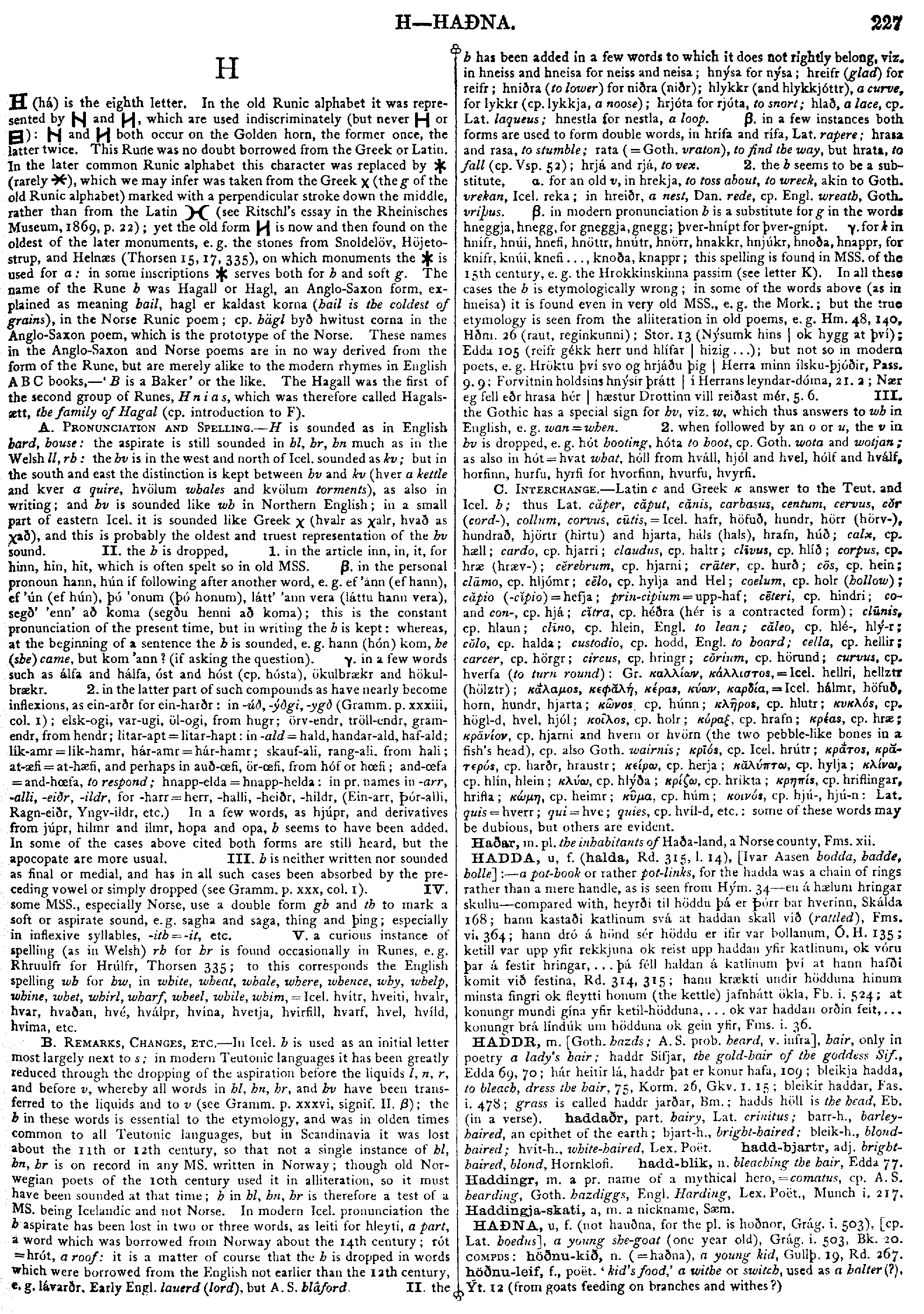
A.
PRONUNCIATION
AND
SPELLING.
--
H
is
sounded
as
in
English
hard,
house:
the
aspirate
is
still
sounded
in
hl,
hr,
hn
much
as
in
the
Welsh
ll,
rh:
the
hv
is
in
the
west
and
north
of
Icel.
sounded
as
kv;
but
in
the
south
and
east
the
distinction
is
kept
between
hv
and
kv
(hver
a
kettle
and
kver
a
quire,
hvölum
whales
and
kvölum
torments),
as
also
in
writing;
and
hv
is
sounded
like
wh
in
Northern
English;
in
a
small
part
of
eastern
Icel.
it
is
sounded
like
Greek
 (hvalr
as
alr,
hvað
as
að),
and
this
is
probably
the
oldest
and
truest
representation
of
the
hv
sound.
II.
the
h
is
dropped,
1.
in
the
article
inn,
in,
it,
for
hinn,
hin,
hit,
which
is
often
spelt
so
in
old
MSS.
.
in
the
personal
pronoun
hann,
hún
if
following
after
another
word,
e.g.
ef
'ann
(ef
hann),
ef
'ún
(ef
hún),
þó
'onum
(þó
honum),
látt'
'ann
vera
(láttu
hann
vera),
segð'
'enn'
að
koma
(segðu
henni
að
koma);
this
is
the
constant
pronunciation
of
the
present
time,
but
in
writing
the
h
is
kept:
whereas,
at
the
beginning
of
a
sentence
the
h
is
sounded,
e.g.
hann
(hón)
kom,
he
(she)
came,
but
kom
'ann
?
(if
asking
the
question).
.
in
a
few
words
such
as
álfa
and
hálfa,
óst
and
host
(cp.
hósta),
ökulbrækr
and
hökulbraekr.
2.
in
the
latter
part
of
such
compounds
as
have
nearly
become
inflexions,
as
ein-arðr
for
ein-harðr:
in
-úð,
-ýðgi,
-ygð
(Gramm.
p.
xxxiii,
col.
1);
elsk-ogi,
var-ugi,
öl-ogi,
from
hugr;
örv-endr,
tröll-endr,
gram-endr,
from
hendr;
litar-apt
=
litar-hapt:
in
-ald
=
hald,
handar-ald,
haf-ald;
lík-amr
=
lík-hamr,
hár-amr
=
hár-hamr;
skauf-ali,
rang-ali,
from
hali;
at-æfi
=
at-hæfi,
and
perhaps
in
auð-œfi,
ör-œfi,
from
hóf
or
hœfi;
and-œfa
=
and-hœfa,
to
respond;
hnapp-elda
=
hnapp-helda:
in
pr.
names
in
-arr,
-alli,
-eiðr,
-ildr,
for
-harr
=
herr,
-halli,
-heiðr,
-hildr,
(Ein-arr,
Þór-alli,
Ragn-eiðr,
Yngv-ildr,
etc.)
In
a
few
words,
as
hjúpr,
and
derivatives
from
júpr,
hilmr
and
ilmr,
hopa
and
opa,
h
seems
to
have
been
added.
In
some
of
the
cases
above
cited
both
forms
are
still
heard,
but
the
apocopate
are
more
usual.
III.
h
is
neither
written
nor
sounded
as
final
or
medial,
and
has
in
all
such
cases
been
absorbed
by
the
preceding
vowel
or
simply
dropped
(see
Gramm.
p.
xxx,
col.
1).
IV.
some
MSS.,
especially
Norse,
use
a
double
form
gh
and
th
to
mark
a
soft
or
aspirate
sound,
e.g.
sagha
and
saga,
thing
and
þing;
especially
in
inflexive
syllables,
-ith
=
-it,
etc.
V.
a
curious
instance
of
spelling
(as
in
Welsh)
rh
for
hr
is
found
occasionally
in
Runes,
e.g.
Rhruulfr
for
Hrúlfr,
Thorsen
335;
to
this
corresponds
the
English
spelling
wh
for
hw,
in
white,
wheat,
whale,
where,
whence,
why,
whelp,
whine,
whet,
whirl,
wharf,
wheel,
while,
whim,
=
Icel.
hvítr,
hveiti,
hvalr,
hvar,
hvaðan,
hvé,
hválpr,
hvína,
hvetja,
hvirfill,
hvarf,
hvel,
hvíld,
hvima,
etc.
(hvalr
as
alr,
hvað
as
að),
and
this
is
probably
the
oldest
and
truest
representation
of
the
hv
sound.
II.
the
h
is
dropped,
1.
in
the
article
inn,
in,
it,
for
hinn,
hin,
hit,
which
is
often
spelt
so
in
old
MSS.
.
in
the
personal
pronoun
hann,
hún
if
following
after
another
word,
e.g.
ef
'ann
(ef
hann),
ef
'ún
(ef
hún),
þó
'onum
(þó
honum),
látt'
'ann
vera
(láttu
hann
vera),
segð'
'enn'
að
koma
(segðu
henni
að
koma);
this
is
the
constant
pronunciation
of
the
present
time,
but
in
writing
the
h
is
kept:
whereas,
at
the
beginning
of
a
sentence
the
h
is
sounded,
e.g.
hann
(hón)
kom,
he
(she)
came,
but
kom
'ann
?
(if
asking
the
question).
.
in
a
few
words
such
as
álfa
and
hálfa,
óst
and
host
(cp.
hósta),
ökulbrækr
and
hökulbraekr.
2.
in
the
latter
part
of
such
compounds
as
have
nearly
become
inflexions,
as
ein-arðr
for
ein-harðr:
in
-úð,
-ýðgi,
-ygð
(Gramm.
p.
xxxiii,
col.
1);
elsk-ogi,
var-ugi,
öl-ogi,
from
hugr;
örv-endr,
tröll-endr,
gram-endr,
from
hendr;
litar-apt
=
litar-hapt:
in
-ald
=
hald,
handar-ald,
haf-ald;
lík-amr
=
lík-hamr,
hár-amr
=
hár-hamr;
skauf-ali,
rang-ali,
from
hali;
at-æfi
=
at-hæfi,
and
perhaps
in
auð-œfi,
ör-œfi,
from
hóf
or
hœfi;
and-œfa
=
and-hœfa,
to
respond;
hnapp-elda
=
hnapp-helda:
in
pr.
names
in
-arr,
-alli,
-eiðr,
-ildr,
for
-harr
=
herr,
-halli,
-heiðr,
-hildr,
(Ein-arr,
Þór-alli,
Ragn-eiðr,
Yngv-ildr,
etc.)
In
a
few
words,
as
hjúpr,
and
derivatives
from
júpr,
hilmr
and
ilmr,
hopa
and
opa,
h
seems
to
have
been
added.
In
some
of
the
cases
above
cited
both
forms
are
still
heard,
but
the
apocopate
are
more
usual.
III.
h
is
neither
written
nor
sounded
as
final
or
medial,
and
has
in
all
such
cases
been
absorbed
by
the
preceding
vowel
or
simply
dropped
(see
Gramm.
p.
xxx,
col.
1).
IV.
some
MSS.,
especially
Norse,
use
a
double
form
gh
and
th
to
mark
a
soft
or
aspirate
sound,
e.g.
sagha
and
saga,
thing
and
þing;
especially
in
inflexive
syllables,
-ith
=
-it,
etc.
V.
a
curious
instance
of
spelling
(as
in
Welsh)
rh
for
hr
is
found
occasionally
in
Runes,
e.g.
Rhruulfr
for
Hrúlfr,
Thorsen
335;
to
this
corresponds
the
English
spelling
wh
for
hw,
in
white,
wheat,
whale,
where,
whence,
why,
whelp,
whine,
whet,
whirl,
wharf,
wheel,
while,
whim,
=
Icel.
hvítr,
hveiti,
hvalr,
hvar,
hvaðan,
hvé,
hválpr,
hvína,
hvetja,
hvirfill,
hvarf,
hvel,
hvíld,
hvima,
etc.
|
Source: Cleasby/Vigfusson, page b0347, entry 48 View original page image as: [TIFF] [PNG] [View previous entry] [View next entry] |
[Comment on this entry] [View comments] |
The following entry has been hand-corrected once. |
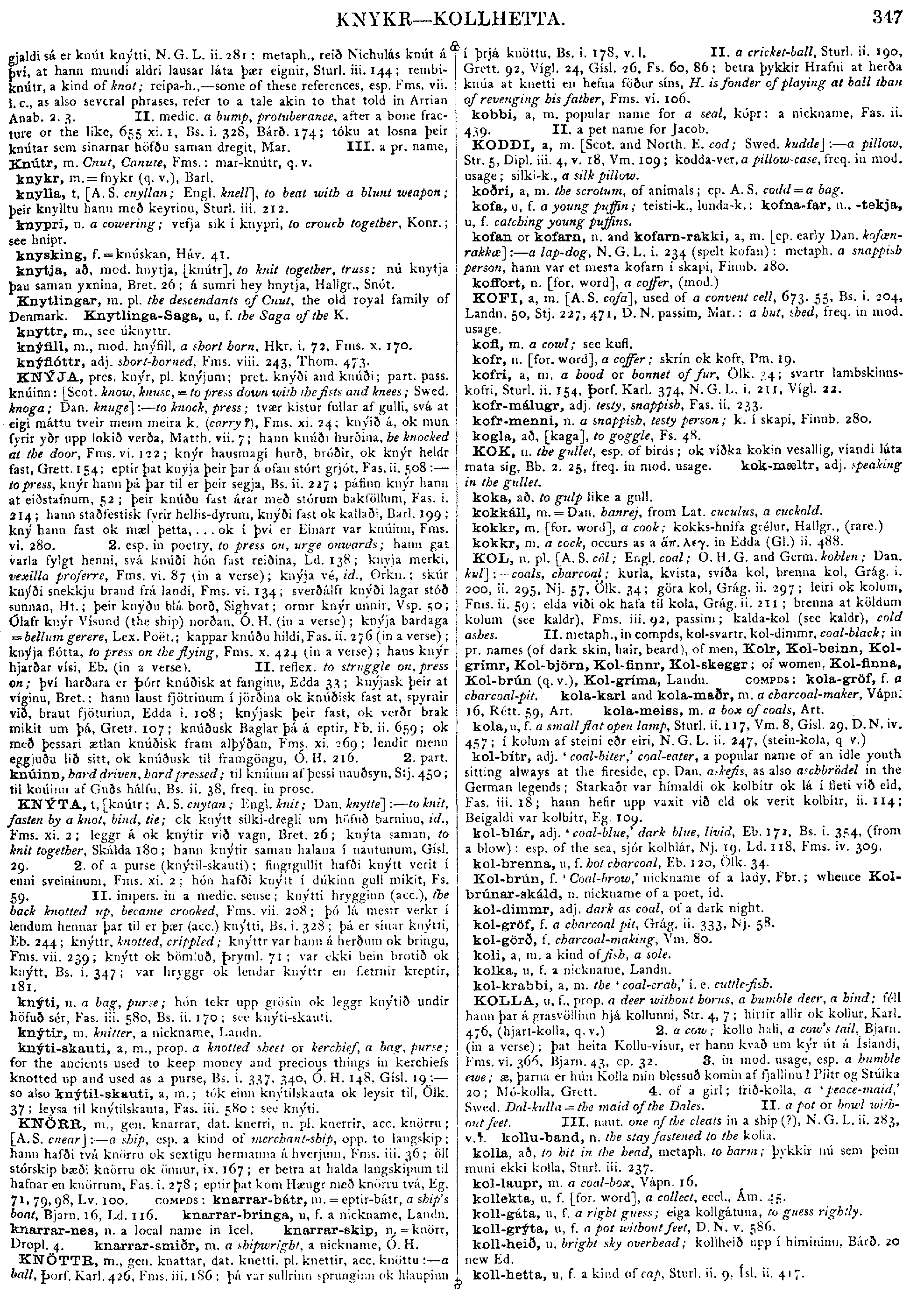
KOLLA, u, f., prop. a deer without horns, a humble deer, a hind; féll hann þar á grasvöllinn hjá kollunni, Str. 4, 7; hirtir allir ok kollur, Karl. 476, (hjart-kolla, q.v.) 2. a cow; kollu hali, a cow's tail, Bjarn. (in a verse); þat heita Kollu-vísur, er hann kvað um kýr út á Íslandi, Fms. vi. 366, Bjarn. 43, cp. 32. 3. in mod. usage, esp. a humble ewe; æ, þarna er hún Kolla mín blessuð komin af fjallinu! Piltr og Stúlka 20; Mó-kolla, Grett. 4. of a girl; frið-kolla, a 'peace-maid,' Swed. Dal-kulla = the maid of the Dales. II. a pot or bowl without feet. III. naut. one of the cleats in a ship (?), N. G. L. ii. 283, v.l. kollu-band, n. the stay fastened to the kolla.
| Result Page: | 1 2 | Next |  |
Germanic Lexicon Project (main page)
This search system was written by
Sean Crist
Please consider
volunteering
to correct the data in these online dictionaries.
No rights reserved. Feel free to use these data in any way you please.