|
|

|
Source: Torp, page b0060, entry 6 View original page image as: [TIFF] [PNG] [View previous entry] [View next entry] |
[Comment on this entry] [View comments] |
The following entry has been hand-corrected once. |
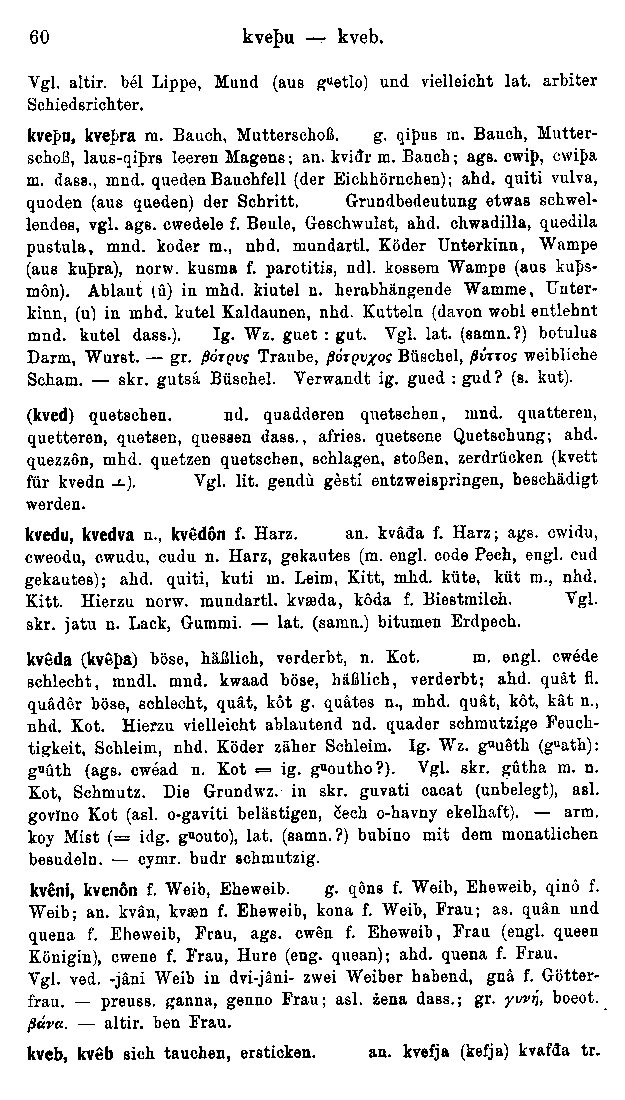
kvêni,
kvenôn
f.
Weib,
Eheweib.
g.
qêns
f.
Weib,
Eheweib,
qinô
f.
Weib;
an.
kvin,
kvæn
f.
Eheweib,
kona
f.
Weib,
Frau;
as.
quân
und
quena
f.
Eheweib,
Frau,
ags.
cwên
f
Eheweib,
Frau
(engl.
queen
Königin),
cwene
f.
Frau,
Hure
(eng.
quean);
ahd.
quena
f.
Frau.
Vgl.
ved.
-jâni
Weib
in
dvi-jâni-
zwei
Weiber
habend,
gnâ
f.
Götterfrau.
-
preuss.
ganna,
genno
Frau;
asl.
 ena
dass.;
gr.
[gunh']
boeot.
[ba'na].
-
altir.
ben
Frau.
ena
dass.;
gr.
[gunh']
boeot.
[ba'na].
-
altir.
ben
Frau.
[Translate the German words]
|
Source: Torp, page b0065, entry 3 View original page image as: [TIFF] [PNG] [View previous entry] [View next entry] |
[Comment on this entry] [View comments] |
The following entry has been hand-corrected once. |
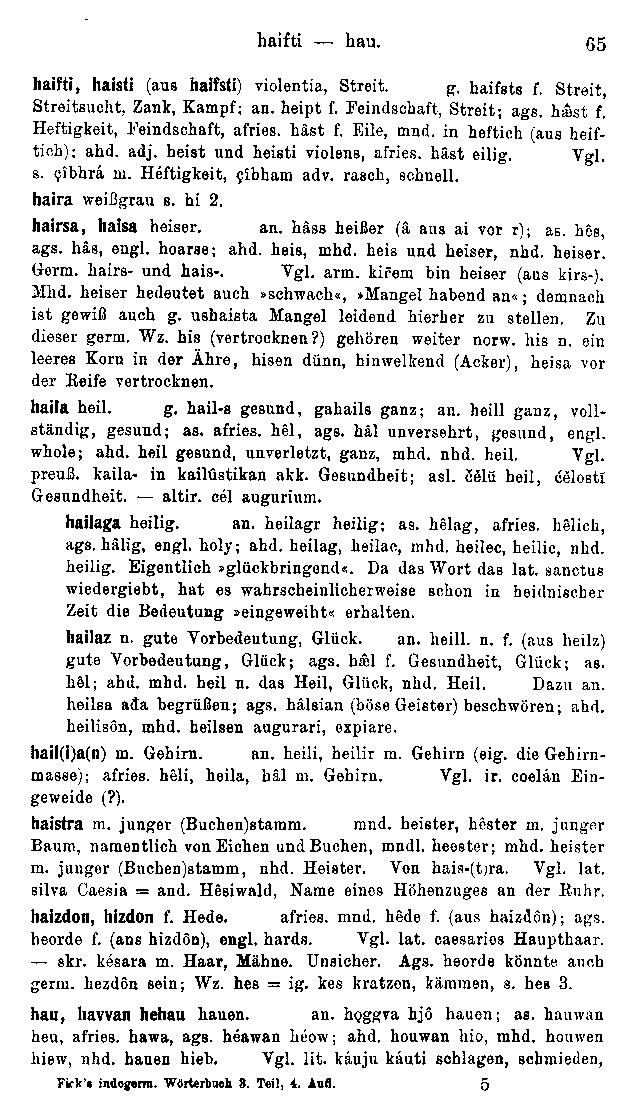
hairsa,
haisa
heiser.
an.
hâss
heißer
(â
aus
ai
vor
r);
as.
hês,
ags.
hâs,
engl.
hoarse;
ahd.
heis,
mhd.
heis
und
heiser,
nhd.
heiser.
Germ.
hairs-
und
hais-.
Vgl.
arm.
ki em
bin
heiser
(aus
kirs-).
Mhd.
heiser
bedeutet
auch
»schwach«,
»Mangel
habend
an«;
demnach
ist
gewiß
auch
g.
ushaista
Mangel
leidend
hierher
zu
stellen.
Zu
dieser
germ.
Wz.
his
(vertrocknen?)
gehören
weiter
norw.
his
n.
ein
leeres
Korn
in
der
Ähre,
hisen
dünn,
hinwelkend
(Acker),
heisa
vor
der
Reife
vertrocknen.
em
bin
heiser
(aus
kirs-).
Mhd.
heiser
bedeutet
auch
»schwach«,
»Mangel
habend
an«;
demnach
ist
gewiß
auch
g.
ushaista
Mangel
leidend
hierher
zu
stellen.
Zu
dieser
germ.
Wz.
his
(vertrocknen?)
gehören
weiter
norw.
his
n.
ein
leeres
Korn
in
der
Ähre,
hisen
dünn,
hinwelkend
(Acker),
heisa
vor
der
Reife
vertrocknen.
[Translate the German words]
|
Source: Torp, page b0119, entry 9 View original page image as: [TIFF] [PNG] [View previous entry] [View next entry] |
[Comment on this entry] [View comments] |
The following entry has been hand-corrected once. |

galîka gleich. g. galeiks ähnlich, gleich; an. glîkr, lîkr; as. afries. gelîk, ags. gelîc (engl. like); ahd. galîh, kilîh, mhd. gelîch, nhd. gleich. Eig. »dieselbe Gestalt habend«, s. lîka.
[Translate the German words]
|
Source: Torp, page b0383, entry 9 View original page image as: [TIFF] [PNG] [View previous entry] [View next entry] |
[Comment on this entry] [View comments] |
The following entry has been hand-corrected once. |
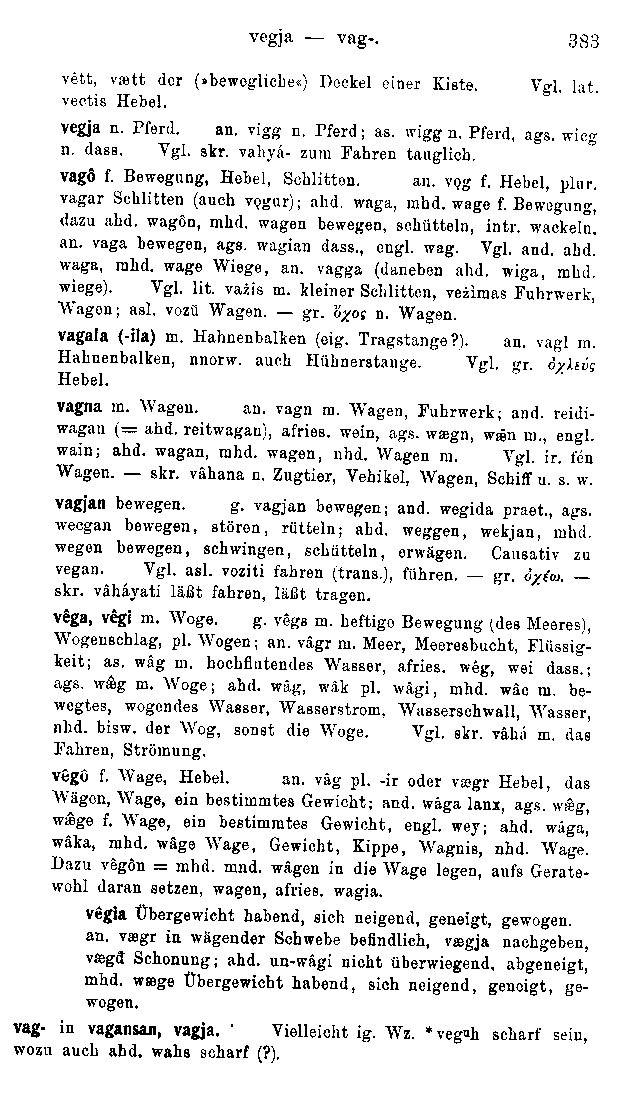
vêgia
Übergewicht
habend,
sich
neigend,
geneigt,
gewogen.
an.
vægr
in
wägender
Schwebe
befindlich,
vægja
nachgeben,
væg Schonung;
ahd.
un-wâgi
nicht
überwiegend,
abgeneigt,
mhd.
wæge
Übergewicht
habend,
sich
neigend,
geneigt,
gewogen.
Schonung;
ahd.
un-wâgi
nicht
überwiegend,
abgeneigt,
mhd.
wæge
Übergewicht
habend,
sich
neigend,
geneigt,
gewogen.
[Translate the German words]
|
Source: Torp, page b0428, entry 6 View original page image as: [TIFF] [PNG] [View previous entry] [View next entry] |
[Comment on this entry] [View comments] |
The following entry has been hand-corrected once. |

seduga
(sedîga)
sittig.
an.
siugr
sittig,
gesittet;
ahd.
sitîg,
mhd.
sitic,
sitec
Gewohnheit
habend,
anständig,
sittig,
zahm.
[Translate the German words]
|
Source: Torp, page b0437, entry 2 View original page image as: [TIFF] [PNG] [View previous entry] [View next entry] |
[Comment on this entry] [View comments] |
The following entry has been hand-corrected once. |
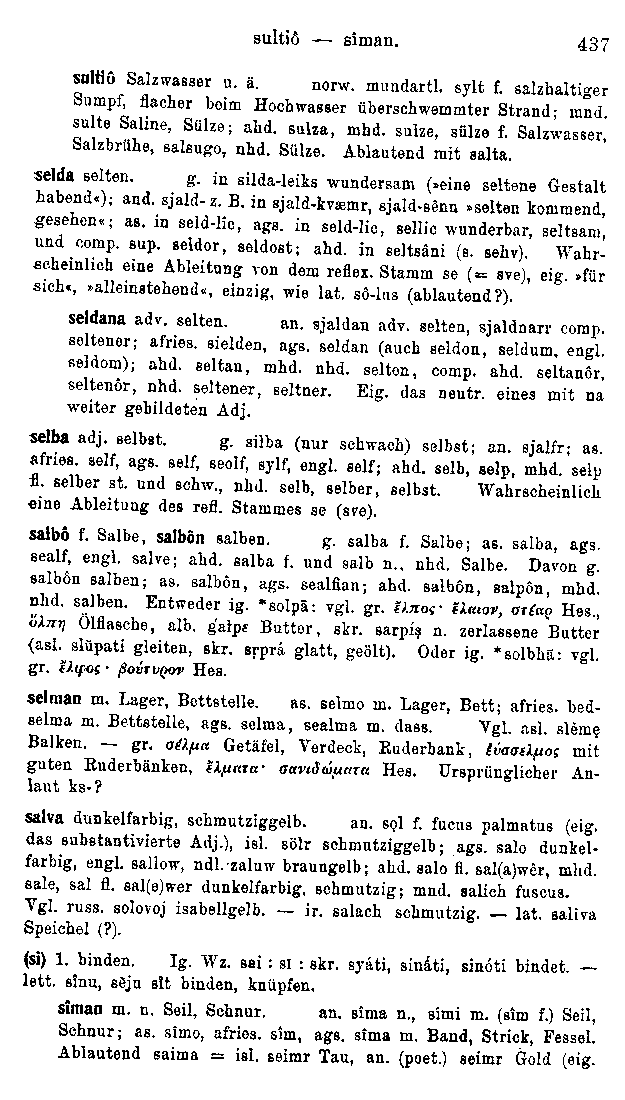
selda selten. g. in silda-leiks wundersam (»eine seltene Gestalt habend«); and. sjald- z. B. in sjald-kvæmr, sjald-sênn »selten kommend, gesehen«; as. in seld-lîc, ags. in seld-lic, sellic wunderbar, seltsam, und comp. sup. seldor, seldost; ahd. in seltsâni (s. sehv). Wahrscheinlich eine Ableitung von dem reflex. Stamm se (= sve), eig. »für sich«, »alleinstehend«, einzig, wie lat. sô-lus (ablautend?).
[Translate the German words]
Germanic Lexicon Project (main page)
This search system was written by
Sean Crist
Please consider
volunteering
to correct the data in these online dictionaries.
No rights reserved. Feel free to use these data in any way you please.