|
|

Search for habeam again, using less strict matching (8 results)
|
Source: Bosworth/Toller, page b0172, entry 32 View original page image as: [TIFF] [PNG] [View previous entry] [View next entry] |
[Comment on this entry] [View comments] |
The following entry has been hand-corrected once. |
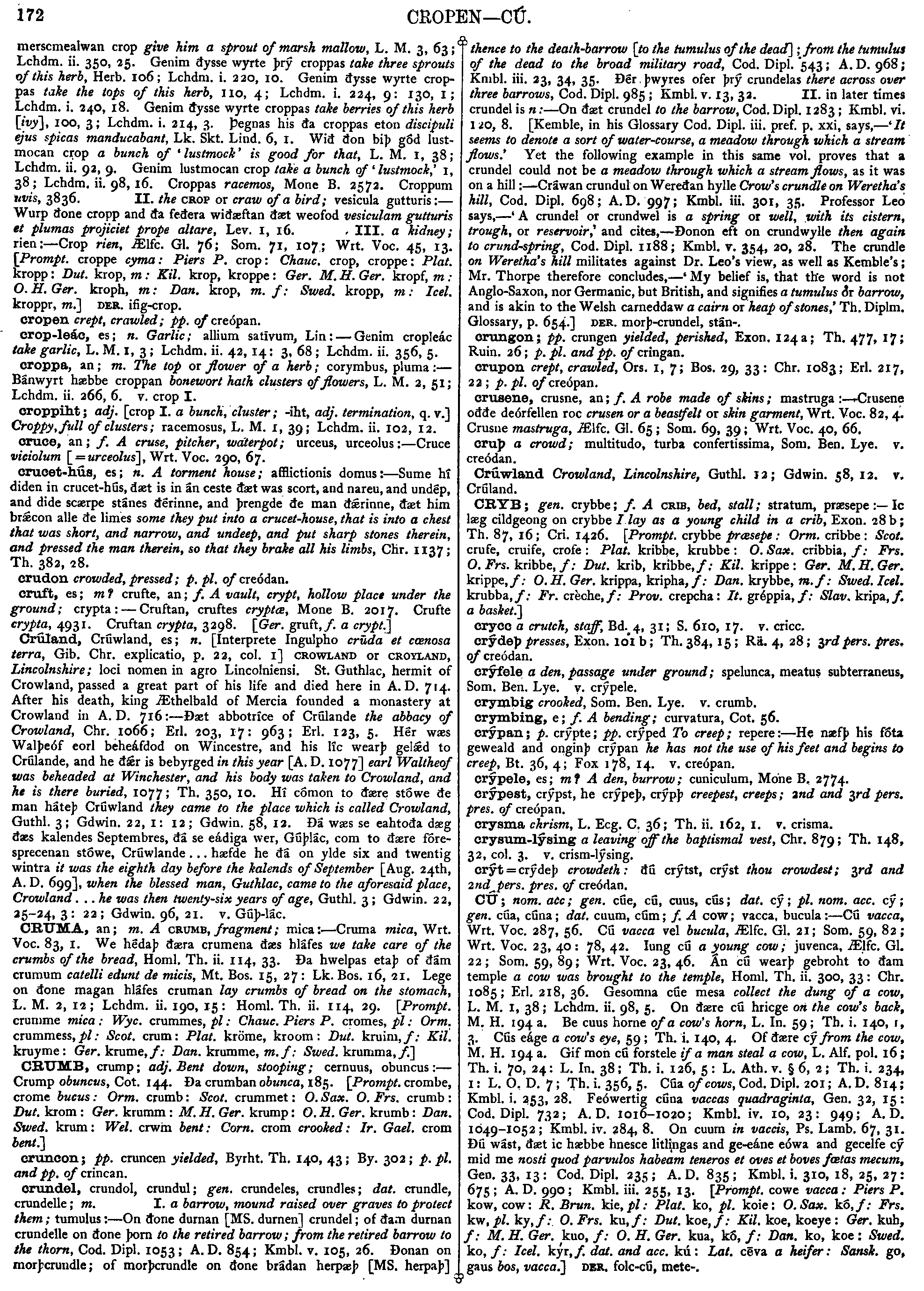
CÚ;
nom.
acc;
gen.
cúe,
cú,
cuus,
cús;
dat.
cý;
pl.
nom.
acc.
cý;
gen.
cúa,
cúna;
dat.
cuum,
cúm;
f.
A
cow;
vacca,
bucula
:--
Cú
vacca,
Wrt.
Voc.
287,
56.
Cú
vacca
vel
bucula,
Ælfc.
Gl.
21;
Som.
59,
82;
Wrt.
Voc.
23,
40:
78,
42.
Iung
cú
a
young
cow;
juvenca,
Ælfc.
Gl.
22;
Som.
59,
89;
Wrt.
Voc.
23,
46.
Án
cú
wearþ
gebroht
to
ðam
temple
a
cow
was
brought
to
the
temple,
Homl.
Th.
ii.
300,
33:
Chr.
1085;
Erl.
218,
36.
Gesomna
cúe
mesa
collect
the
dung
of
a
cow,
L.
M.
1,
38;
Lchdm.
ii.
98,
5.
On
ðære
cú
hricge
on
the
cow's
back,
M.
H.
194a.
Be
cuus
horne
of
a
cow's
horn,
L.
In.
59;
Th.
i.
140,
1,
3.
Cús
eáge
a
cow's
eye,
59;
Th.
i.
140,
4.
Of
ðære
cý
from
the
cow,
M.
H.
194a.
Gif
mon
cú
forstele
if
a
man
steal
a
cow,
L.
Alf.
pol.
16;
Th.
i.
70,
24:
L.
In.
38;
Th.
i.
126,
5:
L.
Ath.
v.
§
6,
2;
Th.
i.
234,
1:
L.
O.
D.
7;
Th.
i.
356,
5.
Cúa
of
cows,
Cod.
Dipl.
201;
A.
D.
814;
Kmbl.
i.
353,
28.
Feówertig
cúna
vaccas
quadraginia,
Gen.
32,
15:
Cod.
Dipl.
732;
A.
D.
1016-1020;
Kmbl.
iv.
10,
23:
949;
A.
D.
1649-1052;
Kmbl.
iv.
284,
8.
On
cuum
in
vaccis,
Ps.
Lamb.
67,
31.
Ðú
wást,
ðæt
ic
hæbbe
hnesce
litlingas
and
ge-eáne
eówa
and
gecelfe
cý
mid
me
nosti
quod
parvulos
habeam
teneros
et
oves
et
boves
fætas
mecum,
Gen.
33,
13:
Cod.
Dipl.
235;
A.
D.
835;
Kmbl.
i.
310,
18,
25,
27:
675;
A.
D.
990;
Kmbl.
iii.
255,
13.
[Prompt,
cowe
vacca:
Piers
P.
kow,
cow:
R.
Brun.
kie,
pl:
Plat.
ko,
pl.
koie:
O.
Sax.
kó,
f:
Frs.
kw,
pl.
ky,
f:
O.
Frs.
ku,
f:
Dut.
koe,
f:
Kil.
koe,
koeye:
Ger.
kuh,
f:
M.
H.
Ger.
kuo,
f:
O.
H.
Ger.
kua,
kó,
f:
Dan.
ko,
koe:
Swed.
ko,
f:
Icel.
kýr,
f.
dat.
and
acc.
kú:
Lat.
c va
a
heifer:
Sansk.
go,
gaus
bos,
vacca.]
DER.
folc-cú,
mete-.
va
a
heifer:
Sansk.
go,
gaus
bos,
vacca.]
DER.
folc-cú,
mete-.
|
Source: Bosworth/Toller, page b0452, entry 19 View original page image as: [TIFF] [PNG] [View previous entry] [View next entry] |
[Comment on this entry] [View comments] |
The following entry has been hand-corrected once. |
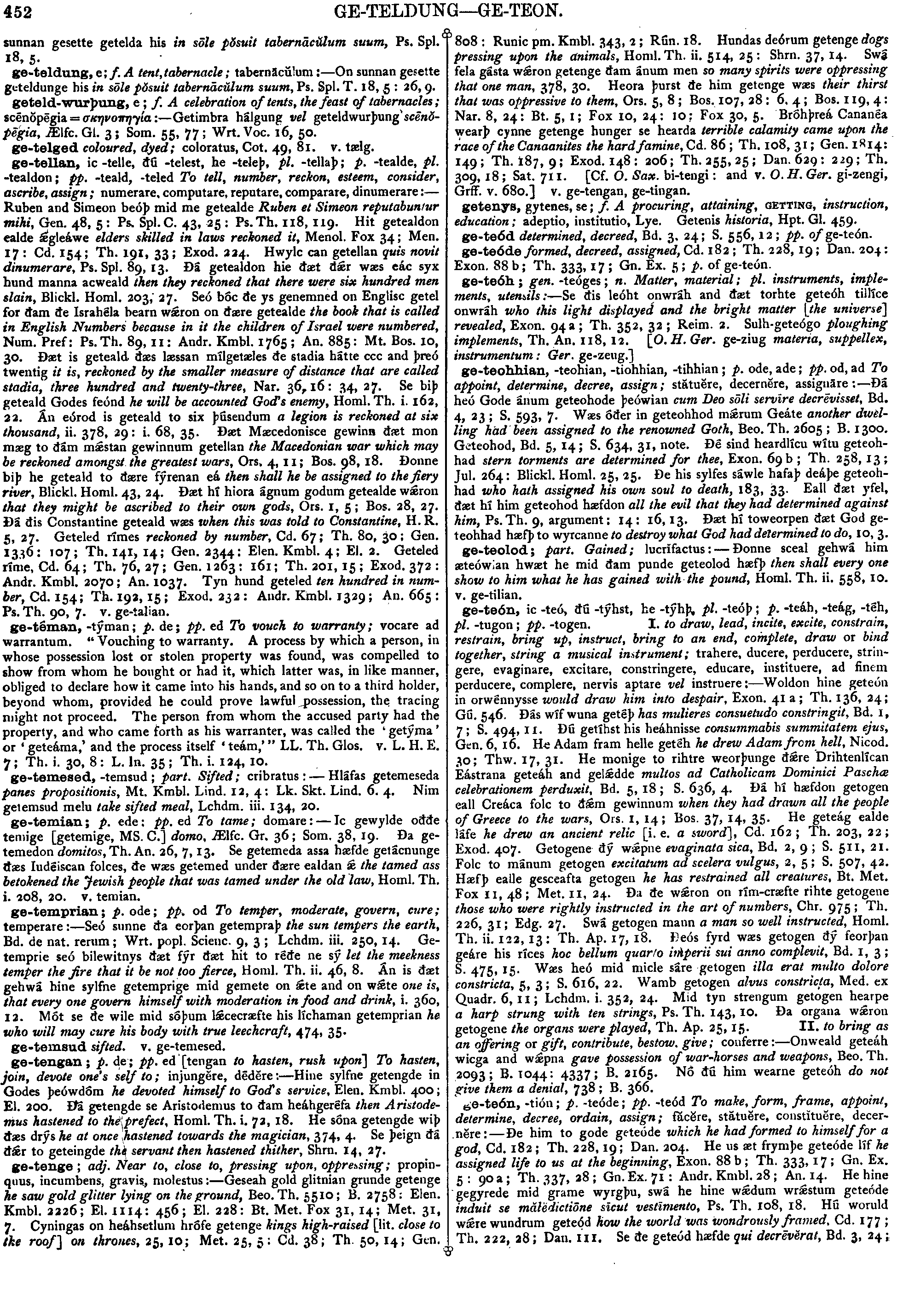
ge-teón,
-tión;
p.
-teóde;
pp.
-teód
To
make,
form,
frame,
appoint,
determine,
decree,
ordain,
assign;
f c
c re,
stture,
const
re,
stture,
const ture,
decernre
:--
Ðe
him
to
gode
geteóde
which
he
had
formed
to
himself
for
a
god,
Cd.
182;
Th.
228,
19;
Dan.
204.
He
us
æt
frymþe
geteóde
líf
he
assigned
life
to
us
at
the
beginning,
Exon.
88
b;
Th.
333,
17;
Gn.
Ex.
5:
90
a;
Th.
337,
28;
Gn.
Ex.
71:
Andr.
Kmbl.
28;
An.
14.
He
hine
gegyrede
mid
grame
wyrgþu,
swá
he
hine
w
ture,
decernre
:--
Ðe
him
to
gode
geteóde
which
he
had
formed
to
himself
for
a
god,
Cd.
182;
Th.
228,
19;
Dan.
204.
He
us
æt
frymþe
geteóde
líf
he
assigned
life
to
us
at
the
beginning,
Exon.
88
b;
Th.
333,
17;
Gn.
Ex.
5:
90
a;
Th.
337,
28;
Gn.
Ex.
71:
Andr.
Kmbl.
28;
An.
14.
He
hine
gegyrede
mid
grame
wyrgþu,
swá
he
hine
w dum
wrstum
geteóde
induit
se
mldicti
dum
wrstum
geteóde
induit
se
mldicti ne
s
ne
s cut
vestmento,
Ps.
Th.
108,
18.
Hú
woruld
wre
wundrum
geteód
how
the
world
was
wondrously
framed,
Cd.
177;
Th.
222,
28;
Dan.
111.
Se
ðe
geteód
hæfde
qui
decrvrat,
Bd.
3,
24;
S.
556,
12:
Blickl.
Homl.
19,
35.
Geteód
to
ðm
écan
wítum
destined
to
eternal
torments,
37,
4:
31,
22.
Ðonne
biþ
ðam
heard
dóm
geteód
a
hard
sentence
will
be
the
lot
of
that
man,
95,
36.
Þurh
hwelces
monnes
hond
mín
ende
wre
getiód
by
what
man's
hand
my
death
was
determined;
cujus
mortem
percussoris
manu
cavendam
habeam,
Nar.
31,
19:
Th.
Ch.
483,
15.
cut
vestmento,
Ps.
Th.
108,
18.
Hú
woruld
wre
wundrum
geteód
how
the
world
was
wondrously
framed,
Cd.
177;
Th.
222,
28;
Dan.
111.
Se
ðe
geteód
hæfde
qui
decrvrat,
Bd.
3,
24;
S.
556,
12:
Blickl.
Homl.
19,
35.
Geteód
to
ðm
écan
wítum
destined
to
eternal
torments,
37,
4:
31,
22.
Ðonne
biþ
ðam
heard
dóm
geteód
a
hard
sentence
will
be
the
lot
of
that
man,
95,
36.
Þurh
hwelces
monnes
hond
mín
ende
wre
getiód
by
what
man's
hand
my
death
was
determined;
cujus
mortem
percussoris
manu
cavendam
habeam,
Nar.
31,
19:
Th.
Ch.
483,
15.
|
Source: Bosworth/Toller, page b0547, entry 8 View original page image as: [TIFF] [PNG] [View previous entry] [View next entry] |
[Comment on this entry] [View comments] |
The following entry has been hand-corrected once. |
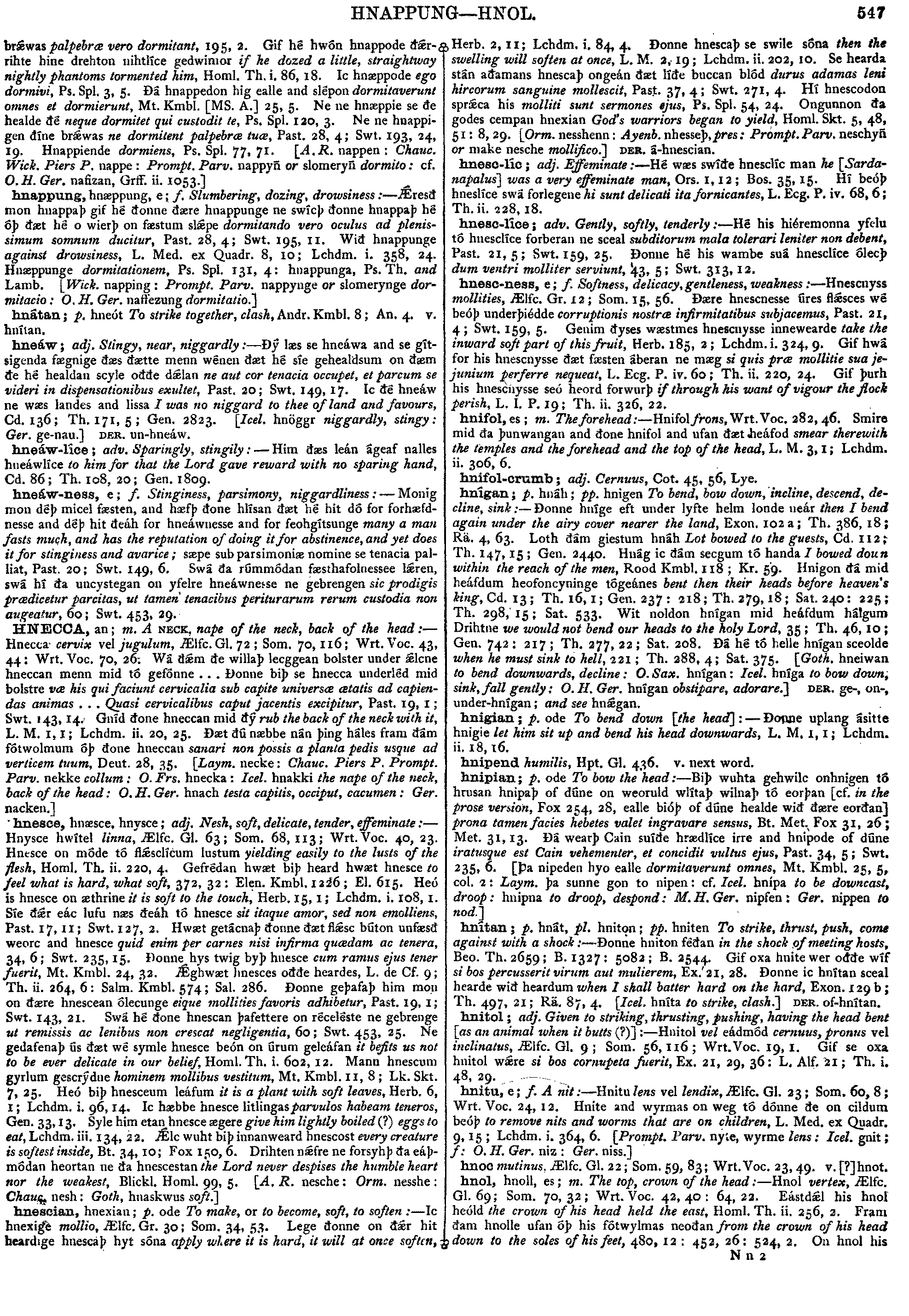
hnesce,
hnæsce,
hnysce;
adj.
Nesh,
soft,
delicate,
tender,
effeminate
:--
Hnysce
hwítel
linna,
Ælfc.
Gl.
63;
Som.
68,
113;
Wrt.
Voc.
40,
23.
Hnesce
on
móde
tó
flsclícum
lustum
yielding
easily
to
the
lusts
of
the
flesh,
Homl.
Th.
ii.
220,
4.
Gefrédan
hwæt
biþ
heard
hwæt
hnesce
to
feel
what
is
hard,
what
soft,
372,
32:
Elen.
Kmbl.
1226;
El.
615.
Heó
is
hnesce
on
æthrine
it
is
soft
to
the
touch,
Herb.
15,
1;
Lchdm.
i.
108,
1.
Síe
ðr
eác
lufu
næs
ðeáh
tó
hnesce
sit
itaque
amor,
sed
non
emolliens,
Past.
17,
11;
Swt.
127,
2.
Hwæt
getácnaþ
ðonne
ðæt
flsc
búton
unfæsð
weorc
and
hnesce
quid
enim
per
carnes
nisi
infirma
quædam
ac
tenera,
34,
6;
Swt.
235,
15.
Ðonne
hys
twig
byþ
hnesce
cum
ramus
ejus
tener
fuerit,
Mt.
Kmbl.
24,
32.
Æ-acute;ghwæt
hnesces
oððe
heardes,
L.
de
Cf.
9;
Th.
ii.
264,
6:
Salm.
Kmbl.
574;
Sal.
286.
Ðonne
geþafaþ
him
mon
on
ðære
hnescean
ólecunge
eique
mollities
favoris
adhibetur,
Past.
19,
1;
Swt.
143,
21.
Swá
hé
ðone
hnescan
þafettere
on
réceléste
ne
gebrenge
ut
remissis
ac
lenibus
non
crescat
negligentia,
60;
Swt.
453,
25.
Ne
gedafenaþ
ús
ðæt
wé
symle
hnesce
beón
on
úrum
geleáfan
it
befits
us
not
to
be
ever
delicate
in
our
belief,
Homl.
Th.
i.
602,
12.
Mann
hnescum
gyrlum
gescrýdne
hominem
mollibus
vestitum,
Mt.
Kmbl.
ii.
8;
Lk.
Skt.
7,
25.
Heó
biþ
hnesceum
leáfum
it
is
a
plant
with
soft
leaves,
Herb.
6,
1;
Lchdm.
i.
96,
14.
Ic
hæbbe
hnesce
litlingas
parvulos
habeam
teneros,
Gen.
33,
13.
Syle
him
etan
hnesce
ægere
give
him
lightly
boiled
(?)
eggs
to
eat,
Lchdm.
iii.
134,
22.
Æ-acute;lc
wuht
biþ
innanweard
hnescost
every
creature
is
softest
inside,
Bt.
34,
10;
Fox
150,
6.
Drihten
nfre
ne
forsyhþ
ða
eáþmódan
heortan
ne
ða
hnescestan
the
Lord
never
despises
the
humble
heart
nor
the
weakest,
Blickl.
Homl.
99,
5.
[A.
R.
nesche:
Orm.
nesshe:
Chauc.
nesh:
Goth.
hnaskwus
soft.]
|
Source: Bosworth/Toller, page b0652, entry 17 View original page image as: [TIFF] [PNG] [View previous entry] [View next entry] |
[Comment on this entry] [View comments] |
The following entry has been hand-corrected once. |
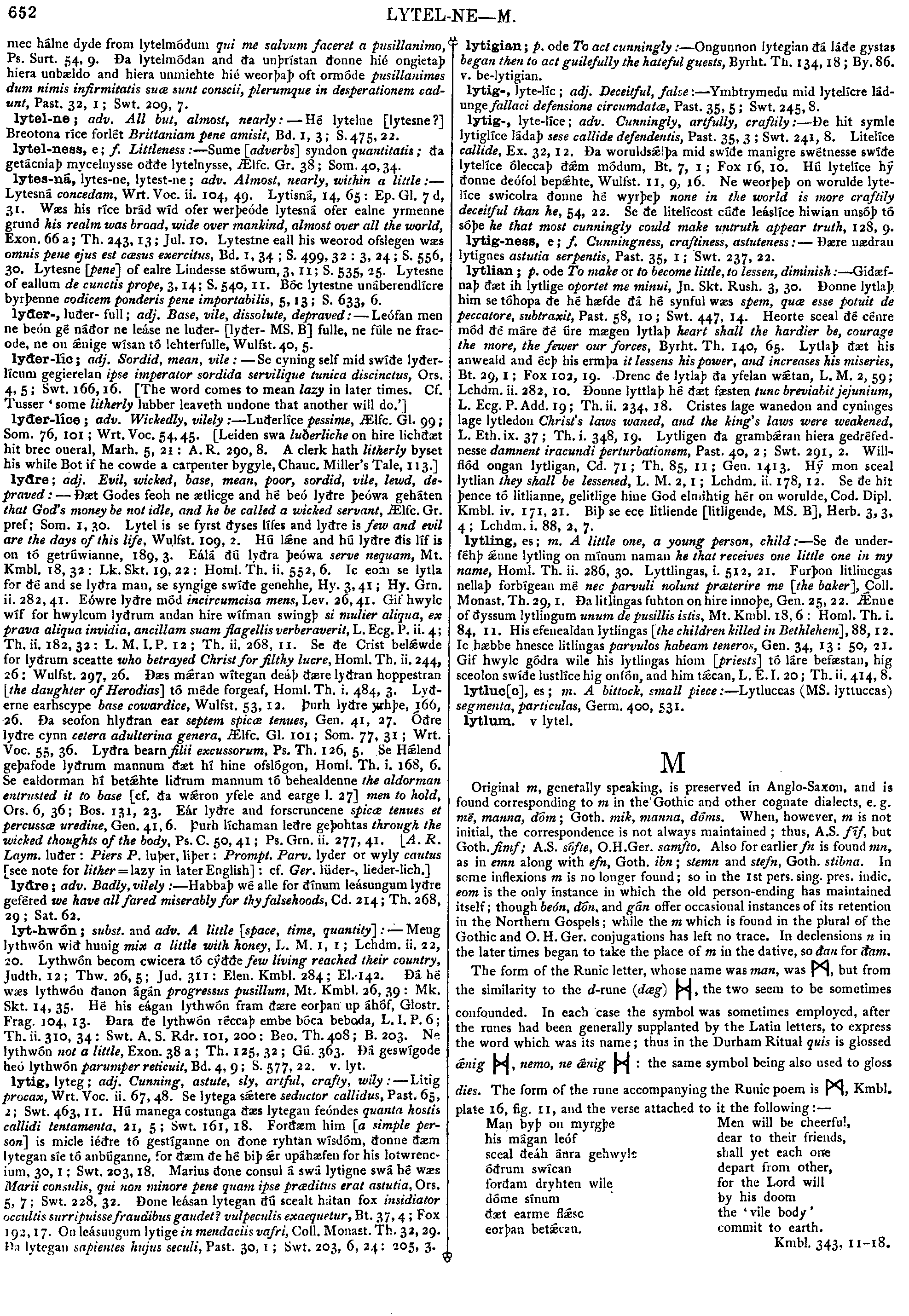
lytling,
es;
m.
A
little
one,
a
young
person,
child
:--
Se
ðe
underféhþ
nne
lytling
on
mínum
naman
he
that
receives
one
little
one
in
my
name,
Homl.
Th.
ii.
286,
30.
Lyttlingas,
i.
512,
21.
Furþon
litlincgas
nellaþ
forbígean
mé
nec
parvuli
nolunt
præterire
me
[the
baker],
Coll.
Monast.
Th.
29,
1.
Ða
litlingas
fuhton
on
hire
innoþe,
Gen.
25,
22.
Æ-acute;nne
of
ðyssum
lytlingum
unum
de
pusillis
istis,
Mt.
Kmbl.
18,
6:
Homl.
Th.
i.
84,
11.
His
efenealdan
lytlingas
[the
children
killed
in
Bethlehem],
88,
12.
Ic
hæbbe
hnesce
litlingas
parvulos
habeam
teneros,
Gen.
34,
13:
50,
21.
Gif
hwylc
gódra
wile
his
lytlingas
hiom
[priests]
tó
láre
befæstan,
hig
sceolon
swíðe
lustlíce
hig
onfón,
and
him
tcan,
L.
E.
I.
20;
Th.
ii.
414,
8.
|
Source: Bosworth/Toller, page d0188, entry 1 View original page image as: [TIFF] [PNG] [View previous entry] [View next entry] |
[Comment on this entry] [View comments] |
The following entry has been hand-corrected once. |
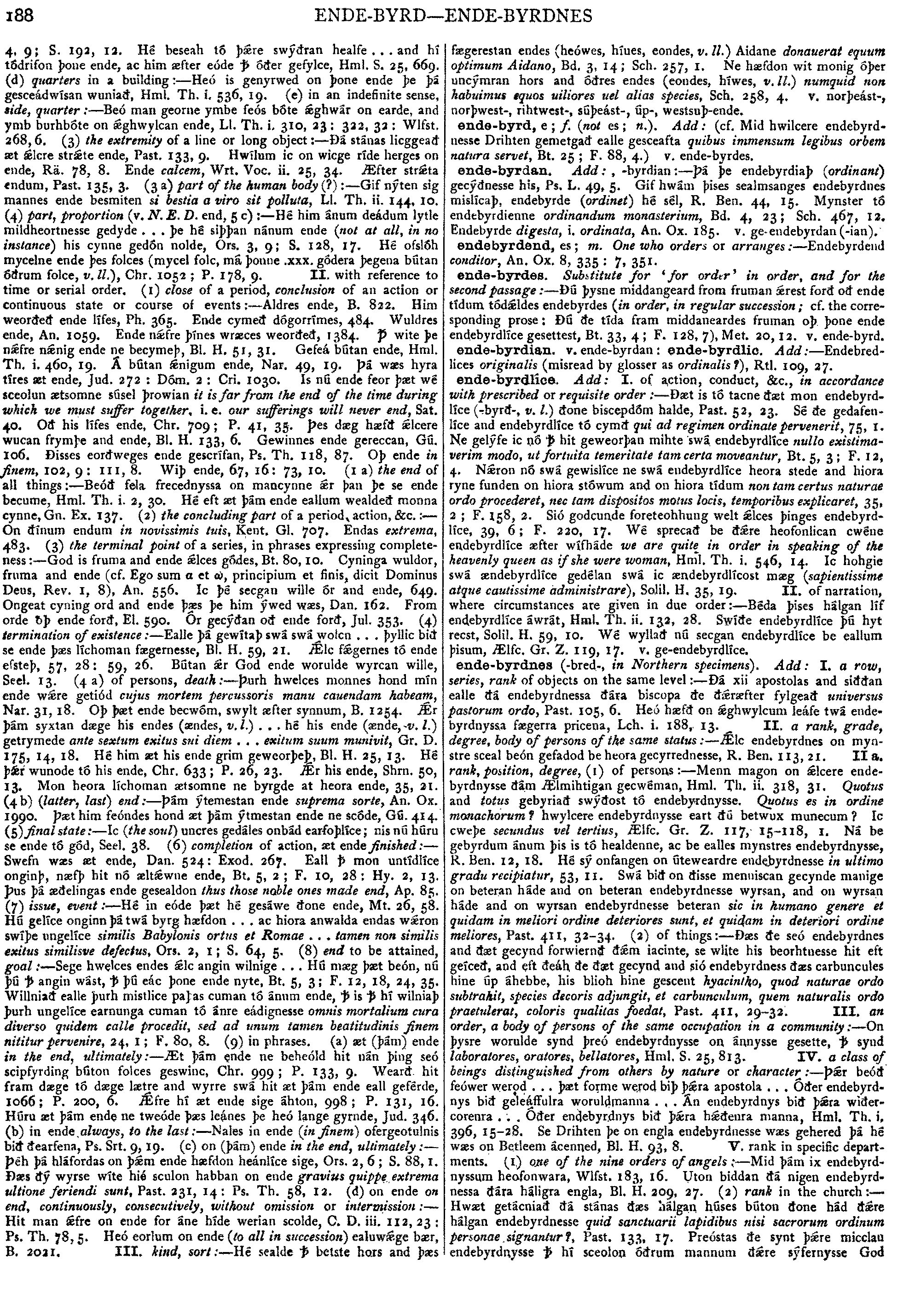
4,
9;
S.
192,
12.
Hé
beseah
tó
þre
swýðran
healfe
.
.
.
and
hí
tódrifon
þone
ende,
ac
him
æfter
eóde
 óðer
gefylce,
Hml.
S.
25,
669.
(d)
quarters
in
a
building
:--
Heó
is
genyrwed
on
þone
ende
þe
þá
gesceádwísan
wuniað,
Hml.
Th.
i.
536,
19.
(e)
in
an
indefinite
sense,
side,
quarter
:--
Beó
man
georne
ymbe
feós
bóte
ghwár
on
earde,
and
ymb
burhbóte
on
ghwylcan
ende,
Ll.
Th.
i.
310,
23
:
322,
32
:
Wlfst.
268,
6.
(3)
the
extremity
of
a
line
or
long
object
:--
Ðá
stánas
licggeað
æt
lcre
strte
ende,
Past.
133,
9.
Hwílum
ic
on
wicge
ríde
herges
on
ende,
Rä.
78,
8.
Ende
calcem,
Wrt.
Voc.
ii.
25,
34.
Æfter
strta
endum,
Past.
135,
3.
(3
a)
part
of
the
human
body
(?)
:--
Gif
nýten
sig
mannes
ende
besmiten
si
bestia
a
viro
sit
polluta,
Ll.
Th.
ii.
144,
10.
(4)
part,
proportion
(v.
N.
E.
D.
end,
5
c)
:--
Hé
him
ánum
deádum
lytle
mildheortnesse
gedyde
.
.
.
þe
hé
siþþan
nánum
ende
(not
at
all,
in
no
instance)
his
cynne
gedón
nolde,
Ors.
3,
9;
S.
128,
17.
Hé
ofslóh
mycelne
ende
þes
folces
(mycel
folc,
má
þonne
.xxx.
gódera
þegena
bútan
óðrum
folce,
v.
ll.),
Chr.
1052
;
P.
178,
9.
II.
with
reference
to
time
or
serial
order.
(1)
close
of
a
period,
conclusion
of
an
action
or
continuous
state
or
course
of
events
:--
Aldres
ende,
B.
822.
Him
weorðeð
ende
lífes,
Ph.
365.
Ende
cymeð
dógorrímes,
484.
Wuldres
ende,
An.
1059.
Ende
nfre
þínes
wræces
weorðeð,
1384.
Þ-bar;
wite
þe
nfre
nnig
ende
ne
becymeþ,
Bl.
H.
51,
31.
Gefeá
bútan
ende,
Hml.
Th.
i.
460,
19.
Á
bútan
nigum
ende,
Nar.
49,
19.
Þá
wæs
hyra
tíres
æt
ende,
Jud.
272
:
Dóm.
2
:
Cri.
1030.
Is
nú
ende
feor
þæt
wé
sceolun
ætsomne
súsel
þrowian
it
is
far
from
the
end
of
the
time
during
which
we
must
suffer
together,
i.
e.
our
sufferings
will
never
end,
Sat.
40.
Oð
his
lífes
ende,
Chr.
709;
P.
41,
35.
Þes
dæg
hæfð
lcere
wucan
frymþe
and
ende,
Bl.
H.
133,
6.
Gewinnes
ende
gereccan,
Gú.
106.
Ðisses
eorðweges
ende
gescrífan,
Ps.
Th.
118,
87.
Oþ
ende
in
finem,
102,
9
:
111,
8.
Wiþ
ende,
67,
16:
73,
10.
(1
a)
the
end
of
all
things
:--
Beóð
fela
frecednyssa
on
mancynne
r
þan
þe
se
ende
becume,
Hml.
Th.
i.
2,
30.
Hé
eft
æt
þám
ende
eallum
wealdeð
monna
cynne,
Gn.
Ex.
137.
(2)
the
concluding
part
of
a
period,
action,
&c.
:--
On
ðínum
endum
in
novissimis
tuis,
Kent.
Gl.
707.
Endas
extrema,
483.
(3)
the
terminal
point
of
a
series,
in
phrases
expressing
completeness
:--
God
is
fruma
and
ende
lces
gódes,
Bt.
80,
10.
Cyninga
wuldor,
fruma
and
ende
(cf.
Ego
sum
óðer
gefylce,
Hml.
S.
25,
669.
(d)
quarters
in
a
building
:--
Heó
is
genyrwed
on
þone
ende
þe
þá
gesceádwísan
wuniað,
Hml.
Th.
i.
536,
19.
(e)
in
an
indefinite
sense,
side,
quarter
:--
Beó
man
georne
ymbe
feós
bóte
ghwár
on
earde,
and
ymb
burhbóte
on
ghwylcan
ende,
Ll.
Th.
i.
310,
23
:
322,
32
:
Wlfst.
268,
6.
(3)
the
extremity
of
a
line
or
long
object
:--
Ðá
stánas
licggeað
æt
lcre
strte
ende,
Past.
133,
9.
Hwílum
ic
on
wicge
ríde
herges
on
ende,
Rä.
78,
8.
Ende
calcem,
Wrt.
Voc.
ii.
25,
34.
Æfter
strta
endum,
Past.
135,
3.
(3
a)
part
of
the
human
body
(?)
:--
Gif
nýten
sig
mannes
ende
besmiten
si
bestia
a
viro
sit
polluta,
Ll.
Th.
ii.
144,
10.
(4)
part,
proportion
(v.
N.
E.
D.
end,
5
c)
:--
Hé
him
ánum
deádum
lytle
mildheortnesse
gedyde
.
.
.
þe
hé
siþþan
nánum
ende
(not
at
all,
in
no
instance)
his
cynne
gedón
nolde,
Ors.
3,
9;
S.
128,
17.
Hé
ofslóh
mycelne
ende
þes
folces
(mycel
folc,
má
þonne
.xxx.
gódera
þegena
bútan
óðrum
folce,
v.
ll.),
Chr.
1052
;
P.
178,
9.
II.
with
reference
to
time
or
serial
order.
(1)
close
of
a
period,
conclusion
of
an
action
or
continuous
state
or
course
of
events
:--
Aldres
ende,
B.
822.
Him
weorðeð
ende
lífes,
Ph.
365.
Ende
cymeð
dógorrímes,
484.
Wuldres
ende,
An.
1059.
Ende
nfre
þínes
wræces
weorðeð,
1384.
Þ-bar;
wite
þe
nfre
nnig
ende
ne
becymeþ,
Bl.
H.
51,
31.
Gefeá
bútan
ende,
Hml.
Th.
i.
460,
19.
Á
bútan
nigum
ende,
Nar.
49,
19.
Þá
wæs
hyra
tíres
æt
ende,
Jud.
272
:
Dóm.
2
:
Cri.
1030.
Is
nú
ende
feor
þæt
wé
sceolun
ætsomne
súsel
þrowian
it
is
far
from
the
end
of
the
time
during
which
we
must
suffer
together,
i.
e.
our
sufferings
will
never
end,
Sat.
40.
Oð
his
lífes
ende,
Chr.
709;
P.
41,
35.
Þes
dæg
hæfð
lcere
wucan
frymþe
and
ende,
Bl.
H.
133,
6.
Gewinnes
ende
gereccan,
Gú.
106.
Ðisses
eorðweges
ende
gescrífan,
Ps.
Th.
118,
87.
Oþ
ende
in
finem,
102,
9
:
111,
8.
Wiþ
ende,
67,
16:
73,
10.
(1
a)
the
end
of
all
things
:--
Beóð
fela
frecednyssa
on
mancynne
r
þan
þe
se
ende
becume,
Hml.
Th.
i.
2,
30.
Hé
eft
æt
þám
ende
eallum
wealdeð
monna
cynne,
Gn.
Ex.
137.
(2)
the
concluding
part
of
a
period,
action,
&c.
:--
On
ðínum
endum
in
novissimis
tuis,
Kent.
Gl.
707.
Endas
extrema,
483.
(3)
the
terminal
point
of
a
series,
in
phrases
expressing
completeness
:--
God
is
fruma
and
ende
lces
gódes,
Bt.
80,
10.
Cyninga
wuldor,
fruma
and
ende
(cf.
Ego
sum
 et
,
principium
et
finis,
dicit
Dominus
Deus,
Rev.
1,
8),
An.
556.
Ic
þé
secgan
wille
ór
and
ende,
649.
Ongeat
cyning
ord
and
ende
þæs
þe
him
ýwed
wæs,
Dan.
162.
From
orde
oþILLEGIBLE
ende
forð,
El.
590.
Ór
gecýðan
oð
ende
forð,
Jul.
353.
(4)
termination
of
existence
:--
Ealle
þá
gewítaþ
swá
swá
wolcn
.
.
.
þyllic
bið
se
ende
þæs
líchoman
fægernesse,
Bl.
H.
59,
21.
Æ-acute;lc
fgernes
tó
ende
efsteþ,
57,
28:
59,
26.
Bútan
r
God
ende
worulde
wyrcan
wille,
Seel.
13.
(4
a)
of
persons,
death
:--
Þurh
hwelces
monnes
hond
mín
ende
wre
getiód
cujus
mortem
percussoris
manu
cauendam
habeam,
Nar.
31,
18.
Oþ
þæt
ende
becwóm,
swylt
æfter
synnum,
B.
1254.
Æ-acute;r
þám
syxtan
dæge
his
endes
(ændes,
v.
l.)
.
.
.
hé
his
ende
(ænde,
v.
l.)
getrymede
ante
sextum
exitus
sui
diem
.
.
.
exitum
suum
munivit,
Gr.
D.
175,
14,
18.
Hé
him
æt
his
ende
grim
geweorþeþ,
Bl.
H.
25,
13.
Hé
þr
wunode
tó
his
ende,
Chr.
633
;
P.
26,
23.
Æ-acute;r
his
ende,
Shrn.
50,
13.
Mon
heora
líchoman
ætsomne
ne
byrgde
at
heora
ende,
35,
21.
(4
b)
(latter,
last)
end
:--
Þám
ýtemestan
ende
suprema
sorte,
An.
Ox.
1990.
Þæt
him
feóndes
hond
æt
þám
ýtmestan
ende
ne
scóde,
Gú.
414.
(5)
final
state
:--
Ic
(the
soul)
uncres
gedáles
onbád
earfoþlíce;
nis
nú
húru
se
ende
tó
gód,
Seel.
38.
(6)
completion
of
action,
æt
ende
finished
:--
Swefn
wæs
æt
ende,
Dan.
524:
Exod.
267.
Eall
mon
untídlíce
onginþ,
næfþ
hit
nó
æltwne
ende,
Bt.
5,
2
;
F.
10,
28:
Hy.
2,
13.
Þus
þá
æðelingas
ende
gesealdon
thus
those
noble
ones
made
end,
Ap.
85.
(7)
issue,
event
:--
Hé
in
eóde
þæt
hé
gesáwe
ðone
ende,
Mt.
26,
58.
Hú
gelíce
onginn
þá
twá
byrg
hæfdon
.
.
.
ac
hiora
anwalda
endas
wron
swíþe
ungelíce
similis
Babylonis
ortus
et
Romae
.
.
.
tamen
non
similis
exitus
similisve
defectus,
Ors.
2,
1;
S.
64,
5.
(8)
end
to
be
attained,
goal
:--Sege
hwelces
endes
lc
angin
wilnige
.
.
.
Hú
mæg
þæt
beón,
nú
þú
angin
wást,
þú
eác
þone
ende
nyte,
Bt.
5,
3;
F.
12,
18,
24,
35.
Willniað
ealle
þurh
mistlice
paþas
cuman
tó
ánum
ende,
is
hí
wilniaþ
þurh
ungelíce
earnunga
cuman
tó
ánre
eádignesse
omnis
mortalium
cura
diverso
quidem
calle
procedit,
sed
ad
unum
tamen
beatitudinis
finem
nititur
pervenire,
24,
1;
F.
80,
8.
(9)
in
phrases.
(a)
æt
(þám)
ende
in
the
end,
ultimately
:--
Æt
þám
ende
ne
beheóld
hit
nán
þing
seó
scipfyrding
búton
folces
geswinc,
Chr.
999
;
P.
133,
9.
Wearð
hit
fram
dæge
tó
dæge
lætre
and
wyrre
swá
hit
æt
þám
ende
eall
geférde,
1066;
P.
200,
6.
Æ-acute;fre
hí
æt
eude
sige
áhton,
998;
P.
131,
16.
Húru
æt
þám
ende
ne
tweóde
þæs
leánes
þe
heó
lange
gyrnde,
Jud.
346.
(b)
in
ende,UNCERTAIN
always,
to
the
last:--
Nales
in
ende
(in
finem)
ofergeotulnis
bið
ðearfena,
Ps.
Srt.
9,
19.
(c)
on
(þám)
ende
in
the
end,
ultimately
:--
Þéh
þá
hláfordas
on
þm
ende
hæfdon
heánlíce
sige,
Ors.
2,
6;
S.
88,
1.
Ðæs
ðý
wyrse
wíte
hié
sculon
habban
on
ende
gravius
quippe
extrema
ultione
feriendi
sunt,
Past.
231,
14:
Ps.
Th.
58,
12.
(d)
on
ende
on
end,
continuously,
consecutively,
without
omission
or
intermission
:--
Hit
man
fre
on
ende
for
áne
híde
werian
scolde,
C.
D.
iii.
112,
23
;
Ps.
Th.
78,
5.
Heó
eorlum
on
ende
(to
all
in
succession)
ealuwge
bær,
B.
2021.
III.
kind,
sort
:--
Hé
sealde
betste
hors
and
þæs
fægerestan
endes
(heówes,
híues,
eondes,
v.
ll.)
Aidane
donauerat
equum
optimum
Aidano,
Bd.
3,
14;
Sch.
257,
1.
Ne
hæfdon
wit
monig
óþer
uncýmran
hors
and
óðres
endes
(eondes,
híwes,
v.
ll.)
numquid
non
habuimus
equos
uiliores
uel
alias
species,
Sch.
258,
4.
v.
norþeást-,
norþwest-,
rihtwest-,
súþeást-,
úp-,
westsuþ-ende.
et
,
principium
et
finis,
dicit
Dominus
Deus,
Rev.
1,
8),
An.
556.
Ic
þé
secgan
wille
ór
and
ende,
649.
Ongeat
cyning
ord
and
ende
þæs
þe
him
ýwed
wæs,
Dan.
162.
From
orde
oþILLEGIBLE
ende
forð,
El.
590.
Ór
gecýðan
oð
ende
forð,
Jul.
353.
(4)
termination
of
existence
:--
Ealle
þá
gewítaþ
swá
swá
wolcn
.
.
.
þyllic
bið
se
ende
þæs
líchoman
fægernesse,
Bl.
H.
59,
21.
Æ-acute;lc
fgernes
tó
ende
efsteþ,
57,
28:
59,
26.
Bútan
r
God
ende
worulde
wyrcan
wille,
Seel.
13.
(4
a)
of
persons,
death
:--
Þurh
hwelces
monnes
hond
mín
ende
wre
getiód
cujus
mortem
percussoris
manu
cauendam
habeam,
Nar.
31,
18.
Oþ
þæt
ende
becwóm,
swylt
æfter
synnum,
B.
1254.
Æ-acute;r
þám
syxtan
dæge
his
endes
(ændes,
v.
l.)
.
.
.
hé
his
ende
(ænde,
v.
l.)
getrymede
ante
sextum
exitus
sui
diem
.
.
.
exitum
suum
munivit,
Gr.
D.
175,
14,
18.
Hé
him
æt
his
ende
grim
geweorþeþ,
Bl.
H.
25,
13.
Hé
þr
wunode
tó
his
ende,
Chr.
633
;
P.
26,
23.
Æ-acute;r
his
ende,
Shrn.
50,
13.
Mon
heora
líchoman
ætsomne
ne
byrgde
at
heora
ende,
35,
21.
(4
b)
(latter,
last)
end
:--
Þám
ýtemestan
ende
suprema
sorte,
An.
Ox.
1990.
Þæt
him
feóndes
hond
æt
þám
ýtmestan
ende
ne
scóde,
Gú.
414.
(5)
final
state
:--
Ic
(the
soul)
uncres
gedáles
onbád
earfoþlíce;
nis
nú
húru
se
ende
tó
gód,
Seel.
38.
(6)
completion
of
action,
æt
ende
finished
:--
Swefn
wæs
æt
ende,
Dan.
524:
Exod.
267.
Eall
mon
untídlíce
onginþ,
næfþ
hit
nó
æltwne
ende,
Bt.
5,
2
;
F.
10,
28:
Hy.
2,
13.
Þus
þá
æðelingas
ende
gesealdon
thus
those
noble
ones
made
end,
Ap.
85.
(7)
issue,
event
:--
Hé
in
eóde
þæt
hé
gesáwe
ðone
ende,
Mt.
26,
58.
Hú
gelíce
onginn
þá
twá
byrg
hæfdon
.
.
.
ac
hiora
anwalda
endas
wron
swíþe
ungelíce
similis
Babylonis
ortus
et
Romae
.
.
.
tamen
non
similis
exitus
similisve
defectus,
Ors.
2,
1;
S.
64,
5.
(8)
end
to
be
attained,
goal
:--Sege
hwelces
endes
lc
angin
wilnige
.
.
.
Hú
mæg
þæt
beón,
nú
þú
angin
wást,
þú
eác
þone
ende
nyte,
Bt.
5,
3;
F.
12,
18,
24,
35.
Willniað
ealle
þurh
mistlice
paþas
cuman
tó
ánum
ende,
is
hí
wilniaþ
þurh
ungelíce
earnunga
cuman
tó
ánre
eádignesse
omnis
mortalium
cura
diverso
quidem
calle
procedit,
sed
ad
unum
tamen
beatitudinis
finem
nititur
pervenire,
24,
1;
F.
80,
8.
(9)
in
phrases.
(a)
æt
(þám)
ende
in
the
end,
ultimately
:--
Æt
þám
ende
ne
beheóld
hit
nán
þing
seó
scipfyrding
búton
folces
geswinc,
Chr.
999
;
P.
133,
9.
Wearð
hit
fram
dæge
tó
dæge
lætre
and
wyrre
swá
hit
æt
þám
ende
eall
geférde,
1066;
P.
200,
6.
Æ-acute;fre
hí
æt
eude
sige
áhton,
998;
P.
131,
16.
Húru
æt
þám
ende
ne
tweóde
þæs
leánes
þe
heó
lange
gyrnde,
Jud.
346.
(b)
in
ende,UNCERTAIN
always,
to
the
last:--
Nales
in
ende
(in
finem)
ofergeotulnis
bið
ðearfena,
Ps.
Srt.
9,
19.
(c)
on
(þám)
ende
in
the
end,
ultimately
:--
Þéh
þá
hláfordas
on
þm
ende
hæfdon
heánlíce
sige,
Ors.
2,
6;
S.
88,
1.
Ðæs
ðý
wyrse
wíte
hié
sculon
habban
on
ende
gravius
quippe
extrema
ultione
feriendi
sunt,
Past.
231,
14:
Ps.
Th.
58,
12.
(d)
on
ende
on
end,
continuously,
consecutively,
without
omission
or
intermission
:--
Hit
man
fre
on
ende
for
áne
híde
werian
scolde,
C.
D.
iii.
112,
23
;
Ps.
Th.
78,
5.
Heó
eorlum
on
ende
(to
all
in
succession)
ealuwge
bær,
B.
2021.
III.
kind,
sort
:--
Hé
sealde
betste
hors
and
þæs
fægerestan
endes
(heówes,
híues,
eondes,
v.
ll.)
Aidane
donauerat
equum
optimum
Aidano,
Bd.
3,
14;
Sch.
257,
1.
Ne
hæfdon
wit
monig
óþer
uncýmran
hors
and
óðres
endes
(eondes,
híwes,
v.
ll.)
numquid
non
habuimus
equos
uiliores
uel
alias
species,
Sch.
258,
4.
v.
norþeást-,
norþwest-,
rihtwest-,
súþeást-,
úp-,
westsuþ-ende.
|
Source: Cleasby/Vigfusson, page b0002, entry 1 View original page image as: [TIFF] [PNG] [View previous entry] [View next entry] |
[Comment on this entry] [View comments] |
The following entry has been hand-corrected once. |
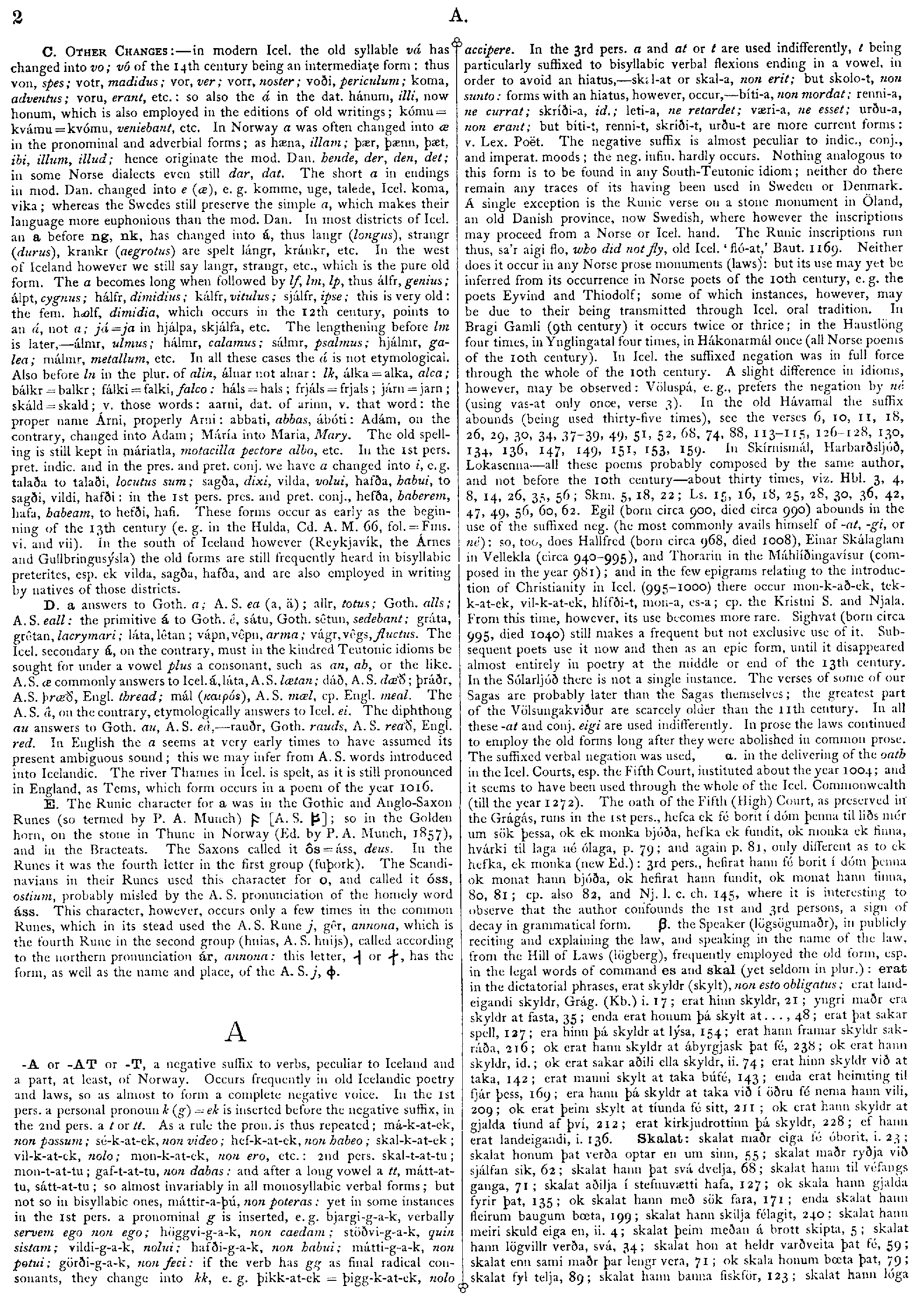
C.
OTHER
CHANGES
:--
in
modern
Icel.
the
old
syllable
va
has
changed
into
vo;
vó
of
the
14th
century
being
an
intermediate
form:
thus
von,
spes;
votr,
madidus;
vor,
ver;
vorr,
noster;
voði,
periculum;
koma,
adventus;
voru,
erant,
etc.:
so
also
the
á
in
the
dat.
hánum,
illi,
now
honum,
which
is
also
employed
in
the
editions
of
old
writings;
kómu
=
kvámu
=
kvómu,
veniebant,
etc.
In
Norway
a
was
often
changed
into
æ
in
the
pronominal
and
adverbial
forms;
as
hæna,
illam;
þær,
þænn,
þæt,
ibi,
ilium,
illud;
hence
originate
the
mod.
Dan.
hende,
der,
den,
det;
in
some
Norse
dialects
even
still
dar,
dat.
The
short
a
in
endings
in
mod.
Dan.
changed
into
e
(æ),
e.
g.
komme,
uge,
talede,
Icel.
koma,
vika;
whereas
the
Swedes
still
preserve
the
simple
a,
which
makes
their
language
more
euphonious
than
the
mod.
Dan.
In
most
districts
of
Icel.
an
a
before
ng,
nk,
has
changed
into
á,
thus
langr
(longus),
strangr
(durus),
krankr
(aegrotus)
are
spelt
lángr,
kránkr,
etc.
In
the
west
of
Iceland
however
we
still
say
langr,
strangr,
etc.,
which
is
the
pure
old
form.
The
a
becomes
long
when
followed
by
lf,
lm,
lp,
thus
álfr,
genius;
álpt,
cygnus;
hálfr,
dimidius;
kálfr,
vitulus;
sjálfr,
ipse;
this
is
very
old:
the
fem.
h lf,
dimidia,
which
occurs
in
the
12th
century,
points
to
an
á,
not
a;
já
=
ja
in
hjálpa,
skjálfa,
etc.
The
lengthening
before
lm
is
later,
--
álmr,
ulmus;
hálmr,
calamus;
sálmr,
psalmus;
hjálmr,
ga-
lea;
málmr,
metallum,
etc.
In
all
these
cases
the
á
is
not
etymological.
Also
before
ln
in
the
plur.
of
alin,
álnar
not
alnar:
lk,
alka
=
alka,
alca;
bálkr
=
balkr;
fálki
=
falki,
falco:
háls
=
hals;
frjáls
=
frjals;
járn
=
jarn;
skáld
=
skald;
v.
those
words:
aarni,
dat.
of
arinn,
v.
that
word:
the
proper
name
Árni,
properly
Arni:
abbati,
abbas,
ábóti:
Adám,
on
the
contrary,
changed
into
Adam;
Máría
into
Maria,
Mary.
The
old
spell-
ing
is
still
kept
in
máriatla,
motacilla
pectore
albo,
etc.
In
the
1st
pers.
pret.
indic.,
and
in
the
pres.
and
pret.
conj.
we
have
a
changed
into
i,
e.
g.
talaða
to
talaði,
locutus
sum;
sagða,
dixi,
vilda,
volui,
hafða,
habui,
to
sagði,
vildi,
hafði:
in
the
1st
pers.
pres.
and
pret.
conj.,
hefða,
haberem,
hafa,
habeam,
to
hefði,
hafi.
These
forms
occur
as
early
as
the
begin-
ning
of
the
13th
century
(e.
g.
in
the
Hulda,
Cd.
A.
M.
66,
fol.
=
Fms.
vi.
and
vii).
In
the
south
of
Iceland
however
(Reykjavik,
the
Árnes
and
Gullbringusýsla)
the
old
forms
are
still
frequently
heard
in
bisyllabic
preterites,
esp.
ek
vilda,
sagða,
hafða,
and
are
also
employed
in
writing
by
natives
of
those
districts.
D.
a
answers
to
Goth,
a;
A.
S.
ea
(a,
ä);
allr,
totus;
Goth,
alls;
A.
S.
eall:
the
primitive
á
to
Goth,
ê,
sátu,
Goth,
sêtun,
sedebant;
gráta,
grétun,
lacrymari;
láta,
lêtan;
vápn,
vêpn,
arma;
vagr,
vêgs,
fluctus.
The
Icel.
secondary
á,
on
the
contrary,
must
in
the
kindred
Teutonic
idioms
be
sought
for
under
a
vowel
plus
a
consonant,
such
as
an,
ah,
or
the
like.
A.
S.
æ
commonly
answers
to
Icel.
á,
láta,
A.
S.
lætan;
dáð,
A.
S.
dæð;
þráðr,
A.
S.
þræð,
Engl.
thread;
mál
(GREEK),
A.
S.
mœl,
cp.
Engl.
meal.
The
A.
S.
(1,
on
the
contrary,
etyrnologically
answers
to
Icel.
ei.
The
diphthong
au
answers
to
Goth.
au,
A.
S.
eá,
--
rauðr,
Goth.
rauds,
A.
S.
reað,
Engl.
red.
In
English
the
a
seems
at
very
early
times
to
have
assumed
its
present
ambiguous
sound;
this
we
may
infer
from
A.
S.
words
introduced
into
Icelandic.
The
river
Thames
in
Icel.
is
spelt,
as
it
is
still
pronounced
in
England,
as
Tems,
which
form
occurs
in
a
poem
of
the
year
1016.
E.
The
Runic
character
for
a
was
in
the
Gothic
and
Anglo-Saxon
Runes
(so
termed
by
P.
A.
Munch)
RUNE
[A.
S.
RUNE];
so
in
the
Golden
horn,
on
the
stone
in
Thune
in
Norway
(Ed.
by
P.
A.
Munch,
1857),
and
in
the
Bracteats.
The
Saxons
called
it
os
=
áss,
deus.
In
the
Runes
it
was
the
fourth
letter
in
the
first
group
(fuþork).
The
Scandi-
navians
in
their
Runes
used
this
character
for
o,
and
called
it
óss,
ostium,
probably
misled
by
the
A.
S.
pronunciation
of
the
homely
word
áss.
This
character,
however,
occurs
only
a
few
times
in
the
common
Runes,
which
in
its
stead
used
the
A.
S.
Rune
RUNE,
gér,
annona,
which
is
the
fourth
Rune
in
the
second
group
(hnias,
A.
S.
hnijs),
called
according
to
the
northern
pronunciation
ár,
annona:
this
letter,
RUNE
or
RUNE
has
the
form,
as
well
as
the
name
and
place,
of
the
A.
S.
RUNE,
RUNE.
lf,
dimidia,
which
occurs
in
the
12th
century,
points
to
an
á,
not
a;
já
=
ja
in
hjálpa,
skjálfa,
etc.
The
lengthening
before
lm
is
later,
--
álmr,
ulmus;
hálmr,
calamus;
sálmr,
psalmus;
hjálmr,
ga-
lea;
málmr,
metallum,
etc.
In
all
these
cases
the
á
is
not
etymological.
Also
before
ln
in
the
plur.
of
alin,
álnar
not
alnar:
lk,
alka
=
alka,
alca;
bálkr
=
balkr;
fálki
=
falki,
falco:
háls
=
hals;
frjáls
=
frjals;
járn
=
jarn;
skáld
=
skald;
v.
those
words:
aarni,
dat.
of
arinn,
v.
that
word:
the
proper
name
Árni,
properly
Arni:
abbati,
abbas,
ábóti:
Adám,
on
the
contrary,
changed
into
Adam;
Máría
into
Maria,
Mary.
The
old
spell-
ing
is
still
kept
in
máriatla,
motacilla
pectore
albo,
etc.
In
the
1st
pers.
pret.
indic.,
and
in
the
pres.
and
pret.
conj.
we
have
a
changed
into
i,
e.
g.
talaða
to
talaði,
locutus
sum;
sagða,
dixi,
vilda,
volui,
hafða,
habui,
to
sagði,
vildi,
hafði:
in
the
1st
pers.
pres.
and
pret.
conj.,
hefða,
haberem,
hafa,
habeam,
to
hefði,
hafi.
These
forms
occur
as
early
as
the
begin-
ning
of
the
13th
century
(e.
g.
in
the
Hulda,
Cd.
A.
M.
66,
fol.
=
Fms.
vi.
and
vii).
In
the
south
of
Iceland
however
(Reykjavik,
the
Árnes
and
Gullbringusýsla)
the
old
forms
are
still
frequently
heard
in
bisyllabic
preterites,
esp.
ek
vilda,
sagða,
hafða,
and
are
also
employed
in
writing
by
natives
of
those
districts.
D.
a
answers
to
Goth,
a;
A.
S.
ea
(a,
ä);
allr,
totus;
Goth,
alls;
A.
S.
eall:
the
primitive
á
to
Goth,
ê,
sátu,
Goth,
sêtun,
sedebant;
gráta,
grétun,
lacrymari;
láta,
lêtan;
vápn,
vêpn,
arma;
vagr,
vêgs,
fluctus.
The
Icel.
secondary
á,
on
the
contrary,
must
in
the
kindred
Teutonic
idioms
be
sought
for
under
a
vowel
plus
a
consonant,
such
as
an,
ah,
or
the
like.
A.
S.
æ
commonly
answers
to
Icel.
á,
láta,
A.
S.
lætan;
dáð,
A.
S.
dæð;
þráðr,
A.
S.
þræð,
Engl.
thread;
mál
(GREEK),
A.
S.
mœl,
cp.
Engl.
meal.
The
A.
S.
(1,
on
the
contrary,
etyrnologically
answers
to
Icel.
ei.
The
diphthong
au
answers
to
Goth.
au,
A.
S.
eá,
--
rauðr,
Goth.
rauds,
A.
S.
reað,
Engl.
red.
In
English
the
a
seems
at
very
early
times
to
have
assumed
its
present
ambiguous
sound;
this
we
may
infer
from
A.
S.
words
introduced
into
Icelandic.
The
river
Thames
in
Icel.
is
spelt,
as
it
is
still
pronounced
in
England,
as
Tems,
which
form
occurs
in
a
poem
of
the
year
1016.
E.
The
Runic
character
for
a
was
in
the
Gothic
and
Anglo-Saxon
Runes
(so
termed
by
P.
A.
Munch)
RUNE
[A.
S.
RUNE];
so
in
the
Golden
horn,
on
the
stone
in
Thune
in
Norway
(Ed.
by
P.
A.
Munch,
1857),
and
in
the
Bracteats.
The
Saxons
called
it
os
=
áss,
deus.
In
the
Runes
it
was
the
fourth
letter
in
the
first
group
(fuþork).
The
Scandi-
navians
in
their
Runes
used
this
character
for
o,
and
called
it
óss,
ostium,
probably
misled
by
the
A.
S.
pronunciation
of
the
homely
word
áss.
This
character,
however,
occurs
only
a
few
times
in
the
common
Runes,
which
in
its
stead
used
the
A.
S.
Rune
RUNE,
gér,
annona,
which
is
the
fourth
Rune
in
the
second
group
(hnias,
A.
S.
hnijs),
called
according
to
the
northern
pronunciation
ár,
annona:
this
letter,
RUNE
or
RUNE
has
the
form,
as
well
as
the
name
and
place,
of
the
A.
S.
RUNE,
RUNE.
Germanic Lexicon Project (main page)
This search system was written by
Sean Crist
Please consider
volunteering
to correct the data in these online dictionaries.
No rights reserved. Feel free to use these data in any way you please.