|
|

Tip: In the search results, you can click on any word or abbreviation for more information.
|
Source: Bosworth/Toller, page b0249, entry 22 View original page image as: [TIFF] [PNG] [View previous entry] [View next entry] |
[Comment on this entry] [View comments] |
The following entry has been hand-corrected once. |
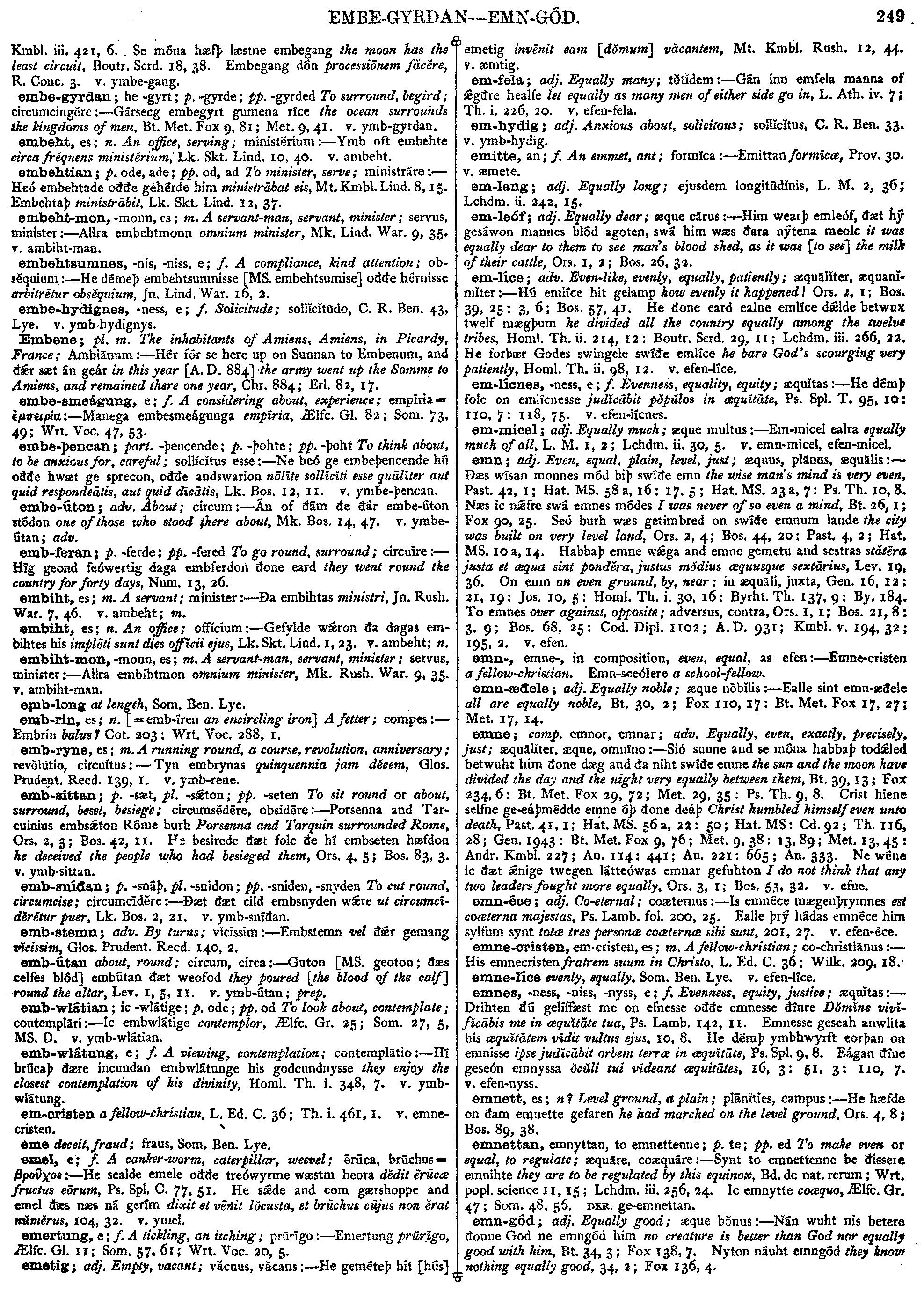
emb-útan about, round; circum, circa :-- Guton [MS. geoton; ðæs celfes blód] embútan ðæt weofod they poured [the blood of the calf] round the altar. Lev. 1. 5, 11. v. ymb-útan; prep.
|
Source: Bosworth/Toller, page b0428, entry 19 View original page image as: [TIFF] [PNG] [View previous entry] [View next entry] |
[Comment on this entry] [View comments] |
The following entry has been hand-corrected once. |
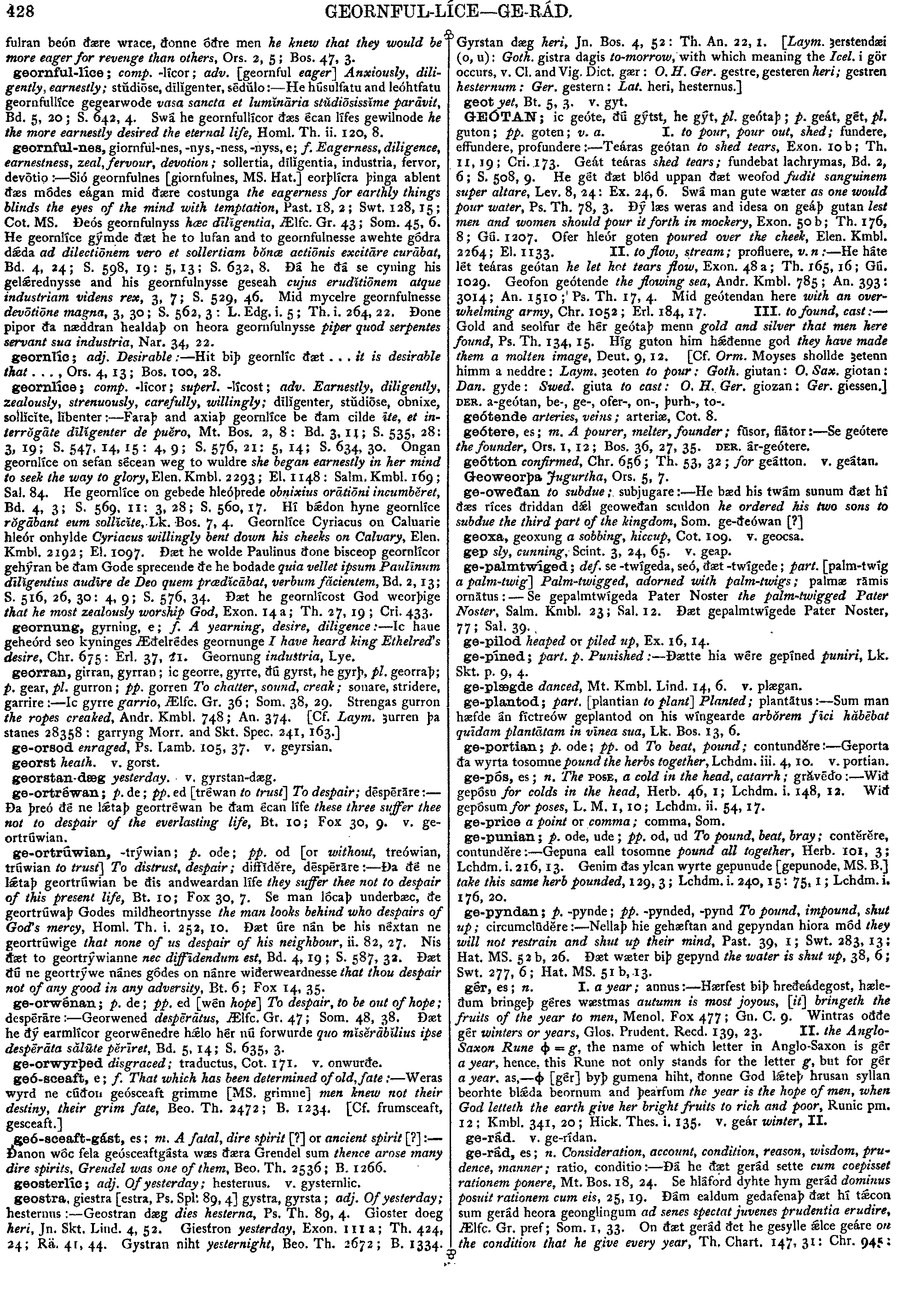
GEÓTAN;
ic
geóte,
ðú
gýtst,
he
gýt,
pl.
geótaþ;
p.
geát,
gét,
pl.
guton;
pp.
goten;
v.
a.
I.
to
pour,
pour
out,
shed;
fundere,
effundere,
profundere
:--
Teáras
geótan
to
shed
tears,
Exon.
10
b;
Th.
11,
19;
Cri.
173.
Geát
teáras
shed
tears;
fundebat
lachrymas,
Bd.
2,
6;
S.
508,
9.
He
gét
ðæt
blód
uppan
ðæt
weofod
fudit
sanguinem
super
altare,
Lev.
8,
24:
Ex.
24,
6.
Swá
man
gute
wæter
as
one
would
pour
water,
Ps.
Th.
78,
3.
Ðý
læs
weras
and
idesa
on
geáþ
gutan
lest
men
and
women
should
pour
it
forth
in
mockery,
Exon.
50
b;
Th.
176,
8;
Gú.
1207.
Ofer
hleór
goten
poured
over
the
cheek,
Elen.
Kmbl.
2264;
El.
1133.
II.
to
flow,
stream;
profluere,
v.n
:--
He
háte
lét
teáras
geótan
he
let
hot
tears
flow,
Exon.
48
a;
Th.
165,
16;
Gú.
1029.
Geofon
geótende
the
flowing
sea,
Andr.
Kmbl.
785;
An.
393:
3014;
An.
1510;
Ps.
Th.
17,
4.
Mid
geótendan
here
with
an
overwhelming
army,
Chr.
1052;
Erl.
184,
17.
III.
to
found,
cast
:--
Gold
and
seolfur
ðe
hér
geótaþ
menn
gold
and
silver
that
men
here
found,
Ps.
Th.
134,
15.
Híg
guton
him
h ðenne
god
they
have
made
them
a
molten
image,
Deut.
9,
12.
[Cf.
Orm.
Moyses
shollde
ðenne
god
they
have
made
them
a
molten
image,
Deut.
9,
12.
[Cf.
Orm.
Moyses
shollde
 etenn
himm
a
neddre:
Laym.
eoten
to
pour:
Goth.
giutan:
O.
Sax.
giotan:
Dan.
gyde:
Swed.
giuta
to
cast:
O.
H.
Ger.
giozan:
Ger.
giessen.]
DER.
a-geótan,
be-,
ge-,
ofer-,
on-,
þurh-,
to-.
etenn
himm
a
neddre:
Laym.
eoten
to
pour:
Goth.
giutan:
O.
Sax.
giotan:
Dan.
gyde:
Swed.
giuta
to
cast:
O.
H.
Ger.
giozan:
Ger.
giessen.]
DER.
a-geótan,
be-,
ge-,
ofer-,
on-,
þurh-,
to-.
|
Source: Bosworth/Toller, page b0807, entry 3 View original page image as: [TIFF] [PNG] [View previous entry] [View next entry] |
[Comment on this entry] [View comments] |
The following entry has been hand-corrected once. |
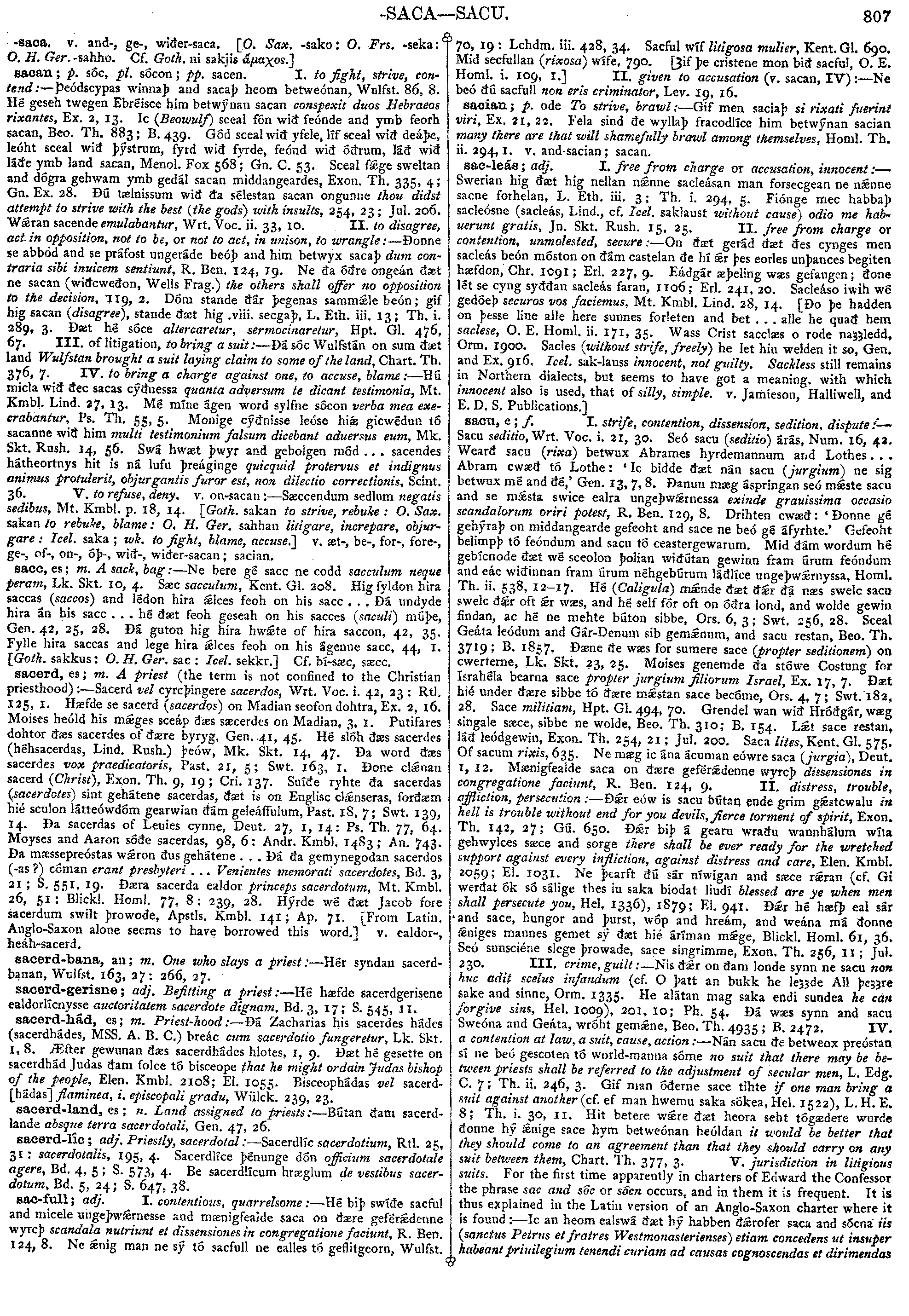
sacc,
es;
m.
A
sack,
bag
:--
Ne
bere
gé
sacc
ne
codd
sacculum
neque
peram,
Lk.
Skt.
10,
4.
Sæc
sacculum,
Kent.
Gl.
208.
Hig
fyldon
hira
saccas
(saccos)
and
lédon
hira
lces
feoh
on
his
sacc
...
Ðá
undyde
hira
án
his
sacc
...
hé
ðæt
feoh
geseah
on
his
sacces
(saculi)
múþe,
Gen.
42,
25,
28.
Ðá
guton
hig
hira
hwte
of
hira
saccon,
42,
35.
Fylle
hira
saccas
and
lege
hira
lces
feoh
on
his
ágenne
sacc,
44,
1.
[Goth.
sakkus
:
O.
H.
Ger.
sac
:
Icel.
sekkr.]
Cf.
bí-sæc,
sæcc.
|
Source: Bosworth/Toller, page b1143, entry 10 View original page image as: [TIFF] [PNG] [View previous entry] [View next entry] |
[Comment on this entry] [View comments] |
The following entry has been hand-corrected once. |
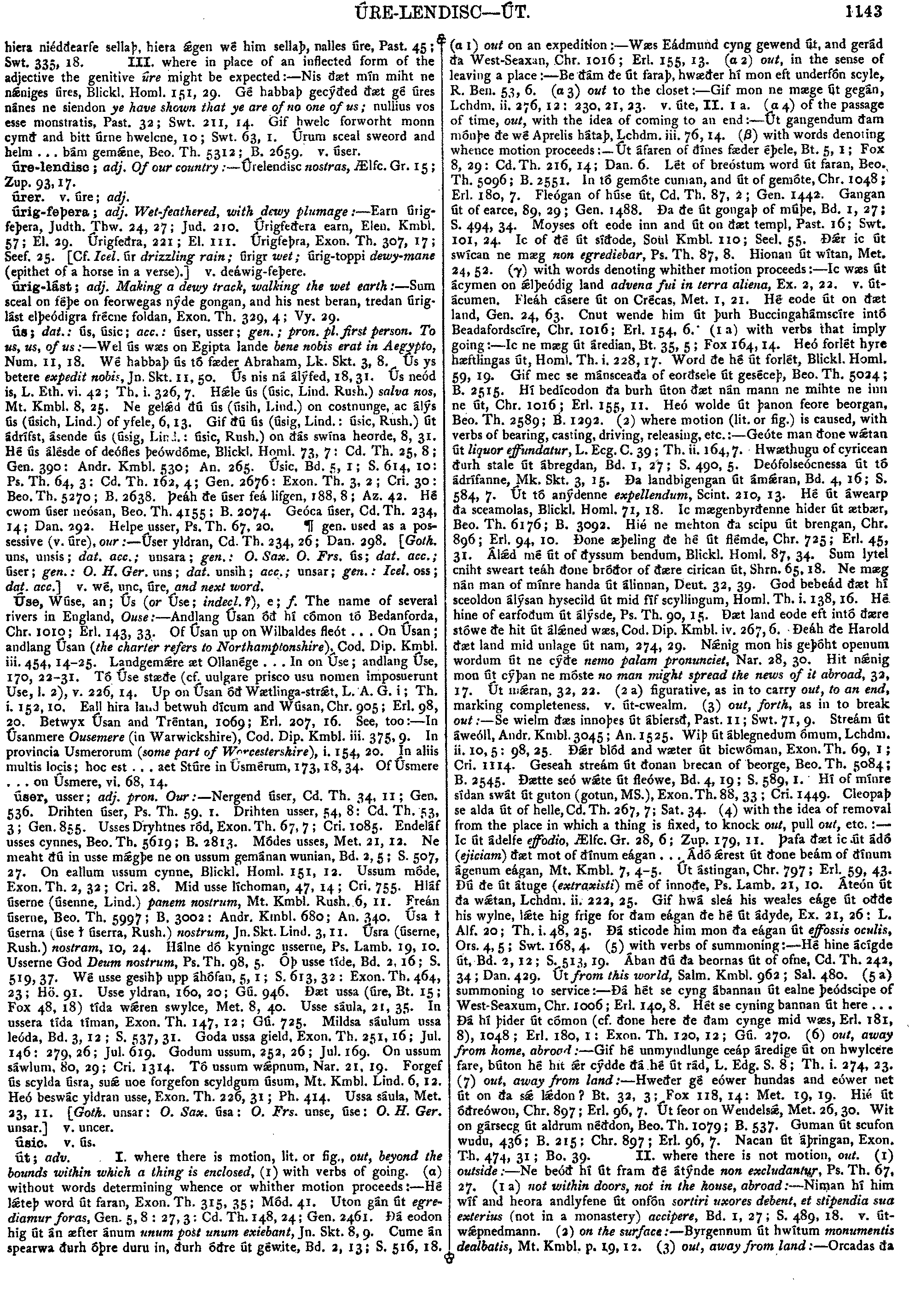
út;
adv.
I.
where
there
is
motion,
lit.
or
fig.,
out,
beyond
the
bounds
within
which
a
thing
is
enclosed,
(1)
with
verbs
of
going.
( )
without
words
determining
whence
or
whither
motion
proceeds
:--
Hé
lteþ
word
út
faran,
Exon.
Th.
315,
35;
Mód.
41.
Uton
gán
út
egrediamur
foras,
Gen.
5,
8:
27,
3:
Cd.
Th.
148,
24;
Gen.
2461.
Ðá
eodon
hig
út
án
æfter
ánum
unum
post
unum
exiebant,
Jn.
Skt.
8,
9.
Cume
án
spearwa
ðurh
óþre
duru
in,
ðurh
óðre
út
géwite,
Bd.
2,
13;
S.
516,
18.
(
1)
out
on
an
expedition
:--
Wæs
Eádmund
cyng
gewend
út,
and
gerád
ða
West-Seaxan,.Chr.
1016;
Erl.
155,
13.
(
2)
out,
in
the
sense
of
leaving
a
place
:--
Be
ðá
ðe
út
faraþ,
hwæðer
hí
mon
eft
underfón
scyle,
R.
Ben.
53,
6.
(
3)
out
to
the
closet
:--
Gif
mon
ne
mæge
út
gegán,
Lchdm.
ii.
276,
12:
230,
21,
23.
v.
úte,
II.
1
a.
(
4)
of
the
passage
of
time,
out,
with
the
idea
of
coming
to
an
end
:--
Út
gangendum
ðam
mónþe
ðe
wé
Aprelis
hátaþ,
Lchdm.
iii.
76,
14.
(
)
without
words
determining
whence
or
whither
motion
proceeds
:--
Hé
lteþ
word
út
faran,
Exon.
Th.
315,
35;
Mód.
41.
Uton
gán
út
egrediamur
foras,
Gen.
5,
8:
27,
3:
Cd.
Th.
148,
24;
Gen.
2461.
Ðá
eodon
hig
út
án
æfter
ánum
unum
post
unum
exiebant,
Jn.
Skt.
8,
9.
Cume
án
spearwa
ðurh
óþre
duru
in,
ðurh
óðre
út
géwite,
Bd.
2,
13;
S.
516,
18.
(
1)
out
on
an
expedition
:--
Wæs
Eádmund
cyng
gewend
út,
and
gerád
ða
West-Seaxan,.Chr.
1016;
Erl.
155,
13.
(
2)
out,
in
the
sense
of
leaving
a
place
:--
Be
ðá
ðe
út
faraþ,
hwæðer
hí
mon
eft
underfón
scyle,
R.
Ben.
53,
6.
(
3)
out
to
the
closet
:--
Gif
mon
ne
mæge
út
gegán,
Lchdm.
ii.
276,
12:
230,
21,
23.
v.
úte,
II.
1
a.
(
4)
of
the
passage
of
time,
out,
with
the
idea
of
coming
to
an
end
:--
Út
gangendum
ðam
mónþe
ðe
wé
Aprelis
hátaþ,
Lchdm.
iii.
76,
14.
( )
with
words
denoting
whence
motion
proceeds
:--
Út
áfaren
of
ðínes
fæder
éþele,
Bt.
5,
1;
Fox
8,
29:
Cd.
Th.
216,
14;
Dan.
6.
Lét
of
breóstum
word
út
faran,
Beo.
Th.
5096;
B.
2551.
In
tó
gemóte
cuman,
and
út
of
gemóte.
Chr.
1048;
Erl.
180,
7.
Fleógan
of
húse
út,
Cd.
Th.
87,
2;
Gen.
1442.
Gangan
út
of
earce,
89,
29;
Gen.
1488.
Ða
ðe
út
gongaþ
of
múþe,
Bd.
1,
27;
S.
494,
34.
Moyses
oft
eode
inn
and
út
on
ðæt
tempt,
Past.
16;
Swt.
101,
24.
Ic
of
ðé
út
síðode,
Soul
Kmbl.
110;
Seel.
55,
Ðr
ic
út
swícan
ne
mæg
non
egrediebar,
Ps.
Th.
87,
8.
Hionan
út
wítan,
Met.
24,
52.
(
)
with
words
denoting
whence
motion
proceeds
:--
Út
áfaren
of
ðínes
fæder
éþele,
Bt.
5,
1;
Fox
8,
29:
Cd.
Th.
216,
14;
Dan.
6.
Lét
of
breóstum
word
út
faran,
Beo.
Th.
5096;
B.
2551.
In
tó
gemóte
cuman,
and
út
of
gemóte.
Chr.
1048;
Erl.
180,
7.
Fleógan
of
húse
út,
Cd.
Th.
87,
2;
Gen.
1442.
Gangan
út
of
earce,
89,
29;
Gen.
1488.
Ða
ðe
út
gongaþ
of
múþe,
Bd.
1,
27;
S.
494,
34.
Moyses
oft
eode
inn
and
út
on
ðæt
tempt,
Past.
16;
Swt.
101,
24.
Ic
of
ðé
út
síðode,
Soul
Kmbl.
110;
Seel.
55,
Ðr
ic
út
swícan
ne
mæg
non
egrediebar,
Ps.
Th.
87,
8.
Hionan
út
wítan,
Met.
24,
52.
( )
with
words
denoting
whither
motion
proceeds
:--
Ic
wæs
út
ácymen
on
lþeódig
land
advena
fui
in
terra
aliena,
Ex.
2,
22.
v.
útácumen.
Fleáh
cásere
út
on
Crécas,
Met.
1,
21.
Hé
eode
út
on
ðæt
land,
Gen.
24,
63.
Cnut
wende
him
út
þurh
Buccingahámscíre
intó
Beadafordscíre,
Chr,
1016;
Erl.
154,
6.
(1
a)
with
verbs
that
imply
going
:--
Ic
ne
mæg
út
áredian,
Bt.
35,
5;
Fox
164,
14.
Heó
forlét
hyre
hæftlingas
út,
Homl.
Th.
i.
228,
17.
Word
ðe
hé
út
forlét,
Blickl.
Homl.
59,
19.
Gif
mec
se
mánsceaða
of
eorðsele
út
geséceþ,
Beo.
Th.
5024;
B.
2515.
Hí
bedícodon
ða
burh
úton
ðæt
nán
mann
ne
mihte
ne
inn
ne
út,
Chr.
1016;
Erl.
155,
11.
Heó
wolde
út
þanon
feore
beorgan,
Beo.
Th.
2589;
B.
1292.
(2)
where
motion
(lit.
or
fig.)
is
caused,
with
verbs
of
bearing,
casting,
driving,
releasing,
etc.
:--
Geóte
man
ðone
wtan
út
liquor
effundatur,
L.
Ecg.
C.
39;
Th.
ii.
164,
7.
Hwæthugu
of
cyricean
ðurh
stale
út
ábregdan,
Bd.
1,
27;
S.
490,
5.
Deófolseócnessa
út
tó
ádrífanne,
Mk.
Skt.
3,
15.
Ða
landbigengan
út
ámran,
Bd.
4,
16;
S.
584,
7.
Út
tó
anýdenne
expellendum,
Scint.
210,
13.
Hé
út
áwearp
ða
sceamolas,
Blickl.
Homl.
71,
18.
Ic
mægenbyrðenne
hider
út
ætbær,
Beo.
Th.
6176;
B.
3092.
Hié
ne
mehton
ða
scipu
út
brengan,
Chr.
896;
Erl.
94,
10.
Ðone
æþeling
ðe
hé
út
flémde,
Chr.
725;
Erl.
45,
31.
Áld
mé
út
of
ðyssum
bendum,
Blickl.
Homl.
87,
34.
Sum
lytel
cniht
sweart
teáh
ðone
bróðor
of
ðære
cirican
út,
Shrn.
65,
18.
Ne
mæg
nán
man
of
mínre
handa
út
álinnan,
Deut.
32,
39.
God
bebeád
ðæt
hí
sceoldon
álýsan
hysecild
út
mid
fíf
scyllingum,
Homl.
Th.
i.
138,
16.
Hé
hine
of
earfoðum
út
álýsde,
Ps.
Th.
90,
15.
Ðæt
land
eode
eft
intó
ðære
stówe
ðe
hit
út
álned
wæs,
Cod.
Dip.
Kmbl.
iv.
267,
6.
Ðeáh
ðe
Harold
ðæt
land
mid
unlage
út
nam,
274,
29.
Nnig
mon
his
geþóht
openum
wordum
út
ne
cýðe
nemo
palam
pronunciet,
Nar.
28,
30.
Hit
nnig
mon
út
cýþan
ne
móste
no
man
might
spread
the
news
of
it
abroad,
32,
17.
Út
mran,
32,
22.
(2
a)
figurative,
as
in
to
carry
out,
to
an
end,
marking
completeness.
v.
út-cwealm.
(3)
out,
forth,
as
in
to
break
out
:--
Se
wielm
ðæs
innoþes
út
ábiersð,
Past.
11;
Swt.
71,
9.
Streám
út
áweóll,
Andr.
Kmbl.
3045;
An.
1525.
Wiþ
út
áblegnedum
ómum,
Lchdm.
ii.
10,
5:
98,
25.
Ðr
blód
and
wæter
út
bicwóman,
Exon.
Th.
69,
1;
Cri.
1114.
Geseah
streám
út
ðonan
brecan
of
beorge,
Beo.
Th.
5084;
B.
2545.
Ðætte
seó
wte
út
fleówe,
Bd.
4,
19;
S.
589,
1.
Hí
of
mínre
sídan
swát
út
guton
(gotun,
MS.),
Exon.
Th.
88,
33;
Cri.
1449.
Cleopaþ
se
alda
út
of
belle,
Cd.
Th.
267,
7;
Sat.
34.
(4)
with
the
idea
of
removal
from
the
place
in
which
a
thing
is
fixed,
to
knock
out,
pull
out,
etc.
:--
Ic
út
ádelfe
effodio,
Ælfc.
Gr.
28,
6;
Zup.
199,
11.
Þafa
ðæt
ic
út
ádó
(ejiciam)
ðæt
mot
of
ðínum
eágan
...
Ádó
rest
út
ðone
beám
of
ðínum
ágenum
eágan,
Mt.
Kmbl.
7,
4-5.
Út
ástingan,
Chr.
797;
Erl.
59,
43.
Ðú
ðe
út
átuge
(extraxisti)
mé
of
innoðe,
Ps.
Lamb.
21,
10.
Áteón
út
ða
wtan,
Lchdm.
ii.
222,
25.
Gif
hwá
sleá
his
weales
eáge
út
oððe
his
wylne,
lte
hig
frige
for
ðám
eágan
ðe
hé
út
ádyde,
Ex.
21,
26:
L.
Alf.
20;
Th.
i.
48,
25.
Ðá
sticode
him
mon
ða
eágan
út
effossis
oculis,
Ors.
4,
5;
Swt.
168,
4.
(5)
with
verbs
of
summoning
:--
Hé
hine
ácígde
út,
Bd.
2,
12;
S.
513,
19.
Ában
ðú
ða
beornas
út
of
ofne,
Cd.
Th.
242,
34;
Dan.
429.
Út
from
this
world,
Salm.
Kmbl.
962;
Sal.
480.
(5
a)
summoning
to
service
:--
Ðá
hét
se
cyng
ábannan
út
ealne
þeódscipe
of
West-Seaxum.
Chr.
1006;
Erl.
140,
8.
Hét
se
cyning
bannan
út
here
...
Ðá
hí
þider
út
cómon
(cf.
ðone
here
ðe
ðam
cynge
mid
wæs,
Ed.
181,
8),
1048;
Erl.
180,
1:
Exon.
Th.
120,
12;
Gú.
270.
(6)
out,
away
from
home,
abroad
:--
Gif
hé
unmyndlunge
ceáp
áredige
út
on
hwylcere
fare,
búton
hé
hit
r
cýdde
ðá
hé
út
rád,
L.
Edg.
S.
8;
Th.
i.
274,
23.
(7)
out,
away
from
land
:--
Hweðer
gé
eówer
hundas
and
eówer
net
út
on
ða
s
ldon?
Bt.
32,
3;
Fox
118,
14:
Met.
19,
19.
Hié
út
óðreówon,
Chr.
897;
Erl.
96,
7.
Út
feor
on
Weudels,
Met.
26,
30.
Wit
)
with
words
denoting
whither
motion
proceeds
:--
Ic
wæs
út
ácymen
on
lþeódig
land
advena
fui
in
terra
aliena,
Ex.
2,
22.
v.
útácumen.
Fleáh
cásere
út
on
Crécas,
Met.
1,
21.
Hé
eode
út
on
ðæt
land,
Gen.
24,
63.
Cnut
wende
him
út
þurh
Buccingahámscíre
intó
Beadafordscíre,
Chr,
1016;
Erl.
154,
6.
(1
a)
with
verbs
that
imply
going
:--
Ic
ne
mæg
út
áredian,
Bt.
35,
5;
Fox
164,
14.
Heó
forlét
hyre
hæftlingas
út,
Homl.
Th.
i.
228,
17.
Word
ðe
hé
út
forlét,
Blickl.
Homl.
59,
19.
Gif
mec
se
mánsceaða
of
eorðsele
út
geséceþ,
Beo.
Th.
5024;
B.
2515.
Hí
bedícodon
ða
burh
úton
ðæt
nán
mann
ne
mihte
ne
inn
ne
út,
Chr.
1016;
Erl.
155,
11.
Heó
wolde
út
þanon
feore
beorgan,
Beo.
Th.
2589;
B.
1292.
(2)
where
motion
(lit.
or
fig.)
is
caused,
with
verbs
of
bearing,
casting,
driving,
releasing,
etc.
:--
Geóte
man
ðone
wtan
út
liquor
effundatur,
L.
Ecg.
C.
39;
Th.
ii.
164,
7.
Hwæthugu
of
cyricean
ðurh
stale
út
ábregdan,
Bd.
1,
27;
S.
490,
5.
Deófolseócnessa
út
tó
ádrífanne,
Mk.
Skt.
3,
15.
Ða
landbigengan
út
ámran,
Bd.
4,
16;
S.
584,
7.
Út
tó
anýdenne
expellendum,
Scint.
210,
13.
Hé
út
áwearp
ða
sceamolas,
Blickl.
Homl.
71,
18.
Ic
mægenbyrðenne
hider
út
ætbær,
Beo.
Th.
6176;
B.
3092.
Hié
ne
mehton
ða
scipu
út
brengan,
Chr.
896;
Erl.
94,
10.
Ðone
æþeling
ðe
hé
út
flémde,
Chr.
725;
Erl.
45,
31.
Áld
mé
út
of
ðyssum
bendum,
Blickl.
Homl.
87,
34.
Sum
lytel
cniht
sweart
teáh
ðone
bróðor
of
ðære
cirican
út,
Shrn.
65,
18.
Ne
mæg
nán
man
of
mínre
handa
út
álinnan,
Deut.
32,
39.
God
bebeád
ðæt
hí
sceoldon
álýsan
hysecild
út
mid
fíf
scyllingum,
Homl.
Th.
i.
138,
16.
Hé
hine
of
earfoðum
út
álýsde,
Ps.
Th.
90,
15.
Ðæt
land
eode
eft
intó
ðære
stówe
ðe
hit
út
álned
wæs,
Cod.
Dip.
Kmbl.
iv.
267,
6.
Ðeáh
ðe
Harold
ðæt
land
mid
unlage
út
nam,
274,
29.
Nnig
mon
his
geþóht
openum
wordum
út
ne
cýðe
nemo
palam
pronunciet,
Nar.
28,
30.
Hit
nnig
mon
út
cýþan
ne
móste
no
man
might
spread
the
news
of
it
abroad,
32,
17.
Út
mran,
32,
22.
(2
a)
figurative,
as
in
to
carry
out,
to
an
end,
marking
completeness.
v.
út-cwealm.
(3)
out,
forth,
as
in
to
break
out
:--
Se
wielm
ðæs
innoþes
út
ábiersð,
Past.
11;
Swt.
71,
9.
Streám
út
áweóll,
Andr.
Kmbl.
3045;
An.
1525.
Wiþ
út
áblegnedum
ómum,
Lchdm.
ii.
10,
5:
98,
25.
Ðr
blód
and
wæter
út
bicwóman,
Exon.
Th.
69,
1;
Cri.
1114.
Geseah
streám
út
ðonan
brecan
of
beorge,
Beo.
Th.
5084;
B.
2545.
Ðætte
seó
wte
út
fleówe,
Bd.
4,
19;
S.
589,
1.
Hí
of
mínre
sídan
swát
út
guton
(gotun,
MS.),
Exon.
Th.
88,
33;
Cri.
1449.
Cleopaþ
se
alda
út
of
belle,
Cd.
Th.
267,
7;
Sat.
34.
(4)
with
the
idea
of
removal
from
the
place
in
which
a
thing
is
fixed,
to
knock
out,
pull
out,
etc.
:--
Ic
út
ádelfe
effodio,
Ælfc.
Gr.
28,
6;
Zup.
199,
11.
Þafa
ðæt
ic
út
ádó
(ejiciam)
ðæt
mot
of
ðínum
eágan
...
Ádó
rest
út
ðone
beám
of
ðínum
ágenum
eágan,
Mt.
Kmbl.
7,
4-5.
Út
ástingan,
Chr.
797;
Erl.
59,
43.
Ðú
ðe
út
átuge
(extraxisti)
mé
of
innoðe,
Ps.
Lamb.
21,
10.
Áteón
út
ða
wtan,
Lchdm.
ii.
222,
25.
Gif
hwá
sleá
his
weales
eáge
út
oððe
his
wylne,
lte
hig
frige
for
ðám
eágan
ðe
hé
út
ádyde,
Ex.
21,
26:
L.
Alf.
20;
Th.
i.
48,
25.
Ðá
sticode
him
mon
ða
eágan
út
effossis
oculis,
Ors.
4,
5;
Swt.
168,
4.
(5)
with
verbs
of
summoning
:--
Hé
hine
ácígde
út,
Bd.
2,
12;
S.
513,
19.
Ában
ðú
ða
beornas
út
of
ofne,
Cd.
Th.
242,
34;
Dan.
429.
Út
from
this
world,
Salm.
Kmbl.
962;
Sal.
480.
(5
a)
summoning
to
service
:--
Ðá
hét
se
cyng
ábannan
út
ealne
þeódscipe
of
West-Seaxum.
Chr.
1006;
Erl.
140,
8.
Hét
se
cyning
bannan
út
here
...
Ðá
hí
þider
út
cómon
(cf.
ðone
here
ðe
ðam
cynge
mid
wæs,
Ed.
181,
8),
1048;
Erl.
180,
1:
Exon.
Th.
120,
12;
Gú.
270.
(6)
out,
away
from
home,
abroad
:--
Gif
hé
unmyndlunge
ceáp
áredige
út
on
hwylcere
fare,
búton
hé
hit
r
cýdde
ðá
hé
út
rád,
L.
Edg.
S.
8;
Th.
i.
274,
23.
(7)
out,
away
from
land
:--
Hweðer
gé
eówer
hundas
and
eówer
net
út
on
ða
s
ldon?
Bt.
32,
3;
Fox
118,
14:
Met.
19,
19.
Hié
út
óðreówon,
Chr.
897;
Erl.
96,
7.
Út
feor
on
Weudels,
Met.
26,
30.
Wit
|
Source: Bosworth/Toller, page d0389, entry 11 View original page image as: [TIFF] [PNG] [View previous entry] [View next entry] |
[Comment on this entry] [View comments] |
The following entry has been hand-corrected once. |
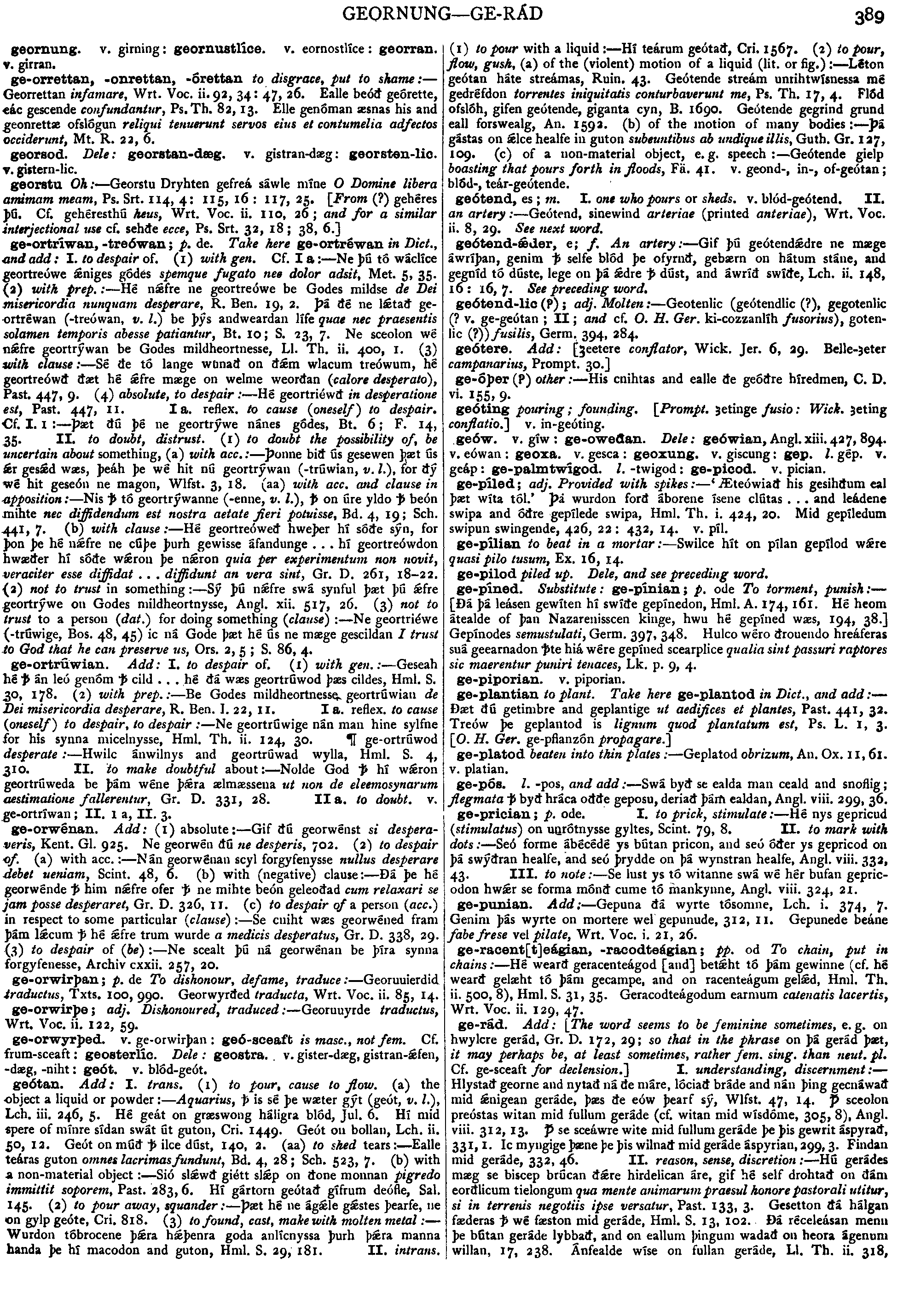
geótan.
Add:
I.
trans.
(1)
to
pour,
cause
to
flow.
(a)
the
object
a
liquid
or
powder:--Aquarius,
 is
sé
þe
wæter
gýt
(geót,
v.
l.),
Lch.
iii.
246,
5.
Hé
geát
on
græswong
háligra
blód,
Jul.
6.
Hí
mid
spere
of
mínre
sídan
swát
út
guton,
Cri.
1449.
Geót
on
bollan,
Lch.
ii.
50,
12.
Geót
on
múð
ilce
dúst,
140,
2.
(aa)
to
shed
tears:--Ealle
teáras
guton
omnes
lacrimas
fundunt,
Bd.
4,
28;
Sch.
523,
7.
(b)
with
a
non-material
object:--Sió
slwð
giétt
slp
on
ðone
monnan
pigredo
immittit
soporem,
Past.
283,
6.
Hí
gártorn
geótað
gífrum
deófle,
Sal.
145.
(2)
to
pour
away,
squander:--Þæt
hé
ne
ágle
gstes
þearfe,
ne
on
gylp
geóte,
Cri.
818.
(3)
to
found,
cast,
make
with
molten
metal:--Wurdon
tóbrocene
þra
hþenra
goda
anlícnyssa
þurh
þra
manna
handa
þe
hí
macodon
and
guton,
Hml.
S.
29,
181.
II.
intrans.
(1)
to
pour
with
a
liquid:--Hí
teárum
geótað,
Cri.
1567.
(2)
to
pour,
flow,
gush,
(a)
of
the
(violent)
motion
of
a
liquid
(lit.
or
fig.
):--Léton
geótan
háte
streámas,
Ruin.
43.
Geótende
streám
unrihtwísnessa
mé
gedréfdon
torrentes
iniquitatis
conturbaverunt
me,
Ps.
Th.
17,
4.
Flód
ofslóh,
gifen
geótende,
giganta
cyn,
B.
1690.
Geótende
gegrind
grund
eall
forswealg,
An.
1592.
(b)
of
the
motion
of
many
bodies:--Þá
gástas
on
lce
healfe
in
guton
subeuntibus
ab
undique
illis,
Guth.
Gr.
127,
109.
(c)
of
a
non-material
object,
e.
g.
speech:--Geótende
gielp
boasting
that
pours
forth
in
floods,
Fä.
41.
v.
geond-,
in-,
of-geótan;
blód-,
teár-geótende.
is
sé
þe
wæter
gýt
(geót,
v.
l.),
Lch.
iii.
246,
5.
Hé
geát
on
græswong
háligra
blód,
Jul.
6.
Hí
mid
spere
of
mínre
sídan
swát
út
guton,
Cri.
1449.
Geót
on
bollan,
Lch.
ii.
50,
12.
Geót
on
múð
ilce
dúst,
140,
2.
(aa)
to
shed
tears:--Ealle
teáras
guton
omnes
lacrimas
fundunt,
Bd.
4,
28;
Sch.
523,
7.
(b)
with
a
non-material
object:--Sió
slwð
giétt
slp
on
ðone
monnan
pigredo
immittit
soporem,
Past.
283,
6.
Hí
gártorn
geótað
gífrum
deófle,
Sal.
145.
(2)
to
pour
away,
squander:--Þæt
hé
ne
ágle
gstes
þearfe,
ne
on
gylp
geóte,
Cri.
818.
(3)
to
found,
cast,
make
with
molten
metal:--Wurdon
tóbrocene
þra
hþenra
goda
anlícnyssa
þurh
þra
manna
handa
þe
hí
macodon
and
guton,
Hml.
S.
29,
181.
II.
intrans.
(1)
to
pour
with
a
liquid:--Hí
teárum
geótað,
Cri.
1567.
(2)
to
pour,
flow,
gush,
(a)
of
the
(violent)
motion
of
a
liquid
(lit.
or
fig.
):--Léton
geótan
háte
streámas,
Ruin.
43.
Geótende
streám
unrihtwísnessa
mé
gedréfdon
torrentes
iniquitatis
conturbaverunt
me,
Ps.
Th.
17,
4.
Flód
ofslóh,
gifen
geótende,
giganta
cyn,
B.
1690.
Geótende
gegrind
grund
eall
forswealg,
An.
1592.
(b)
of
the
motion
of
many
bodies:--Þá
gástas
on
lce
healfe
in
guton
subeuntibus
ab
undique
illis,
Guth.
Gr.
127,
109.
(c)
of
a
non-material
object,
e.
g.
speech:--Geótende
gielp
boasting
that
pours
forth
in
floods,
Fä.
41.
v.
geond-,
in-,
of-geótan;
blód-,
teár-geótende.
|
Source: Bosworth/Toller, page d0626, entry 1 View original page image as: [TIFF] [PNG] [View previous entry] [View next entry] |
[Comment on this entry] [View comments (1)] |
The following entry has been hand-corrected once. |
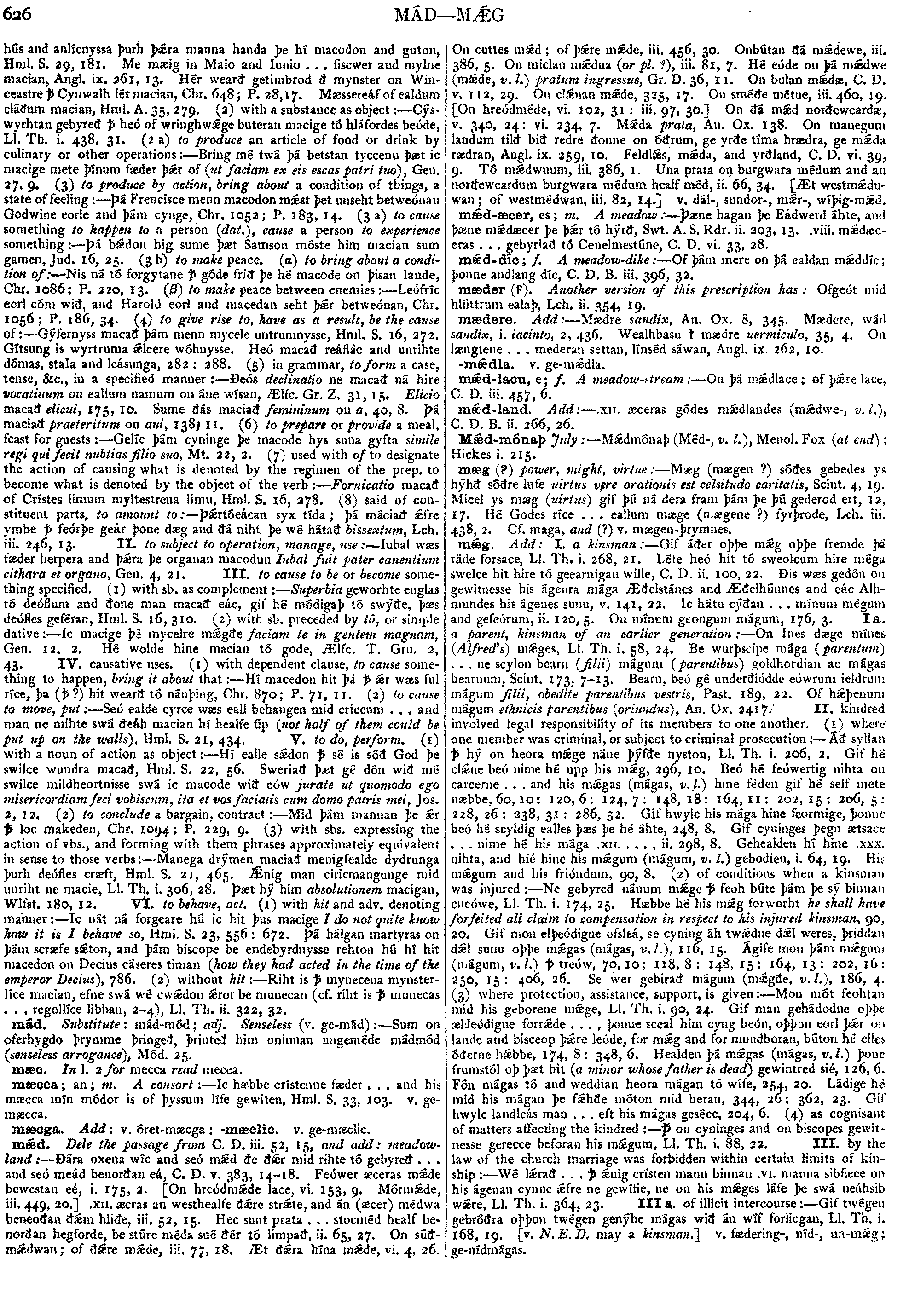
hús
and
anlícnyssa
þurh
þra
manna
handa
þe
hí
macodon
and
guton,
Hml.
S.
29,
181.
Me
mæig
in
Maio
and
Iunio
.
.
.
fiscwer
and
mylne
macian,
Angl.
ix.
261,
13.
Hér
wearð
getimbrod
ð
mynster
on
Winceastre
Cynwalh
lét
macian,
Chr.
648;
P.
28,
17.
Mæssereáf
of
ealdum
cláðum
macian,
Hml,
A.
35,
279.
(2)
with
a
substance
as
object
:--
Cýswyrhtan
gebyreð
heó
of
wringhwge
buteran
macige
tó
hláfordes
beóde,
Ll.
Th.
i.
438,
31.
(2
a)
to
produce
an
article
of
food
or
drink
by
culinary
or
other
operations
:--
Bring
mé
twá
þá
betstan
tyccenu
þæt
ic
macige
mete
þínum
fæder
þr
of
(ut
faciam
ex
eis
escas
patri
tuo),
Gen.
27,
9.
(3)
to
produce
by
action,
bring
about
a
condition
of
things,
a
state
of
feeling
:--
Þá
Frencisce
menn
macodon
mst
þet
unseht
betweónan
Godwine
eorle
and
þám
cynge,
Chr.
1052;
P.
183,
14.
(3
a)
to
cause
something
to
happen
to
a
person
(dat.),
cause
a
person
to
experience
something
:--
Þá
bdon
hig
sume
þæt
Samson
móste
him
macian
sum
gamen,
Jud.
16,
25.
(3b)
to
make
peace,
()
to
bring
about
a
condition
of
:--
Nis
ná
tó
forgytane
góde
frið
þe
hé
macode
on
þisan
lande,
Chr.
1086;
P.
220,
13.
()
to
make
peace
between
enemies
:--
Leófríc
eorl
cóm
wið,
and
Harold
eorl
and
macedan
seht
þr
betweónan,
Chr.
1056
;
P.
186,
34.
(4)
to
give
rise
to,
have
as
a
result,
be
the
cause
of
:--
Gýfernyss
macað
þám
menn
mycele
untrumnysse,
Hml.
S.
16,
272.
Gítsung
is
wyrtruma
lcere
wóhnysse.
Heó
macað
reáflác
and
unrihte
dómas,
stala
and
leásunga,
282
:
288.
(5)
in
grammar,
to
form
a
case,
tense,
&c.
,
in
a
specified
manner
:--
Ðeós
declinatio
ne
macað
ná
hire
vocatiuum
on
eallum
namum
on
áne
wísan,
Ælfc.
Gr.
Z.
31,
15.
Elicio
macað
elicui,
175,
10.
Sume
ðás
maciað
femininum
on
a,
40,
8.
Þá
maciað
praeteritum
on
aui,
138,
11.
(6)
to
prepare
or
provide
a
meal,
feast
for
guests
:--
Gelíc
þám
cyninge
þe
macode
hys
suna
gyfta
simile
regi
qui
fecit
nubtias
filio
suo,
Mt.
22,
2.
(7)
used
with
of
to
designate
the
action
of
causing
what
is
denoted
by
the
regimen
of
the
prep.
to
become
what
is
denoted
by
the
object
of
the
verb
:--
Fornicatio
macað
of
Crístes
limum
myltestrena
limu,
Hml.
S.
16,
278.
(8)
said
of
constituent
parts,
to
amount
to
:--
Þrtóeácan
syx
tída
;
þá
máciað
fre
ymbe
feórþe
geár
þone
dæg
and
ðá
niht
þe
wé
hátað
bissextum.
Lch.
iii.
246,
13.
II.
to
subject
to
operation,
manage,
use
:--
Iubal
wæs
fæder
herpera
and
þra
þe
organan
macodun
Iubal
fuit
pater
canentium
cithara
et
organo,
Gen.
4,
21.
III.
to
cause
to
be
or
become
something
specified,
(1)
with
sb.
as
complement
:--
Superbia
geworhte
englas
tó
deóflum
and
ðone
man
macað
eác,
gif
hé
módigaþ
tó
swýðe,
þæs
deófles
geféran,
Hml.
S.
16,
310.
(2)
with
sb.
preceded
by
tó,
or
simple
dative
:--
Ic
macige
þé
mycelre
mgðe
faciam
te
in
gentem
magnam,
Gen.
12,
2.
Hé
wolde
hine
macian
tó
gode,
Ælfc.
T.
Grn.
2,
43.
IV.
causative
uses.
(1)
with
dependent
clause,
to
cause
something
to
happen,
bring
it
about
that
:--
Hí
macedon
hit
þá
r
wæs
ful
ríce,
þa
(?)
hit
wearð
tó
nánþing,
Chr.
870;
P.
71,
11.
(2)
to
cause
to
move,
put
:--
Seó
ealde
cyrce
wæs
eall
behangen
mid
criccum
.
.
.
and
man
ne
mihte
swá
ðeáh
macian
hí
healfe
úp
(not
half
of
them
could
be
put
up
on
the
walls),
Hml.
S.
21,
434.
V.
to
do,
perform.
(1)
with
a
noun
of
action
as
object
:--
Hí
ealle
sdon
sé
is
sóð
God
þe
swilce
wundra
macað,
Hml.
S.
22,
56.
Sweriað
þæt
gé
dón
wið
mé
swilce
mildheortnisse
swá
ic
macode
wið
eów
jurate
ut
quomodo
ego
misericordiam
feci
vobiscum,
ita
et
vos
faciatis
cum
domo
patris
mei,
Jos.
2,
12.
(2)
to
conclude
a
bargain,
contract
:--
Mid
þám
mannan,
þe
r
loc
makeden,
Chr.
1094;
P.
229,
9.
(3)
with
sbs.
expressing
the
action
of
vbs.,
and
forming
with
them
phrases
approximately
equivalent
in
sense
to
those
verbs
:--
Manega
drýmen
maciaá
menigfealde
dydrunga
þurh
deófles
cræft,
Hml.
S.
21,
465.
Æ-acute;nig
man
ciricmangunge
mid
unriht
ne
macie,
Ll.
Th.
i.
306,
28.
Þæt
hý
him
absolutionem
macigan,
Wlfst.
180,
12.
VI.
to
behave,
act.
(1)
with
hit
and
adv.
denoting
manner
:--
Ic
nát
ná
forgeare
hú
ic
hit
þus
macige
I
do
not
quite
know
how
it
is
I
behave
so,
Hml.
S.
23,
556:
672.
Þá
hálgan
martyras
on
þám
scræfe
ston,
and
þám
biscope
be
endebyrdnysse
rehton
hú
hí
hit
macedon
on
Decius
cáseres
timan
(how
they
had
acted
in
the
time
of
the
emperor
Decius),
786.
(2)
without
hit
:--
Riht
is
mynecena
mynsterlíce
macian,
efne
swá
wé
cwdon
ror
be
munecan
(cf.
riht
is
munecas
.
.
.
regollíce
libban,
2-4),
Ll.
Th.
ii.
322,
32.
Germanic Lexicon Project (main page)
This search system was written by
Sean Crist
Please consider
volunteering
to correct the data in these online dictionaries.
No rights reserved. Feel free to use these data in any way you please.