|
|

Search for grove again, using less strict matching (49 results)
|
Source: Bosworth/Toller, page b0138, entry 18 View original page image as: [TIFF] [PNG] [View previous entry] [View next entry] |
[Comment on this entry] [View comments] |
The following entry has been hand-corrected once. |
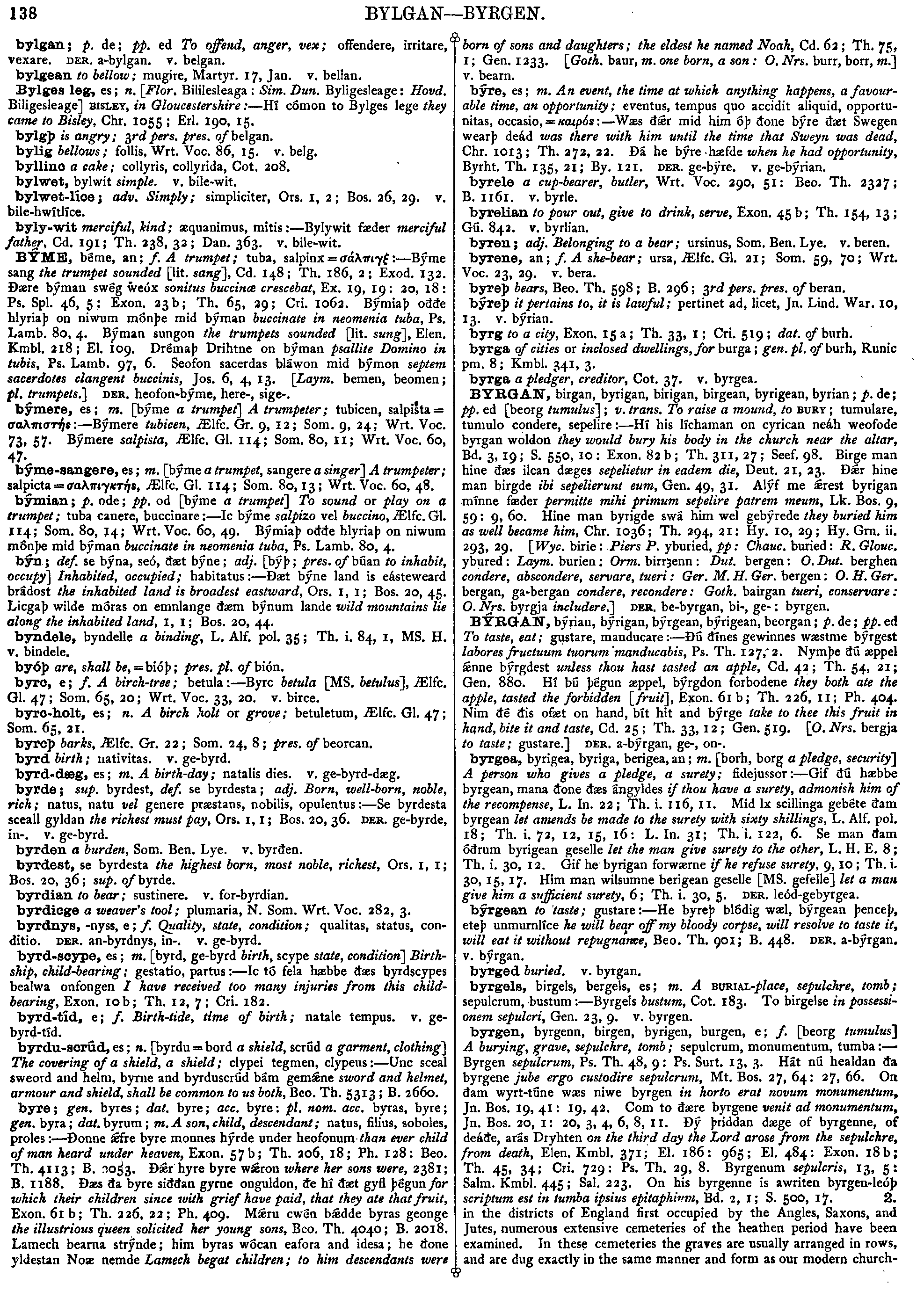
byro-holt, es; n. A birch holt or grove; betuletum, Ælfc. Gl. 47; Som. 65, 21.
|
Source: Bosworth/Toller, page b0199, entry 9 View original page image as: [TIFF] [PNG] [View previous entry] [View next entry] |
[Comment on this entry] [View comments] |
The following entry has been hand-corrected once. |
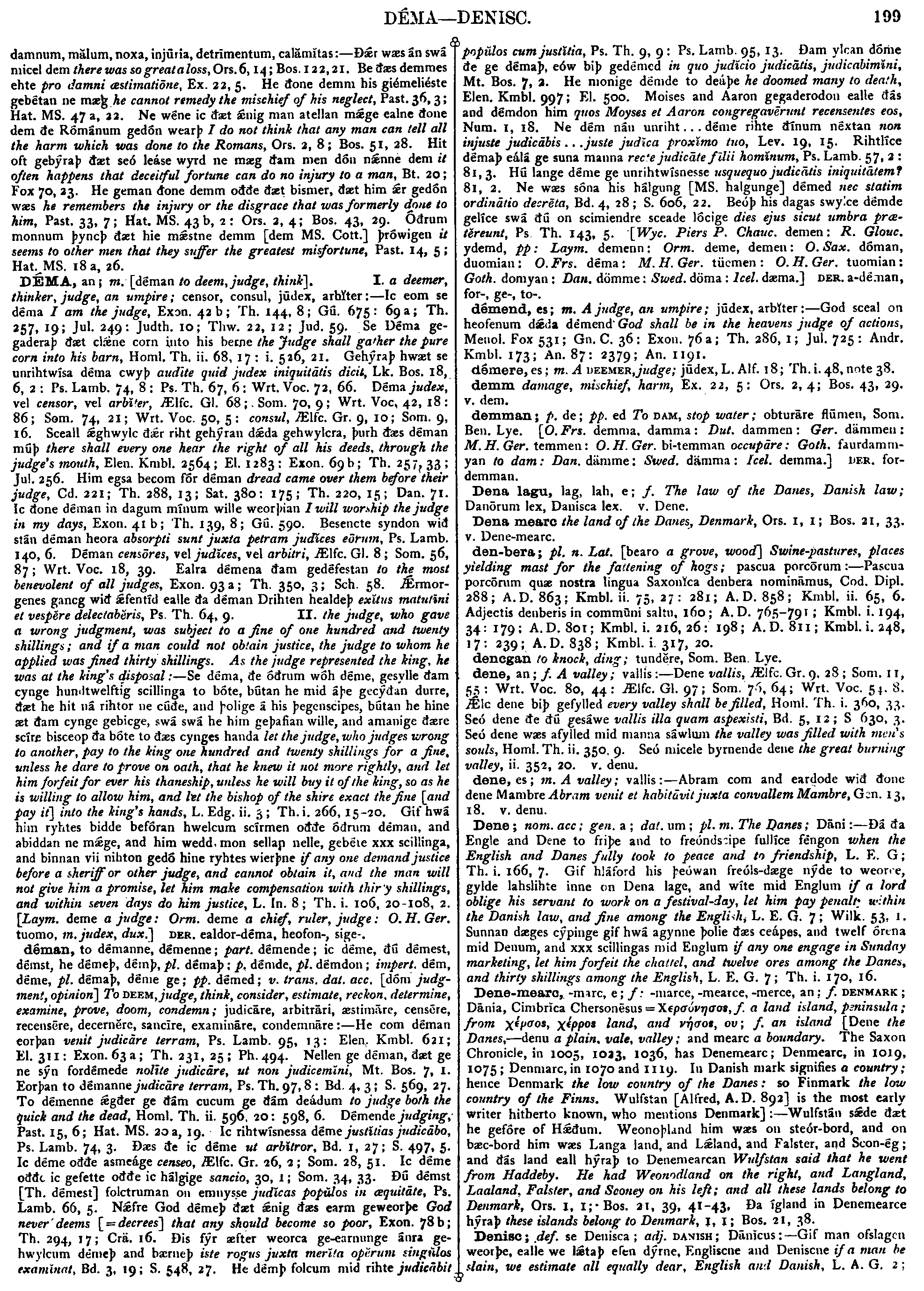
den-bera;
pl.
n.
Lat.
[bearo
a
grove,
wood]
Swine-pastures,
places
yielding
mast
for
the
fattening
of
hogs;
pascua
porc rum
:--
Pascua
porcrum
quæ
nostra
lingua
Saxon
rum
:--
Pascua
porcrum
quæ
nostra
lingua
Saxon ca
denbera
nomin
ca
denbera
nomin mus,
Cod.
Dipl.
288;
A.
D.
863;
Kmbl.
ii.
75,
27:
281;
A.
D.
858;
Kmbl.
ii.
65,
6.
Adjectis
denberis
in
comm
mus,
Cod.
Dipl.
288;
A.
D.
863;
Kmbl.
ii.
75,
27:
281;
A.
D.
858;
Kmbl.
ii.
65,
6.
Adjectis
denberis
in
comm ni
saltu,
160;
A.
D.
765-791;
Kmbl.
i.
194,
34:
179:
A.
D.
801;
Kmbl.
i.
216,
26:
198;
A.
D.
811;
Kmbl.
i.
248,
ni
saltu,
160;
A.
D.
765-791;
Kmbl.
i.
194,
34:
179:
A.
D.
801;
Kmbl.
i.
216,
26:
198;
A.
D.
811;
Kmbl.
i.
248,
|
Source: Bosworth/Toller, page b0364, entry 3 View original page image as: [TIFF] [PNG] [View previous entry] [View next entry] |
[Comment on this entry] [View comments] |
The following entry has been hand-corrected once. |
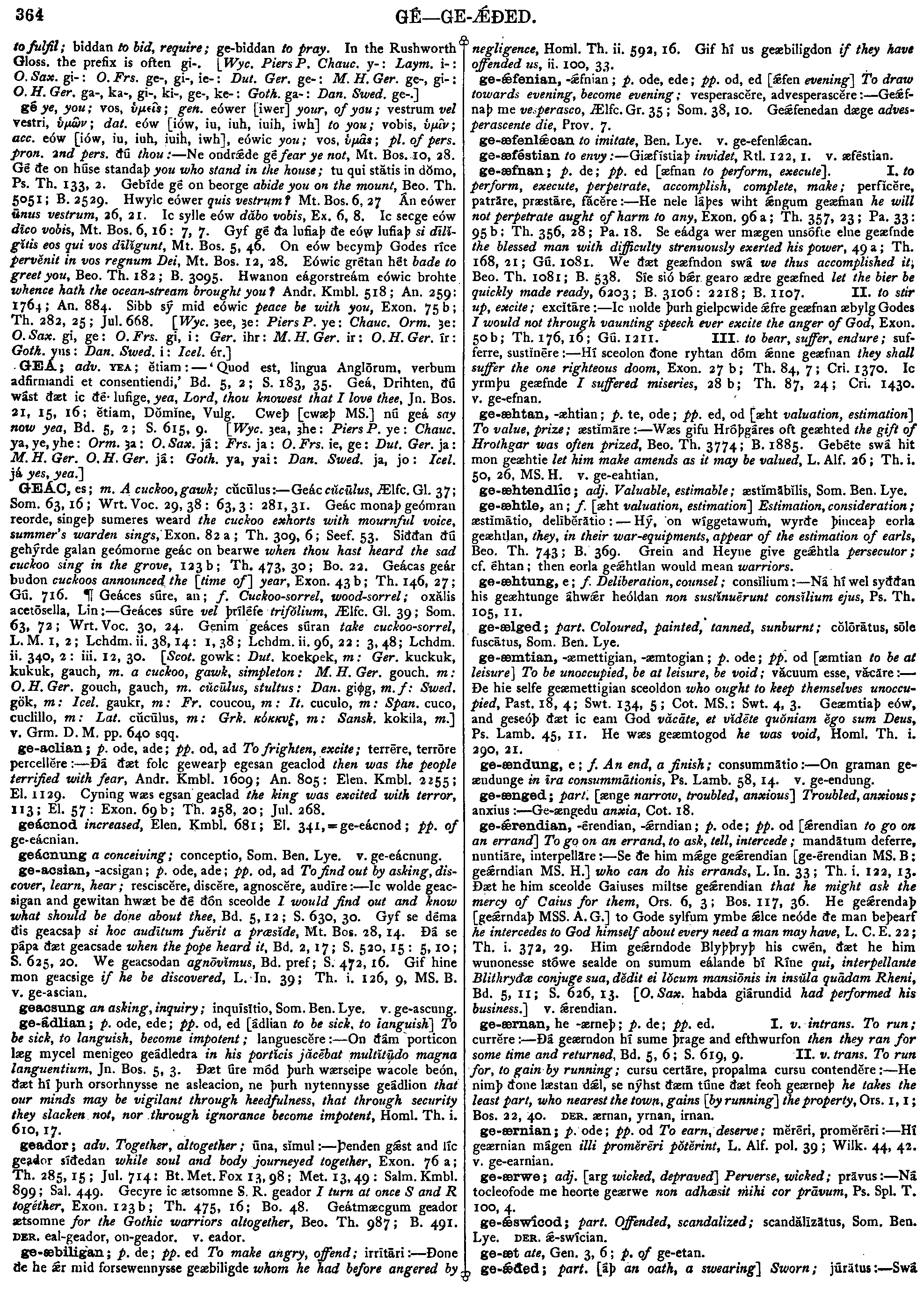
GEÁC,
es;
m.
A
cuckoo,
gawk;
c clus
:--
Geác
cclus,
Ælfc.
Gl.
37;
Som.
63,
16;
Wrt.
Voc.
29,
38
:
63,
3
:
281,
31.
Geác
monaþ
geómran
reorde,
singeþ
sumeres
weard
the
cuckoo
exhorts
with
mournful
voice,
summer's
warden
sings,
Exon.
82
a;
Th.
309,
6;
Seef.
53.
Siððan
ðú
gehýrde
galan
geómorne
geác
on
bearwe
when
thou
hast
heard
the
sad
cuckoo
sing
in
the
grove,
123
b;
Th.
473,
30;
Bo.
22.
Geácas
geár
budon
cuckoos
announced
the
[time
of]
year,
Exon.
43
b;
Th.
146,
27;
Gú.
716.

Geáces
súre,
an;
f.
Cuckoo-sorrel,
wood-sorrel;
ox
clus
:--
Geác
cclus,
Ælfc.
Gl.
37;
Som.
63,
16;
Wrt.
Voc.
29,
38
:
63,
3
:
281,
31.
Geác
monaþ
geómran
reorde,
singeþ
sumeres
weard
the
cuckoo
exhorts
with
mournful
voice,
summer's
warden
sings,
Exon.
82
a;
Th.
309,
6;
Seef.
53.
Siððan
ðú
gehýrde
galan
geómorne
geác
on
bearwe
when
thou
hast
heard
the
sad
cuckoo
sing
in
the
grove,
123
b;
Th.
473,
30;
Bo.
22.
Geácas
geár
budon
cuckoos
announced
the
[time
of]
year,
Exon.
43
b;
Th.
146,
27;
Gú.
716.

Geáces
súre,
an;
f.
Cuckoo-sorrel,
wood-sorrel;
ox lis
acetsella,
Lin
:--
Geáces
súre
vel
þríléfe
trif
lis
acetsella,
Lin
:--
Geáces
súre
vel
þríléfe
trif lium,
Ælfc.
Gl.
39;
Som.
63,
72;
Wrt.
Voc.
30,
24.
Genim
geáces
súran
take
cuckoo-sorrel,
L.
M.
1,
2;
Lchdm.
ii.
38,
14
:
1,
38;
Lchdm.
ii.
96,
22
:
3,
48;
Lchdm.
ii.
340,
2
:
iii.
12,
30.
[Scot.
gowk
:
Dut.
koekoek,
m
:
Ger.
kuckuk,
kukuk,
gauch,
m.
a
cuckoo,
gawk,
simpleton
:
M.
H.
Ger.
gouch.
m
:
O.
H.
Ger.
gouch,
gauch,
m.
cclus,
stultus
:
Dan.
gi248;g,
m.
f
:
Swed.
gök,
m
:
Icel.
gaukr,
m
:
Fr.
coucou,
m
:
It.
cuculo,
m
:
Span.
cuco,
cuclillo,
m
:
Lat.
cclus,
m
:
Grk.
lium,
Ælfc.
Gl.
39;
Som.
63,
72;
Wrt.
Voc.
30,
24.
Genim
geáces
súran
take
cuckoo-sorrel,
L.
M.
1,
2;
Lchdm.
ii.
38,
14
:
1,
38;
Lchdm.
ii.
96,
22
:
3,
48;
Lchdm.
ii.
340,
2
:
iii.
12,
30.
[Scot.
gowk
:
Dut.
koekoek,
m
:
Ger.
kuckuk,
kukuk,
gauch,
m.
a
cuckoo,
gawk,
simpleton
:
M.
H.
Ger.
gouch.
m
:
O.
H.
Ger.
gouch,
gauch,
m.
cclus,
stultus
:
Dan.
gi248;g,
m.
f
:
Swed.
gök,
m
:
Icel.
gaukr,
m
:
Fr.
coucou,
m
:
It.
cuculo,
m
:
Span.
cuco,
cuclillo,
m
:
Lat.
cclus,
m
:
Grk.
 &omicron-tonos;
 ,
m
:
Sansk.
kokila,
m.]
v.
Grm.
D.
M.
pp.
640
sqq.
,
m
:
Sansk.
kokila,
m.]
v.
Grm.
D.
M.
pp.
640
sqq.
|
Source: Bosworth/Toller, page b0425, entry 13 View original page image as: [TIFF] [PNG] [View previous entry] [View next entry] |
[Comment on this entry] [View comments] |
The following entry has been hand-corrected once. |
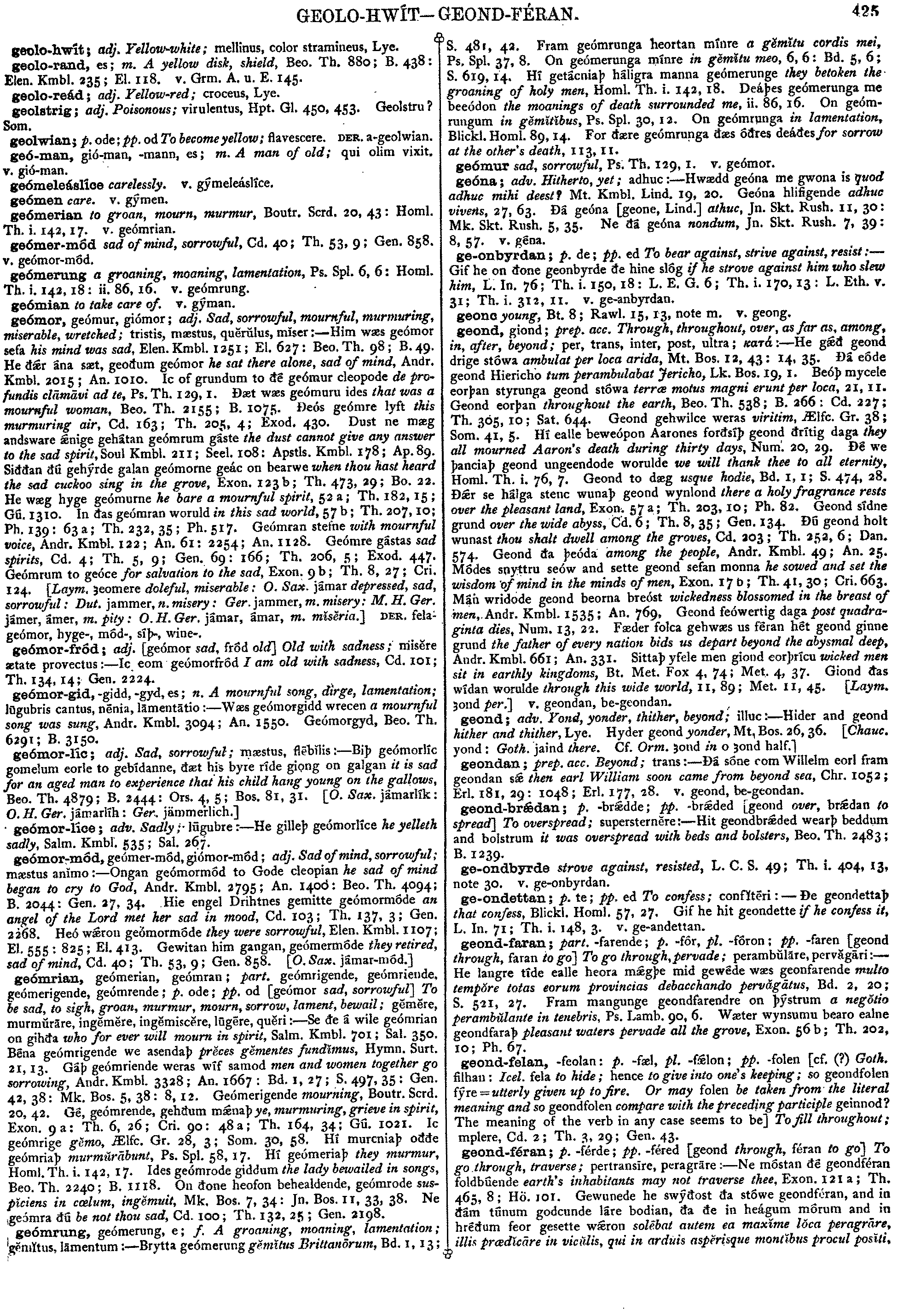
geómor,
geómur,
giómor;
adj.
Sad,
sorrowful,
mournful,
murmuring,
miserable,
wretched;
tristis,
mæstus,
qu rlus,
mser
:--
Him
wæs
geómor
sefa
his
mind
was
sad,
Elen.
Kmbl.
1251;
El.
627:
Beo.
Th.
98;
B.
49.
He
ð
rlus,
mser
:--
Him
wæs
geómor
sefa
his
mind
was
sad,
Elen.
Kmbl.
1251;
El.
627:
Beo.
Th.
98;
B.
49.
He
ð r
ána
sæt,
geoðum
geómor
he
sat
there
alone,
sad
of
mind,
Andr.
Kmbl.
2015;
An.
1010.
Ic
of
grundum
to
ðé
geómur
cleopode
de
profundis
clmvi
ad
te,
Ps.
Th.
129,
1.
Ðæt
wæs
geómuru
ides
that
was
a
mournful
woman,
Beo.
Th.
2155;
B.
1075.
Ðeós
geómre
lyft
this
murmuring
air,
Cd.
163;
Th.
205,
4;
Exod.
430.
Dust
ne
mæg
andsware
nige
gehátan
geómrum
gáste
the
dust
cannot
give
any
answer
to
the
sad
spirit,
Soul
Kmbl.
211;
Seel.
108:
Apstls.
Kmbl.
178;
Ap.
89.
Siððan
ðú
gehýrde
galan
geómorne
geác
on
bearwe
when
thou
host
heard
the
sad
cuckoo
sing
in
the
grove,
Exon.
123
b;
Th.
473,
29;
Bo.
22.
He
wæg
hyge
geómurne
he
bare
a
mournful
spirit,
52
a;
Th.
182,
15;
Gú.
1310.
In
ðas
geómran
woruld
in
this
sad
world,
57
b;
Th.
207,
10;
Ph.
139:
63a;
Th.
232,
35;
Ph.
517.
Geómran
stefne
with
mournful
voice,
Andr.
Kmbl.
122;
An.
61:
2254;
An.
1128.
Geómre
gástas
sad
spirits,
Cd.
4;
Th.
5,
9;
Gen.
69:
166;
Th.
206,
5;
Exod.
447.
Geómrum
to
geóce
for
salvation
to
the
sad,
Exon.
9
b;
Th.
8,
27;
Cri.
124.
[Laym.
r
ána
sæt,
geoðum
geómor
he
sat
there
alone,
sad
of
mind,
Andr.
Kmbl.
2015;
An.
1010.
Ic
of
grundum
to
ðé
geómur
cleopode
de
profundis
clmvi
ad
te,
Ps.
Th.
129,
1.
Ðæt
wæs
geómuru
ides
that
was
a
mournful
woman,
Beo.
Th.
2155;
B.
1075.
Ðeós
geómre
lyft
this
murmuring
air,
Cd.
163;
Th.
205,
4;
Exod.
430.
Dust
ne
mæg
andsware
nige
gehátan
geómrum
gáste
the
dust
cannot
give
any
answer
to
the
sad
spirit,
Soul
Kmbl.
211;
Seel.
108:
Apstls.
Kmbl.
178;
Ap.
89.
Siððan
ðú
gehýrde
galan
geómorne
geác
on
bearwe
when
thou
host
heard
the
sad
cuckoo
sing
in
the
grove,
Exon.
123
b;
Th.
473,
29;
Bo.
22.
He
wæg
hyge
geómurne
he
bare
a
mournful
spirit,
52
a;
Th.
182,
15;
Gú.
1310.
In
ðas
geómran
woruld
in
this
sad
world,
57
b;
Th.
207,
10;
Ph.
139:
63a;
Th.
232,
35;
Ph.
517.
Geómran
stefne
with
mournful
voice,
Andr.
Kmbl.
122;
An.
61:
2254;
An.
1128.
Geómre
gástas
sad
spirits,
Cd.
4;
Th.
5,
9;
Gen.
69:
166;
Th.
206,
5;
Exod.
447.
Geómrum
to
geóce
for
salvation
to
the
sad,
Exon.
9
b;
Th.
8,
27;
Cri.
124.
[Laym.
 eomere
doleful,
miserable:
O.
Sax.
jámar
depressed,
sad,
sorrowful:
Dut.
jammer,
n.
misery:
Ger.
jammer,
m.
misery:
M.
H.
Ger.
jámer,
ámer,
m.
pity:
O.
H.
Ger.
jámar,
ámar,
m.
msria.]
DER.
fela-geómor,
hyge-,
mód-,
síþ-,
wine-.
eomere
doleful,
miserable:
O.
Sax.
jámar
depressed,
sad,
sorrowful:
Dut.
jammer,
n.
misery:
Ger.
jammer,
m.
misery:
M.
H.
Ger.
jámer,
ámer,
m.
pity:
O.
H.
Ger.
jámar,
ámar,
m.
msria.]
DER.
fela-geómor,
hyge-,
mód-,
síþ-,
wine-.
|
Source: Bosworth/Toller, page b0425, entry 32 View original page image as: [TIFF] [PNG] [View previous entry] [View next entry] |
[Comment on this entry] [View comments] |
The following entry has been hand-corrected once. |
geond-faran;
part.
-farende;
p.
-fór,
pl.
-fóron;
pp.
-faren
[geond
through,
faran
to
go]
To
go
through,
pervade;
peramblre,
pervgri
:--
He
langre
tíde
ealle
heora
mgþe
mid
gewéde
wæs
geonfarende
multo
tempre
totas
eorum
provincias
debacchando
pervgtus,
Bd.
2,
20;
S.
521,
27.
Fram
mangunge
geondfarendre
on
þýstrum
a
negtio
peramblante
in
tenebris,
Ps.
Lamb.
90,
6.
Wæter
wynsumu
bearo
ealne
geondfaraþ
pleasant
waters
pervade
all
the
grove,
Exon.
56
b;
Th.
202,
10;
Ph.
67.
|
Source: Bosworth/Toller, page b0486, entry 36 View original page image as: [TIFF] [PNG] [View previous entry] [View next entry] |
[Comment on this entry] [View comments] |
The following entry has been hand-corrected once. |
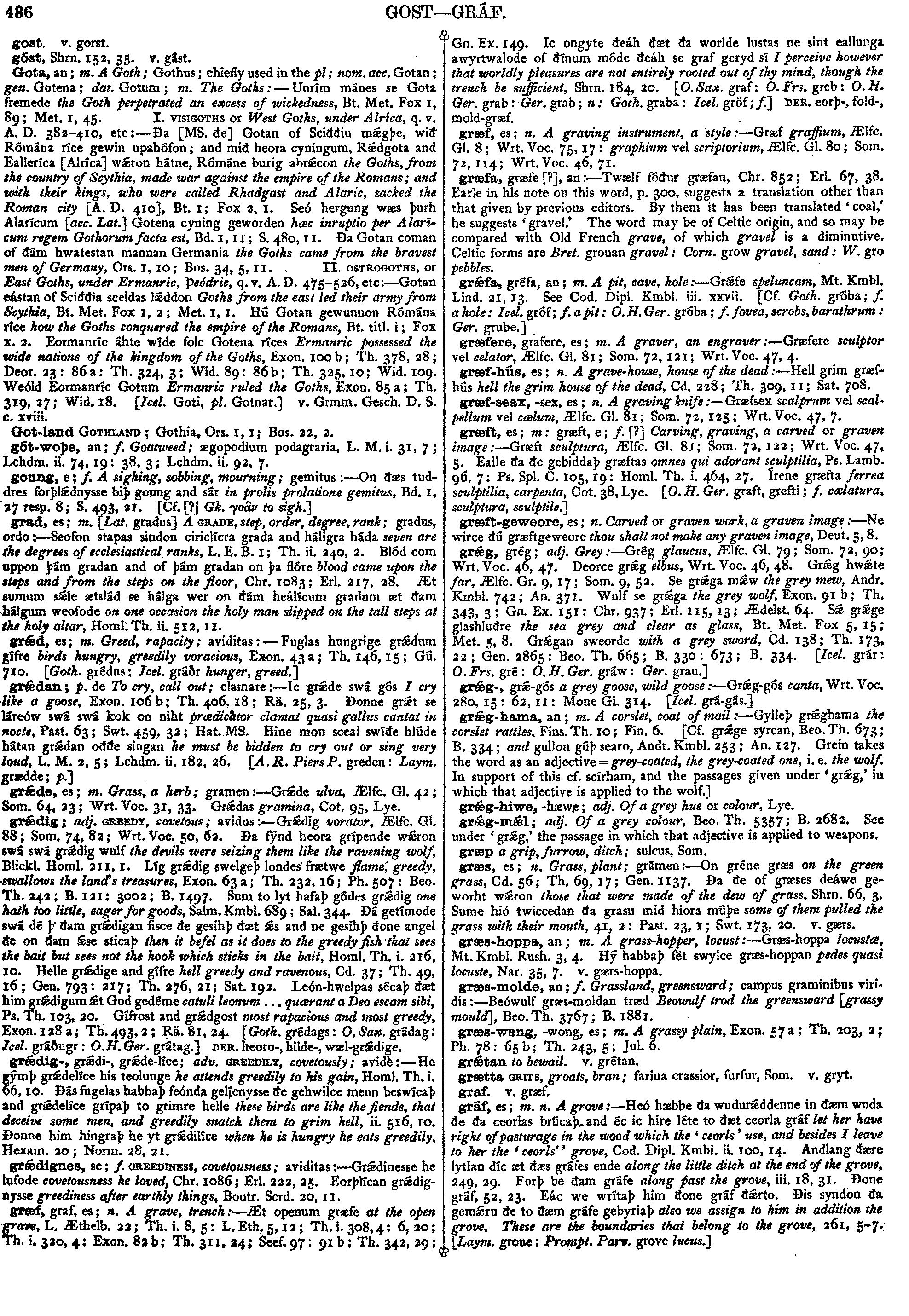
gráf,
es;
m.
n.
A
grove
:--
Heó
hæbbe
ða
wudurddenne
in
ðæm
wuda
ðe
ða
ceorlas
brúcaþ
and
éc
ic
hire
léte
to
ðæt
ceorla
gráf
let
her
have
right
of
pasturage
in
the
wood
which
the
'ceorls'
use,
and
besides
I
leave
to
her
the
'
ceorls'
grove,
Cod.
Dipl.
Kmbl.
ii.
100,
14.
Andlang
ðære
lytlan
díc
æt
ðæs
gráfes
ende
along
the
little
ditch
at
the
end
of
the
grove,
249,
29.
Forþ
be
ðam
gráfe
along
past
the
grove,
iii.
18,
31.
Ðone
gráf,
52,
23.
Eác
we
wrítaþ
him
ðone
gráf
ðrto.
Ðis
syndon
ða
gemru
ðe
to
ðæm
gráfe
gebyriaþ
also
we
assign
to
him
in
addition
the
grove.
These
are
the
boundaries
that
belong
to
the
grove,
261,
5-7.
[Laym.
groue:
Prompt.
Parv.
grove
lucus.]
|
Source: Bosworth/Toller, page b0522, entry 13 View original page image as: [TIFF] [PNG] [View previous entry] [View next entry] |
[Comment on this entry] [View comments (1)] |
The following entry has been hand-corrected once. |
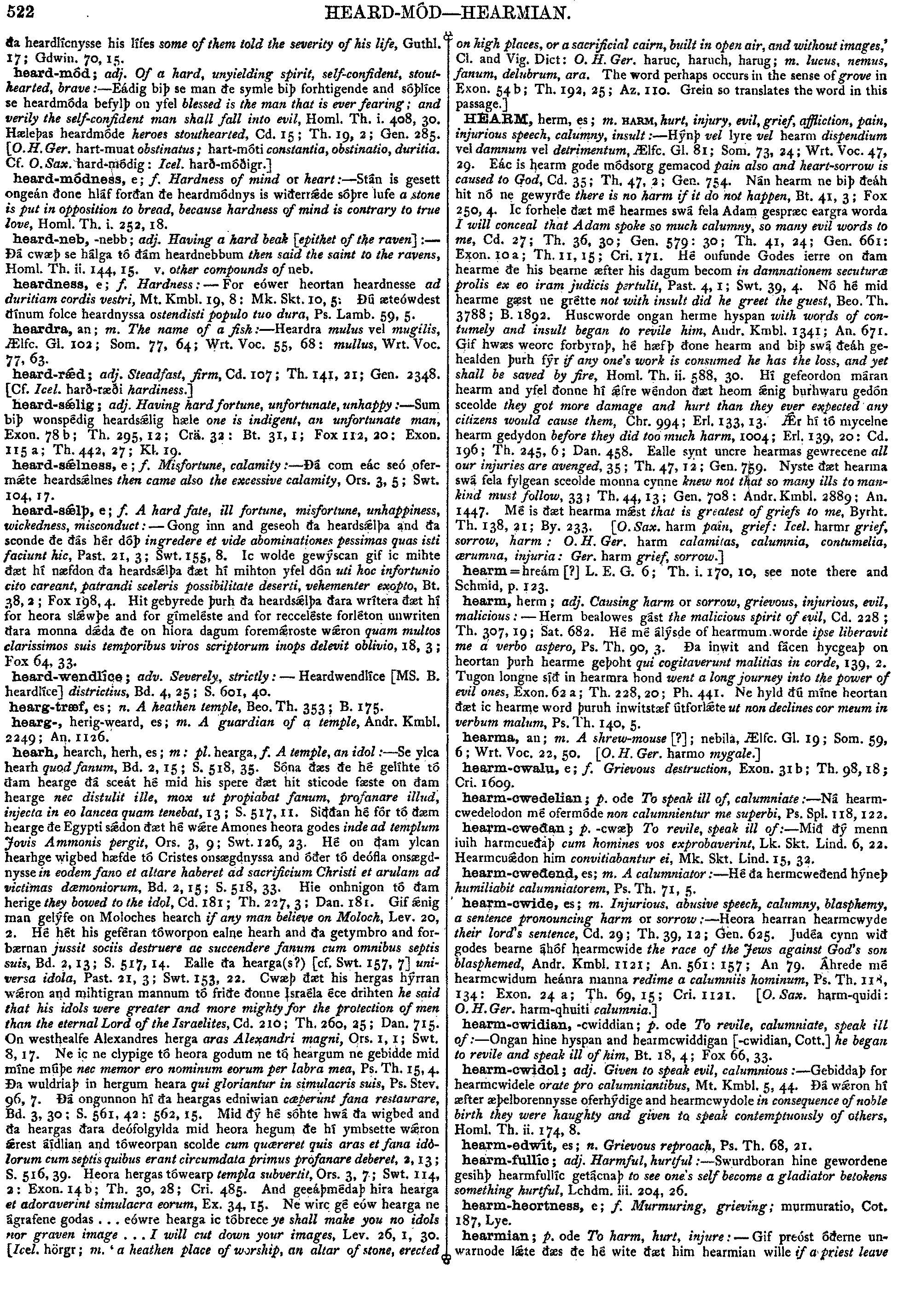
hearh,
hearch,
herh,
es;
m:
pl.
hearga,
f.
A
temple,
an
idol
:--
Se
ylca
hearh
quod
fanum,
Bd.
2,
15;
S.
518,
35.
Sona
ðæs
ðe
hé
gelíhte
tó
ðam
hearge
ðá
sceát
hé
mid
his
spere
ðæt
hit
sticode
fæste
on
ðam
hearge
nec
distulit
ille,
mox
ut
propiabat
fanum,
profanare
illud,
injecta
in
eo
lancea
quam
tenebat,
13;
S.
517,
11.
Siððan
hé
fór
tó
ðæm
hearge
ðe
Egypti
sdon
ðæt
hé
wre
Amones
heora
godes
inde
ad
templum
Jovis
Ammonis
pergit,
Ors.
3,
9;
Swt.
126,
23.
Hé
on
ðam
ylcan
hearhge
wigbed
hæfde
tó
Cristes
onsægdnyssa
and
óðer
tó
deófla
onsægdnysse
in
eodem
fano
et
allare
haberet
ad
sacrificium
Christi
et
arulam
ad
victimas
dæmoniorum,
Bd.
2,
15;
S.
518,
33.
Hie
onhnigon
tó
ðam
herige
they
bowed
to
the
idol,
Cd.
181;
Th.
227,
3;
Dan.
181.
Gif
nig
man
gelýfe
on
Moloches
hearch
if
any
man
believe
on
Moloch,
Lev.
20,
2.
Hé
hét
his
geféran
tóworpon
ealne
hearh
and
ða
getymbro
and
forbærnan
jussit
sociis
destruere
ac
succendere
fanum
cum
omnibus
septis
suis,
Bd.
2,
13;
S.
517,
14.
Ealle
ða
hearga(s?)
[cf.
Swt.
157,
7]
universa
idola,
Past.
21,
3;
Swt.
153,
22.
Cwæþ
ðæt
his
hergas
hýrran
wron
and
mihtigran
mannum
tó
friðe
ðonne
Israéla
éce
drihten
he
said
that
his
idols
were
greater
and
more
mighty
for
the
protection
of
men
than
the
eternal
Lord
of
the
Israelites,
Cd.
210;
Th.
260,
25;
Dan.
715.
On
westhealfe
Alexandres
herga
aras
Alexandri
magni,
Ors.
1,
1;
Swt.
8,
17.
Ne
ic
ne
clypige
tó
heora
godum
ne
tó
heargum
ne
gebidde
mid
míne
múþe
nec
memor
ero
nominum
eorum
per
labra
mea,
Ps.
Th.
15,
4.
Ða
wuldriaþ
in
hergum
heara
qui
gloriantur
in
simulacris
suis,
Ps.
Stev.
96,
7.
Ðá
ongunnon
hí
ða
heargas
edniwian
cæperunt
fana
restaurare,
Bd.
3,
30:
S.
561,
42:
562,
15.
Mid
ðý
hé
sóhte
hwá
ða
wigbed
and
ða
heargas
ðara
deófolgylda
mid
heora
hegum
ðe
hí
ymbsette
wron
rest
áídlian
and
tóweorpan
scolde
cum
quæreret
quis
aras
et
fana
idolorum
cum
septis
quibus
erant
circumdata
primus
profanare
deberet,
2,
13;
S.
516,
39.
Heora
hergas
tówearp
templa
subvertit,
Ors.
3,
7;
Swt.
114,
2:
Exon.
14
b;
Th.
30,
28;
Cri.
485.
And
geeáþmédaþ
hira
hearga
et
adoraverint
simulacra
eorum,
Ex.
34,
15.
Ne
wirc
gé
eów
hearga
ne
ágrafene
godas
...
eówre
hearga
ic
tóbrece
ye
shall
make
you
no
idols
rear
graven
image
...
I
will
cut
down
your
images,
Lev.
26,
1,
30.
[Icel.
hörgr;
m.
'a
heathen
place
of
warship,
an
altar
of
stone,
erected
on
high
places,
or
a
sacrificial
cairn,
built
in
open
air,
and
without
images,'
Cl.
and
Vig.
Dict:
O.
H.
Ger.
haruc,
haruch,
harug;
m.
lucus,
nemus,
fanum,
delubrum,
ara.
The
word
perhaps
occurs
in
the
sense
of
grove
in
Exon.
54
b;
Th.
192,
25;
Az.
110.
Grein
so
translates
the
word
in
this
passage.]
|
Source: Bosworth/Toller, page b0543, entry 3 View original page image as: [TIFF] [PNG] [View previous entry] [View next entry] |
[Comment on this entry] [View comments] |
The following entry has been hand-corrected once. |
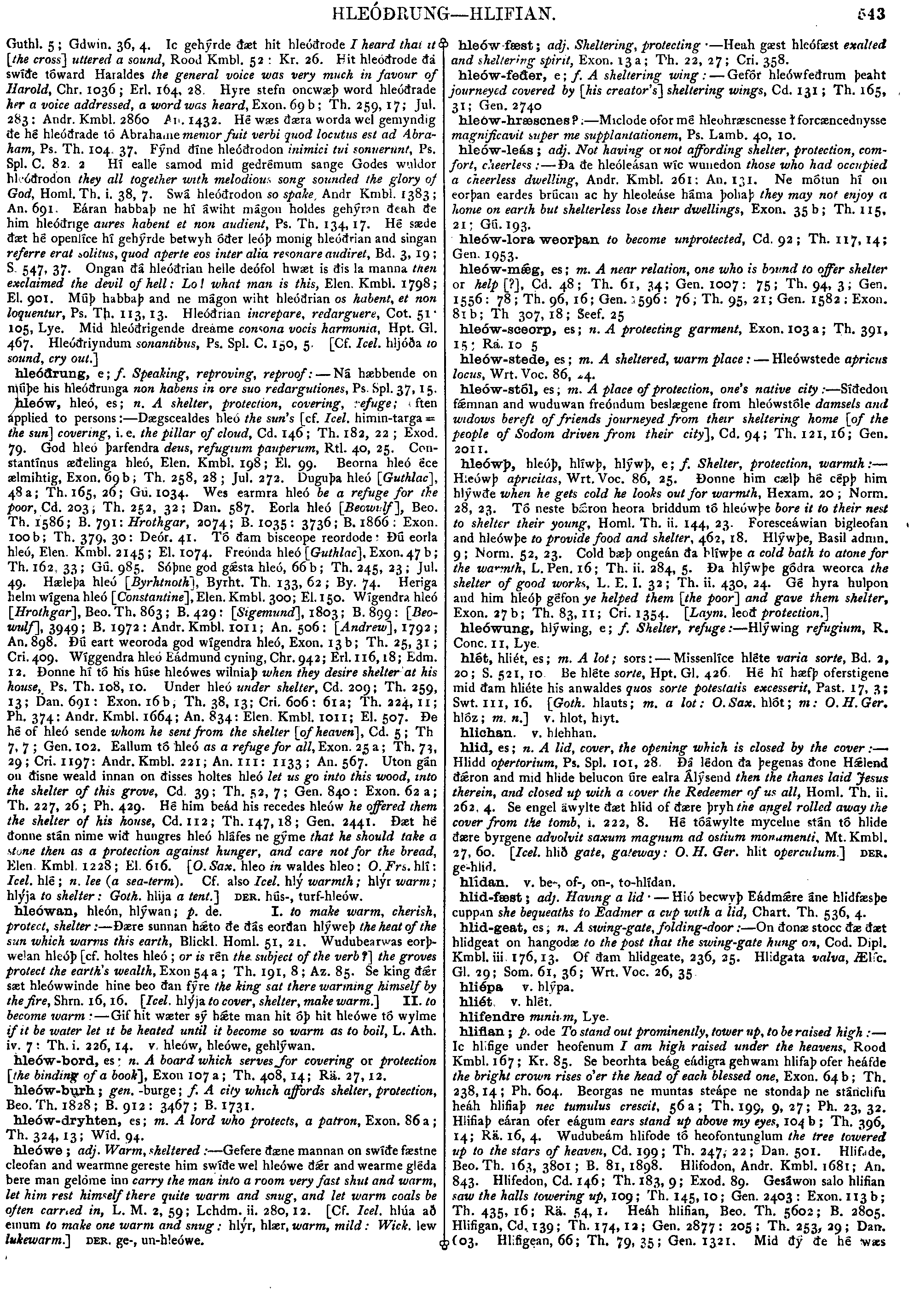
hleów,
hleó,
es;
n.
A
shelter,
protection,
covering,
refuge;
often
applied
to
persons
:--
Dægscealdes
hleó
the
sun's
[cf.
Icel.
himin-targa
=
the
sun]
covering,
i.e.
the
pillar
of
cloud,
Cd.
146;
Th.
182,
22;
Exod.
79.
God
hleó
þarfendra
deus,
refugium
pauperum,
Rtl.
40,
25.
Constantínus
æðelinga
hleó,
Elen.
Kmbl.
198;
El.
99.
Beorna
hleó
éce
ælmihtig,
Exon.
69
b;
Th.
258,
28;
Jul.
272.
Duguþa
hleó
[Guthlac],
48
a;
Th.
165,
26;
Gú.
1034.
Wes
earmra
hleó
be
a
refuge
for
the
poor,
Cd.
203;
Th.
252,
32;
Dan.
587.
Eorla
hleó
[Beowulf],
Beo.
Th.
1586;
B.
791:
Hrothgar,
2074;
B.
1035:
3736;
B.
1866:
Exon.
100
b;
Th.
379,
30:
Deór.
41.
Tó
ðam
bisceope
reordode:
Ðú
eorla
hleó,
Elen.
Kmbl.
2145;
El.
1074.
Freónda
hleó
[Guthlac],
Exon.
47
b;
Th.
162,
33;
Gú.
985.
Sóþne
god
gsta
hleó,
66
b;
Th.
245,
23;
Jul.
49.
Hæleþa
hleó
[Byrhtnoth],
Byrht.
Th.
133,
62;
By.
74.
Heriga
helm
wígena
hleó
[Constantine],
Elen.
Kmbl.
300;
El.
150.
Wígendra
hleó
[Hrothgar],
Beo.
Th.
863;
B.
429:
[Sigemund],
1803;
B.
899:
[Beowulf],
3949;
B.
1972:
Andr.
Kmbl.
1011;
An.
506:
[Andrew],
1792;
An.
898.
Ðú
eart
weoroda
god
wígendra
hleó,
Exon.
13
b;
Th.
25,
31;
Cri.
409,
Wíggendra
hleó
Eádmund
cyning,
Chr.
942;
Erl.
116,
18;
Edm.
12.
Ðonne
hí
tó
his
húse
hleówes
wilniaþ
when
they
desire
shelter
at
his
house,
Ps.
Th.
108,
10.
Under
hleó
under
shelter,
Cd.
209;
Th.
259,
13;
Dan.
691:
Exon.
16
b,
Th.
38,
13;
Cri.
606:
61
a;
Th.
224,
11;
Ph.
374:
Andr.
Kmbl.
1664;
An.
834:
Elen.
Kmbl.
1011;
El.
507.
Ðe
hé
of
hleó
sende
whom
he
sent
from
the
shelter
[of
heaven],
Cd.
5;
Th.
7,
7;
Gen.
102.
Eallum
tó
hleó
as
a
refuge
for
all,
Exon.
25
a;
Th.
73,
29;
Cri.
1197:
Andr.
Kmbl.
221;
An.
111:
1133;
An.
567.
Uton
gán
on
ðisne
weald
innan
on
ðisses
holtes
hleó
let
us
go
into
this
wood,
into
the
shelter
of
this
grove,
Cd.
39;
Th.
52,
7;
Gen.
840:
Exon.
62
a;
Th.
227,
26;
Ph.
429.
Hé
him
beád
his
recedes
hleów
he
offered
them
the
shelter
of
his
house,
Cd.
112;
Th.
147,
18;
Gen.
2441.
Ðæt
hé
ðonne
stán
nime
wið
hungres
hleó
hláfes
ne
gýme
that
he
should
take
a
stone
then
as
a
protection
against
hunger,
and
care
not
for
the
bread,
Elen.
Kmbl.
1228;
El.
616.
[O.
Sax.
hleo
in
waldes
hleo:
O.
Frs.
hlí:
Icel.
hlé;
n.
lee
(a
sea-term.)
Cf.
also
Icel.
hlý
warmth;
hlýr
warm;
hlýja
to
shelter:
Goth.
hlija
a
tent.]
DER.
hús-,
turf-hleów.
|
Source: Bosworth/Toller, page b0551, entry 12 View original page image as: [TIFF] [PNG] [View previous entry] [View next entry] |
[Comment on this entry] [View comments] |
The following entry has been hand-corrected once. |
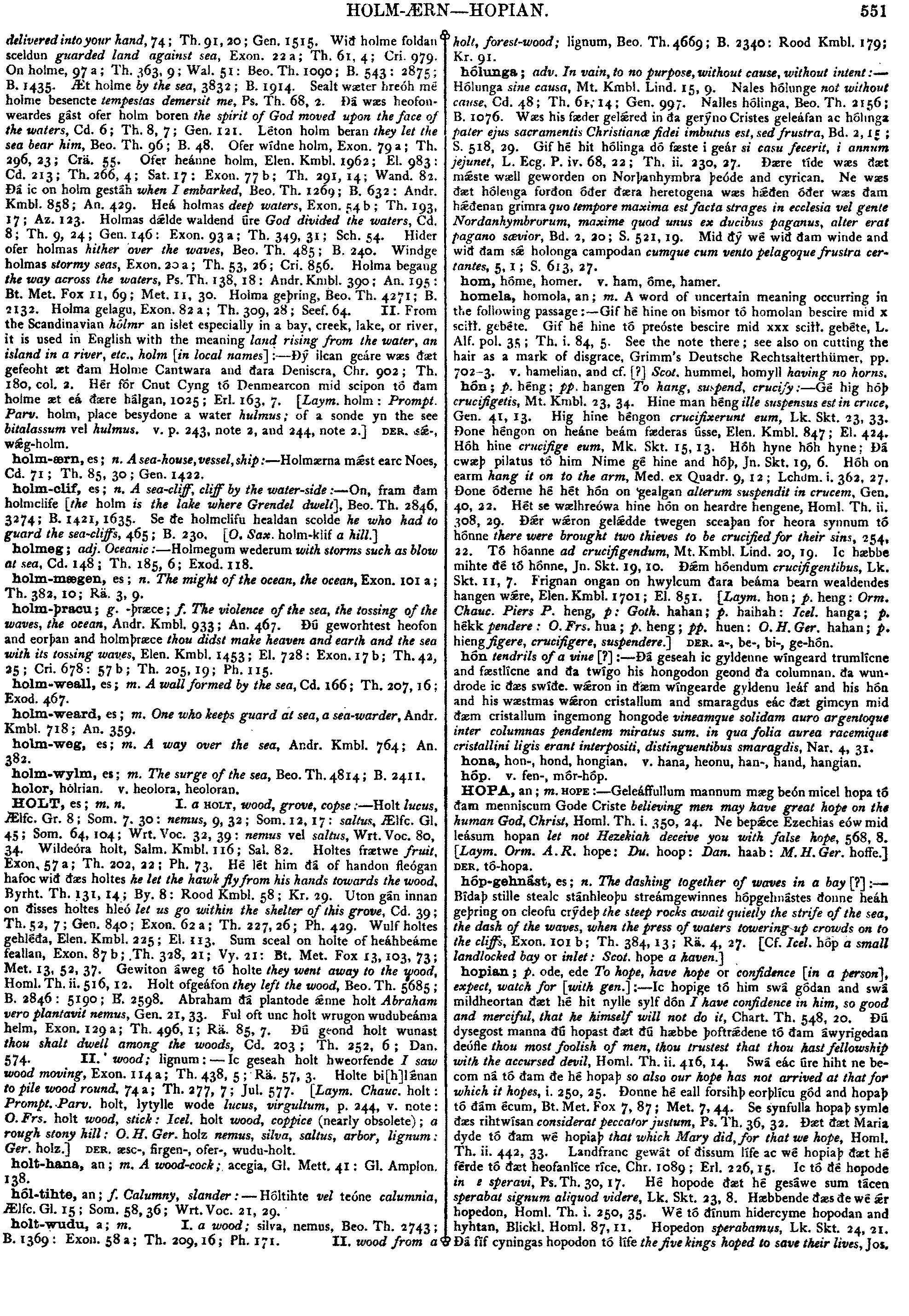
HOLT,
es;
m.
n.
I.
a
HOLT,
wood,
grove,
copse
:--
Holt
lucus,
Ælfc.
Gr.
8;
Som.
7,
30:
nemus,
9,
32;
Som.
12,
17:
saltus,
Ælfc.
Gl.
45;
Som.
64,
104;
Wrt.
Voc.
32,
39:
nemus
vel
saltus,
Wrt.
Voc.
80,
34.
Wildeóra
holt,
Salm.
Kmbl.
116;
Sal.
82.
Holtes
frætwe
fruit,
Exon.
57
a;
Th.
202,
22;
Ph.
73.
Hé
lét
him
ðá
of
handon
fleógan
hafoc
wið
ðæs
holtes
he
let
the
hawk
fly
from
his
hands
towards
the
wood,
Byrht.
Th.
131,
14;
By.
8:
Rood
Kmbl.
58;
Kr.
29.
Uton
gán
innan
on
ðisses
holtes
hleó
let
us
go
within
the
shelter
of
this
grove,
Cd.
39;
Th.
52,
7;
Gen.
840;
Exon.
62
a;
Th.
227,
26;
Ph.
429.
Wulf
holtes
gehléða,
Elen.
Kmbl.
225;
El.
113.
Sum
sceal
on
holte
of
heáhbeáme
feallan,
Exon.
87
b;
Th.
328,
21;
Vy.
21:
Bt.
Met.
Fox
13,
103,
73;
Met.
13,
52,
37.
Gewiton
áweg
tó
holte
they
went
away
to
the
wood,
Homl.
Th.
ii.
516,
12.
Holt
ofgeáfon
they
left
the
wood,
Beo.
Th.
5685;
B.
2846:
5190;
B.
2598.
Abraham
ðá
plantode
nne
holt
Abraham
vero
plantavit
nemus,
Gen.
21,
33.
Ful
oft
unc
holt
wrugon
wudubeáma
helm,
Exon.
129
a;
Th.
496,
1;
Rä.
85,
7.
Ðú
geond
holt
wunast
thou
shall
dwell
among
the
woods,
Cd.
203;
Th.
252,
6;
Dan.
574.
II.
wood;
lignum
:--
Ic
geseah
holt
hweorfende
I
saw
wood
moving,
Exon.
114
a;
Th.
438,
5;
Rä.
57,
3.
Holte
bi[h]lnan
to
pile
wood
round,
74
a;
Th.
277,
7;
Jul.
577.
[Laym.
Chauc.
holt:
Prompt.
Parv.
holt,
lytylle
wode
lucus,
virgultum,
p.
244,
v.
note:
O.
Frs.
holt
wood,
stick:
Icel.
holt
wood,
coppice
(nearly
obsolete);
a
rough
stony
hill:
O.
H.
Ger.
holz
nemus,
silva,
sallus,
arbor,
lignum:
Ger.
holz.]
DER.
æsc-,
firgen-,
ofer-,
wudu-holt.
|
Source: Bosworth/Toller, page b0913, entry 14 View original page image as: [TIFF] [PNG] [View previous entry] [View next entry] |
[Comment on this entry] [View comments] |
The following entry has been hand-corrected once. |
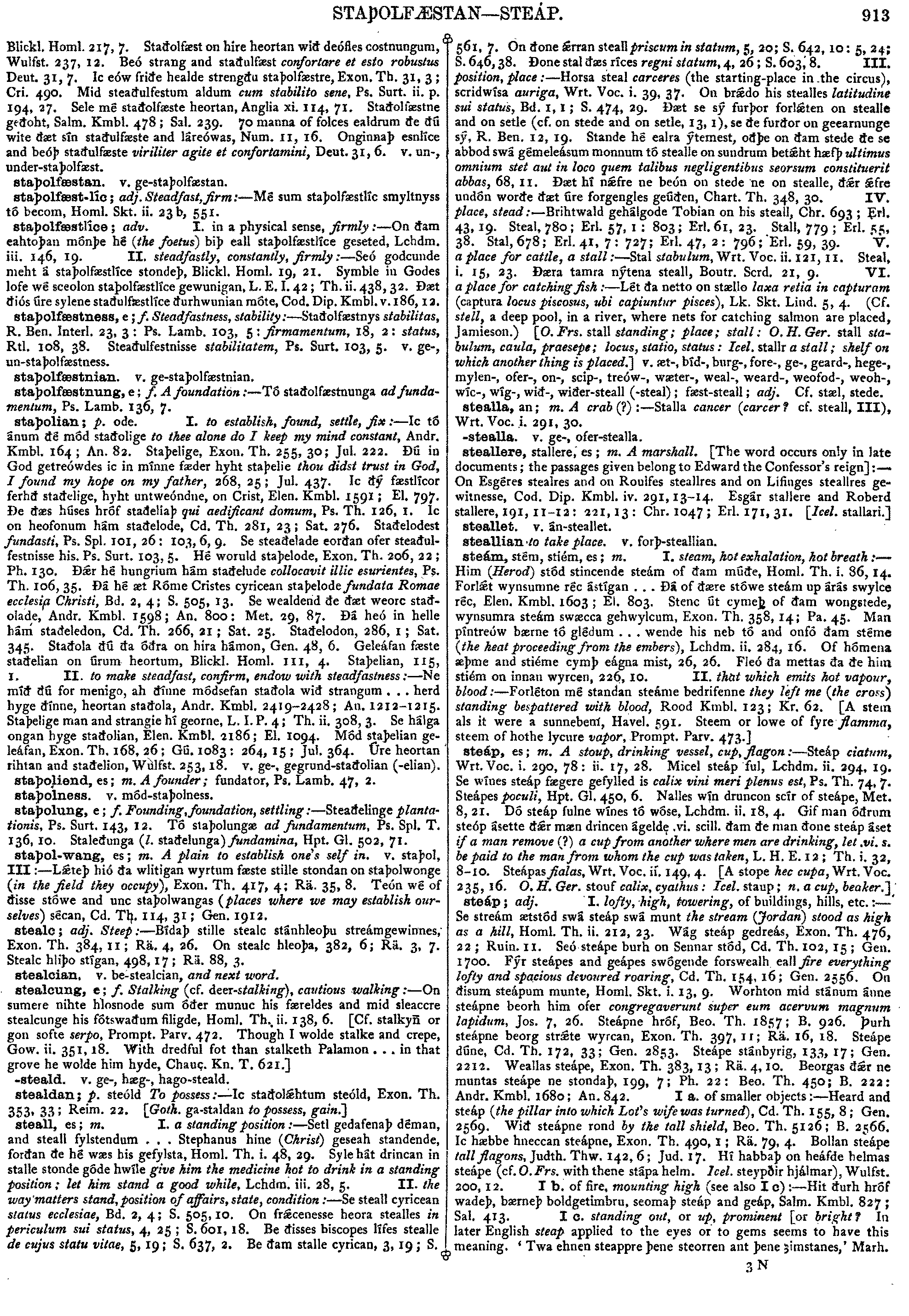
stealcung, e; f. Stalking (cf. deer-stalking), cautious walking :-- On sumere nihte hlosnode sum óðer munuc his færeldes and mid sleaccre stealcunge his fótswaðum filigde, Homl. Th. ii. 138, 6. [Cf. stalkyn or gon softe serpo, Prompt. Parv. 472. Though I wolde stalke and crepe, Gow. ii. 351, 18. With dredful fot than stalketh Palamon ... in that grove he wolde him hyde, Chauc. Kn. T. 621.]
| Result Page: |  |
Previous | 1 2 3 4 5 | Next |  |
Germanic Lexicon Project (main page)
This search system was written by
Sean Crist
Please consider
volunteering
to correct the data in these online dictionaries.
No rights reserved. Feel free to use these data in any way you please.