|
|

Tip: In the search results, you can click on any word or abbreviation for more information.
|
Source: Torp, page b0139, entry 2 View original page image as: [TIFF] [PNG] [View previous entry] [View next entry] |
[Comment on this entry] [View comments] |
The following entry has been hand-corrected once. |
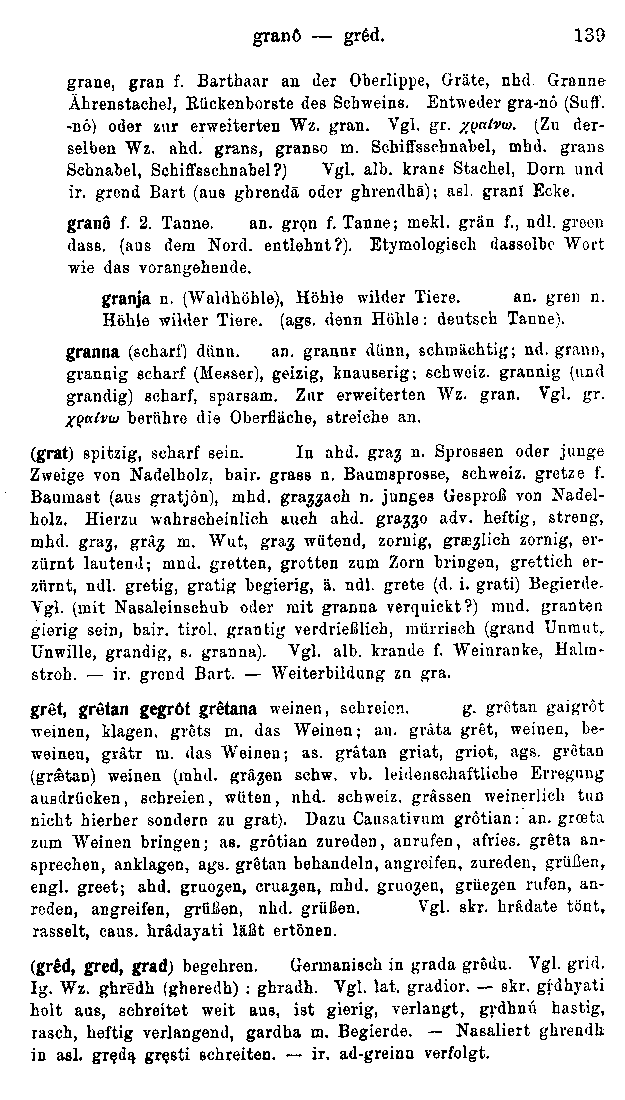
granô
f.
2.
Tanne.
an.
gr n
f.
Tanne;
mekl,
grän
f.,
ndl.
green
dass.
(aus
dem
Nord.
entlehnt?).
Etymologisch
dasselbe
Wort
wie
das
vorangehende.
n
f.
Tanne;
mekl,
grän
f.,
ndl.
green
dass.
(aus
dem
Nord.
entlehnt?).
Etymologisch
dasselbe
Wort
wie
das
vorangehende.
[Translate the German words]
|
Source: Torp, page b0144, entry 10 View original page image as: [TIFF] [PNG] [View previous entry] [View next entry] |
[Comment on this entry] [View comments] |
The following entry has been hand-corrected once. |
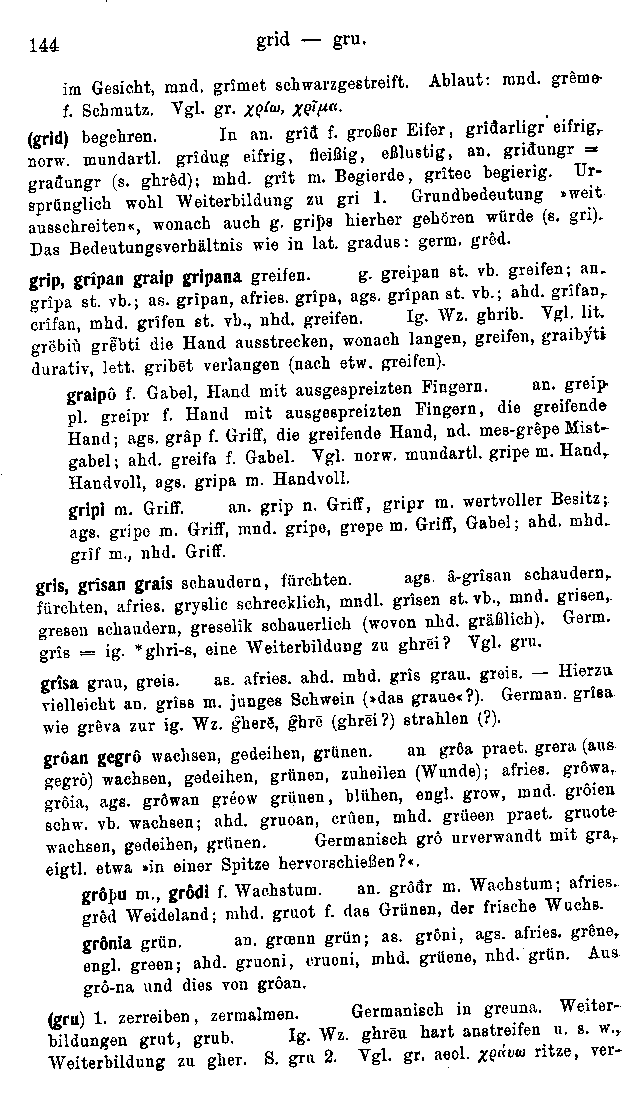
grônia grün. an. grœnn grün; as. grôni, ags. afries. grêne, engl. green; ahd. gruoni, cruoui, mhd. grüene, nhd. grün. Aus grô-na und dies von grôan.
[Translate the German words]
|
Source: Bosworth/Toller, page b0035, entry 20 View original page image as: [TIFF] [PNG] [View previous entry] [View next entry] |
[Comment on this entry] [View comments (1)] |
The following entry has been hand-corrected once. |
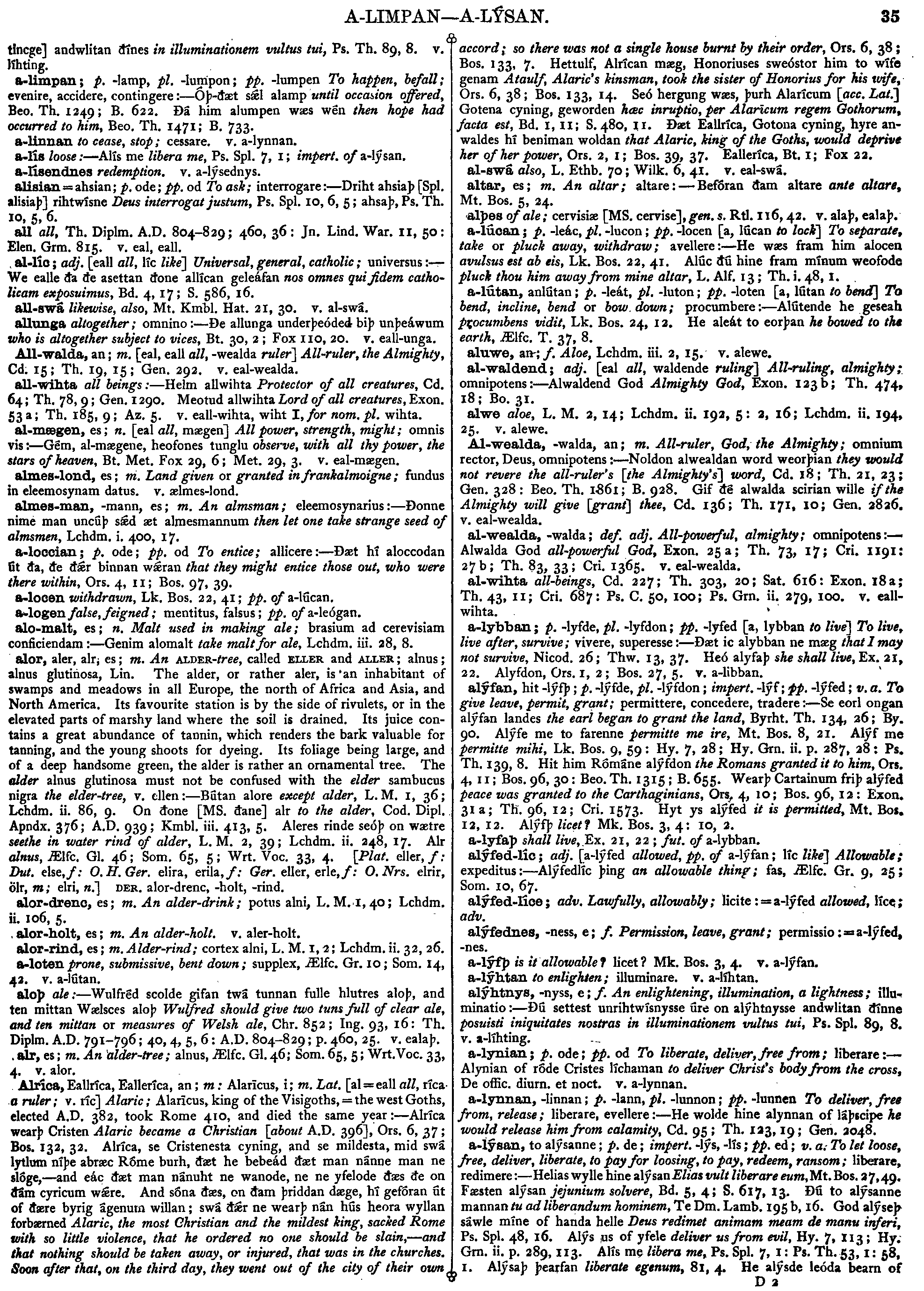
alor, aler, air, es; m. An ALDER- tree, called ELLER and ALLER ; alnus; alnus glutihosa, Lin. The alder, or rather aler, is an inhabitant of swamps and meadows in all Europe, the north of Africa and Asia, and North America. Its favourite station is by the side of rivulets, or in the elevated parts of marshy land where the soil is drained. Its juice contains a great abundance of tannin, which renders the bark valuable for tanning, and the young shoots for dyeing. Its foliage being large, and of a deep handsome green, the alder is rather an ornamental tree. The alder alnus glutinosa must not be confused with the elder sambucus nigra the elder-tree, v. ellen :-- Bútan alore except alder, L. M. 1, 36; Lchdm, ii. 86, 9. On ðone [MS. ðane] alr to the alder, Cod. Dipl. Apndx. 376; A. D. 939; Kmbl. iii. 413, 5. Aleres rinde seóþ on wætre seethe in water rind of alder, L. M. 2, 39; Lchdm, ii. 248, 17. Air alnus, Ælfc. Gl. 46; Som. 65, 5; Wrt. Voc. 33, 4. [Plat. eller. f: Dut. else, f: O. H. Ger. elira, erila, f: Ger. eller, erle, f: O. Nrs. elrir, ölr, m; elri, n.] DER. alor-drenc, -holt, -rind.
|
Source: Bosworth/Toller, page b0047, entry 37 View original page image as: [TIFF] [PNG] [View previous entry] [View next entry] |
[Comment on this entry] [View comments] |
The following entry has been hand-corrected once. |
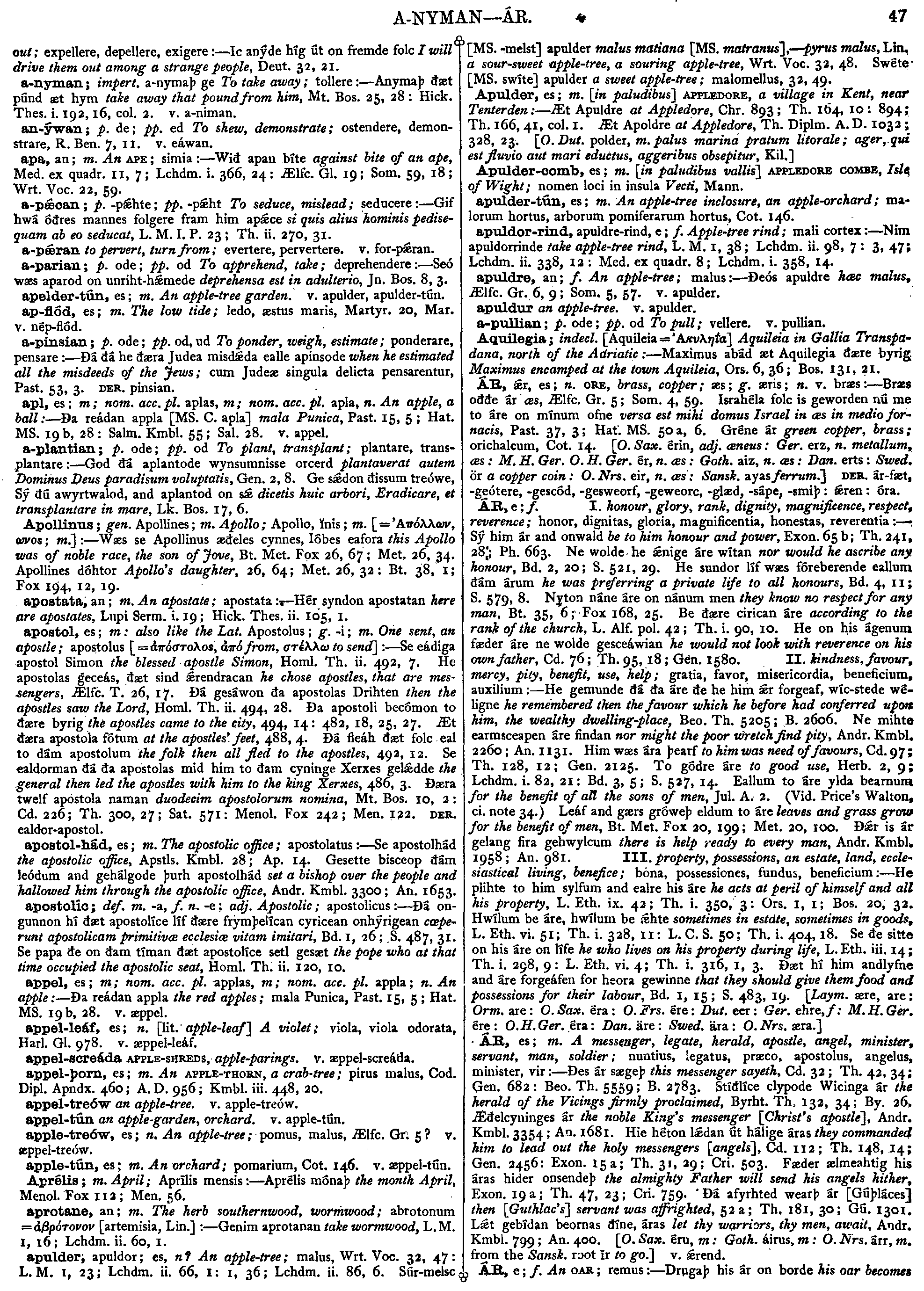
ÁR,
 r,
es;
n.
ORE,
brass,
copper;
æs;
g.
æris;
n.
v.
bræs
:--
Bræs
oððe
ár
æs,
Ælfc.
Gr.
5;
Som.
4,
59.
Israhéla
folc
is
geworden
nú
me
to
áre
on
mínum
ofne
versa
est
mihi
domus
Israel
in
æs
in
medio
fornacis,
Past.
37,
3;
Hat.
MS.
50
a,
6.
Gréne
ár
green
copper,
brass;
orichalcum,
Cot.
14.
[O.
Sax.
érin,
adj.
æneus:
Ger.
erz,
n.
metallum,
æs:
M.
H.
Ger.
O.
H.
Ger.
ér,
n.
æs:
Goth.
aiz,
n.
æs:
Dan.
erts:
Swed.
ör
a
copper
coin:
O.
Nrs.
eir,
n.
æs:
Sansk.
ayas
ferrum.]
DER.
ár-fæt,
-geótere,
-gescód,
-gesweorf,
-geweorc,
-glæd,
-sápe,
-smiþ:
ren:
óra.
r,
es;
n.
ORE,
brass,
copper;
æs;
g.
æris;
n.
v.
bræs
:--
Bræs
oððe
ár
æs,
Ælfc.
Gr.
5;
Som.
4,
59.
Israhéla
folc
is
geworden
nú
me
to
áre
on
mínum
ofne
versa
est
mihi
domus
Israel
in
æs
in
medio
fornacis,
Past.
37,
3;
Hat.
MS.
50
a,
6.
Gréne
ár
green
copper,
brass;
orichalcum,
Cot.
14.
[O.
Sax.
érin,
adj.
æneus:
Ger.
erz,
n.
metallum,
æs:
M.
H.
Ger.
O.
H.
Ger.
ér,
n.
æs:
Goth.
aiz,
n.
æs:
Dan.
erts:
Swed.
ör
a
copper
coin:
O.
Nrs.
eir,
n.
æs:
Sansk.
ayas
ferrum.]
DER.
ár-fæt,
-geótere,
-gescód,
-gesweorf,
-geweorc,
-glæd,
-sápe,
-smiþ:
ren:
óra.
|
Source: Bosworth/Toller, page b0073, entry 3 View original page image as: [TIFF] [PNG] [View previous entry] [View next entry] |
[Comment on this entry] [View comments] |
The following entry has been hand-corrected once. |
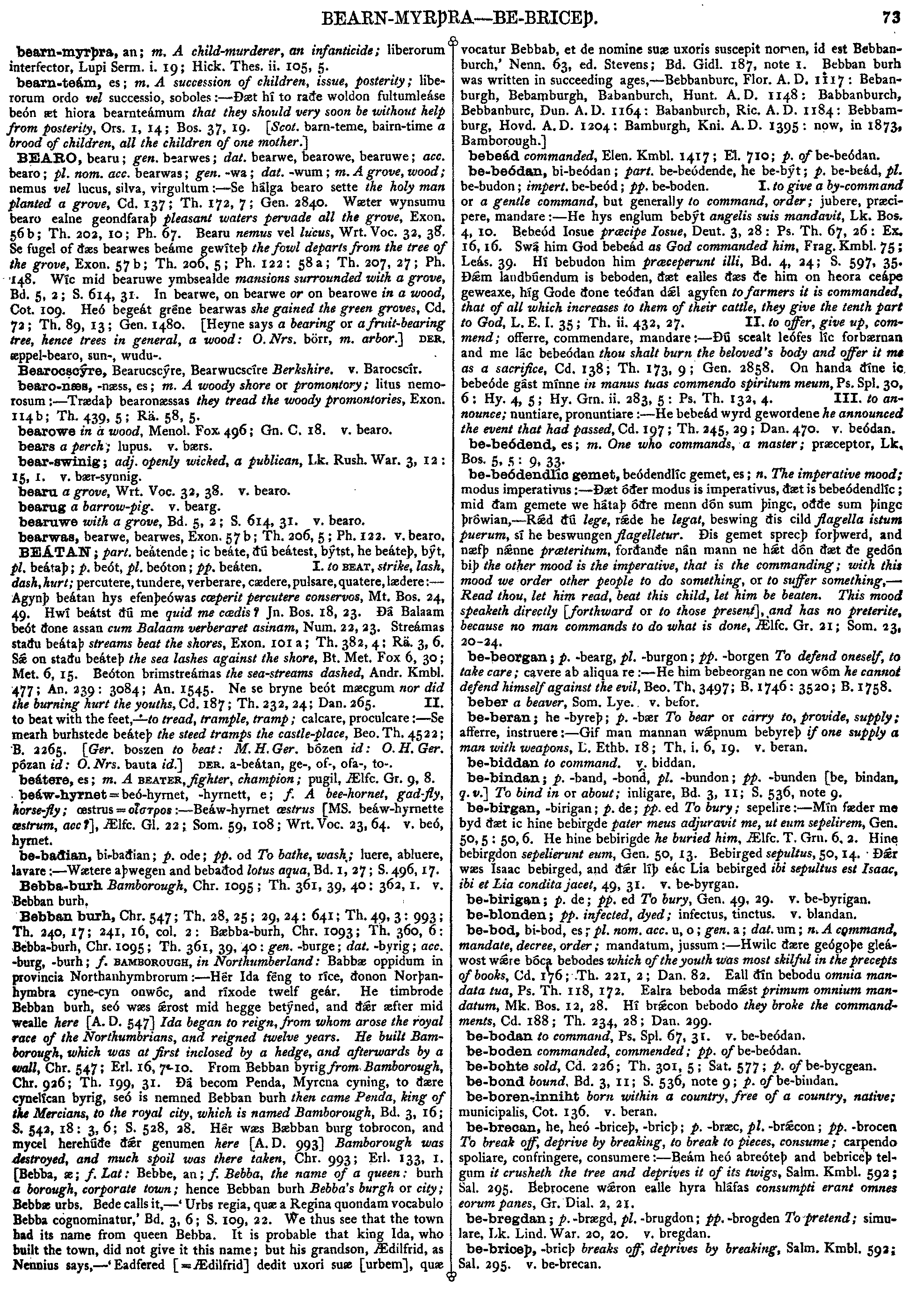
BEARO, bearu; gen. bearwes; dat. bearwe, bearowe, bearuwe; acc. bearo; pl. nom. acc. bearwas; gen. -wa; dat. -wum; m. A grove, wood; nemus vel lucus, silva, virgultum :-- Se hálga bearo sette the holy man planted a grove, Cd. 137; Th. 172, 7; Gen. 2840. Wæter wynsumu bearo ealne geondfaraþ pleasant waters pervade all the grove, Exon. 56 b; Th. 202, 10; Ph. 67. Bearu nemus vel lucus, Wrt. Voc. 32. 38. Se fugel of ðæs bearwes beáme gewíteþ the fowl departs from the tree of the grove, Exon. 57 b ; Th. 206, 5; Ph. 122 : 58 a ; Th. 207, 27; Ph. 148. Wíc mid bearuwe ymbsealde mansions surrounded with a grove, Bd. 5, 2; S. 614, 31. In bearwe, on bearwe or on bearowe in a wood, Cot. 109. Heó begeát gréne bearwas she gained the green groves, Cd. 72; Th. 89, 13; Gen. 1480. [Heyne says a bearing or a fruit-bearing tree, hence trees in general, a wood : O. Nrs. börr, m. arbor.] DER. æppel-bearo, sun-, wudu-.
|
Source: Bosworth/Toller, page b0088, entry 28 View original page image as: [TIFF] [PNG] [View previous entry] [View next entry] |
[Comment on this entry] [View comments] |
The following entry has been hand-corrected once. |
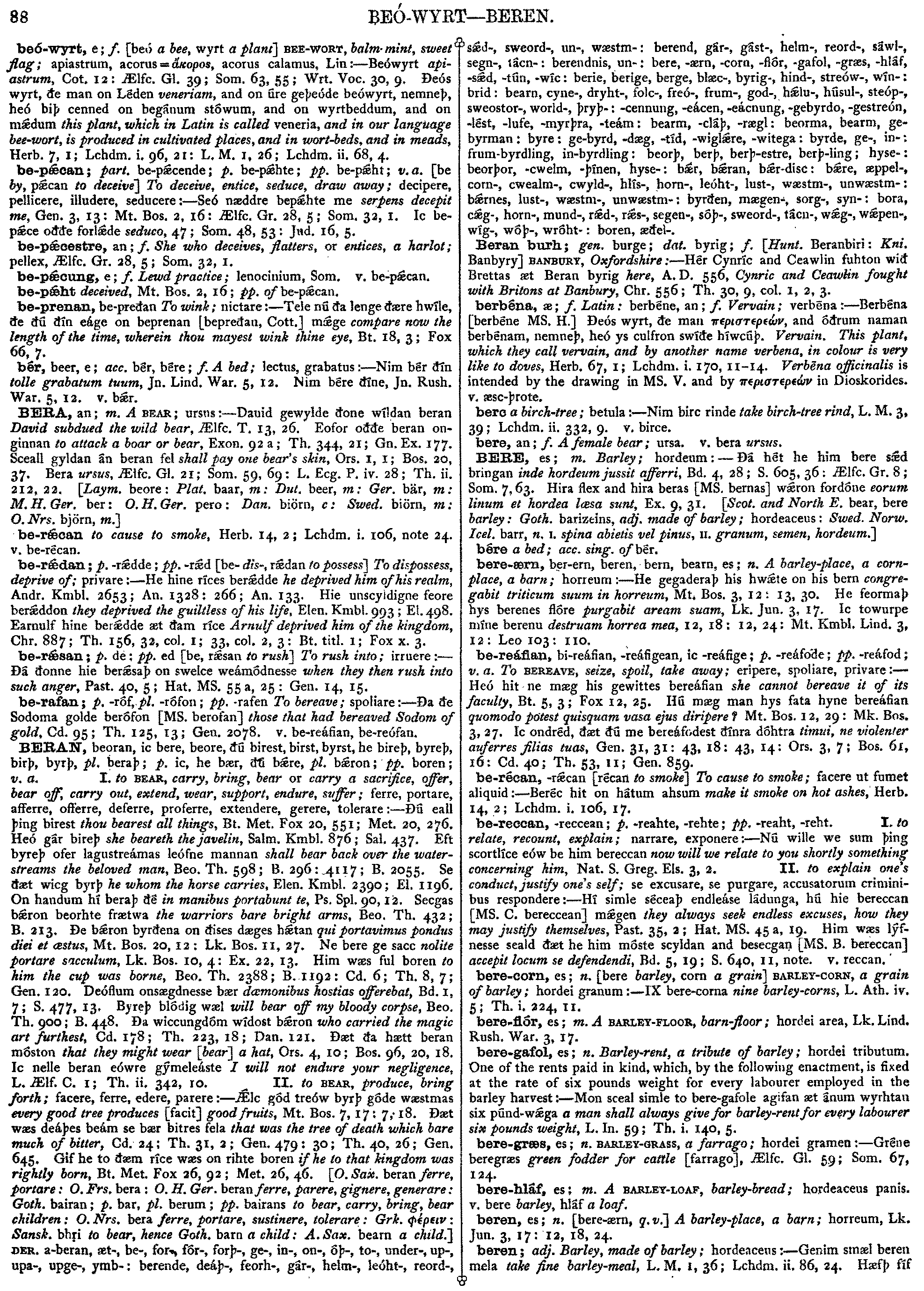
bere-græs, es; n. BARLEY-GRASS, a farrago; hordei gramen :-- Gréne beregræs green fodder for cattle [farrago], Ælfc. Gl. 59; Som. 67, 124.
|
Source: Bosworth/Toller, page b0095, entry 23 View original page image as: [TIFF] [PNG] [View previous entry] [View next entry] |
[Comment on this entry] [View comments] |
The following entry has been hand-corrected once. |
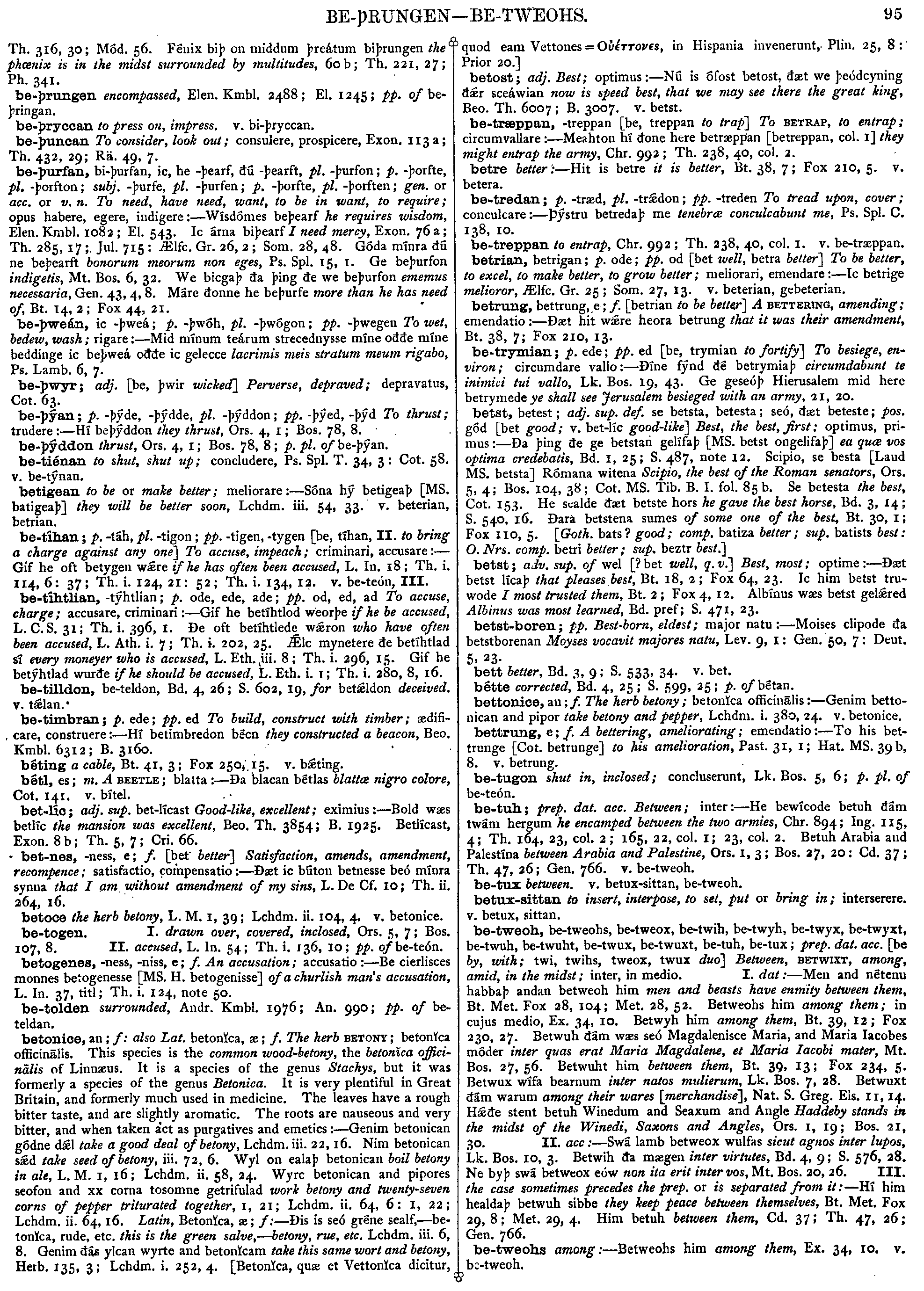
betonice,
an;
f
:
also
Lat.
beton ca,
æ;
f.
The
herb
BETONY;
betonca
officin
ca,
æ;
f.
The
herb
BETONY;
betonca
officin lis.
This
species
is
the
common
wood-betony,
the
betonca
officinlis
of
Linnæus.
It
is
a
species
of
the
genus
Stachys,
but
it
was
formerly
a
species
of
the
genus
Betonica.
It
is
very
plentiful
in
Great
Britain,
and
formerly
much
used
in
medicine.
The
leaves
have
a
rough
bitter
taste,
and
are
slightly
aromatic.
The
roots
are
nauseous
and
very
bitter,
and
when
taken
act
as
purgatives
and
emetics
:--
Genim
betonican
gódne
dl
take
a
good
deal
of
betony,
Lchdm.
iii.
22,
16.
Nim
betonican
sd
take
seed
of
betony,
iii.
72,
6.
Wyl
on
ealaþ
betonican
boil
betony
in
ale,
L.
M.
1,
16;
Lchdm.
ii.
58,
24.
Wyrc
betonican
and
pipores
seofon
and
xx
corna
tosomne
getrifulad
work
betony
and
twenty-seven
corns
of
pepper
triturated
together,
1,
21;
Lchdm.
ii.
64,
6
:
1,
22;
Lchdm.
ii.
64,
16.
Latin,
Betonca,
æ;
f
:--
Ðis
is
seó
gréne
sealf,
-
betonca,
rude,
etc.
this
is
the
green
salve,
-
betony,
rue,
etc.
Lchdm.
iii.
6,
8.
Genim
ðás
ylcan
wyrte
and
betoncam
take
this
same
wort
and
betony,
Herb.
135,
3;
Lchdm.
i.
252,
4.
[Betonca,
quæ
et
Vettonca
dicitur,
quod
eam
Vettones
=
O&upsilon-tonos;&epsilon-tonos;
lis.
This
species
is
the
common
wood-betony,
the
betonca
officinlis
of
Linnæus.
It
is
a
species
of
the
genus
Stachys,
but
it
was
formerly
a
species
of
the
genus
Betonica.
It
is
very
plentiful
in
Great
Britain,
and
formerly
much
used
in
medicine.
The
leaves
have
a
rough
bitter
taste,
and
are
slightly
aromatic.
The
roots
are
nauseous
and
very
bitter,
and
when
taken
act
as
purgatives
and
emetics
:--
Genim
betonican
gódne
dl
take
a
good
deal
of
betony,
Lchdm.
iii.
22,
16.
Nim
betonican
sd
take
seed
of
betony,
iii.
72,
6.
Wyl
on
ealaþ
betonican
boil
betony
in
ale,
L.
M.
1,
16;
Lchdm.
ii.
58,
24.
Wyrc
betonican
and
pipores
seofon
and
xx
corna
tosomne
getrifulad
work
betony
and
twenty-seven
corns
of
pepper
triturated
together,
1,
21;
Lchdm.
ii.
64,
6
:
1,
22;
Lchdm.
ii.
64,
16.
Latin,
Betonca,
æ;
f
:--
Ðis
is
seó
gréne
sealf,
-
betonca,
rude,
etc.
this
is
the
green
salve,
-
betony,
rue,
etc.
Lchdm.
iii.
6,
8.
Genim
ðás
ylcan
wyrte
and
betoncam
take
this
same
wort
and
betony,
Herb.
135,
3;
Lchdm.
i.
252,
4.
[Betonca,
quæ
et
Vettonca
dicitur,
quod
eam
Vettones
=
O&upsilon-tonos;&epsilon-tonos; o
o
 s,
in
Hispania
invenerunt,
Plin.
25,
8
:
Prior
20.]
s,
in
Hispania
invenerunt,
Plin.
25,
8
:
Prior
20.]
|
Source: Bosworth/Toller, page b0108, entry 35 View original page image as: [TIFF] [PNG] [View previous entry] [View next entry] |
[Comment on this entry] [View comments] |
The following entry has been hand-corrected once. |
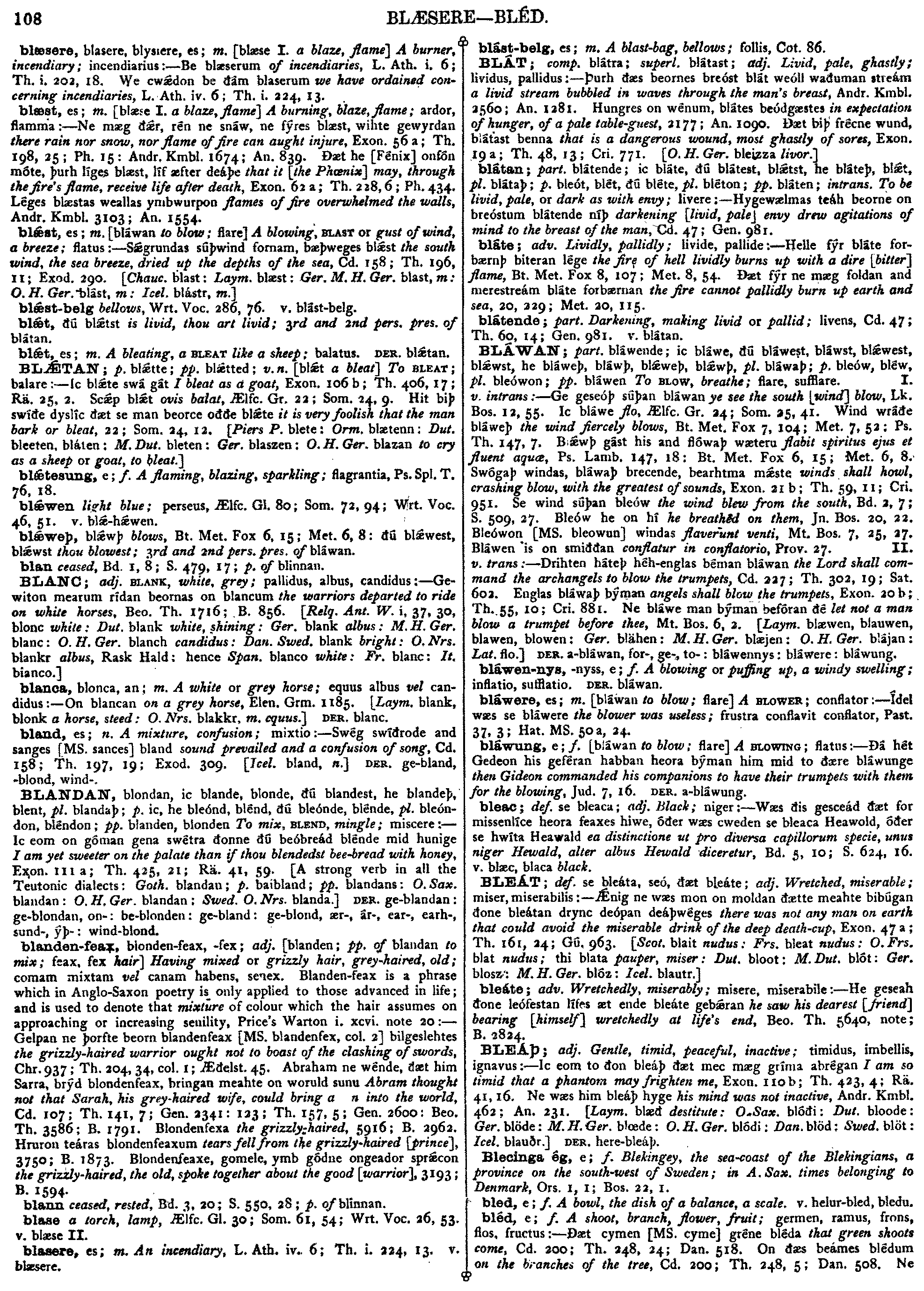
bléd,
e;
f.
A
shoot,
branch,
flower,
fruit;
germen,
ramus,
frons,
flos,
fructus
:--
Ðæt
cymen
[MS.
cyme]
gréne
bléda
that
green
shoots
come,
Cd.
200;
Th.
248,
24;
Dan.
518.
On
ðæs
beámes
blédum
on
the
branches
of
the
tree,
Cd.
200;
Th.
248,
5;
Dan.
508.
Ne
dreósaþ
beorhte
bléde
bright
fruits
fall
not,
Exon.
56
a;
Th.
200,
3;
Ph.
35:
62
b;
Th.
230,
2;
Ph.
466.
God
lteþ
hrusan
syllan
beorhte
bléda
beornum
and
þearfum
God
lets
earth
give
delightful
fruits
to
rich
and
poor,
Hick.
Thes.
i.
135,
24.
DER.
wudu-bléd.
v.
bld.
|
Source: Bosworth/Toller, page b0118, entry 18 View original page image as: [TIFF] [PNG] [View previous entry] [View next entry] |
[Comment on this entry] [View comments (1)] |
The following entry has been hand-corrected once. |
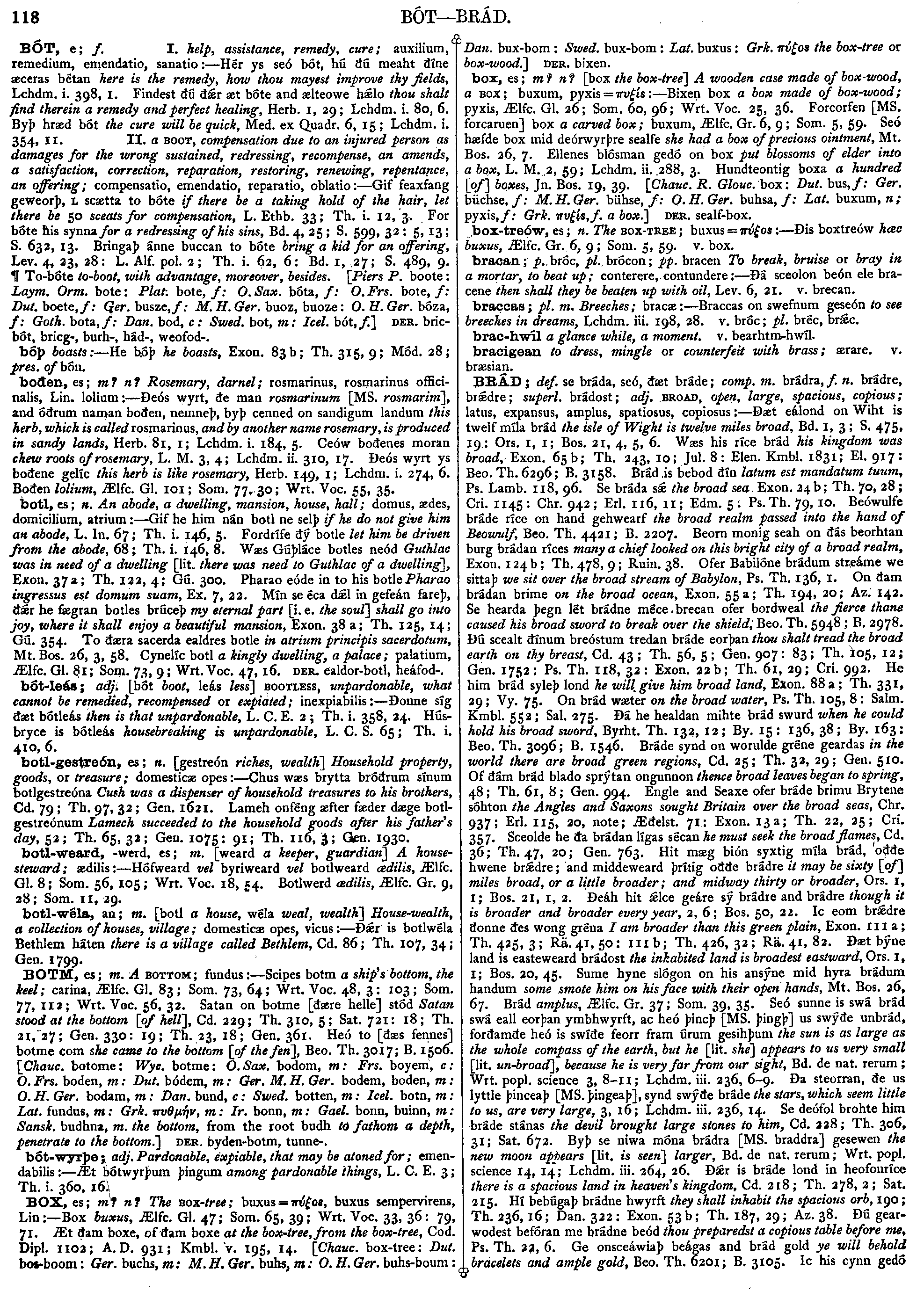
BRÁD;
def.
se
bráda,
seó,
ðæt
bráde;
comp.
m.
brádra,
f.
n.
brádre,
brdre;
superl.
brádost;
adj.
BROAD,
open,
large,
spacious,
copious;
latus,
expansus,
amplus,
spatiosus,
copiosus
:--
Ðæt
eálond
on
Wiht
is
twelif
míla
brád
the
isle
of
Wight
is
twelve
miles
broad,
Bd.
1,
3;
S.
475,
19:
Ors.
1,
1;
Bos.
21,
4,
5,
6.
Was
his
ríce
brád
his
kingdom
was
broad,
Exon.
65
b;
Th.
243,
10;
Jul.
8:
Elen.
Kmbl.
1831;
El.
917:
Beo.
Th.
6296;
B.
3158.
Brád
is
bebod
ðín
latum
est
mandatum
tuum,
Ps.
Lamb.
118,
96.
Se
bráda
s
the
broad
sea.
Exon,
24
b;
Th.
70,
28;
Cri.
1145:
Chr.
942;
Erl.
116,
11;
Edm.
5.
Ps.
Th.
79,
10.
Beówulfe
bráde
ríce
on
hand
gehwearf
the
broad
realm
passed
into
the
hand
of
Beowulf,
Beo.
Th.
4421;
B.
2207.
Beorn
monig
seah
on
ðás
beorhtan
burg
brádan
ríces
many
a
chief
looked
on
this
bright
city
of
a
broad
realm,
Exon.
124
b;
Th,
478,
9;
Ruin.
38.
Ofer
Babilóne
brádum
streáme
we
sittaþ
we
sit
over
the
broad
stream
of
Babylon,
Ps.
Th.
136,
1.
On
ðam
brádan
brime
on
the
broad
ocean,
Exon.
55
a;
Th.
194,
20;
Az:
142.
Se
hearda
þegn
lét
brádne
méce
brecan
ofer
bordweal
the
fierce
thane
caused
his
broad
sword
to
break
over
the
shield,
Beo.
Th.
5948;
B.
2978.
Ðú
scealt
ðínum
breóstum
tredan
bráde
eorþan
thou
shalt
tread
the
broad
earth
on
thy
breast,
Cd,
43;
Th.
56,
5;
Gen.
907:
83;
Th.
105,
12;
Gen.
1752:
Ps.
Th.
118,
32:
Exon.
22
b;
Th.
61,
29;
Cri.
992.
He
him
brád
syleþ
lond
he
will
give
him
broad
land,
Exon.
88
a;
Th.
331,
29;
Vy.
75.
On
brád
wæter
on
the
broad
water,
Ps.
Th.
105,
8:
Salm.
Kmbl.
552;
Sal.
275.
Ðá
he
healdan
mihte
brád
swurd
when
he
could
hold
his
broad
sword,
Byrht.
Th.
132,
12;
By.
15:
136,
38;
By.
163:
Beo.
Th,
3096;
B.
1546.
Bráde
synd
on
worulde
gréne
geardas
in
the
world
there
are
broad
green
regions,
Cd.
25;
Th.
32,
29;
Gen.
510.
Of
ðám
brád
blado
sprýtan
ongunnon
thence
broad
leaves
began
to
spring,
48;
Th.
61,
8
;
Gen.
994.
Engle
and
Seaxe
ofer
bráde
brimu
Brytene
sóhton
the
Angles
and
Saxons
sought
Britain
over
the
broad
seas,
Chr.
937;
Erl.
115,
20,
note;
Æðelst.
71:
Exon.
13
a;
Th.
22,
25;
Cri.
357.
Sceolde
he
ða
brádan
lígas
sécan
he
must
seek
the
broad
flames,
Cd.
36;
Th,
47,
20;
Gen.
763.
Hit
mæg
bión
syxtig
míla
brád,
oððe
hwene
brdre;
and
middeweard
þrítig
oððe
brádre
it
may
be
sixty
[of]
miles
broad,
or
a
little
broader;
and
midway
thirty
or
broader,
Ors.
1,
1;
Bos.
21,
1,
2.
Ðeáh
hit
lce
geáre
sý
brádre
and
brádre
though
it
is
broader
and
broader
every
year,
2,
6;
Bos.
50,
22.
Ic
eom
brdre
ðonne
ðes
wong
gréna
I
am
broader
than
this
green
plain,
Exon.
111
a;
Th.
425,
3;
Rä.
41,
50:
111
b;
Th,
426,
32;
Rä.
41,
82.
Ðæt
býne
land
is
easteweard
brádost
the
inhabited
land
is
broadest
eastward,
Ors.
1,
1;
Bos.
20,
45,
Sume
hyne
slógon
on
his
ansýne
mid
hyra
brádum
handum
some
smote
him
on
his
face
with
their
open
hands,
Mt.
Bos.
26,
67.
Brád
amplus,
Ælfc.
Gr.
37;
Som.
39,
35.
Seó
sunne
is
swá
brád
swá
eall
eorþan
ymbhwyrft,
ac
heó
þincþ
[MS.
þingþ]
us
swýðe
unbrád,
forðamðe
heó
is
swíðe
feorr
fram
úrum
gesihþum
the
sun
is
as
large
as
the
whole
compass
of
the
earth,
but
he
[lit.
she]
appears
to
us
very
small
[lit.
un-broad],
because
he
is
very
far
from
our
sight,
Bd.
de
nat.
rerum;
Wrt.
popl,
science
3,
8-11;
Lchdm.
iii.
236,
6-9.
Ða
steorran,
ðe
us
lyttle
þinceaþ
[MS.
þingeaþ],
synd
swýðe
bráde
the
stars,
which
seem
little
to
us,
are
very
large,
3,
16;
Lchdm.
iii.
236,
14.
Se
deófol
brohte
him
bráde
stánas
the
devil
brought
large
stones
to
him,
Cd.
228;
Th.
306,
31;
Sat.
672.
Byþ
se
niwa
móna
brádra
[MS.
braddra]
gesewen
the
new
moon
appears
[lit.
is
seen]
larger,
Bd.
de
nat.
rerum;
Wrt.
popl.
science
14,
14;
Lchdm.
iii.
264,
26.
Ðr
is
bráde
lond
in
heofonríce
there
is
a
spacious
land
in
heaven's
kingdom,
Cd.
218;
Th.
278,
2;
Sat.
215.
Hí
bebúgaþ
brádne
hwyrft
they
shall
inhabit
the
spacious
orb,
190;
Th.
236,
16;
Dan.
322:
Exon.
53
b;
Th.
187,
29;
Az.
38.
Ðú
gearwodest
befóran
me
brádne
beód
thou
preparedst
a
copious
table
before
me,
Ps.
Th.
22,
6.
Ge
onsceáwiaþ
beágas
and
brád
gold
ye
will
behold
bracelets
and
ample
gold,
Beo.
Th.
6201;
B.
3105.
Ic
his
cyan
gedó
brád
and
bresne
I
will
make
his
race
large
and
powerful,
Cd.
134;
Th.
169,
17;
Gen.
2801.
Brád
earmbeáh
a
broad
or
large
arm-bracelet;
dextrocherium,
Ælfc.
Gl.
114;
Som.
80,
30;
Wrt.
Voc.
61,
10.
[Chauc.
Wyc.
brod,
brood:
R.
Glouc.
brod:
Laym.
braed,
brad,
brod:
Orm.
brad:
Scot.
braid,
brade:
Plat.
breed:
O.
Sax.
bréd:
Frs.
bred:
O.
Frs.
bred,
breid:
Dut.
breed:
Ger.
M.
H.
Ger.
breit:
O.
H.
Ger.
breit:
Goth.
braids:
Dan.
Swed.
bred:
Icel.
breiðr:
Lat.
latus
for
platus:
Grk.


 &upsilon-tonos;s:
Lith.
platus:
Zend
frath-anh
breadth:
Sansk.
prithu
broad,
wide;
prith
to
extend.]
DER.
un-brád,
wíd-.
&upsilon-tonos;s:
Lith.
platus:
Zend
frath-anh
breadth:
Sansk.
prithu
broad,
wide;
prith
to
extend.]
DER.
un-brád,
wíd-.
|
Source: Bosworth/Toller, page b0127, entry 37 View original page image as: [TIFF] [PNG] [View previous entry] [View next entry] |
[Comment on this entry] [View comments] |
The following entry has been hand-corrected once. |
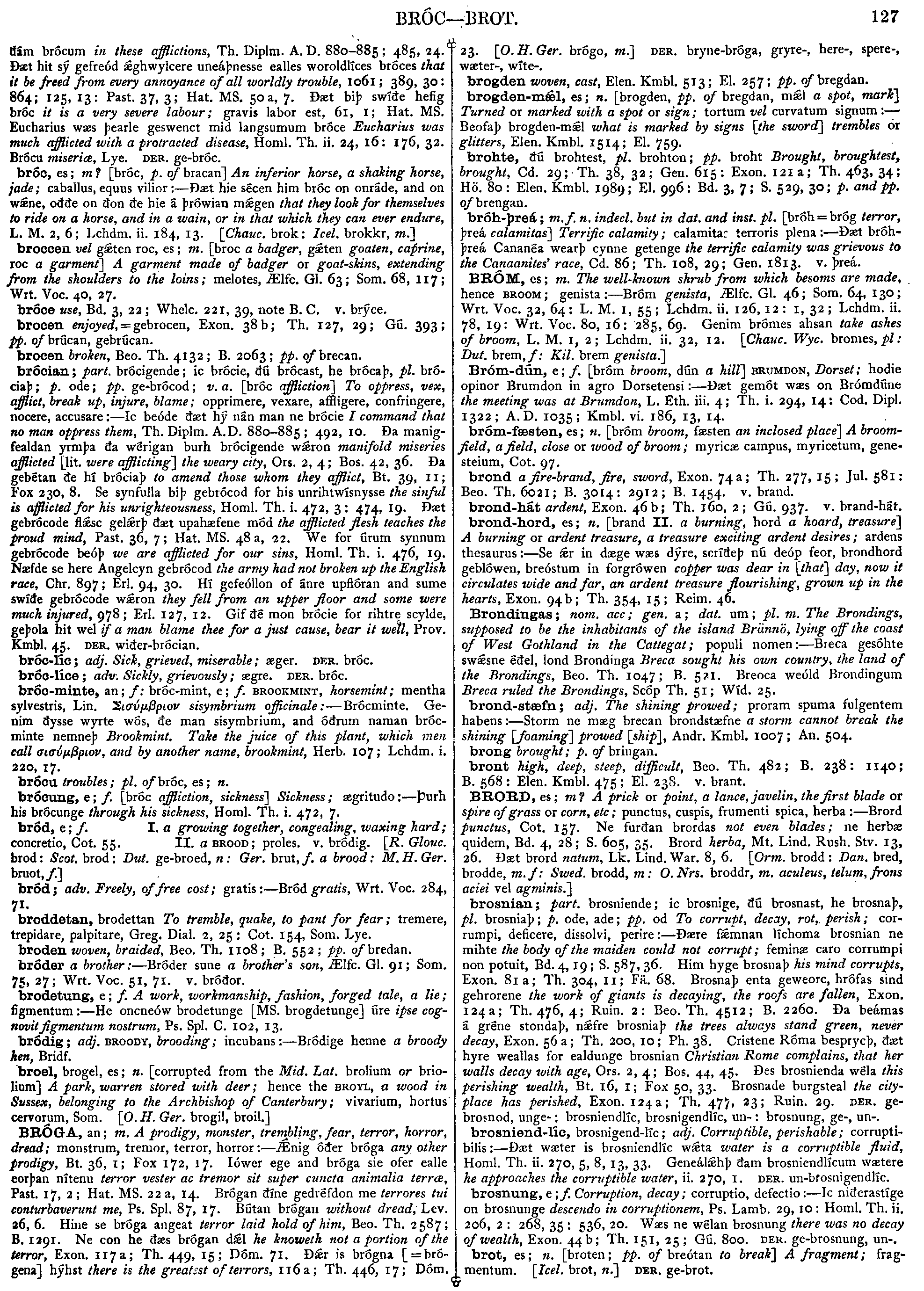
brosnian;
part.
brosniende;
ic
brosnige,
ðú
brosnast,
he
brosnaþ,
pl.
brosniaþ;
p.
ode,
ade;
pp.
od
To
corrupt,
decay,
rot,
perish;
corrumpi,
deficere,
dissolvi,
perire
:--
Ðære
fmnan
líchoma
brosnian
ne
mihte
the
body
of
the
maiden
could
not
corrupt;
feminæ
caro
corrumpi
non
potuit,
Bd.
4,
19;
S.
587,
36.
Him
hyge
brosnaþ
his
mind
corrupts,
Exon.
81
a;
Th.
304,
11;
Fä.
68.
Brosnaþ
enta
geweorc,
hrófas
sind
gehrorene
the
work
of
giants
is
decaying,
the
roofs
are
fallen,
Exon.
124
a;
Th.
476,
4;
Ruin.
2:
Beo.
Th.
4512;
B.
2260.
Ða
beámas
á
gréne
stondaþ,
nfre
brosniaþ
the
trees
always
stand
green,
never
decay,
Exon.
56
a;
Th.
200,
10;
Ph.
38.
Cristene
Róma
besprycþ,
ðæt
hyre
weallas
for
ealdunge
brosnian
Christian
Rome
complains,
that
her
walls
decay
with
age,
Ors.
2,
4;
Bos.
44,
45.
Ðes
brosnienda
wéla
this
perishing
wealth,
Bt.
16,
1;
Fox
50,
33.
Brosnade
burgsteal
the
city-place
has
perished,
Exon.
124
a;
Th.
477,
23;
Ruin.
29.
DER.
ge-brosnod,
unge-;
brosniendlíc,
brosnigendlíc,
un-:
brosnung,
ge-,
un-.
| Result Page: | 1 2 3 4 5 6 7 8 | Next |  |
Germanic Lexicon Project (main page)
This search system was written by
Sean Crist
Please consider
volunteering
to correct the data in these online dictionaries.
No rights reserved. Feel free to use these data in any way you please.