|
|

Search for grana again, using less strict matching (13 results)
|
Source: Bosworth/Toller, page d0484, entry 27 View original page image as: [TIFF] [PNG] [View previous entry] [View next entry] |
[Comment on this entry] [View comments] |
The following entry has been hand-corrected once. |
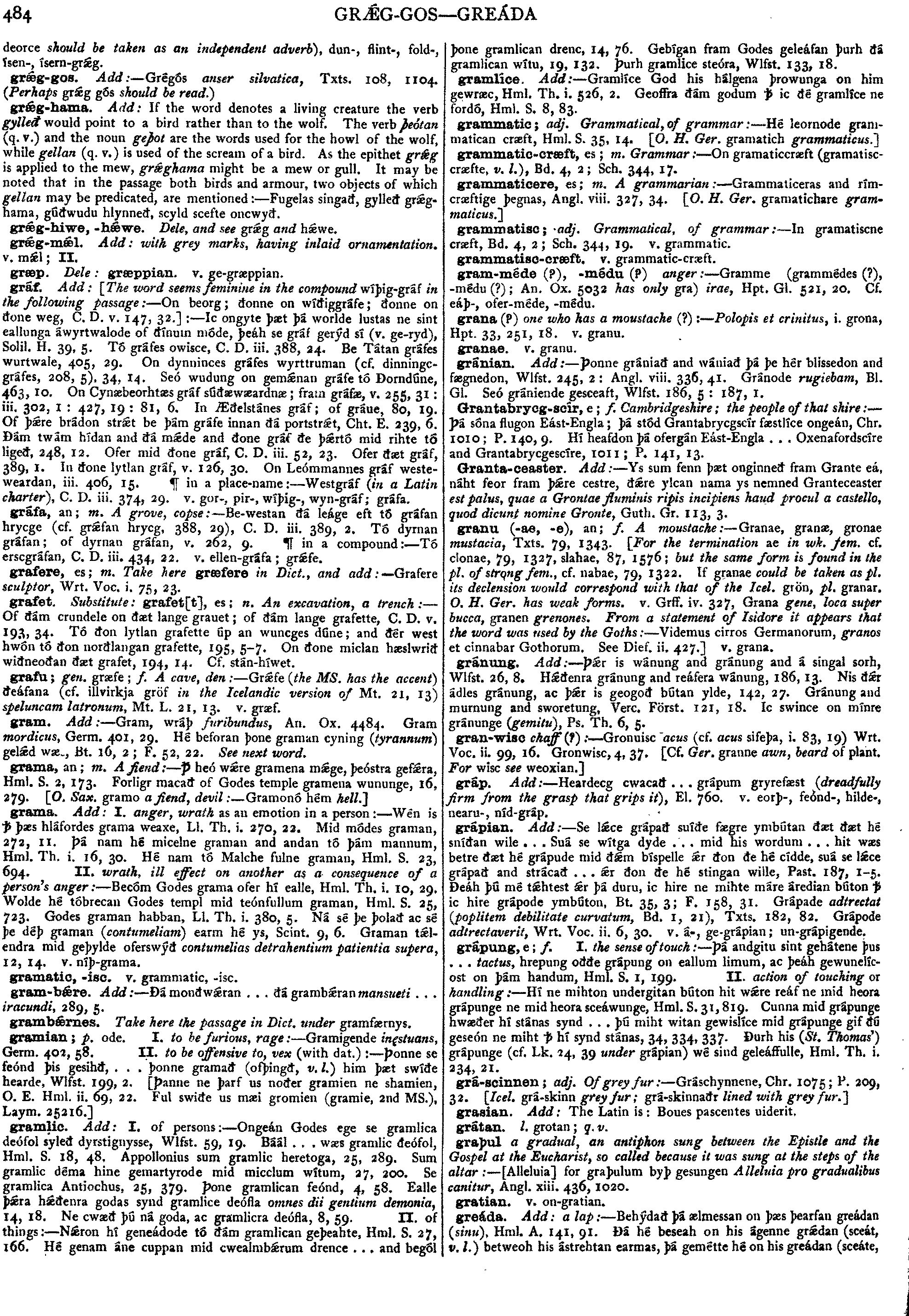
grana (?) one who has a moustache (?) :-- Polopis et crinitus, i. grona, Hpt. 33. 251, 18. v. granu.
|
Source: Torp, page b0138, entry 8 View original page image as: [TIFF] [PNG] [View previous entry] [View next entry] |
[Comment on this entry] [View comments] |
The following entry has been hand-corrected once. |
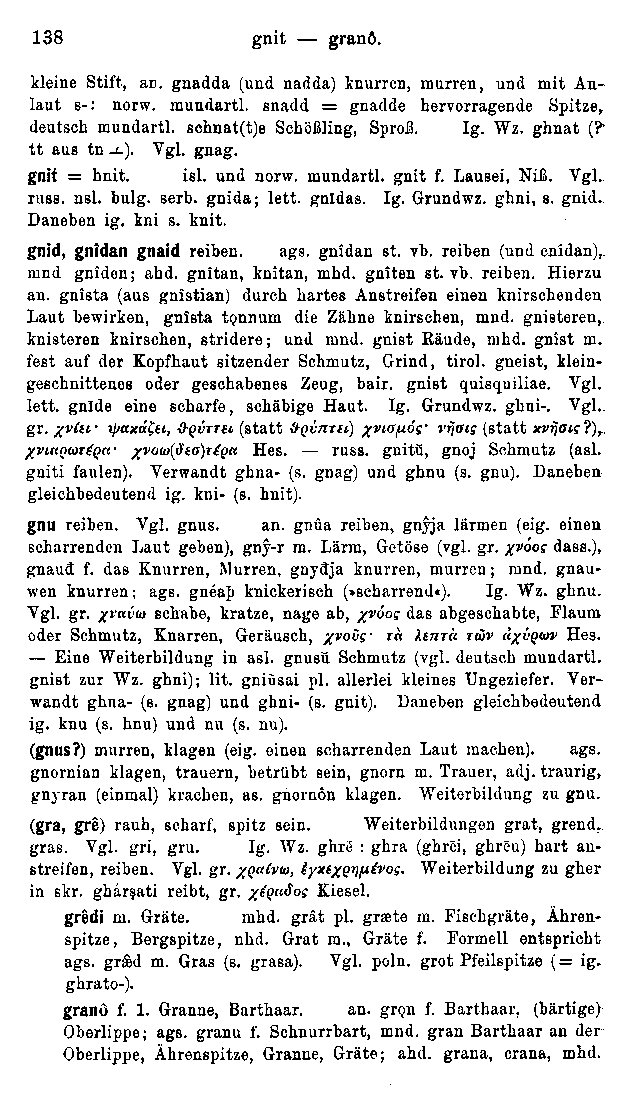
granô
f.
1.
Granne,
Barthaar.
an.
gr n
f.
Barthaar.
(bärtige)
Oberlippe;
ags.
granu
f.
Schnurrbart,
mnd.
gran
Barthaar
an
der
Oberlippe,
Ährenspitze,
Granne,
Gräte;
ahd.
grana,
crana,
mhd.
n
f.
Barthaar.
(bärtige)
Oberlippe;
ags.
granu
f.
Schnurrbart,
mnd.
gran
Barthaar
an
der
Oberlippe,
Ährenspitze,
Granne,
Gräte;
ahd.
grana,
crana,
mhd.
 Schnabel,
Schiffsschnabel?)
Vgl.
alb.
krans
Stachel,
Dorn
und
ir.
grend
Bart
(aus
ghrend
Schnabel,
Schiffsschnabel?)
Vgl.
alb.
krans
Stachel,
Dorn
und
ir.
grend
Bart
(aus
ghrend oder
ghrendh);
asl.
gran
oder
ghrendh);
asl.
gran Ecke.
Ecke.
[Translate the German words]
|
Source: Bosworth/Toller, page b0094, entry 12 View original page image as: [TIFF] [PNG] [View previous entry] [View next entry] |
[Comment on this entry] [View comments] |
The following entry has been hand-corrected once. |
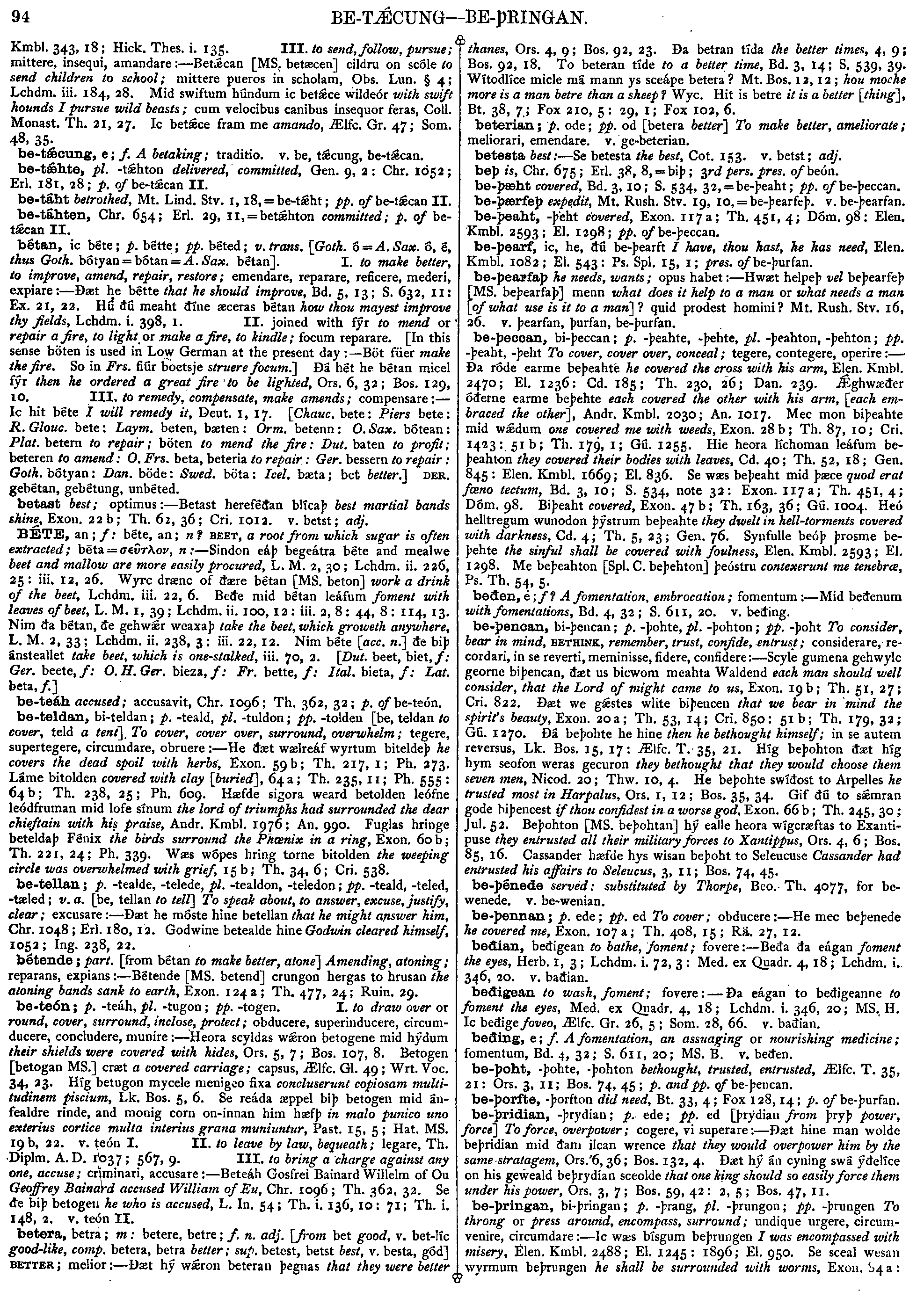
be-teón;
p.
-teáh,
pl.
-tugon;
pp.
-togen.
I.
to
draw
over
or
round,
cover,
surround,
inclose,
protect;
obducere,
superinducere,
circumducere,
concludere,
munire
:--
Heora
scyldas
w ron
betogene
mid
hýdum
their
shields
were
covered
with
hides,
Ors.
5,
7;
Bos.
107,
8.
Betogen
[betogan
MS.]
cræt
a
covered
carriage;
capsus,
Ælfc.
Gl.
49;
Wrt.
Voc.
34,
23.
Híg
betugon
mycele
menigeo
fixa
concluserunt
copiosam
multitudinem
piscium,
Lk.
Bos.
5,
6.
Se
reáda
æppel
biþ
betogen
mid
ánfealdre
rinde,
and
monig
corn
on-innan
him
hæfþ
in
malo
punico
uno
exterius
cortice
multa
interius
grana
muniuntur,
Past.
15,
5;
Hat.
MS.
19
b,
22.
v.
teón
I.
II.
to
leave
by
law,
bequeath;
legare,
Th.
Diplm.
A.
D.
1037;
567,
9.
III.
to
bring
a
charge
against
any
one,
accuse;
criminari,
accusare
:--
Beteáh
Gosfrei
Bainard
Willelm
of
Ou
Geoffrey
Bainard
accused
William
of
Eu,
Chr.
1096;
Th.
362,
32.
Se
ðe
biþ
betogen
he
who
is
accused,
L.
In.
54;
Th.
i.
136,
10
:
71;
Th.
i.
148,
2.
v.
teón
II.
ron
betogene
mid
hýdum
their
shields
were
covered
with
hides,
Ors.
5,
7;
Bos.
107,
8.
Betogen
[betogan
MS.]
cræt
a
covered
carriage;
capsus,
Ælfc.
Gl.
49;
Wrt.
Voc.
34,
23.
Híg
betugon
mycele
menigeo
fixa
concluserunt
copiosam
multitudinem
piscium,
Lk.
Bos.
5,
6.
Se
reáda
æppel
biþ
betogen
mid
ánfealdre
rinde,
and
monig
corn
on-innan
him
hæfþ
in
malo
punico
uno
exterius
cortice
multa
interius
grana
muniuntur,
Past.
15,
5;
Hat.
MS.
19
b,
22.
v.
teón
I.
II.
to
leave
by
law,
bequeath;
legare,
Th.
Diplm.
A.
D.
1037;
567,
9.
III.
to
bring
a
charge
against
any
one,
accuse;
criminari,
accusare
:--
Beteáh
Gosfrei
Bainard
Willelm
of
Ou
Geoffrey
Bainard
accused
William
of
Eu,
Chr.
1096;
Th.
362,
32.
Se
ðe
biþ
betogen
he
who
is
accused,
L.
In.
54;
Th.
i.
136,
10
:
71;
Th.
i.
148,
2.
v.
teón
II.
|
Source: Bosworth/Toller, page b0821, entry 17 View original page image as: [TIFF] [PNG] [View previous entry] [View next entry] |
[Comment on this entry] [View comments] |
The following entry has been hand-corrected once. |
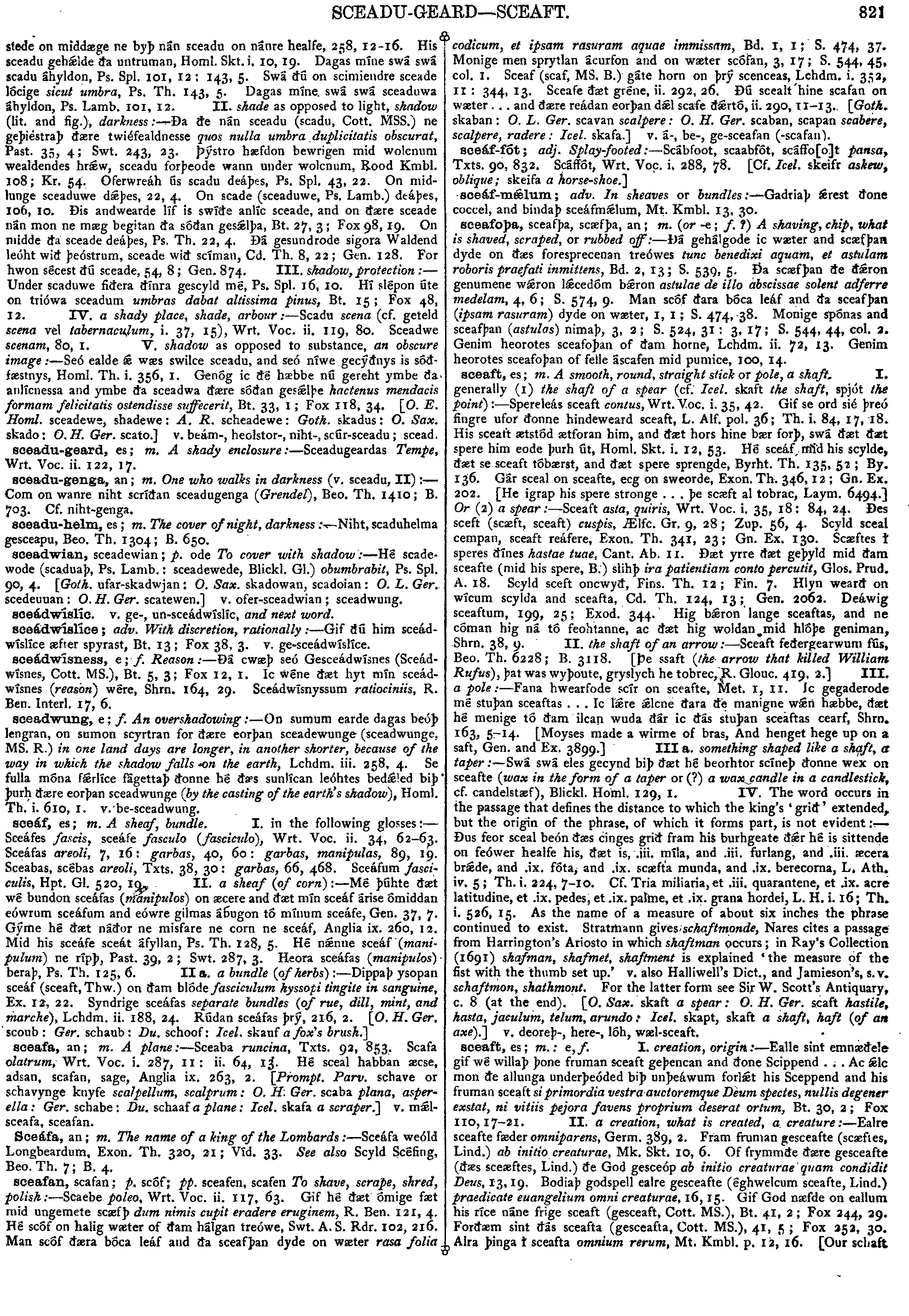
sceaft,
es;
m.
A
smooth,
round,
straight
stick
or
pole,
a
shaft.
I.
generally
(1)
the
shaft
of
a
spear
(cf.
Icel.
skaft
the
shaft,
spjót
the
point)
:--
Spereleás
sceaft
contus,
Wrt.
Voc.
i.
35,
42.
Gif
se
ord
sié
þreó
fingre
ufor
ðonne
hindeweard
sceaft,
L.
Alf.
pol.
36;
Th.
i.
84,
17,
18.
His
sceaft
ætstód
ætforan
him,
and
ðæt
hors
hine
bær
forþ,
swá
ðæt
ðæt
spere
him
eode
þurh
út,
Homl.
Skt.
i.
12,
53.
Hé
sceáf,
mid
his
scylde,
ðæt
se
sceaft
tóbærst,
and
ðæt
spere
sprengde,
Byrht.
Th.
135,
52;
By.
136.
Gár
sceal
on
sceafte,
ecg
on
sweorde,
Exon.
Th.
346,
12;
Gn.
Ex.
202.
[He
igrap
his
spere
stronge
.
.
.
þe
scæft
al
tobrac,
Laym.
6494.]
Or
(2)
a
spear
:--
Sceaft
asta,
quiris,
Wrt.
Voc.
i.
35,
18:
84,
24.
Ðes
sceft
(scæft,
sceaft)
cuspis,
Ælfc.
Gr.
9,
28;
Zup.
56,
4.
Scyld
sceal
cempan,
sceaft
reáfere,
Exon.
Th.
341,
23;
Gn.
Ex.
130.
Scæftes
 speres
ðínes
hastae
tuae,
Cant.
Ab.
11.
Ðæt
yrre
ðæt
geþyld
mid
ðam
sceafte
(mid
his
spere,
B.)
slihþ
ira
patientiam
conto
percutit,
Glos.
Prud.
A.
18.
Scyld
sceft
oncwyð,
Fins.
Th.
12;
Fin.
7.
Hlyn
wearð
on
wícum
scylda
and
sceafta,
Cd.
Th.
124,
13;
Gen.
2062.
Deáwig
sceaftum,
199,
25;
Exod.
344.
Hig
bron
lange
sceaftas,
and
ne
cóman
hig
ná
tó
feohtanne,
ac
ðæt
hig
woldan
mid
hlóþe
geniman,
Shrn.
38,
9.
II.
the
shaft
of
an
arrow
:--
Sceaft
feðergearwum
fús,
Beo.
Th.
6228;
B.
3118.
[Þe
ssaft
(the
arrow
that
killed
William
Rufus),
þat
was
wyþoute,
gryslych
he
tobrec,
R.
Glouc.
419,
2.]
III.
a
pole
:--
Fana
hwearfode
scír
on
sceafte,
Met.
1.
11.
Ic
gegaderode
mé
stuþan
sceaftas
.
.
.
Ic
lre
lcne
ðara
ðe
manigne
wn
hæbbe,
ðæt
hé
menige
tó
ðam
ilcan
wuda
ðár
ic
ðás
stuþan
sceaftas
cearf,
Shrn.
163,
5-14.
[Moyses
made
a
wirme
of
bras,
And
henget
hege
up
on
a
saft,
Gen.
and
Ex.
3899.]
III
a.
something
shaped
like
a
shaft,
a
taper
:--
Swá
swá
eles
gecynd
biþ
ðæt
hé
beorhtor
scíneþ
ðonne
wex
on
sceafte
(wax
in
the
form
of
a
taper
or
(?)
a
wax
candle
in
a
candlestick,
cf.
candelstæf),
Blickl.
Homl.
129,
1.
IV.
The
word
occurs
in
the
passage
that
defines
the
distance
to
which
the
king's
'grið'
extended,
but
the
origin
of
the
phrase,
of
which
it
forms
part,
is
not
evident
:--
Ðus
feor
sceal
beón
ðæs
cinges
grið
fram
his
burhgeate
ðr
hé
is
sittende
on
feówer
healfe
his,
ðæt
is,
.iii.
míla,
and
.iii.
furlang,
and
.iii.
æcera
brde,
and
.ix.
fóta,
and
.ix.
scæfta
munda,
and
.ix.
berecorna,
L.
Ath.
iv.
5;
Th.
i.
224,
7-10.
Cf.
Tria
miliaria,
et
.iii.
quarantene,
et
.ix.
acre
latitudine,
et
.ix.
pedes,
et
.ix.
palme,
et
.ix.
grana
hordei,
L.
H.
i.
16;
Th.
i.
526,
15.
As
the
name
of
a
measure
of
about
six
inches
the
phrase
continued
to
exist.
Stratmann
gives
schaftmonde,
Nares
cites
a
passage
from
Harrington's
Ariosto
in
which
shaftman
occurs;
in
Ray's
Collection
(1691)
shafman,
shafmet,
shaftment
is
explained
'the
measure
of
the
fist
with
the
thumb
set
up.'
v.
also
Halliwell's
Dict.,
and
Jamieson's,
s.v.
schaftmon,
shathmont.
For
the
latter
form
see
Sir
W.
Scott's
Antiquary,
c.
8
(at
the
end).
[O.
Sax.
skaft
a
spear:
O.
H.
Ger.
scafe
hostile,
hasta,
jaculum,
telum,
arundo:
Icel.
skapt,
skaft
a
shaft,
haft
(of
an
axe).]
v.
deoreþ-,
here-,
lóh,
wæl-sceaft.
speres
ðínes
hastae
tuae,
Cant.
Ab.
11.
Ðæt
yrre
ðæt
geþyld
mid
ðam
sceafte
(mid
his
spere,
B.)
slihþ
ira
patientiam
conto
percutit,
Glos.
Prud.
A.
18.
Scyld
sceft
oncwyð,
Fins.
Th.
12;
Fin.
7.
Hlyn
wearð
on
wícum
scylda
and
sceafta,
Cd.
Th.
124,
13;
Gen.
2062.
Deáwig
sceaftum,
199,
25;
Exod.
344.
Hig
bron
lange
sceaftas,
and
ne
cóman
hig
ná
tó
feohtanne,
ac
ðæt
hig
woldan
mid
hlóþe
geniman,
Shrn.
38,
9.
II.
the
shaft
of
an
arrow
:--
Sceaft
feðergearwum
fús,
Beo.
Th.
6228;
B.
3118.
[Þe
ssaft
(the
arrow
that
killed
William
Rufus),
þat
was
wyþoute,
gryslych
he
tobrec,
R.
Glouc.
419,
2.]
III.
a
pole
:--
Fana
hwearfode
scír
on
sceafte,
Met.
1.
11.
Ic
gegaderode
mé
stuþan
sceaftas
.
.
.
Ic
lre
lcne
ðara
ðe
manigne
wn
hæbbe,
ðæt
hé
menige
tó
ðam
ilcan
wuda
ðár
ic
ðás
stuþan
sceaftas
cearf,
Shrn.
163,
5-14.
[Moyses
made
a
wirme
of
bras,
And
henget
hege
up
on
a
saft,
Gen.
and
Ex.
3899.]
III
a.
something
shaped
like
a
shaft,
a
taper
:--
Swá
swá
eles
gecynd
biþ
ðæt
hé
beorhtor
scíneþ
ðonne
wex
on
sceafte
(wax
in
the
form
of
a
taper
or
(?)
a
wax
candle
in
a
candlestick,
cf.
candelstæf),
Blickl.
Homl.
129,
1.
IV.
The
word
occurs
in
the
passage
that
defines
the
distance
to
which
the
king's
'grið'
extended,
but
the
origin
of
the
phrase,
of
which
it
forms
part,
is
not
evident
:--
Ðus
feor
sceal
beón
ðæs
cinges
grið
fram
his
burhgeate
ðr
hé
is
sittende
on
feówer
healfe
his,
ðæt
is,
.iii.
míla,
and
.iii.
furlang,
and
.iii.
æcera
brde,
and
.ix.
fóta,
and
.ix.
scæfta
munda,
and
.ix.
berecorna,
L.
Ath.
iv.
5;
Th.
i.
224,
7-10.
Cf.
Tria
miliaria,
et
.iii.
quarantene,
et
.ix.
acre
latitudine,
et
.ix.
pedes,
et
.ix.
palme,
et
.ix.
grana
hordei,
L.
H.
i.
16;
Th.
i.
526,
15.
As
the
name
of
a
measure
of
about
six
inches
the
phrase
continued
to
exist.
Stratmann
gives
schaftmonde,
Nares
cites
a
passage
from
Harrington's
Ariosto
in
which
shaftman
occurs;
in
Ray's
Collection
(1691)
shafman,
shafmet,
shaftment
is
explained
'the
measure
of
the
fist
with
the
thumb
set
up.'
v.
also
Halliwell's
Dict.,
and
Jamieson's,
s.v.
schaftmon,
shathmont.
For
the
latter
form
see
Sir
W.
Scott's
Antiquary,
c.
8
(at
the
end).
[O.
Sax.
skaft
a
spear:
O.
H.
Ger.
scafe
hostile,
hasta,
jaculum,
telum,
arundo:
Icel.
skapt,
skaft
a
shaft,
haft
(of
an
axe).]
v.
deoreþ-,
here-,
lóh,
wæl-sceaft.
|
Source: Bosworth/Toller, page d0132, entry 38 View original page image as: [TIFF] [PNG] [View previous entry] [View next entry] |
[Comment on this entry] [View comments] |
The following entry has been hand-corrected once. |
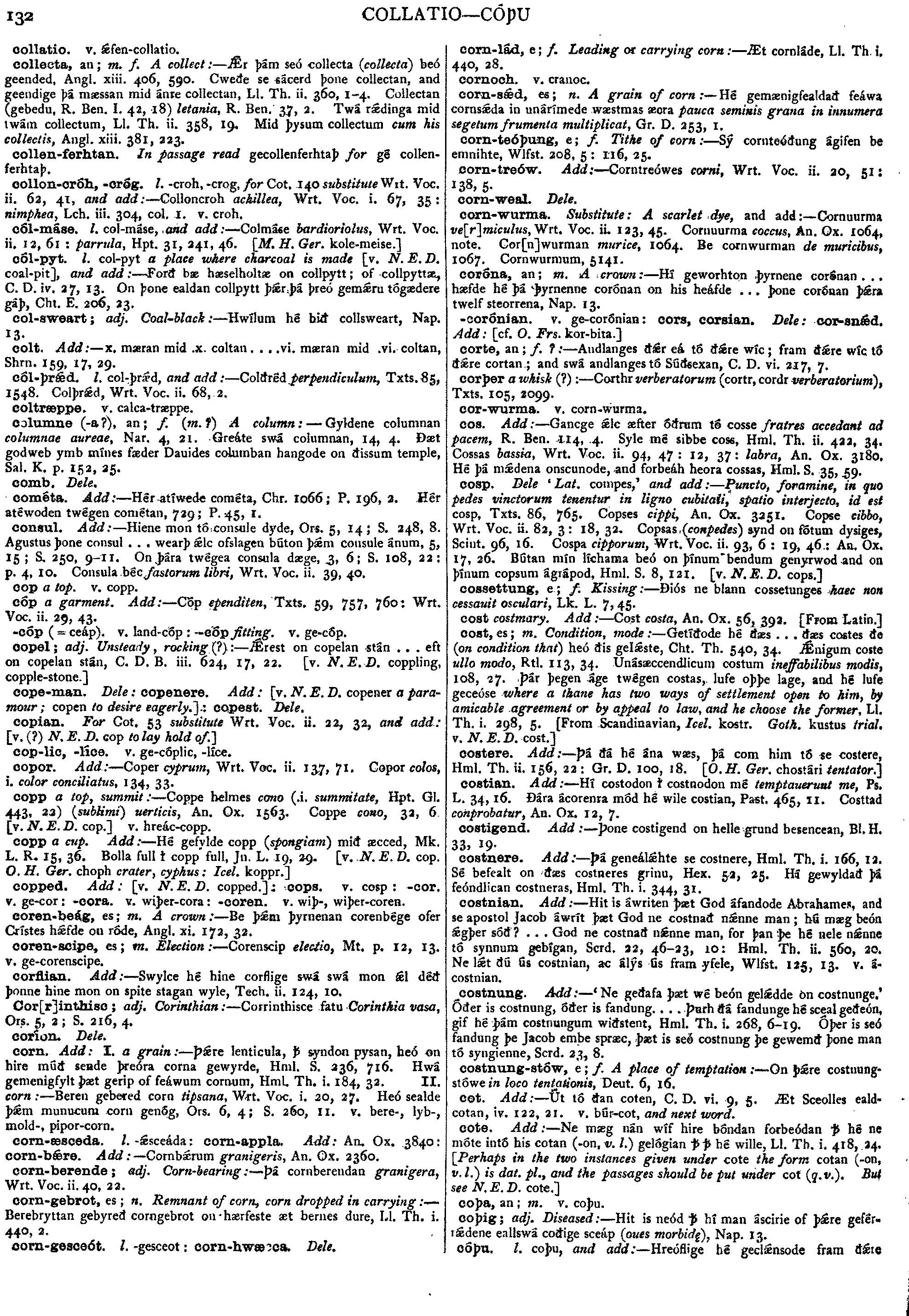
corn-sd,
es;
n.
A
grain
of
corn:--Hé
gemænigfealdað
feáwa
cornsda
in
unárímede
wæstmas
æora
pauca
seminis
grana
in
innumera
segetum
frumenta
multiplicat,
Gr.
D.
253,
1.
|
Source: Bosworth/Toller, page d0218, entry 14 View original page image as: [TIFF] [PNG] [View previous entry] [View next entry] |
[Comment on this entry] [View comments] |
The following entry has been hand-corrected once. |
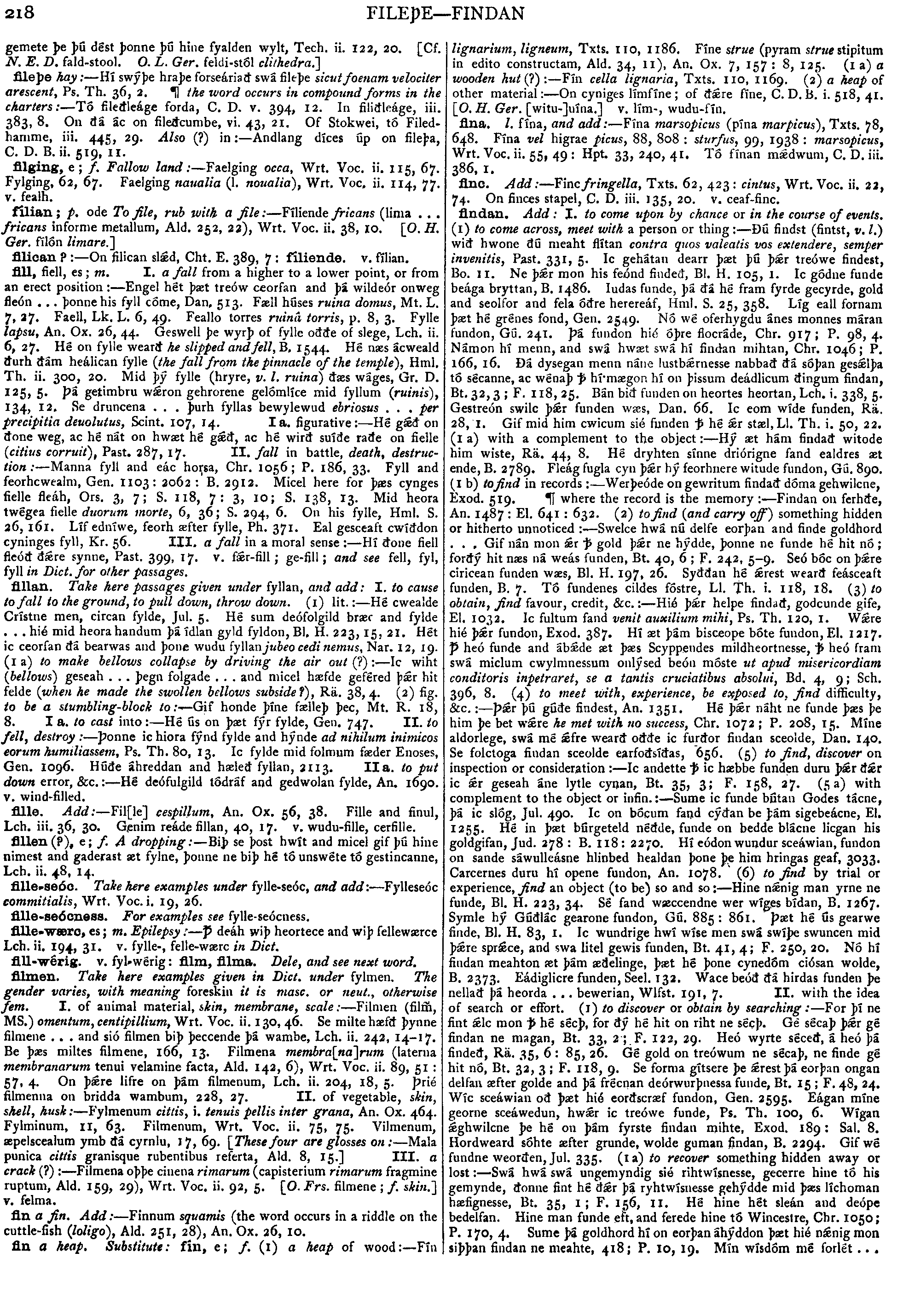
filmen.
Take
here
examples
given
in
Dict.
under
fylmen.
The
gender
varies,
with
meaning
foreskin
it
is
masc.
or
neut.
,
otherwise
fem.
I.
of
animal
material,
skin,
membrane,
scale
:--
Filmen
(fil ,
MS.)
omentum,
centipillium,
Wrt.
Voc.
ii.
130,
46.
Se
milte
hæfð
þynne
filmene
.
.
.
and
sió
filmen
biþ
þeccende
þá
wambe,
Lch.
ii.
242,
14-17.
Be
þæs
miltes
filmene,
166,
13.
Filmena
membra[na]rum
(laterna
membranarum
tenui
velamine
facta,
Aid.
142,
6),
Wrt.
Voc.
ii.
89,
51
:
57,
4.
On
þre
lifre
on
þám
filmenum,
Lch.
ii.
204,
18,
5.
prié
filmenna
on
bridda
wambum,
228,
27.
II.
of
vegetable,
skin,
shell,
husk:
:--
Fylmenum
cittis,
i.
tenuis
pellis
inter
grana,
An.
Ox.
464.
Fylminum,
ii.
63.
Filmenum,
Wrt.
Voc.
ii.
75,
75.
Vilmenum,
æpelscealum
ymb
ðá
cyrnlu,
17,
69.
[These
four
are
glosses
on
:--
Mala
punica
cittis
granisque
rubentibus
referta,
Aid.
8,
15.]
III.
a
crack
(?)
:--
Filmena
oþþe
cinena
rimarum
(capisterium
rimarum
fragmine
ruptum,
Aid.
159,
29),
Wrt.
Voc.
ii.
92,
5.
[O.
Frs.
filmene
;
f.
skin.]
v.
felma.
,
MS.)
omentum,
centipillium,
Wrt.
Voc.
ii.
130,
46.
Se
milte
hæfð
þynne
filmene
.
.
.
and
sió
filmen
biþ
þeccende
þá
wambe,
Lch.
ii.
242,
14-17.
Be
þæs
miltes
filmene,
166,
13.
Filmena
membra[na]rum
(laterna
membranarum
tenui
velamine
facta,
Aid.
142,
6),
Wrt.
Voc.
ii.
89,
51
:
57,
4.
On
þre
lifre
on
þám
filmenum,
Lch.
ii.
204,
18,
5.
prié
filmenna
on
bridda
wambum,
228,
27.
II.
of
vegetable,
skin,
shell,
husk:
:--
Fylmenum
cittis,
i.
tenuis
pellis
inter
grana,
An.
Ox.
464.
Fylminum,
ii.
63.
Filmenum,
Wrt.
Voc.
ii.
75,
75.
Vilmenum,
æpelscealum
ymb
ðá
cyrnlu,
17,
69.
[These
four
are
glosses
on
:--
Mala
punica
cittis
granisque
rubentibus
referta,
Aid.
8,
15.]
III.
a
crack
(?)
:--
Filmena
oþþe
cinena
rimarum
(capisterium
rimarum
fragmine
ruptum,
Aid.
159,
29),
Wrt.
Voc.
ii.
92,
5.
[O.
Frs.
filmene
;
f.
skin.]
v.
felma.
|
Source: Bosworth/Toller, page d0484, entry 32 View original page image as: [TIFF] [PNG] [View previous entry] [View next entry] |
[Comment on this entry] [View comments] |
The following entry has been hand-corrected once. |
granu (-ae, -e), an; f. A moustache :-- Granae, granæ, gronae mustacia, Txts. 79, 1343. [For the termination ae in wk. fem. cf. clonae, 79, 1327, slahae, 87, 1576; but the same form is found in the pl. of strong fem., cf. nabae, 79, 1322. If granae could be taken as pl. its declension would correspond with that of the Icel. grön. pl. granar. O. H. Ger. has weak forms, v. Grff. iv. 327, Grana gene, loca super bucca, granen grenones. From a statement of Isidore it appears that the word was used by the Goths :-- Videmus cirros Germanorum, granos et cinnabar Gothorum. See Dief. ii. 427.] v. grana.
|
Source: Bosworth/Toller, page d0692, entry 15 View original page image as: [TIFF] [PNG] [View previous entry] [View next entry] |
[Comment on this entry] [View comments] |
The following entry has been hand-corrected once. |
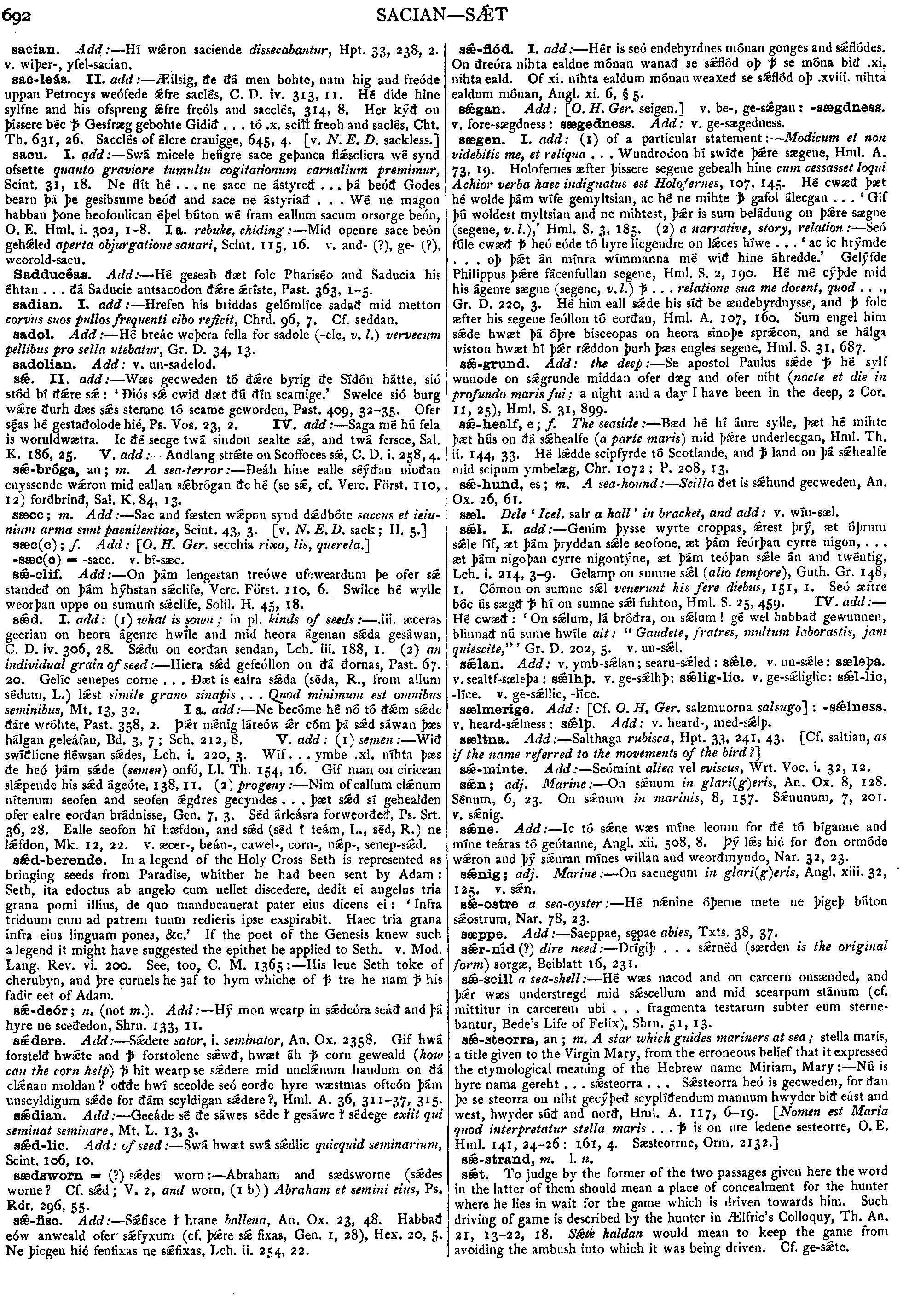
sd-berende.
In
a
legend
of
the
Holy
Cross
Seth
is
represented
as
bringing
seeds
from
Paradise,
whither
he
had
been
sent
by
Adam:
Seth,
ita
edoctus
ab
angelo
cum
uellet
discedere,
dedit
ei
angelus
tria
grana
pomi
illius,
de
quo
manducauerat
pater
eius
dicens
ei:
'Infra
triduum
cum
ad
patrem
tuum
redieris
ipse
exspirabit.
Haec
tria
grana
infra
eius
linguam
pones,
&c.'
If
the
poet
of
the
Genesis
knew
such
a
legend
it
might
have
suggested
the
epithet
he
applied
to
Seth.
v.
Mod.
Lang.
Rev.
vi.
200.
See,
too,
C.
M.
1365
:--
His
leue
Seth
toke
of
cherubyn,
and
þre
curnels
he
 af
to
hym
whiche
of
af
to
hym
whiche
of
 tre
he
nam
his
fadir
eet
of
Adam.
tre
he
nam
his
fadir
eet
of
Adam.
|
Source: Gordon/Taylor, page b0092, entry 3 View original page image as: [TIFF][PNG] [View previous entry] [View next entry] |
[Comment on this entry] [View comments] |
The following entry has been hand-corrected once. |
110
Nú
er
þar
til
máls
at
taka
at
Bergþórshváli
at
þeir
Grímr
ok
Helgi
fóru
til
Hóla
--
þar
váru
þeim
fóstruð
brn
--
ok
sgðu
fður
sínum
at
þeir
mundu
ekki
heim
um
kveldit.
Þeir
váru
í
Hólum
allan
daginn.
Þar
kómu
konur
fátœkar
ok
kváðusk
komnar
at
langt.
Þeir
spurðu
þær
tíðinda.
Þær
115
kváðusk
engi
tíðindi
segja
--
'en
segja
kunnu
vér
nýlundu
nkkura.'
Þeir
spurðu
hverja
nýlundu
þær
segði
ok
báðu
þær
eigi
leyna.
Þær
sgðu
svá
vera
skyldu:
'Vér
kómum
at
ofan
ór
Fljótshlíð,
ok
sá
vér
Sigfússsonu
alla
ríða
með
alvæpni,
ok
120
stefndu
þeir
upp
á
Þríhyrningshálsa
ok
váru
fimtán
í
flokki.
Vér
sám
ok
Grana
Gunnarsson
ok
Gunnar
Lambason
ok
váru
þeir
fimm
saman
ok
stefndu
allir
eina
leið.
Ok
kalla
má
at
nú
sé
alt
á
fr
ok
flaugun.'
Helgi
Njálsson
mælti:
'Þá
mun
Flosi
kominn
austan,
ok
125
munu
þeir
allir
koma
til
móts
við
hann,
ok
skulu
vit
Grímr
vera
þar
sem
Skarpheðinn
er.'
Grímr
kvað
svá
vera
skyldu,
ok
fóru
þeir
heim.
Þenna
aptan
inn
sama
mælti
Bergþóra
til
hjóna
sinna:
'Nú
skulu
þér
kjósa
yðr
mat
í
kveld,
at
hverr
hafi
þat
er
mest
130
fýsir
til,
því
at
þenna
aptan
mun
ek
bera
síðast
mat
fyrir
hjón
mín.'
'Þat
skyldi
eigi
vera',
sgðu
þeir
er
hjá
váru.
'Þat
mun
þó
vera',
segir
hon,
'ok
má
ek
miklu
fleira
af
segja,
ef
ek
vil,
ok
mun
þat
til
marka,
at
þeir
Grímr
ok
Helgi
135
munu
heim
koma
áðr
menn
eru
mettir
í
kveld.
Ok
ef
þetta
Germanic Lexicon Project (main page)
This search system was written by
Sean Crist
Please consider
volunteering
to correct the data in these online dictionaries.
No rights reserved. Feel free to use these data in any way you please.