|
|

Search for gora again, using less strict matching (480 results)
|
Source: Cleasby/Vigfusson, page b0026, entry 4 View original page image as: [TIFF] [PNG] [View previous entry] [View next entry] |
[Comment on this entry] [View comments] |
The following entry has been hand-corrected once. |
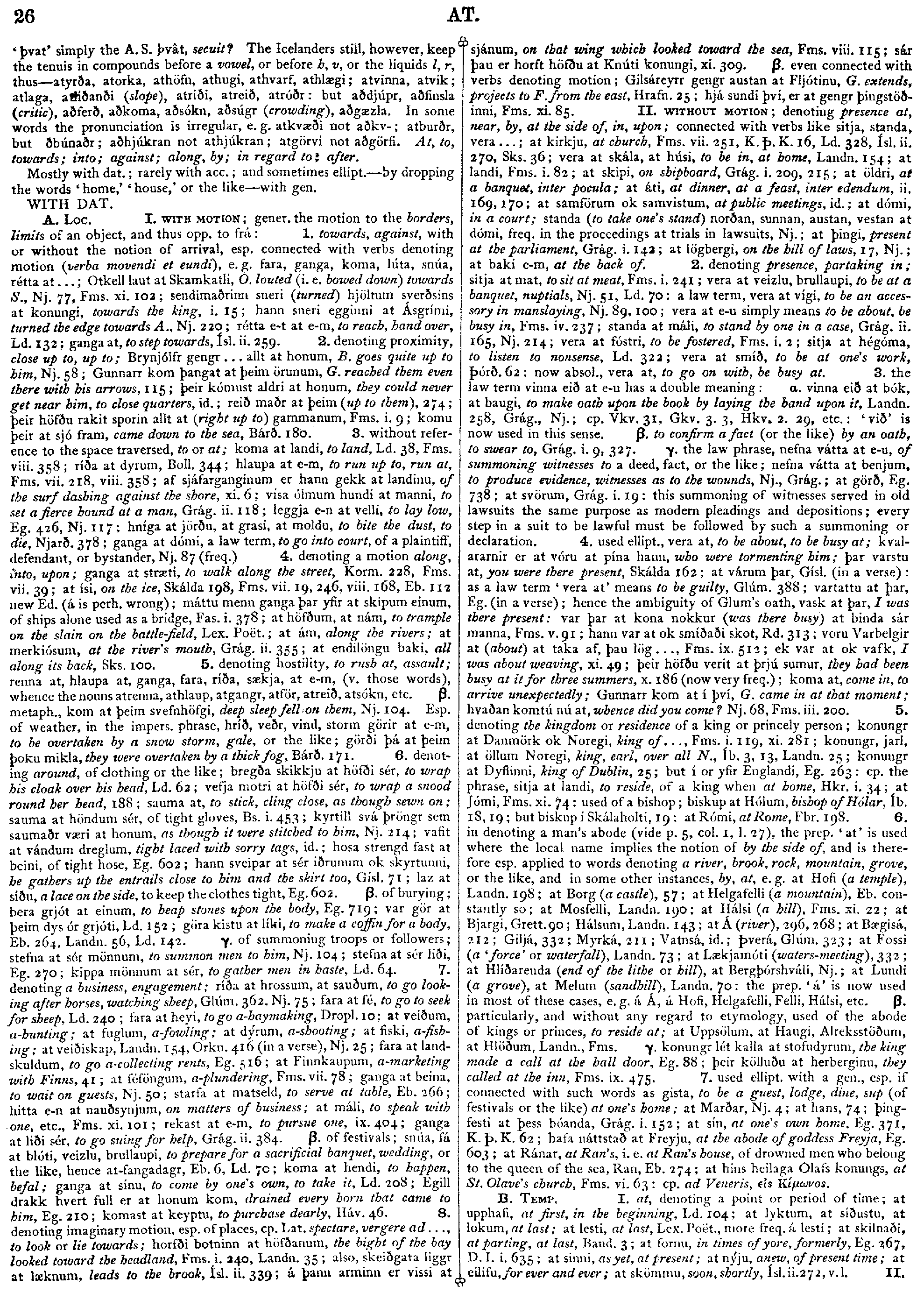
A.
LOG.
I.
WITH
MOTION;
gener.
the
motion
to
the
borders,
limits
of
an
object,
and
thus
opp.
to
frá:
1.
towards,
against,
with
or
without
the
notion
of
arrival,
esp.
connected
with
verbs
denoting
motion
(verba
movendi
et
eundi),
e.
g.
fara,
ganga,
koma,
lúta,
snúa,
rétta
at...;
Otkell
laut
at
Skamkatli,
O.
louted
(i.
e.
bowed
down)
towards
S.,
Nj.
77,
Fms.
xi.
102;
sendimaðrinn
sneri
(turned)
hjöltum
sverðsins
at
konungi,
towards
the
king,
i.
15;
hann
sneri
egginni
at
Ásgrími,
turned
the
edge
towards
A.,
Nj.
220;
rétta
e-t
at
e-m,
to
reach,
hand
over,
Ld.
132;
ganga
at,
to
step
towards,
Ísl.
ii.
259.
2.
denoting
proximity,
close
up
to,
up
to;
Brynjólfr
gengr
...
allt
at
honum,
B.
goes
quite
up
to
him,
Nj.
58;
Gunnarr
kom
þangat
at
þeim
örunum,
G.
reached
them
even
there
with
his
arrows,
115;
þeir
kómust
aldri
at
honum,
they
could
never
get
near
him,
to
close
quarters,
id.;
reið
maðr
at
þeim
(up
to
them),
274;
þeir
höfðu
rakit
sporin
allt
at
(right
up
to)
gammanum,
Fms.
i.
9;
komu
þeir
at
sjó
fram,
came
down
to
the
sea,
Bárð.
180.
3.
without
refer-
ence
to
the
space
traversed,
to
or
at;
koma
at
landi,
to
land,
Ld.
38,
Fms.
viii.
358;
ríða
at
dyrurn,
Boll.
344;
hlaupa
at
e-m,
to
run
up
to,
run
at,
Fms.
vii.
218,
viii.
358;
af
sjáfarganginum
er
hann
gekk
at
landinu,
of
the
surf
dashing
against
the
shore,
xi.
6;
vísa
ólmum
hundi
at
manni,
to
set
a
fierce
hound
at
a
man,
Grág.
ii.
118;
leggja
e-n
at
velli,
to
lay
low,
Eg.
426,
Nj.
117;
hníga
at
jörðu,
at
grasi,
at
moldu,
to
bite
the
dust,
to
die,
Njarð.
378;
ganga
at
dómi,
a
law
term,
to
go
into
court,
of
a
plaintiff,
defendant,
or
bystander,
Nj.
87
(freq.)
4.
denoting
a
motion
along,
into,
upon;
ganga
at
stræti,
to
walk
along
the
street,
Korm.
228,
Fms.
vii.
39;
at
ísi,
on
the
ice,
Skálda
198,
Fms.
vii.
19,
246,
viii.
168,
Eb.
112
new
Ed.
(á
is
perh.
wrong);
máttu
menn
ganga
bar
yfir
at
skipum
einum,
of
ships
alone
used
as
a
bridge,
Fas.
i.
378;
at
höfðum,
at
nám,
to
trample
on
the
slain
on
the
battle-field,
Lex.
Poët.;
at
ám,
along
the
rivers;
at
merkiósum,
at
the
river's
mouth,
Grág.
ii.
355;
at
endilöngu
baki,
all
along
its
back,
Sks.
100.
5.
denoting
hostility,
to
rush
at,
assault;
renna
at,
hlaupa
at,
ganga,
fara,
ríða,
sækja,
at
e-m,
(v.
those
words),
whence
the
nouns
atrenna,
athlaup,
atgangr,
atför,
atreið,
atsókn,
etc.
 .
metaph.,
kom
at
þeim
svefnhöfgi,
deep
sleep
fell
on
them,
Nj.
104.
Esp.
of
weather,
in
the
impers.
phrase,
hríð,
veðr,
vind,
storm
görir
at
e-m,
to
be
overtaken
by
a
snow
storm,
gale,
or
the
like;
görði
þá
at
þeim
þoku
mikla,
they
were
overtaken
by
a
thick
fog,
Bárð.
171.
6.
denot-
ing
around,
of
clothing
or
the
like;
bregða
skikkju
at
höfði
sér,
to
wrap
his
cloak
over
his
head,
Ld.
62;
vefja
motri
at
höfði
sér,
to
wrap
a
snood
round
her
head,
188;
sauma
at,
to
stick,
cling
close,
as
though
sewn
on;
sauma
at
höndum
sér,
of
tight
gloves,
Bs.
i.
453;
kyrtill
svá
þröngr
sem
saumaðr
væri
at
honum,
as
though
it
were
stitched
to
him,
Nj.
214;
vafit
at
vándum
dreglum,
tight
laced
with
sorry
tags,
id.;
hosa
strengd
fast
at
beini,
of
tight
hose,
Eg.
602;
hann
sveipar
at
sér
iðrunum
ok
skyrtunni,
he
gathers
up
the
entrails
close
to
him
and
the
skirt
too,
Gísl.
71;
laz
at
síðu,
a
lace
on
the
side,
to
keep
the
clothes
tight,
Eg.
602.
p.
of
burying;
bera
grjót
at
einum,
to
heap
stones
upon
the
body,
Eg.
719;
var
gör
at
þeim
dys
or
grjóti,
Ld.
152;
gora
kistu
at
líki,
to
make
a
coffin
for
a
body,
Eb.
264,
Landn.
56,
Ld.
142.
.
metaph.,
kom
at
þeim
svefnhöfgi,
deep
sleep
fell
on
them,
Nj.
104.
Esp.
of
weather,
in
the
impers.
phrase,
hríð,
veðr,
vind,
storm
görir
at
e-m,
to
be
overtaken
by
a
snow
storm,
gale,
or
the
like;
görði
þá
at
þeim
þoku
mikla,
they
were
overtaken
by
a
thick
fog,
Bárð.
171.
6.
denot-
ing
around,
of
clothing
or
the
like;
bregða
skikkju
at
höfði
sér,
to
wrap
his
cloak
over
his
head,
Ld.
62;
vefja
motri
at
höfði
sér,
to
wrap
a
snood
round
her
head,
188;
sauma
at,
to
stick,
cling
close,
as
though
sewn
on;
sauma
at
höndum
sér,
of
tight
gloves,
Bs.
i.
453;
kyrtill
svá
þröngr
sem
saumaðr
væri
at
honum,
as
though
it
were
stitched
to
him,
Nj.
214;
vafit
at
vándum
dreglum,
tight
laced
with
sorry
tags,
id.;
hosa
strengd
fast
at
beini,
of
tight
hose,
Eg.
602;
hann
sveipar
at
sér
iðrunum
ok
skyrtunni,
he
gathers
up
the
entrails
close
to
him
and
the
skirt
too,
Gísl.
71;
laz
at
síðu,
a
lace
on
the
side,
to
keep
the
clothes
tight,
Eg.
602.
p.
of
burying;
bera
grjót
at
einum,
to
heap
stones
upon
the
body,
Eg.
719;
var
gör
at
þeim
dys
or
grjóti,
Ld.
152;
gora
kistu
at
líki,
to
make
a
coffin
for
a
body,
Eb.
264,
Landn.
56,
Ld.
142.
 of
summoning
troops
or
followers;
stefna
at
sér
mönnum,
to
summon
men
to
him,
Nj.
104;
stefna
at
sér
liði,
Eg.
270;
kippa
mönnum
at
sér,
to
gather
men
in
haste,
Ld.
64.
7.
denoting
a
business,
engagement;
ríða
at
hrossum,
at
sauðum,
to
go
looking
after
after
horses,
watching
sheep,
Glúm.
362,
Nj.
75;
fara
at
fé,
to
go
to
seek
for
sheep,
Ld.
240;
fara
at
heyi,
to
go
a-haymaking,
Dropl.
10;
at
veiðum,
a-hunting;
at
fuglum,
a-fowling;
at
dýrum,
a-sbooting;
at
fiski,
a-fishing;
at
veiðiskap,
Landn.
154,
Orkn.
416
(in
a
verse),
Nj.
25;
fara
at
landskuldum,
to
go
a-collecling
rents,
Eg.
516;
at
Finnkaupum,
a-marketing
with
Finns,
41;
at
féföngum,
a-plundering,
Fms.
vii.
78;
ganga
at
beina,
to
wait
on
guests,
Nj.
50;
starfa
at
matseld,
to
serve
at
table,
Eb.
266;
hitta
e-n
at
nauðsynjum,
on
matters
of
business;
at
máli,
to
speak
with
one,
etc.,
Fms.
xi.
101;
rekast
at
e-m,
to
pursue
one,
ix.
404;
ganga
at
liði
sér,
to
go
suing
for
help,
Grág.
ii.
384.
p.
of
festivals;
snúa,
fá
at
blóti,
veizlu,
brullaupi,
to
prepare
for
a
sacrificial
banquet,
wedding,
or
the
like,
hence
at-fangadagr,
Eb.
6,
Ld.
70;
koma
at
hendi,
to
happen,
befall;
ganga
at
sínu,
to
come
by
one's
own,
to
take
it,
Ld.
208;
Egill
drakk
hvert
full
er
at
honum
kom,
drained
every
horn
that
came
to
him,
Eg.
210;
komast
at
keyptu,
to
purchase
dearly,
Húv.
46.
8.
denoting
imaginary
motion,
esp.
of
places,
cp.
Lat.
spectare,
vergere
ad...,
to
look
or
lie
towards;
horfði
botninn
at
höfðanum,
the
bight
of
the
bay
looked
toward
the
headland,
Fms.
i.
340,
Landn.
35;
also,
skeiðgata
liggr
at
læknum,
leads
to
the
brook,
Ísl.
ii.
339;
á
þann
arminn
er
vissi
at
sjánum,
on
that
wing
which
looked
toward
the
sea,
Fms.
viii.
115;
sár
þau
er
horft
höfðu
at
Knúti
konungi,
xi.
309.
.
even
connected
with
verbs
denoting
motion;
Gilsáreyrr
gengr
austan
at
Fljótinu,
G.
extends,
projects
to
F.
from
the
east,
Hrafh.
25;
hjá
sundi
því,
er
at
gengr
þingstöðinni,
Fms.
xi.
85.
of
summoning
troops
or
followers;
stefna
at
sér
mönnum,
to
summon
men
to
him,
Nj.
104;
stefna
at
sér
liði,
Eg.
270;
kippa
mönnum
at
sér,
to
gather
men
in
haste,
Ld.
64.
7.
denoting
a
business,
engagement;
ríða
at
hrossum,
at
sauðum,
to
go
looking
after
after
horses,
watching
sheep,
Glúm.
362,
Nj.
75;
fara
at
fé,
to
go
to
seek
for
sheep,
Ld.
240;
fara
at
heyi,
to
go
a-haymaking,
Dropl.
10;
at
veiðum,
a-hunting;
at
fuglum,
a-fowling;
at
dýrum,
a-sbooting;
at
fiski,
a-fishing;
at
veiðiskap,
Landn.
154,
Orkn.
416
(in
a
verse),
Nj.
25;
fara
at
landskuldum,
to
go
a-collecling
rents,
Eg.
516;
at
Finnkaupum,
a-marketing
with
Finns,
41;
at
féföngum,
a-plundering,
Fms.
vii.
78;
ganga
at
beina,
to
wait
on
guests,
Nj.
50;
starfa
at
matseld,
to
serve
at
table,
Eb.
266;
hitta
e-n
at
nauðsynjum,
on
matters
of
business;
at
máli,
to
speak
with
one,
etc.,
Fms.
xi.
101;
rekast
at
e-m,
to
pursue
one,
ix.
404;
ganga
at
liði
sér,
to
go
suing
for
help,
Grág.
ii.
384.
p.
of
festivals;
snúa,
fá
at
blóti,
veizlu,
brullaupi,
to
prepare
for
a
sacrificial
banquet,
wedding,
or
the
like,
hence
at-fangadagr,
Eb.
6,
Ld.
70;
koma
at
hendi,
to
happen,
befall;
ganga
at
sínu,
to
come
by
one's
own,
to
take
it,
Ld.
208;
Egill
drakk
hvert
full
er
at
honum
kom,
drained
every
horn
that
came
to
him,
Eg.
210;
komast
at
keyptu,
to
purchase
dearly,
Húv.
46.
8.
denoting
imaginary
motion,
esp.
of
places,
cp.
Lat.
spectare,
vergere
ad...,
to
look
or
lie
towards;
horfði
botninn
at
höfðanum,
the
bight
of
the
bay
looked
toward
the
headland,
Fms.
i.
340,
Landn.
35;
also,
skeiðgata
liggr
at
læknum,
leads
to
the
brook,
Ísl.
ii.
339;
á
þann
arminn
er
vissi
at
sjánum,
on
that
wing
which
looked
toward
the
sea,
Fms.
viii.
115;
sár
þau
er
horft
höfðu
at
Knúti
konungi,
xi.
309.
.
even
connected
with
verbs
denoting
motion;
Gilsáreyrr
gengr
austan
at
Fljótinu,
G.
extends,
projects
to
F.
from
the
east,
Hrafh.
25;
hjá
sundi
því,
er
at
gengr
þingstöðinni,
Fms.
xi.
85.
|
Source: Cleasby/Vigfusson, page b0027, entry 2 View original page image as: [TIFF] [PNG] [View previous entry] [View next entry] |
[Comment on this entry] [View comments] |
The following entry has been hand-corrected once. |
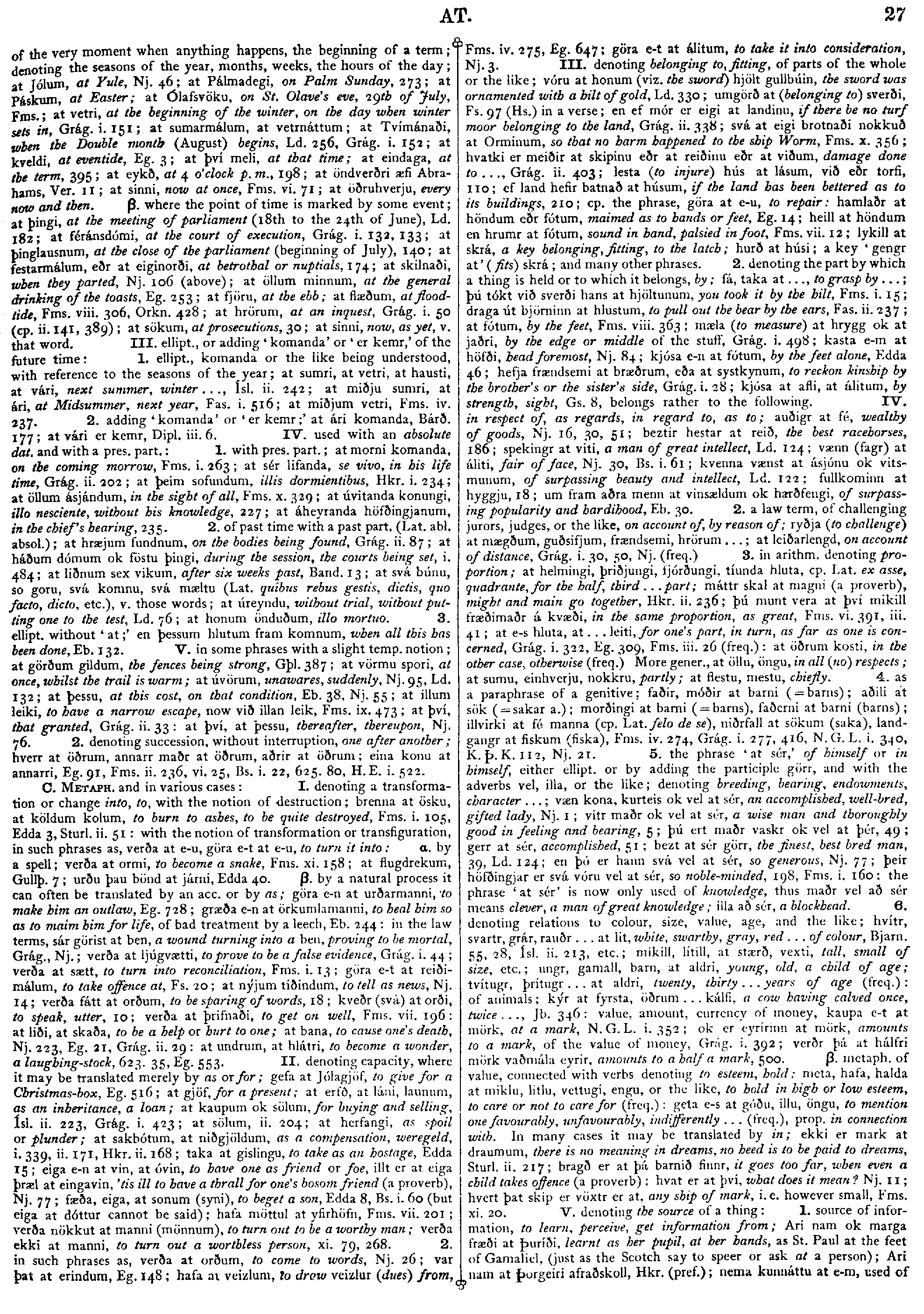
C.
METAPH.
and
in
various
cases:
I.
denoting
a
transforma-
tion
or
change
into,
to,
with
the
notion
of
destruction;
brenna
at
ösku,
at
köldum
kolum,
to
burn
to
ashes,
to
be
quite
destroyed,
Fms.
i.
105,
Edda
3,
Sturl.
ii.
51:
with
the
notion
of
transformation
or
transfiguration,
in
such
phrases
as,
verða
at
e-u,
göra
e-t
at
e-u,
to
turn
it
into:
a.
by
a
spell;
verða
at
ormi,
to
become
a
snake,
Fms.
xi.
158;
at
flugdrekum,
Gullþ.
7;
urðu
þau
bönd
at
járni,
Edda
40.
P.
by
a
natural
process
it
can
often
be
translated
by
an
acc.
or
by
as;
göra
e-n
at
urðarmanni,
'
t
o
make
him
an
outlaw,
Eg.
728;
græða
e-n
at
orkumlamanni,
to
heal
him
so
as
to
maim
him
for
life,
of
bad
treatment
by
a
leech,
Eb.
244:
in
the
law
terms,
sár
görist
at
ben,
a
wound
turning
into
a
ben,
proving
to
be
mortal,
Grág.,
Nj.;
verða
at
ljúgvætti,
to
prove
to
be
a
false
evidence,
Grág.
i.
44;
verða
at
sætt,
to
turn
into
reconciliation,
Fms.
i.
13;
göra
e-t
at
reiði
málum,
to
take
offence
at,
Fs.
20;
at
nýjum
tíðindum,
to
tell
as
news,
Nj.
14;
verða
fátt
at
orðum,
to
be
sparing
of
words,
18;
kveðr
(svá)
at
orði,
to
speak,
utter,
10;
verða
at
þrifnaði,
to
geton
well,
Fms.
vii.
196:
at
liði,
at
skaða,
to
be
a
help
or
hurt
to
one;
at
bana,
to
cause
one's
death,
Nj.
223,
Eg.
21,
Grág.
ii.
29:
at
undrum,
at
hlátri,
to
become
a
wonder,
a
laughing-stock,
623.
35,
Eg.
553.
II.
denoting
capacity,
where
it
may
be
translated
merely
by
as
or
for;
gefa
at
Jólagjöf,
to
give
for
a
Christmas-box,
Eg.
516;
at
gjöf,
for
a
present;
at
erfð,
at
láni,
launum,
as
an
inheritance,
a
loan;
at
kaupum
ok
sökum,
for
buying
and
selling,
Ísl.
ii.
223,
Grág.
i.
423;
at
solum,
ii.
204;
at
herfangi,
as
spoil
or
plunder;
at
sakbótum,
at
niðgjöldum,
as
a
compensation,
weregeld,
i.
339,
ii.
171,
Hkr.
ii.
168;
taka
at
gíslingu,
to
take
as
an
hostage,
Edda
15;
eiga
e-n
at
vin,
at
óvin,
to
have
one
as
friend
or
foe,
illt
er
at
eiga
þræl
at
eingavin,
'tis
ill
to
have
a
thrall
for
one's
bosom
friend
(a
proverb),
Nj.
77;
fæða,
eiga,
at
sonum
(syni),
to
beget
a
son,
Edda
8,
Bs.
i.
60
(but
eiga
at
dóttur
cannot
be
said);
hafa
möttul
at
yfirhöfn,
Fms.
vii.
201;
verða
nökkut
at
manni
(mönnum),
to
turn
out
to
be
a
worthy
man;
verða
ekki
at
manni,
to
turn
out
a
worthless
person,
xi.
79,
268.
2.
in
such
phrases
as,
verða
at
orðum,
to
come
towards,
Nj.
26;
var
þat
at
erindum,
Eg.
148;
hafa
at
veizlum,
to
draw
veizlur
(dues)
from,
'Fms.
iv.
275,
Eg.
647;
gora
e-t
at
álitum,
to
take
it
into
consideration,
Nj-3.
III.
denoting
belonging
to,
fitting,
of
parts
of
the
whole
or
the
like;
vóru
at
honum
(viz.
the
sword)
hjölt
gullbúin,
the
sword
was
ornamented
with
a
hilt
of
gold,
Ld.
330;
umgörð
at
(belonging
to)
sverði,
Fs.
97
(Hs.)
in
a
verse;
en
ef
mór
er
eigi
at
landinu,
if
there
be
no
turf
moor
belonging
to
the
land,
Grág.
ii.
338;
svá
at
eigi
brotnaði
nokkuð
at
Orminum,
so
that
no
harm
happened
to
the
ship
Worm,
Fms.
x.
356;
hvatki
er
meiðir
at
skipinu
eðr
at
reiðinu
eðr
at
viðum,
damage
done
t
o
...,
Grág.
ii.
403;
lesta
(to
injure)
hús
at
lásum,
við
eðr
torfi,
110;
ef
land
hefir
batnað
at
húsum,
if
the
land
has
been
bettered
as
to
its
buildings,
210;
cp.
the
phrase,
göra
at
e-u,
to
repair:
hamlaðr
at
höndum
eðr
fótum,
maimed
as
to
hands
or
feet,
Eg.
14;
heill
at
höndum
en
hrumr
at
fótum,
sound
in
band,
palsied
in
foot,
Fms.
vii.
12;
lykill
at
skrá,
a
key
belonging,
fitting,
to
the
latch;
hurð
at
húsi;
a
key
'gengr
at'
(fits)
skrá;
and
many
other
phrases.
2.
denoting
the
part
by
which
a
thing
is
held
or
to
which
it
belongs,
by;
fá,
taka
at...,
to
grasp
by
...;
þú
tókt
við
sverði
hans
at
hjöltunum,
you
took
it
by
the
bill,
Fms.
i.
15;
draga
út
björninn
at
hlustum,
to
pull
out
the
bear
by
the
ears,
Fas.
ii.
237;
at
fótum,
by
the
feet,
Fms.
viii.
363;
mæla
(to
measure)
at
hrygg
ok
at
jaðri,
by
the
edge
or
middle
of
the
stuff,
Grág.
i.
498;
kasta
e-m
at
höfði,
head
foremost,
Nj.
84;
kjósa
e-n
at
fótum,
by
the
feet
alone,
Edda
46;
hefja
frændsemi
at
bræðrum,
eða
at
systkynum,
to
reckon
kinship
by
the
brother's
or
the
sister's
side,
Grág.
i.
28;
kjósa
at
afli,
at
álitum,
by
strength,
sight,
Gs.
8,
belongs
rather
to
the
following.
IV.
in
respect
of,
as
regards,
in
regard
to,
as
to;
auðigr
at
fé,
wealthy
of
goods,
Nj.
16,
30,
51;
beztir
hestar
at
reið,
the
best
racehorses,
186;
spekingr
at
viti,
a
man
of
great
intellect,
Ld.
124;
vænn
(fagr)
at
áliti,
fair
of
face,
Nj.
30,
Bs.
i.
61;
kvenna
vænst
at
ásjónu
ok
vits
munum,
of
surpassing
beauty
and
intellect,
Ld.
122;
fullkominn
at
hyggju,
18;
um
fram
aðra
menn
at
vinsældum
ok
harðfengi,
of
surpass-
ing
popularity
and
hardihood,
Eb.
30.
2.
a
law
term,
of
challenging
jurors,
judges,
or
the
like,
on
account
of,
by
reason
of;
ryðja
(to
challenge)
at
mægðum,
guðsifjum,
frændsemi,
hrörum
...;
at
leiðarlengd,
on
account
of
distance,
Grág.
i.
30,
50,
Nj.
(freq.)
3.
in
arithm.
denoting
pro
portion;
at
helmingi,
þriðjungi,
fjórðungi,
tíunda
hluta,
cp.
Lat.
ex
asse,
quadrante,
for
the
half,
third...
part;
máttr
skal
at
magni
(a
proverb),
might
and
main
go
together,
Hkr.
ii.
236;
þú
munt
vera
at
því
mikill
fræðimaðr
á
kvæði,
in
the
same
proportion,
as
great,
Fms.
vi.
391,
iii.
41;
at
e-s
hluta,
at...
leiti,
for
one's
part,
in
turn,
as
far
as
one
is
con
cerned,
Grág.
i.
322,
Eg.
309,
Fms.
iii.
26
(freq.):
at
öðrum
kosti,
in
the
other
case,
otherwise
(freq.)
More
gener.,
at
öllu,
öngu,
in
all
(no)
respects;
at
sumu,
einhverju,
nokkru,
partly;
at
flestu,
mestu,
chiefly.
4.
as
a
paraphrase
of
a
genitive;
faðir,
móðir
at
barni
(=
barns);
aðili
at
sök
(=
sakar
a.);
morðingi
at
barni
(=
barns),
faðerni
at
barni
(barns);
illvirki
at
fé
manna
(cp.
Lat.
felo
de
se),
niðrfall
at
sökum
(saka),
land
gangr
at
fiskum
(fiska),
Fms.
iv.
274,
Grág.
i.
277,
416,
N.
G.
L.
i.
340,
K.
Þ.
K.
112,
Nj.
21.
5.
the
phrase
'at
sér,'
of
himself
or
in
himself,
either
ellipt.
or
by
adding
the
participle
görr,
and
with
the
adverbs
vel,
ilia,
or
the
like;
denoting
breeding,
bearing,
endowments,
character
...;
væn
kona,
kurteis
ok
vel
at
sér,
an
accomplished,
well-bred,
gifted
lady,
Nj.
I;
vitr
maðr
ok
vel
at
sér,
a
wise
man
and
thoroughly
good
in
feeling
and
bearing,
5;
þú
ert
maðr
vaskr
ok
vel
at
þér,
49;
gerr
at
sér,
accomplished,
51;
bezt
at
sér
görr,
the
finest,
best
bred
man,
39,
Ld.
124;
en
þó
er
hann
svá
vel
at
sér,
so
generous,
Nj.
77;
þeir
höfðingjar
er
svá
vóru
vel
at
sér,
so
noble-minded,
198,
Fms.
i.
160:
the
phrase
'at
sér'
is
now
only
used
of
knowledge,
thus
maðr
vel
að
sér
means
clever,
a
man
of
great
knowledge;
illa
að
sér,
a
blockhead.
6.
denoting
relations
to
colour,
size,
value,
age,
and
the
like;
hvitr,
svartr,
grár,
rauðr
...
at
lit,
white,
swarthy,
gray,
red
...
of
colour,
Bjarn.
55,
28,
Ísl.
ii.
213,
etc.;
mikill,
litill,
at
stærð,
vexti,
tall,
small
of
size,
etc.;
ungr,
gamall,
barn,
at
aldri,
young,
old,
a
child
of
age;
tvítugr,
þrítugr
...
at
aldri,
twenty,
thirty
...
years
of
age
(freq.):
of
animals;
kyr
at
fyrsta,
öðrum
...
kálfi,
a
cow
having
calved
once,
twice...,
Jb.
346:
value,
amount,
currency
of
money,
kaupa
e-t
at
mörk,
at
a
mark,
N.
G.
L.
1.
352;
ok
er
eyririnn
at
mörk,
amounts
to
a
mark,
of
the
value
of
money,
Grág.
i.
392;
verðr
þá
at
hálfri
murk
vaðmála
eyrir,
amounts
to
a
half
a
mark,
500.
.
metaph.
of
value,
connected
with
verbs
denoting
to
esteem,
hold;
meta,
hafa,
halda
at
miklu,
litlu,
vettugi,
engu,
or
the
like,
to
hold
in
high
or
low
esteem,
to
care
or
not
to
care
for
(freq.):
geta
e-s
at
góðu,
illu,
öngu,
to
mention
one
favourably,
unfavourably,
indifferently
...
(freq.),
prop,
in
connection
with.
In
many
cases
it
may
be
translated
by
in;
ekki
er
mark
at
draumum,
there
is
no
meaning
in
dreams,
no
heed
is
to
be
paid
to
dreams,
Sturl.
ii.
217;
bragð
er
at
þá
barnið
finnr,
it
goes
too
far,
when
even
a
child
takes
offence
(a
proverb):
hvat
er
at
því,
what
does
it
mean?
Nj.
11;
hvert
þat
skip
er
vöxtr
er
at,
any
ship
of
mark,
i.
e.
however
small,
Fms.
xi.
2O.
V.
denoting
the
source
of
a
thing:
1.
source
of
infor
mation,
to
learn,
perceive,
get
information
from;
Ari
nam
ok
marga
fræði
at
Þuríði,
learnt
as
her
pupil,
at
her
hands,
as
St.
Paul
at
the
feet
of
Gamaliel,
(just
as
the
Scotch
say
to
speer
or
ask
at
a
person);
Ari
nam
at
Þorgeiri
afraðskoll,
Hkr.
(pref.);
nema
kunnáttu
at
e-m,
used
of
|
Source: Cleasby/Vigfusson, page b0030, entry 24 View original page image as: [TIFF] [PNG] [View previous entry] [View next entry] |
[Comment on this entry] [View comments] |
The following entry has been hand-corrected once. |
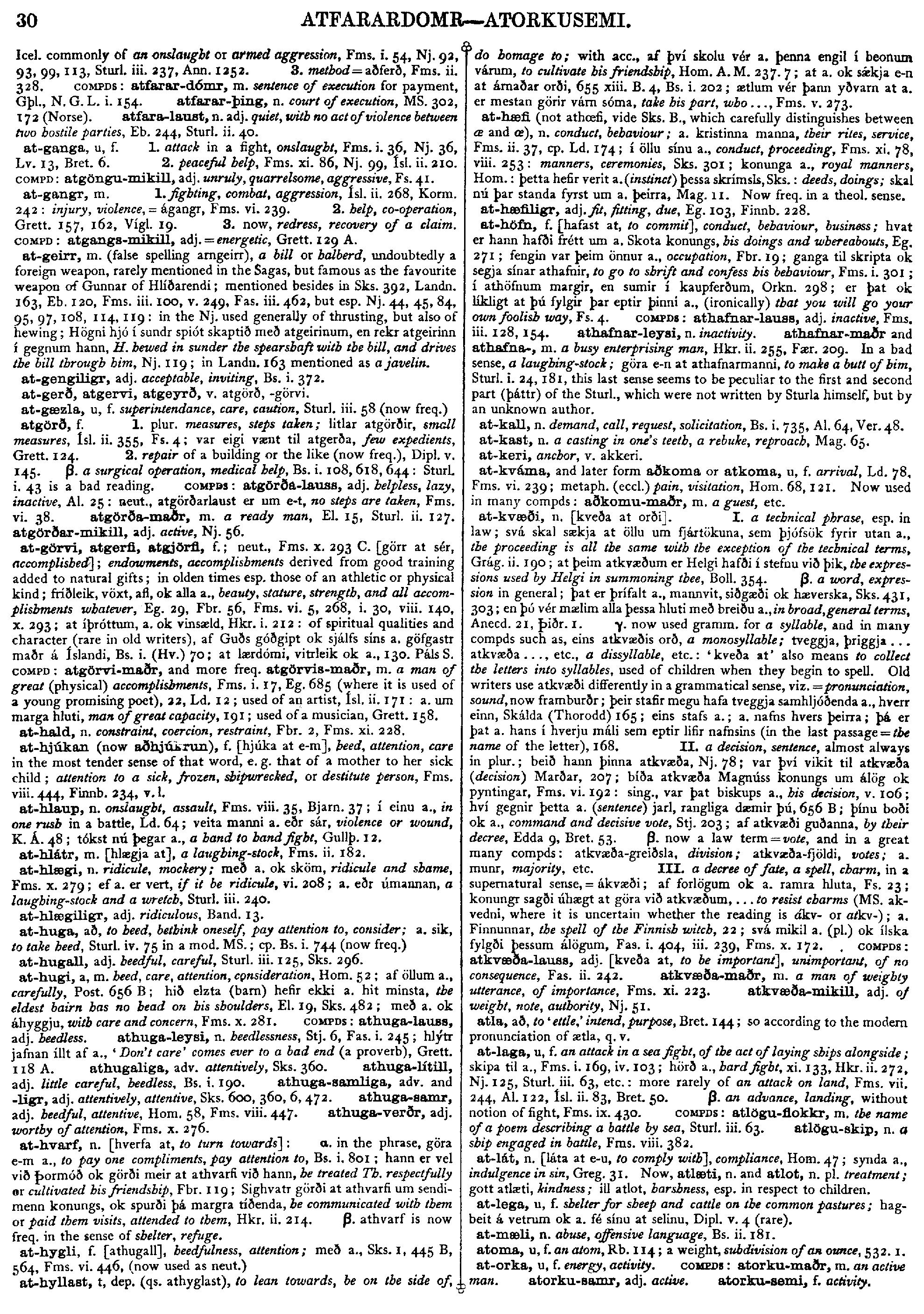
at-hofn, f. [hafast at, to commit] , conduct, behaviour, business; hvat er hann hafði frétt um a. Skota konungs, his doings and whereabouts, Eg. 271; fengin var þeim önnur a., occupation, Fbr. 19; ganga til skripta ok segja sínar athafnir, to go to shrift and confess his behaviour, Fms. i. 301; í athöfnum margir, en sumir í kaupferðum, Orkn. 298; er þat ok likligt at þú fylgir þar eptir þinni a., (ironically) that you will go your own foolish way, Fs. 4. COMPDS: athafnar-lauss, adj. inactive, Fms. iii. 128, 154. athafnar-leysi, n. inactivity. atliafoar-maðr and athafna-, m. a busy enterprising man, Hkr. ii. 255, Fær. 209. In a bad sense, a laughing-stock; gora e-n at athafnarmanni, to make a butt of him, Sturl. i. 24, 181, this last sense seems to be peculiar to the first and second part (þáttr) of the Sturl., which were not written by Sturla himself, but by an unknown author.
|
Source: Cleasby/Vigfusson, page b0108, entry 4 View original page image as: [TIFF] [PNG] [View previous entry] [View next entry] |
[Comment on this entry] [View comments] |
The following entry has not been hand-corrected. However, the page is reserved and someone is correcting it. |
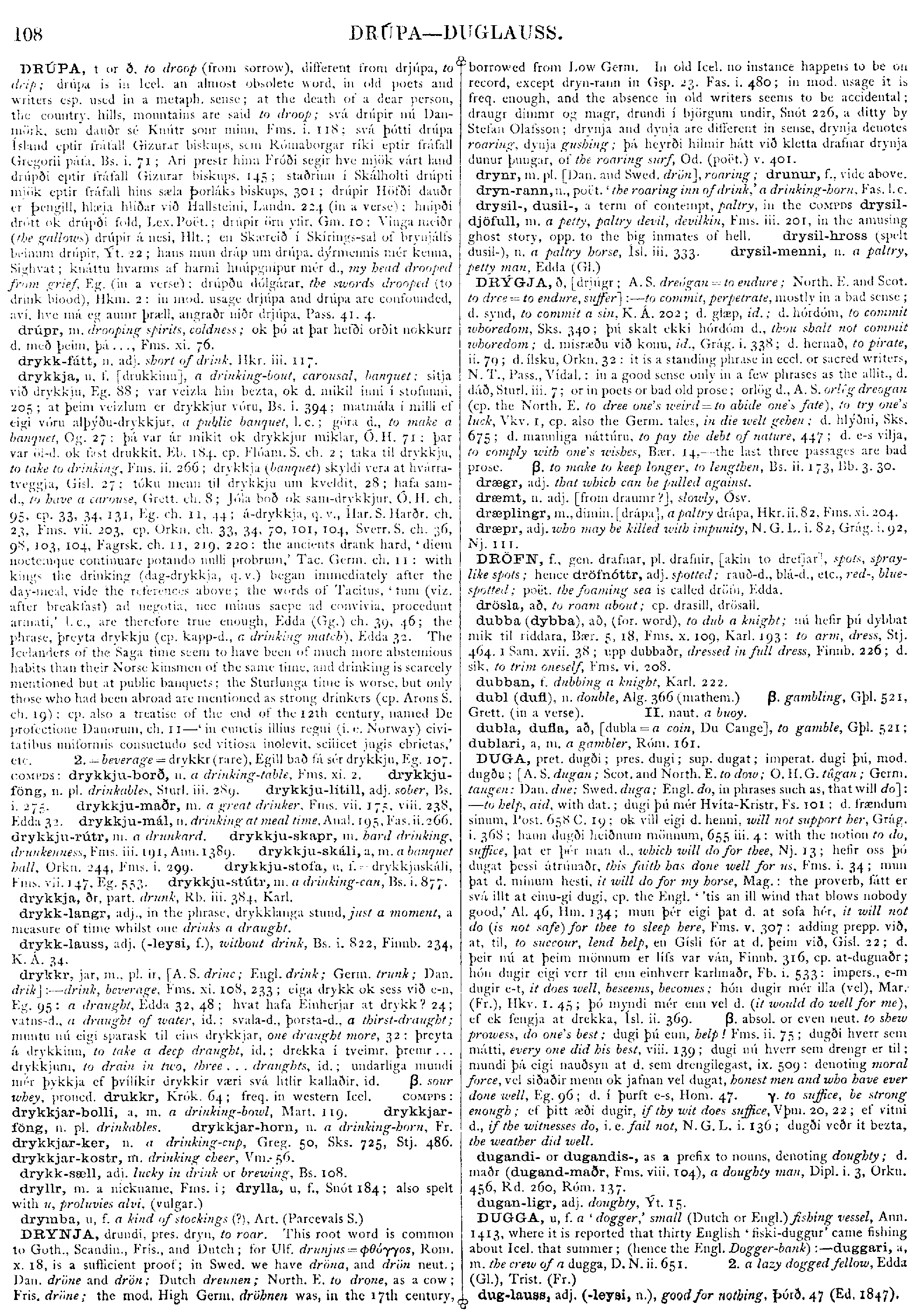
drykkja, u, f. [drukkinn], a drinking-bout, carousal, banquet: sitja við drykkiu, Eg. 88; var vei/la bin be/ta, ok d. mikil inni í stofunni, 205; at þeim vei/. lum er drykkiur vuru, Bs. i. 394; inatmala í milli ef tii^i vóru alþýðu-drvkkjur, a public banquet, I. e.; gora d., to make a banquet, Og. 27; þá var ár mikit ok drykkjur miklar, (). U. 71; bar var oi-il. ok fast drukkit. Kb. 184. cp. Flóain. S. ch. 2; taka til drykkju, to take to drinking. Fms. ii. 266; drvkkja (banquet] skvlili vera at livi'irra- tveggia, (jÍsl. 27; tóku menu til drykkju nm kveklit, 28; hafa sam- d., to have a carouse, (îrett. c!i. 8; Jóla boð ok sain-drvkkjnr, C). H. ch. 95- CP- 33' 34' ï. Vi J'-g- C'K J1i 44! u-drykkia, ij. v., liar. S. Harðr. ch. 2/!, Fms. vii. 203, cp. Orkn. ch. 33, 34, 70, IOI, 104, Sverr. S. ch. 36, 98, 103, 104, Fagrsk. ch. 11, 219. 220: the ancients drank hard, 'diem noctemque continuare potando nulli probrum, ' Tac. Germ. ch. 11: with kim;s ti;e drinking (dag-drykkia, q. v.) began immediately after the dav-nical, vide the rcferenc'. -s above; the words of Tacitus, 'turn (viz. after breakfast) ad nei'otia, nee minus sacpe ad convivia. procedunt arniati, ' I. e., are therefore true enough, Fdda (Gg.) ch. 39, 46; the phrase, þrevta drykkju (cp. kapp-d., a drinking match'). Edda 32. The Icelanders of the Saga time seem to have been of much more abstemious habits than their Norse kinsmen ot the same time, and drinking is scarcely mentioned but at public banquets: the Sturlunga time is worse, but only those who had been abroad are mentioned as strong drinkers (cp. Arons S. ch. 19); cp. also a treatise of the end of the 12th century, named De profectione Daiiorum, ch. II -- 'in cunctis illius regni (i. e. Norway) civi- tatibus nnitormis consuetudo sed vitiosa inolevit, scilicet jugis ebrietas, ' etc. 2. -- -- -beverage = drvkkr (rare), Egill bað fá sér drykkju, Eg. 107. coMi'Ds: drykkju-borð, n. a drinking-table. Fms. xi. 2. drykkju- föng, n. pl. drinkables, Sturl. iii. 289. drykkju-litill, adj. sober, Bs. i. 275. drykkju-maðr, in. a great drinker. Fms. vii. 175, viii. 238, Fdda 32. drykkju-mal, n. drinking at meal time. Anal. 195, Fas. ii. 266. drykkju-ru. tr, m. n drunkard. drykkju-skapr, in. hard drinking, drunkenness, Fms. iii. 191, Ann. 1389. drykkju-skáli, a, in. a banquet ball, Orkn. 244, Fms. i. '299. drykkju-stoi'a, u, f. - drykkjuskali. Fms. vii. 147, Eg. 553. drykkju-stutr, in. a drinking-can, Bs. i. 877.
|
Source: Cleasby/Vigfusson, page b0126, entry 1 View original page image as: [TIFF] [PNG] [View previous entry] [View next entry] |
[Comment on this entry] [View comments] |
The following entry has not been hand-corrected. However, the page is reserved and someone is correcting it. |
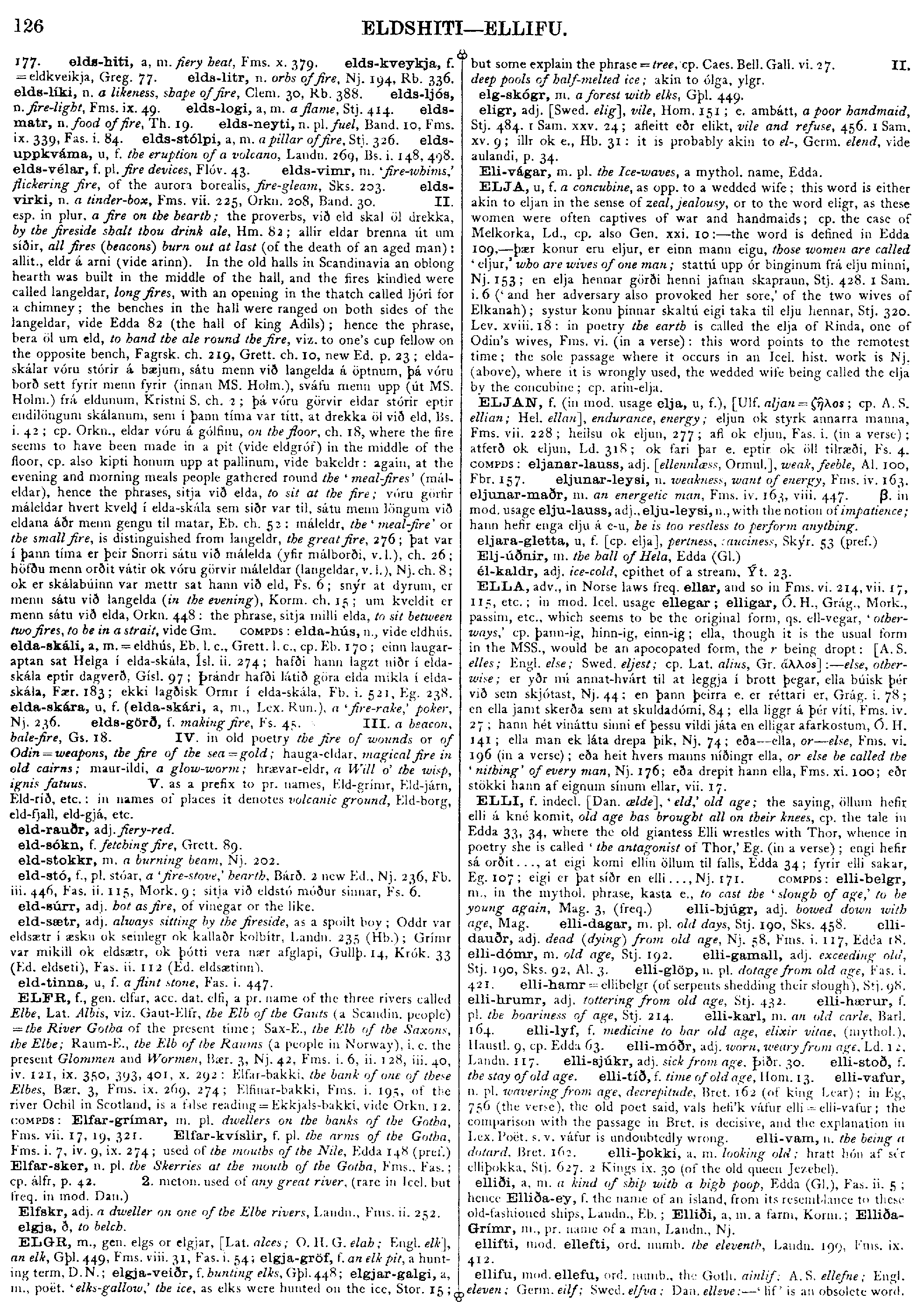
177- elds-hiti, a, m. fiery beat, Fms. x. 379. elds-kveykja, f. = eldkveikja, Greg. 77. elds-litr, n. orbs of fire, Nj. 194, Rb. 336. elds-MM, n. a likeness, shape of fire, Clem. 30, Rb. 388. elds-ljós, n. fire-light, Fms. ix. 49. elds-logi, a, m. aflame, Stj. 414. elds- matr, n. /oo d of fire, Th. 19. elds-neyti, n. pl. fuel, Band. 10, Fms. ix. 339, Fas. i. 84. elds-stólpi, a, m. a pillar of fire, Stj. 326. elds- uppkváma, u, f. the eruption of a volcano, Landn. 269, Bs. i. 148, 498. elds-velar, f. pl. ^î re de-vices, Flóv. 43. elds-vimr, m. 'fire-whims, ' flickering fire, of the aurora borealis, fire-gleam, Sks. 203. elds- virki, n. a tinder-box, Fms. vii. 225, Orkn. 208, Band. 30. II. esp. in plur. a fire on the hearth; the proverbs, við eld skal ol drekka, by the fireside sbalt tbou drink ale, Hm. 82; allir eldar brenna út um síðir, all fires (beacons') burn out at last (of the death of an aged man): allit., eldr á ami (vide arinn). In the old halls in Scandinavia an oblong hearth was built in the middle of the hall, and the fires kindled were called langeldar, long fires, with an opening in the thatch called ljuri for a chimney; the benches in the hall were ranged on both sides of the langeldar, vide Edda 82 (the hall of king Adils); hence the phrase, bera ol um eld, to hand the ale round the fire, viz. to one's cup fellow on the opposite bench, Fagrsk. ch. 219, Grett. ch. 10, new Ed. p. 23; elda- skálar vóru stórir á bæjuni, sátu menu við langelda á öptnuin, þá voru borð sett fyrir menn fyrir (inrian MS. Holm.), sváfu menu upp (ut MS. Holm.) frá eldunurn, Kristni S. ch. 2; þá vóru görvir eldar stórir eptir endilonguni skalanum, sem í þann tínia var titt, at drekka öl við eld, Bs. i. 42; cp. Orkn., eldar vóru á gólfinu, on the floor, ch. 18, where the fire seems to have been made in a pit (vide eldgróf) in the middle of the floor, cp. also kipti honum upp at pallinum, vide bakeldr: again, at the evening and morning meals people gathered round the 'meal-fires' (m;d- eldar), hence the phrases, sitja við elda, t o s it at the fire; vóru görrir máleldar hvert kveli] í elda-skúla sern siðr var til, sátu menn löngum við eldana áðr menn gengu til matar, Eb. ch. 52: maleldr, the' meal-fire' or the small fire, is distinguished from laugeldr, the great fire, 276; þat var í þann tíma er þeir Snorri sátu við málelda (yfir málborði, v. 1.), ch. 26; höfðu menn orðit vátir ok vóru görvir máleldar (langeldar, v. 1.), Nj. ch. 8; ok er skálabúinn var mettr sat hann við eld, Fs. 6; snýr at dyruin, er menn sátu við langelda (i n the evening), Korm. ch. 15; um kveldit er menn sátu við elda, Orkn. 448: the phrase, sitja milli elda, to sit between two fires, to be in a strait, vide Gin. COMPDS: elda-hús, n., vide eldhiis. elda-skali, a, m. = eldhús, Eb. 1. c., Grett. 1. c., cp. Eb. 170; einn laugar- aptan sat Helga í elda-skála, Ísl. ii. 274; hafði hann lagzt uiðr í elcla- skála eptir dagverð. Gísl. 97; þrándr hafði látið gora elda mikla í elda- skála, Fzr. 183; ekki lagðisk Ormr í elda-skála, Fb. i. 521, Eg. 238. elda-skára, u, f. (elda-skári, a, m., Lex. Run.), a 'fire-rake, ' poker, Nj. 236. elds-görð, f. making fire, Fs. 45. III. a beacon, bale-fire, Gs. 18. IV. in old poetry the fire of wounds or of Odin = weapons, the fire of the sea = gold; hauga-eldar, magical fire in old cairns; maur-ildi, a glow-worm; hraevar-eldr, a Will o' the wisp, ignis fatuus. V. as a prefix to pr. names, Kld-grinir, Kld-járn, Kld-ríð, etc.: in names of places it denotes volcanic ground, Kld-borg, eld-fjall, eld-gjá, etc.
|
Source: Cleasby/Vigfusson, page b0223, entry 38 View original page image as: [TIFF] [PNG] [View previous entry] [View next entry] |
[Comment on this entry] [View comments (1)] |
The following entry has been hand-corrected once. |
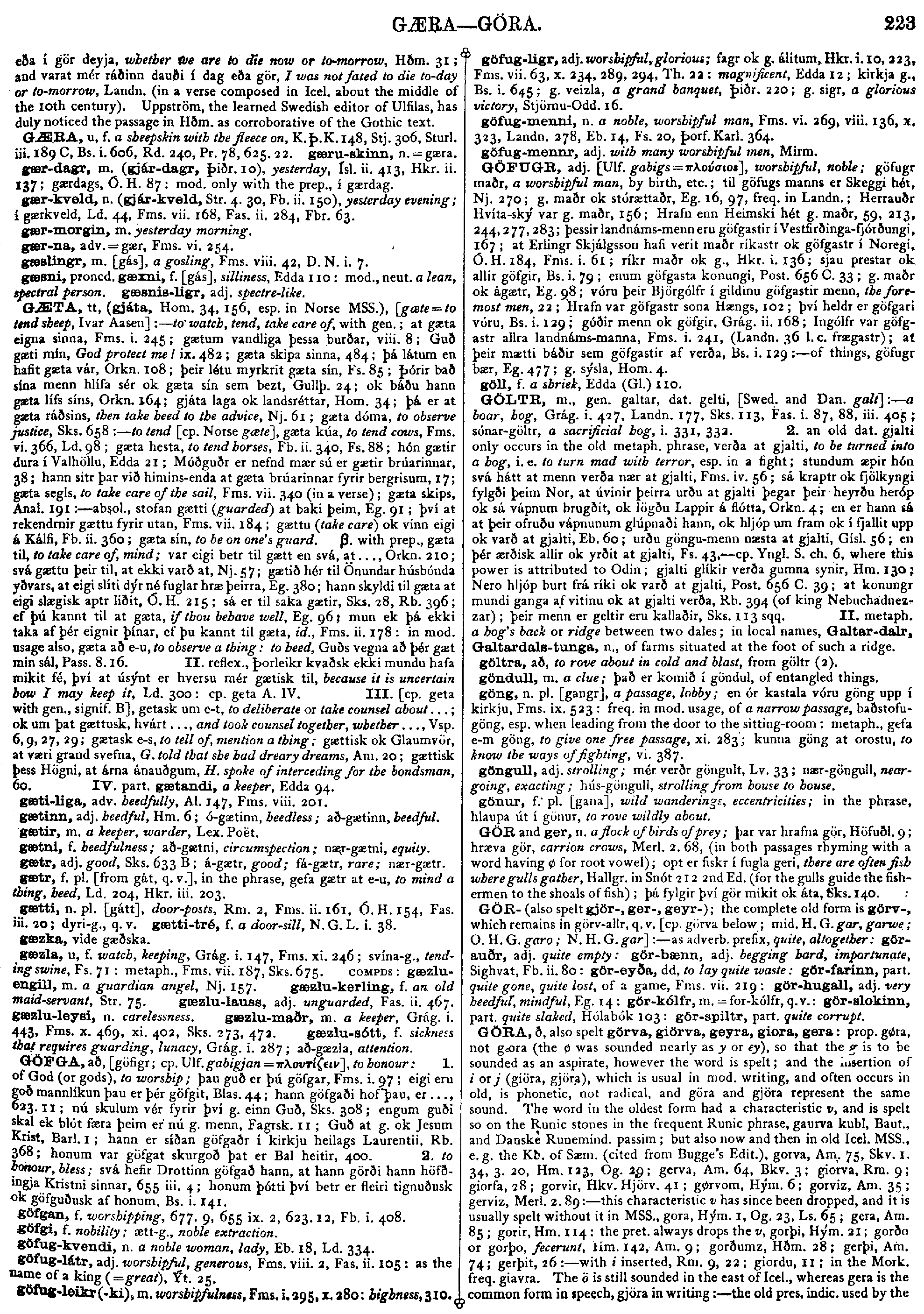
GÖRA,
ð,
also
spelt
görva,
giörva,
geyra,
giora,
gera:
prop.
gøra,
not
g ra
(the
ø
was
sounded
nearly
as
y
or
ey),
so
that
the
g
is
to
be
sounded
as
an
aspirate,
however
the
word
is
spelt;
and
the
insertion
of
i
or
j
(giöra,
gjöra),
which
is
usual
in
mod.
writing,
and
often
occurs
in
old,
is
phonetic,
not
radical,
and
göra
and
gjöra
represent
the
same
sound.
The
word
in
the
oldest
form
had
a
characteristic
v,
and
is
spelt
so
on
the
Runic
stones
in
the
frequent
Runic
phrase,
gaurva
kubl,
Baut.,
and
Danske
Runemind.
passim;
but
also
now
and
then
in
old
Icel.
MSS.,
e.g.
the
Kb.
of
Sæm.
(cited
from
Bugge's
Edit.),
gorva,
Am.
75,
Skv.
1.
34,
3.
20,
Hm.
123,
Og.
29;
gerva,
Am.
64,
Bkv.
3;
giorva,
Rm.
9;
giorfa,
28;
gorvir,
Hkv.
Hjörv.
41;
gørvom,
Hým.
6;
gorviz,
Am.
35;
gerviz,
Merl.
2.
89
:--
this
characteristic
v
has
since
been
dropped,
and
it
is
usually
spelt
without
it
in
MSS.,
gora,
Hým.
1,
Og.
23,
Ls.
65;
gera,
Am.
85;
gorir,
Hm.
114:
the
pret.
always
drops
the
v,
gorþi,
Hym.
21;
gorðo
or
gorþo,
fecerunt,
Hm.
142,
Am.
9;
gorðumz,
Hðm.
28;
gerþi,
Am.
74;
gerþit,
26
:--
with
i
inserted,
Rm.
9,
22;
giordu,
11;
in
the
Mork.
freq.
giavra.
The
ö
is
still
sounded
in
the
east
of
Icel.,
whereas
gera
is
the
common
form
in
speech,
gjöra
in
writing
:--
the
old
pres.
indic.
used
by
the
ra
(the
ø
was
sounded
nearly
as
y
or
ey),
so
that
the
g
is
to
be
sounded
as
an
aspirate,
however
the
word
is
spelt;
and
the
insertion
of
i
or
j
(giöra,
gjöra),
which
is
usual
in
mod.
writing,
and
often
occurs
in
old,
is
phonetic,
not
radical,
and
göra
and
gjöra
represent
the
same
sound.
The
word
in
the
oldest
form
had
a
characteristic
v,
and
is
spelt
so
on
the
Runic
stones
in
the
frequent
Runic
phrase,
gaurva
kubl,
Baut.,
and
Danske
Runemind.
passim;
but
also
now
and
then
in
old
Icel.
MSS.,
e.g.
the
Kb.
of
Sæm.
(cited
from
Bugge's
Edit.),
gorva,
Am.
75,
Skv.
1.
34,
3.
20,
Hm.
123,
Og.
29;
gerva,
Am.
64,
Bkv.
3;
giorva,
Rm.
9;
giorfa,
28;
gorvir,
Hkv.
Hjörv.
41;
gørvom,
Hým.
6;
gorviz,
Am.
35;
gerviz,
Merl.
2.
89
:--
this
characteristic
v
has
since
been
dropped,
and
it
is
usually
spelt
without
it
in
MSS.,
gora,
Hým.
1,
Og.
23,
Ls.
65;
gera,
Am.
85;
gorir,
Hm.
114:
the
pret.
always
drops
the
v,
gorþi,
Hym.
21;
gorðo
or
gorþo,
fecerunt,
Hm.
142,
Am.
9;
gorðumz,
Hðm.
28;
gerþi,
Am.
74;
gerþit,
26
:--
with
i
inserted,
Rm.
9,
22;
giordu,
11;
in
the
Mork.
freq.
giavra.
The
ö
is
still
sounded
in
the
east
of
Icel.,
whereas
gera
is
the
common
form
in
speech,
gjöra
in
writing
:--
the
old
pres.
indic.
used
by
the
|
Source: Cleasby/Vigfusson, page b0357, entry 1 View original page image as: [TIFF] [PNG] [View previous entry] [View next entry] |
[Comment on this entry] [View comments] |
The following entry has been hand-corrected once. |
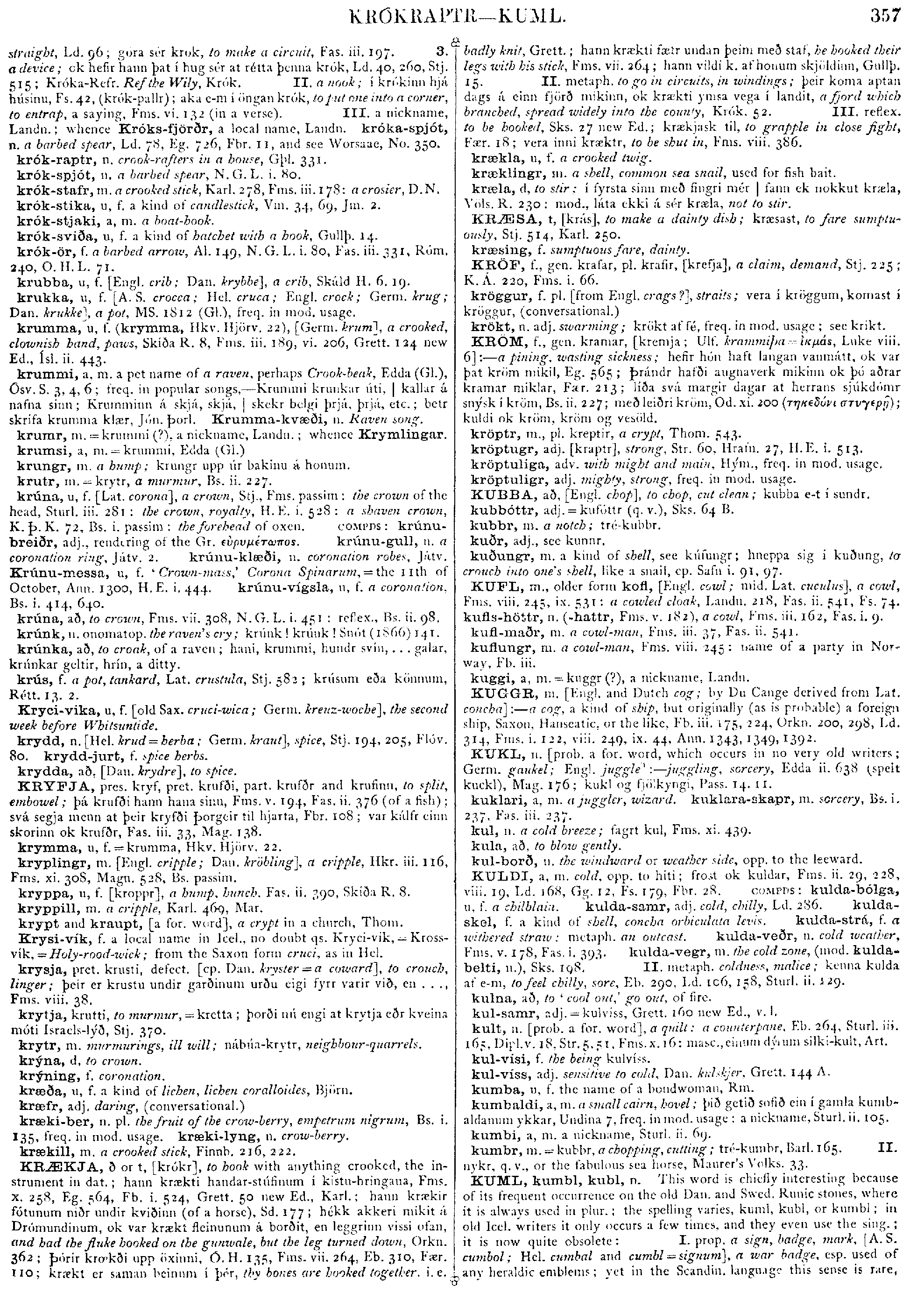
straight, Ld. 96; gora sér krok, to make a circuit, Fas. iii. 197. 3. a device; ok hefir hann þat í hug sér at rétta þenna krók, Ld. 40, 260, Stj. 515; Króka-Rcfr. Ref the Wily, Krók. II. a nook; í krókinn hjá húsinu, Fs. 42, (krók-pallr); aka e-m í öngan krók, to put one into a corner, to entrap, a saying, Fms. vi. 132 (in a verse). III. a nickname, Landn.; whence Króks-fjörðr, a local name, Landn. króka-spjót, n. a barbed spear, Ld. 78, Eg. 726, Fbr. 11, and see Worsaae, No. 350.
|
Source: Cleasby/Vigfusson, page b0382, entry 24 View original page image as: [TIFF] [PNG] [View previous entry] [View next entry] |
[Comment on this entry] [View comments] |
The following entry has not been hand-corrected. However, the page is reserved and someone is correcting it. |
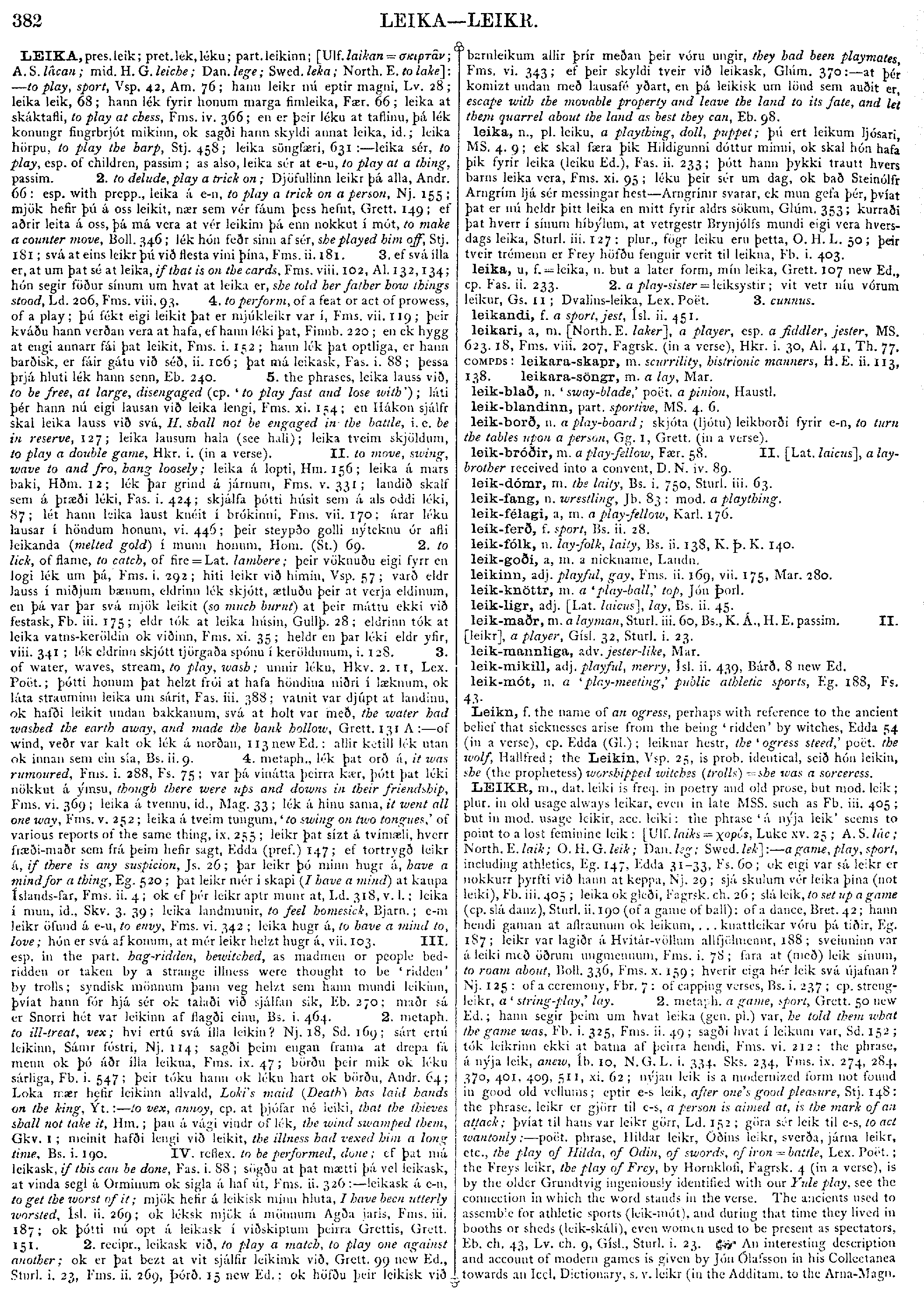
LEIKR, m., dat. Ieiki is freq. in poetry and old prose, but mod. leik; plur. in old usage always leikar, even in late MSS. such as Fb. iii. 405; but in mod. usage Icikir, acc. Ieiki: the phrase 'á nyja leik' seems to point to a lost feminine leik: [ Ulf. laiks = x0P^Sj Luke xv. 25; A. S. lâc; North. E. /a ik; O. H. G. leik; Dan. h'g; Swed. / ek] :-- a game, play, sport, including athletics, Eg. 147, Edda 31-33, Fs. 60; ok eigi var sá leikr er nokkurr þyrfti við hann at keppa, Nj. 29; sjú skulum ver leika þína (not Ieiki), Fb. iii. 405; leika ok glfði, Fagrsk. ch. 26; slu leik, to set up a game (cp. sla dan/,), Sturl. ii. 190 (of a game of ball): of a dance, Bret. 42; hann heudi ganian at aflraunnm ok leikum, ... knattlcikar vóru þú tiðir, Eg. 187; leikr var lagiðr á Hvítár-völlum allfji'ilmennr, 188; sveiiminn var a, Ieiki með öðrum ungmennum, Fms. i. 78; fara at (mcð) leik sinuin, to roa/w about, Boil. 336, Fms. x. 159; hverir eiga her leik svá njauian? Nj. 125: of a ceremony, Fbr. 7: of capping verses, Bs. i. 237; cp. streng- leikr, a ' string-play, ' lay. 2. metaph. a game, sport, Grett. 50 new Ed.; hann segir þeim um hvat leika (gen. pl.) var, he told them what the game was, Fb. i. 325, Fms. ii. 49; sagði hvat í leikinn var, Sd. 152; tók Icikrinn ekki at batna af beiira hendi, Fms. vi. 212: the phrase, á nyja leik, anew, íb. 10, N. G. L. i. 334, Sks. 234, Fms. ix. 274, 284, 370, 401, 409, 511, xi. 62; nyjan leik is a modernized form not found in good old vellums; eptir e-s leik, after one'sgood pleasure, Stj. 148: the phrase, leikr er gjorr til e-s, a person is aimed at, is the mark of a;i attack; þvíat til hans var leikr görr, Ld. 152; gora sJ-r leik til e-s, to act wantonly :-- poet, phrase, ilildar leikr, Öðins lcikr, sverða, járna leikr, etc., the play of Hilda, of Odin, of swords, rf iron - battle, Lex. Poët.; the Freys leikr, the play of Frey, by Hornkloii, Fagrsk. 4 (in a verse), is by the older Grundtvig ingeniously identified with our Yale play, see the connection in which the word stands in the verse. The ancients used to assemble for athletic sports (lcik-mút), and during that time they lived in booths or sheds (lcik-skúli), even womui used to be present as spectators, Eb. ch. 43, Lv. ch. 9, Gísl., Sturl. i. 23. (Jy- An interesting description and account of modern games is given by Jón ölafsson in his Collectanea towards an led. Dictionary, s. v. leikr (in the Additam. to the Arna-Magn.
|
Source: Gordon/Taylor, page b0015, entry 1 View original page image as: [TIFF][PNG] [View previous entry] [View next entry] |
[Comment on this entry] [View comments] |
The following entry has been hand-corrected once. |
Þá
svarar
Útgarða-Loki
ok
litask
um
á
bekkina
ok
mælti:
'Eigi
sé
ek
þann
mann
hér
inni
er
eigi
mun
lítilræði
í
þykkja
at
fásk
við
þik';
ok
enn
mælti
hann,
'Sjám
fyrst,
kalli
mér
hingat
kerlinguna,
fóstru
mína
Elli,
ok
fáisk
Þórr
við
hana,
ef
330
hann
vill.
Felt
hefir
hon
þá
menn
er
mér
hafa
litizk
eigi
ósterkligri
en
Þórr
er.'
Því
næst
gekk
í
h llina
kerling
ein
llina
kerling
ein
gmul.
Þá
mælti
Útgarða-Loki
at
hon
skal
taka
fang
við
Ása-Þór.
Ekki
er
langt
um
at
gora:
svá
fór
fang
þat,
at
því
harðara
er
Þórr
knúðisk
at
fanginu,
því
fastara
stóð
hon.
Þá
335
tók
kerling
at
leita
til
bragða,
ok
var
Þórr
þá
lauss
á
fórum,
ok
váru
þær
sviptingar
allharðar;
ok
eigi
lengi
áðr
en
Þórr
fell
á
kné
ðrum
fceti.
Þá
gekk
til
Útgarða-Loki
ok
bað
þau
hætta
fanginu
ok
sagði
svá,
at
Þórr
mundi
eigi
þurfa
at
bjóða
fleirum
mnnum
fang
í
hans
hirð.
Var
þá
ok
liðit
á
nótt;
340
vísaði
Útgarða-Loki
Þór
ok
þeim
félgum
til
sætis,
ok
dveljask
þar
náttlangt
í
góðum
fagnaði.
En
at
morni
þegar
dagaði,
stendr
Þórr
upp
ok
þeir
félagar,
klæða
sik,
ok
eru
búnir
braut
at
ganga.
Þá
kom
þar
Útgarða-
Loki
ok
lét
setja
þeim
borð;
skorti
þá
eigi
góðan
fagnað,
345
mat
ok
drykk.
En
er
þeir
hafa
matazk,
þá
snúask
þeir
til
ferðar.
Útgarða-Loki
fylgir
þeim
út,
gengr
með
þeim
braut
ór
borginni;
en
at
skilnaði
þá
mæltí
Otgarða-Loki
til
Þórs
ok
spyrr
hvernig
honum
þykkir
ferð
sín
orðin,
eða
hvárt
hann
hefir
hitt
ríkara
mann
nkkurn
en
sik.
Þórr
segir
at
350
eigi
mun
hann
þat
segja,
at
eigi
hafi
hann
mikla
ósœmd
farit
í
þeira
viðskiptum,
'en
þó
veit
ek
at
þér
munuð
kalla
mik
lítinn
mann
fyrir
mér,
ok
uni
ek
því
illa'.
Þá
mælti
Útgarða-Loki:
'Nú
skal
segja
þér
it
sanna,
er
þú
ert
út
kominn
ór
borginni
--
ok
ef
ek
lifi
ok
megak
ráða,
355
þá
skaltu
aldri
optar
í
hana
koma;
ok
þat
veit
trúa
mín,
at
aldri
hefðir
þú
í
hana
komit,
ef
ek
hefða
vitat
áðr
at
þú
hefðir
svá
mikinn
krapt
með
þér,
ok
þú
hefðir
svá
nær
haft
oss
mikilli
ófœru.
En
sjónhverfingar
hefi
ek
grt
þér,
ok
fyrsta
sinn
á
skóginum
kom
ek
til
fundar
við
yðr,
ok
þá
er
þú
skyldir
360
Germanic Lexicon Project (main page)
This search system was written by
Sean Crist
Please consider
volunteering
to correct the data in these online dictionaries.
No rights reserved. Feel free to use these data in any way you please.