|
|

|
Source: Bosworth/Toller, page b0254, entry 9 View original page image as: [TIFF] [PNG] [View previous entry] [View next entry] |
[Comment on this entry] [View comments] |
The following entry has been hand-corrected once. |
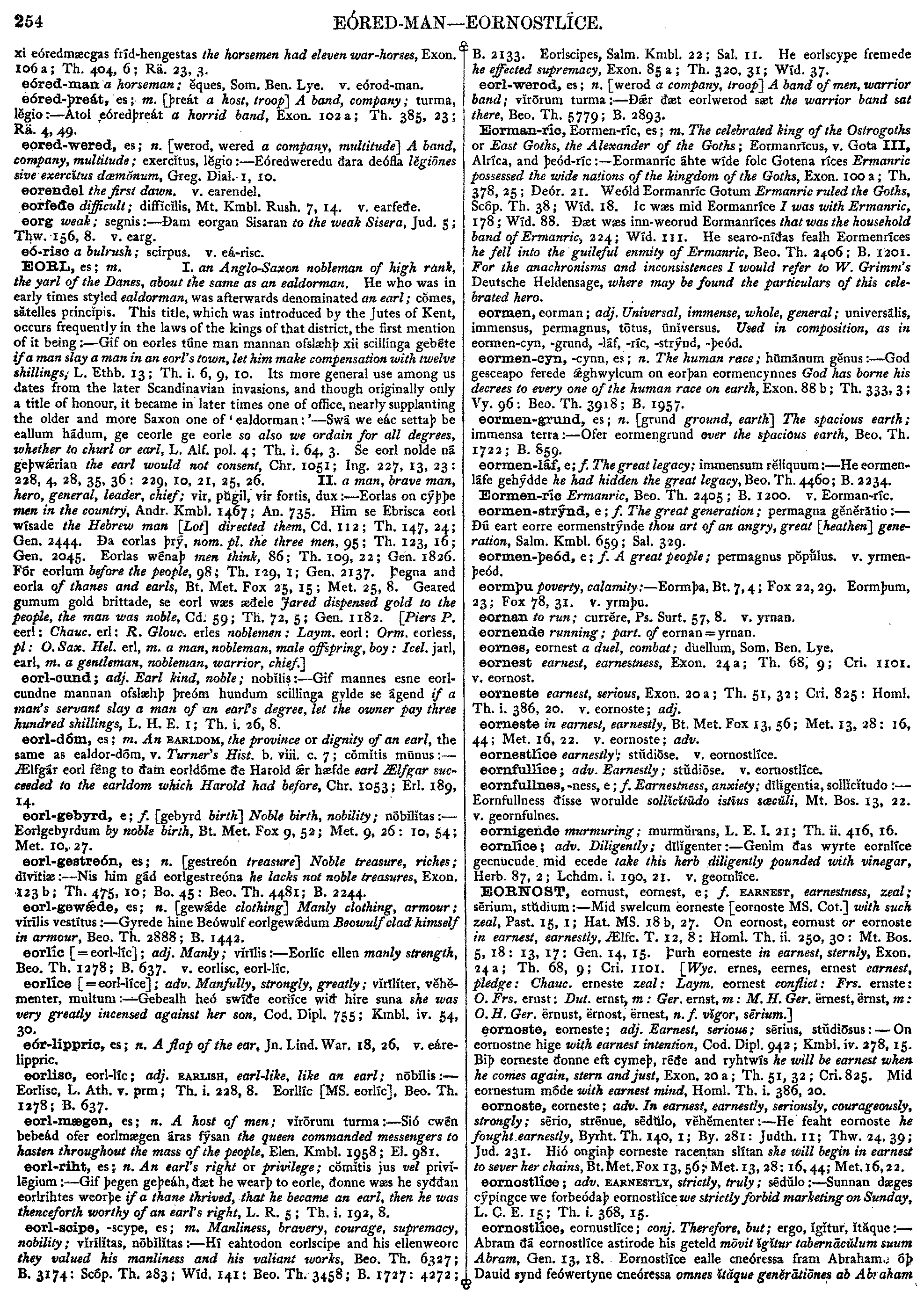
EORL.
es;
m.
I.
an
Anglo-Saxon
nobleman
of
high
rank,
the
yarl
of
the
Danes,
about
the
same
as
an
ealdorman.
He
who
was
in
early
times
styled
ealdorman,
was
afterwards
denominated
an
earl;
c mes,
s
mes,
s telles
princ
telles
princ pis.
This
title,
which
was
introduced
by
the
Jutes
of
Kent,
occurs
frequently
in
the
laws
of
the
kings
of
that
district,
the
first
mention
of
it
being
:--
Gif
on
eorles
túne
man
mannan
ofslæhþ
xii
scillinga
gebéte
if
a
man
slay
a
man
in
an
earl's
town,
let
him
make
compensation
with
twelve
shillings,
L.
Ethb.
13;
Th.
i.
6,
9,
10.
Its
more
general
use
among
us
dates
from
the
later
Scandinavian
invasions,
and
though
originally
only
a
title
of
honour,
it
became
in
later
times
one
of
office,
nearly
supplanting
the
older
and
more
Saxon
one
of
'ealdorman:'
--
Swá
we
eác
settaþ
be
eallum
hádum,
ge
ceorle
ge
eorle
so
also
we
ordain
for
all
degrees,
whether
to
churl
or
earl,
L.
Alf.
pol.
4;
Th.
i.
64,
3.
Se
eorl
nolde
ná
géþws
pis.
This
title,
which
was
introduced
by
the
Jutes
of
Kent,
occurs
frequently
in
the
laws
of
the
kings
of
that
district,
the
first
mention
of
it
being
:--
Gif
on
eorles
túne
man
mannan
ofslæhþ
xii
scillinga
gebéte
if
a
man
slay
a
man
in
an
earl's
town,
let
him
make
compensation
with
twelve
shillings,
L.
Ethb.
13;
Th.
i.
6,
9,
10.
Its
more
general
use
among
us
dates
from
the
later
Scandinavian
invasions,
and
though
originally
only
a
title
of
honour,
it
became
in
later
times
one
of
office,
nearly
supplanting
the
older
and
more
Saxon
one
of
'ealdorman:'
--
Swá
we
eác
settaþ
be
eallum
hádum,
ge
ceorle
ge
eorle
so
also
we
ordain
for
all
degrees,
whether
to
churl
or
earl,
L.
Alf.
pol.
4;
Th.
i.
64,
3.
Se
eorl
nolde
ná
géþws rian
the
earl
would
not
consent,
Chr.
1051;
Ing.
227,
13,
23:
228,
4,
28,
35,
36:
229,
10,
21,
25,
26.
II.
a
man,
brave
man,
hero,
general,
leader,
chief;
vir,
p
rian
the
earl
would
not
consent,
Chr.
1051;
Ing.
227,
13,
23:
228,
4,
28,
35,
36:
229,
10,
21,
25,
26.
II.
a
man,
brave
man,
hero,
general,
leader,
chief;
vir,
p gil,
vir
fortis,
dux
:--
Eorlas
on
cýþþe
men
in
the
country.
Andr.
Kmbl.
1467;
An.
735.
Him
se
Ebrisca
eorl
wísade
the
Hebrew
man
[Lot]
directed
them.
Cd.
112;
Th.
147,
24;
Gen.
2444.
Ða
eorlas
þrý,
nom.
pl.
the
three
men,
95;
Th.
123,
16;
Gen.
2045.
Eorlas
wénaþ
men
think,
86;
Th.
109,
22;
Gen.
1826.
Fór
eorlum
before
the
people,
98;
Th.
129,
1;
Gen.
2137.
þegna
and
eorla
of
thanes
and
earls,
Bt.
Met.
Fox
25,
15
;
Met.
25,
8.
Geared
gumum
gold
brittade,
se
eorl
wæs
æðele
Jared
dispensed
gold
to
the
people,
the
man
was
noble.
Cd.
59;
Th.
72,
5;
Gen.
1182.
[Piers
P.
eerl:
Chauc.
erl:
R.
Glouc.
erles
noblemen:
Laym.
eorl:
Orm.
eorless,
pl:
O.
Sax.
Hel.
erl,
m.
a
man,
nobleman,
male
offspring,
boy:
Icel.
jarl,
earl,
m.
a
gentleman,
nobleman,
warrior,
chief.]
gil,
vir
fortis,
dux
:--
Eorlas
on
cýþþe
men
in
the
country.
Andr.
Kmbl.
1467;
An.
735.
Him
se
Ebrisca
eorl
wísade
the
Hebrew
man
[Lot]
directed
them.
Cd.
112;
Th.
147,
24;
Gen.
2444.
Ða
eorlas
þrý,
nom.
pl.
the
three
men,
95;
Th.
123,
16;
Gen.
2045.
Eorlas
wénaþ
men
think,
86;
Th.
109,
22;
Gen.
1826.
Fór
eorlum
before
the
people,
98;
Th.
129,
1;
Gen.
2137.
þegna
and
eorla
of
thanes
and
earls,
Bt.
Met.
Fox
25,
15
;
Met.
25,
8.
Geared
gumum
gold
brittade,
se
eorl
wæs
æðele
Jared
dispensed
gold
to
the
people,
the
man
was
noble.
Cd.
59;
Th.
72,
5;
Gen.
1182.
[Piers
P.
eerl:
Chauc.
erl:
R.
Glouc.
erles
noblemen:
Laym.
eorl:
Orm.
eorless,
pl:
O.
Sax.
Hel.
erl,
m.
a
man,
nobleman,
male
offspring,
boy:
Icel.
jarl,
earl,
m.
a
gentleman,
nobleman,
warrior,
chief.]
|
Source: Bosworth/Toller, page b0259, entry 20 View original page image as: [TIFF] [PNG] [View previous entry] [View next entry] |
[Comment on this entry] [View comments] |
The following entry has been hand-corrected once. |
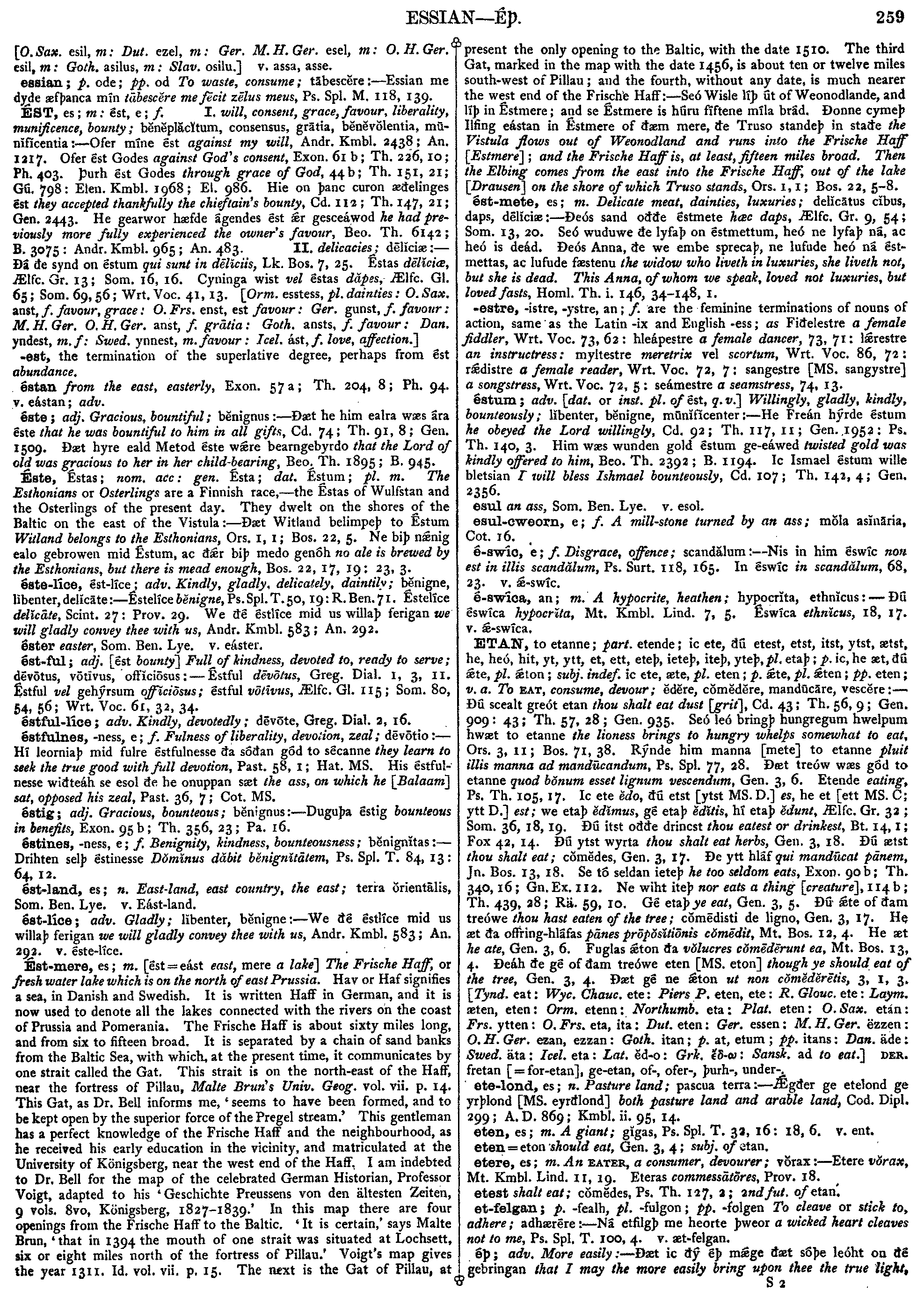
éstum;
adv.
[dat.
or
inst.
pl.
of
ést,
q.v.]
Willingly,
gladly,
kindly,
bounteously;
lbenter,
b nigne,
m
nigne,
m nfcenter
:--
He
Freán
hýrde
éstum
he
obeyed
the
Lord
willingly,
Cd.
92;
Th.
117,
11;
Gen.
1952:
Ps.
Th.
140,
3.
Him
wæs
wunden
gold
éstum
ge-eáwed
twisted
gold
was
kindly
offered
to
him.
Beo.
Th.
2392;
B.
1194.
Ic
Ismael
éstum
wille
bletsian
.
I
will
bless
Ishmael
bounteously,
Cd.
107;
Th.
142,
4;
Gen.
2356.
nfcenter
:--
He
Freán
hýrde
éstum
he
obeyed
the
Lord
willingly,
Cd.
92;
Th.
117,
11;
Gen.
1952:
Ps.
Th.
140,
3.
Him
wæs
wunden
gold
éstum
ge-eáwed
twisted
gold
was
kindly
offered
to
him.
Beo.
Th.
2392;
B.
1194.
Ic
Ismael
éstum
wille
bletsian
.
I
will
bless
Ishmael
bounteously,
Cd.
107;
Th.
142,
4;
Gen.
2356.
|
Source: Bosworth/Toller, page b0268, entry 14 View original page image as: [TIFF] [PNG] [View previous entry] [View next entry] |
[Comment on this entry] [View comments] |
The following entry has been hand-corrected once. |
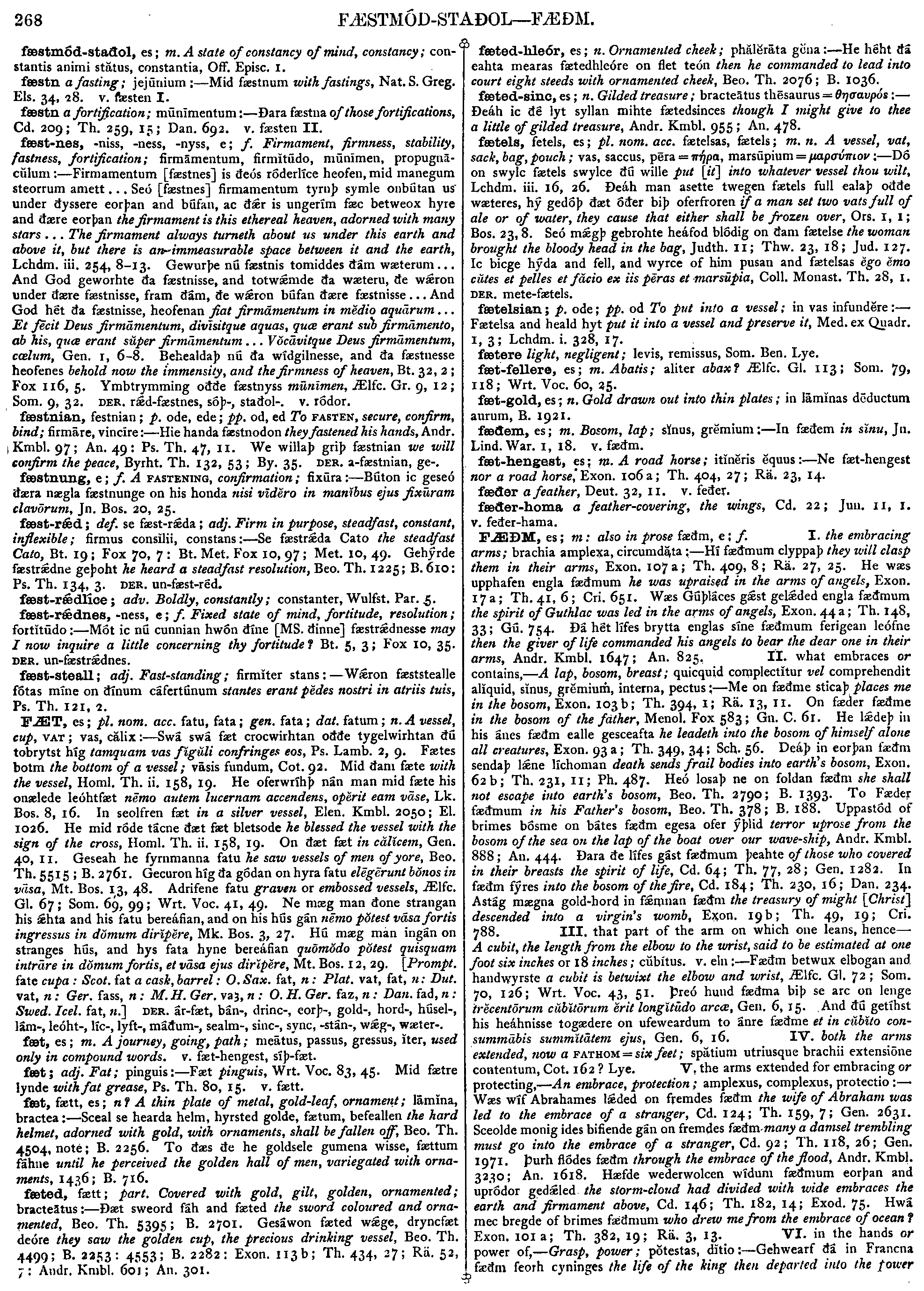
fæt,
fætt,
es;
n?
A
thin
plate
of
metal,
gold-leaf,
ornament;
l mna,
bractea
:--
Sceal
se
hearda
helm,
hyrsted
golde,
fætum,
befeallen
the
hard
helmet,
adorned
with
gold,
with
ornaments,
shall
be
fallen
off,
Beo.
Th.
4504,
note;
B.
2256.
To
ðæs
ðe
he
goldsele
gumena
wisse,
fættum
fáhne
until
he
perceived
the
golden
hall
of
men,
variegated
with
ornaments,
1436;
B.
716.
mna,
bractea
:--
Sceal
se
hearda
helm,
hyrsted
golde,
fætum,
befeallen
the
hard
helmet,
adorned
with
gold,
with
ornaments,
shall
be
fallen
off,
Beo.
Th.
4504,
note;
B.
2256.
To
ðæs
ðe
he
goldsele
gumena
wisse,
fættum
fáhne
until
he
perceived
the
golden
hall
of
men,
variegated
with
ornaments,
1436;
B.
716.
|
Source: Bosworth/Toller, page b0268, entry 15 View original page image as: [TIFF] [PNG] [View previous entry] [View next entry] |
[Comment on this entry] [View comments] |
The following entry has been hand-corrected once. |
fæted,
fætt;
part.
Covered
with
gold,
gilt,
golden,
ornamented;
bractetus
:--
Ðæt
sweord
fáh
and
fæted
the
sword
coloured
and
ornamented,
Beo.
Th.
5395;
B.
2701.
Gesáwon
fæted
wge,
dryncfæt
deóre
they
saw
the
golden
cup,
the
precious
drinking
vessel,
Beo.
Th.
4499;
B.
2253:
4553;
B.
2282:
Exon.
113
b;
Th.
434,
27;
Rä.
52,
7:
Andr.
Kmbl.
601;
An.
301.
|
Source: Bosworth/Toller, page b0268, entry 22 View original page image as: [TIFF] [PNG] [View previous entry] [View next entry] |
[Comment on this entry] [View comments] |
The following entry has been hand-corrected once. |
fæt-gold,
es;
n.
Gold
drawn
out
into
thin
plates;
in
lmnas
d ductum
aurum,
B.
1921.
ductum
aurum,
B.
1921.
|
Source: Bosworth/Toller, page b0269, entry 7 View original page image as: [TIFF] [PNG] [View previous entry] [View next entry] |
[Comment on this entry] [View comments] |
The following entry has been hand-corrected once. |
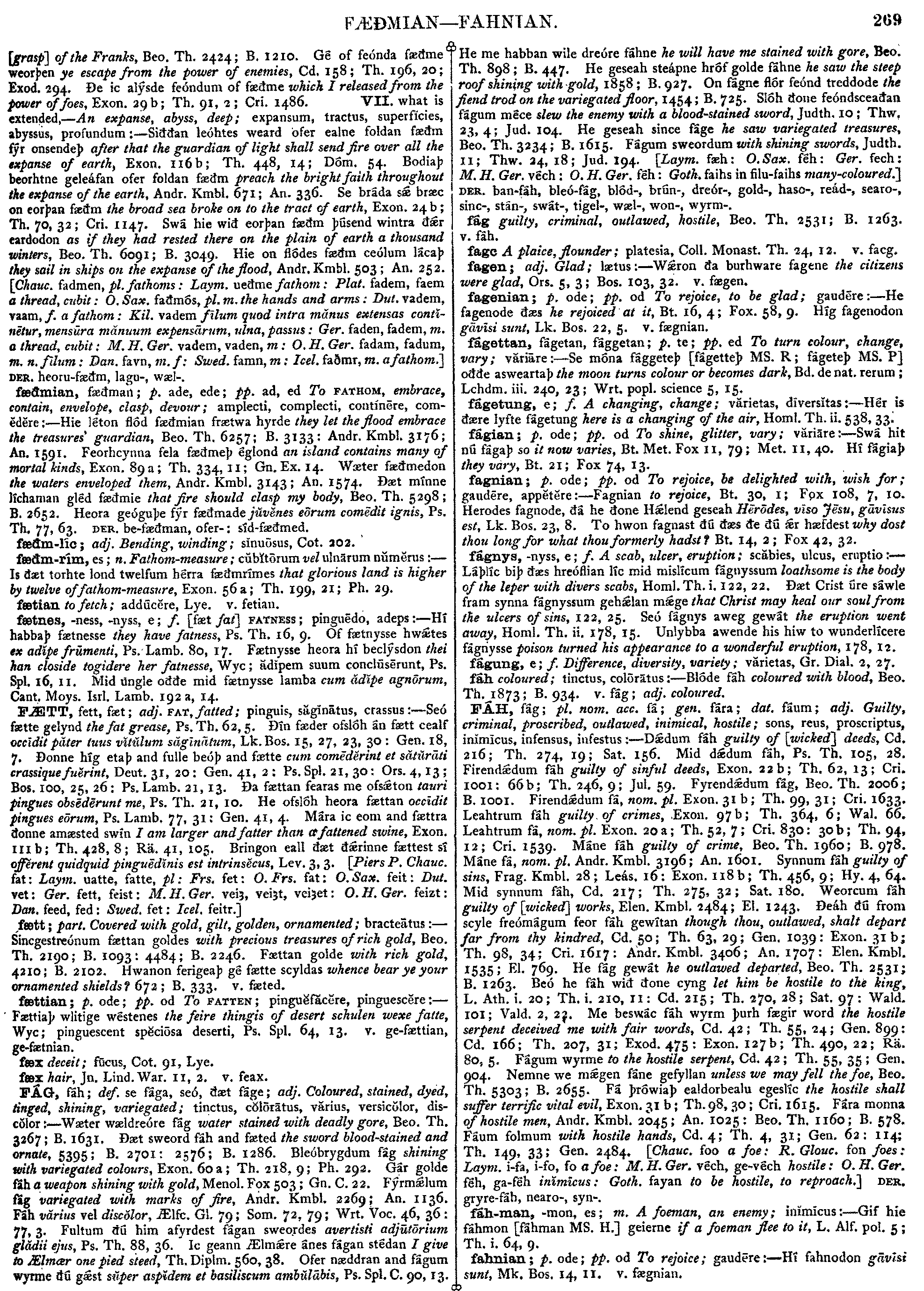
fætt;
part.
Covered
with
gold,
gilt,
golden,
ornamented;
bractetus
:--
Sincgestreónum
fættan
goldes
with
precious
treasures
of
rich
gold,
Beo.
Th.
2190;
B.
1093:
4484;
B.
2246.
Fættan
golde
with
rich
gold,
4210;
B.
2102.
Hwanon
ferigeaþ
gé
fætte
scyldas
whence
bear
ye
your
ornamented
shields?
672;
B.
333.
v.
fæted.
|
Source: Bosworth/Toller, page b0269, entry 11 View original page image as: [TIFF] [PNG] [View previous entry] [View next entry] |
[Comment on this entry] [View comments] |
The following entry has been hand-corrected once. |
FÁG,
fáh;
def.
se
fága,
seó,
ðæt
fáge;
adj.
Coloured,
stained,
dyed,
tinged,
shining,
variegated;
tinctus,
cl rtus,
vrius,
versiclor,
disclor
:--
Wæter
wældreóre
fág
water
stained
with
deadly
gore,
Beo.
Th.
3267;
B.
1631.
Ðæt
sweord
fáh
and
fæted
the
sword
blood-stained
and
ornate,
5395;
B.
2701:
2576;
B.
1286.
Bleóbrygdum
fág
shining
with
variegated
colours,
Exon.
60
a;
Th.
218,
9;
Ph.
292.
Gár
golde
fáh
a
weapon
shining
with
gold,
Menol.
Fox
503;
Gn.
C.
22.
Fýrmlum
fág
variegated
with
marks
of
fire,
Andr.
Kmbl.
2269;
An.
1136.
Fáh
vrius
vel
disclor,
Ælfc.
Gl.
79;
Som.
72,
79;
Wrt.
Voc.
46,
36:
77,
3.
Fultum
ðú
him
afyrdest
fágan
sweordes
avertisti
adjtrium
gldii
ejus,
Ps.
Th.
88,
36.
Ic
geann
Ælmre
ánes
fágan
stédan
I
give
to
Ælmær
one
pied
steed,
Th.
Diplm.
560,
38.
Ofer
næddran
and
fágum
wyrme
ðú
gst
sper
aspdem
et
basiliscum
amblbis,
Ps.
Spl.
C.
90,
13.
He
me
habban
wile
dreóre
fáhne
he
will
have
me
stained
with
gore,
Beo.
Th.
898;
B.
447.
He
geseah
steápne
hróf
golde
fáhne
he
saw
the
steep
roof
shining
with
gold,
1858;
B.
927.
On
fágne
flór
feónd
treddode
the
fiend
trod
on
the
variegated
floor,
1454;
B.
725.
Slóh
ðone
feóndsceaðan
fágum
méce
slew
the
enemy
with
a
blood-stained
sword,
Judth.
10;
Thw,
23,
4;
Jud.
104.
He
geseah
since
fáge
he
saw
variegated
treasures,
Beo.
Th.
3234;
B.
1615.
Fágum
sweordum
with
shining
swords,
Judth.
11;
Thw.
24,
18;
Jud.
194.
[Laym.
fæh:
O.
Sax.
féh:
Ger.
fech:
M.
H.
Ger.
véch:
O.
H.
Ger.
féh:
Goth.
faihs
in
filu-faihs
many-coloured.]
DER.
ban-fáh,
bleó-fág,
blód-,
brún-,
dreór-,
gold-,
haso-,
reád-,
searo-,
sinc-,
stán-,
swát-,
tigel-,
wæl-,
won-,
wyrm-.
rtus,
vrius,
versiclor,
disclor
:--
Wæter
wældreóre
fág
water
stained
with
deadly
gore,
Beo.
Th.
3267;
B.
1631.
Ðæt
sweord
fáh
and
fæted
the
sword
blood-stained
and
ornate,
5395;
B.
2701:
2576;
B.
1286.
Bleóbrygdum
fág
shining
with
variegated
colours,
Exon.
60
a;
Th.
218,
9;
Ph.
292.
Gár
golde
fáh
a
weapon
shining
with
gold,
Menol.
Fox
503;
Gn.
C.
22.
Fýrmlum
fág
variegated
with
marks
of
fire,
Andr.
Kmbl.
2269;
An.
1136.
Fáh
vrius
vel
disclor,
Ælfc.
Gl.
79;
Som.
72,
79;
Wrt.
Voc.
46,
36:
77,
3.
Fultum
ðú
him
afyrdest
fágan
sweordes
avertisti
adjtrium
gldii
ejus,
Ps.
Th.
88,
36.
Ic
geann
Ælmre
ánes
fágan
stédan
I
give
to
Ælmær
one
pied
steed,
Th.
Diplm.
560,
38.
Ofer
næddran
and
fágum
wyrme
ðú
gst
sper
aspdem
et
basiliscum
amblbis,
Ps.
Spl.
C.
90,
13.
He
me
habban
wile
dreóre
fáhne
he
will
have
me
stained
with
gore,
Beo.
Th.
898;
B.
447.
He
geseah
steápne
hróf
golde
fáhne
he
saw
the
steep
roof
shining
with
gold,
1858;
B.
927.
On
fágne
flór
feónd
treddode
the
fiend
trod
on
the
variegated
floor,
1454;
B.
725.
Slóh
ðone
feóndsceaðan
fágum
méce
slew
the
enemy
with
a
blood-stained
sword,
Judth.
10;
Thw,
23,
4;
Jud.
104.
He
geseah
since
fáge
he
saw
variegated
treasures,
Beo.
Th.
3234;
B.
1615.
Fágum
sweordum
with
shining
swords,
Judth.
11;
Thw.
24,
18;
Jud.
194.
[Laym.
fæh:
O.
Sax.
féh:
Ger.
fech:
M.
H.
Ger.
véch:
O.
H.
Ger.
féh:
Goth.
faihs
in
filu-faihs
many-coloured.]
DER.
ban-fáh,
bleó-fág,
blód-,
brún-,
dreór-,
gold-,
haso-,
reád-,
searo-,
sinc-,
stán-,
swát-,
tigel-,
wæl-,
won-,
wyrm-.
|
Source: Bosworth/Toller, page b0274, entry 12 View original page image as: [TIFF] [PNG] [View previous entry] [View next entry] |
[Comment on this entry] [View comments] |
The following entry has been hand-corrected once. |
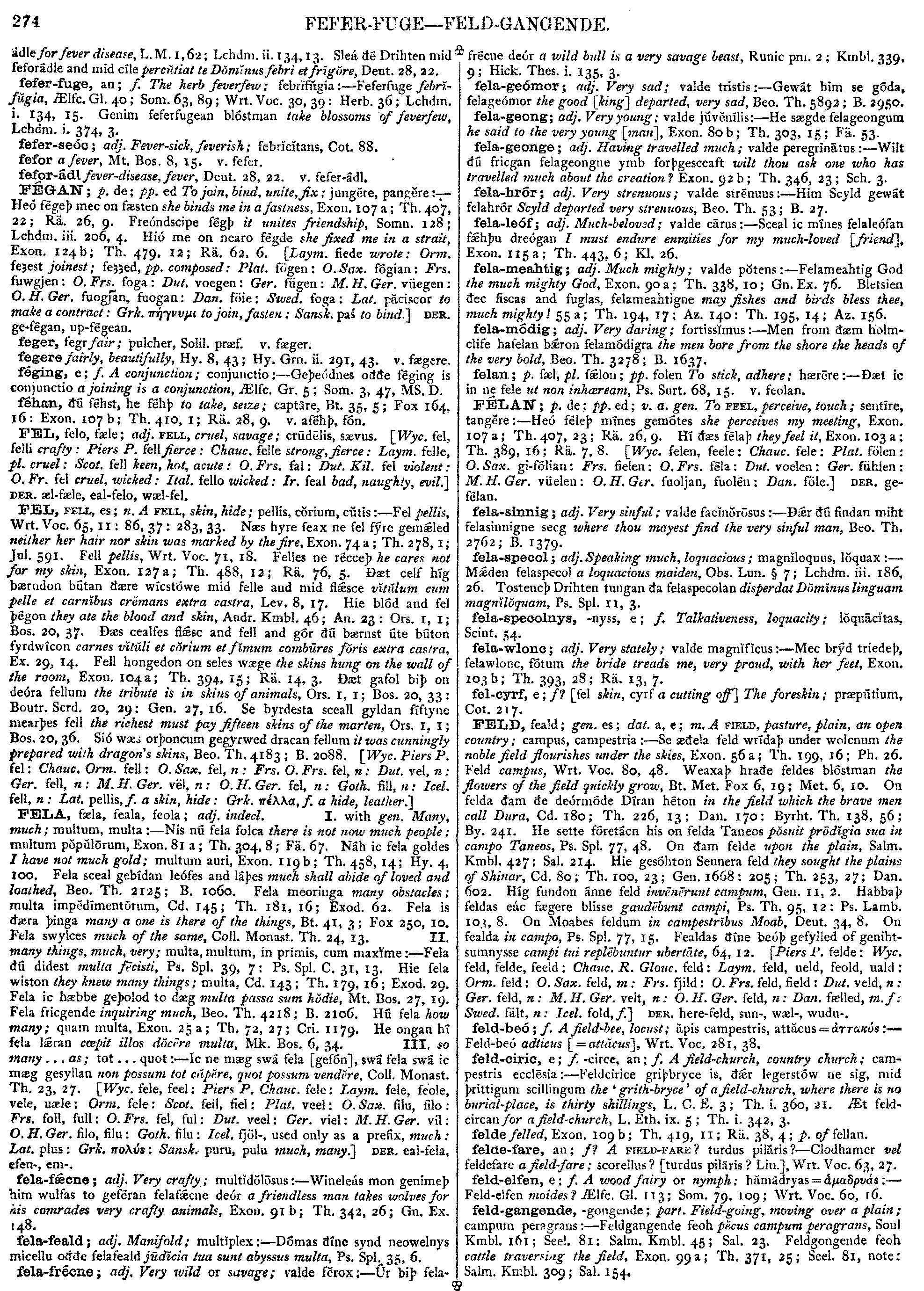
FELA,
fæla,
feala,
feola;
adj.
indecl.
I.
with
gen.
Many,
much;
multum,
multa
:--
Nis
nú
fela
folca
there
is
not
now
much
people;
multum
pplrum,
Exon.
81
a;
Th.
304,
8;
Fä.
67.
Náh
ic
fela
goldes
I
have
not
much
gold;
multum
auri,
Exon.
119
b;
Th.
458,
14;
Hy.
4,
100.
Fela
sceal
gebídan
leófes
and
láþes
much
shall
abide
of
loved
and
loathed,
Beo.
Th.
2125;
B.
1060.
Fela
meoringa
many
obstacles;
multa
impd mentrum,
Cd.
145;
Th.
181,
16;
Exod.
62.
Fela
is
ðæra
þinga
many
a
one
is
there
of
the
things,
Bt.
41,
3;
Fox
250,
10.
Fela
swylces
much
of
the
same,
Coll.
Monast.
Th.
24,
13.
II.
many
things,
much,
very;
multa,
multum,
in
primis,
cum
maxme
:--
Fela
ðú
didest
multa
fcisti,
Ps.
Spl.
39,
7:
Ps.
Spl.
C.
31,
13.
Hie
fela
wiston
they
knew
many
things;
multa,
Cd.
143;
Th.
179,
16;
Exod.
29.
Fela
ic
hæbbe
geþolod
to
dæg
multa
passa
sum
hdie,
Mt.
Bos.
27,
19.
Fela
fricgende
inquiring
much,
Beo.
Th.
4218;
B.
2106.
Hú
fela
how
many;
quam
multa,
Exon.
25
a;
Th.
72,
27;
Cri.
1179.
He
ongan
hí
fela
lran
cæpit
illos
dcre
multa,
Mk.
Bos.
6,
34.
III.
so
many
...
as;
tot
...
quot
:--
Ic
ne
mæg
swá
fela
[gefón],
swá
fela
swá
ic
mæg
gesyllan
non
possum
tot
cpre,
quot
possum
vendre,
Coll.
Monast.
Th.
23,
27.
[Wyc.
fele,
feel:
Piers
P.
Chauc.
fele:
Laym.
fele,
feole,
vele,
uæle:
Orm.
fele:
Scot.
feil,
fiel:
Plat.
veel:
O.
Sax.
filu,
filo:
Frs.
foll,
full:
O.
Frs.
fel,
ful:
Dut.
veel:
Ger.
viel:
M.
H.
Ger.
vil:
O.
H.
Ger.
filo,
filu:
Goth.
filu:
Icel.
fjöl-,
used
only
as
a
prefix,
much:
Lat.
plus:
Grk.
mentrum,
Cd.
145;
Th.
181,
16;
Exod.
62.
Fela
is
ðæra
þinga
many
a
one
is
there
of
the
things,
Bt.
41,
3;
Fox
250,
10.
Fela
swylces
much
of
the
same,
Coll.
Monast.
Th.
24,
13.
II.
many
things,
much,
very;
multa,
multum,
in
primis,
cum
maxme
:--
Fela
ðú
didest
multa
fcisti,
Ps.
Spl.
39,
7:
Ps.
Spl.
C.
31,
13.
Hie
fela
wiston
they
knew
many
things;
multa,
Cd.
143;
Th.
179,
16;
Exod.
29.
Fela
ic
hæbbe
geþolod
to
dæg
multa
passa
sum
hdie,
Mt.
Bos.
27,
19.
Fela
fricgende
inquiring
much,
Beo.
Th.
4218;
B.
2106.
Hú
fela
how
many;
quam
multa,
Exon.
25
a;
Th.
72,
27;
Cri.
1179.
He
ongan
hí
fela
lran
cæpit
illos
dcre
multa,
Mk.
Bos.
6,
34.
III.
so
many
...
as;
tot
...
quot
:--
Ic
ne
mæg
swá
fela
[gefón],
swá
fela
swá
ic
mæg
gesyllan
non
possum
tot
cpre,
quot
possum
vendre,
Coll.
Monast.
Th.
23,
27.
[Wyc.
fele,
feel:
Piers
P.
Chauc.
fele:
Laym.
fele,
feole,
vele,
uæle:
Orm.
fele:
Scot.
feil,
fiel:
Plat.
veel:
O.
Sax.
filu,
filo:
Frs.
foll,
full:
O.
Frs.
fel,
ful:
Dut.
veel:
Ger.
viel:
M.
H.
Ger.
vil:
O.
H.
Ger.
filo,
filu:
Goth.
filu:
Icel.
fjöl-,
used
only
as
a
prefix,
much:
Lat.
plus:
Grk.
 o
o &upsilon-tonos;s:
Sansk.
puru,
pulu
much,
many.]
DER.
eal-fela,
efen-,
em-.
&upsilon-tonos;s:
Sansk.
puru,
pulu
much,
many.]
DER.
eal-fela,
efen-,
em-.
|
Source: Bosworth/Toller, page b0311, entry 21 View original page image as: [TIFF] [PNG] [View previous entry] [View next entry] |
[Comment on this entry] [View comments] |
The following entry has been hand-corrected once. |
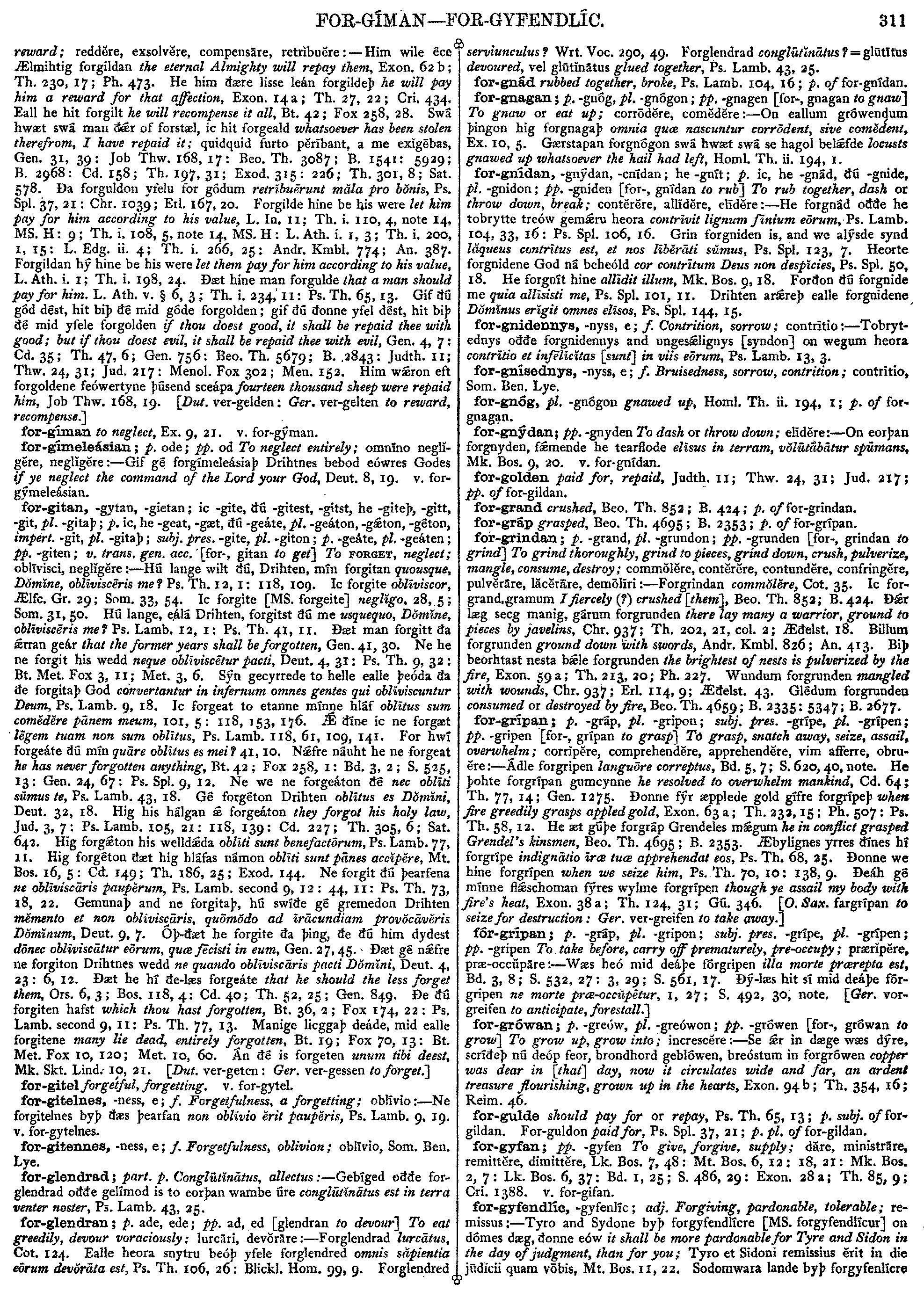
for-grípan;
p.
-gráp,
pl.
-gripon;
subj.
pres.
-grípe,
pl.
-grípen;
pp.
-gripen
[for-,
grípan
to
grasp]
To
grasp,
snatch
away,
seize,
assail,
overwhelm;
corrpre,
comprehendre,
apprehendre,
vim
afferre,
obrure
:--
Ádle
forgripen
langure
correptus,
Bd.
5,
7;
S.
620,
40,
note.
He
þohte
forgrípan
gumcynne
he
resolved
to
overwhelm
mankind,
Cd.
64;
Th.
77,
14;
Gen.
1275.
Ðonne
fýr
æpplede
gold
gífre
forgrípeþ
when
fire
greedily
grasps
appled
gold,
Exon.
63
a;
Th.
232,
15;
Ph.
507:
Ps.
Th.
58,
12.
He
æt
gúþe
forgráp
Grendeles
mgum
he
in
conflict
grasped
Grendel's
kinsmen,
Beo.
Th.
4695;
B.
2353.
Æbylignes
yrres
ðínes
hí
forgrípe
indigntio
ræ
tuæ
apprehendat
eos,
Ps.
Th.
68,
25.
Ðonne
we
hine
forgrípen
when
we
seize
him,
Ps.
Th.
70,
10:
138,
9.
Ðeáh
gé
mínne
flschoman
fýres
wylme
forgrípen
though
ye
assail
my
body
with
fire's
heat,
Exon.
38
a;
Th.
124,
31;
Gú.
346.
[O.
Sax.
fargrípan
to
seize
for
destruction:
Ger.
ver-greifen
to
take
away.]
|
Source: Bosworth/Toller, page b0328, entry 23 View original page image as: [TIFF] [PNG] [View previous entry] [View next entry] |
[Comment on this entry] [View comments] |
The following entry has been hand-corrected once. |
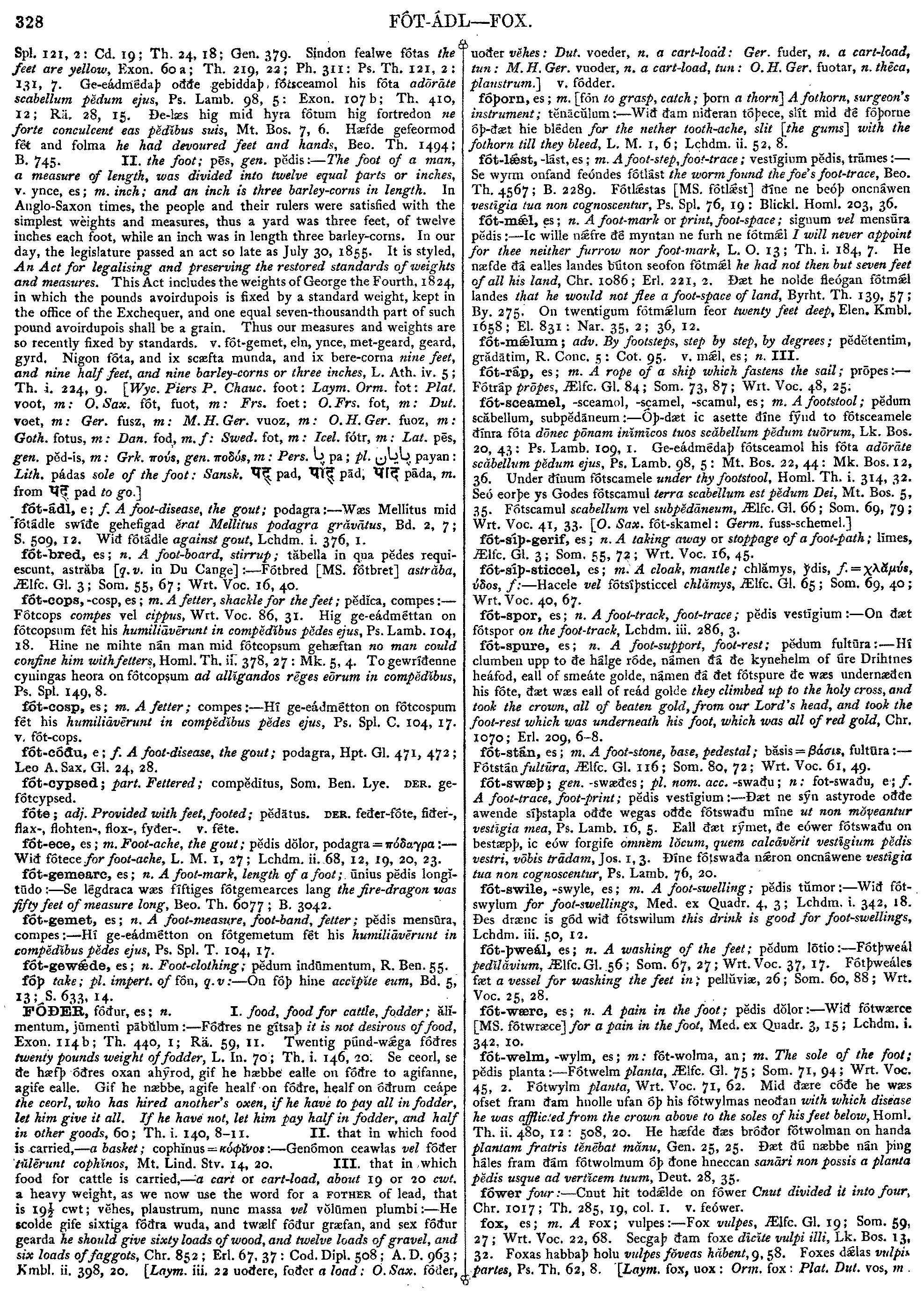
fót-spure,
es;
n.
A
foot-support,
foot-rest;
pdum
fultra
:--
Hí
clumben
upp
to
ðe
hálge
róde,
námen
ðá
ðe
kynehelm
of
úre
Drihtnes
heáfod,
eall
of
smeáte
golde,
námen
ðá
ðet
fótspure
ðe
wæs
undernæðen
his
fóte,
ðæt
wæs
eall
of
reád
golde
they
climbed
up
to
the
holy
cross,
and
took
the
crown,
all
of
beaten
gold,
from
our
Lord's
head,
and
took
the
foot-rest
which
was
underneath
his
foot,
which
was
all
of
red
gold,
Chr.
1070;
Erl.
209,
6-8.
| Result Page: |  |
Previous | 1 2 3 4 5 6 7 8 9 10 11 12 13 14 | Next |  |
Germanic Lexicon Project (main page)
This search system was written by
Sean Crist
Please consider
volunteering
to correct the data in these online dictionaries.
No rights reserved. Feel free to use these data in any way you please.