|
|

Search for godes again, using less strict matching (1995 results)
|
Source: Bosworth/Toller, page d0236, entry 17 View original page image as: [TIFF] [PNG] [View previous entry] [View next entry] |
[Comment on this entry] [View comments] |
The following entry has been hand-corrected once. |
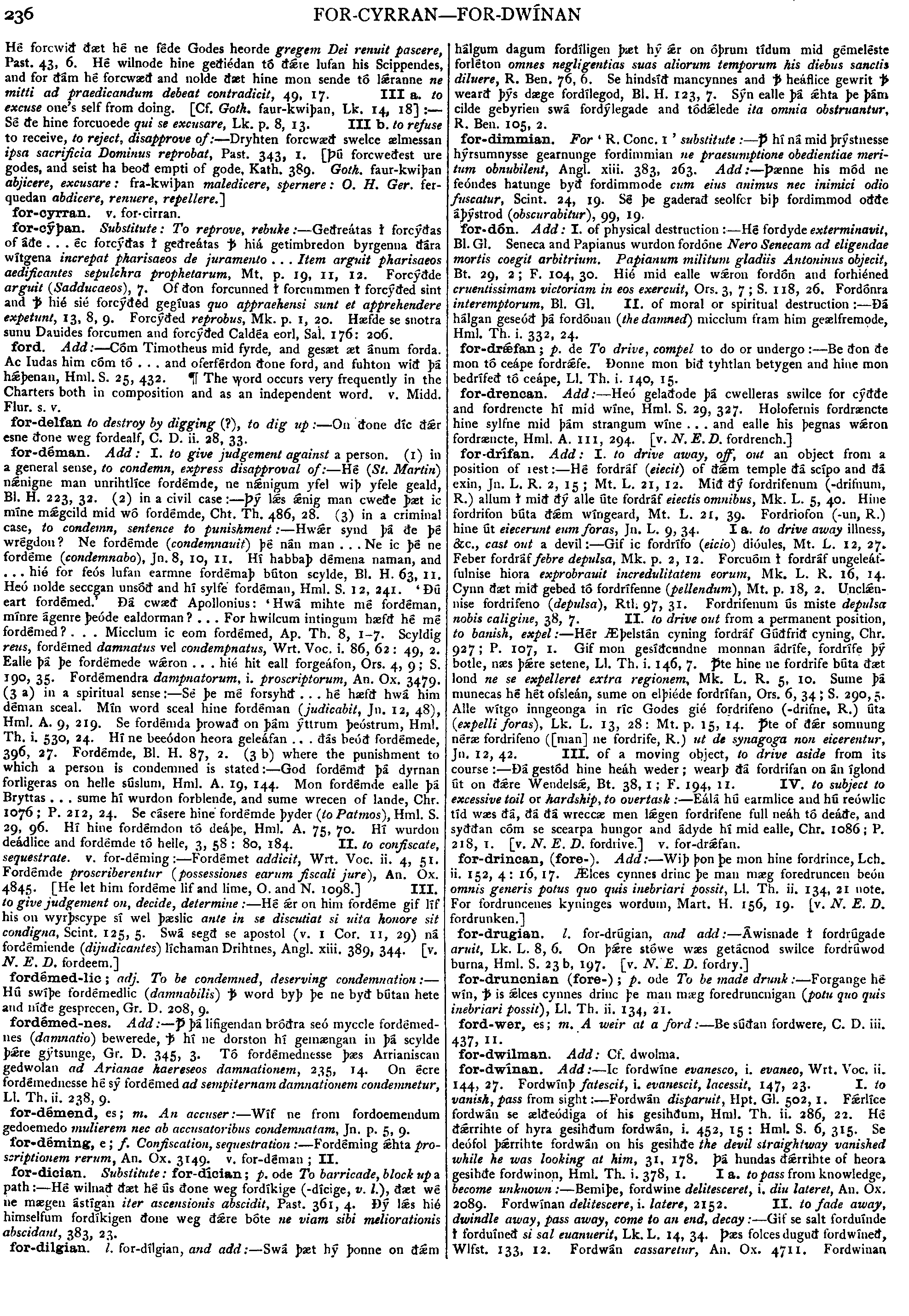
for-drífan.
Add:
I.
to
drive
away,
off,
out
an
object
from
a
position
of
rest
:--
Hé
fordráf
(eiecit)
of
ð m
temple
ðá
scípo
and
ðá
exin,
Jn.
L.
R.
2,
15;
Mt.
L.
21,
12.
Mið
ðý
fordrifenum
(-drifnum,
R.)
allum
m
temple
ðá
scípo
and
ðá
exin,
Jn.
L.
R.
2,
15;
Mt.
L.
21,
12.
Mið
ðý
fordrifenum
(-drifnum,
R.)
allum
 mið
ðý
alle
úte
fordráf
eiectis
omnibus,
Mk.
L.
5,
40.
Hine
fordrifon
búta
ðm
wíngeard,
Mt.
L.
21,
39.
Fordriofon
(-un,
R.)
hine
út
eiecerunt
eum
foras,
Jn.
L.
9,
34.
I
a.
to
drive
away
illness,
&c.,
cast
out
a
devil
:--
Gif
ic
fordrifo
(eicio)
dióules.
Mt.
L.
12,
27.
Feber
fordráf
febre
depulsa,
Mk.
p.
2,
12.
Forcuóm
fordráf
ungeleáffulnise
hiora
exprobrauit
incredulitatem
eorum,
Mk.
L.
R.
16,
14.
Cynn
ðæt
mið
gebed
tó
fordrífenne
(pellendum),
Mt.
p.
18,
2.
Unclnnise
fordrifeno
(depulsa),
Rtl;
97,
31.
Fordrifenum
ús
miste
depulsa
nobis
caligine,
38,
7.
II.
to
drive
out
from
a
permanent
position,
to
banish,
expel
:--
Her
Æþelstán
cyning
fordráf
Gúðfrið
cyning,
Chr.
927;
P.
107,
1.
Gif
mon
gesíðcundne
monnan
ádrífe,
fordrífe
þý
botle,
næs
þre
setene,
Ll.
Th.
i.
146,
7.
Þ-bar;te
hine
ne
fordrife
búta
ðæt
lond
ne
se
expelleret
extra
regionem.
Mk.
L.
R.
5,
10.
Sume
þá
munecas
hé
hét
ofsleán,
sume
on
elþiéde
fordrífan,
Ors.
6,
34;
S.
290,
5.
Alle
wítgo
inngeonga
in
ríc
Godes
gié
fordrifeno
(-drifne,
R.)
úta
(expelli
foras),
Lk.
L.
13,
28:
Mt.
p.
15,
14.
Þ-bar;te
of
ðr
somnung
néræ
fordrifeno
([man]
ne
fordrife,
R.)
ut
de
synagoga
non
eicerentur,
Jn.
12,
42.
III.
of
a
moving
object,
to
drive
aside
from
its
course
:--
Ðá
gestód
hine
heáh
weder;
wearþ
ðá
fordrifan
on
án
íglond
út
on
ðre
Wendels,
Bt.
38,
1;
F.
194,
11.
IV.
to
subject
to
excessive
toil
or
hardship,
to
overtask
:--
Eálá
hú
earmlice
and
hú
reówlic
tíd
wæs
ðá,
ðá
ðá
wreccæ
men
lgen
fordrifene
full
neáh
tó
deáðe,
and
syððan
cóm
se
scearpa
hungor
and
ádyde
hí
mid
ealle,
Chr.
1086;
P.
218,
1.
[v.
N.
E.
D.
fordrive.]
v.
for-drfan.
mið
ðý
alle
úte
fordráf
eiectis
omnibus,
Mk.
L.
5,
40.
Hine
fordrifon
búta
ðm
wíngeard,
Mt.
L.
21,
39.
Fordriofon
(-un,
R.)
hine
út
eiecerunt
eum
foras,
Jn.
L.
9,
34.
I
a.
to
drive
away
illness,
&c.,
cast
out
a
devil
:--
Gif
ic
fordrifo
(eicio)
dióules.
Mt.
L.
12,
27.
Feber
fordráf
febre
depulsa,
Mk.
p.
2,
12.
Forcuóm
fordráf
ungeleáffulnise
hiora
exprobrauit
incredulitatem
eorum,
Mk.
L.
R.
16,
14.
Cynn
ðæt
mið
gebed
tó
fordrífenne
(pellendum),
Mt.
p.
18,
2.
Unclnnise
fordrifeno
(depulsa),
Rtl;
97,
31.
Fordrifenum
ús
miste
depulsa
nobis
caligine,
38,
7.
II.
to
drive
out
from
a
permanent
position,
to
banish,
expel
:--
Her
Æþelstán
cyning
fordráf
Gúðfrið
cyning,
Chr.
927;
P.
107,
1.
Gif
mon
gesíðcundne
monnan
ádrífe,
fordrífe
þý
botle,
næs
þre
setene,
Ll.
Th.
i.
146,
7.
Þ-bar;te
hine
ne
fordrife
búta
ðæt
lond
ne
se
expelleret
extra
regionem.
Mk.
L.
R.
5,
10.
Sume
þá
munecas
hé
hét
ofsleán,
sume
on
elþiéde
fordrífan,
Ors.
6,
34;
S.
290,
5.
Alle
wítgo
inngeonga
in
ríc
Godes
gié
fordrifeno
(-drifne,
R.)
úta
(expelli
foras),
Lk.
L.
13,
28:
Mt.
p.
15,
14.
Þ-bar;te
of
ðr
somnung
néræ
fordrifeno
([man]
ne
fordrife,
R.)
ut
de
synagoga
non
eicerentur,
Jn.
12,
42.
III.
of
a
moving
object,
to
drive
aside
from
its
course
:--
Ðá
gestód
hine
heáh
weder;
wearþ
ðá
fordrifan
on
án
íglond
út
on
ðre
Wendels,
Bt.
38,
1;
F.
194,
11.
IV.
to
subject
to
excessive
toil
or
hardship,
to
overtask
:--
Eálá
hú
earmlice
and
hú
reówlic
tíd
wæs
ðá,
ðá
ðá
wreccæ
men
lgen
fordrifene
full
neáh
tó
deáðe,
and
syððan
cóm
se
scearpa
hungor
and
ádyde
hí
mid
ealle,
Chr.
1086;
P.
218,
1.
[v.
N.
E.
D.
fordrive.]
v.
for-drfan.
|
Source: Bosworth/Toller, page d0237, entry 4 View original page image as: [TIFF] [PNG] [View previous entry] [View next entry] |
[Comment on this entry] [View comments] |
The following entry has been hand-corrected once. |
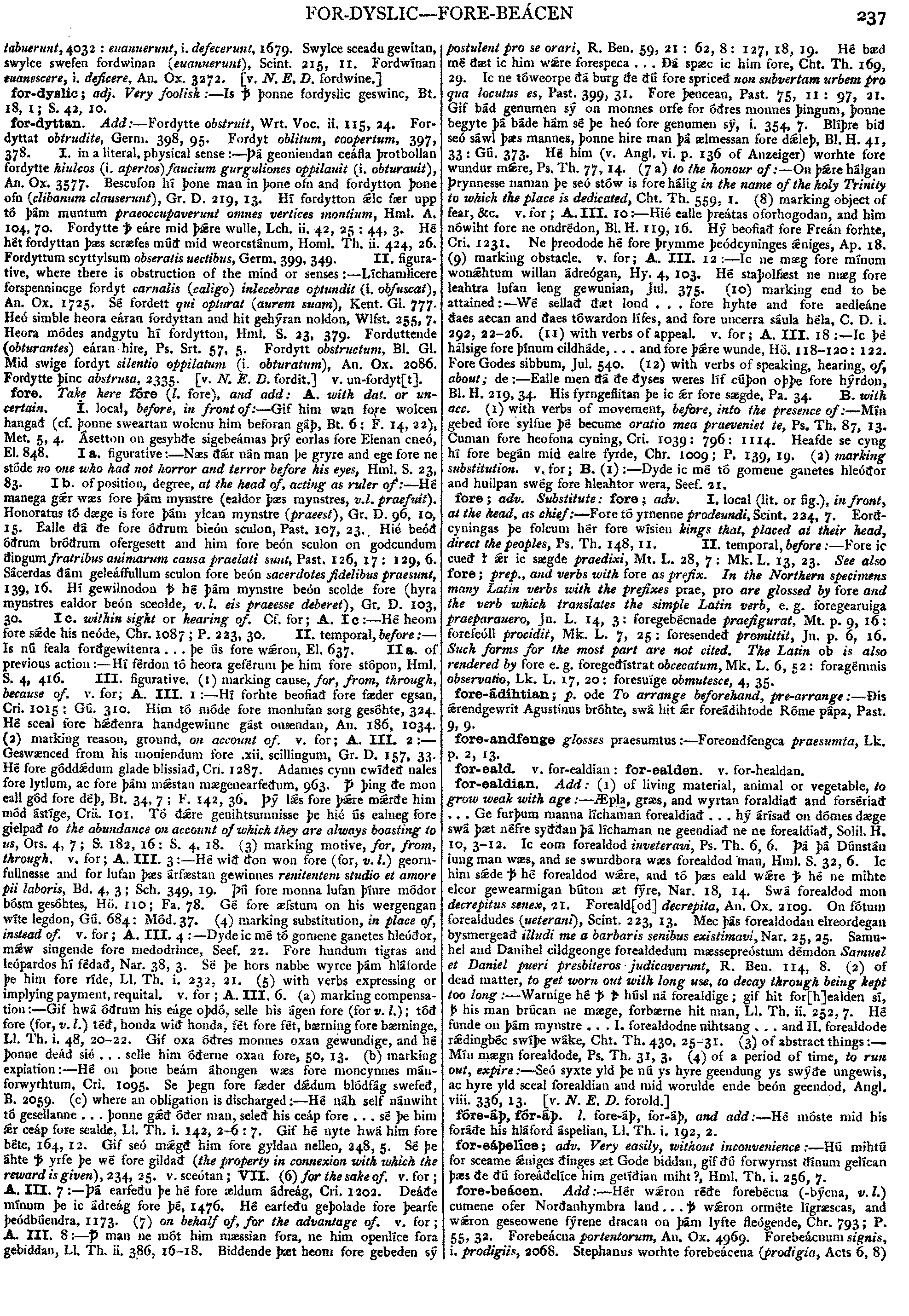
fore.
Take
here
fóre
(l.
fore),
and
add:
A.
with
dat.
or
uncertain.
I.
local,
before,
in
front
of
:--
Gif
him
wan
fore
wolcen
hangað
(cf.
þonne
sweartan
wolcnu
him
beforan
gáþ,
Bt.
6:
F.
14,
22),
Met.
5,
4.
Ásetton
on
gesyhðe
sigebeámas
þrý
eorlas
fore
Elenan
cneó,
El.
848.
I
a.
figurative
:--
Næs
ðr
nán
man
þe
gryre
and
ege
fore
ne
stóde
no
one
who
had
not
horror
and
terror
before
his
eyes,
Hml.
S.
23,
83.
I
b.
of
position,
degree,
at
the
head
of,
acting
as
ruler
of
:--
Hé
manega
gr
wæs
fore
þám
mynstre
(ealdor
þæs
mynstres,
v.
l.
praefuit).
Honoratus
tó
dæge
is
fore
þám
ylcan
mynstre
(praeest),
Gr.
D.
96,
10,
15.
Ealle
ðá
ðe
fore
óðrum
bieón
sculon,
Past.
107,
23.
Hié
beóð
óðrum
bróðrum
ofergesett
and
him
fore
beón
sculon
on
godcundum
ðingum
fratribus
animarum
causa
praelati
sunt,
Past.
126,
17:
129,
6.
Sácerdas
dám
geleáffullum
sculon
fore
beón
sacerdotes
fidelibus
praesunt,
139,
16.
Hí
gewilnodon
 hé
þám
mynstre
beón
scolde
fore
(hyra
mynstres
ealdor
beón
sceolde,
v.
l.
eis
praeesse
deberet),
Gr.
D.
103,
30.
I
c.
within
sight
or
hearing
of.
Cf.
for;
A.
I
c
:--
Hé
heom
fore
sde
his
neóde,
Chr.
1087;
P.
223,
30.
II.
temporal,
before
:--
Is
nú
feala
forðgewitenra
...
þe
ús
fore
wron,
El.
637.
II
a.
of
previous
action
:--
Hí
férdon
tó
heora
geférum
þe
him
fore
stópon,
Hml.
S.
4,
416.
III.
figurative.
(1)
marking
cause,
for,
from,
through,
because
of.
v.
for;
A.
III.
1
:--
Hí
forhte
beofiad
fore
fæder
egsan,
Cri.
1015:
Gú.
310.
Him
tó
móde
fore
monlufan
sorg
gesóhte,
324.
Hé
sceal
fore
hðenra
handgewinne
gást
onsendan,
An.
186,
1034.
(2)
marking
reason,
ground,
on
account
of.
v.
for;
A.
III.
2
:--
Geswænced
from
his
moniendum
fore
.xii.
scillingum,
Gr.
D.
157,
33.
Hé
fore
gódddum
glade
blissiað,
Cri.
1287.
Adames
cynn
cwíðeð
nales
fore
lytlum,
ac
fore
þám
mstan
mægenearfeðum,
963.
Þ-bar;
þing
ðe
mon
eall
gód
fore
déþ,
Bt.
34,
7;
F.
142,
36.
Þý
ls
fore
þre
mrðe
him
mód
ástíge,
Crä.
101.
Tó
ðre
genihtsumnisse
þe
hié
ús
ealneg
fore
gielpað
to
the
abundance
on
account
of
which
they
are
always
boasting
to
us,
Ors.
4,
7;
S.
182,
16:
S.
4,
18.
(3)
marking
motive,
for,
from,
through,
v.
for;
A.
III.
3
:--
Hé
wið
ðon
won
fore
(for,
v.
l.)
geornfullnesse
and
for
lufan
þæs
árfæstan
gewinnes
renitentem
studio
et
amore
pii
laboris,
Bd.
4,
3;
Sch.
349,
Þú
fore
monna
lufan
þínre
módor
bósm
gesóhtes,
Hö.
110;
Fa.
78.
Gé
fore
æfstum
on
his
wergengan
wíte
legdon,
Gú.
684:
Mód.
37.
(4)
marking
substitution,
in
place
of,
instead
of.
v.
for;
A.
III.
4
:--
Dyde
ic
mé
tó
gomene
ganetes
hleóðor,
mw
singende
fore
medodrince,
Seef.
22.
Fore
hundum
tigras
and
leópardos
hí
fédað,
Nar.
38,
3.
Sé
þe
hors
nabbe
wyrce
þám
hláforde
þe
him
fore
ríde,
Ll.
Th.
i.
232,
21.
(5)
with
verbs
expressing
or
implying
payment,
requital.
v.
for;
A.
III.
6.
(a)
marking
compensation
:--
Gif
hwá
óðrum
his
eáge
oþdó,
selle
his
ágen
fore
(for
v.
l.);
tóð
fore
(for,
v.
l.)
téð,
honda
wið
honda,
fét
fore
fét,
bærning
fore
bærninge,
Ll.
Th.
i.
48,
20-22.
Gif
oxa
óðres
monnes
oxan
gewundige,
and
hé
þonne
deád
sié
...
selle
him
óðerne
oxan
fore,
50,
13.
(b)
marking
expiation
:--
Hé
on
þone
beám
áhongen
wæs
fore
moncynnes
mánforwyrhtum,
Cri.
1095.
Se
þegn
fore
fæder
ddum
blódfág
swefeð,
B.
2059.
(c)
where
an
obligation
is
discharged
:--
He
náh
self
nánwiht
tó
gesellanne
...
þonne
gð
óðer
man,
seleð
his
ceáp
fore
...
sé
þe
him
r
ceáp
fore
sealde,
Ll.
Th.
i.
142,
2-6:
7.
Gif
hé
nyte
hwá
him
fore
béte,
164,
12.
Gif
seó
mgð
him
fore
gyldan
nellen,
248,
5.
Sé
þe
áhte
yrfe
þe
wé
fore
gildað
(the
property
in
connexion
with
which
the
reward
is
given),
234,
25.
v.
sceótan;
VII.
(6)
for
the
sake
of.
v.
for;
A.
III.
7
:--
Þá
earfeðu
þe
hé
fore
ældum
ádreág,
Cri.
1202.
Deáðe
mínum
þe
ic
ádreág
fore
þé,
1476.
Hé
earfeðu
geþolade
fore
þearfe
þeódbúendra,
1173.
(7)
on
behalf
of,
for
the
advantage
of.
v.
for;
A.
III.
8
:--
Þ-bar;
man
ne
mót
him
mæssian
fora,
ne
him
openlíce
fora
gebiddan,
Ll.
Th.
ii.
386,
16-18.
Biddende
þæt
heom
fore
gebeden
sý
postulent
pro
se
orari,
R.
Ben.
59,
21:
62,
8:
127,
18,
19.
Hé
bæd
mé
ðæt
ic
him
wre
forespeca
...
Ðá
spæc
ic
him
fore,
Cht.
Th.
169,
29.
Ic
ne
tóweorpe
ðá
burg
ðe
ðú
fore
spriceð
non
subvertam
urbem
pro
qua
locutus
es,
Past.
399,
31.
Fore
þencean,
Past.
75,
11:
97,
21.
Gif
bád
genumen
sý
on
monnes
orfe
for
óðres
monnes
þingum,
þonne
begyte
þá
báde
hám
sé
þe
heó
fore
genumen
sý,
i.
354,
7.
Blíþre
bið
seó
sáwl
þæs
mannes,
þonne
hire
man
þá
ælmessan
fore
dleþ,
Bl.
H.
41,
33:
Gú.
373.
Hé
him
(v.
Angl.
vi.
p.
136
of
Anzeiger)
worhte
fore
wundur
mre,
Ps.
Th.
77,
14.
(7
a)
to
the
honour
of
:--
On
þre
hálgan
Þrynnesse
naman
þe
seó
stow
is
fore
hálig
in
the
name
of
the
holy
Trinity
to
which
the
place
is
dedicated,
Cht.
Th.
559,
i.
(8)
marking
object
of
fear,
&c.
v.
for;
A.
III.
10
:--
Hié
ealle
þreátas
oforhogodan,
and
him
nówiht
fore
ne
ondrédon,
Bl.
H.
119,
16.
Hý
beofiað
fore
Freán
forhte,
Cri.
1231.
Ne
þreodode
hé
fore
þrymme
þeódcyninges
niges,
Ap.
18.
(9)
marking
obstacle,
v.
for;
A.
III.
12
:--
Ic
ne
mæg
fore
mínum
wonhtum
willan
ádreógan,
Hy.
4,
103.
Hé
staþolfæst
ne
mæg
fore
leahtra
lufan
leng
gewunian,
Jul.
375.
(10)
marking
end
to
be
attained
:--
Wé
sellað
ðæt
lond
...
fore
hyhte
and
fore
aedleáne
ðaes
aecan
and
ðaes
tówardon
lífes,
and
fore
uncerra
sáula
héla,
C.
D.
i.
292,
22-26.
(11)
with
verbs
of
appeal.
v.
for;
A.
III.
18
:--
Ic
þé
hálsige
fore
þínum
cildháde,
...
and
fore
þre
wunde,
Hö.
118-120:
122.
Fore
Godes
sibbum,
Jul.
540.
(12)
with
verbs
of
speaking,
hearing,
of,
about;
de
:--
Ealle
men
ðá
ðe
ðyses
weres
líf
cúþon
oþþe
fore
hýrdon,
Bl.
H.
219,
34.
His
fyrngeflitan
þe
ic
r
fore
sægde,
Pa.
34.
B.
with
acc.
(1)
with
verbs
of
movement,
before,
into
the
presence
of
:--
Mín
gebed
fore
sylfne
þé
becume
oratio
mea
praeveniet
te,
Ps.
Th.
87,
13.
Cuman
fore
heofona
cyning,
Cri.
1039:
796:
1114.
Heafde
se
cyng
hí
fore
begán
mid
ealre
fyrde,
Chr.
1009;
P.
139,
19.
(2)
marking
substitution,
v.
for;
B.
(1)
:--
Dyde
ic
mé
tó
gomene
ganetes
hleóðor
and
huilpan
swég
fore
hleahtor
wera,
Seef.
21.
hé
þám
mynstre
beón
scolde
fore
(hyra
mynstres
ealdor
beón
sceolde,
v.
l.
eis
praeesse
deberet),
Gr.
D.
103,
30.
I
c.
within
sight
or
hearing
of.
Cf.
for;
A.
I
c
:--
Hé
heom
fore
sde
his
neóde,
Chr.
1087;
P.
223,
30.
II.
temporal,
before
:--
Is
nú
feala
forðgewitenra
...
þe
ús
fore
wron,
El.
637.
II
a.
of
previous
action
:--
Hí
férdon
tó
heora
geférum
þe
him
fore
stópon,
Hml.
S.
4,
416.
III.
figurative.
(1)
marking
cause,
for,
from,
through,
because
of.
v.
for;
A.
III.
1
:--
Hí
forhte
beofiad
fore
fæder
egsan,
Cri.
1015:
Gú.
310.
Him
tó
móde
fore
monlufan
sorg
gesóhte,
324.
Hé
sceal
fore
hðenra
handgewinne
gást
onsendan,
An.
186,
1034.
(2)
marking
reason,
ground,
on
account
of.
v.
for;
A.
III.
2
:--
Geswænced
from
his
moniendum
fore
.xii.
scillingum,
Gr.
D.
157,
33.
Hé
fore
gódddum
glade
blissiað,
Cri.
1287.
Adames
cynn
cwíðeð
nales
fore
lytlum,
ac
fore
þám
mstan
mægenearfeðum,
963.
Þ-bar;
þing
ðe
mon
eall
gód
fore
déþ,
Bt.
34,
7;
F.
142,
36.
Þý
ls
fore
þre
mrðe
him
mód
ástíge,
Crä.
101.
Tó
ðre
genihtsumnisse
þe
hié
ús
ealneg
fore
gielpað
to
the
abundance
on
account
of
which
they
are
always
boasting
to
us,
Ors.
4,
7;
S.
182,
16:
S.
4,
18.
(3)
marking
motive,
for,
from,
through,
v.
for;
A.
III.
3
:--
Hé
wið
ðon
won
fore
(for,
v.
l.)
geornfullnesse
and
for
lufan
þæs
árfæstan
gewinnes
renitentem
studio
et
amore
pii
laboris,
Bd.
4,
3;
Sch.
349,
Þú
fore
monna
lufan
þínre
módor
bósm
gesóhtes,
Hö.
110;
Fa.
78.
Gé
fore
æfstum
on
his
wergengan
wíte
legdon,
Gú.
684:
Mód.
37.
(4)
marking
substitution,
in
place
of,
instead
of.
v.
for;
A.
III.
4
:--
Dyde
ic
mé
tó
gomene
ganetes
hleóðor,
mw
singende
fore
medodrince,
Seef.
22.
Fore
hundum
tigras
and
leópardos
hí
fédað,
Nar.
38,
3.
Sé
þe
hors
nabbe
wyrce
þám
hláforde
þe
him
fore
ríde,
Ll.
Th.
i.
232,
21.
(5)
with
verbs
expressing
or
implying
payment,
requital.
v.
for;
A.
III.
6.
(a)
marking
compensation
:--
Gif
hwá
óðrum
his
eáge
oþdó,
selle
his
ágen
fore
(for
v.
l.);
tóð
fore
(for,
v.
l.)
téð,
honda
wið
honda,
fét
fore
fét,
bærning
fore
bærninge,
Ll.
Th.
i.
48,
20-22.
Gif
oxa
óðres
monnes
oxan
gewundige,
and
hé
þonne
deád
sié
...
selle
him
óðerne
oxan
fore,
50,
13.
(b)
marking
expiation
:--
Hé
on
þone
beám
áhongen
wæs
fore
moncynnes
mánforwyrhtum,
Cri.
1095.
Se
þegn
fore
fæder
ddum
blódfág
swefeð,
B.
2059.
(c)
where
an
obligation
is
discharged
:--
He
náh
self
nánwiht
tó
gesellanne
...
þonne
gð
óðer
man,
seleð
his
ceáp
fore
...
sé
þe
him
r
ceáp
fore
sealde,
Ll.
Th.
i.
142,
2-6:
7.
Gif
hé
nyte
hwá
him
fore
béte,
164,
12.
Gif
seó
mgð
him
fore
gyldan
nellen,
248,
5.
Sé
þe
áhte
yrfe
þe
wé
fore
gildað
(the
property
in
connexion
with
which
the
reward
is
given),
234,
25.
v.
sceótan;
VII.
(6)
for
the
sake
of.
v.
for;
A.
III.
7
:--
Þá
earfeðu
þe
hé
fore
ældum
ádreág,
Cri.
1202.
Deáðe
mínum
þe
ic
ádreág
fore
þé,
1476.
Hé
earfeðu
geþolade
fore
þearfe
þeódbúendra,
1173.
(7)
on
behalf
of,
for
the
advantage
of.
v.
for;
A.
III.
8
:--
Þ-bar;
man
ne
mót
him
mæssian
fora,
ne
him
openlíce
fora
gebiddan,
Ll.
Th.
ii.
386,
16-18.
Biddende
þæt
heom
fore
gebeden
sý
postulent
pro
se
orari,
R.
Ben.
59,
21:
62,
8:
127,
18,
19.
Hé
bæd
mé
ðæt
ic
him
wre
forespeca
...
Ðá
spæc
ic
him
fore,
Cht.
Th.
169,
29.
Ic
ne
tóweorpe
ðá
burg
ðe
ðú
fore
spriceð
non
subvertam
urbem
pro
qua
locutus
es,
Past.
399,
31.
Fore
þencean,
Past.
75,
11:
97,
21.
Gif
bád
genumen
sý
on
monnes
orfe
for
óðres
monnes
þingum,
þonne
begyte
þá
báde
hám
sé
þe
heó
fore
genumen
sý,
i.
354,
7.
Blíþre
bið
seó
sáwl
þæs
mannes,
þonne
hire
man
þá
ælmessan
fore
dleþ,
Bl.
H.
41,
33:
Gú.
373.
Hé
him
(v.
Angl.
vi.
p.
136
of
Anzeiger)
worhte
fore
wundur
mre,
Ps.
Th.
77,
14.
(7
a)
to
the
honour
of
:--
On
þre
hálgan
Þrynnesse
naman
þe
seó
stow
is
fore
hálig
in
the
name
of
the
holy
Trinity
to
which
the
place
is
dedicated,
Cht.
Th.
559,
i.
(8)
marking
object
of
fear,
&c.
v.
for;
A.
III.
10
:--
Hié
ealle
þreátas
oforhogodan,
and
him
nówiht
fore
ne
ondrédon,
Bl.
H.
119,
16.
Hý
beofiað
fore
Freán
forhte,
Cri.
1231.
Ne
þreodode
hé
fore
þrymme
þeódcyninges
niges,
Ap.
18.
(9)
marking
obstacle,
v.
for;
A.
III.
12
:--
Ic
ne
mæg
fore
mínum
wonhtum
willan
ádreógan,
Hy.
4,
103.
Hé
staþolfæst
ne
mæg
fore
leahtra
lufan
leng
gewunian,
Jul.
375.
(10)
marking
end
to
be
attained
:--
Wé
sellað
ðæt
lond
...
fore
hyhte
and
fore
aedleáne
ðaes
aecan
and
ðaes
tówardon
lífes,
and
fore
uncerra
sáula
héla,
C.
D.
i.
292,
22-26.
(11)
with
verbs
of
appeal.
v.
for;
A.
III.
18
:--
Ic
þé
hálsige
fore
þínum
cildháde,
...
and
fore
þre
wunde,
Hö.
118-120:
122.
Fore
Godes
sibbum,
Jul.
540.
(12)
with
verbs
of
speaking,
hearing,
of,
about;
de
:--
Ealle
men
ðá
ðe
ðyses
weres
líf
cúþon
oþþe
fore
hýrdon,
Bl.
H.
219,
34.
His
fyrngeflitan
þe
ic
r
fore
sægde,
Pa.
34.
B.
with
acc.
(1)
with
verbs
of
movement,
before,
into
the
presence
of
:--
Mín
gebed
fore
sylfne
þé
becume
oratio
mea
praeveniet
te,
Ps.
Th.
87,
13.
Cuman
fore
heofona
cyning,
Cri.
1039:
796:
1114.
Heafde
se
cyng
hí
fore
begán
mid
ealre
fyrde,
Chr.
1009;
P.
139,
19.
(2)
marking
substitution,
v.
for;
B.
(1)
:--
Dyde
ic
mé
tó
gomene
ganetes
hleóðor
and
huilpan
swég
fore
hleahtor
wera,
Seef.
21.
|
Source: Bosworth/Toller, page d0238, entry 21 View original page image as: [TIFF] [PNG] [View previous entry] [View next entry] |
[Comment on this entry] [View comments] |
The following entry has been hand-corrected once. |
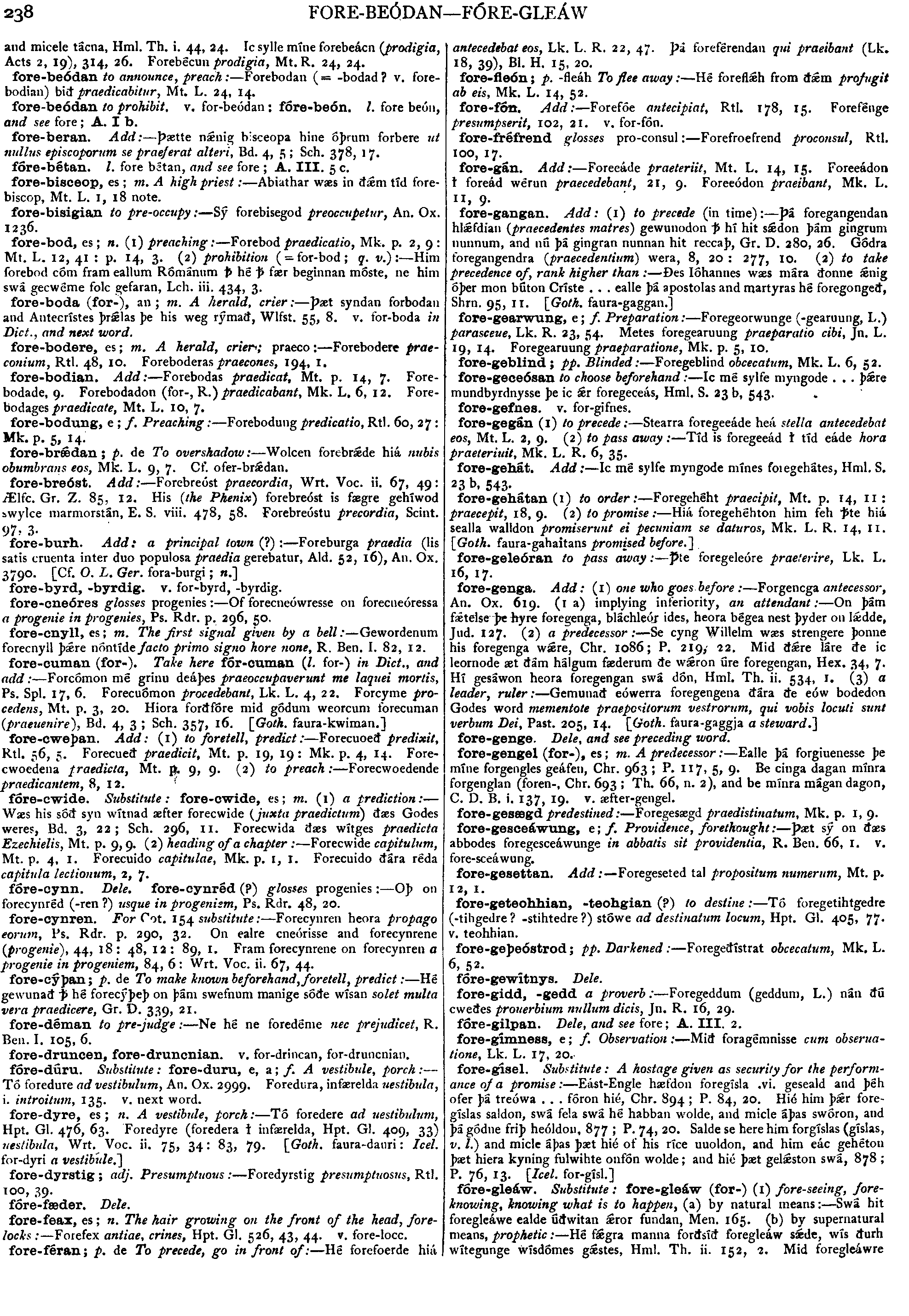
fóre-cwide. Substitute: fore-cwide, es; m. (1) a prediction:--Wæs his sóð syn wítnad æfter forecwide (juxta praedictum) ðæs Godes weres, Bd. 3, 22; Sch. 296, 11. Forecwida ðæs wítges praedicta Ezechielis, Mt. p. 9, 9. (2) heading of a chapter:--Forecwide capitulum, Mt. p. 4, 1. Forecuido capitulae, Mk. p. 1, 1. Forecuido ðára réda capitula lectionum, 2, 7.
|
Source: Bosworth/Toller, page d0238, entry 46 View original page image as: [TIFF] [PNG] [View previous entry] [View next entry] |
[Comment on this entry] [View comments] |
The following entry has been hand-corrected once. |
fore-genga.
Add:
(1)
one
who
goes
before:--Forgencga
antecessor,
An.
Ox.
619.
(1
a)
implying
inferiority,
an
attendant:--On
þám
ftelse
þe
hyre
foregenga,
bláchleór
ides,
heora
bégea
nest
þyder
on
ldde,
Jud.
127.
(2)
a
predecessor:--Se
cyng
Willelm
wæs
strengere
þonne
his
foregenga
wre,
Chr.
1086;
P.
219,
22.
Mid
ðre
láre
ðe
ic
leornode
æt
ðám
hálgum
fæderum
ðe
wron
úre
foregengan,
Hex.
34,
7.
Hí
gesáwon
heora
foregengan
swá
dón,
Hml.
Th.
ii.
534,
1.
(3)
a
leader,
ruler:--Gemunað
eówerra
foregengena
ðára
ðe
eów
bodedon
Godes
word
mementote
praepositorum
vestrorum,
qui
vobis
locuti
sunt
verbum
Dei,
Past.
205,
14.
[Goth.
faura-gaggja
a
steward.]
|
Source: Bosworth/Toller, page d0239, entry 12 View original page image as: [TIFF] [PNG] [View previous entry] [View next entry] |
[Comment on this entry] [View comments] |
The following entry has been hand-corrected once. |
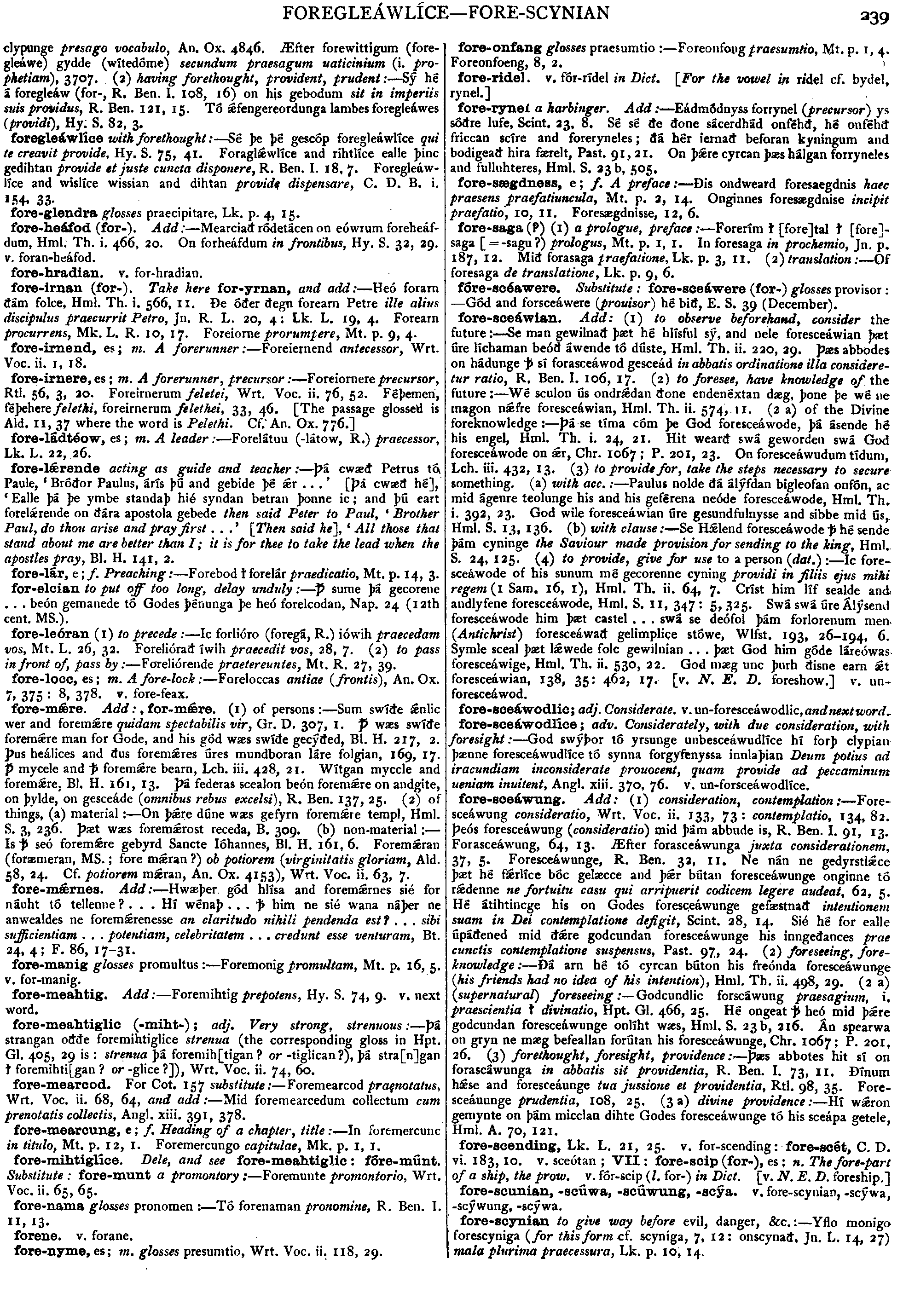
for-elcian to put off too long, delay unduly:--Þ-bar; sume þá gecorene . . . beón gemanede tó Godes þénunga þe heó forelcodan, Nap. 24 (12th cent. MS.).
|
Source: Bosworth/Toller, page d0239, entry 35 View original page image as: [TIFF] [PNG] [View previous entry] [View next entry] |
[Comment on this entry] [View comments] |
The following entry has been hand-corrected once. |
fore-sceáwung.
Add:
(1)
consideration,
contemplation:--Foresceáwung
consideratio,
Wrt.
Voc.
ii.
133,
73:
contemplatio,
134,
82.
Þeós
foresceáwung
(consideratio)
mid
þám
abbude
is,
R.
Ben.
I.
91,
13.
Forasceáwung,
64,
13.
Æfter
forasceáwunga
juxta
considerationem,
37,
5.
Foresceáwunge,
R.
Ben.
32,
11.
Ne
nán
ne
gedyrstlce
þæt
hé
frlíce
bóc
gelæcce
and
þr
bútan
foresceáwunge
onginne
tó
rdenne
ne
fortuitu
casu
qui
arripuerit
codicem
legere
audeat,
62,
5.
Hé
átihtincge
his
on
Godes
foresceáwunge
gefæstnað
intentionem
suam
in
Dei
contemplatione
defigit,
Scint.
28,
14.
Sié
hé
for
ealle
úpáðened
mid
ðre
godcundan
foresceáwunge
his
inngeðances
prae
cunctis
contemplatione
suspensus,
Past.
97,
24.
(2)
foreseeing,
foreknowledge:--Ðá
arn
hé
tó
cyrcan
búton
his
freónda
foresceáwunge
(his
friends
had
no
idea
of
his
intention),
Hml.
Th.
ii.
498,
29.
(2
a)
(supernatural)
foreseeing:--Godcundlic
forscáwung
praesagium,
i.
praescientia
divinatio,
Hpt.
Gl.
466,
25.
Hé
ongeat
heó
mid
þre
godcundan
foresceáwunge
onlíht
wæs,
Hml.
S.
23
b,
216.
Án
spearwa
on
gryn
ne
mæg
befeallan
forútan
his
foresceáwunge,
Chr.
1067;
P.
201,
26.
(3)
forethought,
foresight,
providence:--Þæs
abbotes
hit
sí
on
forascáwunga
in
abbatis
sit
providentia,
R.
Ben.
I.
73,
11.
Ðínum
hse
and
foresceáunge
tua
jussione
et
providentia,
Rtl.
98,
35.
Foresceáuunge
prudentia,
108,
25.
(3
a)
divine
providence:--Hí
wron
gemynte
on
þám
micclan
dihte
Godes
foresceáwunge
tó
his
sceápa
getele,
Hml.
A.
70,
121.
|
Source: Bosworth/Toller, page d0240, entry 26 View original page image as: [TIFF] [PNG] [View previous entry] [View next entry] |
[Comment on this entry] [View comments] |
The following entry has been hand-corrected once. |
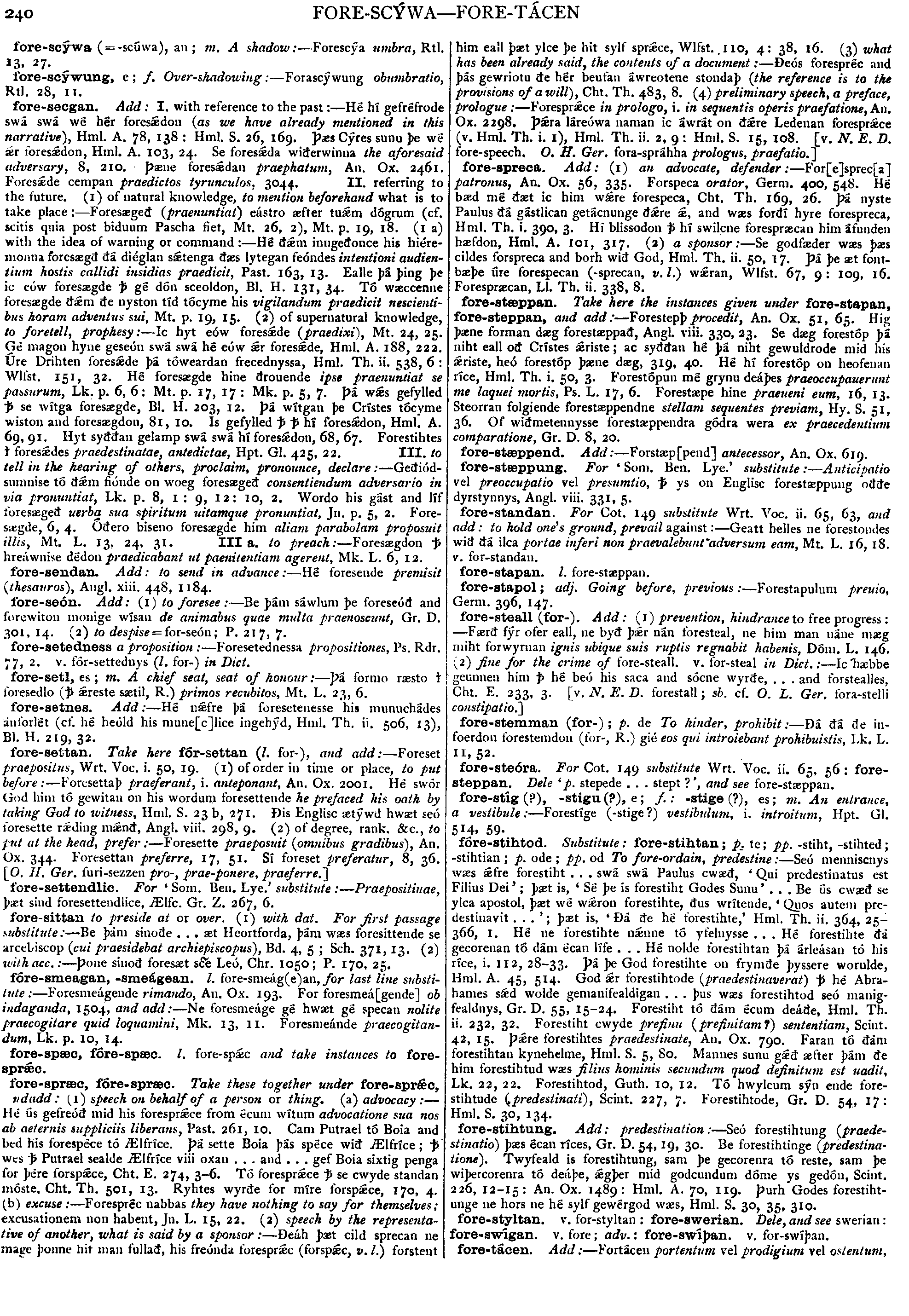
fóre-stihtod.
Substitute:
fore-stihtan;
p.
te;
pp.
-stiht,
-stihted;
-stihtian;
p.
ode;
pp.
od
To
fore-ordain,
predestine:--Seó
menniscnys
wæs
fre
forestiht
.
.
.
swá
swá
Paulus
cwæð,
'Qui
predestinatus
est
Filius
Dei';
þæt
is,
'Sé
þe
is
forestiht
Godes
Sunu'
.
.
.
Be
ús
cwæð
se
ylca
apostol,
þæt
wé
wron
forestihte,
ðus
wrítende,
'Quos
autem
predestinavit
.
.
.';
þæt
is,
'Ðá
ðe
hé
forestihte,'
Hml.
Th.
ii.
364,
25-366,
1.
Hé
ne
forestihte
nnne
tó
yfelnysse
.
.
.
Hé
forestihte
ðá
gecorenan
tó
dám
écan
lífe
.
.
.
Hé
nolde
forestihtan
þá
árleásan
tó
his
ríce,
i.
112,
28-33.
Þá
þe
God
forestihte
on
frymðe
þyssere
worulde,
Hml.
A.
45,
514.
God
r
forestihtode
(praedestinaverat)
hé
Abrahames
sd
wolde
gemanifealdigan
.
.
.
þus
wæs
forestihtod
seó
manigfealdnys,
Gr.
D.
55,
15-24.
Forestiht
tó
ðám
écum
deáðe,
Hml.
Th.
ii.
232,
32.
Forestiht
cwyde
prefinu
(prefinitam?)
sententiam,
Scint.
42,
15.
Þre
forestihtes
praedestinate,
An.
Ox.
790.
Faran
tó
ðám
forestihtan
kynehelme,
Hml.
S.
5,
80.
Mannes
sunu
gð
æfter
þám
ðe
him
forestihtud
wæs
filius
hominis
secundum
quod
definitum
est
uadit,
Lk.
22,
22.
Forestihtod,
Guth.
10,
12.
Tó
hwylcum
sýn
ende
forestihtude
(predestinati),
Scint.
227,
7.
Forestihtode,
Gr.
D.
54,
17:
Hml.
S.
30,
134.
|
Source: Bosworth/Toller, page d0240, entry 27 View original page image as: [TIFF] [PNG] [View previous entry] [View next entry] |
[Comment on this entry] [View comments] |
The following entry has been hand-corrected once. |
fore-stihtung.
Add:
predestination:--Seó
forestihtung
(praedestinatio)
þæs
écan
ríces,
Gr.
D.
54,
19,
30.
Be
forestihtinge
(predestinatione).
Twyfeald
is
forestihtung,
sam
þe
gecorenra
tó
reste,
sam
þe
wiþercorenra
tó
deáþe,
gþer
mid
godcundum
dóme
ys
gedón,
Scint.
226,
12-15:
An.
Ox.
1489:
Hml.
A.
70,
119.
Þurh
Godes
forestihtunge
ne
hors
ne
hé
sylf
gewérgod
wæs,
Hml.
S.
30,
35,
310.
|
Source: Bosworth/Toller, page d0242, entry 7 View original page image as: [TIFF] [PNG] [View previous entry] [View next entry] |
[Comment on this entry] [View comments] |
The following entry has been hand-corrected once. |
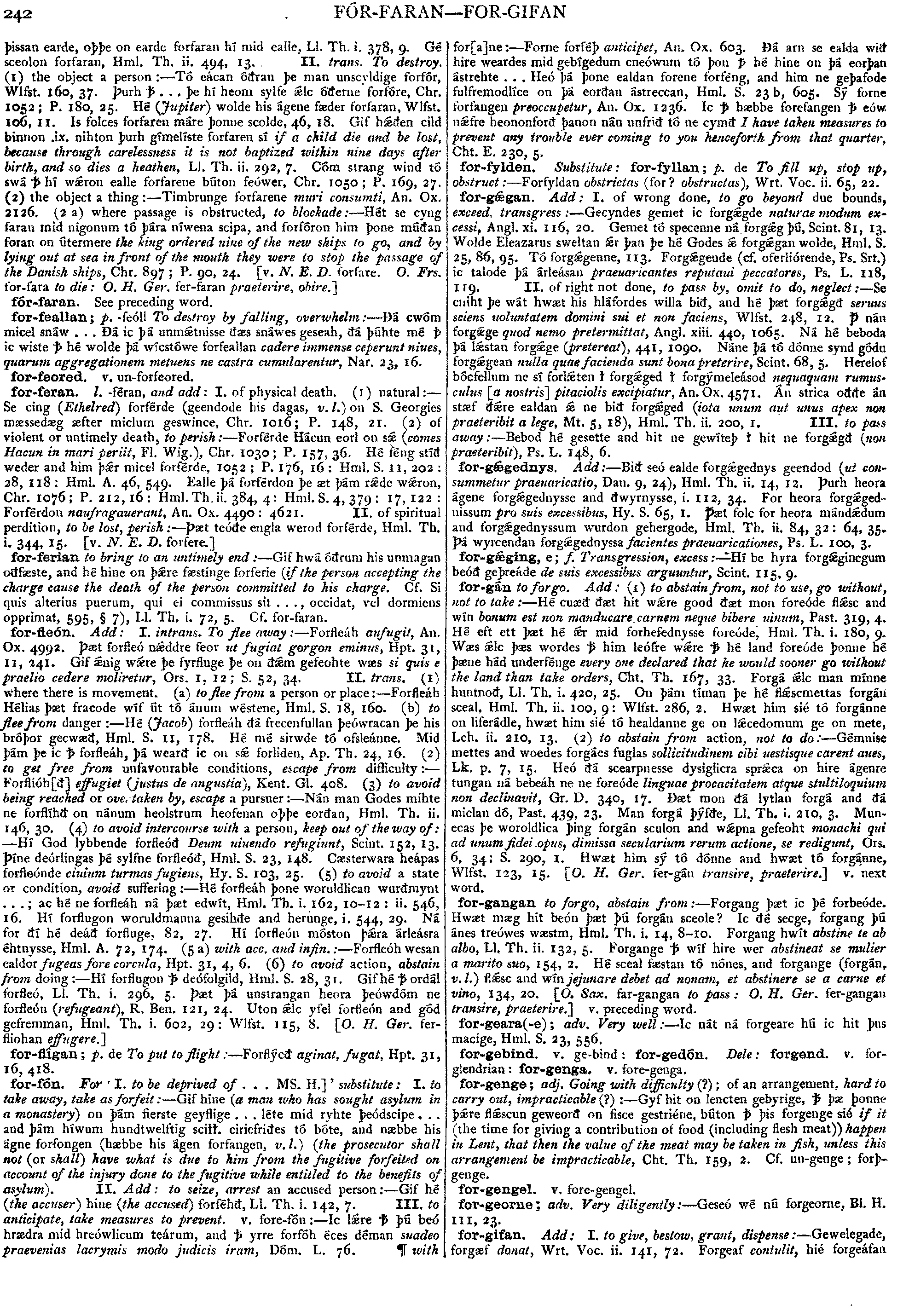
for-fleón.
Add:
I.
intrans.
To
flee
away:--Forfleáh
aufugit,
An.
Ox.
4992.
Þæt
forfleó
nddre
feor
ut
fugiat
gorgon
eminus,
Hpt.
31,
11,
241.
Gif
nig
wre
þe
fyrfluge
þe
on
ðm
gefeohte
wæs
si
quis
e
praelio
cedere
moliretur,
Ors.
1,
12;
S.
52,
34.
II.
trans.
(1)
where
there
is
movement.
(a)
to
flee
from
a
person
or
place:--Forfleáh
Hélias
þæt
fracode
wíf
út
tó
ánum
wéstene,
Hml.
S.
18,
160.
(b)
to
flee
from
danger:--Hé
(Jacob)
forfleáh
ðá
frecenfullan
þeówracan
þe
his
bróþor
gecwæð,
Hml.
S.
11,
178.
Hé
mé
sirwde
tó
ofsleánne.
Mid
þám
þe
ic
forfleáh,
þá
wearð
ic
on
s
forliden,
Ap.
Th.
24,
16.
(2)
to
get
free
from
unfavourable
conditions,
escape
from
difficulty:--Forflióh[ð]
effugiet
(justus
de
angustia),
Kent.
Gl.
408.
(3)
to
avoid
being
reached
or
overtaken
by,
escape
a
pursuer:--Nán
man
Godes
mihte
ne
forflíhð
on
nánum
heolstrum
heofenan
oþþe
eorðan,
Hml.
Th.
ii.
146,
30.
(4)
to
avoid
intercourse
with
a
person,
keep
out
of
the
way
of:--Hí
God
lybbende
forfleóð
Deum
uiuendo
refugiunt,
Scint.
152,
13.
Þíne
deórlingas
þé
sylfne
forfleóð,
Hml.
S.
23,
148.
Cæsterwara
heápas
forfleónde
ciuium
turmas
fugiens,
Hy.
S.
103,
25.
(5)
to
avoid
a
state
or
condition,
avoid
suffering:--Hé
forfleáh
þone
woruldlican
wurðmynt
.
.
.;
ac
hé
ne
forfleáh
ná
þæt
edwít,
Hml.
Th.
i.
162,
10-12:
ii.
546,
16.
Hí
forflugon
woruldmanna
gesihðe
and
herunge,
i.
544,
29.
Ná
for
ðí
hé
deáð
forfluge,
82,
27.
Hí
forfleón
móston
þra
árleásra
éhtnysse,
Hml.
A.
72,
174.
(5
a)
with
acc.
And
infin.:--Forfleóh
wesan
ealdor
fugeas
fore
corcula,
Hpt.
31,
4,
6.
(6)
to
avoid
action,
abstain
from
doing:--Hí
forflugon
deófolgild,
Hml.
S.
28,
31.
Gif
hé
ordál
forfleó,
Ll.
Th.
i.
296,
5.
Þæt
þá
unstrangan
heora
þeówdóm
ne
forfleón
(refugeant),
R.
Ben.
121,
24.
Uton
lc
yfel
forfleón
and
gód
gefremman,
Hml.
Th.
i.
602,
29:
Wlfst.
115,
8.
[O.
H.
Ger.
fer fliohan
effugere.]
fliohan
effugere.]
|
Source: Bosworth/Toller, page d0242, entry 11 View original page image as: [TIFF] [PNG] [View previous entry] [View next entry] |
[Comment on this entry] [View comments] |
The following entry has been hand-corrected once. |
for-ggan.
Add:
I.
of
wrong
done,
to
go
beyond
due
bounds,
exceed,
transgress:--Gecyndes
gemet
ic
forggde
naturae
modum
excessi,
Angl.
xi.
116,
20.
Gemet
tó
specenne
ná
forgg
þú,
Scint.
81,
13.
Wolde
Eleazarus
sweltan
r
þan
þe
hé
Godes
forggan
wolde,
Hml.
S.
25,
86,
95.
Tó
forggenne,
113.
Forggende
(cf.
oferliórende,
Ps.
Srt.)
ic
talode
þá
árleásan
praeuaricantes
reputaui
peccatores,
Ps.
L.
118,
119.
II.
of
right
not
done,
to
pass
by,
omit
to
do,
neglect:--Se
cniht
þe
wát
hwæt
his
hláfordes
willa
bið,
and
hé
þæt
forggð
seruus
sciens
uoluntatem
domini
sui
et
non
faciens,
Wlfst.
248,
12.
Þ-bar;
nán
forgge
quod
nemo
pretermittat,
Angl.
xiii.
440,
1065.
Ná
hé
beboda
þá
lstan
forgge
(pretereat),
441,
1090.
Náne
þá
tó
dónne
synd
gódu
forggean
nulla
quae
facienda
sunt
bona
preterire,
Scint.
68,
5.
Herelof
bócfellum
ne
sí
forlten
forgged
forgýmeleásod
nequaquam
rumusculus
[a
nostris]
pitaciolis
excipiatur,
An.
Ox.
4571.
Án
strica
oððe
án
stæf
ðre
ealdan
ne
bið
forgged
(iota
ununt
aut
unus
apex
non
praeteribit
a
lege,
Mt.
5,
18),
Hml.
Th.
ii.
200,
1.
III.
to
pass
away:--Bebod
hé
gesette
and
hit
ne
gewíteþ
hit
ne
forggð
(non
praeteribit),
Ps.
L.
148,
6.
| Result Page: |  |
Previous | 115 116 117 118 119 120 121 122 123 124 125 126 127 128 129 130 131 132 133 | Next |  |
Germanic Lexicon Project (main page)
This search system was written by
Sean Crist
Please consider
volunteering
to correct the data in these online dictionaries.
No rights reserved. Feel free to use these data in any way you please.