|
|

|
Source: Cleasby/Vigfusson, page b0206, entry 49 View original page image as: [TIFF] [PNG] [View previous entry] [View next entry] |
[Comment on this entry] [View comments] |
The following entry has been hand-corrected once. |
gnat, n. a clash (of weapons), Höfuðl.; the Engl. gnat is so called from the sound of its wings.
|
Source: Torp, page b0137, entry 9 View original page image as: [TIFF] [PNG] [View previous entry] [View next entry] |
[Comment on this entry] [View comments] |
The following entry has been hand-corrected once. |
gnatta
m.
kleine
Mücke
u.
ä.
ags.
gnæt
m.
kleine
Mücke
(engl.
gnat),
nd.
gnatte
dass.;
schwed.
mundartl.
gnatt
Stäubchen,
Atom
(daneben
mit
kn-
norw.
und
schwed.
mundartl.
knott
(an.
*kn ttr)
kleine
Mücke,
kleiner
Gegenstand).
Vgl.
mnd.
gnitte
kleine
Mücke
(zur
Grundwurzel
gni-).
Die
Grundbedeutung
der
Wz.
»kratzen,
zerreiben«.
Hierzu
auch
an.
gntra
(und
ntra)
klappern,
offies.
gnatern.
gnätern
murren,
engl.
mundartl.
gnatter
dass.,
schwed.
mundartl.
gnatig
mürrisch.
Daneben
Formen
mid
ttr)
kleine
Mücke,
kleiner
Gegenstand).
Vgl.
mnd.
gnitte
kleine
Mücke
(zur
Grundwurzel
gni-).
Die
Grundbedeutung
der
Wz.
»kratzen,
zerreiben«.
Hierzu
auch
an.
gntra
(und
ntra)
klappern,
offies.
gnatern.
gnätern
murren,
engl.
mundartl.
gnatter
dass.,
schwed.
mundartl.
gnatig
mürrisch.
Daneben
Formen
mid
 ).
Vgl.
gnag.
).
Vgl.
gnag.
[Translate the German words]
|
Source: Bosworth/Toller, page b0061, entry 25 View original page image as: [TIFF] [PNG] [View previous entry] [View next entry] |
[Comment on this entry] [View comments] |
The following entry has been hand-corrected once. |
a-weg; adv. AWAY, out; (this is its meaning both in and out of composition) ; auferendi vim habet :-- Ðá éode he aweg autem abiit, Mt. Bos. 19, 22. Ge drehnigeaþ ðone gnæt aweg ye strain the gnat out; excolantes [ex out, colare to filter, strain] culicem, Mt. Bos. 23, 24. He hí raðe aweg aþýwde he quickly drove them away, Ors. 6, 36; Bos. 131, 28 : Ps. Th. 77, 57. v. on-weg.
|
Source: Bosworth/Toller, page b0481, entry 50 View original page image as: [TIFF] [PNG] [View previous entry] [View next entry] |
[Comment on this entry] [View comments] |
The following entry has been hand-corrected once. |
GNÆT,
gnætt;
gen.
gnættes;
m.
GNAT;
culex
:--
Gedrehnigeaþ
ðone
gnæt
aweg
ye
strain
out
the
gnat,
Mt.
Bos.
23,
24.
Com
hundes
fleógan
and
gnættas
venit
cænomyia
et
cinipes,
Ps.
Spl.
104,
29.
Aaron
slóh
mid
ðære
girde
on
ða
eorþan,
and
gnættas
w ron
gewordene
on
mannum
and
on
yrfe;
and
ealle
ðære
eorþan
dust
wæs
gewurden
to
gnættum
ofer
eall
Egipta
land
Aaron
percussit
pulverem
terræ,
et
facti
sunt
sciniphes
[gnats]
in
hominibus,
et
in
jumentis;
omnis
pulvis
terræ
versus
est
in
sciniphes
per
totam
terram
Ægypti,
Ex.
8,
17,
16:
Ps.
Th
104,
27.
Gnættas
cómon
ofer
eall
ðæt
land
gnats
came
over
all
the
land,
Or.
1,
7;
Bos.
29,
29.
ron
gewordene
on
mannum
and
on
yrfe;
and
ealle
ðære
eorþan
dust
wæs
gewurden
to
gnættum
ofer
eall
Egipta
land
Aaron
percussit
pulverem
terræ,
et
facti
sunt
sciniphes
[gnats]
in
hominibus,
et
in
jumentis;
omnis
pulvis
terræ
versus
est
in
sciniphes
per
totam
terram
Ægypti,
Ex.
8,
17,
16:
Ps.
Th
104,
27.
Gnættas
cómon
ofer
eall
ðæt
land
gnats
came
over
all
the
land,
Or.
1,
7;
Bos.
29,
29.
|
Source: Bosworth/Toller, page b0930, entry 23 View original page image as: [TIFF] [PNG] [View previous entry] [View next entry] |
[Comment on this entry] [View comments] |
The following entry has been hand-corrected once. |
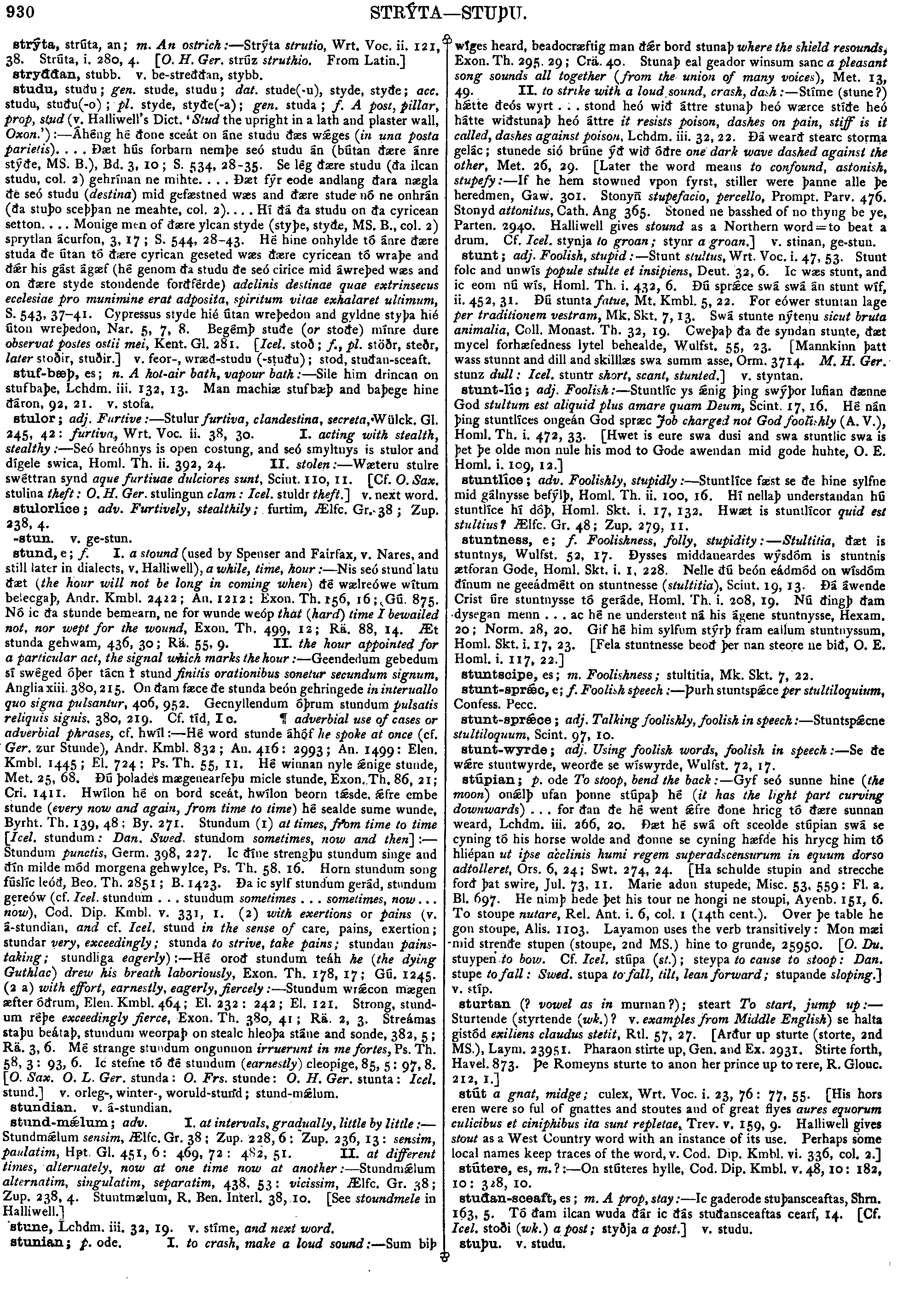
stút a gnat, midge; culex. Wrt. Voc. i. 23, 76: 77, 55. [His hors eren were so ful of gnattes and stoutes and of great flyes aures equorum culicibus et ciniphibus ita sunt repletae, Trev. v. 159, 9. Hailiwell gives stout as a West Country word with an instance of its use. Perhaps some local names keep traces of the word, v. Cod. Dip. Kmbl. vi. 336, col. 2.]
|
Source: Cleasby/Vigfusson, page b0162, entry 11 View original page image as: [TIFF] [PNG] [View previous entry] [View next entry] |
[Comment on this entry] [View comments] |
The following entry has been hand-corrected once. |
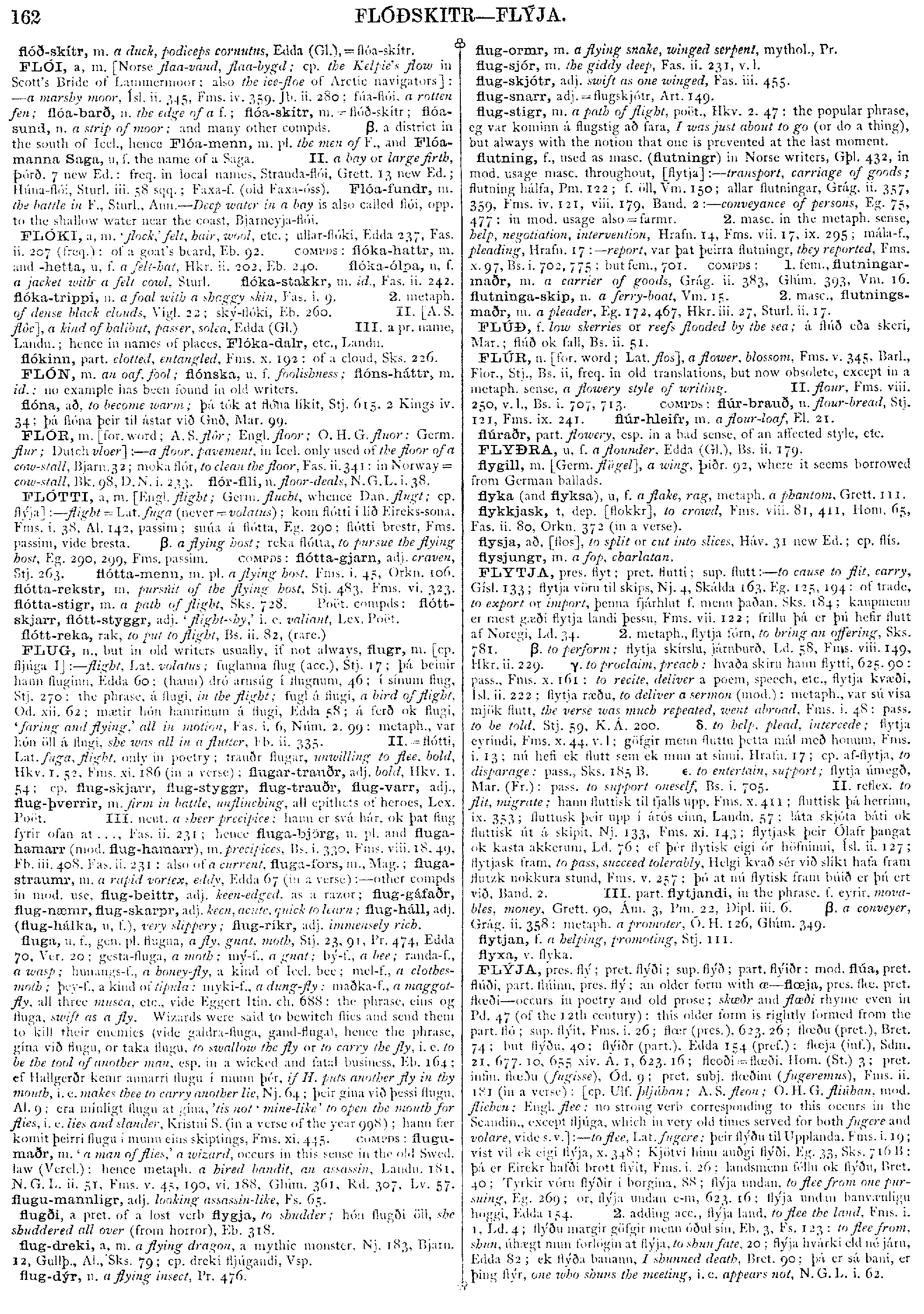
fluga, u. f., gen. pl. flugna, a fly, gnat, moth, Stj. 23, 91, Pr. 474, Edda 70, Ver. 20; gesta-fluga, a moth; mý-f., a gnat; bý-f., a bee; randa-f., a wasp; hunangs-f., a honey-fly, a kind of Icel. bee; mel-f., a clothes-moth; þev-f., a kind of tipula: myki-f., a dung-fly: maðka-f., a maggot-fly, all three musca, etc., vide Eggert Itin. ch. 688: the phrase, eins og fluga, swift as a fly. Wizards were said to bewitch flies and send them to kill their enemies (vide galdra-fluga, gand-fluga), hence the phrase, gína við flugu, or taka flugu, to swallow the fly or to carry the fly, i.e. to be the tool of another man, esp. in a wicked and fatal business, Eb. 164; ef Hallgerðr kemr annarri flugu í munn þér, if H. puts another fly in thy mouth, i.e. makes thee to carry another lie, Nj. 64; þeir gina við þessi flugu, Al. 9; era mínligt flugu at gína, 'tis not 'mine-like' to open the mouth for flies, i.e. lies and slander, Kristni S. (in a verse of the year 998); hann fær komit þeirri flugu í munn eins skiptings, Fms. xi. 445. COMPDS: flugu-maðr, m. 'a man of flies,' a wizard, occurs in this sense in the old Swed. law (Verel.): hence metaph. a hired bandit, an assassin, Landn. 181, N. G. L. ii. 51, Fms. v. 45, 190, vi. 188, Glúm. 361, Rd. 307, Lv. 57. flugu-mannligr, adj. looking assassin-like, Fs. 65.
|
Source: Cleasby/Vigfusson, page b0186, entry 2 View original page image as: [TIFF] [PNG] [View previous entry] [View next entry] |
[Comment on this entry] [View comments] |
The following entry has been hand-corrected once. |
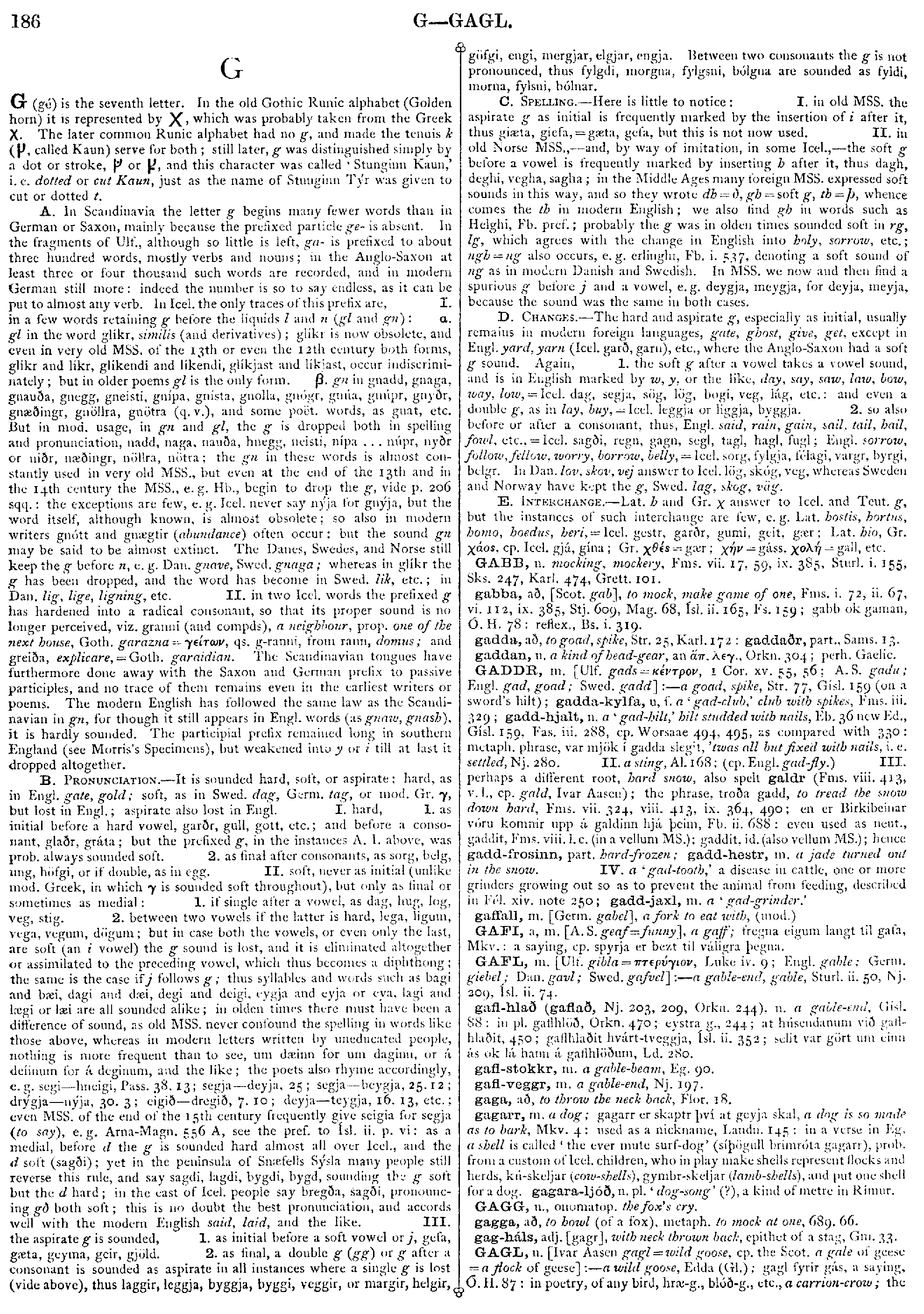
A.
In
Scandinavia
the
letter
g
begins
many
fewer
words
than
in
German
or
Saxon,
mainly
because
the
prefixed
particle
ge-
is
absent.
In
the
fragments
of
Ulf.,
although
so
little
is
left,
ga-
is
prefixed
to
about
three
hundred
words,
mostly
verbs
and
nouns;
in
the
Anglo-Saxon
at
least
three
or
four
thousand
such
words
are
recorded,
and
in
modern
German
still
more:
indeed
the
number
is
so
to
say
endless,
as
it
can
be
put
to
almost
any
verb.
In
Icel.
the
only
traces
of
this
prefix
are,
I.
in
a
few
words
retaining
g
before
the
liquids
l
and
n
(gl
and
gn):
 .
gl
in
the
word
glíkr,
similis
(and
derivatives);
glíkr
is
now
obsolete,
and
even
in
very
old
MSS.
of
the
13th
or
even
the
12th
century
both
forms,
glíkr
and
líkr,
glíkendi
and
líkendi,
glíkjast
and
líkjast,
occur
indiscriminately;
but
in
older
poems
gl
is
the
only
form.
.
gl
in
the
word
glíkr,
similis
(and
derivatives);
glíkr
is
now
obsolete,
and
even
in
very
old
MSS.
of
the
13th
or
even
the
12th
century
both
forms,
glíkr
and
líkr,
glíkendi
and
líkendi,
glíkjast
and
líkjast,
occur
indiscriminately;
but
in
older
poems
gl
is
the
only
form.
 .
gn
in
gnadd,
gnaga,
gnauða,
gnegg,
gneisti,
gnípa,
gnísta,
gnolla,
gnógr,
gnúa,
gnúpr,
gnyðr,
gnæðingr,
gnöllra,
gnötra
(q.v.),
and
some
poët.
words,
as
gnat,
etc.
But
in
mod.
usage,
in
gn
and
gl,
the
g
is
dropped
both
in
spelling
and
pronunciation,
nadd,
naga,
nauða,
hnegg,
neisti,
nípa
...
núpr,
nyðr
or
niðr,
næðingr,
nöllra,
nötra;
the
gn
in
these
words
is
almost
constantly
used
in
very
old
MSS.,
but
even
at
the
end
of
the
13th
and
in
the
14th
century
the
MSS.,
e.g.
Hb.,
begin
to
drop
the
g,
vide
p.
206
sqq.:
the
exceptions
are
few,
e.g.
Icel.
never
say
nýja
tor
gnýja,
but
the
word
itself,
although
known,
is
almost
obsolete:
so
also
in
modern
writers
gnótt
and
gnægtir
(abundance)
often
occur:
but
the
sound
gn
may
be
said
to
be
almost
extinct.
The
Danes,
Swedes,
and
Norse
still
keep
the
g
before
n,
e.g.
Dan.
gnave,
Swed.
gnaga;
whereas
in
glíkr
the
g
has
been
dropped,
and
the
word
has
become
in
Swed.
lik,
etc.;
in
Dan.
lig,
lige,
ligning,
etc.
II.
in
two
Icel.
words
the
prefixed
g
has
hardened
into
a
radical
consonant,
so
that
its
proper
sound
is
no
longer
perceived,
viz.
granni
(and
compds),
a
neighbour,
prop.
one
of
the
next
house,
Goth.
garazna
=
GREEK,
qs.
g-ranni,
from
rann,
domus;
and
greiða,
explicare,
=
Goth.
garaidian.
The
Scandinavian
tongues
have
furthermore
done
away
with
the
Saxon
and
German
prefix
to
passive
participles,
and
no
trace
of
them
remains
even
in
the
earliest
writers
or
poems.
The
modern
English
has
followed
the
same
law
as
the
Scandinavian
in
gn,
for
though
it
still
appears
in
Engl.
words
(as
gnaw,
gnash),
it
is
hardly
sounded.
The
participial
prefix
remained
long
in
southern
England
(see
Morris's
Specimens),
but
weakened
into
y
or
i
till
at
last
it
dropped
altogether.
.
gn
in
gnadd,
gnaga,
gnauða,
gnegg,
gneisti,
gnípa,
gnísta,
gnolla,
gnógr,
gnúa,
gnúpr,
gnyðr,
gnæðingr,
gnöllra,
gnötra
(q.v.),
and
some
poët.
words,
as
gnat,
etc.
But
in
mod.
usage,
in
gn
and
gl,
the
g
is
dropped
both
in
spelling
and
pronunciation,
nadd,
naga,
nauða,
hnegg,
neisti,
nípa
...
núpr,
nyðr
or
niðr,
næðingr,
nöllra,
nötra;
the
gn
in
these
words
is
almost
constantly
used
in
very
old
MSS.,
but
even
at
the
end
of
the
13th
and
in
the
14th
century
the
MSS.,
e.g.
Hb.,
begin
to
drop
the
g,
vide
p.
206
sqq.:
the
exceptions
are
few,
e.g.
Icel.
never
say
nýja
tor
gnýja,
but
the
word
itself,
although
known,
is
almost
obsolete:
so
also
in
modern
writers
gnótt
and
gnægtir
(abundance)
often
occur:
but
the
sound
gn
may
be
said
to
be
almost
extinct.
The
Danes,
Swedes,
and
Norse
still
keep
the
g
before
n,
e.g.
Dan.
gnave,
Swed.
gnaga;
whereas
in
glíkr
the
g
has
been
dropped,
and
the
word
has
become
in
Swed.
lik,
etc.;
in
Dan.
lig,
lige,
ligning,
etc.
II.
in
two
Icel.
words
the
prefixed
g
has
hardened
into
a
radical
consonant,
so
that
its
proper
sound
is
no
longer
perceived,
viz.
granni
(and
compds),
a
neighbour,
prop.
one
of
the
next
house,
Goth.
garazna
=
GREEK,
qs.
g-ranni,
from
rann,
domus;
and
greiða,
explicare,
=
Goth.
garaidian.
The
Scandinavian
tongues
have
furthermore
done
away
with
the
Saxon
and
German
prefix
to
passive
participles,
and
no
trace
of
them
remains
even
in
the
earliest
writers
or
poems.
The
modern
English
has
followed
the
same
law
as
the
Scandinavian
in
gn,
for
though
it
still
appears
in
Engl.
words
(as
gnaw,
gnash),
it
is
hardly
sounded.
The
participial
prefix
remained
long
in
southern
England
(see
Morris's
Specimens),
but
weakened
into
y
or
i
till
at
last
it
dropped
altogether.
|
Source: Cleasby/Vigfusson, page b0207, entry 35 View original page image as: [TIFF] [PNG] [View previous entry] [View next entry] |
[Comment on this entry] [View comments] |
The following entry has been hand-corrected once. |
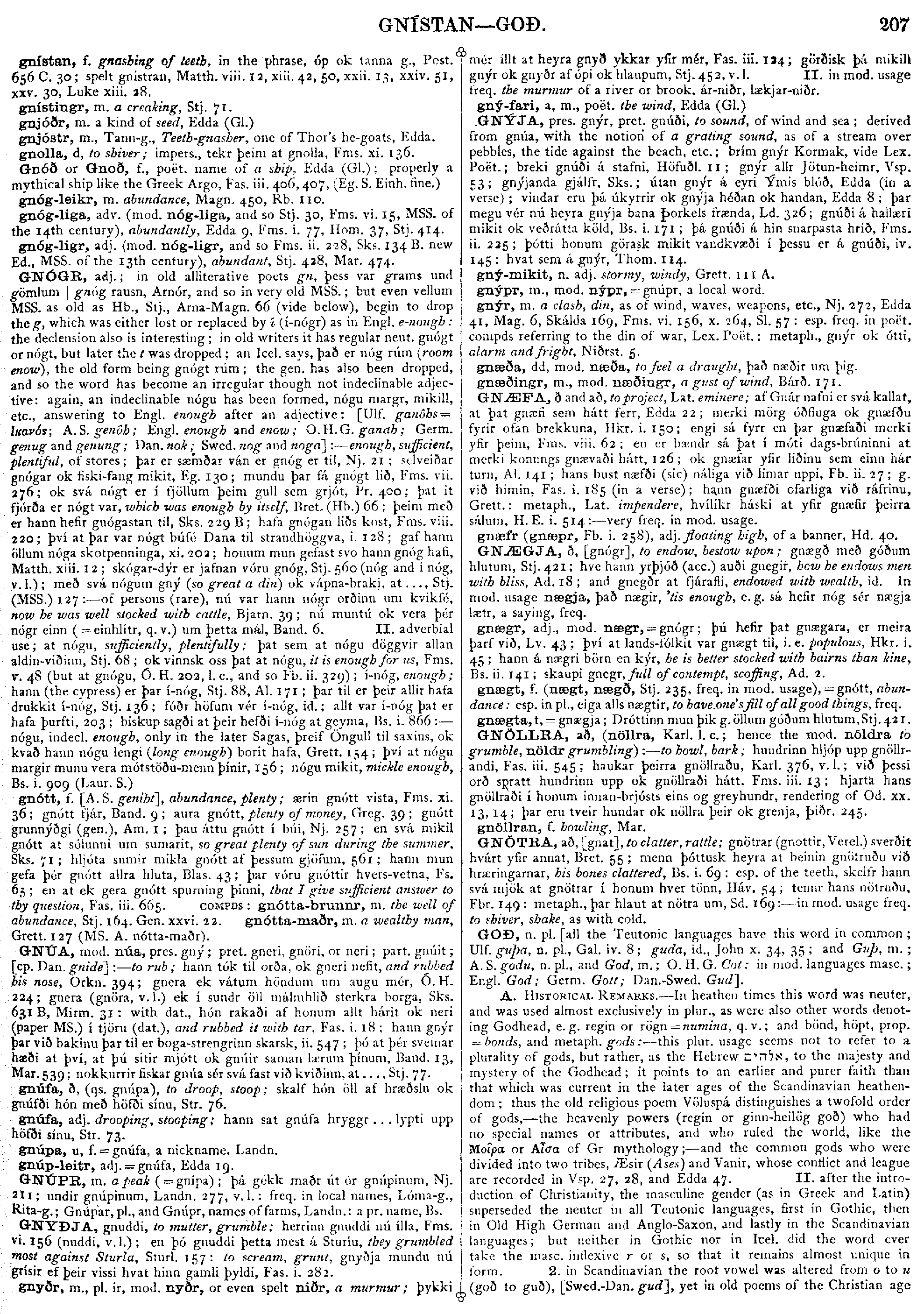
GNÖTRA, að, [gnat], to clatter, rattle; gnötrar (gnottir, Verel.) sverðit hvárt yfir annat, Bret. 55; menn þóttusk heyra at beinin gnötruðu við hræringarnar, his bones clattered, Bs. i. 69: esp. of the teeth, skelfr hann svá mjök at gnötrar í honum hver tönn, Háv. 54; tennr hans nötruðu, Fbr. 149: metaph., þar hlaut at nötra um, Sd. 169 :-- in mod. usage freq. to shiver, shake, as with cold.
|
Source: Cleasby/Vigfusson, page b0441, entry 31 View original page image as: [TIFF] [PNG] [View previous entry] [View next entry] |
[Comment on this entry] [View comments] |
The following entry has not been hand-corrected. However, the page is reserved and someone is correcting it. |
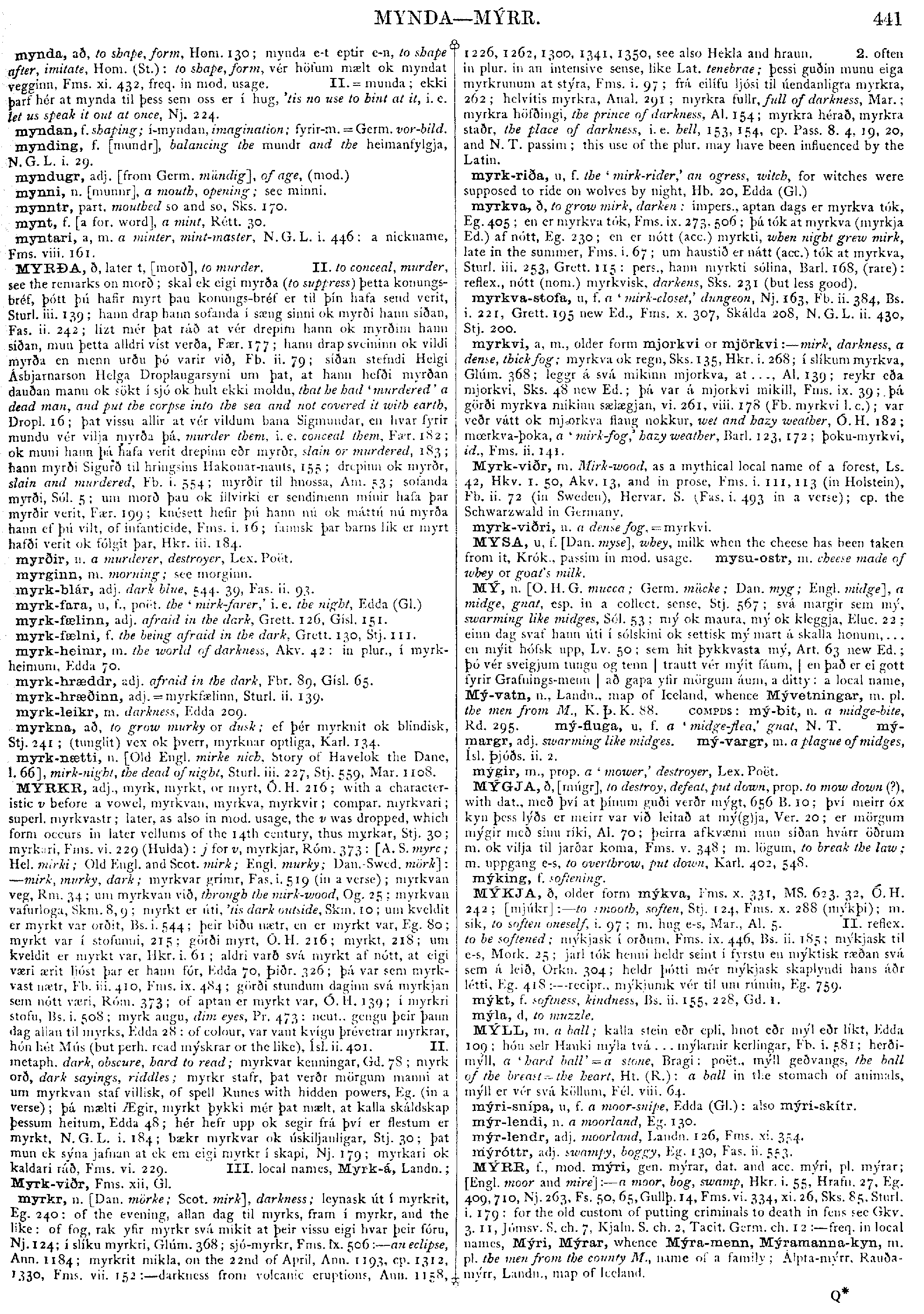
MÝ, n. [O. H. G. mucca; Germ, m'ucke; Dan. myg; Engl. midget, a midge, gnat, esp. in a collect, sense, Stj. 567; sva niargir sem my, swarming like midges. Sol. 53; mý ok maura, my ok kleggja, Eluc. 22: einn dag svaf hann uti í sólskini ok settisk my mart á skalla honum, ... en myit hófsk upp, Lv. 50; sem hit þykkvasta mý, Art. 63 new Ed.; þó vér sveigjum tungu og tenn | trautt vér myit fáum, | en það er ei gott iyrir Grafnings-memi | að gapa ylir nuirgum aurn, a ditty: a local name, My-vatn, n., Landn., map of Iceland, whence Mývetningar, m. pl. the men from M., K. Jj. K. 88. COMPDS: my-bit, n. a midge-bite, Rd. 295. my-fluga, u, f. a ' midge-flea, ' gnat, N. T. mý- margr, adj. sivarming like midges. my-vargr, m. a plague of midges, ísl. þjóðs. ii. 2.
|
Source: Gordon/Taylor, page b0113, entry 1 View original page image as: [TIFF][PNG] [View previous entry] [View next entry] |
[Comment on this entry] [View comments] |
The following entry has been hand-corrected once. |
Vasa
villr
staðar
vefr
darraðar
fyr
grams
glðum
geirvangs
rðum,
þar's
í
blóði
í
brimils
móði
vllr
of
þrumði
und
véum
glumði.
190
Hné
folk
á
fit
við
fleina
hnit.
Orðstir
ofgat
Eiríkr
at
þat.
Fremr
munk
segja,
ef
firar
þegja;
frágum
fleira
til
frama
þeira.
Œxtu
undir
jfra
fundir,
195
brustu
brandar
við
bláar
randar.
Hlam
heinsðul
við
hjalmrðul,
beit
bengrefill
--
þat
vas
blóðrefill.
Frák
at
felli
fyr
fetils
svelli
Óðins
eiki
í
járnleiki.
200
Vas
odda
at
ok
eggja
gnat.
Orðstir
ofgat
Eirikr
at
þat.
Rauð
hilmir
hjr,
þar
vas
hrafna
gjr,
fleinn
sótti
fjr,
flugu
dreyrug
spjr.
Ól
flagðs
gota
fárbjóðr
Skota,
205
trað
nipt
Nara
náttverð
ara.
Flugu
hjaldrtranar
á
hræs
lanar,
várut
blóðs
vanar
benmás
granar,
sleit
und
freki,
en
oddbreki
gnúði
hrafni
á
hfuðstafni.
210
Kom
gráðar
læ
at
Gjalpar
skæ.
Bauð
ulfum
hræ
Eiríkr
of
sæ.
Lætr
snót
saka
sverð-Freyr
vaka,
en
skers
Haka
skíðgarð
braka;
brustu
broddar,
en
bitu
oddar,
215
báru
hrvar
af
bogum
rvar.
Germanic Lexicon Project (main page)
This search system was written by
Sean Crist
Please consider
volunteering
to correct the data in these online dictionaries.
No rights reserved. Feel free to use these data in any way you please.