|
|

|
Source: Bosworth/Toller, page b0465, entry 8 View original page image as: [TIFF] [PNG] [View previous entry] [View next entry] |
[Comment on this entry] [View comments] |
The following entry has been hand-corrected once. |
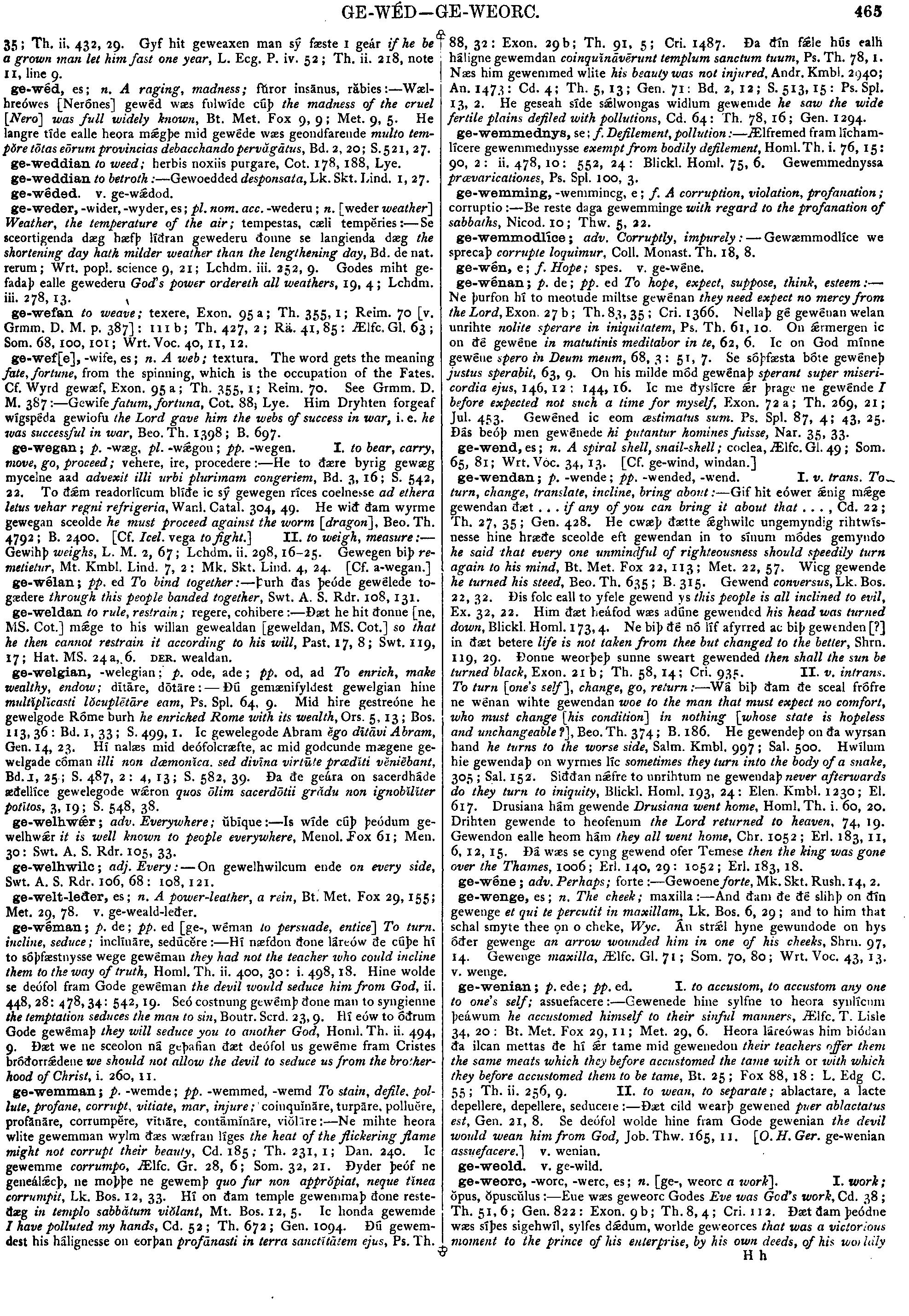
ge-wegan;
p.
-wæg,
pl.
-w gon;
pp.
-wegen.
I.
to
bear,
carry,
move,
go,
proceed;
vehere,
ire,
procedere
:--
He
to
ðære
byrig
gewæg
mycelne
aad
advexit
illi
urbi
plurimam
congeriem,
Bd.
3,
16;
S.
542,
22.
To
ðm
readorlícum
blíðe
ic
sý
gewegen
ríces
coelnesse
ad
ethera
letus
vehar
regni
refrigeria,
Wanl.
Catal.
304,
49.
He
wið
ðam
wyrme
gewegan
sceolde
he
must
proceed
against
the
worm
[dragon],
Beo.
Th.
4792;
B.
2400.
[Cf.
Icel.
vega
to
fight.]
II.
to
weigh,
measure
:--
Gewihþ
weighs,
L.
M.
2,
67;
Lchdm.
ii.
298,
16-25.
Gewegen
biþ
remetietur,
Mt.
Kmbl.
Lind.
7,
2:
Mk.
Skt.
Lind.
4,
24.
[Cf.
a-wegan.]
gon;
pp.
-wegen.
I.
to
bear,
carry,
move,
go,
proceed;
vehere,
ire,
procedere
:--
He
to
ðære
byrig
gewæg
mycelne
aad
advexit
illi
urbi
plurimam
congeriem,
Bd.
3,
16;
S.
542,
22.
To
ðm
readorlícum
blíðe
ic
sý
gewegen
ríces
coelnesse
ad
ethera
letus
vehar
regni
refrigeria,
Wanl.
Catal.
304,
49.
He
wið
ðam
wyrme
gewegan
sceolde
he
must
proceed
against
the
worm
[dragon],
Beo.
Th.
4792;
B.
2400.
[Cf.
Icel.
vega
to
fight.]
II.
to
weigh,
measure
:--
Gewihþ
weighs,
L.
M.
2,
67;
Lchdm.
ii.
298,
16-25.
Gewegen
biþ
remetietur,
Mt.
Kmbl.
Lind.
7,
2:
Mk.
Skt.
Lind.
4,
24.
[Cf.
a-wegan.]
|
Source: Bosworth/Toller, page b1248, entry 1 View original page image as: [TIFF] [PNG] [View previous entry] [View next entry] |
[Comment on this entry] [View comments] |
The following entry has been hand-corrected once. |
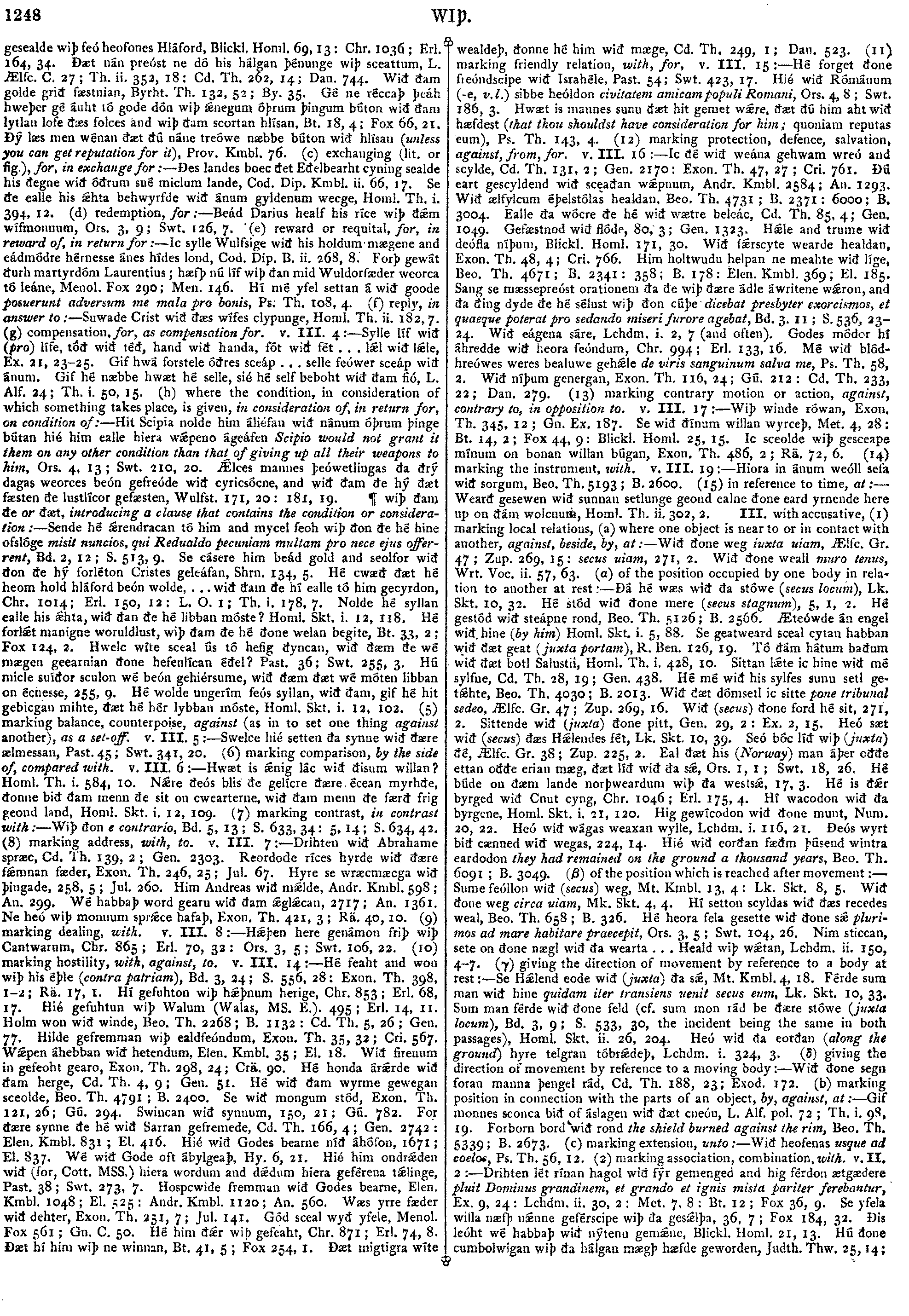
gesealde
wiþ
feó
heofones
Hláford,
Blickl.
Homl.
69,
13:
Chr.
1036
;
Erl.
164,
34.
Ðæt
nán
preóst
ne
dó
his
hálgan
þénunge
wiþ
sceattum,
L.
Ælfc.
C.
27
;
Th.
ii.
352,
18:
Cd.
Th.
262,
14;
Dan.
744.
Wið
ðam
golde
grið
fæstnian,
Byrht.
Th.
132,
52;
By.
35.
Gé
ne
réccaþ
þeáh
hweþer
gé
áuht
tó
gode
dón
wiþ
negum
óþrum
þingum
búton
wið
ðam
lytlan
lofe
ðæs
folces
and
wiþ
ðam
scortan
hlísan,
Bt.
18,
4;
Fox
66,
21.
Ðý
læs
men
wénan
ðæt
ðú
náne
treówe
næbbe
búton
wið
hlísan
(unless
you
can
get
reputation
for
it),
Prov.
Kmbl.
76.
(c)
exchanging
(lit.
or
fig.),
for,
in
exchange
for:
--
Ðes
landes
boec
ðet
Eðelbearht
cyning
sealde
his
ðegne
wið
óðrum
sué
miclum
lande,
Cod.
Dip.
Kmbl.
ii.
66,
17.
Se
ðe
ealle
his
hta
behwyrfde
wið
ánum
gyldenum
wecge,
Homl.
Th.
i.
394,
12.
(d)
redemption,
for:
--
Beád
Darius
healf
his
ríce
wiþ
ðm
wífmonnum,
Ors.
3,
9
;
Swt.
126,
7.
(e)
reward
or
requital,
for,
in
reward
of,
in
return
for
:--
Ic
sylle
Wulfsige
wið
his
holdum
mægene
and
eádmódre
hérnesse
ánes
hídes
lond,
Cod.
Dip.
B.
ii.
268,
8.
Forþ
gewát
ðurh
martyrdóm
Laurentius;
hæfþ
nú
líf
wiþ
ðan
mid
Wuldorfæder
weorca
tó
leáne,
Menol.
Fox
290;
Men.
146.
Hí
mé
yfel
settan
á
wið
goode
posuerunt
adversum
me
mala
pro
bonis,
Ps:
Th.
108,
4.
(f)
reply,
in
answer
to
:--
Suwade
Crist
wið
ðæs
wífes
clypunge,
Homl.
Th.
ii.
182,
7.
(g)
compensation,
for,
as
compensation
for.
v.
III.
4
:--
Sylle
líf
wið
(pro)
lífe,
tóð
wið
téð,
hand
wið
handa,
fót
wið
fét
.
.
.
ll
wið
lle,
Ex.
21,
23-25.
Gif
hwá
forstele
óðres
sceáp
.
.
.
selle
feówer
sceáp
wið
ánum.
Gif
hé
næbbe
hwæt
hé
selle,
sié
hé
self
beboht
wið
ðam
fió,
L.
Alf.
24;
Th.
i.
50,
15.
(h)
where
the
condition,
in
consideration
of
which
something
takes
place,
is
given,
in
consideration
of,
in
return
for,
on
condition
of
:--
Hit
Scipia
nolde
him
áliéfan
wið
nánum
óþrum
þinge
bútan
hié
him
ealle
hiera
wpeno
ágeáfen
Scipio
would
not
grant
it
them
on
any
other
condition
than
that
of
giving
up
all
their
weapons
to
him,
Ors.
4,
13;
Swt.
210,
20.
Æ-acute;lces
mannes
þeówetlingas
ða
ðrý
dagas
weorces
beón
gefreóde
wið
cyricsócne,
and
wið
ðam
ðe
hý
ðæt
fæsten
ðe
lustlícor
gefæsten,
Wulfst.
171,
20:
181,
19.

wiþ
ðam
ðe
or
ðæt,
introducing
a
clause
that
contains
the
condition
or
consideration
:--
Sende
hé
rendracan
tó
him
and
mycel
feoh
wiþ
ðon
ðe
hé
hine
ofslóge
misit
nuncios,
qui
Redualdo
pecuniam
multam
pro
nece
ejus
offerrent,
Bd.
2,
12
;
S.
513,
9.
Se
cásere
UNCERTAIN
him
beád
gold
and
seolfor
wið
ðon
ðe
hý
forléton
Cristes
geleáfan,
Shrn.
134,
5.
Hé
cwæð
ðæt
hé
heom
hold
hláford
beón
wolde,
.
.
.
wið
ðam
ðe
hí
ealle
tó
him
gecyrdon,
Chr.
1014;
Erl.
150,
12:
L.
O.
1;
Th.
i.
178,
7.
Nolde
hé
syllan
ealle
his
hta,
wið
ðan
ðe
hé
libban
móste?
Homl.
Skt.
i.
12,
118.
Hé
forlt
manigne
woruldlust,
wiþ
ðam
ðe
hé
ðone
welan
begite,
Bt.
33,
2
;
Fox
124,
2.
Hwelc
wíte
sceal
ús
tó
hefig
ðyncan,
wið
ðæm
ðe
wé
mægen
geearnian
ðone
hefenlícan
éðel?
Past.
36;
Swt.
255,
3.
Hú
micle
suíðor
sculon
wé
beón
gehiérsume,
wið
ðæm
ðæt
wé
móten
libban
on
écnesse,
255,
9.
Hé
wolde
ungerím
feós
syllan,
wið
ðam,
gif
hé
hit
gebicgan
mihte,
ðæt
hé
hér
lybban
móste,
Homl.
Skt.
i.
12,
102.
(5)
marking
balance,
counterpoise,
against
(as
in
to
set
one
thing
against
another),
as
a
set-off.
v.
III.
5
:--
Swelce
hié
setten
ða
synne
wið
ðære
ælmessan,
Past.
45;
Swt.
341,
20.
(6)
marking
comparison,
by
the
side
of,
compared
with.
v.
III.
6
:--
Hwæt
is
nig
lác
wið
ðisum
willan
?
Homl.
Th.
i.
584,
10.
Nre
ðeós
blis
ðe
gelícre
ðære
écean
myrhðe,
ðonne
bið
ðam
menn
ðe
sit
on
cwearterne,
wið
ðam
menn
ðe
færð
frig
geond
land,
Homl.
Skt.
i.
12,
109.
(7)
marking
contrast,
in
contrast
with
:--
Wiþ
ðon
e
contrario,
Bd.
5,
13
;
S.
633,
34:
5,
14;
S.
634,
42.
(8)
marking
address,
with,
to.
v.
III.
7
:--
Drihten
wið
Abrahame
spræc,
Cd.
Th.
139,
2
;
Gen.
2303.
Reordode
ríces
hyrde
wið
ðære
fmnan
fæder,
Exon.
Th.
246,
25
;
Jul.
67.
Hyre
se
wræcmæcga
wið
þingade,
258,
5
;
Jul.
260.
Him
Andreas
wið
mlde,
Andr.
Kmbl.
598
;
An.
299.
Wé
habbaþ
word
gearu
wið
ðam
glcan,
2717
;
An.
1361.
Ne
heó
wiþ
monnum
sprce
hafaþ,
Exon.
Th.
421,
3
;
Rä.
40,
10.
(9)
marking
dealing,
with.
v.
III.
8
:--
Hþen
here
genámon
friþ
wiþ
Cantwarum,
Chr.
865;
Erl.
70,
32:
Ors.
3,
5;
Swt.
106,
22.
(10)
marking
hostility,
with,
against,
to.
v.
III.
14
:--
He
feaht
and
won
wiþ
his
éþle
(contra
patriam),
Bd.
3,
24;
S.
556,
28:
Exon.
Th.
398,
1-2;
Rä.
17,
1.
Hí
gefuhton
wiþ
hþnum
herige,
Chr.
853
;
Erl.
68,
17.
Hié
gefuhtun
wiþ
Walum
(Walas,
MS.
E.
).
495;
Erl.
14,
11.
Holm
won
wið
winde,
Beo.
Th.
2268;
B.
1132
:
Cd.
Th.
5,
26
;
Gen.
77.
Hilde
gefremman
wiþ
ealdfeóndum,
Exon.
Th.
35,
32
;
Cri.
567.
Wpen
áhebban
wið
hetendum,
Elen.
Kmbl.
35
;
El.
18.
Wið
firenum
in
gefeoht
gearo,
Exon.
Th.
298,
24;
Crä.
90.
Hé
honda
árrde
wið
ðam
herge,
Cd.
Th.
4,
9;
Gen.
51.
Hé
wið
ðam
wyrme
gewegan
sceolde,
Beo.
Th.
4791
;
B.
2400.
Se
wið
mongum
stód,
Exon.
Th.
121,
26;
Gú.
294.
Swincan
wið
synnum,
150,
21;
Gú.
782.
For
ðære
synne
ðe
hé
wið
Sarran
gefremede,
Cd.
Th.
166,
4;
Gen.
2742
:
Elen.
Kmbl.
831
;
El.
416.
Hié
wið
Godes
bearne
níð
áhófon,
1671;
El.
837.
Wé
wið
Gode
oft
ábylgeaþ,
Hy.
6,
21.
Hié
him
ondrden
wið
(for,
Cott.
MSS.)
hiera
wordum
and
ddum
hiera
geférena
tlinge,
Past.
38
;
Swt.
273,
7.
Hospcwide
fremman
wið
Godes
bearne,
Elen.
Kmbl.
1048;
El.
525:
Andr.
Kmbl.
1120;
An.
560.
Wæs
yrre
fæder
wið
dehter,
Exon.
Th.
251,
7
;
Jul.
141.
Gód
sceal
wyð
yfele,
Menol.
Fox
561
;
Gn.
C.
50.
Hé
him
ðr
wiþ
gefeaht,
Chr.
871;
Erl.
74,
8.
Ðæt
hí
him
wiþ
ne
winnan,
Bt.
41,
5
;
Fox
254,
l.
Ðæt
migtigra
wíte
wealdeþ,
ðonne
hé
him
wið
mæge,
Cd.
Th.
249,
1;
Dan.
523.
(11)
marking
friendly
relation,
with,
for,
v.
III.
15
:--
Hé
forget
ðone
freóndscipe
wið
Israhéle,
Past.
54;
Swt.
423,
17.
Hié
wið
Rómánum
(-e,
v.
l.)
sibbe
heóldon
civitatem
amicam
populi
Romani,
Ors.
4,
8
;
Swt.
186,
3.
Hwæt
is
mannes
sunu
ðæt
hit
gemet
wre,
ðæt
ðú
him
aht
wið
hæfdest
(that
thou
shouldst
have
consideration
for
him;
quoniam
reputas
eum),
Ps.
Th.
143,
4.
(12)
marking
protection,
defence,
salvation,
against,
from,
for.
v.
III.
16
:--
Ic
ðé
wið
weána
gehwam
wreó
and
scylde,
Cd.
Th.
131,
2;
Gen.
2170:
Exon.
Th.
47,
27
;
Cri.
761.
Ðú
eart
gescyldend
wið
sceaðan
wpnum,
Andr.
Kmbl.
2584;
An.
1293.
Wið
ælfylcum
éþelstólas
healdan,
Beo.
Th.
4731
;
B.
2371
:
6000;
B.
3004.
Ealle
ða
wócre
ðe
hé
wið
wætre
beleác,
Cd.
Th.
85,
4;
Gen.
1049.
Gefæstnod
wið
flóde,
80,
3;
Gen.
1323.
Hle
and
trume
wið
deófla
níþum,
Blickl.
Homl.
171,
30.
Wið
frscyte
wearde
healdan,
Exon.
Th.
48,
4;
Cri.
766.
Him
holtwudu
helpan
ne
meahte
wið
líge,
Beo.
Th.
4671;
B.
2341:
358;
B.
178:
Elen.
Kmbl.
369;
El.
185.
Sang
se
mæssepreóst
orationem
ða
ðe
wiþ
ðære
ádle
áwritene
wron,
and
ða
ðing
dyde
ðe
hé
sélust
wiþ
ðon
cúþe
dicebat
presbyter
exorcismos,
et
quaeque
poterat
pro
sedando
miseri
furore
agebat,
Bd.
3.
11
;
S.
536,
23
--
24.
Wið
eágena
sáre,
Lchdm.
i.
2,
7
(and
often).
Godes
módor
hí
áhredde
wið
heora
feóndum,
Chr.
994;
Erl.
133,
16.
Mé
wið
blódhreówes
weres
bealuwe
gehle
de
viris
sanguinum
salva
me,
Ps.
Th.
58,
2.
Wið
níþum
genergan,
Exon.
Th.
116,
24;
Gú.
212
:
Cd.
Th.
233,
22;
Dan.
279.
(13)
marking
contrary
motion
or
action,
against,
contrary
to,
in
opposition
to.
v.
III.
17
:--
Wiþ
winde
rówan,
Exon.
Th.
345,
12
;
Gn.
Ex.
187.
Se
wið
ðínum
willan
wyrceþ,
Met.
4,
28:
Bt.
14,
2;
Fox
44,
9:
Blickl.
Homl.
25,
15.
Ic
sceolde
wiþ
gesceape
mínum
on
bonan
willan
búgan,
Exon.
Th.
486,
2
;
Rä.
72,
6.
(14)
marking
the
instrument,
with.
v.
III.
19
:--
Hiora
in
ánum
weóll
sefa
wið
sorgum,
Beo.
Th.
5193
;
B.
2600.
(15)
in
reference
to
time,
at
:--
Wearð
gesewen
wið
sunnan
setlunge
geond
ealne
ðone
eard
yrnende
here
up
on
ðam
wolcnum,
Homl.
Th.
ii.
302,
2.
III.
with
accusative,
(1)
marking
local
relations,
(a)
where
one
object
is
near
to
or
in
contact
with
another,
against,
beside,
by,
at
:--
Wið
ðone
weg
iuxta
uiam,
Ælfc.
Gr.
47
;
Zup.
269,
15:
secus
uiam,
271,
2.
Wið
ðone
weall
muro
tenus,
Wrt.
Voc.
ii.
57,
63.
( )
of
the
position
occupied
by
one
body
in
relation
to
another
at
rest
:--
Ðá
hé
wæs
wið
ða
stówe
(secus
locum),
Lk.
Skt.
10,
32.
Hé
stód
wið
ðone
mere
(secus
stagnum),
5,
1,
2.
Hé
gestód
wið
steápne
rond,
Beo.
Th.
5126;
B.
2566.
Æteówde
án
engel
wið
hine
(by
him)
Homl.
Skt.
i.
5,
88.
Se
geatweard
sceal
cytan
habban
wið
ðæt
geat
(juxta
portam),
R.
Ben.
126,
19.
Tó
ðam
hátum
baðum
wið
ðæt
botl
Salustii,
Homl.
Th.
i.
428,
10.
Sittan
lte
ic
hine
wið
mé
sylfne,
Cd.
Th.
28,
19
;
Gen.
438.
Hé
mé
wið
his
sylfes
sunu
setl
gethte,
Beo.
Th.
4030;
B.
2013.
Wið
ðæt
dómsetl
ic
sitte
pone
tribunal
sedeo,
Ælfc.
Gr.
47
;
Zup.
269,
16.
Wið
(secus)
ðone
ford
hé
sit,
271,
2.
Sittende
wið
(juxta)
ðone
pitt,
Gen.
29,
2
:
Ex.
2,
15.
Heó
sæt
wið
(secus)
ðæs
Hlendes
fét,
Lk.
Skt.
10,
39.
Seó
bóc
líð
wiþ
(juxta)
ðé,
Ælfc.
Gr.
38;
Zup.
225,
2.
Eal
ðæt
his
(Norway)
man
áþer
oððe
ettan
oððe
erian
mæg,
ðæt
líð
wið
ða
s,
Ors.
1,
1
;
Swt.
18,
26.
Hé
búde
on
ðæm
lande
norþweardum
wiþ
ða
westsæ-acute;,
17,
3.
Hé
is
ðr
byrged
wið
Cnut
cyng,
Chr.
1046
;
Erl.
175,
4.
Hí
wacodon
wið
ða
byrgene,
Homl.
Skt.
i.
21,
120.
Hig
gewícodon
wið
ðone
munt,
Num.
20,
22.
Heó
wið
wágas
weaxan
wylle,
Lchdm.
i.
116,
21.
Ðeós
wyrt
bið
cænned
wið
wegas,
224,
14.
Hié
wið
eorðan
fæðm
þúsend
wintra
eardodon
they
had
remained
on
the
ground
a
thousand
years,
Beo.
Th.
6091;
B.
3049.
(
)
of
the
position
occupied
by
one
body
in
relation
to
another
at
rest
:--
Ðá
hé
wæs
wið
ða
stówe
(secus
locum),
Lk.
Skt.
10,
32.
Hé
stód
wið
ðone
mere
(secus
stagnum),
5,
1,
2.
Hé
gestód
wið
steápne
rond,
Beo.
Th.
5126;
B.
2566.
Æteówde
án
engel
wið
hine
(by
him)
Homl.
Skt.
i.
5,
88.
Se
geatweard
sceal
cytan
habban
wið
ðæt
geat
(juxta
portam),
R.
Ben.
126,
19.
Tó
ðam
hátum
baðum
wið
ðæt
botl
Salustii,
Homl.
Th.
i.
428,
10.
Sittan
lte
ic
hine
wið
mé
sylfne,
Cd.
Th.
28,
19
;
Gen.
438.
Hé
mé
wið
his
sylfes
sunu
setl
gethte,
Beo.
Th.
4030;
B.
2013.
Wið
ðæt
dómsetl
ic
sitte
pone
tribunal
sedeo,
Ælfc.
Gr.
47
;
Zup.
269,
16.
Wið
(secus)
ðone
ford
hé
sit,
271,
2.
Sittende
wið
(juxta)
ðone
pitt,
Gen.
29,
2
:
Ex.
2,
15.
Heó
sæt
wið
(secus)
ðæs
Hlendes
fét,
Lk.
Skt.
10,
39.
Seó
bóc
líð
wiþ
(juxta)
ðé,
Ælfc.
Gr.
38;
Zup.
225,
2.
Eal
ðæt
his
(Norway)
man
áþer
oððe
ettan
oððe
erian
mæg,
ðæt
líð
wið
ða
s,
Ors.
1,
1
;
Swt.
18,
26.
Hé
búde
on
ðæm
lande
norþweardum
wiþ
ða
westsæ-acute;,
17,
3.
Hé
is
ðr
byrged
wið
Cnut
cyng,
Chr.
1046
;
Erl.
175,
4.
Hí
wacodon
wið
ða
byrgene,
Homl.
Skt.
i.
21,
120.
Hig
gewícodon
wið
ðone
munt,
Num.
20,
22.
Heó
wið
wágas
weaxan
wylle,
Lchdm.
i.
116,
21.
Ðeós
wyrt
bið
cænned
wið
wegas,
224,
14.
Hié
wið
eorðan
fæðm
þúsend
wintra
eardodon
they
had
remained
on
the
ground
a
thousand
years,
Beo.
Th.
6091;
B.
3049.
( )
of
the
position
which
is
reached
after
movement
:--
Sume
feóllon
wið
(secus)
weg,
Mt.
Kmbl.
13,
4
:
Lk.
Skt.
8,
5.
Wið
ðone
weg
circa
uiam,
Mk.
Skt.
4,
4.
Hí
setton
scyldas
wið
ðæs
recedes
weal,
Beo.
Th.
658
;
B.
326.
Hé
heora
fela
gesette
wið
ðone
s
plurimos
ad
mare
habitare
praecepit,
Ors.
3,
5
;
Swt.
104,
26.
Nim
sticcan,
sete
on
ðone
nægl
wið
ða
wearta
.
.
.
Heald
wiþ
wtan,
Lchdm.
ii.
150,
4-7.
(
)
of
the
position
which
is
reached
after
movement
:--
Sume
feóllon
wið
(secus)
weg,
Mt.
Kmbl.
13,
4
:
Lk.
Skt.
8,
5.
Wið
ðone
weg
circa
uiam,
Mk.
Skt.
4,
4.
Hí
setton
scyldas
wið
ðæs
recedes
weal,
Beo.
Th.
658
;
B.
326.
Hé
heora
fela
gesette
wið
ðone
s
plurimos
ad
mare
habitare
praecepit,
Ors.
3,
5
;
Swt.
104,
26.
Nim
sticcan,
sete
on
ðone
nægl
wið
ða
wearta
.
.
.
Heald
wiþ
wtan,
Lchdm.
ii.
150,
4-7.
( )
giving
the
direction
of
movement
by
reference
to
a
body
at
rest
:--
Se
Hlend
eode
wið
(juxta)
ða
s,
Mt.
Kmbl.
4,
18.
Férde
sum
man
wið
hine
quidam
iter
transiens
uenit
secus
eum,
Lk.
Skt.
10,
33.
Sum
man
férde
wið
ðone
feld
(cf.
sum
mon
rád
be
ðære
stówe
(juxta
locum),
Bd.
3,
9
;
S.
533,
30,
the
incident
being
the
same
in
both
passages),
Homl.
Skt.
ii.
26,
204.
Heó
wið
ða
eorðan
(along
the
ground)
hyre
telgran
tóbrdeþ,
Lchdm.
i.
324,
3.
(
)
giving
the
direction
of
movement
by
reference
to
a
body
at
rest
:--
Se
Hlend
eode
wið
(juxta)
ða
s,
Mt.
Kmbl.
4,
18.
Férde
sum
man
wið
hine
quidam
iter
transiens
uenit
secus
eum,
Lk.
Skt.
10,
33.
Sum
man
férde
wið
ðone
feld
(cf.
sum
mon
rád
be
ðære
stówe
(juxta
locum),
Bd.
3,
9
;
S.
533,
30,
the
incident
being
the
same
in
both
passages),
Homl.
Skt.
ii.
26,
204.
Heó
wið
ða
eorðan
(along
the
ground)
hyre
telgran
tóbrdeþ,
Lchdm.
i.
324,
3.
( )
giving
the
direction
of
movement
by
reference
to
a
moving
body
:--
Wið
ðone
segn
foran
manna
þengel
rád,
Cd.
Th.
188,
23;
Exod.
172.
(b)
marking
position
in
connection
with
the
parts
of
an
object,
by,
against,
at:
--
Gif
monnes
sconca
bið
of
áslagen
wið
ðæt
cneóu,
L.
Alf.
pol.
72
;
Th.
i.
98,
19.
Forborn
bord
wið
rond
the
shield
burned
against
the
rim,
Beo.
Th.
5339;
B.
2673.
(c)
marking
extension,
unto
:--
Wið
heofenas
usque
ad
coelos,
Ps.
Th.
56,
12.
(2)
marking
association,
combination,
with.
v.
II.
2
:--
Drihten
lét
rínan
hagol
wið
fýr
gemenged
and
hig
férdon
ætgædere
pluit
Dominus
grandinem,
et
grando
et
ignis
mista
pariter
ferebantur,
Ex.
9,
24
:
Lchdm.
ii.
30,
2
:
Met.
7,
8
:
Bt.
12
;
Fox
36,
9.
Se
yfela
willa
næfþ
nnne
geférscipe
wiþ
ða
geslþa,
36,
7
;
Fox
184,
32.
Ðis
leóht
wé
habbaþ
wið
nýtenu
gemæ-acute;ne,
Blickl.
Homl.
21,
13.
Hú
ðone
cumbolwigan
wiþ
ða
hálgan
mægþ
hæfde
geworden,
Judth.
Thw.
25,
14;
)
giving
the
direction
of
movement
by
reference
to
a
moving
body
:--
Wið
ðone
segn
foran
manna
þengel
rád,
Cd.
Th.
188,
23;
Exod.
172.
(b)
marking
position
in
connection
with
the
parts
of
an
object,
by,
against,
at:
--
Gif
monnes
sconca
bið
of
áslagen
wið
ðæt
cneóu,
L.
Alf.
pol.
72
;
Th.
i.
98,
19.
Forborn
bord
wið
rond
the
shield
burned
against
the
rim,
Beo.
Th.
5339;
B.
2673.
(c)
marking
extension,
unto
:--
Wið
heofenas
usque
ad
coelos,
Ps.
Th.
56,
12.
(2)
marking
association,
combination,
with.
v.
II.
2
:--
Drihten
lét
rínan
hagol
wið
fýr
gemenged
and
hig
férdon
ætgædere
pluit
Dominus
grandinem,
et
grando
et
ignis
mista
pariter
ferebantur,
Ex.
9,
24
:
Lchdm.
ii.
30,
2
:
Met.
7,
8
:
Bt.
12
;
Fox
36,
9.
Se
yfela
willa
næfþ
nnne
geférscipe
wiþ
ða
geslþa,
36,
7
;
Fox
184,
32.
Ðis
leóht
wé
habbaþ
wið
nýtenu
gemæ-acute;ne,
Blickl.
Homl.
21,
13.
Hú
ðone
cumbolwigan
wiþ
ða
hálgan
mægþ
hæfde
geworden,
Judth.
Thw.
25,
14;
|
Source: Bosworth/Toller, page d0445, entry 19 View original page image as: [TIFF] [PNG] [View previous entry] [View next entry] |
[Comment on this entry] [View comments] |
The following entry has been hand-corrected once. |
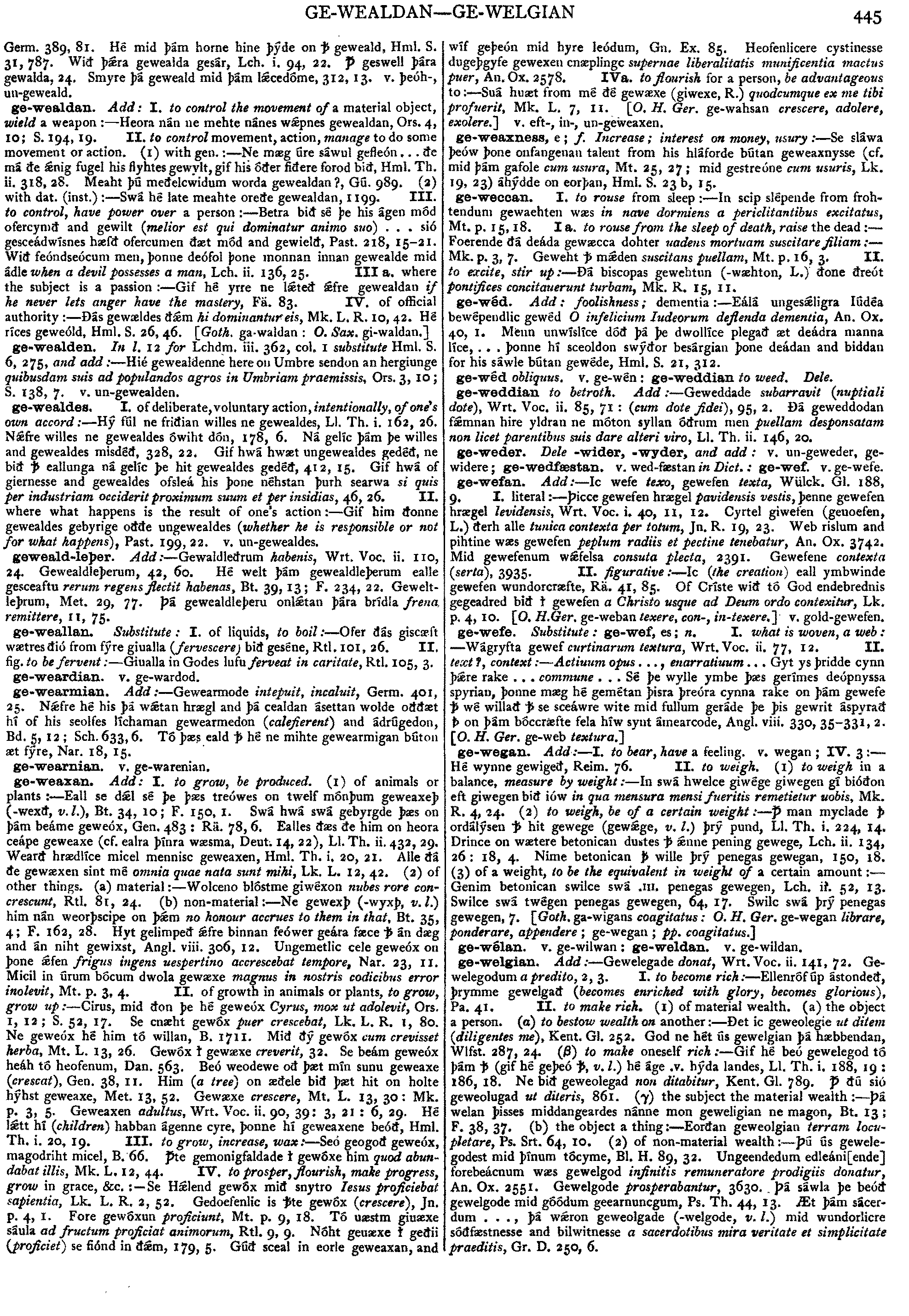
ge-wegan.
Add
:--
I.
to
bear,
have
a
feeling,
v.
wegan;
IV.
3
:--
Hé
wynne
gewigeð,
Reim.
76.
II.
to
weigh.
(1)
to
weigh
in
a
balance,
measure
by
weight
:--
In
swá
hwelce
giwége
giwegen
gí
bióðon
eft
giwegen
bið
iów
in
qua
mensura
mensi
fueritis
remetietur
uobis,
Mk.
R.
4,
24.
(2)
to
weigh,
be
of
a
certain
weight
:--
 man
myclade
ordálýsen
hit
gewege
(gewge,
v.
l.)
þrý
pund,
Ll.
Th.
i.
224,
14.
Drince
on
wætere
betonican
dustes
nne
pening
gewege,
Lch.
ii.
134,
26:
18,
4.
Nime
betonican
wille
þrý
penegas
gewegan,
150,
18.
(3)
of
a
weight,
to
be
the
equivalent
in
weight
of
a
certain
amount
:--
Genim
betonican
swilce
swá
.iii.
penegas
gewegen,
Lch.
ii.
52,
13.
Swilce
swá
twégen
penegas
gewegen,
64,
17.
Swilc
swá
þrý
penegas
gewegen,
7.
[Goth.
ga-wigans
coagitatus:
O.
H.
Ger.
ge-wegan
librare,
ponderare,
appendere;
ge-wegan;
pp.
coagitatus.]
man
myclade
ordálýsen
hit
gewege
(gewge,
v.
l.)
þrý
pund,
Ll.
Th.
i.
224,
14.
Drince
on
wætere
betonican
dustes
nne
pening
gewege,
Lch.
ii.
134,
26:
18,
4.
Nime
betonican
wille
þrý
penegas
gewegan,
150,
18.
(3)
of
a
weight,
to
be
the
equivalent
in
weight
of
a
certain
amount
:--
Genim
betonican
swilce
swá
.iii.
penegas
gewegen,
Lch.
ii.
52,
13.
Swilce
swá
twégen
penegas
gewegen,
64,
17.
Swilc
swá
þrý
penegas
gewegen,
7.
[Goth.
ga-wigans
coagitatus:
O.
H.
Ger.
ge-wegan
librare,
ponderare,
appendere;
ge-wegan;
pp.
coagitatus.]
Germanic Lexicon Project (main page)
This search system was written by
Sean Crist
Please consider
volunteering
to correct the data in these online dictionaries.
No rights reserved. Feel free to use these data in any way you please.