|
|

Search for geond again, using less strict matching (364 results)
|
Source: Bosworth/Toller, page b1215, entry 10 View original page image as: [TIFF] [PNG] [View previous entry] [View next entry] |
[Comment on this entry] [View comments] |
The following entry has been hand-corrected once. |
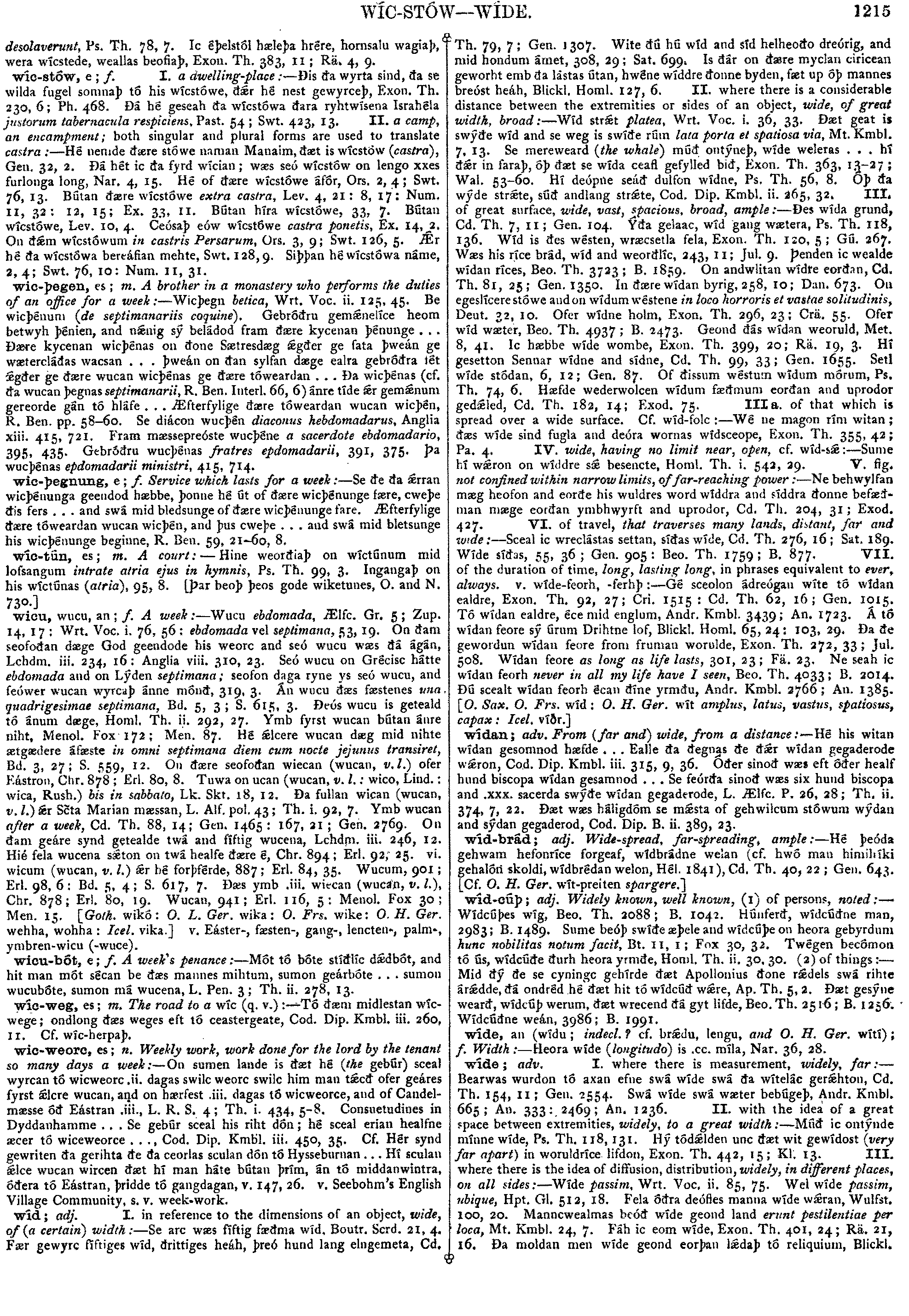
wíd;
adj.
I.
in
reference
to
the
dimensions
of
an
object,
wide,
of
(a
certain)
width
:--
Se
arc
wæs
fíftig
fæðma
wíd,
Boutr.
Scrd.
21,
4.
Fær
gewyrc
fiftiges
wíd,
ðrittiges
heáh,
þreó
hund
lang
elngemeta,
Cd.
Th.
79,
7;
Gen.
1307.
Wite
ðú
hú
wíd
and
síd
helheoðo
dreórig,
and
mid
hondum
ámet,
308,
29;
Sat.
699,
Is
ðár
on
ðære
myclan
ciricean
geworht
emb
ða
lástas
útan,
hwéne
wíddre
ðonne
byden,
fæt
up
óþ
mannes
breóst
heáh.
Blickl.
Homl.
127,
6.
II.
where
there
is
a
considerable
distance
between
the
extremities
or
sides
of
an
object,
wide,
of
great
width,
broad
:--
Wíd
str t
platea,
Wrt.
Voc.
i.
36,
33.
Ðæt
geat
is
swýðe
wíd
and
se
weg
is
swíðe
rúm
lata
porta
et
spatiosa
via,
Mt.
Kmbl.
7,
13.
Se
mereweard
(the
whale)
múð
ontýneþ,
wíde
weleras
.
.
.
hí
ðr
in
faraþ,
óþ
ðæt
se
wída
ceafl
gefylled
bið,
Exon.
Th.
363,
i.
13-27;
Wal.
53-60.
Hí
deópne
seúð
dulfon
wídne.
Ps.
Th.
56,
8.
Óþ
ða
wýde
strte,
súð
andlang
strte,
Cod.
Dip.
Kmbl.
ii.
265,
32.
III.
of
great
surface,
wide,
vast,
spacious,
broad,
ample
:--
Ðes
wída
grund,
Cd.
Th.
7,
11;
Gen.
104.
Ýða
gelaac,
wíd
gang
wætera,
Ps.
Th.
118,
136.
Wíd
is
ðes
wésten,
wræcsetla
fela,
Exon.
Th.
120,
5;
Gú.
267.
Wæs
his
ríce
brád,
wíd
and
weorðlíc,
243,
11;
Jul.
9.
Þenden
ic
wealde
wídan
ríces,
Beo.
Th.
3723
;
B.
1859.
On
andwlitan
wídre
eorðan,
Cd.
Th.
81,
25;
Gen.
1350.
In
ðære
wídan
byrig,
258,
10;
Dan.
673.
On
egeslícere
stówe
and
on
wídum
wéstene
in
loco
horroris
et
vastae
solitudinis,
Deut.
32,
10.
Ofer
wídne
holm,
Exon.
Th.
296,
23;
Crä.
55.
Ofer
wíd
wæter,
Beo.
Th.
4937
;
B.
2473.
Geond
ðás
wídan
weoruld,
Met.
8,
41.
Ic
hæbbe
wíde
wombe,
Exon.
Th.
399,
20;
Rä.
19,
3.
Hí
gesetton
Sennar
wídne
and
sídne,
Cd.
Th.
99,
33
;
Gen.
1655.
Setl
wíde
stódan,
6,
12;
Gen.
87.
Of
ðissum
wéstum
wídum
mórum,
Ps.
Th.
74,
6.
Hæfde
wederwolcen
wídum
fæðmum
eorðan
and
uprodor
gedled,
Cd.
Th.
182,
14;
Exod.
75.
IIIa.
of
that
which
is
spread
over
a
wide
surface.
Cf.
wíd-folc
:--
Wé
ne
magon
rím
witan;
ðæs
wíde
sind
fugla
and
deóra
wornas
wídsceope,
Exon.
Th.
355,
42;
Pa.
4.
IV.
wide,
having
no
limit
near,
open,
cf.
wíd-s:--
Sume
hí
wron
on
wíddre
s
besencte,
Homl.
Th.
i.
542,
29.
V.
fig.
not
confined
within
narrow
limits,
of
far-reaching
power
:--
Ne
behwylfan
mæg
heofon
and
eorðe
his
wuldres
word
wíddra
and
síddra
ðonne
befæð-man
mæge
eorðan
ymbhwyrft
and
uprodor,
Cd.
Th.
204,
31;
Exod.
427.
VI.
of
travel,
that
traverses
many
lands,
distant,
far
and
wide
:--
Sceal
ic
wreclástas
settan,
síðas
wíde,
Cd.
Th.
276,
16
;
Sat.
189.
Wíde
síðas,
55,
36;
Gen.
905:
Beo.
Th.
1759;
B.
877.
VII.
of
the
duration
of
time,
long,
lasting
long,
in
phrases
equivalent
to
ever,
always.
v.
wíde-feorh,
-ferhþ
:--
Gé
sceolon
ádreógan
wíte
tó
wídan
ealdre,
Exon.
Th.
92,
27;
Cri.
1515
:
Cd.
Th.
62,
16
;
Gen.
1015.
Tó
wídan
ealdre,
éce
mid
englum,
Andr.
Kmbl.
3439;
An.
1723.
Á
tó
wídan
feore
sý
úrum
Drihtne
lof,
Blickl.
Homl.
65,
24:
103,
29.
Ða
ðe
gewordun
wídan
feore
from
fruman
worulde,
Exon.
Th.
272,
33
;
Jul.
508.
Wídan
feore
as
long
as
life
lasts,
301,
23
;
Fä.
23.
Ne
seah
ic
wídan
feorh
never
in
all
my
life
have
I
seen,
Beo.
Th.
4033
;
B.
2014.
Ðú
scealt
wídan
feorh
écan
ðíne
yrmðu,
Andr.
Kmbl.
2766
;
An.
1385.
[O.
Sax.
O.
Frs.
wíd
:
O.
H.
Ger.
wít
amplus,
latus,
vastus,
spatiosus,
capax:
Icel.
víðr.]
t
platea,
Wrt.
Voc.
i.
36,
33.
Ðæt
geat
is
swýðe
wíd
and
se
weg
is
swíðe
rúm
lata
porta
et
spatiosa
via,
Mt.
Kmbl.
7,
13.
Se
mereweard
(the
whale)
múð
ontýneþ,
wíde
weleras
.
.
.
hí
ðr
in
faraþ,
óþ
ðæt
se
wída
ceafl
gefylled
bið,
Exon.
Th.
363,
i.
13-27;
Wal.
53-60.
Hí
deópne
seúð
dulfon
wídne.
Ps.
Th.
56,
8.
Óþ
ða
wýde
strte,
súð
andlang
strte,
Cod.
Dip.
Kmbl.
ii.
265,
32.
III.
of
great
surface,
wide,
vast,
spacious,
broad,
ample
:--
Ðes
wída
grund,
Cd.
Th.
7,
11;
Gen.
104.
Ýða
gelaac,
wíd
gang
wætera,
Ps.
Th.
118,
136.
Wíd
is
ðes
wésten,
wræcsetla
fela,
Exon.
Th.
120,
5;
Gú.
267.
Wæs
his
ríce
brád,
wíd
and
weorðlíc,
243,
11;
Jul.
9.
Þenden
ic
wealde
wídan
ríces,
Beo.
Th.
3723
;
B.
1859.
On
andwlitan
wídre
eorðan,
Cd.
Th.
81,
25;
Gen.
1350.
In
ðære
wídan
byrig,
258,
10;
Dan.
673.
On
egeslícere
stówe
and
on
wídum
wéstene
in
loco
horroris
et
vastae
solitudinis,
Deut.
32,
10.
Ofer
wídne
holm,
Exon.
Th.
296,
23;
Crä.
55.
Ofer
wíd
wæter,
Beo.
Th.
4937
;
B.
2473.
Geond
ðás
wídan
weoruld,
Met.
8,
41.
Ic
hæbbe
wíde
wombe,
Exon.
Th.
399,
20;
Rä.
19,
3.
Hí
gesetton
Sennar
wídne
and
sídne,
Cd.
Th.
99,
33
;
Gen.
1655.
Setl
wíde
stódan,
6,
12;
Gen.
87.
Of
ðissum
wéstum
wídum
mórum,
Ps.
Th.
74,
6.
Hæfde
wederwolcen
wídum
fæðmum
eorðan
and
uprodor
gedled,
Cd.
Th.
182,
14;
Exod.
75.
IIIa.
of
that
which
is
spread
over
a
wide
surface.
Cf.
wíd-folc
:--
Wé
ne
magon
rím
witan;
ðæs
wíde
sind
fugla
and
deóra
wornas
wídsceope,
Exon.
Th.
355,
42;
Pa.
4.
IV.
wide,
having
no
limit
near,
open,
cf.
wíd-s:--
Sume
hí
wron
on
wíddre
s
besencte,
Homl.
Th.
i.
542,
29.
V.
fig.
not
confined
within
narrow
limits,
of
far-reaching
power
:--
Ne
behwylfan
mæg
heofon
and
eorðe
his
wuldres
word
wíddra
and
síddra
ðonne
befæð-man
mæge
eorðan
ymbhwyrft
and
uprodor,
Cd.
Th.
204,
31;
Exod.
427.
VI.
of
travel,
that
traverses
many
lands,
distant,
far
and
wide
:--
Sceal
ic
wreclástas
settan,
síðas
wíde,
Cd.
Th.
276,
16
;
Sat.
189.
Wíde
síðas,
55,
36;
Gen.
905:
Beo.
Th.
1759;
B.
877.
VII.
of
the
duration
of
time,
long,
lasting
long,
in
phrases
equivalent
to
ever,
always.
v.
wíde-feorh,
-ferhþ
:--
Gé
sceolon
ádreógan
wíte
tó
wídan
ealdre,
Exon.
Th.
92,
27;
Cri.
1515
:
Cd.
Th.
62,
16
;
Gen.
1015.
Tó
wídan
ealdre,
éce
mid
englum,
Andr.
Kmbl.
3439;
An.
1723.
Á
tó
wídan
feore
sý
úrum
Drihtne
lof,
Blickl.
Homl.
65,
24:
103,
29.
Ða
ðe
gewordun
wídan
feore
from
fruman
worulde,
Exon.
Th.
272,
33
;
Jul.
508.
Wídan
feore
as
long
as
life
lasts,
301,
23
;
Fä.
23.
Ne
seah
ic
wídan
feorh
never
in
all
my
life
have
I
seen,
Beo.
Th.
4033
;
B.
2014.
Ðú
scealt
wídan
feorh
écan
ðíne
yrmðu,
Andr.
Kmbl.
2766
;
An.
1385.
[O.
Sax.
O.
Frs.
wíd
:
O.
H.
Ger.
wít
amplus,
latus,
vastus,
spatiosus,
capax:
Icel.
víðr.]
|
Source: Bosworth/Toller, page b1215, entry 15 View original page image as: [TIFF] [PNG] [View previous entry] [View next entry] |
[Comment on this entry] [View comments] |
The following entry has been hand-corrected once. |
wíde
;
adv.
I.
where
there
is
measurement,
widely,
far
:--
Bearwas
wurdon
tó
axan
efne
swá
wíde
swá
ða
wítelác
gerhton,
Cd.
Th.
154,
11;
Gen.
2554.
Swá
wíde
swá
wæter
bebúgeþ,
Andr.
Kmbl.
665;
An.
333:
2469;
An.
1236.
II.
with
the
idea
of
a
great
space
between
extremities,
widely,
to
a
great
width
:--
Múð
ic
ontýnde
mínne
wíde,
Ps.
Th.
118,
131.
Hý
tódlden
unc
ðæt
wit
gewídost
(very
far
apart)
in
woruldríce
lifdon,
Exon.
Th.
442,
15;
Kl.
13.
III.
where
there
is
the
idea
of
diffusion,
distribution,
widely,
in
different
places,
on
all
sides
:--
Wíde
passim,
Wrt.
Voc.
ii.
85,
75.
Wel
wíde
passim,
ubique,
Hpt.
Gl.
512,
18.
Fela
óðra
deófles
manna
wíde
wran,
Wulfst.
100,
20.
Manncwealmas
beóð
wíde
geond
land
erunt
pestilentiae
per
loca,
Mt.
Kmbl.
24,
7.
Fáh
ic
eom
wíde,
Exon.
Th.
401,
24;
Rä.
21,
16.
Ða
moldan
men
wíde
geond
eorþan
ldaþ
tó
reliquium,
Blick.
|
Source: Bosworth/Toller, page b1216, entry 1 View original page image as: [TIFF] [PNG] [View previous entry] [View next entry] |
[Comment on this entry] [View comments] |
The following entry has been hand-corrected once. |
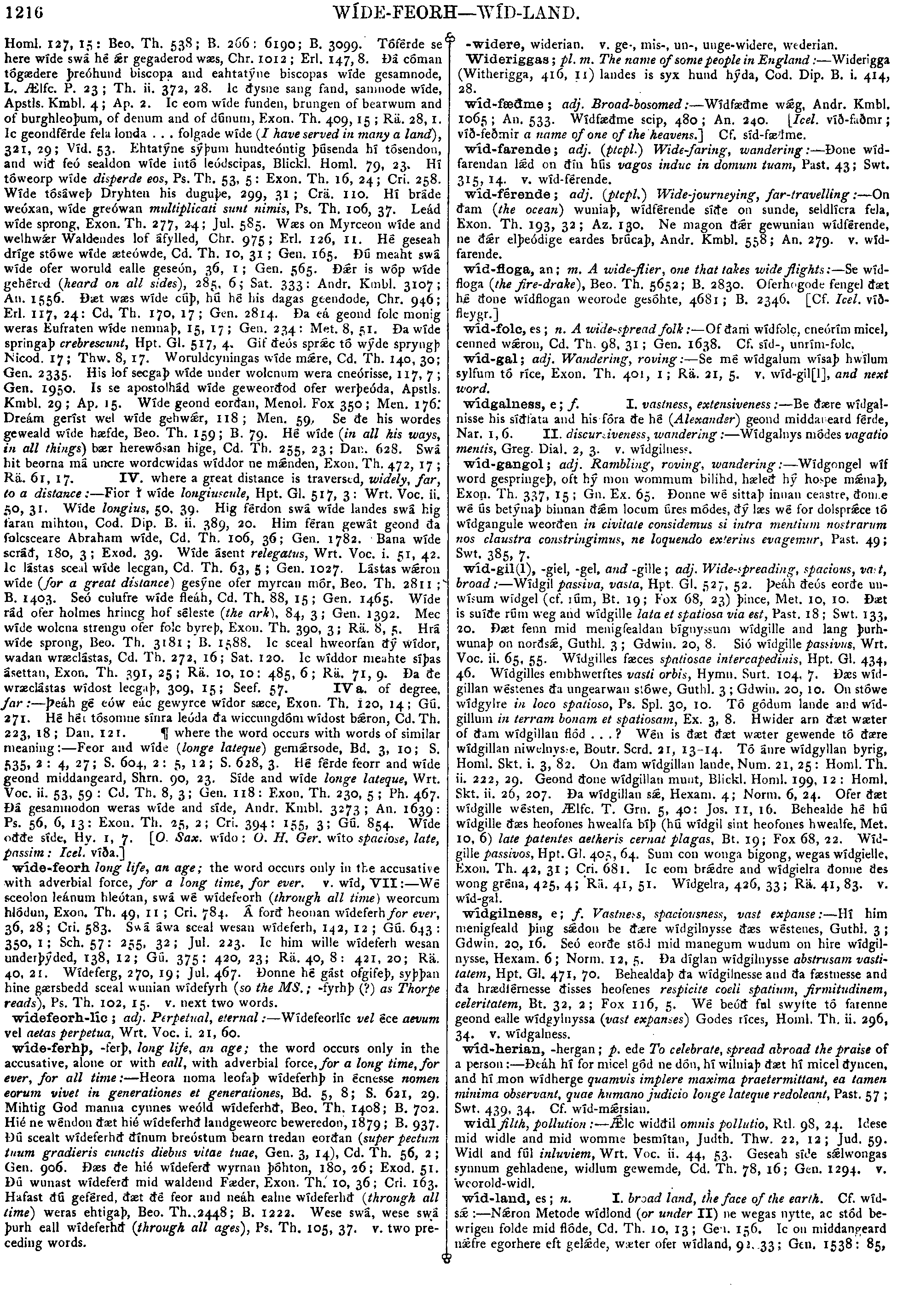
Homl.
127,
15:
Beo.
Th.
538;
B.
266:
6190;
B.
3099.
Tóférde
se
here
wíde
swá
hé
r
gegaderod
wæs,
Chr.
1012
;
Erl.
147,
8.
Ðá
cóman
tógædere
þreóhund
biscopa
and
eahtatýne
biscopas
wíde
gesamnode,
L.
Ælfc.
P.
23
;
Th.
ii.
372,
28.
Ic
ðysne
sang
fand,
samnode
wíde,
Apstls.
Kmbl.
4;
Ap.
2.
Ic
eom
wíde
funden,
brungen
of
bearwum
and
of
burghleoþum,
of
denum
and
of
dúnum,
Exon.
Th.
409,
15
;
Rä.
28,
1.
Ic
geondférde
fela
londa
.
.
.
folgade
wíde
(I
have
served
in
many
a
land),
321,
29;
Víd.
53.
Ehtatýne
sýþum
hundteóntig
þúsenda
hí
tósendon,
and
wið
feó
sealdon
wíde
intó
leódscipas,
Blickl.
Homl.
79,
23.
Hí
tóweorp
wíde
disperde
eos,
Ps.
Th.
53,
5:
Exon.
Th.
16,
24;
Cri.
258.
Wíde
tósáweþ
Dryhten
his
duguþe,
299,
31;
Crä.
110.
Hí
bráde
weóxan,
wíde
greówan
multiplicati
sunt
nimis,
Ps.
Th.
106,
37.
Leád
wíde
sprong,
Exon.
Th.
277,
24;
Jul.
585.
Wæs
on
Myrceon
wíde
and
welhwr
Waldendes
lof
áfylled,
Chr.
975;
Erl.
126,
11.
Hé
geseah
dríge
stówe
wíde
æteówde,
Cd.
Th.
10,
31
;
Gen.
165.
Ðú
meaht
swá
wíde
ofer
woruld
ealle
geseón,
36,
1;
Gen.
565.
Ðr
is
wóp
wíde
gehéred
(heard
on
all
sides),
285,
6;
Sat.
333:
Andr.
Kmbl.
3107;
An.
1556.
Ðaelig-acute;t
wæs
wíde
cúþ,
hú
hé
his
dagas
geendode,
Chr.
946;
Erl.
117,
24:
Cd.
Th.
170,
17;
Gen.
2814.
Ða
eá
geond
folc
monig
weras
Eufraten
wíde
nemnaþ,
15,
17;
Gen.
234:
Met.
8,
51.
Ða
wíde
springaþ
crebrescunt,
Hpt.
Gl.
517,
4,
Gif
ðeós
sprc
tó
wýde
spryngþ
-Nicod.
17;
Thw.
8,
17.
Woruldcyningas
wíde
mre.
Cd.
Th.
140,
30;
Gen.
2335.
His
lof
secgaþ
wíde
under
wolcnum
wera
cneórisse,
117,
7
;
Gen.
1950.
Is
se
apostolhád
wíde
geweorðod
ofer
werþeóda,
Apstls.
Kmbl.
29
;
Ap.
15.
Wíde
geond
eorðan,
Menol.
Fox
350
;
Men.
176:
Dreám
geríst
wel
wíde
gehwr,
118
;
Men.
59,
Se
ðe
his
wordes
geweald
wíde
hæfde,
Beo.
Th.
159;
B.
79.
Hé
wíde
(in
all
his
ways,
in
all
things)
bær
herewósan
hige,
Cd.
Th.
255,
23
;
Dan.
628.
Swá
hit
beorna
má
uncre
wordcwidas
wíddor
ne
mnden,
Exon.
Th.
472,
17
;
Rä.
61,
17.
IV.
where
a
great
distance
is
traversed,
widely,
far,
to
a
distance
:--
Fior
 wíde
longiuscule,
Hpt.
Gl.
517,
3
:
Wrt.
Voc.
ii.
50,
31.
Wíde
longius,
50,
39.
Hig
férdon
swá
wíde
landes
swá
hig
faran
mihton.
Cod.
Dip.
B.
ii.
389,
20.
Him
féran
gewát
geond
ða
folcsceare
Abraham
wíde.
Cd.
Th.
106,
36;
Gen.
1782.
Bana
wíde
scráð,
180,
3;
Exod.
39.
Wíde
ásent
relegatus,
Wrt.
Voc.
i.
51,
42.
Ic
lástas
sceal
wíde
lecgan,
Cd.
Th.
63,
5;
Gen.
1027.
Lástas
wron
wíde
(for
a
great
distance)
gesýne
ofer
myrcan
mór,
Beo.
Th.
2811
;
B.
1403.
Seó
culufre
wíde
fleáh,
Cd.
Th.
88,
15
;
Gen.
1465.
Wíde
rád
ofer
holmes
hrincg
hof
séleste
(the
ark),
84,
3;
Gen.
1392.
Mec
wíde
wolcna
strengu
ofer
folc
byreþ,
Exon.
Th.
390,
3;
Rä.
8,
5.
Hrá
wíde
sprong,
Beo.
Th.
3181;
B.
1588.
Ic
sceal
hweorfan
ðý
wídor,
wadan
wræclástas,
Cd.
Th.
272,
16;
Sat.
120.
Ic
wíddor
meahte
síþas
ásettan,
Exon.
Th.
391,
25;
Rä.
10,
10:
485,
6;
Rä.
71,
9.
Ða
ðe
wræclástas
wídost
lecgaþ,
309,
15;
Seef.
57.
IVa.
of
degree,
far:
--
Þeáh
gé
eów
eác
gewyrce
wídor
sæce,
Exon.
Th.
120,
14;
Gú.
271.
Hé
hét
tósomne
sínra
leóda
ða
wiccungdóm
wídost
bron,
Cd.
Th.
223,
18
;
Dan.
121.

where
the
word
occurs
with
words
of
similar
meaning
:--
Feor
and
wíde
(longe
lateque)
gemrsode,
Bd.
3,
10;
S.
535,
2:
4,
27;
S.
604,
2
:
5,
12;
S.
628,
3.
Hé
férde
feorr
and
wíde
geond
middangeard.
Shrn.
90,
23.
Síde
and
wíde
longe
laleque.
Wrt.
Voc.
ii.
53,
59:
Cd.
Th.
8,
3;
Gen.
118:
Exon.
Th.
230,
5;
Ph.
467.
Ðá
gesamnodon
weras
wíde
and
síde,
Andr.
Kmbl.
3273
;
An.
1639
:
Ps.
56,
6,
13:
Exon.
Th.
25,
2;
Cri.
394:
155,
3;
Gú.
854.
Wíde
oððe
síde.
Hy.
1,
7.
[O.
Sax.
wído
:
O.
H.
Ger.
wíto
spaciose,
late,
passim:
Icel.
víða.]
wíde
longiuscule,
Hpt.
Gl.
517,
3
:
Wrt.
Voc.
ii.
50,
31.
Wíde
longius,
50,
39.
Hig
férdon
swá
wíde
landes
swá
hig
faran
mihton.
Cod.
Dip.
B.
ii.
389,
20.
Him
féran
gewát
geond
ða
folcsceare
Abraham
wíde.
Cd.
Th.
106,
36;
Gen.
1782.
Bana
wíde
scráð,
180,
3;
Exod.
39.
Wíde
ásent
relegatus,
Wrt.
Voc.
i.
51,
42.
Ic
lástas
sceal
wíde
lecgan,
Cd.
Th.
63,
5;
Gen.
1027.
Lástas
wron
wíde
(for
a
great
distance)
gesýne
ofer
myrcan
mór,
Beo.
Th.
2811
;
B.
1403.
Seó
culufre
wíde
fleáh,
Cd.
Th.
88,
15
;
Gen.
1465.
Wíde
rád
ofer
holmes
hrincg
hof
séleste
(the
ark),
84,
3;
Gen.
1392.
Mec
wíde
wolcna
strengu
ofer
folc
byreþ,
Exon.
Th.
390,
3;
Rä.
8,
5.
Hrá
wíde
sprong,
Beo.
Th.
3181;
B.
1588.
Ic
sceal
hweorfan
ðý
wídor,
wadan
wræclástas,
Cd.
Th.
272,
16;
Sat.
120.
Ic
wíddor
meahte
síþas
ásettan,
Exon.
Th.
391,
25;
Rä.
10,
10:
485,
6;
Rä.
71,
9.
Ða
ðe
wræclástas
wídost
lecgaþ,
309,
15;
Seef.
57.
IVa.
of
degree,
far:
--
Þeáh
gé
eów
eác
gewyrce
wídor
sæce,
Exon.
Th.
120,
14;
Gú.
271.
Hé
hét
tósomne
sínra
leóda
ða
wiccungdóm
wídost
bron,
Cd.
Th.
223,
18
;
Dan.
121.

where
the
word
occurs
with
words
of
similar
meaning
:--
Feor
and
wíde
(longe
lateque)
gemrsode,
Bd.
3,
10;
S.
535,
2:
4,
27;
S.
604,
2
:
5,
12;
S.
628,
3.
Hé
férde
feorr
and
wíde
geond
middangeard.
Shrn.
90,
23.
Síde
and
wíde
longe
laleque.
Wrt.
Voc.
ii.
53,
59:
Cd.
Th.
8,
3;
Gen.
118:
Exon.
Th.
230,
5;
Ph.
467.
Ðá
gesamnodon
weras
wíde
and
síde,
Andr.
Kmbl.
3273
;
An.
1639
:
Ps.
56,
6,
13:
Exon.
Th.
25,
2;
Cri.
394:
155,
3;
Gú.
854.
Wíde
oððe
síde.
Hy.
1,
7.
[O.
Sax.
wído
:
O.
H.
Ger.
wíto
spaciose,
late,
passim:
Icel.
víða.]
|
Source: Bosworth/Toller, page b1216, entry 13 View original page image as: [TIFF] [PNG] [View previous entry] [View next entry] |
[Comment on this entry] [View comments] |
The following entry has been hand-corrected once. |
wídgalness,
e;
f.
I.
vastness,
extensiveness
:--
Be
ðære
wídgal nisse
his
síðfata
and
his
fóra
ðe
hé
(Alexander)
geond
middaneard
férde,
Nar.
1,
6.
II.
discursiveness,
wandering
:--
Wídgalnys
módes
vagatio
mentis,
Greg.
Dial.
2,
3.
v.
wídgilness.
nisse
his
síðfata
and
his
fóra
ðe
hé
(Alexander)
geond
middaneard
férde,
Nar.
1,
6.
II.
discursiveness,
wandering
:--
Wídgalnys
módes
vagatio
mentis,
Greg.
Dial.
2,
3.
v.
wídgilness.
|
Source: Bosworth/Toller, page b1216, entry 15 View original page image as: [TIFF] [PNG] [View previous entry] [View next entry] |
[Comment on this entry] [View comments] |
The following entry has been hand-corrected once. |
wíd-gil(l),
-giel,
-gel,
and-gille;
adj.
Wide-spreading,
spacious,
vast,
broad
:--
Wídgil
passiva,
vasta,
Hpt.
Gl.
527,
52.
þeáh
ðeós
eorðe
unwísum
wídgel
(cf.
iúm,
Bt.
19;
Fox
68,
23)
þince.
Met.
10,
10.
Ðæt
is
suíðe
rúm
weg
and
wídgille
lata
et
spatiosa
via
est,
Past.
18
;
Swt.
133,
20.
Ðæt
fenn
mid
menigfealdan
bígnyssum
wídgille
and
lang
þurhwunaþ
on
norðs,
Guthl.
3
;
Gdwin.
20,
8.
Sió
wídgille
passivus,
Wrt.
Voc.
ii.
65,
55.
Wídgilles
fæces
spatiosae
intercapedinis,
Hpt.
Gl.
434,
46.
Wídgilles
embhwerftes
vasti
orbis,
Hymn.
Surt.
104,
7.
Ðæs
wídgillan
wéstenes
ða
ungearwan
stówe,
Guthl.
3
;
Gdwin.
20,
10.
On
stówe
wídgylre
in
loco
spatioso.
Ps.
Spl.
30,
10.
Tó
gódum
lande
and
wídgillum
in
terram
bonam
et
spatiosam,
Ex.
3,
8.
Hwider
arn
ðæt
wæter
of
ðam
wídgillan
flód
.
.
.
?
Wén
is
ðæt
ðæt
wæter
gewende
tó
ðære
wídgillan
niwe
lnysse,
Boutr.
Scrd.
21,
13-14.
Tó
ánre
wídgyllan
byrig,
Homl.
Skt.
i.
3,
82.
On
ðam
wídgillan
lande,
Num.
21,
25:
Homl.
Th.
ii.
222,
29.
Geond
ðone
wídgillan
munt,
Blickl.
Homl.
199,
12
:
Homl.
Skt.
ii.
26,
207.
Ða
wídgillan
s,
Hexam.
4;
Norm.
6,
24.
Ofer
ðæt
wídgille
wésten,
Ælfc.
T.
Grn.
5,
40:
Jos.
11,
16.
Behealde
hé
hú
wídgille
ðæs
heofones
hwealfa
bíþ
(hú
widgil
sint
heofones
hwealfe,
Met.
10,
6)
late
patentes
aetheris
cernat
plagas,
Bt.
19;
Fox
68,
22.
Widgille
passivos,
Hpt.
Gl.
405,
64.
Sum
con
wonga
bigong,
wegas
wídgielle,
Exon.
Th.
42,
31
;
Cri.
681.
Ic
com
brdre
and
wídgielra
ðonne
ðes
wong
gréna,
425,
4;
Rä.
41,
51.
Wídgelra,
426,
33;
Rä.
41,
83.
v.
wíd-gal.
|
Source: Bosworth/Toller, page b1216, entry 16 View original page image as: [TIFF] [PNG] [View previous entry] [View next entry] |
[Comment on this entry] [View comments] |
The following entry has been hand-corrected once. |
wídgilness,
e;
f.
Vastness,
spaciousness,
vast
expanse
:--
Hí
him
menigfeald
þing
sdon
be
ðære
wídgilnysse
ðæs
wéstenes.
Guthl.
3;
Gdwin.
20,
16.
Seó
eorðe
stód
mid
manegum
wudum
on
hire
wídgilnysse.
Hexam.
6;
Norm.
12,
5.
Ða
díglan
wídgilnysse
abstrusam
vastitatem,
Hpt.
Gl.
471,
70.
Behealdaþ
ða
wídgilnesse
and
ða
fæstnesse
and
ða
hrædlérnesse
ðisses
heofenes
respicite
coeli
spatium,
firmitudinem,
celeritaíem,
Bt.
32,
2;
Fox
116,
5.
Wé
beóð
ful
swyfte
tó
farenne
geond
ealle
wídgylnyssa
(vast
expanses)
Godes
ríces,
Homl.
Th.
ii.
296,
34.
v.
wídgalness.
|
Source: Bosworth/Toller, page b1217, entry 16 View original page image as: [TIFF] [PNG] [View previous entry] [View next entry] |
[Comment on this entry] [View comments] |
The following entry has been hand-corrected once. |
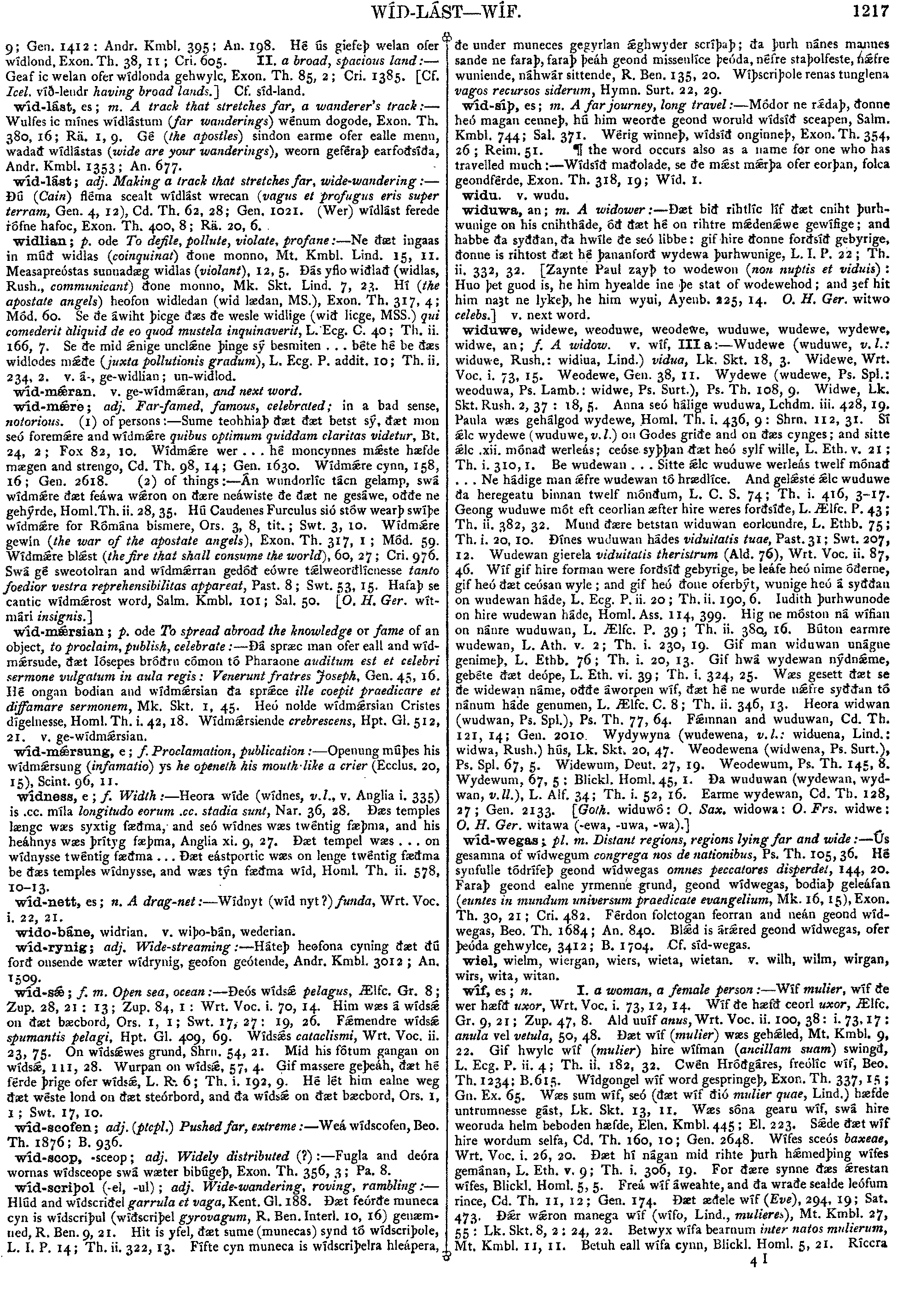
wíd-scriþol
(-el,
-ul);
adj.
Wide-wandering,
roving,
rambling
:--
Hlúd
and
wídscriðel
garrula
et
vaga,
Kent.
Gl.
188.
Ðæt
feórðe
muneca
cyn
is
wídscriþul
(wíðscriþel
gyrovagum,
R.
Ben.
Interl.
10,
16)
genæmned,
R.
Ben.
9,
21.
Hit
is
yfel,
ðæt
sume
(munecas)
synd
to
wídscriþole,
L.
I.
P.
14;
Th.
11.
322,
13.
Fífte
cyn
muneca
is
wídscriþelra
hleápera,
ðe
under
muneces
gegyrlan
ghwyder
scríþaþ;
ða
þurh
nánes
mannes
sande
ne
faraþ,
faraþ
þeáh
geond
missenlíce
þeóda,
néfre
staþolfeste,
nfre
wuniende,
náhwár
sittende,
R.
Ben.
135,
20.
Wíþscriþole
renas
tunglena
vagos
recursos
siderum,
Hymn.
Surt.
22,
29.
|
Source: Bosworth/Toller, page b1217, entry 17 View original page image as: [TIFF] [PNG] [View previous entry] [View next entry] |
[Comment on this entry] [View comments] |
The following entry has been hand-corrected once. |
wíd-síþ,
es;
m.
A
far
journey,
long
travel
:--
Módor
ne
rdaþ,
ðonne
heó
magan
cenneþ,
hú
him
weorðe
geond
woruld
wídsíð
sceapen,
Salm.
Kmbl.
744;
Sal.
371.
Wérig
winneþ,
wídsíð
onginneþ,
Exon.
Th.
354,
26
;
Reim.
51.

the
word
occurs
also
as
a
name
for
one
who
has
travelled
much
:--
Wídsíð
maðolade,
se
ðe
mst
mrþa
ofer
eorþan,
folca
geondférde,
Exon.
Th.
318,
19;
Wíd.
1.
|
Source: Bosworth/Toller, page b1217, entry 21 View original page image as: [TIFF] [PNG] [View previous entry] [View next entry] |
[Comment on this entry] [View comments (1)] |
The following entry has been hand-corrected once. |
wíd-wegas
j.
pl.
m.
Distant
regions,
regions
lying
far
and
wide
:--
Ús
gesamna
of
wídwegum
congrega
nos
de
nationibus,
Ps.
Th.
105,
36,
Hé
synfulle
tðdrífeþ
geond
wídwegas
omnes
peccatores
disperdet,
144,
20.
Faraþ
geond
ealne
yrrnenne
grund,
geond
wídwegas,
bodiaþ
geleáfan
(euntes
in
mundum
universum
praedicate
evangelium,
Mk.
16,
15),
Exon.
Th.
30,
21;
Cri.
482.
Férdon
folctogan
feorran
and
neán
geond
wídwegas,
Beo.
Th.
1684;
An.
840.
Bld
is
árred
geond
wídwegas,
ofer
þeóda
gehwylce,
3412
;
B.
1704.
Cf.
síd-wegas.
|
Source: Bosworth/Toller, page b1222, entry 28 View original page image as: [TIFF] [PNG] [View previous entry] [View next entry] |
[Comment on this entry] [View comments (1)] |
The following entry has been hand-corrected once. |
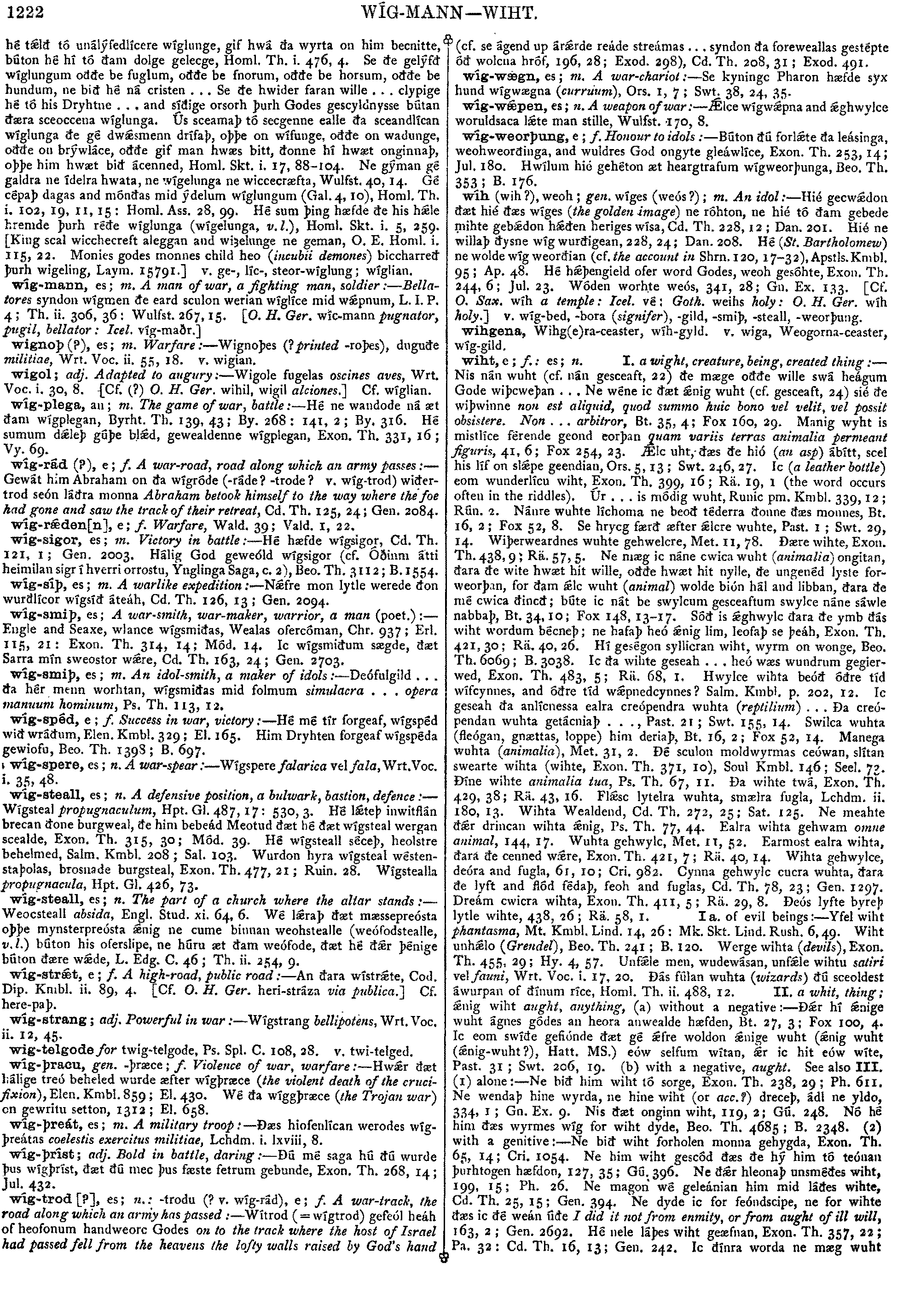
wiht,
e
;
f.:
es;
a.
I.
a
wight,
creature,
being,
created
thing
:--
Nis
n n
wuht
(cf.
nn
gesceaft,
22)
n
wuht
(cf.
nn
gesceaft,
22)
 e
mæge
oe
wille
sw
heágum
Gode
wiþcweþan
.
.
.
Ne
w
e
mæge
oe
wille
sw
heágum
Gode
wiþcweþan
.
.
.
Ne
w ne
ic
æt
ne
ic
æt
 nig
wuht
(cf.
gesceaft,
24)
sié
e
wiþwinne
non
est
aliquid,
quod
summo
huic
bono
vel
velit,
vel
possit
obsistere.
Non
.
.
.
arbitror.
Bt.
35,
4;
Fox
160,
29.
Manig
wyht
is
mistl
nig
wuht
(cf.
gesceaft,
24)
sié
e
wiþwinne
non
est
aliquid,
quod
summo
huic
bono
vel
velit,
vel
possit
obsistere.
Non
.
.
.
arbitror.
Bt.
35,
4;
Fox
160,
29.
Manig
wyht
is
mistl ce
frende
geond
corþan
quam
variis
terras
animalia
permeant
figuris,
41,
6;
Fox
254,
23.
Æle
uht,
æs
e
hió
(an
asp)
bítt,
scel
his
lf
on
slpe
geendian,
Ors.
5,
13
;
Swt.
246,
27.
Ic
(a
leather
bottle)
eom
wunderlcu
wiht,
Exon.
Th.
399,
16
;
Rä.
19,
l
(the
word
occurs
often
in
the
riddles).
&U-long;r
.
.
.
is
m
ce
frende
geond
corþan
quam
variis
terras
animalia
permeant
figuris,
41,
6;
Fox
254,
23.
Æle
uht,
æs
e
hió
(an
asp)
bítt,
scel
his
lf
on
slpe
geendian,
Ors.
5,
13
;
Swt.
246,
27.
Ic
(a
leather
bottle)
eom
wunderlcu
wiht,
Exon.
Th.
399,
16
;
Rä.
19,
l
(the
word
occurs
often
in
the
riddles).
&U-long;r
.
.
.
is
m dig
wuht,
Runic
pm.
Kmbl.
339,
12
;
R
dig
wuht,
Runic
pm.
Kmbl.
339,
12
;
R n.
2.
Nnre
wuhte
lchoma
ne
beo
tderra
onne
æs
monnes,
Bt.
16,
2
;
Fox
52,
8.
Se
hrycg
fær
æfter
lcre
wuhte,
Past.
I
;
Swt.
29,
14.
Wiþerweardnes
wuhte
gehwelcre,
Met.
II,
78.
Ðære
wihte,
Exon.
Th.
438,
9;
Rä.
57,
5.
Ne
mæg
ic
nne
cwica
wuht
(animalia)
ongitan,
ara
e
wite
hwæt
hit
wille,
oe
hwæt
hit
nylle,
e
ungend
lyste
for-weorþan,
for
am
lc
wuht
(animal]
wolde
bión
hl
and
libban,
ara
e
m
cwica
inc
bte
ic
nt
be
swylcum
gesceaftum
swylce
nne
swle
nabbaþ,
Bt.
34,
10;
Fox
148,
13-17.
Só
is
ghwylc
ara
e
ymb
s
wiht
wordum
bécneþ
ne
hafaþ
heó
nig
lim,
leofaþ
se
þeáh.
Exon.
Th.
421,
30
;
Rä.
40,
26.
Hí
geségon
syllicran
wiht,
wyrm
on
wonge,
Beo.
Th.
6069
;
B.
3038.
Ic
a
wihte
geseah
.
.
.
heó
wæs
wundrum
gegier-wed.
Exon.
Th.
483,
5;
Rä.
68,
Hwylce
wihta
beó
d-bar;re
td
wfcynnes,
and
re
td
wpnedcynnes
?
Salm.
Kmbl.
p.
202,
12.
Ic
geseah
a
anlcnessa
ealra
creópendra
wuhta
(reptilium).
.
.
Ða
creó-pendan
wuhta
getcniaþ
.
.
.
,
Past.
21;
Swt.
155,
14.
Swilca
wuhta
(fleógan,
gnættas,
loppe)
him
deriaþ.
Bt.
16,
2
;
Fox
52,
14.
Manega
wuhta
(animalia),
Met.
31,
2.
Ðe
sculon
moldwyrmas
ceówan,
sltan
swearte
wihta
(wihte,
Exon.
Th.
371,
10),
Soul
Kmbl.
146;
Seel.
72.
Ðine
wihte
animalia
tua,
Ps.
Th.
67,
Ða
wihte
tw,
Exon.
Th.
429,
38;
R.
43,
16.
Flsc
lytelra
wuhta,
smælra
fugla,
Lchdm.
ii.
180,
13.
Wihta
Wealdend,
Cd.
Th.
272,
25;
Sat.
125.
Ne
meahte
r
drincan
wihta
nig,
Ps.
Th.
77,
44.
Ealra
wihta
gehwam
omne
animal,
144,
17.
Wuhta
gehwylc,
Met.
ll,
52.
Earmost
ealra
wihta,
ara
e
cenned
wre.
Exon.
Th.
421,
7;
Rä
40,
14.
Wihta
gehwylce,
deóra
and
fugla,
61,
10;
Cri.
982.
Cynna
gehwylc
cucra
wuhta,
ara
e
lyft
and
fld
fdaþ,
feoh
and
fuglas,
Cd.
Th.
78,
23;
Gen.
1297.
Dreám
cwicra
wihta,
Exon.
Th.
411,
5
;
Rä.
29,
8.
Ðeós
lyfte
byreþ
lytle
wihte,
438,
26;
Rä.
58,
l.
Ia.
of
evil
beings
:--
Yfel
wiht
phantasma,
Mt.
Kmbl.
Lind.
14,
26
:
Mk.
Skt.
Lind.
Rush.
6,
49.
Wiht
unhlo
(Grendel),
Beo.
Th.
241;
B.
120.
Werge
wihta
(devils'),
Exon.
Th.
455,
29;
Hy.
4,
57.
Unfle
men,
wudewsan,
unfle
wihtu
satiri
vel
fauni,
Wrt.
Voc.
i.
17,
20.
Ðas
flan
wuhta
(wizards)
ú
sceoldest
wurpan
of
num
rce,
Homl.
Th.
ii.
488,
12.
II.
a
whit,
thing;
nig
wiht
aught,
anything,
(a)
without
a
negative
:--
Ðr
h
nige
wuht
gnes
gdes
an
heora
anwealde
hæfden,
Bt.
27,
3;
Fox
100,
4.
Ic
eom
swe
gefiónde
æt
g
fre
woldon
nige
wuht
(nig
wuht
(nig-wuht?),
Halt.
MS.)
eów
selfum
wtan,
r
ic
hit
eów
wte,
Past.
31
;
Swt.
206,
19.
(b)
with
a
negative,
aught.
See
also
III.
(l)
alone
:--
Ne
bi
him
wiht
to
sorge.
Exon.
Th.
238,
29
;
Ph.
611.
Ne
wendaþ
hine
wyrda,
ne
hine
wiht
(or
acc.
?)
dreceþ,
dl
ne
yldo,
334,
l;
Gn.
Ex.
9.
Nis
æt
onginn
wiht,
119,
2;
G.
248.
N
h
him
æs
wyrmes
wg
for
wiht
dyde.
Beo.
Th.
4685
;
B.
2348.
(2)
with
a
genitive
:--
Ne
bi
wiht
forholen
monna
gehygda,
Exon.
Th.
65,
14;
Cri.
1054.
Ne
him
wiht
gescód
æs
e
hý
him
t
teónan
þurhtogen
hæfdon,
127,
35;
G.
396.
Ne
r
hleonaþ
unsmes
wiht,
199,
15;
Ph.
26.
Ne
magon
w
geleánian
him
mid
les
wihte,
Cd.
Th.
25,
15;
Gen.
394.
Ne
dyde
ic
for
feóndscipe,
ne
for
wihte
ðæs
ic
weán
e
did
it
not
from
enmity,
or
from
aught
of
ill
will,
163,
2
;
Gen.
2692.
H
nele
lþes
wiht
geæfnan.
Exon.
Th.
357,
22;
Pa.
32:
Cd.
Th.
16,
13;
Gen.
242.
Ic
nra
worda
ne
mæg
wuht
n.
2.
Nnre
wuhte
lchoma
ne
beo
tderra
onne
æs
monnes,
Bt.
16,
2
;
Fox
52,
8.
Se
hrycg
fær
æfter
lcre
wuhte,
Past.
I
;
Swt.
29,
14.
Wiþerweardnes
wuhte
gehwelcre,
Met.
II,
78.
Ðære
wihte,
Exon.
Th.
438,
9;
Rä.
57,
5.
Ne
mæg
ic
nne
cwica
wuht
(animalia)
ongitan,
ara
e
wite
hwæt
hit
wille,
oe
hwæt
hit
nylle,
e
ungend
lyste
for-weorþan,
for
am
lc
wuht
(animal]
wolde
bión
hl
and
libban,
ara
e
m
cwica
inc
bte
ic
nt
be
swylcum
gesceaftum
swylce
nne
swle
nabbaþ,
Bt.
34,
10;
Fox
148,
13-17.
Só
is
ghwylc
ara
e
ymb
s
wiht
wordum
bécneþ
ne
hafaþ
heó
nig
lim,
leofaþ
se
þeáh.
Exon.
Th.
421,
30
;
Rä.
40,
26.
Hí
geségon
syllicran
wiht,
wyrm
on
wonge,
Beo.
Th.
6069
;
B.
3038.
Ic
a
wihte
geseah
.
.
.
heó
wæs
wundrum
gegier-wed.
Exon.
Th.
483,
5;
Rä.
68,
Hwylce
wihta
beó
d-bar;re
td
wfcynnes,
and
re
td
wpnedcynnes
?
Salm.
Kmbl.
p.
202,
12.
Ic
geseah
a
anlcnessa
ealra
creópendra
wuhta
(reptilium).
.
.
Ða
creó-pendan
wuhta
getcniaþ
.
.
.
,
Past.
21;
Swt.
155,
14.
Swilca
wuhta
(fleógan,
gnættas,
loppe)
him
deriaþ.
Bt.
16,
2
;
Fox
52,
14.
Manega
wuhta
(animalia),
Met.
31,
2.
Ðe
sculon
moldwyrmas
ceówan,
sltan
swearte
wihta
(wihte,
Exon.
Th.
371,
10),
Soul
Kmbl.
146;
Seel.
72.
Ðine
wihte
animalia
tua,
Ps.
Th.
67,
Ða
wihte
tw,
Exon.
Th.
429,
38;
R.
43,
16.
Flsc
lytelra
wuhta,
smælra
fugla,
Lchdm.
ii.
180,
13.
Wihta
Wealdend,
Cd.
Th.
272,
25;
Sat.
125.
Ne
meahte
r
drincan
wihta
nig,
Ps.
Th.
77,
44.
Ealra
wihta
gehwam
omne
animal,
144,
17.
Wuhta
gehwylc,
Met.
ll,
52.
Earmost
ealra
wihta,
ara
e
cenned
wre.
Exon.
Th.
421,
7;
Rä
40,
14.
Wihta
gehwylce,
deóra
and
fugla,
61,
10;
Cri.
982.
Cynna
gehwylc
cucra
wuhta,
ara
e
lyft
and
fld
fdaþ,
feoh
and
fuglas,
Cd.
Th.
78,
23;
Gen.
1297.
Dreám
cwicra
wihta,
Exon.
Th.
411,
5
;
Rä.
29,
8.
Ðeós
lyfte
byreþ
lytle
wihte,
438,
26;
Rä.
58,
l.
Ia.
of
evil
beings
:--
Yfel
wiht
phantasma,
Mt.
Kmbl.
Lind.
14,
26
:
Mk.
Skt.
Lind.
Rush.
6,
49.
Wiht
unhlo
(Grendel),
Beo.
Th.
241;
B.
120.
Werge
wihta
(devils'),
Exon.
Th.
455,
29;
Hy.
4,
57.
Unfle
men,
wudewsan,
unfle
wihtu
satiri
vel
fauni,
Wrt.
Voc.
i.
17,
20.
Ðas
flan
wuhta
(wizards)
ú
sceoldest
wurpan
of
num
rce,
Homl.
Th.
ii.
488,
12.
II.
a
whit,
thing;
nig
wiht
aught,
anything,
(a)
without
a
negative
:--
Ðr
h
nige
wuht
gnes
gdes
an
heora
anwealde
hæfden,
Bt.
27,
3;
Fox
100,
4.
Ic
eom
swe
gefiónde
æt
g
fre
woldon
nige
wuht
(nig
wuht
(nig-wuht?),
Halt.
MS.)
eów
selfum
wtan,
r
ic
hit
eów
wte,
Past.
31
;
Swt.
206,
19.
(b)
with
a
negative,
aught.
See
also
III.
(l)
alone
:--
Ne
bi
him
wiht
to
sorge.
Exon.
Th.
238,
29
;
Ph.
611.
Ne
wendaþ
hine
wyrda,
ne
hine
wiht
(or
acc.
?)
dreceþ,
dl
ne
yldo,
334,
l;
Gn.
Ex.
9.
Nis
æt
onginn
wiht,
119,
2;
G.
248.
N
h
him
æs
wyrmes
wg
for
wiht
dyde.
Beo.
Th.
4685
;
B.
2348.
(2)
with
a
genitive
:--
Ne
bi
wiht
forholen
monna
gehygda,
Exon.
Th.
65,
14;
Cri.
1054.
Ne
him
wiht
gescód
æs
e
hý
him
t
teónan
þurhtogen
hæfdon,
127,
35;
G.
396.
Ne
r
hleonaþ
unsmes
wiht,
199,
15;
Ph.
26.
Ne
magon
w
geleánian
him
mid
les
wihte,
Cd.
Th.
25,
15;
Gen.
394.
Ne
dyde
ic
for
feóndscipe,
ne
for
wihte
ðæs
ic
weán
e
did
it
not
from
enmity,
or
from
aught
of
ill
will,
163,
2
;
Gen.
2692.
H
nele
lþes
wiht
geæfnan.
Exon.
Th.
357,
22;
Pa.
32:
Cd.
Th.
16,
13;
Gen.
242.
Ic
nra
worda
ne
mæg
wuht
| Result Page: |  |
Previous | 12 13 14 15 16 17 18 19 20 21 22 23 24 25 26 27 28 29 30 | Next |  |
Germanic Lexicon Project (main page)
This search system was written by
Sean Crist
Please consider
volunteering
to correct the data in these online dictionaries.
No rights reserved. Feel free to use these data in any way you please.