|
|

|
Source: Bosworth/Toller, page b0812, entry 17 View original page image as: [TIFF] [PNG] [View previous entry] [View next entry] |
[Comment on this entry] [View comments] |
The following entry has been hand-corrected once. |
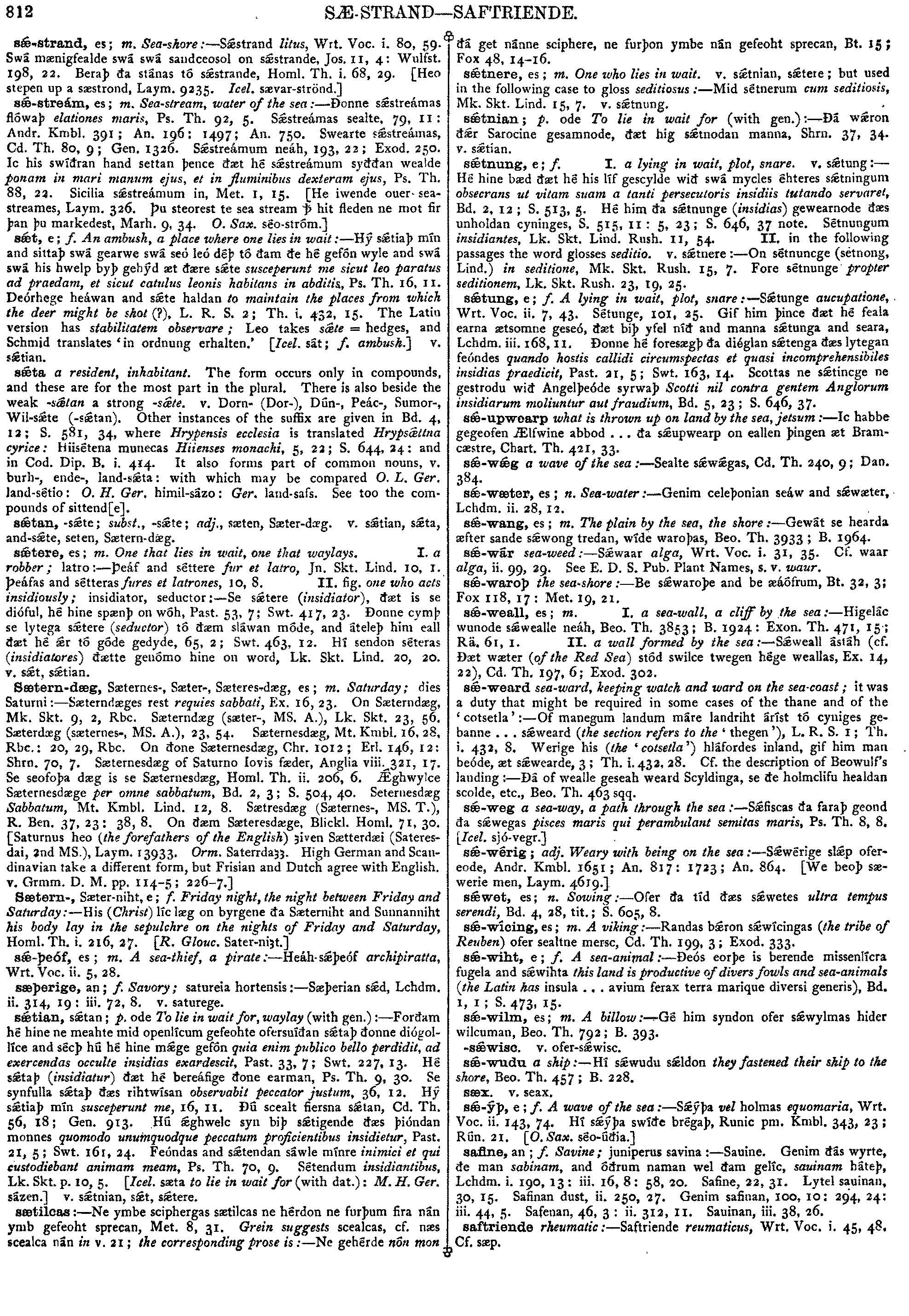
s -upwoarp
what
is
thrown
up
on
land
by
the
sea,
jetsum
:--
Ic
habbe
gegeofen
Ælfwine
abbod
.
.
.
ða
supwearp
on
eallen
þingen
æt
Bramcæstre,
Chart.
Th.
421,
33.
-upwoarp
what
is
thrown
up
on
land
by
the
sea,
jetsum
:--
Ic
habbe
gegeofen
Ælfwine
abbod
.
.
.
ða
supwearp
on
eallen
þingen
æt
Bramcæstre,
Chart.
Th.
421,
33.
|
Source: Bosworth/Toller, page b0834, entry 16 View original page image as: [TIFF] [PNG] [View previous entry] [View next entry] |
[Comment on this entry] [View comments] |
The following entry has been hand-corrected once. |
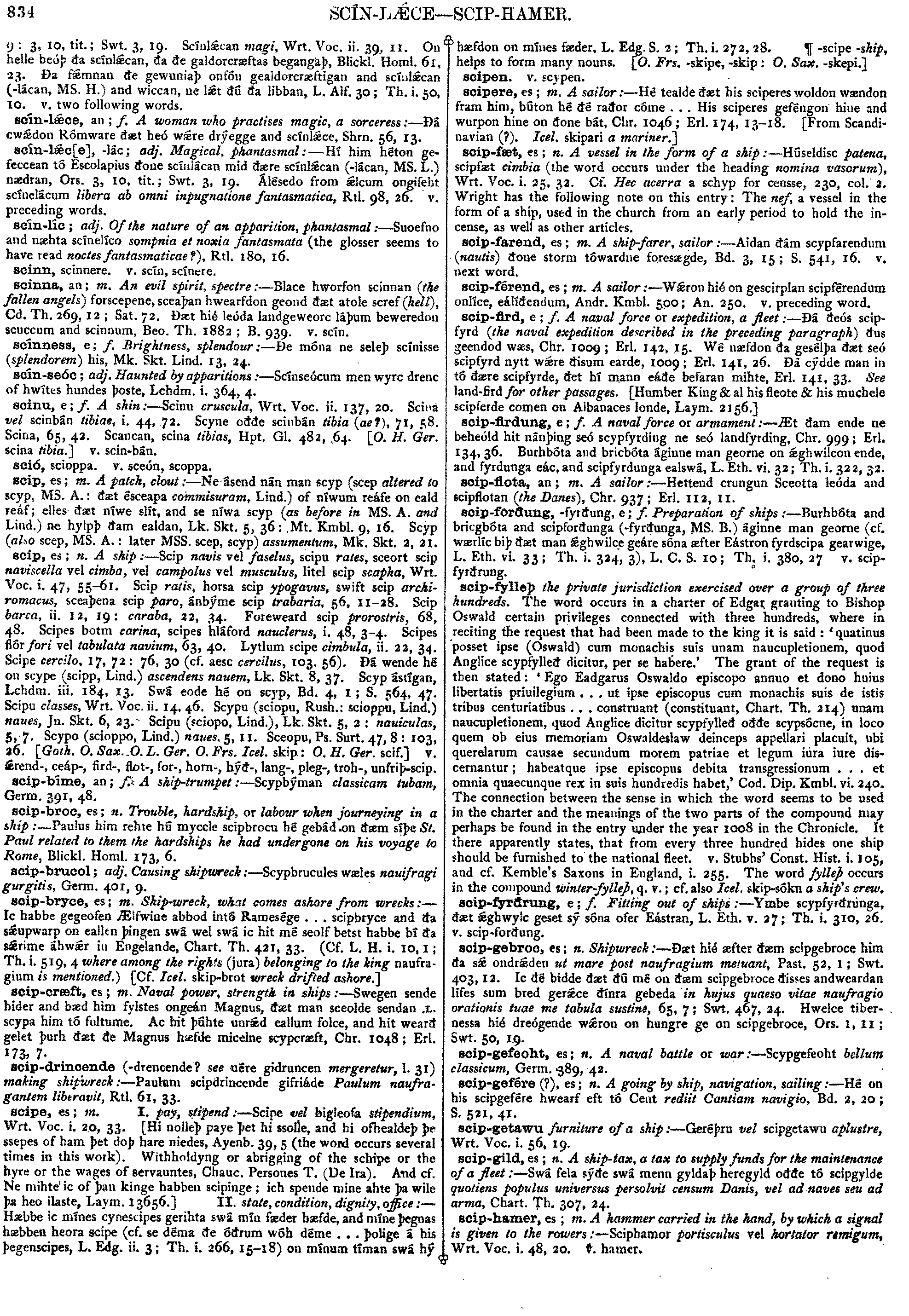
scip-bryce,
es;
m.
Ship-wreck,
what
comes
ashore
from
wrecks:--Ic
habbe
gegeofen
Ælfwine
abbod
intó
Ramesége
.
.
.
scipbryce
and
ða
supwarp
on
eallen
þingen
swá
wel
swá
ic
hit
mé
seolf
betst
habbe
bí
ða
srime
áhwr
in
Engelande,
Chart.
Th.
421,
33.
(Cf.
L.
H.
i.
10,
1;
Th.
i.
519,
4
where
among
the
rights
(jura)
belonging
to
the
king
naufragium
is
mentioned.)
[Cf.
Icel.
skip-brot
wreck
drifted
ashore.]
|
Source: Bosworth/Toller, page b0893, entry 22 View original page image as: [TIFF] [PNG] [View previous entry] [View next entry] |
[Comment on this entry] [View comments] |
The following entry has been hand-corrected once. |
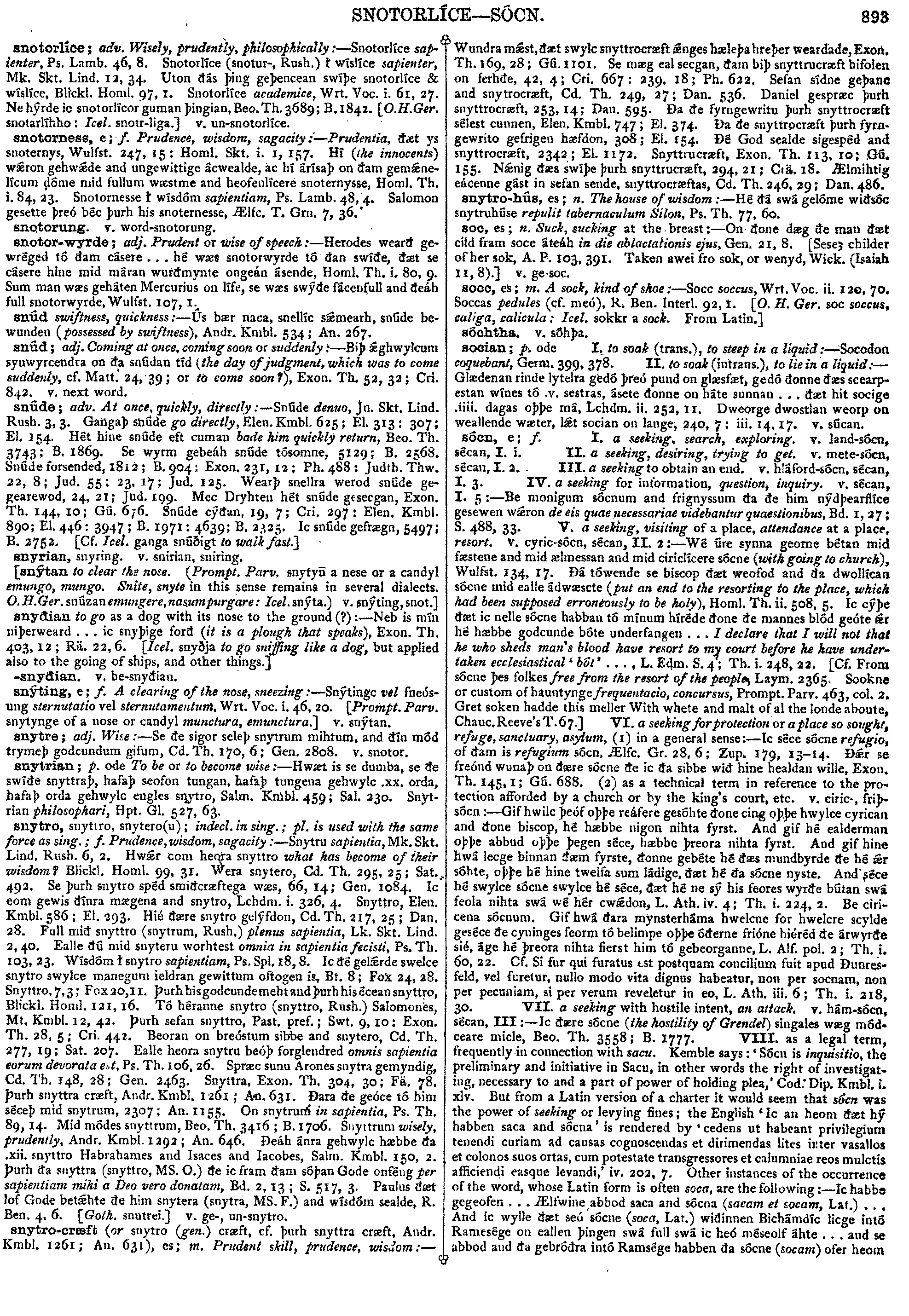
sócn,
e;
f.
I.
a
seeking,
search,
exploring.
v.
land-sócn,
sécan,
I.
1.
II.
a
seeking,
desiring,
trying
to
get.
v.
mete-sócn,
sécan,
I.
2.
III.
a
seeking
to
obtain
an
end.
v.
hláford-sócn,
sécan,
I.
3.
IV.
a
seeking
for
information,
question,
inquiry,
v.
sécan,
I.
5:--Be
monigum
sócnum
and
frignyssum
ða
ðe
him
nýdþearflíce
gesewen
wron
de
eis
quae
necessariae
videbantur
quaestionibus,
Bd.
1,
27;
S.
488,
33.
V.
a
seeking,
visiting
of
a
place,
attendance
at
a
place,
resort.
v.
cyric-sócn,
sécan,
II.
2:--Wé
úre
synna
georne
bétan
mid
fæstene
and
mid
ælmessan
and
mid
ciriclícere
sócne
(with
going
to
church),
Wulfst.
134,
17.
Ðá
tówende
se
biscop
ðæt
weofod
and
ða
dwollícan
sócne
mid
ealle
ádwæscte
(put
an
end
to
the
resorting
to
the
place,
which
had
been
supposed
erroneously
to
be
holy),
Homl.
Th.
ii.
508,
5.
Ic
cýþe
ðæt
ic
nelle
sócne
habban
tó
mínum
híréde
ðone
ðe
mannes
blód
geóte
r
hé
hæbbe
godcunde
bóte
underfangen
.
.
.
I
declare
that
I
will
not
that
he
who
sheds
man's
blood
have
resort
to
my
court
before
he
have
undertaken
ecclesiastical
'bót'
.
.
.
,
L.
Edm.
S.
4;
Th.
i.
248,
22.
[Cf.
From
sócne
þes
folkes
free
from
the
resort
of
the
people,)
Laym.
2365.
Sookne
or
custom
of
hauntynge
frequentacio,
concursus,
Prompt.
Parv.
463,
col.
2.
Gret
soken
hadde
this
meller
With
whete
and
malt
of
al
the
londe
aboute,
Chauc.Reeve's
T.
67.]
VI.
a
seeking
for
protection
or
a
place
so
sought,
refuge,
sanctuary,
asylum,
(1)
in
a
general
sense:--Ic
séce
sócne
refugio,
of
ðam
is
refugium
sócn,
Ælfc.
Gr.
28,
6;
Zup.
179,
13-14.
Ðr
se
freónd
wunaþ
on
ðære
sócne
ðe
ic
ða
sibbe
wið
hine
healdan
wille,
Exon.
Th.
145,
1;
Gú.
688.
(2)
as
a
technical
term
in
reference
to
the
protection
afforded
by
a
church
or
by
the
king's
court,
etc.
v.
ciric-,
friþ-sócn:--Gif
hwilc
þeóf
oþþe
reáfere
gesóhte
ðone
cing
oþþe
hwylce
cyrican
and
ðone
biscop,
hé
hæbbe
nigon
nihta
fyrst.
And
gif
hé
ealderman
oþþe
abbud
oþþe
þegen
séce,
hæbbe
þreora
nihta
fyrst.
And
gif
hine
hwá
lecge
binnan
ðæm
fyrste,
ðonne
gebéte
hé
ðæs
mundbyrde
ðe
hé
r
sóhte,
oþþe
hé
hine
twelfa
sum
ládige,
ðæt
hé
ða
sócne
nyste.
And
séce
hé
swylce
sócne
swylce
hé
séce,
ðæt
hé
ne
sý
his
feores
wyrðe
bútan
swá
feola
nihta
swá
wé
hér
cwdon,
L.
Ath.
iv.
4;
Th.
i.
224,
2.
Be
ciricena
sócnum.
Gif
hwá
ðara
mynsterháma
hwelcne
for
hwelcre
scylde
geséce
ðe
cyninges
feorm
tó
belimpe
oþþe
óðerne
frióne
hiéréd
ðe
árwyrðe
sié,
áge
hé
þreora
nihta
fierst
him
tó
gebeorganne,
L.
Alf.
pol.
2;
Th.
i.
60,
22.
Cf.
Si
fur
qui
furatus
est
postquam
concilium
fuit
apud
Ðunres feld,
vel
furetur,
nullo
modo
vita
dignus
habeatur,
non
per
socnam,
non
per
pecuniam,
si
per
verum
reveletur
in
eo,
L.
Ath.
iii.
6;
Th.
i.
218,
30.
VII.
a
seeking
with
hostile
intent,
an
attack,
v.
hám-sócn,
sécan,
III:--Ic
ðære
sócne
(the
hostility
of
Grendel)
singales
wæg
módceare
micle,
Beo.
Th.
3558;
B.
1777.
VIII.
as
a
legal
term,
frequently
in
connection
with
sacu.
Kemble
says:'Sócn
is
inquisitio,
the
preliminary
and
initiative
in
Sacu,
in
other
words
the
right
of
investigating,
necessary
to
and
a
part
of
power
of
holding
plea,'
Cod.
Dip.
Kmbl.
i.
xlv.
But
from
a
Latin
version
of
a
charter
it
would
seem
that
sócn
was
the
power
of
seeking
or
levying
fines;
the
English
'Ic
an
heom
ðæt
hý
habben
saca
and
sócna'
is
rendered
by
'cedens
ut
habeant
privilegium
tenendi
curiam
ad
causas
cognoscendas
et
dirimendas
lites
inter
vasallos
et
colonos
suos
ortas,
cum
potestate
transgressores
et
calumniae
reos
mulctis
afficiendi
easque
levandi,'
iv.
202,
7.
Other
instances
of
the
occurrence
of
the
word,
whose
Latin
form
is
often
soca,
are
the
following:--Ic
habbe
gegeofen
.
.
.
Ælfwine
abbod
saca
and
sócna
(sacam
et
socam,
Lat.)
.
.
.
And
ic
wylle
ðæt
seó
sócne
(soca,
Lat.)
wiðinnen
Bichámdíc
licge
intó
Ramesége
on
eallen
þingen
swá
full
swá
ic
heó
méseolf
áhte
.
.
.
and
se
abbod
and
ða
gebróðra
intó
Ramsége
habben
ða
sócne
(socam)
ofer
heom
feld,
vel
furetur,
nullo
modo
vita
dignus
habeatur,
non
per
socnam,
non
per
pecuniam,
si
per
verum
reveletur
in
eo,
L.
Ath.
iii.
6;
Th.
i.
218,
30.
VII.
a
seeking
with
hostile
intent,
an
attack,
v.
hám-sócn,
sécan,
III:--Ic
ðære
sócne
(the
hostility
of
Grendel)
singales
wæg
módceare
micle,
Beo.
Th.
3558;
B.
1777.
VIII.
as
a
legal
term,
frequently
in
connection
with
sacu.
Kemble
says:'Sócn
is
inquisitio,
the
preliminary
and
initiative
in
Sacu,
in
other
words
the
right
of
investigating,
necessary
to
and
a
part
of
power
of
holding
plea,'
Cod.
Dip.
Kmbl.
i.
xlv.
But
from
a
Latin
version
of
a
charter
it
would
seem
that
sócn
was
the
power
of
seeking
or
levying
fines;
the
English
'Ic
an
heom
ðæt
hý
habben
saca
and
sócna'
is
rendered
by
'cedens
ut
habeant
privilegium
tenendi
curiam
ad
causas
cognoscendas
et
dirimendas
lites
inter
vasallos
et
colonos
suos
ortas,
cum
potestate
transgressores
et
calumniae
reos
mulctis
afficiendi
easque
levandi,'
iv.
202,
7.
Other
instances
of
the
occurrence
of
the
word,
whose
Latin
form
is
often
soca,
are
the
following:--Ic
habbe
gegeofen
.
.
.
Ælfwine
abbod
saca
and
sócna
(sacam
et
socam,
Lat.)
.
.
.
And
ic
wylle
ðæt
seó
sócne
(soca,
Lat.)
wiðinnen
Bichámdíc
licge
intó
Ramesége
on
eallen
þingen
swá
full
swá
ic
heó
méseolf
áhte
.
.
.
and
se
abbod
and
ða
gebróðra
intó
Ramsége
habben
ða
sócne
(socam)
ofer
heom
|
Source: Bosworth/Toller, page d0217, entry 30 View original page image as: [TIFF] [PNG] [View previous entry] [View next entry] |
[Comment on this entry] [View comments] |
The following entry has been hand-corrected once. |
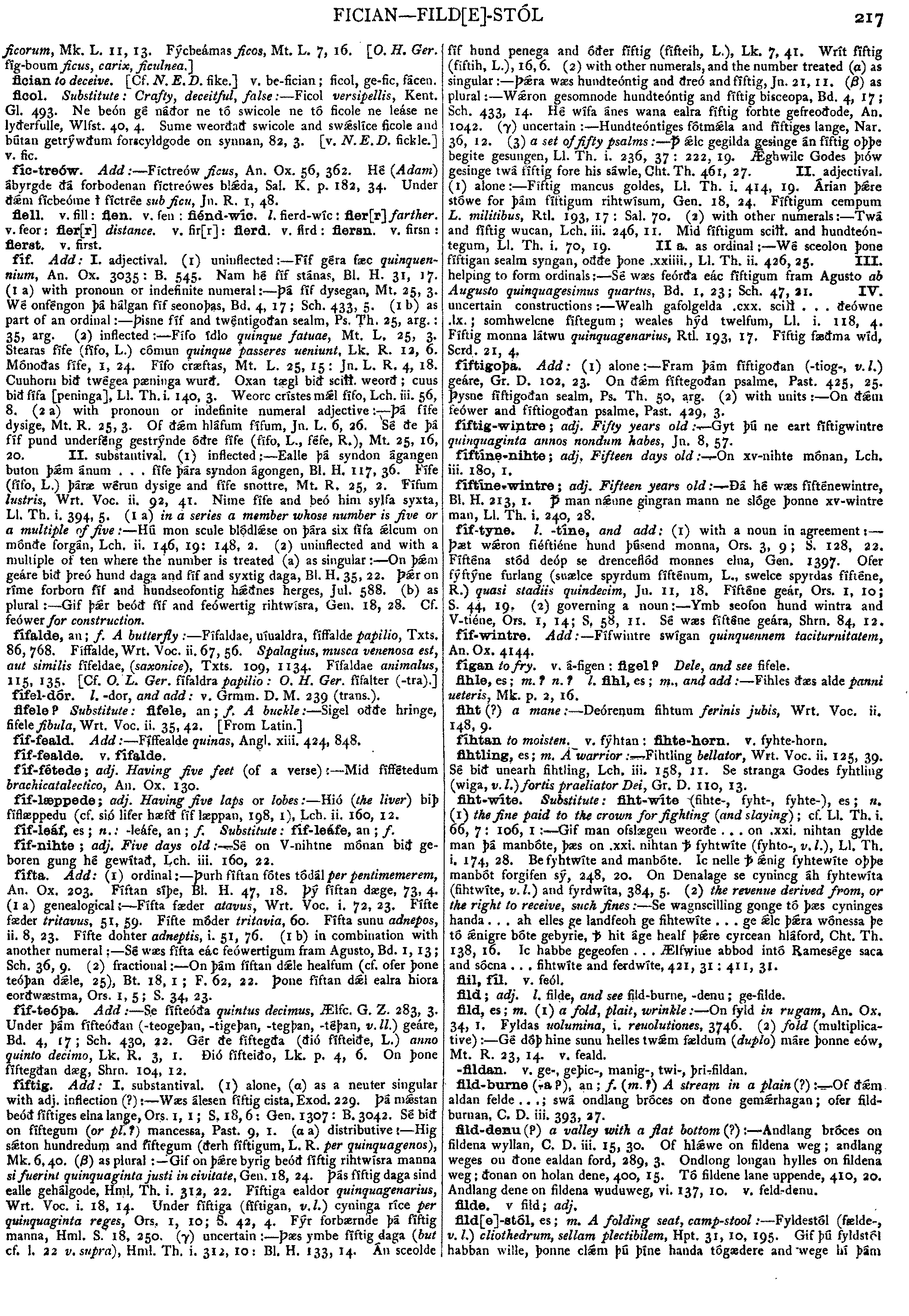
fiht-wíte.
Substitute:
fiht-wíte
(fihte-,
fyht-,
fyhte-),
es;
n.
(1)
the
fine
paid
to
the
crown
for
fighting
(and
slaying);
cf.
Ll.
Th.
i.
66,
7:
106,
1:--Gif
man
ofslægen
weorðe
.
.
.
on
.xxi.
nihtan
gylde
man
þá
manbóte,
þæs
on
.xxi.
nihtan
 fyhtwíte
(fyhto-,
v.
l.),
Ll.
Th.
i.
174,
28.
Be
fyhtwíte
and
manbóte.
Ic
nelle
nig
fyhtewíte
oþþe
manbót
forgifen
sý,
248,
20.
On
Denalage
se
cynincg
áh
fyhtewíta
(fihtwíte,
v.
l.)
and
fyrdwíta,
384,
5.
(2)
the
revenue
derived
from,
or
the
right
to
receive,
such
fines:--Se
wagnscilling
gonge
tó
þæs
cyninges
handa
.
.
.
ah
elles
ge
landfeoh
ge
fihtewíte
.
.
.
ge
lc
þra
wónessa
þe
tó
nigre
bóte
gebyrie,
hit
áge
healf
þre
cyrcean
hláford,
Cht.
Th.
138,
16.
Ic
habbe
gegeofen
.
.
.
Ælfwine
abbod
intó
Ramesége
saca
and
sócna
.
.
.
fihtwíte
and
ferdwíte,
421,
31:
411,
31.
fyhtwíte
(fyhto-,
v.
l.),
Ll.
Th.
i.
174,
28.
Be
fyhtwíte
and
manbóte.
Ic
nelle
nig
fyhtewíte
oþþe
manbót
forgifen
sý,
248,
20.
On
Denalage
se
cynincg
áh
fyhtewíta
(fihtwíte,
v.
l.)
and
fyrdwíta,
384,
5.
(2)
the
revenue
derived
from,
or
the
right
to
receive,
such
fines:--Se
wagnscilling
gonge
tó
þæs
cyninges
handa
.
.
.
ah
elles
ge
landfeoh
ge
fihtewíte
.
.
.
ge
lc
þra
wónessa
þe
tó
nigre
bóte
gebyrie,
hit
áge
healf
þre
cyrcean
hláford,
Cht.
Th.
138,
16.
Ic
habbe
gegeofen
.
.
.
Ælfwine
abbod
intó
Ramesége
saca
and
sócna
.
.
.
fihtwíte
and
ferdwíte,
421,
31:
411,
31.
|
Source: Bosworth/Toller, page d0488, entry 18 View original page image as: [TIFF] [PNG] [View previous entry] [View next entry] |
[Comment on this entry] [View comments] |
The following entry has been hand-corrected once. |
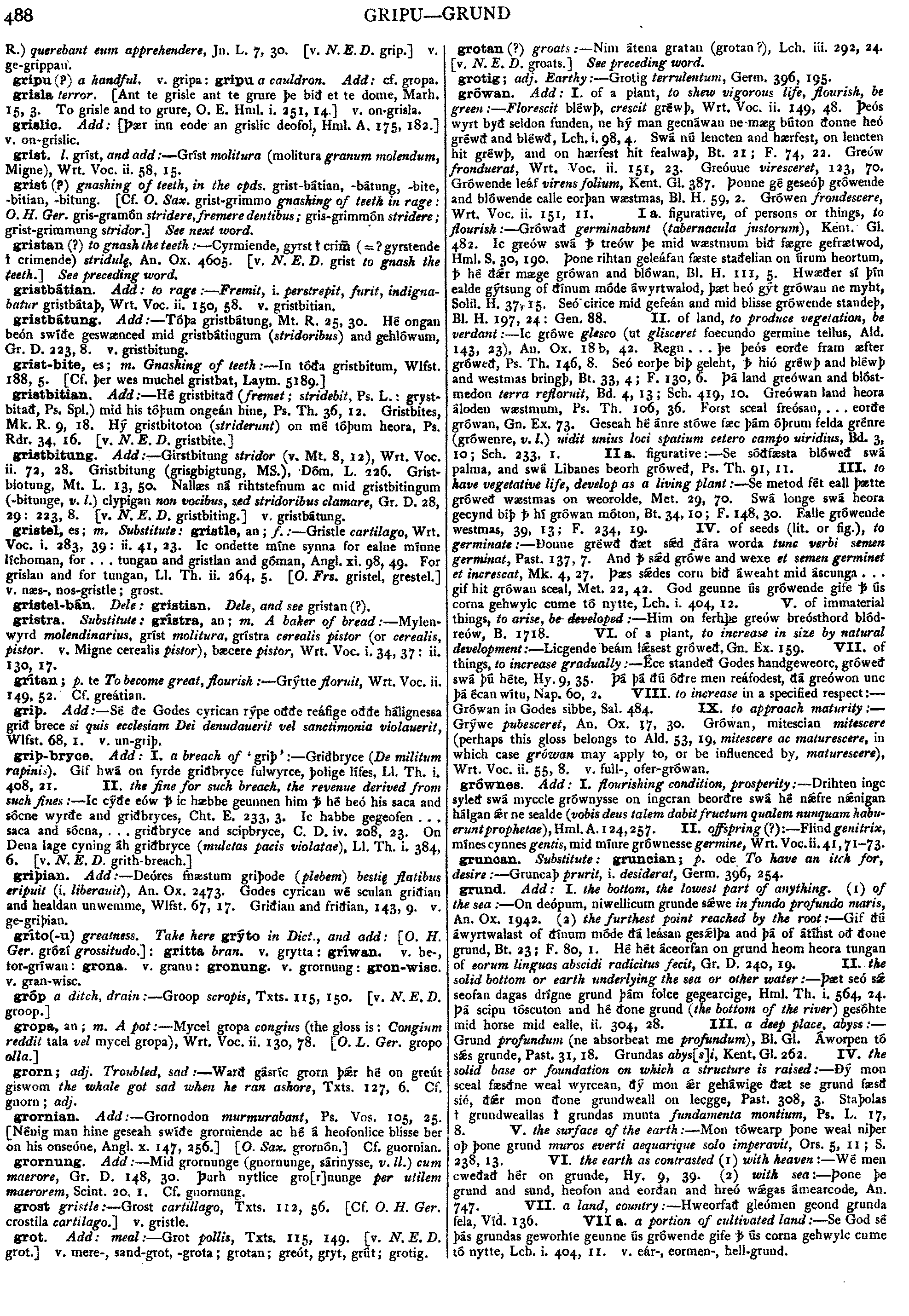
griþ-bryce.
Add:
I.
a
breach
of
'griþ'
:--
Griðbryce
(De
militum
rapinis).
Gif
hwá
on
fyrde
griðbryce
fulwyrce,
þolige
lífes,
Ll.
Th.
i.
408,
21.
II.
the
fine
for
such
breach,
the
revenue
derived
from
such
fines
:--
Ic
cýðe
eów
ic
hæbbe
geunnen
him
hé
beó
his
saca
and
sócne
wyrðe
and
griðbryces,
Cht.
E.
233,
3.
Ic
habbe
gegeofen
...
saca
and
sócna,
...
griðbryce
and
scipbryce,
C.
D.
iv.
208,
23.
On
Dena
lage
cyning
áh
griðbryce
(mulctas
pacis
violatae),
Ll.
Th.
i.
384,
6.
[v.
N.
E.
D.
grith-breach.]
Germanic Lexicon Project (main page)
This search system was written by
Sean Crist
Please consider
volunteering
to correct the data in these online dictionaries.
No rights reserved. Feel free to use these data in any way you please.