|
|

|
Source: Torp, page b0035, entry 6 View original page image as: [TIFF] [PNG] [View previous entry] [View next entry] |
[Comment on this entry] [View comments] |
The following entry has been hand-corrected once. |
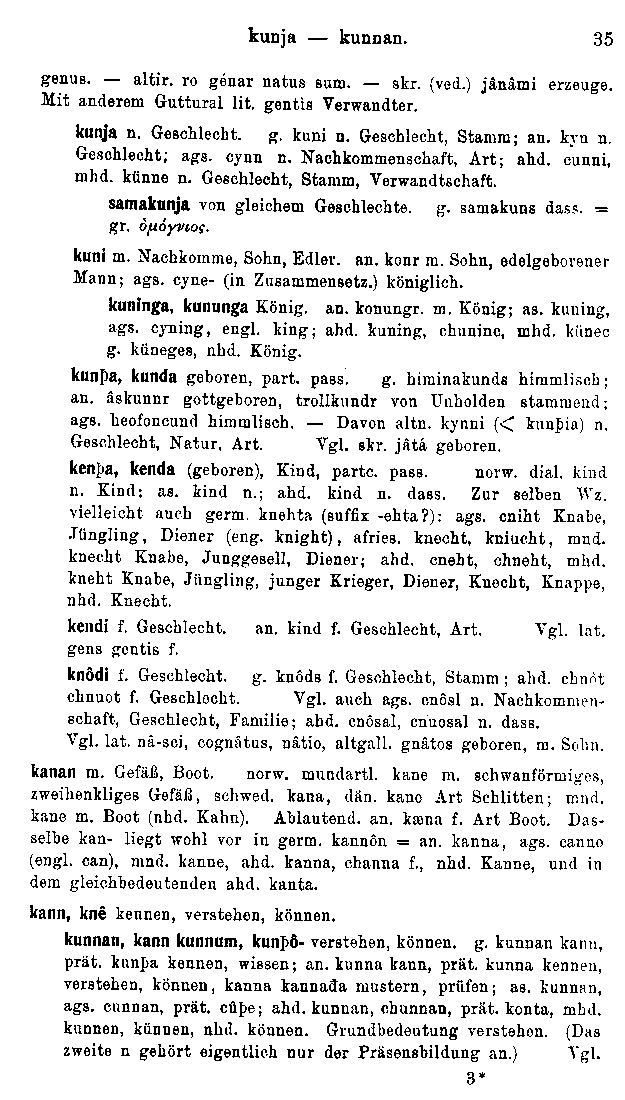
kunþa, kunda geboren, part. pass. g. himinakunds himmlisch; an. âskunnr gottgeboren, trollkundr von Unholden stammend; ags. heofoncund himmlisch. - Davon altn. kynni (< kunþia) n. Geschlecht, Natur, Art. Vgl. skr. jâtá geboren.
[Translate the German words]
|
Source: Torp, page b0035, entry 7 View original page image as: [TIFF] [PNG] [View previous entry] [View next entry] |
[Comment on this entry] [View comments] |
The following entry has been hand-corrected once. |
kenþa, kenda (geboren), Kind, partc. pass. norw. dial. kind n. Kind; as. kind n.; ahd. kind n. dass. Zur selben Wz. vielleicht auch germ. knehta (suffix -ehta?): ags. cniht Knabe, Jüngling, Diener (eng. knight), afries. knecht, kniucht, mnd. knecht Knabe, Junggesell, Diener; ahd. cneht, chneht, mhd. kneht Knabe, Jüngling, junger Krieger, Diener, Knecht, Knappe, nhd. Knecht.
[Translate the German words]
|
Source: Torp, page b0035, entry 9 View original page image as: [TIFF] [PNG] [View previous entry] [View next entry] |
[Comment on this entry] [View comments] |
The following entry has been hand-corrected once. |
knôdi f. Geschlecht. g. knôds f. Geschlecht, Stamm; ahd. chnôt chnuot f. Geschlecht. Vgl. auch ags. cnôsl n. Nachkommenschaft, Geschlecht, Familie; ahd. cnôsal, cnuosal n. dass. Vgl. lat. nâ-sci, cognâtus, nâtio, altgall. gnâtos geboren, m. Sohn.
[Translate the German words]
|
Source: Torp, page b0043, entry 11 View original page image as: [TIFF] [PNG] [View previous entry] [View next entry] |
[Comment on this entry] [View comments] |
The following entry has been hand-corrected once. |
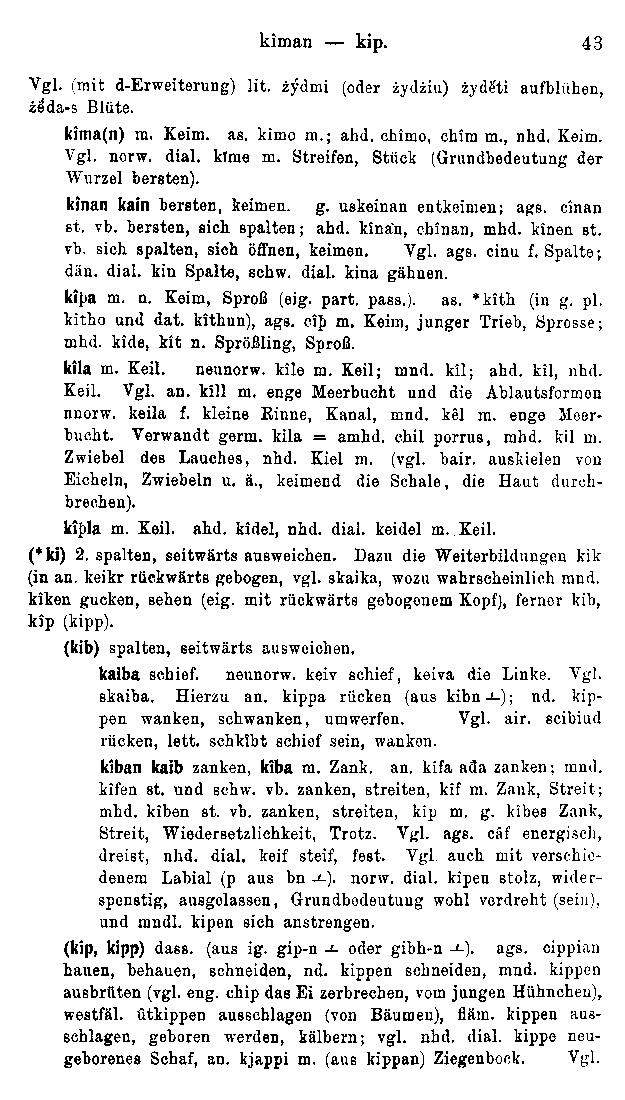
(kip,
kipp)
dass.
(aus
ig.
gip-n
 oder
gibh-n
).
ags.
cippian
hauen,
behauen,
schneiden,
nd.
kippen
schneiden,
mnd.
kippen
ausbrüten
(vgl.
eng.
chip
das
Ei
zerbrechen,
vom
jungen
Hühnchen),
westfäl.
ûtkippen
ausschlagen
(von
Bäumen),
fläm.
kippen
ausschlagen,
geboren
werden,
kälbern;
vgl.
nhd.
dial.
kippe
neugeborenes
Schaf,
an.
kjappi
m.
(aus
kippan)
Ziegenbock.
Vgl.
oder
gibh-n
).
ags.
cippian
hauen,
behauen,
schneiden,
nd.
kippen
schneiden,
mnd.
kippen
ausbrüten
(vgl.
eng.
chip
das
Ei
zerbrechen,
vom
jungen
Hühnchen),
westfäl.
ûtkippen
ausschlagen
(von
Bäumen),
fläm.
kippen
ausschlagen,
geboren
werden,
kälbern;
vgl.
nhd.
dial.
kippe
neugeborenes
Schaf,
an.
kjappi
m.
(aus
kippan)
Ziegenbock.
Vgl.

 piti
spalten,
Mit
s-
:
lett.
schkib
piti
spalten,
Mit
s-
:
lett.
schkib t
hatten,
schneiden,
lat.
scîpio,
gr.
[ski'pwn]
Stab,
[skoi=pos]
Töpferscheibe.
Vgl.
skaib.
t
hatten,
schneiden,
lat.
scîpio,
gr.
[ski'pwn]
Stab,
[skoi=pos]
Töpferscheibe.
Vgl.
skaib.
[Translate the German words]
|
Source: Torp, page b0380, entry 3 View original page image as: [TIFF] [PNG] [View previous entry] [View next entry] |
[Comment on this entry] [View comments] |
The following entry has been hand-corrected once. |
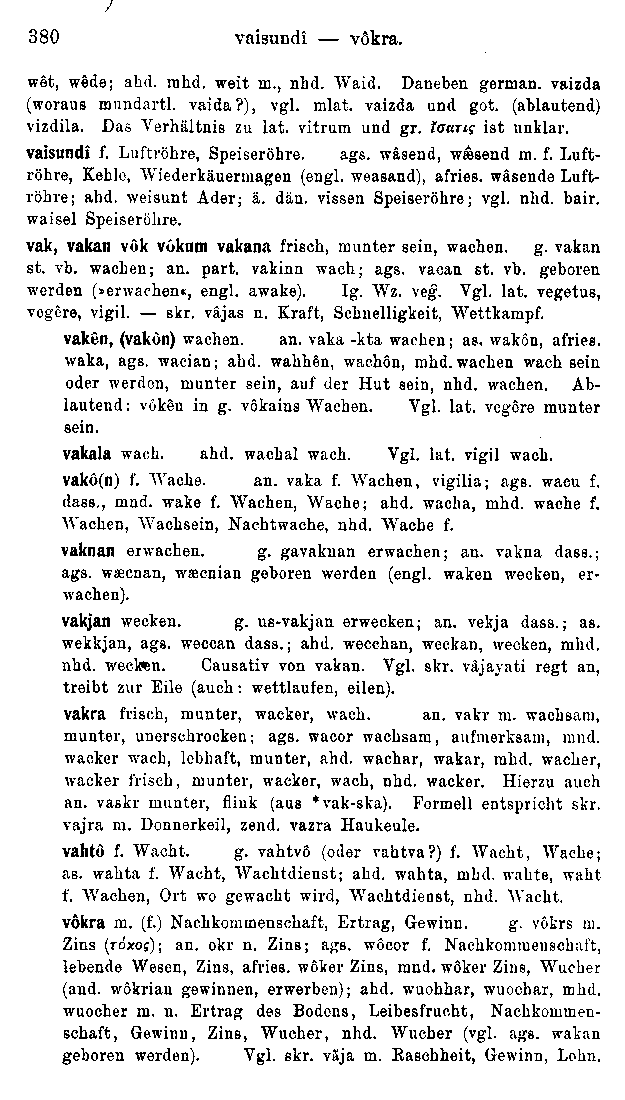
vak,
vakan
vôk
vôkum
vakana
frisch,
munter
sein,
wachen.
g.
vakan
st.
vb.
wachen;
an.
part.
vakinn
wach;
ags.
vacan
st.
vb.
geboren
werden
(»erwachen«,
engl.
awake).
Ig.
Wz.
ve .
Vgl.
lat.
vegetus,
vegêre,
vigil.
-
skr.
vâjas
n.
Kraft,
Schnelligkeit,
Wettkampf.
.
Vgl.
lat.
vegetus,
vegêre,
vigil.
-
skr.
vâjas
n.
Kraft,
Schnelligkeit,
Wettkampf.
[Translate the German words]
|
Source: Torp, page b0380, entry 7 View original page image as: [TIFF] [PNG] [View previous entry] [View next entry] |
[Comment on this entry] [View comments] |
The following entry has been hand-corrected once. |
vaknan erwachen. g. gavaknan erwachen; an. vakna dass.; ags. wæcnan, wæcnian geboren werden (engl. waken wecken, erwachen).
[Translate the German words]
|
Source: Torp, page b0380, entry 11 View original page image as: [TIFF] [PNG] [View previous entry] [View next entry] |
[Comment on this entry] [View comments] |
The following entry has been hand-corrected once. |
vôkra
m.
(f.)
Nachkommenschaft,
Ertrag,
Gewinn.
g.
vôkrs
m.
Zins
([to'kos]);
an.
okr
n.
Zins;
ags.
wôcor
f.
Nachkommenschaft,
lebende
Wesen,
Zins,
afries.
wôker
Zins,
mnd.
wôker
Zins,
Wucher
(and.
wôkrian
gewinnen,
erwerben);
ahd.
wuohhar,
wuochar,
mhd.
wuocher
m.
n.
Ertrag
des
Bodens,
Leibesfrucht,
Nachkommenschaft,
Gewinn,
Zins,
Wucher,
nhd.
Wucher
(vgl.
ags.
wakan
geboren
werden).
Vgl.
skr.
v ja
m.
Raschheit,
Gewinn,
Lohn.
ja
m.
Raschheit,
Gewinn,
Lohn.
[Translate the German words]
|
Source: Torp, page b0441, entry 10 View original page image as: [TIFF] [PNG] [View previous entry] [View next entry] |
[Comment on this entry] [View comments] |
The following entry has been hand-corrected once. |

(su)
2.
zeugen.
Vgl.
skr.
s te,
sâuti,
sûyate
erzeugt,
gebärt,
sû-
Erzeuger,
sutá
geboren,
Sohn
-
ir.
suth
Geburt,
Frucht.
te,
sâuti,
sûyate
erzeugt,
gebärt,
sû-
Erzeuger,
sutá
geboren,
Sohn
-
ir.
suth
Geburt,
Frucht.
[Translate the German words]
|
Source: Bosworth/Toller, page b0011, entry 16 View original page image as: [TIFF] [PNG] [View previous entry] [View next entry] |
[Comment on this entry] [View comments] |
The following entry has been hand-corrected once. |
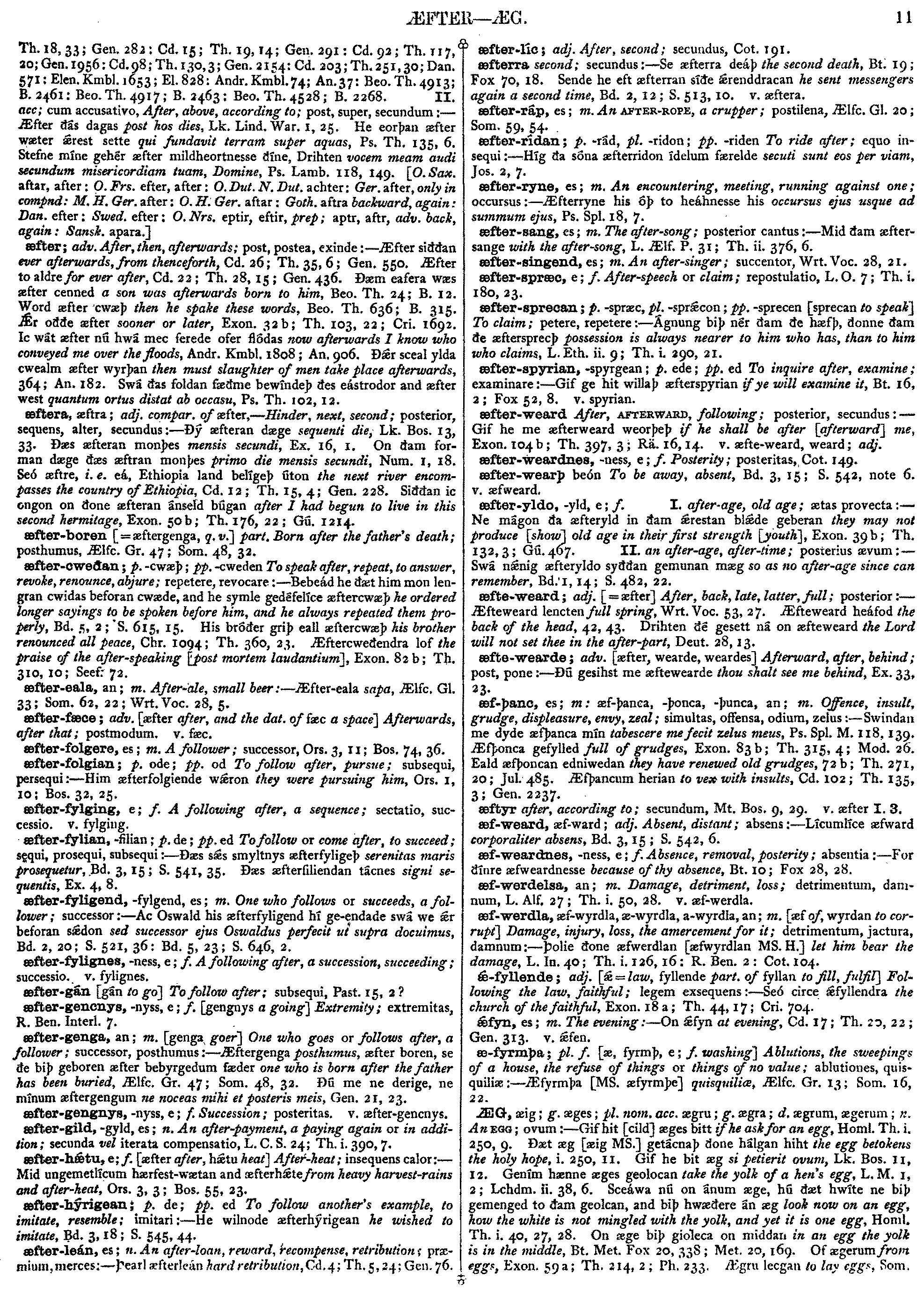
æfter-genga, an; m. [genga goer] One who goes or follows after, a follower; successor, posthumus :-- Æftergenga posthumus, æfter boren, se ðe biþ geboren æfter bebyrgedum fæder one who is born after the father has been buried, Ælfc. Gr. 47; Som. 48, 32. Ðú me ne derige, ne mínum æftergengum ne noceas mihi et posteris meis, Gen. 21, 23.
|
Source: Bosworth/Toller, page b0015, entry 35 View original page image as: [TIFF] [PNG] [View previous entry] [View next entry] |
[Comment on this entry] [View comments (2)] |
The following entry has been hand-corrected once. |
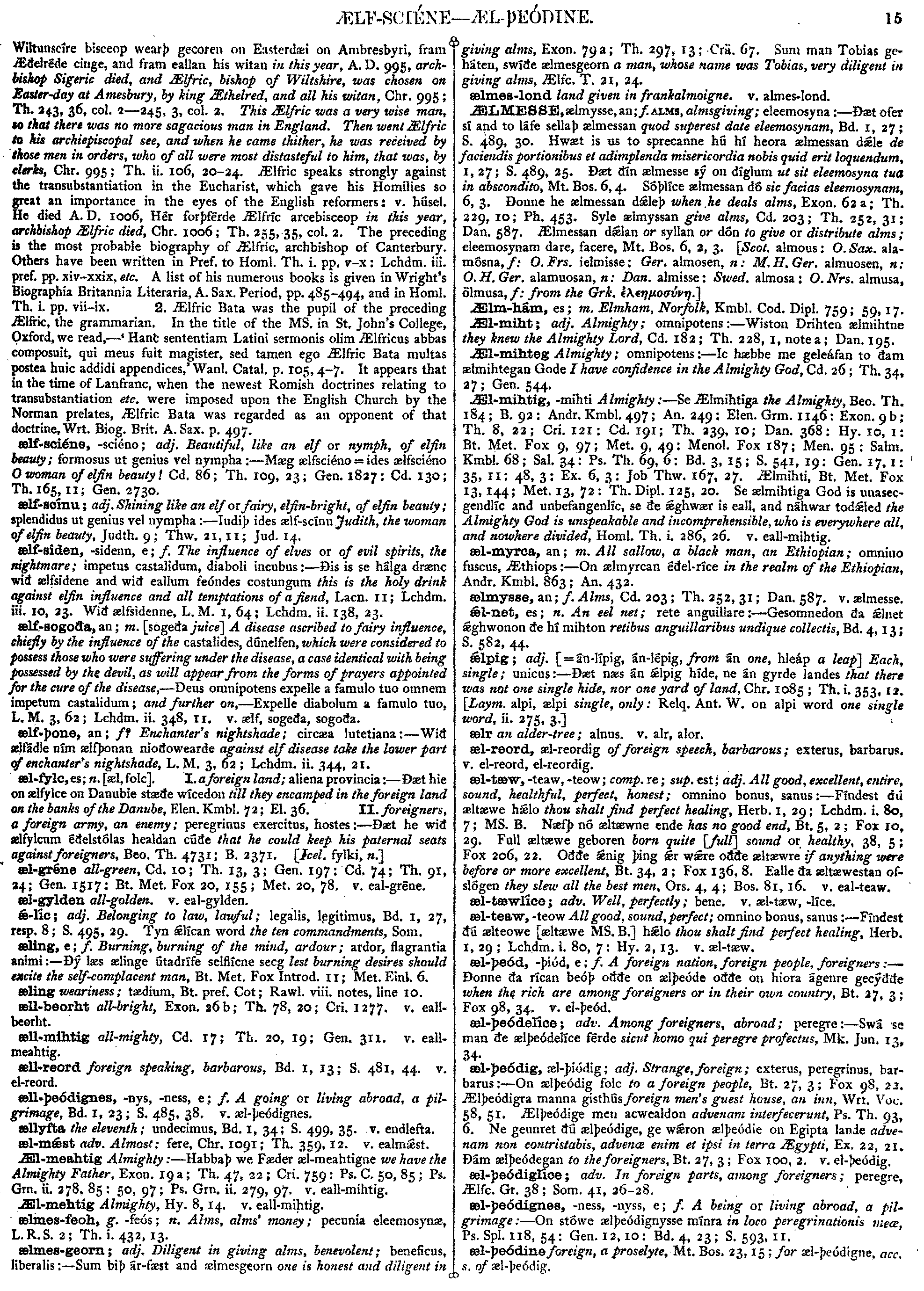
æl-tæw,
-teaw,
-teow;
comp.
re;
sup.
est;
adj.
All
good,
excellent,
entire,
sound,
healthful,
perfect,
honest;
omnino
bonus,
sanus
:--
Fíndest
ðu
æltæwe
h lo
thou
shall
find
perfect
healing.
Herb.
1,
29;
Lchdm,
i.
80,
7;
MS.
B.
Næfþ
nó
æltæwne
ende
has
no
good
end,
Bt.
5,
2;
Fox
10,
29.
Full
æltæwe
geboren
born
quite
[full]
sound
or
healthy,
38,
5;
Fox
206,
22.
Oððe
nig
þing
r
wre
oðíe
æltæwre
if
anything
were
before
or
more
excellent,
Bt.
34,
2;
Fox
136,
8.
Ealle
ða
æltæwestan
of-slógen
they
slew
all
the
best
men,
Ors.
4,
4;
Bos.
81,
16.
v.
eal-teaw.
lo
thou
shall
find
perfect
healing.
Herb.
1,
29;
Lchdm,
i.
80,
7;
MS.
B.
Næfþ
nó
æltæwne
ende
has
no
good
end,
Bt.
5,
2;
Fox
10,
29.
Full
æltæwe
geboren
born
quite
[full]
sound
or
healthy,
38,
5;
Fox
206,
22.
Oððe
nig
þing
r
wre
oðíe
æltæwre
if
anything
were
before
or
more
excellent,
Bt.
34,
2;
Fox
136,
8.
Ealle
ða
æltæwestan
of-slógen
they
slew
all
the
best
men,
Ors.
4,
4;
Bos.
81,
16.
v.
eal-teaw.
| Result Page: | 1 2 3 4 5 6 7 8 | Next |  |
Germanic Lexicon Project (main page)
This search system was written by
Sean Crist
Please consider
volunteering
to correct the data in these online dictionaries.
No rights reserved. Feel free to use these data in any way you please.