|
|

|
Source: Cleasby/Vigfusson, page b0729, entry 2 View original page image as: [TIFF] [PNG] [View previous entry] [View next entry] |
[Comment on this entry] [View comments] |
The following entry has been hand-corrected once. |
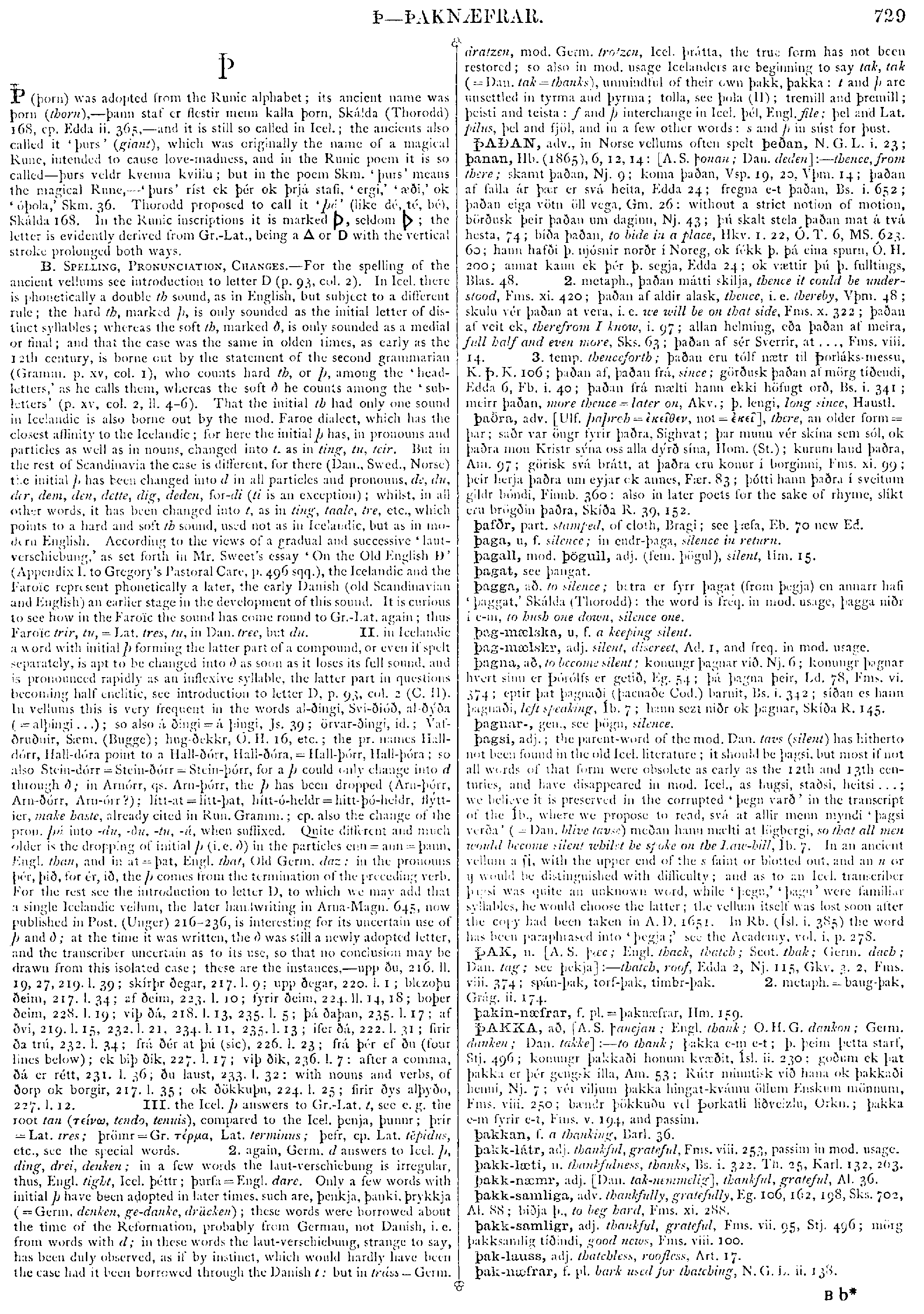
Þ
(þorn)
was
adopted
from
the
Runic
alphabet;
its
ancient
name
was
þorn
(thorn),
--
þann
staf
er
flestir
menn
kalla
þorn,
Skálda
(Thorodd)
168,
cp.
Edda
ii.
365,
--
and
it
is
still
so
called
in
Icel.;
the
ancients
also
called
it
'þurs'
(giant),
which
was
originally
the
name
of
a
magical
Rune,
intended
to
cause
love-madness,
and
in
the
Runic
poem
it
is
so
called
--
þurs
veldr
kvenna
kvillu;
but
in
the
poem
Skm.
'þurs'
means
the
magical
Rune,
--
'þurs'
ríst
ek
þér
ok
þrjá
stafi,
'ergi,'
'æði,'
ok
'óþola,'
Skm.
36.
Thorodd
proposed
to
call
it
'þé'
(like
dé,
té,
bé),
Skálda
168.
In
the
Runic
inscriptions
it
is
marked
RUNE,
seldom
RUNE;
the
letter
is
evidently
derived
from
Gr.-Lat.,
being
a
RUNE
or
RUNE
with
the
vertical
stroke
prolonged
both
ways.
B.
SPELLING,
PRONUNCIATION,
CHANGES.
--
For
the
spelling
of
the
ancient
vellums
see
introduction
to
letter
D
(p.
93,
col.
2).
In
Icel.
there
is
phonetically
a
double
th
sound,
as
in
English,
but
subject
to
a
different
rule;
the
hard
th,
marked
þ
is
only
sounded
as
the
initial
letter
of
distinct
syllables;
whereas
the
soft
th,
marked
ð
is
only
sounded
as
a
medial
or
final;
and
that
the
case
was
the
same
in
olden
times,
as
early
as
the
12th
century,
is
borne
out
by
the
statement
of
the
second
grammarian
(Gramm.
p.
xv,
col.
1),
who
counts
hard
th,
or
þ,
among
the
'head-letters,'
as
he
calls
them,
whereas
the
soft
ð
he
counts
among
the
'sub-letters'
(p.
xv,
col.
2,
ll.
4-6).
That
the
initial
th
had
only
one
sound
in
Icelandic
is
also
borne
out
by
the
mod.
Faroe
dialect,
which
has
the
closest
affinity
to
the
Icelandic;
for
here
the
initial
þ
has,
in
pronouns
and
particles
as
well
as
in
nouns,
changed
into
t
as
in
ting,
tu,
teir.
But
in
the
rest
of
Scandinavia
the
case
is
different,
for
there
(Dan.,
Swed.,
Norse)
the
initial
þ
has
been
changed
into
d
in
all
particles
and
pronouns,
de,
du,
der,
dem,
den,
dette,
dig,
deden,
for-di
(ti
is
an
exception);
whilst,
in
all
other
words,
it
has
been
changed
into
t,
as
in
ting
taale,
tre,
etc.,
which
points
to
a
hard
and
soft
th
sound,
used
not
as
in
Icelandic,
but
as
in
modern
English.
According
to
the
views
of
a
gradual
and
successive
'laut-verschiebung,'
as
set
forth
in
Mr.
Sweet's
essay
'On
the
Old
English
Ð'
(Appendix
1.
to
Gregory's
Pastoral
Care,
p.
496
sqq.),
the
Icelandic
and
the
Faroïc
represent
phonetically
a
later,
the
early
Danish
(old
Scandinavian
and
English)
an
earlier
stage
in
the
development
of
this
sound.
It
is
curious
to
see
how
in
the
Faroïc
the
sound
has
come
round
to
Gr.-Lat.
again;
thus
Faroïc
trir,
tu,
=
Lat.
tres,
tu,
in
Dan.
tree,
but
du.
II.
in
Icelandic
a
word
with
initial
þ
forming
the
latter
part
of
a
compound,
or
even
if
spelt
separately,
is
apt
to
be
changed
into
ð
as
soon
as
it
loses
its
full
sound,
and
is
pronounced
rapidly
as
an
inflexive
syllable,
the
latter
part
in
questions
becoming
half
enclitic,
see
introduction
to
letter
D,
p.
93,
col.
2
(C.
II).
In
vellums
this
is
very
frequent
in
the
words
al-ðingi,
Svi-ðióð,
al-ðýða
(=
alþingi...);
so
also
á
ðingi
=
á
þingi,
Js.
39;
örvar-ðingi,
id.;
Vaf-ðruðnir,
Sæm.
(Bugge);
hug-ðekkr,
Ó.H.
16,
etc.;
the
pr.
names
Hall-dórr,
Hall-dóra
point
to
a
Hall-ðórr,
Hall-ðóra,
=
Hall-þórr,
Hall-þora;
so
also
Stein-dórr
=
Stein-ðórr
=
Stein-þórr,
for
a
þ
could
only
change
into
d
through
ð;
in
Arnórr,
qs.
Arn-þórr,
the
þ
has
been
dropped
(Arn-þórr,
Arn-ðórr,
Arn-órr?);
lítt-at
=
lítt-þat,
hítt-ó-heldr
=
hitt-þó-heldr,
flýttier,
make
haste,
already
cited
in
Run.
Gramm.;
cp.
also
tlie
change
of
the
pron.
þú
into
-du,
-ðu,
-tu,
-ú,
when
suffixed.
Quite
different
and
much
older
is
the
dropping
of
initial
þ
(i.e.
ð)
in
the
particles
enn
=
ann
=
þann,
Engl.
than,
and
in
at
=
þat,
Engl.
that,
Old
Germ.
daz:
in
the
pronouns
þér,
þið,
for
ér,
ið,
the
þ
comes
from
the
termination
of
the
preceding
verb.
For
the
rest
see
the
introduction
to
letter
D,
to
which
we
may
add
that
a
single
Icelandic
vellum,
the
later
handwriting
in
Arna-Magn.
645,
now
published
in
Post.
(Unger)
216-236,
is
interesting
for
its
uncertain
use
of
þ
and
ð;
at
the
time
it
was
written,
the
ð
was
still
a
newly
adopted
letter,
and
the
transcriber
uncertain
as
to
its
use,
so
that
no
conclusion
may
be
drawn
from
this
isolated
case;
these
are
the
instances,
--
upp
ðu,
216.
ll.
19,
27,
219.
l.
39;
skírþr
ðegar,
217.
l.
9;
upp
ðegar,
220.
l.
1;
blezoþu
ðeim,
217.
l.
34;
af
ðeim,
223.
l.
10;
fyrir
ðeim,
224.
ll.
14,
18;
boþer
ðeim,
228.
l.
19;
viþ
ðú,
218.
l.
13,
235.
l.
5;
þá
ðaþan,
235.
l.
17;
af
ðvi,
219.
l.
15,
232.
l.
21,
234.
l.
11,
235.
l.
13;
ifer
ðá,
222.
l.
31;
firir
ða
trú,
232.
l.
34;
frá
ðér
at
þú
(sic),
226.
l.
23;
frá
þér
ef
ðu
(four
lines
below);
ek
biþ
ðik,
227.
l.
17;
viþ
ðik,
236.
l.
7:
after
a
comma,
ðá
er
rétt,
231.
l.
36;
ðu
laust,
233.
l.
32:
with
nouns
and
verbs,
of
ðorp
ok
borgir,
217.
l.
35;
ok
ðökkuþu,
224.
l.
25;
firir
ðys
alþyðo,
227.
l.
12.
III.
the
Icel.
þ
answers
to
Gr.-Lat.
t,
see
e.g.
the
root
tan
(GREEK)
compared
to
the
Icel,
þenja,
þunnr;
þrir
=
Lat.
tres;
þrömr
=
Gr.
GREEK,
Lat.
terminus;
þefr,
cp.
Lat.
t pidus,
etc.,
see
the
special
words.
2.
again,
Germ.
d
answers
to
Icel.
þ,
ding,
drei,
denken;
in
a
few
words
the
laut-verschiebung
is
irregular,
thus,
Engl.
tight,
Icel.
þéttr;
þurfa
=
Engl.
dare.
Only
a
few
words
with
initial
þ
have
been
adopted
in
later
times,
such
are,
þenkja,
þanki,
þrykkja
(=
Germ.
denken,
ge-danke,
drücken);
these
words
were
borrowed
about
the
time
of
the
Reformation,
probably
from
German,
not
Danish,
i.e.
from
words
with
d;
in
these
words
the
laut-verschiebung,
strange
to
say,
has
been
duly
observed,
as
if
by
instinct,
which
would
hardly
have
been
the
case
had
it
been
borrowed
through
the
Danish
t:
but
in
tráss
=
Germ.
dratzen,
mod.
Germ.
trotzen,
Icel.
þrátta,
tlie
true
form
has
not
been
restored;
so
also
in
mod.
usage
Icelanders
are
beginning
to
say
tak,
tak
(=
Dan.
tak
=
thanks),
unmindful
of
their
own
þakk,
þakka:
t
and
þ
are
unsettled
in
tyrma
and
þyrma;
tolla,
see
þola
(II);
tremill
and
þremill;
þeisti
and
teista:
f
and
þ
interchange
in
Icel.
þél,
Engl.
file;
þel
and
Lat.
pilus,
þel
and
fjöl,
and
in
a
few
other
words:
s
and
þ
in
súst
for
þust.
pidus,
etc.,
see
the
special
words.
2.
again,
Germ.
d
answers
to
Icel.
þ,
ding,
drei,
denken;
in
a
few
words
the
laut-verschiebung
is
irregular,
thus,
Engl.
tight,
Icel.
þéttr;
þurfa
=
Engl.
dare.
Only
a
few
words
with
initial
þ
have
been
adopted
in
later
times,
such
are,
þenkja,
þanki,
þrykkja
(=
Germ.
denken,
ge-danke,
drücken);
these
words
were
borrowed
about
the
time
of
the
Reformation,
probably
from
German,
not
Danish,
i.e.
from
words
with
d;
in
these
words
the
laut-verschiebung,
strange
to
say,
has
been
duly
observed,
as
if
by
instinct,
which
would
hardly
have
been
the
case
had
it
been
borrowed
through
the
Danish
t:
but
in
tráss
=
Germ.
dratzen,
mod.
Germ.
trotzen,
Icel.
þrátta,
tlie
true
form
has
not
been
restored;
so
also
in
mod.
usage
Icelanders
are
beginning
to
say
tak,
tak
(=
Dan.
tak
=
thanks),
unmindful
of
their
own
þakk,
þakka:
t
and
þ
are
unsettled
in
tyrma
and
þyrma;
tolla,
see
þola
(II);
tremill
and
þremill;
þeisti
and
teista:
f
and
þ
interchange
in
Icel.
þél,
Engl.
file;
þel
and
Lat.
pilus,
þel
and
fjöl,
and
in
a
few
other
words:
s
and
þ
in
súst
for
þust.
|
Source: Cleasby/Vigfusson, page b0730, entry 10 View original page image as: [TIFF] [PNG] [View previous entry] [View next entry] |
[Comment on this entry] [View comments] |
The following entry has been hand-corrected once. |
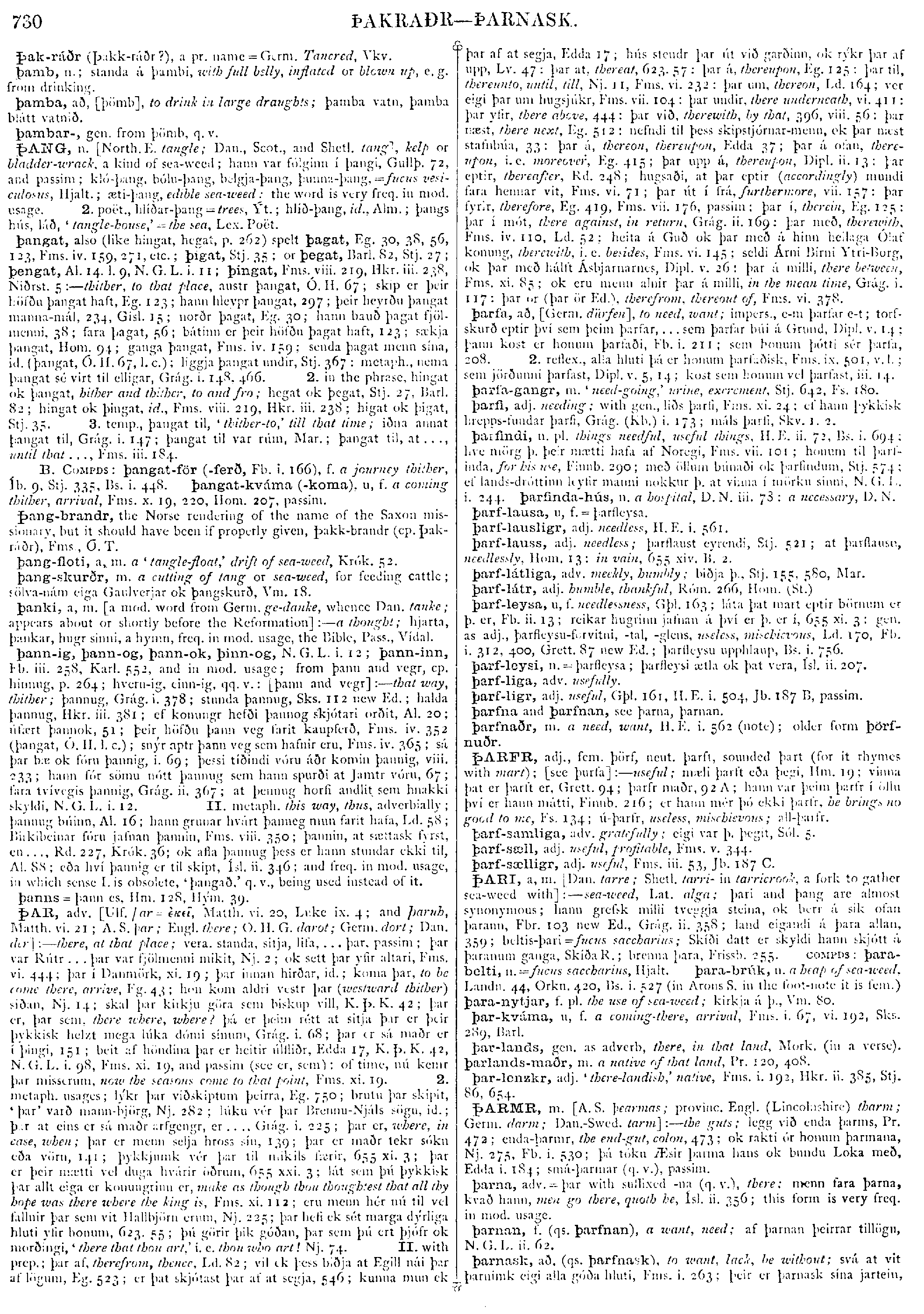
þanki, a, m. [a mod. word from Germ. ge-danke, whence Dan. tanke; appears about or shortly before the Reformation] :-- a thought; hjarta, þankar, hugr sinni, a hymn, freq. in mod. usage, the Bible, Pass., Vídal.
Germanic Lexicon Project (main page)
This search system was written by
Sean Crist
Please consider
volunteering
to correct the data in these online dictionaries.
No rights reserved. Feel free to use these data in any way you please.