|
|

Search for futurus again, using less strict matching (7 results)
|
Source: Torp, page b0272, entry 7 View original page image as: [TIFF] [PNG] [View previous entry] [View next entry] |
[Comment on this entry] [View comments] |
The following entry has been hand-corrected once. |
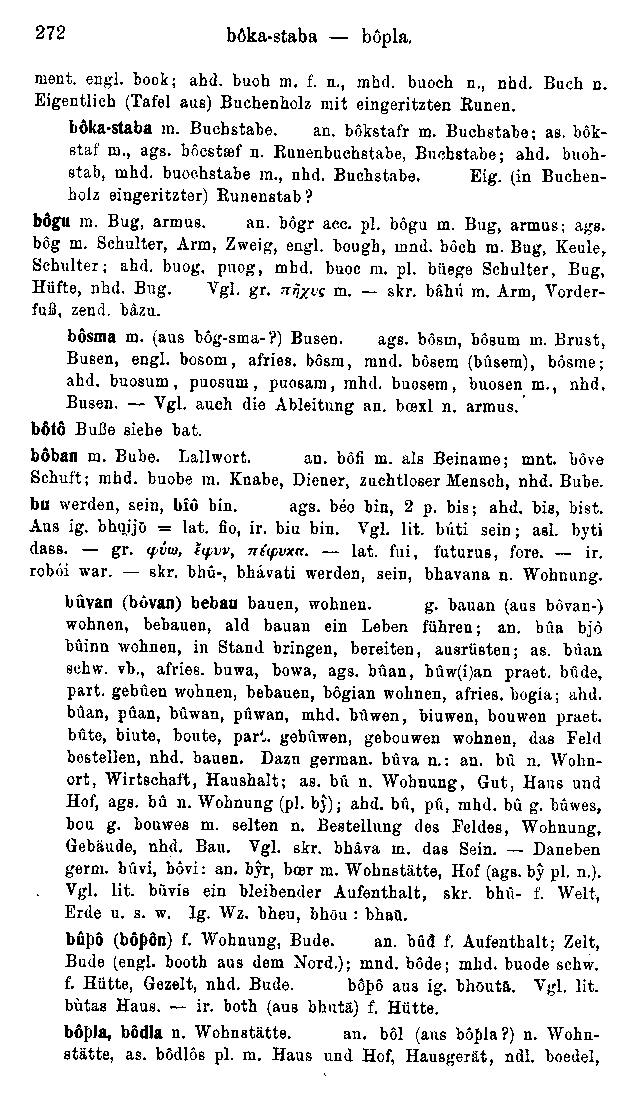
bu
werden,
sein,
bîô
bin.
ags.
béo
bin,
2
p.
bis;
ahd.
bis,
bist.
Aus
ig.
bh ij
ij =
lat.
fio,
ir.
biu
bin.
Vgl.
lit.
búti
sein;
asl.
byti
dass.
-
gr.
[fu'w,
e)'fun,
pe'fuka].
-
lat.
fui,
futurus,
fore.
-
ir.
robói
war.
-
skr.
bhû-,
bhávati
werden,
sein,
bhavana
n.
Wohnung.
=
lat.
fio,
ir.
biu
bin.
Vgl.
lit.
búti
sein;
asl.
byti
dass.
-
gr.
[fu'w,
e)'fun,
pe'fuka].
-
lat.
fui,
futurus,
fore.
-
ir.
robói
war.
-
skr.
bhû-,
bhávati
werden,
sein,
bhavana
n.
Wohnung.
[Translate the German words]
|
Source: Bosworth/Toller, page b0657, entry 20 View original page image as: [TIFF] [PNG] [View previous entry] [View next entry] |
[Comment on this entry] [View comments] |
The following entry has been hand-corrected once. |
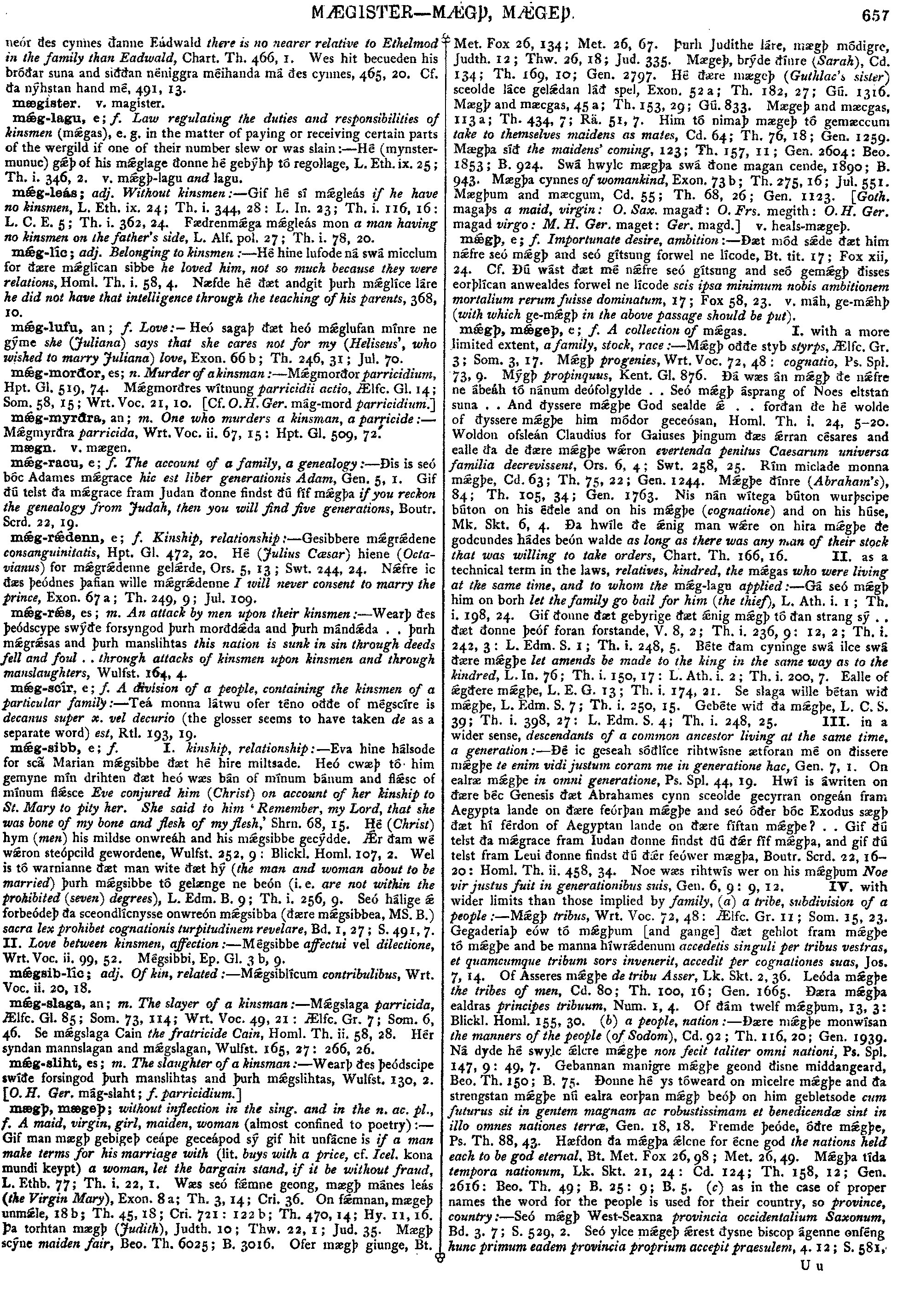
m gþ,
mgeþ,
e;
f.
A
collection
of
mgas.
I.
with
a
more
limited
extent,
a
family,
stock,
race:--Mgþ
oððe
styb
styrps,
Ælfc.
Gr.
3;
Som.
3,
17.
Mgþ
progenies,
Wrt.
Voc.
72,
48:
cognatio,
Ps.
Spl.
73,
9.
Mýgþ
propinquus,
Kent.
Gl.
876.
Ðá
wæs
án
mgþ
ðe
nfre
ne
ábeáh
tó
nánum
deófolgylde
.
.
Seó
mgþ
ásprang
of
Noes
eltstan
suna
.
.
And
ðyssere
mgþe
God
sealde
.
.
forðan
ðe
hé
wolde
of
ðyssere
mgþe
him
módor
geceósan,
Homl.
Th.
i.
24,
5-20.
Woldon
ofsleán
Claudius
for
Gaiuses
þingum
ðæs
rran
césares
and
ealle
ða
de
ðære
mgþe
wron
evertenda
penitus
Caesarum
universa
familia
decrevissent,
Ors.
6,
4;
Swt.
258,
25.
Rím
miclade
monna
mgþe,
Cd.
63;
Th.
75,
22;
Gen.
1244.
Mgþe
ðínre
(Abraham's),
84;
Th.
105,
34;
Gen.
1763.
Nis
nán
wítega
búton
wurþscipe
búton
on
his
éðele
and
on
his
mgþe
(cognatione)
and
on
his
húse,
Mk.
Skt.
6,
4.
Ða
hwíle
ðe
nig
man
wre
on
hira
mgþe
ðe
godcundes
hádes
beón
walde
as
long
as
there
was
any
man
of
their
stock
that
was
willing
to
take
orders,
Chart.
Th.
166,
16.
II.
as
a
technical
term
in
the
laws,
relatives,
kindred,
the
mgas
who
were
living
at
the
same
time,
and
to
whom
the
mg-lagu
applied:--Gá
seó
mgþ
him
on
borh
let
the
family
go
bail
for
him
(the
thief),
L.
Ath.
i.
1;
Th.
i.
198,
24.
Gif
ðonne
ðæt
gebyrige
ðæt
nig
mgþ
tó
ðan
strang
sý
.
.
ðæt
ðonne
þeóf
foran
forstande,
V.
8,
2;
Th.
i.
236,
9:
12,
2;
Th.
i.
242,
3:
L.
Edm.
S.
1;
Th.
i.
248,
5.
Béte
ðam
cyninge
swá
ilce
swá
ðære
mgþe
let
amends
be
made
to
the
king
in
the
same
way
as
to
the
kindred,
L.
In.
76;
Th.
i.
150,
17:
L.
Ath.
i.
2;
Th.
i.
200,
7.
Ealle
of
gðere
mgþe,
L.
E.
G.
13;
Th.
i.
174,
21.
Se
slaga
wille
bétan
wið
mgþe,
L.
Edm.
S.
7;
Th.
i.
250,
15.
Gebéte
wið
ða
mgþe,
L.
C.
S.
39;
Th.
i.
398,
27:
L.
Edm.
S.
4;
Th.
i.
248,
25.
III.
in
a
wider
sense,
descendants
of
a
common
ancestor
living
at
the
same
time,
a
generation:--Ðé
ic
geseah
sóðlíce
rihtwísne
ætforan
mé
on
ðissere
mgþe
te
enim
vidi
justum
coram
me
in
generatione
hac,
Gen.
7,
1.
On
ealræ
mgþe
in
omni
generatione,
Ps.
Spl.
44,
19.
Hwí
is
áwriten
on
ðære
béc
Genesis
ðæt
Abrahames
cynn
sceolde
gecyrran
ongeán
fram
Aegypta
lande
on
ðære
feórþan
mgþe
and
seó
óðer
bóc
Exodus
sægþ
ðæt
hí
férdon
of
Aegyptan
lande
on
ðære
fíftan
mgþe?
.
.
Gif
ðú
telst
ða
mgrace
fram
Iudan
ðonne
findst
ðú
ðr
fíf
mgþa,
and
gif
ðú
telst
fram
Leui
ðonne
findst
ðú
ðr
feówer
mægþa,
Boutr.
Scrd.
22,
16-20:
Homl.
Th.
ii.
458,
34.
Noe
wæs
rihtwís
wer
on
his
mgþum
Noe
vir
justus
fuit
in
generationibus
suis,
Gen.
6,
9:
9,
12.
IV.
with
wider
limits
than
those
implied
by
family,
(a)
a
tribe,
subdivision
of
a
people:--Mgþ
tribus,
Wrt.
Voc.
72,
48:
Ælfc.
Gr.
11;
Som.
15,
23.
Gegaderiaþ
eów
tó
mgþum
[and
gange]
ðæt
gehlot
fram
mgþe
tó
mgþe
and
be
manna
híwrdenum
accedetis
singuli
per
tribus
vestras,
et
quamcumque
tribum
sors
invenerit,
accedit
per
cognationes
suas,
Jos.
7,
14.
Of
Asseres
mgþe
de
tribu
Asser,
Lk.
Skt.
2,
36.
Leóda
mgþe
the
tribes
of
men,
Cd.
80;
Th.
100,
16;
Gen.
1665.
Ðæra
mgþa
ealdras
principes
tribuum,
Num.
1,
4.
Of
ðám
twelf
mgþum,
13,
3:
Blickl.
Homl.
155,
30.
(b)
a
people,
nation:--Ðære
mgþe
monwísan
the
manners
of
the
people
(of
Sodom),
Cd.
92;
Th.
116,
20;
Gen.
1939.
Ná
dyde
hé
swylc
lcre
mgþe
non
fecit
taliter
omni
nationi,
Ps.
Spl.
147,
9:
49,
7.
Gebannan
manigre
mgþe
geond
ðisne
middangeard,
Beo.
Th.
150;
B.
75.
Ðonne
hé
ys
tóweard
on
micelre
mgþe
and
ða
strengstan
mgþe
nú
ealra
eorþan
mgþ
beóþ
on
him
gebletsode
cum
futurus
sit
in
gentem
magnam
ac
robustissimam
et
benedicendæ
sint
in
illo
omnes
nationes
terræ,
Gen.
18,
18.
Fremde
þeóde,
óðre
mgþe,
Ps.
Th.
88,
43.
Hæfdon
ða
mgþa
lcne
for
écne
god
the
nations
held
each
to
be
god
eternal,
Bt.
Met.
Fox
26,
98;
Met.
26,
49.
Mgþa
tída
tempora
nationum,
Lk.
Skt.
21,
24:
Cd.
124;
Th.
158,
12;
Gen.
2616:
Beo.
Th.
49;
B.
25:
9;
B.
5.
(c)
as
in
the
case
of
proper
names
the
word
for
the
people
is
used
for
their
country,
so
province,
country:--Seó
mgþ
West-Seaxna
provincia
occidentalium
Saxonum,
Bd.
3.
7;
S.
529,
2.
Seó
ylce
mgeþ
rest
ðysne
biscop
ágenne
onféng
hunc
primum
eadem
provincia
proprium
accepit
praesulem,
4,
12;
S.
581,
gþ,
mgeþ,
e;
f.
A
collection
of
mgas.
I.
with
a
more
limited
extent,
a
family,
stock,
race:--Mgþ
oððe
styb
styrps,
Ælfc.
Gr.
3;
Som.
3,
17.
Mgþ
progenies,
Wrt.
Voc.
72,
48:
cognatio,
Ps.
Spl.
73,
9.
Mýgþ
propinquus,
Kent.
Gl.
876.
Ðá
wæs
án
mgþ
ðe
nfre
ne
ábeáh
tó
nánum
deófolgylde
.
.
Seó
mgþ
ásprang
of
Noes
eltstan
suna
.
.
And
ðyssere
mgþe
God
sealde
.
.
forðan
ðe
hé
wolde
of
ðyssere
mgþe
him
módor
geceósan,
Homl.
Th.
i.
24,
5-20.
Woldon
ofsleán
Claudius
for
Gaiuses
þingum
ðæs
rran
césares
and
ealle
ða
de
ðære
mgþe
wron
evertenda
penitus
Caesarum
universa
familia
decrevissent,
Ors.
6,
4;
Swt.
258,
25.
Rím
miclade
monna
mgþe,
Cd.
63;
Th.
75,
22;
Gen.
1244.
Mgþe
ðínre
(Abraham's),
84;
Th.
105,
34;
Gen.
1763.
Nis
nán
wítega
búton
wurþscipe
búton
on
his
éðele
and
on
his
mgþe
(cognatione)
and
on
his
húse,
Mk.
Skt.
6,
4.
Ða
hwíle
ðe
nig
man
wre
on
hira
mgþe
ðe
godcundes
hádes
beón
walde
as
long
as
there
was
any
man
of
their
stock
that
was
willing
to
take
orders,
Chart.
Th.
166,
16.
II.
as
a
technical
term
in
the
laws,
relatives,
kindred,
the
mgas
who
were
living
at
the
same
time,
and
to
whom
the
mg-lagu
applied:--Gá
seó
mgþ
him
on
borh
let
the
family
go
bail
for
him
(the
thief),
L.
Ath.
i.
1;
Th.
i.
198,
24.
Gif
ðonne
ðæt
gebyrige
ðæt
nig
mgþ
tó
ðan
strang
sý
.
.
ðæt
ðonne
þeóf
foran
forstande,
V.
8,
2;
Th.
i.
236,
9:
12,
2;
Th.
i.
242,
3:
L.
Edm.
S.
1;
Th.
i.
248,
5.
Béte
ðam
cyninge
swá
ilce
swá
ðære
mgþe
let
amends
be
made
to
the
king
in
the
same
way
as
to
the
kindred,
L.
In.
76;
Th.
i.
150,
17:
L.
Ath.
i.
2;
Th.
i.
200,
7.
Ealle
of
gðere
mgþe,
L.
E.
G.
13;
Th.
i.
174,
21.
Se
slaga
wille
bétan
wið
mgþe,
L.
Edm.
S.
7;
Th.
i.
250,
15.
Gebéte
wið
ða
mgþe,
L.
C.
S.
39;
Th.
i.
398,
27:
L.
Edm.
S.
4;
Th.
i.
248,
25.
III.
in
a
wider
sense,
descendants
of
a
common
ancestor
living
at
the
same
time,
a
generation:--Ðé
ic
geseah
sóðlíce
rihtwísne
ætforan
mé
on
ðissere
mgþe
te
enim
vidi
justum
coram
me
in
generatione
hac,
Gen.
7,
1.
On
ealræ
mgþe
in
omni
generatione,
Ps.
Spl.
44,
19.
Hwí
is
áwriten
on
ðære
béc
Genesis
ðæt
Abrahames
cynn
sceolde
gecyrran
ongeán
fram
Aegypta
lande
on
ðære
feórþan
mgþe
and
seó
óðer
bóc
Exodus
sægþ
ðæt
hí
férdon
of
Aegyptan
lande
on
ðære
fíftan
mgþe?
.
.
Gif
ðú
telst
ða
mgrace
fram
Iudan
ðonne
findst
ðú
ðr
fíf
mgþa,
and
gif
ðú
telst
fram
Leui
ðonne
findst
ðú
ðr
feówer
mægþa,
Boutr.
Scrd.
22,
16-20:
Homl.
Th.
ii.
458,
34.
Noe
wæs
rihtwís
wer
on
his
mgþum
Noe
vir
justus
fuit
in
generationibus
suis,
Gen.
6,
9:
9,
12.
IV.
with
wider
limits
than
those
implied
by
family,
(a)
a
tribe,
subdivision
of
a
people:--Mgþ
tribus,
Wrt.
Voc.
72,
48:
Ælfc.
Gr.
11;
Som.
15,
23.
Gegaderiaþ
eów
tó
mgþum
[and
gange]
ðæt
gehlot
fram
mgþe
tó
mgþe
and
be
manna
híwrdenum
accedetis
singuli
per
tribus
vestras,
et
quamcumque
tribum
sors
invenerit,
accedit
per
cognationes
suas,
Jos.
7,
14.
Of
Asseres
mgþe
de
tribu
Asser,
Lk.
Skt.
2,
36.
Leóda
mgþe
the
tribes
of
men,
Cd.
80;
Th.
100,
16;
Gen.
1665.
Ðæra
mgþa
ealdras
principes
tribuum,
Num.
1,
4.
Of
ðám
twelf
mgþum,
13,
3:
Blickl.
Homl.
155,
30.
(b)
a
people,
nation:--Ðære
mgþe
monwísan
the
manners
of
the
people
(of
Sodom),
Cd.
92;
Th.
116,
20;
Gen.
1939.
Ná
dyde
hé
swylc
lcre
mgþe
non
fecit
taliter
omni
nationi,
Ps.
Spl.
147,
9:
49,
7.
Gebannan
manigre
mgþe
geond
ðisne
middangeard,
Beo.
Th.
150;
B.
75.
Ðonne
hé
ys
tóweard
on
micelre
mgþe
and
ða
strengstan
mgþe
nú
ealra
eorþan
mgþ
beóþ
on
him
gebletsode
cum
futurus
sit
in
gentem
magnam
ac
robustissimam
et
benedicendæ
sint
in
illo
omnes
nationes
terræ,
Gen.
18,
18.
Fremde
þeóde,
óðre
mgþe,
Ps.
Th.
88,
43.
Hæfdon
ða
mgþa
lcne
for
écne
god
the
nations
held
each
to
be
god
eternal,
Bt.
Met.
Fox
26,
98;
Met.
26,
49.
Mgþa
tída
tempora
nationum,
Lk.
Skt.
21,
24:
Cd.
124;
Th.
158,
12;
Gen.
2616:
Beo.
Th.
49;
B.
25:
9;
B.
5.
(c)
as
in
the
case
of
proper
names
the
word
for
the
people
is
used
for
their
country,
so
province,
country:--Seó
mgþ
West-Seaxna
provincia
occidentalium
Saxonum,
Bd.
3.
7;
S.
529,
2.
Seó
ylce
mgeþ
rest
ðysne
biscop
ágenne
onféng
hunc
primum
eadem
provincia
proprium
accepit
praesulem,
4,
12;
S.
581,
|
Source: Bosworth/Toller, page b0999, entry 24 View original page image as: [TIFF] [PNG] [View previous entry] [View next entry] |
[Comment on this entry] [View comments] |
The following entry has been hand-corrected once. |
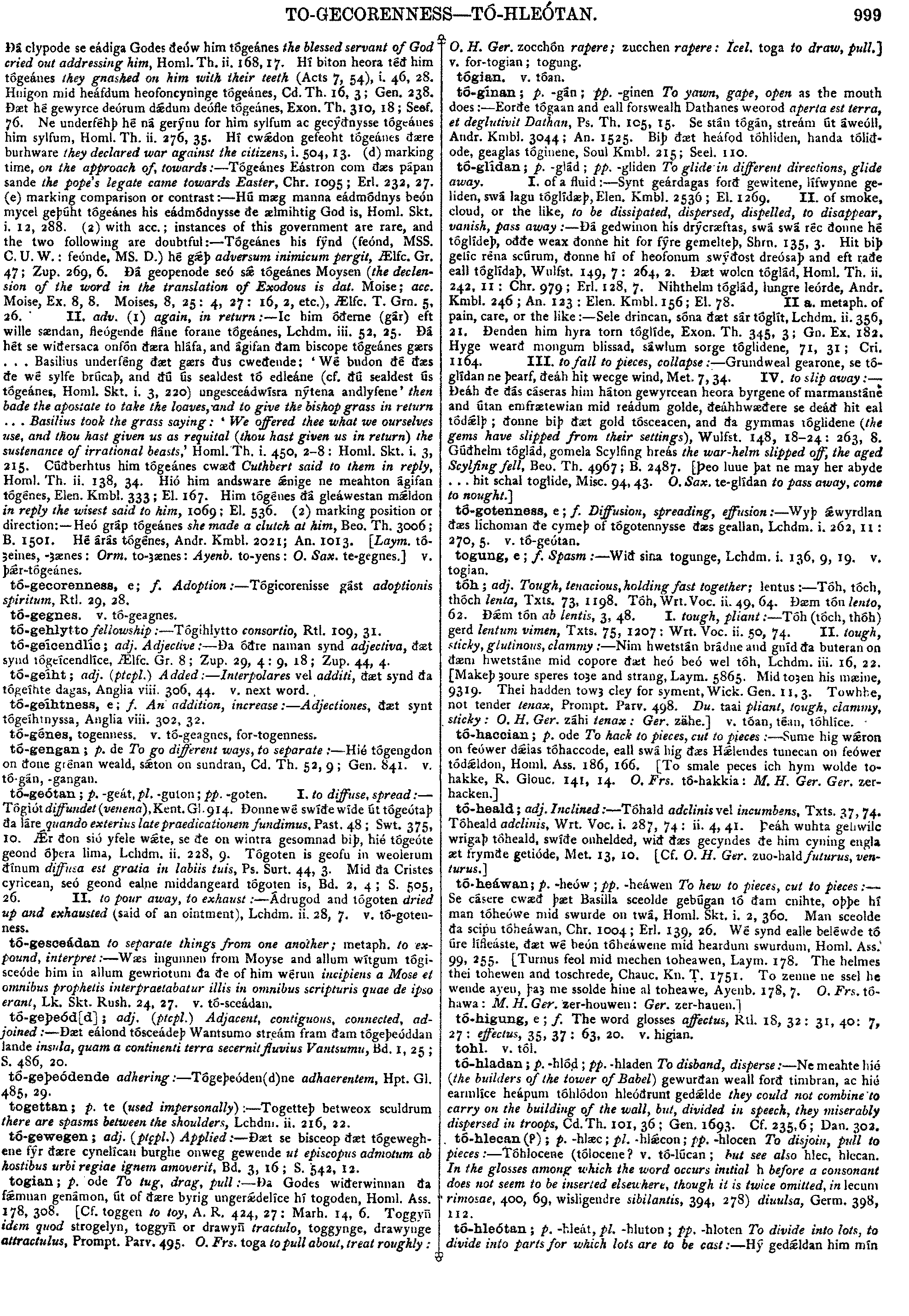
tó-heald; adj. Inclined :-- Tóhald adclinisvel incumbens, Txts. 37, 74. Tóheald adclinis. Wrt. Voc. i. 287, 74 : ii. 4, 41. Þeáh wuhta geliwílc wrigaþ tóheald, swíðe onhelded, wið ðæs gecyndes ðe him cyning engla æt trymðe getióde. Met. 13, 10. [Cf. O. H. Ger. zuo-hald futurus, ven-turus.]
|
Source: Bosworth/Toller, page b1009, entry 19 View original page image as: [TIFF] [PNG] [View previous entry] [View next entry] |
[Comment on this entry] [View comments] |
The following entry has been hand-corrected once. |
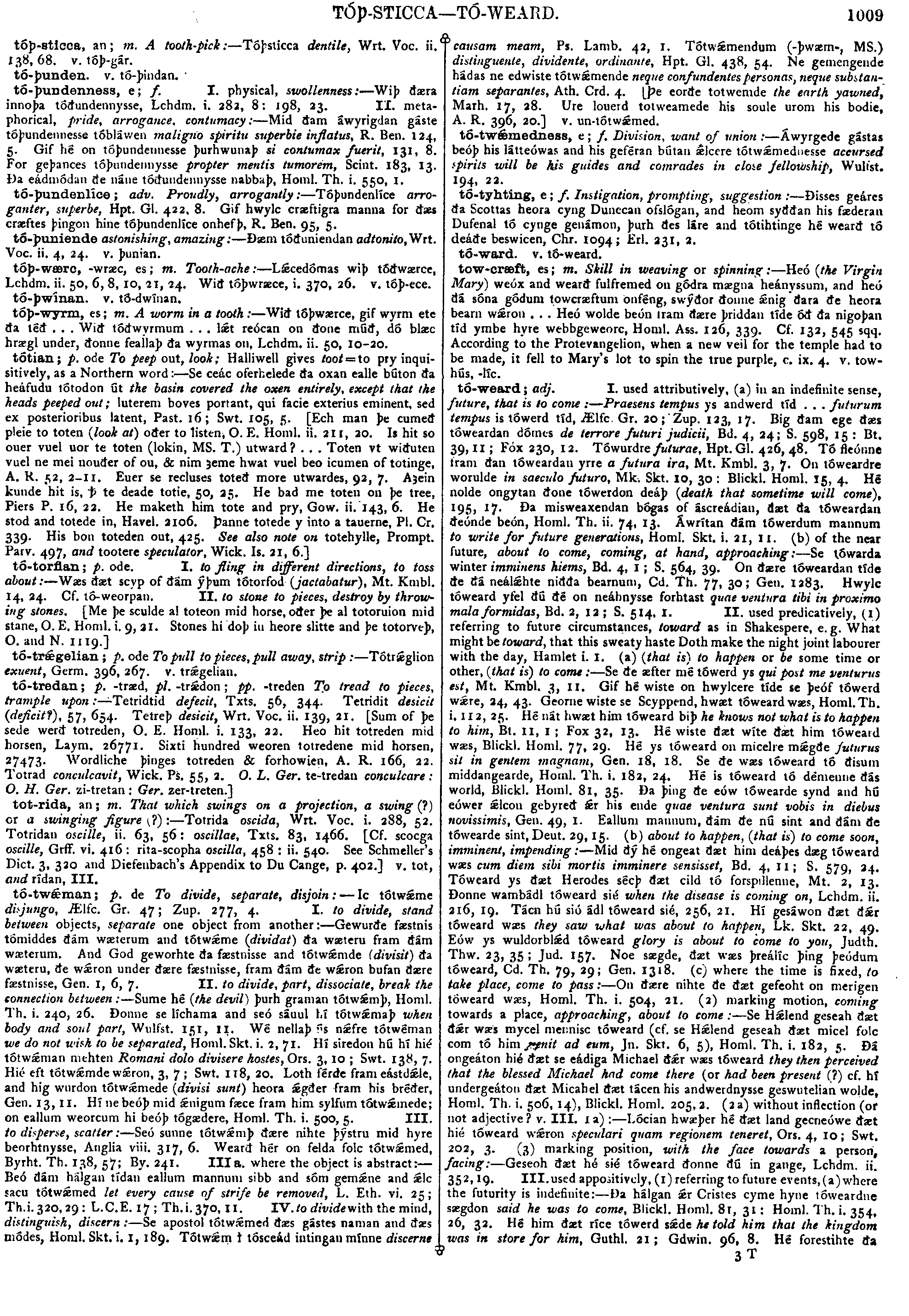
tó-weard;
adj.
I.
used
attributively,
(a)
in
an
indefinite
sense,
future,
that
is
to
come
:--
Praesens
tempus
ys
andwerd
tíd
.
.
.
fufurum
tempus
is
tówerd
tíd,
Ælfc.
Gr.
20;
'Zup.
123,
17.
Big
ðam
ege
ðæs
tóweardan
dómes
de
terrore
futuri
judicii,
Bd.
4,
24;
S.
598,
15:
Bt.
39,
ll;
Fóx
230,
12.
Tówurdre
futurae,
Hpt.
Gl.
426,
48.
Tó
fleónne
tram
ðan
tóweardan
yrre
a
futura
ira.
Mt.
Kmbl.
3,
7.
On
tóweardre
worulde
in
saeculo
futuro
Mk.
Skt.
10,
30
:
Blickl.
Homl.
15,
4.
Hé
nolde
ongytan
ðone
tówerdon
deáþ
(death
that
sometime
will
come),
195,
17.
Ða
misweaxendan
bógas
of
áscreádian,
ðæt
ða
tóweardan
ðeónde
beón,
Homl.
Th.
ii.
74,
13.
Áwrítan
ðám
tówerdum
mannum
to
write
for
future
generations,
Homl.
Skt.
i.
21,
II.
(b)
of
the
near
future,
about
to
come,
coming,
at
hand,
approaching
:--
Se
tówarda
winter
imminens
hiems,
Bd.
4,
1;
S.
564,
39.
On
ðære
tóweardan
tíde
ðe
ðá
neálhte
niðða
bearnum,
Cd.
Th.
77,
30;
Gen.
1283.
Hwylc
tóweard
yfel
ðú
ðé
on
neáhnysse
forhtast
quae
ventura
tibi
in
proximo
mala
formidas,
Bd.
2,
12
;
S.
514,
1.
II.
used
predicatively,
(l)
referring
to
future
circumstances,
toward
as
in
Shakespere,
e.
g.
What
might
be
toward,
that
this
sweaty
haste
Doth
make
the
night
joint
labourer
with
the
day,
Hamlet
i.
I.
(a)
(that
is)
to
happen
or
be
some
time
or
other,
(that
is)
to
come
:--
Se
ðe
æfter
mé
tówerd
ys
qui
post
me
venturus
est,
Mt.
Kmbl.
3,
11.
Gif
hé
wiste
on
hwylcere
tíde
se
þeóf
tówerd
wre,
24,
43.
Georne
wiste
se
Scyppend,
hwæt
tóweard
wæs,
Homl.
Th.
i.
112,
25.
Hé
nát
hwæt
him
tóweard
biþ
he
knows
not
what
is
to
happen
to
him,
Bt.
ll,
I
;
Fox
32,
13.
He
wiste
ðæt
wíte
ðæt
him
tóweard
wæs,
Blick.
Homl.
77,
29.
Hé
ys
tóweard
on
micelre
mgðe
futurus
sit
in
gentem
magnam,
Gen.
18,
18.
Se
ðe
waes
tóweard
tó
ðisum
middangearde,
Homl.
Th.
i.
182,
24.
Hé
is
tóweard
tó
démenne
ðás
world,
Blickl.
Homl.
81,
35.
Ða
þing
ðe
eów
tówearde
synd
and
hú
eówer
lcon
gebyreð
r
his
ende
quae
ventura
sunt
vobis
in
diebus
novissimis.
Gen.
49,
Eallum
mannum,
ðám
ðe
nú
sint
and
ðám
ðe
tówearde
sint.
Deut.
29,
15.
(b)
about
to
happen,
(that
is)
to
come
soon,
imminent,
impending
:--
Mid
ðý
hé
ongeat
ðæt
him
deáþes
dæg
tóweard
wæs
cum
diem
sibi
mortis
imminere
sensisset,
Bd.
4,
11;
S.
579,
24.
Tóweard
ys
ðæt
Herodes
sécþ
ðæt
cild
tó
forspillenne,
Mt.
2,
13.
Ðonne
wambádl
tóweard
sié
when
the
disease
is
coming
on,
Lchdm.
ii.
216,
19.
Tácn
hú
sió
ádl
tóweard
sié,
256,
21.
Hí
gesáwon
ðæt
ðár
tóweard
wæs
they
saw
what
was
about
to
happen,
Lk.
Skt.
22,
49.
Eów
ys
wuldorbld
tóweard
glory
is
about
to
come
to
you,
Judth.
Thw.
23,
35
;
Jud.
157.
Noe
sægde,
ðæt
wæs
þreálíc
þing
þeódum
tóweard,
Cd.
Th.
79,
29;
Gen.
1318.
(c)
where
the
time
is
fixed,
to
take
place,
come
to
pass
:--
On
ðære
nihte
ðe
ðæt
gefeoht
on
merigen
tóweard
wæs,
Homl.
Th.
i.
504,
21.
(2)
marking
motion,
coming
towards
a
place,
approaching,
about
to
come
:--
Se
Hlend
geseah
ðæt
ðr
wæs
mycel
mennisc
tóweard
(cf.
se
Hlend
geseah
ðæt
micel
folc
com
to
him
renit
ad
eum,
Jn.
Skt.
6,
5),
Homl.
Th.
i.
182,
5.
Ða
ongeáton
hié
ðæt
se
eádiga
Michael
ðr
wæs
tóweard
they
then
perceived
that
the
blessed
Michael
had
come
there
(or
had
been
present
cf.
hí
undergeaton
ðæt
Michael
ðæt
tácen
his
andwerdnysse
geswutelian
wolde,
Homl.
Th.
i.
506,
14),
Blickl.
Homl.
205,
2.
(2
a)
without
inflection
(or
not
adjective
?
v.
III.
1
a)
:--
Lócian
hwæþer
hé
ðæt
land
gecneowe
ðæt
hié
tóweard
wron
speculari
quam
regionem
teneret.
Ors.
4,
10;
Swt.
202,
3.
(3)
marking
position,
with
the
face
towards
a
person,
facing
:--
Geseoh
ðæt
hé
sié
tóweard
ðonne
ðú
in
gange,
Lchdm.
ii.
352,
19,
III
used
appositively,
(l)
referring
to
future
events,
(a)
where
the
futurity
is
indefinite
:--
Ða
hálgan
r
Cristes
cyme
hyne
tóweardne
sægdon
said
he
was
to
come,
Blickl.
Homl.
81,
31:
Homl.
Th.
i.
354,
26,
32.
Hé
him
ðæt
ríce
tówerd
sde
he
told
him
that
the
kingdom
was
in
store
for
him,
Guthl.
21;
Gdwin.
96,
8.
Hé
forestihte
ða
|
Source: Bosworth/Toller, page b1058, entry 11 View original page image as: [TIFF] [PNG] [View previous entry] [View next entry] |
[Comment on this entry] [View comments] |
The following entry has been hand-corrected once. |
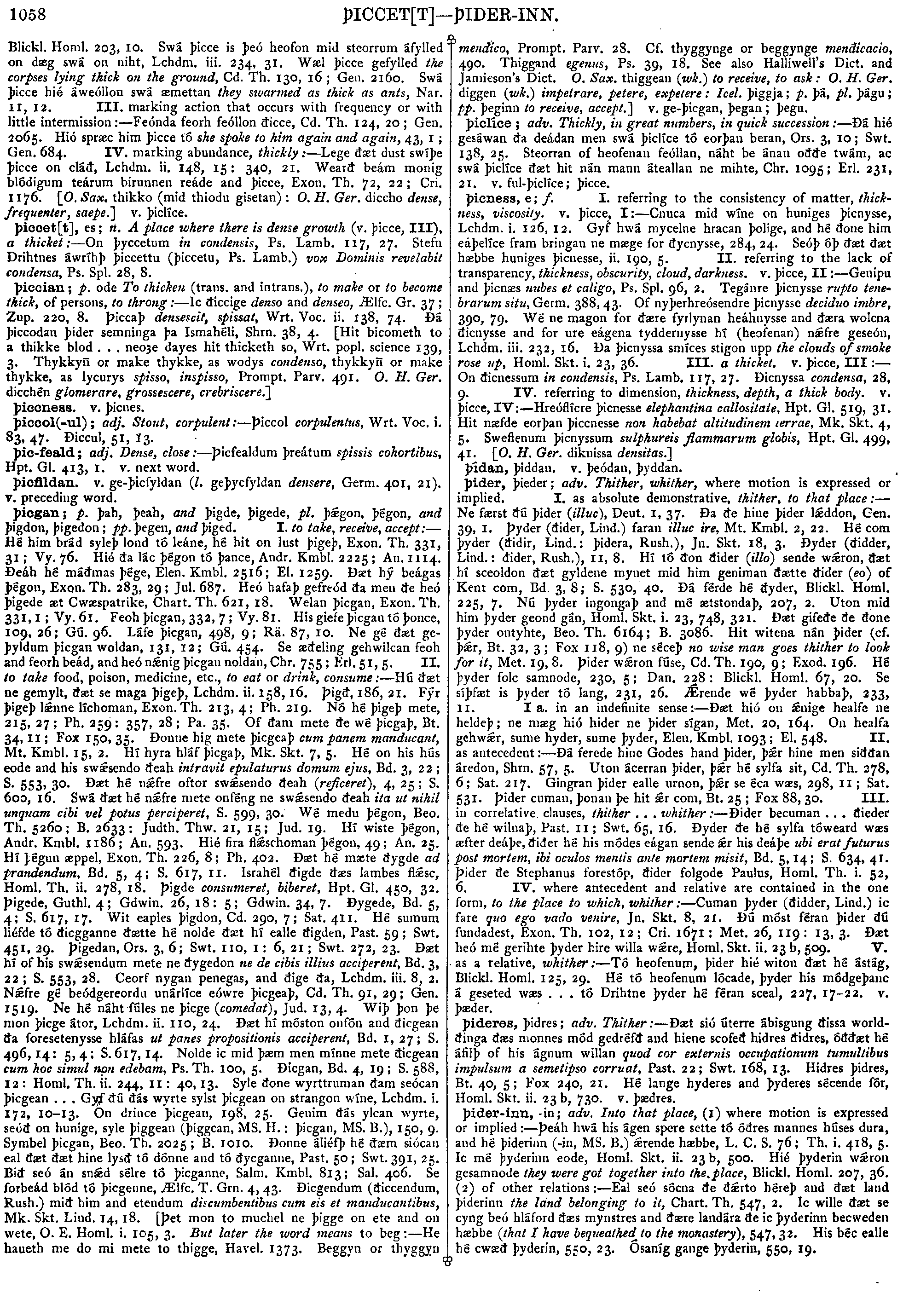
þider,
þieder;
adv.
Thither,
whither,
where
motion
is
expressed
or
implied.
I.
as
absolute
demonstrative,
thither,
to
that
place
:--
Ne
færst
ðú
þider
(illuc),
Deut.
1,
37.
Ða
ðe
hine
þider
lddon,
Gen.
39,
1.
Þyder
(ðider,
Lind.)
faran
illuc
ire,
Mt.
Kmbl.
2,
22.
Hé
com
þyder
(ðidir,
Lind.:
þidera,
Rush.),
Jn.
Skt.
18,
3.
Ðyder
(ðidder,
Lind.:
ðider,
Rush.),
11,
8.
Hí
tó
ðon
ðider
(illo)
sende
wron,
ðæt
hí
sceoldon
ðæt
gyldene
mynet
mid
him
geniman
ðætte
ðider
(eo)
of
Kent
com,
Bd.
3,
8;
S.
530,
40.
Ðá
férde
hé
ðyder,
Blickl.
Homl.
225,
7.
Nú
þyder
ingongaþ
and
mé
ætstondaþ,
207,
2.
Uton
mid
him
þyder
geond
gán,
Homl.
Skt.
i.
23,
748,
321.
Ðæt
gifeðe
ðe
ðone
þyder
ontyhte,
Beo.
Th.
6164;
B.
3086.
Hit
witena
nán
þider
(cf.
þr,
Bt.
32,
3;
Fox
118,
9)
ne
séceþ
no
wise
man
goes
thither
to
look
for
it,
Met.
19,
8.
Þider
wron
fúse,
Cd.
Th.
190,
9;
Exod.
196.
Hé
þyder
folc
samnode,
230,
5;
Dan.
228:
Blickl.
Homl.
67,
20.
Se
síþfæt
is
þyder
tó
lang,
231,
26.
Æ-acute;rende
wé
þyder
habbaþ,
233,
11.
I
a.
in
an
indefinite
sense
:--
Ðæt
hió
on
nige
healfe
ne
heldeþ;
ne
mæg
hió
hider
ne
þider
sígan,
Met.
20,
164.
On
healfa
gehwr,
sume
hyder,
sume
þyder,
Elen.
Kmbl.
1093;
El.
548.
II.
as
antecedent
:--
Ðá
ferede
hine
Godes
hand
þider,
þr
hine
men
siððan
áredon,
Shrn.
57,
5.
Uton
ácerran
þider,
þr
hé
sylfa
sit,
Cd.
Th.
278,
6;
Sat.
217.
Gingran
þider
ealle
urnon,
þr
se
éca
wæs,
298,
11;
Sat.
531.
Þider
cuman,
þonan
þe
hit
r
com,
Bt.
25;
Fox
88,
30.
III.
in
correlative
clauses,
thither
...
whither
:--
Ðider
becuman
...
ðieder
ðe
hé
wilnaþ,
Past.
11;
Swt.
65,
16.
Ðyder
ðe
hé
sylfa
tóweard
wæs
æfter
deáþe,
ðider
hé
his
módes
eágan
sende
r
his
deáþe
ubi
erat
futurus
post
mortem,
ibi
oculos
mentis
ante
mortem
misit,
Bd.
5,
14;
S.
634,
41.
Þider
ðe
Stephanus
forestóp,
ðider
folgode
Paulus,
Homl.
Th.
i.
52,
6.
IV.
where
antecedent
and
relative
are
contained
in
the
one
form,
to
the
place
to
which,
whither
:--
Cuman
þyder
(ðidder,
Lind.)
ic
fare
quo
ego
vado
venire,
Jn.
Skt.
8,
21.
Ðú
móst
féran
þider
ðú
fundadest,
Exon.
Th.
102,
12;
Cri.
1671:
Met.
26,
119:
13,
3.
Ðæt
heó
mé
gerihte
þyder
hire
willa
wre,
Homl.
Skt.
ii.
23
b,
509.
V.
as
a
relative,
whither
:--
Tó
heofenum,
þider
hié
witon
ðæt
hé
ástág,
Blickl.
Homl.
125,
29.
Hé
tó
heofenum
lócade,
þyder
his
módgeþanc
á
geseted
wæs
...
tó
Drihtne
þyder
hé
féran
sceal,
227,
17-22.
v.
þæder.
|
Source: Bosworth/Toller, page d0725, entry 1 View original page image as: [TIFF] [PNG] [View previous entry] [View next entry] |
[Comment on this entry] [View comments] |
The following entry has been hand-corrected once. |
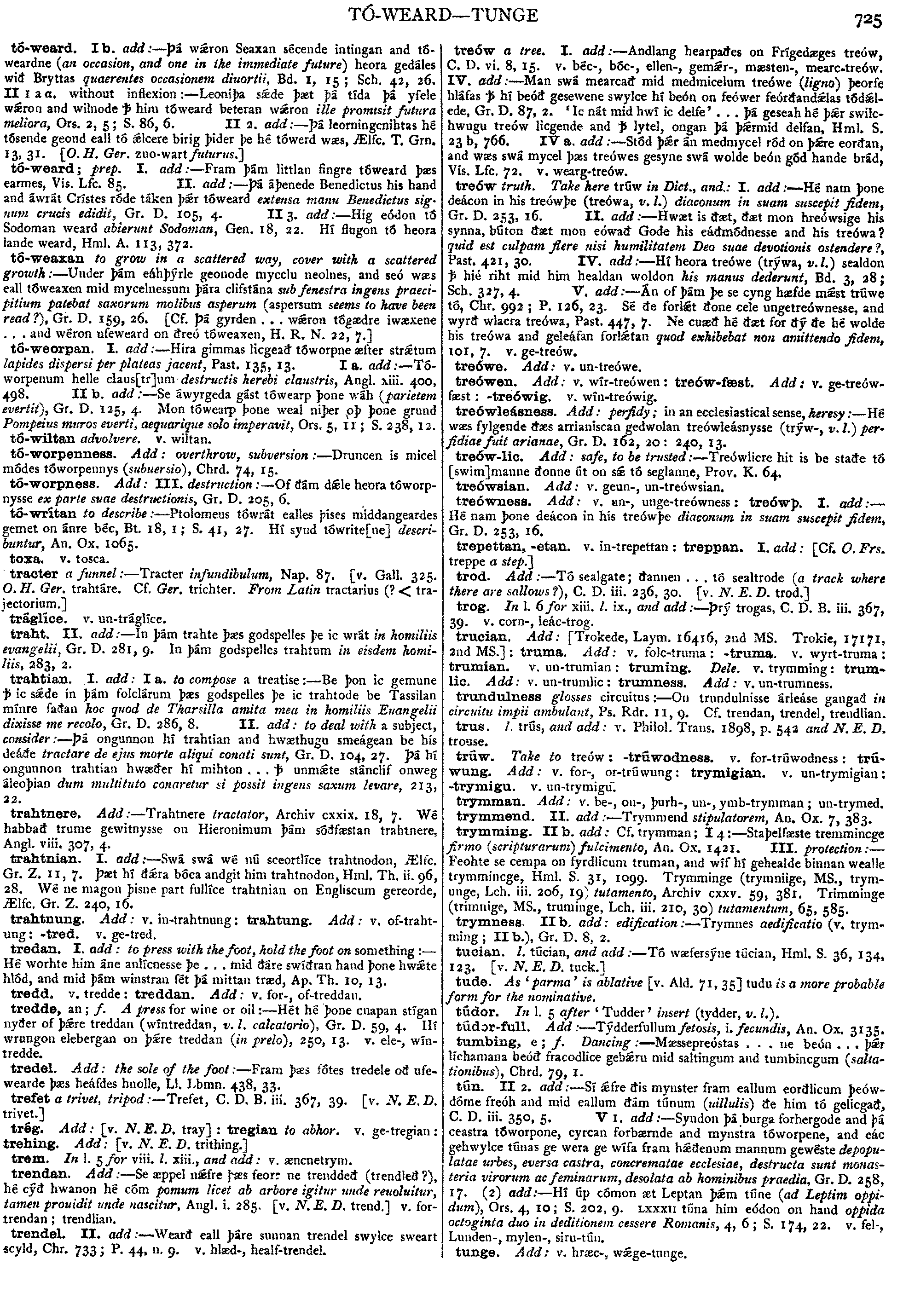
tó-weard.
I
b.
add
:--
Þá
wron
Seaxan
sécende
intingan
and
tó-weardne
(an
occasion,
and
one
in
the
immediate
future)
heora
gedáles
wið
Bryttas
quaerentes
occasionem
diuortii,
Bd.
1.
15;
Sch.
42,
26.
II
1
a
a.
without
inflexion
:--
Leoniþa
sde
þæt
þá
tída
þá
yfele
wron
and
wilnode
 him
tóweard
beteran
wron
ille
promisit
futura
meliora,
Ors.
2,
5;
S.
86,
6.
II
2.
add
:--
Þá
leorningcnihtas
hé
tósende
geond
eall
tó
lcere
birig
þider
þe
hé
tówerd
wæs,
Ælfc.
T.
Grn.
13.
31.
[O.H.
Ger.
zuo-wart
futurus]
him
tóweard
beteran
wron
ille
promisit
futura
meliora,
Ors.
2,
5;
S.
86,
6.
II
2.
add
:--
Þá
leorningcnihtas
hé
tósende
geond
eall
tó
lcere
birig
þider
þe
hé
tówerd
wæs,
Ælfc.
T.
Grn.
13.
31.
[O.H.
Ger.
zuo-wart
futurus]
Germanic Lexicon Project (main page)
This search system was written by
Sean Crist
Please consider
volunteering
to correct the data in these online dictionaries.
No rights reserved. Feel free to use these data in any way you please.