|
|

|
Source: Bosworth/Toller, page d0725, entry 1 View original page image as: [TIFF] [PNG] [View previous entry] [View next entry] |
[Comment on this entry] [View comments] |
The following entry has been hand-corrected once. |
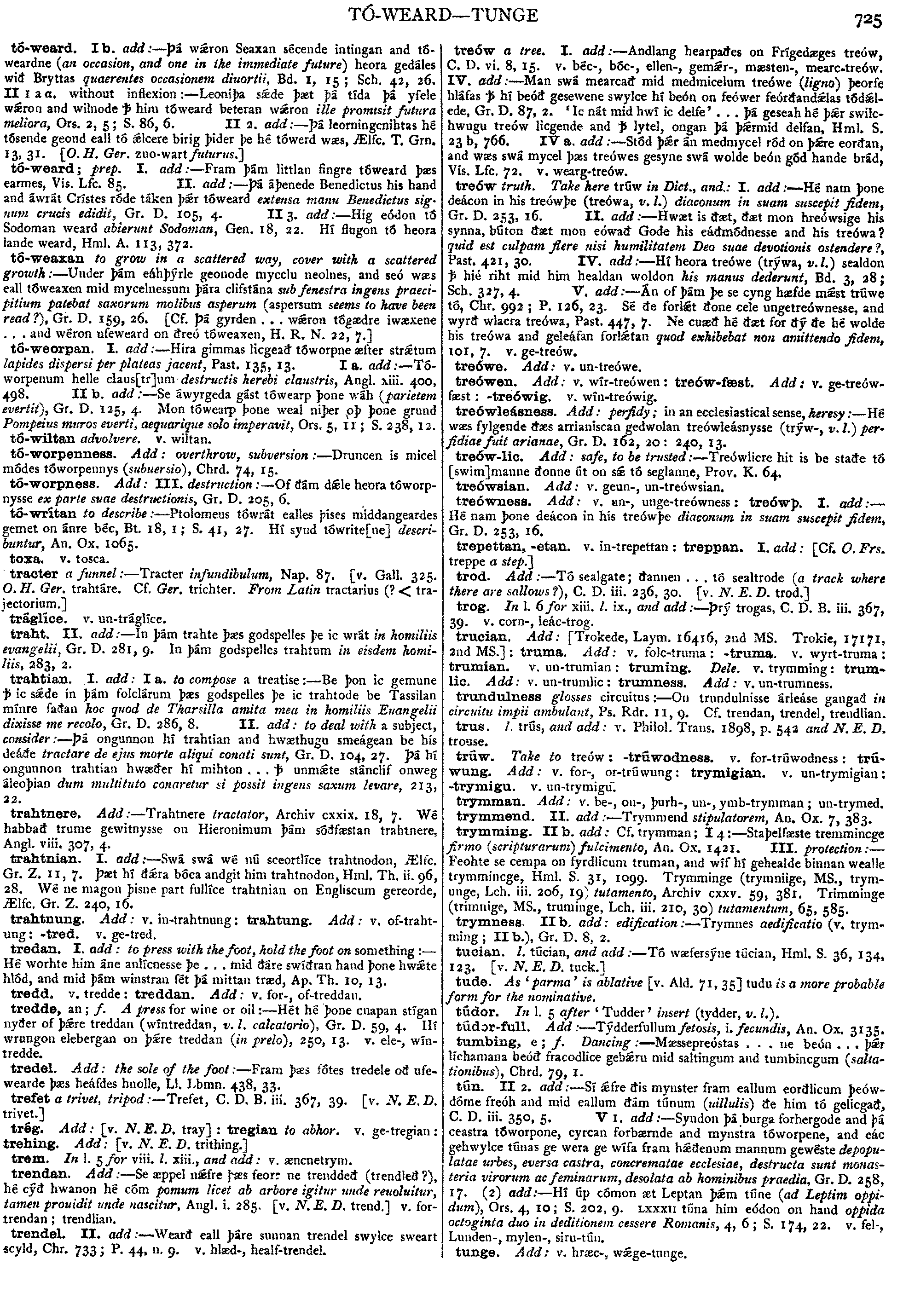
tó-weard.
I
b.
add
:--
Þá
w ron
Seaxan
sécende
intingan
and
tó-weardne
(an
occasion,
and
one
in
the
immediate
future)
heora
gedáles
wið
Bryttas
quaerentes
occasionem
diuortii,
Bd.
1.
15;
Sch.
42,
26.
II
1
a
a.
without
inflexion
:--
Leoniþa
sde
þæt
þá
tída
þá
yfele
wron
and
wilnode
ron
Seaxan
sécende
intingan
and
tó-weardne
(an
occasion,
and
one
in
the
immediate
future)
heora
gedáles
wið
Bryttas
quaerentes
occasionem
diuortii,
Bd.
1.
15;
Sch.
42,
26.
II
1
a
a.
without
inflexion
:--
Leoniþa
sde
þæt
þá
tída
þá
yfele
wron
and
wilnode
 him
tóweard
beteran
wron
ille
promisit
futura
meliora,
Ors.
2,
5;
S.
86,
6.
II
2.
add
:--
Þá
leorningcnihtas
hé
tósende
geond
eall
tó
lcere
birig
þider
þe
hé
tówerd
wæs,
Ælfc.
T.
Grn.
13.
31.
[O.H.
Ger.
zuo-wart
futurus]
him
tóweard
beteran
wron
ille
promisit
futura
meliora,
Ors.
2,
5;
S.
86,
6.
II
2.
add
:--
Þá
leorningcnihtas
hé
tósende
geond
eall
tó
lcere
birig
þider
þe
hé
tówerd
wæs,
Ælfc.
T.
Grn.
13.
31.
[O.H.
Ger.
zuo-wart
futurus]
|
Source: Bright's OE Grammar, page b0362, entry 3 View original page image as: [TIFF] [PNG] [View previous entry] [View next entry] |
[Comment on this entry] [View comments] |
The following entry has been hand-corrected once. |
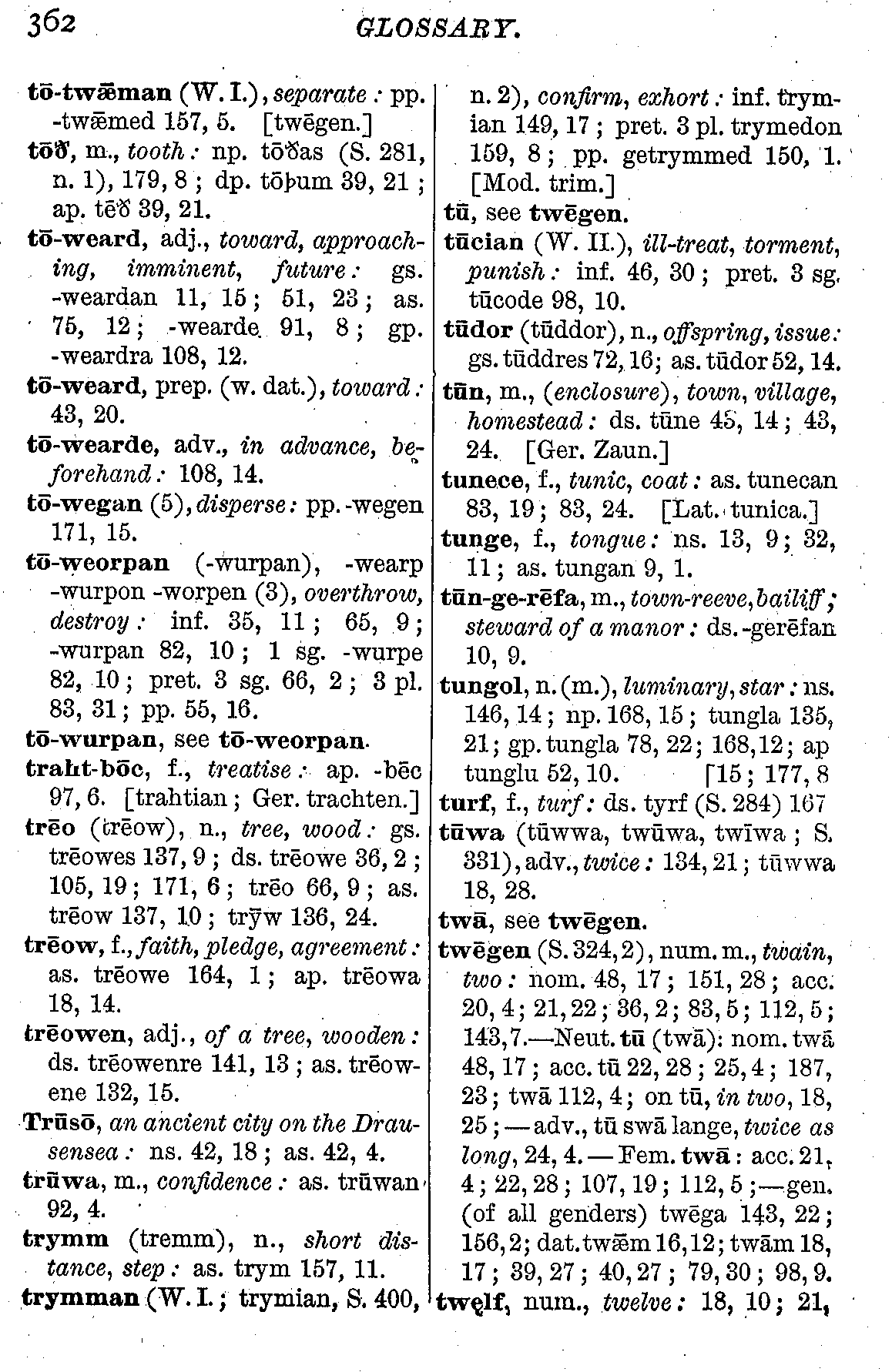
t -weard
adj
toward,
approaching,
imminent,
future
-weard
adj
toward,
approaching,
imminent,
future
|
Source: Cleasby/Vigfusson, page b0011, entry 9 View original page image as: [TIFF] [PNG] [View previous entry] [View next entry] |
[Comment on this entry] [View comments (1)] |
The following entry has been hand-corrected once. |
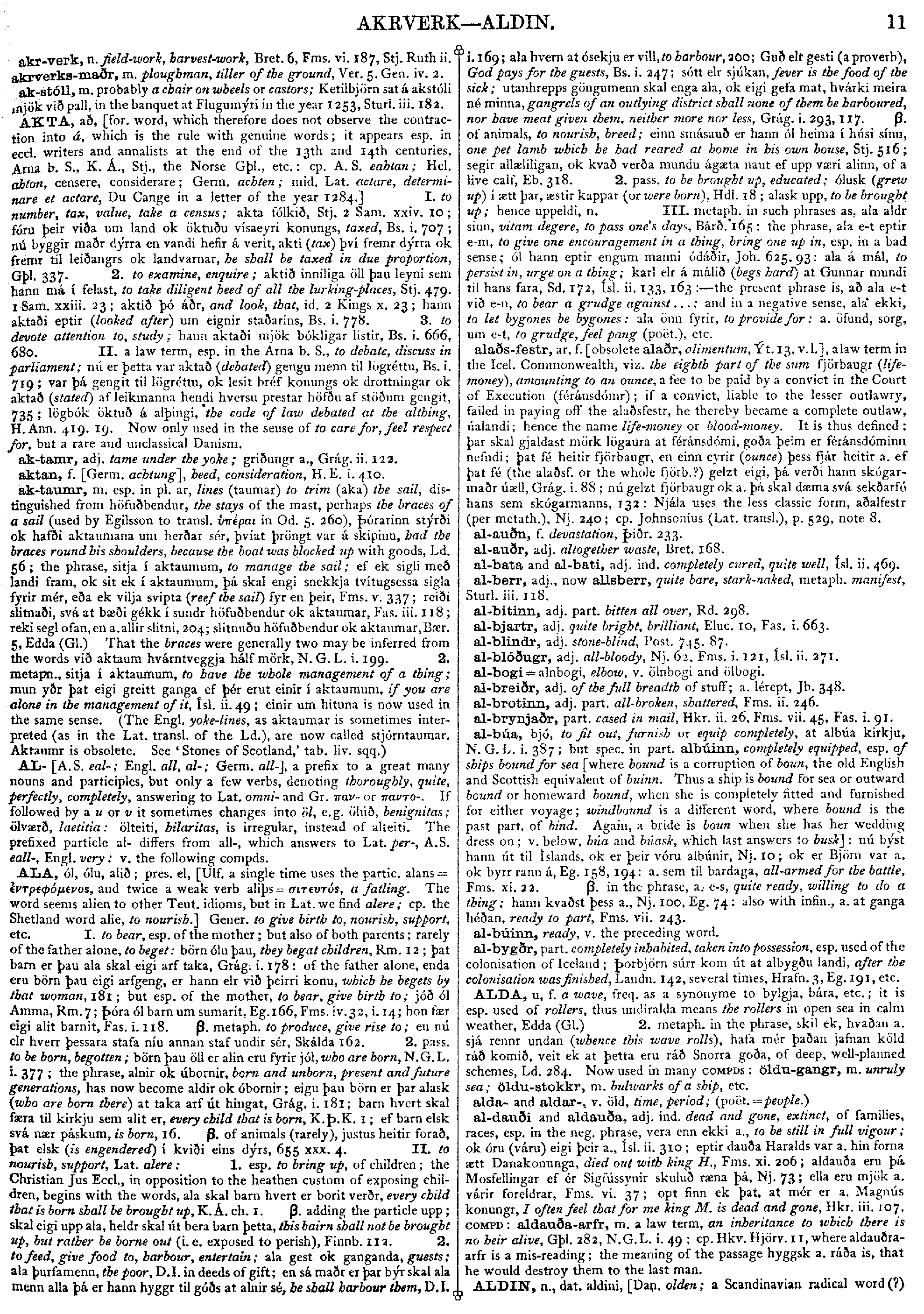
ALA,
ól,
ólu,
alið;
pres.
el,
[Ulf.
a
single
time
uses
the
partic.
alans
=
(GREEK,
and
twice
a
weak
verb
aliþs
=
GREEK,
a
fatling.
The
word
seems
alien
to
other
Teut.
idioms,
but
in
Lat.
we
find
alere;
cp.
the
Shetland
word
alie,
to
nourish.]
Gener.
to
give
birth
to,
nourish,
support,
etc.
I.
to
bear,
esp.
of
the
mother;
but
also
of
both
parents;
rarely
of
the
father
alone,
to
beget:
börn
ólu
þau,
they
begat
children,
Rm.
12;
þat
barn
er
þau
ala
skal
eigi
arf
taka,
Grág.
i.
178:
of
the
father
alone,
enda
eru
börn
þau
eigi
arfgeng,
er
hann
elr
við
þeirri
konu,
which
be
begets
by
that
woman,
181;
but
esp.
of
the
mother,
to
bear,
give
birth
to;
jóð
ól
Amma,
Rm.
7;
þóra
ól
barn
um
sumarit,
Eg.
166,
Fms.
iv.
32,
i.
14;
hon
fær
eigi
alit
barnit,
Fas.
i.
118.
 .
metaph.
to
produce,
give
rise
to;
en
nú
elr
hverr
þessara
stafa
níu
annan
staf
undir
sér,
Skálda
162.
2.
pass.
to
be
born,
begotten;
börn
þau
öll
er
alin
eru
fyrir
jól,
who
are
born,
N.
G.
L.
i.;
377;
the
phrase,
alnir
ok
úbornir,
born
and
unborn,
present
and
future
generations,
has
now
become
aldir
ok
óbornir;
eigu
þau
börn
er
þar
alask
(who
are
born
there)
at
taka
arf
út
hingat,
Grág.
i.
181;
barn
hvert
skal
færa
til
kirkju
sem
alit
er,
every
child
that
is
born,
K.
Þ.
K.
1;
ef
barn
elsk
svá
naer
páskum,
is
born,
16.
.
of
animals
(rarely),
justus
heitir
forað,
þat
elsk
(is
engendered)
í
kviði
eins
dýrs,
655
xxx.
4.
II.
to
nourish,
support,
Lat.
alere:
1.
esp.
to
bring
up,
of
children;
the
Christian
Jus
Eccl.,
in
opposition
to
the
heathen
custom
of
exposing
chil-
dren,
begins
with
the
words,
ala
skal
barn
hvert
er
borit
verðr,
every
child
that
is
born
shall
be
brought
up,
K.
Á.
ch.
1.
.
adding
the
particle
upp;
skal
eigi
upp
ala,
heldr
skal
út
bera
barn
þetta,
this
bairn
shall
not
be
brought
up,
but
rather
be
borne
out
(i.
e.
exposed
to
perish),
Finnb.
112.
2.
to
feed,
give
food
to,
harbour,
entertain;
ala
gest
ok
ganganda,
guests;
ala
þurfamenn,
the
poor,
D.
in
deeds
of
gift;
en
sá
maðr
er
þar
býr
skal
ala
menn
alla
þá
er
hann
hyggr
til
góðs
at
alnir
sé,
he
shall
harbour
them,
D.
i.
169;
ala
hvern
at
ósekju
er
vill.
to
harbour,
200;
Guð
elf
gesti
(a
proverb),
God
pays
for
the
guests,
Bs.
i.
247;
sótt
elr
sjúkan,
fever
is
the
food
of
the
sick;
utanhrepps
göngumenn
skal
enga
ala,
ok
eigi
gefa
mat,
hvárki
meira
né
minna,
gangrels
of
an
outlying
district
shall
none
of
them
be
harboured,
nor
have
meat
given
them,
neither
more
nor
less,
Grág.
i.
293,
117.
.
of
animals,
to
nourish,
breed;
einn
smásauð
er
hann
ól
heima
í
húsi
sínu,
one
pet
lamb
which
he
had
reared
at
home
in
his
own
house,
Stj.
516;
segir
allæliligan,
ok
kvað
verða
mundu
ágæta
naut
ef
upp
væri
alinn,
of
a
live
calf,
Eb.
318.
2.
pass,
to
be
brought
tip,
educated;
ólusk
(grew
up)
í
ætt
þar,
æstir
kappar
(or
were
born),
Hdl.
18;
alask
upp,
to
be
brought
up;
hence
uppeldi,
n.
III.
metaph.
in
such
phrases
as,
ala
aldr
sinn,
vitam
degere,
to
pass
one's
days,
Bárð.
165:
the
phrase,
ala
e-t
eptir
e-m,
to
give
one
encouragement
in
a
thing,
bring
one
tip
in,
esp.
in
a
bad
sense;
ól
hann
eptir
engum
manni
ódáðir,
Joh.
625.
93:
ala
á
mál,
to
persist
in,
urge
on
a
thing;
karl
elr
á
málið
(begs
hard)
at
Gunnar
mundi
til
hans
fara,
Sd.
172,
Ísl.
ii.
133,
163
:--
the
present
phrase
is,
að
ala
e-t
við
e-n,
to
bear
a
grudge
against...;
and
in
a
negative
sense,
ala
ekki,
to
let
bygones
be
bygones:
ala
önn
fyrir,
to
provide
for:
a.
öfund,
sorg,
um
e-t,
to
grudge,
feel
pang
(poët.),
.
metaph.
to
produce,
give
rise
to;
en
nú
elr
hverr
þessara
stafa
níu
annan
staf
undir
sér,
Skálda
162.
2.
pass.
to
be
born,
begotten;
börn
þau
öll
er
alin
eru
fyrir
jól,
who
are
born,
N.
G.
L.
i.;
377;
the
phrase,
alnir
ok
úbornir,
born
and
unborn,
present
and
future
generations,
has
now
become
aldir
ok
óbornir;
eigu
þau
börn
er
þar
alask
(who
are
born
there)
at
taka
arf
út
hingat,
Grág.
i.
181;
barn
hvert
skal
færa
til
kirkju
sem
alit
er,
every
child
that
is
born,
K.
Þ.
K.
1;
ef
barn
elsk
svá
naer
páskum,
is
born,
16.
.
of
animals
(rarely),
justus
heitir
forað,
þat
elsk
(is
engendered)
í
kviði
eins
dýrs,
655
xxx.
4.
II.
to
nourish,
support,
Lat.
alere:
1.
esp.
to
bring
up,
of
children;
the
Christian
Jus
Eccl.,
in
opposition
to
the
heathen
custom
of
exposing
chil-
dren,
begins
with
the
words,
ala
skal
barn
hvert
er
borit
verðr,
every
child
that
is
born
shall
be
brought
up,
K.
Á.
ch.
1.
.
adding
the
particle
upp;
skal
eigi
upp
ala,
heldr
skal
út
bera
barn
þetta,
this
bairn
shall
not
be
brought
up,
but
rather
be
borne
out
(i.
e.
exposed
to
perish),
Finnb.
112.
2.
to
feed,
give
food
to,
harbour,
entertain;
ala
gest
ok
ganganda,
guests;
ala
þurfamenn,
the
poor,
D.
in
deeds
of
gift;
en
sá
maðr
er
þar
býr
skal
ala
menn
alla
þá
er
hann
hyggr
til
góðs
at
alnir
sé,
he
shall
harbour
them,
D.
i.
169;
ala
hvern
at
ósekju
er
vill.
to
harbour,
200;
Guð
elf
gesti
(a
proverb),
God
pays
for
the
guests,
Bs.
i.
247;
sótt
elr
sjúkan,
fever
is
the
food
of
the
sick;
utanhrepps
göngumenn
skal
enga
ala,
ok
eigi
gefa
mat,
hvárki
meira
né
minna,
gangrels
of
an
outlying
district
shall
none
of
them
be
harboured,
nor
have
meat
given
them,
neither
more
nor
less,
Grág.
i.
293,
117.
.
of
animals,
to
nourish,
breed;
einn
smásauð
er
hann
ól
heima
í
húsi
sínu,
one
pet
lamb
which
he
had
reared
at
home
in
his
own
house,
Stj.
516;
segir
allæliligan,
ok
kvað
verða
mundu
ágæta
naut
ef
upp
væri
alinn,
of
a
live
calf,
Eb.
318.
2.
pass,
to
be
brought
tip,
educated;
ólusk
(grew
up)
í
ætt
þar,
æstir
kappar
(or
were
born),
Hdl.
18;
alask
upp,
to
be
brought
up;
hence
uppeldi,
n.
III.
metaph.
in
such
phrases
as,
ala
aldr
sinn,
vitam
degere,
to
pass
one's
days,
Bárð.
165:
the
phrase,
ala
e-t
eptir
e-m,
to
give
one
encouragement
in
a
thing,
bring
one
tip
in,
esp.
in
a
bad
sense;
ól
hann
eptir
engum
manni
ódáðir,
Joh.
625.
93:
ala
á
mál,
to
persist
in,
urge
on
a
thing;
karl
elr
á
málið
(begs
hard)
at
Gunnar
mundi
til
hans
fara,
Sd.
172,
Ísl.
ii.
133,
163
:--
the
present
phrase
is,
að
ala
e-t
við
e-n,
to
bear
a
grudge
against...;
and
in
a
negative
sense,
ala
ekki,
to
let
bygones
be
bygones:
ala
önn
fyrir,
to
provide
for:
a.
öfund,
sorg,
um
e-t,
to
grudge,
feel
pang
(poët.),
|
Source: Cleasby/Vigfusson, page b0027, entry 1 View original page image as: [TIFF] [PNG] [View previous entry] [View next entry] |
[Comment on this entry] [View comments] |
The following entry has been hand-corrected once. |
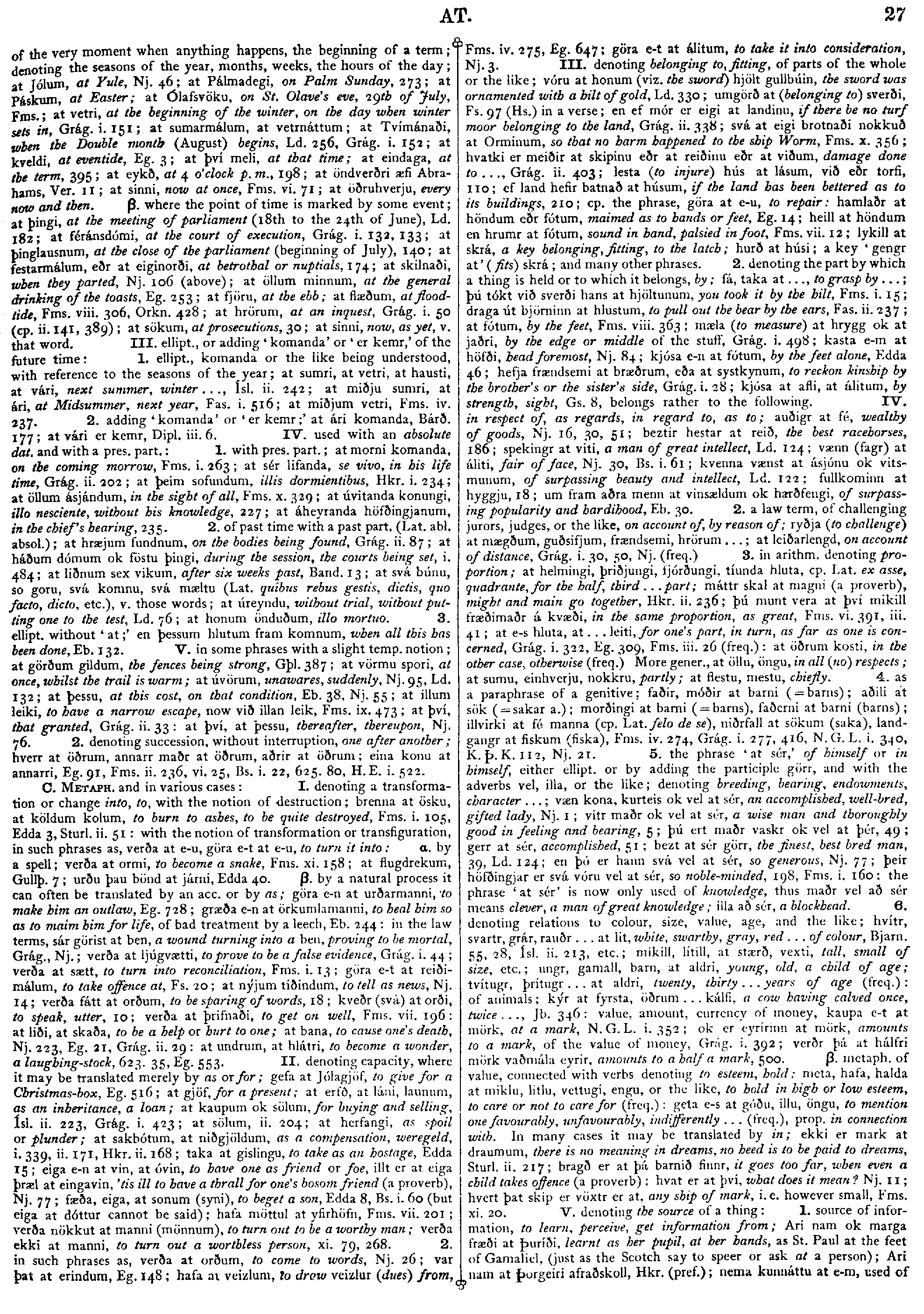
of
the
very
moment
when
anything
happens,
the
beginning
of
a
term;
denoting
the
seasons
of
the
year,
months,
weeks,
the
hours
of
the
day;
at
Jólum,
at
Yule,
Nj.
46;
at
Pálmadegi,
on
Palm
Sunday,
273;
at
Páskum,
at
Easter;
at
Ólafsvöku,
on
St.
Olave's
eve,
29th
of
July,
Fms.;
at
vetri,
at
the
beginning
of
the
winter,
on
the
day
when
winter
sets
in,
Grág.
1.
151;
at
sumarmálum,
at
vetrnáttum;
at
Tvímánaði,
when
the
Double
month
(August)
begins,
Ld.
256,
Grág.
i.
152;
at
kveldi,
at
eventide,
Eg.
3;
at
því
meli,
at
that
time;
at
eindaga,
at
the
term,
395;
at
eykð,
at
4
o'clock
p.m.,
198;
at
öndverðri
æfi
Abra
hams,
Ver.
II;
at
sinni,
now
at
once,
Fms.
vi.
71;
at
öðruhverju,
every
now
and
then.
.
where
the
point
of
time
is
marked
by
some
event;
at
þingi,
at
the
meeting
of
parliament
(18th
to
the
24th
of
June),
Ld.
182;
at
féránsdómi,
at
the
court
of
execution,
Grág.
i.
132,
133;
at
þinglausnum,
at
the
close
of
the
parliament
(beginning
of
July),
140;
at
festarmálum,
eðr
at
eiginorði,
at
betrothal
or
nuptials,
174;
at
skilnaði,
when
they
parted,
Nj.
106
(above);
at
öllum
minnum,
at
the
general
drinking
of
the
toasts,
Eg.
253;
at
fjöru,
at
the
ebb;
at
flæðum,
at
flood
tide,
Fms.
viii.
306,
Orkn.
428;
at
hrörum,
at
an
inquest,
Grág.
i.
50
(cp.
ii.
141,
389);
at
sökum,
at
prosecutions,
30;
at
sinni,
now,
as
yet,
v.
that
word.
III.
ellipt.,
or
adding
'komanda'
or
'er
kemr,'
of
the
future
time:
1.
ellipt.,
komanda
or
the
like
being
understood,
with
reference
to
the
seasons
of
the
year;
at
sumri,
at
vetri,
at
hausti,
at
vári,
next
summer,
winter...,
Ísl.
ii.
242;
at
miðju
sumri,
at
ári,
at
Midsummer,
next
year,
Fas.
i.
516;
at
miðjum
vetri,
Fms.
iv.
237,
2.
adding
'komanda'
or
'
er
kemr;'
at
ári
komanda,
Bárð.
177;
at
vári
er
kemr,
Dipl.
iii.
6.
IV.
used
with
an
absolute
dat.
and
with
a
pres.
part.:
1.
with
pres.
part.;
at
morni
komanda,
on
the
coming
morrow,
Fms.
i.
263;
at
sér
lifanda,
in
vivo,
in
his
life
time,
Grág.
ii.
202;
at
þeim
sofundum,
illis
dormientibus,
Hkr.
i.
234;
at
öllum
ásjándum,
in
the
sight
of
all,
Fms.
x.
329;
at
úvitanda
konungi,
illo
nesciente,
without
his
knowledge,
227;
at
áheyranda
höfðingjanum,
in
the
chief's
bearing,
235.
2.
of
past
time
with
a
past
part.
(Lat.
abl.
absol.);
at
hræjum
fundnum,
on
the
bodies
being
found,
Grág.
ii.
87;
at
háðum
dómum
ok
föstu
þingi,
during
the
session,
the
courts
being
set,
i.
484;
at
liðnum
sex
vikum,
after
six
weeks
past,
Band.
13;
at
svá
búnu,
so
goru,
svá
komnu,
svá
mæltu
(Lat.
quibus
rebus
gestis,
dictis,
quo
facto,
dicto,
etc.),
v.
those
words;
at
úreyndu,
without
trial,
without
put
ting
one
to
the
test,
Ld.
76;
at
honum
önduðum,
illo
mortuo.
3.
ellipt.
without
'at;'
en
þessum
hlutum
fram
komnum,
when
all
this
has
been
done,
Eb.
132.
V.
in
some
phrases
with
a
slight
temp,
notion;
at
görðum
gildum,
the
fences
being
strong,
Gþl.
387;
at
vörmu
spori,
at
once,
whilst
the
trail
is
warm;
at
úvörum,
unawares,
suddenly,
Nj.
95,
Ld.
132;
at
þessu,
at
this
cost,
on
that
condition,
Eb.
38,
Nj.
55;
at
illum
leiki,
to
have
a
narrow
escape,
now
við
illan
leik,
Fms.
ix.
473;
at
því,
that
granted,
Grág.
ii.
33:
at
því,
at
pessu,
thereafter,
thereupon,
Nj.
76.
2.
denoting
succession,
without
interruption,
one
after
another;
hverr
at
öðrum,
annarr
maðr
at
öðrum,
aðrir
at
öðrum;
eina
konu
at
annarri,
Eg.
91,
Fms.
ii.
236,
vi.
25,
Bs.
i.
22,
625.
80,
H.
E.
i.
522.
|
Source: Cleasby/Vigfusson, page b0033, entry 3 View original page image as: [TIFF] [PNG] [View previous entry] [View next entry] |
[Comment on this entry] [View comments] |
The following entry has been hand-corrected once. |
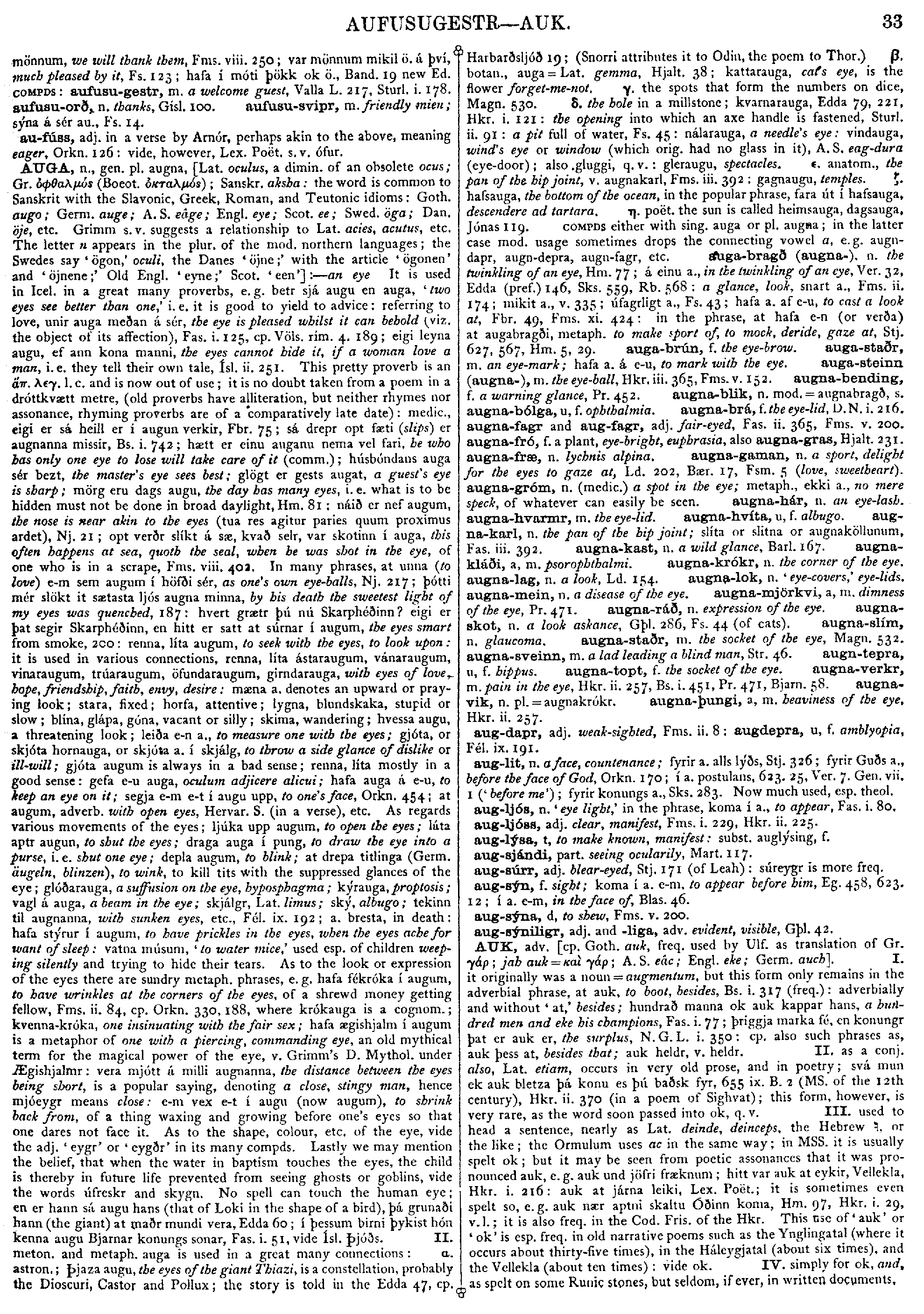
AUGA,
n.,
gen.
pl.
augna,
[Lat.
oculus,
a
dimin.
of
an
obsolete
ocus;
Gr.
GREEK
(Boeot.
GREEK);
Sanskr.
aksha:
the
word
is
common
to
Sanskrit
with
the
Slavonic,
Greek,
Roman,
and
Teutonic
idioms:
Goth.
augo;
Germ,
auge;
A.
S.
eâge;
Engl.
eye;
Scot.
ee;
Swed.
öga;
Dan.
öje,
etc.
Grimm
s.
v.
suggests
a
relationship
to
Lat.
acies,
acutus,
etc.
The
letter
n
appears
in
the
plur.
of
the
mod.
northern
languages;
the
Swedes
say
'ögon,'
oculi,
the
Danes
'öjne;'
with
the
article
'ögonen'
and
'öjnene;'
Old
Engl.
'eyne;'
Scot,
'een']
:--
an
eye
It
is
used
in
Icel.
in
a
great
many
proverbs,
e.
g.
betr
sjá
augu
en
auga,
'
two
eyes
see
better
than
one,'
i.
e.
it
is
good
to
yield
to
advice:
referring
to
love,
unir
auga
meðan
á
sér,
the
eye
is
pleased
whilst
it
can
behold
(viz.
the
object
of
its
affection),
Fas.
i.
125,
cp.
Völs.
rím.
4.
189;
eigi
leyna
augu,
ef
ann
kona
manni,
the
eyes
cannot
bide
it,
if
a
woman
love
a
man,
i.
e.
they
tell
their
own
tale,
Ísl.
ii.
251.
This
pretty
proverb
is
an
GREEK.
1.
c.
and
is
now
out
of
use;
it
is
no
doubt
taken
from
a
poem
in
a
dróttkvætt
metre,
(old
proverbs
have
alliteration,
but
neither
rhymes
nor
assonance,
rhyming
proverbs
are
of
a
comparatively
late
date):
medic.,
eigi
er
sá
heill
er
í
augun
verkir,
Fbr.
75;
sá
drepr
opt
fæti
(slips)
er
augnanna
missir,
Bs.
i.
742;
hætt
er
einu
auganu
nema
vel
fari,
he
who
has
only
one
eye
to
lose
will
take
care
of
it
(comm.);
húsbóndans
auga
sér
bezt,
the
master's
eye
sees
best;
glögt
er
gests
augat,
a
guest's
eye
is
sharp;
mörg
eru
dags
augu,
the
day
has
many
eyes,
i.
e.
what
is
to
be
hidden
must
not
be
done
in
broad
daylight,
Hm.
81;
náið
er
nef
augum,
the
nose
is
near
akin
to
the
eyes
(tua
res
agitur
paries
quum
proximus
ardet),
Nj.
21;
opt
verðr
slíkt
á
sæ,
kvað
selr,
var
skotinn
í
auga,
this
often
happens
at
sea,
quoth
the
seal,
when
he
was
shot
in
the
eye,
of
one
who
is
in
a
scrape,
Fms.
viii.
402.
In
many
phrases,
at
unna
(to
love)
e-m
sem
augum
í
höfði
sér,
as
one's
own
eye-balls,
Nj.
217;
þótti
mér
slökt
it
sætasta
ljós
augna
minna,
by
his
death
the
sweetest
light
of
my
eyes
was
quenched,
187:
hvert
grætr
þú
nú
Skarphéðinn?
eigi
er
þat
segir
Skarphéðinn,
en
hitt
er
satt
at
súrnar
í
augum,
the
eyes
smart
from
smoke,
200:
renna,
líta
augum,
to
seek
with
the
eyes,
to
look
upon:
it
is
used
in
various
connections,
renna,
líta
ástaraugum,
vánaraugum,
vinaraugum,
trúaraugum,
öfundaraugum,
girndarauga,
with
eyes
of
love,
hope,
friendship,
faith,
envy,
desire:
mæna
a.
denotes
an
upward
or
praying
look;
stara,
fixed;
horfa,
attentive;
lygna,
blundskaka,
stupid
or
slow;
blína,
glápa,
góna,
vacant
or
silly;
skima,
wandering;
hvessa
augu,
a
threatening
look;
leiða
e-n
a.,
to
measure
one
with
the
eyes;
gjóta,
or
skjóta
hornauga,
or
skjóta
a.
í
skjálg,
to
throw
a
side
glance
of
dislike
or
ill-will;
gjóta
augum
is
always
in
a
bad
sense;
renna,
líta
mostly
in
a
good
sense:
gefa
e-u
auga,
oculum
adjicere
alicui;
hafa
auga
á
e-u,
to
keep
an
eye
on
it;
segja
e-m
e-t
í
augu
upp,
to
one's
face,
Orkn.
454;
at
augum,
adverb.
with
open
eyes,
Hervar.
S.
(in
a
verse),
etc.
As
regards
various
movements
of
the
eyes;
ljúka
upp
augum,
to
open
the
eyes;
láta
aptr
augun,
to
shut
the
eyes;
draga
auga
í
pung,
to
draw
the
eye
into
a
purse,
i.
e.
shut
one
eye;
depla
augum,
to
blink;
at
drepa
titlinga
(Germ.
äugeln,
blinzen),
to
wink,
to
kill
tits
with
the
suppressed
glances
of
the
eye;
glóðarauga,
a
suffusion
on
the
eye,
hyposphagma;
kýrauga.
proptosis;
vagl
á
auga,
a
beam
in
the
eye;
skjálgr,
Lat.
limus;
ský,
albugo;
tekinn
til
augnanna,
with
sunken
eyes,
etc.,
Fél.
ix.
192;
a.
bresta,
in
death:
hafa
stýrur
í
augum,
to
have
prickles
in
the
eyes,
when
the
eyes
ache
for
want
of
sleep:
vatna
músum,
'to
water
mice,'
used
esp.
of
children
weep-
ing
silently
and
trying
to
hide
their
tears.
As
to
the
look
or
expression
of
the
eyes
there
are
sundry
metaph.
phrases,
e.
g.
hafa
fékróka
í
augum,
to
have
wrinkles
at
the
corners
of
the
eyes,
of
a
shrewd
money
getting
fellow,
Fms.
ii.
84,
cp.
Orkn.
330,
188,
where
krókauga
is
a
cognom.;
kvenna-króka,
one
insinuating
with
the
fair
sex;
hafa
ægishjalm
í
augum
is
a
metaphor
of
one
with
a
piercing,
commanding
eye,
an
old
mythical
term
for
the
magical
power
of
the
eye,
v.
Grimm's
D.
Mythol.
under
Ægishjalmr:
vera
mjótt
á
milli
augnanna,
the
distance
between
the
eyes
being
short,
is
a
popular
saying,
denoting
a
close,
stingy
man,
hence
mjóeygr
means
close:
e-m
vex
e-t
í
augu
(now
augum),
to
shrink
back
from,
of
a
thing
waxing
and
growing
before
one's
eyes
so
that
one
dares
not
face
it.
As
to
the
shape,
colour,
etc.
of
the
eye,
vide
the
adj.
'
eygr'
or
'
eygðr'
in
its
many
compds.
Lastly
we
may
mention
the
belief,
that
when
the
water
in
baptism
touches
the
eyes,
the
child
is
thereby
in
future
life
prevented
from
seeing
ghosts
or
goblins,
vide
the
words
úfreskr
and
skygn.
No
spell
can
touch
the
human
eye;
en
er
harm
sá
augu
hans
(that
of
Loki
in
the
shape
of
a
bird),
þá
grunaði
hann
(the
giant)
at
maðr
mundi
vera,
Edda
60;
í
bessum
birni
þykist
hón
kenna
augu
Bjarnar
konungs
sonar,
Fas.
i.
51,
vide
Ísl.
Þjóðs.
II.
meton.
and
metaph.
auga
is
used
in
a
great
many
connections:
 .
astron.;
þjaza
augu,
the
eyes
of
the
giant
Thiazi,
is
a
constellation,
probably
the
Dioscuri,
Castor
and
Pollux;
the
story
is
told
in
the
Edda
47,
cp.
Harbarðsljóð
19;
(Snorri
attributes
it
to
Odin,
the
poem
to
Thor.)
.
botan.,
auga
=
Lat.
gemma,
Hjalt.
38;
kattarauga,
cat's
eye,
is
the
flower
forget-me-not.
.
astron.;
þjaza
augu,
the
eyes
of
the
giant
Thiazi,
is
a
constellation,
probably
the
Dioscuri,
Castor
and
Pollux;
the
story
is
told
in
the
Edda
47,
cp.
Harbarðsljóð
19;
(Snorri
attributes
it
to
Odin,
the
poem
to
Thor.)
.
botan.,
auga
=
Lat.
gemma,
Hjalt.
38;
kattarauga,
cat's
eye,
is
the
flower
forget-me-not.
 the
spots
that
form
the
numbers
on
dice,
Magn.
530.
the
spots
that
form
the
numbers
on
dice,
Magn.
530.
 .
the
hole
in
a
millstone;
kvarnarauga,
Edda
79,
221,
Hkr.
i.
121:
the
opening
into
which
an
axe
handle
is
fastened,
Sturl.
ii.
91:
a
pit
full
of
water,
Fs.
45:
nálarauga,
a
needle's
eye:
vindauga,
wind's
eye
or
window
(which
orig.
had
no
glass
in
it),
A.
S.
eag-dura
(eye-door);
also
gluggi,
q.
v.:
gleraugu,
spectacles.
.
the
hole
in
a
millstone;
kvarnarauga,
Edda
79,
221,
Hkr.
i.
121:
the
opening
into
which
an
axe
handle
is
fastened,
Sturl.
ii.
91:
a
pit
full
of
water,
Fs.
45:
nálarauga,
a
needle's
eye:
vindauga,
wind's
eye
or
window
(which
orig.
had
no
glass
in
it),
A.
S.
eag-dura
(eye-door);
also
gluggi,
q.
v.:
gleraugu,
spectacles.
 .
anatom.,
the
pan
of
the
hip
joint,
v.
augnakarl,
Fms.
iii.
392:
gagnaugu,
temples.
.
anatom.,
the
pan
of
the
hip
joint,
v.
augnakarl,
Fms.
iii.
392:
gagnaugu,
temples.
 .
hafsauga,
the
bottom
of
the
ocean,
in
the
popular
phrase,
fara
út
í
hafsauga,
descendere
ad
tartara.
.
hafsauga,
the
bottom
of
the
ocean,
in
the
popular
phrase,
fara
út
í
hafsauga,
descendere
ad
tartara.
 .
poët,
the
sun
is
called
heimsauga,
dagsauga,
Jónas
119.
COMPDS
either
with
sing.
auga
or
pl.
augna;
in
the
latter
case
mod.
usage
sometimes
drops
the
connecting
vowel
a,
e.
g.
augn-
dapr,
augn-depra,
augn-fagr,
etc.
auga-bragð
(augna-),
n.
the
twinkling
of
an
eye,
Hm.
77;
á
einu
a.,
in
the
twinkling
of
an
eye,
Ver.
32,
Edda
(pref.)
146,
Sks.
559,
Rb.
568:
a
glance,
look,
snart
a.,
Fms.
ii.
174;
mikit
a.,
v.
335;
úfagrligt
a.,
Fs.
43;
hafa
a.
af
e-u,
to
cast
a
look
at,
Fbr.
49,
Fms.
xi.
424:
in
the
phrase,
at
hafa
e-n
(or
verða)
at
augabragði,
metaph.
to
make
sport
of,
to
mock,
deride,
gaze
at,
Stj.
627,
567,
Hm.
5,
29.
auga-brun,
f.
the
eye-brow.
auga-staðr,
m.
an
eye-mark;
hafa
a.
á
e-u,
to
mark
with
the
eye.
auga-steinn
(augna-),
m.
the
eye-ball,
Hkr.
iii.
365,
Fms.
v.
152.
augna-bending,
f.
a
warning
glance,
Pr.
452.
augna-blik,
n.
mod.
=
augnabragð,
s.
augna-bólga,
u,
f.
ophthalmia.
augna-brá,
f.
the
eye-lid,
D.
N.
i.
216.
augna-fagr
and
aug-fagr,
adj.
fair-eyed,
Fas.
ii.
365,
Fms.
v.
200.
augna-fró,
f.
a
plant,
eye-bright,
euphrasia,
also
augna-gras,
Hjalt.
231.
augna-fræ,
n.
lychnis
alpina.
augna-gaman,
n.
a
sport,
delight
for
the
eyes
to
gaze
at,
Ld.
202,
Bær.
17,
Fsm.
5
(love,
sweetheart).
augna-gróm,
n.
(medic.)
a
spot
in
the
eye;
metaph.,
ekki
a.,
no
mere
speck,
of
whatever
can
easily
be
seen.
augna-hár,
n.
an
eye-lash.
augna-hvannr,
m.
the
eye-lid.
augna-hvita,
u,
f.
albugo.
augna-karl,
n.
the
pan
of
the
hip
joint;
slíta
or
slitna
or
augnaköllunum,
Fas.
iii.
392.
augna-kast,
n.
a
wild
glance,
Barl.
167.
augna-
kláði,
a,
m.
psorophthalmi.
augna-krókr,
n.
the
corner
of
the
eye.
augna-lag,
n.
a
look,
Ld.
154.
augna-lok,
n.
'eye-covers,'
eye-lids.
augna-mein,
n.
a
disease
of
the
eye.
augna-mjörkvi,
a,
m.
dimness
of
the
eye,
Pr.
471.
augna-ráð,
n.
expression
of
the
eye.
augna-
skot,
n.
a
look
askance,
Gþl.
286,
Fs.
44
(of
cats).
augna-slím,
n.
glaucoma.
augna-staðr,
m.
the
socket
of
the
eye,
Magn.
532.
augna-sveinn,
m.
a
lad
leading
a
blind
man,
Str.
46.
augn-tepra,
u,
f.
hippus.
augna-topt,
f.
the
socket
of
the
eye.
augna-verkr,
m.
pain
in
the
eye,
Hkr.
ii.
257,
Bs.
i.
451,
Pr.
471,
Bjarn.
58.
augna-
vik,
n.
pl.
=
augnakrókr.
augna-þungi,
a,
m.
heaviness
of
the
eye,
Hkr.
ii.
257.
.
poët,
the
sun
is
called
heimsauga,
dagsauga,
Jónas
119.
COMPDS
either
with
sing.
auga
or
pl.
augna;
in
the
latter
case
mod.
usage
sometimes
drops
the
connecting
vowel
a,
e.
g.
augn-
dapr,
augn-depra,
augn-fagr,
etc.
auga-bragð
(augna-),
n.
the
twinkling
of
an
eye,
Hm.
77;
á
einu
a.,
in
the
twinkling
of
an
eye,
Ver.
32,
Edda
(pref.)
146,
Sks.
559,
Rb.
568:
a
glance,
look,
snart
a.,
Fms.
ii.
174;
mikit
a.,
v.
335;
úfagrligt
a.,
Fs.
43;
hafa
a.
af
e-u,
to
cast
a
look
at,
Fbr.
49,
Fms.
xi.
424:
in
the
phrase,
at
hafa
e-n
(or
verða)
at
augabragði,
metaph.
to
make
sport
of,
to
mock,
deride,
gaze
at,
Stj.
627,
567,
Hm.
5,
29.
auga-brun,
f.
the
eye-brow.
auga-staðr,
m.
an
eye-mark;
hafa
a.
á
e-u,
to
mark
with
the
eye.
auga-steinn
(augna-),
m.
the
eye-ball,
Hkr.
iii.
365,
Fms.
v.
152.
augna-bending,
f.
a
warning
glance,
Pr.
452.
augna-blik,
n.
mod.
=
augnabragð,
s.
augna-bólga,
u,
f.
ophthalmia.
augna-brá,
f.
the
eye-lid,
D.
N.
i.
216.
augna-fagr
and
aug-fagr,
adj.
fair-eyed,
Fas.
ii.
365,
Fms.
v.
200.
augna-fró,
f.
a
plant,
eye-bright,
euphrasia,
also
augna-gras,
Hjalt.
231.
augna-fræ,
n.
lychnis
alpina.
augna-gaman,
n.
a
sport,
delight
for
the
eyes
to
gaze
at,
Ld.
202,
Bær.
17,
Fsm.
5
(love,
sweetheart).
augna-gróm,
n.
(medic.)
a
spot
in
the
eye;
metaph.,
ekki
a.,
no
mere
speck,
of
whatever
can
easily
be
seen.
augna-hár,
n.
an
eye-lash.
augna-hvannr,
m.
the
eye-lid.
augna-hvita,
u,
f.
albugo.
augna-karl,
n.
the
pan
of
the
hip
joint;
slíta
or
slitna
or
augnaköllunum,
Fas.
iii.
392.
augna-kast,
n.
a
wild
glance,
Barl.
167.
augna-
kláði,
a,
m.
psorophthalmi.
augna-krókr,
n.
the
corner
of
the
eye.
augna-lag,
n.
a
look,
Ld.
154.
augna-lok,
n.
'eye-covers,'
eye-lids.
augna-mein,
n.
a
disease
of
the
eye.
augna-mjörkvi,
a,
m.
dimness
of
the
eye,
Pr.
471.
augna-ráð,
n.
expression
of
the
eye.
augna-
skot,
n.
a
look
askance,
Gþl.
286,
Fs.
44
(of
cats).
augna-slím,
n.
glaucoma.
augna-staðr,
m.
the
socket
of
the
eye,
Magn.
532.
augna-sveinn,
m.
a
lad
leading
a
blind
man,
Str.
46.
augn-tepra,
u,
f.
hippus.
augna-topt,
f.
the
socket
of
the
eye.
augna-verkr,
m.
pain
in
the
eye,
Hkr.
ii.
257,
Bs.
i.
451,
Pr.
471,
Bjarn.
58.
augna-
vik,
n.
pl.
=
augnakrókr.
augna-þungi,
a,
m.
heaviness
of
the
eye,
Hkr.
ii.
257.
|
Source: Cleasby/Vigfusson, page b0037, entry 2 View original page image as: [TIFF] [PNG] [View previous entry] [View next entry] |
[Comment on this entry] [View comments] |
The following entry has been hand-corrected once. |
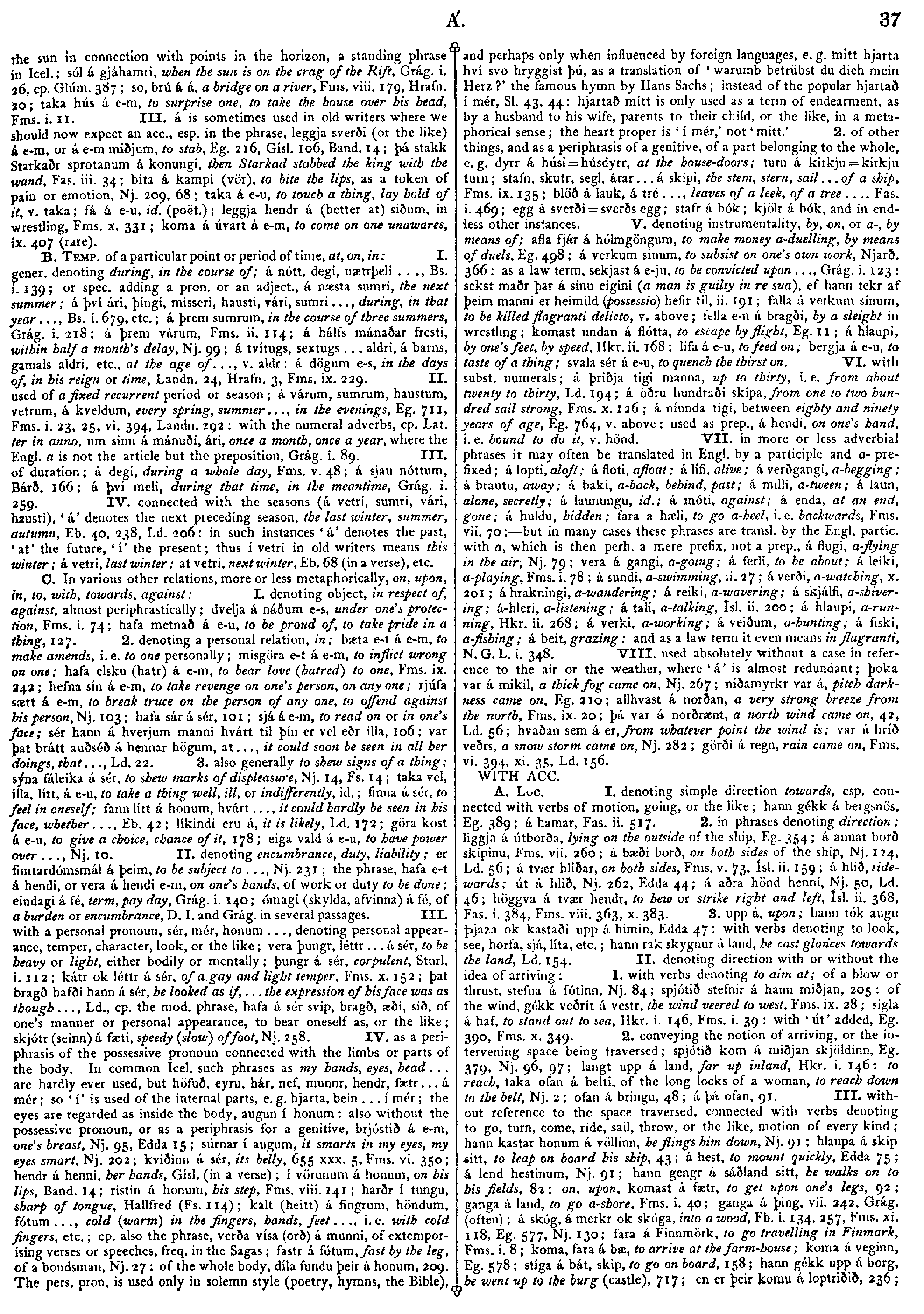
B. TEMP. of a particular point or period of time, at, on, in: I. gener. denoting during, in the course of; á nótt, degi, nætrþeli ..., Bs. i. 139; or spec. adding a pron. or an adject., á næsta sumri, the next summer; á því ári, þingi, misseri, hausti, vári, sumri ..., during, in that year ..., Bs. i. 679, etc.; á þrem sumrum, in the course of three summers, Grág. i. 218; á þrem várum, Fms. ii. 114; á hálfs mánaðar fresti, within half a month's delay, Nj. 99; á tvítugs, sextugs ... aldri, á barns, gamals aldri, etc., at the age of ..., v. aldr: á dögum e-s, in the days of, in his reign or time, Landn. 24, Hrafn. 3, Fms. ix. 229. II. used of a fixed recurrent period or season; á várum, sumrum, haustum, vetrum, á kveldum, every spring, summer ..., in the evenings, Eg. 711, Fms. i. 23, 25, vi. 394, Landn. 292: with the numeral adverbs, cp. Lat. ter in anno, um sinn á mánuði, ári, once a month, once a year, where the Engl. a is not the article but the preposition, Grág. i. 89. III. of duration; á degi, during a whole day, Fms. v. 48; á sjau nóttum, Bárð. 166; á því meli, during that time, in the meantime, Grág. i. 259. IV. connected with the seasons (á vetri, sumri, vári, hausti), 'á' denotes the next preceding season, the last winter, summer, autumn, Eb. 40, 238, Ld. 206: in such instances 'á' denotes the past, 'at' the future, 'í' the present; thus í vetri in old writers means this winter; á vetri, last winter; at vetri, next winter, Eb. 68 (in a verse), etc.
|
Source: Cleasby/Vigfusson, page b0060, entry 6 View original page image as: [TIFF] [PNG] [View previous entry] [View next entry] |
[Comment on this entry] [View comments] |
The following entry has been hand-corrected once. |
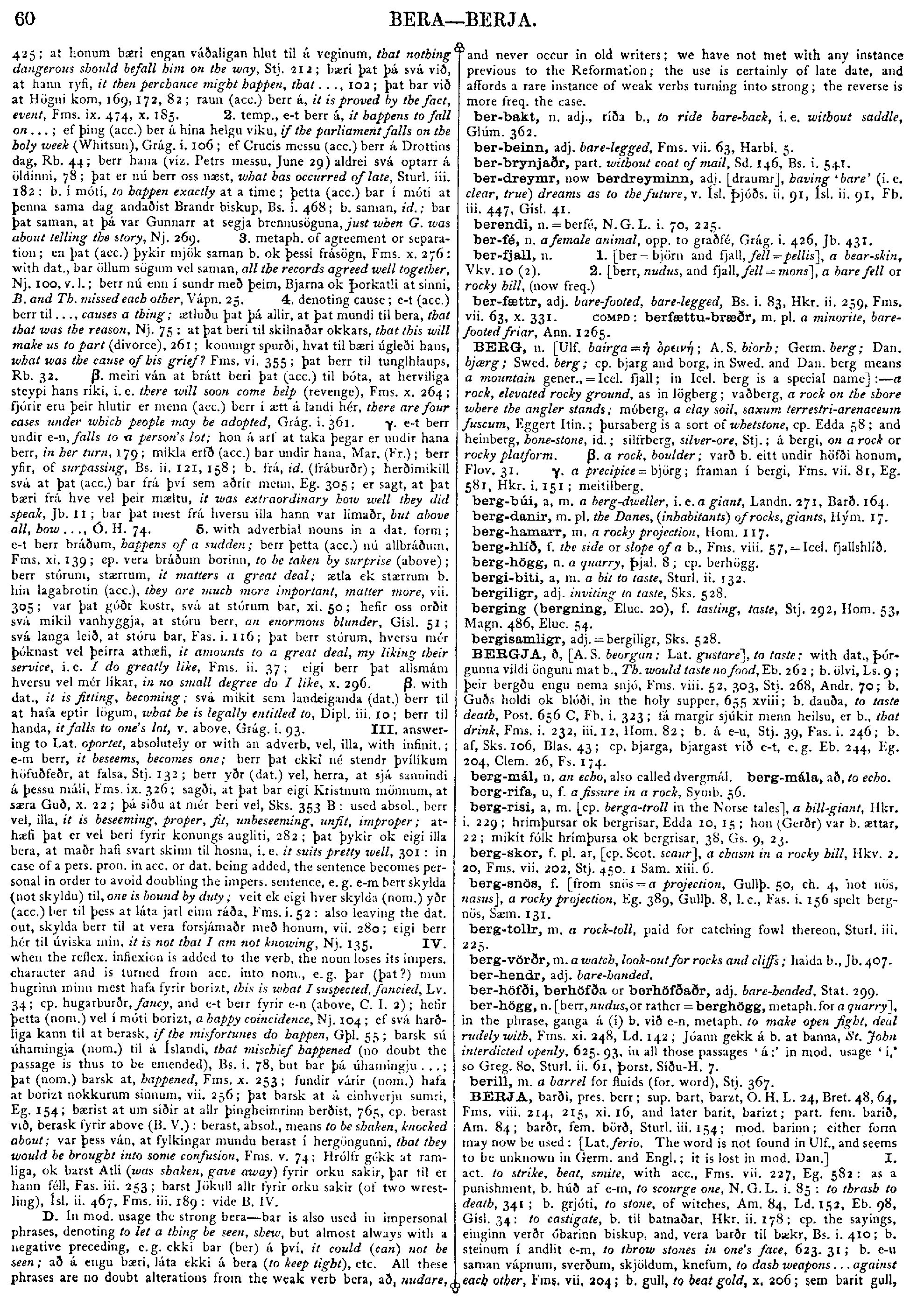
ber-dreymr, now berdreyminn, adj. [draumr], having 'bare' (i.e. clear, true) dreams as to the future, v. Ísl. Þjóðs. ii. 91, Ísl. ii. 91, Fb. iii. 447, Gísl. 41.
|
Source: Cleasby/Vigfusson, page b0107, entry 33 View original page image as: [TIFF] [PNG] [View previous entry] [View next entry] |
[Comment on this entry] [View comments] |
The following entry has not been hand-corrected. However, the page is reserved and someone is correcting it. |
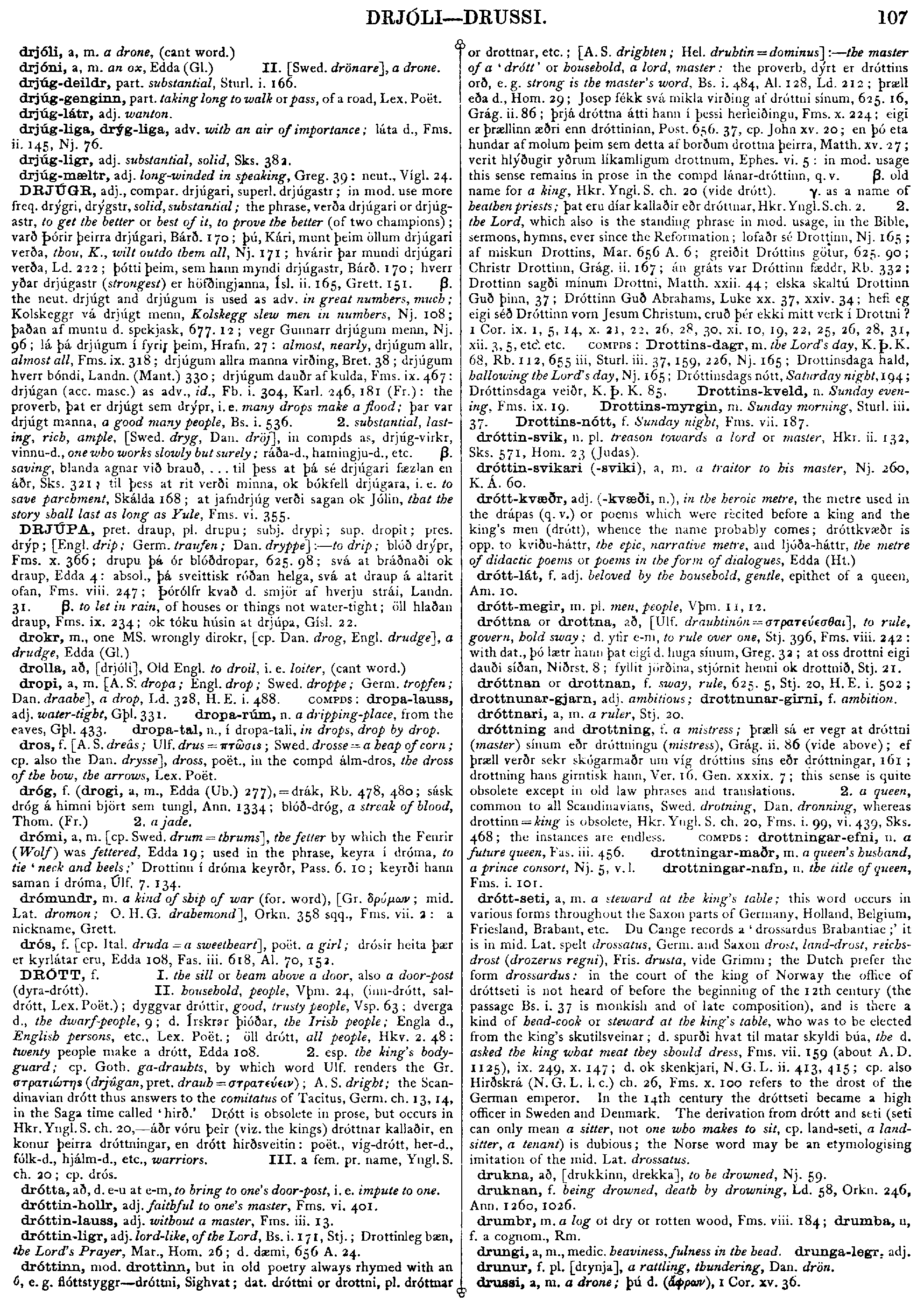
dróttning and drottning, f. a mistress; þræll sá er vegr at drottai (master) sínum eðr dróttningu (mistress), Grág. ii. 86 (vide above); ef þræll verðr sekr skógannaðr urn víg dróttins sins eðr dróttningar, 161; drottning hans girntisk hann, Ver. 16. Gen. xxxix. 7; this sense is quite obsolete except in old law phrases and translations. 2. a queen, common to all Scandinavians, Swed. draining, Dan. dronning, whereas drottinn = king is obsolete, Hkr. Yngl. S. ch. 20, Fms. i. 99, vi. 439, Sks. 468; the instances are endltss. COMPDS: drottningar-efni, n. a future queen, Fas. iii. 456. drottningar-maðr, m. a queen's husband, a prince consort, Nj. 5, v. l. drottningar-nafn, n. the title of queen, Fms. i. 101.
|
Source: Cleasby/Vigfusson, page b0116, entry 8 View original page image as: [TIFF] [PNG] [View previous entry] [View next entry] |
[Comment on this entry] [View comments] |
The following entry has been hand-corrected once. |
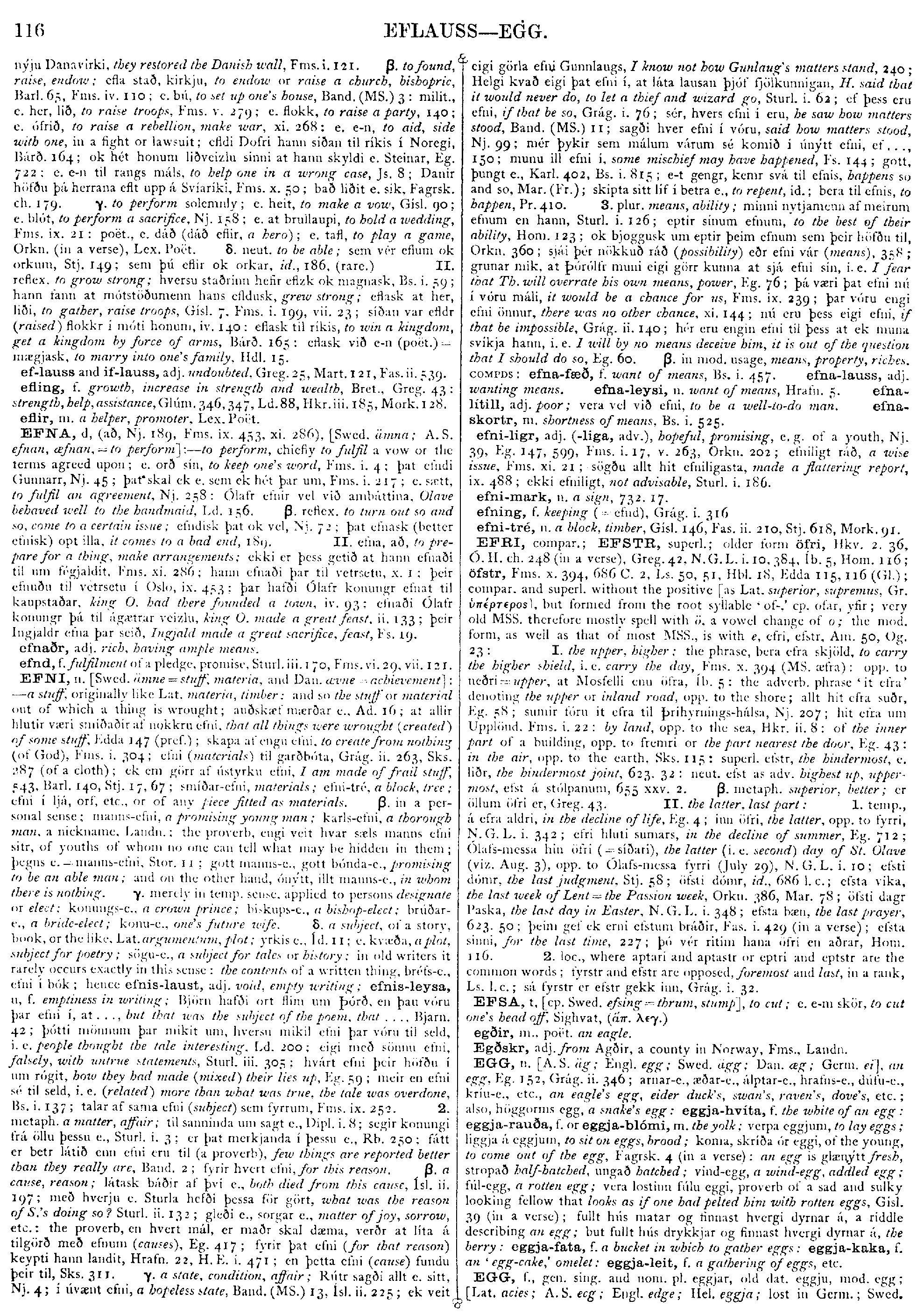
EFNI,
n.
[Swed.
ämne
=
stuff,
materia,
and
Dan.
ævne
=
achievement]
:--
a
stuff,
originally
like
Lat.
materia,
timber;
and
so
the
stuff
or
material
out
of
which
a
thing
is
wrought;
auðskæf
mærðar
e.,
Ad.
16;
at
allir
hlutir
væri
smíðaðir
af
nokkru
efni,
that
all
things
were
wrought
(created)
of
some
stuff,
Edda
147
(pref.);
skapa
af
engu
efni,
to
create
from
nothing
(of
God),
Fms.
i.
304;
efni
(materials)
til
garðbóta,
Grág.
ii.
263,
Sks.
287
(of
a
cloth);
ek
em
görr
af
ústyrku
efni,
I
am
made
of
frail
stuff,
543,
Barl.
140,
Stj.
17,
67;
smíðar-efni,
materials;
efni-tré,
a
block,
tree;
efni
í
ljá,
orf,
etc.,
or
of
any
piece
fitted
as
materials.
.
in
a
personal
sense;
manns-efni,
a
promising
young
man:
karls-efni,
a
thorough
man,
a
nickname,
Landn.:
the
proverb,
engi
veit
hvar
sæls
manns
efni
sitr,
of
youths
of
whom
no
one
can
tell
what
may
be
hidden
in
them;
þegns
e.
=
manns-efni,
Stor.
11:
gott
manns-e.,
gott
bónda-e.,
promising
to
be
an
able
man;
and
on
the
other
hand,
ónýtt,
illt
manns-e.,
in
whom
there
is
nothing.
.
merely
in
temp.
sense,
applied
to
persons
designate
or
elect;
konungs-e.,
a
crown
prince;
biskups-e.,
a
bishop-elect;
brúðar-e.,
a
bride-elect;
konu-e.,
one's
future
wife.
.
a
subject,
of
a
story,
book,
or
the
like,
Lat.
argumentum,
plot;
yrkis
e.,
Íd.
11;
e.
kvæða,
a
plot,
subject
for
poetry;
sögu-e.,
a
subject
for
tales
or
history;
in
old
writers
it
rarely
occurs
exactly
in
this
sense:
the
contents
of
a
written
thing,
bréfs-e.,
efni
í
bók;
hence
efnis-laust,
adj.
void,
empty
writing;
efnis-leysa,
u,
f.
emptiness
in
writing;
Björn
hafði
ort
flim
um
Þórð,
en
þau
vóru
þar
efni
í,
at
...,
but
that
was
the
subject
of
the
poem,
that
...,
Bjarn.
42;
þótti
mönnum
þar
mikit
um,
hversu
mikil
efni
þar
vóru
til
seld,
i.e.
people
thought
the
tale
interesting,
Ld.
200;
eigi
með
sönnu
efni,
falsely,
with
untrue
statements,
Sturl.
iii.
305:
hvárt
efni
þeir
höfðu
í
um
rógit,
how
they
had
made
(mixed)
their
lies
up,
Eg.
59;
meir
en
efni
sé
til
seld,
i.e.
(related)
more
than
what
was
true,
the
tale
was
overdone,
Bs.
i.
137;
talar
af
sama
efni
(subject)
sem
fyrrum,
Fms.
ix.
252.
2.
metaph.
a
matter,
affair;
til
sanninda
um
sagt
e.,
Dipl.
i.
8;
segir
konungi
frá
öllu
þessu
e.,
Sturl.
i.
3;
er
þat
merkjanda
í
þessu
e.,
Rb.
250;
fátt
er
betr
látið
enn
efni
eru
til
(a
proverb),
few
things
are
reported
better
than
they
really
are,
Band.
2;
fyrir
hvert
efni,
for
this
reason.
.
a
cause,
reason;
látask
báðir
af
því
e.,
both
died
from
this
cause,
Ísl.
ii.
197;
með
hverju
e.
Sturla
hefði
þessa
för
gört,
what
was
the
reason
of
S.'s
doing
so?
Sturl.
ii.
132;
gleði
e.,
sorgar
e.,
matter
of
joy,
sorrow,
etc.:
the
proverb,
en
hvert
mál,
er
maðr
skal
dæma,
verðr
at
líta
á
tilgörð
með
efnum
(causes),
Eg.
417;
fyrir
þat
efni
(for
that
reason)
keypti
hann
landit,
Hrafn.
22,
H.
E.
i.
471;
en
þetta
efni
(cause)
fundu
þeir
til,
Sks.
311.
.
a
state,
condition,
affair;
Rútr
sagði
allt
e.
sitt,
Nj.
4;
í
úvænt
efni,
a
hopeless
state,
Band.
(MS.)
13,
Ísl.
ii.
225;
ek
veit
eigi
görla
efni
Gunnlaugs,
I
know
not
how
Gunlaug's
matters
stand,
240;
Helgi
kvað
eigi
þat
efni
í,
at
láta
lausan
þjóf
fjölkunnigan,
H.
said
that
it
would
never
do,
to
let
a
thief
and
wizard
go,
Sturl.
i.
62;
ef
þess
eru
efni,
if
that
be
so,
Grág.
i.
76;
sér,
hvers
efni
í
eru,
he
saw
how
matters
stood,
Band.
(MS.)
11;
sagði
hver
efni
í
voru,
said
how
matters
stood,
Nj.
99;
mér
þykir
sem
málum
várum
sé
komið
í
únýtt
efni,
ef
...,
150;
munu
ill
efni
í,
some
mischief
may
have
happened,
Fs.
144;
gott,
þungt
e.,
Karl.
402,
Bs.
i.
815;
e-t
gengr,
kemr
svá
til
efnis,
happens
so
and
so,
Mar.
(Fr.);
skipta
sitt
líf
í
betra
e.,
to
repent,
id.;
bera
til
efnis,
to
happen,
Pr.
410.
3.
plur.
means,
ability;
minni
nytjamenn
af
meirum
efnum
en
hann,
Sturl.
i.
126;
eptir
sínum
efnum,
to
the
best
of
their
ability,
Hom.
123;
ok
bjoggusk
um
eptir
þeim
efnum
sem
þeir
höfðu
til,
Orkn.
360;
sjái
þér
nökkuð
ráð
(possibility)
eðr
efni
vár
(means),
358;
grunar
mik,
at
Þórólfr
muni
eigi
görr
kunna
at
sjá
efni
sín,
i.e.
I
fear
that
Th.
will
overrate
his
own
means,
power,
Eg.
76;
þá
væri
þat
efni
nú
í
vóru
máli,
it
would
be
a
chance
for
us,
Fms.
ix.
239;
þar
vóru
engi
efni
önnur,
there
was
no
other
chance,
xi.
144;
nú
eru
þess
eigi
efni,
if
that
be
impossible,
Grág.
ii.
140;
hér
eru
engin
efni
til
þess
at
ek
muna
svíkja
hann,
i.e.
I
will
by
no
means
deceive
him,
it
is
out
of
the
question
that
I
should
do
so,
Eg.
60.
.
in
mod.
usage,
means,
property,
riches.
COMPDS:
efna-fæð,
f.
want
of
means,
Bs.
i.
457.
efna-lauss,
adj.
wanting
means.
efna-leysi,
n.
want
of
means,
Hrafn.
5.
efna-lítill,
adj.
poor;
vera
vel
við
efni,
to
be
a
well-to-do
man.
efna-skortr,
m.
shortness
of
means,
Bs.
i.
525.
|
Source: Cleasby/Vigfusson, page b0131, entry 23 View original page image as: [TIFF] [PNG] [View previous entry] [View next entry] |
[Comment on this entry] [View comments] |
The following entry has been hand-corrected once. |
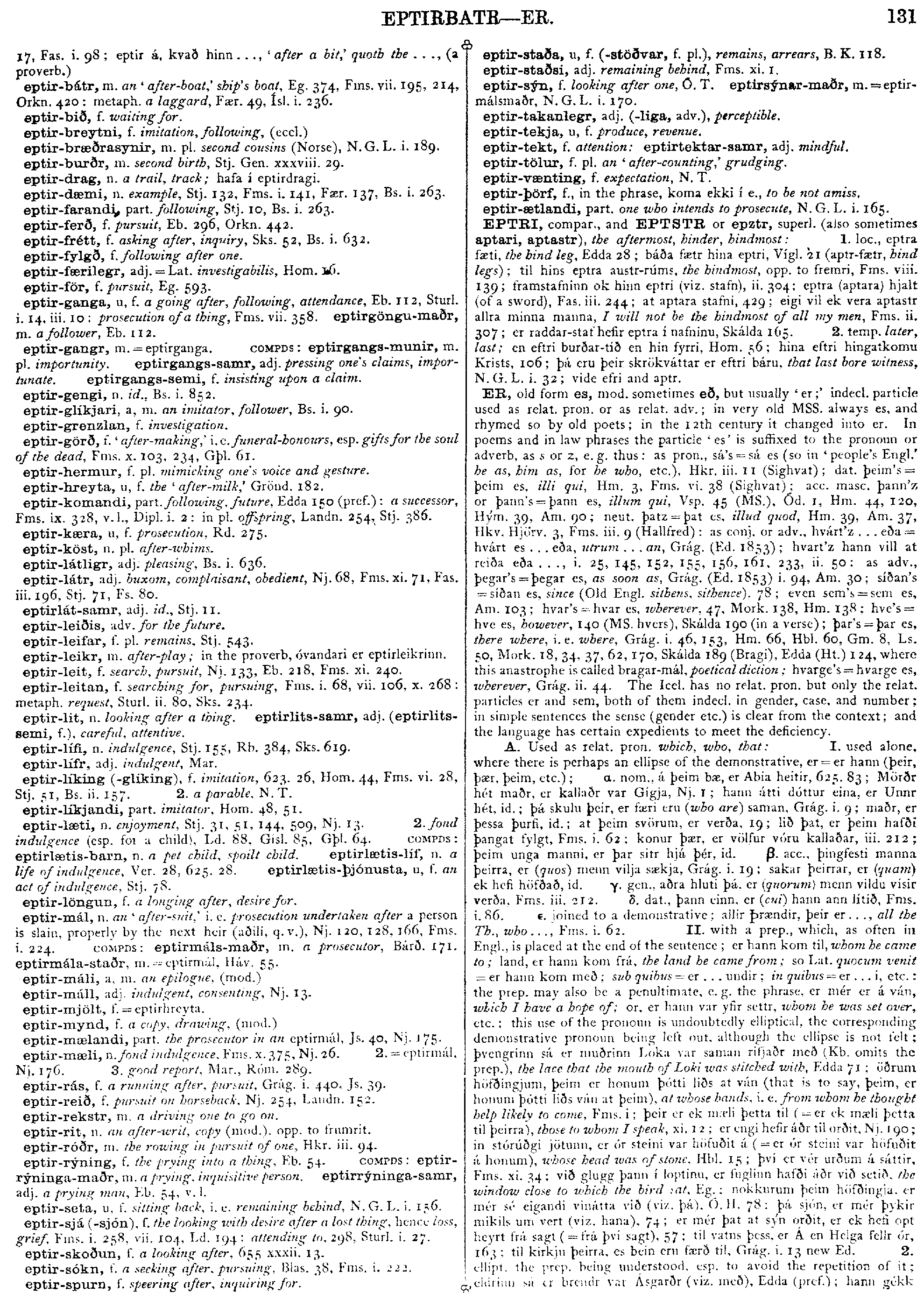
eptir-komandi, part. following, future, Edda 150 (pref.): a successor, Fms. ix. 328, v. l., Dipl. i. 2: in pl. offspring, Landn. 254, Stj. 386.
| Result Page: |  |
Previous | 1 2 3 4 5 6 7 8 9 | Next |  |
Germanic Lexicon Project (main page)
This search system was written by
Sean Crist
Please consider
volunteering
to correct the data in these online dictionaries.
No rights reserved. Feel free to use these data in any way you please.