|
|

Search for furor again, using less strict matching (26 results)
|
Source: Bosworth/Toller, page d0252, entry 27 View original page image as: [TIFF] [PNG] [View previous entry] [View next entry] |
[Comment on this entry] [View comments] |
The following entry has been hand-corrected once. |
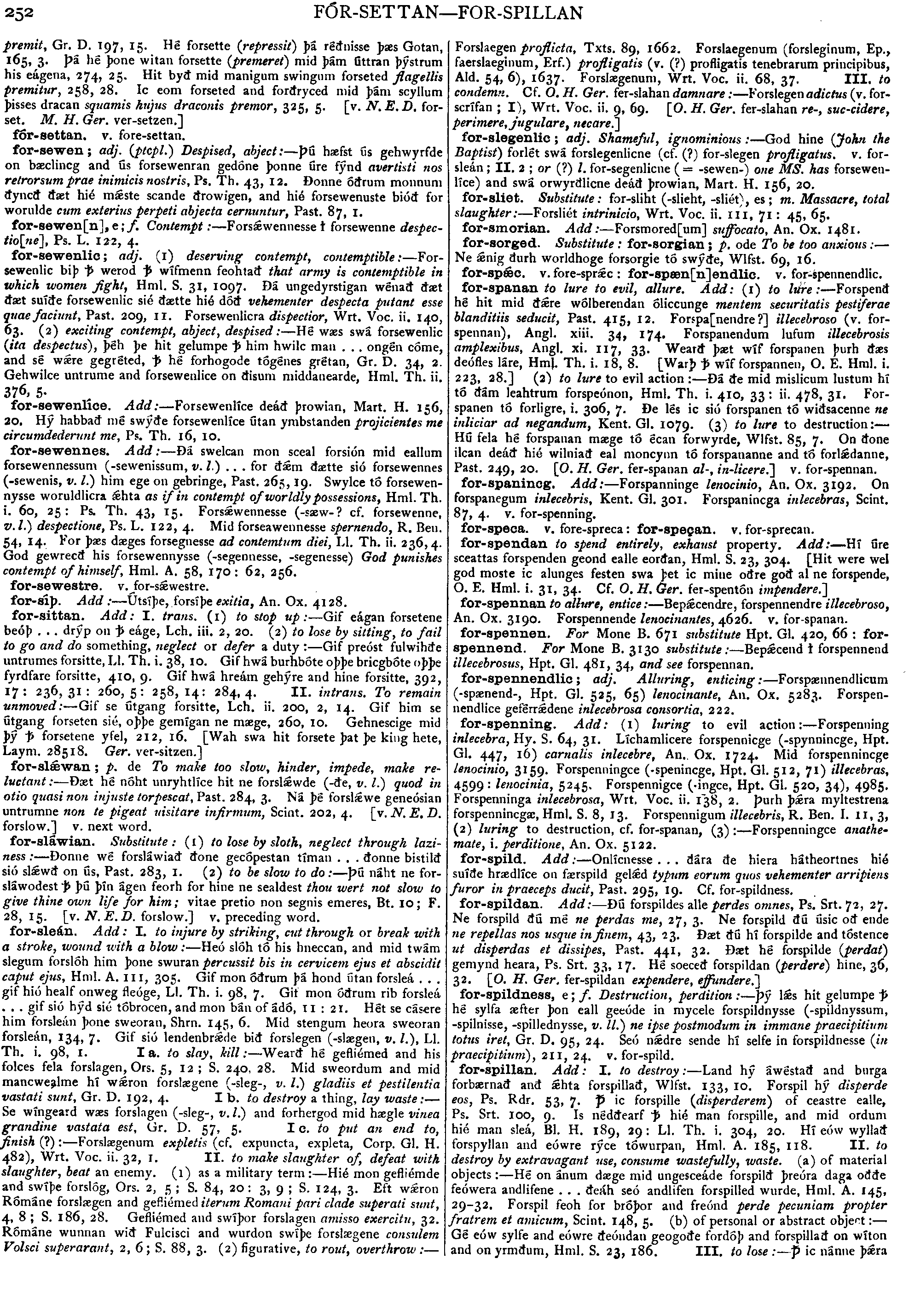
for-spild.
Add
:--
Onlícnesse
...
ðára
ðe
hiera
hátheortnes
hié
suíðe
hrædlíce
on
færspild
gel d
typum
eorum
quos
vehementer
arripiens
furor
in
praeceps
ducit,
Past.
295,
19.
Cf.
for-spildness.
d
typum
eorum
quos
vehementer
arripiens
furor
in
praeceps
ducit,
Past.
295,
19.
Cf.
for-spildness.
|
Source: Bosworth/Toller, page d0298, entry 19 View original page image as: [TIFF] [PNG] [View previous entry] [View next entry] |
[Comment on this entry] [View comments] |
The following entry has been hand-corrected once. |
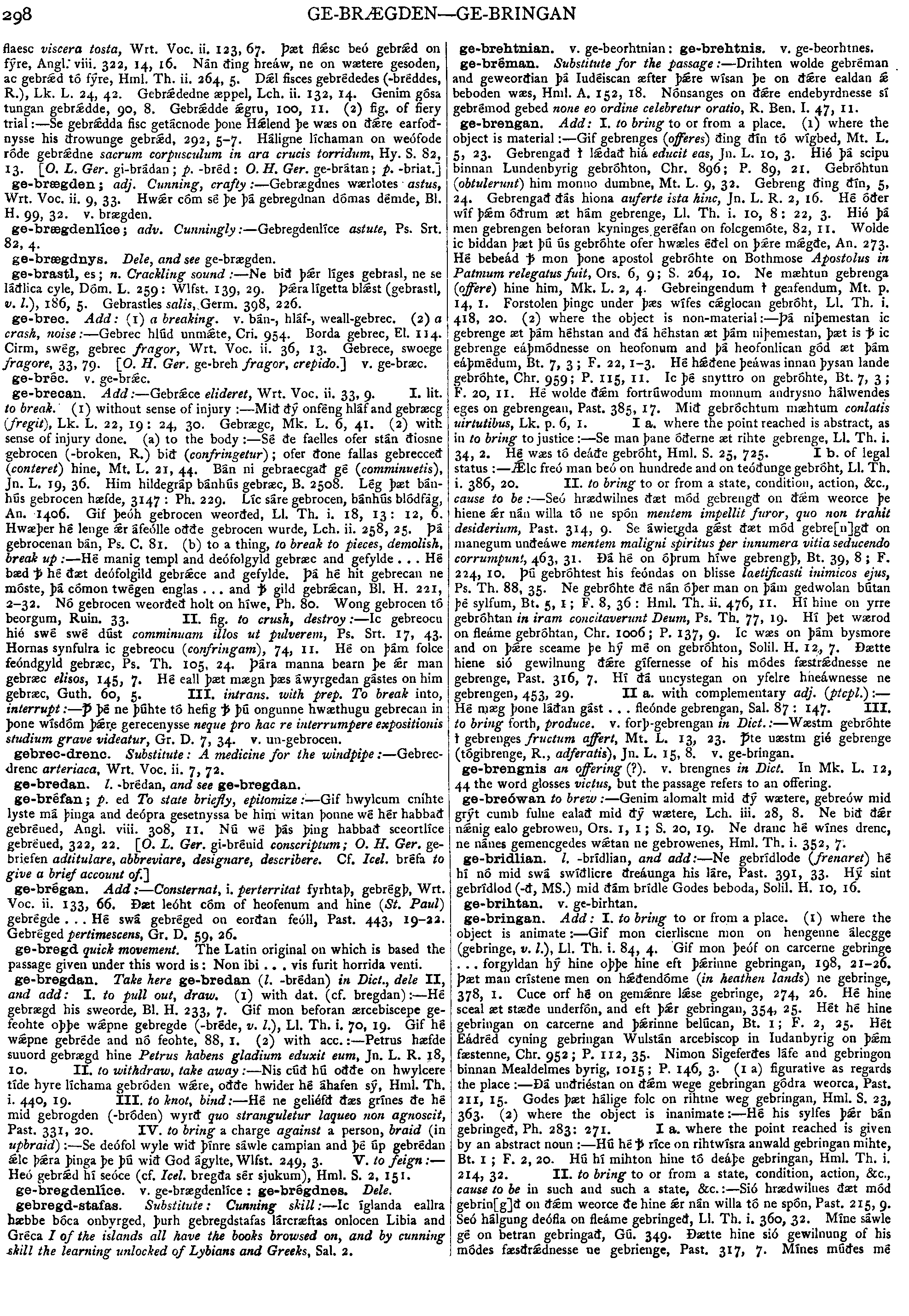
ge-brengan.
Add:
I.
to
bring
to
or
from
a
place,
(1)
where
the
object
is
material
:--
Gif
gebrenges
(offeres)
ðing
ð
ín
tó
wígbed,
Mt.
L.
5,
23.
Gebrengað
 ldað
hiá
educit
eas,
Jn.
L.
10,
3.
Hié
þá
scipu
binnan
Lundenbyrig
gebróhton,
Chr.
896;
P.
89,
21.
Gebróhtun
(obtulerunt)
him
monno
dumbne,
Mt.
L.
9,
32.
Gebreng
ðing
ðín,
5,
24.
Gebrengað
ðás
hiona
auferte
ista
hinc,
Jn.
L.
R.
2,
16.
Hé
óðer
wíf
þm
óðrum
æt
hám
gebrenge,
Ll.
Th.
i.
10,
8:
22,
3.
Hié
þá
men
gebrengen
beforan
kyninges
geréfan
on
folcgemóte,
82,
11.
Wolde
ic
biddan
þæt
þu
ús
gebróhte
ofer
hwæles
éðel
on
þre
mgðe.
An.
273.
Hé
bebeád
ldað
hiá
educit
eas,
Jn.
L.
10,
3.
Hié
þá
scipu
binnan
Lundenbyrig
gebróhton,
Chr.
896;
P.
89,
21.
Gebróhtun
(obtulerunt)
him
monno
dumbne,
Mt.
L.
9,
32.
Gebreng
ðing
ðín,
5,
24.
Gebrengað
ðás
hiona
auferte
ista
hinc,
Jn.
L.
R.
2,
16.
Hé
óðer
wíf
þm
óðrum
æt
hám
gebrenge,
Ll.
Th.
i.
10,
8:
22,
3.
Hié
þá
men
gebrengen
beforan
kyninges
geréfan
on
folcgemóte,
82,
11.
Wolde
ic
biddan
þæt
þu
ús
gebróhte
ofer
hwæles
éðel
on
þre
mgðe.
An.
273.
Hé
bebeád
 mon
þone
apostol
gebróhte
on
Bothmose
Apostolus
in
Patmum
relegatus
fuit,
Ors.
6,
9;
S.
264,
10.
Ne
mæhtun
gebrenga
(offere)
hine
him,
Mk.
L.
2,
4.
Gebreingendum
genfendum,
Mt.
p.
14,
1.
Forstolen
þingc
under
þæs
wífes
cglocan
gebróht,
Ll.
Th.
i.
418,
20.
(2)
where
the
object
is
non-material
:--
Þá
niþemestan
ic
gebrenge
æt
þám
hehstan
and
ðá
hehstan
æt
þám
niþemestan,
þæt
is
ic
gebrenge
eáþmódnesse
on
heofonum
and
þá
heofonlican
gód
æt
þám
eáþmédum,
Bt.
7,
3
;
F.
22,
1-3.
Hé
hðene
þeáwas
innan
þysan
lande
gebróhte.
Chr.
959;
P.
115,
11.
Ic
þé
snyttro
on
gebróhte,
Bt.
7,
3
;
F.
20,
11.
Hé
wolde
ðm
fortrúwodum
monnum
andrysno
hálwendes
eges
on
gebrengean.
Past.
385,
17.
Mið
gebróchtum
mæhtum
conlatis
uirtutibus,
Lk.
p.
6,
1.
I
a.
where
the
point
reached
is
abstract,
as
in
to
bring
to
justice
:--
Se
man
þane
óðerne
æt
rihte
gebrenge.
Ll.
Th.
i.
34,
2.
Hé
wæs
tó
deáðe
gebróht,
Hml.
S.
25,
725.
I
b.
of
legal
status
:--
Æ-acute;lc
freó
man
beó
on
hundrede
and
on
teóðunge
gebróht,
Ll.
Th.
i.
386,
20.
II.
to
bring
to
or
from
a
state,
condition,
action,
&c.
,
cause
to
be
:--
Seó
hrædwilnes
ðæt
mod
gebrengð
on
ðm
weorce
þe
hiene
r
nán
willa
tó
ne
spón
mentem
impellit
furor,
quo
non
trahit
desiderium,
Past.
314,
9.
Se
áwiergda
gst
ðæt
mod
gebre[n]gð
on
manegum
unðeáwe
mentem
maligni
spiritus
per
innumera
vitia
seducendo
corrumpunt,
463,
31.
Ðá
hé
on
óþrum
híwe
gebrengþ,
Bt.
39,
8
;
F.
224,
10.
Þ
ú
gebróhtest
his
feóndas
on
blisse
laetificasti
inimicos
ejus,
Ps.
Th.
88,
35.
Ne
gebróhte
ðé
nán
óþer
man
on
þám
gedwolan
bútan
þé
sylfum,
Bt.
5,
1;
F.
8,
36
:
Hml.
Th.
ii.
476,
11.
Hí
hine
on
yrre
gebróhtan
in
iram
concitaverunt
Deum,
Ps.
Th.
77,
19.
Hí
þet
wærod
on
fleáme
gebróhtan,
Chr.
1006;
P.
137,
9.
Ic
wæs
on
þám
bysmore
and
on
þre
sceame
þe
hý
mé
on
gebróhton,
Solil.
H.
12,
7.
Ðætte
hiene
sió
gewilnung
ðre
gífernesse
of
his
módes
fæstrdnesse
ne
gebrenge,
Past.
316,
7.
Hí
ðá
uncystegan
on
yfelre
hneáwnesse
ne
gebrengen,
453,
29.
II
a.
with
complementary
adj.
(ptcpl.)
:--
Hé
mæg
þone
láðan
gást
.
.
.
fleónde
gebrengan.
Sal.
87
:
147.
III.
to
bring
forth,
produce,
v.
forþ-gebrengan
in
Dict.
:--
Wæstm
gebróhte
gebrenges
frustum
affert.
Mt.
L.
13,
23.
te
uæstm
gié
gebrenge
(tógibrenge,
R.,
adferatis).
Jn.
L.
15,
8.
v.
ge-bringan.
mon
þone
apostol
gebróhte
on
Bothmose
Apostolus
in
Patmum
relegatus
fuit,
Ors.
6,
9;
S.
264,
10.
Ne
mæhtun
gebrenga
(offere)
hine
him,
Mk.
L.
2,
4.
Gebreingendum
genfendum,
Mt.
p.
14,
1.
Forstolen
þingc
under
þæs
wífes
cglocan
gebróht,
Ll.
Th.
i.
418,
20.
(2)
where
the
object
is
non-material
:--
Þá
niþemestan
ic
gebrenge
æt
þám
hehstan
and
ðá
hehstan
æt
þám
niþemestan,
þæt
is
ic
gebrenge
eáþmódnesse
on
heofonum
and
þá
heofonlican
gód
æt
þám
eáþmédum,
Bt.
7,
3
;
F.
22,
1-3.
Hé
hðene
þeáwas
innan
þysan
lande
gebróhte.
Chr.
959;
P.
115,
11.
Ic
þé
snyttro
on
gebróhte,
Bt.
7,
3
;
F.
20,
11.
Hé
wolde
ðm
fortrúwodum
monnum
andrysno
hálwendes
eges
on
gebrengean.
Past.
385,
17.
Mið
gebróchtum
mæhtum
conlatis
uirtutibus,
Lk.
p.
6,
1.
I
a.
where
the
point
reached
is
abstract,
as
in
to
bring
to
justice
:--
Se
man
þane
óðerne
æt
rihte
gebrenge.
Ll.
Th.
i.
34,
2.
Hé
wæs
tó
deáðe
gebróht,
Hml.
S.
25,
725.
I
b.
of
legal
status
:--
Æ-acute;lc
freó
man
beó
on
hundrede
and
on
teóðunge
gebróht,
Ll.
Th.
i.
386,
20.
II.
to
bring
to
or
from
a
state,
condition,
action,
&c.
,
cause
to
be
:--
Seó
hrædwilnes
ðæt
mod
gebrengð
on
ðm
weorce
þe
hiene
r
nán
willa
tó
ne
spón
mentem
impellit
furor,
quo
non
trahit
desiderium,
Past.
314,
9.
Se
áwiergda
gst
ðæt
mod
gebre[n]gð
on
manegum
unðeáwe
mentem
maligni
spiritus
per
innumera
vitia
seducendo
corrumpunt,
463,
31.
Ðá
hé
on
óþrum
híwe
gebrengþ,
Bt.
39,
8
;
F.
224,
10.
Þ
ú
gebróhtest
his
feóndas
on
blisse
laetificasti
inimicos
ejus,
Ps.
Th.
88,
35.
Ne
gebróhte
ðé
nán
óþer
man
on
þám
gedwolan
bútan
þé
sylfum,
Bt.
5,
1;
F.
8,
36
:
Hml.
Th.
ii.
476,
11.
Hí
hine
on
yrre
gebróhtan
in
iram
concitaverunt
Deum,
Ps.
Th.
77,
19.
Hí
þet
wærod
on
fleáme
gebróhtan,
Chr.
1006;
P.
137,
9.
Ic
wæs
on
þám
bysmore
and
on
þre
sceame
þe
hý
mé
on
gebróhton,
Solil.
H.
12,
7.
Ðætte
hiene
sió
gewilnung
ðre
gífernesse
of
his
módes
fæstrdnesse
ne
gebrenge,
Past.
316,
7.
Hí
ðá
uncystegan
on
yfelre
hneáwnesse
ne
gebrengen,
453,
29.
II
a.
with
complementary
adj.
(ptcpl.)
:--
Hé
mæg
þone
láðan
gást
.
.
.
fleónde
gebrengan.
Sal.
87
:
147.
III.
to
bring
forth,
produce,
v.
forþ-gebrengan
in
Dict.
:--
Wæstm
gebróhte
gebrenges
frustum
affert.
Mt.
L.
13,
23.
te
uæstm
gié
gebrenge
(tógibrenge,
R.,
adferatis).
Jn.
L.
15,
8.
v.
ge-bringan.
|
Source: Bosworth/Toller, page d0510, entry 5 View original page image as: [TIFF] [PNG] [View previous entry] [View next entry] |
[Comment on this entry] [View comments] |
The following entry has been hand-corrected once. |
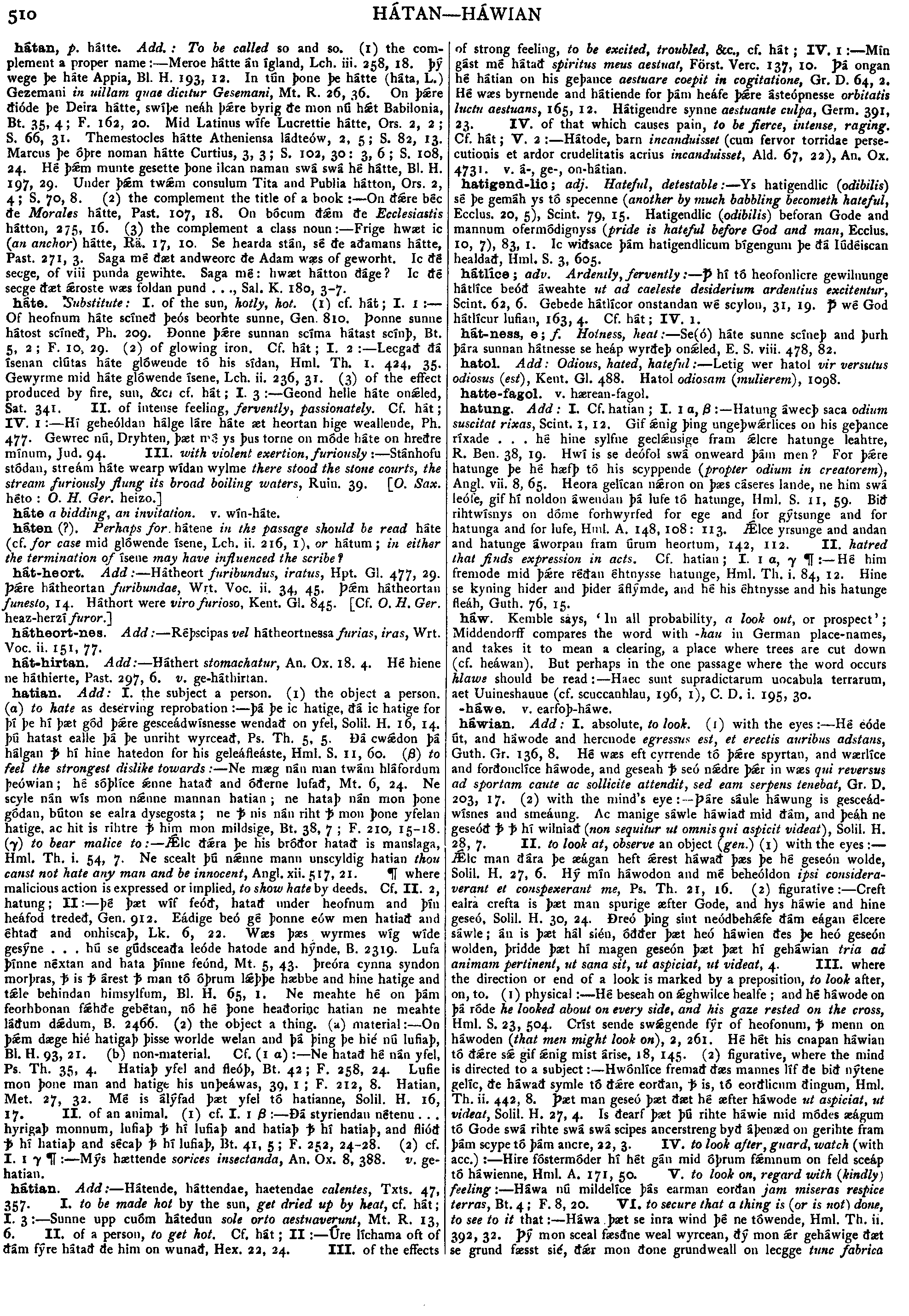
hát-heort.
Add:
--
Hátheort
furibundus,
iratus,
Hpt.
Gl.
477,
29.
Þre
hátheortan
furibundae,
Wrt.
Voc.
ii.
34,
45.
Þm
hátheortan
funesto,
14.
Háthort
were
viro
furioso,
Kent.
Gl.
845.
[Cf.
O.
H.
Ger.
heaz-herzí
furor.]
|
Source: Bosworth/Toller, page d0664, entry 30 View original page image as: [TIFF] [PNG] [View previous entry] [View next entry] |
[Comment on this entry] [View comments] |
The following entry has been hand-corrected once. |
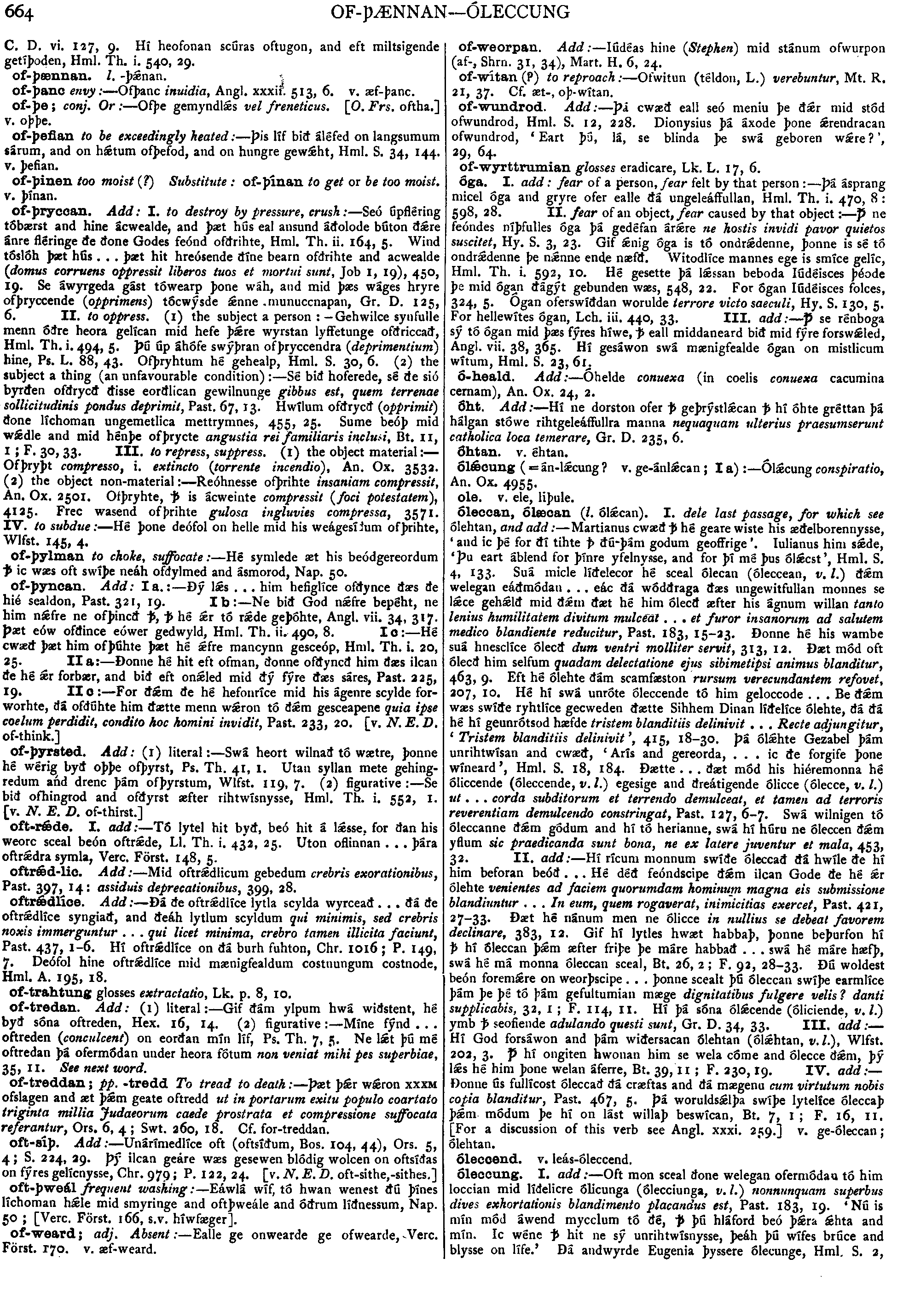
óleccan,
ólæcan
(l.
ólcan).
I.
dele
last
passage,
for
which
see
ólehtan,
and
add
:--
Martianus
cwæð
hé
geare
wiste
his
æðelborennysse,
'and
ic
þé
for
ðí
tihte
ðú-þám
godum
geoffrige'.
Iulianus
him
sde,
'Þu
eart
áblend
for
þínre
yfelnysse,
and
for
þí
mé
þus
ólcst',
Hml.
S.
4,
133.
Suá
micle
líðelecor
hé
sceal
ólecan
(óleccean,
v.
l.)
ðm
welegan
eáðmódan
.
.
.
eác
ðá
wódðraga
ðæs
ungewitfullan
monnes
se
lce
gehlð
mid
ðm
ðæt
hé
him
ólecð
æfter
his
ágnum
willan
tanto
lenius
humilitatem
divitum
mulceat.
.
.
et
furor
insanorum
ad
salutem
medico
blandiente
reducitur,
Past.
183,
15-33.
Ðonne
hé
his
wambe
suá
hnesclíce
ólecð
dum
ventri
molliter
servit,
313,
12.
Ðæt
mód
oft
ólecð
him
selfum
guadam
delectatione
ejus
sibimetipsi
animus
blanditur,
463,
9.
Eft
hé
ólehte
ðám
scamfæston
rursum
verecundantem
refovet,
207,
10.
Hé
hí
swá
unróte
óleccende
tó
him
geloccode
.
.
.
Be
ðm
wæs
swíðe
ryhtlíce
gecweden
ðætte
Sihhem
Dinan
líðelíce
ólehte,
ðá
ðá
hé
hí
geunrótsod
hæfde
tristem
blanditiis
delinivit
.
.
.
Recte
adjungitur,
'Tristem
blanditiis
delinivit',
415,
18-30.
Þá
ólhte
Gezabel
þám
unrihtwísan
and
cwæð,
'Arís
and
gereorda,
.
.
.
ic
ðe
forgife
þone
wíneard',
Hml.
S.
18,
184.
Ðætte
.
.
.
ðæt
mód
his
hiéremonna
hé
óliccende
(óleccende,
v.
l.)
egesige
and
ðreátigende
ólicce
(ólecce,
v.
l.)
ut.
.
.
corda
subditorum
et
terrendo
demulceat,
et
tamen
ad
terroris
reverentiam
demulcendo
constringat,
Past.
127,
6-7.
Swá
wilnigen
tó
óleccanne
ðm
gódum
and
hí
tó
herianne,
swá
hí
húru
ne
óleccen
ðm
yflum
sic
praedicanda
sunt
bona,
ne
ex
latere
juventur
et
mala,
453,
32.
II.
add
:--
Hí
rícum
monnum
swíðe
óleccað
ðá
hwíle
ðe
hí
him
beforan
beóð
.
.
.
Hé
déð
feóndscipe
ðm
ilcan
Gode
ðe
hé
r
ólehte
venientes
ad
faciem
quorumdam
hominum
magna
eis
submissione
blandiuntur
.
.
.
In
eum,
quem
rogaverat,
inimicitias
exercet,
Past.
421,
27-33.
Ðæt
hé
nánum
men
ne
ólicce
in
nullius
se
debeat
favorem
declinare,
383,
12.
Gif
hí
lytles
hwæt
habbaþ,
þonne
beþurfon
hí
hí
óleccan
þm
æfter
friþe
þe
máre
habbað
.
.
.
swá
hé
máre
hæfþ,
swá
hé
má
monna
óleccan
sceal,
Bt.
26,
2;
F.
92,
28-33.
Ðú
woldest
beón
foremre
on
weorþscipe
.
.
.
þonne
scealt
þú
óleccan
swíþe
earmlíce
þám
þe
þé
tó
þám
gefultumian
mæge
dignitatibus
fulgere
velis
?
danti
supplicabis,
32,
1;
F.
114,
11.
Hí
þá
sóna
ólcende
(óliciende,
v.
l.)
ymb
seofiende
adulando
questi
sunt,
Gr.
D.
34,
33.
III.
add
:--
Hí
God
forsáwon
and
þám
wiðersacan
ólehtan
(ólhtan,
v.
l.),
Wlfst.
202,
3.
Þ-bar;
hí
ongiten
hwonan
him
se
wela
cóme
and
ólecce
ðm,
þý
ls
hé
him
þone
welan
áferre,
Bt.
39,
11;
F.
230,
19.
IV.
add
:--
Ðonne
ús
fullícost
óleccað
ðá
cræftas
and
ðá
mægenu
cum
virtutum
nobis
copia
blanditur,
Past.
467,
5.
Þá
woruldslþa
swíþe
lytelíce
óleccaþ
þm
módum
þe
hí
on
lást
willaþ
beswícan,
Bt.
7,
1
;
F.
16,
11.
[For
a
discussion
of
this
verb
see
Angl.
xxxi.
259.]
v.
ge-óleccan
;
ólehtan.
|
Source: Cleasby/Vigfusson, page b0061, entry 17 View original page image as: [TIFF] [PNG] [View previous entry] [View next entry] |
[Comment on this entry] [View comments] |
The following entry has been hand-corrected once. |
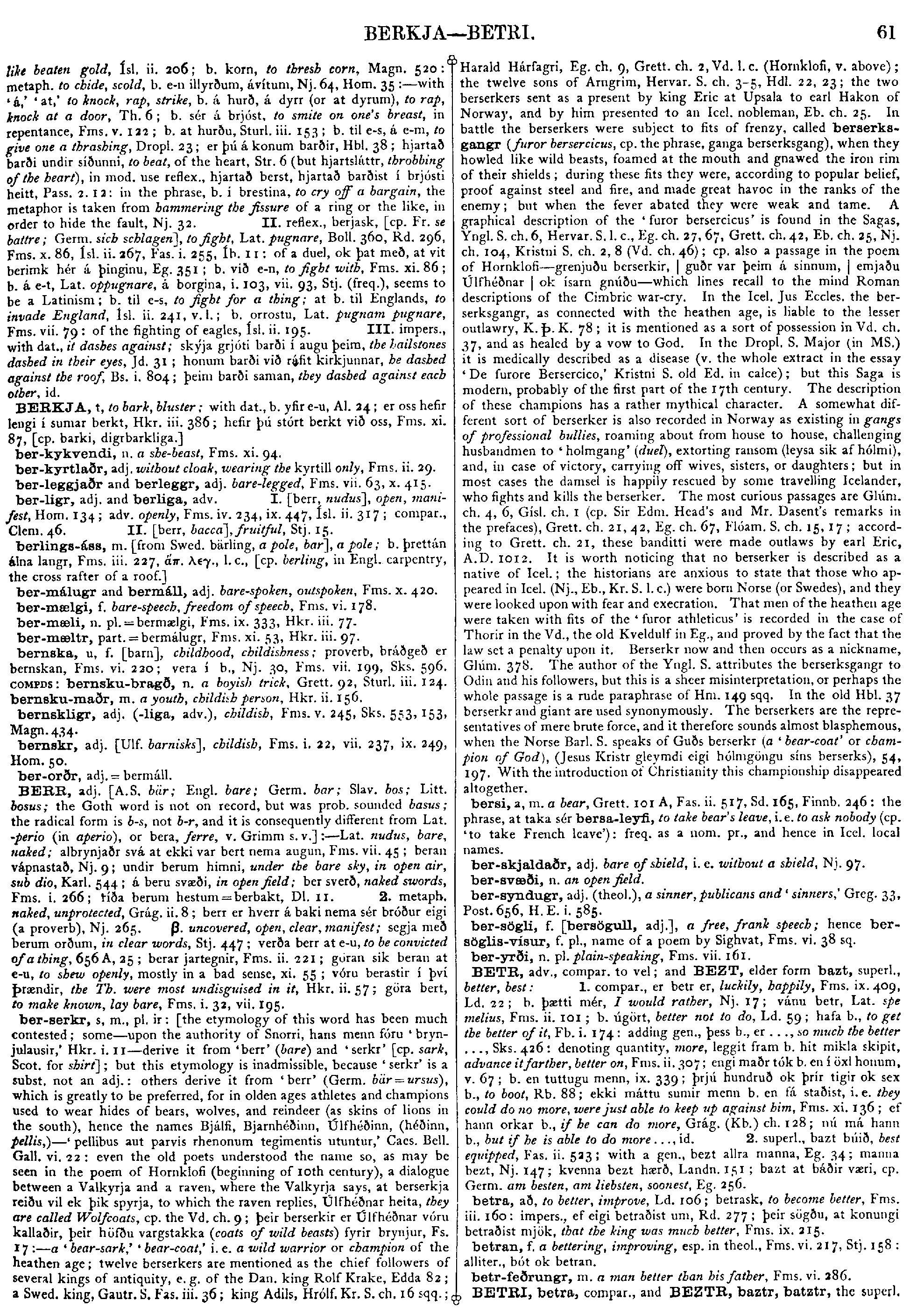
ber-serkr,
s,
m.,
pl.
ir:
[the
etymology
of
this
word
has
been
much
contested;
some
--
upon
the
authority
of
Snorri,
hans
menn
fóru
'bryn julausir,'
Hkr.
i.
11
--
derive
it
from
'berr'
(bare)
and
'serkr'
[cp.
sark,
Scot,
for
shirt];
but
this
etymology
is
inadmissible,
because
'serkr'
is
a
subst.
not
an
adj.:
others
derive
it
from
'berr'
(Germ,
bär
=
ursus),
which
is
greatly
to
be
preferred,
for
in
olden
ages
athletes
and
champions
used
to
wear
hides
of
bears,
wolves,
and
reindeer
(as
skins
of
lions
in
the
south),
hence
the
names
Bjálfi,
Bjarnhéðinn,
Úlfhéðinn,
(héðinn,
pellis,)
--
'pellibus
aut
parvis
rhenonum
tegimentis
utuntur,
'Caes.
Bell.
Gall.
vi.
22:
even
the
old
poets
understood
the
name
so,
as
may
be
seen
in
the
poem
of
Hornklofi
(beginning
of
10th
century),
a
dialogue
between
a
Valkyrja
and
a
raven,
where
the
Valkyrja
says,
at
berserkja
reiðu
vil
ek
þik
spyrja,
to
which
the
raven
replies,
Úlfhéðnar
heita,
they
are
called
Wolfcoats,
cp.
the
Vd.
ch.
9;
þeir
berserkir
er
Úlfhéðnar
vóru
kallaðir,
þeir
höfðu
vargstakka
(coats
of
wild
beasts)
fyrir
brynjur,
Fs.
17
:--
a
'bear-sark,'
'bear-coat,'
i.
e.
a
wild
warrior
or
champion
of
the
heathen
age;
twelve
berserkers
are
mentioned
as
the
chief
followers
of
several
kings
of
antiquity,
e.
g.
of
the
Dan.
king
Rolf
Krake,
Edda
82;
a
Swed.
king,
Gautr.
S.
Fas.
iii.
36;
king
Adils,
Hrólf.
Kr.
S.
ch.
16
sqq.;
Harald
Hárfagri,
Eg.
ch.
9,
Grett.
ch.
2,
Vd.
l.
c.
(Hornklofi,
v.
above);
the
twelve
sons
of
Arngrim,
Hervar.
S.
ch.
3-5,
Hdl.
22,
23;
the
two
berserkers
sent
as
a
present
by
king
Eric
at
Upsala
to
earl
Hakon
of
Norway,
and
by
him
presented
to
an
Icel.
nobleman,
Eb.
ch.
25.
In
battle
the
berserkers
were
subject
to
fits
of
frenzy,
called
berserksgangr
(furor
bersercicus,
cp.
the
phrase,
ganga
berserksgang),
when
they
howled
like
wild
beasts,
foamed
at
the
mouth
and
gnawed
the
iron
rim
of
their
shields;
during
these
fits
they
were,
according
to
popular
belief,
proof
against
steel
and
fire,
and
made
great
havoc
in
the
ranks
of
the
enemy;
but
when
the
fever
abated
they
were
weak
and
tame.
A
graphical
description
of
the
'furor
bersercicus'
is
found
in
the
Sagas,
Yngl.
S.
ch.
6,
Hervar.
S.
l.
c.,
Eg.
ch.
27,
67,
Grett.
ch.
42,
Eb.
ch.
25,
Nj.
ch.
104,
Kristni
S.
ch.
2,
8
(Vd.
ch.
46);
cp.
also
a
passage
in
the
poem
of
Hornklofi
|
grenjuðu
berserkir,
|
guðr
var
þeim
á
sinnum,
|
emjaðu
Úlfhéðnar
|
ok
ísarn
gniiðu
--
which
lines
recall
to
the
mind
Roman
descriptions
of
the
Cimbric
war-cry.
In
the
Icel.
Jus
Eccles.
the
berserksgangr,
as
connected
with
the
heathen
age,
is
liable
to
the
lesser
outlawry,
K.
Þ.
K.
78;
it
is
mentioned
as
a
sort
of
possession
in
Vd.
ch.
37,
and
as
healed
by
a
vow
to
God.
In
the
Dropl.
S.
Major
(in
MS.)
it
is
medically
described
as
a
disease
(v.
the
whole
extract
in
the
essay
'De
furore
Bersercico,'
Kristni
S.
old
Ed.
in
cake);
but
this
Saga
is
modern,
probably
of
the
first
part
of
the
17th
century.
The
description
of
these
champions
has
a
rather
mythical
character.
A
somewhat
different
sort
of
berserker
is
also
recorded
in
Norway
as
existing
in
gangs
of
professional
bullies,
roaming
about
from
house
to
house,
challenging
husbandmen
to
'holmgang'
(duel),
extorting
ransom
(leysa
sik
af
hólmi),
and,
in
case
of
victory,
carrying
off
wives,
sisters,
or
daughters;
but
in
most
cases
the
damsel
is
happily
rescued
by
some
travelling
Icelander,
who
fights
and
kills
the
berserker.
The
most
curious
passages
are
Glúm,
ch.
4,
6,
Gísl.
ch.
1
(cp.
Sir
Edm.
Head's
and
Mr.
Dasent's
remarks
in
the
prefaces),
Grett.
ch.
21,
42,
Eg.
ch.
67,
Flóam.
S.
ch.
15,
17;
according
to
Grett.
ch.
21,
these
banditti
were
made
outlaws
by
earl
Eric,
A.
D.
1012.
It
is
worth
noticing
that
no
berserker
is
described
as
a
native
of
Icel.;
the
historians
are
anxious
to
state
that
those
who
appeared
in
Icel.
(Nj.,
Eb.,
Kr.
S.
l.
c.)
were
born
Norse
(or
Swedes),
and
they
were
looked
upon
with
fear
and
execration.
That
men
of
the
heathen
age
were
taken
with
fits
of
the
'furor
athleticus'
is
recorded
in
the
case
of
Thorir
in
the
Vd.,
the
old
Kveldulf
in
Eg.,
and
proved
by
the
fact
that
the
law
set
a
penalty
upon
it.
Berserkr
now
and
then
occurs
as
a
nickname,
Glúm.
378.
The
author
of
the
Yngl.
S.
attributes
the
berserksgangr
to
Odin
and
his
followers,
but
this
is
a
sheer
misinterpretation,
or
perhaps
the
whole
passage
is
a
rude
paraphrase
of
Hm.
149
sqq.
In
the
old
Hbl.
37
berserkr
and
giant
are
used
synonymously.
The
berserkers
are
the
representatives
of
mere
brute
force,
and
it
therefore
sounds
almost
blasphemous,
when
the
Norse
Barl.
S.
speaks
of
Guðs
berserkr
(a'bear-coat'
or
champion
of
God),
(Jesus
Kristr
gleymdi
eigi
hólmgöngu
sins
berserks),
54,
197.
With
the
introduction
of
Christianity
this
championship
disappeared
altogether.
julausir,'
Hkr.
i.
11
--
derive
it
from
'berr'
(bare)
and
'serkr'
[cp.
sark,
Scot,
for
shirt];
but
this
etymology
is
inadmissible,
because
'serkr'
is
a
subst.
not
an
adj.:
others
derive
it
from
'berr'
(Germ,
bär
=
ursus),
which
is
greatly
to
be
preferred,
for
in
olden
ages
athletes
and
champions
used
to
wear
hides
of
bears,
wolves,
and
reindeer
(as
skins
of
lions
in
the
south),
hence
the
names
Bjálfi,
Bjarnhéðinn,
Úlfhéðinn,
(héðinn,
pellis,)
--
'pellibus
aut
parvis
rhenonum
tegimentis
utuntur,
'Caes.
Bell.
Gall.
vi.
22:
even
the
old
poets
understood
the
name
so,
as
may
be
seen
in
the
poem
of
Hornklofi
(beginning
of
10th
century),
a
dialogue
between
a
Valkyrja
and
a
raven,
where
the
Valkyrja
says,
at
berserkja
reiðu
vil
ek
þik
spyrja,
to
which
the
raven
replies,
Úlfhéðnar
heita,
they
are
called
Wolfcoats,
cp.
the
Vd.
ch.
9;
þeir
berserkir
er
Úlfhéðnar
vóru
kallaðir,
þeir
höfðu
vargstakka
(coats
of
wild
beasts)
fyrir
brynjur,
Fs.
17
:--
a
'bear-sark,'
'bear-coat,'
i.
e.
a
wild
warrior
or
champion
of
the
heathen
age;
twelve
berserkers
are
mentioned
as
the
chief
followers
of
several
kings
of
antiquity,
e.
g.
of
the
Dan.
king
Rolf
Krake,
Edda
82;
a
Swed.
king,
Gautr.
S.
Fas.
iii.
36;
king
Adils,
Hrólf.
Kr.
S.
ch.
16
sqq.;
Harald
Hárfagri,
Eg.
ch.
9,
Grett.
ch.
2,
Vd.
l.
c.
(Hornklofi,
v.
above);
the
twelve
sons
of
Arngrim,
Hervar.
S.
ch.
3-5,
Hdl.
22,
23;
the
two
berserkers
sent
as
a
present
by
king
Eric
at
Upsala
to
earl
Hakon
of
Norway,
and
by
him
presented
to
an
Icel.
nobleman,
Eb.
ch.
25.
In
battle
the
berserkers
were
subject
to
fits
of
frenzy,
called
berserksgangr
(furor
bersercicus,
cp.
the
phrase,
ganga
berserksgang),
when
they
howled
like
wild
beasts,
foamed
at
the
mouth
and
gnawed
the
iron
rim
of
their
shields;
during
these
fits
they
were,
according
to
popular
belief,
proof
against
steel
and
fire,
and
made
great
havoc
in
the
ranks
of
the
enemy;
but
when
the
fever
abated
they
were
weak
and
tame.
A
graphical
description
of
the
'furor
bersercicus'
is
found
in
the
Sagas,
Yngl.
S.
ch.
6,
Hervar.
S.
l.
c.,
Eg.
ch.
27,
67,
Grett.
ch.
42,
Eb.
ch.
25,
Nj.
ch.
104,
Kristni
S.
ch.
2,
8
(Vd.
ch.
46);
cp.
also
a
passage
in
the
poem
of
Hornklofi
|
grenjuðu
berserkir,
|
guðr
var
þeim
á
sinnum,
|
emjaðu
Úlfhéðnar
|
ok
ísarn
gniiðu
--
which
lines
recall
to
the
mind
Roman
descriptions
of
the
Cimbric
war-cry.
In
the
Icel.
Jus
Eccles.
the
berserksgangr,
as
connected
with
the
heathen
age,
is
liable
to
the
lesser
outlawry,
K.
Þ.
K.
78;
it
is
mentioned
as
a
sort
of
possession
in
Vd.
ch.
37,
and
as
healed
by
a
vow
to
God.
In
the
Dropl.
S.
Major
(in
MS.)
it
is
medically
described
as
a
disease
(v.
the
whole
extract
in
the
essay
'De
furore
Bersercico,'
Kristni
S.
old
Ed.
in
cake);
but
this
Saga
is
modern,
probably
of
the
first
part
of
the
17th
century.
The
description
of
these
champions
has
a
rather
mythical
character.
A
somewhat
different
sort
of
berserker
is
also
recorded
in
Norway
as
existing
in
gangs
of
professional
bullies,
roaming
about
from
house
to
house,
challenging
husbandmen
to
'holmgang'
(duel),
extorting
ransom
(leysa
sik
af
hólmi),
and,
in
case
of
victory,
carrying
off
wives,
sisters,
or
daughters;
but
in
most
cases
the
damsel
is
happily
rescued
by
some
travelling
Icelander,
who
fights
and
kills
the
berserker.
The
most
curious
passages
are
Glúm,
ch.
4,
6,
Gísl.
ch.
1
(cp.
Sir
Edm.
Head's
and
Mr.
Dasent's
remarks
in
the
prefaces),
Grett.
ch.
21,
42,
Eg.
ch.
67,
Flóam.
S.
ch.
15,
17;
according
to
Grett.
ch.
21,
these
banditti
were
made
outlaws
by
earl
Eric,
A.
D.
1012.
It
is
worth
noticing
that
no
berserker
is
described
as
a
native
of
Icel.;
the
historians
are
anxious
to
state
that
those
who
appeared
in
Icel.
(Nj.,
Eb.,
Kr.
S.
l.
c.)
were
born
Norse
(or
Swedes),
and
they
were
looked
upon
with
fear
and
execration.
That
men
of
the
heathen
age
were
taken
with
fits
of
the
'furor
athleticus'
is
recorded
in
the
case
of
Thorir
in
the
Vd.,
the
old
Kveldulf
in
Eg.,
and
proved
by
the
fact
that
the
law
set
a
penalty
upon
it.
Berserkr
now
and
then
occurs
as
a
nickname,
Glúm.
378.
The
author
of
the
Yngl.
S.
attributes
the
berserksgangr
to
Odin
and
his
followers,
but
this
is
a
sheer
misinterpretation,
or
perhaps
the
whole
passage
is
a
rude
paraphrase
of
Hm.
149
sqq.
In
the
old
Hbl.
37
berserkr
and
giant
are
used
synonymously.
The
berserkers
are
the
representatives
of
mere
brute
force,
and
it
therefore
sounds
almost
blasphemous,
when
the
Norse
Barl.
S.
speaks
of
Guðs
berserkr
(a'bear-coat'
or
champion
of
God),
(Jesus
Kristr
gleymdi
eigi
hólmgöngu
sins
berserks),
54,
197.
With
the
introduction
of
Christianity
this
championship
disappeared
altogether.
| Result Page: |  |
Previous | 1 2 3 |
Germanic Lexicon Project (main page)
This search system was written by
Sean Crist
Please consider
volunteering
to correct the data in these online dictionaries.
No rights reserved. Feel free to use these data in any way you please.