|
|

Search for froskr again, using less strict matching (7 results)
|
Source: Cleasby/Vigfusson, page b0174, entry 48 View original page image as: [TIFF] [PNG] [View previous entry] [View next entry] |
[Comment on this entry] [View comments] |
The following entry has been hand-corrected once. |
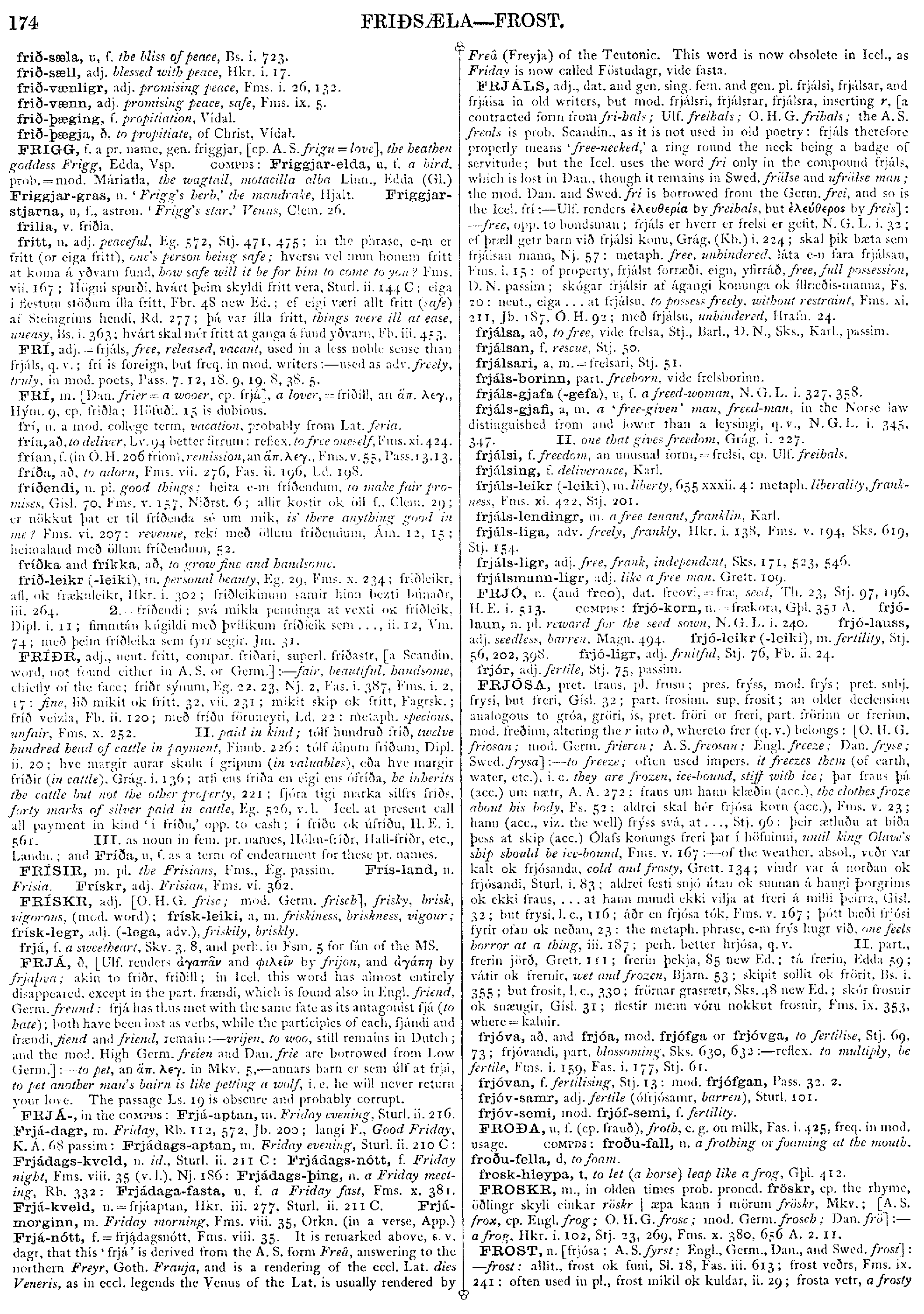
FROSKR, m., in olden times prob. proncd. fröskr, cp. the rhyme, öðlingr skyli einkar röskr | æpa kann í mörum fröskr, Mkv.; [A. S. frox, cp. Engl. frog; O. H. G. frosc; mod. Germ. frosch; Dan. frö] :-- a frog, Hkr. i. 102, Stj. 23, 269, Fms. x. 380. 656 A. 2. 11.
|
Source: Torp, page b0248, entry 9 View original page image as: [TIFF] [PNG] [View previous entry] [View next entry] |
[Comment on this entry] [View comments] |
The following entry has been hand-corrected once. |
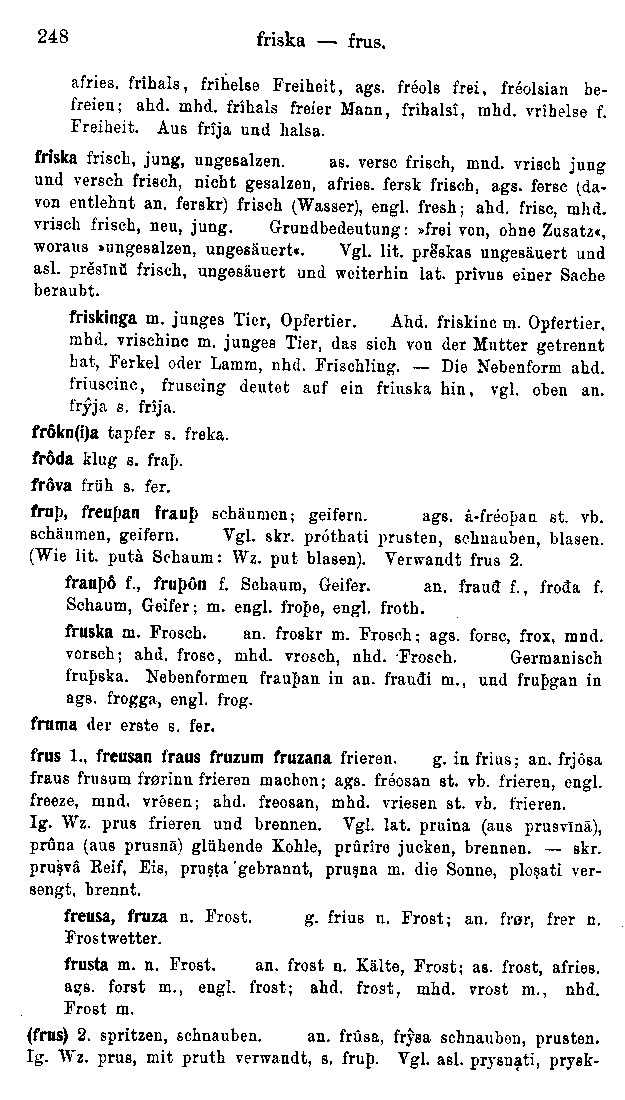
fruska
m.
Frosch.
an.
froskr
m.
Frosch,
ags.
forsc,
frox,
mnd.
vorsch;
ahd.
frosc,
mhd.
vrosch,
nhd.
Frosch.
Germanisch
fruþska.
Nebenformen
frauþan
in
an.
frau i
m.,
und
fruþgan
in
ags.
frogga,
engl.
frog.
i
m.,
und
fruþgan
in
ags.
frogga,
engl.
frog.
[Translate the German words]
|
Source: Bosworth/Toller, page b0340, entry 8 View original page image as: [TIFF] [PNG] [View previous entry] [View next entry] |
[Comment on this entry] [View comments] |
The following entry has been hand-corrected once. |
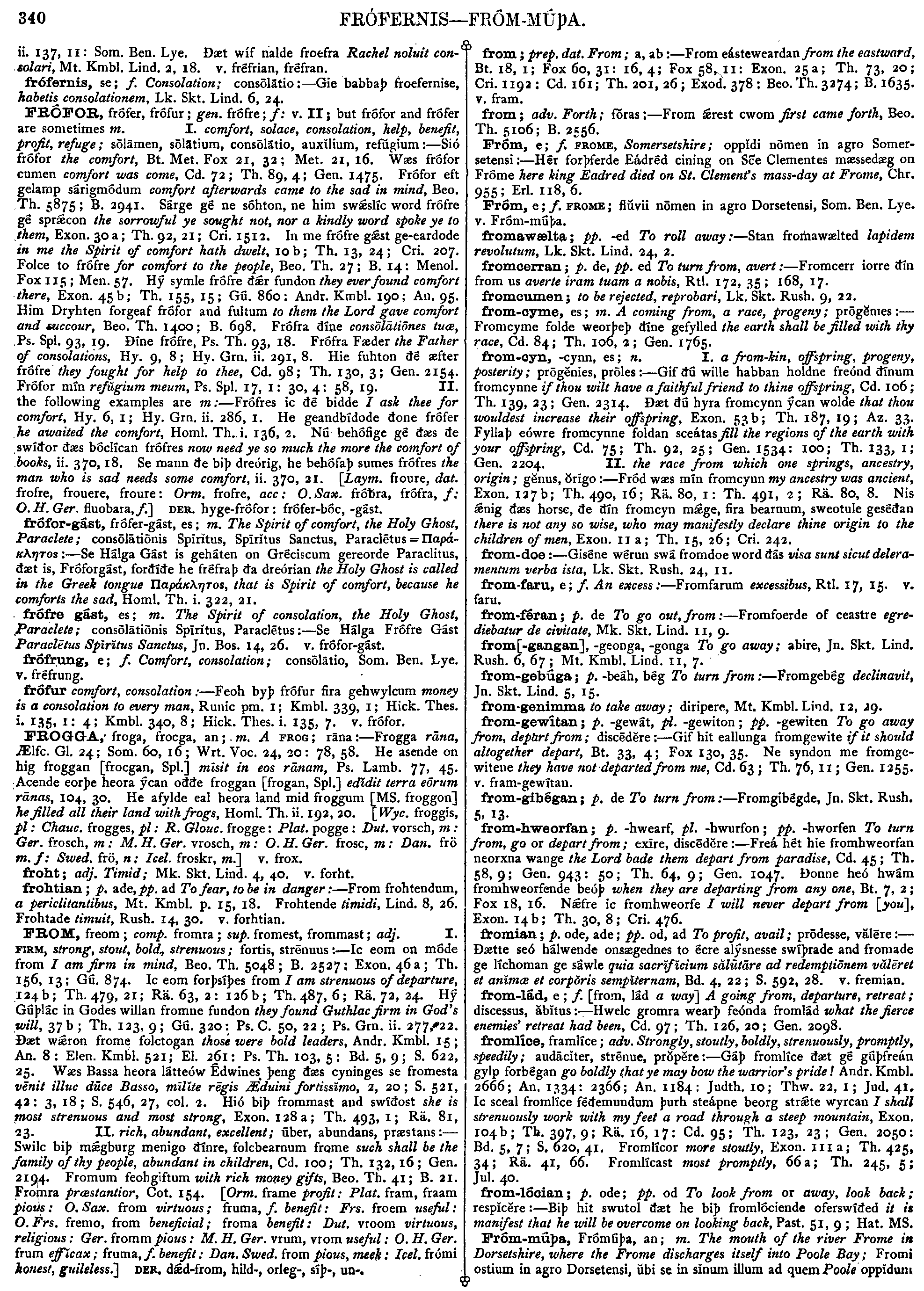
FROGGA,
froga,
frocga,
an;
m.
A
FROG;
r na
:--
Frogga
rna,
Ælfc.
Gl.
24;
Som.
60,
16;
Wrt.
Voc.
24,
20:
78,
58.
He
asende
on
hig
froggan
[frocgan.
Spl.]
m
na
:--
Frogga
rna,
Ælfc.
Gl.
24;
Som.
60,
16;
Wrt.
Voc.
24,
20:
78,
58.
He
asende
on
hig
froggan
[frocgan.
Spl.]
m sit
in
eos
rnam,
Ps.
Lamb.
77,
45.
Acende
eorþe
heora
ýcan
oððe
froggan
[frogan.
Spl.]
ed
sit
in
eos
rnam,
Ps.
Lamb.
77,
45.
Acende
eorþe
heora
ýcan
oððe
froggan
[frogan.
Spl.]
ed dit
terra
e
dit
terra
e rum
rnas,
104,
30.
He
afylde
eal
heora
land
mid
froggum
[MS.
froggon]
he
filled
all
their
land
with
frogs,
Homl.
Th.
ii.
192,
20.
[Wyc.
froggis,
pl:
Chauc.
frogges,
pl:
R.
Glouc.
frogge:
Plat.
pogge:
Dut.
vorsch,
m:
Ger.
frosch,
m:
M.
H.
Ger.
vrosch,
m:
O.
H.
Ger.
frosc,
m:
Dan.
frö
m.
f:
Swed.
frö,
n:
Icel.
froskr,
m.]
v.
frox.
rum
rnas,
104,
30.
He
afylde
eal
heora
land
mid
froggum
[MS.
froggon]
he
filled
all
their
land
with
frogs,
Homl.
Th.
ii.
192,
20.
[Wyc.
froggis,
pl:
Chauc.
frogges,
pl:
R.
Glouc.
frogge:
Plat.
pogge:
Dut.
vorsch,
m:
Ger.
frosch,
m:
M.
H.
Ger.
vrosch,
m:
O.
H.
Ger.
frosc,
m:
Dan.
frö
m.
f:
Swed.
frö,
n:
Icel.
froskr,
m.]
v.
frox.
|
Source: Bosworth/Toller, page d0269, entry 17 View original page image as: [TIFF] [PNG] [View previous entry] [View next entry] |
[Comment on this entry] [View comments] |
The following entry has been hand-corrected once. |
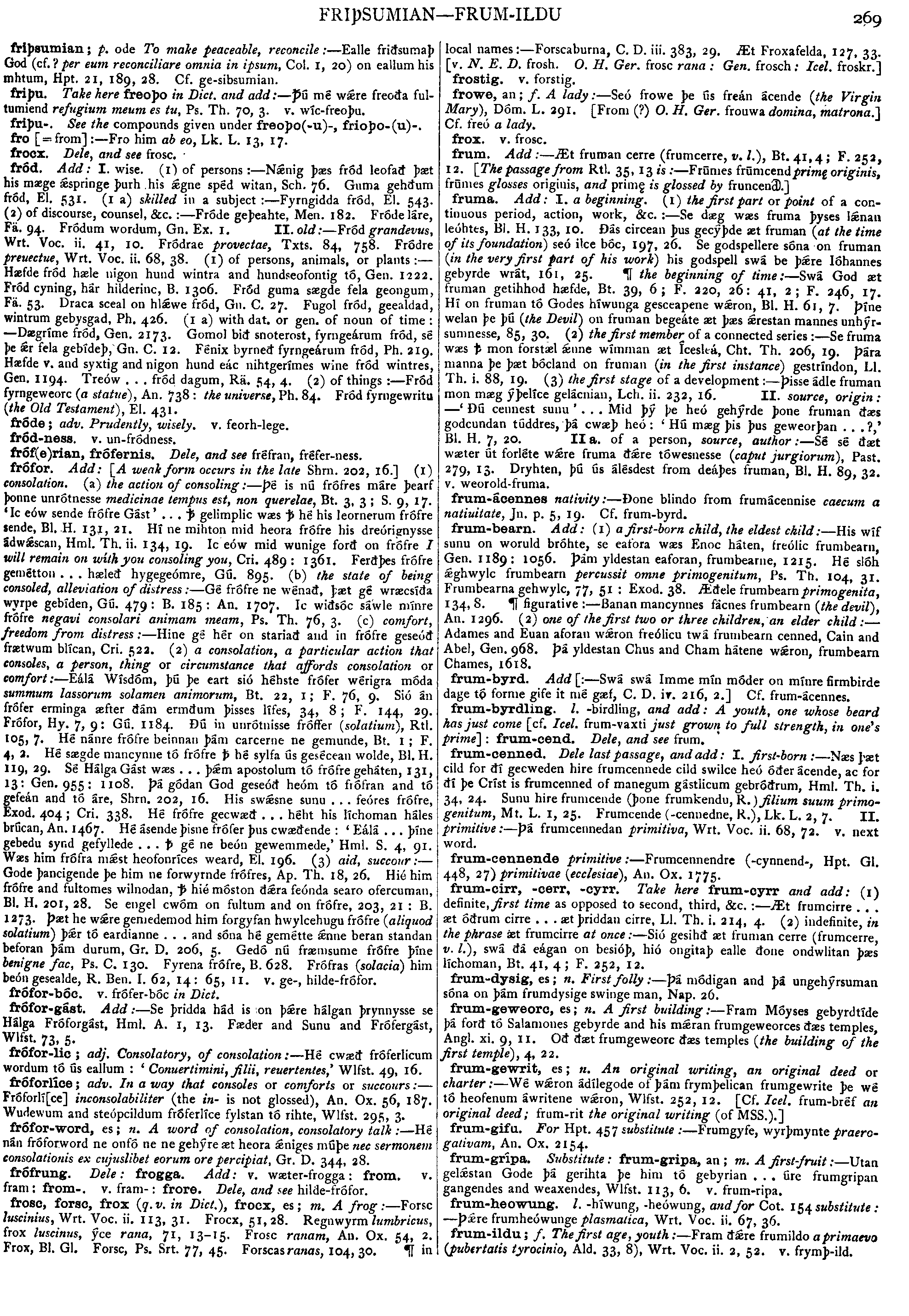
frosc, forsc, frox (q. v. in Dict.), frocx, es; m. A frog:--Forsc luscinius, Wrt. Voc. ii. 113, 31. Frocx, 51, 28. Regnwyrm lumbricus, frox luscinus, ýce rana, 71, 13-15. Frosc ranam, An. Ox. 54, 2. Frox, Bl. Gl. Forsc, Ps. Srt. 77, 45. Forscas ranas, 104, 30. ¶ in local names:--Forscaburna, C. D. iii. 383, 29. Æt Froxafelda, 127, 33. [v. N. E. D. frosh. O. H. Ger. frosc rana: Gen. frosch: Icel. froskr.]
|
Source: Cleasby/Vigfusson, page b0449, entry 48 View original page image as: [TIFF] [PNG] [View previous entry] [View next entry] |
[Comment on this entry] [View comments] |
The following entry has been hand-corrected once. |
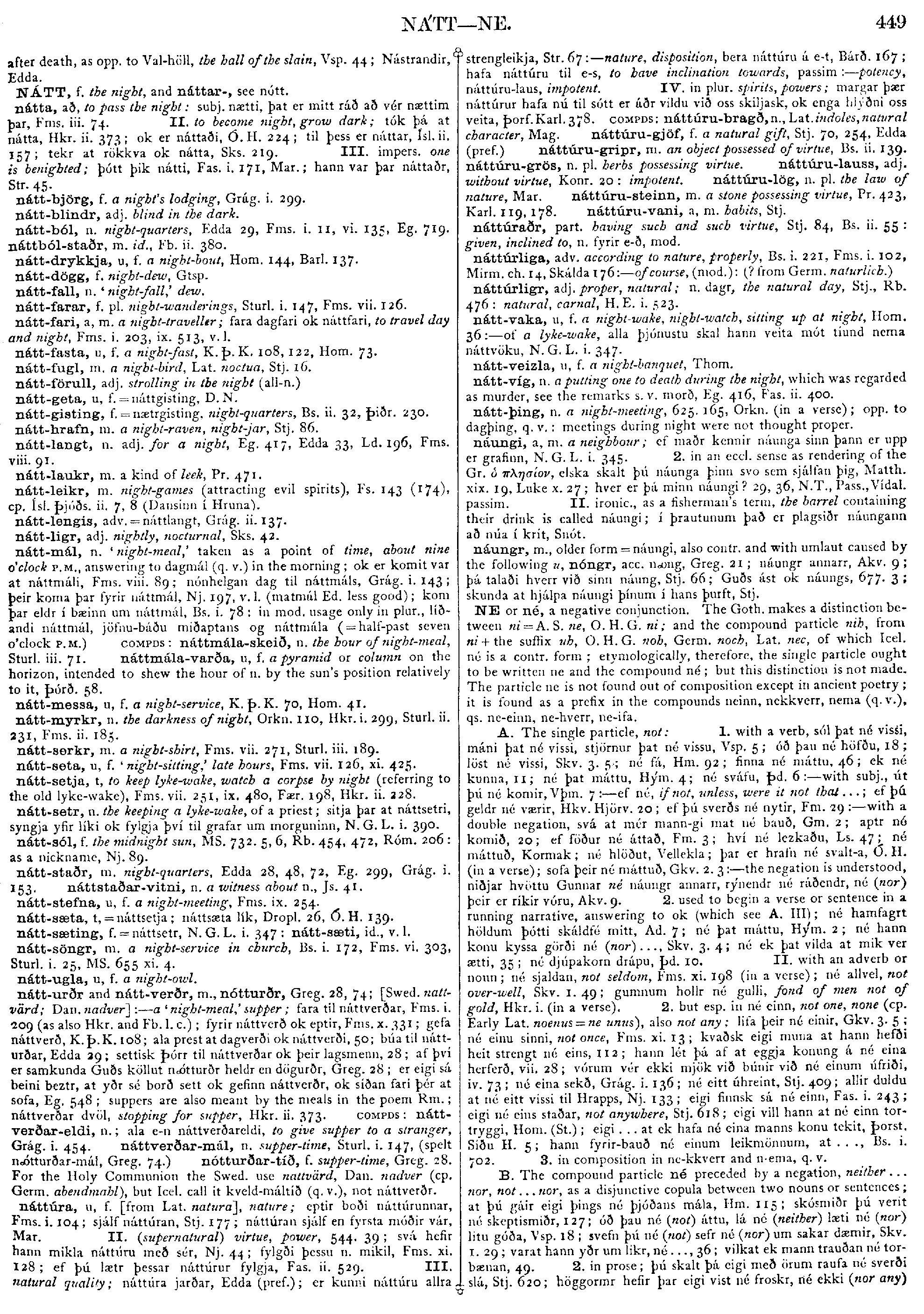
NE or né, a negative conjunction. The Goth. makes a distinction between ni = A. S. ne, O. H. G. ni; and the compound particle nih, from ni + the suffix uh, O. H. G. noh, Germ, noch, Lat. nec, of which Icel. né is a contr. form; etymologically, therefore, the single particle ought to be written ne and the compound né; but this distinction is not made. The particle ne is not found out of composition except in ancient poetry; it is found as a prefix in the compounds neinn, nekkverr, nema (q. v.), qs. ne-einn, ne-hverr, ne-ifa. A. The single particle, not: 1. with a verb, sól þat né vissi, máni þat né vissi, stjörnur þat né vissu, Vsp. 5; óð þau né höfðu, 18; löst né vissi, Skv. 3. 5; né fá, Hm. 92; finna né máttu, 46; ek né kunna, 11; né þat máttu, Hým. 4; né sváfu, Þd. 6 :-- with subj., út þú né komir, Vþm. 7 :-- ef né, if not, unless, were it not that . . .; ef þú geldr né værir, Hkv. Hjörv. 20; ef þú sverðs né nytir, Fm. 29 :-- with a double negation, svá at mér mann-gi mat né bauð, Gm. 2; aptr né komið, 20; ef föður né áttað, Fm. 3; hví né lezkaðu, Ls. 47; né máttuð, Kormak; né hlöðut, Vellekla; þar er hrafn né svalt-a, Ó. H. (in a verse); sofa þeir né máttuð, Gkv. 2. 3 :-- the negation is understood, niðjar hvöttu Gunnar né náungr annarr, rýnendr né ráðendr, né (nor) þeir er ríkir vóru, Akv. 9, 2. used to begin a verse or sentence in a running narrative, answering to ok (which see A. III); né hamfagrt höldum þótti skáldfé mitt, Ad. 7; né þat máttu, Hým. 2; né hann konu kyssa görði né (nor) . . ., Skv. 3. 4; né ek þat vilda at mik ver ætti, 35; né djúpakorn drápu, Þd. 10. II. with an adverb or noun; né sjaldan, not seldom, Fms. xi. 198 (in a verse); né allvel, not over-well, Skv. 1. 49; gumnum hollr né gulli, fond of men not of gold, Hkr. i. (in a verse). 2. but esp. in né einn, not one, none (cp. Early Lat. noenus = ne unus), also not any; lifa þeir né einir, Gkv. 3. 5; né einu sinni, not once, Fms. xi. 13; kvaðsk eigi muna at hann hefði heit strengt né eins, 112; hann lét þá af at eggja konung á né eina herferð, vii. 28; vórum vér ekki mjök við búnir við né einum lífriði, iv. 73; né eina sekð, Grág. i. 136; né eitt úhreint, Stj. 409; allir duldu at né eitt vissi til Hrapps, Nj. 133; eigi finnsk sá né einn, Fas. i. 243; eigi né eins staðar, not anywhere, Stj. 618; eigi vill hann at né einn tortryggi, Hom. (St.); eigi . . . at ek hafa né eina manns konu tekit, Þorst. Síðu H. 5; hann fyrir-bauð né einum leikmönnum, at . . ., Bs. i. 702. 3. in composition in ne-kkverr and n-ema, q. v. B. The compound particle né preceded by a negation, neither . . . nor, not . . . nor, as a disjunctive copula between two nouns or sentences; at þú gáir eigi þings né þjóðans mála, Hm. 115; skósmiðr þú verit né skeptismiðr, 127; óð þau né (not) áttu, lá né (neither) læti né (nor) litu góða, Vsp. 18; svefn þú né (not) sefr né (nor) um sakar dæmir, Skv. I. 29; varat harm yðr um likr, né . . ., 36; vilkat ek mann trauðan né torbænan, 49. 2. in prose; þú skalt þá eigi með örum raufa né sverði slá, Stj. 620; höggormr hefir þar eigi vist né froskr, né ekki (nor any)
|
Source: Cleasby/Vigfusson, page b0474, entry 3 View original page image as: [TIFF] [PNG] [View previous entry] [View next entry] |
[Comment on this entry] [View comments] |
The following entry has been hand-corrected once. |
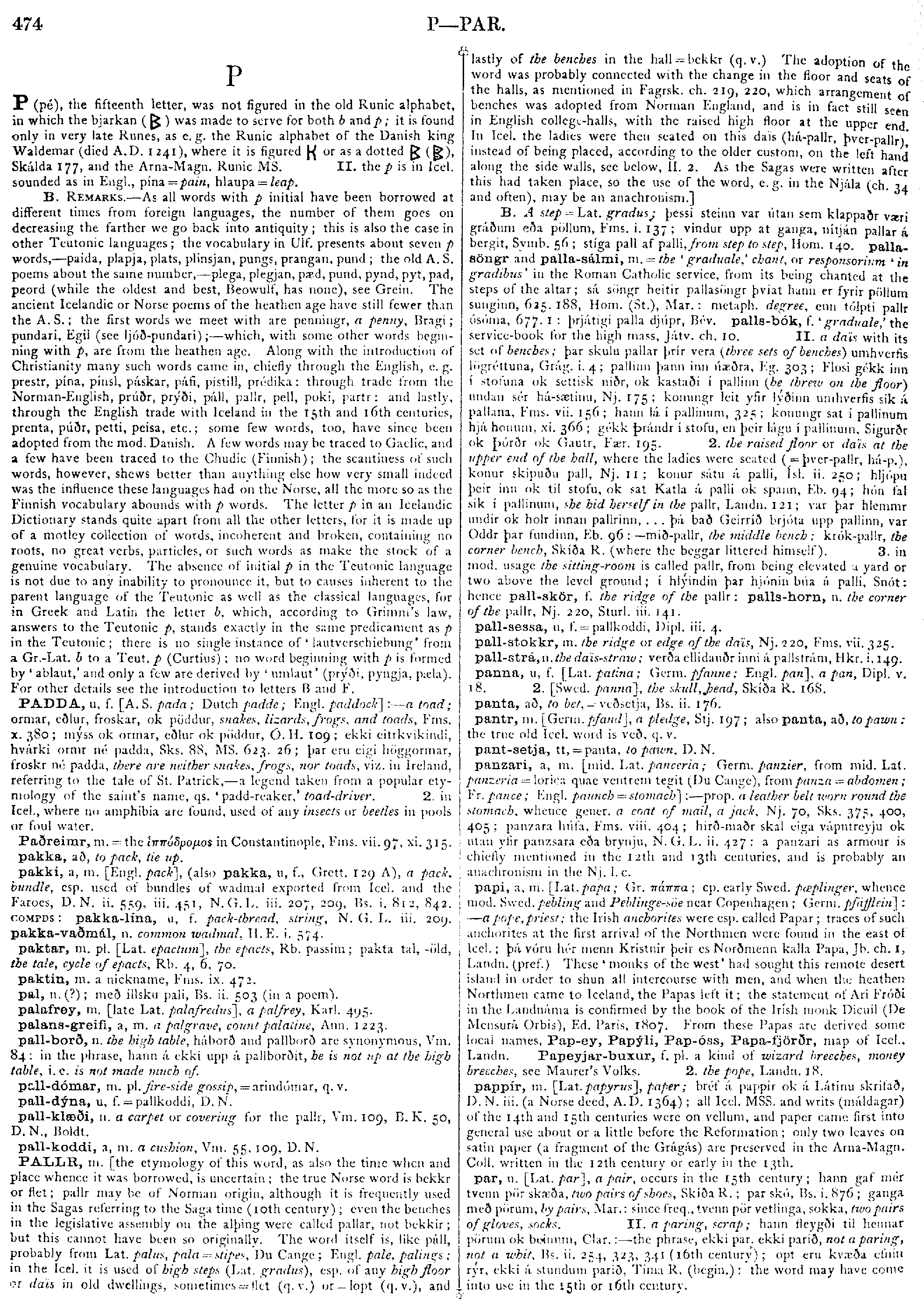
PADDA, u, f. [A.S. pada; Dutch padde; Engl. paddock] :-- a toad; ormar, eðlur, froskar, ok pöddur, snakes, lizards, frogs, and toads, Fms. x. 380; mýss ok ormar, eðlur ok pöddur, Ó.H. 109; ekki eitrkvikindi, hvárki ormr né padda, Sks. 88, MS. 623. 26; þar eru eigi höggormar, froskr né padda, there are neither snakes, frogs, nor toads, viz. in Ireland, referring to the tale of St. Patrick, -- a legend taken from a popular etymology of the saint's name, qs. 'padd-reaker,' toad-driver. 2. in Icel., where no amphibia are found, used of any insects or beetles in pools or foul water.
Germanic Lexicon Project (main page)
This search system was written by
Sean Crist
Please consider
volunteering
to correct the data in these online dictionaries.
No rights reserved. Feel free to use these data in any way you please.