|
|

|
Source: Bosworth/Toller, page b0584, entry 4 View original page image as: [TIFF] [PNG] [View previous entry] [View next entry] |
[Comment on this entry] [View comments] |
The following entry has been hand-corrected once. |
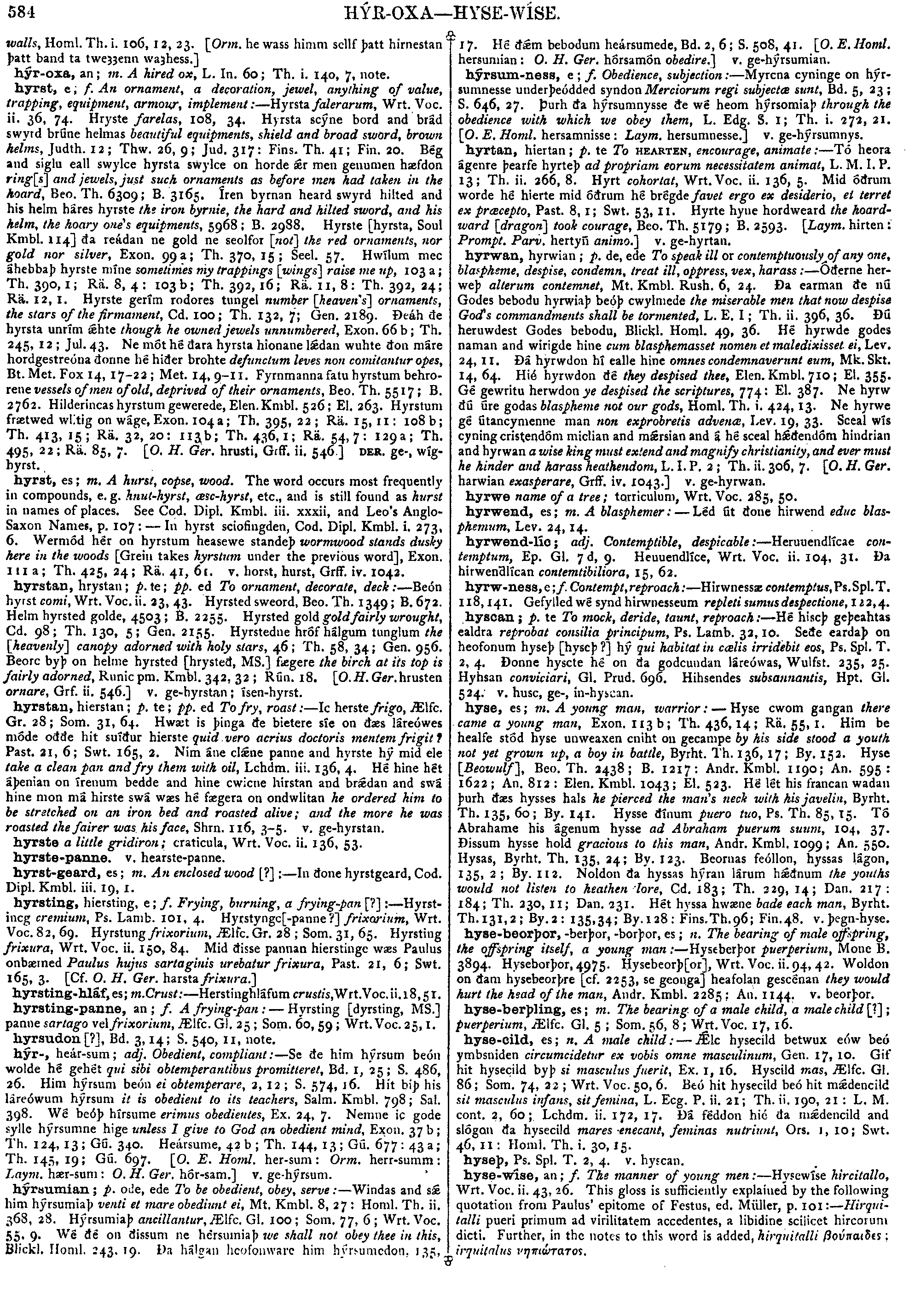
hyrst, es; m. A hurst, copse, wood. The word occurs most frequently in compounds, e.g. hnut-hyrst, æsc-hyrst, etc. , and is still found as hurst in names of places. See Cod. Dipl. Kmbl. iii. xxxii, and Leo's Anglo-Saxon Names. p. 107 :-- In hyrst sciofingden, Cod. Dipl. Kmbl. i. 273, 6. Wermód hér on hyrstum heasewe standeþ wormwood stands dusky here in the woods [Grein takes hyrstum under the previous word], Exon. 111 a; Th. 425, 24; Rä. 41, 61. v. horst, hurst, Grff. iv. 1042.
|
Source: Bosworth/Toller, page b0624, entry 24 View original page image as: [TIFF] [PNG] [View previous entry] [View next entry] |
[Comment on this entry] [View comments] |
The following entry has been hand-corrected once. |
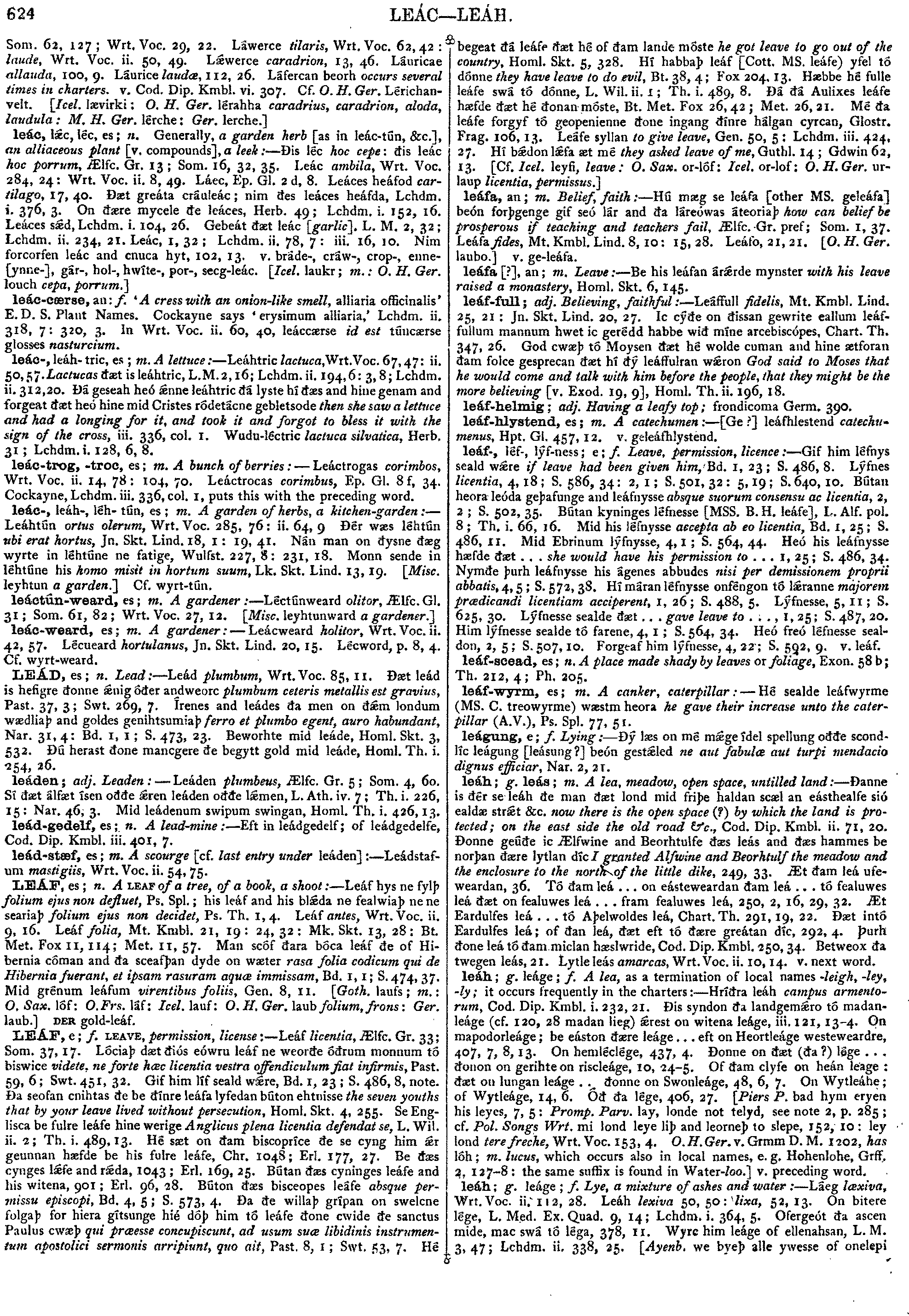
leáh;
g.
leáge;
f.
A
lea,
as
a
termination
of
local
names
-leigh,
-ley,
-ly;
it
occurs
frequently
in
the
charters
:--
Hríðra
leáh
campus
armentorum,
Cod.
Dip.
Kmbl.
i.
232,
21.
Ðis
syndon
ða
landgem ro
tó
madanleáge
(cf.
120,
28
madan
lieg)
rest
on
witena
leáge,
iii.
121,
13-4.
On
mapodorleáge;
be
eáston
ðære
leáge
...
eft
on
Heortleáge
westeweardre,
407,
7,
8,
13.
On
hemléclége,
437,
4.
Ðonne
on
ðæt
(ða?)
lége
...
ðonne
on
gerihte
on
riscleáge,
10,
24-5.
Of
ðam
clyfe
on
heán
léage:
ðæt
on
lungan
leáge
..
ðonne
on
Swonleáge,
48,
6,
7.
On
Wytleáhe;
of
Wytleáge,
14,
6.
Óð
ða
lége,
406,
27.
[Piers
P.
bad
hym
eryen
his
leyes,
7,
5:
Promp.
Parv.
lay,
londe
not
telyd,
see
note
2,
p.
285;
cf.
Pol.
Songs
Wrt.
mi
lond
leye
liþ
and
leorneþ
to
slepe,
152,
10:
ley
lond
tere
freche,
Wrt.
Voc.
153,
4.
O.
H.Ger.
v.
Grmm
D.
M.
1202,
has
lóh;
m.
lucus,
which
occurs
also
in
local
names,
e.g.
Hohenlohe,
Grff.
2,
127-8:
the
same
suffix
is
found
in
Water-loo.]
v.
preceding
word.
ro
tó
madanleáge
(cf.
120,
28
madan
lieg)
rest
on
witena
leáge,
iii.
121,
13-4.
On
mapodorleáge;
be
eáston
ðære
leáge
...
eft
on
Heortleáge
westeweardre,
407,
7,
8,
13.
On
hemléclége,
437,
4.
Ðonne
on
ðæt
(ða?)
lége
...
ðonne
on
gerihte
on
riscleáge,
10,
24-5.
Of
ðam
clyfe
on
heán
léage:
ðæt
on
lungan
leáge
..
ðonne
on
Swonleáge,
48,
6,
7.
On
Wytleáhe;
of
Wytleáge,
14,
6.
Óð
ða
lége,
406,
27.
[Piers
P.
bad
hym
eryen
his
leyes,
7,
5:
Promp.
Parv.
lay,
londe
not
telyd,
see
note
2,
p.
285;
cf.
Pol.
Songs
Wrt.
mi
lond
leye
liþ
and
leorneþ
to
slepe,
152,
10:
ley
lond
tere
freche,
Wrt.
Voc.
153,
4.
O.
H.Ger.
v.
Grmm
D.
M.
1202,
has
lóh;
m.
lucus,
which
occurs
also
in
local
names,
e.g.
Hohenlohe,
Grff.
2,
127-8:
the
same
suffix
is
found
in
Water-loo.]
v.
preceding
word.
|
Source: Bosworth/Toller, page b0626, entry 3 View original page image as: [TIFF] [PNG] [View previous entry] [View next entry] |
[Comment on this entry] [View comments] |
The following entry has been hand-corrected once. |
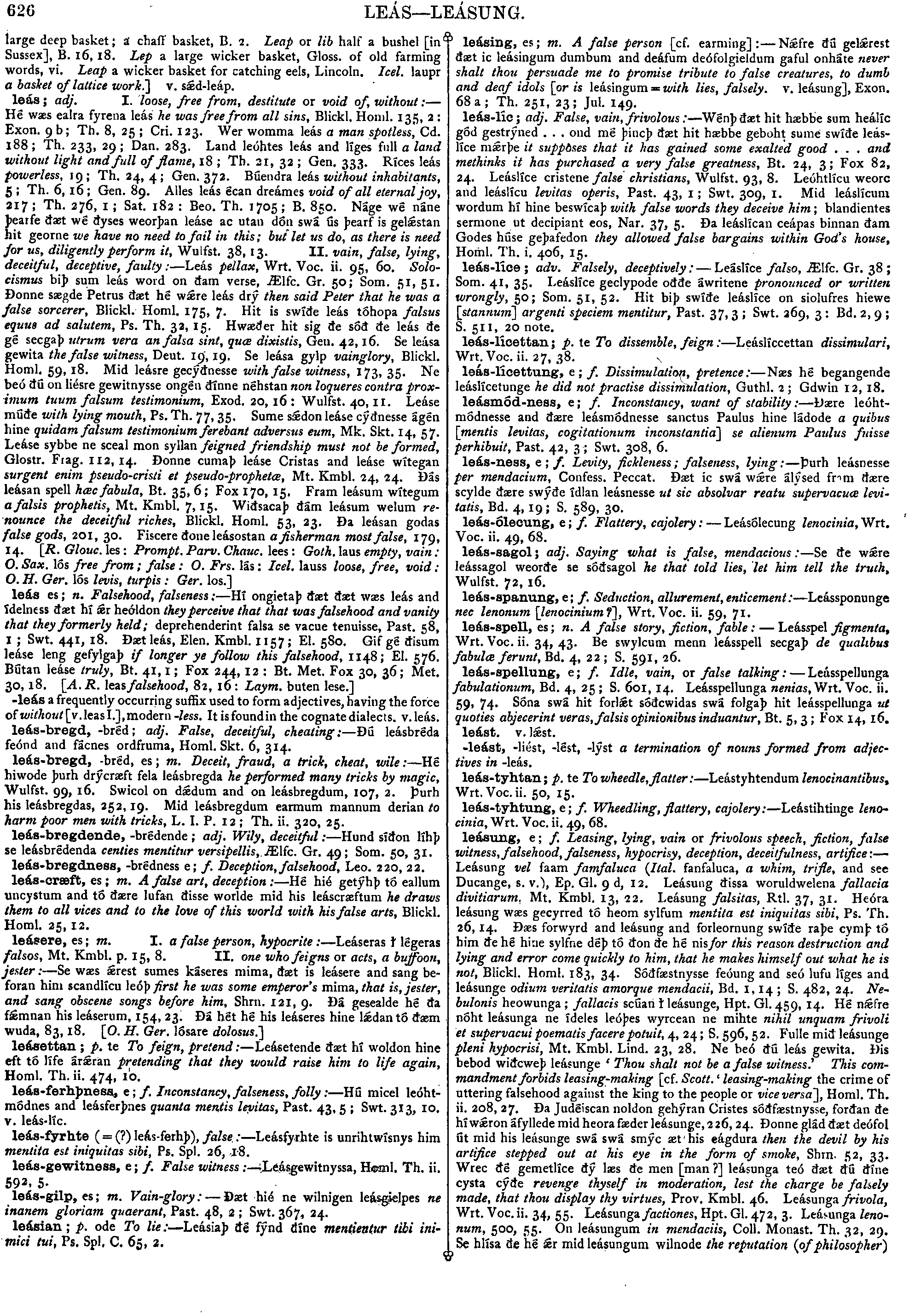
-leás a frequently occurring suffix used to form adjectives, having the force of without [v. leas I.], modern -less. It is found in the cognate dialects. v. leás.
|
Source: Bosworth/Toller, page b0627, entry 2 View original page image as: [TIFF] [PNG] [View previous entry] [View next entry] |
[Comment on this entry] [View comments] |
The following entry has been hand-corrected once. |
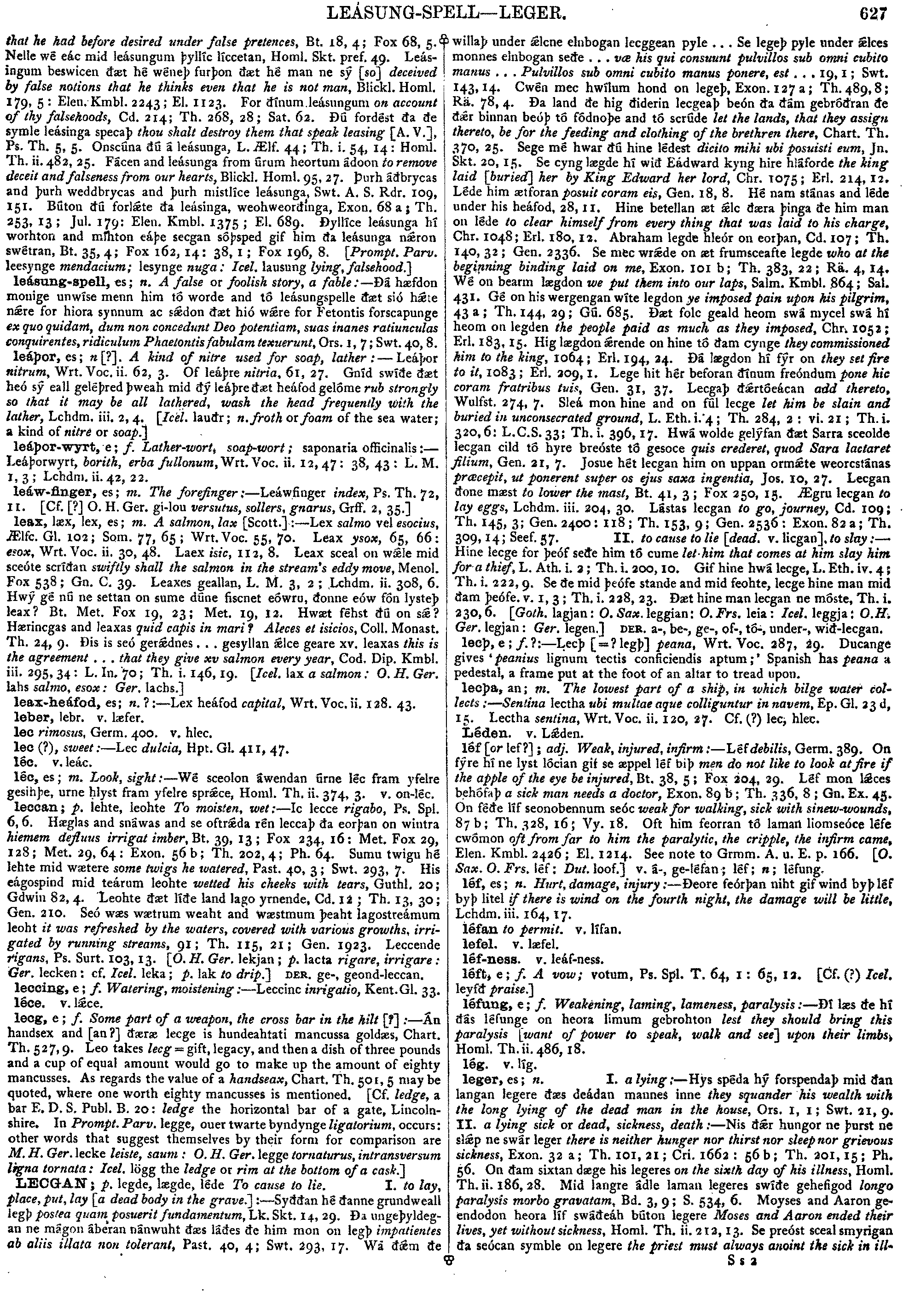
leáþor, es; n[?]. A kind of nitre used for soap, lather :-- Leáþor nitrum, Wrt. Voc. ii. 62, 3. Of leáþre nitria, 61, 27. Gníd swíðe ðæt heó sý eall geléþred þweah mid ðý leáþre ðæt heáfod gelóme rub strongly so that it may be all lathered, wash the head frequently with the lather, Lchdm. iii. 2, 4. [Icel. lauðr; n. froth or foam of the sea water; a kind of nitre or soap.]
|
Source: Bosworth/Toller, page b0632, entry 6 View original page image as: [TIFF] [PNG] [View previous entry] [View next entry] |
[Comment on this entry] [View comments] |
The following entry has been hand-corrected once. |
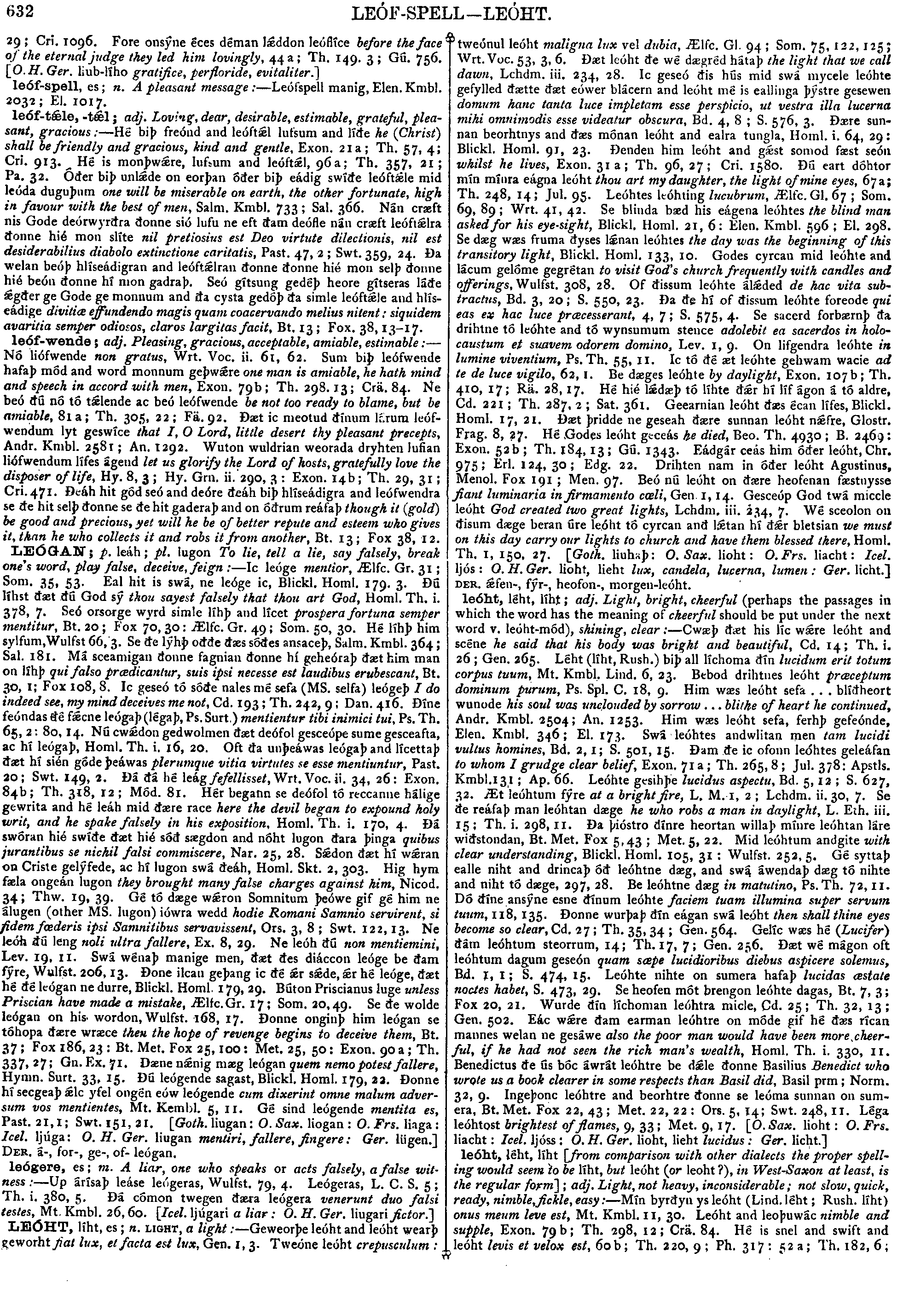
LEÓHT,
líht,
es;
n.
LIGHT,
a
light
:--
Geweorþe
leóht
and
leóht
wearþ
geworht
fiat
lux,
et
facta
est
lux,
Gen.
1,
3.
Tweóne
leóht
crepusculum:
tweónul
leóht
maligna
lux
vel
dubia,
Ælfc.
Gl.
94;
Som.
75,
122,
125;
Wrt.
Voc.
53,
3,
6.
Ðæt
leóht
ðe
wé
dægréd
hátaþ
the
light
that
we
call
dawn,
Lchdm.
iii.
234,
28.
Ic
geseó
ðis
hús
mid
swá
mycele
leóhte
gefylled
ðætte
ðæt
eówer
blácern
and
leóht
mé
is
eallinga
þýstre
gesewen
domum
hanc
tanta
luce
impletam
esse
perspicio,
ut
vestra
illa
lucerna
mihi
omnimodis
esse
videatur
obscura,
Bd.
4,
8;
S.
576,
3.
Ðære
sunan
beorhtnys
and
ðæs
mónan
leóht
and
ealra
tungla,
Homl.
i.
64,
29:
Blickl.
Homl.
91,
23.
Ðenden
him
leóht
and
gst
somod
fæst
seón
whilst
he
lives,
Exon.
31
a;
Th.
96,
27;
Cri.
1580.
Ðú
eart
dóhtor
mín
mínra
eágna
leóht
thou
art
my
daughter,
the
light
of
mine
eyes,
67
a;
Th.
248.
14;
Jul.
95.
Leóhtes
leóhting
lucubrum,
Ælfc.
Gl.
67;
Som.
69,
89;
Wrt.
41,
42.
Se
blinda
bæd
his
eágena
leóhtes
the
blind
man
asked
for
his
eye-sight,
Blickl,
Homl.
21,
6:
Elen.
Kmbl.
596;
El.
298.
Se
dæg
wæs
fruma
ðyses
lnan
leóhtes
the
day
was
the
beginning
of
this
transitory
light,
Blickl.
Homl.
133,
10.
Godes
cyrcan
mid
leóhte
and
lácum
gelóme
gegrétan
to
visit
God's
church
frequently
with
candles
and
offerings,
Wulfst,
308,
28.
Of
ðissum
leóhte
álded
de
hac
vita
subtractus,
Bd.
3,
20;
S.
550,
23.
Ða
ðe
hí
of
ðissum
leóhte
foreode
qui
eas
ex
hac
luce
præcesserant,
4,
7;
S.
575,
4.
Se
sacerd
forbærnþ
ða
drihtne
tó
leóhte
and
tó
wynsumum
stence
adolebit
ea
sacerdos
in
holocaustum
et
suavem
odorem
domino,
Lev.
1,
9.
On
lifgendra
leóhte
in
lumine
viventium,
Ps.
Th.
55,
11.
Ic
tó
ðé
æt
leóhte
gehwam
wacie
ad
te
de
luce
vigilo,
62,
1.
Be
dæges
leóhte
by
daylight,
Exon.
107
b;
Th.
410,
17;
Rä.
28,
17.
Hé
hié
ldæþ
tó
líhte
ðr
hí
líf
ágon
á
tó
aldre,
Cd.
221;
Th.
287,
2;
Sat.
361.
Geearnian
leóht
ðæs
écan
lífes,
Blickl.
Homl.
17,
21.
Ðæt
þridde
ne
geseah
ðære
sunnan
leóht
nfre,
Glostr.
Frag.
8,
27.
Hé
Godes
leóht
geceás
he
died,
Beo.
Th,
4930;
B.
2469:
|
Source: Bosworth/Toller, page b0634, entry 13 View original page image as: [TIFF] [PNG] [View previous entry] [View next entry] |
[Comment on this entry] [View comments] |
The following entry has been hand-corrected once. |
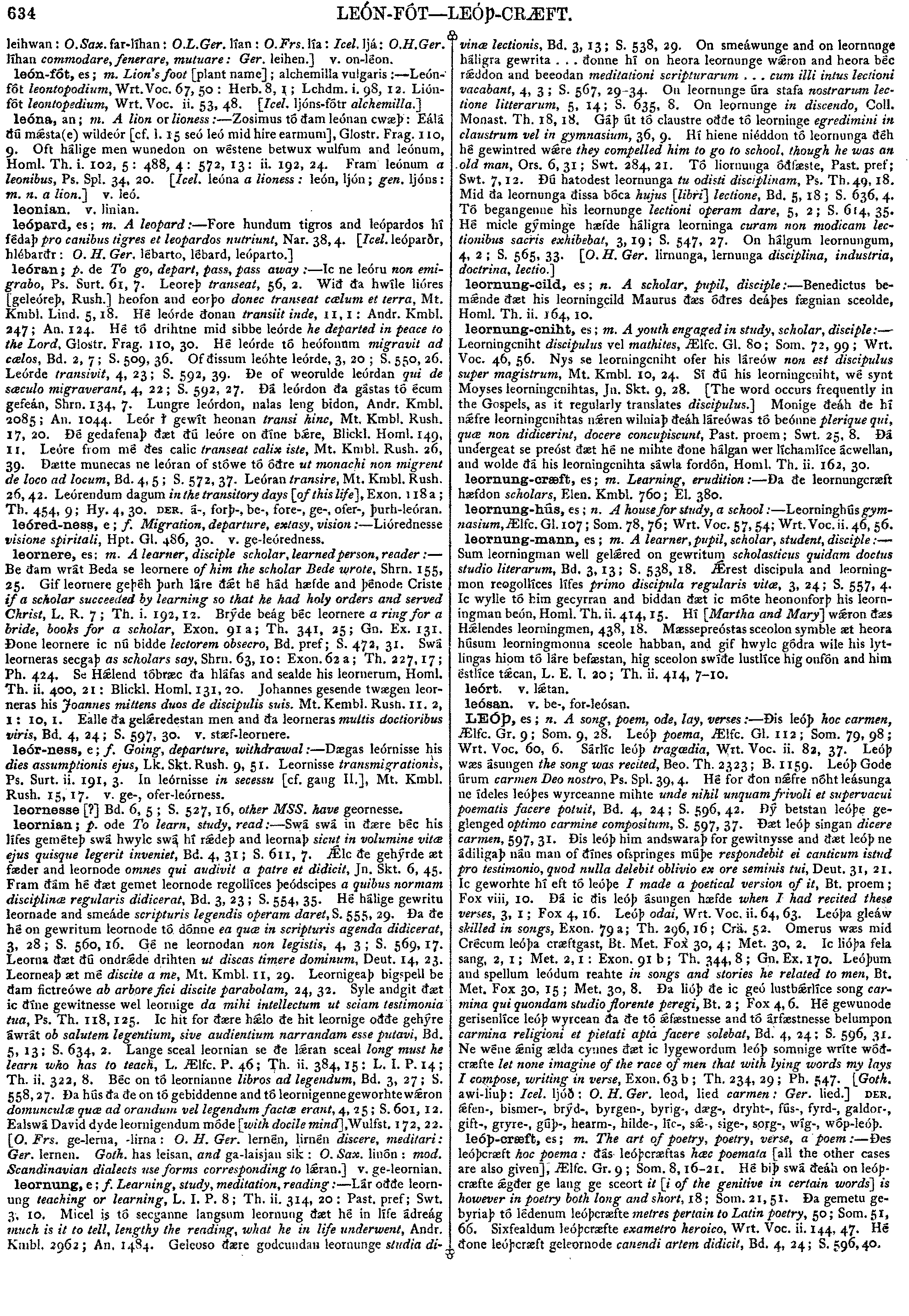
leornung-cniht,
es;
m.
A
youth
engaged
in
study,
scholar,
disciple
:--
Leorningcniht
discipulus
vel
mathites,
Ælfc.
Gl.
80;
Som.
72,
99;
Wrt.
Voc.
46,
56.
Nys
se
leorningcniht
ofer
his
láreów
non
est
discipulus
super
magistrum,
Mt.
Kmbl.
10,
24.
Sí
ðú
his
leorningcniht,
wé
synt
Moyses
leorningcnihtas,
Jn.
Skt.
9,
28.
[The
word
occurs
frequently
in
the
Gospels,
as
it
regularly
translates
discipulus.]
Monige
ðeáh
ðe
hí
nfre
leorningcnihtas
nren
wilniaþ
ðeáh
láreówas
tó
beónne
plerique
qui,
quæ
non
didicerint,
docere
concupiscunt,
Past.
proem;
Swt.
25,
8.
Ðá
undergeat
se
preóst
ðæt
hé
ne
mihte
ðone
hálgan
wer
líchamlíce
ácwellan,
and
wolde
ðá
his
leorningcnihta
sáwla
fordón,
Homl.
Th.
ii.
162,
30.
|
Source: Bosworth/Toller, page b0661, entry 12 View original page image as: [TIFF] [PNG] [View previous entry] [View next entry] |
[Comment on this entry] [View comments] |
The following entry has been hand-corrected once. |
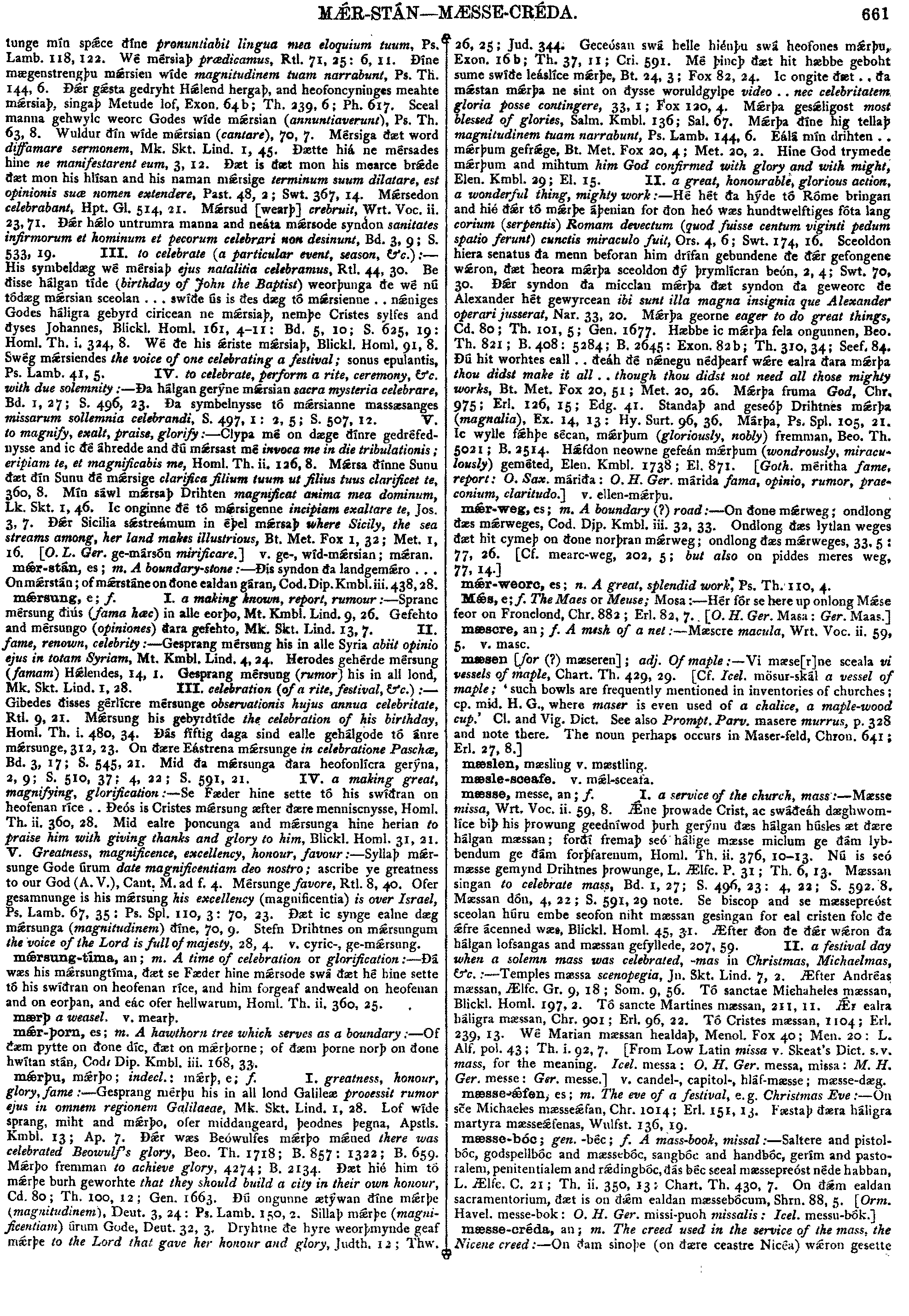
mæsen [for (?) mæseren]; adj. Of maple :-- Vi mæse[r]ne sceala vi vessels of maple, Chart. Th. 429, 29. [Cf. Icel. mösur-skál a vessel of maple; 'such bowls are frequently mentioned in inventories of churches; cp. mid. H. G., where maser is even used of a chalice, a maple-wood cup.' Cl. and Vig. Dict. See also Prompt. Parv. masere murrus, p. 328 and note there. The noun perhaps occurs in Maser-feld, Chron. 641; Erl. 27, 8.]
|
Source: Bosworth/Toller, page b0682, entry 22 View original page image as: [TIFF] [PNG] [View previous entry] [View next entry] |
[Comment on this entry] [View comments] |
The following entry has been hand-corrected once. |
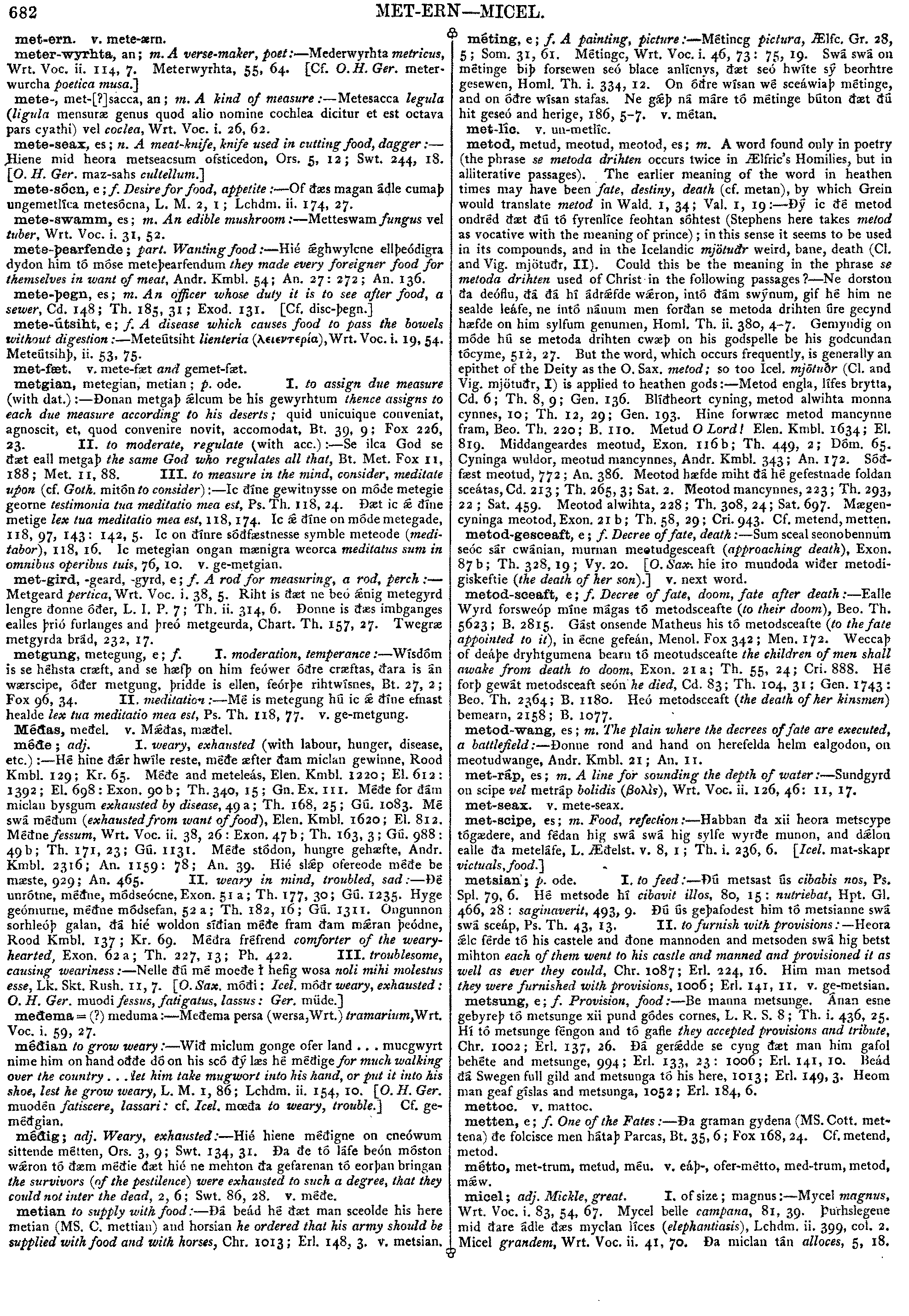
metod,
metud,
meotud,
meotod,
es;
m.
A
word
found
only
in
poetry
(the
phrase
se
metoda
drihten
occurs
twice
in
Ælfric's
Homilies,
but
in
alliterative
passages).
The
earlier
meaning
of
the
word
in
heathen
times
may
have
been
fate,
destiny,
death
(cf.
metan),
by
which
Grein
would
translate
metod
in
Wald.
1,
34;
Val.
1,
19
:--
Ðý
ic
ðé
metod
ondréd
ðæt
ðú
tó
fyrenlíce
feohtan
sóhtest
(Stephens
here
takes
metod
as
vocative
with
the
meaning
of
prince);
in
this
sense
it
seems
to
be
used
in
its
compounds,
and
in
the
Icelandic
mjötuðr
weird,
bane,
death
(Cl.
and
Vig.
mjötuðr,
II).
Could
this
be
the
meaning
in
the
phrase
se
metoda
drihten
used
of
Christ
in
the
following
passages?-Ne
dorston
ða
deóflu,
ðá
ðá
hí
ádrfde
wron,
intó
ðám
swýnum,
gif
hé
him
ne
sealde
leáfe,
ne
intó
nánum
men
forðan
se
metoda
drihten
úre
gecynd
hæfde
on
him
sylfum
genumen,
Homl.
Th.
ii.
380,
4-7.
Gemyndig
on
móde
hú
se
metoda
drihten
cwæþ
on
his
godspelle
be
his
godcundan
tócyme,
512,
27.
But
the
word,
which
occurs
frequently,
is
generally
an
epithet
of
the
Deity
as
the
O.
Sax.
metod;
so
too
Icel.
mjötuðr
(Cl.
and
Vig.
mjötuðr,
I)
is
applied
to
heathen
gods
:--
Metod
engla,
lífes
brytta,
Cd.
6;
Th.
8,
9;
Gen.
136.
Blíðheort
cyning,
metod
alwihta
monna
cynnes,
10;
Th.
12,
29;
Gen.
193.
Hine
forwræc
metod
mancynne
fram,
Beo.
Th.
220;
B.
110.
Metud
O
Lord!
Elen.
Kmbl.
1634;
El.
819.
Middangeardes
meotud,
Exon.
116
b;
Th.
449,
2;
Dóm.
65.
Cyninga
wuldor,
meotud
mancynnes,
Andr.
Kmbl.
343;
An.
172.
Sóðfæst
meotud,
772;
An.
386.
Meotod
hæfde
miht
ðá
hé
gefestnade
foldan
sceátas,
Cd.
213;
Th.
265,
3;
Sat.
2.
Meotod
mancynnes,
223;
Th.
293,
22;
Sat.
459.
Meotod
alwihta,
228;
Th.
308,
24;
Sat.
697.
Mægencyninga
meotod,
Exon.
21
b;
Th.
58,
29;
Cri.
943.
Cf.
metend,
metten.
|
Source: Bosworth/Toller, page b0711, entry 12 View original page image as: [TIFF] [PNG] [View previous entry] [View next entry] |
[Comment on this entry] [View comments] |
The following entry has been hand-corrected once. |
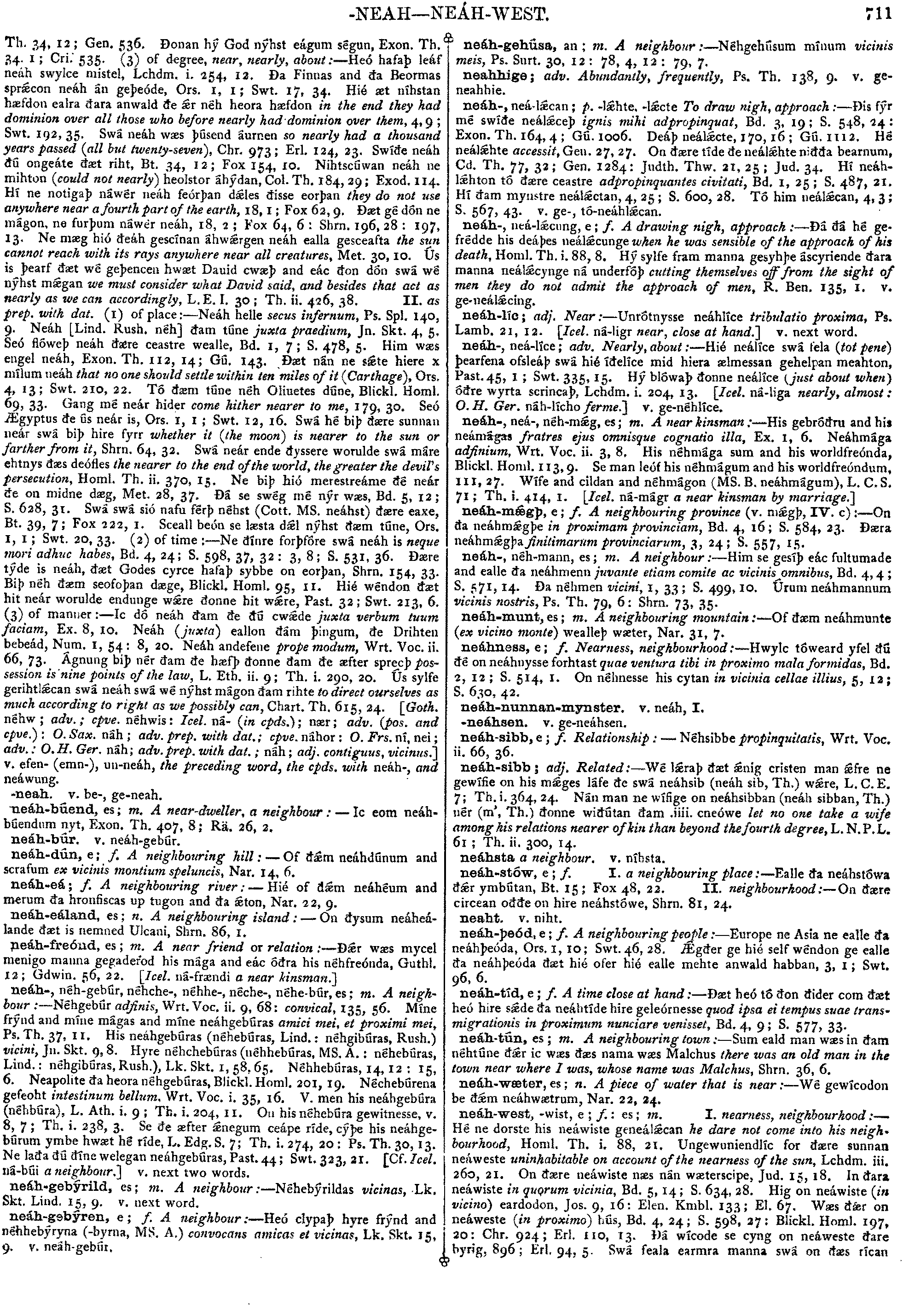
neahhige; adv. Abundantly, frequently, Ps. Th. 138, 9. v. geneahhie.
|
Source: Bosworth/Toller, page b0714, entry 12 View original page image as: [TIFF] [PNG] [View previous entry] [View next entry] |
[Comment on this entry] [View comments] |
The following entry has been hand-corrected once. |
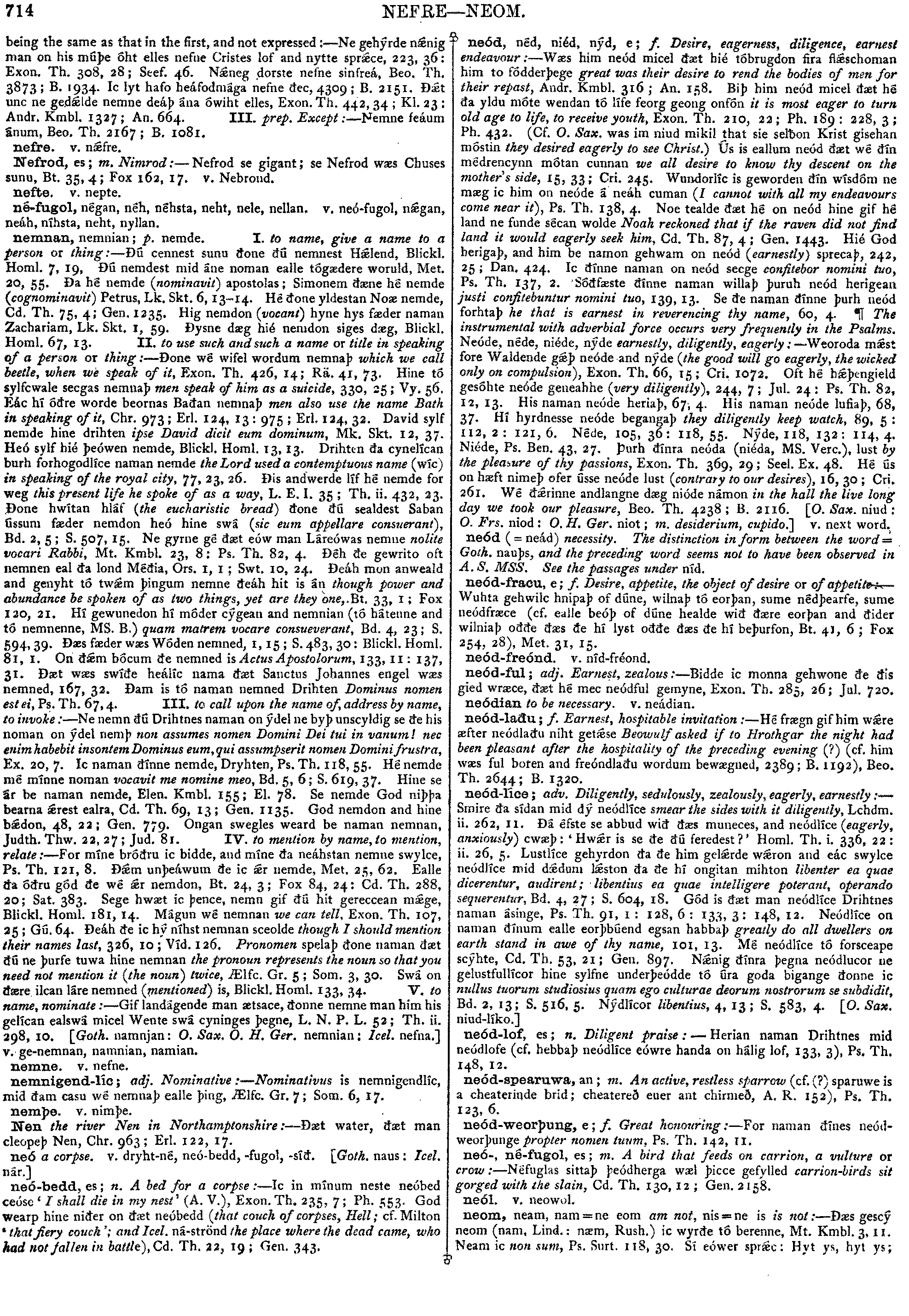
neód,
néd,
niéd,
nýd,
e
;
f.
Desire,
eagerness,
diligence,
earnest
endeavour
:--
Wæs
him
neód
micel
ðæt
hié
tóbrugdon
fira
flschoman
him
to
fódderþege
great
was
their
desire
to
rend
the
bodies
of
men
for
their
repast,
Andr.
Kmbl.
316
;
An.
158.
Biþ
him
neód
micel
ðæt
hé
ða
yldu
móte
wendan
tó
lífe
feorg
geong
onfón
it
is
most
eager
to
turn
old
age
to
life,
to
receive
youth,
Exon.
Th.
210,
22;
Ph.
189
:
228,
3
;
Ph.
432.
(Cf.
O.
Sax.
was
im
niud
mikil
that
sie
sel on
Krist
gisehan
móstin
they
desired
eagerly
to
see
Christ.)
Ús
is
eallum
neód
ðæt
wé
ðín
médrencynn
mótan
cunnan
we
all
desire
to
know
thy
descent
on
the
mother's
side,
15,
33;
Cri.
245.
Wundorlíc
is
geworden
ðín
wísdóm
ne
mæg
ic
him
on
neóde
á
neáh
cuman
(I
cannot
with
all
my
endeavours
come
near
it),
Ps.
Th.
138,
4.
Noe
tealde
ðæt
hé
on
neód
hine
gif
hé
land
ne
funde
sécan
wolde
Noah
reckoned
that
if
the
raven
did
not
find
land
it
would
eagerly
seek
him,
Cd.
Th.
87,
4
;
Gen.
1443.
Hié
God
herigaþ,
and
him
be
namon
gehwam
on
neód
(earnestly)
sprecaþ,
242,
25
;
Dan.
424.
Ic
ðínne
naman
on
neód
secge
confitebor
nomini
tuo,
Ps.
Th.
137,
2.
Sóðfæste
ðínne
naman
willaþ
þuruh
neód
herigean
justi
confitebuntur
nomini
tuo,
139,
13.
Se
ðe
naman
ðínne
þurh
neód
forhtaþ
he
that
is
earnest
in
reverencing
thy
name,
60,
4.

The
instrumental
with
adverbial
force
occurs
very
frequently
in
the
Psalms.
Neóde,
néde,
niéde,
nýde
earnestly,
diligently,
eagerly
:--
Weoroda
mst
fore
Waldende
gþ
neóde
and
nýde
(the
good
will
go
eagerly,
the
wicked
only
on
compulsion),
Exon.
Th.
66,
15;
Cri,
1072.
Oft
hé
hþengield
gesóhte
neóde
geneahhe
(very
diligently),
244,
7
;
Jul.
24
:
Ps.
Th.
82,
12,
13.
His
naman
neóde
heriaþ,
67;
4.
His
naman
neóde
lufiaþ,
68,
37.
Hí
hyrdnesse
neóde
begangaþ
they
diligently
keep
watch,
89,
5
:
112,
2
:
121,
6.
Néde,
105,
36
:
118,
55.
Nýde,
118,
132
:
114,
4.
Niéde,
Ps.
Ben.
43,
27.
Þurh
ðínra
neóda
(niéda,
MS.
Verc.),
lust
by
the
pleasure
of
thy
passions,
Exon.
Th.
369,
29;
Seel.
Ex.
48.
Hé
ús
on
hæft
nimeþ
ofer
ússe
neóde
lust
(contrary
to
our
desires),
16,
30
;
Cri.
261.
Wé
ðrinne
andlangne
dæg
nióde
namon
in
the
hall
the
live
long
day
we
took
our
pleasure,
Beo.
Th.
4238
;
B.
2116.
[O.
Sax.
niud
:
O.
Frs.
niod
:
O.
H.
Ger.
niot
;
m.
desiderium,
cupido.]
v.
next
word.
on
Krist
gisehan
móstin
they
desired
eagerly
to
see
Christ.)
Ús
is
eallum
neód
ðæt
wé
ðín
médrencynn
mótan
cunnan
we
all
desire
to
know
thy
descent
on
the
mother's
side,
15,
33;
Cri.
245.
Wundorlíc
is
geworden
ðín
wísdóm
ne
mæg
ic
him
on
neóde
á
neáh
cuman
(I
cannot
with
all
my
endeavours
come
near
it),
Ps.
Th.
138,
4.
Noe
tealde
ðæt
hé
on
neód
hine
gif
hé
land
ne
funde
sécan
wolde
Noah
reckoned
that
if
the
raven
did
not
find
land
it
would
eagerly
seek
him,
Cd.
Th.
87,
4
;
Gen.
1443.
Hié
God
herigaþ,
and
him
be
namon
gehwam
on
neód
(earnestly)
sprecaþ,
242,
25
;
Dan.
424.
Ic
ðínne
naman
on
neód
secge
confitebor
nomini
tuo,
Ps.
Th.
137,
2.
Sóðfæste
ðínne
naman
willaþ
þuruh
neód
herigean
justi
confitebuntur
nomini
tuo,
139,
13.
Se
ðe
naman
ðínne
þurh
neód
forhtaþ
he
that
is
earnest
in
reverencing
thy
name,
60,
4.

The
instrumental
with
adverbial
force
occurs
very
frequently
in
the
Psalms.
Neóde,
néde,
niéde,
nýde
earnestly,
diligently,
eagerly
:--
Weoroda
mst
fore
Waldende
gþ
neóde
and
nýde
(the
good
will
go
eagerly,
the
wicked
only
on
compulsion),
Exon.
Th.
66,
15;
Cri,
1072.
Oft
hé
hþengield
gesóhte
neóde
geneahhe
(very
diligently),
244,
7
;
Jul.
24
:
Ps.
Th.
82,
12,
13.
His
naman
neóde
heriaþ,
67;
4.
His
naman
neóde
lufiaþ,
68,
37.
Hí
hyrdnesse
neóde
begangaþ
they
diligently
keep
watch,
89,
5
:
112,
2
:
121,
6.
Néde,
105,
36
:
118,
55.
Nýde,
118,
132
:
114,
4.
Niéde,
Ps.
Ben.
43,
27.
Þurh
ðínra
neóda
(niéda,
MS.
Verc.),
lust
by
the
pleasure
of
thy
passions,
Exon.
Th.
369,
29;
Seel.
Ex.
48.
Hé
ús
on
hæft
nimeþ
ofer
ússe
neóde
lust
(contrary
to
our
desires),
16,
30
;
Cri.
261.
Wé
ðrinne
andlangne
dæg
nióde
namon
in
the
hall
the
live
long
day
we
took
our
pleasure,
Beo.
Th.
4238
;
B.
2116.
[O.
Sax.
niud
:
O.
Frs.
niod
:
O.
H.
Ger.
niot
;
m.
desiderium,
cupido.]
v.
next
word.
| Result Page: |  |
Previous | 1 2 3 4 5 6 7 8 9 10 | Next |  |
Germanic Lexicon Project (main page)
This search system was written by
Sean Crist
Please consider
volunteering
to correct the data in these online dictionaries.
No rights reserved. Feel free to use these data in any way you please.