|
|

Tip: In the search results, you can click on any word or abbreviation for more information.
|
Source: Cleasby/Vigfusson, page b0260, entry 17 View original page image as: [TIFF] [PNG] [View previous entry] [View next entry] |
[Comment on this entry] [View comments] |
The following entry has been hand-corrected once. |
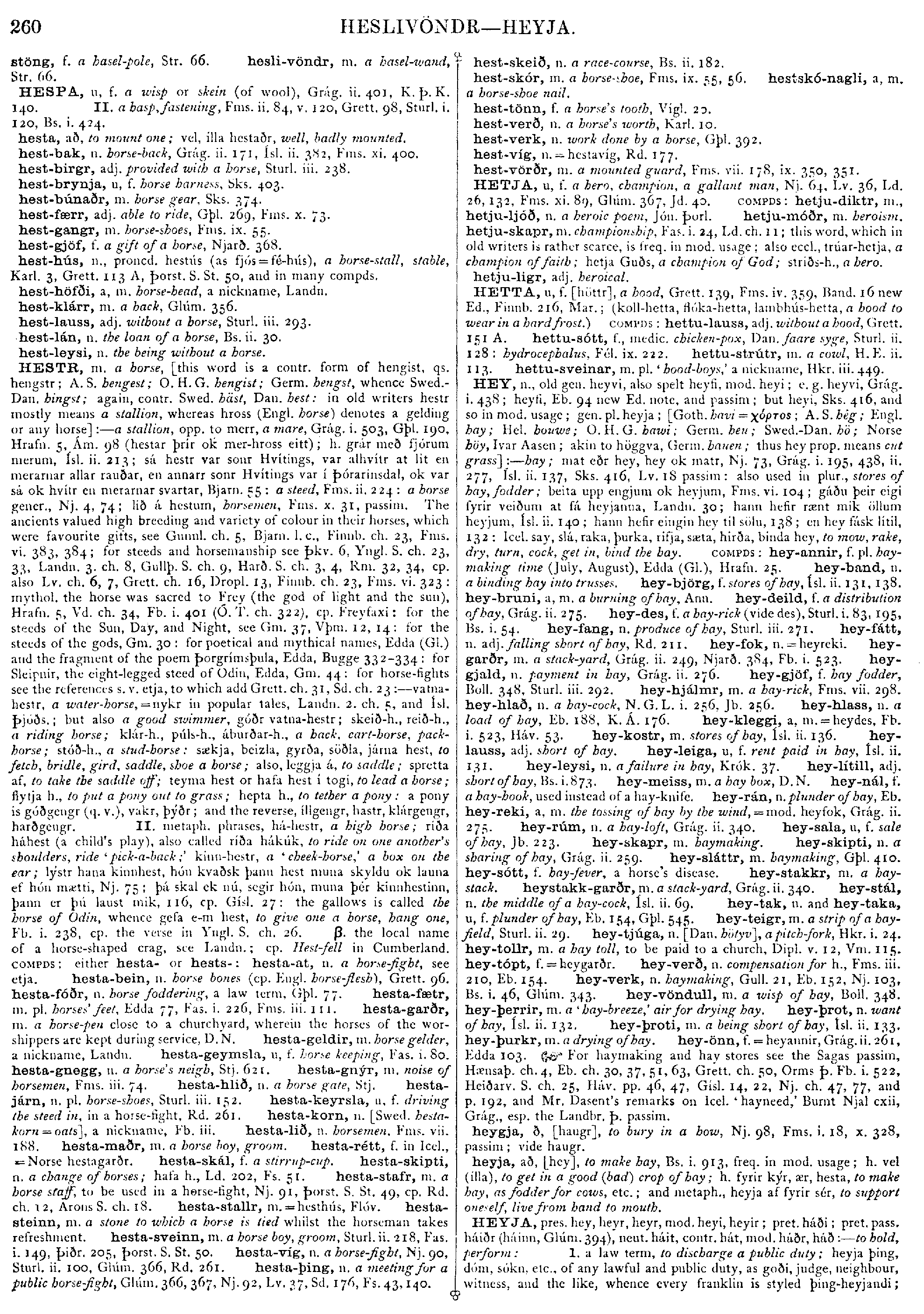
HESTR,
m.
a
horse,
[this
word
is
a
contr.
form
of
hengist,
qs.
hengstr;
A.
S.
hengest;
O.
H.
G.
hengist;
Germ.
hengst,
whence
Swed.-Dan.
hingst;
again,
contr.
Swed.
häst,
Dan.
hest:
in
old
writers
hestr
mostly
means
a
stallion,
whereas
hross
(Engl.
horse)
denotes
a
gelding
or
any
horse]
:--
a
stallion,
opp.
to
merr,
a
mare,
Grág.
i.
503,
Gþl.
190,
Hrafn.
5,
Ám.
98
(hestar
þrír
ok
mer-hross
eitt);
h.
grár
með
fjórum
merum,
Ísl.
ii.
213;
sá
hestr
var
sonr
Hvítings,
var
alhvítr
at
lit
en
merarnar
allar
rauðar,
en
annarr
sonr
Hvítings
var
í
Þórarínsdal,
ok
var
sá
ok
hvítr
en
merarnar
svartar,
Bjarn.
55:
a
steed,
Fms.
ii.
224:
a
horse
gener.,
Nj.
4,
74;
lið
á
hestum,
horsemen,
Fms.
x.
31,
passim.
The
ancients
valued
high
breeding
and
variety
of
colour
in
their
horses,
which
were
favourite
gifts,
see
Gunnl.
ch.
5,
Bjarn.
l.c.,
Finnb.
ch.
23,
Fms.
vi.
383,
384;
for
steeds
and
horsemanship
see
Þkv.
6,
Yngl.
S.
ch.
23,
33,
Landn.
3.
ch.
8,
Gullþ.
S.
ch.
9,
Harð.
S.
ch.
3,
4,
Rm.
32,
34,
cp.
also
Lv.
ch.
6,
7,
Grett.
ch.
16,
Dropl.
13,
Finnb.
ch.
23,
Fms.
vi.
323:
mythol.
the
horse
was
sacred
to
Frey
(the
god
of
light
and
the
sun),
Hrafn.
5,
Vd.
ch.
34,
Fb.
i.
401
(Ó.
T.
ch.
322),
cp.
Freyfaxi:
for
the
steeds
of
the
Sun,
Day,
and
Night,
see
Gm.
37,
Vþm.
12,
14:
for
the
steeds
of
the
gods,
Gm.
30:
for
poetical
and
mythical
names,
Edda
(Gl.)
and
the
fragment
of
the
poem
Þorgrímsþula,
Edda,
Bugge
332-334:
for
Sleipnir,
the
eight-legged
steed
of
Odin,
Edda,
Gm.
44:
for
horse-fights
see
the
references
s.v.
etja,
to
which
add
Grett.
ch.
31,
Sd.
ch.
23
:--
vatna-hestr,
a
water-horse,
=
nykr
in
popular
tales,
Landn.
2.
ch.
5,
and
Ísl.
Þjóðs.;
but
also
a
good
swimmer,
góðr
vatna-hestr;
skeið-h.,
reið-h.,
a
riding
horse;
klár-h.,
púls-h.,
áburðar-h.,
a
hack,
cart-horse,
pack-horse;
stóð-h.,
a
stud-horse:
sækja,
beizla,
gyrða,
söðla,
járna
hest,
to
fetch,
bridle,
gird,
saddle,
shoe
a
horse;
also,
leggja
á,
to
saddle;
spretta
af,
to
take
the
saddle
off;
teyma
hest
or
hafa
hest
í
togi,
to
lead
a
horse;
flytja
h.,
to
put
a
pony
out
to
grass;
hepla
h.,
to
tether
a
pony:
a
pony
is
gúðgengr
(q.v.),
vakr,
þýðr;
and
the
reverse,
íllgengr,
hastr,
klárgengr,
harðgengr.
II.
metaph.
phrases,
há-hestr,
a
high
horse;
ríða
háhest
(a
child's
play),
also
called
ríða
hákúk,
to
ride
on
one
another's
shoulders,
ride
'pick-a-back;'
kinn-hestr,
a
'cheek-horse,'
a
box
on
the
ear;
lýstr
hana
kinnhest,
hón
kvaðsk
þann
hest
muna
skyldu
ok
launa
ef
hón
mætti,
Nj.
75;
þá
skal
ek
nú,
segir
hón,
muna
þér
kinnhestinn,
þann
er
þú
laust
mik,
116,
cp.
Gísl.
27:
the
gallows
is
called
the
horse
of
Odin,
whence
gefa
e-m
hest,
to
give
one
a
horse,
hang
one,
Fb.
i.
238,
cp.
the
verse
in
Yngl.
S.
ch.
26.
 .
the
local
name
of
a
horse-shaped
crag,
see
Landn.;
cp.
Hest-fell
in
Cumberland.
COMPDS:
either
hesta-
or
hests-:
hesta-at,
n.
a
horse-fight,
see
etja.
hesta-bein,
n.
horse
bones
(cp.
Engl.
horse-flesh),
Grett.
96.
hesta-fóðr,
n.
horse
foddering,
a
law
term,
Gþl.
77.
hesta-fætr,
m.
pl.
horses'
feet,
Edda
77,
Fas.
i.
226,
Fms.
iii.
111.
hesta-garðr,
m.
a
horse-pen
close
to
a
churchyard,
wherein
the
horses
of
the
worshippers
are
kept
during
service,
D.
N.
hesta-geldir,
m.
horse
gelder,
a
nickname,
Landn.
hesta-geymsla,
u,
f.
horse
keeping,
Fas.
i.
80.
hesta-gnegg,
n.
a
horse's
neigh,
Stj.
621.
hesta-gnýr,
m,
noise
of
horsemen,
Fms.
iii.
74.
hesta-hlið,
n.
a
horse
gate,
Stj.
hesta-járn,
n.
pl.
horse-shoes,
Sturl.
iii.
152.
hesta-keyrsla,
u,
f.
driving
the
steed
in,
in
a
horse-fight,
Rd.
261.
hesta-korn,
n.
[Swed.
hestakorn
=
oats],
a
nickname,
Fb.
iii.
hesta-lið,
n.
horsemen,
Fms.
vii.
188.
hesta-maðr,
m.
a
horse
boy,
groom.
hesta-rétt,
f.
in
Icel.,
=
Norse
hestagarðr.
hesta-skál,
f.
a
stirrup-cup.
hesta-skipti,
n.
a
change
of
horses;
hafa
h.,
Ld.
202,
Fs.
51.
hesta-stafr,
m.
a
horse
staff,
to
be
used
in
a
horse-fight,
Nj.
91,
Þorst.
S.
St.
49,
cp.
Rd.
ch.
12,
Arons
S.
ch.
18.
hesta-stallr,
m.
=
hesthús,
Flóv.
hesta-steinn,
m.
a
stone
to
whicb
a
horse
is
tied
whilst
the
horseman
takes
refreshment.
hesta-sveinn,
m.
a
horse
boy,
groom,
Sturl.
ii.
218,
Fas.
i.
149,
Þiðr.
205,
Þorst.
S.
St.
50.
hesta-víg,
n.
a
horse-fight,
Nj.
90,
Sturl.
ii.
100,
Glúm.
366,
Rd.
261.
hesta-þing,
n.
a
meeting
for
a
public
horse-fight,
Glúm.
366,
367,
Nj.
92,
Lv.
37,
Sd.
176,
Fs.
43,
140.
.
the
local
name
of
a
horse-shaped
crag,
see
Landn.;
cp.
Hest-fell
in
Cumberland.
COMPDS:
either
hesta-
or
hests-:
hesta-at,
n.
a
horse-fight,
see
etja.
hesta-bein,
n.
horse
bones
(cp.
Engl.
horse-flesh),
Grett.
96.
hesta-fóðr,
n.
horse
foddering,
a
law
term,
Gþl.
77.
hesta-fætr,
m.
pl.
horses'
feet,
Edda
77,
Fas.
i.
226,
Fms.
iii.
111.
hesta-garðr,
m.
a
horse-pen
close
to
a
churchyard,
wherein
the
horses
of
the
worshippers
are
kept
during
service,
D.
N.
hesta-geldir,
m.
horse
gelder,
a
nickname,
Landn.
hesta-geymsla,
u,
f.
horse
keeping,
Fas.
i.
80.
hesta-gnegg,
n.
a
horse's
neigh,
Stj.
621.
hesta-gnýr,
m,
noise
of
horsemen,
Fms.
iii.
74.
hesta-hlið,
n.
a
horse
gate,
Stj.
hesta-járn,
n.
pl.
horse-shoes,
Sturl.
iii.
152.
hesta-keyrsla,
u,
f.
driving
the
steed
in,
in
a
horse-fight,
Rd.
261.
hesta-korn,
n.
[Swed.
hestakorn
=
oats],
a
nickname,
Fb.
iii.
hesta-lið,
n.
horsemen,
Fms.
vii.
188.
hesta-maðr,
m.
a
horse
boy,
groom.
hesta-rétt,
f.
in
Icel.,
=
Norse
hestagarðr.
hesta-skál,
f.
a
stirrup-cup.
hesta-skipti,
n.
a
change
of
horses;
hafa
h.,
Ld.
202,
Fs.
51.
hesta-stafr,
m.
a
horse
staff,
to
be
used
in
a
horse-fight,
Nj.
91,
Þorst.
S.
St.
49,
cp.
Rd.
ch.
12,
Arons
S.
ch.
18.
hesta-stallr,
m.
=
hesthús,
Flóv.
hesta-steinn,
m.
a
stone
to
whicb
a
horse
is
tied
whilst
the
horseman
takes
refreshment.
hesta-sveinn,
m.
a
horse
boy,
groom,
Sturl.
ii.
218,
Fas.
i.
149,
Þiðr.
205,
Þorst.
S.
St.
50.
hesta-víg,
n.
a
horse-fight,
Nj.
90,
Sturl.
ii.
100,
Glúm.
366,
Rd.
261.
hesta-þing,
n.
a
meeting
for
a
public
horse-fight,
Glúm.
366,
367,
Nj.
92,
Lv.
37,
Sd.
176,
Fs.
43,
140.
|
Source: Cleasby/Vigfusson, page b0462, entry 12 View original page image as: [TIFF] [PNG] [View previous entry] [View next entry] |
[Comment on this entry] [View comments] |
The following entry has been hand-corrected once. |
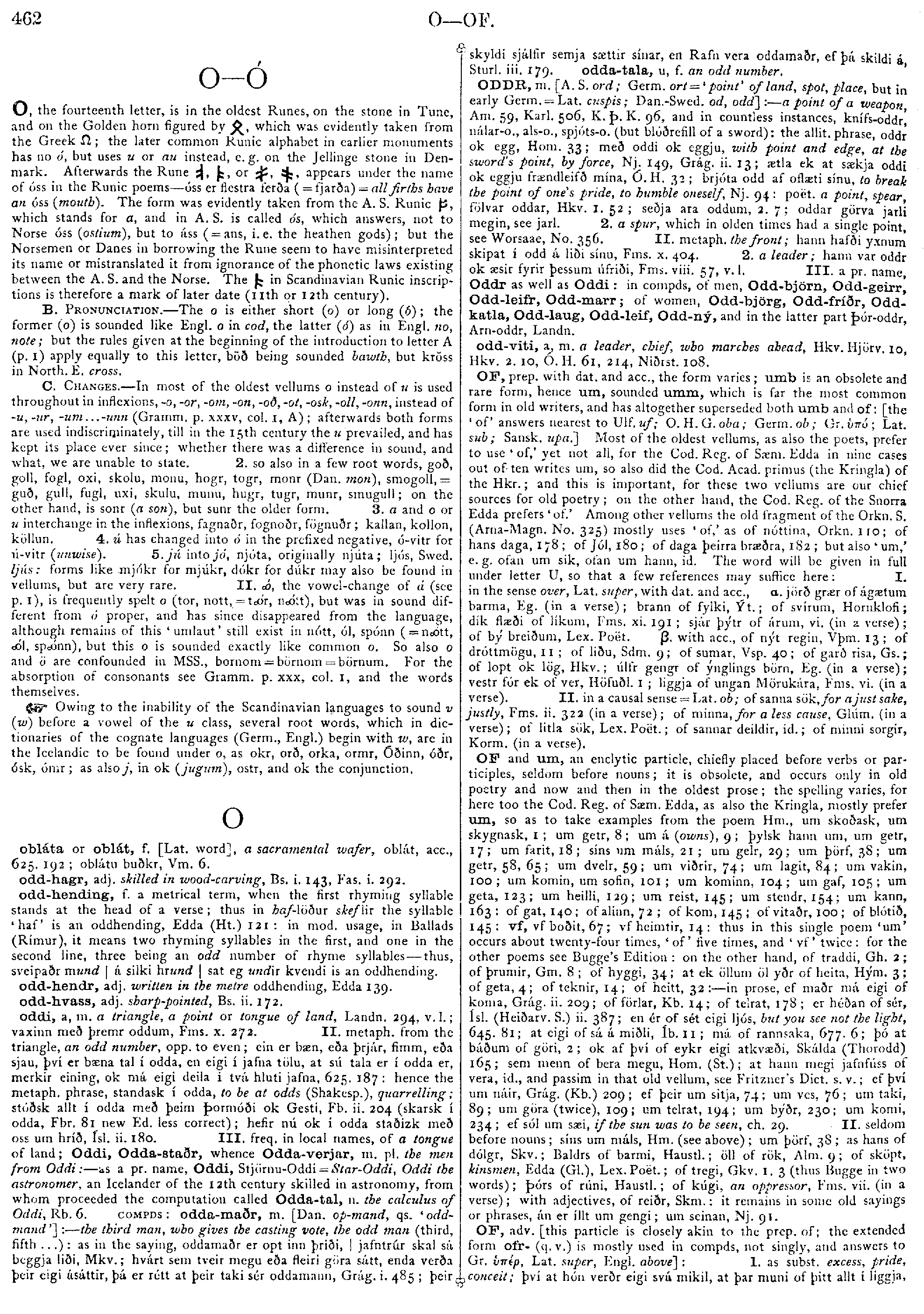
OF,
prep.
with
dat.
and
acc.,
the
form
varies;
umb
is
an
obsolete
and
rare
form,
hence
um,
sounded
umm,
which
is
far
the
most
common
form
in
old
writers,
and
has
altogether
superseded
both
umb
and
of:
[the
'of'
answers
nearest
to
Ulf.
uf;
O.H.G.
oba;
Germ.
ob;
Gr.
GREEK;
Lat.
sub;
Sansk.
upa.]
Most
of
the
oldest
vellums,
as
also
the
poets,
prefer
to
use
'of,'
yet
not
all,
for
the
Cod.
Reg.
of
Sæm.
Edda
in
nine
cases
out
of
ten
writes
um,
so
also
did
the
Cod.
Acad.
primus
(the
Kringla)
of
the
Hkr.;
and
this
is
important,
for
these
two
vellums
are
our
chief
sources
for
old
poetry;
on
the
other
hand,
the
Cod.
Reg.
of
the
Snorra
Edda
prefers
'of.'
Among
other
vellums
the
old
fragment
of
the
Orkn.
S.
(Arna-Magn.
No.
325)
mostly
uses
'of'
as
of
nóttina,
Orkn.
110;
of
hans
daga,
178;
of
Jól,
180;
of
daga
þeirra
bræðra,
182;
but
also
'um'
e.g.
ofan
um
sik,
ofan
um
hann,
id.
The
word
will
be
given
in
full
under
letter
U,
so
that
a
few
references
may
suffice
here:
I.
in
the
sense
over,
Lat.
super,
with
dat.
and
acc.,
 .
jörð
grær
of
ágætum
barma,
Eg.
(in
a
verse);
brann
of
fylki,
Ýt.;
of
svírum,
Hornklofi;
dík
flæði
of
líkum,
Fms.
xi.
191;
sjár
þýtr
of
árum,
vi.
(in
a
verse);
of
bý
breiðum,
Lex.
Poët.
.
with
acc.,
of
nýt
regin,
Vþm.
13;
of
dróttmögu,
11;
of
liðu,
Sdm.
9;
of
sumar,
Vsp.
40;
of
garð
risa,
Gs.;
of
lopt
ok
lög,
Hkv.;
úlfr
gengr
of
ýnglings
börn,
Eg.
(in
a
verse);
vestr
fór
ek
of
ver,
Höfuðl.
1;
liggja
of
ungan
Mörukára,
Fms.
vi.
(in
a
verse).
II.
in
a
causal
sense
=
Lat.
ob;
of
sanna
sök,
for
a
just
sake,
justly,
Fms.
ii.
322
(in
a
verse);
of
minna,
for
a
less
cause,
Glúm,
(in
a
verse);
of
litla
sök,
Lex.
Poët.;
of
sannar
deildir,
id.;
of
minni
sorgir,
Korm.
(in
a
verse).
.
jörð
grær
of
ágætum
barma,
Eg.
(in
a
verse);
brann
of
fylki,
Ýt.;
of
svírum,
Hornklofi;
dík
flæði
of
líkum,
Fms.
xi.
191;
sjár
þýtr
of
árum,
vi.
(in
a
verse);
of
bý
breiðum,
Lex.
Poët.
.
with
acc.,
of
nýt
regin,
Vþm.
13;
of
dróttmögu,
11;
of
liðu,
Sdm.
9;
of
sumar,
Vsp.
40;
of
garð
risa,
Gs.;
of
lopt
ok
lög,
Hkv.;
úlfr
gengr
of
ýnglings
börn,
Eg.
(in
a
verse);
vestr
fór
ek
of
ver,
Höfuðl.
1;
liggja
of
ungan
Mörukára,
Fms.
vi.
(in
a
verse).
II.
in
a
causal
sense
=
Lat.
ob;
of
sanna
sök,
for
a
just
sake,
justly,
Fms.
ii.
322
(in
a
verse);
of
minna,
for
a
less
cause,
Glúm,
(in
a
verse);
of
litla
sök,
Lex.
Poët.;
of
sannar
deildir,
id.;
of
minni
sorgir,
Korm.
(in
a
verse).
|
Source: Cleasby/Vigfusson, page b0474, entry 27 View original page image as: [TIFF] [PNG] [View previous entry] [View next entry] |
[Comment on this entry] [View comments] |
The following entry has been hand-corrected once. |
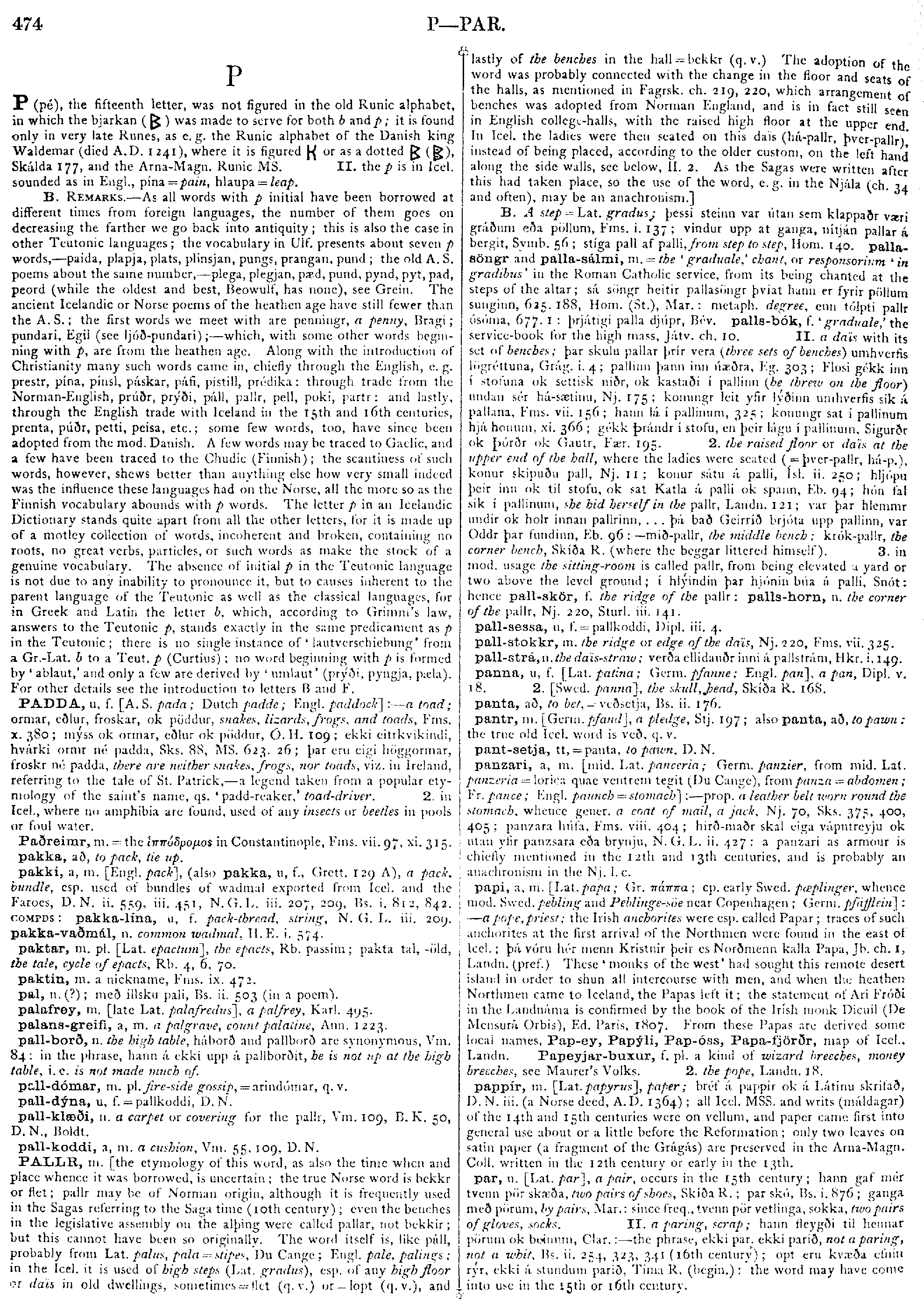
pappír, m. [Lat. papyrus], paper; bréf á pappír ok á Látinu skritað, D.N. iii. (a Norse deed, A.D. 1364); all Icel. MSS. and writs (máldagar) of the 14th and 15th centuries were on vellum, and paper came first into general use about or a little before the Reformation; only two leaves on satin paper (a fragment of the Grágás) are preserved in the Arna-Magn. Coll. written in the 12th century or early in the 13th.
|
Source: Cleasby/Vigfusson, page b0488, entry 28 View original page image as: [TIFF] [PNG] [View previous entry] [View next entry] |
[Comment on this entry] [View comments] |
The following entry has been hand-corrected once. |
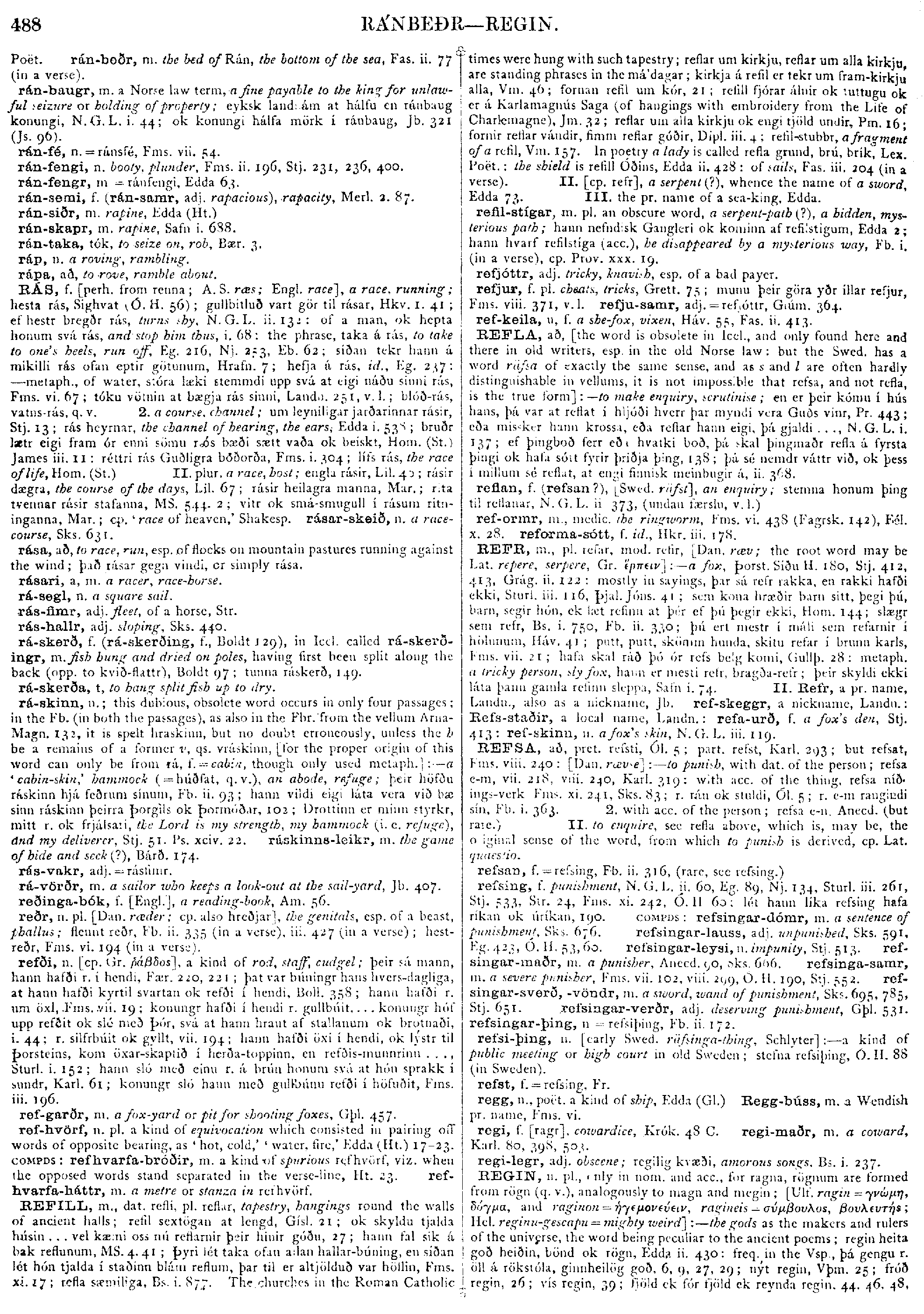
REFILL, m., dat. refli, pl. reflar, tapestry, hangings round the walls of ancient halls; refil sextögan at lengd, Gísl. 21; ok skyldu tjalda húsin ... vel kæmi oss nú reflarnir þeir hinir góðu, 27; hann fal sik á bak reflunum, MS. 4. 41; Þyri lét taka ofan allan hallar-búning, en síðan lét hón tjalda í staðinn blám reflum, þar til er altjölduð var höllin, Fms. xi. 17; refla sæmiliga, Bs. i. 877. The churches in the Roman Catholic times were hung with such tapestry; reflar um kirkju, reflar um alla kirkju are standing phrases in the má'dagar; kirkja á refil er tekr um fram-kirkju alla, Vm. 46; fornan refil um kór, 21; refill fjórar álnir ok tuttugu ok er á Karlamagnús Saga (of hangings with embroidery from the Life of Charlemagne), Jm. 32; reflar um alla kirkju ok engi tjöld undir, Pm. 16; fornir reflar vándir, fimm reflar góðir, Dipl. iii. 4; refil-stubbr, a fragment of a refil, Vm. 157. In poetry a lady is called refla grund, brú, brík, Lex. Poët.: the shield is refill Óðins, Edda ii. 428: of sails, Fas. iii. 204 (in a verse). II. [cp. refr], a serpent(?), whence the name of a sword, Edda 73. III. the pr. name of a sea-king, Edda.
|
Source: Cleasby/Vigfusson, page b0509, entry 1 View original page image as: [TIFF] [PNG] [View previous entry] [View next entry] |
[Comment on this entry] [View comments] |
The following entry has been hand-corrected once. |
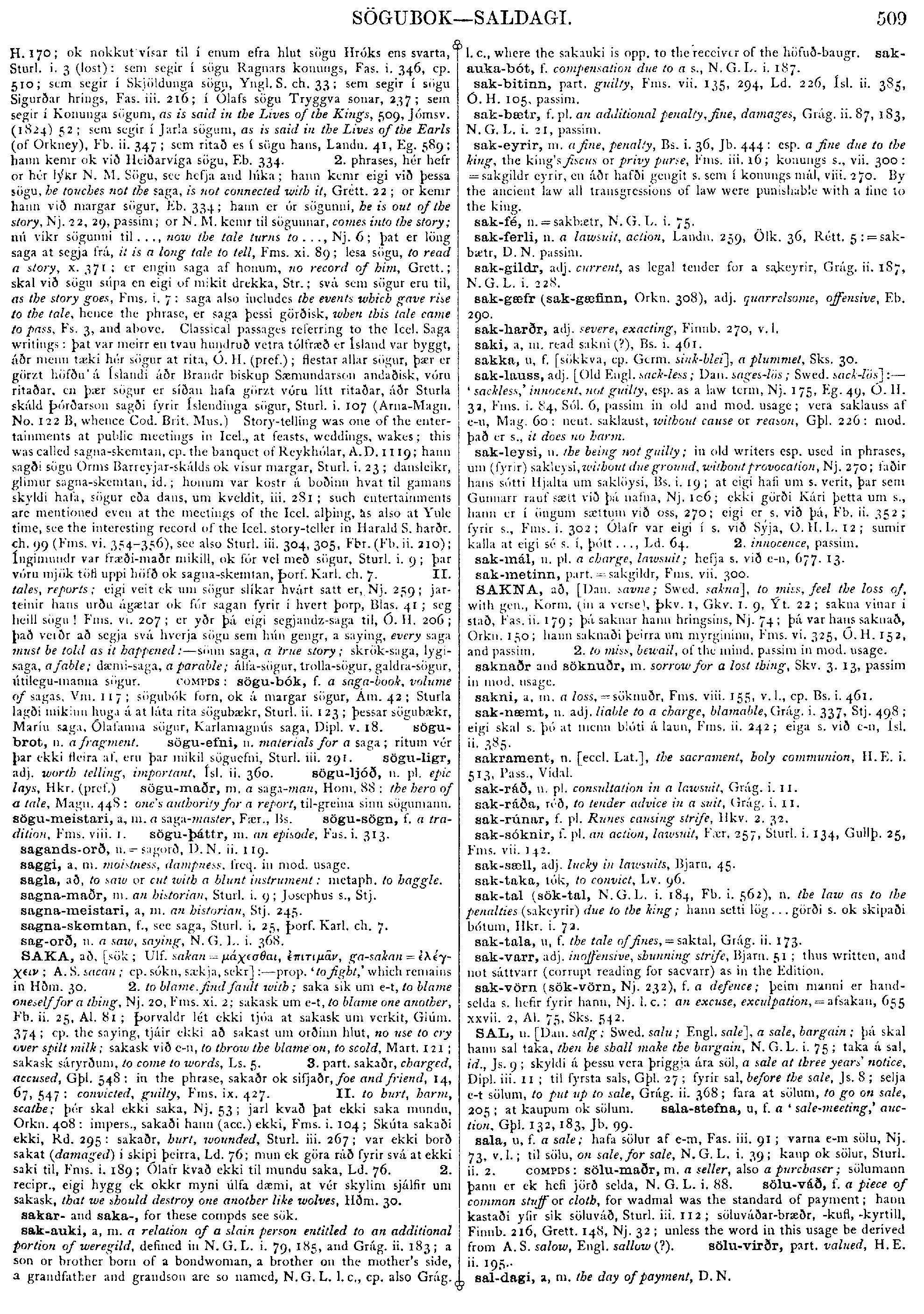
H. 170; ok nokkut vísar til í enum efra hlut sögu Hróks ens svarta, Sturl. i. 3 (lost): sem segir í sögu Ragnars konuugs, Fas. i. 346, cp. 510; sem segir í Skjöldunga sögu, Yngl. S. ch. 33; sem segir í sögu Sigurðar hrings, Fas. iii. 216; í Ólafs sögu Tryggva sonar, 237; sem segir í Konunga sögum, as is said in the Lives of the Kings, 509, Jómsv. (1824) 52; sem segir í Jarla sögum, as is said in the Lives of the Earls (of Orkney), Fb. ii. 347; sem ritað es í sögu hans, Landn. 41, Eg. 589; hann kemr ok við Heiðarvíga sögu, Eb. 334. 2. phrases, hér hefr or hér lýkr N.M. Sögu, see hefja and lúka; hann kemr eigi við þessa sögu, he touches not the saga, is not connected with it, Grett. 22; or kemr hann við margar sögur, Eb. 334; hann er ór sögunni, he is out of the story, Nj. 22, 29, passim; or N.M. kemr til sögunnar, comes into the story; nú víkr sögunni til ..., now the tale turns, to ..., Nj. 6; þat er löng saga at segja frá, it is a long tale to tell, Fms. xi. 89; lesa sögu, to read a story, x. 371; er engin saga af honum, no record of him, Grett.; skal við sögu súpa en eigi of mikit drekka, Str.; svá sem sögur eru til, as the story goes, Fms. i. 7: saga also includes the events which gave rise to the tale, hence the phrase, er saga þessi görðisk, when this tale came to pass, Fs. 3, and above. Classical passages referring to the Icel. Saga writings: þat var meirr en tvau hundruð vetra tólfræð er Ísland var byggt, áðr menn tæki hér sögur at rita, Ó.H. (pref.); flestar allar sögur, þær er görzt höfðu á Íslandi áðr Brandr biskup Sæmundarson andaðisk, vóru ritaðar, en þær sögur er síðan hafa görzt vóru lítt ritaðar, áðr Sturla skúld Þórðarson sagði fyrir Íslendinga sögur, Sturl. i. 107 (Arna-Magn. No. 122 B, whence Cod. Brit. Mus.) Story-telling was one of the entertainments at public meetings in Icel., at feasts, weddings, wakes; this was called sagna-skemtan, cp. the banquet of Reykhólar, A.D. 1119; hann sagði sögu Orms Barreyjar-skálds ok vísur margar, Sturl. i. 23; dansleikr, glímur sagna-skemtan, id.; honum var kostr á boðinn hvat til gamans skyldi hafa, sögur eða dans, um kveldit, iii. 281; such entertainments are mentioned even at the meetings of the Icel. alþing, as also at Yule time, see the interesting record of the Icel. story-teller in Harald S. harðr. ch. 99 (Fms. vi. 354-356), see also Sturl. iii. 304, 305, Fbr. (Fb. ii. 210); Íngimundr var fræði-maðr mikill, ok fór vel með sögur, Sturl. i. 9; þar vóru mjök töfl uppi höfð ok sagna-skemtan, Þorf. Karl. ch. 7. II. tales, reports; eigi veit ek um sögur slíkar hvárt satt er, Nj. 259; jarteinir hans urðu ágætar ok fór sagan fyrir í hvert þorp, Blas. 41; seg heill sögu! Fms. vi. 207; er yðr þá eigi segjandz-saga til, Ó.H. 206; það verðr að segja svá hverja sögu sem hún gengr, a saying, every saga must be told as it happened :-- sönn saga, a true story; skrök-saga, lygisaga, a fable; dæmi-saga, a parable; álfa-sögur, trolla-sögur, galdra-sögur, útilegu-manna sögur. COMPDS: sögu-bók, f. a saga-book, volume of sagas, Vm. 117; sögubók forn, ok á margar sögur, Ám. 42; Sturla lagði mikinn huga á at láta rita sögubækr, Sturl. ii. 123; þessar sögubækr, Maríu saga, Ólafanna sögur, Karlamagnús saga, Dipl. v. 18. sögu-brot, n. a fragment. sögu-efni, n. materials for a saga; ritum vér þar ekki fleira af, eru þar mikil söguefni, Sturl. iii. 291. sögu-ligr, adj. worth telling, important, Ísl. ii. 360. Sögu-ljóð, n. pl. epic lays, Hkr. (pref.) sögu-maðr, m. a saga-man, Hom. 88: the hero of a tale, Magn. 448: one's authority for a report, til-greina sinn sögumann. sögu-meistari, a, m. a saga-master, Fær., Bs. sögu-sögn, f. a tradition. Fms. viii. 1. sögu-þáttr, m. an episode, Fas. i. 313.
|
Source: Cleasby/Vigfusson, page b0570, entry 34 View original page image as: [TIFF] [PNG] [View previous entry] [View next entry] |
[Comment on this entry] [View comments] |
The following entry has been hand-corrected once. |
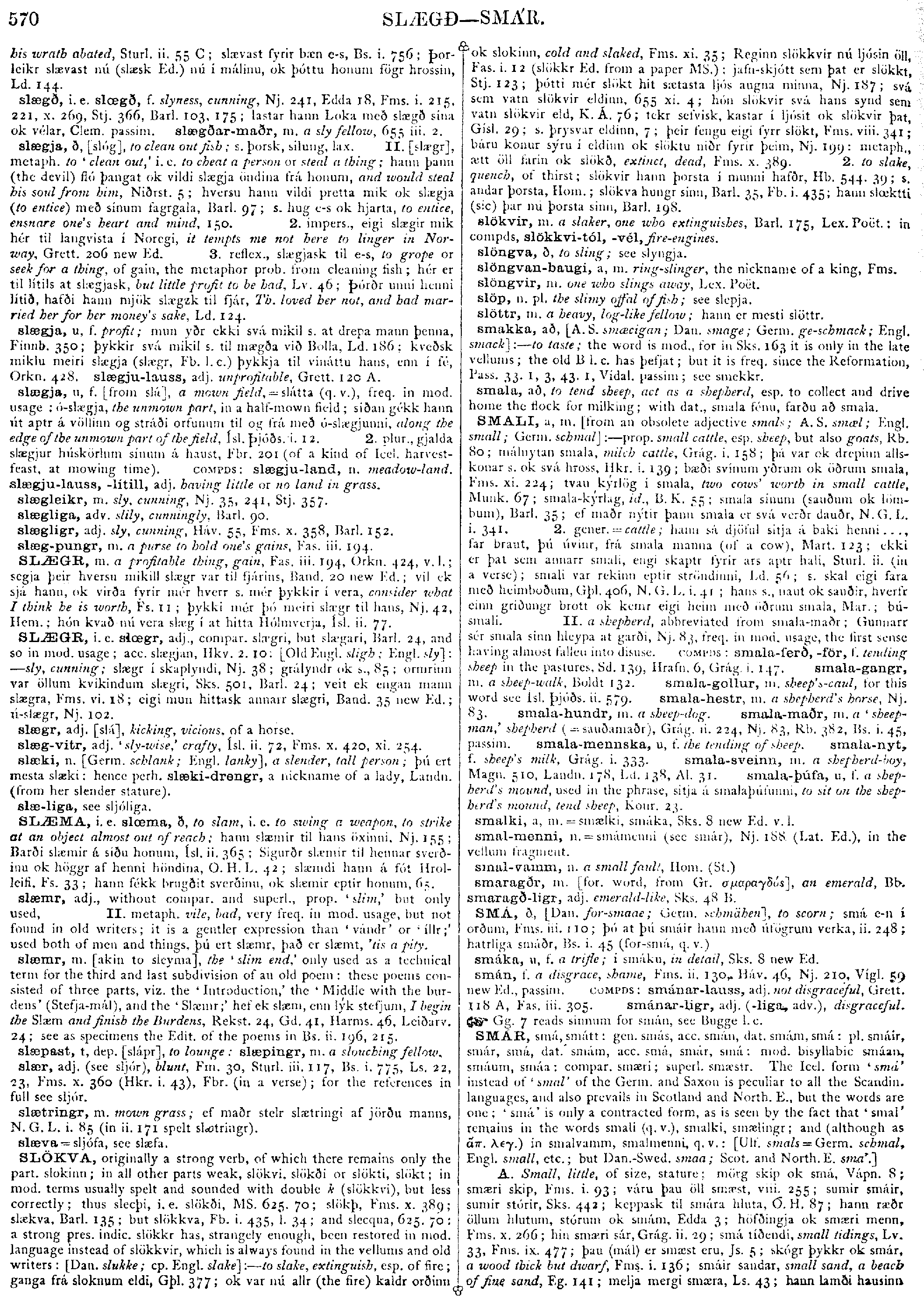
smal-menni, n. = smámenni (see smár), Nj. 188. (Lat. Ed.), in the vellum fragment.
|
Source: Cleasby/Vigfusson, page b0572, entry 4 View original page image as: [TIFF] [PNG] [View previous entry] [View next entry] |
[Comment on this entry] [View comments] |
The following entry has been hand-corrected once. |
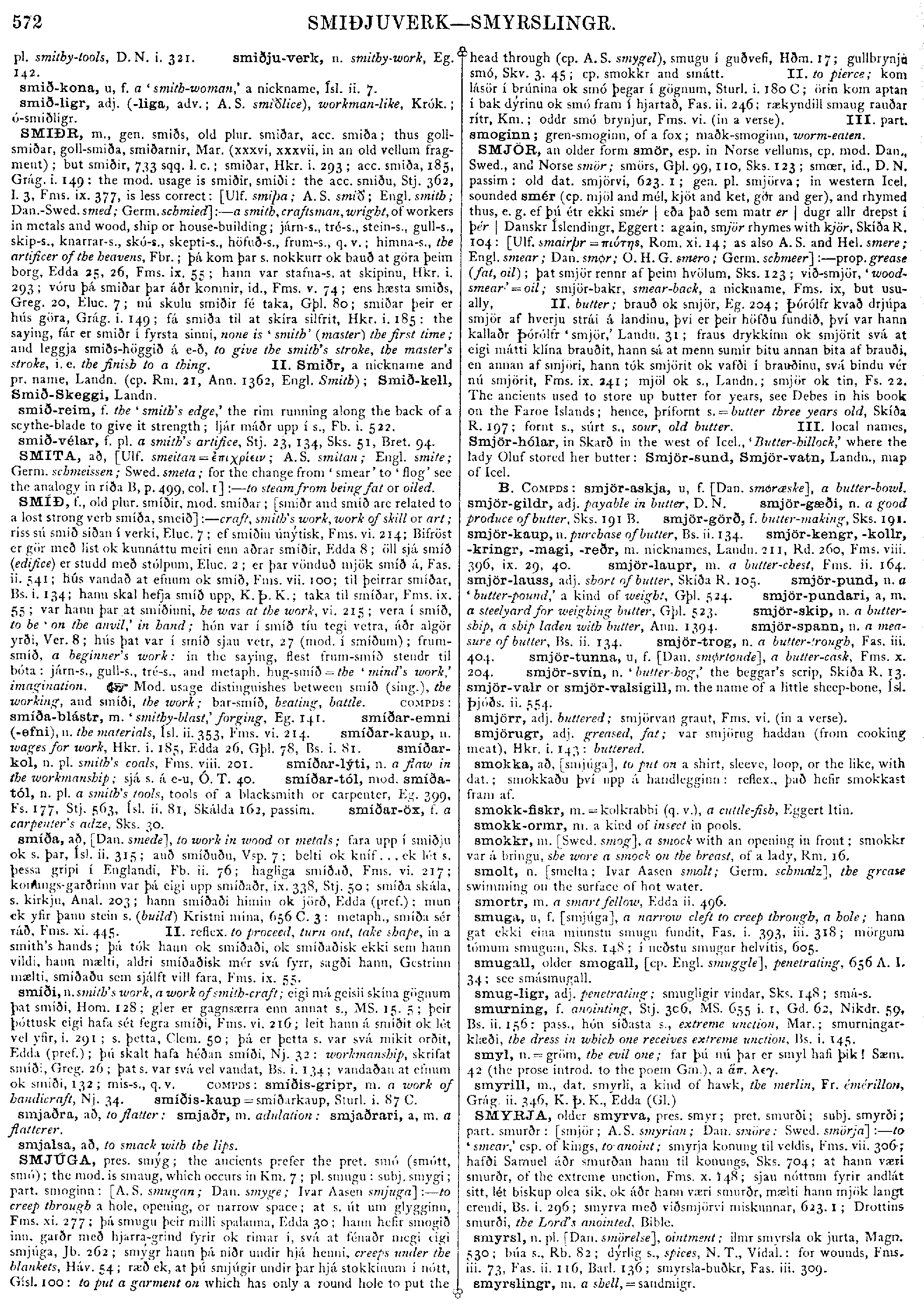
SMIÐR, m., gen. smiðs, old plur. smiðar, acc. smiða; thus goll-smiðar, goll-smiða, smiðarnir, Mar. (xxxvi, xxxvii, in an old vellum fragment); but smiðir, 733 sqq. l.c.; smiðar, Hkr. i. 293; acc. smiða, 185, Grág. i. 149: the mod. usage is smiðir, smiði: the acc. smiðu, Stj. 362, l. 3, Fms. ix. 377, is less correct: [Ulf. smiþa; A.S. smið; Engl. smith; Dan.-Swed. smed; Germ. schmied] :-- a smith, craftsman, wright, of workers in metals and wood, ship or house-building; járn-s., tré-s., stein-s., gull-s., skip-s., knarrar-s., skó-s., skepti-s., höfuð-s., frum-s., q.v.; himna-s., the artificer of the heavens, Fbr.; þá kom þar s. nokkurr ok bauð at göra þeim borg, Edda 25, 26, Fms. ix. 55; hann var stafna-s. at skipinu, Hkr. i. 293; vóru þá smiðar þar áðr komnir, id., Fms. v. 74; ens hæsta smiðs, Greg. 20, Eluc. 7; ú skulu smiðir fé taka, Gþl. 80; smiðar þeir er hús göra, Grág. i. 149; fá smiða til at skíra silfrit, Hkr. i. 185: the saying, fár er smiðr í fyrsta sinni, none is 'smith' (master) the first time; and leggja smiðs-höggið á e-ð, to give the smith's stroke, the master's stroke, i.e. the finish to a thing. II. Smiðr, a nickname and pr. name, Landn. (cp. Rm. 21, Ann. 1362, Engl. Smith); Smið-kell, Smið-Skeggi, Landn.
|
Source: Cleasby/Vigfusson, page b0654, entry 27 View original page image as: [TIFF] [PNG] [View previous entry] [View next entry] |
[Comment on this entry] [View comments] |
The following entry has been hand-corrected once. |
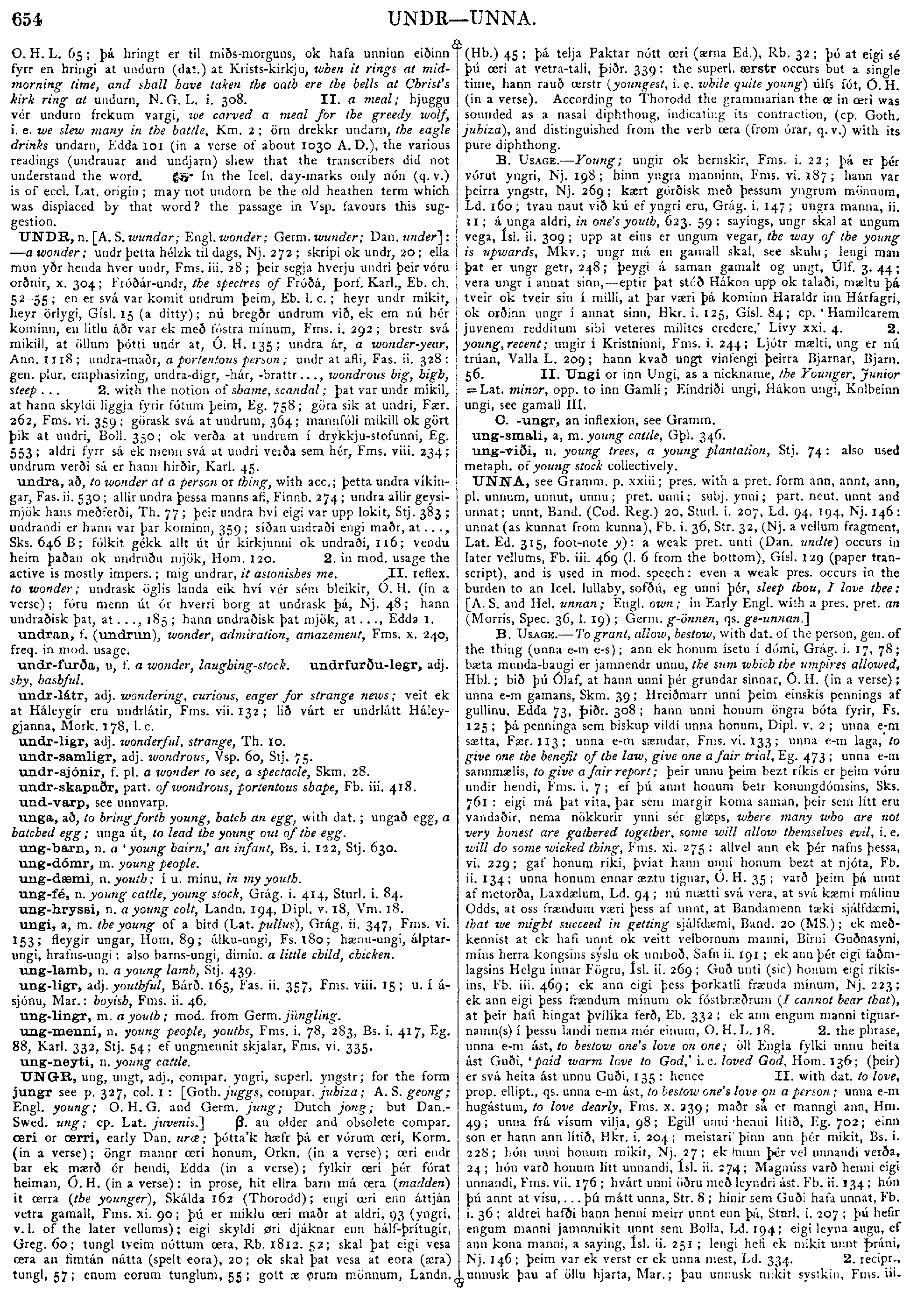
UNNA, see Gramm. p. xxiii; pres. with a pret. form ann, annt, ann, pl. unnum, unnut, unnu; pret. unni; subj. ynni; part. neut. unnt and unnat; unnt, Band. (Cod. Reg.) 20, Sturl. i. 207, Ld. 94, 194, Nj. 146: unnat (as kunnat from kunna), Fb. i. 36, Str. 32, (Nj. a vellum fragment, Lat. Ed. 315, foot-note y): a weak pret. unti (Dan. undte) occurs in later vellums, Fb. iii. 469 (l. 6 from the bottom), Gísl. 129 (paper transcript), and is used in mod. speech: even a weak pres. occurs in the burden to an Icel. lullaby, sofðú, eg unni þér, sleep thou, I love thee: [A.S. and Hel. unnan; Engl. own; in Early Engl. with a pres. pret. an (Morris, Spec. 36, l. 19); Germ. g-önnen, qs. ge-unnan.] B. USAGE. -- To grant, allow, bestow, with dat. of the person, gen. of the thing (unna e-m e-s); ann ek honum ísetu í dómi, Grág. i. 17, 78; bæta munda-baugi er jamnendr unnu, the sum which the umpires allowed, Hbl.; bið þú Ólaf, at hann unni þér grundar sinnar, Ó.H. (in a verse); unna e-m gamans, Skm. 39; Hreiðmarr unni þeim einskis pennings af gullinu, Edda 73, Þiðr. 308; hann unni honum öngra bóta fyrir, Fs. 125; þá penninga sem biskup vildi unna honum, Dipl. v. 2; unna e-m sætta, Fær. 113; unna e-m sæmdar, Fms. vi. 133; unna e-m laga, to give one the benefit of the law, give one a fair trial. Eg. 473; unna e-m sannmælis, to give a fair report; þeir unnu þeim bezt ríkis er þeim vóru undir hendi, Fms. i. 7; ef þú annt honum betr konungdómsins, Sks. 761: eigi má þat vita, þar sem margir koma saman, þeir sem lítt eru vandaðir, nema nökkurir ynni sér glæps, where many who are not very honest are gathered together, some will allow themselves evil, i.e. will do some wicked thing, Fms. xi. 275: allvel ann ek þér nafns þessa, vi. 229; gaf honum ríki, þvíat hann unni honum bezt at njóta, Fb. ii. 134; unna honum ennar æztu tignar, Ó.H. 35; varð þeim þá unnt af metorða, Laxdælum, Ld. 94; nú mætti svá vera, at svá kæmi málinu Odds, at oss frændum væri þess af unnt, at Bandamenn tæki sjálfdæmi, that we might succeed in getting sjálfdæmi, Band. 20 (MS.); ek meðkennist at ek hafi unnt ok veitt velbornum manni, Birni Guðnasyni, míns herra kongsins sýslu ok umboð, Safn ii. 191; ek ann þér eigi faðmlagsins Helgu innar Fögru, Ísl. ii. 269; Guð unti (sic) honum eigi ríkisins, Fb. iii. 469; ek ann eigi þess Þorkatli frænda mínum, Nj. 223; ek ann eigi þess frændum mínum ok fóstbræðrum (I cannot bear that), at þeir hafi hingat þvílíka ferð, Eb. 332; ek ann engum manni tignar-namn(s) í þessu landi nema mér einum, O.H.L. 18. 2. the phrase, unna e-m ást, to bestow one's love on one; öll Engla fylki unnu heita ást Guði, 'paid warm love to God,' i.e. loved God, Hom. 136; (þeir) er svá heita ást unnu Guði, 135: hence II. with dat. to love, prop, ellipt., qs. unna e-m ást, to bestow one's love on a person; unna e-m hugástum, to love dearly, Fms. x. 239; maðr sá er manngi ann, Hm. 49; unna frá vísum vilja, 98; Egill unni henni lítið, Eg. 702; einn son er hann ann lítið, Hkr. i. 204; meistari þinn ann þér mikit, Bs. i. 228; hón unni honum mikit, Nj. 27; ek mun þér vel unnandi verða, 24; hón varð honum lítt unnandi, Ísl. ii. 274; Magnúss varð henni eigi unnandi, Fms. vii. 176; hvárt unni öðru með leyndri ást. Fb. ii. 134; hón þú annt at vísu, ... þú mátt unna, Str. 8; hinir sem Guði hafa unnat, Fb. i. 36; aldrei hafði hann henni meirr unnt enn þá, Sturl. i. 207; þú hefir engum manni jamnmikit unnt sem Bolla, Ld. 194; eigi leyna augu, ef ann kona manni, a saying, Ísl. ii. 251; lengi hefi ek mikit unnt Þráni, Nj. 146; þeim var ek verst er ek unna mest, Ld. 334. 2. recipr., unnusk þau af öllu hjarta, Mar.; þau unnusk mikit systkin, Fms. iii.
|
Source: Cleasby/Vigfusson, page b0767, entry 18 View original page image as: [TIFF] [PNG] [View previous entry] [View next entry] |
[Comment on this entry] [View comments] |
The following entry has been hand-corrected once. |
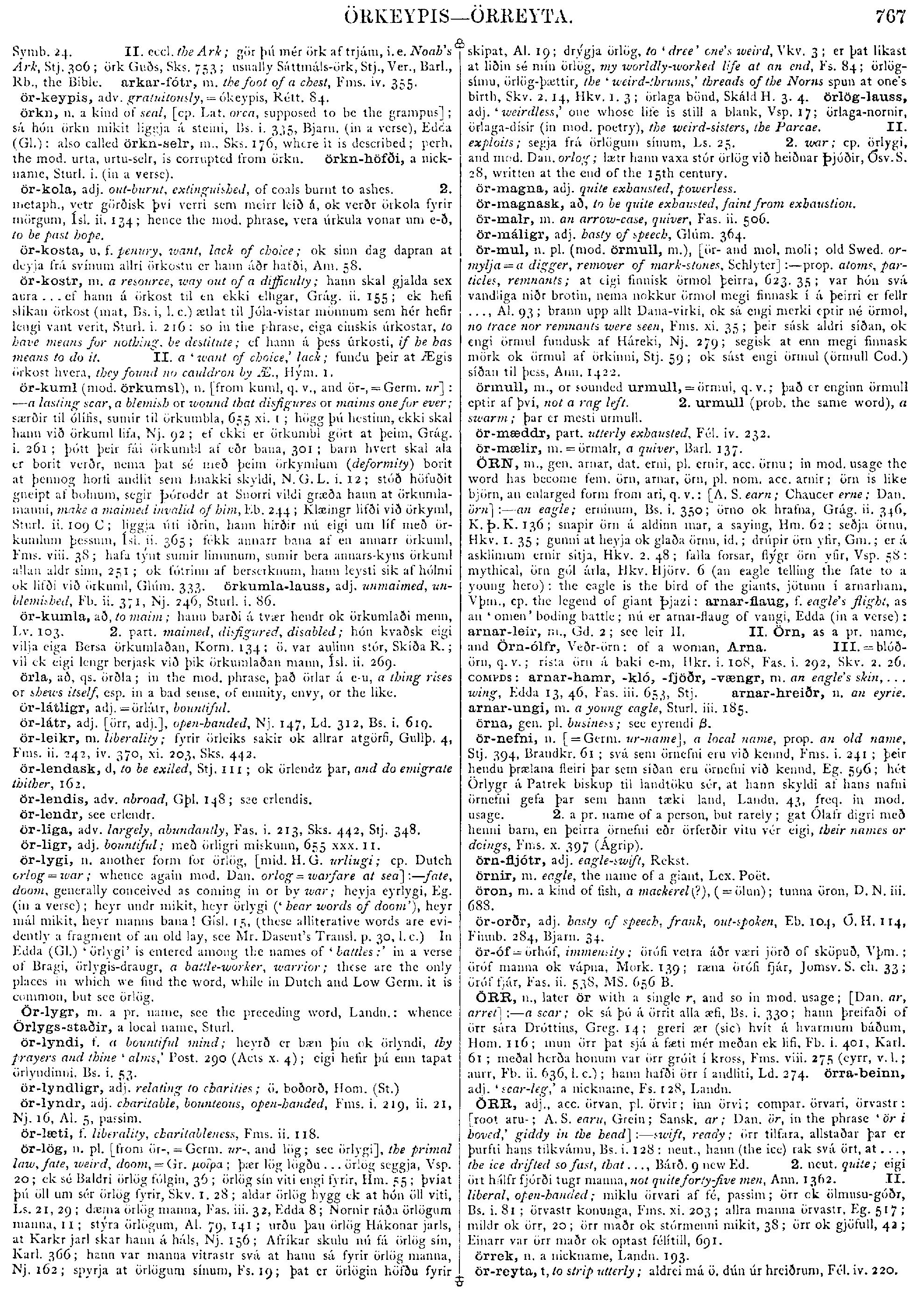
ör-lygi, n. another form for örlög, [mid. H.G. urliugi; cp. Dutch orlog = war; whence again mod. Dan. orlog = warfare at sea] :-- fate, doom, generally conceived as coming in or by war; heyja eyrlygi, Eg. (in a verse); heyr undr mikit, heyr örlygi ('hear words of doom'), heyr mál mikit, heyr manns bana! Gísl. 15, (these alliterative words are evidently a fragment of an old lay, see Mr. Dasent's Transl. p. 30, l.c.) In Edda (Gl.) 'örlygi' is entered among the names of 'battles:' in a verse of Bragi, örlygis-draugr, a battle-worker, warrior; these are the only places in which we find the word, while in Dutch and Low Germ. it is common, but see örlög.
| Result Page: |  |
Previous | 1 2 3 4 |
Germanic Lexicon Project (main page)
This search system was written by
Sean Crist
Please consider
volunteering
to correct the data in these online dictionaries.
No rights reserved. Feel free to use these data in any way you please.