|
|

Tip: In the search results, you can click on any word or abbreviation for more information.
|
Source: Bosworth/Toller, page b0313, entry 1 View original page image as: [TIFF] [PNG] [View previous entry] [View next entry] |
[Comment on this entry] [View comments] |
The following entry has been hand-corrected once. |
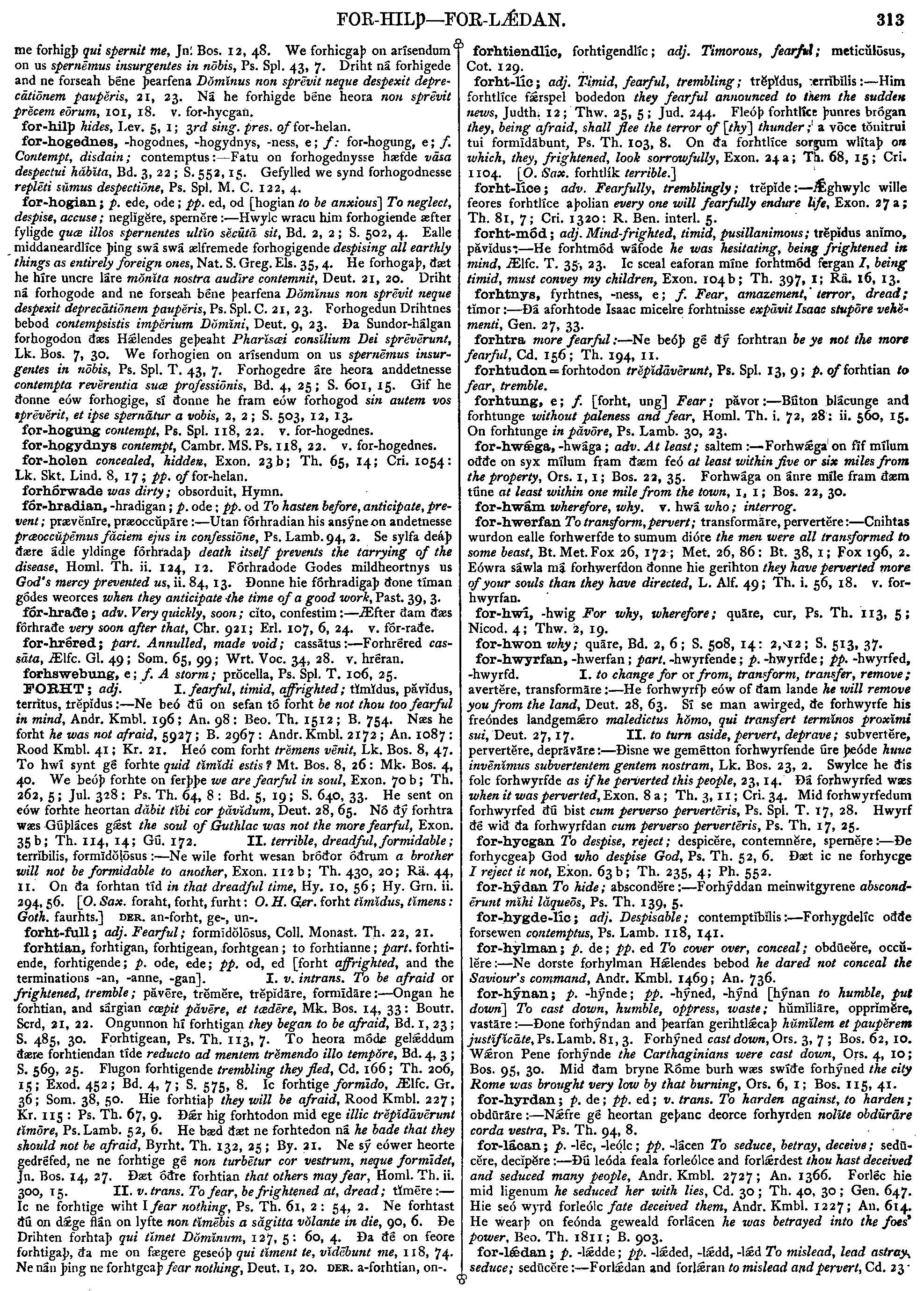
me
forhigþ
qui
spernit
me,
Jn.
Bos.
12,
48.
We
forhicgaþ
on
arísendum
on
us
spern mus
insurgentes
in
n
mus
insurgentes
in
n bis,
Ps.
Spl.
43,
7.
Driht
ná
forhigede
and
ne
forseah
béne
þearfena
D
bis,
Ps.
Spl.
43,
7.
Driht
ná
forhigede
and
ne
forseah
béne
þearfena
D m
m nus
non
sprvit
neque
despexit
deprec
nus
non
sprvit
neque
despexit
deprec tinem
paup
tinem
paup ris,
21,
23.
Ná
he
forhigde
béne
heora
non
sprvit
prcem
erum,
101,
18.
v.
for-hycgan.
ris,
21,
23.
Ná
he
forhigde
béne
heora
non
sprvit
prcem
erum,
101,
18.
v.
for-hycgan.
|
Source: Bosworth/Toller, page b0313, entry 4 View original page image as: [TIFF] [PNG] [View previous entry] [View next entry] |
[Comment on this entry] [View comments] |
The following entry has been hand-corrected once. |
for-hogian;
p.
ede,
ode;
pp.
ed.
od
[hogian
to
be
anxious]
To
neglect,
despise,
accuse;
neglgre,
spernre
:--
Hwylc
wracu
him
forhogiende
æfter
fyligde
quæ
illos
spernentes
ulto
sc t
sit,
Bd.
2,
2;
S.
502,
4.
Ealle
middaneardlíce
þing
swá
swá
ælfremede
forhogigende
despising
all
earthly
things
as
entirely
foreign
ones,
Nat.
S.
Greg.
Els.
35,
4.
He
forhogaþ,
ðæt
he
híre
uncre
láre
mnta
nostra
aud
t
sit,
Bd.
2,
2;
S.
502,
4.
Ealle
middaneardlíce
þing
swá
swá
ælfremede
forhogigende
despising
all
earthly
things
as
entirely
foreign
ones,
Nat.
S.
Greg.
Els.
35,
4.
He
forhogaþ,
ðæt
he
híre
uncre
láre
mnta
nostra
aud re
contemnit,
Deut.
21,
20.
Driht
ná
forhogode
and
ne
forseah
béne
þearfena
Dmnus
non
sprvit
neque
despexit
deprectinem
paupris,
Ps.
Spl.
C.
21,
23.
Forhogedun
Drihtnes
bebod
contempsistis
imprium
Dmni,
Deut.
9,
23.
Ða
Sundor-hálgan
forhogodon
ðæs
H
re
contemnit,
Deut.
21,
20.
Driht
ná
forhogode
and
ne
forseah
béne
þearfena
Dmnus
non
sprvit
neque
despexit
deprectinem
paupris,
Ps.
Spl.
C.
21,
23.
Forhogedun
Drihtnes
bebod
contempsistis
imprium
Dmni,
Deut.
9,
23.
Ða
Sundor-hálgan
forhogodon
ðæs
H lendes
geþeaht
Pharsæi
conslium
Dei
sprvrunt,
Lk.
Bos.
7,
30.
We
forhogien
on
arísendum
on
us
spernmus
insurgentes
in
nbis,
Ps.
Spl.
T.
43,
7.
Forhogedre
áre
heora
anddetnesse
contempta
revrentia
suæ
professinis.
Bd.
4,
25;
S.
601,
15.
Gif
he
ðonne
eów
forhogige,
si
ðonne
he
fram
eów
forhogod
sin
autem
vos
sprvrit,
et
ipse
sperntur
a
vobis,
2,
2;
S.
503,
12,
13.
lendes
geþeaht
Pharsæi
conslium
Dei
sprvrunt,
Lk.
Bos.
7,
30.
We
forhogien
on
arísendum
on
us
spernmus
insurgentes
in
nbis,
Ps.
Spl.
T.
43,
7.
Forhogedre
áre
heora
anddetnesse
contempta
revrentia
suæ
professinis.
Bd.
4,
25;
S.
601,
15.
Gif
he
ðonne
eów
forhogige,
si
ðonne
he
fram
eów
forhogod
sin
autem
vos
sprvrit,
et
ipse
sperntur
a
vobis,
2,
2;
S.
503,
12,
13.
|
Source: Bosworth/Toller, page b0317, entry 14 View original page image as: [TIFF] [PNG] [View previous entry] [View next entry] |
[Comment on this entry] [View comments (1)] |
The following entry has been hand-corrected once. |
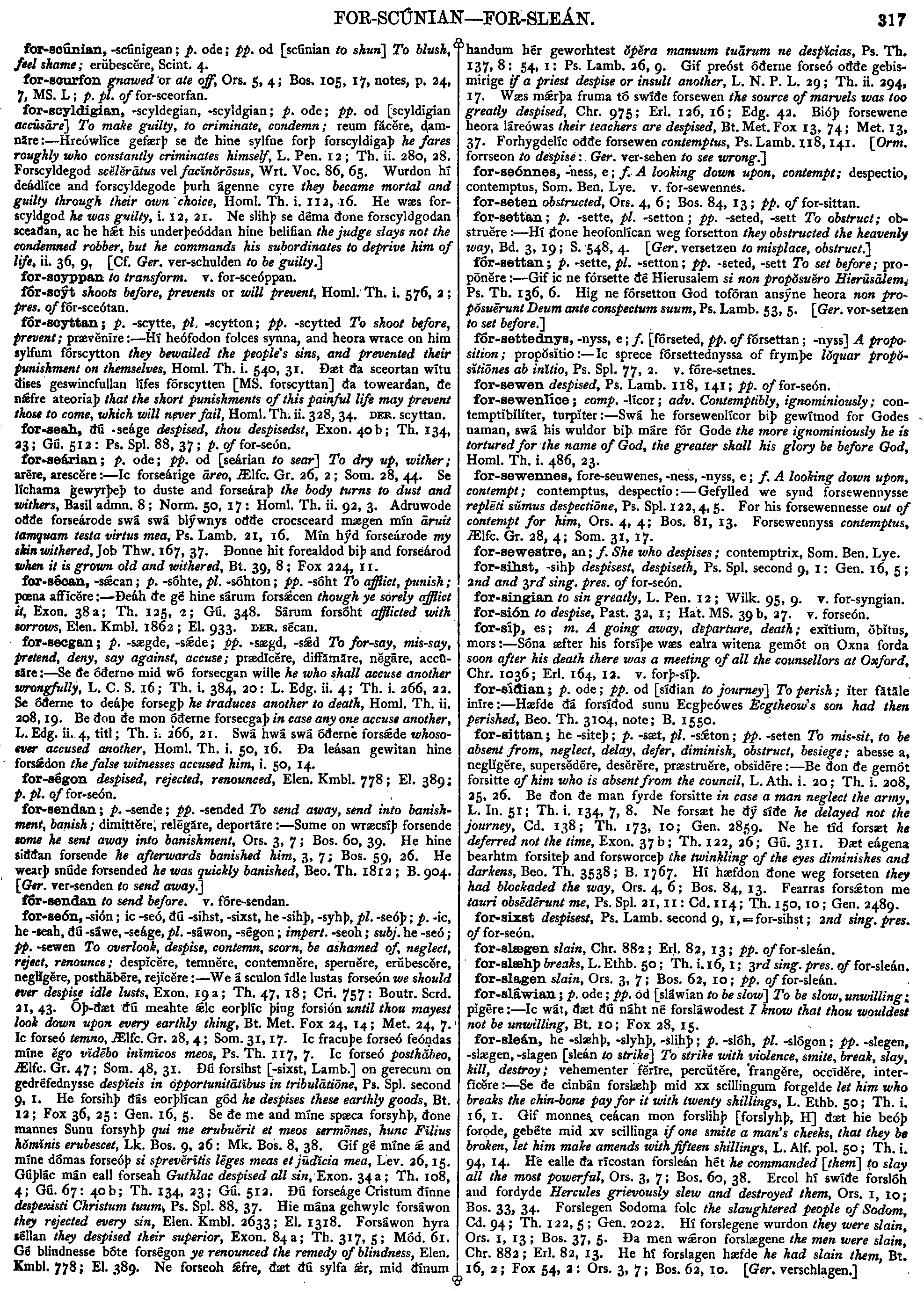
for-seón,
-sión;
ic
-seó,
ðú
-sihst,
-sixst,
he
-sihþ,
-syhþ,
pl.
-seóþ;
p.
-ic,
he
-seah,
ðú
-sáwe,
-seáge,
pl.
-sáwon,
-ségon;
impert.
-seoh;
subj.
he
-seó;
pp.
-sewen
To
overlook,
despise,
contemn,
scorn,
be
ashamed
of,
neglect,
reject,
renounce;
despcre,
temnre,
contemnre,
spernre,
er bescre,
neglgre,
posth
bescre,
neglgre,
posth bre,
rejcre
:--
We
á
sculon
ídle
lustas
forseón
we
should
ever
despise
idle
lusts,
Exon.
19
a;
Th.
47,
18;
Cri.
757:
Boutr.
Scrd.
21,
43.
Óþ-ðæt
ðú
meahte
lc
eorþlic
þing
forsión
until
thou
mayest
look
down
upon
every
earthly
thing,
Bt.
Met.
Fox
24,
14;
Met.
24,
7.
Ic
forseó
temno,
Ælfc.
Gr.
28,
4;
Som.
31,
17.
Ic
fracuþe
forseó
feóndas
míne
go
vdbo
inmcos
meos.
Ps.
Th.
117,
7.
Ic
forseó
posthbeo,
Ælfc.
Gr.
47;
Som.
48,
31.
Ðú
forsihst
[-sixst.
Lamb.]
on
gerecum
on
gedréfednysse
despcis
in
opportunittbus
in
tribultine,
Ps.
Spl.
second
9,
1.
He
forsihþ
ðás
eorþlícan
gód
he
despises
these
earthly
goods,
Bt.
12;
Fox
36,
25:
Gen.
16,
5.
Se
ðe
me
and
míne
spæca
forsyhþ,
ðone
mannes
Sunn
forsyhþ
qui
me
eruburit
et
meos
sermnes,
hunc
Flius
hmnis
erubescet,
Lk.
Bos.
9,
26:
Mk.
Bos.
8,
38.
Gif
gé
míne
and
míne
dómas
forseóþ
si
sprevrtis
lges
meas
et
jdcia
mea,
Lev.
26,
15.
Gúþlác
mán
eall
forseah
Guthlac
despised
all
sin,
Exon.
34
a;
Th.
108,
4;
Gú.
67:
40
b;
Th.
134,
23;
Gú.
512.
Ðú
forseáge
Cristum
ðínne
despexisti
Christum
tuam,
Ps.
Spl.
88,
37.
Hie
mána
gehwylc
forsáwon
they
rejected
every
sin,
Elen.
Kmbl.
2633;
El.
1318.
Forsáwon
hyra
séllan
they
despised
their
superior,
Exon.
84
a;
Th.
317,
5;
Mód.
61.
Gé
blindnesse
bóte
forségon
ye
renounced
the
remedy
of
blindness,
Elen.
Kmbl.
778;
El.
389.
Ne
forseoh
fre,
ðæt
ðú
sylfa
r,
mid
ðínum
handum
her
geworhtest
pra
manuum
turum
ne
despcias,
Ps.
Th.
137.
8:
54,
1:
Ps.
Lamb.
26,
9.
Gif
preóst
óðerne
forseó
oððe
gebismirige
if
a
priest
despise
or
insult
another,
L.
N.
P.
L.
29;
Th.
ii.
294,
17.
Wæs
mrþa
fruma
tó
swíðe
forsewen
the
source
of
marvels
was
too
greatly
despised,
Chr.
975;
Erl.
126,
16;
Edg.
42.
Bióþ
forsewene
heora
láreówas
their
teachers
are
despised,
Bt.
Met.
Fox
13,
74;
Met.
13,
37.
Forhygdelíc
oððe
forsewen
contemptus,
Ps.
Lamb.
118,
141.
[Orm.
forrseon
to
despise:
Ger.
ver-sehen
to
see
wrong.]
bre,
rejcre
:--
We
á
sculon
ídle
lustas
forseón
we
should
ever
despise
idle
lusts,
Exon.
19
a;
Th.
47,
18;
Cri.
757:
Boutr.
Scrd.
21,
43.
Óþ-ðæt
ðú
meahte
lc
eorþlic
þing
forsión
until
thou
mayest
look
down
upon
every
earthly
thing,
Bt.
Met.
Fox
24,
14;
Met.
24,
7.
Ic
forseó
temno,
Ælfc.
Gr.
28,
4;
Som.
31,
17.
Ic
fracuþe
forseó
feóndas
míne
go
vdbo
inmcos
meos.
Ps.
Th.
117,
7.
Ic
forseó
posthbeo,
Ælfc.
Gr.
47;
Som.
48,
31.
Ðú
forsihst
[-sixst.
Lamb.]
on
gerecum
on
gedréfednysse
despcis
in
opportunittbus
in
tribultine,
Ps.
Spl.
second
9,
1.
He
forsihþ
ðás
eorþlícan
gód
he
despises
these
earthly
goods,
Bt.
12;
Fox
36,
25:
Gen.
16,
5.
Se
ðe
me
and
míne
spæca
forsyhþ,
ðone
mannes
Sunn
forsyhþ
qui
me
eruburit
et
meos
sermnes,
hunc
Flius
hmnis
erubescet,
Lk.
Bos.
9,
26:
Mk.
Bos.
8,
38.
Gif
gé
míne
and
míne
dómas
forseóþ
si
sprevrtis
lges
meas
et
jdcia
mea,
Lev.
26,
15.
Gúþlác
mán
eall
forseah
Guthlac
despised
all
sin,
Exon.
34
a;
Th.
108,
4;
Gú.
67:
40
b;
Th.
134,
23;
Gú.
512.
Ðú
forseáge
Cristum
ðínne
despexisti
Christum
tuam,
Ps.
Spl.
88,
37.
Hie
mána
gehwylc
forsáwon
they
rejected
every
sin,
Elen.
Kmbl.
2633;
El.
1318.
Forsáwon
hyra
séllan
they
despised
their
superior,
Exon.
84
a;
Th.
317,
5;
Mód.
61.
Gé
blindnesse
bóte
forségon
ye
renounced
the
remedy
of
blindness,
Elen.
Kmbl.
778;
El.
389.
Ne
forseoh
fre,
ðæt
ðú
sylfa
r,
mid
ðínum
handum
her
geworhtest
pra
manuum
turum
ne
despcias,
Ps.
Th.
137.
8:
54,
1:
Ps.
Lamb.
26,
9.
Gif
preóst
óðerne
forseó
oððe
gebismirige
if
a
priest
despise
or
insult
another,
L.
N.
P.
L.
29;
Th.
ii.
294,
17.
Wæs
mrþa
fruma
tó
swíðe
forsewen
the
source
of
marvels
was
too
greatly
despised,
Chr.
975;
Erl.
126,
16;
Edg.
42.
Bióþ
forsewene
heora
láreówas
their
teachers
are
despised,
Bt.
Met.
Fox
13,
74;
Met.
13,
37.
Forhygdelíc
oððe
forsewen
contemptus,
Ps.
Lamb.
118,
141.
[Orm.
forrseon
to
despise:
Ger.
ver-sehen
to
see
wrong.]
|
Source: Bosworth/Toller, page b0534, entry 23 View original page image as: [TIFF] [PNG] [View previous entry] [View next entry] |
[Comment on this entry] [View comments] |
The following entry has been hand-corrected once. |
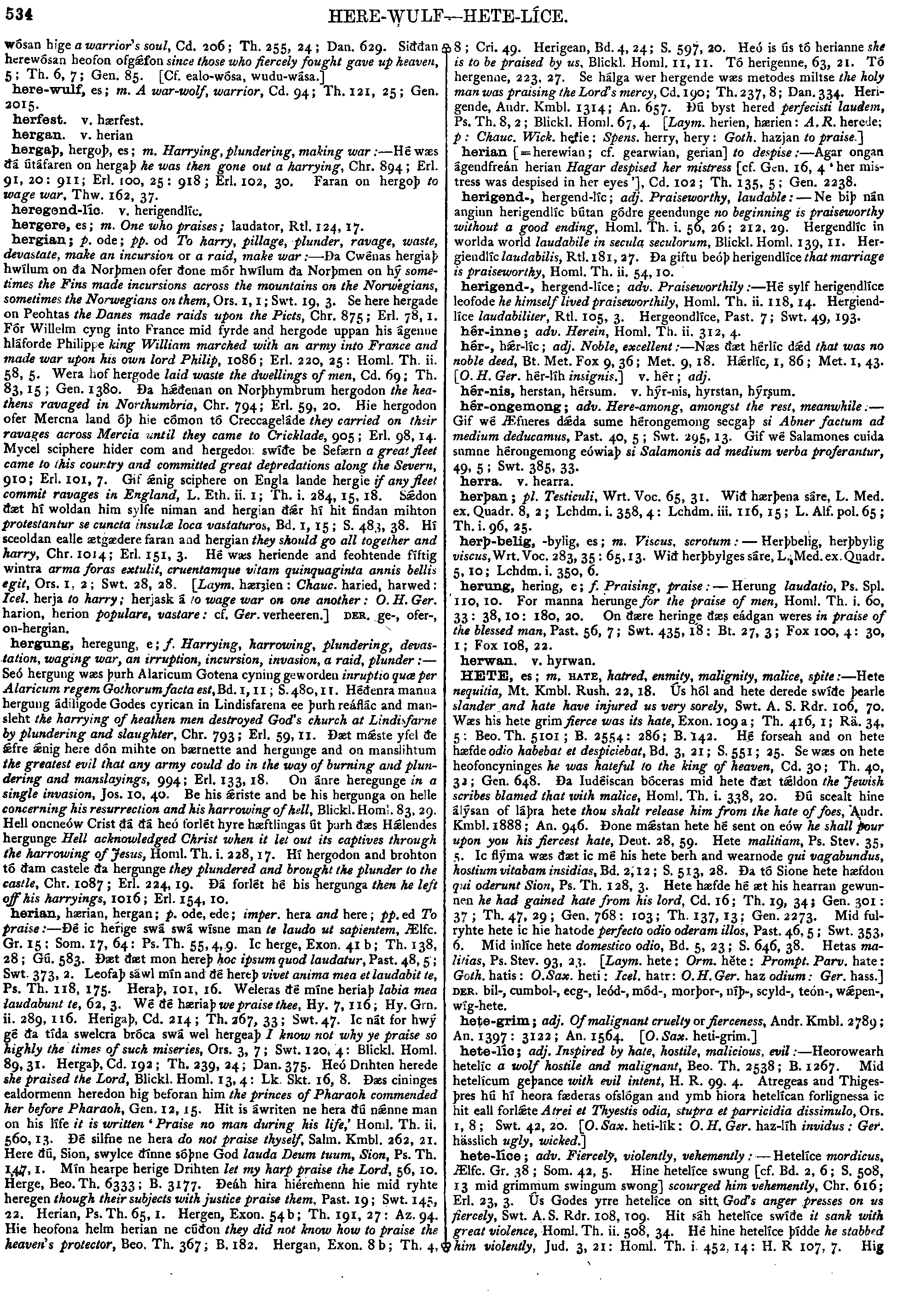
HETE,
es;
m,
HATE,
hatred,
enmity,
malignity,
malice,
spite:--
Hete
nequitia,
Mt.
Kmbl.
Rush.
22,
18.
Ús
hól
and
hete
derede
swíðe
þearle
slander
and
hate
have
injured
us
very
sorely.
Swt.
A.
S.
Rdr.
106,
70.
Wæs
his
hete
grim
fierce
was
its
hate.
Exon.
109
a;
Th.
416,
1;
Rä.
34,
5:
Beo.
Th.
5101;
B.
2554:
286;
6.
142.
Hé
forseah
and
on
hete
hæfde
odio
habebat
et
despiciebat,
Bd.
3,
21;
S.
551;
25.
Se
wæs
on
hete
heofoncyninges
he
was
hateful
to
the
king
of
heaven,
Cd.
30;
Th.
40,
31;
Gen.
648.
Ða
Iudéiscan
bóceras
mid
hete
ðæt
tldon
the
Jewish
scribes
blamed
that
with
malice.
Homl.
Th.
i.
338,
20.
Ðú
scealt
hine
álýsan
of
láþra
hete
thou
shalt
release
him
from
the
hate
of
foes,
Andr.
Kmbl.
1888;
An.
946.
Ðone
mstan
hete
hé
sent
on
eów
he
shall
pour
upon
you
his
fiercest
hate,
Deut.
28,
59.
Hete
malitiam,
Ps.
Stev.
35,
5.
Ic
flýma
wæs
ðæt
ic
mé
his
hete
berh
and
wearnode
qui
vagabundus,
hostium
vitabam
insidias,
Bd.
2,
12;
S.
513,
28.
Ða
tó
Sione
hete
hæfdon
qui
oderunt
Sion,
Ps.
Th.
128,
3.
Hete
hæfde
hé
æt
his
hearran
gewunnen
he
had
gained
hate
from
his
lord,
Cd.
16;
Th.
19,
34;
Gen.
301:
37;
Th.
47,
29;
Gen.
768:
103;
Th.
137,
13;
Gen.
2273.
Mid
fulryhte
hete
ic
hie
hatode
perfecto
odio
oderam
illos,
Past.
46,
5;
Swt.
353,
6.
Mid
inlíce
hete
domestico
odio,
Bd.
5,
23;
S.
646,
38.
Hetas
malitias,
Ps.
Stev.
93,
23.
[Laym.
hete:
Orm.
hte:
Prompt.
Parv.
hate:
Goth.
hatis:
O.
Sax.
heti:
Icel.
hatr:
O.
H.
Ger.
haz
odium:
Ger.
hass.]
DER.
bil-,
cumbol-,
ecg-,
leód-,
mód-,
morþor-,
níþ-,
scyld-,
teón-,
wpen-,
wíg-hete.
|
Source: Bosworth/Toller, page b0539, entry 21 View original page image as: [TIFF] [PNG] [View previous entry] [View next entry] |
[Comment on this entry] [View comments] |
The following entry has been hand-corrected once. |
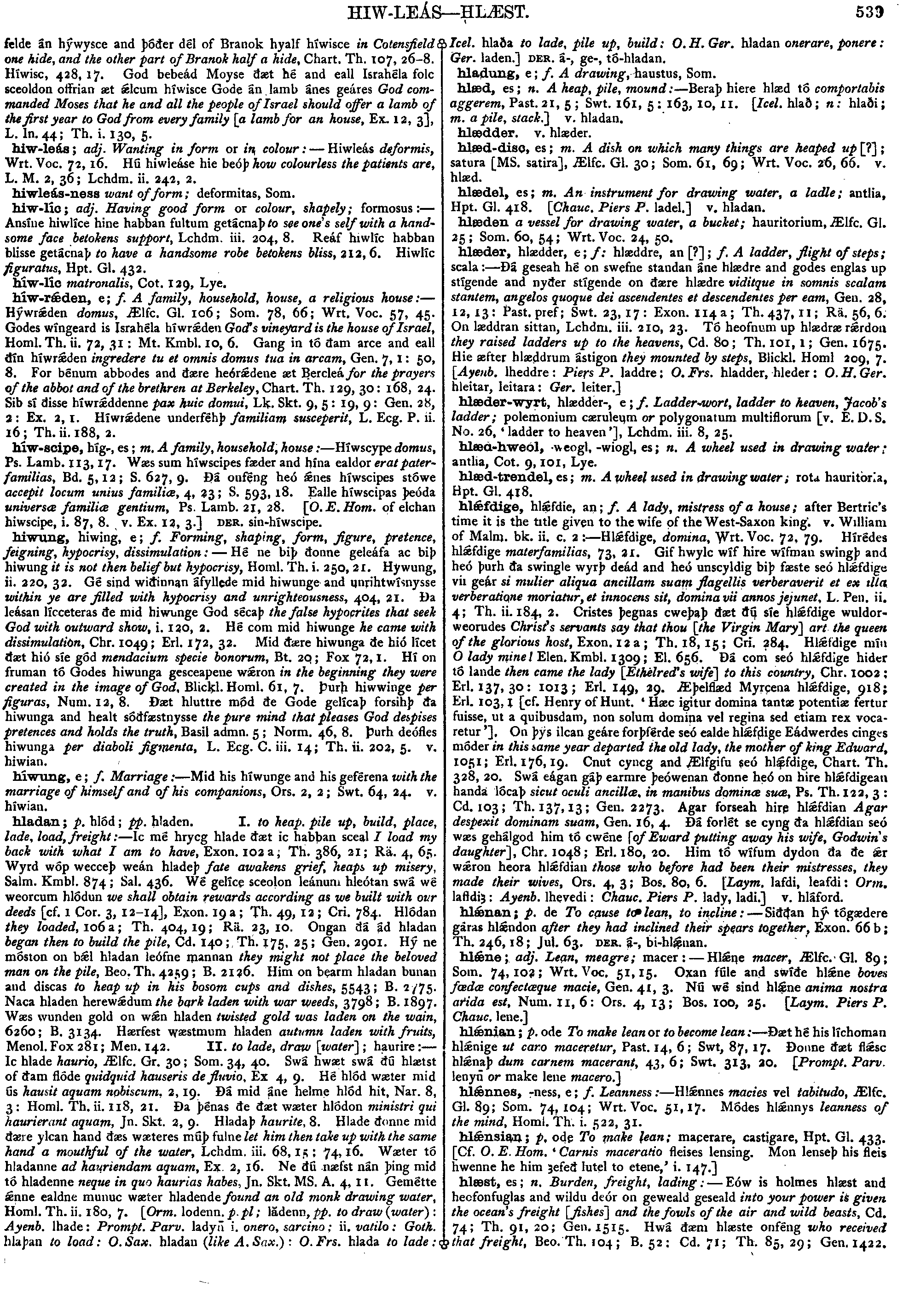
hlfdige,
hlfdie,
an;
f.
A
lady,
mistress
of
a
house;
after
Bertric's
time
it
is
the
title
given
to
the
wife
of
the
West-Saxon
king,
v.
William
of
Malm.
bk.
ii.
c.
2
:--
Hlfdige,
domina,
Wrt.
Voc.
72,
79.
Hírédes
hlfdige
materfamilias,
73,
21.
Gif
hwylc
wíf
hire
wífman
swingþ
and
heó
þurh
ða
swingle
wyrþ
dead
and
heó
unscyldig
biþ
fæste
seó
hlfdige
vii
geár
si
mulier
aliqua
ancillam
suam
flagellis
verberaverit
et
ex
illa
verberatione
moriatur,
et
innocens
sit,
domina
vii
annos
jejunet,
L.
Pen.
ii.
4;
Th.
ii.
184,
2.
Cristes
þegnas
cweþaþ
ðæt
ðú
síe
hlfdige
wuldorweorudes
Christ's
servants
say
that
thou
[the
Virgin
Mary]
art
the
queen
of
the
glorious
host,
Exon.
12
a;
Th.
18,
15;
Cri.
284.
Hlfdige
mín
O
lady
mine!
Elen.
Kmbl.
1309;
El.
656.
Ðá
com
seó
hlfdige
hider
tó
lande
then
came
the
lady
[Ethelred's
wife]
to
this
country,
Chr.
1002;
Erl.
137,
30:
1013;
Erl.
149,
29.
Æþelflæd
Myrcena
hlfdige,
918;
Erl.
103,
1
[cf.
Henry
of
Hunt.
'Hæc
igitur
domina
tantæ
potentiæ
fertur
fuisse,
ut
a
quibusdam,
non
solum
domina
vel
regina
sed
etiam
rex
vocaretur'].
On
þýs
ilcan
geáre
forþférde
seó
ealde
hlfdige
Eádwerdes
cinges
móder
in
this
same
year
departed
the
old
lady,
the
mother
of
king
Edward,
1051;
Erl.
176,
19.
Cnut
cyncg
and
Ælfgifu
seó
hlfdige,
Chart.
Th.
328,
20.
Swá
eágan
gáþ
earmre
þeówenan
ðonne
heó
on
hire
hlfdigean
handá
lócaþ
sicut
oculi
ancillæ,
in
manibus
dominæ
suæ,
Ps.
Th.
122,
3:
Cd.
103;
Th.
137,
13;
Gen.
2273.
Agar
forseah
hirp
hlfdian
Agar
despexit
dominam
suam,
Gen.
16,
4.
Ðá
forlét
se
cyng
ða
hlfdian
seó
wæs
gehálgod
him
tó
cwéne
[of
Eward
putting
away
his
wife,
Godwin's
daughter],
Chr.
1048;
Erl.
180,
20.
Him
tó
wífum
dydon
ða
ðe
r
wron
heora
hlfdian
those
who
before
had
been
their
mistresses,
they
made
their
wives,
Ors.
4,
3;
Bos.
80,
6.
[Laym.
lafdi,
leafdi:
Orm.
laftdi :
Ayenb.
lhevedi:
Chauc.
Piers
P.
lady,
ladi.]
v.
hláford.
:
Ayenb.
lhevedi:
Chauc.
Piers
P.
lady,
ladi.]
v.
hláford.
|
Source: Bosworth/Toller, page b0546, entry 17 View original page image as: [TIFF] [PNG] [View previous entry] [View next entry] |
[Comment on this entry] [View comments] |
The following entry has been hand-corrected once. |
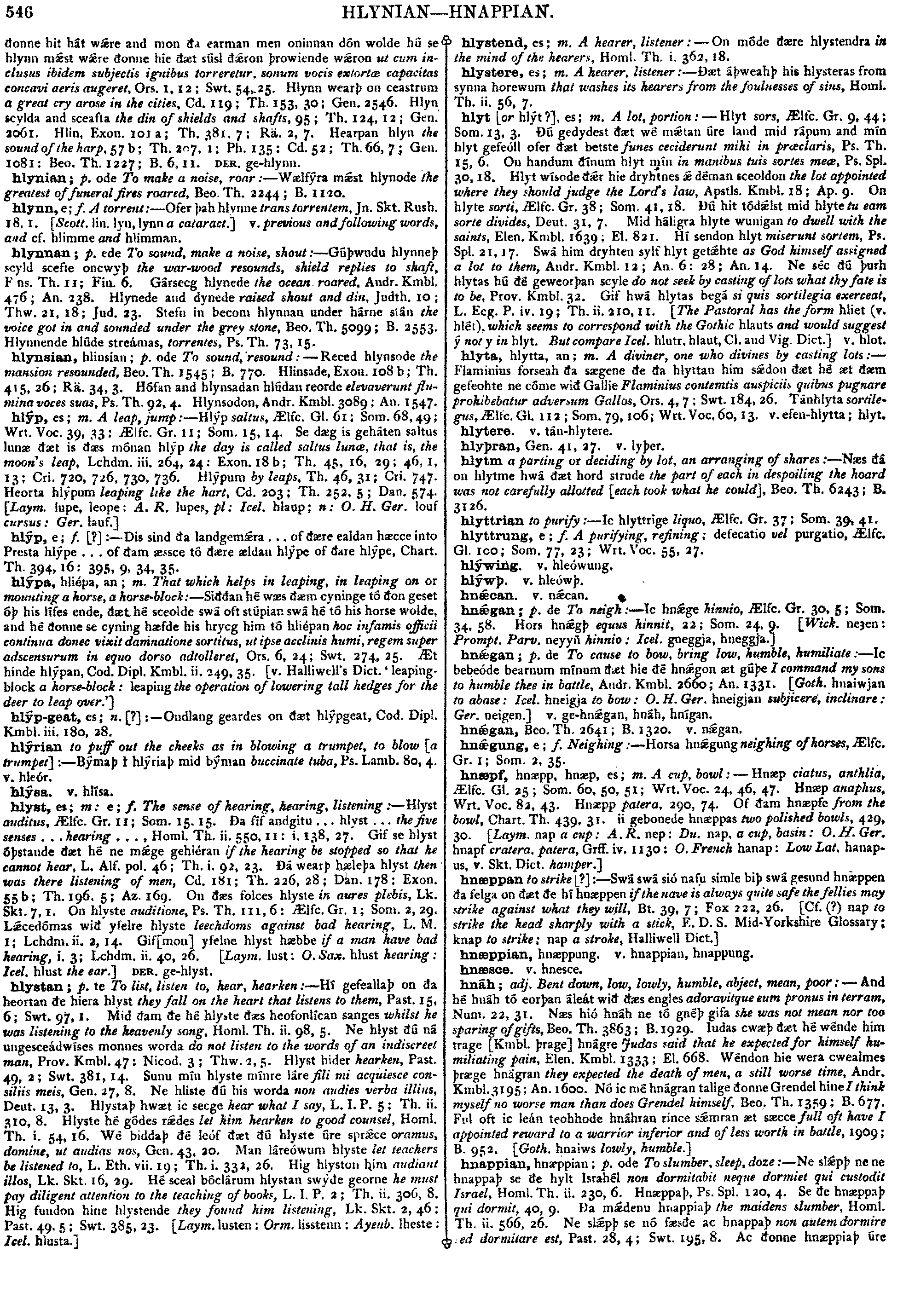
hlyta,
hlytta,
an;
m.
A
diviner,
one
who
divines
by
casting
lots
:--
Flaminius
forseah
ða
sægene
ðe
ða
hlyttan
him
sdon
ðæt
hé
æt
ðæm
gefeohte
ne
cóme
wið
Gallíe
Flaminius
contemtis
auspiciis
quibus
pugnare
prohibebatur
adversum
Gallos,
Ors.
4,
7;
Swt.
184,
26.
Tánhlyta
sortilegus,
Ælfc.
Gl.
112;
Som.
79,
106;
Wrt.
Voc.
60,
13.
v.
efen-hlytta;
hlyt.
|
Source: Bosworth/Toller, page b0679, entry 21 View original page image as: [TIFF] [PNG] [View previous entry] [View next entry] |
[Comment on this entry] [View comments] |
The following entry has been hand-corrected once. |
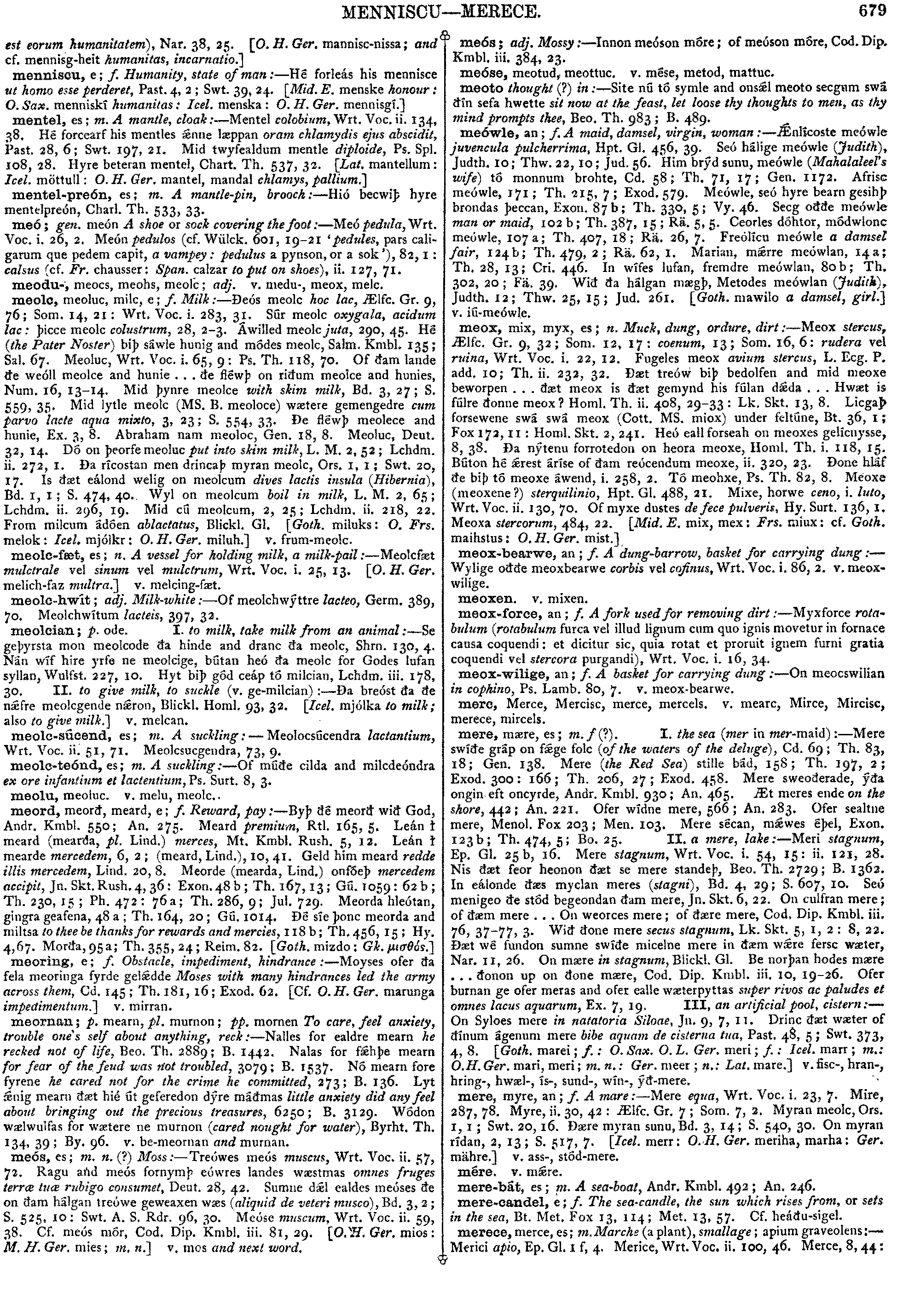
meox,
mix,
myx,
es;
n.
Muck,
dung,
ordure,
dirt
:--
Meox
stercus,
Ælfc.
Gr.
9,
32;
Som.
12,
17:
coenum,
13;
Som.
16,
6:
rudera
vel
ruina,
Wrt.
Voc.
i.
22,
12.
Fugeles
meox
avium
stercus,
L.
Ecg.
P.
add.
10;
Th.
ii.
232,
32.
Ðæt
treów
biþ
bedolfen
and
mid
meoxe
beworpen
...
ðæt
meox
is
ðæt
gemynd
his
fúlan
dda
...
Hwæt
is
fúlre
ðonne
meox?
Homl.
Th.
ii.
408,
29-33:
Lk.
Skt.
13,
8.
Licgaþ
forsewene
swá
swá
meox
(Cott.
MS.
miox)
under
feltúne,
Bt.
36,
1;
Fox
172,
11:
Homl.
Skt.
2,
241.
Heó
eall
forseah
on
meoxes
gelícnysse,
8,
38.
Ða
nýtenu
forrotedon
on
heora
meoxe,
Homl.
Th.
i.
118,
15.
Búton
hé
rest
áríse
of
ðam
reócendum
meoxe,
ii.
320,
23.
Ðone
hláf
ðe
biþ
tó
meoxe
áwend,
i.
258,
2.
Tó
meohxe,
Ps.
Th.
82,
8.
Meoxe
(meoxene?)
sterquilinio,
Hpt.
Gl.
488,
21.
Mixe,
horwe
ceno,
i.
luto,
Wrt.
Voc.
ii.
130,
70.
Of
myxe
dustes
de
fece
pulveris,
Hy.
Surt.
136,
1.
Meoxa
stercorum,
484,
22.
[Mid.
E.
mix,
mex:
Frs.
miux:
cf.
Goth.
maihstus:
O.
H.
Ger.
mist.]
|
Source: Bosworth/Toller, page b1008, entry 21 View original page image as: [TIFF] [PNG] [View previous entry] [View next entry] |
[Comment on this entry] [View comments (1)] |
The following entry has been hand-corrected once. |
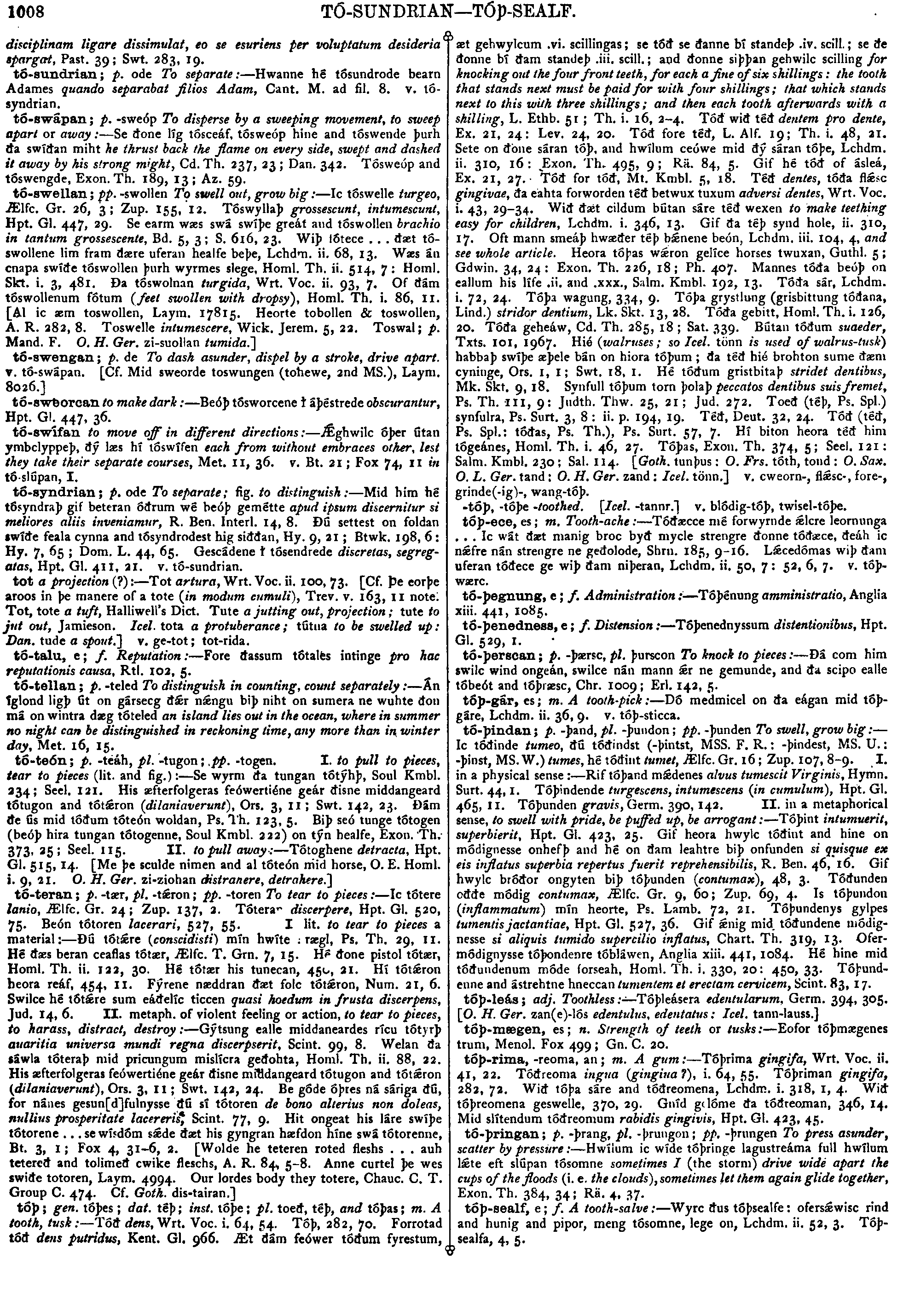
tó-þindan
;
þ.
-þand,
pl.
-þundon;
pp.
-þunden
To
swell,
grow
big
:--
Ic
tóðinde
tumeo,
ðú
tóðindst
(-þintst,
MSS.
F.
R.
:
-bindest,
MS.
U.
:
-þinst,
MS.
W.
)
tumes,
hé
tóðint
tumet,
Ælfc.
Gr.
16;
Zup.
107,
8-9.
I.
in
a
physical
sense
:--
Rif
tóþand
mdenes
alvus
tumescit
Virginis,
Hymn.
Surt.
44,
1.
Tóþindende
turgescens,
intumescens
(in
cumulum),
Hpt.
Gl.
465,
11.
Tóþunden
gravis,
Germ.
390,
142.
II.
in
a
metaphorical
sense,
to
swell
with
pride,
be
puffed
up,
be
arrogant
:--
Tóþint
intumuerit,
superbierit.
Hpt.
Gl.
423,
25.
Gif
heora
hwylc
tóðint
and
hine
on
módignesse
onhefþ
and
hé
on
ðám
leahtre
biþ
onfunden
si
quisque
ex
eis
inflatus
superbia
repertus
fuerit
reprehensibilis,
R.
Ben.
46,
16.
Gif
hwylc
bróðor
ongyten
biþ
tóþunden
(contumax),
48,
3.
Tóðunden
oððe
módig
contumax,
Ælfc.
Gr.
9,
60;
Zup.
69,
4.
Is
tópundon
(inflammatum)
mín
heorte,
Ps.
Lamb.
72,
21.
Tóþundenys
gylpes
tumentis
jactantiae,
Hpt.
Gl.
527,
36.
Gif
nig
mid.
tðóundene
módig-nesse
si
aliquis
tumido
supircilio
inflatus,
Chart.
Th.
319,
13.
Ofer-módignysse
tóþondenre
tóbláwen,
Anglia
xiii.
441,
1084.
Hé
hine
mid
tóðundenum
móde
forseah,
Homl.
Th.
i.
330,
20:
450,
33.
Tó
þund-enne
and
ástrehtne
hneccan
tumentem
et
erectam
cervicem,
Scint.
83,
17.
|
Source: Bosworth/Toller, page b1110, entry 6 View original page image as: [TIFF] [PNG] [View previous entry] [View next entry] |
[Comment on this entry] [View comments] |
The following entry has been hand-corrected once. |
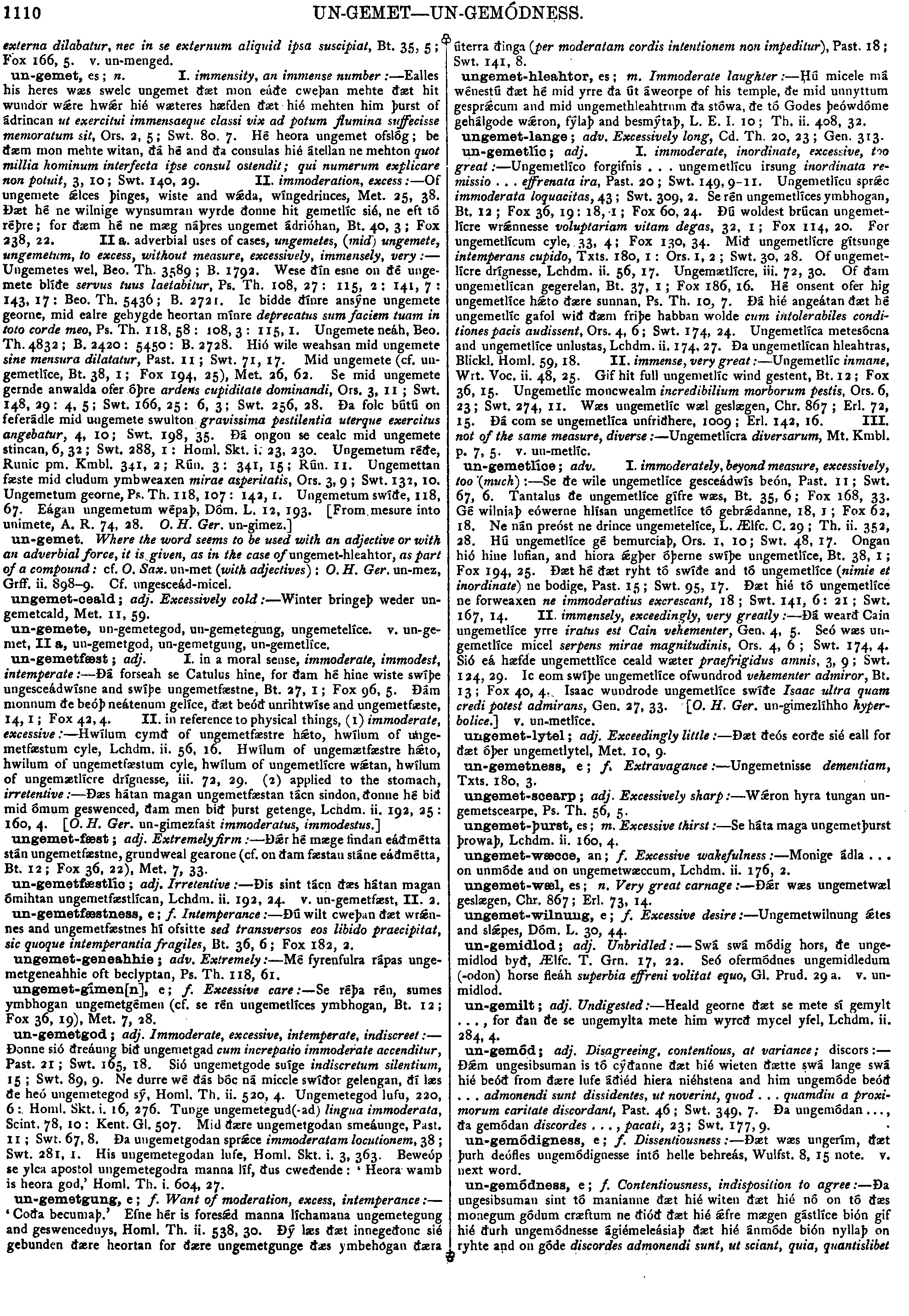
un-gemetfæst;
adj.
I.
in
a
moral
sense,
immoderate,
immodest,
intemperate
:--
Ðá
forseah
se
Catulus
hine,
for
ðam
hé
hine
wiste
swíþe
ungesceádwísne
and
swíþe
ungemetfæstne,
Bt.
27,
1;
Fox
96,
5.
Ðám
monnum
ðe
beóþ
neátenum
gelíce,
ðæt
beóð
unrihtwíse
and
ungemetfæste,
14,
1;
Fox
42,
4.
II.
in
reference
to
physical
things,
(1)
immoderate,
excessive
:--
Hwílum
cymð
of
ungemetfæstre
hto,
hwílum
of
ungemetfæstum
cyle,
Lchdm.
ii.
56,
16.
Hwílum
of
ungemetfæstre
hto,
hwilum
of
ungemetfæstum
cyle,
hwílum
of
ungemetlícre
wtan,
hwílum
of
ungemætlícre
drígnesse,
iii.
72,
29.
(2)
applied
to
the
stomach,
irretentive
:--
Ðæs
hátan
magan
ungemetfæstan
tácn
sindon,
ðonne
hé
bið
mid
ómum
geswenced,
ðam
men
bið
þurst
getenge,
Lchdm.
ii.
192,
25:
160,
4.
[O.
H.
Ger.
un-gimezfast
immoderatus,
immodestus.]
|
Source: Bosworth/Toller, page b1137, entry 2 View original page image as: [TIFF] [PNG] [View previous entry] [View next entry] |
[Comment on this entry] [View comments] |
The following entry has been hand-corrected once. |
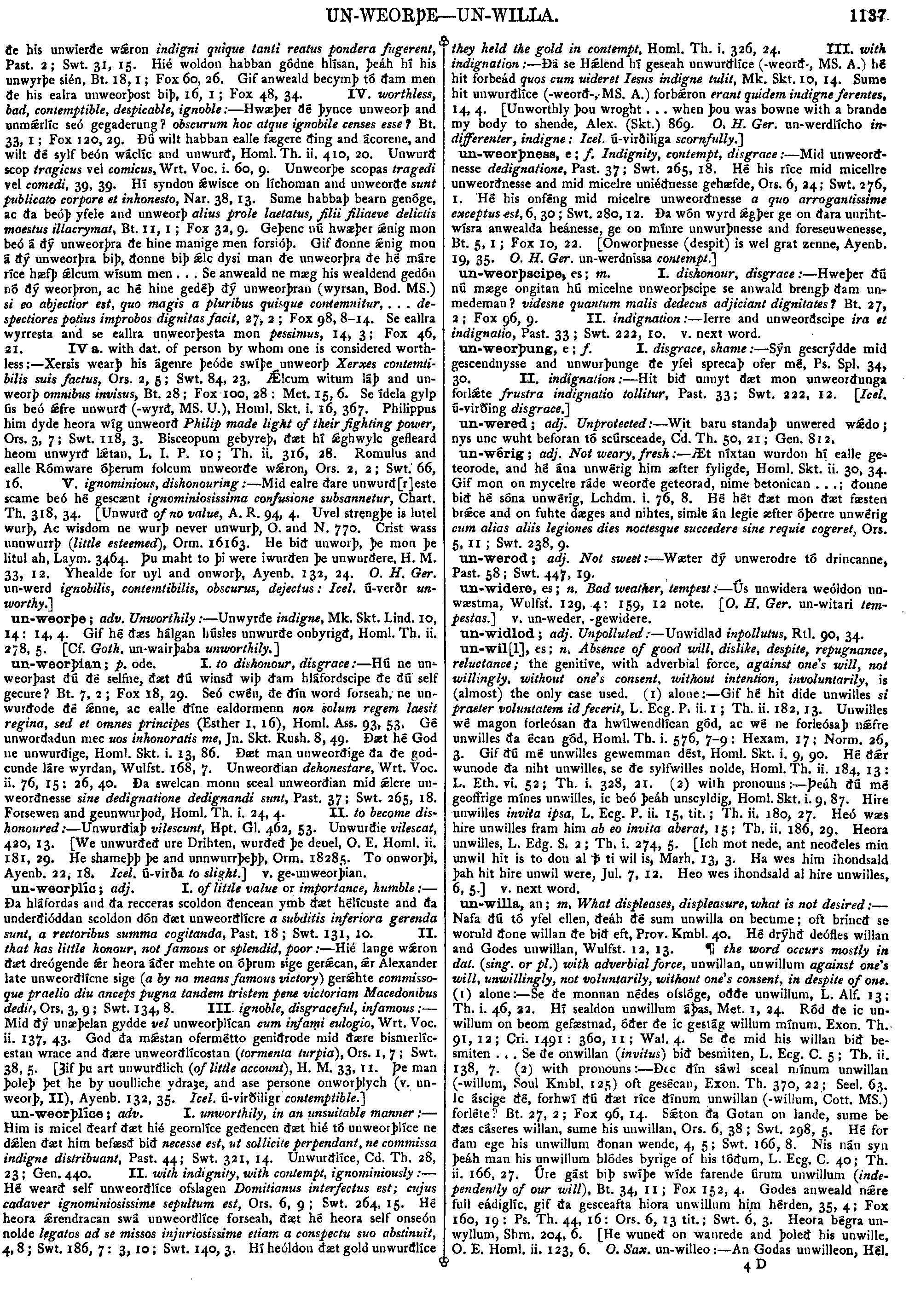
un-weorþian;
p.
ode.
I.
to
dishonour,
disgrace
:--
Hú
ne
unweorþast
ðú
ðé
selfne,
ðæt
ðú
winsð
wiþ
ðam
hláfordscipe
ðe
ðú
self
gecure?
Bt.
7,
2;
Fox
18,
29.
Seó
cwén,
ðe
ðín
word
forseah,
ne
unwurðode
ðé
nne,
ac
ealle
ðíne
ealdormenn
non
solum
regem
laesit
regina,
sed
et
omnes
principes
(Esther
1,
16),
Homl.
Ass.
93,
53.
Gé
unworðadun
mec
uos
inhonoratis
me,
Jn.
Skt.
Rush.
8,
49.
Ðæt
hé
God
ne
unwurðige,
Homl.
Skt.
i.
13,
86.
Ðæt
man
unweorðige
ða
ðe
godcunde
láre
wyrdan,
Wulfst.
168,
7.
Unweorðian
dehonestare,
Wrt.
Voc.
ii.
76,
15:
26,
40.
Ða
swelcan
monn
sceal
unweorðian
mid
lcre
unweorðnesse
sine
dedignatione
dedignandi
sunt,
Past.
37;
Swt.
265,
18.
Forsewen
and
geunwurþod,
Homl.
Th.
i.
24,
4.
II.
to
become
dishonoured
:--
Unwurðiaþ
vilescunt,
Hpt.
Gl.
462,
53.
Unwurðie
vilescat,
420,
13.
[We
unwurðeð
ure
Drihten,
wurðeð
þe
deuel,
O.
E.
Homl.
ii.
181,
29.
He
sharneþþ
þe
and
unnwssrrþeþþ,
Orm.
18285.
To
onworþi,
Ayenb.
22;
18.
Icel.
ú-virða
to
slight.]
v.
ge-unweorþian.
| Result Page: | 1 2 3 | Next |  |
Germanic Lexicon Project (main page)
This search system was written by
Sean Crist
Please consider
volunteering
to correct the data in these online dictionaries.
No rights reserved. Feel free to use these data in any way you please.