|
|

|
Source: Cleasby/Vigfusson, page b0481, entry 2 View original page image as: [TIFF] [PNG] [View previous entry] [View next entry] |
[Comment on this entry] [View comments] |
The following entry has been hand-corrected once. |
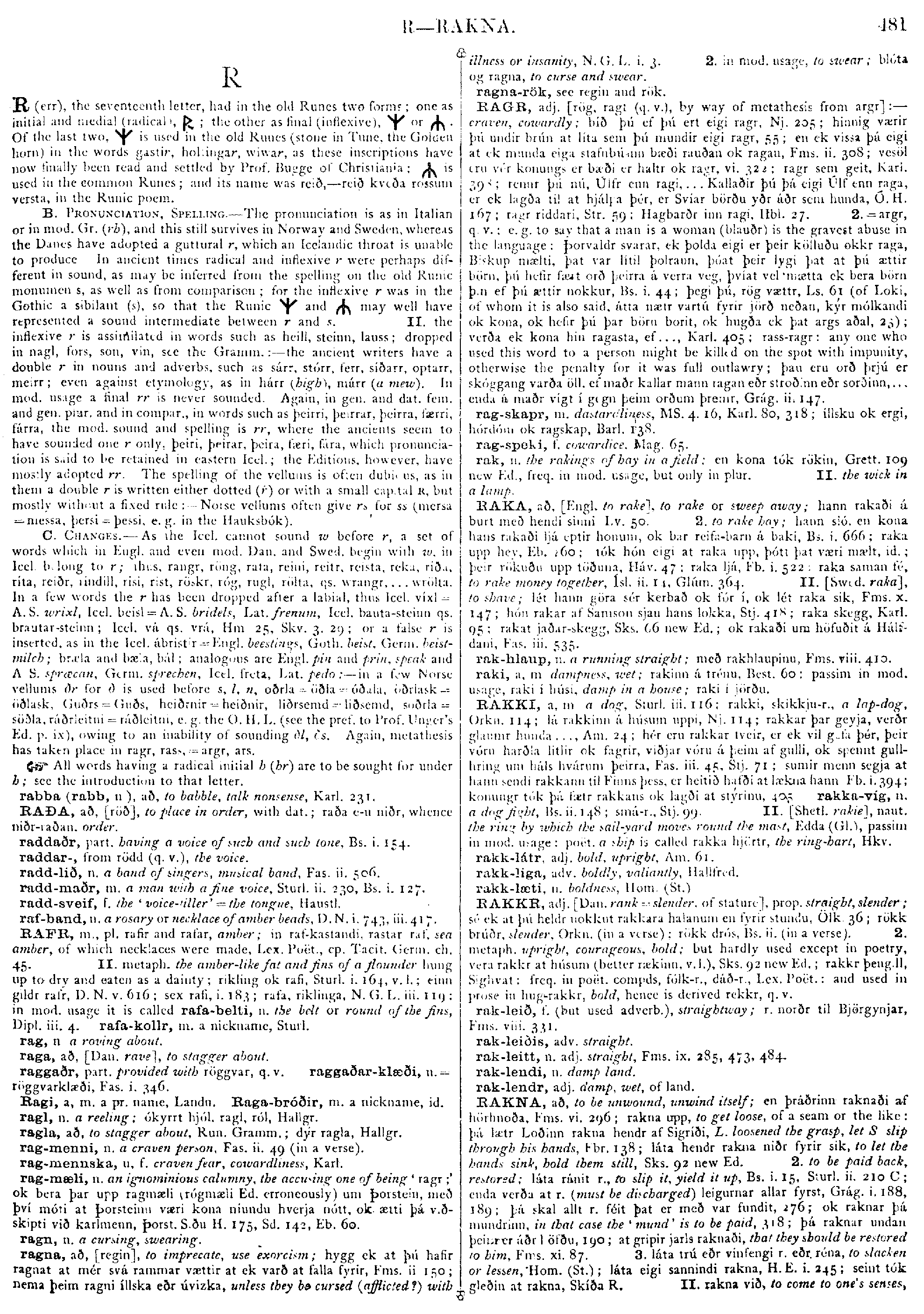
R, (err), the seventeenth letter, had in the old Runes two forms; one as initial and medial (radical), RUNE; the other as final (inflexive), RUNE or RUNE. Of the last two, RUNE is used in the old Runes (stone in Tune, the Golden horn) in the words gastir, hokingar, wiwar, as these inscriptions have now finally been read and settled by Prof. Bugge of Christiana; RUNE is used in the common Runes; and its name was reið, -- reið kveða rossum versta, in the Runic poem. B. PRONUNCIATION, SPELLING. -- The pronunciation is as in Italian or in mod. Gr. (rh), and this still survives in Norway and Sweden, whereas the Danes have adopted a guttural r, which an Icelandic throat is unable to produce In ancient times radical and inflexive r were perhaps different in sound, as may be inferred from the spelling on the old Runic monuments, as well as from comparison; for the inflexive r was in the Gothic a sibilant (s), so that the Runic RUNE and RUNE may well have represented a sound intermediate between r and s. II. the inflexive r is assimilated in words such as heill, steinn, lauss: dropped in nagl, fors, son, vin, see the Gramm. :-- the ancient writers have a double r in nouns and adverbs, such as sárr, stórr, ferr, síðarr, optarr, meirr; even against etymology, as in hárr (high), márr (a mew). In mod. usage a final rr is never sounded. Again, in gen. and dat. fem. and gen. plur. and in compar., in words such as þeirri, þeirrar, þeirra, færri, fárra, the mod. sound and spelling is rr, where the ancients seem to have sounded one r only, þeiri, þeirar, þeira, færi, fára, which pronunciation is said to be retained in eastern Icel.; the Editions, however, have mostly adopted rr. The spelling of the vellums is often dubious, as in them a double r is written either dotted (r) UNCERTAIN or with a small capital R, but mostly without a fixed rule :-- Norse vellums often give rs for ss (mersa = messa, þersi = þessi, e.g. in the Hauksbók). C. CHANGES. -- As the Icel. cannot sound w before r, a set of words which in Engl. and even mod. Dan. and Swed. begin with w, in Icel. belong to r; thus, rangr, röng, rata, reini, reitr, reista, reka, ríða, ríta, reiðr, rindill, risi, rist, röskr, róg, rugl, rölta, qs. wrangr, ... wrölta. In a few words the r has been dropped after a labial, thus Icel. víxl = A.S. wrixl, Icel. beisl = A.S. bridels, Lat. frenum, Icel. bauta-steinn qs. brautar-steinn; Icel. vá qs. vrá, Hm 25, Skv. 3. 29; or a false r is inserted, as in the Icel. ábristir = Engl. beestings, Goth. beist. Germ. beist-milch; bræla and bæla, bál; analogous are Engl. pin and prin, speak and A.S. spræcan, Germ. sprechen, Icel. freta, Lat. pedo :-- in a few Norse vellums ðr for ð is used before s, l, n, oðrla = öðla = óðala, öðrlask = öðlask, Guðrs = Guðs, heiðrnir = heiðnir, liðrsemd = liðsemd, soðrla = söðla, ráðrleitni = ráðleitni, e.g. the O.H.L. (see the pref. to Prof. Unger's Ed. p. ix), owing to an inability of sounding ðl, ðs. Again, metathesis has taken place in ragr, rass, = argr, ars. &FINGER; All words having a radical initial h (hr) are to be sought for under h; see the introduction to that letter.
|
Source: Cleasby/Vigfusson, page b0487, entry 67 View original page image as: [TIFF] [PNG] [View previous entry] [View next entry] |
[Comment on this entry] [View comments] |
The following entry has been hand-corrected once. |
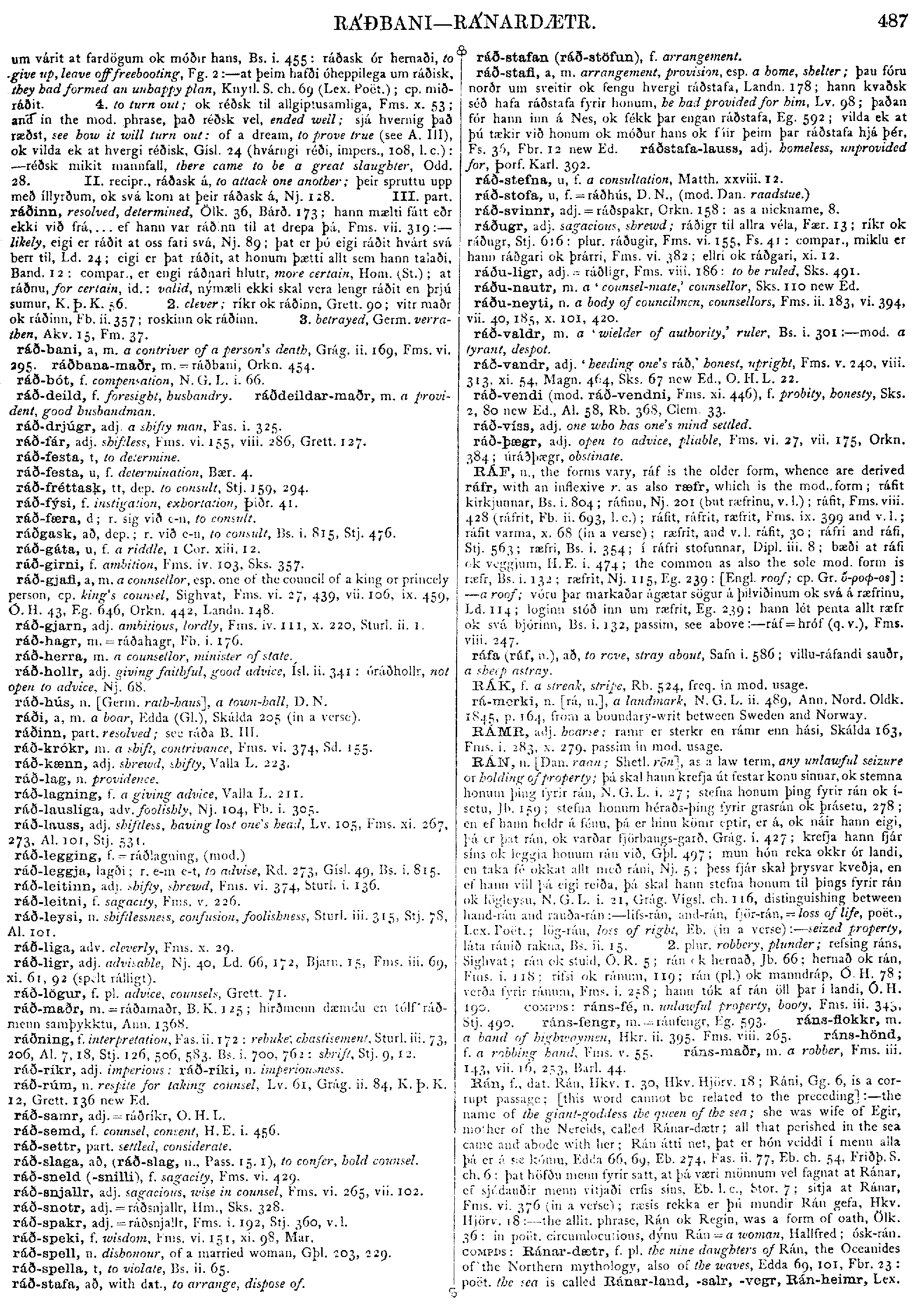
RÁF, n., the forms vary, ráf is the older form, whence are derived ráfr, with an inflexive r. as also ræfr, which is the mod. form; ráfit kirkjunnar, Bs. i. 804; ráfinu, Nj. 201 (but ræfrinu, v.l.); ráfit, Fms. viii. 428 (ráfrit, Fb. ii. 693, l.c.); ráfit, ráfrit, ræfrit, Fms. ix. 399 and v.l.; ráfit varma, x. 68 (in a verse); ræfrit, and v.l. ráfit, 30; ráfri and ráfi, Stj. 563; ræfri, Bs. i. 354; í ráfri stofunnar, Dipl. iii. 8; bæði at ráfi ok veggjum, H.E. i. 474; the common as also the sole mod. form is ræfr, Bs. i. 132; ræfrit, Nj. 115, Eg. 239: [Engl. roof; cp. Gr. GREEK]:-- a roof; vóru þar markaðar ágætar sögur á þilviðinum ok svá á ræfrinu, Ld. 114; loginn stóð inn um ræfrit, Eg. 239; hann lét penta allt ræfr ok svá bjórinn, Bs. i. 132, passim, see above :-- ráf = hróf (q.v.), Fms. viii. 247.
|
Source: Cleasby/Vigfusson, page b0500, entry 10 View original page image as: [TIFF] [PNG] [View previous entry] [View next entry] |
[Comment on this entry] [View comments] |
The following entry has been hand-corrected once. |
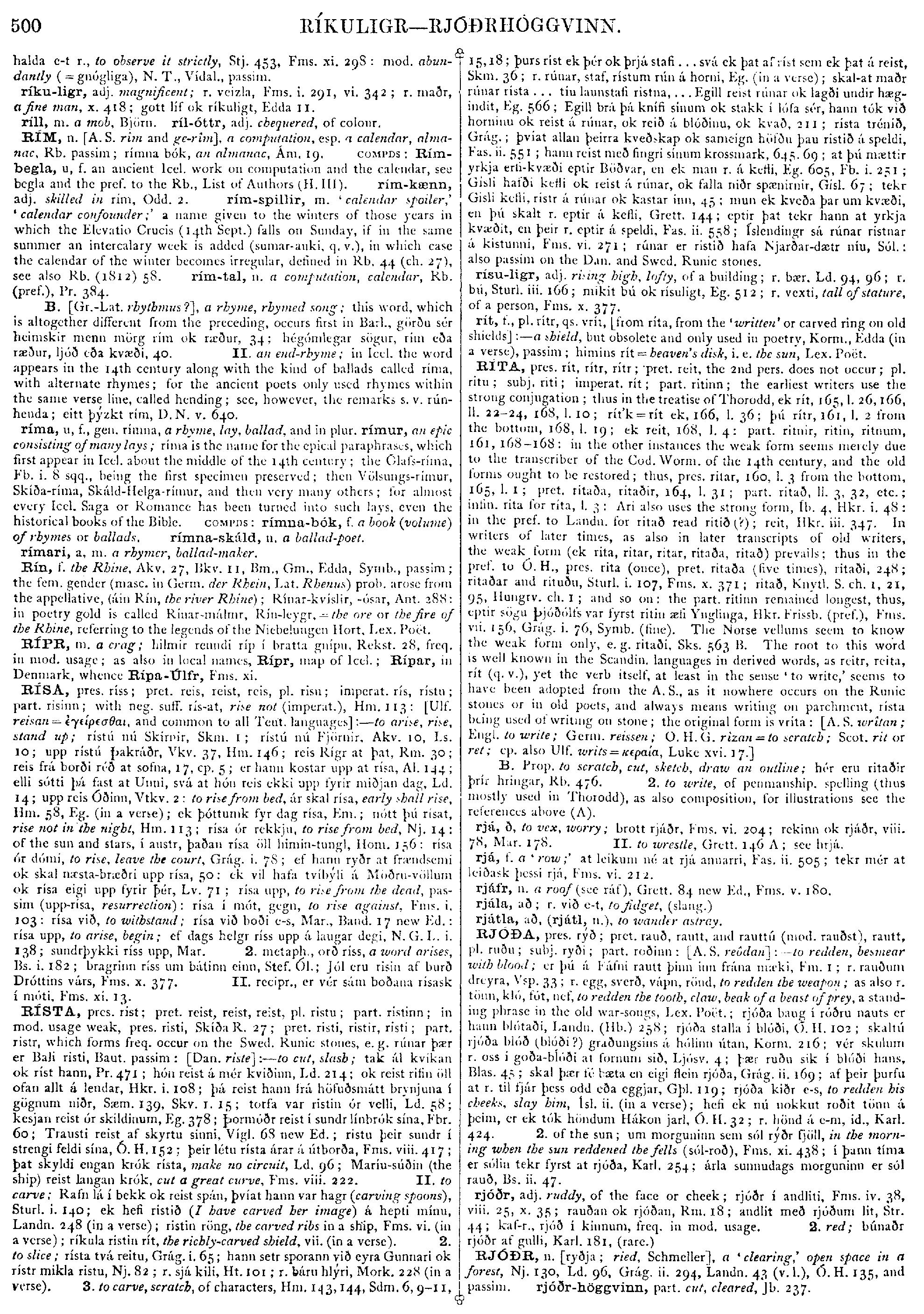
RÍSTA, pres. ríst; pret. reist, reist, reist, pl. ristu; part, ristinn; in mod. usage weak, pres. risti, Skíða R. 27; pret. risti, ristir, risti; part, ristr, which forms freq. occur on the Swed. Runic stones, e.g. rúnar þær er Bali risti, Baut. passim: [Dan. riste] :-- to cut, slash; tak ál kvikan ok ríst hann, Pr. 471; hón reist á mér kviðinn, Ld. 214; ok reist rifin öll ofan allt á lendar, Hkr. i. 108; þá reist hann frá höfuðsmátt brynjuna í gögnum niðr, Sæm. 139, Skv. 1. 15; torfa var ristin ór velli, Ld. 58; kesjan reist ór skildinum, Eg. 378; Þormóðr reist í sundr línbrók sína, Fbr. 60; Trausti reist af skyrtu sinni, Vígl. 68 new Ed.; ristu þeir sundr í strengi feldi sína, Ó.H. 152; þeir létu rísta árar á útborða, Fms. viii. 417; þat skyldi engan krók rísta, make no circuit, Ld. 96; Maríu-súðin (the ship) reist langan krók, cut a great curve, Fms. viii. 222. II. to carve; Rafn lá í bekk ok reist spán, þvíat hann var hagr (carving spoons), Sturl. i. 140; ek hefi ristið (I have carved her image) á hepti mínu, Landn. 248 (in a verse); ristin röng, the carved ribs in a ship, Fms. vi. (in a verse); ríkula ristin rít, the richly-carved shield, vii. (in a verse). 2. to slice; rísta tvá reitu, Grág. i. 65; hann setr sporann við eyra Gunnari ok rístr mikla ristu, Nj. 82; r. sjá kili, Ht. 101; r. báru hlýri, Mork. 228 (in a verse). 3. to carve, scratch, of characters, Hm. 143, 144, Sdm. 6, 9-11, 15, 18; þurs ríst ek þér ok þrjá stafi ... svá ek þat af ríst sem ek þat á reist, Skm. 36; r. rúnar, staf, rístum rún á horni, Eg. (in a verse); skal-at maðr rúnar rísta ... tíu launstafi ristna, ... Egill reist rúnar ok lagði undir hægindit, Eg. 566; Egill brá þá knífi sínum ok stakk í lófa sér, hann tók við horninu ok reist á rúnar, ok reið á blóðinu, ok kvað, 211; rísta tréníð, Grág.; þvíat allan þeirra kveðskap ok sameign höfðu þau ristið á speldi, Fas. ii. 551; hann reist með fingri sínum krossmark, 645. 69; at þú mættir yrkja erti-kvæði eptir Böðvar, en ek man r. á kefli, Eg. 605, Fb. i. 251; Gísli hafði kefli ok reist á rúnar, ok falla niðr spænirnir, Gísl. 67; tekr Gisli kefli, rístr á rúnar ok kastar inn, 45; mun ek kveða þar um kvæði, en þú skalt r. eptir á kefli, Grett. 144; eptir þat tekr hann at yrkja kvæðit, en þeir r. eptir á speldi, Fas. ii. 558; Íslendingr sá rúnar ristnar á kistunni, Fms. vi. 271; rúnar er ristið hafa Njarðar-dætr níu, Sól.: also passim on the Dan. and Swed. Runic stones.
|
Source: Cleasby/Vigfusson, page b0500, entry 13 View original page image as: [TIFF] [PNG] [View previous entry] [View next entry] |
[Comment on this entry] [View comments] |
The following entry has been hand-corrected once. |
RÍTA, pres. rít, rítr, rítr; pret. reit, the 2nd pers. does not occur; pl. ritu; subj. riti; imperat. rít; part, ritinn; the earliest writers use the strong conjugation; thus in the treatise of Thorodd, ek rít, 165, l. 26, 166, ll. 22-24, 168, l. 10; rít'k = rít ek, 166, 1. 36; þú rítr, 161, l. 2 from the bottom, 168, l. 19; ek reit, 168, l. 4: part, ritnir, ritin, ritnum,161, 168-168: in the other instances the weak form seems merely due to the transcriber of the Cod. Worm, of the 14th century, and the old forms ought to be restored; thus, pres. ritar, 160, l. 3 from the bottom,165, l. 1; pret. ritaða, ritaðir, 164, l. 31; part, ritað, ll. 3, 32, etc.; intin. rita for ríta, l. 3: Ari also uses the strong form, Íb. 4, Hkr. i. 48: in the pref. to Landn. for ritað read ritið(?); reit, Hkr. iii. 347. In writers of later times, as also in later transcripts of old writers, the weak form (ek rita, ritar, ritar, ritaða, ritað) prevails; thus in the pref. to Ó.H., pres. rita (once), pret. ritaða (five times), ritaði, 248; ritaðar and rituðu, Sturl. i. 107, Fms. x. 371; ritað, Knytl. S. ch. 1, 21, 95, Hungrv, ch. 1; and so on: the part, ritinn remained longest, thus, eptir sögu Þjóðólfs var fyrst ritin æli Ynglinga, Hkr. Frissb. (pref.), Fms. vii. 156, Grág. i. 76, Symb. (fine). The Norse vellums seem to know the weak form only, e.g. ritaði, Sks. 563 B. The root to this word is well known in the Scandin. languages in derived words, as reitr, reita, rít (q.v.), yet the verb itself, at least in the sense 'to write,' seems to have been adopted from the A.S., as it nowhere occurs on the Runic stones or in old poets, and always means writing on parchment, rísta being used of writing on stone; the original form is vríta: [A.S. wrítan; Engl. to write; Germ. reissen; O.H.G. rízan = to scratch; Scot. rit or ret; cp. also Ulf. writs = GREEK, Luke xvi. 17.] B. Prop. to scratch, cut, sketch, draw an outline; hér eru ritaðir þrír hringar, Rb. 476. 2. to write, of penmanship, spelling (thus mostly used in Thorodd), as also composition, for illustrations see the references above (A).
|
Source: Cleasby/Vigfusson, page b0501, entry 39 View original page image as: [TIFF] [PNG] [View previous entry] [View next entry] |
[Comment on this entry] [View comments] |
The following entry has been hand-corrected once. |
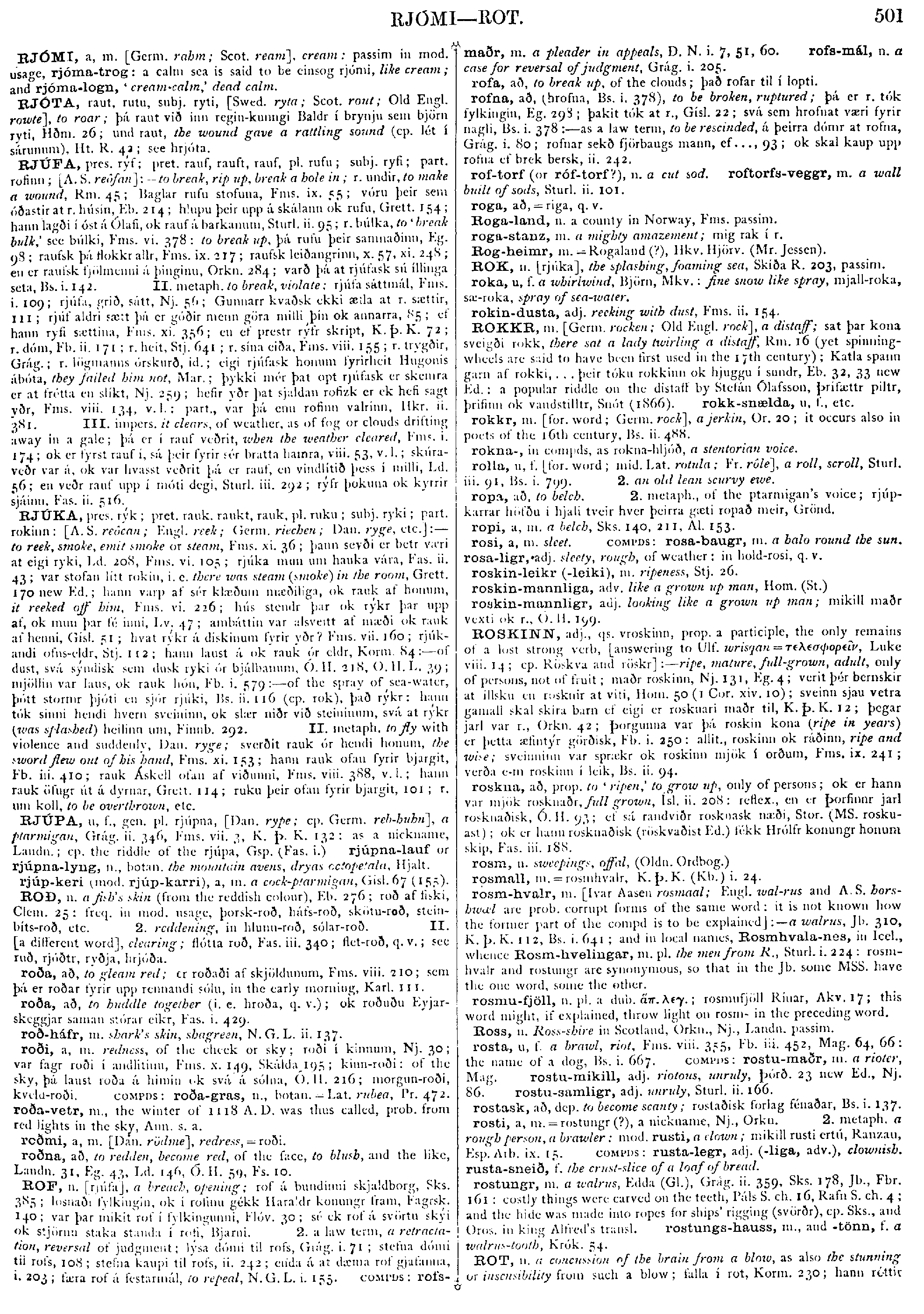
rosm-hvalr, m. [Ivar Aasen rosmaal; Engl. wal-rus and A.S. bors-hwæl are prob. corrupt forms of the same word: it is not known how the former part of the compd is to be explained] :-- a walrus, Jb. 310, K.Þ.K. 112, Bs. i. 641; and in local names, Rosmhvala-nes, in Icel., whence Rosm-hvelingar, m. pl. the men from R., Sturl. i. 224: rosm-hvalr and rostungr are synonymous, so that in the Jb. some MSS. have the one word, some the other.
|
Source: Cleasby/Vigfusson, page b0502, entry 35 View original page image as: [TIFF] [PNG] [View previous entry] [View next entry] |
[Comment on this entry] [View comments] |
The following entry has been hand-corrected once. |
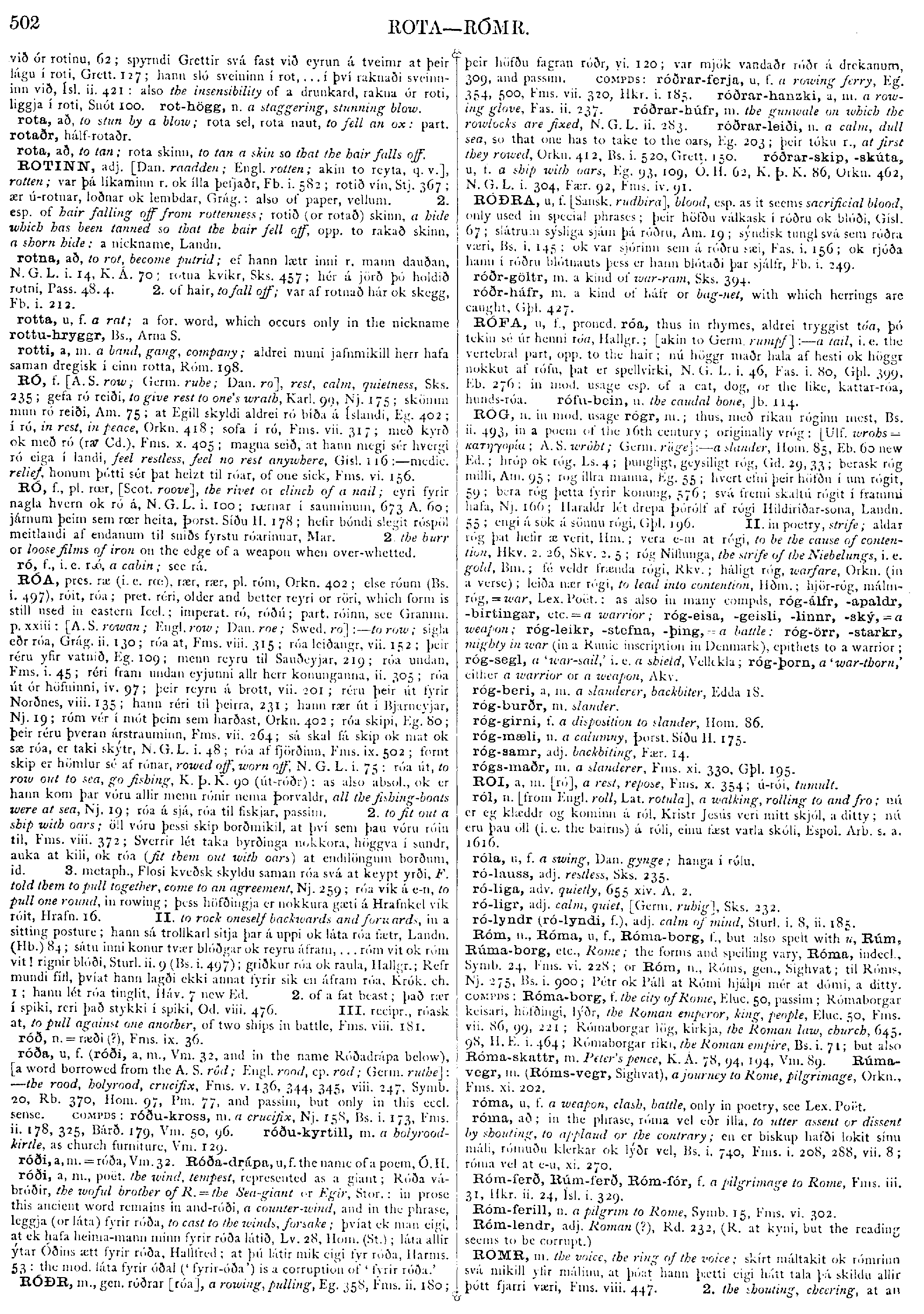
Róm, n., Róma, u, f., Róma-borg, f., but also spelt with u, Rúm, Rúma-borg, etc., Rome; the forms and spelling vary, Róma, indecl., Symb. 24, Fms. vi. 228; or Róm, n., Róms, gen., Sighvat; til Róms, Nj. 275, Bs. i. 900; Pétr ok Páll at Rómi hjálpi mér at dómi, a ditty. COMPDS: Róma-borg, f. the city of Rome, Eluc. 50, passim; Rómaborgar keisari, höfðingi, lýðr, the Roman emperor, king, people, Eluc. 50, Fms, vii. 86, 99, 221; Rómaborgar lög, kirkja, the Roman law, church, 645. 98, H.E. i 464; Rómaborgar ríki, the Roman empire, Bs. i. 71; but also Róma-skattr, m. Peter's pence, K.Á. 78, 94, 194, Vm. 89. Rúma-vegr, m. (Róms-vegr, Sighvat), a journey to Rome, pilgrimage, Orkn.,Fms. xi. 202.
|
Source: Cleasby/Vigfusson, page b0507, entry 21 View original page image as: [TIFF] [PNG] [View previous entry] [View next entry] |
[Comment on this entry] [View comments] |
The following entry has been hand-corrected once. |
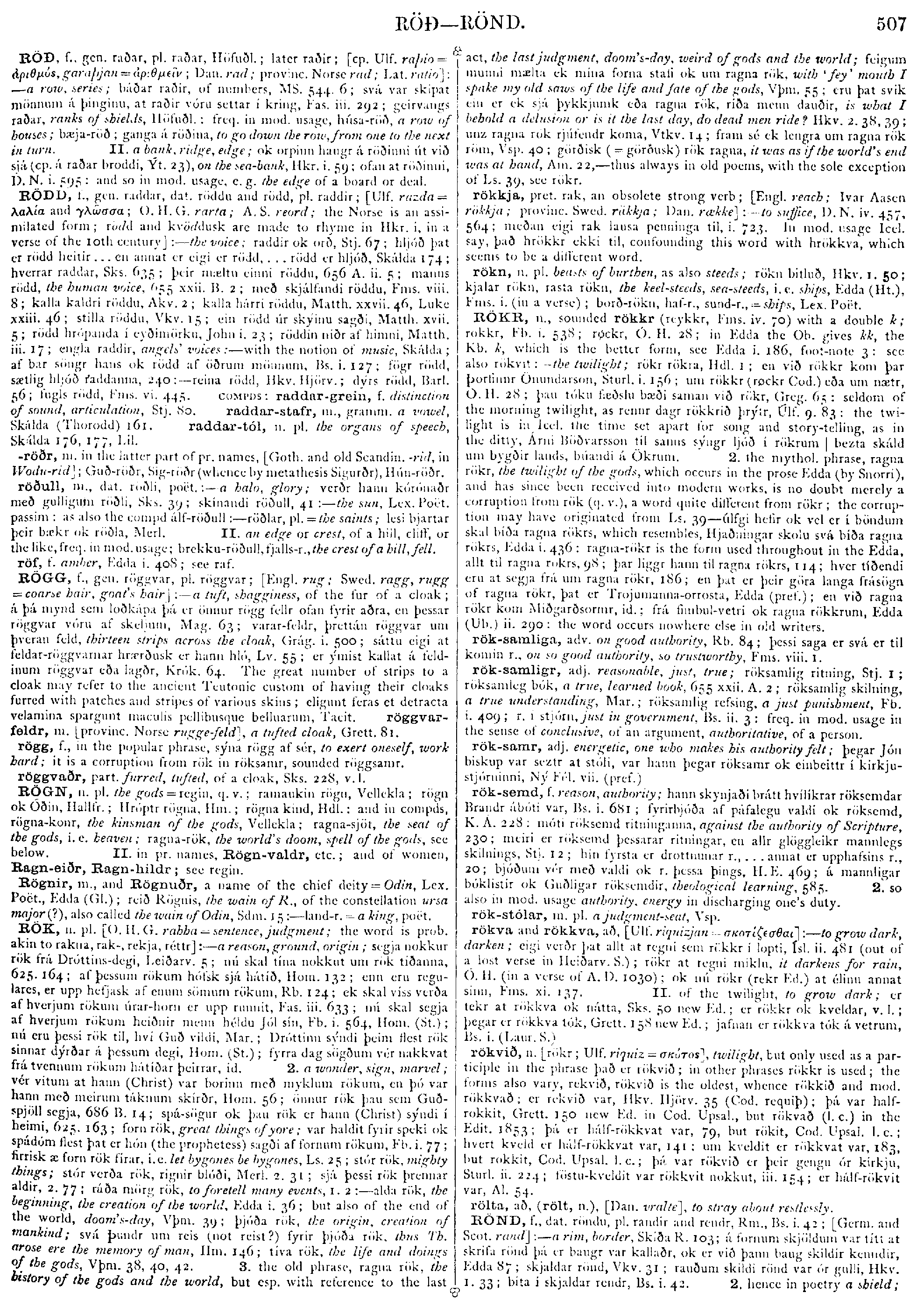
rökvið, n. [rökr; Ulf. riquiz = GREEK] twilight, but only used as a participle in the phrase það er rökvið; in other phrases rökkr is used; the forms also vary, rekvið, rökvið is the oldest, whence rökkið and mod. rökkvað; er rekvið var, Hkv. Hjörv. 35 (Cod. requiþ); þá var half-rokkit, Grett. 150 new Ed. in Cod. Upsal., but rökvað (l.c.) in the Edit. 1853; þá er hálf-rökkvat var, 79, but rökit, Cod. Upsal. l.c.; hvert kveld er hálf-rökkvat var, 141; um kveldit er rökkvat var, 183, but rokkit, Cod. Upsal. l.c.; þá var rökvið er þeir gengu ór kirkju, Sturl. ii. 224; föstu-kveldit var rökkvit nokkut, iii. 154; er hálf-rökvit var, Al. 54.
|
Source: Cleasby/Vigfusson, page b0508, entry 19 View original page image as: [TIFF] [PNG] [View previous entry] [View next entry] |
[Comment on this entry] [View comments] |
The following entry has been hand-corrected once. |
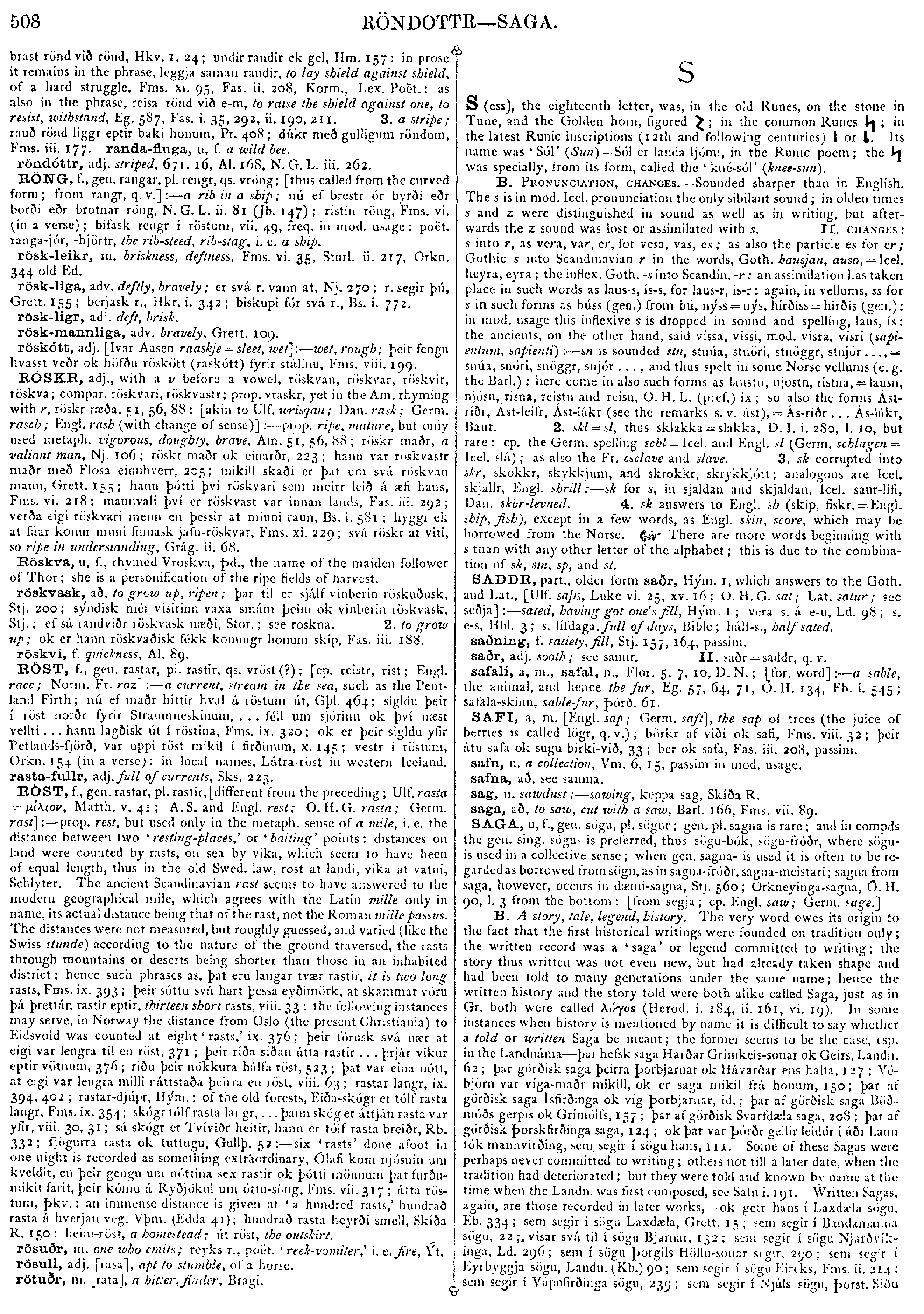
S (ess), the eighteenth letter, was, in the old Runes, on the stone in Tune, and the Golden horn, figured RUNE; in the common Runes RUNE; in the latest Runic inscriptions (12th and following centuries) RUNE or RUNE Its name was 'Sól' (Sun) -- Sól er landa ljómi, in the Runic poem; the RUNE was specially, from its form, called the 'kné-sól' (knee-sun). B. PRONUNCIATION, CHANGES. -- Sounded sharper than in English. The s is in mod. Icel. pronunciation the only sibilant sound; in olden times s and z were distinguished in sound as well as in writing, but afterwards the z sound was lost or assimilated with s. II. CHANGES: s into r, as vera, var, er, for vesa, vas, es; as also the particle es for er; Gothic s into Scandinavian r in the words, Goth. hausjan, auso, = Icel. heyra, eyra; the infiex. Goth. -s into Scandin. -r: an assimilation has taken place in such words as laus-s, ís-s, for laus-r, ís-r: again, in vellums, ss for s in such forms as búss (gen.) from bú, nýss = nýs, hirðiss = hirðis (gen.): in mod. usage this inflexive s is dropped in sound and spelling, laus, ís: the ancients, on the other hand, said víssa, víssi, mod. vísra, vísri (sapientum, sapienti) :-- sn is sounded stn, stnúa, stnöri, stnöggr, stnjór ..., = snúa, snöri, snöggr, snjór ..., and thus spelt in some Norse vellums (e.g. the Barl.): here come in also such forms as laustn, njostn, ristna, = lausn, njósn, risna, reistn and reisn, O.H.L. (pref.) ix; so also the forms Ást-ríðr, Ást-leifr, Ást-lákr (see the remarks s.v. ást), = Ás-ríðr ... Ás-lákr, Baut. 2. skl = sl, thus sklakka = slakka, D.I. i. 280, l. 10, but rare: cp. the Germ. spelling schl = Icel. and Engl. sl (Germ. schlagen = Icel. slá); as also the Fr. esclave and slave. 3. sk corrupted into skr, skokkr, skykkjum, and skrokkr, skrykkjótt; analogous are Icel. skjallr, Engl. shrill :-- sk for s, in sjaldan and skjaldan, Icel. saur-lífi, Dan. skör-levned. 4. sk answers to Engl. sh (skip, fiskr, = Engl.ship, fish), except in a few words, as Engl. skin, score, which may be borrowed from the Norse. (???)UNCERTAIN There are more words beginning with s than with any other letter of the alphabet; this is due to the combination of sk, sm, sp, and st.
|
Source: Cleasby/Vigfusson, page b0517, entry 40 View original page image as: [TIFF] [PNG] [View previous entry] [View next entry] |
[Comment on this entry] [View comments] |
The following entry has been hand-corrected once. |
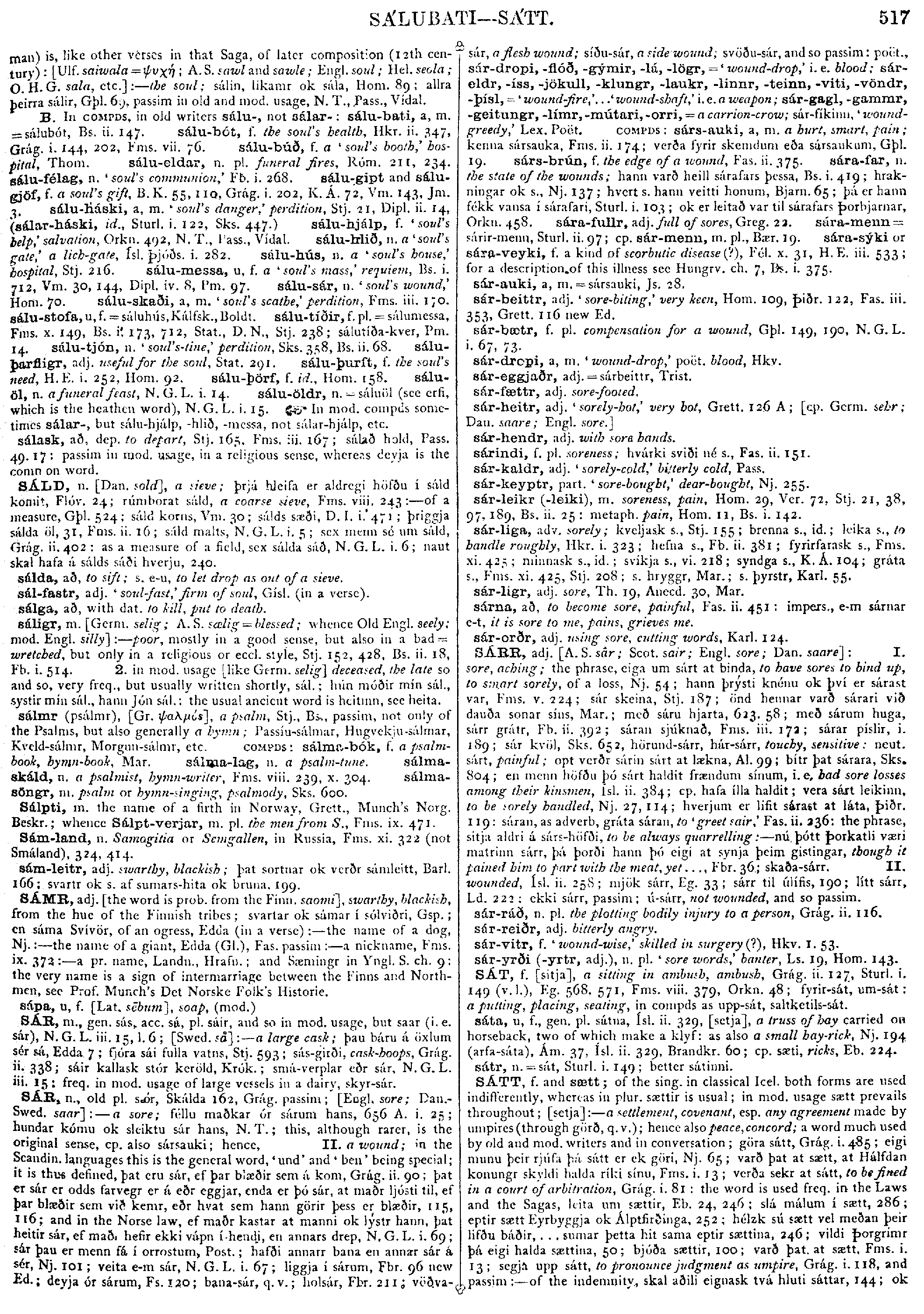
SÁTT, f. and sætt; of the sing, in classical Icel. both forms are used indifferently, whereas in plur. sættir is usual; in mod. usage sætt prevails throughout; [setja] :-- a settlement, covenant, esp. any agreement made by umpires (through görð, q.v.); hence also peace, concord; a word much used by old and mod. writers and in conversation; göra sátt, Grág. i. 485; eigi munu þeir rjúfa þá sátt er ek göri, Nj. 65; varð þat at sætt, at Hálfdan konungr skyldi halda ríki sínu, Fms. i. 13; verða sekr at sátt, to bt fined in a court of arbitration, Grág. i. 81: the word is used freq. in the Laws and the Sagas, leita um sættir, Eb. 24, 246; slá málum í sætt, 286; eptir sætt Eyrbyggja ok Álptfirðinga, 252; hélzk sú sætt vel meðan þeir lifðu báðir, ... sumar þetta hit sama eptir sættina, 246; vildi Þorgrímr þá eigi halda sættina, 50; bjóða sættir, 100; varð þat at sætt, Fms. i. 13; segja upp sátt, to pronounce judgment as umpire, Grág. i. 118, and. passim :-- of the indemnity, skal aðili eignask tvá hluti sáttar, 144; ok
|
Source: Cleasby/Vigfusson, page b0518, entry 28 View original page image as: [TIFF] [PNG] [View previous entry] [View next entry] |
[Comment on this entry] [View comments] |
The following entry has been hand-corrected once. |
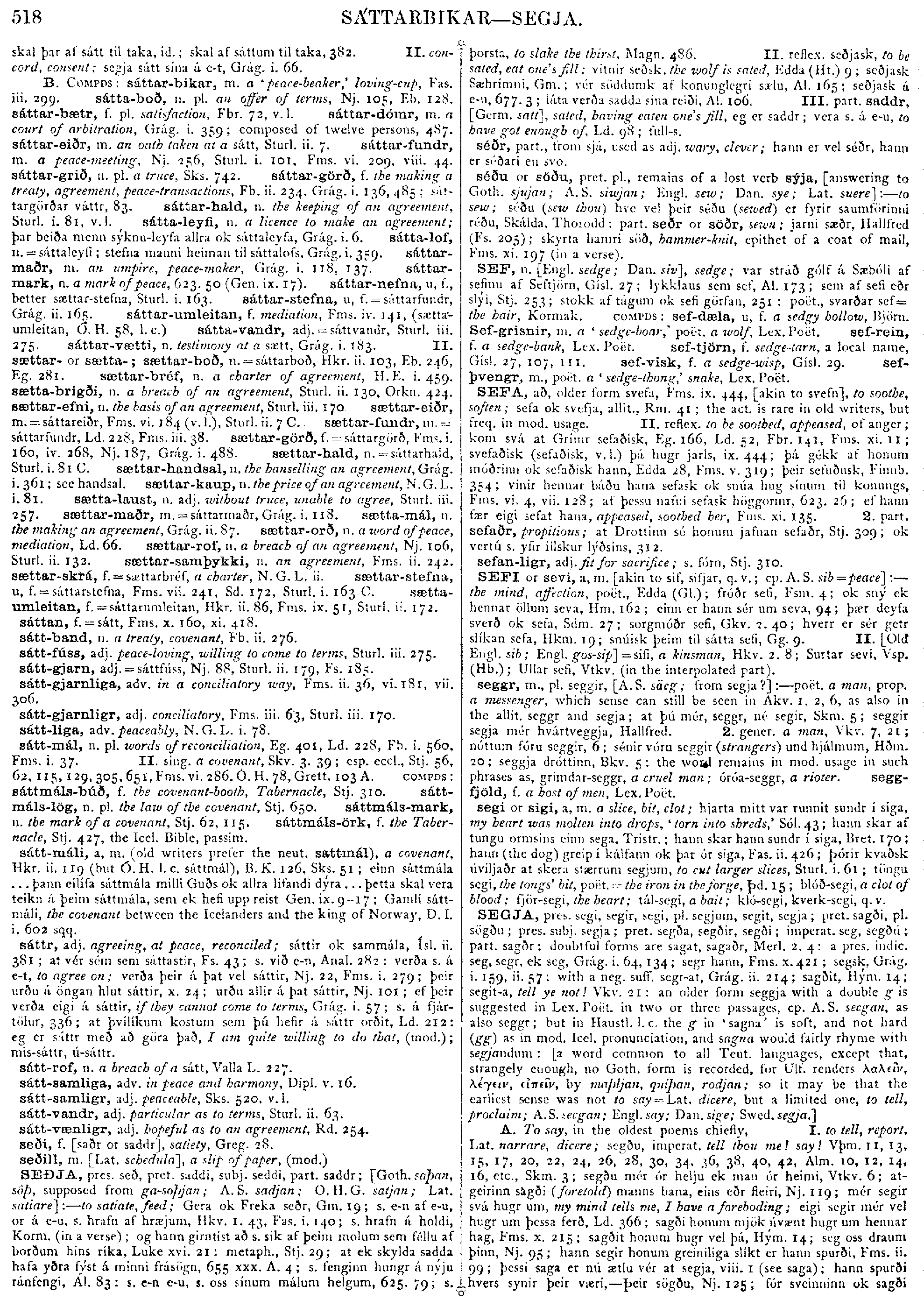
SEGJA, pres. segi, segir, segi, pl. segjum, segit, segja; pret. sagði, pl. sögðu; pres. subj. segja; pret. segða, segðir, segði; imperat. seg, segðú; part. sagðr: doubtful forms are sagat, sagaðr, Merl. 2. 4: a pres. indic. seg, segr, ek seg, Grág. i. 64, 134; segr hann, Fms. x. 421; segsk, Grág.i. 159, ii. 57: with a neg. suff. segr-at, Grág. ii. 214; sagðit, Hým. 14; segit-a, tell ye not! Vkv. 21: an older form seggja with a double g is suggested in Lex. Poët, in two or three passages, cp. A.S. secgan, as also seggr; but in Haustl. l.c. the g in 'sagna' is soft, and not hard (gg) as in mod. Icel. pronunciation, and sagna would fairly rhyme with segjaandum: [a word common to all Teut. languages, except that, strangely enough, no Goth, form is recorded, for Ulf. renders GREEK, GREEK, GREEK, by maþljan, quiþan, rodjan; so it may be that the earliest sense was not to say = Lat. dicere, but a limited one, to tell, proclaim; A.S. secgan; Engl. say; Dan. sige; Swed. segja.] A. To say, in the oldest poems chiefly, I. to tell, report, Lat. narrare, dicere; segðu, imperat. tell thou me! say! Vþm. 11, 13, 15. 17, 20, 22, 24, 26, 28, 30, 34, 36, 38, 40, 42, Alm. 10, 12, 14, 16. etc., Skm. 3; segðu mér ór helju ek man ór heimi, Vtkv. 6; atgeirinn sagði (foretold) manns bana, eins eðr fleiri, Nj. 119; mér segir svá hugr um, my mind tells me, I have a foreboding; eigi segir mér vel hugr um þessa ferð, Ld. 366; sagði honum mjök úvænt hugr um hennar hag, Fms. x. 215; sagðit honum hugr vel þá, Hým. 14; seg oss draum þinn, Nj. 95; hann segir honum greiniliga slíkt er hann spurði, Fms. ii. 99; þessi saga er nú ætlu vér at segja, viii. 1 (see saga); hann spurði hvers synir þeir væri, -- þeir sögðu, Nj. 125; fór sveinninn ok sagði
| Result Page: |  |
Previous | 31 32 33 34 35 36 37 38 39 40 41 42 43 44 45 46 47 | Next |  |
Germanic Lexicon Project (main page)
This search system was written by
Sean Crist
Please consider
volunteering
to correct the data in these online dictionaries.
No rights reserved. Feel free to use these data in any way you please.