|
|

|
Source: Bosworth/Toller, page d0585, entry 13 View original page image as: [TIFF] [PNG] [View previous entry] [View next entry] |
[Comment on this entry] [View comments] |
The following entry has been hand-corrected once. |
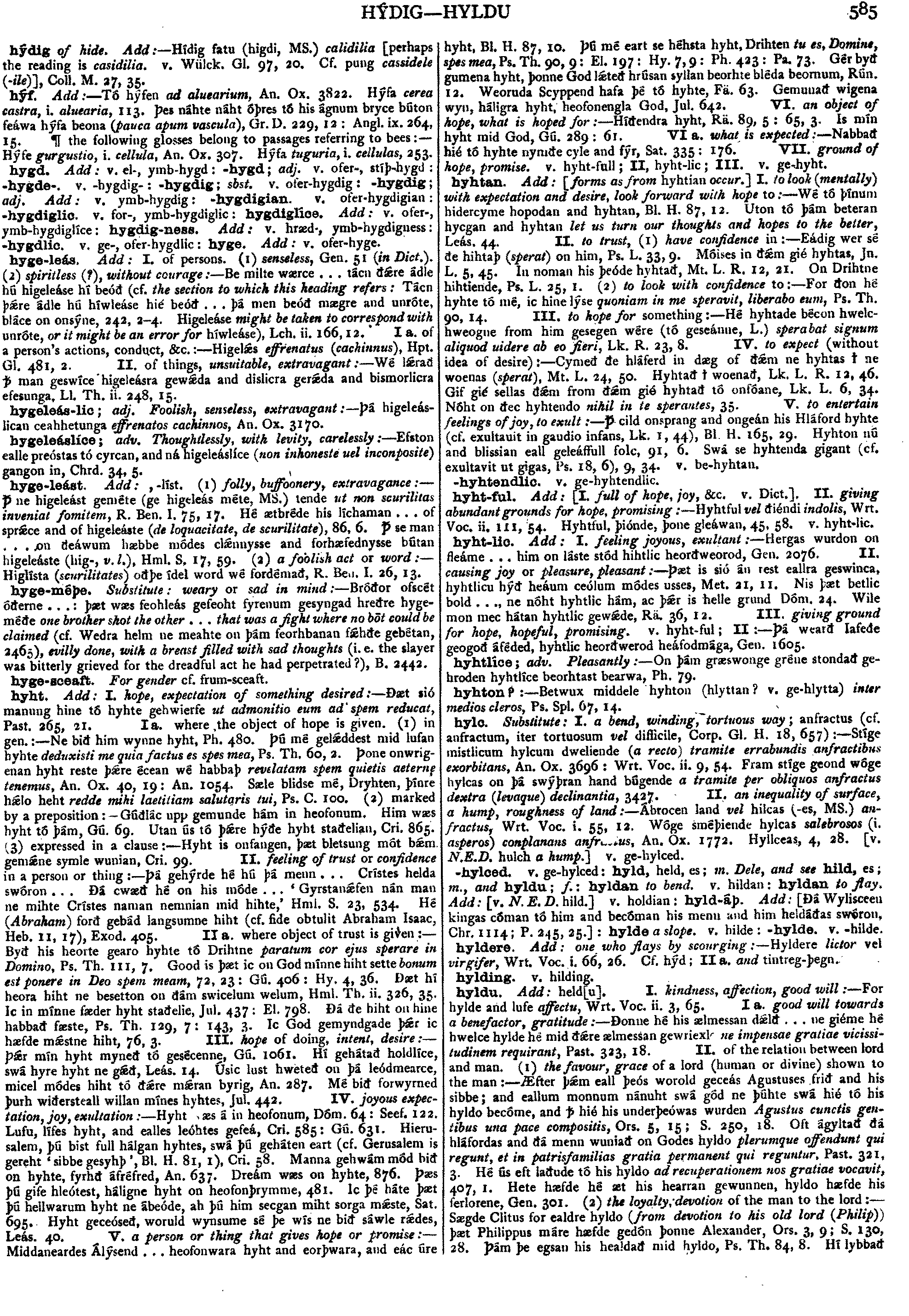
hyhtan.
Add:
[forms
as
from
hyhtian
occur.]
I.
to
look
(mentally)
with
expectation
and
desire,
look
forward
with
hope
to
:--
W t
t þ
þ num
hidercyme
hopodan
and
hyhtan,
Bl.
H.
87,
12.
Uton
t
þ
num
hidercyme
hopodan
and
hyhtan,
Bl.
H.
87,
12.
Uton
t
þ m
beteran
hycgan
and
hyhtan
let
us
turn
our
thoughts
and
hopes
to
the
better,
Leás.
44.
II.
to
trust,
(l)
have
confidence
in
:--
Eádig
wer
s
m
beteran
hycgan
and
hyhtan
let
us
turn
our
thoughts
and
hopes
to
the
better,
Leás.
44.
II.
to
trust,
(l)
have
confidence
in
:--
Eádig
wer
s
 e
hihtaþ
(sperat)
on
him,
Ps.
L.
33,
9.
Mises
in
e
hihtaþ
(sperat)
on
him,
Ps.
L.
33,
9.
Mises
in
 m
gié
hyhtas,
Jn.
L.
5,
45.
In
noman
his
þeóde
hyhta,
Mt.
L.
R.
12,
21.
On
Drihtne
hihtiende,
Ps.
L.
25,
1.
(2)
to
look
with
confidence
to
:--
For
on
h
hyhte
t
m,
ic
hine
l
m
gié
hyhtas,
Jn.
L.
5,
45.
In
noman
his
þeóde
hyhta,
Mt.
L.
R.
12,
21.
On
Drihtne
hihtiende,
Ps.
L.
25,
1.
(2)
to
look
with
confidence
to
:--
For
on
h
hyhte
t
m,
ic
hine
l se
quoniam
in
me
speravit,
liberabo
eum,
Ps.
Th.
90,
14.
III.
to
hope
for
something
:--
H
hyhtade
bcon
hwelc-hweogne
from
him
gesegen
wre
(t
geseánne,
L.)
sperabat
signum
aliquod
uidere
ab
eo
fieri,
Lk.
R.
23,
8.
IV.
to
expect
(without
idea
of
desire)
:--
Cyme
e
hlferd
in
dæg
of
m
ne
hyhtas
ne
se
quoniam
in
me
speravit,
liberabo
eum,
Ps.
Th.
90,
14.
III.
to
hope
for
something
:--
H
hyhtade
bcon
hwelc-hweogne
from
him
gesegen
wre
(t
geseánne,
L.)
sperabat
signum
aliquod
uidere
ab
eo
fieri,
Lk.
R.
23,
8.
IV.
to
expect
(without
idea
of
desire)
:--
Cyme
e
hlferd
in
dæg
of
m
ne
hyhtas
ne
 woenas
(sperat),
Mt.
L.
24,
50.
Hyhta
woena,
Lk.
L.
R.
12,
46.
Gif
gié
sellas
m
from
ðm
gié
hyhta
t
onfane,
Lk.
L.
6,
34.
Nht
on
ec
hyhtendo
nihil
in
te
sperantes,
35.
V.
to
entertain
feelings
of
joy,
to
exult
:--
woenas
(sperat),
Mt.
L.
24,
50.
Hyhta
woena,
Lk.
L.
R.
12,
46.
Gif
gié
sellas
m
from
ðm
gié
hyhta
t
onfane,
Lk.
L.
6,
34.
Nht
on
ec
hyhtendo
nihil
in
te
sperantes,
35.
V.
to
entertain
feelings
of
joy,
to
exult
:--
 cild
onsprang
and
ongeán
his
Hlford
hyhte
(cf.
exultauit
in
gaudio
infans.
Lk.
I.
44),
Bl
H.
165,
29.
Hyhton
n
cild
onsprang
and
ongeán
his
Hlford
hyhte
(cf.
exultauit
in
gaudio
infans.
Lk.
I.
44),
Bl
H.
165,
29.
Hyhton
n and
blissian
eall
geleáffull
folc,
91,
6.
Sw
se
hyhtenda
gigant
(cf.
exultavit
ut
gigas,
Ps.
18,
6),
9,
34.
v.
be-hyhtan.
and
blissian
eall
geleáffull
folc,
91,
6.
Sw
se
hyhtenda
gigant
(cf.
exultavit
ut
gigas,
Ps.
18,
6),
9,
34.
v.
be-hyhtan.
|
Source: Bosworth/Toller, page d0654, entry 1 View original page image as: [TIFF] [PNG] [View previous entry] [View next entry] |
[Comment on this entry] [View comments] |
The following entry has been hand-corrected once. |
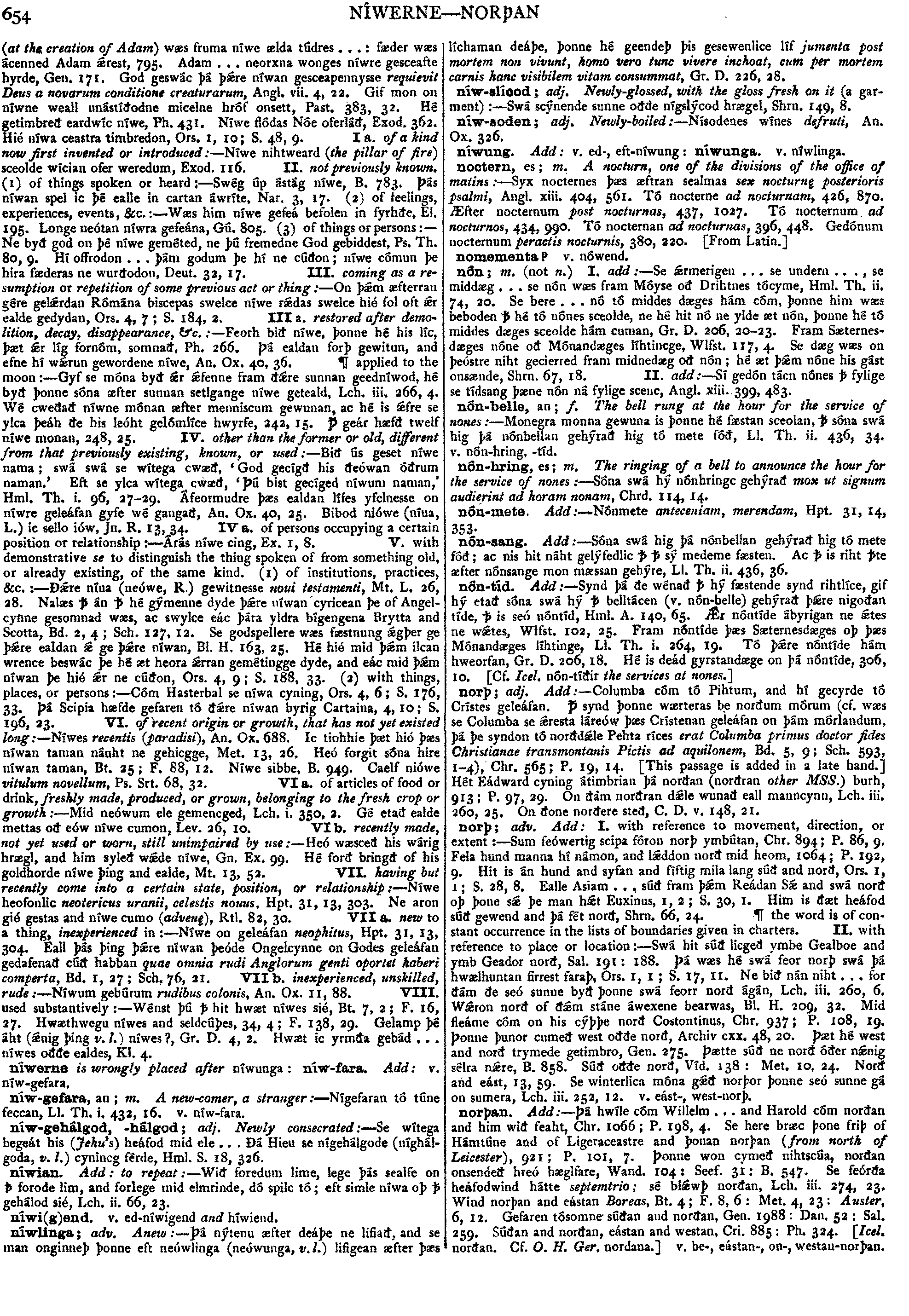
(at
the
creation
of
Adam)
wæs
fruma
níwe
ælda
túdres
.
.
.
:
fæder
wæs
ácenned
Adam
 rest,
795.
Adam
.
.
.
neorxna
wonges
níwre
gesceafte
hyrde,
Gen.
171.
God
geswác
þá
þre
níwan
gesceapennysse
requievit
Deus
a
novarum
conditione
creaturarum,
Angl.
vii.
4,
22.
Gif
mon
on
níwne
weall
unástíðodne
micelne
hróf
onsett,
Past.
383,
32.
Hé
getimbreð
eardwíc
níwe,
Ph.
431.
Níwe
flódas
Nóe
oferláð,
Exod.
362.
Hié
níwa
ceastra
timbredon,
Ors.
1.
10;
S.
48,
9.
I
a.
of
a
kind
now
first
invented
or
introduced
:--
Níwe
nihtweard
(the
pillar
of
fire)
sceolde
wícian
ofer
weredum,
Exod.
116.
II.
not
previously
known.
(1)
of
things
spoken
or
heard
:--
Swég
úp
ástág
níwe,
B.
783.
Þás
níwan
spel
ic
þé
ealle
in
cartan
áwríte,
Nar.
3,
17.
(2)
of
feelings,
experiences,
events,
&c.
:--
Wæs
him
níwe
gefeá
befolen
in
fyrhðe,
El.
195.
Longe
neótan
níwra
gefeána,
Gú.
805.
(3)
of
things
or
persons
:--
Ne
byð
god
on
þé
níwe
geméted,
ne
þú
fremedne
God
gebiddest,
Ps.
Th.
80,
9.
Hí
offrodon
.
.
.
þám
godum
þe
hí
ne
cúðon;
níwe
cómun
þe
hira
fæderas
ne
wurðodon,
Deut.
32,
17.
III.
coming
as
a
resumption
or
repetition
of
some
previous
act
or
thing
:--
On
þm
æfterran
gére
gelrdan
Rómána
biscepas
swelce
níwe
rdas
swelce
hié
fol
oft
r
ealde
gedydan,
Ors.
4,
7;
S.
184,
2.
III
a.
restored
after
demolition,
decay,
disappearance,
&c.
:--
Feorh
bið
níwe,
þonne
hé
his
líc,
þæt
r
líg
fornóm,
somnað,
Ph.
266.
Þá
ealdan
forþ
gewitun,
and
efne
hí
wrun
gewordene
níwe,
An.
Ox.
40,
36.

applied
to
the
moon
:--
Gyf
se
móna
byð
r
fenne
fram
ðre
sunnan
geedníwod,
hé
byð
þonne
sóna
æfter
sunnan
setlgange
níwe
geteald,
Lch.
iii.
266,
4.
Wé
cweðað
níwne
mónan
æfter
menniscum
gewunan,
ac
hé
is
fre
se
ylca
þeáh
ðe
his
leóht
gelómlíce
hwyrfe,
242,
15.
Þ-bar;
geár
hæfð
twelf
níwe
monan,
248,
25.
IV.
other
than
the
former
or
old,
different
from
that
previously
existing,
known,
or
used
:--
Bið
ús
geset
níwe
nama;
swá
swá
se
wítega
cwæð,
'God
gecígð
his
ðeówan
óðrum
naman.'
Eft
se
ylca
wítega
cwæð,'
Þú
bist
gecíged
níwum
naman,'
Hml.
Th.
i.
96,
27-29.
Áfeormudre
þæs
ealdan
lífes
yfelnesse
on
níwre
geleáfan
gyfe
wé
gangað,
An.
Ox.
40,
25.
Bibod
niówe
(níua,
L.
)
ic
sello
iów,
Jn.
R.
13,
34.
IV
a.
of
persons
occupying
a
certain
position
or
relationship
:--
Árás
níwe
cing,
Ex.
1,
8.
V.
with
demonstrative
se
to
distinguish
the
thing
spoken
of
from
something
old,
or
already
existing,
of
the
same
kind.
(1)
of
institutions,
practices,
&c.
:--
Ðre
níua
(neówe,
R.
)
gewitnesse
noui
testamenti,
Mt.
L.
26,
28.
Nalæs
an
hé
gýmenne
dyde
þre
níwan
cyricean
þe
of
Angelcynne
gesomnad
wæs,
ac
swylce
eác
þára
yldra
bígengena
Brytta
and
Scotta,
Bd.
2,
4
;
Sch.
127,
12.
Se
godspellere
wæs
fæstnung
gþer
ge
þre
ealdan
ge
þre
níwan,
Bl.
H.
163,
25.
Hé
hié
mid
þm
ilcan
wrence
beswác
þe
hé
æt
heora
rran
gemétingge
dyde,
and
eác
mid
þm
níwan
þe
hié
r
ne
cúðon,
Ors.
4,
9
;
S.
188,
33.
(2)
with
things,
places,
or
persons
:--
Cóm
Hasterbal
se
níwa
cyning,
Ors.
4,
6
;
S.
176,
33.
Þá
Scipia
hæfde
gefaren
tó
ðre
níwan
byrig
Cartaina,
4,
10;
S.
196,
33.
VI.
of
recent
origin
or
growth,
that
has
not
yet
existed
long
:--
Níwes
recentis
(paradisi),
An.
Ox.
688.
Ic
tiohhie
þæt
hió
þæs
níwan
taman
náuht
ne
gehicgge,
Met.
13,
26.
Heó
forgit
sóna
hire
níwan
taman,
Bt.
25;
F.
88,
12.
Níwe
sibbe,
B.
949.
Caelf
niówe
vitulum
novellum,
Ps.
Srt.
68,
32.
VI
a.
of
articles
of
food
or
drink,
freshly
made,
produced,
or
grown,
belonging
to
the
fresh
crop
or
growth
:--
Mid
neówum
ele
gemencged,
Lch.
i.
350,
2.
Gé
etað
ealde
mettas
oð
eów
níwe
cumon,
Lev.
26,
10.
VI
b.
recently
made,
not
yet
used
or
worn,
still
unimpaired
by
use
:--
Heó
wæsceð
his
wárig
hrægl,
and
him
syleð
wde
níwe,
Gn.
Ex.
99.
Hé
forð
bringð
of
his
goldhorde
níwe
þing
and
ealde,
Mt.
13,
52.
VII.
having
but
recently
come
into
a
certain
state,
position,
or
relationship
:--
Níwe
heofonlic
neotericus
uranii,
celestis
nouus,
Hpt.
31,
13,
303.
Ne
aron
gié
gestas
and
níwe
cumo
(adven
rest,
795.
Adam
.
.
.
neorxna
wonges
níwre
gesceafte
hyrde,
Gen.
171.
God
geswác
þá
þre
níwan
gesceapennysse
requievit
Deus
a
novarum
conditione
creaturarum,
Angl.
vii.
4,
22.
Gif
mon
on
níwne
weall
unástíðodne
micelne
hróf
onsett,
Past.
383,
32.
Hé
getimbreð
eardwíc
níwe,
Ph.
431.
Níwe
flódas
Nóe
oferláð,
Exod.
362.
Hié
níwa
ceastra
timbredon,
Ors.
1.
10;
S.
48,
9.
I
a.
of
a
kind
now
first
invented
or
introduced
:--
Níwe
nihtweard
(the
pillar
of
fire)
sceolde
wícian
ofer
weredum,
Exod.
116.
II.
not
previously
known.
(1)
of
things
spoken
or
heard
:--
Swég
úp
ástág
níwe,
B.
783.
Þás
níwan
spel
ic
þé
ealle
in
cartan
áwríte,
Nar.
3,
17.
(2)
of
feelings,
experiences,
events,
&c.
:--
Wæs
him
níwe
gefeá
befolen
in
fyrhðe,
El.
195.
Longe
neótan
níwra
gefeána,
Gú.
805.
(3)
of
things
or
persons
:--
Ne
byð
god
on
þé
níwe
geméted,
ne
þú
fremedne
God
gebiddest,
Ps.
Th.
80,
9.
Hí
offrodon
.
.
.
þám
godum
þe
hí
ne
cúðon;
níwe
cómun
þe
hira
fæderas
ne
wurðodon,
Deut.
32,
17.
III.
coming
as
a
resumption
or
repetition
of
some
previous
act
or
thing
:--
On
þm
æfterran
gére
gelrdan
Rómána
biscepas
swelce
níwe
rdas
swelce
hié
fol
oft
r
ealde
gedydan,
Ors.
4,
7;
S.
184,
2.
III
a.
restored
after
demolition,
decay,
disappearance,
&c.
:--
Feorh
bið
níwe,
þonne
hé
his
líc,
þæt
r
líg
fornóm,
somnað,
Ph.
266.
Þá
ealdan
forþ
gewitun,
and
efne
hí
wrun
gewordene
níwe,
An.
Ox.
40,
36.

applied
to
the
moon
:--
Gyf
se
móna
byð
r
fenne
fram
ðre
sunnan
geedníwod,
hé
byð
þonne
sóna
æfter
sunnan
setlgange
níwe
geteald,
Lch.
iii.
266,
4.
Wé
cweðað
níwne
mónan
æfter
menniscum
gewunan,
ac
hé
is
fre
se
ylca
þeáh
ðe
his
leóht
gelómlíce
hwyrfe,
242,
15.
Þ-bar;
geár
hæfð
twelf
níwe
monan,
248,
25.
IV.
other
than
the
former
or
old,
different
from
that
previously
existing,
known,
or
used
:--
Bið
ús
geset
níwe
nama;
swá
swá
se
wítega
cwæð,
'God
gecígð
his
ðeówan
óðrum
naman.'
Eft
se
ylca
wítega
cwæð,'
Þú
bist
gecíged
níwum
naman,'
Hml.
Th.
i.
96,
27-29.
Áfeormudre
þæs
ealdan
lífes
yfelnesse
on
níwre
geleáfan
gyfe
wé
gangað,
An.
Ox.
40,
25.
Bibod
niówe
(níua,
L.
)
ic
sello
iów,
Jn.
R.
13,
34.
IV
a.
of
persons
occupying
a
certain
position
or
relationship
:--
Árás
níwe
cing,
Ex.
1,
8.
V.
with
demonstrative
se
to
distinguish
the
thing
spoken
of
from
something
old,
or
already
existing,
of
the
same
kind.
(1)
of
institutions,
practices,
&c.
:--
Ðre
níua
(neówe,
R.
)
gewitnesse
noui
testamenti,
Mt.
L.
26,
28.
Nalæs
an
hé
gýmenne
dyde
þre
níwan
cyricean
þe
of
Angelcynne
gesomnad
wæs,
ac
swylce
eác
þára
yldra
bígengena
Brytta
and
Scotta,
Bd.
2,
4
;
Sch.
127,
12.
Se
godspellere
wæs
fæstnung
gþer
ge
þre
ealdan
ge
þre
níwan,
Bl.
H.
163,
25.
Hé
hié
mid
þm
ilcan
wrence
beswác
þe
hé
æt
heora
rran
gemétingge
dyde,
and
eác
mid
þm
níwan
þe
hié
r
ne
cúðon,
Ors.
4,
9
;
S.
188,
33.
(2)
with
things,
places,
or
persons
:--
Cóm
Hasterbal
se
níwa
cyning,
Ors.
4,
6
;
S.
176,
33.
Þá
Scipia
hæfde
gefaren
tó
ðre
níwan
byrig
Cartaina,
4,
10;
S.
196,
33.
VI.
of
recent
origin
or
growth,
that
has
not
yet
existed
long
:--
Níwes
recentis
(paradisi),
An.
Ox.
688.
Ic
tiohhie
þæt
hió
þæs
níwan
taman
náuht
ne
gehicgge,
Met.
13,
26.
Heó
forgit
sóna
hire
níwan
taman,
Bt.
25;
F.
88,
12.
Níwe
sibbe,
B.
949.
Caelf
niówe
vitulum
novellum,
Ps.
Srt.
68,
32.
VI
a.
of
articles
of
food
or
drink,
freshly
made,
produced,
or
grown,
belonging
to
the
fresh
crop
or
growth
:--
Mid
neówum
ele
gemencged,
Lch.
i.
350,
2.
Gé
etað
ealde
mettas
oð
eów
níwe
cumon,
Lev.
26,
10.
VI
b.
recently
made,
not
yet
used
or
worn,
still
unimpaired
by
use
:--
Heó
wæsceð
his
wárig
hrægl,
and
him
syleð
wde
níwe,
Gn.
Ex.
99.
Hé
forð
bringð
of
his
goldhorde
níwe
þing
and
ealde,
Mt.
13,
52.
VII.
having
but
recently
come
into
a
certain
state,
position,
or
relationship
:--
Níwe
heofonlic
neotericus
uranii,
celestis
nouus,
Hpt.
31,
13,
303.
Ne
aron
gié
gestas
and
níwe
cumo
(adven ),
Rtl.
82,
30.
VII
a.
new
to
a
thing,
inexperienced
in
:--
Níwe
on
geleáfan
neophitus,
Hpt.
31,
13,
304.
Eall
þás
þing
þre
níwan
þeóde
Ongelcynne
on
Godes
geleáfan
gedafenað
cúð
habban
quae
omnia
rudi
Anglorum
genti
oportet
haberi
comperta,
Bd.
1.
27;
Sch.
76,
21.
VII
b.
inexperienced,
unskilled,
rude
:--
Níwum
gebúrum
rudibus
colonis.
An.
Ox.
11,
88.
VIII.
used
substantively
:--
Wénst
þú
hit
hwæt
níwes
sié,
Bt.
7,
2
;
F.
16,
27.
Hwæthwegu
níwes
and
seldcúþes,
34,
4
;
F.
138,
29.
Gelamp
þé
áht
(nig
þing
v.
l.
)
níwes
?,
Gr.
D.
4,
2.
Hwæt
ic
yrmða
gebád
.
.
.
níwes
oððe
ealdes,
Kl.
4.
),
Rtl.
82,
30.
VII
a.
new
to
a
thing,
inexperienced
in
:--
Níwe
on
geleáfan
neophitus,
Hpt.
31,
13,
304.
Eall
þás
þing
þre
níwan
þeóde
Ongelcynne
on
Godes
geleáfan
gedafenað
cúð
habban
quae
omnia
rudi
Anglorum
genti
oportet
haberi
comperta,
Bd.
1.
27;
Sch.
76,
21.
VII
b.
inexperienced,
unskilled,
rude
:--
Níwum
gebúrum
rudibus
colonis.
An.
Ox.
11,
88.
VIII.
used
substantively
:--
Wénst
þú
hit
hwæt
níwes
sié,
Bt.
7,
2
;
F.
16,
27.
Hwæthwegu
níwes
and
seldcúþes,
34,
4
;
F.
138,
29.
Gelamp
þé
áht
(nig
þing
v.
l.
)
níwes
?,
Gr.
D.
4,
2.
Hwæt
ic
yrmða
gebád
.
.
.
níwes
oððe
ealdes,
Kl.
4.
| Result Page: |  |
Previous | 1 2 3 |
Germanic Lexicon Project (main page)
This search system was written by
Sean Crist
Please consider
volunteering
to correct the data in these online dictionaries.
No rights reserved. Feel free to use these data in any way you please.