|
|

Tip: In the search results, you can click on any word or abbreviation for more information.
|
Source: Cleasby/Vigfusson, page b0037, entry 3 View original page image as: [TIFF] [PNG] [View previous entry] [View next entry] |
[Comment on this entry] [View comments] |
The following entry has been hand-corrected once. |
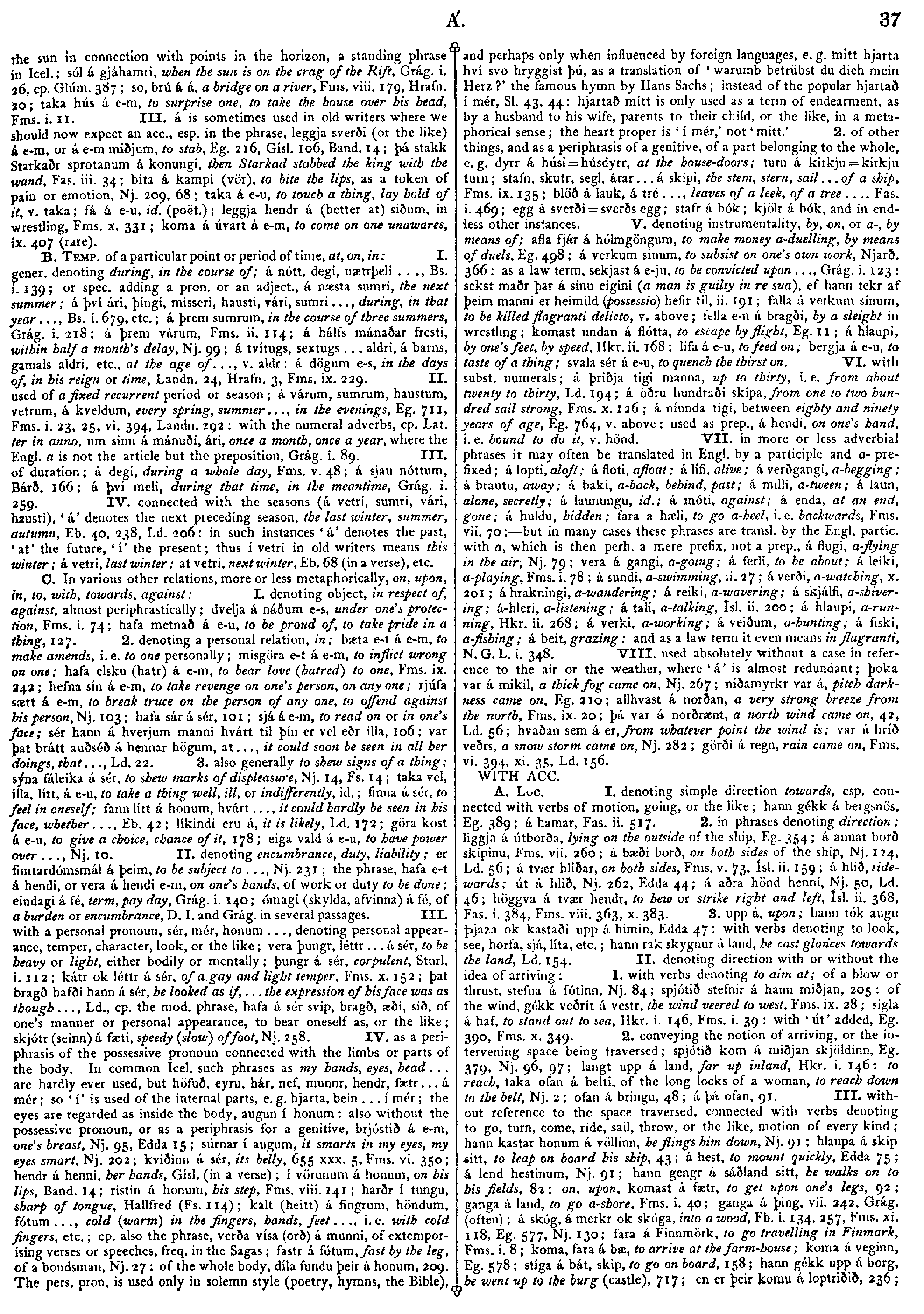
C. In various other relations, more or less metaphorically, on, upon, in, to, with, towards, against: I. denoting object, in respect of, against, almost periphrastically; dvelja á náðum e-s, under one's protection, Fms. i. 74; hafa metnað á e-u, to be proud of, to take pride in a thing, 127. 2. denoting a personal relation, in; bæta e-t á e-m, to make amends, i.e. to one personally; misgöra e-t á e-m, to inflict wrong on one; hafa elsku (hatr) á e-m, to bear love (hatred) to one, Fms. ix. 242; hefna sín á e-m, to take revenge on one's person, on anyone; rjúfa sætt á e-m, to break truce on the person of any one, to offend against his person, Nj. 103; hafa sár á sér, 101; sjá á e-m, to read on or in one's face; sér hann á hverjum manni hvárt til þín er vel eðr illa, 106; var þat brátt auðséð á hennar högum, at ..., it could soon be seen in all her doings, that ..., Ld. 22. 3. also generally to shew signs of a thing; sýna fáleika á sér, to shew marks of displeasure, Nj. 14, Fs. 14; taka vel, illa, lítt, á e-u, to take a thing well, ill, or indifferently, id.; finna á sér, to feel in oneself; fann lítt á honum, hvárt ..., it could hardly be seen in his face, whether ..., Eb. 42; líkindi eru á, it is likely, Ld. 172; göra kost á e-u, to give a choice, chance of it, 178; eiga vald á e-u, to have power over ..., Nj. 10. II. denoting encumbrance, duty, liability; er fimtardómsmál á þeim, to be subject to ..., Nj. 231; the phrase, hafa e-t á hendi, or vera á hendi e-m, on one's hands, of work or duty to be done; eindagi á fé, term, pay day, Grág. i. 140; ómagi (skylda, afvinna) á fé, of a burden or encumbrance, D. I. and Grág. in several passages. III. with a personal pronoun, sér, mér, honum ..., denoting personal appearance, temper, character, look, or the like; vera þungr, léttr ... á sér, to be heavy or light, either bodily or mentally; þungr á sér, corpulent, Sturl. i. 112; kátr ok léttr á sér, of a gay and light temper, Fms. x. 152; þat bragð hafði hann á sér, he looked as if, ... the expression of his face was as though ..., Ld., cp. the mod. phrase, hafa á sér svip, bragð, æði, sið, of one's manner or personal appearance, to bear oneself as, or the like; skjótr (seinn) á fæti, speedy (slow) of foot, Nj. 258. IV. as a periphrasis of the possessive pronoun connected with the limbs or parts of the body. In common Icel. such phrases as my hands, eyes, head ... are hardly ever used, but höfuð, eyru, hár, nef, munnr, hendr, faetr ... á mér; so 'í' is used of the internal parts, e.g. hjarta, bein ... í mér; the eyes are regarded as inside the body, augun í honum: also without the possessive pronoun, or as a periphrasis for a genitive, brjóstið á e-m, one's breast, Nj. 95, Edda 15; súrnar í augum, it smarts in my eyes, my eyes smart, Nj. 202; kviðinn á sér, its belly, 655 xxx. 5, Fms. vi. 350; hendr á henni, her hands, Gísl. (in a verse); í vörunum á honum, on his lips, Band. 14; ristin á honum, his step, Fms. viii. 141; harðr í tungu, sharp of tongue, Hallfred (Fs. 114); kalt (heitt) á fingrum, höndum, fótum ..., cold (warm) in the fingers, hands, feet ..., i.e. with cold fingers, etc.; cp. also the phrase, verða vísa (orð) á munni, of extemporising verses or speeches, freq. in the Sagas; fastr á fótum, fast by the leg, of a bondsman, Nj. 27: of the whole body, díla fundu þeir á honum, 209. The pers. pron. is used only in solemn style (poetry, hymns, the Bible), and perhaps only when influenced by foreign languages, e.g. mitt hjarta hví svo hryggist þú, as a translation of 'warumb betrübst du dich mein Herz?' the famous hymn by Hans Sachs; instead of the popular hjartað í mér, Sl. 43, 44: hjartað mitt is only used as a term of endearment, as by a husband to his wife, parents to their child, or the like, in a metaphorical sense; the heart proper is 'í mér,' not 'mitt.' 2. of other things, and as a periphrasis of a genitive, of a part belonging to the whole, e.g. dyrr á husi = húsdyrr, at the house-doors; turn á kirkju = kirkju turn; stafn, skutr, segl, árar ... á skipi, the stem, stern, sail ... of a ship, Fms. ix. 135; blöð á lauk, á tré ..., leaves of a leek, of a tree ..., Fas. i. 469; egg á sverði = sverðs egg; stafr á bók; kjölr á bók, and in endless other instances. V. denoting instrumentality, by, on, or a-, by means of; afla fjár á hólmgöngum, to make money a-duelling, by means of duels, Eg. 498; á verkum sínum, to subsist on one's own work, Njarð. 366: as a law term, sekjast á e-ju, to be convicted upon ..., Grág. i. 123; sekst maðr þar á sínu eigini (a man is guilty in re sua), ef hann tekr af þeim manni er heimild (possessio) hefir til, ii. 191; falla á verkum sínum, to be killed flagranti delicto, v. above; fella e-n á bragði, by a sleight in wrestling; komast undan á flótta, to escape by flight, Eg. 11; á hlaupi, by one's feet, by speed, Hkr. ii. 168; lifa á e-u, to feed on; bergja á e-u, to taste of a thing; svala sér á e-u, to quench the thirst on. VI. with subst. numerals; á þriðja tigi manna, up to thirty, i.e. from about twenty to thirty, Ld. 194; á öðru hundraði skipa, from one to two hundred sail strong, Fms. x. 126; á níunda tigi, between eighty and ninety years of age, Eg. 764, v. above: used as prep., á hendi, on one's hand, i.e. bound to do it, v. hönd. VII. in more or less adverbial phrases it may often be translated in Engl. by a participle and a- prefixed; á lopti, aloft; á floti, afloat; á lífi, alive; á verðgangi, a-begging; á brautu, away; á baki, a-back, behind, past; á milli, a-tween; á laun, alone, secretly; á launungu, id.; á móti, against; á enda, at an end, gone; á huldu, hidden; fara á hæli, to go a-heel, i.e. backwards, Fms. vii. 70; -- but in many cases these phrases are transl. by the Engl. partic. with a, which is then perh. a mere prefix, not a prep., á flugi, a-flying in the air, Nj. 79; vera á gangi, a-going; á ferli, to be about; á leiki, a-playing, Fms. i. 78; á sundi, a-swimming, ii. 27; á verði, a-watching, x. 201; á hrakningi, a-wandering; á reiki, a-wavering; á skjálfi, a-shivering; á-hleri, a-listening; á tali, a-talking, Ísl. ii. 200; á hlaupi, a-running, Hkr. ii. 268; á verki, a-working; á veiðum, a-hunting; á fiski, a-fishing; á beit, grazing: and as a law term it even means in flagranti, N. G. L. i. 348. VIII. used absolutely without a case in reference to the air or the weather, where 'á' is almost redundant; þoka var á mikil, a thick fog came on, Nj. 267; niðamyrkr var á, pitch darkness came on, Eg. 210; allhvast á norðan, a very strong breeze from the north, Fms. ix. 20; þá var á norðrænt, a north wind came on, 42, Ld. 56; hvaðan sem á er, from whatever point the wind is; var á hríð veðrs, a snow storm came on, Nj. 282; görði á regn, rain came on, Fms. vi. 394, xi. 35, Ld. 156.
|
Source: Cleasby/Vigfusson, page b0056, entry 31 View original page image as: [TIFF] [PNG] [View previous entry] [View next entry] |
[Comment on this entry] [View comments] |
The following entry has not been hand-corrected. However, the page is reserved and someone is correcting it. |
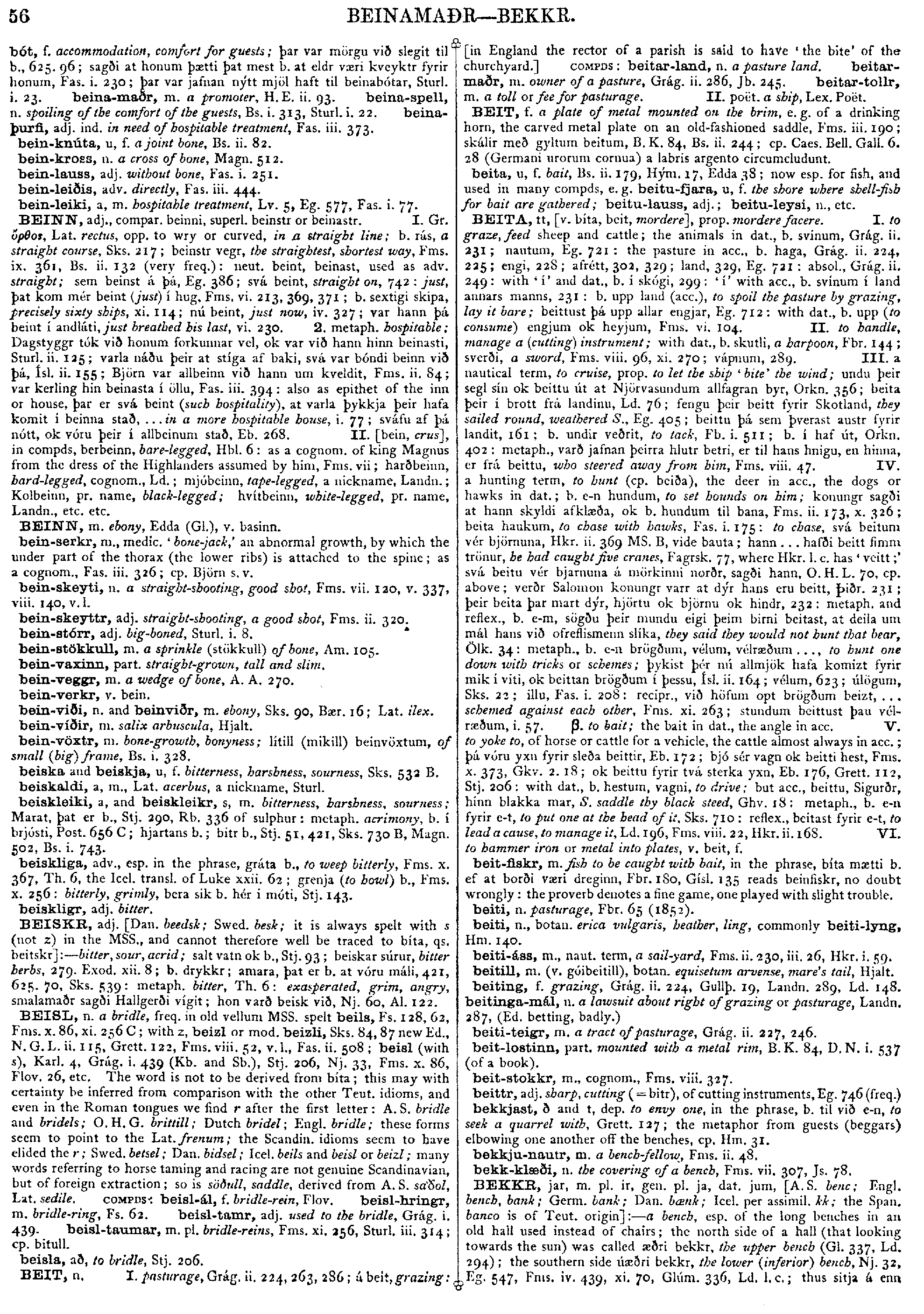
BEITA, tt, [v. bita, beit, mordere], prop, mordere facer e. I. t o graze, feed sheep and cattle; the animals in dat., b. svínum, Grág. ii. 231; nautum, Eg. 721: the pasture in acc., b. haga, Grág. ii. 224, 225; engi, 228; afrétt, 302, 329; land, 329, Eg. 721: absol., Grág. ii. 249: with ' i' and dat., b. í skógi, 299: ' í' with acc., b. svínum í land annars manns, 231: b. upp land (acc.), t o s poil the pasture by grazing, lay it bare; beittust þá upp allar engjar, Eg. 712: with dat., b. upp (t o consume) engjum ok heyjum, Fms. vi. 104. II. to handle, manage a (cutting) instrument; with dat., b. skutli, a harpoon, Fbr. 144; sverði, a sword, Fms. viii. 96, xi. 270; vápnum, 289. III. a nautical term, to cruise, prop, to let the ship 'bite' the wind; undu þeir segl sin ok beittu út at Njcirvasundum allfagran byr, Orkn. 356; beita þeir í brott frá landinu, Ld. 76; fengu þeir beitt fyrir Skotland, the y sailed round, weathered S., Eg. 405; beittu þá sem þverast austr fyrir landit, 161; b. undir veðrit, to tack, Vb. i. 511; b. í haf út, Orkn. 402: metaph., varð jafnan þeirra hlutr betri, er til hans hnigu, en hinna, er frá beittu, who steered away from him, Fms. viii. 47. IV. a hunting term, to bunt (cp. bciða), the deer in acc., the dogs or hawks in dat.; b. e-n hundum, to set hounds on him; konungr sagði at hann skyldi afklæða, ok b. hundum til bana, Fms. ii. 173, x. 326; beita haukum, to chase with hawks, Fas. 1. 175: to chase, svá beitum vér björnuna, Hkr. ii. 369 MS. B, vide bauta; hann ... hafði beitt fimm trönur, be had caught Jîve cranes, Fagrsk. 77, where Hkr. 1. c. has ' veitt;' svá beitu vér bjarnuna á mörkinni norðr, sagði hann, O. H. L. 70, cp. above; verðr Salomon konungr varr at dýr hans eru beitt, biðr. 231; þeir beita bar mart dýr, hjörtu ok bjornu ok hindr, 232: metaph. and reflex., b. e-m, sögðu þeir mundu eigi þeim birni bcitast, at deila um mál hans við ofreflismenn slika, the y sa id the y would not bunt that bear, 01k. 34: metaph., b. e-n brügðum, vélum, vólræðum..., to hunt one down with tricks or schemes; þykist þér nú allmjök hafa komizt fyrir mik í viti, ok beittan brögðum í þessu, Ísl. ii. 164; vélum, 623; lilögum, Sks. 22; illu, Fas. i. 208: recipr., við höfum opt brögðum beizt, ... schemed against each other, Fms. xi. 263; stundum beittust þau vel- ræðum, i. 57. p. to bait; the bait in dat., the angle in acc. V. to yoke to, of horse or cattle for a vehicle, the cattle almost always in acc.; þá vóru yxn fyrir sleða beittir, Eb. 172; bjó sér vagn ok beitti hest, Fms. x. 373, Gkv. 2. 18; ok beittu fyrir tvá sterka yxn, Eb. 176, Grett. 112, Stj. 206: with dat., b. hestum, vagni, to drive; but acc., beittu, Sigurðr, hinn blakka mar, S. saddle thy black steed, Ghv. 18: metaph., b. e-n fyrir e-t, to pwto ne at the head of it, Sks. 710: reflex., beitast fyrir e-t, t o lead a cause, to manage it, Ld. 196, Fms. viii. 22, Hkr. ii. 168. VI. to hammer iron or metal intoplates, v. beit,
|
Source: Cleasby/Vigfusson, page b0080, entry 36 View original page image as: [TIFF] [PNG] [View previous entry] [View next entry] |
[Comment on this entry] [View comments] |
The following entry has been hand-corrected once. |
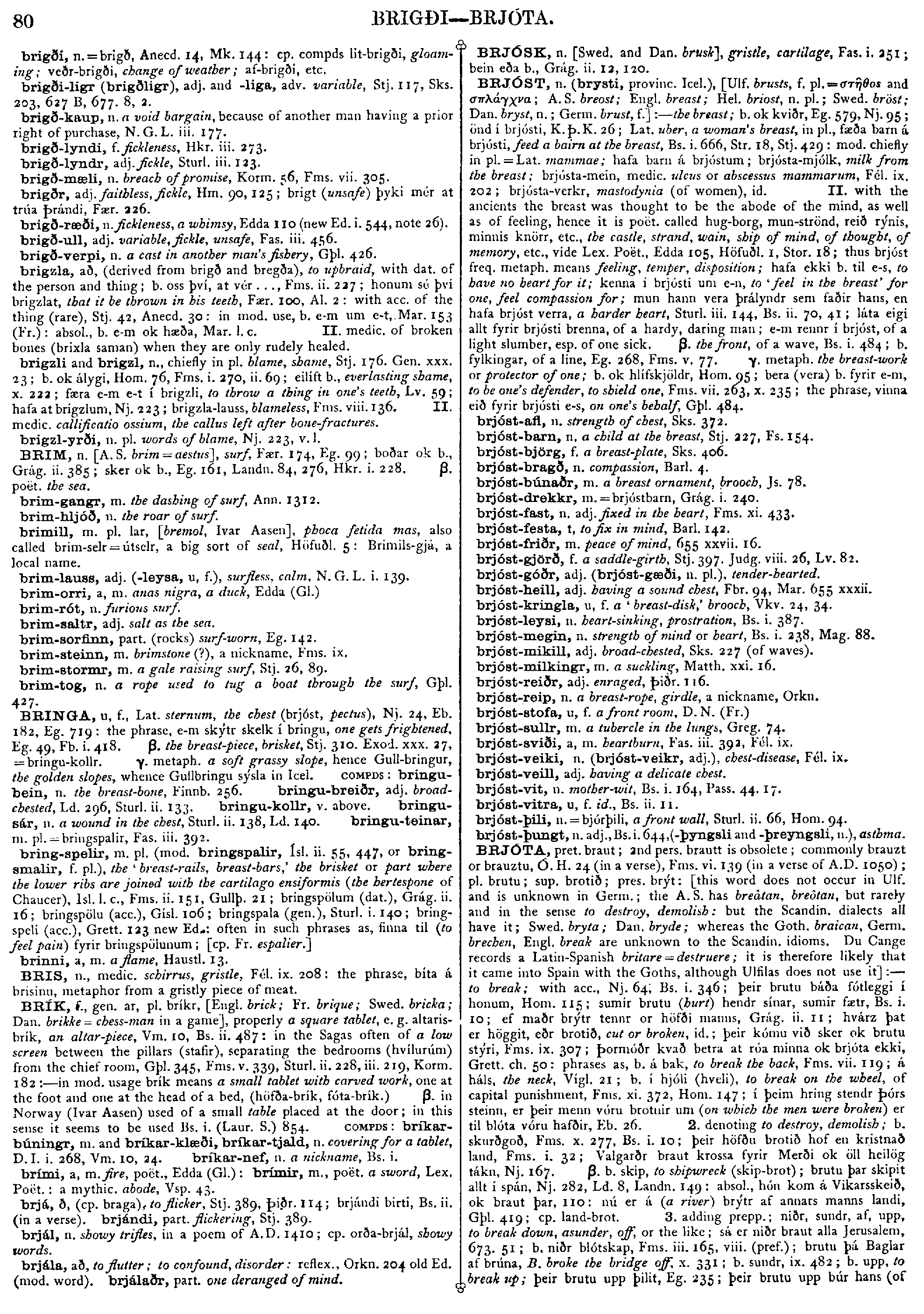
BRJÓST,
n.
(brysti,
provinc.
Icel.),
[Ulf.
brusts,
f.
pl.
=
GREEK
and
GREEK;
A.
S.
breost;
Engl.
breast;
Hel.
briost,
n.
pl.;
Swed.
bröst;
Dan.
bryst,
n.;
Germ,
brust,
f.]
:--
the
breast;
b.
ok
kviðr,
Eg.
579,
Nj.
95;
önd
í
brjósti,
K.
Þ.
K.
26;
Lat.
uber,
a
woman's
breast,
in
pl.,
fæða
barn
á
brjósti,
feed
a
bairn
at
the
breast,
Bs.
i.
666,
Str.
18,
Stj.
429:
mod.
chiefly
in
pl.
=
Lat.
mammae;
hafa
barn
á
brjóstum;
brjósta-mjólk,
milk
from
the
breast;
brjósta-mein,
medic.
ulcus
or
abscessus
mammarum,
Fél.
ix.
202;
brjósta-verkr,
mastodynia
(of
women),
id.
II.
with
the
ancients
the
breast
was
thought
to
be
the
abode
of
the
mind,
as
well
as
of
feeling,
hence
it
is
poët,
called
hug-borg,
mun-strönd,
reið
rýnis,
minnis
knörr,
etc.,
the
castle,
strand,
wain,
ship
of
mind,
of
thought,
of
memory,
etc.,
vide
Lex.
Poët.,
Edda
105,
Höfuðl.
1,
Stor.
18;
thus
brjóst
freq.
metaph.
means
feeling,
temper,
disposition;
hafa
ekki
b.
til
e-s,
to
have
no
heart
for
it;
kenna
í
brjósti
um
e-n,
to
'feel
in
the
breast'
for
one,
feel
compassion
for;
mun
hann
vera
þrályndr
sem
faðir
hans,
en
hafa
brjóst
verra,
a
harder
heart,
Sturl.
iii.
144,
Bs.
ii.
70,
41;
láta
eigi
allt
fyrir
brjósti
brenna,
of
a
hardy,
daring
man;
e-m
rennr
í
brjóst,
of
a
light
slumber,
esp.
of
one
sick.
 .
the
front,
of
a
wave,
Bs.
i.
484;
b.
fylkingar,
of
a
line,
Eg.
268,
Fms.
v.
77.
.
the
front,
of
a
wave,
Bs.
i.
484;
b.
fylkingar,
of
a
line,
Eg.
268,
Fms.
v.
77.
 .
metaph.
the
breast-work
or
protector
of
one;
b.
ok
hlífskjöldr,
Hom.
95;
bera
(vera)
b.
fyrir
e-m,
to
be
one's
defender,
to
shield
one,
Fms.
vii.
263,
x.
235;
the
phrase,
vinna
eið
fyrir
brjósti
e-s,
on
one's
behalf,
Gþl.
484.
.
metaph.
the
breast-work
or
protector
of
one;
b.
ok
hlífskjöldr,
Hom.
95;
bera
(vera)
b.
fyrir
e-m,
to
be
one's
defender,
to
shield
one,
Fms.
vii.
263,
x.
235;
the
phrase,
vinna
eið
fyrir
brjósti
e-s,
on
one's
behalf,
Gþl.
484.
|
Source: Cleasby/Vigfusson, page b0125, entry 27 View original page image as: [TIFF] [PNG] [View previous entry] [View next entry] |
[Comment on this entry] [View comments] |
The following entry has been hand-corrected once. |
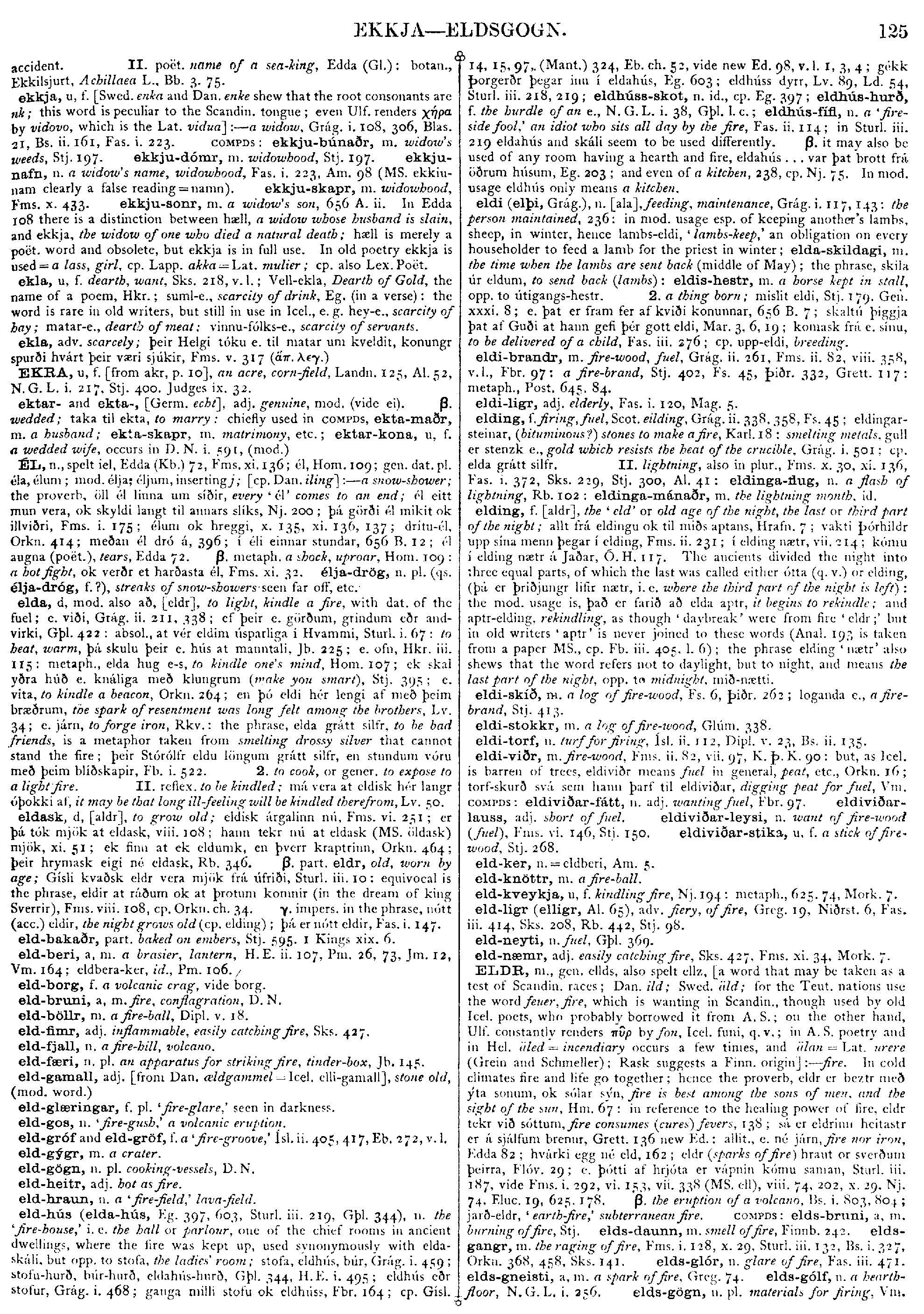
eldi (elþi, Grág.), n. [ala], feeding, maintenance, Grág. i. ii 7, 143: the person maintained, 236: in mod. usage esp. of keeping another's lambs, sheep, in winter, hence lambs-eldi, 'lambs-keep,' an obligation on every householder to feed a lamb for the priest in winter; elda-skildagi, m. the time when the lambs are sent back (middle of May); the phrase, skila úr eldum, to send back (lambs): eldis-hestr, m. a horse kept in stall, opp. to útigangs-hestr. 2. a thing born; mislit eldi, Stj. 179. Gen. xxxi. 8; e. þat er fram fer af kviði konunnar, 656 B. 7; skaltú þiggja þat at Guði at hann gefi þér gott eldi, Mar. 3, 6, 19; komask frá e. sínu, to be delivered of a child, Fas. iii. 276; cp. upp-eldi, breeding.
|
Source: Cleasby/Vigfusson, page b0150, entry 11 View original page image as: [TIFF] [PNG] [View previous entry] [View next entry] |
[Comment on this entry] [View comments] |
The following entry has been hand-corrected once. |
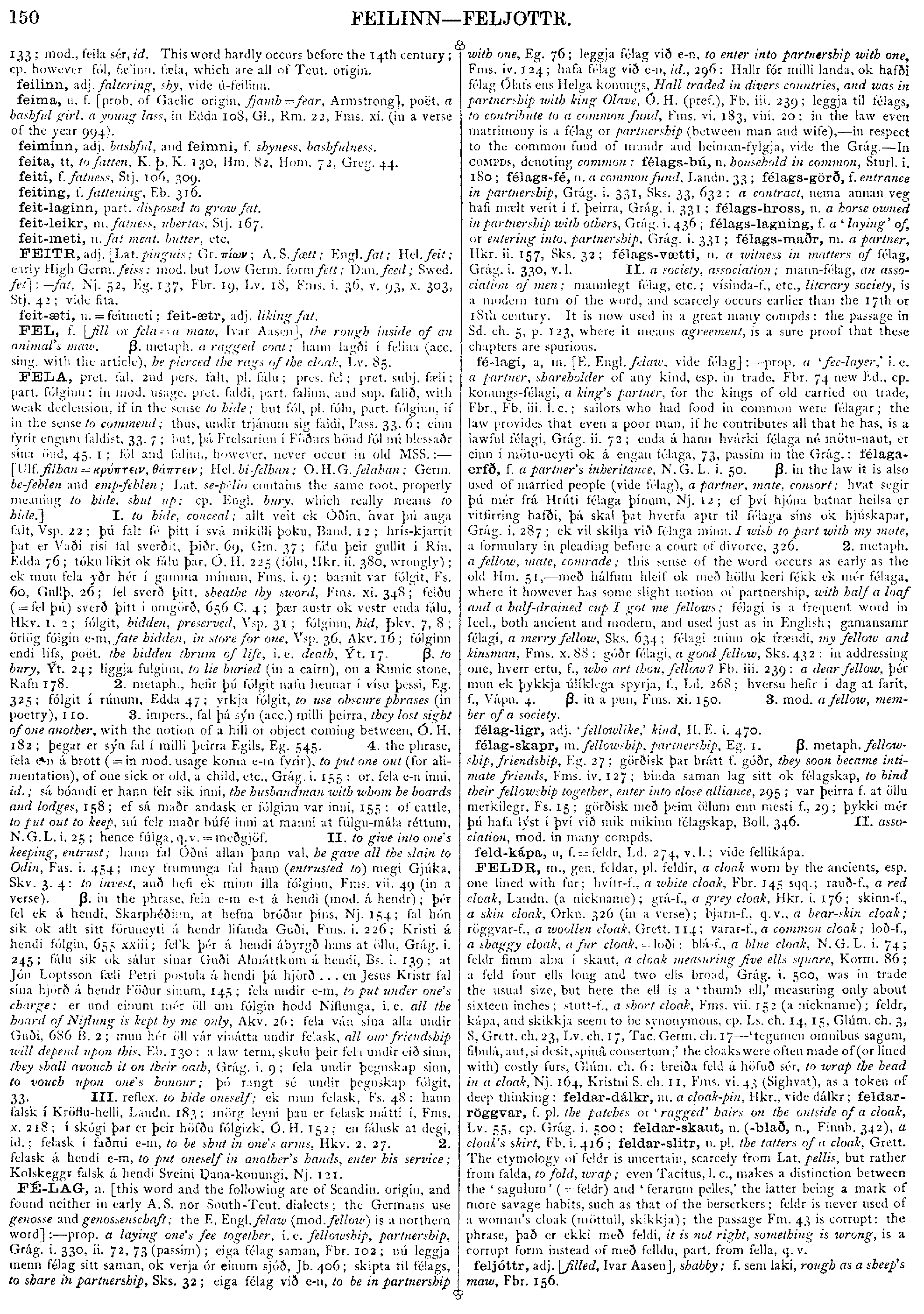
FEITR, adj. [Lat. pinguis; Gr. GREEK; A. S. fætt; Engl. fat; Hel. feit; early High Germ. feiss; mod. but Low Germ. form fett; Dan. feed; Swed. fet] :-- fat, Nj. 52, Eg. 137, Fbr. 19, Lv. 18, Fms. i. 36, v. 93, x. 303, Stj. 42; vide fita.
|
Source: Cleasby/Vigfusson, page b0184, entry 22 View original page image as: [TIFF] [PNG] [View previous entry] [View next entry] |
[Comment on this entry] [View comments] |
The following entry has been hand-corrected once. |
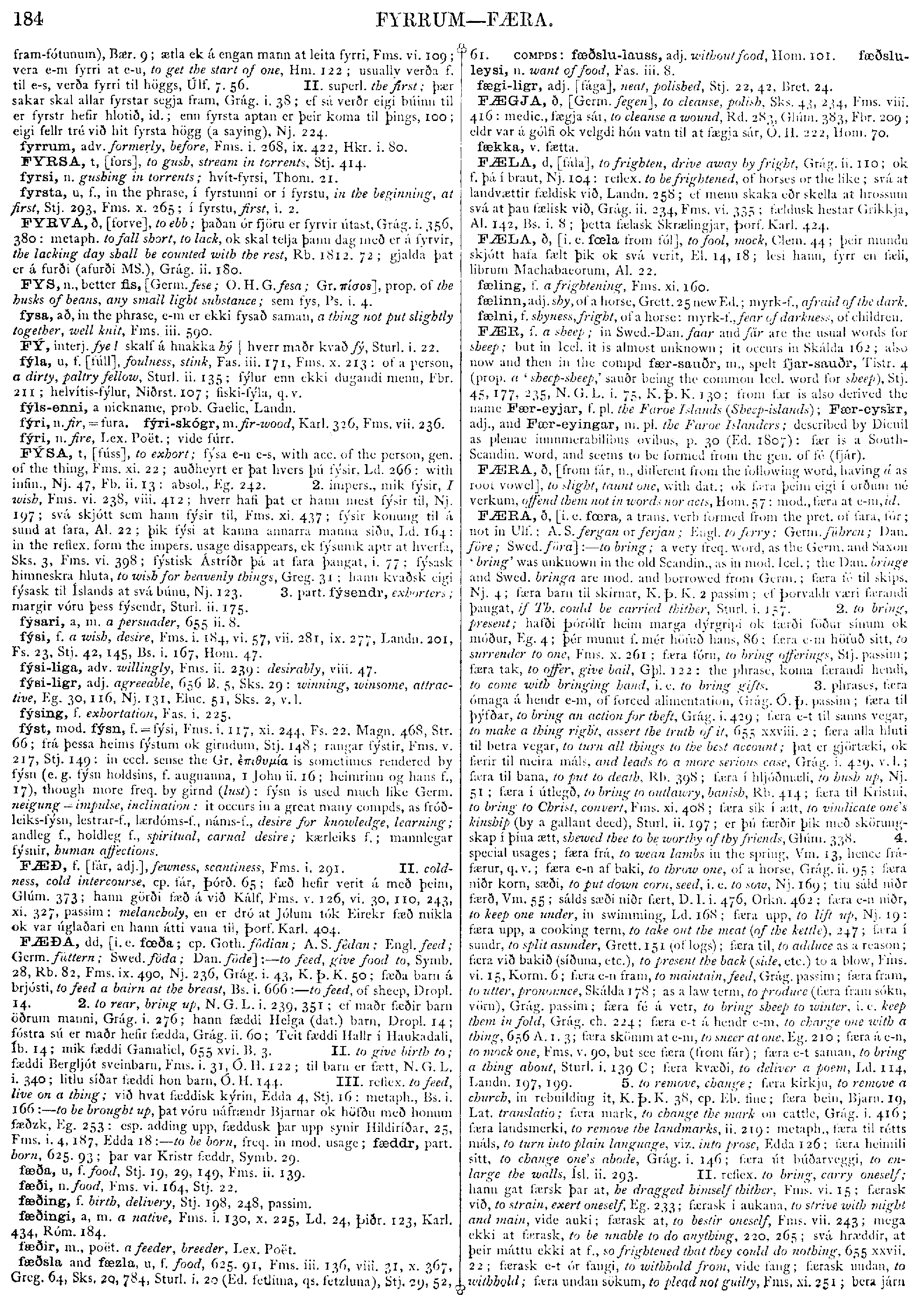
FÆÐA, dd, [i.e. fœða; cp. Goth. fôdian; A. S. fêdan; Engl. feed; Germ. füttern; Swed. föda; Dan. föde] :-- to feed, give food to, Symb. 28, Rb. 82, Fms. ix. 490, Nj. 236, Grág. i. 43, K. Þ. K. 50; fæða barn á brjósti, to feed a bairn at the breast, Bs. i. 666 :-- to feed, of sheep, Dropl. 14. 2. to rear, bring up, N. G. L. i. 239, 351; ef maðr fæðir barn öðrum manni, Grág. i. 276; hann fæddi Helga (dat.) barn, Dropl. 14; fóstra sú er maðr hefir fædda, Grág. ii. 60; Teit faddi Hallr í Haukadali, Íb. 14; mik fæddi Gamaliel, 655 xvi. B. 3. II. to give birth to; faddi Bergljót sveinbarn, Fms. i. 31, Ó. H. 122; til barn er fætt, N. G. L. i. 340; litlu síðar fæddi hon barn, Ó. H. 144. III. reflex. to feed, live on a thing; við hvat fæddisk kýrin, Edda 4, Stj. 16: metaph., Bs. i. 166 :-- to be brought up, þat vóru náfrændr Bjarnar ok höfðu með honum fæðzk, Eg. 253: esp. adding upp, fæddusk þar upp synir Hildiríðar, 25, Fms. i. 4, 187, Edda 18 :-- to be born, freq. in mod. usage; fæddr, part. born, 625. 93; þar var Kristr fæddr, Symb. 29.
|
Source: Cleasby/Vigfusson, page b0184, entry 39 View original page image as: [TIFF] [PNG] [View previous entry] [View next entry] |
[Comment on this entry] [View comments] |
The following entry has been hand-corrected once. |
FÆRA, ð, [i.e. fœra, a trans. verb formed from the pret. of fara, fór; not in Ulf.; A. S. fergan or ferjan; Engl. to ferry; Germ. führen; Dan. före; Swed. föra] :-- to bring; a very freq. word, as the Germ. and Saxon 'bring' was unknown in the old Scandin., as in mod. Icel.; the Dan. bringe and Swed. bringa are mod. and borrowed from Germ.; færa fé til skips, Nj. 4; færa barn til skírnar, K. Þ. K. 2 passim; ef Þorvaldr væri færandi þangat, if Th. could be carried thither, Sturl. i. 157. 2. to bring, present; hafði Þórólfr heim marga dýrgripi ok færði föður sínum ok móður, Eg. 4; þér munut f. mér höfuð hans, 86; færa e-m höfuð sitt, to surrender to one, Fms. x. 261; færa fórn, to bring offerings, Stj. passim; færa tak, to offer, give bail, Gþl. 122: the phrase, koma færandi hendi, to come with bringing hand, i.e. to bring gifts. 3. phrases, færa ómaga á hendr e-m, of forced alimentation, Grág. Ó. Þ. passim; færa til þýfðar, to bring an action for theft, Grág. i. 429; færa e-t til sanns vegar, to make a thing right, assert the truth of it, 655 xxviii. 2; færa alla hluti til betra vegar, to turn all things to the best account; þat er gjörtæki, ok færir til meira máls, and leads to a more serious case, Grág. i. 429, v.l.; færa til bana, to put to death, Rb. 398; færa í hljóðmæli, to hush up, Nj. 51; færa í útlegð, to bring to outlawry, banish, Rb. 414; færa til Kristni, to bring to Christ, convert, Fms. xi. 408; færa sik í ætt, to vindicate one's kinship (by a gallant deed), Sturl. ii. 197; er þú færðir þik með skörungskap í þína ætt, shewed thee to be worthy of thy friends, Glúm. 338. 4. special usages; færa frá, to wean lambs in the spring, Vm. 13, hence frá-færur, q.v.; færa e-n af baki, to throw one, of a horse, Grág. ii. 95: færa niðr korn, sæði, to put down corn, seed, i.e. to sow, Nj. 169; tiu sáld niðr færð, Vm. 55; sálds sæði niðr fært, D. I. i. 476, Orkn. 462; færa e-n niðr, to keep one under, in swimming, Ld. 168; færa upp, to lift up, Nj. 19: færa upp, a cooking term, to take out the meat (of the kettle), 247; færa í sundr, to split asunder, Grett. 151 (of logs); færa til, to adduce as a reason; færa við bakið (síðuna, etc.), to present the back (side, etc.) to a blow, Fms. vi. 15, Korm. 6; færa e-n fram, to maintain, feed, Grág. passim; færa fram, to utter, pronounce, Skálda 178; as a law term, to produce (færa fram sókn, vörn), Grág. passim; færa fé á vetr, to bring sheep to winter, i.e. keep them in fold, Grág. ch. 224; færa e-t á hendr e-m, to charge one with a thing, 656 A. 1. 3; færa skömm at e-m, to sneer at one, Eg. 210; færa á e-n, to mock one, Fms. v. 90, but see færa (from fár); færa e-t saman, to bring a thing about, Sturl. i. 139 C; færa kvæði, to deliver a poem, Ld. 114, Landn. 197, 199. 5. to remove, change; færa kirkju, to remove a church, in rebuilding it, K. Þ. K. 38, cp. Eb. fine; færa bein, Bjarn. 19, Lat. translatio; færa mark, to change the mark on cattle, Grág. i. 416; færa landsmerki, to remove the landmarks, ii. 219: metaph., færa til rétts máls, to turn into plain language, viz. into prose, Edda 126; færa heimili sitt, to change one's abode, Grág. i. 146; færa út búðarveggi, to enlarge the walls, Ísl. ii. 293. II. reflex. to bring, carry oneself; hann gat færsk þar at, he dragged himself thither, Fms. vi. 15; færask við, to strain, exert oneself, Eg. 233; færask í aukana, to strive with might and main, vide auki; færask at, to bestir oneself, Fms. vii. 243; mega ekki at færask, to be unable to do anything, 220, 265; svá hræddir, at þeir máttu ekki at f., so frightened that they could do nothing, 655 xxvii. 22; færask e-t ór fangi, to withhold from, vide fang; færask undan, to withhold; færa undan sökum, to plead not guilty, Fms. xi. 251; bera járn
|
Source: Cleasby/Vigfusson, page b0197, entry 31 View original page image as: [TIFF] [PNG] [View previous entry] [View next entry] |
[Comment on this entry] [View comments] |
The following entry has been hand-corrected once. |
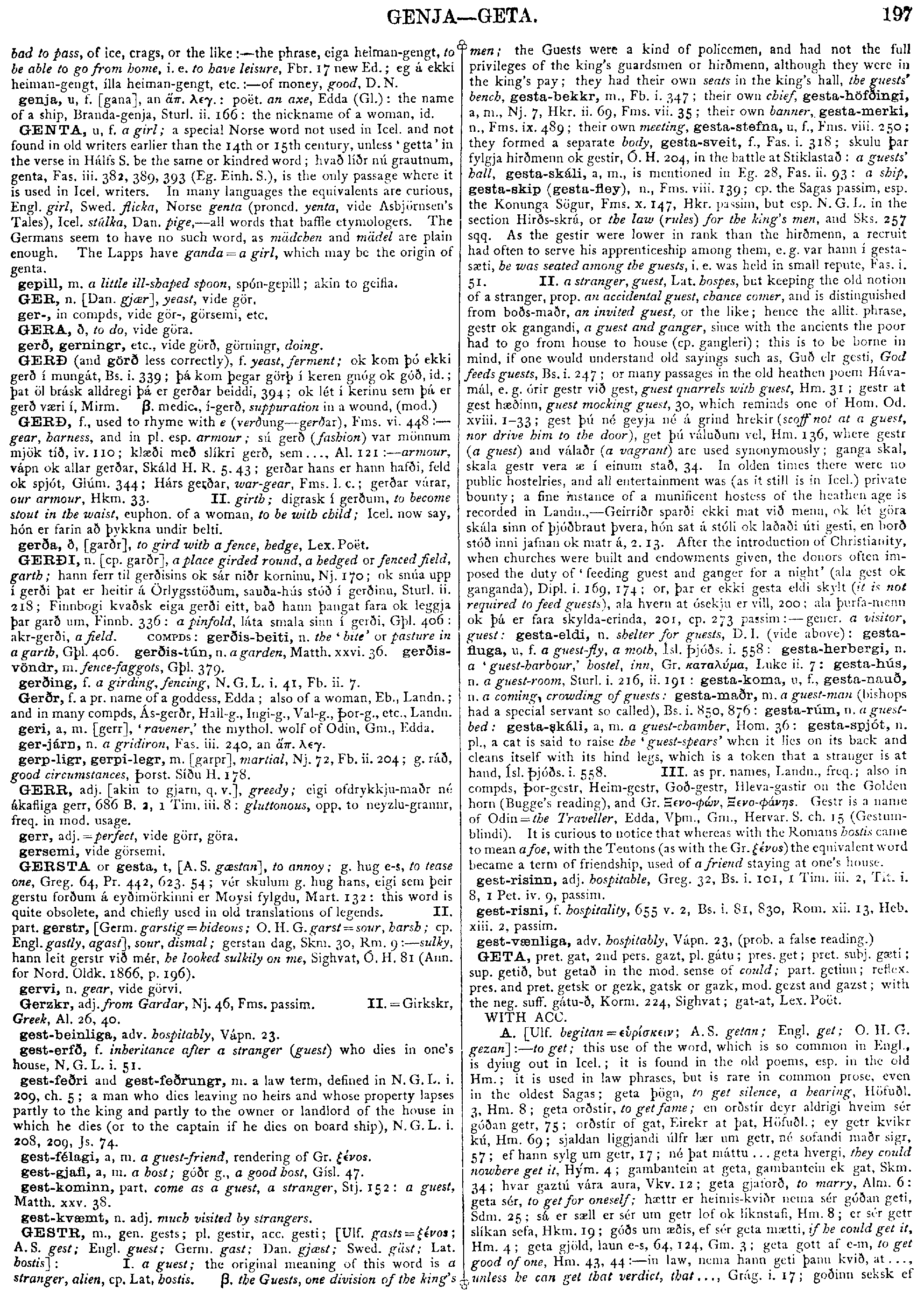
GESTR,
m.,
gen.
gests;
pl.
gestir,
acc.
gesti;
[Ulf.
gasts
=
GREEK;
A.
S.
gest;
Engl.
guest;
Germ.
gast;
Dan.
gjæst;
Swed.
gäst;
Lat.
hostis]:
I.
a
guest;
the
original
meaning
of
this
word
is
a
stranger,
alien,
cp.
Lat.
hostis.
.
the
Guests,
one
division
of
the
king's
men;
the
Guests
were
a
kind
of
policemen,
and
had
not
the
full
privileges
of
the
king's
guardsmen
or
hirðmenn,
although
they
were
in
the
king's
pay;
they
had
their
own
seats
in
the
king's
hall,
the
guests'
bench,
gesta-bekkr,
m.,
Fb.
i.
347;
their
own
chief,
gesta-höfðingi,
a,
m.,
Nj.
7,
Hkr.
ii.
69,
Fms.
vii.
35;
their
own
banner,
gesta-merki,
n.,
Fms.
ix.
489;
their
own
meeting,
gesta-stefna,
u,
f.,
Fms.
viii.
250;
they
formed
a
separate
body,
gesta-sveit,
f.,
Fas.
i.
318;
skulu
þar
fylgja
hirðmenn
ok
gestir,
Ó.
H.
204,
in
the
battle
at
Stiklastað:
a
guests'
hall,
gesta-skáli,
a,
m.,
is
mentioned
in
Eg.
28,
Fas.
ii.
93:
a
ship,
gesta-skip
(gesta-fley),
n.,
Fms.
viii.
139;
cp.
the
Sagas
passim,
esp.
the
Konunga
Sögur,
Fms.
x.
147,
Hkr.
passim,
but
esp.
N.
G.
L.
in
the
section
Hirðs-skrá,
or
the
law
(rules)
for
the
king's
men,
and
Sks.
257
sqq.
As
the
gestir
were
lower
in
rank
than
the
hirðmenn,
a
recruit
had
often
to
serve
his
apprenticeship
among
them,
e.g.
var
hann
í
gestasæti,
he
was
seated
among
the
guests,
i.e.
was
held
in
small
repute,
Fas.
i.
51.
II.
a
stranger,
guest,
Lat.
hospes,
but
keeping
the
old
notion
of
a
stranger,
prop.
an
accidental
guest,
chance
comer,
and
is
distinguished
from
boðs-maðr,
an
invited
guest,
or
the
like;
hence
the
allit.
phrase,
gestr
ok
gangandi,
a
guest
and
ganger,
since
with
the
ancients
the
poor
had
to
go
from
house
to
house
(cp.
gangleri);
this
is
to
be
borne
in
mind,
if
one
would
understand
old
sayings
such
as,
Guð
elr
gesti,
God
feeds
guests,
Bs.
i.
247;
or
many
passages
in
the
old
heathen
poem
Hávamál,
e.g.
órir
gestr
við
gest,
guest
quarrels
with
guest,
Hm.
31;
gestr
at
gest
hæðinn,
guest
mocking
guest,
30,
which
reminds
one
of
Hom.
Od.
xviii.
1-33;
gest
þú
né
geyja
né
á
grind
hrekir
(scoff
not
at
a
guest,
nor
drive
him
to
the
door),
get
þú
váluðum
vel,
Hm.
136,
where
gestr
(a
guest)
and
válaðr
(a
vagrant)
are
used
synonymously;
ganga
skal,
skala
gestr
vera
æ
í
einum
stað,
34.
In
olden
times
there
were
no
public
hostelries,
and
all
entertainment
was
(as
it
still
is
in
Icel.)
private
bounty;
a
fine
instance
of
a
munificent
hostess
of
the
heathen
age
is
recorded
in
Landn.,
--
Geirríðr
sparði
ekki
mat
við
menn,
ok
lét
göra
skála
sinn
of
þjóðbraut
þvera,
hón
sat
á
stóli
ok
laðaði
úti
gesti,
en
borð
stóð
inni
jafnan
ok
matr
á,
2.
13.
After
the
introduction
of
Christianity,
when
churches
were
built
and
endowments
given,
the
donors
often
imposed
the
duty
of
'feeding
guest
and
ganger
for
a
night'
(ala
gest
ok
ganganda),
Dipl.
i.
169,
174;
or,
þar
er
ekki
gesta
eldi
skylt
(it
is
not
required
to
feed
guests),
ala
hvern
at
ósekju
er
vill,
200;
ala
þurfa-menn
ok
þá
er
fara
skylda-erinda,
201,
cp.
273
passim
:--
gener.
a
visitor,
guest:
gesta-eldi,
n.
shelter
for
guests,
D.
I.
(vide
above):
gesta-fluga,
u,
f.
a
guest-fly,
a
moth,
Ísl.
Þjóðs.
i.
558:
gesta-herbergi,
n.
a
'guest-harbour,'
hostel,
inn,
Gr.
GREEK,
Luke
ii.
7:
gesta-hús,
n.
a
guest-room,
Sturl.
i.
216,
ii.
191:
gesta-koma,
u,
f.,
gesta-nauð,
n.
a
coming,
crowding
of
guests:
gesta-maðr,
m.
a
guest-man
(bishops
had
a
special
servant
so
called),
Bs.
i.
850,
876:
gesta-rúm,
n.
a
guest-bed:
gesta-skáli,
a,
m.
a
guest-chamber,
Hom.
36:
gesta-spjót,
n.
pl.,
a
cat
is
said
to
raise
the
'guest-spears'
when
it
lies
on
its
back
and
cleans
itself
with
its
hind
legs,
which
is
a
token
that
a
stranger
is
at
hand,
Ísl.
Þjóðs.
i.
558.
III.
as
pr.
names,
Landn.,
freq.;
also
in
compds,
Þor-gestr,
Heim-gestr,
Goð-gestr,
Hleva-gastir
on
the
Golden
horn
(Bugge's
reading),
and
Gr.
GREEK,
GREEK.
Gestr
is
a
name
of
Odin
=
the
Traveller,
Edda,
Vþm.,
Gm.,
Hervar.
S.
ch.
15
(Gestum-blindi).
It
is
curious
to
notice
that
whereas
with
the
Romans
hostis
came
to
mean
a
foe,
with
the
Teutons
(as
with
the
Gr.
GREEK)
the
equivalent
word
became
a
term
of
friendship,
used
of
a
friend
staying
at
one's
house.
|
Source: Cleasby/Vigfusson, page b0323, entry 15 View original page image as: [TIFF] [PNG] [View previous entry] [View next entry] |
[Comment on this entry] [View comments] |
The following entry has been hand-corrected once. |
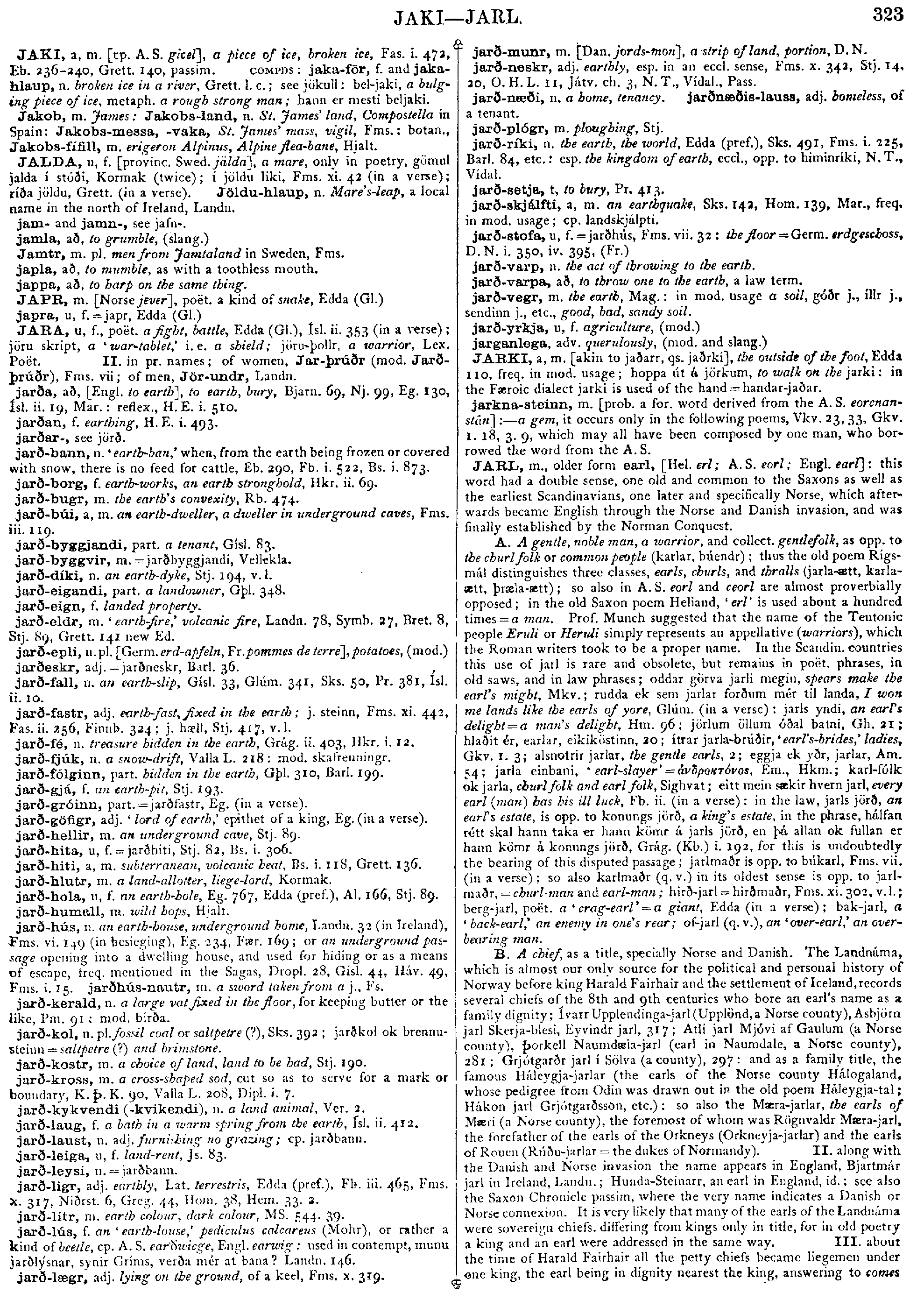
jarð-bann, n. 'earth-ban,' when, from the earth being frozen or covered with snow, there is no feed for cattle, Eb. 290, Fb. i. 522, Bs. i. 873.
|
Source: Cleasby/Vigfusson, page b0334, entry 62 View original page image as: [TIFF] [PNG] [View previous entry] [View next entry] |
[Comment on this entry] [View comments] |
The following entry has been hand-corrected once. |
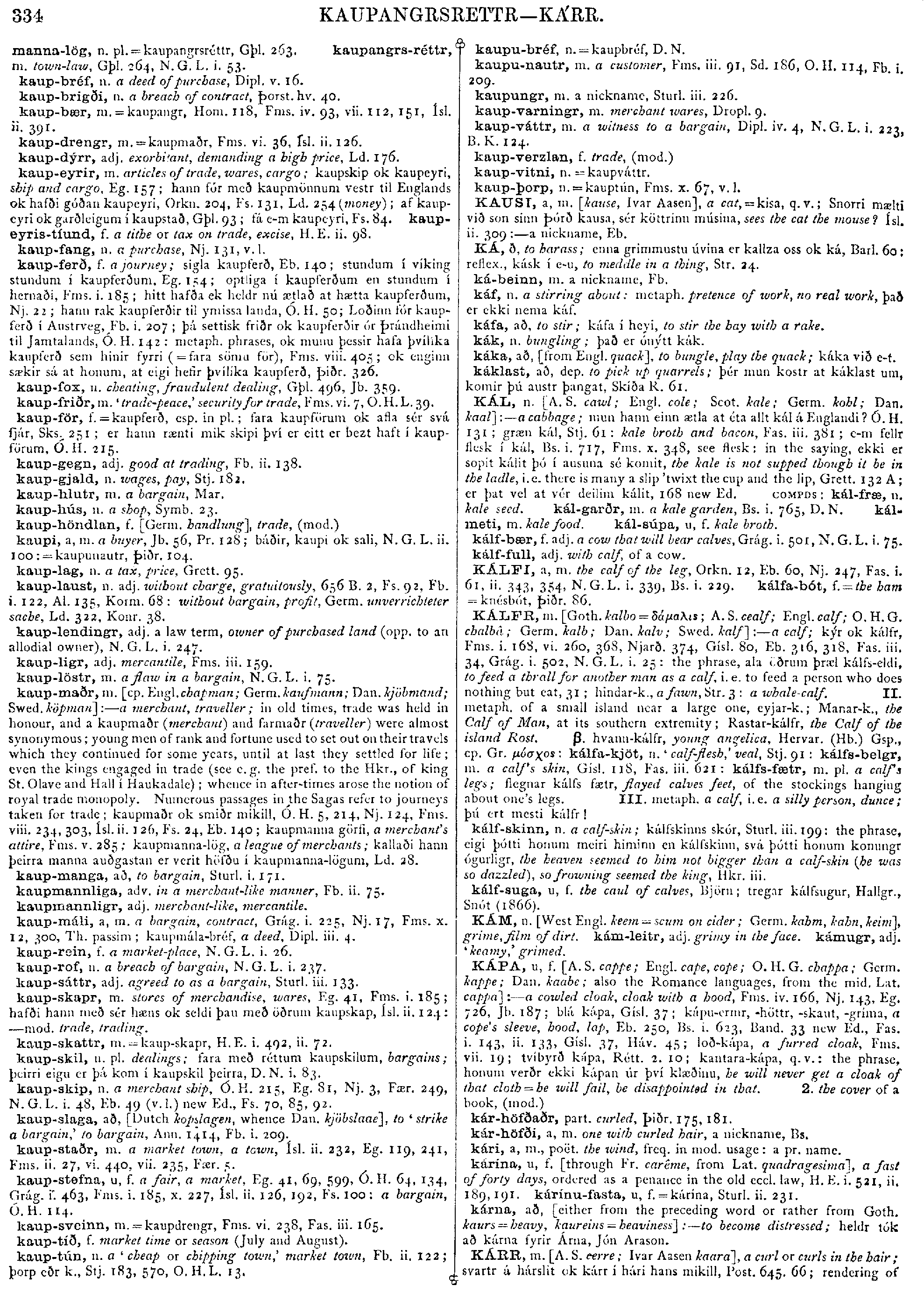
KÁLFR,
m.
[Goth.
kalbo
=
GREEK;
A.
S.
cealf;
Engl.
calf;
O.
H.
G.
chalbâ;
Germ.
kalb;
Dan.
kalv;
Swed.
kalf]
:--
a
calf;
kýr
ok
kálfr,
Fms.
i.
168,
vi.
260,
368,
Njarð.
374,
Gísl.
80,
Eb.
316,
318,
Fas.
iii.
34,
Grág.
i.
502,
N.
G.
L.
i.
25:
the
phrase,
ala
öðrum
þræl
kálfs-eldi,
to
feed
a
thrall
for
another
man
as
a
calf,
i.e.
to
feed
a
person
who
does
nothing
but
eat,
31;
hindar-k.,
a
fawn,
Str.
3:
a
whale-calf.
II.
metaph.
of
a
small
island
near
a
large
one,
eyjar-k.;
Manar-k.,
the
Calf
of
Man,
at
its
southern
extremity;
Rastar-kálfr,
the
Calf
of
the
island
Rost.
.
hvann-kálfr,
young
angelica,
Hervar.
(Hb.)
Gsp.,
cp.
Gr.
GREEK:
kálfa-kjöt,
n.
'calf-flesh,'
veal,
Stj.
91:
kálfs-belgr,
m.
a
calf's
skin,
Gísl.
118,
Fas.
iii.
621:
kálfs-fætr,
m.
pl.
a
calf's
legs;
flegnar
kálfs
fætr,
flayed
calves
feet,
of
the
stockings
hanging
about
one's
legs.
III.
metaph.
a
calf,
i.e.
a
silly
person,
dunce;
þú
ert
mesti
kálfr!
| Result Page: |  |
Previous | 1 2 3 4 5 6 7 | Next |  |
Germanic Lexicon Project (main page)
This search system was written by
Sean Crist
Please consider
volunteering
to correct the data in these online dictionaries.
No rights reserved. Feel free to use these data in any way you please.