|
|

|
Source: Wright's Gothic Grammar, page b0336, entry 5 View original page image as: [TIFF] [PNG] [View previous entry] [View next entry] |
[Comment on this entry] [View comments] |
The following entry has been hand-corrected once. |
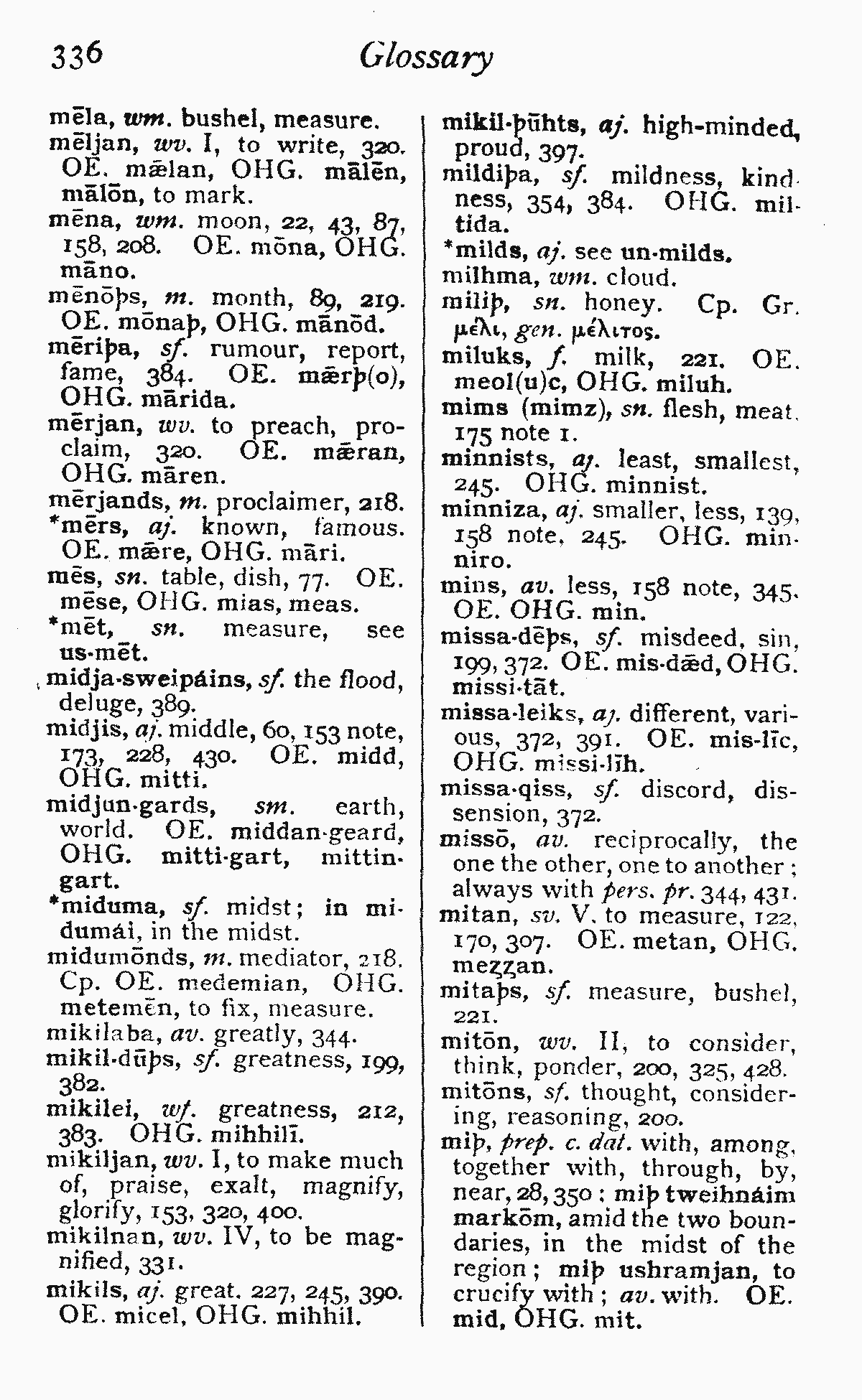
m riþa,
sf.
rumour,
report,
fame,
384.
OE.
m
riþa,
sf.
rumour,
report,
fame,
384.
OE.
m rþ(o),
OHG.
m
rþ(o),
OHG.
m rida.
rida.
|
Source: Bosworth/Toller, page b0001, entry 5 View original page image as: [TIFF] [PNG] [View previous entry] [View next entry] |
[Comment on this entry] [View comments] |
The following entry has been hand-corrected once. |
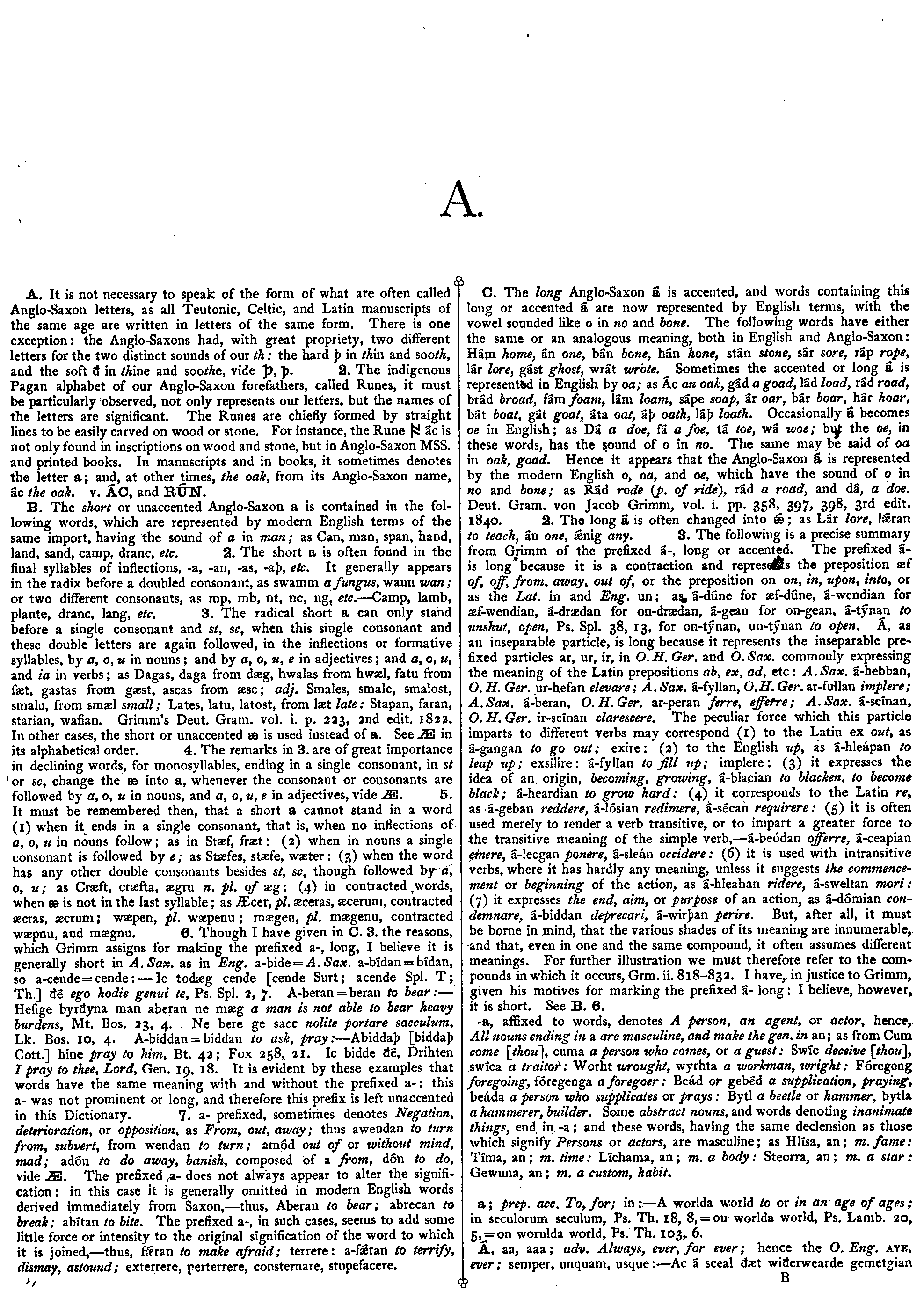
-a, affixed to words, denotes A person, an agent, or actor, hence, All nouns ending in a are masculine, and make the gen. in an; as from Cum come [thou], cuma a person who comes, or a guest: Swíc deceive [thou], swica a traitor: Worht wrought, wyrhta a workman, wright: Fóregeng foregoing, fóregenga a foregoer: Beád or gebéd a supplication, praying, beáda a person who supplicates or prays: Bytl a beetle or hammer, bytla a hammerer, builder. Some abstract nouns, and words denoting inanimate things, end in -a; and these words, having the same declension as those which signify Persons or actors, are masculine; as Hlísa, an; m. fame: Tíma, an; m. fame: Líchama, an; m. a body: Steorra, an; m. a star: Gewuna, an; m. a custom, habit.
|
Source: Bosworth/Toller, page b0007, entry 29 View original page image as: [TIFF] [PNG] [View previous entry] [View next entry] |
[Comment on this entry] [View comments] |
The following entry has been hand-corrected once. |
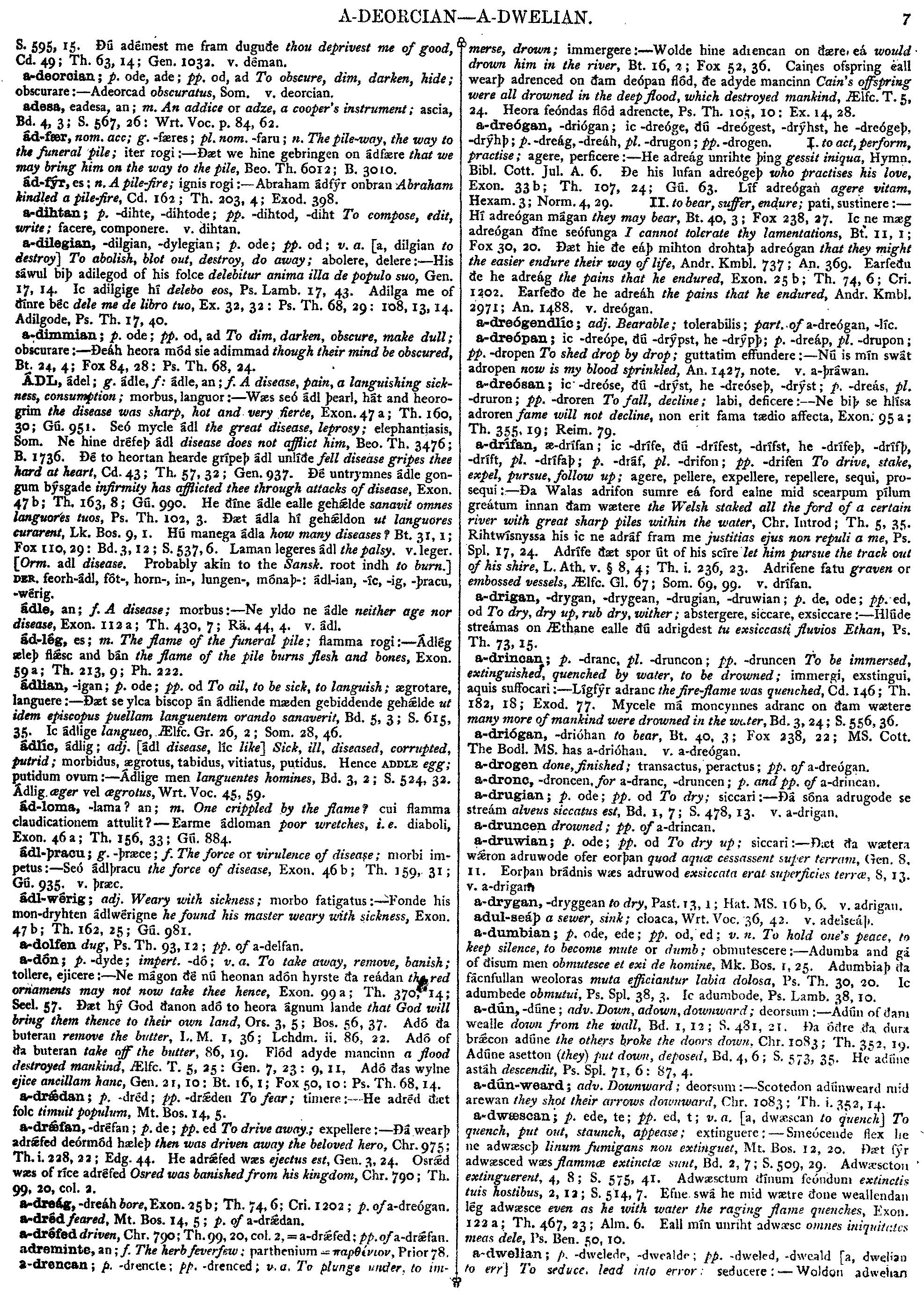
a-dreósan; ic -dreóse, ðú -drýst, he -dreóseþ, -drýst; p. -dreás, pl. -druron; pp. -droren To fall, decline; labi, deficere :-- Ne biþ se hlísa adroren fame will not decline, non erit fama tædio affecta, Exon. 95a; Th. 355, 19; Reim. 79.
|
Source: Bosworth/Toller, page b0069, entry 12 View original page image as: [TIFF] [PNG] [View previous entry] [View next entry] |
[Comment on this entry] [View comments] |
The following entry has been hand-corrected once. |
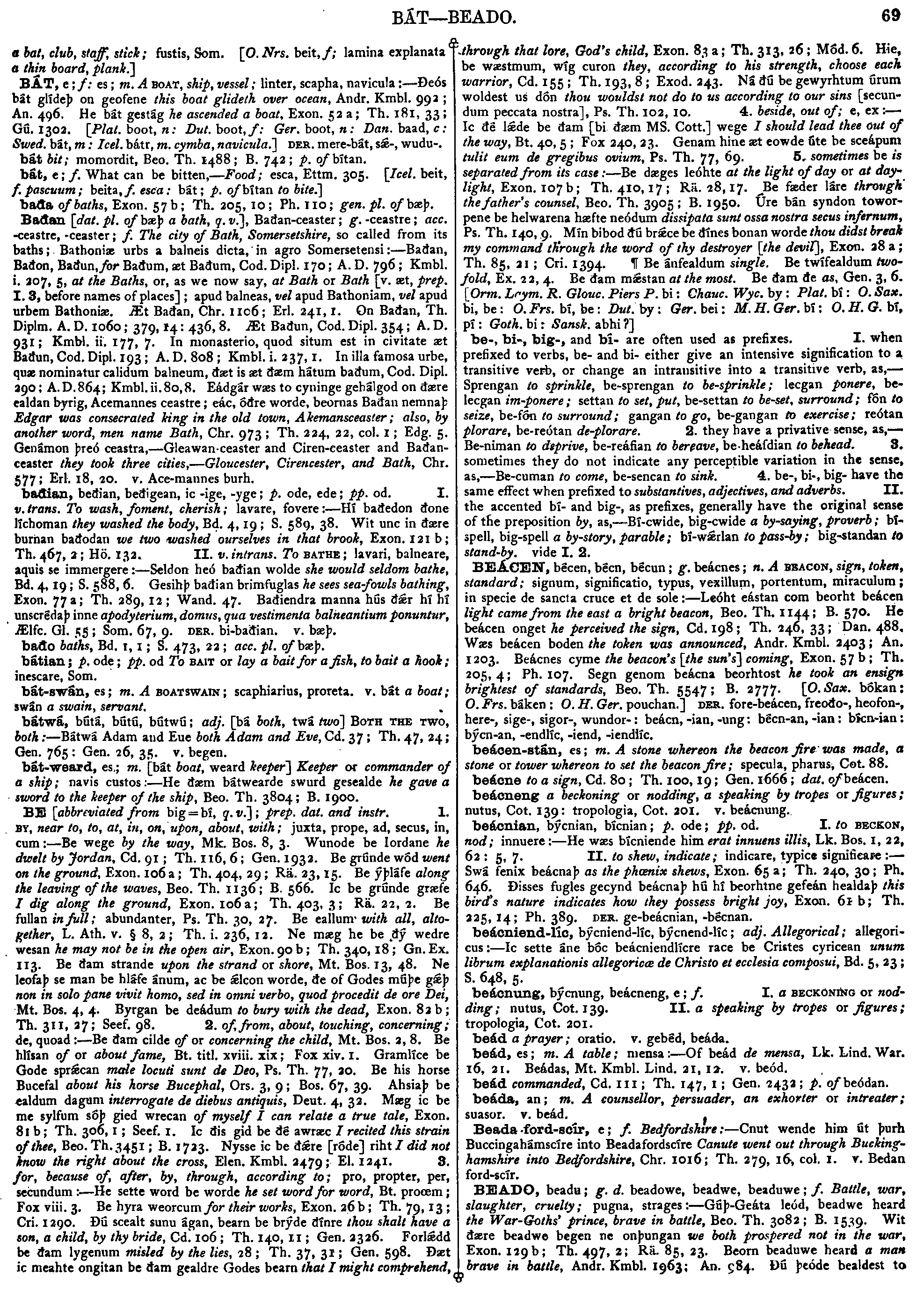
BE
[abbreviated
from
big
=
bí,
q.
v.];
prep.
dat.
and
instr.
1.
BY,
near
to,
to,
at,
in,
on,
upon,
about,
with;
juxta,
prope,
ad,
secus,
in,
cum
:--
Be
wege
by
the
way,
Mk.
Bos.
8,
3.
Wunode
be
lordane
he
dwelt
by
Jordan,
Cd.
91;
Th.
116,
6;
Gen.
1932.
Be
grúnde
wód
went
on
the
ground,
Exon.
106a;
Th.
404,
29;
Rä.
23,
15.
Be
ýþláfe
along
the
leaving
of
the
waves,
Beo.
Th.
1136;
B.
566.
Ic
be
grúnde
græfe
I
dig
along
the
ground,
Exon.
106a;
Th.
403,
3;
Rä.
22,
2.
Be
fullan
in
full;
abundanter,
Ps.
Th.
30,
27.
Be
eallum
with
all,
altogether,
L.
Ath.
v.
§
8,
2;
Th.
i.
236,
12.
Ne
mæg
he
be
ðý
wedre
wesan
he
may
not
be
in
the
open
air,
Exon.
90b;
Th.
340,
18;
Gn.
Ex.
113.
Be
ðam
strande
upon
the
strand
or
shore,
Mt.
Bos.
13,
48.
Ne
leofaþ
se
man
be
hláfe
ánum,
ac
be
 lcon
worde,
ðe
of
Godes
múþe
gþ
non
in
solo
pane
vivit
homo,
sed
in
omni
verbo,
quod
procedit
de
ore
Dei,
Mt.
Bos.
4,
4.
Byrgan
be
deádum
to
bury
with
the
dead,
Exon.
82b;
Th.
311,
27;
Seef,
98.
2.
of,
from,
about,
touching,
concerning;
de,
quoad
:--
Be
ðam
cilde
of
or
concerning
the
child,
Mt.
Bos.
2,
8.
Be
hlísan
of
or
about
fame,
Bt.
titl.
xviii.
xix;
Fox
xiv.
1.
Gramlíce
be
Gode
sprcan
male
locuti
sunt
de
Deo,
Ps.
Th.
77,
20.
Be
his
horse
Bucefal
about
his
horse
Bucephal,
Ors.
3,
9;
Bos.
67,
39.
Ahsiaþ
be
ealdum
dagum
interrogate
de
diebus
antiquis,
Deut.
4,
32.
Mæg
ic
be
me
sylfum
sóþ
gied
wrecan
of
myself
I
can
relate
a
true
tale,
Exon.
81b;
Th.
306,
1;
Seef.
1.
Ic
ðis
gid
be
ðé
awræc
I
recited
this
strain
of
thee,
Beo.
Th.
3451;
B.
1723.
Nysse
ic
be
ðre
[róde]
riht
I
did
not
know
the
right
about
the
cross,
Elen.
Kmbl.
2479;
El.
1241.
3.
for,
because
of,
after,
by,
through,
according
to;
pro,
propter,
per,
secundum
:--
He
sette
word
be
worde
he
set
word
for
word,
Bt.
pro?m;
Fox
viii.
3.
Be
hyra
weorcum
for
their
works,
Exon.
26b;
Th.
79,
13;
Cri.
1290.
Ðú
scealt
sunu
ágan,
bearn
be
brýde
ðínre
thou
shalt
have
a
son,
a
child,
by
thy
bride,
Cd.
106;
Th.
140,
11;
Gen.
2326.
Forldd
be
ðam
lygenum
misled
by
the
lies,
28;
Th.
37,
31;
Gen.
598.
Ðæt
ic
meahte
ongitan
be
ðam
gealdre
Godes
bearn
that
I
might
comprehend,
through
that
lore,
God's
child,
Exon.
83a;
Th.
313,
26;
Mód.
6.
Hie,
be
wæstmum,
wíg
curon
they,
according
to
his
strength,
choose
each
warrior,
Cd.
155;
Th.
193,
8;
Exod.
243.
Ná
ðú
be
gewyrhtum
úrum
woldest
us
dón
thou
wouldst
not
do
to
us
according
to
our
sins
[secundum
peccata
nostra],
Ps.
Th.
102,
10.
4.
beside,
out
of;
e,
ex
:--
Ic
ðé
lde
be
ðam
[bi,
ðæm
MS.
Cott.]
wege
I
should
lead
thee
out
of
the
way,
Bt.
40,
5;
Fox
240,
23.
Genam
hine
æt
eowde
úte
be
sceápum
tulit
eum
de
gregibus
ovium,
Ps.
Th.
77,
69.
5.
sometimes
be
is
separated
from
its
case:-Be
dæges
leóhte
at
the
light
of
day
or
at
daylight,
Exon.
107b;
Th.
410,
17;
Rä.
28,
17.
Be
fæder
láre
through
the
father's
counsel,
Beo.
Th.
3905;
B.
1950.
Úre
bán
syndon
toworpene
be
helwarena
hæfte
neódum
dissipata
sunt
ossa
nostra
secus
infernum,
Ps.
Th.
140,
9.
Mín
bibod
ðú
brce
be
ðines
bonan
worde
thou
didst
break
my
command
through
the
word
of
thy
destroyer
[the
devil],
Exon.
28a;
Th.
85,
21;
Cri.
1394.
¶
Be
ánfealdum
single.
Be
twífealdum
twofold,
Ex.
22,
4.
Be
ðam
mstan
at
the
most.
Be
ðam
ðe
as,
Gen.
3,
6.
[Orm.
Laym.
R.
Glouc.
Piers
P.
bi:
Chauc.
Wyc.
by:
Plat.
bí:
O.
Sax.
bi,
be:
O.
Frs.
bí,
be:
Dut.
by:
Ger.
bei:
M.
H.
Ger.
bí:
O.
H.
G.
bí,
pí:
Goth.
bi:
Sansk.
abhi?]
lcon
worde,
ðe
of
Godes
múþe
gþ
non
in
solo
pane
vivit
homo,
sed
in
omni
verbo,
quod
procedit
de
ore
Dei,
Mt.
Bos.
4,
4.
Byrgan
be
deádum
to
bury
with
the
dead,
Exon.
82b;
Th.
311,
27;
Seef,
98.
2.
of,
from,
about,
touching,
concerning;
de,
quoad
:--
Be
ðam
cilde
of
or
concerning
the
child,
Mt.
Bos.
2,
8.
Be
hlísan
of
or
about
fame,
Bt.
titl.
xviii.
xix;
Fox
xiv.
1.
Gramlíce
be
Gode
sprcan
male
locuti
sunt
de
Deo,
Ps.
Th.
77,
20.
Be
his
horse
Bucefal
about
his
horse
Bucephal,
Ors.
3,
9;
Bos.
67,
39.
Ahsiaþ
be
ealdum
dagum
interrogate
de
diebus
antiquis,
Deut.
4,
32.
Mæg
ic
be
me
sylfum
sóþ
gied
wrecan
of
myself
I
can
relate
a
true
tale,
Exon.
81b;
Th.
306,
1;
Seef.
1.
Ic
ðis
gid
be
ðé
awræc
I
recited
this
strain
of
thee,
Beo.
Th.
3451;
B.
1723.
Nysse
ic
be
ðre
[róde]
riht
I
did
not
know
the
right
about
the
cross,
Elen.
Kmbl.
2479;
El.
1241.
3.
for,
because
of,
after,
by,
through,
according
to;
pro,
propter,
per,
secundum
:--
He
sette
word
be
worde
he
set
word
for
word,
Bt.
pro?m;
Fox
viii.
3.
Be
hyra
weorcum
for
their
works,
Exon.
26b;
Th.
79,
13;
Cri.
1290.
Ðú
scealt
sunu
ágan,
bearn
be
brýde
ðínre
thou
shalt
have
a
son,
a
child,
by
thy
bride,
Cd.
106;
Th.
140,
11;
Gen.
2326.
Forldd
be
ðam
lygenum
misled
by
the
lies,
28;
Th.
37,
31;
Gen.
598.
Ðæt
ic
meahte
ongitan
be
ðam
gealdre
Godes
bearn
that
I
might
comprehend,
through
that
lore,
God's
child,
Exon.
83a;
Th.
313,
26;
Mód.
6.
Hie,
be
wæstmum,
wíg
curon
they,
according
to
his
strength,
choose
each
warrior,
Cd.
155;
Th.
193,
8;
Exod.
243.
Ná
ðú
be
gewyrhtum
úrum
woldest
us
dón
thou
wouldst
not
do
to
us
according
to
our
sins
[secundum
peccata
nostra],
Ps.
Th.
102,
10.
4.
beside,
out
of;
e,
ex
:--
Ic
ðé
lde
be
ðam
[bi,
ðæm
MS.
Cott.]
wege
I
should
lead
thee
out
of
the
way,
Bt.
40,
5;
Fox
240,
23.
Genam
hine
æt
eowde
úte
be
sceápum
tulit
eum
de
gregibus
ovium,
Ps.
Th.
77,
69.
5.
sometimes
be
is
separated
from
its
case:-Be
dæges
leóhte
at
the
light
of
day
or
at
daylight,
Exon.
107b;
Th.
410,
17;
Rä.
28,
17.
Be
fæder
láre
through
the
father's
counsel,
Beo.
Th.
3905;
B.
1950.
Úre
bán
syndon
toworpene
be
helwarena
hæfte
neódum
dissipata
sunt
ossa
nostra
secus
infernum,
Ps.
Th.
140,
9.
Mín
bibod
ðú
brce
be
ðines
bonan
worde
thou
didst
break
my
command
through
the
word
of
thy
destroyer
[the
devil],
Exon.
28a;
Th.
85,
21;
Cri.
1394.
¶
Be
ánfealdum
single.
Be
twífealdum
twofold,
Ex.
22,
4.
Be
ðam
mstan
at
the
most.
Be
ðam
ðe
as,
Gen.
3,
6.
[Orm.
Laym.
R.
Glouc.
Piers
P.
bi:
Chauc.
Wyc.
by:
Plat.
bí:
O.
Sax.
bi,
be:
O.
Frs.
bí,
be:
Dut.
by:
Ger.
bei:
M.
H.
Ger.
bí:
O.
H.
G.
bí,
pí:
Goth.
bi:
Sansk.
abhi?]
|
Source: Bosworth/Toller, page b0119, entry 25 View original page image as: [TIFF] [PNG] [View previous entry] [View next entry] |
[Comment on this entry] [View comments] |
The following entry has been hand-corrected once. |
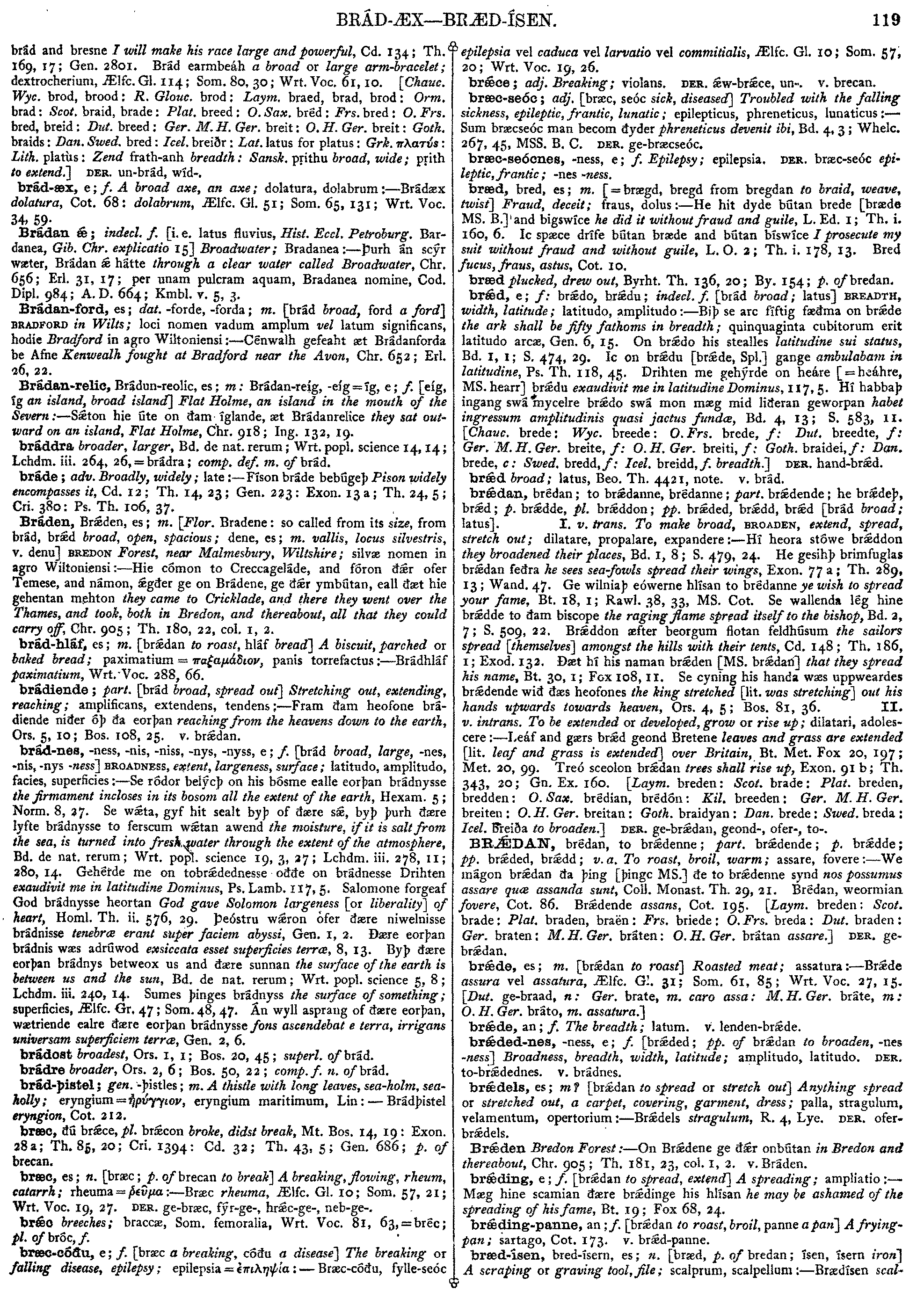
brdan,
brédan;
to
brdanne,
brédanne;
part.
brdende;
he
brdeþ,
brd;
p.
brdde,
pl.
brddon;
pp.
brded,
brdd,
brd
[brád
broad;
latus].
I.
v.
trans.
To
make
broad,
BROADEN,
extend,
spread,
stretch
out;
dilatare,
propalare,
expandere
:--
Hí
heora
stówe
brddon
they
broadened
their
places,
Bd.
1,
8;
S.
479,
24.
He
gesihþ
brimfuglas
brdan
feðra
he
sees
sea-fowls
spread
their
wings,
Exon.
77
a;
Th.
289,
13;
Wand.
47.
Ge
wilniaþ
eówerne
hlísan
to
brédanne
ye
wish
to
spread
your
fame,
Bt.
18,
1;
Rawl.
38,
33,
MS.
Cot.
Se
wallenda
lég
hine
brdde
to
ðam
biscope
the
raging
flame
spread
itself
to
the
bishop,
Bd.
2,
7;
S.
509,
22.
Brddon
æfter
beorgum
flotan
feldhúsum
the
sailors
spread
[themselves]
amongst
the
hills
with
their
tents,
Cd.
148;
Th.
186,
1;
Exod.
132.
Ðæt
hí
his
naman
brden
[MS.
brdan]
that
they
spread
his
name,
Bt.
30,
1;
Fox
108,
11.
Se
cyning
his
handa
wæs
uppweardes
brdende
wið
ðæs
heofones
the
king
stretched
[lit.
was
stretching]
out
his
hands
upwards
towards
heaven,
Ors.
4,
5;
Bos.
81,
36.
II.
v.
intrans.
To
be
extended
or
developed,
grow
or
rise
up;
dilatari,
adolescere
:--
Leáf
and
gærs
brd
geond
Bretene
leaves
and
grass
are
extended
[lit.
leaf
and
grass
is
extended]
over
Britain,
Bt.
Met.
Fox
20,
197;
Met.
20,
99.
Treó
sceolon
brdan
trees
shall
rise
up,
Exon.
91
b;
Th.
343.
20;
Gn.
Ex.
160.
[Laym.
breden:
Scot.
brade:
Plat.
breden,
bredden:
O.
Sax.
brédian,
brédón:
Kil.
breeden:
Ger.
M.
H.
Ger.
breiten:
O.
H.
Ger.
breitan:
Goth.
braidyan:
Dan.
brede:
Swed.
breda:
Icel.
breiða
to
broaden.]
DER.
ge-brdan,
geond-,
ofer-,
to-.
|
Source: Bosworth/Toller, page b0119, entry 32 View original page image as: [TIFF] [PNG] [View previous entry] [View next entry] |
[Comment on this entry] [View comments] |
The following entry has been hand-corrected once. |
brding,
e;
f.
[brdan
to
spread,
extend]
A
spreading;
ampliatio
:--
Mæg
hine
scamian
ðære
brdinge
his
hlísan
he
may
be
ashamed
of
the
spreading
of
his
fame,
Bt.
19;
Fox
68,
24.
|
Source: Bosworth/Toller, page b0202, entry 7 View original page image as: [TIFF] [PNG] [View previous entry] [View next entry] |
[Comment on this entry] [View comments] |
The following entry has been hand-corrected once. |
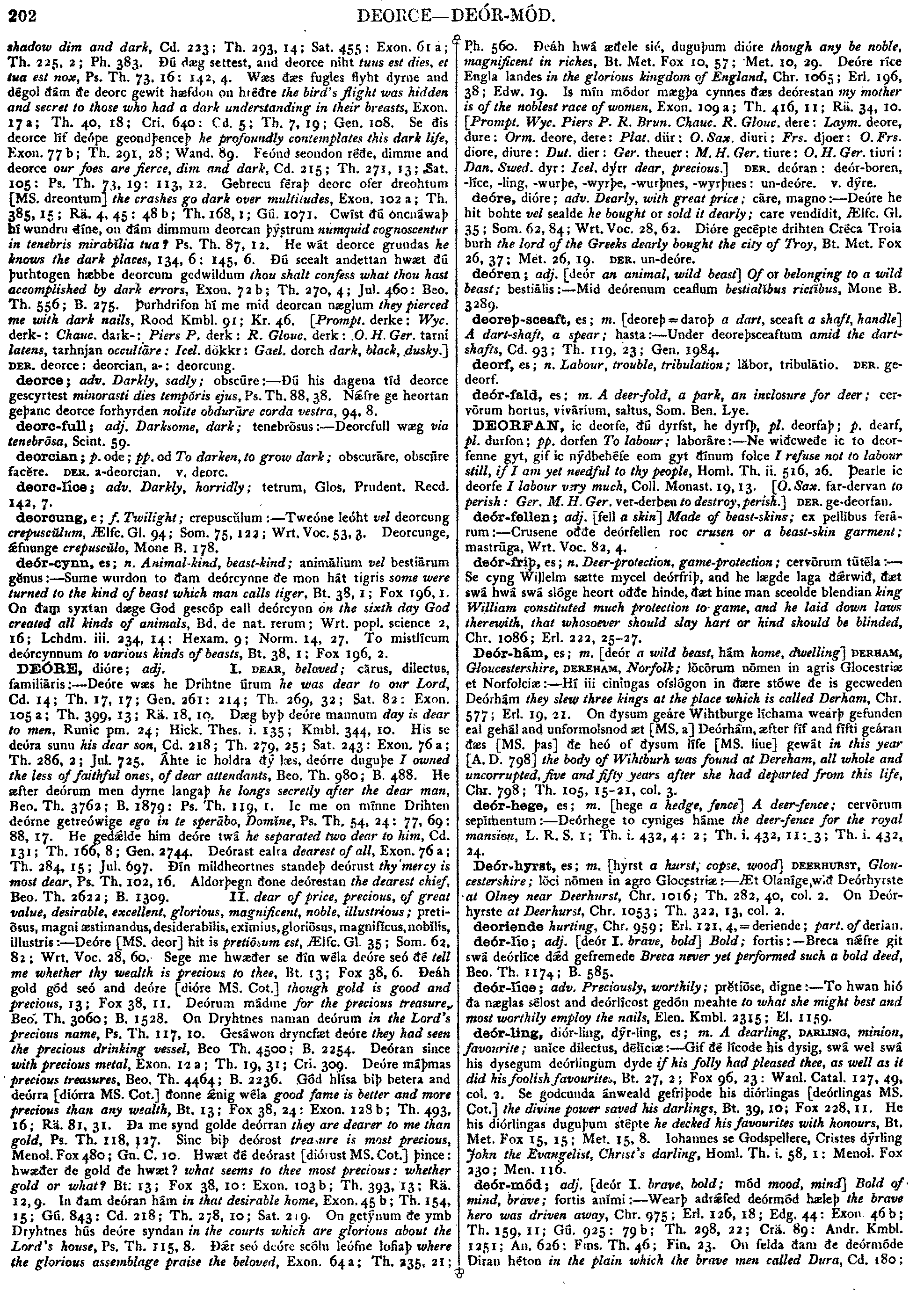
DEÓRE,
dióre;
adj.
I.
DEAR,
beloved;
crus,
dilectus,
familiris
:--
Deóre
wæs
he
Drihtne
úrum
he
was
dear
to
our
Lord,
Cd.
14;
Th.
17,
17;
Gen.
261:
214;
Th.
269,
32;
Sat.
82:
Exon.
105
a;
Th.
399,
13;
Rä.
18,
10.
Dæg
byþ
deóre
mannum
day
is
dear
to
men,
Runic
pm.
24;
Hick.
Thes.
i.
135;
Kmbl.
344,
10.
His
se
deóra
sunu
his
dear
son,
Cd.
218;
Th.
219,
25;
Sat.
243:
Exon.
76
a;
Th.
286,
2;
Jul.
725.
Áhte
ic
holdra
ðý
læs,
deórre
duguþe
I
owned
the
less
of
faithful
ones,
of
dear
attendants,
Beo.
Th.
980;
B.
488.
He
æfter
deórum
men
dyrne
langaþ
he
longs
secretly
after
the
dear
man,
Beo.
Th.
3762;
B.
1879:
Ps.
Th.
119,
1.
Ic
me
on
mínne
Drihten
deórne
getreówige
ego
in
te
sperbo,
Dom ne,
Ps.
Th,
54.
24:
77,
69:
88,
17.
He
gedlde
him
deóre
twá
he
separated
two
dear
to
him,
Cd.
131;
Th.
166,
8;
Gen.
2744.
Deórast
ealra
dearest
of
all,
Exon.
76
a;
Th.
284,
15;
Jul.
697.
Ðín
mildheortnes
standeþ
deórust
thy
mercy
is
most
dear,
Ps.
Th.
102,
16.
Aldorþegn
ðone
deórestan
the
dearest
chief,
Beo.
Th.
2622;
B.
1309.
II.
dear
of
price,
precious,
of
great
value,
desirable,
excellent,
glorious,
magnificent,
noble,
illustrious;
preti
ne,
Ps.
Th,
54.
24:
77,
69:
88,
17.
He
gedlde
him
deóre
twá
he
separated
two
dear
to
him,
Cd.
131;
Th.
166,
8;
Gen.
2744.
Deórast
ealra
dearest
of
all,
Exon.
76
a;
Th.
284,
15;
Jul.
697.
Ðín
mildheortnes
standeþ
deórust
thy
mercy
is
most
dear,
Ps.
Th.
102,
16.
Aldorþegn
ðone
deórestan
the
dearest
chief,
Beo.
Th.
2622;
B.
1309.
II.
dear
of
price,
precious,
of
great
value,
desirable,
excellent,
glorious,
magnificent,
noble,
illustrious;
preti sus,
magni
æstimandus,
desiderablis,
exmius,
glorisus,
magnifcus,
noblis,
illustris
:--
Deóre
[MS.
deor]
hit
is
pretisum
est,
Ælfc.
Gl.
35;
Som.
62,
82;
Wrt.
Voc.
28,
60.
Sege
me
hwæðer
se
ðín
wéla
deóre
seó
ðé
tell
me
whether
thy
wealth
is
precious
to
thee,
Bt.
13;
Fox
38,
6.
Ðeáh
gold
gód
seó
and
deóre
[dióre
MS.
Cot.]
though
gold
is
good
and
precious,
13;
Fox
38,
11.
Deórum
mádme
for
the
precious
treasure
Beo.
Th.
3060;
B.
1528.
On
Dryhtnes
naman
deórum
in
the
Lord's
precious
name,
Ps.
Th.
117,
l0.
Gesáwon
dryncfæt
deóre
they
had
seen
the
precious
drinking
vessel,
Beo
Th,
4500;
B.
2254.
Deóran
since
with
precious
metal,
Exon.
12
a;
Th.
19,
31;
Cri.
309.
Deóre
máþmas
precious
treasures,
Beo.
Th.
4464;
B.
2236.
Gód
hlísa
biþ
betera
and
deórra
[diórra
MS.
Cot.]
ðonne
nig
wéla
good
fame
is
better
and
more
precious
than
any
wealth,
Bt.
13;
Fox
38,
24:
Exon.
128
b;
Th.
493,
16;
Rä.
81,
31.
Ða
me
synd
golde
deórran
they
are
dearer
to
me
than
gold,
Ps.
Th.
118,
127.
Sinc
biþ
deórost
treasure
is
most
precious,
Menol.
Fox
480;
Gn.
C.
10.
Hwæt
ðé
deórast
[diórust
MS.
Cot.]
þince:
hwæðer
ðe
gold
ðe
hwæt?
what
seems
to
thee
most
precious:
whether
gold
or
what?
Bt.
13;
Fox
38,
10:
Exon.
103
b;
Th.
393,
13;
Rä.
12,
9.
In
ðam
deóran
hám
in
that
desirable
home,
Exon.
45
b;
Th.
154,
15;
Gú.
843:
Cd.
218;
Th.
278,
10;
Sat.
219.
On
getýnum
ðe
ymb
Dryhtnes
hús
deóre
syndan
in
the
courts
which
are
glorious
about
the
Lord's
house,
Ps.
Th.
115,
8.
Ðr
seó
deóre
scólu
leófne
lofiaþ
where
the
glorious
assemblage
praise
the
beloved,
Exon.
64
a;
Th.
235,
21;
Ph.
560.
Ðeáh
hwá
æðele
sié,
duguþum
dióre
though
any
be
noble,
magnificent
in
riches,
Bt.
Met.
Fox
10,
57;
Met.
10,
29.
Deóre
ríce
Engla
landes
in
the
glorious
kingdom
of
England,
Chr.
1065;
Erl.
196,
38;
Edw.
19.
Is
mín
módor
mægþa
cynnes
ðæs
deórestan
my
mother
is
of
the
noblest
race
of
women,
Exon.
l09
a;
Th.
416,
11;
Rä.
34,
10.
[Prompt.
Wyc.
Piers
P.
R.
Brun.
Chauc.
R.
Glouc.
dere:
Laym.
deore,
dure:
Orm.
deore,
dere:
Plat.
dür:
O.
Sax.
diuri:
Frs.
djoer:
O.
Frs.
diore,
diure:
Dut.
dier:
Ger.
theuer:
M.
H.
Ger.
tiure:
O.
H.
Ger.
tiuri:
Dan.
Swed.
dyr:
Icel.
dýrr
dear,
precious.]
DER.
deóran:
deór-boren,
-líce,
-ling,
-wurþe,
-wyrþe,
-wurþnes,
-wyrþnes:
un-deóre.
v.
dýre.
sus,
magni
æstimandus,
desiderablis,
exmius,
glorisus,
magnifcus,
noblis,
illustris
:--
Deóre
[MS.
deor]
hit
is
pretisum
est,
Ælfc.
Gl.
35;
Som.
62,
82;
Wrt.
Voc.
28,
60.
Sege
me
hwæðer
se
ðín
wéla
deóre
seó
ðé
tell
me
whether
thy
wealth
is
precious
to
thee,
Bt.
13;
Fox
38,
6.
Ðeáh
gold
gód
seó
and
deóre
[dióre
MS.
Cot.]
though
gold
is
good
and
precious,
13;
Fox
38,
11.
Deórum
mádme
for
the
precious
treasure
Beo.
Th.
3060;
B.
1528.
On
Dryhtnes
naman
deórum
in
the
Lord's
precious
name,
Ps.
Th.
117,
l0.
Gesáwon
dryncfæt
deóre
they
had
seen
the
precious
drinking
vessel,
Beo
Th,
4500;
B.
2254.
Deóran
since
with
precious
metal,
Exon.
12
a;
Th.
19,
31;
Cri.
309.
Deóre
máþmas
precious
treasures,
Beo.
Th.
4464;
B.
2236.
Gód
hlísa
biþ
betera
and
deórra
[diórra
MS.
Cot.]
ðonne
nig
wéla
good
fame
is
better
and
more
precious
than
any
wealth,
Bt.
13;
Fox
38,
24:
Exon.
128
b;
Th.
493,
16;
Rä.
81,
31.
Ða
me
synd
golde
deórran
they
are
dearer
to
me
than
gold,
Ps.
Th.
118,
127.
Sinc
biþ
deórost
treasure
is
most
precious,
Menol.
Fox
480;
Gn.
C.
10.
Hwæt
ðé
deórast
[diórust
MS.
Cot.]
þince:
hwæðer
ðe
gold
ðe
hwæt?
what
seems
to
thee
most
precious:
whether
gold
or
what?
Bt.
13;
Fox
38,
10:
Exon.
103
b;
Th.
393,
13;
Rä.
12,
9.
In
ðam
deóran
hám
in
that
desirable
home,
Exon.
45
b;
Th.
154,
15;
Gú.
843:
Cd.
218;
Th.
278,
10;
Sat.
219.
On
getýnum
ðe
ymb
Dryhtnes
hús
deóre
syndan
in
the
courts
which
are
glorious
about
the
Lord's
house,
Ps.
Th.
115,
8.
Ðr
seó
deóre
scólu
leófne
lofiaþ
where
the
glorious
assemblage
praise
the
beloved,
Exon.
64
a;
Th.
235,
21;
Ph.
560.
Ðeáh
hwá
æðele
sié,
duguþum
dióre
though
any
be
noble,
magnificent
in
riches,
Bt.
Met.
Fox
10,
57;
Met.
10,
29.
Deóre
ríce
Engla
landes
in
the
glorious
kingdom
of
England,
Chr.
1065;
Erl.
196,
38;
Edw.
19.
Is
mín
módor
mægþa
cynnes
ðæs
deórestan
my
mother
is
of
the
noblest
race
of
women,
Exon.
l09
a;
Th.
416,
11;
Rä.
34,
10.
[Prompt.
Wyc.
Piers
P.
R.
Brun.
Chauc.
R.
Glouc.
dere:
Laym.
deore,
dure:
Orm.
deore,
dere:
Plat.
dür:
O.
Sax.
diuri:
Frs.
djoer:
O.
Frs.
diore,
diure:
Dut.
dier:
Ger.
theuer:
M.
H.
Ger.
tiure:
O.
H.
Ger.
tiuri:
Dan.
Swed.
dyr:
Icel.
dýrr
dear,
precious.]
DER.
deóran:
deór-boren,
-líce,
-ling,
-wurþe,
-wyrþe,
-wurþnes,
-wyrþnes:
un-deóre.
v.
dýre.
|
Source: Bosworth/Toller, page b0227, entry 16 View original page image as: [TIFF] [PNG] [View previous entry] [View next entry] |
[Comment on this entry] [View comments] |
The following entry has been hand-corrected once. |
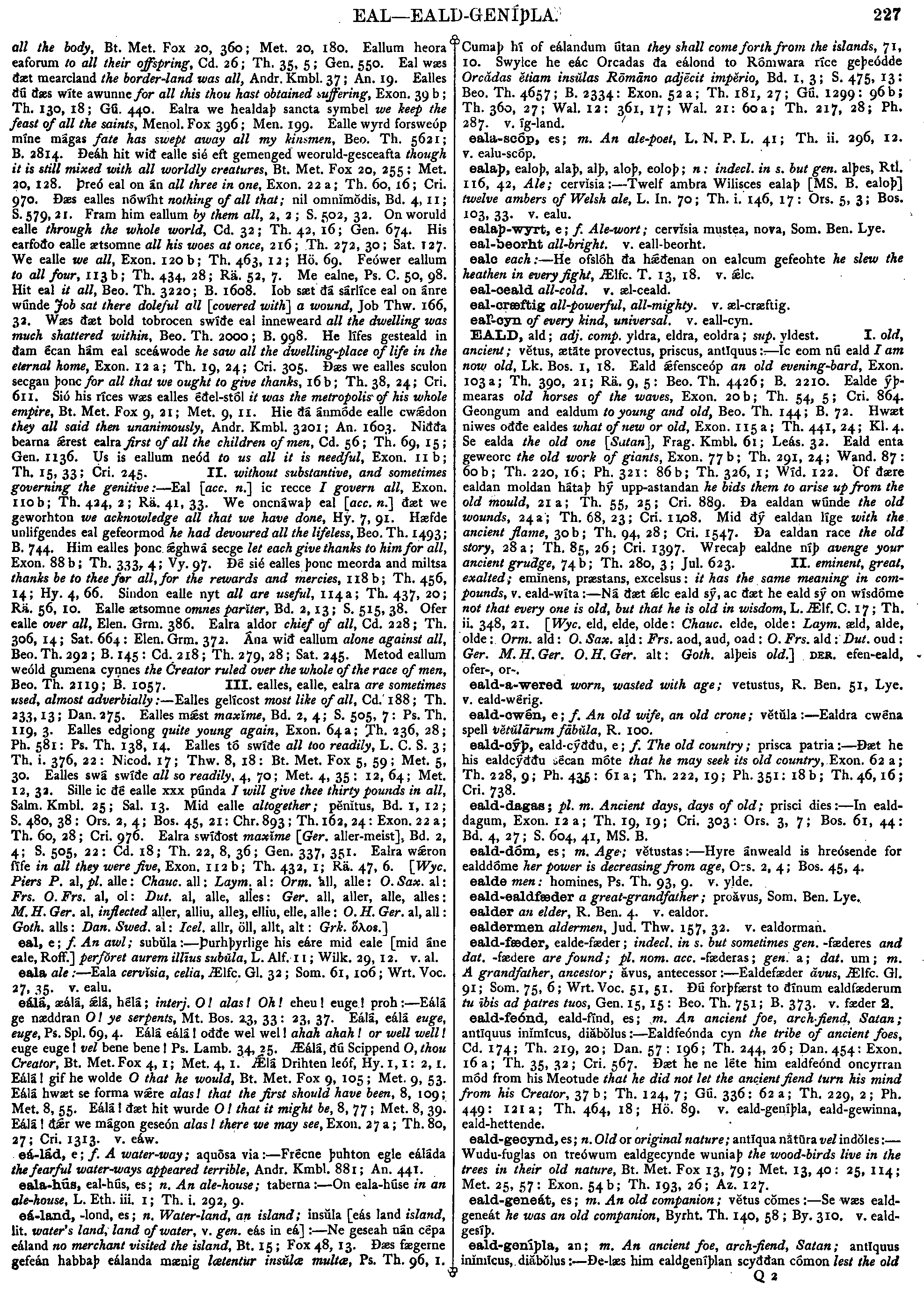
EALD,
ald;
adj.
comp.
yldra,
eldra,
eoldra;
sup.
yldest.
I.
old,
ancient;
v tus,
ætte
provectus,
priscus,
ant
tus,
ætte
provectus,
priscus,
ant quus
:--
Ic
com
nú
eald
I
am
now
old.
Lk.
Bos.
1,
18.
Eald
fensceóp
an
old
evening-bard,
Exon.
103a;
Th.
390,
21;
Rä.
9,
5:
Beo.
Th.
4426;
B.
2210.
Ealde
ýþ-mearas
old
horses
of
the
waves,
Exon.
20b;
Th.
54,
5;
Cri.
864.
Geongum
and
ealdum
to
young
and
old,
Beo.
Th.
144;
B.
72.
Hwæt
niwes
oððe
ealdes
what
of
new
or
old,
Exon.
115a;
Th.
441,
24;
Kl.
4.
Se
ealda
the
old
one
[Satan],
Frag.
Kmbl.
61;
Leás.
32.
Eald
enta
geweorc
the
old
work
of
giants,
Exon.
77b;
Th.
291,
24;
Wand.
87:
60b;
Th.
220,
16;
Ph.
321:
86b;
Th.
326,
1;
Wíd.
122.
Of
ðære
ealdan
moldan
hátaþ
hý
upp-astandan
he
bids
them
to
arise
up
from
the
old
mould,
21a;
Th.
55,
25;
Cri.
889.
Ða
ealdan
wúnde
the
old
wounds,
24a;
Th.
68,
23;
Cri.
1108.
Mid
ðý
ealdan
líge
with
the
ancient
fame,
30b;
Th.
94,
28;
Cri.
1547.
Ða
ealdan
race
the
old
story,
28a;
Th.
85,
26;
Cri.
1397.
Wrecaþ
ealdne
níþ
avenge
your
ancient
grudge,
74b;
Th.
280,
3;
Jul.
623.
II.
eminent,
great,
exalted;
emnens,
præstans,
excelsus:
it
has
the
same
meaning
in
compounds,
v.
eald-wíta
:--
Ná
ðæt
lc
eald
sý,
ac
ðæt
he
eald
sý
on
wísdóme
not
that
every
one
is
old,
but
that
he
is
old
in
wisdom,
L.
Ælf.
C.
17;
Th.
ii.
348,
21.
[Wyc.
eld,
elde,
olde:
Chauc.
elde,
olde:
Laym.
æld,
alde,
olde:
Orm.
ald:
O.
Sax.
ald:
Frs.
aod,
aud,
oad:
O.
Frs.
ald:
Dut.
oud:
Ger.
M.
H.
Ger.
O.
H.
Ger.
alt:
Goth.
alþeis
old.]
DER.
efen-eald,
ofer-,
or-.
quus
:--
Ic
com
nú
eald
I
am
now
old.
Lk.
Bos.
1,
18.
Eald
fensceóp
an
old
evening-bard,
Exon.
103a;
Th.
390,
21;
Rä.
9,
5:
Beo.
Th.
4426;
B.
2210.
Ealde
ýþ-mearas
old
horses
of
the
waves,
Exon.
20b;
Th.
54,
5;
Cri.
864.
Geongum
and
ealdum
to
young
and
old,
Beo.
Th.
144;
B.
72.
Hwæt
niwes
oððe
ealdes
what
of
new
or
old,
Exon.
115a;
Th.
441,
24;
Kl.
4.
Se
ealda
the
old
one
[Satan],
Frag.
Kmbl.
61;
Leás.
32.
Eald
enta
geweorc
the
old
work
of
giants,
Exon.
77b;
Th.
291,
24;
Wand.
87:
60b;
Th.
220,
16;
Ph.
321:
86b;
Th.
326,
1;
Wíd.
122.
Of
ðære
ealdan
moldan
hátaþ
hý
upp-astandan
he
bids
them
to
arise
up
from
the
old
mould,
21a;
Th.
55,
25;
Cri.
889.
Ða
ealdan
wúnde
the
old
wounds,
24a;
Th.
68,
23;
Cri.
1108.
Mid
ðý
ealdan
líge
with
the
ancient
fame,
30b;
Th.
94,
28;
Cri.
1547.
Ða
ealdan
race
the
old
story,
28a;
Th.
85,
26;
Cri.
1397.
Wrecaþ
ealdne
níþ
avenge
your
ancient
grudge,
74b;
Th.
280,
3;
Jul.
623.
II.
eminent,
great,
exalted;
emnens,
præstans,
excelsus:
it
has
the
same
meaning
in
compounds,
v.
eald-wíta
:--
Ná
ðæt
lc
eald
sý,
ac
ðæt
he
eald
sý
on
wísdóme
not
that
every
one
is
old,
but
that
he
is
old
in
wisdom,
L.
Ælf.
C.
17;
Th.
ii.
348,
21.
[Wyc.
eld,
elde,
olde:
Chauc.
elde,
olde:
Laym.
æld,
alde,
olde:
Orm.
ald:
O.
Sax.
ald:
Frs.
aod,
aud,
oad:
O.
Frs.
ald:
Dut.
oud:
Ger.
M.
H.
Ger.
O.
H.
Ger.
alt:
Goth.
alþeis
old.]
DER.
efen-eald,
ofer-,
or-.
|
Source: Bosworth/Toller, page b0322, entry 13 View original page image as: [TIFF] [PNG] [View previous entry] [View next entry] |
[Comment on this entry] [View comments] |
The following entry has been hand-corrected once. |
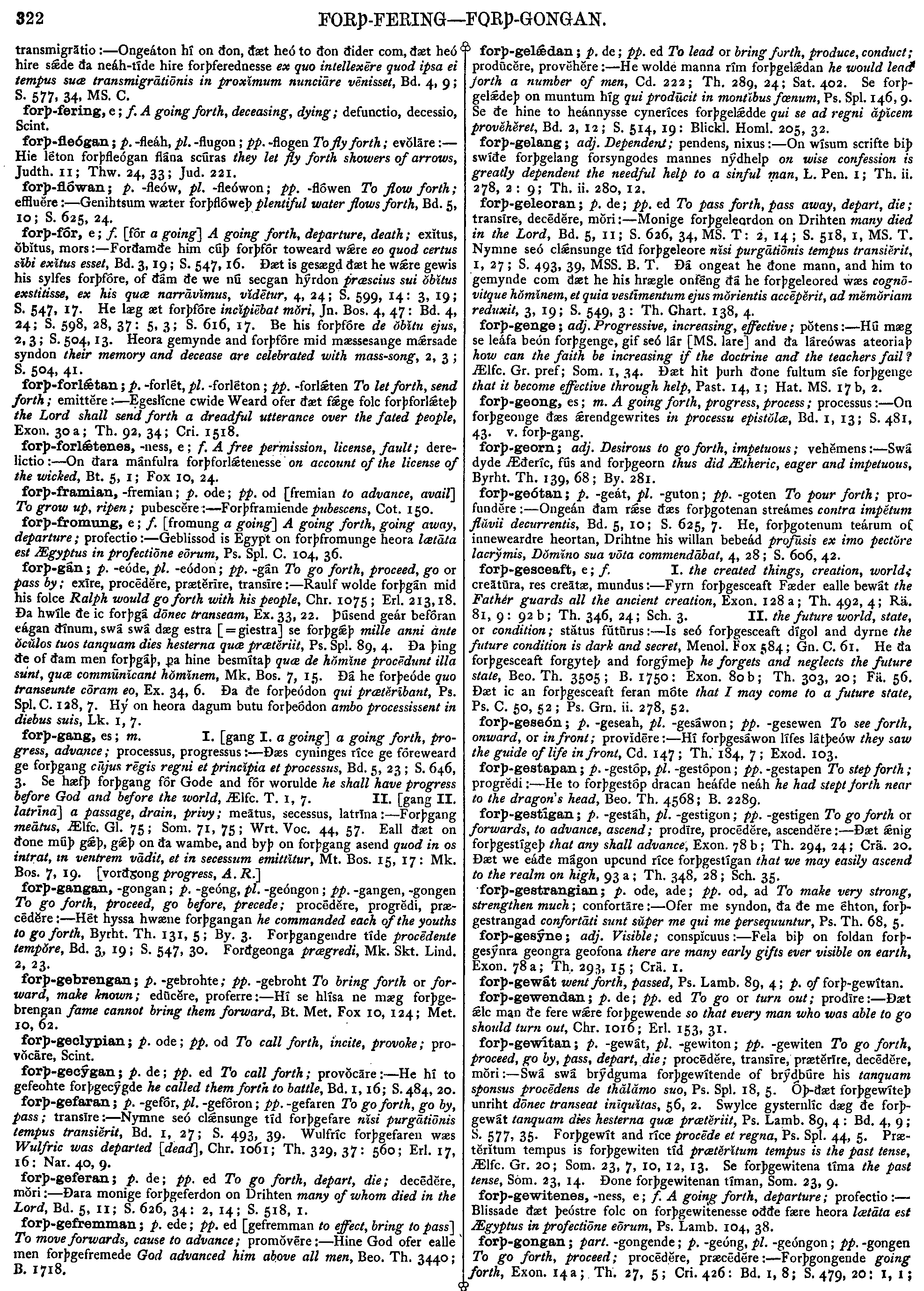
forþ-gebrengan;
p.
-gebrohte;
pp.
-gebroht
To
bring
forth
or
forward,
make
known;
ed cre,
proferre
:--
Hí
se
hlísa
ne
mæg
forþgebrengan
fame
cannot
bring
them
forward,
Bt.
Met.
Fox
10,
124;
Met.
10,
62.
cre,
proferre
:--
Hí
se
hlísa
ne
mæg
forþgebrengan
fame
cannot
bring
them
forward,
Bt.
Met.
Fox
10,
124;
Met.
10,
62.
|
Source: Bosworth/Toller, page b0421, entry 7 View original page image as: [TIFF] [PNG] [View previous entry] [View next entry] |
[Comment on this entry] [View comments] |
The following entry has been hand-corrected once. |
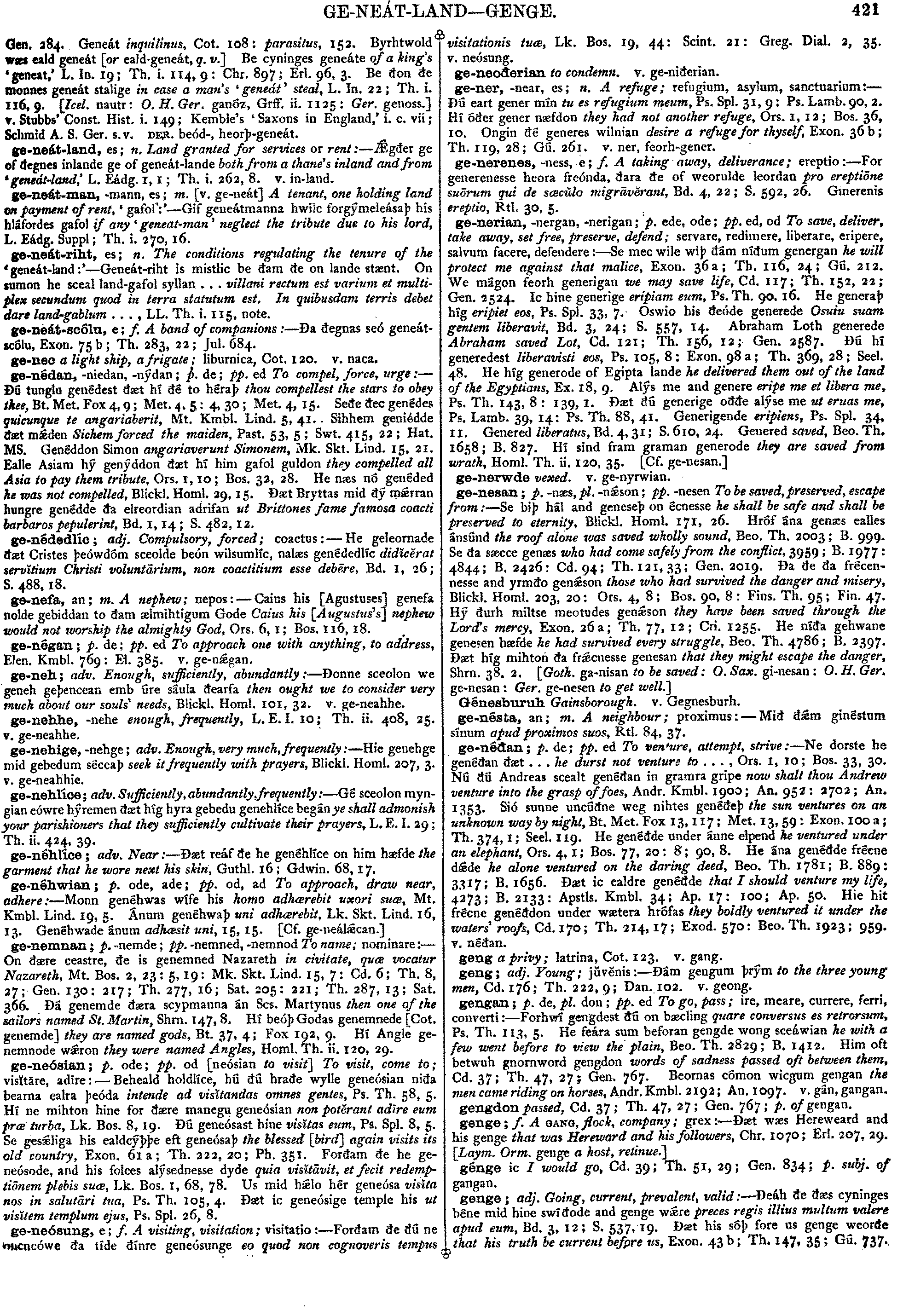
quicunque
to
angariaberit,
Mt.
Kmbl.
Lind.
5,
41.
Sihhem
geniédde
ðæt
mden
Sichem
forced
the
maiden,
Past.
53,
5;
Swt.
415,
22;
Hat.
MS.
Genéddon
Simon
angariaverunt
Simonem,
Mk.
Skt.
Lind.
15,
21.
Ealle
Asiam
hý
genýddon
ðæt
hí
him
gafol
guldon
they
compelled
all
Asia
to
pay
them
tribute,
Ors.
1,
10;
Bos.
32,
28.
He
næs
nó
genéded
he
was
not
compelled,
Blickl.
Homl.
29,
15.
Ðæt
Bryttas
mid
ðý
mrran
hungre
genédde
ða
elreordian
adrifan
ut
Brittones
fame
famosa
coacti
barbaros
pepulerint,
Bd.
1,
14;
S.
482,
12.
| Result Page: | 1 2 3 4 5 6 7 8 | Next |  |
Germanic Lexicon Project (main page)
This search system was written by
Sean Crist
Please consider
volunteering
to correct the data in these online dictionaries.
No rights reserved. Feel free to use these data in any way you please.