|
|

Tip: In the search results, you can click on any word or abbreviation for more information.
|
Source: Bosworth/Toller, page d0479, entry 1 View original page image as: [TIFF] [PNG] [View previous entry] [View next entry] |
[Comment on this entry] [View comments] |
The following entry has been hand-corrected once. |
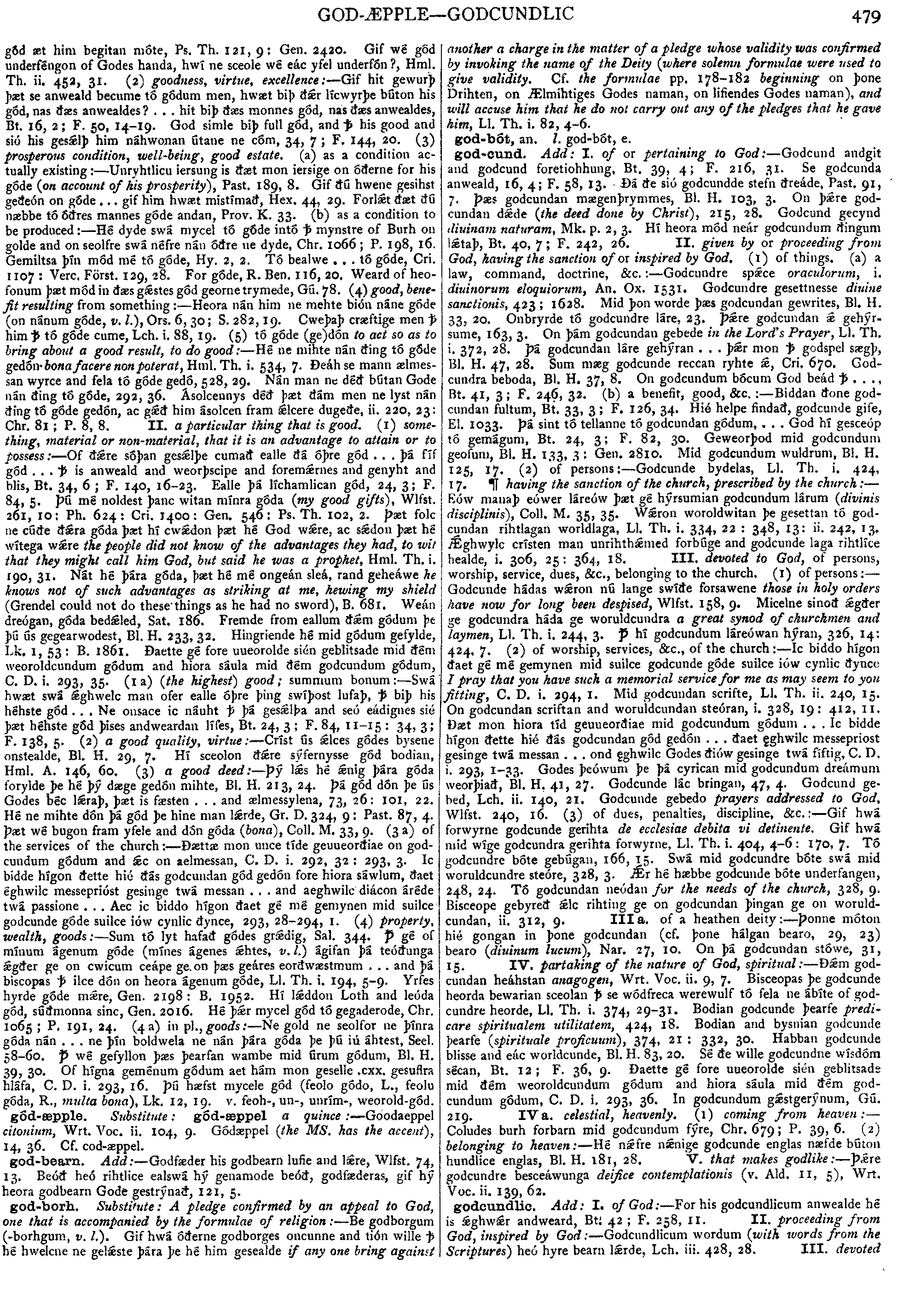
gód
æt
him
begitan
móte,
Ps.
Th.
121,
9:
Gen.
2420.
Gif
wé
gód
underféngon
of
Godes
handa,
hwí
ne
sceole
wé
eác
yfel
underfón
?,
Hml.
Th.
ii.
452,
31.
(2)
goodness,
virtue,
excellence:--Gif
hit
gewurþ
þæt
se
anweald
becume
tó
gódum
men,
hwæt
biþ
ð r
lícwyrþe
búton
his
gód,
nas
ðæs
anwealdes?
.
.
.
hit
biþ
ðæs
monnes
gód,
nas
ðæs
anwealdes,
Bt.
16,
2;
F.
50,
14-19.
God
simle
biþ
full
gód,
and
r
lícwyrþe
búton
his
gód,
nas
ðæs
anwealdes?
.
.
.
hit
biþ
ðæs
monnes
gód,
nas
ðæs
anwealdes,
Bt.
16,
2;
F.
50,
14-19.
God
simle
biþ
full
gód,
and
 his
good
and
sió
his
geslþ
him
náhwonan
útane
ne
cóm,
34,
7;
F.
144,
20.
(3)
prosperous
condition,
well-being,
good
estate.
(a)
as
a
condition
actually
existing:--Unryhtlicu
iersung
is
ðæt
mon
iersige
on
óðerne
for
his
góde
(on
account
of
his
prosperity),
Past.
189,
8.
Gif
ðú
hwene
gesihst
geðeón
on
góde
.
.
.
gif
him
hwæt
mistímað,
Hex.
44,
29.
Forlt
ðæt
ðú
næbbe
tó
óðres
mannes
góde
andan,
Prov.
K.
33.
(b)
as
a
condition
to
be
produced:--Hé
dyde
swá
mycel
tó
góde
intó
mynstre
of
Burh
on
golde
and
on
seolfre
swá
néfre
nán
óðre
ne
dyde,
Chr.
1066;
P.
198,
16.
Gemiltsa
þín
mód
mé
tó
góde,
Hy.
2,
2.
Tó
bealwe
.
.
.
tó
góde,
Cri.
1107:
Verc.
Först.
129,
28.
For
góde,
R.
Ben.
116,
20.
Weard
of
heofonum
þæt
mód
in
ðæs
gstes
gód
georne
trymede,
Gú.
78.
(4)
good,
benefit
resulting
from
something:--Heora
nán
him
ne
mehte
bión
náne
góde
(on
nánum
góde,
v.
l.),
Ors.
6,
30;
S.
282,
19.
Cweþaþ
cræftige
men
him
tó
góde
cume,
Lch.
i.
88,
19.
(5)
tó
góde
(ge)dón
to
act
so
as
to
bring
about
a
good
result,
to
do
good:--Hé
ne
mihte
nán
ðing
tó
góde
gedón
bona
facere
non
poterat,
Hml.
Th.
i.
534,
7.
Ðeáh
se
mann
ælmessan
wyrce
and
fela
tó
góde
gedó,
528,
29.
Nán
man
ne
déð
bútan
Gode
nán
ðing
tó
góde,
292,
36.
Ásolcennys
déð
þæt
ðám
men
ne
lyst
nán
ðing
tó
góde
gedón,
ac
gð
him
ásolcen
fram
lcere
dugeðe,
ii.
220,
23:
Chr.
81;
P.
8,
8.
II.
a
particular
thing
that
is
good.
(1)
something,
material
or
non-material,
that
it
is
an
advantage
to
attain
or
to
possess:--Of
ðre
sóþan
geslþe
cumað
ealle
ðá
óþre
gód
.
.
.
þá
fíf
gód
.
.
.
is
anweald
and
weorþscipe
and
foremrnes
and
genyht
and
blis,
Bt.
34,
6;
F.
140,
16-23.
Ealle
þá
líchamlican
gód,
24,
3;
F.
84,
5.
Þú
mé
noldest
þanc
witan
mínra
góda
(my
good
gifts),
Wlfst.
261,
10:
Ph.
624:
Cri.
1400:
Gen.
546:
Ps.
Th.
102,
2.
Þæt
folc
ne
cúðe
ðra
góda
þæt
hí
cwdon
þæt
hé
God
wre,
ac
sdon
þæt
hé
wítega
wre
the
people
did
not
know
of
the
advantages
they
had,
to
wit
that
they
might
call
him
God,
but
said
he
was
a
prophet,
Hml.
Th.
i.
190,
31.
Nát
hé
þára
góda,
þæt
hé
mé
ongeán
sleá,
rand
geheáwe
he
knows
not
of
such
advantages
as
striking
at
me,
hewing
my
shield
(Grendel
could
not
do
these
things
as
he
had
no
sword),
B.
681.
Weán
dreógan,
góda
bedled,
Sat.
186.
Fremde
from
eallum
ðm
gódum
þe
þú
ús
gegearwodest,
Bl.
H.
233,
32.
Hingriende
hé
mid
gódum
gefylde,
Lk.
1,
53:
B.
1861.
Ðaette
gé
fore
uueorolde
sién
geblitsade
mid
ðém
weoroldcundum
gódum
and
hiora
sáula
mid
ðém
godcundum
gódum,
C.
D.
i.
293,
35.
(1
a)
(the
highest)
good;
summum
bonum:--Swá
hwæt
swá
ghwelc
man
ofer
ealle
óþre
þing
swíþost
lufaþ,
biþ
his
héhste
gód
.
.
.
Ne
onsace
ic
náuht
þá
geslþa
and
seó
eádignes
sié
þæt
héhste
gód
þises
andweardan
lífes,
Bt.
24,
3;
F.
84,
11-15:
34,
3;
F.
138,
5.
(2)
a
good
quality,
virtue:--Críst
ús
lces
gódes
bysene
onstealde,
Bl.
H.
29,
7.
Hí
sceolon
ðre
sýfernysse
gód
bodian,
Hml.
A.
146,
60.
(3)
a
good
deed:--Þý
ls
hé
nig
þára
góda
forylde
þe
hé
þý
dæge
gedón
mihte,
Bl.
H.
213,
24.
Þá
gód
dón
þe
ús
Godes
béc
lraþ,
þæt
is
fæsten
.
.
.
and
ælmessylena,
73,
26:
101,
22.
Hé
ne
mihte
dón
þá
gód
þe
hine
man
lrde,
Gr.
D.
324,
9:
Past.
87,
4.
Þæt
wé
bugon
fram
yfele
and
dón
góda
(bona),
Coll.
M.
33,
9.
(3
a)
of
the
services
of
the
church:--Ðættæ
mon
unce
tíde
geuueorðiae
on
godcundum
gódum
and
c
on
aelmessan,
C.
D.
i.
292,
32:
293,
3.
Ic
bidde
hígon
ðette
hié
ðás
godcundan
gód
gedón
fore
hiora
sáwlum,
ðaet
éghwilc
messeprióst
gesinge
twá
messan
.
.
.
and
aeghwilc
diácon
áréde
twá
passione
.
.
.
Aec
ic
biddo
hígon
ðaet
gé
mé
gemynen
mid
suilce
godcunde
góde
suilce
iów
cynlic
ðynce,
293,
28-294,
1.
(4)
property,
wealth,
goods:--Sum
tó
lyt
hafað
gódes
grdig,
Sal.
344.
Þ-bar;
gé
of
mínum
ágenum
góde
(mínes
ágenes
htes,
v.
l.)
ágifan
þá
teóðunga
gðer
ge
on
cwicum
ceápe
ge
on
þæs
geáres
eorðwæstmum
.
.
.
and
þá
biscopas
ilce
dón
on
heora
ágenum
góde,
Ll.
Th.
i.
194,
5-9.
Yrfes
hyrde
góde
mre,
Gen.
2198:
B.
1952.
Hí
lddon
Loth
and
leóda
gód,
súðmonna
sinc,
Gen.
2016.
Hé
þr
mycel
gód
tó
gegaderode,
Chr.
1065;
P.
191,
24.
(4
a)
in
pl.,
goods:--Ne
gold
ne
seolfor
ne
þínra
góda
nán
.
.
.
ne
þín
boldwela
ne
nán
þára
góda
þe
þú
iú
áhtest,
Seel.
58-60.
Þ-bar;
wé
gefyllon
þæs
þearfan
wambe
mid
úrum
gódum,
Bl.
H.
39,
30.
Of
hígna
geménum
gódum
aet
hám
mon
geselle
.cxx.
gesuflra
hláfa,
C.
D.
i.
293,
16.
Þú
hæfst
mycele
gód
(feolo
gódo,
L.,
feolu
góda,
R.,
multa
bona),
Lk.
12,
19.
v.
feoh-,
un-,
unrím-,
weorold-gód.
his
good
and
sió
his
geslþ
him
náhwonan
útane
ne
cóm,
34,
7;
F.
144,
20.
(3)
prosperous
condition,
well-being,
good
estate.
(a)
as
a
condition
actually
existing:--Unryhtlicu
iersung
is
ðæt
mon
iersige
on
óðerne
for
his
góde
(on
account
of
his
prosperity),
Past.
189,
8.
Gif
ðú
hwene
gesihst
geðeón
on
góde
.
.
.
gif
him
hwæt
mistímað,
Hex.
44,
29.
Forlt
ðæt
ðú
næbbe
tó
óðres
mannes
góde
andan,
Prov.
K.
33.
(b)
as
a
condition
to
be
produced:--Hé
dyde
swá
mycel
tó
góde
intó
mynstre
of
Burh
on
golde
and
on
seolfre
swá
néfre
nán
óðre
ne
dyde,
Chr.
1066;
P.
198,
16.
Gemiltsa
þín
mód
mé
tó
góde,
Hy.
2,
2.
Tó
bealwe
.
.
.
tó
góde,
Cri.
1107:
Verc.
Först.
129,
28.
For
góde,
R.
Ben.
116,
20.
Weard
of
heofonum
þæt
mód
in
ðæs
gstes
gód
georne
trymede,
Gú.
78.
(4)
good,
benefit
resulting
from
something:--Heora
nán
him
ne
mehte
bión
náne
góde
(on
nánum
góde,
v.
l.),
Ors.
6,
30;
S.
282,
19.
Cweþaþ
cræftige
men
him
tó
góde
cume,
Lch.
i.
88,
19.
(5)
tó
góde
(ge)dón
to
act
so
as
to
bring
about
a
good
result,
to
do
good:--Hé
ne
mihte
nán
ðing
tó
góde
gedón
bona
facere
non
poterat,
Hml.
Th.
i.
534,
7.
Ðeáh
se
mann
ælmessan
wyrce
and
fela
tó
góde
gedó,
528,
29.
Nán
man
ne
déð
bútan
Gode
nán
ðing
tó
góde,
292,
36.
Ásolcennys
déð
þæt
ðám
men
ne
lyst
nán
ðing
tó
góde
gedón,
ac
gð
him
ásolcen
fram
lcere
dugeðe,
ii.
220,
23:
Chr.
81;
P.
8,
8.
II.
a
particular
thing
that
is
good.
(1)
something,
material
or
non-material,
that
it
is
an
advantage
to
attain
or
to
possess:--Of
ðre
sóþan
geslþe
cumað
ealle
ðá
óþre
gód
.
.
.
þá
fíf
gód
.
.
.
is
anweald
and
weorþscipe
and
foremrnes
and
genyht
and
blis,
Bt.
34,
6;
F.
140,
16-23.
Ealle
þá
líchamlican
gód,
24,
3;
F.
84,
5.
Þú
mé
noldest
þanc
witan
mínra
góda
(my
good
gifts),
Wlfst.
261,
10:
Ph.
624:
Cri.
1400:
Gen.
546:
Ps.
Th.
102,
2.
Þæt
folc
ne
cúðe
ðra
góda
þæt
hí
cwdon
þæt
hé
God
wre,
ac
sdon
þæt
hé
wítega
wre
the
people
did
not
know
of
the
advantages
they
had,
to
wit
that
they
might
call
him
God,
but
said
he
was
a
prophet,
Hml.
Th.
i.
190,
31.
Nát
hé
þára
góda,
þæt
hé
mé
ongeán
sleá,
rand
geheáwe
he
knows
not
of
such
advantages
as
striking
at
me,
hewing
my
shield
(Grendel
could
not
do
these
things
as
he
had
no
sword),
B.
681.
Weán
dreógan,
góda
bedled,
Sat.
186.
Fremde
from
eallum
ðm
gódum
þe
þú
ús
gegearwodest,
Bl.
H.
233,
32.
Hingriende
hé
mid
gódum
gefylde,
Lk.
1,
53:
B.
1861.
Ðaette
gé
fore
uueorolde
sién
geblitsade
mid
ðém
weoroldcundum
gódum
and
hiora
sáula
mid
ðém
godcundum
gódum,
C.
D.
i.
293,
35.
(1
a)
(the
highest)
good;
summum
bonum:--Swá
hwæt
swá
ghwelc
man
ofer
ealle
óþre
þing
swíþost
lufaþ,
biþ
his
héhste
gód
.
.
.
Ne
onsace
ic
náuht
þá
geslþa
and
seó
eádignes
sié
þæt
héhste
gód
þises
andweardan
lífes,
Bt.
24,
3;
F.
84,
11-15:
34,
3;
F.
138,
5.
(2)
a
good
quality,
virtue:--Críst
ús
lces
gódes
bysene
onstealde,
Bl.
H.
29,
7.
Hí
sceolon
ðre
sýfernysse
gód
bodian,
Hml.
A.
146,
60.
(3)
a
good
deed:--Þý
ls
hé
nig
þára
góda
forylde
þe
hé
þý
dæge
gedón
mihte,
Bl.
H.
213,
24.
Þá
gód
dón
þe
ús
Godes
béc
lraþ,
þæt
is
fæsten
.
.
.
and
ælmessylena,
73,
26:
101,
22.
Hé
ne
mihte
dón
þá
gód
þe
hine
man
lrde,
Gr.
D.
324,
9:
Past.
87,
4.
Þæt
wé
bugon
fram
yfele
and
dón
góda
(bona),
Coll.
M.
33,
9.
(3
a)
of
the
services
of
the
church:--Ðættæ
mon
unce
tíde
geuueorðiae
on
godcundum
gódum
and
c
on
aelmessan,
C.
D.
i.
292,
32:
293,
3.
Ic
bidde
hígon
ðette
hié
ðás
godcundan
gód
gedón
fore
hiora
sáwlum,
ðaet
éghwilc
messeprióst
gesinge
twá
messan
.
.
.
and
aeghwilc
diácon
áréde
twá
passione
.
.
.
Aec
ic
biddo
hígon
ðaet
gé
mé
gemynen
mid
suilce
godcunde
góde
suilce
iów
cynlic
ðynce,
293,
28-294,
1.
(4)
property,
wealth,
goods:--Sum
tó
lyt
hafað
gódes
grdig,
Sal.
344.
Þ-bar;
gé
of
mínum
ágenum
góde
(mínes
ágenes
htes,
v.
l.)
ágifan
þá
teóðunga
gðer
ge
on
cwicum
ceápe
ge
on
þæs
geáres
eorðwæstmum
.
.
.
and
þá
biscopas
ilce
dón
on
heora
ágenum
góde,
Ll.
Th.
i.
194,
5-9.
Yrfes
hyrde
góde
mre,
Gen.
2198:
B.
1952.
Hí
lddon
Loth
and
leóda
gód,
súðmonna
sinc,
Gen.
2016.
Hé
þr
mycel
gód
tó
gegaderode,
Chr.
1065;
P.
191,
24.
(4
a)
in
pl.,
goods:--Ne
gold
ne
seolfor
ne
þínra
góda
nán
.
.
.
ne
þín
boldwela
ne
nán
þára
góda
þe
þú
iú
áhtest,
Seel.
58-60.
Þ-bar;
wé
gefyllon
þæs
þearfan
wambe
mid
úrum
gódum,
Bl.
H.
39,
30.
Of
hígna
geménum
gódum
aet
hám
mon
geselle
.cxx.
gesuflra
hláfa,
C.
D.
i.
293,
16.
Þú
hæfst
mycele
gód
(feolo
gódo,
L.,
feolu
góda,
R.,
multa
bona),
Lk.
12,
19.
v.
feoh-,
un-,
unrím-,
weorold-gód.
|
Source: Bosworth/Toller, page d0496, entry 14 View original page image as: [TIFF] [PNG] [View previous entry] [View next entry] |
[Comment on this entry] [View comments] |
The following entry has been hand-corrected once. |
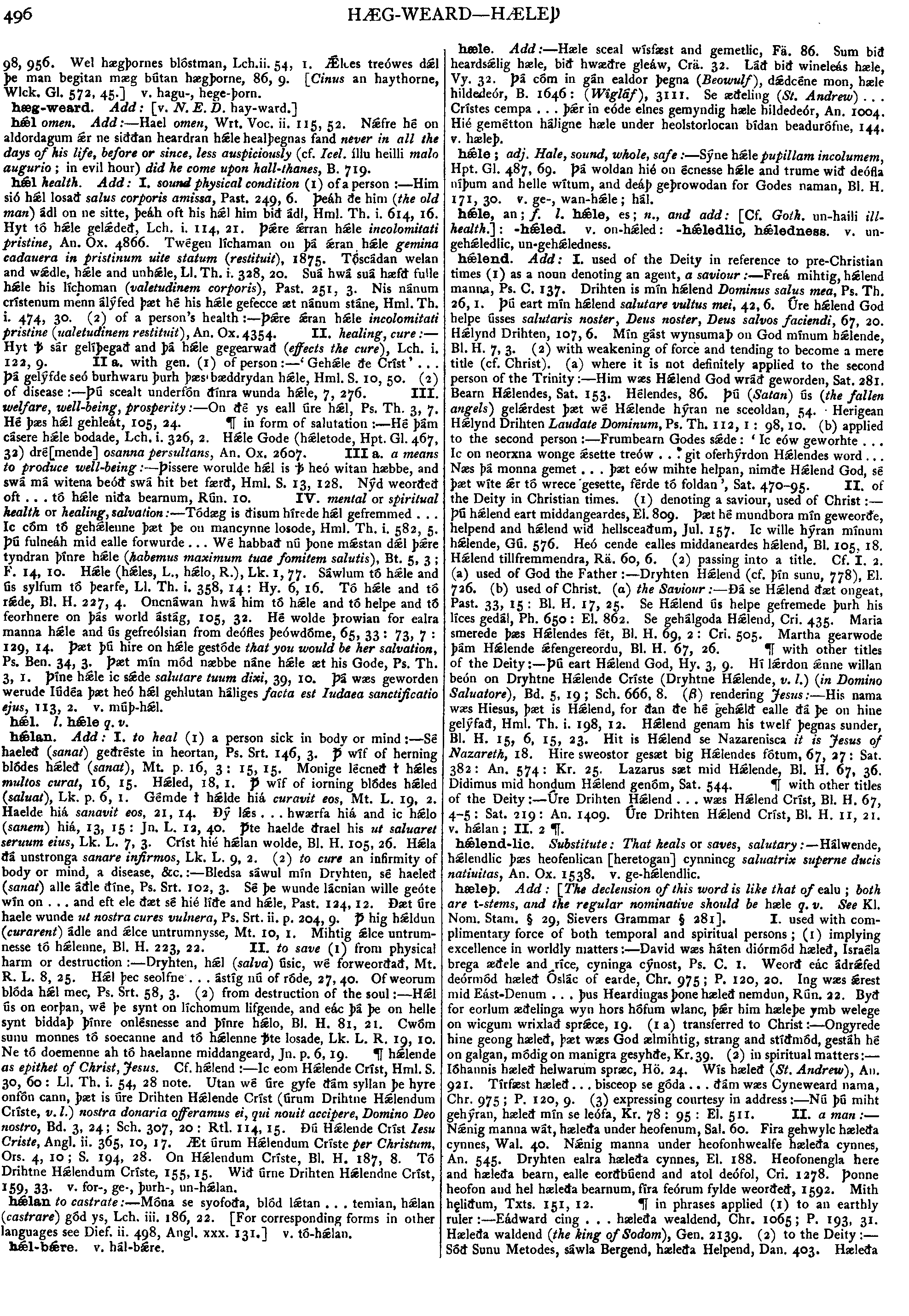
hæleþ.
Add:
[The
declension
of
this
word
is
like
that
of
ealu
;
both
are
t-stems,
and
the
regular
nominative
should
be
hæle
q.
v.
See
Kl.
Nom.
Stam.
§29,
Sievers
Grammar
§
281].
I.
used
with
complimentary
force
of
both
temporal
and
spiritual
persons;
(1)
implying
excellence
in
worldly
matters
:--
David
wæs
háten
diórmód
hæleð,
Israéls
brega
æðele
and
ríce,
cyninga
cýnost,
Ps.
C.
I.
Weorð
eác
ádrfed
deórmód
hæleð
Óslác
of
earde,
Chr.
975
;
P.
120,
20.
Ing
wæs
rest
mid
Eást-Denum
.
.
.
þus
Heardingasþone
hæleð
nemdun,
Rún.
22.
Byð
for
eorlum
æðelinga
wyn
hors
hófum
wlanc,
þr
him
hæleþe
ymb
welege
on
wicgum
wrixlað
sprce,
19.
(l
a)
transferred
to
Christ
:--
Ongyrede
hine
geong
hæleð,
þæt
wæs
God
ælmihtig,
strang
and
stíðmód,
gestáh
hé
on
galgan,
módig
on
manigra
gesyhðe,
Kr.
39.
(2)
in
spiritual
matters
:--
Ióhannis
hæleð
helwarum
spr.
ec,
Hö.
24.
Wís
hæleð
(St.
Andrew),
An.
921.
Tírfæst
hæleð.
.
.
bisceop
se
góda
.
.
.
ðám
wæs
Cyneweard
nama,
Chr.
975
;
P.
120,
9.
(3)
expressing
courtesy
in
address
:--
Nú
þú
miht
gehýran,
hæleð
mín
se
leófa,
Kr.
78
:
95
:
El.
511.
II.
a
man
:--
Nnig
manna
wát,
hæleða
under
heofenum,
Sal.
60.
Fira
gehwylc
hæleða
cynnes,
Wal.
40.
Nnig
manna
under
heofonhwealfe
hæleða
cynnes,
An.
545.
Dryhten
ealra
hæleða
cynnes,
El.
188.
Heofonengla
here
and
hæleða
beam,
ealle
eorðbúend
and
atol
deófol,
Cri.
1278.
Þonne
heofon
and
hel
hæleda
bearnum,
fíra
feórum
fylde
weorðeð,
1592.
Mith
h liðum,
Txts.
151,
12.
¶
in
phrases
applied
(1)
to
an
earthly
ruler
:--
Eádward
cing
.
.
.
hæleða
wealdend,
Chr.
1065;
P.
193,
31.
Hæleða
waldend
(the
king
of
Sodom),
Gen.
2139.
(2)
to
the
Deity
:--
Sóð
Sunu
Metodes,
sáwla
Bergend,
hæleða
Helpend,
Dan.
403.
Hælða
liðum,
Txts.
151,
12.
¶
in
phrases
applied
(1)
to
an
earthly
ruler
:--
Eádward
cing
.
.
.
hæleða
wealdend,
Chr.
1065;
P.
193,
31.
Hæleða
waldend
(the
king
of
Sodom),
Gen.
2139.
(2)
to
the
Deity
:--
Sóð
Sunu
Metodes,
sáwla
Bergend,
hæleða
Helpend,
Dan.
403.
Hælða
|
Source: Bosworth/Toller, page d0521, entry 1 View original page image as: [TIFF] [PNG] [View previous entry] [View next entry] |
[Comment on this entry] [View comments] |
The following entry has been hand-corrected once. |
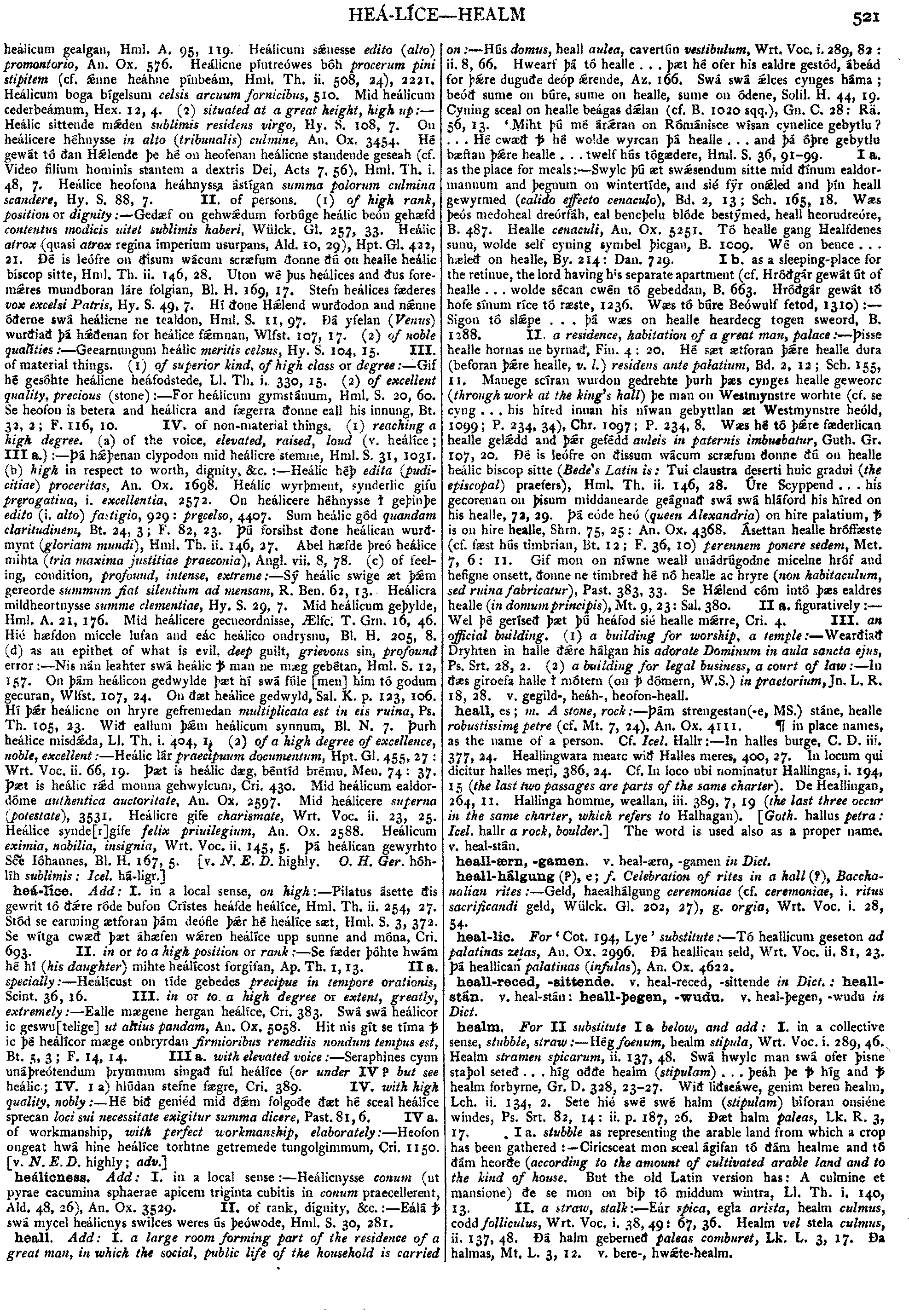
heálicum
gealgan,
Hml.
A.
95,
119.
Heálicum
snesse
edito
(alto)
promontorio,
An.
Ox.
576.
Heálicne
píntreówes
bóh
procerum
pini
stipitem
(cf.
nne
heáhne
pínbeám.
Hml.
Th.
ii.
508,
24),
2221.
Heálicum
boga
bígelsum
celsis
arcuum
fornicibus,
510.
Mid
heálicum
cederbeámum,
Hex.
12,
4.
(2
)
situated
at
a
great
height,
high
up
:--
Heálic
sittende
mden
sublimis
residens
virgo,
Hy.
S.
108,
7.
On
heálicere
héhnysse
in
alto
(tribunalis)
culmine,
An.
Ox.
3454.
Hé
gewát
tó
ðan
Hlende
þe
hé
on
heofenan
heálicne
standende
geseah
(cf.
Video
filium
hominis
stantem
a
dextris
Dei,
Acts
7,
56),
Hml.
Th.
i.
48,
7.
Heálice
heofona
heáhnyssa
ástígan
summa
polorum
culmina
scandere,
Hy.
S.
88,
7.
II.
of
persons.
(l)
of
high
rank,
position
or
dignity
:--
Gedsæf
on
gehwdum
forbúge
heálic
beón
gehæfd
contentus
modicis
uitet
sublimis
haberi,
Wülck.
Gl.
257,
33.
Heálic
atrox
(quasi
atrox
regina
imperium
usurpans,
Ald.
10,
29),
Hpt.
Gl.
422,
21.
Ðe
is
leófre
on
ðisum
wácum
scræfum
ðonne
ðú
on
healle
heálic
biscop
sitte,
Hml.
Th.
ii.
146,
28.
Uton
wé
þus
heálices
and
ðus
foremres
mundboran
láre
folgian,
Bl.
H.
169,
17.
Stefn
heálices
fæderes
vox
excelsi
Patris,
Hy.
S.
49,
7.
Hí
ðone
Hlend
wurðodon
and
nnne
óðerne
swá
heálicne
ne
tealdon,
Hml.
S.
11,
97.
Ðá
yfelan
(Venus)
wurðiað
þá
hðenan
for
heálice
fmnan,
Wlfst.
107,
17.
(2)
of
noble
qualities
:--
Geearnungum
heálic
meritis
celsus,
Hy.
S.
104,
15.
III.
of
material
things,
(l)
of
superior
kind,
of
high
class
or
degree
:--
Gif
hé
gesóhte
heálicne
heáfodstede,
Ll.
Th.
i.
330,
15.
(2)
of
excellent
quality,
precious
(stone)
:--
For
heálicum
gymstánum,
Hml.
S.
20,
60.
Se
heofon
is
betera
and
heálicra
and
fægerra
ðonne
eall
his
innung.
Bt.
32,
2;
F.
116,
10.
IV.
of
non-material
things,
(l)
reaching
a
high
degree,
(a)
of
the
voice,
elevated,
raised,
loud
(v.
heálíce;
IIIa.
)
:--
Þá
hþenan
clypodon
mid
heálicre
stemne,
Hml.
S.
31,
1031.
(b)
high
in
respect
to
worth,
dignity,
etc.
:--
Heálic
héþ
edita
(pudi citiae)
proceritas,
An.
Ox.
1698.
Heálic
wyrþment,
synderlic
gifu
prerogatiua,
UNCERTAIN
i.
excellentia,
2572.
On
heálicere
héhnysse
citiae)
proceritas,
An.
Ox.
1698.
Heálic
wyrþment,
synderlic
gifu
prerogatiua,
UNCERTAIN
i.
excellentia,
2572.
On
heálicere
héhnysse
 geþinþe
edito
(i.
alto)
fastigio,
929:
precelso,
UNCERTAIN
4407.
Sum
heálic
gód
quandam
claritudinem,
Bt.
24,
3;
F.
82,
23.
Þú
forsihst
ðone
heálican
wurðmynt
(gloriam
mundi),
Hml.
Th.
ii.
146,
27.
Abel
hæfde
þreó
heálice
mihta
(tria
maxima
justitiae
praeconia),
Angl.
vii.
8,
78.
(c)
of
feeling,
condition,
profound,
intense,
extreme
:--
Sý
heálic
swige
æt
þm
gereorde
summum
fiat
silentium
ad
mensam,
R.
Ben.
62,
13.
Heálicra
mildheortnysse
summe
clementiae,
Hy.
S.
29,
7.
Mid
heálicum
geþylde,
Hml.
A.
21,
176.
Mid
heálicere
gecneordnisse,
Ælfc.
T.
Grn.
16,
46.
Hié
hæfdon
miccle
lufan
and
eác
heálico
ondrysnu,
Bl.
H.
205,
8.
(d)
as
an
epithet
of
what
is
evil,
deep
guilt,
grievous
sin,
profound
error
:--
Nis
nán
leahter
swá
heálic
man
ne
mæg
gebétan,
Hml.
S.
12,
157.
On
þám
heálicon
gedwylde
þæt
hí
swá
fúle
[men]
him
tó
godum
gecuran,
Wlfst.
107,
24.
On
ðæt
heálice
gedwyld,
Sal.
K.
p.
123,
106.
Hí
þr
heálicne
on
hryre
gefremedan
multiplicata
est
in
eis
ruina,
Ps.
Th.
105,
23.
Wið
eallum
þm
heálicum
synnum,
Bl.
N.
7.
Þurh
heálice
misdda,
Ll.
UNCERTAIN
Th.
i.
404,
1.
(2)
of
a
high
degree
of
excellence,
noble,
excellent
:--
Heálic
lár
praecipuum
documentum,
Hpt.
Gl.
455,
27
:
Wrt.
Voc.
ii.
66,
19.
Þæt
is
heálic
dæg,
béntíd
brému,
Men.
74:
37.
Þæt
is
heálic
rd
monna
gehwylcum,
Cri.
430.
Mid
heálicum
ealdordóme
authentica
auctoritate.
An.
Ox.
2597.
Mid
heálicere
superna
(potestate),
3531.
Heálicre
gife
charismate,
Wrt.
Voc.
ii.
23,
25.
Heálice
synde[r]gife
felix
priuilegium,
An.
Ox.
2588.
Heálicum
eximia,
nobilia,
insignia,
Wrt.
Voc.
ii.
145,
5.
Þá
heálican
gewyrhto
Sce
UNCERTAIN
Ióhannes,
Bl.
H.
167,
5.
[v.
N.
E.
D.
highly.
O.
H.
Ger.
hóhlih
sublimis:
Icel.
há-ligr.]
geþinþe
edito
(i.
alto)
fastigio,
929:
precelso,
UNCERTAIN
4407.
Sum
heálic
gód
quandam
claritudinem,
Bt.
24,
3;
F.
82,
23.
Þú
forsihst
ðone
heálican
wurðmynt
(gloriam
mundi),
Hml.
Th.
ii.
146,
27.
Abel
hæfde
þreó
heálice
mihta
(tria
maxima
justitiae
praeconia),
Angl.
vii.
8,
78.
(c)
of
feeling,
condition,
profound,
intense,
extreme
:--
Sý
heálic
swige
æt
þm
gereorde
summum
fiat
silentium
ad
mensam,
R.
Ben.
62,
13.
Heálicra
mildheortnysse
summe
clementiae,
Hy.
S.
29,
7.
Mid
heálicum
geþylde,
Hml.
A.
21,
176.
Mid
heálicere
gecneordnisse,
Ælfc.
T.
Grn.
16,
46.
Hié
hæfdon
miccle
lufan
and
eác
heálico
ondrysnu,
Bl.
H.
205,
8.
(d)
as
an
epithet
of
what
is
evil,
deep
guilt,
grievous
sin,
profound
error
:--
Nis
nán
leahter
swá
heálic
man
ne
mæg
gebétan,
Hml.
S.
12,
157.
On
þám
heálicon
gedwylde
þæt
hí
swá
fúle
[men]
him
tó
godum
gecuran,
Wlfst.
107,
24.
On
ðæt
heálice
gedwyld,
Sal.
K.
p.
123,
106.
Hí
þr
heálicne
on
hryre
gefremedan
multiplicata
est
in
eis
ruina,
Ps.
Th.
105,
23.
Wið
eallum
þm
heálicum
synnum,
Bl.
N.
7.
Þurh
heálice
misdda,
Ll.
UNCERTAIN
Th.
i.
404,
1.
(2)
of
a
high
degree
of
excellence,
noble,
excellent
:--
Heálic
lár
praecipuum
documentum,
Hpt.
Gl.
455,
27
:
Wrt.
Voc.
ii.
66,
19.
Þæt
is
heálic
dæg,
béntíd
brému,
Men.
74:
37.
Þæt
is
heálic
rd
monna
gehwylcum,
Cri.
430.
Mid
heálicum
ealdordóme
authentica
auctoritate.
An.
Ox.
2597.
Mid
heálicere
superna
(potestate),
3531.
Heálicre
gife
charismate,
Wrt.
Voc.
ii.
23,
25.
Heálice
synde[r]gife
felix
priuilegium,
An.
Ox.
2588.
Heálicum
eximia,
nobilia,
insignia,
Wrt.
Voc.
ii.
145,
5.
Þá
heálican
gewyrhto
Sce
UNCERTAIN
Ióhannes,
Bl.
H.
167,
5.
[v.
N.
E.
D.
highly.
O.
H.
Ger.
hóhlih
sublimis:
Icel.
há-ligr.]
|
Source: Bosworth/Toller, page d0637, entry 22 View original page image as: [TIFF] [PNG] [View previous entry] [View next entry] |
[Comment on this entry] [View comments] |
The following entry has been hand-corrected once. |
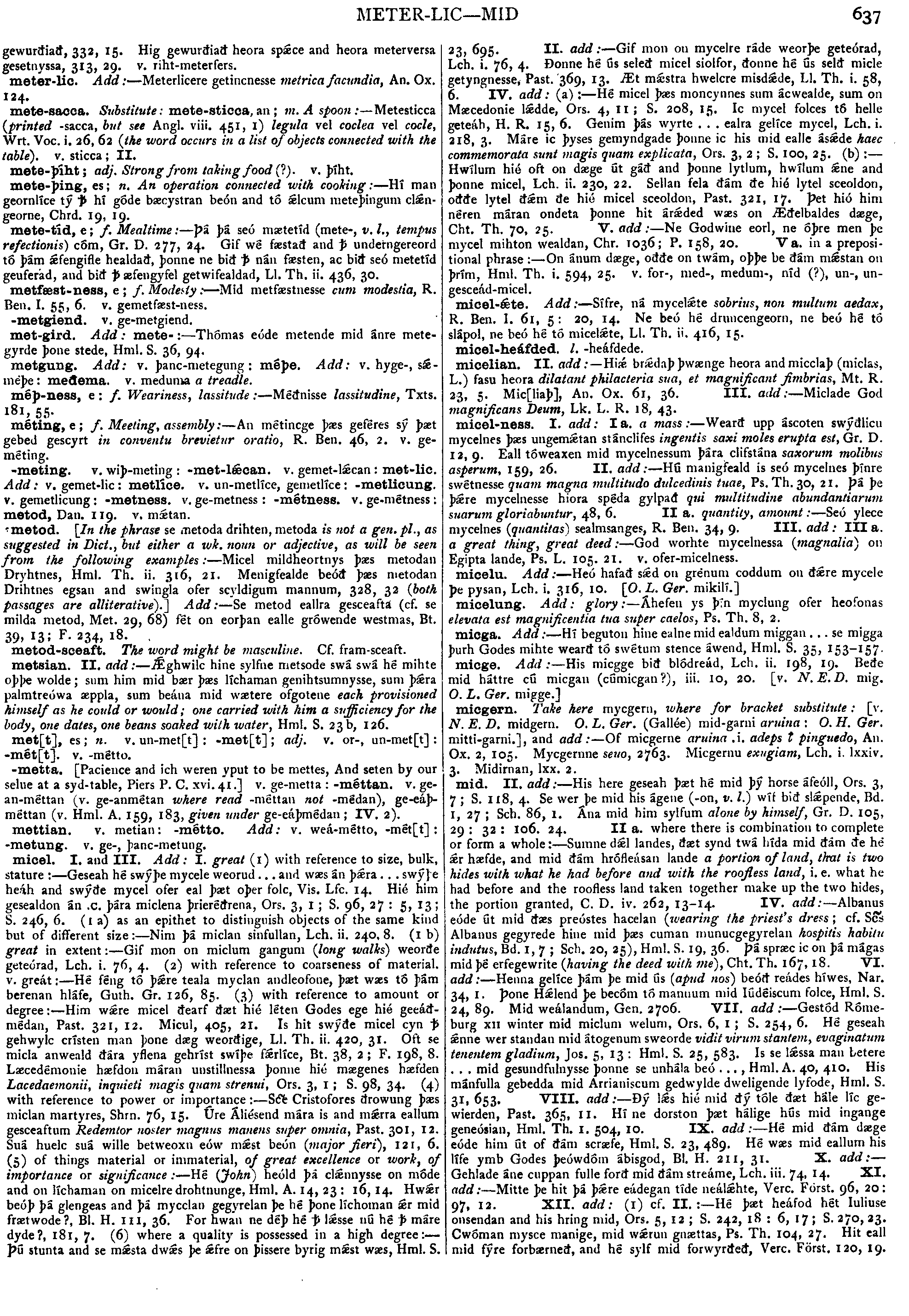
micel.
I.
and
III.
Add;
I.
great
(1)
with
reference
to
size,
bulk,
stature
:--
Geseah
hé
swýþe
mycele
weorud.
.
.
and
wæs
án
þra.
.
.
swýþe
heáh
and
swýðe
mycel
ofer
eal
þæt
oþer
folc.
Vis.
Lfc.
14.
Hié
him
gesealdon
án
.c.
þára
miclena
þrieréðrena,
Ors.
3,
1;
S.
96,
27
:
5,
13;
S.
246,
6.
(1a)
as
an
epithet
to
distinguish
objects
of
the
same
kind
but
of
different
size
:--
Nim
þá
miclan
sinfullan,
Lch.
ii.
240,
8.
(1b)
great
in
extent
:--
Gif
mon
on
miclum
gangum
(long
walks)
weorðe
geteórad.
Lch.
i.
76,
4.
(2)
with
reference
to
coarseness
of
material,
v.
greát
:--
Hé
féng
tó
þre
teala
myclan
andleofone,
þæt
wæs
tó
þám
berenan
hláfe,
Guth.
Gr.
126,
85.
(3)
with
reference
to
amount
or
degree
:--
Him
wre
micel
ðearf
ðæt
hié
léten
Godes
ege
hié
geeáðmédan,
Past.
321,
12.
Micul,
405,
21.
Is
hit
swýðe
micel
cyn
gehwylc
crísten
man
þone
dæg
weorðige,
Ll.
Th.
ii.
420,
31.
Oft
se
micla
anweald
ðára
yflena
gehríst
swíþe
frlíce,
Bt.
38,
2
;
F.
198,
8.
Læcedémonie
hæfdon
máran
unstillnessa
þonne
hié
mægenes
hæfden
Lacedaemonii,
inquieti
magis
quam
strenui,
Ors.
3,
1;
S.
98,
34.
(4)
with
reference
to
power
or
importance
:--
S
UNCERTAIN
e
Cristofores
ðrowung
þæs
miclan
martyres,
Shrn.
76,
15.
Úre
Áliésend
mára
is
and
mrra
eallum
gesceaftum
Redemtor
noster
magnus
manens
super
omnia,
Past.
301,
12.
Suá
huelc
suá
wille
betweoxn
eów
mst
beón
(major
fieri),
121,
6.
(5)
of
things
material
or
immaterial,
of
great
excellence
or
work,
of
importance
or
significance
:--
Hé
(John)
heóld
þá
clnnysse
on
móde
and
on
líchaman
on
micelre
drohtnunge,
Hml.
A.
14,
23
:
16,
14.
Hwr
beóþ
þá
glengeas
and
þá
mycclat,
gegyrelan
þe
hé
þone
líchoman
r
mid
frætwode?,
Bl.
H.
111,
36.
For
hwan
ne
déþ
hé
lsse
nú
hé
máre
dyde?,
181,
7.
(6)
where
a
quality
is
possessed
in
a
high
degree
:--
Þú
stunta
and
se
msta
dws
þe
fre
on
þissere
byrig
mst
wæs,
Hml.
S.
23,
695.
II.
add
:--
Gif
mon
on
mycelre
ráde
weorþe
geteórad,
Lch.
i.
76,
4.
Ðonne
hé
ús
seleð
micel
siolfor,
ðonne
hé
ús
selð
micle
getyngnesse,
Past.
369,
13.
Æt
mstra
hwelcre
misdde,
Ll.
Th.
i.
58,
6.
IV.
add;
(a)
:--
Hé
micel
þæs
moncynnes
sum
ácwealde,
sum
on
Mæcedonie
ldde,
Ors.
4,
11;
S.
208,
15.
Ic
mycel
folces
tó
helle
geteáh,
H.
R.
15,
6.
Genim
þás
wyrte
.
.
.
ealra
gelíce
mycel.
Lch.
i.
218,
3.
Máre
ic
þyses
gemyndgade
þonne
ic
his
mid
ealle
ásde
haec
commemorata
sunt
magis
quam
explicata,
Ors.
3,
2
;
S.
100,
25.
(b)
:--
Hwílum
hié
oft
on
dæge
út
gáð
and
þonne
lytlum,
hwílum
ne
and
þonne
micel,
Lch.
ii.
230,
22.
Sellan
fela
ðám
ðe
hié
lytel
sceoldon,
oððe
lytel
ðm
ðe
hié
micel
sceoldon.
Past.
321,
17.
Þet
hió
him
néren
máran
ondeta
þonne
hit
árded
wæs
on
Æðelbaldes
dæge,
Cht.
Th.
70,
25.
V.
add
:--
Ne
Godwíne
eorl,
ne
óþre
men
þe
mycel
mihton
wealdan,
Chr.
1036;
P.
158,
20.
Va.
in
a
prepositional
phrase
:--
On
ánum
dæge,
oððe
on
twám,
oþþe
be
ðám
mstan
on
þrím,
Hml.
Th.
i.
594,
25.
v.
for-,
med-,
medum-.
níd
(?),
un-,
un-gesceád-micel.
|
Source: Bosworth/Toller, page d0719, entry 35 View original page image as: [TIFF] [PNG] [View previous entry] [View next entry] |
[Comment on this entry] [View comments] |
The following entry has been hand-corrected once. |
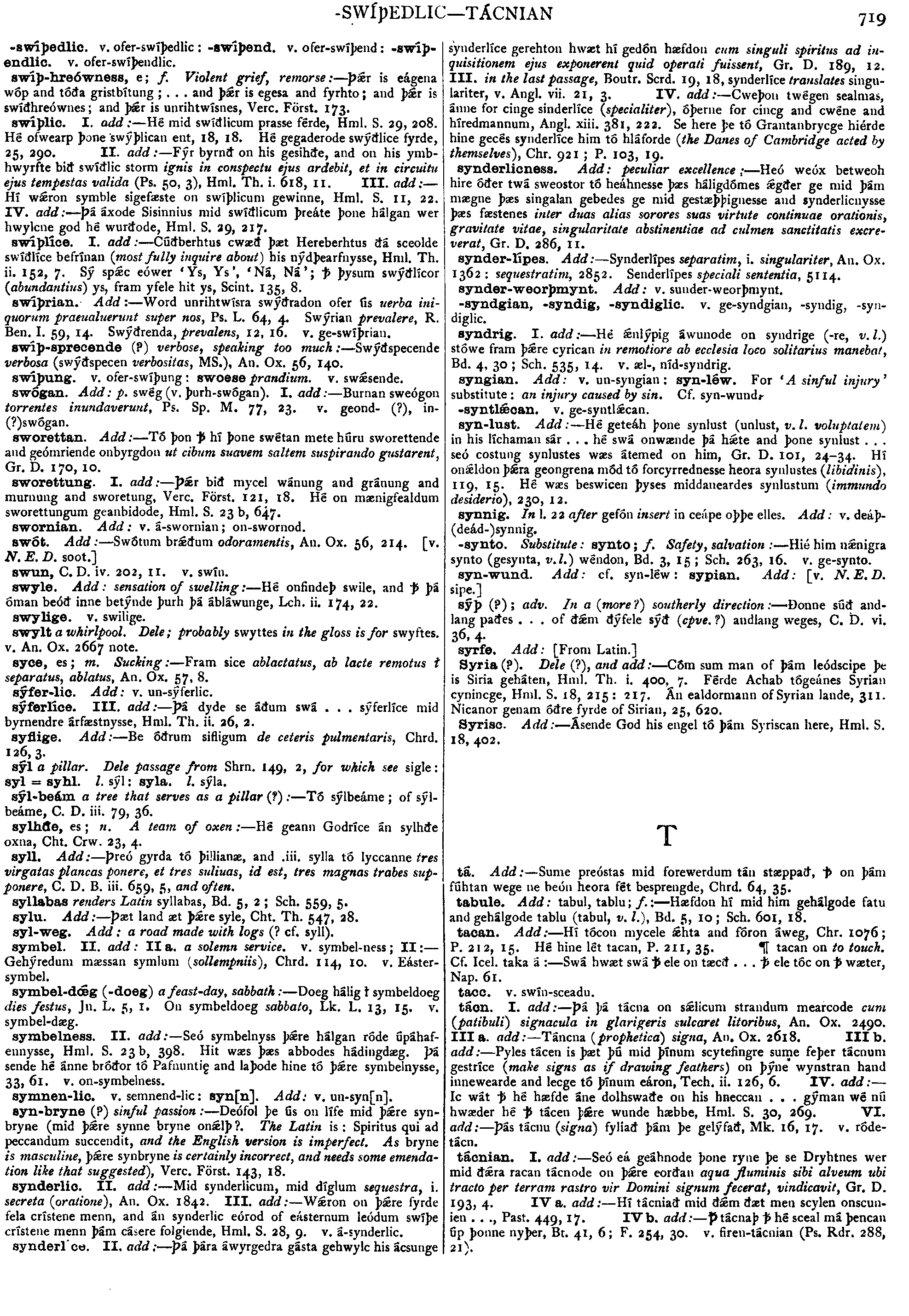
synderlicness.
Add:
peculiar
excellence
:--
Heó
weóx
betweoh
hire
óðer
twá
sweostor
tó
heáhnesse
þæs
háligdómes
gðer
ge
mid
þám
mægne
þæs
singalan
gebedes
ge
mid
gestæþþignesse
and
synderlicnysse
þæs
fæstenes
inter
duas
alias
sorores
suas
virtute
continuae
orationis,
gravitate
vitae,
singularitate
abstinentiae
ad
oilmen
sanctitatis
excreverat,
Gr.
D.
286,
11.
|
Source: Bright's OE Grammar, page b0312, entry 18 View original page image as: [TIFF] [PNG] [View previous entry] [View next entry] |
[Comment on this entry] [View comments] |
The following entry has been hand-corrected once. |
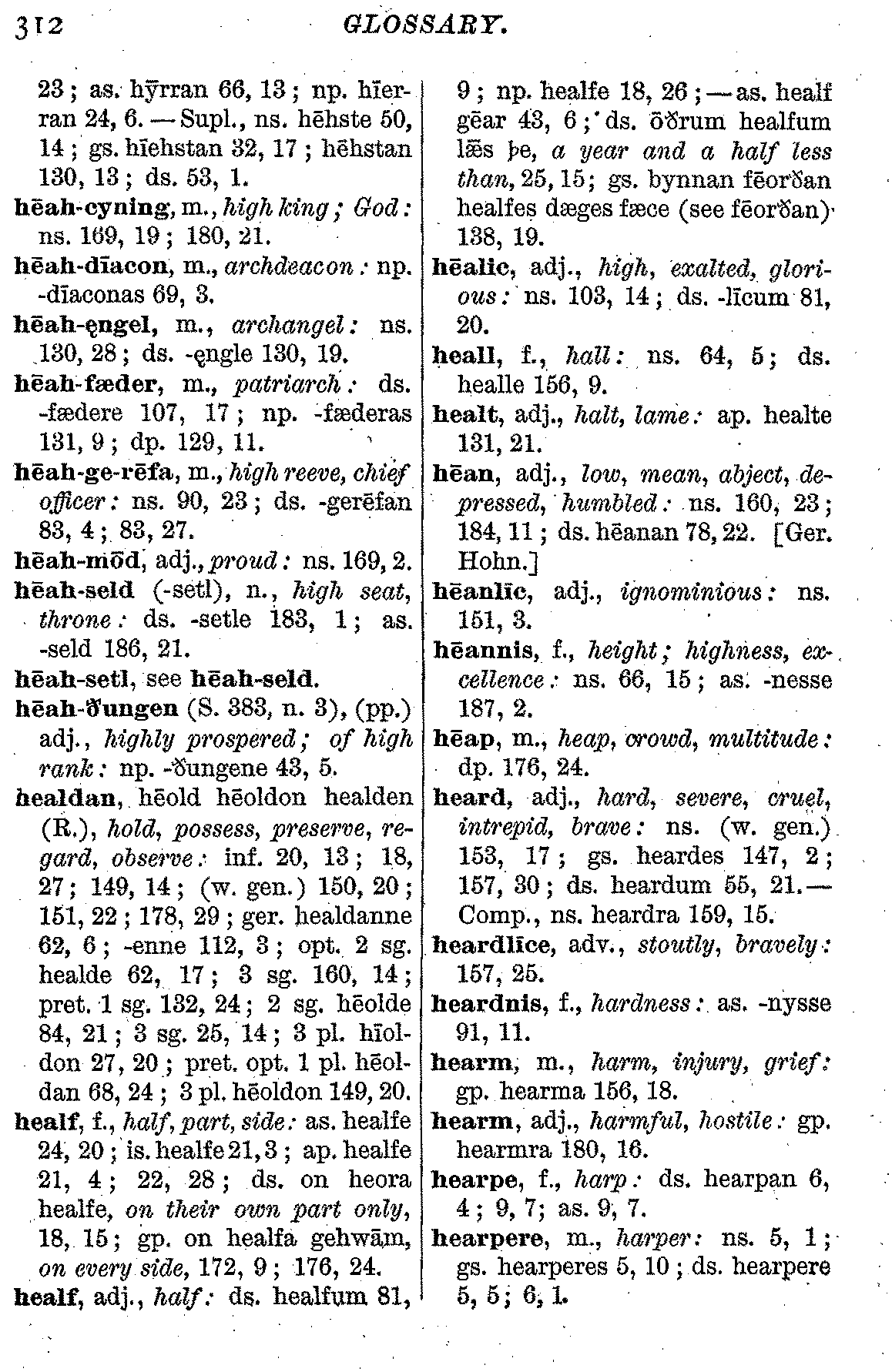
h annis
f
height,
highness,
excellence
annis
f
height,
highness,
excellence
|
Source: Bright's OE Grammar, page b0382, entry 19 View original page image as: [TIFF] [PNG] [View previous entry] [View next entry] |
[Comment on this entry] [View comments] |
The following entry has been hand-corrected once. |
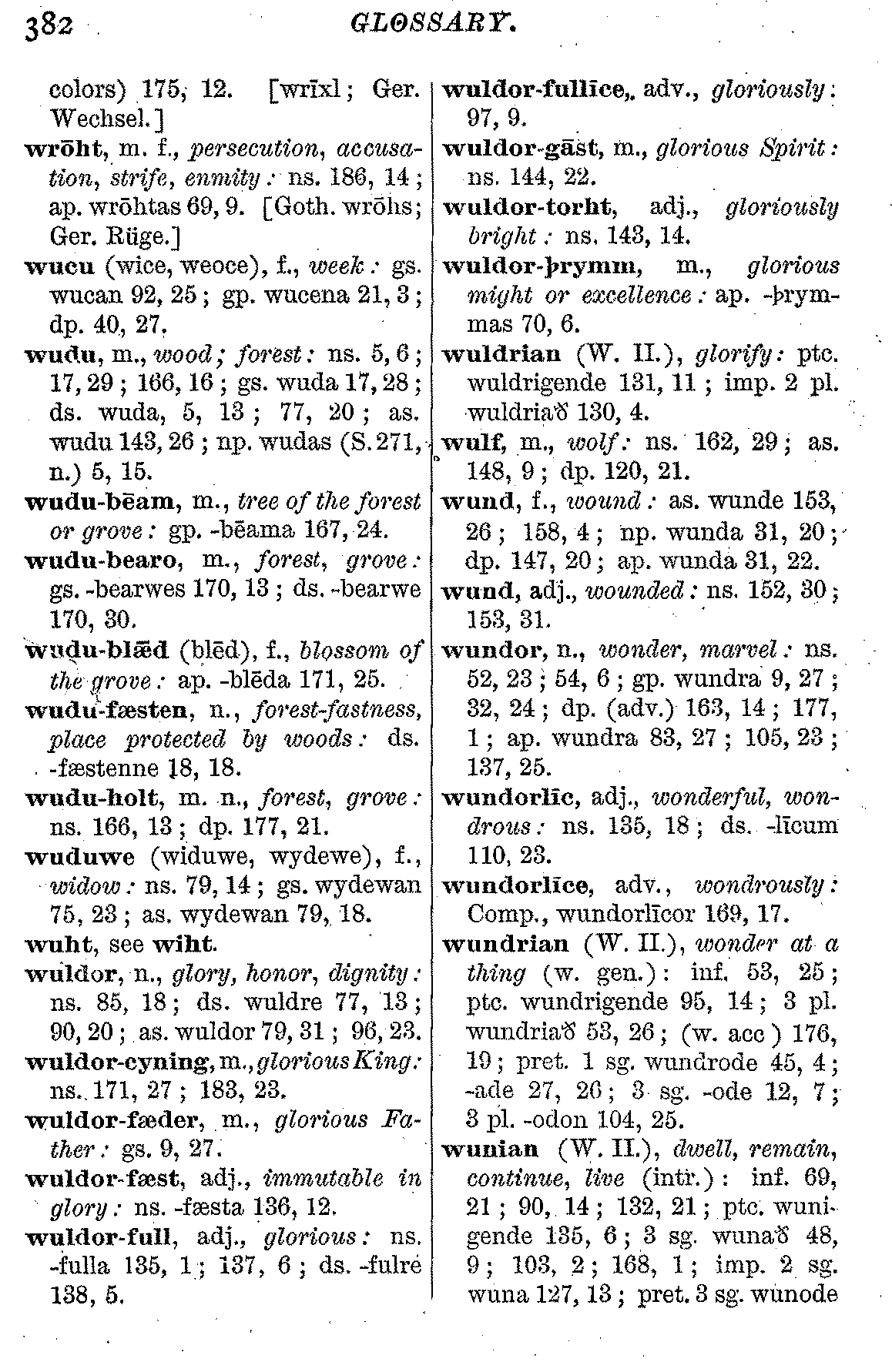
wuldor-þrymm m glorious might or excellence
|
Source: Cleasby/Vigfusson, page b0040, entry 38 View original page image as: [TIFF] [PNG] [View previous entry] [View next entry] |
[Comment on this entry] [View comments] |
The following entry has not been hand-corrected. However, the page is reserved and someone is correcting it. |
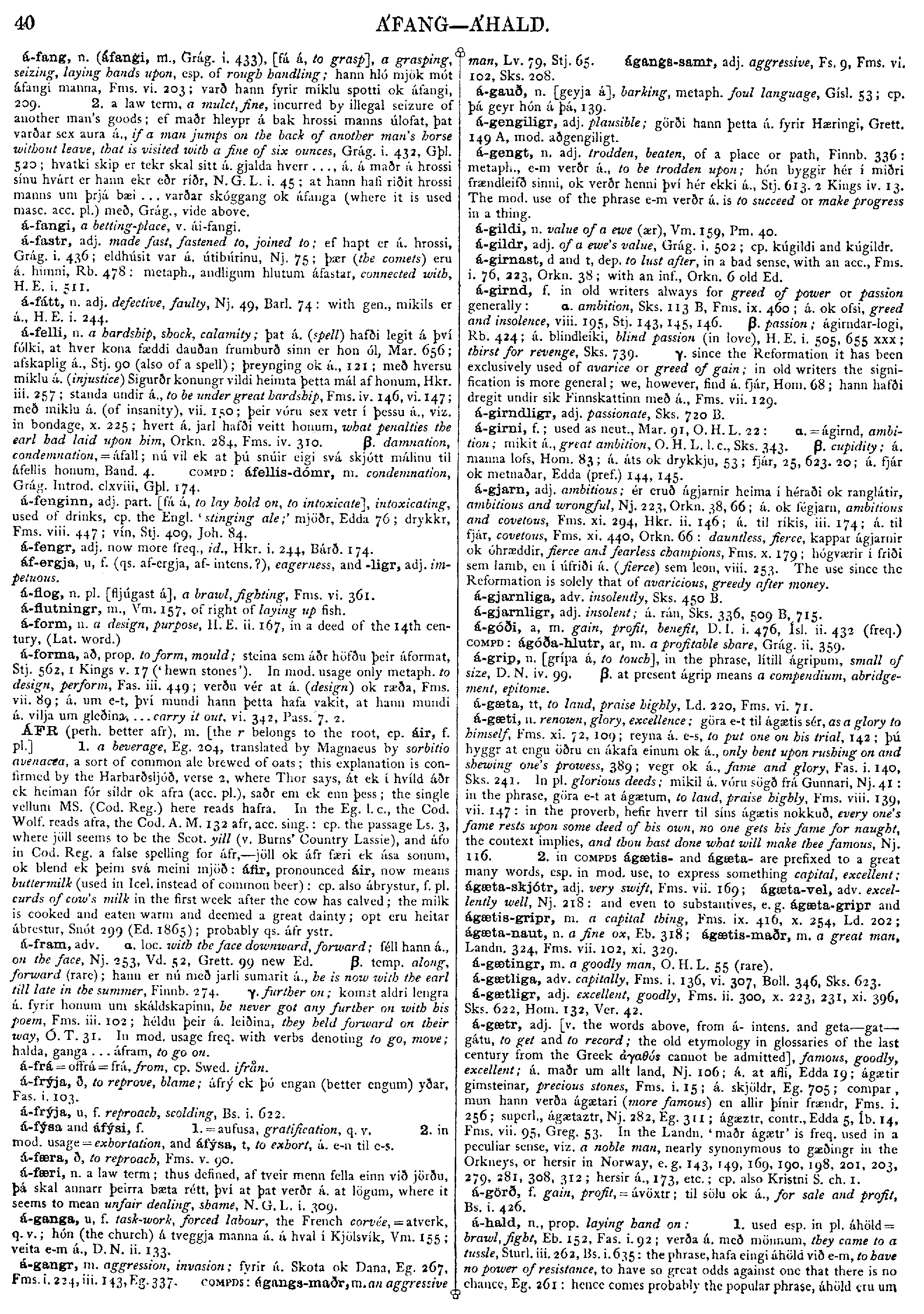
á-gœti, n. renown, glory, excellence; göra e-t til ágætis sór, a s a glory t o himself, Fms. xi. 72, 109; reyna á. e-s, to put one on his trial, 142; þú hyggr at engu öðru en ákafa einum ok á., o nly bent upon rushing on and shewing one's prowess, 389; vegr ok á., fame and glory, Fas. i. 140, Sks. 241. In pl. glorious deeds; mikil á. vóni sögð frá Gunnari, Nj. 41: in the phrase, göra e-t at ágætum, to laud, praise highly, Fms. viii. 139, vii. 147: in the proverb, hefir hverr til sins ágætis nokkuð, every one's fame rests upon some deed of his own, no one gets his fame for naught, the context implies, a n d thou ha s t done what will make thee famous, Nj. 116. 2. in COMPDS ágœtis- and ágœta- are prefixed to a great many words, esp. in mod. use, to express something capital, excellent; ágæta-skjótr, adj. very swift, Fms. vii. 169; agæta-vel, adv. excel- lently well, Nj. 218: and even to substantives, e. g. ágæta-gripr and ágætis-gripr, m. a capital thing, Fms. ix. 416, x. 254, Ld. 202; ágæta-naut, n. a fine ox, Eb. 318; ágœtis-maðr, m. a great man, Landn. 324, Fms. vii. 102, xi. 329.
|
Source: Cleasby/Vigfusson, page b0645, entry 1 View original page image as: [TIFF] [PNG] [View previous entry] [View next entry] |
[Comment on this entry] [View comments] |
The following entry has been hand-corrected once. |
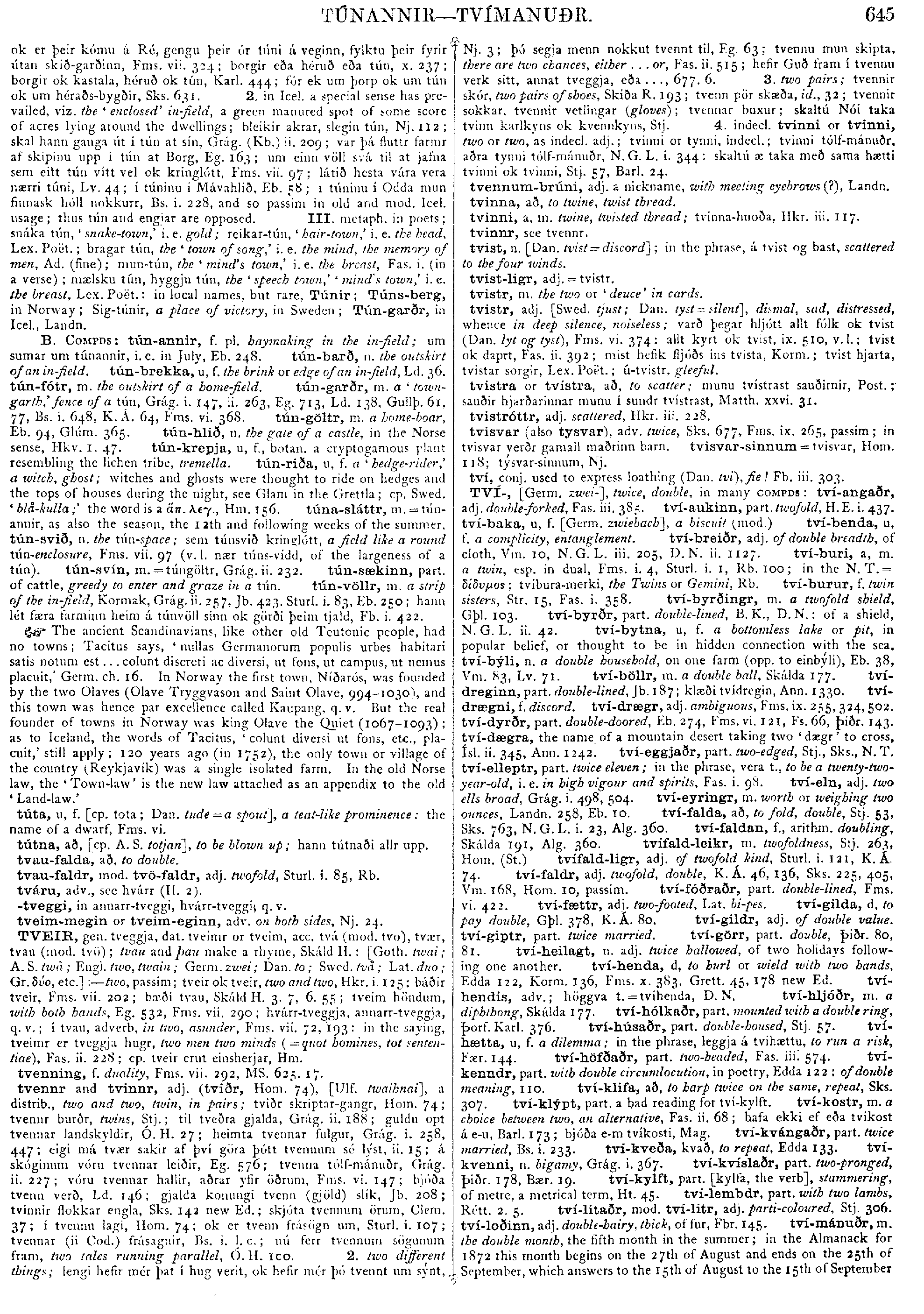
ok er þeir kómu á Ré, gengu þeir ór túni á veginn, fylktu þeir fyrir útan skíð-garðinn, Fms. vii. 324; borgir eða héruð eða tún, x. 237; borgir ok kastala, héruð ok tún, Karl. 444; fór ek um þorp ok um tún ok um héraðs-bygðir, Sks. 631. 2. in Icel. a special sense has prevailed, viz. the 'enclosed' in-field, a green manured spot of some score of acres lying around the dwellings; bleikir akrar, slegin tún, Nj. 112; skal hann ganga út í tún at sín, Grág. (Kb.) ii. 209; var þá fluttr farmr af skipinu upp í tún at Borg, Eg. 163; um einn völl svá til at jafna sem eitt tún vítt vel ok kringlótt, Fms. vii. 97; látið hesta vára vera nærri túni, Lv. 44; í túninu í Mávahlíð, Eb. 58; í túninu í Odda mun finnask hóll nokkurr, Bs. i. 228, and so passim in old and mod. Icel. usage; thus tún and engiar are opposed. III. metaph. in poets; snáka tún, 'snake-town,' i.e. gold; reikar-tún, 'hair-town' i.e. the head, Lex. Poët.; bragar tún, the 'town of song,' i.e. the mind, the memory of men, Ad. (fine); mun-tún, the 'mind's town,' i.e. the breast, Fas. i. (in a verse); mælsku tún, hyggju tún, the 'speech town,' 'mind's town,' i.e. the breast. Lex. Poët.: in local names, but rare, Túnir: Túns-berg, in Norway; Sig-túnir, a place of victory, in Sweden; Tún-garðr, in Icel., Landn. B. COMPDS: tún-annir, f. pl. haymaking in the in-field; um sumar um túnannir, i.e. in July, Eb. 248. tún-barð, n. the outskirt of an in-field. tún-brekka, u, f. the brink or edge of an in-field, Ld. 36. tún-fótr, m. the outskirt of a home-field, tún-garðr, m. a 'town-garth,' fence of a tún, Grág. i. 147, ii. 263, Eg. 713, Ld. 138, Gullþ. 61, 77, Bs. i. 648, K.Á. 64, Fms. vi. 368. tún-göltr, m. a home-boar, Eb. 94, Glúm. 365. tún-hlið, n. the gate of a castle, in the Norse sense, Hkv. I. 47. tún-krepja, u, f., botan. a cryptogamous plant resembling the lichen tribe, tremella. tún-riða, u, f. a 'hedge-rider,' a witch, ghost; witches and ghosts were thought to ride on hedges and the tops of houses during the night, see Glam in the Grettla; cp. Swed. 'blå-kulla;' the word is a GREEK., Hm. 156. túna-sláttr, m. = túnannir, as also the season, the 12th and following weeks of the summer. tún-svið, n. the tún-space; sem túnsvið kringlótt, a field like a round tún-enclosure, Fms. vii. 97 (v.l. nær túns-vídd, of the largeness of a tún). tún-svín, m. = túngöltr, Grág. ii. 232. tún-sækinn, part. of cattle, greedy to enter and graze in a tún. tún-völlr, m. a strip of the in-field, Kormak, Grág. ii. 257, Jb. 423. Stud. i. 83, Eb. 250; hann lét færa farminn heim á túnvöll sinn ok görði þeim tjald, Fb. i. 422. &FINGER; The ancient Scandinavians, like other old Teutonic people, had no towns; Tacitus says, 'nullas Germanorum populis urbes habitari satis notum est... colunt discreti ac diversi, ut fons, ut campus, ut nemus placuit,' Germ. ch. 16. In Norway the first town, Níðarós, was founded by the two Olaves (Olave Tryggvason and Saint Olave, 994-1030), and this town was hence par excellence called Kaupang, q.v. But the real founder of towns in Norway was king Olave the Quiet (1067-1093); as to Iceland, the words of Tacitus, 'colunt diversi ut fons, etc., placuit,' still apply; 120 years ago (in 1752), the only town or village of the country (Reykjavík) was a single isolated farm. In the old Norse law, the 'Town-law' is the new law attached as an appendix to the old 'Land-law.'
|
Source: Cleasby/Vigfusson, page b0709, entry 8 View original page image as: [TIFF] [PNG] [View previous entry] [View next entry] |
[Comment on this entry] [View comments] |
The following entry has been hand-corrected once. |
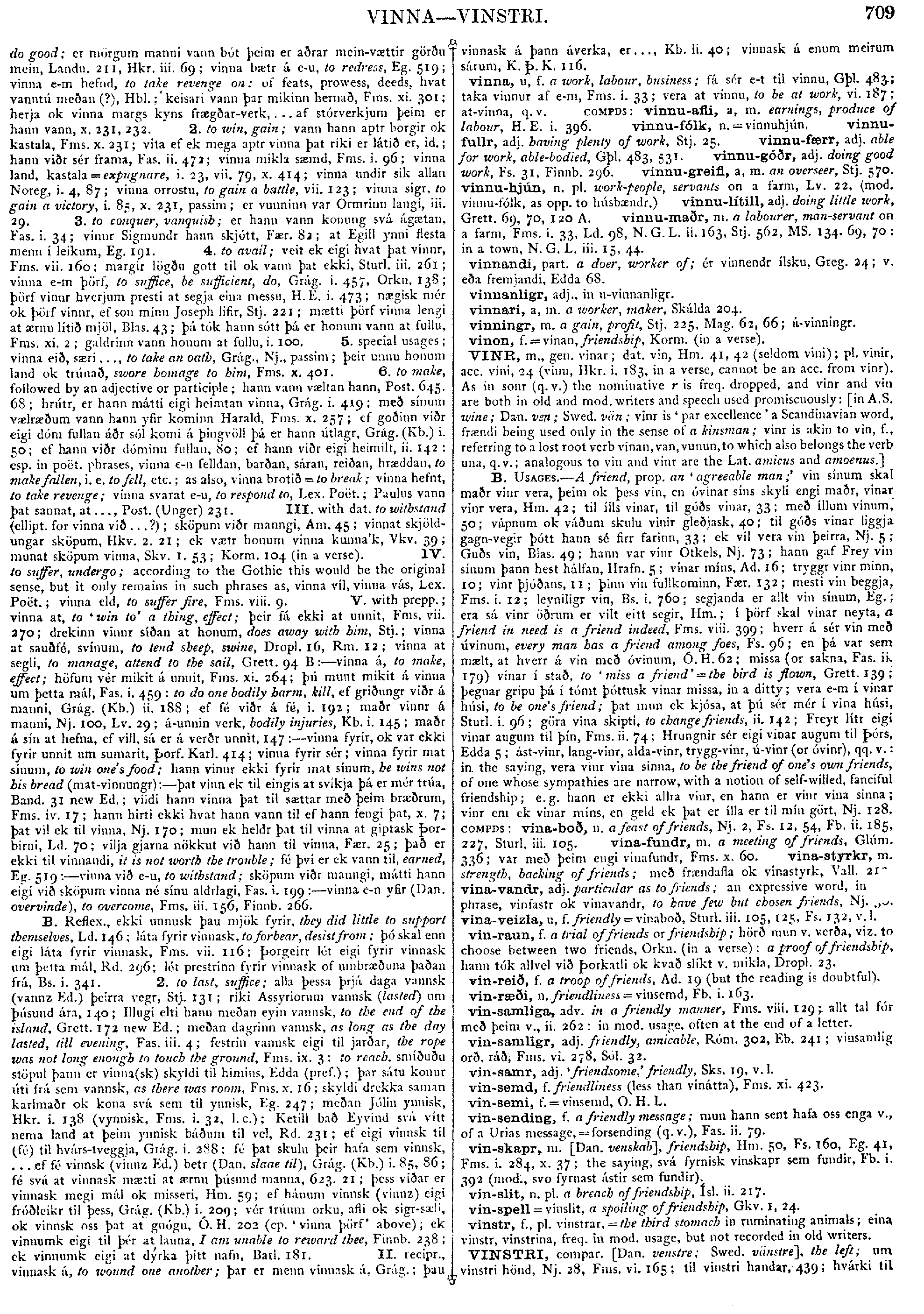
VINR, m., gen. vinar; dat. vin, Hm. 41, 42 (seldom vini); pl. vinir, acc. vini, 24 (vinu, Hkr. i. 183, in a verse, cannot be an acc. from vinr). As in sonr (q.v.) the nominative r is freq. dropped, and vinr and vin are both in old and mod. writers and speech used promiscuously: [in A.S. wine; Dan. ven; Swed. vän; vinr is 'par excellence' a Scandinavian word, frændi being used only in the sense of a kinsman; vinr is akin to vin, f., referring to a lost root verb vinan, van, vunun, to which also belongs the verb una, q.v.; analogous to vin and vinr are the Lat. amicus and amoenus.] B. USAGES. -- A friend, prop. an 'agreeable man;' vin sínum skal maðr vinr vera, þeim ok þess vin, en óvinar síns skyli engi maðr, vinar vinr vera, Hm. 42; til ílls vinar, til góðs vinar, 33; með íllum vinum, 50; vápnum ok váðum skulu vinir gleðjask, 40; til góðs vinar liggja gagn-vegir þótt hann sé firr farinn, 33; ek vil vera vin þeirra, Nj. 5; Guðs vin, Blas. 49; hann var vinr Otkels, Nj. 73; hann gaf Frey vin sínum þann hest hálfan, Hrafn. 5; vinar míns, Ad. 16; tryggr vinr minn, 10; vinr þjóðans, 11; þinn vin fullkominn, Fær. 132; mesti vin beggja, Fms. i. 12; leyniligr vin, Bs. i. 760; segjanda er allt vin sínum, Eg.; era sá vinr öðrum er vilt eitt segir, Hm.; í þörf skal vinar neyta, a friend in need is a friend indeed, Fms. viii. 399; hverr á sér vin með úvinum, every man has a friend among foes, Fs. 96; en þá var sem mælt, at hverr á vin með óvimim, Ó.H. 62; missa (or sakna, Fas. ii. 179) vinar í stað, to 'miss a friend' = the bird is flown, Grett. 139; þegnar gripu þá í tómt þóttusk vinar missa, in a ditty; vera e-m í vinar húsi, t o 6 e one's friend; þat mun ek kjósa, at þú sér mér í vina húsi, Sturl. i. 96; göra vina skipti, to change friends, ii. 142; Freyr lítr eigi vinar augum til þín, Fms. ii. 74; Hrungnir sér eigi vinar augum til Þórs, Edda 5; ást-vinr, lang-vinr, alda-vinr, trygg-vinr, ú-vinr (or óvinr), qq.v.: in. the saying, vera vinr vina sinna, to be the friend of one's own friends, of one whose sympathies are narrow, with a notion of self-willed, fanciful friendship; e.g. hann er ekki allra vinr, en hann er vinr vina sinna; vinr em ek vinar míns, en geld ek þat er ílla er til mín gört, Nj. 128. COMPDS: vina-boð, n. a feast of friends, Nj. 2, Fs. 12, 54, Fb. ii. 185, 227, Sturl. iii. 105. vina-fundr, m. a meeting of friends. Glúm. 336; var með þeim engi vinafundr, Fms. x. 60. vina-styrkr, m. strength, backing of friends; með frændafla ok vinastyrk, Vall. 213 vina-vandr, adj. particular as to friends; an expressive word, in phrase, vinfastr ok vinavandr, to have few but chosen friends, Nj. 30. vina-veizla, u, f. friendly = vinabod, Sturl. iii. 105, 125, Fs. 132, v.l.
| Result Page: |  |
Previous | 1 2 3 4 5 |
Germanic Lexicon Project (main page)
This search system was written by
Sean Crist
Please consider
volunteering
to correct the data in these online dictionaries.
No rights reserved. Feel free to use these data in any way you please.