|
|

|
Source: Bosworth/Toller, page d0464, entry 20 View original page image as: [TIFF] [PNG] [View previous entry] [View next entry] |
[Comment on this entry] [View comments] |
The following entry has been hand-corrected once. |
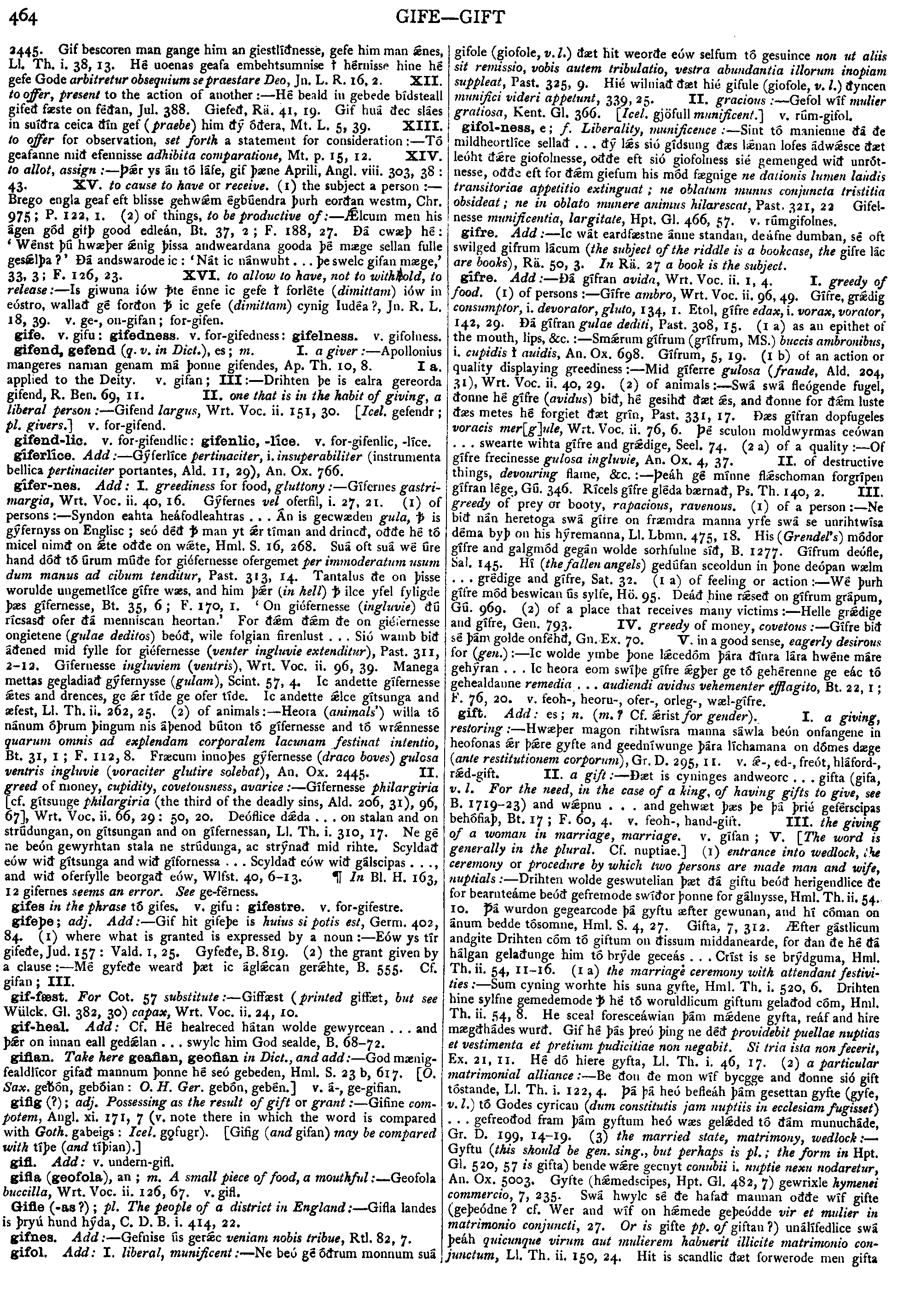
g fre.
Add
:--
Ð
fre.
Add
:--
Ð gfran
avida.
Wrt.
Voc.
ii.
i.
4.
I.
greedy
of
food.
(l)
of
persons
:--
Gfre
ambro,
Wrt.
Voc.
ii.
96,
49.
Gfre,
gr
gfran
avida.
Wrt.
Voc.
ii.
i.
4.
I.
greedy
of
food.
(l)
of
persons
:--
Gfre
ambro,
Wrt.
Voc.
ii.
96,
49.
Gfre,
gr dig
consumptor,
i.
devorator,
gluto,
134,
I.
Etol,
gfre
edax,
i.
vorax,
vorator,
142,
29.
Ð
gfran
gulae
dediti,
Past.
308,
15.
(l
a)
as
an
epithet
of
the
mouth,
lips,
&c.
:--
Smrum
gfrum
(grfrum,
MS.)
buccis
ambronibus,
i.
cupidis
dig
consumptor,
i.
devorator,
gluto,
134,
I.
Etol,
gfre
edax,
i.
vorax,
vorator,
142,
29.
Ð
gfran
gulae
dediti,
Past.
308,
15.
(l
a)
as
an
epithet
of
the
mouth,
lips,
&c.
:--
Smrum
gfrum
(grfrum,
MS.)
buccis
ambronibus,
i.
cupidis
 auidis,
An.
Ox.
698.
Gfrum,
5,
19,
(l
b)
of
an
action
or
quality
displaying
greediness
:--
Mid
gferre
gulosa
(fraude,
Ald.
204,
31),
Wrt.
Voc.
ii.
40,
29.
(2)
of
animals
:--
Sw
sw
fleógende
fugel,
auidis,
An.
Ox.
698.
Gfrum,
5,
19,
(l
b)
of
an
action
or
quality
displaying
greediness
:--
Mid
gferre
gulosa
(fraude,
Ald.
204,
31),
Wrt.
Voc.
ii.
40,
29.
(2)
of
animals
:--
Sw
sw
fleógende
fugel,
 onne
h
onne
h gfre
(avidus)
bi,
h
gesih
æt
s,
and
onne
for
m
luste
æs
metes
h
forgiet
æt
grn,
Past.
331,
17.
Ðæs
gfran
dopfugeles
voracis
mer[g]ule,
Wrt.
Voc.
ii.
76,
6.
Þ
sculon
moldwyrrnas
ceówan
.
.
.
swearte
wihta
gfre
and
grdige,
Seel.
74.
(2
a)
of
a
quality
:--
Of
gfre
frecinesse
gulosa
ingluvie,
An.
Ox.
4,
37.
II.
of
destructive
things,
devouring
flame,
&c.
:--
Þeáh
g
mnne
flschoman
forgrpen
gfran
lge,
G
gfre
(avidus)
bi,
h
gesih
æt
s,
and
onne
for
m
luste
æs
metes
h
forgiet
æt
grn,
Past.
331,
17.
Ðæs
gfran
dopfugeles
voracis
mer[g]ule,
Wrt.
Voc.
ii.
76,
6.
Þ
sculon
moldwyrrnas
ceówan
.
.
.
swearte
wihta
gfre
and
grdige,
Seel.
74.
(2
a)
of
a
quality
:--
Of
gfre
frecinesse
gulosa
ingluvie,
An.
Ox.
4,
37.
II.
of
destructive
things,
devouring
flame,
&c.
:--
Þeáh
g
mnne
flschoman
forgrpen
gfran
lge,
G .
346.
Rcels
gfre
glda
bærna,
Ps.
Th.
140,
2.
III.
greedy
of
prey
or
booty,
rapacious,
ravenous.
(l)
of
a
person
:--
Ne
bi
nn
heretoga
sw
gfre
on
fræmdra
manna
yrfe
sw
se
unrihtwsa
dma
byþ
on
his
h
.
346.
Rcels
gfre
glda
bærna,
Ps.
Th.
140,
2.
III.
greedy
of
prey
or
booty,
rapacious,
ravenous.
(l)
of
a
person
:--
Ne
bi
nn
heretoga
sw
gfre
on
fræmdra
manna
yrfe
sw
se
unrihtwsa
dma
byþ
on
his
h remanna,
Ll.
Lbmn.
475,
18.
His
(Grendel's)
m
remanna,
Ll.
Lbmn.
475,
18.
His
(Grendel's)
m dor
gfre
and
galgmd
gegn
wolde
sorhfulne
s,
B.
1277.
Gfrum
deófle,
Sal.
145.
H
(the
fallen
angels')
gedfan
sceoldun
in
þone
deópan
wælm
.
.
.
grdige
and
gfre,
Sat.
32.
(l
a)
of
feeling
or
action
:--
W
þurh
gfre
md
beswican
s
sylfe,
Hö.
95.
Deá
hine
rse
on
gfrum
grpum,
G.
969.
(2)
of
a
place
that
receives
many
victims
:--
Helle
grdige
and
gfre,
Gen.
793.
IV.
greedy
of
money,
covetous
:--
Gfre
bi
s
þm
golde
onfh,
Gn.
Ex.
70.
V.
in
a
good
sense,
eagerly
desirous
for
(gen.)
:--
Ic
wolde
ymbe
þone
lcedm
þra
nra
lra
hwne
mre
gehran
,
.
.
Ic
heora
eom
swþe
gfre
gþer
ge
t
gehrenne
ge
eác
t
gehealdanne
remedia
.
.
.
audiendi
avidus
vehementer
efflagito,
Bt.
22,
I;
F.
76,
20.
v.
feoh-,
heoru-,
ofer-,
orleg-,
wæl-gfre.
dor
gfre
and
galgmd
gegn
wolde
sorhfulne
s,
B.
1277.
Gfrum
deófle,
Sal.
145.
H
(the
fallen
angels')
gedfan
sceoldun
in
þone
deópan
wælm
.
.
.
grdige
and
gfre,
Sat.
32.
(l
a)
of
feeling
or
action
:--
W
þurh
gfre
md
beswican
s
sylfe,
Hö.
95.
Deá
hine
rse
on
gfrum
grpum,
G.
969.
(2)
of
a
place
that
receives
many
victims
:--
Helle
grdige
and
gfre,
Gen.
793.
IV.
greedy
of
money,
covetous
:--
Gfre
bi
s
þm
golde
onfh,
Gn.
Ex.
70.
V.
in
a
good
sense,
eagerly
desirous
for
(gen.)
:--
Ic
wolde
ymbe
þone
lcedm
þra
nra
lra
hwne
mre
gehran
,
.
.
Ic
heora
eom
swþe
gfre
gþer
ge
t
gehrenne
ge
eác
t
gehealdanne
remedia
.
.
.
audiendi
avidus
vehementer
efflagito,
Bt.
22,
I;
F.
76,
20.
v.
feoh-,
heoru-,
ofer-,
orleg-,
wæl-gfre.
|
Source: Bosworth/Toller, page d0464, entry 21 View original page image as: [TIFF] [PNG] [View previous entry] [View next entry] |
[Comment on this entry] [View comments] |
The following entry has been hand-corrected once. |
gift.
Add:
es;
n.
(m.
?
Cf.
rist
for
gender).
I.
a
giving,
restoring
:--
Hwæþer
magon
rihtwsra
manna
swla
beón
onfangene
in
heofonas
r
þre
gyfte
and
geednwunge
þra
lchamana
on
dmes
dæge
(ante
restitutionem
corporum),
Gr.
D.
295,
ii.
v.
æ-,
ed-,
freót,
hlford-,
rd-gift.
II.
a
gift
:--
-Ðæt
is
cyninges
andweorc
.
.
.
gifta
(gifa,
v.
l.
For
the
need,
in
the
case
of
a
king,
of
having
gifts
to
give,
see
B.
1719-23)
and
wpnu
.
.
.
and
gehwæt
þæs
þe
þ
þrié
gefrscipas
behfiaþ,
Bt.
17
;
F.
60,
4.
v.
feoh-,
hand-gift.
III.
the
giving
of
a
woman
in
marriage,
marriage,
v.
gfan
;
V.
[The
word
is
generally
in
the
plural.
Cf.
nuptiae.]
(l)
entrance
into
wedlock,
ihe
ceremony
or
procedure
by
which
two
persons
are
made
man
and
wife,
nuptials
:--
Drihten
wolde
geswutelian
þæt
giftu
beó
herigendlice
e
for
bearnteáme
beó
gefremode
swor
þonne
for
glnysse.
Hml.
Th.
ii.
54.
10.
 wurdon
gegearcode
þ
gyftu
æfter
gewunan,
and
h
cman
on
num
bedde
tsomne.
Hml.
S.
4,
27.
Gifta,
7,
312.
Æfter
gstlicum
andgite
Drihten
cm
t
giftum
on
issum
middanearde,
for
an
e
h
d
hlgan
gelaunge
him
t
brde
geceás
.
.
.
Crst
is
se
brdguma,
Hml.
Th.
ii.
54,
11-16.
(I
a)
the
marriage
ceremony
with
attendant
festivi-ties
:--
Sum
cyning
worhte
his
suna
gyfte,
Hml.
Th.
i.
520,
6.
Drihten
hine
sylfne
gemedemode
h
t
woruldlicum
giftum
gelaod
cm,
Hml.
Th.
ii.
54,
8.
He
sceal
foresceáwian
þm
mdene
gyfta,
reáf
and
hire
mæghdes
wur.
Gif
h
þs
þreó
þing
ne
d
providebit
puellae
nuptias
et
vestimenta
et
pretium
pudicitiae
non
negabit.
Si
tria
ista
non
fecerit,
Ex.
21,
II.
H
d
hiere
gyfta,
Ll.
Th.
i.
46,
17.
(2)
a
particular
matrimonial
alliance
:--
Be
on
e
mon
wf
bycgge
and
onne
sió
gift
tstande.
Ll.
Th.
i.
122,
4.
Þ
þ
heó
befleáh
þm
gesettan
gyfte
(gyfe,
v.
l.)
t
Godes
cyrican
(dum
constitutis
jam
nuptiis
in
ecclesiam
fugisset)
.
.
.
gefreood
fram
þm
gyftum
heó
wæs
gelded
t
m
munuchde.
Gr.
D.
199,
14-19.
(3)
the
married
state,
matrimony,
wedlock
:--
Gyftu
(this
should
be
gen.
sing.,
but
perhaps
is
pl.;
the
form
in
Hpt.
Gl.
520,
57
is
gifta)
bende
wre
gecnyt
conubii
i.
nuptie
nexu
nodaretur,
An.
Ox.
5003.
Gyfte
(hmedscipes.
Hpt.
Gl.
482,
7)
gewrixle
hymenei
commercio,
7,
235.
Sw
hwylc
s
e
hafa
manual,
oe
wf
gifte
(geþeódne
?
cf.
Wer
and
wf
on
hmede
geþeódde
vir
et
mulier
in
matrimonio
conjuncti.
27.
Or
is
gifte
pp.
of
giftan?)
unlfedlice
sw
þeáh
quicunque
virum
aut
mulierem
habuerit
illicite
matrimonio
con-junctum,
Ll.
Th.
ii.
150,
24.
Hit
is
scandlic
æt
forwerode
men
gifta
wurdon
gegearcode
þ
gyftu
æfter
gewunan,
and
h
cman
on
num
bedde
tsomne.
Hml.
S.
4,
27.
Gifta,
7,
312.
Æfter
gstlicum
andgite
Drihten
cm
t
giftum
on
issum
middanearde,
for
an
e
h
d
hlgan
gelaunge
him
t
brde
geceás
.
.
.
Crst
is
se
brdguma,
Hml.
Th.
ii.
54,
11-16.
(I
a)
the
marriage
ceremony
with
attendant
festivi-ties
:--
Sum
cyning
worhte
his
suna
gyfte,
Hml.
Th.
i.
520,
6.
Drihten
hine
sylfne
gemedemode
h
t
woruldlicum
giftum
gelaod
cm,
Hml.
Th.
ii.
54,
8.
He
sceal
foresceáwian
þm
mdene
gyfta,
reáf
and
hire
mæghdes
wur.
Gif
h
þs
þreó
þing
ne
d
providebit
puellae
nuptias
et
vestimenta
et
pretium
pudicitiae
non
negabit.
Si
tria
ista
non
fecerit,
Ex.
21,
II.
H
d
hiere
gyfta,
Ll.
Th.
i.
46,
17.
(2)
a
particular
matrimonial
alliance
:--
Be
on
e
mon
wf
bycgge
and
onne
sió
gift
tstande.
Ll.
Th.
i.
122,
4.
Þ
þ
heó
befleáh
þm
gesettan
gyfte
(gyfe,
v.
l.)
t
Godes
cyrican
(dum
constitutis
jam
nuptiis
in
ecclesiam
fugisset)
.
.
.
gefreood
fram
þm
gyftum
heó
wæs
gelded
t
m
munuchde.
Gr.
D.
199,
14-19.
(3)
the
married
state,
matrimony,
wedlock
:--
Gyftu
(this
should
be
gen.
sing.,
but
perhaps
is
pl.;
the
form
in
Hpt.
Gl.
520,
57
is
gifta)
bende
wre
gecnyt
conubii
i.
nuptie
nexu
nodaretur,
An.
Ox.
5003.
Gyfte
(hmedscipes.
Hpt.
Gl.
482,
7)
gewrixle
hymenei
commercio,
7,
235.
Sw
hwylc
s
e
hafa
manual,
oe
wf
gifte
(geþeódne
?
cf.
Wer
and
wf
on
hmede
geþeódde
vir
et
mulier
in
matrimonio
conjuncti.
27.
Or
is
gifte
pp.
of
giftan?)
unlfedlice
sw
þeáh
quicunque
virum
aut
mulierem
habuerit
illicite
matrimonio
con-junctum,
Ll.
Th.
ii.
150,
24.
Hit
is
scandlic
æt
forwerode
men
gifta
|
Source: Bosworth/Toller, page d0468, entry 1 View original page image as: [TIFF] [PNG] [View previous entry] [View next entry] |
[Comment on this entry] [View comments (1)] |
The following entry has been hand-corrected once. |
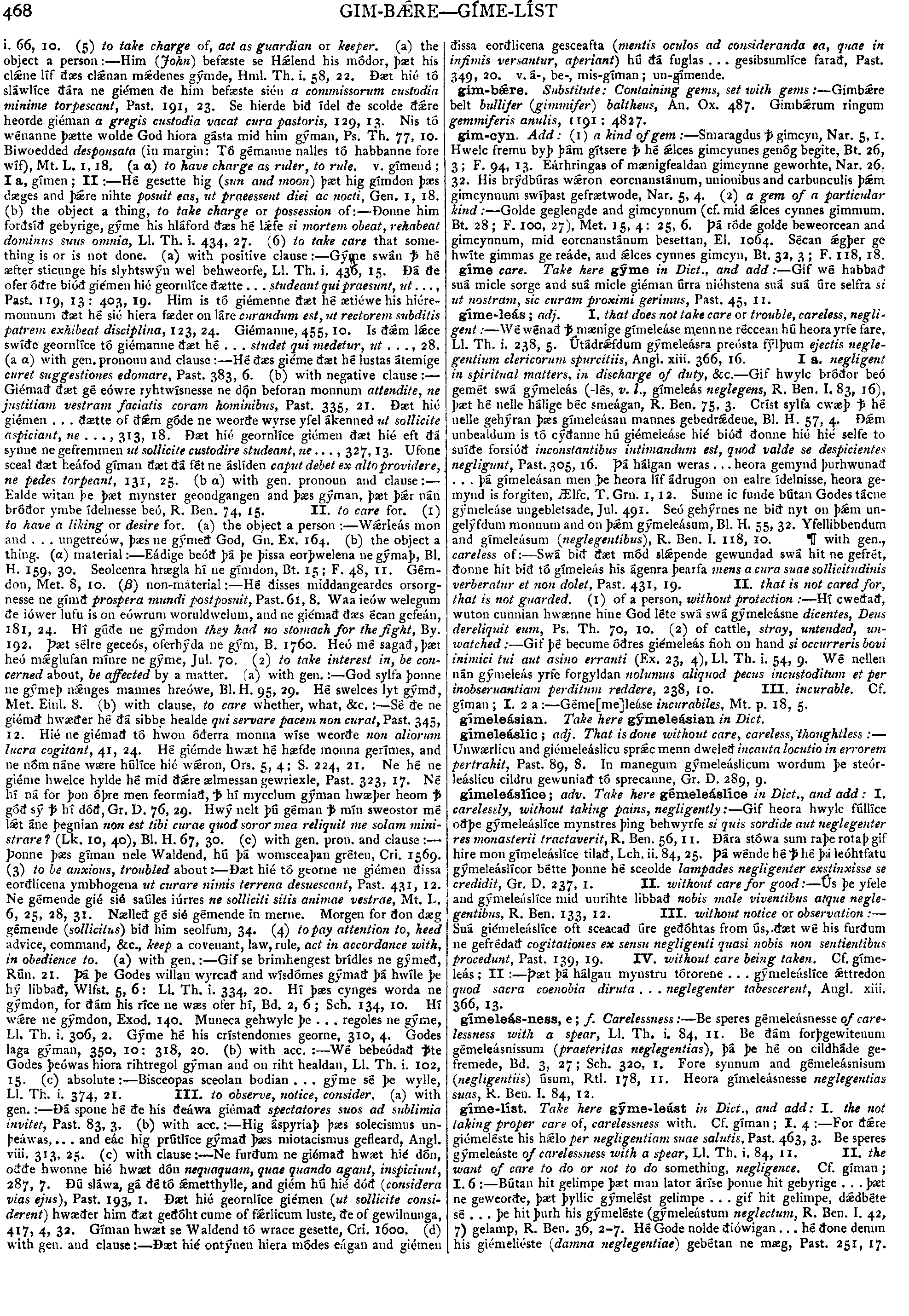
i.
66,
10.
(5)
to
take
charge
of,
act
as
guardian
or
keeper,
(a)
the
object
a
person
:--
Him
(John)
befæste
se
Hlend
his
mdor,
þæt
his
clne
lf
æs
clnan
mdenes
gmde,
Hml.
Th.
i.
58,
22.
Ðæt
hié
t
slwlce
ra
ne
giémen
e
him
befæste
sién
a
commissorum
custodia
minime
torpescant,
Past.
191,
23.
Se
hierde
bi
del
e
scolde
re
heorde
giéman
a
gregis
custodia
vacat
cura
pastoris,
129,
13.
Nis
t
wnanne
þætte
wolde
God
hiora
gsta
mid
him
gman,
Ps.
Th.
77,
10.
Biwoedded
desponsata
(in
margin:
T
gmanne
nalles
t
habbanne
fore
wf),
Mt.
L.
1,
18.
(a
 )
to
have
charge
as
ruler,
to
rule.
v.
gmend
;
I
a.
gmen
;
II
:--
H
gesette
hig
(sun
and
moon)
þæt
hig
gmdon
þæs
dæges
and
þre
nihte
posuit
eas,
ut
praeessent
diei
ac
nocti,
Gen.
l,
18.
(b)
the
object
a
thing,
to
take
charge
or
possession
of:--
Ðonne
him
fors
gebyrige,
gme
his
hlford
æs
h
lfe
si
mortem
obeat,
rehabeat
dominus
suus
omnia,
Ll.
Th.
i.
434,
27.
(6)
to
take
care
that
something
is
or
is
not
done,
(a)
with
positive
clause
:--
Gme
swn
h
æfter
sticunge
his
slyhtswn
we]
behweorfe,
Ll.
Th.
i.
430,
15.
Ð
e
ofer
re
bió
giUNCERTAINmen
hié
geornlce
ætte
.
.
.
studeant
quipraesunt,
ut
.
.
.
.
Past.
119,
13
:
403,
19.
Him
is
t
giémenne
æt
h
ætiéwe
his
hiére-monnum
æt
h
sié
hiera
fæder
on
lre
curandum
est,
ut
rectorem
subditis
patrem
exhibeat
disciplina,
123,
24.
Giémanne,
455,
10.
Is
m
lce
swe
geornlce
t
giémanne
æt
h
.
.
.
studet
qui
medetur,
ut
.
.
.
,
28.
(a
)
with
gen.
pronoun
and
clause
:--
H
æs
giéme
æt
h
lustas
temige
curet
suggestiones
edomare,
Past.
383,
6.
(b)
with
negative
clause
:--
Giéma
æt
g
eówre
ryhtwsnesse
ne
dUNCERTAINn
beforan
monnum
attendite,
ne
justitiam
vestram
faciatis
coram
hominibus,
Past.
335,
21.
Ðæt
hié
giémen
.
.
.
ætte
of
m
gde
ne
weore
wyrse
yfel
kenned
ut
sollicite
aspiciant,
ne
.
.
.
,
313,
18.
Ðæt
hié
geornlce
giémen
æt
hié
eft
synne
ne
gefremmen
ut
sollicite
custodire
studeant,
ne
.
.
.
,
327,
13.
Ufone
sceal
æt
heáfod
gman
æt
ft
ne
slden
caput
debet
ex
alto
providere,
ne
pedes
torpeant,
131,
25.
(b
)
with
gen.
pronoun
and
clause:--
Ealde
witan
þe
þæt
mynster
geondgangen
and
þæs
gman,
þæt
þr
nn
bror
ymbe
delnesse
beó,
R.
Ben.
74,
15.
II.
to
core
for.
(l)
to
have
a
liking
or
desire
for.
(a)
the
object
a
person
:--
Wrleás
mon
and
.
.
.
ungetreów,
þæs
ne
gme
God,
Gn.
Ex.
164.
(b)
the
object
a
thing,
(a)
material
:--
Eádige
beó
þ
þe
þissa
eorþwelena
ne
gmaþ,
Bl.
H.
159,
30.
Seolcenra
hrægla
h
ne
gmdon,
Bt.
15
;
F.
48,
ii.
Gm-don,
Met.
8,
10.
(
)
to
have
charge
as
ruler,
to
rule.
v.
gmend
;
I
a.
gmen
;
II
:--
H
gesette
hig
(sun
and
moon)
þæt
hig
gmdon
þæs
dæges
and
þre
nihte
posuit
eas,
ut
praeessent
diei
ac
nocti,
Gen.
l,
18.
(b)
the
object
a
thing,
to
take
charge
or
possession
of:--
Ðonne
him
fors
gebyrige,
gme
his
hlford
æs
h
lfe
si
mortem
obeat,
rehabeat
dominus
suus
omnia,
Ll.
Th.
i.
434,
27.
(6)
to
take
care
that
something
is
or
is
not
done,
(a)
with
positive
clause
:--
Gme
swn
h
æfter
sticunge
his
slyhtswn
we]
behweorfe,
Ll.
Th.
i.
430,
15.
Ð
e
ofer
re
bió
giUNCERTAINmen
hié
geornlce
ætte
.
.
.
studeant
quipraesunt,
ut
.
.
.
.
Past.
119,
13
:
403,
19.
Him
is
t
giémenne
æt
h
ætiéwe
his
hiére-monnum
æt
h
sié
hiera
fæder
on
lre
curandum
est,
ut
rectorem
subditis
patrem
exhibeat
disciplina,
123,
24.
Giémanne,
455,
10.
Is
m
lce
swe
geornlce
t
giémanne
æt
h
.
.
.
studet
qui
medetur,
ut
.
.
.
,
28.
(a
)
with
gen.
pronoun
and
clause
:--
H
æs
giéme
æt
h
lustas
temige
curet
suggestiones
edomare,
Past.
383,
6.
(b)
with
negative
clause
:--
Giéma
æt
g
eówre
ryhtwsnesse
ne
dUNCERTAINn
beforan
monnum
attendite,
ne
justitiam
vestram
faciatis
coram
hominibus,
Past.
335,
21.
Ðæt
hié
giémen
.
.
.
ætte
of
m
gde
ne
weore
wyrse
yfel
kenned
ut
sollicite
aspiciant,
ne
.
.
.
,
313,
18.
Ðæt
hié
geornlce
giémen
æt
hié
eft
synne
ne
gefremmen
ut
sollicite
custodire
studeant,
ne
.
.
.
,
327,
13.
Ufone
sceal
æt
heáfod
gman
æt
ft
ne
slden
caput
debet
ex
alto
providere,
ne
pedes
torpeant,
131,
25.
(b
)
with
gen.
pronoun
and
clause:--
Ealde
witan
þe
þæt
mynster
geondgangen
and
þæs
gman,
þæt
þr
nn
bror
ymbe
delnesse
beó,
R.
Ben.
74,
15.
II.
to
core
for.
(l)
to
have
a
liking
or
desire
for.
(a)
the
object
a
person
:--
Wrleás
mon
and
.
.
.
ungetreów,
þæs
ne
gme
God,
Gn.
Ex.
164.
(b)
the
object
a
thing,
(a)
material
:--
Eádige
beó
þ
þe
þissa
eorþwelena
ne
gmaþ,
Bl.
H.
159,
30.
Seolcenra
hrægla
h
ne
gmdon,
Bt.
15
;
F.
48,
ii.
Gm-don,
Met.
8,
10.
( )
non-material
:--
H
isses
middangeardes
orsorg-nesse
ne
gm
prospera
mundi
postposuit,
Past.
61,
8.
Waa
ieów
welegum
e
iówer
lufu
is
on
eówrum
wortildwelum,
and
ne
giéma
æs
can
gefeán,
181,
24.
H
ge
ne
gmdon
they
had
no
stomach
for
the
fight,
By.
192.
Þæt
slre
geceós,
oferhda
ne
gm,
B.
1760.
Heó
m
saga,
þæt
heó
mglufan
mnre
ne
gme,
Jul.
70.
(2)
to
take
interest
in,
be
noc-cerned
about,
be
affected
by
a
matter,
(a)
with
gen.
:--
God
sylfa
þonne
ne
gmeþ
nnges
mannes
hreówe,
Bl.
H.
95,
29.
H
swelces
lyt
gm,
Met.
Einl.
8.
(b)
with
clause,
to
care
whether,
what,
&c.
:--
S
e
ne
giém
hwæer
h
sibbe
healde
qui
servare
pacem
non
curat,
Past.
345,
12.
Hié
ne
giéma
t
hwon
erra
monna
wse
weore
non
aliorum
lucra
cogitant,
41,
24.
H
giémde
hwæt
h
hæfde
monna
germes,
and
ne
nm
nne
wære
hlce
hié
wron,
Ors.
5,
4;
S.
224,
21.
Ne
h
ne
giéme
hwelce
hylde
h
mid
re
ælmessan
gewriexle.
Past.
323,
17.
N
h
n
for
þon
þre
men
feormia,
h
mycclum
gman
hwæþer
heom
g
s
h
d,
Gr.
D.
76,
29.
Hw
nelt
þ
gman
mn
sweostor
m
lt
ne
þegnian
non
est
tibi
curae
quod
soror
mea
reliquit
me
solam
mini-strare?
(Lk.
10,
40),
Bl.
H.
67,
30.
(c)
with
gen.
pron.
and
clause
:--
Þonne
þæs
gman
nele
Waldend,
h
þ
womsceaþan
grten,
Cri.
1569.
(3)
to
be
anxious,
troubled
about
:--
Ðæt
hié
t
georne
ne
giémen
issa
eorlicena
ymbhogena
ut
curare
nimis
terrena
desuescant,
Past.
431,
12.
Ne
gmende
gié
sié
sales
iúrres
ne
solliciti
sitis
animae
vestrae,
Mt.
L.
6,
25,
28,
31.
Nælle
g
sié
gmende
in
merne.
Morgen
for
on
dæg
gmende
(sollicitus)
bi
him
seolfum,
34.
(4)
to
pay
attention
to,
heed
advice,
command,
&c.,
keep
a
covenant,
law,
rule,
act
in
accordance
with,
in
obedience
to.
(a)
with
gen.
:--
Gif
se
brimhengest
brdles
ne
gme,
Rn.
21.
Þ
þe
Godes
willan
wyrca
and
wsdmes
gma
þ
hwle
þe
h
libba,
Wlfst.
5,
6:
Ll.
Th.
i.
334,
20.
H
þæs
cynges
worda
ne
gmdon,
for
m
his
rce
ne
wæs
ofer
h,
Bd.
2,
6
;
Sch.
134,
10.
H
wre
ne
gmdon,
Exod.
140.
Muneca
gehwylc
þe
.
.
.
regoles
ne
gme,
Ll.
Th.
i.
306,
2.
Gme
h
his
crstendomes
georne,
310,
4.
Godes
laga
gman,
350,
10:
318,
20.
(b)
with
acc.
:--
W
bebeóda
te
Godes
þeówas
hiora
rihtregol
gman
and
on
riht
healdan,
Ll.
Th.
i.
102,
15.
(c)
absolute:--
Bisceopas
sceolan
bodian
.
.
.
gme
s
þe
wylle,
Ll.
Th.
i.
374,
21.
III.
to
observe,
notice,
consider,
(a)
with
gen.
:--
Ð
spone
h
e
his
eáwa
giéma
spectatores
suos
ad
sublimia
invitet,
Past.
83,
3.
(b)
with
acc.
:--
Hig
spyriaþ
þæs
solecismus
un-þeúwas,
.
.
.
and
eác
hig
prtlce
gma
þæs
miotacisnius
gefleard,
Angl.
viii.
313,
25.
(c)
with
clause:--
Ne
furum
ne
giéma
hwæt
hié
dn,
oe
hwonne
hié
hwæt
dn
nequaquam,
quae
quando
agant,
inspiciuut.
287,
7.
Ð
slwa,
g
t
metthylle,
and
giém
h
hié
dó
(considera
vias
ejus),
Past.
193,
l.
Ðæt
hié
geornlce
giémen
(ut
sollicite
consi-derent)
hwæer
him
æt
geht
cume
of
frlicum
luste,
e
of
gewilnunga,
417,
4,
32.
Gman
hwæt
se
Waldend
t
wrace
gesette,
Cri.
1600.
(d)
with
gen.
and
clause
:--
Ðæt
hié
ontnen
hiera
mdes
eágan
and
giémen
issa
eorðlicena
gesceafta
(mentis
oculos
ad
consideranda
ea,
quae
in
infimis
versantur,
aperiant)
h
fuglas
.
.
.
gesibsumlce
fara,
Past.
349,
20.
v.
-,
be-,
mis-gman
;
un-gmende.
)
non-material
:--
H
isses
middangeardes
orsorg-nesse
ne
gm
prospera
mundi
postposuit,
Past.
61,
8.
Waa
ieów
welegum
e
iówer
lufu
is
on
eówrum
wortildwelum,
and
ne
giéma
æs
can
gefeán,
181,
24.
H
ge
ne
gmdon
they
had
no
stomach
for
the
fight,
By.
192.
Þæt
slre
geceós,
oferhda
ne
gm,
B.
1760.
Heó
m
saga,
þæt
heó
mglufan
mnre
ne
gme,
Jul.
70.
(2)
to
take
interest
in,
be
noc-cerned
about,
be
affected
by
a
matter,
(a)
with
gen.
:--
God
sylfa
þonne
ne
gmeþ
nnges
mannes
hreówe,
Bl.
H.
95,
29.
H
swelces
lyt
gm,
Met.
Einl.
8.
(b)
with
clause,
to
care
whether,
what,
&c.
:--
S
e
ne
giém
hwæer
h
sibbe
healde
qui
servare
pacem
non
curat,
Past.
345,
12.
Hié
ne
giéma
t
hwon
erra
monna
wse
weore
non
aliorum
lucra
cogitant,
41,
24.
H
giémde
hwæt
h
hæfde
monna
germes,
and
ne
nm
nne
wære
hlce
hié
wron,
Ors.
5,
4;
S.
224,
21.
Ne
h
ne
giéme
hwelce
hylde
h
mid
re
ælmessan
gewriexle.
Past.
323,
17.
N
h
n
for
þon
þre
men
feormia,
h
mycclum
gman
hwæþer
heom
g
s
h
d,
Gr.
D.
76,
29.
Hw
nelt
þ
gman
mn
sweostor
m
lt
ne
þegnian
non
est
tibi
curae
quod
soror
mea
reliquit
me
solam
mini-strare?
(Lk.
10,
40),
Bl.
H.
67,
30.
(c)
with
gen.
pron.
and
clause
:--
Þonne
þæs
gman
nele
Waldend,
h
þ
womsceaþan
grten,
Cri.
1569.
(3)
to
be
anxious,
troubled
about
:--
Ðæt
hié
t
georne
ne
giémen
issa
eorlicena
ymbhogena
ut
curare
nimis
terrena
desuescant,
Past.
431,
12.
Ne
gmende
gié
sié
sales
iúrres
ne
solliciti
sitis
animae
vestrae,
Mt.
L.
6,
25,
28,
31.
Nælle
g
sié
gmende
in
merne.
Morgen
for
on
dæg
gmende
(sollicitus)
bi
him
seolfum,
34.
(4)
to
pay
attention
to,
heed
advice,
command,
&c.,
keep
a
covenant,
law,
rule,
act
in
accordance
with,
in
obedience
to.
(a)
with
gen.
:--
Gif
se
brimhengest
brdles
ne
gme,
Rn.
21.
Þ
þe
Godes
willan
wyrca
and
wsdmes
gma
þ
hwle
þe
h
libba,
Wlfst.
5,
6:
Ll.
Th.
i.
334,
20.
H
þæs
cynges
worda
ne
gmdon,
for
m
his
rce
ne
wæs
ofer
h,
Bd.
2,
6
;
Sch.
134,
10.
H
wre
ne
gmdon,
Exod.
140.
Muneca
gehwylc
þe
.
.
.
regoles
ne
gme,
Ll.
Th.
i.
306,
2.
Gme
h
his
crstendomes
georne,
310,
4.
Godes
laga
gman,
350,
10:
318,
20.
(b)
with
acc.
:--
W
bebeóda
te
Godes
þeówas
hiora
rihtregol
gman
and
on
riht
healdan,
Ll.
Th.
i.
102,
15.
(c)
absolute:--
Bisceopas
sceolan
bodian
.
.
.
gme
s
þe
wylle,
Ll.
Th.
i.
374,
21.
III.
to
observe,
notice,
consider,
(a)
with
gen.
:--
Ð
spone
h
e
his
eáwa
giéma
spectatores
suos
ad
sublimia
invitet,
Past.
83,
3.
(b)
with
acc.
:--
Hig
spyriaþ
þæs
solecismus
un-þeúwas,
.
.
.
and
eác
hig
prtlce
gma
þæs
miotacisnius
gefleard,
Angl.
viii.
313,
25.
(c)
with
clause:--
Ne
furum
ne
giéma
hwæt
hié
dn,
oe
hwonne
hié
hwæt
dn
nequaquam,
quae
quando
agant,
inspiciuut.
287,
7.
Ð
slwa,
g
t
metthylle,
and
giém
h
hié
dó
(considera
vias
ejus),
Past.
193,
l.
Ðæt
hié
geornlce
giémen
(ut
sollicite
consi-derent)
hwæer
him
æt
geht
cume
of
frlicum
luste,
e
of
gewilnunga,
417,
4,
32.
Gman
hwæt
se
Waldend
t
wrace
gesette,
Cri.
1600.
(d)
with
gen.
and
clause
:--
Ðæt
hié
ontnen
hiera
mdes
eágan
and
giémen
issa
eorðlicena
gesceafta
(mentis
oculos
ad
consideranda
ea,
quae
in
infimis
versantur,
aperiant)
h
fuglas
.
.
.
gesibsumlce
fara,
Past.
349,
20.
v.
-,
be-,
mis-gman
;
un-gmende.
|
Source: Bosworth/Toller, page d0468, entry 5 View original page image as: [TIFF] [PNG] [View previous entry] [View next entry] |
[Comment on this entry] [View comments (1)] |
The following entry has been hand-corrected once. |
gme-leás;
adj.
I.
that
does
not
take
care
or
trouble,
careless,
negligent
:--
W
wna
mænige
gmeleúse
menn
ne
rccean
h
heora
yrfe
fare,
Ll.
Th.
i.
238,
5.
&U-long;tdrfdum
gmeleásra
preósta
flþum
ejectis
negle-gentium
clericorum
spurcitiis,
Angl.
xiii.
366,
16.
I
a.
negligent
in
spiritual
matters,
in
discharge
of
duty,
&c.
--
Gif
hwylc
bror
beó
gemt
sw
gmeleás
(-ls,
v.
l.,
gmeleás
neglegens,
R.
Ben.
I.
83,
16),
þæt
h
nelle
hlige
bc
smeágan,
R.
Ben.
75,
3.
Crst
sylfa
cwæþ
h
nelle
gehran
þæs
gmeleásan
mannes
gebedrdene,
Bl.
H.
57,
4.
Ðm
unbealdum
is
t
canne
h
giémeleáse
hié
bió
onne
hié
hié
selfe
to
sue
forsió
inconstantibus
intimandum
est,
quod
valde
se
despicientes
negligunt,
Past.
305,
16.
Þ
hlgan
weras
.
.
.
heora
gemynd
þurhwuna
.
.
.
þ
gmeleásan
men
þe
heora
lf
drugon
on
ealre
delnisse,
heora
gemynd
is
forgiten,
Ælfc.
T.
Grn.
I.
12.
Sume
ic
funde
btan
Godes
tcne
gmeleúse
ungebletsade,
Jul.
491.
Seó
gehrnes
ne
bi
nyt
on
þm
un-gelfdum
monnum
and
on
þm
gmeleásum,
Bl.
H.
55,
32.
Yfellibbendum
and
gmeleásum
(neglegentibus),
R.
Ben.
I.
118,
10.

with
gen.,
careless
of
:--
Sw
bi
æt
md
slpende
gewundad
sw
hit
ne
gefrt,
onne
hit
bi
t
gmeleás
his
genra
þearfa
mens
a
cura
suae
sollicitudinis
verberatur
et
non
dolet,
Past.
431,
19.
II.
that
is
not
cared
for,
that
is
not
guarded.
(l)
of
a
person,
without
protection
:--
H
cwea,
wuton
cunnian
hwænne
bine
God
lte
sw
sw
gmeleásne
dicentes,
Deus
dereliqnit
eum,
Ps.
Th.
70,
10.
(2)
of
cattle,
stray,
untended,
un-watched
:--
Gif
þ
hecuje
res
giémeleás
fioh
on
hand
si
occurreris
bovi
inimici
tui
aut
asino
erranti
(Ex.
23,
4),
Ll.
Th.
i.
54,
9.
W
nellen
nn
gmeleás
yrfe
forgyldan
nolumus
aliqnod
pecus
incnstoditum
et
per
inobseruantiam
perditum
reddere,
238,
10.
III.
incurable.
Cf.
gman
;
I.
2
a
:--
Gme[me]leáse
incurabiles,
Mt.
p.
18,
5.
|
Source: Bosworth/Toller, page d0468, entry 8 View original page image as: [TIFF] [PNG] [View previous entry] [View next entry] |
[Comment on this entry] [View comments] |
The following entry has been hand-corrected once. |
gmeleáslce;
adv.
Take
here
gmeleáslce
in
Dict.,
and
add:
I.
carelessly,
without
taking
pains,
negligently
:--
Gif
heora
hwylc
fllce
oþe
gmeleáslce
mynstres
þing
behwyrfe
si
quis
sordide
aut
neglegenter
res
monasterii
tractaverit,
R.
Ben.
56,
11.
Ðra
stwa
sum
raþe
rotaþ
gif
hire
mon
gmeleáslce
tila.
Lch.
ii.
84,
25.
Þ
wnde
h
h
þ
leóhtfatu
gmeleáslcor
btte
þonne
h
sceolde
lampades
negligenter
exstinxisse
se
credidit,
Gr.
D.
237,
l.
II.
without
care
for
good
:--
&U-long;s
þe
yfele
and
gmeleáslce
mid
unrihte
libba
nobis
male
viventibus
atque
negle-gentibus,
R.
Ben.
133,
12.
III.
without
notice
or
observation
:--
Su
giémeleáslce
oft
sceaca
re
gehtas
from
s,
.æt
w
his
furum
ne
gefrda
cogitationes
ex
sensu
negligenti
quasi
nobis
non
sentientibus
procedunt,
Past.
139,
19.
IV.
without
care
being
taken.
Cf.
gme-leás
;
II
:--
Þæt
þ
hlgan
mynstru
trorene
.
.
.
gmeleáslce
ttredon
quod
sacra
coenobia
diruta
.
.
.
neglegenter
tabescerent,
Angl.
xiii.
366,
13.
|
Source: Bosworth/Toller, page d0469, entry 2 View original page image as: [TIFF] [PNG] [View previous entry] [View next entry] |
[Comment on this entry] [View comments] |
The following entry has been hand-corrected once. |
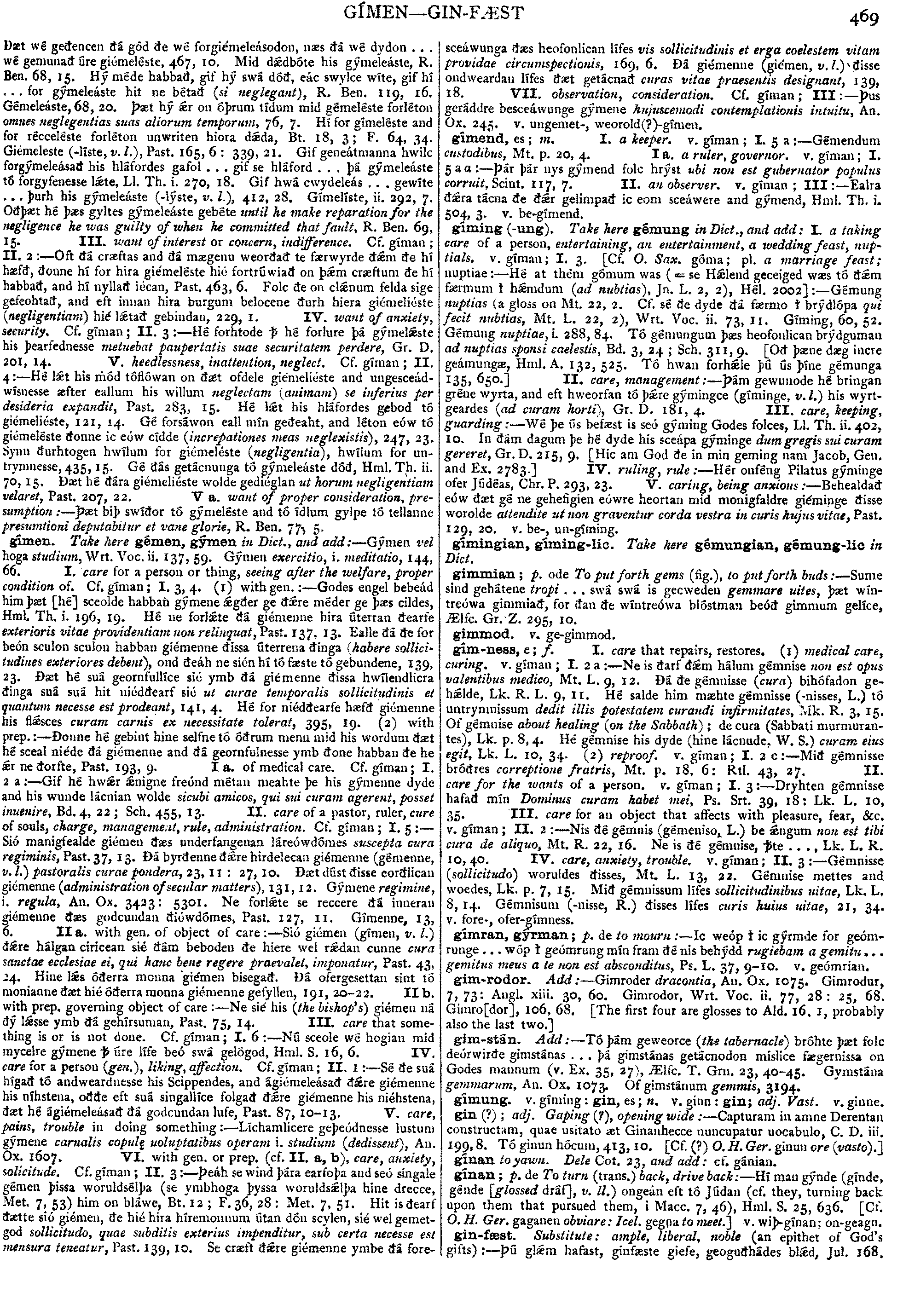
gmen.
Take
here
gmen,
gmen
in
Dict.,
and
add
:--
Gmen
vel
hoga
studium,
Wrt.
Voc.
ii.
137,
59.
Gmen
exercitio,
i.
meditatio,
144,
66.
I.
care
for
a
person
or
thing,
seeing
after
the
welfare,
proper
condition
of.
Cf.
gman;
I.
3,
4.
(1)
with
gen.
:--
Godes
engel
beheád
him
þæt
[h]
sceolde
habban
gmene
ger
ge
re
mder
ge
þæs
cildes,
Hml.
Th.
i.
196,
19.
H
ne
forlte
giémenne
hira
terran
earfe
exterioris
vitae
providentiam
non
relinquat,
Past.
137,
13.
Ealle
e
for
beón
sculon
sculon
habban
giémenne
issa
uterrena
inga
(habere
sollici-tudines
exteriores
debent),
ond
eáh
ne
sién
h
t
fæste
t
gebundene,
139,
23.
Ðæt
h
su
geornfullce
sié
ymb
giémenne
issa
hwlendlicra
inga
su
su
hit
niédearf
sié
ut
curae
temporalis
sollicitudinis
et
quantum
necesse
est
prodeant,
141,
4.
H
for
niédearfe
hæf
giémenne
his
flsces
curam
carnis
ex
necessitate
tolerat,
395,
19.
(2)
with
prep.
:--
Ðonne
h
gebint
hine
selfne
t
rum
menn
mid
his
wordum
æt
h
sceal
niéde
giémenne
and
geornfulnesse
ymb
one
habban
e
he
r
ne
orfte,
Past.
193,
9.
I
a.
of
medical
care.
Cf.
gman;
I.
2
a
:--
Gif
h
hwr
nigne
freónd
mtan
meahte
þe
his
gmenne
dyde
and
his
wunde
lcnian
wolde
sicubi
amicos,
qui
sui
curam
agerent,
posset
inuenire,
Bd.
4,
22
;
Sch.
455,
13.
II.
care
of
a
pastor,
ruler,
cure
of
souls,
charge,
management,
rule,
administration.
Cf.
gman;
I.
5
:--
Sió
manigfealde
giémen
æs
underfangenan
lreówdmes
suscepta
cura
regiminis,
Past.
37,
13.
Ð
byrenne
re
hirdelecan
giémenne
(gmenne,
v.
l.)
pastoralis
curie
pondera,
23,
II
:
27,
10.
Ðæt
dst
isse
eorlican
giémenne
(administration
of
secular
matters),
131,
12.
Gmene
regimine,
i.
regula,
An.
Ox.
3423:
5301.
Ne
forlte
se
reccere
inneran
giémenne
æs
godcundan
iówdmes,
Past.
127,
II.
Gmenne,
13,
6.
II
a.
with
gen.
of
object
of
care
:--
Sió
giúmen
(gmen,
v.
l.)
re
hlgan
ciricean
sié
m
beboden
e
hiere
wel
rdan
cunne
cura
sanctae
ecclesiae
ei,
qui
hanc
bene
regere
praevalet,
imponatur,
Past.
43,
24.
Hine
ls
erra
monna
giémen
bisega.
Ð
ofergesettan
sint
t
monianne
æt
hié
erra
monna
giémenne
gefyllen,
191,
2O-22.
II
b.
with
prep.
governing
object
of
care
:--
Ne
sié
his
(the
bishop's)
giémen
n
lsse
ymb
gehrsuman,
Past.
75,
14.
III.
care
that
something
is
or
is
not
done.
Cf.
gman;
I.
6
:--
N
sceole
w
hogian
mid
mycelre
gmene
re
lfe
beó
sw
gelgod,
Hml.
S.
16,
6.
IV.
care
for
a
person
(gen.),
liking,
affection.
Cf.
gman;
II.
l
:--
S
e
su
hga
t
andweardnesse
his
Scippendes,
and
giémeleása
re
giémenne
his
nhstena,
oe
eft
su
singallce
folga
re
giémenne
his
niéhstena,
æt
h
giémeleása
godcundan
lufe,
Past.
87,
10-13.
V.
care,
pains,
trouble
in
doing
something
:--
Lchamlicere
geþeódnesse
lustum
gmene
carnalis
copul uoluptatibus
operam
i.
studium
(dedissent),
An
Ox.
1607.
VI.
with
gen.
or
prep.
(cf.
II.
a.
b),
care,
anxiety
solicitude.
Cf.
gman;
II.
3
:--
Þeáh
se
wind
þra
earfoþa
and
seó
singale
gmen
þissa
woruldslþa
(se
ymbhoga
þyssa
woruldslþa
hine
drecce
Met.
7,
53)
him
on
blwe,
Bt.
12
;
F.
36,
28
:
Met.
7,
51.
Hit
is
earf
ætte
sió
giémen,
e
hié
hira
hremonnum
tan
dn
scylen,
sié
wel
gemet-god
sollicitudo,
quae
subditis
exterius
impenditur,
sub
certa
necesse
est
mensura
teneatur,
Past.
139,
10.
Se
cræft
re
giémenne
ymbe
fore-sceáwunga
æs
heofonlican
lfes
vis
sollicitudinis
et
erga
coelestem
vitam
providae
circumspectionis,
169,
6.
Ð
giémenne
(giémen
v.
l.)
isse
ondweardan
lfes
æt
getcna
curas
vitae
praesentis
designant,
139,
18.
VII.
observation,
consideration.
Cf.
gman;
III
:--
Þus
gerddre
besceáwunge
gmene
hujuscemodi
contemplationis
intuitu,
An.
Ox.
245.
v.
ungemet-,
weorold(?)-gmen.
uoluptatibus
operam
i.
studium
(dedissent),
An
Ox.
1607.
VI.
with
gen.
or
prep.
(cf.
II.
a.
b),
care,
anxiety
solicitude.
Cf.
gman;
II.
3
:--
Þeáh
se
wind
þra
earfoþa
and
seó
singale
gmen
þissa
woruldslþa
(se
ymbhoga
þyssa
woruldslþa
hine
drecce
Met.
7,
53)
him
on
blwe,
Bt.
12
;
F.
36,
28
:
Met.
7,
51.
Hit
is
earf
ætte
sió
giémen,
e
hié
hira
hremonnum
tan
dn
scylen,
sié
wel
gemet-god
sollicitudo,
quae
subditis
exterius
impenditur,
sub
certa
necesse
est
mensura
teneatur,
Past.
139,
10.
Se
cræft
re
giémenne
ymbe
fore-sceáwunga
æs
heofonlican
lfes
vis
sollicitudinis
et
erga
coelestem
vitam
providae
circumspectionis,
169,
6.
Ð
giémenne
(giémen
v.
l.)
isse
ondweardan
lfes
æt
getcna
curas
vitae
praesentis
designant,
139,
18.
VII.
observation,
consideration.
Cf.
gman;
III
:--
Þus
gerddre
besceáwunge
gmene
hujuscemodi
contemplationis
intuitu,
An.
Ox.
245.
v.
ungemet-,
weorold(?)-gmen.
|
Source: Bosworth/Toller, page d0469, entry 4 View original page image as: [TIFF] [PNG] [View previous entry] [View next entry] |
[Comment on this entry] [View comments] |
The following entry has been hand-corrected once. |
gming
(-ung).
Take
here
gmung
in
Dict.,
and
add:
I.
a
taiking
care
of
a
person,
entertaining,
an
entertainment,
a
wedding
feast,
nup-ials.
v.
gman;
I.
3.
[Cf.
O.
Sax.
gma;
pl.
a
marriage
feast;
nuptiae
:--
H
at
them
gmum
was
(=
se
Hlend
geceiged
wæs
t
m
færmum
hmdum
(ad
nubtias),
Jn.
L.
2,
2),
Hl.
2002]
:--
Gmung
nuptias
(a
gloss
on
Mt.
22,
2.
Cf.
s
e
dyde
færmo
brdlpa
qui
fecit
nubtias,
Mt.
L.
22,
2),
Wrt.
Voc.
ii.
73,
II.
Gming,
60,
52.
Gmung
nuptiae,
i.
288,
84.
T
gmungum
þæs
heofonlican
brdguman
ad
nuptias
sponsi
caelestis,
Bd.
3,
24
;
Sch.
311,
9.
[O
þæne
dæg
incre
geámungæ,
Hml.
A.
132,
525.
T
hwan
forhle
þ
s
þne
gmunga
135,
650.]
II.
care,
management
:--
Þm
gewunode
h
bringan
grne
wyrta,
and
eft
hweorfan
t
þre
gmingce
(gminge,
v.
l.)
his
wyrt-geardes
(ad
curam
horti),
Gr.
D.
181,
4.
III.
care,
keeping,
guarding
:--
W
þe
s
befæst
is
seó
gming
Godes
folces,
Ll.
Th.
ii.
402,
10.
In
m
dagum
þe
h
dyde
his
sceápa
gminge
dum
gregis
sui
curam
gereret,
Gr.
D.
215,
9.
[Hic
am
God
e
in
min
geming
nam
Jacob,
Gen.
and
Ex.
2783.]
IV.
ruling,
rule
:--
Hr
onfng
Pilatus
gminge
ofer
Jdas,
Chr.
P.
293,
23.
V.
caring,
being
anxious
:--
Behealda
eów
æt
g
ne
gehefigien
eówre
heortan
mid
monigfaldre
giéminge
isse
worolde
attendite
ut
non
graventur
corda
vestra
in
curis
hujus
vitae,
Past.
129,
20.
v.
be-,
um-gming.
|
Source: Bosworth/Toller, page d0469, entry 11 View original page image as: [TIFF] [PNG] [View previous entry] [View next entry] |
[Comment on this entry] [View comments] |
The following entry has been hand-corrected once. |
gim-stn.
Add
:--
T
þm
geweorce
(the
tabernacle)
brhte
þæt
folc
deórwire
gimstnas
.
.
.
þ
gimstnas
getcnodon
mislice
fægernissa
on
Godes
mannum
(v.
Ex.
35,
27),
Ælfc.
T.
Grn.
23,
40-45.
Gymstna
gemmarum,
An.
Ox.
1073.
Of
gimstnum
gemmis,
3194.
|
Source: Bosworth/Toller, page d0470, entry 17 View original page image as: [TIFF] [PNG] [View previous entry] [View next entry] |
[Comment on this entry] [View comments] |
The following entry has been hand-corrected once. |
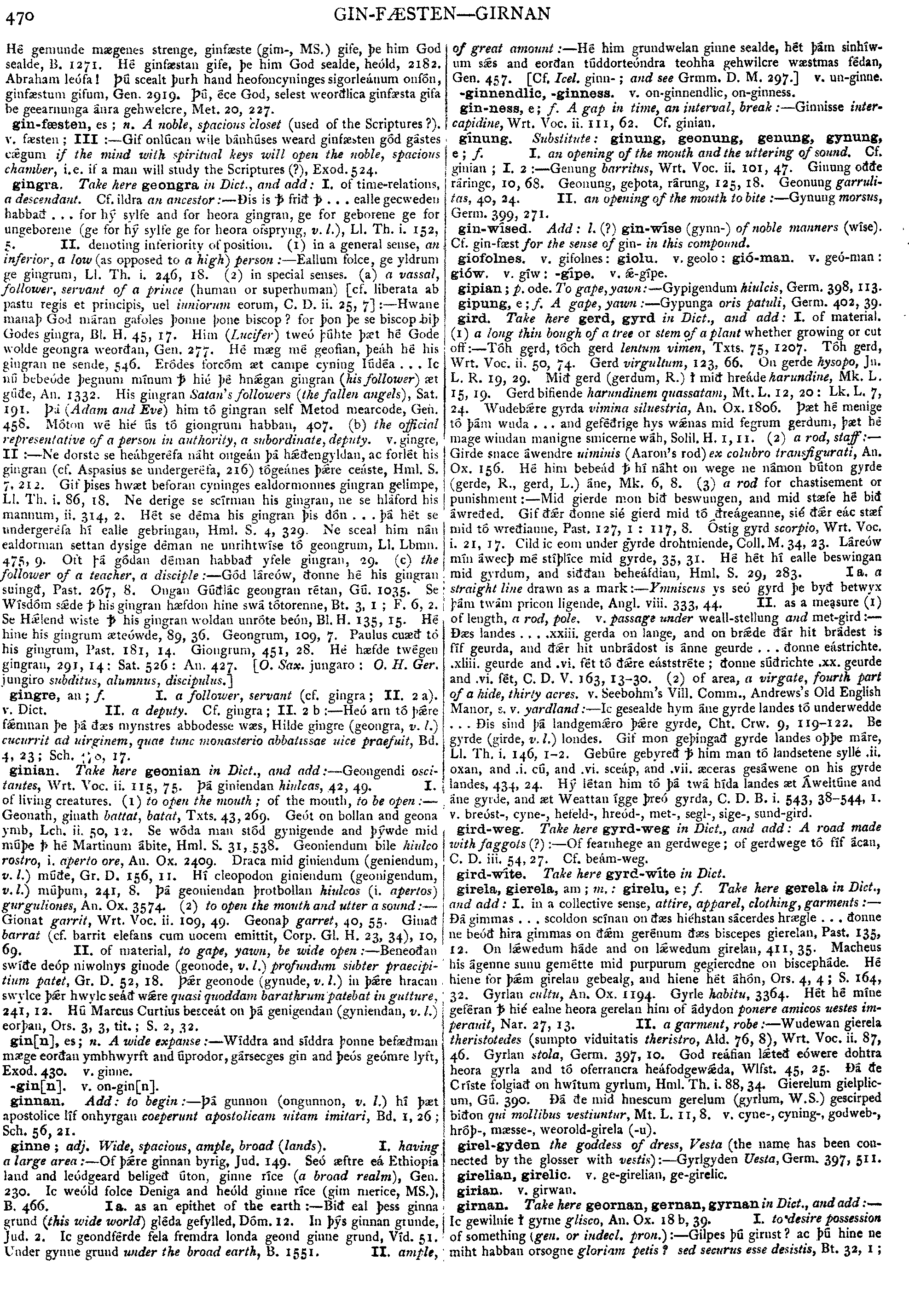
gird.
Take
here
gerd,
gyrd
in
Dict.,
and
add:
I.
of
material.
(1)
a
long
thin
bough
of
a
tree
or
stem
of
a
plant
whether
growing
or
cut
off:--Tóh
grd,
tóch
gerd
lentum
vimen,
Txts.
75,
1207.
Tóh
gerd,
Wrt.
Voc.
ii.
50,
74.
Gerd
virgultum,
123,
66.
On
gerde
hysopo,
Jn.
L.
R.
19,
29.
Mið
gerd
(gerdum,
R.)
mið
hreáde
harundine,
Mk.
L.
15,
19.
Gerd
bifiende
harundinem
quassatam,
Mt.
L.
12,
20:
Lk.
L.
7,
24.
Wudeb re
gyrda
vimina
siluestria,
An.
Ox.
1806.
Þæt
hé
menige
tó
þám
wuda
.
.
.
and
geféðrige
hys
wnas
mid
fegrum
gerdum,
þæt
hé
mage
windan
manigne
smicerne
wáh,
Solil.
H.
1,
11.
(2)
a
rod,
staff:--Girde
snace
áwendre
uiminis
(Aaron's
rod)
ex
colubro
transfigurati,
An.
Ox.
156.
Hé
him
bebeád
hí
náht
on
wege
ne
námon
búton
gyrde
(gerde,
R.,
gerd,
L.)
áne,
Mk.
6,
8.
(3)
a
rod
for
chastisement
or
punishment:--Mid
gierde
mon
bið
beswungen,
and
mid
stæfe
hé
bið
áwreðed.
Gif
ðr
ðonne
sié
gierd
mid
tó
ðreágeanne,
sié
ðr
eác
stæf
mid
tó
wreðianne,
Past.
127,
1:
117,
8.
Óstig
gyrd
scorpio,
Wrt.
Voc.
i.
21,
17.
Cild
ic
eom
under
gyrde
drohtniende,
Coll.
M.
34,
23.
Láreów
mín
áwecþ
mé
stíþlíce
mid
gyrde,
35,
31.
Hé
hét
hí
ealle
beswingan
mid
gyrdum,
and
siððan
beheáfdian,
Hml.
S.
29,
283.
I
a.
a
straight
line
drawn
as
a
mark:--Ymniscus
ys
seó
gyrd
þe
byð
betwyx
þám
twám
pricon
ligende,
Angl.
viii.
333,
44.
II.
as
a
measure
(1)
of
length,
a
rod,
pole.
v.
passage
under
weall-stellung
and
met-gird:--Ðæs
landes
.
.
.
.xxiii.
gerda
on
lange,
and
on
brde
ðár
hit
brádest
is
fíf
geurda,
and
ðr
hit
unbrádost
is
ánne
geurde
.
.
.
ðonne
eástrichte.
.xliii.
geurde
and
.vi.
fét
tó
ðre
eáststréte;
ðonne
súðrichte
.xx.
geurde
and
.vi.
fét,
C.
D.
V.
163,
13-30.
(2)
of
area,
a
virgate,
fourth
part
of
a
hide,
thirty
acres.
v.
Seebohm's
Vill.
Comm.,
Andrews's
Old
English
Manor,
s.
v.
yardland:--Ic
gesealde
hym
áne
gyrde
landes
tó
underwedde
.
.
.
Ðis
sind
þá
landgemro
þre
gyrde,
Cht.
Crw.
9,
119-122.
Be
gyrde
(girde,
v.
l.)
londes.
Gif
mon
geþingað
gyrde
landes
oþþe
máre,
Ll.
Th.
i.
146,
1-2;
Gebúre
gebyreð
him
man
tó
landsetene
syllé
.ii.
oxan,
and
.i.
cú,
and
.vi.
sceáp,
and
.vii.
æceras
gesáwene
on
his
gyrde
landes,
434,
24.
Hý
létan
him
tó
þá
twá
hída
landes
æt
Áweltúne
and
áne
gyrde,
and
æt
Weattan
ígge
þreó
gyrda,
C.
D.
B.
i.
543,
38-544,
1.
v.
breóst-,
cyne-,
hefeld-,
hreód-,
met-,
segl-,
sige-,
sund-gird.
re
gyrda
vimina
siluestria,
An.
Ox.
1806.
Þæt
hé
menige
tó
þám
wuda
.
.
.
and
geféðrige
hys
wnas
mid
fegrum
gerdum,
þæt
hé
mage
windan
manigne
smicerne
wáh,
Solil.
H.
1,
11.
(2)
a
rod,
staff:--Girde
snace
áwendre
uiminis
(Aaron's
rod)
ex
colubro
transfigurati,
An.
Ox.
156.
Hé
him
bebeád
hí
náht
on
wege
ne
námon
búton
gyrde
(gerde,
R.,
gerd,
L.)
áne,
Mk.
6,
8.
(3)
a
rod
for
chastisement
or
punishment:--Mid
gierde
mon
bið
beswungen,
and
mid
stæfe
hé
bið
áwreðed.
Gif
ðr
ðonne
sié
gierd
mid
tó
ðreágeanne,
sié
ðr
eác
stæf
mid
tó
wreðianne,
Past.
127,
1:
117,
8.
Óstig
gyrd
scorpio,
Wrt.
Voc.
i.
21,
17.
Cild
ic
eom
under
gyrde
drohtniende,
Coll.
M.
34,
23.
Láreów
mín
áwecþ
mé
stíþlíce
mid
gyrde,
35,
31.
Hé
hét
hí
ealle
beswingan
mid
gyrdum,
and
siððan
beheáfdian,
Hml.
S.
29,
283.
I
a.
a
straight
line
drawn
as
a
mark:--Ymniscus
ys
seó
gyrd
þe
byð
betwyx
þám
twám
pricon
ligende,
Angl.
viii.
333,
44.
II.
as
a
measure
(1)
of
length,
a
rod,
pole.
v.
passage
under
weall-stellung
and
met-gird:--Ðæs
landes
.
.
.
.xxiii.
gerda
on
lange,
and
on
brde
ðár
hit
brádest
is
fíf
geurda,
and
ðr
hit
unbrádost
is
ánne
geurde
.
.
.
ðonne
eástrichte.
.xliii.
geurde
and
.vi.
fét
tó
ðre
eáststréte;
ðonne
súðrichte
.xx.
geurde
and
.vi.
fét,
C.
D.
V.
163,
13-30.
(2)
of
area,
a
virgate,
fourth
part
of
a
hide,
thirty
acres.
v.
Seebohm's
Vill.
Comm.,
Andrews's
Old
English
Manor,
s.
v.
yardland:--Ic
gesealde
hym
áne
gyrde
landes
tó
underwedde
.
.
.
Ðis
sind
þá
landgemro
þre
gyrde,
Cht.
Crw.
9,
119-122.
Be
gyrde
(girde,
v.
l.)
londes.
Gif
mon
geþingað
gyrde
landes
oþþe
máre,
Ll.
Th.
i.
146,
1-2;
Gebúre
gebyreð
him
man
tó
landsetene
syllé
.ii.
oxan,
and
.i.
cú,
and
.vi.
sceáp,
and
.vii.
æceras
gesáwene
on
his
gyrde
landes,
434,
24.
Hý
létan
him
tó
þá
twá
hída
landes
æt
Áweltúne
and
áne
gyrde,
and
æt
Weattan
ígge
þreó
gyrda,
C.
D.
B.
i.
543,
38-544,
1.
v.
breóst-,
cyne-,
hefeld-,
hreód-,
met-,
segl-,
sige-,
sund-gird.
|
Source: Bosworth/Toller, page d0471, entry 1 View original page image as: [TIFF] [PNG] [View previous entry] [View next entry] |
[Comment on this entry] [View comments] |
The following entry has been hand-corrected once. |
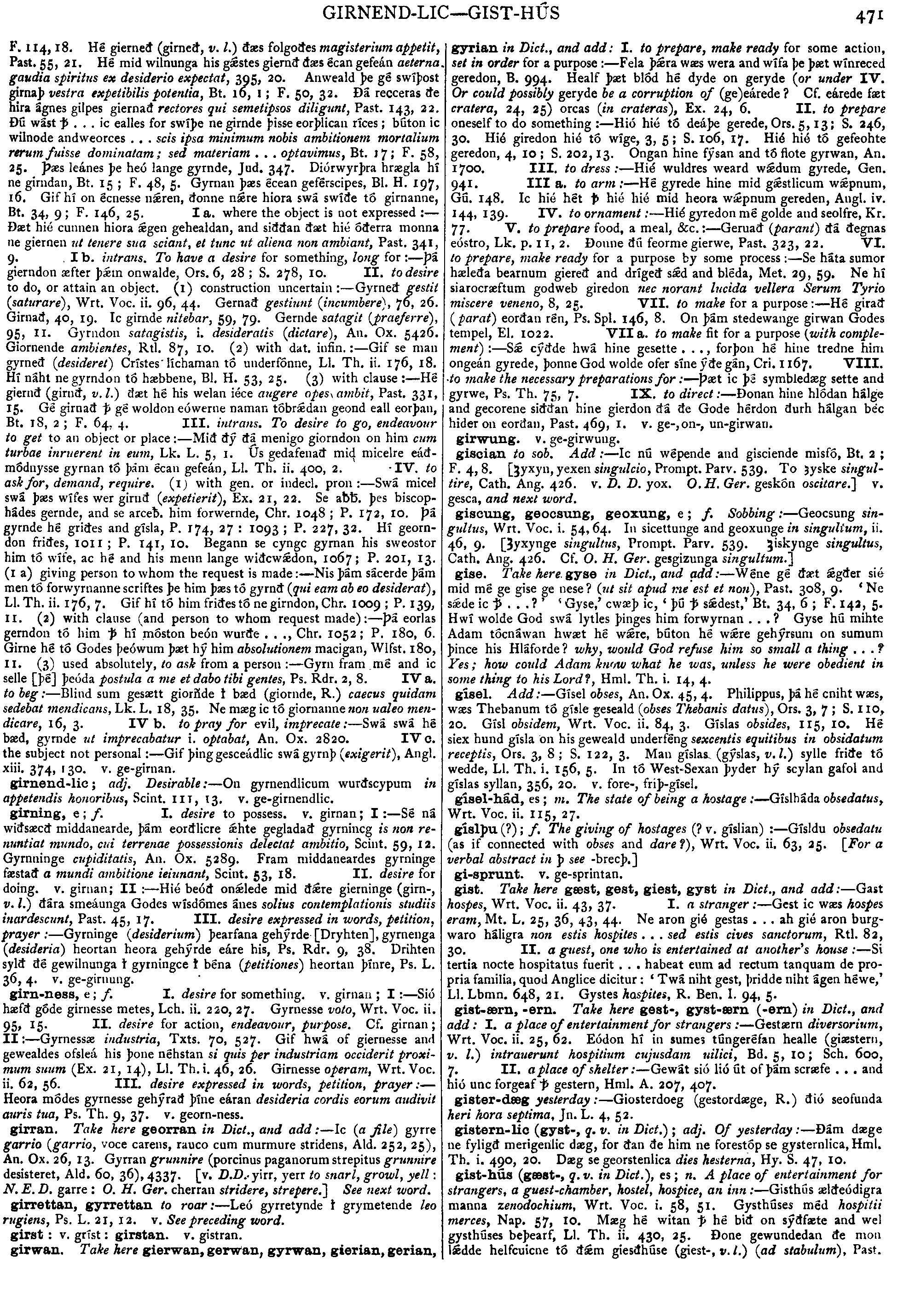
F.
114,
18.
Hé
gierneð
(girneð,
v.
l.)
ðæs
folgoðes
magisterium
appetit,
Past.
55,
21.
Hé
mid
wilnunga
his
gstes
giernð
ðæs
écan
gefeán
aeterna
gaudia
spiritus
ex
desiderio
expectat,
395,
20.
Anweald
þe
gé
swíþost
girnaþ
vestra
expetibilis
potentia,
Bt.
16,
1;
F.
50,
32.
Ðá
recceras
ðe
hira
ágnes
gilpes
giernað
rectores
qui
semetipsos
diligunt,
Past.
143,
22.
Ðú
wást
.
.
.
ic
ealles
for
swíþe
ne
girnde
þisse
eorþlican
ríces;
búton
ic
wilnode
andweorces
.
.
.
scis
ipsa
minimum
nobis
ambitionem
mortalium
rerum
fuisse
dominatam;
sed
materiam
.
.
.
optavimus,
Bt.
17;
F.
58,
25.
Þæs
leánes
þe
heó
lange
gyrnde,
Jud.
347.
Diórwyrþra
hrægla
hí
ne
girndan,
Bt.
15;
F.
48,
5.
Gyrnan
þæs
écean
geférscipes,
Bl.
H.
197,
16.
Gif
hí
on
écnesse
nren,
ðonne
nre
hiora
swá
swíðe
tó
girnanne,
Bt.
34,
9;
F.
146,
25.
I
a.
where
the
object
is
not
expressed:--Ðæt
hié
cunnen
hiora
gen
gehealdan,
and
siððan
ðæt
hié
óðerra
monna
ne
giernen
ut
tenere
sua
sciant,
et
tunc
ut
aliena
non
ambiant,
Past.
341,
9.
I
b.
intrans.
To
have
a
desire
for
something,
long
for:--Þá
gierndon
æfter
þm
onwalde,
Ors.
6,
28;
S.
278,
10.
II.
to
desire
to
do,
or
attain
an
object.
(1)
construction
uncertain:--Gyrneð
gestit
(saturare),
Wrt.
Voc.
ii.
96,
44.
Gernað
gestiunt
(incumbere),
76,
26.
Girnað,
40,
19.
Ic
girnde
nitebar,
59,
79.
Gernde
satagit
(praeferre),
95,
11.
Gyrndon
satagistis,
i.
desideratis
(dictare),
An.
Ox.
5426.
Giornende
ambientes,
Rtl.
87,
10.
(2)
with
dat.
infin.:--Gif
se
man
gyrneð
(desideret)
Crístes
líchaman
tó
underfónne,
Ll.
Th.
ii.
176,
18.
Hí
náht
ne
gyrndon
tó
hæbbene,
Bl.
H.
53,
25.
(3)
with
clause:--Hé
giernð
(girnð,
v.
l.)
ðæt
hé
his
welan
iéce
augers
opes
ambit,
Past.
331,
15.
Gé
girnað
gé
woldon
eówerne
naman
tóbrdan
geond
eall
eorþan,
Bt.
18,
2;
F.
64.
4.
III.
intrans.
To
desire
to
go,
endeavour
to
get
to
an
object
or
place:--Mið
ðý
ðá
menigo
giorndon
on
him
cum
turbae
inruerent
in
eum,
Lk.
L.
5,
1.
Ús
gedafenað
mid
micelre
eáðmódnysse
gyrnan
tó
þám
écan
gefeán,
Ll.
Th.
ii.
400,
2.
IV.
to
ask
for,
demand,
require.
(1)
with
gen.
or
indecl.
pron:--Swá
micel
swá
þæs
wífes
wer
girnð
(expetierit),
Ex.
21,
22.
Se
a .
þes
biscophádes
gernde,
and
se
arce.
him
forwernde,
Chr.
1048;
P.
172,
10.
Þá
gyrnde
hé
griðes
and
gísla,
P.
174,
27:
1093;
P.
227,
32.
Hí
georndon
friðes,
1011;
P.
141,
10.
Begann
se
cyngc
gyman
his
sweostor
him
tó
wífe,
ac
hé
and
his
menn
lange
wiðcwdon,
1067;
P.
201,
13.
(1
a)
giving
person
to
whom
the
request
is
made:--Nis
þám
sácerde
þám
men
tó
forwyrnanne
scriftes
þe
him
þæs
tó
gyrnð
(qui
eam
ab
eo
desiderat),
Ll.
Th.
ii.
176,
7.
Gif
hí
tó
him
friðes
tó
ne
girndon,
Chr.
1009;
P.
139,
11.
(2)
with
clause
(and
person
to
whom
request
made):--Þá
eorlas
gerndon
tó
him
hí
móston
beón
wurðe
.
.
.,
Chr.
1052;
P.
180,
6.
Girne
hé
tó
Godes
þeówum
þæt
hý
him
absolutionem
macigan,
Wlfst.
180,
11.
(3)
used
absolutely,
to
ask
from
a
person:--Gyrn
fram
mé
and
ic
selle
[þé]
þeóda
postula
a
me
et
dabo
tibi
gentes,
Ps.
Rdr.
2,
8.
IV
a.
to
beg:--Blind
sum
gesætt
gior&n-tilde;de
bæd
(giornde,
R.)
caecus
quidam
sedebat
mendicans,
Lk.
L.
18,
35.
Ne
mæg
ic
tó
giornanne
non
ualeo
mendicare,
16,
3.
IV
b.
to
pray
for
evil,
imprecate:--Swá
swá
hé
bæd,
gyrnde
ut
imprecabatur
i.
optabat,
An.
Ox.
2820.
IV
c.
the
subject
not
personal:--Gif
þing
gesceádlic
swá
gyrnþ
(exigerit),
Angl.
xiii.
374,
130.
v.
ge-girnan.
.
þes
biscophádes
gernde,
and
se
arce.
him
forwernde,
Chr.
1048;
P.
172,
10.
Þá
gyrnde
hé
griðes
and
gísla,
P.
174,
27:
1093;
P.
227,
32.
Hí
georndon
friðes,
1011;
P.
141,
10.
Begann
se
cyngc
gyman
his
sweostor
him
tó
wífe,
ac
hé
and
his
menn
lange
wiðcwdon,
1067;
P.
201,
13.
(1
a)
giving
person
to
whom
the
request
is
made:--Nis
þám
sácerde
þám
men
tó
forwyrnanne
scriftes
þe
him
þæs
tó
gyrnð
(qui
eam
ab
eo
desiderat),
Ll.
Th.
ii.
176,
7.
Gif
hí
tó
him
friðes
tó
ne
girndon,
Chr.
1009;
P.
139,
11.
(2)
with
clause
(and
person
to
whom
request
made):--Þá
eorlas
gerndon
tó
him
hí
móston
beón
wurðe
.
.
.,
Chr.
1052;
P.
180,
6.
Girne
hé
tó
Godes
þeówum
þæt
hý
him
absolutionem
macigan,
Wlfst.
180,
11.
(3)
used
absolutely,
to
ask
from
a
person:--Gyrn
fram
mé
and
ic
selle
[þé]
þeóda
postula
a
me
et
dabo
tibi
gentes,
Ps.
Rdr.
2,
8.
IV
a.
to
beg:--Blind
sum
gesætt
gior&n-tilde;de
bæd
(giornde,
R.)
caecus
quidam
sedebat
mendicans,
Lk.
L.
18,
35.
Ne
mæg
ic
tó
giornanne
non
ualeo
mendicare,
16,
3.
IV
b.
to
pray
for
evil,
imprecate:--Swá
swá
hé
bæd,
gyrnde
ut
imprecabatur
i.
optabat,
An.
Ox.
2820.
IV
c.
the
subject
not
personal:--Gif
þing
gesceádlic
swá
gyrnþ
(exigerit),
Angl.
xiii.
374,
130.
v.
ge-girnan.
| Result Page: |  |
Previous | 170 171 172 173 174 175 176 177 178 179 180 181 182 183 184 185 186 187 188 | Next |  |
Germanic Lexicon Project (main page)
This search system was written by
Sean Crist
Please consider
volunteering
to correct the data in these online dictionaries.
No rights reserved. Feel free to use these data in any way you please.