|
|

Tip: In the search results, you can click on any word or abbreviation for more information.
|
Source: Bosworth/Toller, page d0381, entry 2 View original page image as: [TIFF] [PNG] [View previous entry] [View next entry] |
[Comment on this entry] [View comments] |
The following entry has been hand-corrected once. |
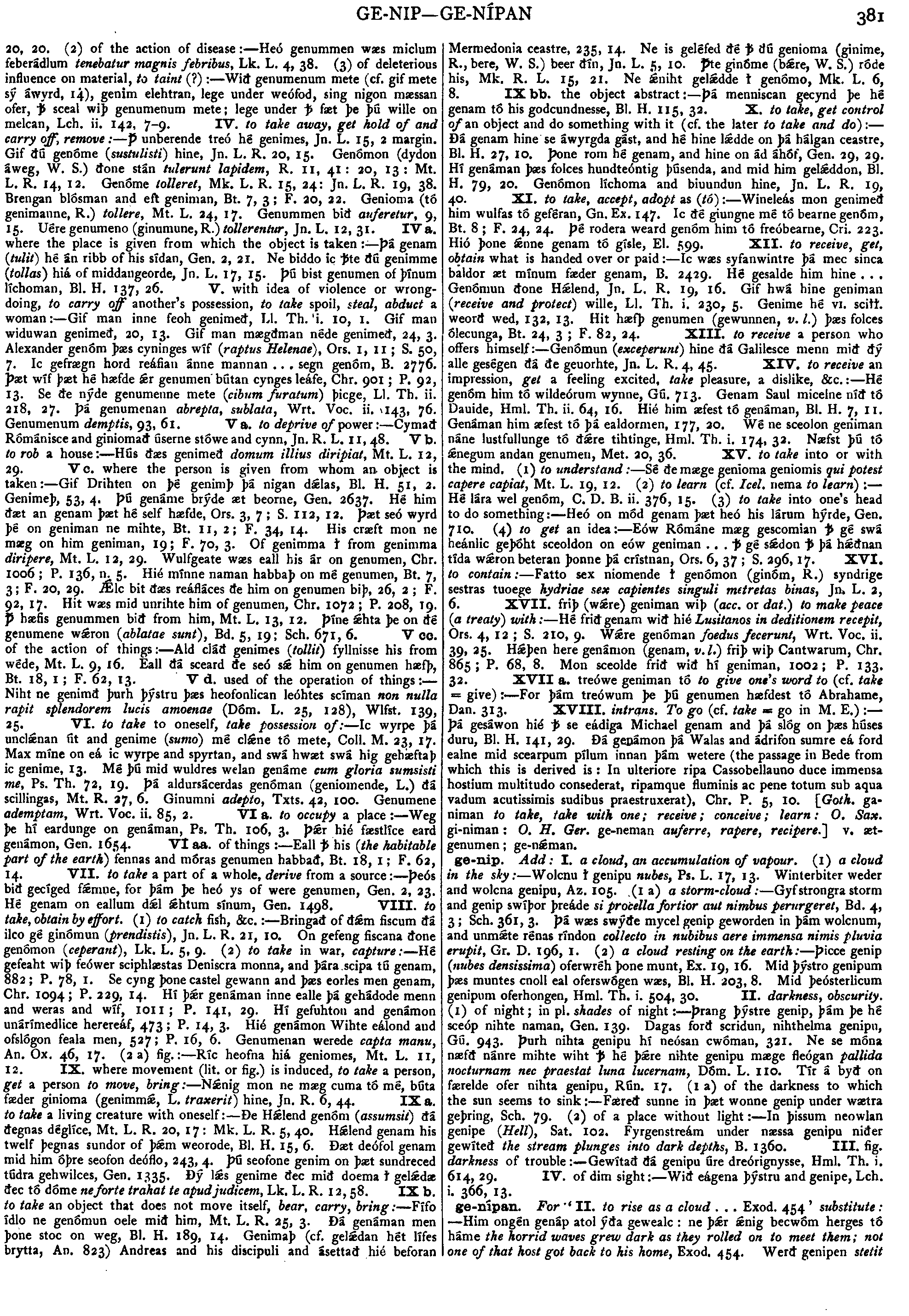
ge-nip.
Add:
I.
a
cloud,
an
accumulation
of
vapour.
(1)
a
cloud
in
the
sky:--Wolcnu
 genipu
nubes,
Ps.
L.
17,
13.
Winterbiter
weder
and
wolcna
genipu,
Az.
105.
(1
a)
a
storm-cloud:--Gyf
strongra
storm
and
genip
swíþor
þreáde
si
procella
fortior
aut
nimbus
perurgeret,
Bd.
4,
3;
Sch.
361,
3.
Þá
wæs
swýðe
mycel
genip
geworden
in
þám
wolcnum,
and
unm
genipu
nubes,
Ps.
L.
17,
13.
Winterbiter
weder
and
wolcna
genipu,
Az.
105.
(1
a)
a
storm-cloud:--Gyf
strongra
storm
and
genip
swíþor
þreáde
si
procella
fortior
aut
nimbus
perurgeret,
Bd.
4,
3;
Sch.
361,
3.
Þá
wæs
swýðe
mycel
genip
geworden
in
þám
wolcnum,
and
unm te
rénas
ríndon
collecto
in
nubibus
aere
immensa
nimis
pluvia
erupit,
Gr.
D.
196,
1.
(2)
a
cloud
resting
on
the
earth:--Þicce
genip
(nubes
densissima)
oferwréh
þone
munt,
Ex.
19,
16.
Mid
þýstro
genipum
þæs
muntes
cnoll
eal
oferswógen
wæs,
Bl.
H.
203,
8.
Mid
þeósterlicum
genipum
oferhongen,
Hml.
Th.
i.
504,
30.
II.
darkness,
obscurity.
(1)
of
night;
in
pl.
shades
of
night:--Þrang
þýstre
genip,
þám
þe
hé
sceóp
nihte
naman,
Gen.
139.
Dagas
forð
scridun,
nihthelma
genipu,
Gú.
943.
Þurh
nihta
genipu
hí
neósan
cwóman,
321.
Ne
se
móna
næfð
nánre
mihte
wiht
te
rénas
ríndon
collecto
in
nubibus
aere
immensa
nimis
pluvia
erupit,
Gr.
D.
196,
1.
(2)
a
cloud
resting
on
the
earth:--Þicce
genip
(nubes
densissima)
oferwréh
þone
munt,
Ex.
19,
16.
Mid
þýstro
genipum
þæs
muntes
cnoll
eal
oferswógen
wæs,
Bl.
H.
203,
8.
Mid
þeósterlicum
genipum
oferhongen,
Hml.
Th.
i.
504,
30.
II.
darkness,
obscurity.
(1)
of
night;
in
pl.
shades
of
night:--Þrang
þýstre
genip,
þám
þe
hé
sceóp
nihte
naman,
Gen.
139.
Dagas
forð
scridun,
nihthelma
genipu,
Gú.
943.
Þurh
nihta
genipu
hí
neósan
cwóman,
321.
Ne
se
móna
næfð
nánre
mihte
wiht
 hé
þre
nihte
genipu
mæge
fleógan
pallida
nocturnam
nec
praestat
luna
lucernam,
Dóm.
L.
110.
Tír
á
byð
on
færelde
ofer
nihta
genipu,
Rún.
17.
(1
a)
of
the
darkness
to
which
the
sun
seems
to
sink:--Færeð
sunne
in
þæt
wonne
genip
under
waetra
geþring,
Sch.
79.
(2)
of
a
place
without
light:--In
þissum
neowlan
genipe
(Hell),
Sat.
102.
Fyrgenstreám
under
næssa
genipu
niðer
gewíteð
the
stream
plunges
into
dark
depths,
B.
1360.
III.
fig.
darkness
of
trouble:--Gewítað
ðá
genipu
úre
dreórignysse,
Hml.
Th.
i.
614,
29.
IV.
of
dim
sight:--Wið
eágena
þýstru
and
genipe,
Lch.
i.
366,
13.
hé
þre
nihte
genipu
mæge
fleógan
pallida
nocturnam
nec
praestat
luna
lucernam,
Dóm.
L.
110.
Tír
á
byð
on
færelde
ofer
nihta
genipu,
Rún.
17.
(1
a)
of
the
darkness
to
which
the
sun
seems
to
sink:--Færeð
sunne
in
þæt
wonne
genip
under
waetra
geþring,
Sch.
79.
(2)
of
a
place
without
light:--In
þissum
neowlan
genipe
(Hell),
Sat.
102.
Fyrgenstreám
under
næssa
genipu
niðer
gewíteð
the
stream
plunges
into
dark
depths,
B.
1360.
III.
fig.
darkness
of
trouble:--Gewítað
ðá
genipu
úre
dreórignysse,
Hml.
Th.
i.
614,
29.
IV.
of
dim
sight:--Wið
eágena
þýstru
and
genipe,
Lch.
i.
366,
13.
|
Source: Bosworth/Toller, page d0382, entry 4 View original page image as: [TIFF] [PNG] [View previous entry] [View next entry] |
[Comment on this entry] [View comments] |
The following entry has been hand-corrected once. |
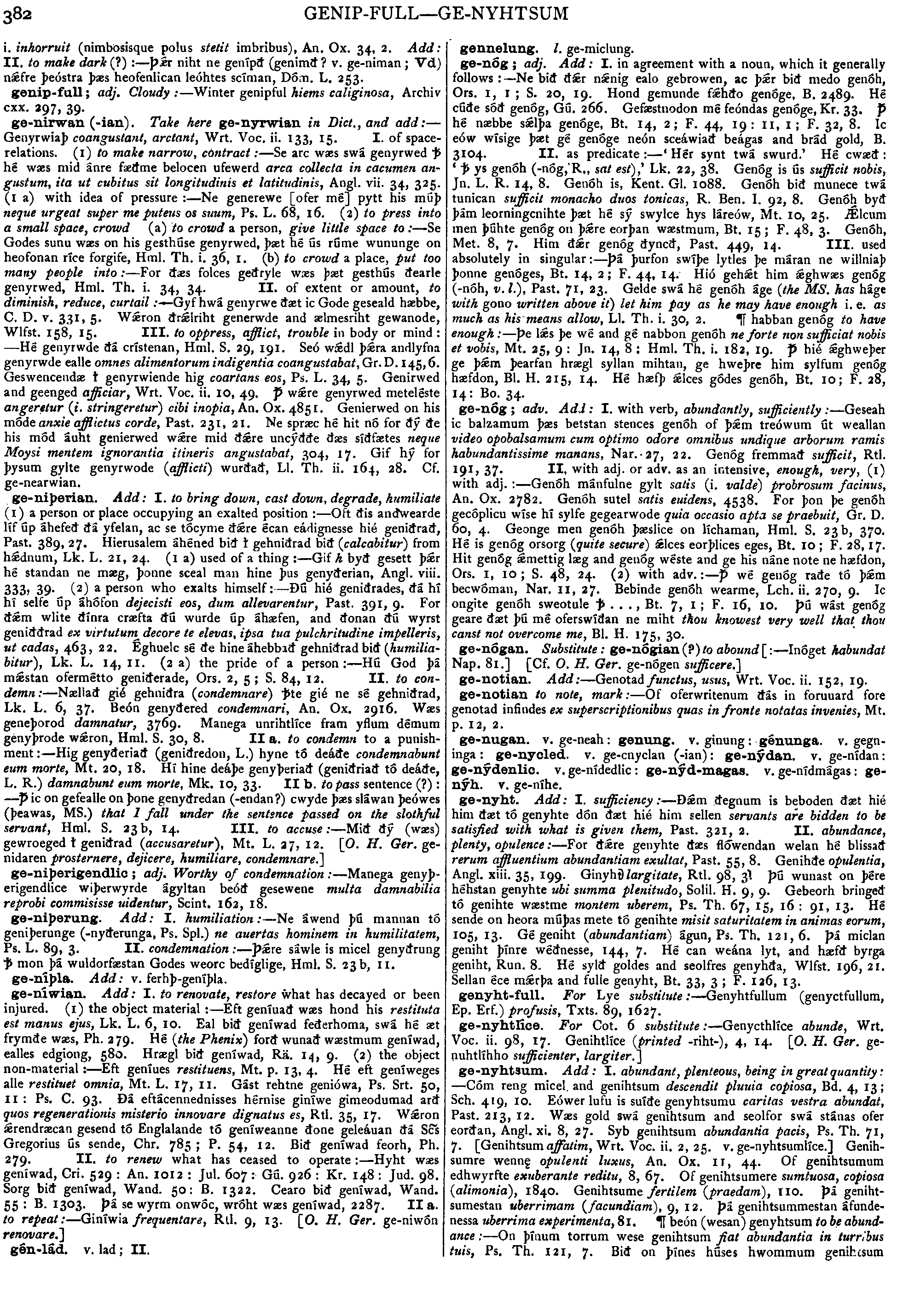
ge-niþerian.
Add:
I.
to
bring
down,
cast
down,
degrade,
humiliate
(1)
a
person
or
place
occupying
an
exalted
position:--Oft
ðis
andwearde
líf
úp
áhefeð
ðá
yfelan,
ac
se
tócyme
ðre
écan
eádignesse
hié
geniðrað,
Past.
389,
27.
Hierusalem
áhéned
bið
gehniðrad
bið
(calcabitur)
from
hdnum,
Lk.
L.
21,
24.
(1
a)
used
of
a
thing:--Gif
h
byð
gesett
þr
hé
standan
ne
mæg,
þonne
sceal
man
hine
þus
genyðerian,
Angl.
viii.
333,
39.
(2)
a
person
who
exalts
himself:--Ðú
hié
geniðrades,
ðá
hí
hí
selfe
úp
áhófon
dejecisti
eos,
dum
allevarentur,
Past.
391,
9.
For
ðm
wlite
ðínra
cræfta
ðú
wurde
úp
áhæfen,
and
ðonan
ðú
wyrst
geniððrad
ex
virtutum
decore
te
elevas,
ipsa
tua
pulchritudine
impelleris,
ut
cadas,
463,
22.
Éghuelc
sé
ðe
hine
áhebbað
gehniðrad
bið
(humiliabitur),
Lk.
L.
14,
11.
(2
a)
the
pride
of
a
person:--Hú
God
þá
mstan
ofermétto
geniðerade,
Ors.
2,
5;
S.
84,
12.
II.
to
condemn:--Nællað
gié
gehniðra
(condemnare)
te
gié
ne
se
gehniðrad,
Lk.
L.
6,
37.
Beón
genyðered
condemnari,
An.
Ox.
2916.
Wæs
geneþorod
damnatur,
3769.
Manega
unrihtlíce
fram
yflum
démum
genyþrode
wron,
Hml.
S.
30,
8.
II
a.
to
condemn
to
a
punishment:--Hig
genyðeriað
(geniðredon,
L.)
hyne
tó
deáðe
condemnabunt
eum
morte,
Mt.
20,
18.
Hí
hine
deáþe
genyþeriað
(geniðriað
tó
deáðe,
L.
R.)
damnabunt
eum
morte,
Mk.
10,
33.
II
b.
to
pass
sentence(?):--Þ-bar;
ic
on
gefealle
on
þone
genyðredan
(-endan?)
cwyde
þæs
sláwan
þeówes
(þeawas,
MS.)
that
I
fall
under
the
sentence
passed
on
the
slothful
servant,
Hml.
S.
23
b,
14.
III.
to
accuse:--Mið
ðý
(wæs)
gewroeged
geniðrad
(accusaretur),
Mt.
L.
27,
12.
[O.
H.
Ger.
genidaren
prosternere,
dejicere,
humiliare,
condemnare.]
|
Source: Bosworth/Toller, page d0382, entry 15 View original page image as: [TIFF] [PNG] [View previous entry] [View next entry] |
[Comment on this entry] [View comments] |
The following entry has been hand-corrected once. |
ge-notian to note, mark:--Of oferwritenum ðás in foruuard fore genotad infindes ex superscriptionibus quas in fronte notatas invenies, Mt. p. 12, 2.
|
Source: Bosworth/Toller, page d0383, entry 21 View original page image as: [TIFF] [PNG] [View previous entry] [View next entry] |
[Comment on this entry] [View comments] |
The following entry has been hand-corrected once. |
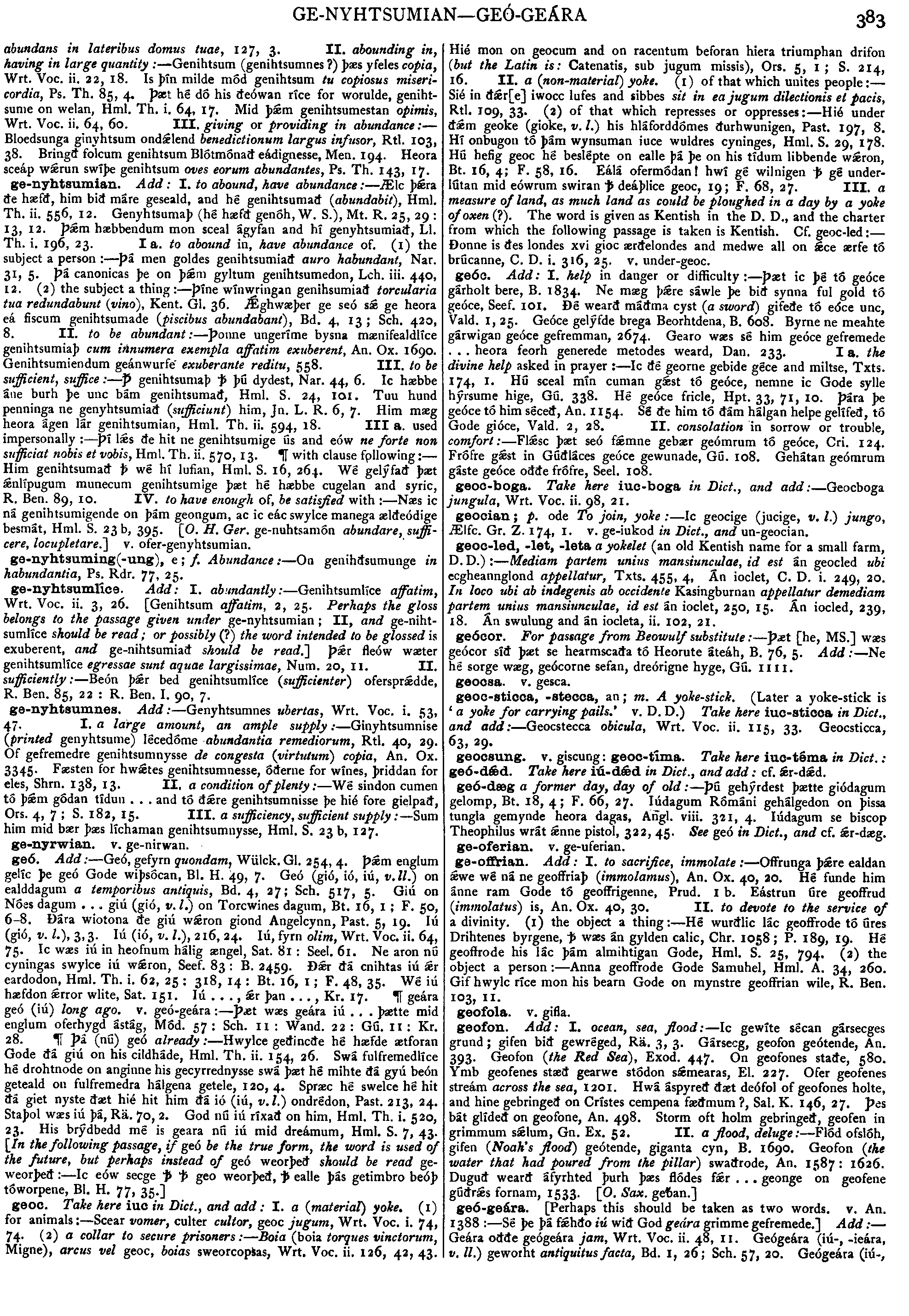
geofon.
Add:
I.
ocean,
sea,
flood:--Ic
gewíte
sécan
gársecges
grund;
gifen
bið
gewréged,
Rá.
3,
3.
Gársecg,
geofon
geótende,
An.
393.
Geofon
(the
Red
Sea),
Exod.
447.
On
geofones
staðe,
580.
Ymb
geofenes
stæð
gearwe
stódon
smearas,
El.
227.
Ofer
geofenes
streám
across
the
sea,
1201.
Hwá
áspyreð
ðæt
deófol
of
geofones
holte,
and
hine
gebringeð
on
Crístes
cempena
fæðmum?,
Sal.
K.
146,
27.
Þes
bát
glídeð
on
geofone,
An.
498.
Storm
oft
holm
gebringeð,
geofen
in
grimmum
slum,
Gn.
Ex.
52.
II.
a
flood,
deluge:--Flód
ofslóh,
gifen
(Noah's
flood)
geótende,
giganta
cyn,
B.
1690.
Geofon
(the
water
that
had
poured
from
the
pillar)
swaðrode,
An.
1587:
1626.
Duguð
wearð
áfyrhted
þurh
þæs
flódes
fr
.
.
.
geonge
on
geofene
gúðrs
fornam,
1533.
[O.
Sax.
ge an.?
an.?
|
Source: Bosworth/Toller, page d0385, entry 16 View original page image as: [TIFF] [PNG] [View previous entry] [View next entry] |
[Comment on this entry] [View comments] |
The following entry has been hand-corrected once. |
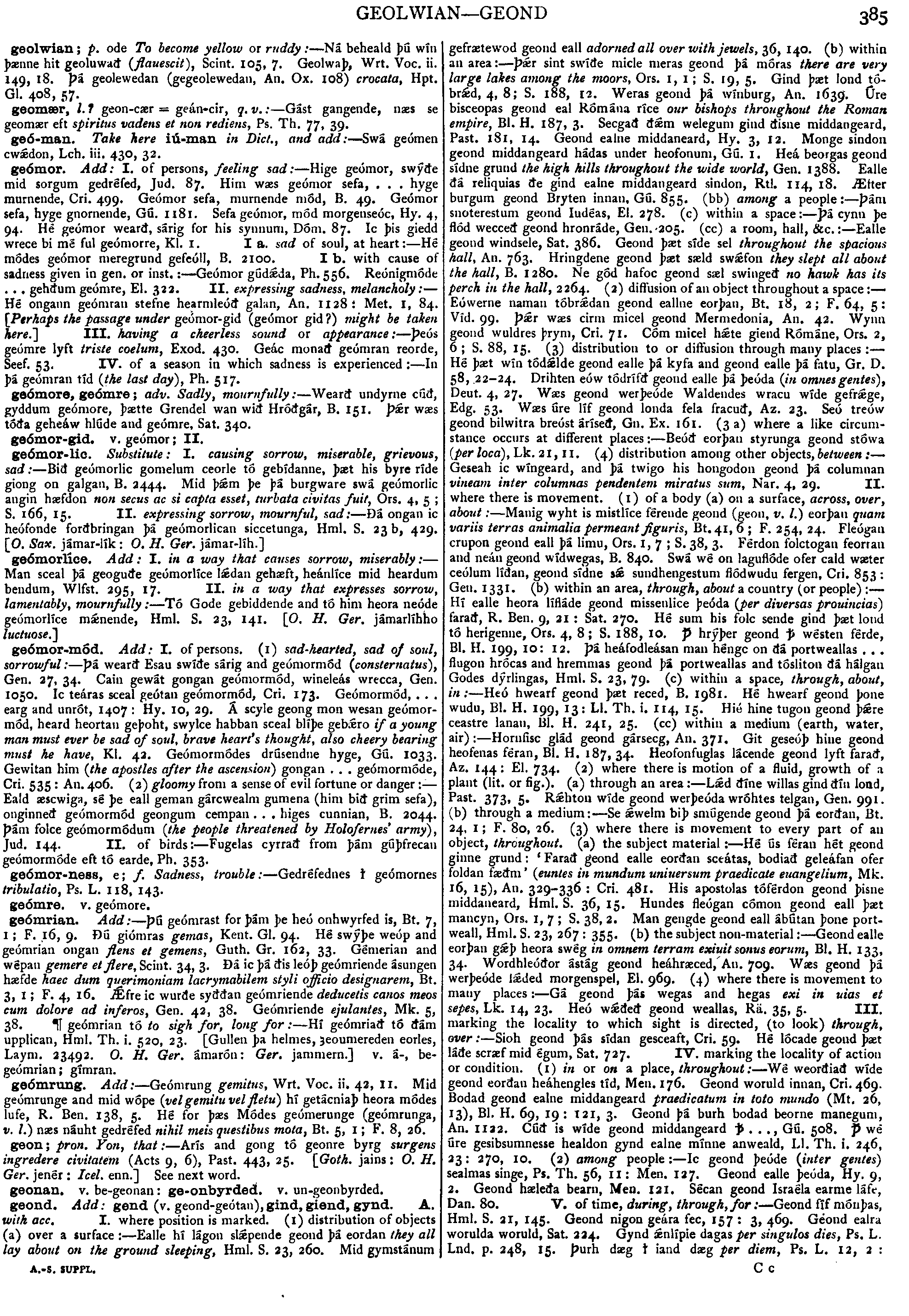
geond.
Add:
gend
(v.
geond-geótan),
gind,
giend,
gynd.
A.
with
acc.
I.
where
position
is
marked.
(1)
distribution
of
objects
(a)
over
a
surface:--Ealle
hí
lágon
slpende
geond
þá
eordan
they
all
lay
about
on
the
ground
sleeping,
Hml.
S.
23,
260.
Mid
gymstánum
gefrætewod
geond
eall
adorned
all
over
with
jewels,
36,
140.
(b)
within
an
area:--Þr
sint
swíðe
micle
meras
geond
þá
móras
there
are
very
large
lakes
among
the
moors,
Ors.
1,
1;
S.
19,
5.
Gind
þæt
lond
tó brd,
4,
8;
S.
188,
12.
Weras
geond
þá
wínburg,
An.
1639.
Úre
bisceopas
geond
eal
Romána
ríce
our
bishops
throughout
the
Roman
empire,
Bl.
H.
187,
3.
Secgað
ðm
welegum
gind
ðisne
middangeard,
Past.
181,
14.
Geond
ealne
middaneard,
Hy.
3,
12.
Monge
sindon
geond
middangeard
hádas
under
heofonum,
Gú.
1.
Heá
beorgas
geond
sídne
grund
the
high
hills
throughout
the
wide
world,
Gen.
1388.
Ealle
ðá
reliquias
ðe
gind
ealne
middangeard
sindon,
Rtl.
114,
18.
Æfter
burgum
geond
Bryten
innan,
Gú.
855.
(bb)
among
a
people:--Þám
snoterestum
geond
Iudéas,
El.
278.
(c)
within
a
space:--Þá
cynn
þe
flód
wecceð
geond
hronráde,
Gen.
205.
(cc)
a
room,
hall,
&c.:--Ealle
geond
windsele,
Sat.
386.
Geond
þæt
síde
sel
throughout
the
spacious
hall,
An.
763.
Hringdene
geond
þæt
sæld
swfon
they
slept
all
about
the
hall,
B.
1280.
Ne
gód
hafoc
geond
sæl
swingeð
no
hawk
has
its
perch
in
the
hall,
2264.
(2)
diffusion
of
an
object
throughout
a
space:--Eówerne
naman
tóbrdan
geond
eallne
eorþan,
Bt.
18,
2;
F.
64,
5:
Víd.
99.
Þr
wæs
cirm
micel
geond
Mermedonia,
An.
42.
Wynn
geond
wuldres
þrym,
Cri.
71.
Cóm
micel
hte
giend
Rómáne,
Ors.
2,
6;
S.
88,
15.
(3)
distribution
to
or
diffusion
through
many
places:--Hé
þæt
wín
tódlde
geond
ealle
þá
kyfa
and
geond
ealle
þá
fatu,
Gr.
D.
58,
22-24.
Drihten
eów
tódrífð
geond
ealle
þá
þeóda
(in
omnes
gentes),
Deut.
4,
27.
Wæs
geond
werþeóde
Waldendes
wracu
wíde
gefrge,
Edg.
53.
Wæs
úre
líf
geond
londa
fela
fracuð,
Az.
23.
Seó
treów
geond
bilwitra
breóst
áríseð,
Gn.
Ex.
161.
(3
a)
where
a
like
circumstance
occurs
at
different
places:--Beóð
eorþan
styrunga
geond
stówa
(per
loca),
Lk.
21,
11.
(4)
distribution
among
other
objects,
between:--Geseah
ic
wíngeard,
and
þá
twigo
his
hongodon
geond
þá
columnan
vineam
inter
columnas
pendentem
miratus
sum,
Nar.
4,
29.
II.
where
there
is
movement.
(1)
of
a
body
(a)
on
a
surface,
across,
over,
about:--Manig
wyht
is
mistlíce
férende
geond
(geon,
v.
l.)
eorþan
quam
variis
terras
animalia
permeant
figuris,
Bt.
41,
6;
F.
254,
24.
Fleógan
crupon
geond
eall
þá
limu,
Ors.
1,
7;
S.
38,
3.
Férdon
folctogan
feorran
and
neán
geond
wídwegas,
B.
840.
Swá
wé
on
laguflóde
ofer
cald
wæter
ceólum
líðan,
geond
sídne
a
sundhengestum
flódwudu
fergen,
Cri.
853:
Gen.
1331.
(b)
within
an
area,
through,
about
a
country
(or
people):--Hí
ealle
heora
lífláde
geond
missenlice
þeóda
(per
diversas
prouincias)
farað,
R.
Ben.
9,
21:
Sat.
270.
Hé
sum
his
folc
sende
gind
þæt
lond
tó
herigenne,
Ors.
4,
8;
S.
188,
10.
Þ-bar;
hrýþer
geond
wésten
férde,
Bl.
H.
199,
10:
12.
Þá
heáfodleásan
man
héngc
on
ðá
portweallas
.
.
.
flugon
hrócas
and
hremmas
geond
þá
portweallas
and
tósliton
ðá
hálgan
Godes
dýrlingas,
Hml.
S.
23,
79.
(c)
within
a
space,
through,
about,
in:--Heó
hwearf
geond
þæt
reced,
B.
1981.
Hé
hwearf
geond
þone
wudu,
Bl.
H.
199,
13:
Ll.
Th.
i.
114,
15.
Hié
hine
tugon
geond
þre
ceastre
lanan,
Bl.
H.
241,
25.
(cc)
within
a
medium
(earth,
water,
air):--Hornfisc
glád
geond
gársecg,
An.
371.
Git
geseóþ
hine
geond
heofenas
féran,
Bl.
H.
187,
34.
Heofonfuglas
lácende
geond
lyft
farað,
Az.
144:
El.
734.
(2)
where
there
is
motion
of
a
fluid,
growth
of
a
plant
(lit.
or
fig.).
(a)
through
an
area:--Ld
ðíne
willas
gind
ðín
lond,
Past.
373,
5.
Rhton
wíde
geond
werþeóda
wróhtes
telgan,
Gen.
991.
(b)
through
a
medium:--Se
welm
biþ
smúgende
geond
þá
eorðan,
Bt.
24,
1;
F.
80,
26.
(3)
where
there
is
movement
to
every
part
of
an
object,
throughout.
(a)
the
subject
material:--Hé
ús
féran
hét
geond
ginne
grund:
'Farað
geond
ealle
eorðan
sceátas,
bodiað
geleáfan
ofer
foldan
fæðm'
(euntes
in
mundum
uniuersum
praedicate
euangelium,
Mk.
16,
15),
An.
329-336:
Cri.
481.
His
apostolas
tóférdon
geond
þisne
middaneard,
Hml.
S.
36,
15.
Hundes
fleógan
cómon
geond
eall
þæt
mancyn,
Ors.
1,
7;
S.
38,
2.
Man
gengde
geond
eall
ábútan
þone
portweall,
Hml.
S.
23,
267:
355.
(b)
the
subject
non-material:--Geond
ealle
eorþan
gþ
heora
swég
in
omnem
terram
exiuit
sonus
eorum,
Bl.
H.
133,
34.
Wordhleóðor
ástág
geond
heáhræced,
An.
709.
Wæs
geond
þá
werþeóde
lded
morgenspel,
El.
969.
(4)
where
there
is
movement
to
many
places:--Gá
geond
þás
wegas
and
hegas
exi
in
uias
et
sepes,
Lk.
14,
23.
Heó
wðeð
geond
weallas,
Rä.
35,
5.
III.
marking
the
locality
to
which
sight
is
directed,
(to
look)
through,
over:--Sioh
geond
þás
sídan
gesceaft,
Cri.
59.
Hé
lócade
geond
þæt
láðe
scræf
mid
égum,
Sat.
727.
IV.
marking
the
locality
of
action
or
condition.
(1)
in
or
on
a
place,
throughout:--Wé
weorðiað
wíde
geond
eorðan
heáhengles
tíd,
Men.
176.
Geond
woruld
innan,
Cri.
469.
Bodad
geond
ealne
middangeard
praedicatum
in
toto
mundo
(Mt.
26,
13),
Bl.
H.
69,
19:
121,
3.
Geond
þá
burh
bodad
beorne
manegum,
An.
1122.
Cúð
is
wíde
geond
middangeard
.
.
.,
Gú.
508.
Þ-bar;
wé
úre
gesibsumnesse
healdon
gynd
ealne
mínne
anweald,
Ll.
Th.
i.
246,
23:
270,
10.
(2)
among
people:--Ic
geond
þeóde
(inter
gentes)
sealmas
singe,
Ps.
Th.
56,
11:
Men.
127.
Geond
ealle
þeóda,
Hy.
9,
2.
Geond
hæleða
bearn,
Men.
121.
Sécan
geond
Israéla
earme
láfe,
Dan.
80.
V.
of
time,
during,
through,
for:--Geond
fíf
mónþas,
Hml.
S.
21,
145.
Geond
nigon
geúra
fec,
157:
3,
469.
Géond
ealra
worulda
woruld,
Sat.
224.
Gynd
nlípie
dagas
per
singulos
dies,
Ps.
L.
Lnd.
p.
248,
15.
Þurh
dæg
iand
dæg
per
diem,
Ps.
L.
12,
2:
brd,
4,
8;
S.
188,
12.
Weras
geond
þá
wínburg,
An.
1639.
Úre
bisceopas
geond
eal
Romána
ríce
our
bishops
throughout
the
Roman
empire,
Bl.
H.
187,
3.
Secgað
ðm
welegum
gind
ðisne
middangeard,
Past.
181,
14.
Geond
ealne
middaneard,
Hy.
3,
12.
Monge
sindon
geond
middangeard
hádas
under
heofonum,
Gú.
1.
Heá
beorgas
geond
sídne
grund
the
high
hills
throughout
the
wide
world,
Gen.
1388.
Ealle
ðá
reliquias
ðe
gind
ealne
middangeard
sindon,
Rtl.
114,
18.
Æfter
burgum
geond
Bryten
innan,
Gú.
855.
(bb)
among
a
people:--Þám
snoterestum
geond
Iudéas,
El.
278.
(c)
within
a
space:--Þá
cynn
þe
flód
wecceð
geond
hronráde,
Gen.
205.
(cc)
a
room,
hall,
&c.:--Ealle
geond
windsele,
Sat.
386.
Geond
þæt
síde
sel
throughout
the
spacious
hall,
An.
763.
Hringdene
geond
þæt
sæld
swfon
they
slept
all
about
the
hall,
B.
1280.
Ne
gód
hafoc
geond
sæl
swingeð
no
hawk
has
its
perch
in
the
hall,
2264.
(2)
diffusion
of
an
object
throughout
a
space:--Eówerne
naman
tóbrdan
geond
eallne
eorþan,
Bt.
18,
2;
F.
64,
5:
Víd.
99.
Þr
wæs
cirm
micel
geond
Mermedonia,
An.
42.
Wynn
geond
wuldres
þrym,
Cri.
71.
Cóm
micel
hte
giend
Rómáne,
Ors.
2,
6;
S.
88,
15.
(3)
distribution
to
or
diffusion
through
many
places:--Hé
þæt
wín
tódlde
geond
ealle
þá
kyfa
and
geond
ealle
þá
fatu,
Gr.
D.
58,
22-24.
Drihten
eów
tódrífð
geond
ealle
þá
þeóda
(in
omnes
gentes),
Deut.
4,
27.
Wæs
geond
werþeóde
Waldendes
wracu
wíde
gefrge,
Edg.
53.
Wæs
úre
líf
geond
londa
fela
fracuð,
Az.
23.
Seó
treów
geond
bilwitra
breóst
áríseð,
Gn.
Ex.
161.
(3
a)
where
a
like
circumstance
occurs
at
different
places:--Beóð
eorþan
styrunga
geond
stówa
(per
loca),
Lk.
21,
11.
(4)
distribution
among
other
objects,
between:--Geseah
ic
wíngeard,
and
þá
twigo
his
hongodon
geond
þá
columnan
vineam
inter
columnas
pendentem
miratus
sum,
Nar.
4,
29.
II.
where
there
is
movement.
(1)
of
a
body
(a)
on
a
surface,
across,
over,
about:--Manig
wyht
is
mistlíce
férende
geond
(geon,
v.
l.)
eorþan
quam
variis
terras
animalia
permeant
figuris,
Bt.
41,
6;
F.
254,
24.
Fleógan
crupon
geond
eall
þá
limu,
Ors.
1,
7;
S.
38,
3.
Férdon
folctogan
feorran
and
neán
geond
wídwegas,
B.
840.
Swá
wé
on
laguflóde
ofer
cald
wæter
ceólum
líðan,
geond
sídne
a
sundhengestum
flódwudu
fergen,
Cri.
853:
Gen.
1331.
(b)
within
an
area,
through,
about
a
country
(or
people):--Hí
ealle
heora
lífláde
geond
missenlice
þeóda
(per
diversas
prouincias)
farað,
R.
Ben.
9,
21:
Sat.
270.
Hé
sum
his
folc
sende
gind
þæt
lond
tó
herigenne,
Ors.
4,
8;
S.
188,
10.
Þ-bar;
hrýþer
geond
wésten
férde,
Bl.
H.
199,
10:
12.
Þá
heáfodleásan
man
héngc
on
ðá
portweallas
.
.
.
flugon
hrócas
and
hremmas
geond
þá
portweallas
and
tósliton
ðá
hálgan
Godes
dýrlingas,
Hml.
S.
23,
79.
(c)
within
a
space,
through,
about,
in:--Heó
hwearf
geond
þæt
reced,
B.
1981.
Hé
hwearf
geond
þone
wudu,
Bl.
H.
199,
13:
Ll.
Th.
i.
114,
15.
Hié
hine
tugon
geond
þre
ceastre
lanan,
Bl.
H.
241,
25.
(cc)
within
a
medium
(earth,
water,
air):--Hornfisc
glád
geond
gársecg,
An.
371.
Git
geseóþ
hine
geond
heofenas
féran,
Bl.
H.
187,
34.
Heofonfuglas
lácende
geond
lyft
farað,
Az.
144:
El.
734.
(2)
where
there
is
motion
of
a
fluid,
growth
of
a
plant
(lit.
or
fig.).
(a)
through
an
area:--Ld
ðíne
willas
gind
ðín
lond,
Past.
373,
5.
Rhton
wíde
geond
werþeóda
wróhtes
telgan,
Gen.
991.
(b)
through
a
medium:--Se
welm
biþ
smúgende
geond
þá
eorðan,
Bt.
24,
1;
F.
80,
26.
(3)
where
there
is
movement
to
every
part
of
an
object,
throughout.
(a)
the
subject
material:--Hé
ús
féran
hét
geond
ginne
grund:
'Farað
geond
ealle
eorðan
sceátas,
bodiað
geleáfan
ofer
foldan
fæðm'
(euntes
in
mundum
uniuersum
praedicate
euangelium,
Mk.
16,
15),
An.
329-336:
Cri.
481.
His
apostolas
tóférdon
geond
þisne
middaneard,
Hml.
S.
36,
15.
Hundes
fleógan
cómon
geond
eall
þæt
mancyn,
Ors.
1,
7;
S.
38,
2.
Man
gengde
geond
eall
ábútan
þone
portweall,
Hml.
S.
23,
267:
355.
(b)
the
subject
non-material:--Geond
ealle
eorþan
gþ
heora
swég
in
omnem
terram
exiuit
sonus
eorum,
Bl.
H.
133,
34.
Wordhleóðor
ástág
geond
heáhræced,
An.
709.
Wæs
geond
þá
werþeóde
lded
morgenspel,
El.
969.
(4)
where
there
is
movement
to
many
places:--Gá
geond
þás
wegas
and
hegas
exi
in
uias
et
sepes,
Lk.
14,
23.
Heó
wðeð
geond
weallas,
Rä.
35,
5.
III.
marking
the
locality
to
which
sight
is
directed,
(to
look)
through,
over:--Sioh
geond
þás
sídan
gesceaft,
Cri.
59.
Hé
lócade
geond
þæt
láðe
scræf
mid
égum,
Sat.
727.
IV.
marking
the
locality
of
action
or
condition.
(1)
in
or
on
a
place,
throughout:--Wé
weorðiað
wíde
geond
eorðan
heáhengles
tíd,
Men.
176.
Geond
woruld
innan,
Cri.
469.
Bodad
geond
ealne
middangeard
praedicatum
in
toto
mundo
(Mt.
26,
13),
Bl.
H.
69,
19:
121,
3.
Geond
þá
burh
bodad
beorne
manegum,
An.
1122.
Cúð
is
wíde
geond
middangeard
.
.
.,
Gú.
508.
Þ-bar;
wé
úre
gesibsumnesse
healdon
gynd
ealne
mínne
anweald,
Ll.
Th.
i.
246,
23:
270,
10.
(2)
among
people:--Ic
geond
þeóde
(inter
gentes)
sealmas
singe,
Ps.
Th.
56,
11:
Men.
127.
Geond
ealle
þeóda,
Hy.
9,
2.
Geond
hæleða
bearn,
Men.
121.
Sécan
geond
Israéla
earme
láfe,
Dan.
80.
V.
of
time,
during,
through,
for:--Geond
fíf
mónþas,
Hml.
S.
21,
145.
Geond
nigon
geúra
fec,
157:
3,
469.
Géond
ealra
worulda
woruld,
Sat.
224.
Gynd
nlípie
dagas
per
singulos
dies,
Ps.
L.
Lnd.
p.
248,
15.
Þurh
dæg
iand
dæg
per
diem,
Ps.
L.
12,
2:
|
Source: Bosworth/Toller, page d0386, entry 11 View original page image as: [TIFF] [PNG] [View previous entry] [View next entry] |
[Comment on this entry] [View comments] |
The following entry has been hand-corrected once. |
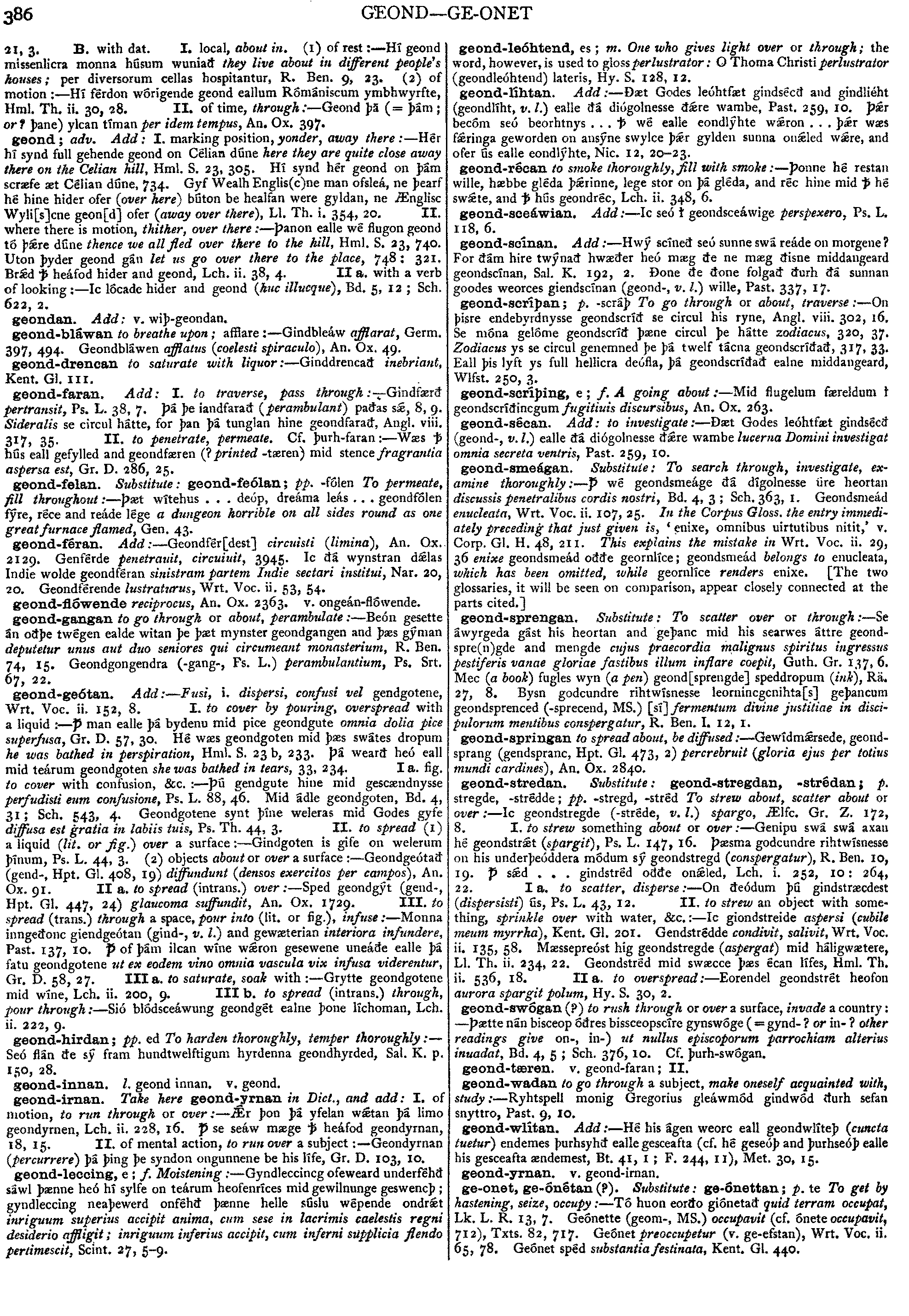
geond-geótan.
Add:--Fusi,
i.
dispersi,
confusi
vel
gendgotene,
Wrt.
Voc.
ii.
152,
8.
I.
to
cover
by
pouring,
overspread
with
a
liquid:--Þ-bar;
man
ealle
þá
bydenu
mid
pice
geondgute
omnia
dolia
pice
superfusa,
Gr.
D.
57,
30.
Hé
wæs
geondgoten
mid
þæs
swátes
dropum
he
was
bathed
in
perspiration,
Hml.
S.
23
b,
233.
Þá
wearð
heó
eall
mid
teárum
geondgoten
she
was
bathed
in
tears,
33,
234.
I
a.
fig.
to
cover
with
confusion,
&c.:--Þú
gendgute
hine
mid
gescændnysse
perfudisti
eum
confusione,
Ps.
L.
88,
46.
Mid
ádle
geondgoten,
Bd.
4,
31;
Sch.
543,
4.
Geondgotene
synt
þíne
weleras
mid
Godes
gyfe
diffusa
est
gratia
in
labiis
tuis,
Ps.
Th.
44,
3.
II.
to
spread
(1)
a
liquid
(lit.
or
fig.)
over
a
surface:--Gindgoten
is
gife
on
welerum
þínum,
Ps.
L.
44,
3.
(2)
objects
about
or
over
a
surface:--Geondgeótað
(gend-,
Hpt.
Gl.
408,
19)
diffundunt
(densos
exercitos
per
campos),
An.
Ox.
91.
II
a.
to
spread
(intrans.)
over:--Sped
geondgýt
(gend-,
Hpt.
Gl.
447,
24)
glaucoma
suffundit,
An.
Ox.
1729.
III.
to
spread
(trans.)
through
a
space,
pour
into
(lit.
or
fig.),
infuse:--Monna
inngeðonc
giendgeótan
(gind-,
v.
l.)
and
gewæterian
interiora
infundere,
Past.
137,
10.
Þ-bar;
of
þám
ilcan
wíne
wron
gesewene
uneáðe
ealle
þá
fatu
geondgotene
ut
ex
eodem
vino
omnia
vascula
vix
infusa
viderentur,
Gr.
D.
58,
27.
III
a.
to
saturate,
soak
with:--Grytte
geondgotene
mid
wíne,
Lch.
ii.
200,
9.
III
b.
to
spread
(intrans.)
through,
pour
through:--Sió
blódsceáwung
geondgét
ealne
þone
líchoman,
Lch.
ii.
222,
9.
|
Source: Bosworth/Toller, page d0389, entry 20 View original page image as: [TIFF] [PNG] [View previous entry] [View next entry] |
[Comment on this entry] [View comments] |
The following entry has been hand-corrected once. |
ge-pílian
to
beat
in
a
mortar:--Swilce
hít
on
pílan
gepílod
wre
quasi
pilo
tusum,
Ex.
16,
14.
|
Source: Bosworth/Toller, page d0391, entry 1 View original page image as: [TIFF] [PNG] [View previous entry] [View next entry] |
[Comment on this entry] [View comments (1)] |
The following entry has been hand-corrected once. |
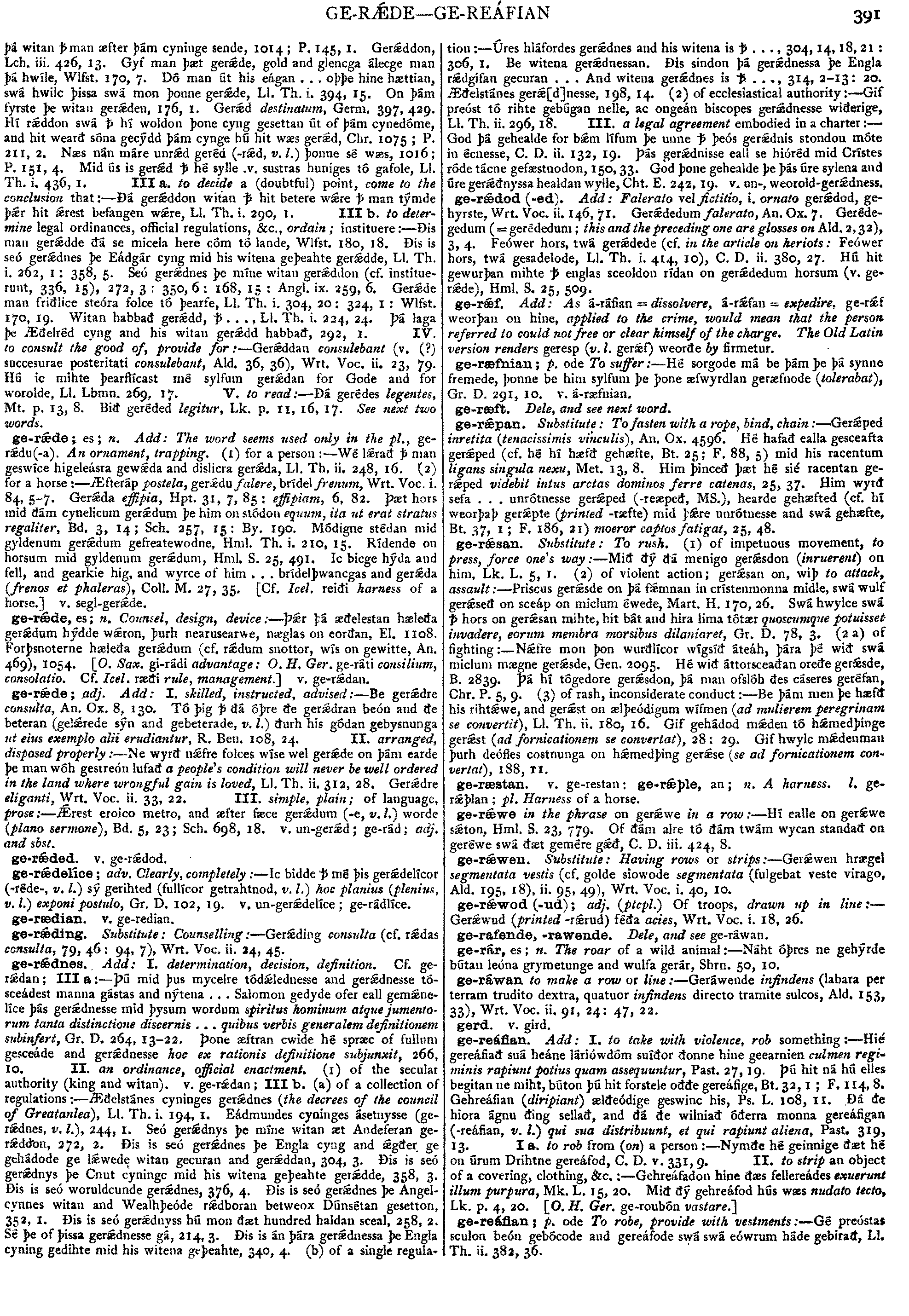
þá
witan
ILLEGIBLE
man
æfter
þäm
cyninge
sende,
1014
;
P.
145,
i.
Gerddon,
Lch.
iii.
426,
13.
Gyf
man
þæt
gerde,
gold
and
glencga
álecge
man
þá
hwíle,
Wlfst.
170,
7.
Dó
man
út
his
eágan
.
.
.
oþþe
hine
hættian,
swá
hwilc
þissa
swá
mon
þonne
gerde,
Ll.
Th.
i.
394,
15.
On
þám
fyrste
þe
witan
gerden,
176,
1.
Gerd
destinatum,
Germ.
397,
429.
Hi
rddon
swá
ILLEGIBLE
hí
woldon
þone
cyng
gesettan
út
of
þám
cynedóme,
and
hit
wearð
sona
gecýdd
þám
cynge
hú
hit
wæs
gerd,
Chr.
1075
;
P.
211,
2.
Næs
nán
máre
unrd
geréd
(-rd,
v.
l.)
þonne
së
wæs,
1016
;
P.
151,
4.
Mid
ús
UNCERTAIN
is
gerd
ILLEGIBLE
hé
sylle
.
v.
sustras
huniges
tó
gafole,
Ll.
Th.
i.
436,
l.
IIIa
to
decide
a
(doubtful)
point,
come
to
the
conclusion
that
:--
Ðá
gerddon
witan
ILLEGIBLE
hit
betere
wre
ILLEGIBLE
man
týmde
þr
hit
rest
befangen
wre,
Ll.
Th.
i.
290,
1.
IIIb.
to
determine
legal
ordinances,
official
regulations,
&c.
,
ordain;
instituere
:--
Ðis
man
gerdde
ðá
se
micela
here
cóm
tó
lande,
Wlfst.
180,
18.
Ðis
is
seó
gerdnes
þe
Eádgár
cyng
mid
his
witena
geþeahte
gerdde,
Ll.
Th.
i.
262,
l
:
358,
5.
Seó
gerdnes
þe
míne
witan
gerdilon
(cf.
institue-runt,
336,
15),
272,
3
:
350,
6:
168,
15
:
Angl.
ix.
259,
6.
Gerde
man
friðlice
steóra
folce
tó
þearfe,
Ll.
Th.
i.
304,
20
:
324,
I
:
Wlfst.
170,
19.
Witan
habbað
gerdd,
ILLEGIBLE
.
.
.
,
Ll.
Th.
i.
224,
24.
þá
lagaþe
Æ-acute;ðelréd
cyng
and
his
witan
gerdd
habbað,
292,
1.
IV.
to
consult
the
good
of,
provide
for
:--
Gerddan
consulebant
(v.
(?)
succesurae
posteritati
consulebant,
Aid.
36,
36),
Wrt.
Voc.
ii.
23,
79.
Hú
ic
mihte
þearflícast
mé
sylfum
gerdan
for
Gode
and
for
worolde,
Ll.
Lbmn.
269,
17.
V.
to
read
:--
Ðá
gerédes
legentes,
Mt.
p.
13,
8.
Bið
geréded
legitur.
Lk.
p.
II,
16,
17.
See
next
two
words.
ge-rde;
es;
n.
Add:
The
word
seems
used
only
in
the
pl.
,
ge-rdu(-a).
An
ornament,
trapping.
(1)
for
a
person
:--
Wé
lrað
ILLEGIBLE
man
geswíce
higeleásra
gewda
and
dislicra
gerda,
Ll.
Th.
ii.
248,
16.
(2)
for
a
horse
:--
Æ-acute;fteráp
postela,
gerdu
falere,
brídel
frenum,
Wrt.
Voc.
i.
84,
5-7.
Gerda
effipia,
Hpt.
31,
7,
85
:
effipiam,
6,
82.
þæt
hors
mid
ðám
cynelicum
gerdum
þe
him
on
stódon
equum,
ita
ut
erat
stratus
regaliter
,
Bd.
3,
14
;
Sch.
257,
15
:
By.
190.
Módigne
stédan
mid
gyldenum
gerdum
gefreatewodne,
Hml.
Th.
i.
210,
15.
Ridende
on
horsum
mid
gyldenum
gerdum,
Hml.
S.
25,
491.
Ic
bicge
hýda
and
fell,
and
gearkie
hig,
and
wyrce
of
him
.
.
.
brídelþwancgas
and
gerda
(frenos
et
phaleras),
Coll.
M.
27,
35.
[Cf.
Icel.
reiði
harness
of
a
horse.]
v.
segl-gerde.
ge-rde,
es;
n.
Counsel,
design,
device
:--
þr
þá
æðelestan
hæleða
gerdum
hýdde
wron,
þurh
nearusearwe,
næglas
on
eorðan,
El.
1108.
Forþsnoterne
hæleða
gerdum
(cf.
rdum
snottor,
wís
on
gewitte,
An.
469),
1054.
[O.
Sax.
gi-rádi
advantage:
O.
H.
Ger.
ge-ráti
concilium,
consolatio.
Cf.
Icel.
ræði
rule,
management.]
v.
ge-rdan.
ge-rde;
adj.
Add:
I.
skilled,
instructed,
advised
:--
Be
gerdre
consulta,
An.
Ox.
8,
130.
Tó
þig
ILLEGIBLE
ðá
óþre
ðe
gerdran
beón
and
ðe
beteran
(gelrede
sýn
and
gebeterade,
v.
l.)
ðurh
his
gódan
gebysnunga
ut
eius
exemplo
alii
erudiantur,
R.
Ben.
108,
24.
II.
arranged,
disposed
properly
:--
Ne
wyrð
nfre
folces
wise
wel
gerde
on
þám
earde
þe
man
wóh
gestreón
lufað
a
people's
condition
will
never
be
well
ordered
in
the
land
where
wrongful
gain
is
loved,
Ll.
Th.
ii.
312,
28.
Gerdre
eliganti,
Wrt.
Voc.
ii.
33,
22.
III.
simple,
plain;
of
language,
prose
:--
Æ-acute;rest
eroico
metro,
and
æfter
fæce
gerdum
(-e,
v.
l.)
worde
(piano
sermone),
Bd.
5,
23;
Sch.
698,
18.
v.
un-gerd;
ge-rád;
adj.
and
sbst.
ge-rded.
v.
ge-rdod.
ge-rdelíce
;
adv.
Clearly,
completely
:--
Ic
bidde
ILLEGIBLE
mILLEGIBLE
þis
gerdelícor
(-réde-,
v.
l.)
sý
gerihted
(fullícor
getrahtnod,
v.
l.)
hoc
planius
(plenius,
v.
l.)
exponi
postulo,
Gr.
D.
102,
19.
v.
un-gerdelíce
;
ge-rádlíce.
ge-rædian.
v.
ge-redian.
ge-rding.
Substitute:
Counselling
:--
Gerding
consulta
(cf.
rdas
consulta,
79,
46
:
94,
7),
Wrt.
Voc.
ii.
24,
45.
ge-rdnes.
Add:
I.
determination,
decision,
definition.
Cf.
gerdan
;
III
a
:--
Þú
mid
þus
mycelre
tódlednesse
and
gerdnesse
tósceádest
manna
gástas
and
nýtena
.
.
.
Salomon
gedyde
ofer
eall
gemne-líce
þás
gerdnesse
mid
þysum
wordum
spiritus
hominum
atque
jumentorum
tanta
distinctione
discernis.
.
.
quibus
verbis
generalem
definitionem
subinfert,
Gr.
D.
264,
13
--
22.
Þone
æftran
cwide
hé
spræc
of
fullom.
gesceáde
and
gerdnesse
hoc
ex
rationis
definitione
subjunxit,
266,
10.
II.
an
ordinance,
official
enactment,
(1)
of
the
secular
authority
(king
and
witan).
v.
ge-rdan
;
III
b.
(a)
of
a
collection
of
regulations
:--
Æ-acute;ðelstánes
cyninges
gerdnes
(the
decrees
of
the
council
of
Greatanlea),
Ll.
Th.
i.
194,
i.
Eádmundes
cyninges
ásetnysse
(gerdnes,
v.
l.
),
244,
l.
Seó
gerdnys
þe
mine
witan
æt
Andeferan
ge-rdðon,
272,
2.
Ðis
is
seó
gerdnes
þe
Engla
cyng
and
gðer
ge
gehádode
ge
lwede
witan
gecuran
and
gerddan,
304,
3.
Ðis
is
seó
gerdnys
þe
Cnut
cyninge
mid
his
witena
geþeahte
gerdde,
358,
3.
Ðis
is
seó
woruldcunde
gerdnes,
376,
4.
Ðis
is
seé
gerdnes
þe
Angel-cynnes
witan
and
Wealhþeóde
rdboran
betweox
Dúnsétan
gesetton,
352,
1.
Ðis
is
seó
gerdnyss
hú
mon
ðæt
hundred
haldan
sceal,
258,
2.
Sé
þe
of
þissa
gerdnesse
gá,
214,
3.
Ðis
is
án
þára
gerdnessa
þe
Engla
cyning
gedihte
mid
his
witena
gcþeahte,
340,
4.
(b)
of
a
single
regulation
:--
Úres
hláfordes
gerdnes
and
his
witena
is
ILLEGIBLE
.
.
.
,
304,
14,
18,
21
:
306,
l.
Be
witena
gerdnessan.
Ðis
sindon
þá
gerdnessa
þe
Engla
rdgifan
gecuran
.
.
.
And
witena
geræ-acute;dnes
is
ILLEGIBLE
.
.
.
,
314,
2-13:
20.
Æðelstánes
ger[d]nesse,
198,
14.
(2)
of
ecclesiastical
authority
:--
Gif
preóst
tó
rihte
gebúgan
nelle,
ac
ongeán
biscopes
gerdnesse
wiðerige,
Ll.
Th.
ii.
296,
18.
III.
a
legal
agreement
embodied
in
a
charter
:--
God
þá
gehealde
for
bm
lífum
þe
mine
ILLEGIBLE
þeós
gerdnis
stondon
móte
in
écnesse,
C.
D.
ii.
132,
19.
þás
gerdnisse
eall
se
hióréd
mid
Crístes
róde
tácne
gefæstnodon,
150,
33.
God
þone
gehealde
þe
þás
úre
sylena
and
úre
gerðnyssa
healdan
wylle,
Cht.
E.
242,
19.
v.
un-,
weorold-gerdness.
ge-rdod
(-ed).
Add:
Falerato
vel
fictitio,
i.
ornato
gerdod,
ge-hyrste,
Wrt.
Voc.
ii.
146,
71.
Gerdedum
falerato,
An.
Ox.
7.
Geréde-gedum
(
=
gerédedum;
this
and
the
preceding
one
are
glosses
on
Ald.
2,
32),
3,
4.
Feówer
hors,
twá.
gerdede
(cf.
in
the
article
on
heriots:
Feówer
hors,
twá
gesadelode,
Ll.
Th.
i.
414,
10),
C.
D.
ii.
380,
27.
Hú
hit
gewurþan
mihte
ILLEGIBLE
englas
sceoldon
ridan
on
gerdedum
horsum
(v.
ge-rde),
Hml.
S.
25,
509.
ge-rf.
Add:
As
á-ráfian
=
dissolvere,
á-rfan
=
expedire,
ge-rf
weorþan
on
hine,
applied
to
the
crime,
would
mean
that
the
person
referred
to
could
not
free
or
clear
himself
of
the
charge.
The
Old
Latin
version
renders
geresp
(v.
l.
gerf)
weorðe
by
firmetur.
ge-ræfnian;
p.
ode
To
suffer
:--
Hé
sorgode
má
be
þám
þe
þá
synne
fremede,
þonne
be
him
sylfum
þe
þone
æfwyrdlan
geræfnode
(tolerabaf),
Gr.
D.
291,
10.
v.
á-ræfnian.
ge-ræft.
Dele,
and
see
next
word.
ge-rpan.
Substitute:
To
fasten
with
a
rope,
bind,
chain:
--
Gerped
inretita(tenacissimis
vinculis),
An.
Ox.
4596.
Hé
hafað
ealla
gesceafta
gerped
(cf.
hé
hí
hæfð
gehæfte,
Bt.
25;
F.
88,
5)
mid
his
racentum
ligans
singula
nexu,
Met.
13,
8.
Him
þinceð
þæt
hé
sié
racentan
gerped
videbit
intus
arctas
dominos
ferre
catenas,
25,
37.
Him
wyrð
sefa
.
.
.
unrótnesse
gerped
(-reæpeð,
MS.
),
hearde
gehæfted
(cf.
hi
weorþaþ
gerpte
(printed
-ræfte)
mid
þre
unrótnesse
and
swá
gehæfte,
Bt.
37,
I;
F.
186,
21)
moeror
captos
fatigat,
25,
48.
ge-rsan.
Substitute:
To
rush.
(1)
of
impetuous
movement,
to
press,
force
one's
way
:--
Mið
ðý
ðá
menigo
gersdon
(inruerenf)
on
him,
Lk.
L.
5,
I.
(2)
of
violent
action;
gersan
on,
wiþ
to
attack,
assault
:--
Priscus
gersde
on
þá
fmnan
in
crístenmonna
midle,
swá
wulf
gerseþ
on
sceáp
on
miclum
éwede,
Mart.
H.
170,
26.
Swá
hwylce
swá
ILLEGIBLE
hors
on
gersan
mihte,
hit
bát
and
hira
lima
tótær
quoscumque
potuisset-invadere,
eorum
membra
morsibus
dilaniaret,
Gr.
D.
78,
3.
(2
a)
of
fighting
:--
Nfre
mon
þon
wurðlícor
wígsíð
áteáh,
þára
þé
wið
swá
miclum
mægne
gersde,
Gen.
2095.
Hé
wið
áttorsceadan
oreðe
gersde,
B.
2839.
Þá
hí
tógedore
gersdon,
þá
man
ofslóh
ðes
cáseres
geréfan,
Chr.
P.
5,
9.
(3)
of
rash,
inconsiderate
conduct
:--
Be
þám
men
þe
hæfð
his
rihtwe,
and
gerst
on
æþeódigum
UNCERTAIN
wífmen
(ad
midierem
peregrinam
se
convertit),
Ll.
Th.
ii.
180,
16.
Gif
gehádod
mden
tó
hiémedþinge
gerst
(ad
fornicationem
se
convertat),
28:
29.
Gif
hwylc
mdenman
þurh
deófles
costnunga
on
hmedþing
gerse
(se
ad
fornicationem
convertat),
188,
II.
ge-ræstan.
v.
ge-restan:
ge-rþle,
an;
n.
A
harness,
l.
ge-rþlan
;
pl.
Harness
of
a
horse.
ge-rwe
in
the
phrase
on
gerwe
in
a
row
:--
Hí
ealle
on
gerwe
ston,
Hml.
S.
23,
779.
Of
ðám
alre
tó
ðám
twám
wycan
standað
on
geréwe
swá
ðæt
gemére
gþ,
C.
D.
iii.
424,
8.
ge-rwen.
Substitute:
Having
rows
or
strips:
--
Gerwen
hrægel
segmentata
vestis
(cf.
golde
siowode
segmentata(fulgebat
veste
virago,
Aid.
195,
18),
ii.
95,
49),
Wrt.
Voc.
i.
40,
10.
ge-rwod
(-ud);
adj.
(ptcpl.)
Of
troops,
drawn
up
in
line
:--
Gerwud
(printed
-rrud)
féda
acies,
Wrt.
Voc.
i.
18,
26.
ge-rafende,
-rawende.
Dele,
and
see
ge-rawan.
ge-rár,
es;
n.
The
roar
of
a
wild
animal
:--
Náht
óþres
ne
gehýrde
bútan
leóna
grymetunge
and
wulfa
gerár,
Shrn.
50,
10.
ge-ráwan
to
make
a
row
or
line
:--
Geráwende
infindens
(labara
per
terram
trudito
dextra,
quatuor
infindens
directo
tramite
sulcos,
Ald.
153,
33),
Wrt.
Voc.
ii.
91,
24:
47,
22.
gerd.
v.
gird.
ge-reáfian.
Add:
I.
to
take
with
violence,
rob
something
:--
Hié
gereáfiað
suá
heáne
láriówdóm
suíðor
ðonne
hine
geearnien
culmen
regi-tninis
rapiunt
potins
quam
assequuntur.
Past.
27,
19.Þú
hit
ná
hú
elles
begitan
ne
miht,
búton
þú
hit
forstele
oððe
gereáfige,
Bt.
32,
l
;
F.
114,
8.
Gehreáfian
(diripiant)
ælðeódige
geswinc
his,
Ps.
L.
108,
Ðá
ðe
hiora
ágnu
ðing
sellað,
and
ð,á
ðe
wilniað
óðerra
monna
gereáfigan
(-reáfian,
v.
l.)
qui
sua
distribuunt,
et
qui
rapiunt
aliena,
Past.
319,
13.
Ia.
to
rob
from
(on)
a
person
:--
Nymðe
hé
geinnige
ðæt
hé
on
úrum
Drihtne
gereáfod,
C.
D.
v.
331,
9.
II.
to
strip
an
object
of
a
covering,
clothing,
&c.
:--
Gehreáfadon
hine
ðæs
fellereádes
exuerunt
ilium
purpura,
Mk.
L.
15,
20.
Mið
ðý
gehreáfod
hús
wæs
nudato
tecto,
Lk.
p.
4,
ac.
[O.
H.
Ger.
ge-roubón
vastare]
ge-reáfian
;
p.
ode
.To
robe,
provide
with
vestments
:--
Gé
preóstat
sculon
beón
gebócode
and
gereáfode
swá
swá
eówrum
háde
gebirað,
Ll.
Th.
ii.
382,
36.
|
Source: Bosworth/Toller, page d0392, entry 1 View original page image as: [TIFF] [PNG] [View previous entry] [View next entry] |
[Comment on this entry] [View comments (1)] |
The following entry has been hand-corrected once. |
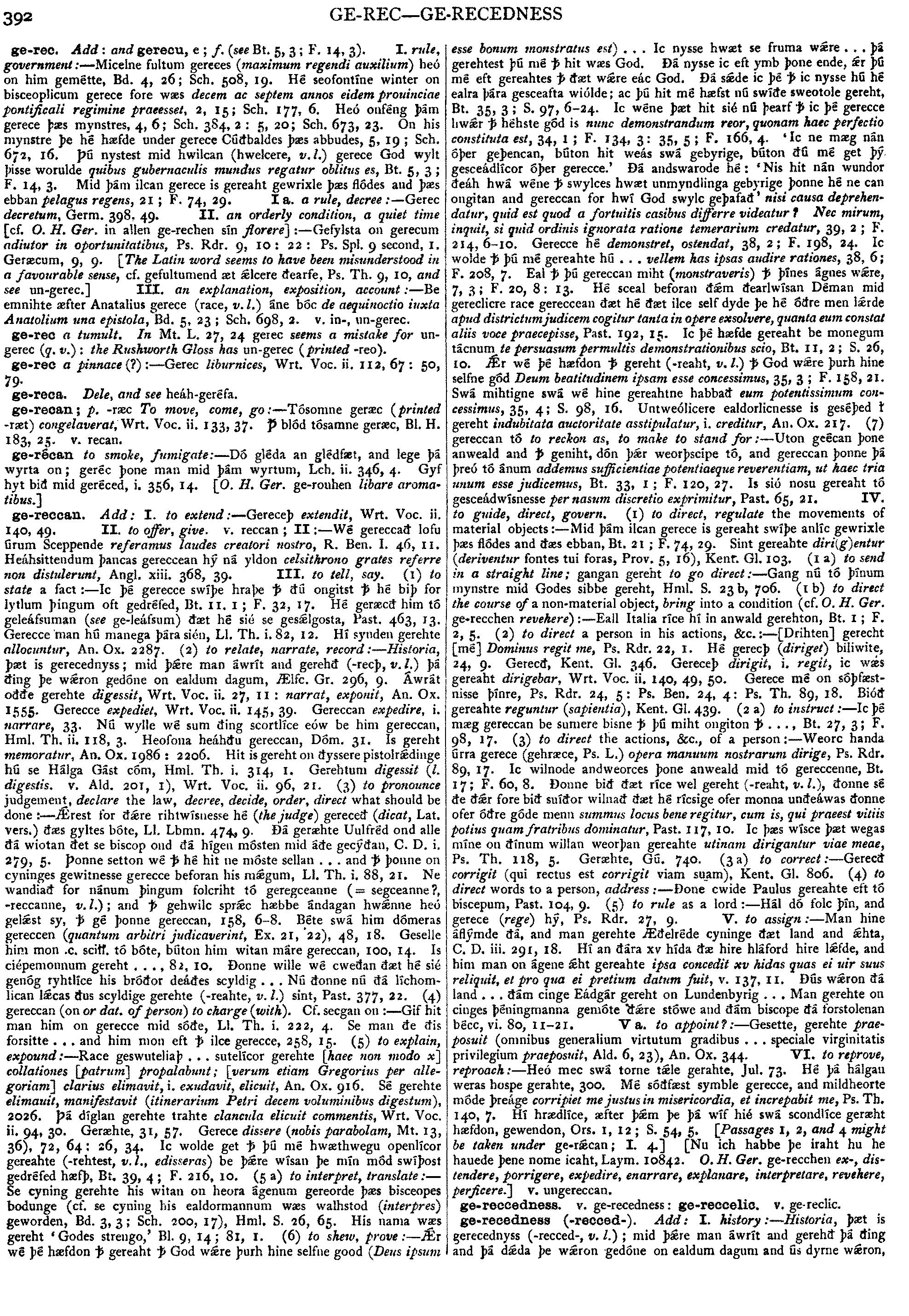
ge-rec.
Add:
and
gerecu,
e
;
f.
(
see
Bt.
5,
3;
F.
14,
3).
I.
rule,
government
:--
Micelne
fultum
gereces
(maximum
regendi
auxilium)
néo
on
him
gemétte,
Bd.
4,
26;
Sch.
508,
19.
He
seofontine
winter
on
bisceoplicum
gerece
fore
wæs
decem
ac
septem
annos
eidem
prouinciae
pontificali
regimine
praeesset,
2,
15;
Sch.
177,
6.
Heó
onféng
Þam
gerece
þæs
mynstres,
4,
6;
Sch.
384,
2
:
5,
20;
Sch.
673,
23.
On
his
mynstre
þe
hé
hæfde
under
gerece
cúðbaldes
þæs
abbudes,
5,
19
;
Sch.
672,
16.
Þú
nystest
mid
hwilcan
(hwelcere,
v.
l.)
gerece
God
wylt
þisse
worulde
quibus
gubernactulis
mundus
regatur
oblitus
es,
Bt.
5,
3
;
F.
14,
3.
Mid
þám
ilcan
gerece
is
gereaht
gewrixle
þæs
flódes
and
þæs
ebban
pelagus
regens,
21
;
F.
74,
29,
Ia.
a
rule,
decree
:--
Gerec
decretum,
Germ.
398,
49.
II.
an
orderly
condition,
a
quiet
time
[cf.
O.
H.
Ger.
in
allen
ge-rechen
sin
florere]
:--
Gefylsta
on
gerecum
ndiutor
in
oportunitatibus,
Ps.
Rdr.
9,
10
:
22
:
Ps.
Spl.
9
second,
l.
Geræcum,
9,
9.
[The
Latin
word
seems
to
have
been
misunderstood
in
a
favourable
sense,
cf.
gefultumend
æt
lcere
ðearfe.
Ps.
Th.
9,
10,
and
see
un-gerec.]
III.
an
explanation,
exposition,
account
:--
Be
emnihte
æfter
Anatalius
gerece
(race,
v.
l.)
áne
bóc
de
aequinoctio
iuxta
Anatolium
una
epislola,
Bd.
5,
23
;
Sch.
698,
2.
v.
in-,un-gerec.
ge-rec
a
tumult.
In
Mt.
L.
27,
24
gerec
seems
a
mistake
for
un-gerec
(q.
v.)
:
the
Rushworth
Gloss
has
un-gerec
(printed
-reo).ge-rec
a
pinnace
(?)
:--
Gerec
liburnices,
Wrt.
Voc.
ii.
112,
67:
50,
79
.ge-reca.
Dele,
and
see
heáh-geréfa.ge-recan;
ILLEGIBLE
-ræc
To
move,
come,
g
o
:--
Tósomne
geræc
(printed
-ræt)
congelaverat.
Wrt.
Voc.
ii.
133,
37.
ILLEGIBLE
blód
tósamne
geræc,
Bl.
H.
183,
25.
v.
recan.ge-récan
to
smoke,
fumigate
:--
Dó
gléda
an
glédfæt,
and
lege
þá
wyrta
on;
geréc
þone
man
mid
þám
wyrtum,
Lch.
ii.
346,
4.
Gyf
hyt
bið
mid
gereced,
i.
356,
14.
[O.
H.
Ger.
ge-rouhen
libare
aromatibus
.]ge-reccan.
Add:
I.
to
extend
:--
Gereceþ
extendit,
Wrt.
Voc.
ii.
140,
49.
II.
to
offer,
give.
v.
reccan
;
II
:--
Wé
gereccað
lofu
Úrum
Sceppende
referamus
laudes
creatori
nostro,
R.
Ben.
I.
46,
ii.
Heahsittendum
þancas
gereccean
hý
ná
yldon
celsithrono
grates
referre
non
distulerunt,
Angl.
xiii.
368,
39.
III.
to
tell,
say.
(1)
to
state
a
fact
:--
Ic
þé
gerecce
swíþe
hraþe
ILLEGIBLE
ðú
ongitst
ILLEGIBLE
hé
biþ
for
lytlum
þingum
oft
gedréfed,
Bt.
II.
I
;
F.
32,
17.
Hé
geræcð
him
tó
geleáfsuman
(see
ge-leáfsum)
ðæt
hé
sié
se
geslgosta,
Past.
463,
13.
Gerecce
man
hú
manega
þára
sién,
Ll.
Th.
i.
82,
12.
Hí
synden
gerehte
allocuntur,
An.
Ox.
2287.
(2)
to
relate,
narrate,
record
:--
Historia,
þæt
is
gerecednyss;
mid
þre
man
áwrít
and
gerehð
(-recþ,
v.
l.)
þá
ðing
þe
wron
gedóne
on
ealdum
dagum,
Ælfc.
Gr.
296,
9.
Áwrát
oððe
gerehte
digessit,
Wrt.
Voc.
ii.
27,
ii
:
narrat,
exponit,
An.
Ox.
1555.
Gerecce
expediet,
Wrt.
Voc.
ii.
145,
39.
Gereccan
expedire,
i.
narrare,
33.
Nú
wylle
wé
sum
ðing
scortlíce
eów
be
him
gereccan,
Hml.
Th.
ii.
118,
3.
Heofona
heáhðu
gereccan,
Dóm.
31.
Is
gereht
memoratur,
An.
Ox.
1986
:
2206.
Hit
is
gereht
on
ðyssere
pistolrdinge
hú
se
Hálga
Gást
óm,
Hml.
Th.
i.
314,
l.
Ge-ehtum
digessit
(l.
digestis.
v.
Aid.
201,
l),
Wrt.
Voc.
ii.
96,
21.
(3)
to
pronounce
judgement,
declare
the
law,
decree,
decide,
order,
direct
what
should
be
done
:--
Æ-acute;rest
for
ðre
rihtwísnesse
hé
(the
judge]
gereceð
(dicat,
Lat.
vers.
)
ðæs
gyltes
bote,
Ll.
Lbmn.
474,
9.
Ðá
geræhte
Uulfréd
ond
alle
ðá
wiotan
ðet
se
biscop
ond
ðá
hígen
mósten
mid
áðe
gecýðan,
C.
D.
i.
279
5.
þonne
setton
wé
hé
hit
ne
móste
sellan
.
.
.
and
ILLEGIBLE
þonne
on
cyninges
gewitnesse
gerecce
beforan
his
mgum,
Ll.
Th.
i.
88,
21.
Ne
wandiað
for
nánum
þingum
folcriht
tó
geregceanne
(=segclanne
?
,
-reccanne,
v.
l.
)
;
and
Þ
gehwilc
sprc
hæbbe
ándagan
hwnne
heó
gelst
sy,
ILLEGIBLE
gé
þonne
gereccan,
158,
6-8.
Béte
swá
him
dómeras
gereccen
(quantum
arbitri
judicaverint,
Ex.
21,
22),
48,
18.
Geselle
him
mon
.
c.
scitf.
tó
bóte,
búton
him
witan
máre
gereccan,
100,
14.
Is
ciépemonnum
gereht
.
.
.
,
82,
10,
Ðonne
wille
wé
cweðan
ðæt
hé
sié
genóg
ryhtlíce
his
bróðor
deáðes
scyldig
.
.
.
Nú
ðonne
nú
ðá
líchomlican
lcas
ðus
scyldige
gerehte
(-reahte,
v.
l.)
sint,
Past.
377,
22.
(4)
gereccan
(on
or
dat.
of
person)
to
charge
(with).
Cf.
secgan
on
:--
Gif
hit
man
him
on
gerecce
mid
sóðe,
Ll.
Th.
i.
222,
4.
Se
man
ðe
ðis
forsitte
.
.
.
and
him
mon
eft
þilce
gerecce,
258,
15.
(5)
to
explain,
expound
:--
Race
geswuteliaþ
.
.
.
sutelícor
gerehte
[haee
non
modo
x]
collationes
[patrum]
propalabnnt;
[verum
etiam
Gregorius
per
allegoriam]
clarius
elimavit,
i.
exudavit,
elicuit,
An.
Ox.
916.
Sé
gerehte
elimauit,
manifestavit
(itinerarium
Petri
decem
voluminibus
digestum),
2026.
Þá
diglan
gerehte
trahte
clancula
elicuit
commentis,
Wrt.
Voc.
ii.
94,
30.
Geræhte,
31,
57.
Gerece
dissere
(nobis
parabolam,
Mt.
13,
36),
72,
64:
26,
34.
Ic
wolde
get
þú
me
hwæthwegu
openlícor
gereahte
(-rehtest,
v.
l.
,
edisseras)
be
þre
wísan
þe
mín
mód
swíþost
gedréfed
hæfþ,
Bt.
39,
4
;
F.
216,
10.
(5
a)
to
interpret,
translate
:--
Se
cyning
gerehte
his
witan
on
heora
ágenum
gereorde
þæs
bisceopes
bodunge
(cf.
se
cyning
his
ealdormannum
wæs
walhstod
interpres
geworden,
Bd.
3,
3;
Sch.
200,
17,
Hml.
S.
26,
65.
His
nama
wæs
gereht
'Godes
strengo,
'
Bl.
9,
14;
81,
I.
(6)
to
shew,
prove
:--
Æ-acute;r
wé
þé
hæfdon
ILLEGIBLE
gereaht
ILLEGIBLE
God
wre
þurh
hine
selfne
good
(Deus
ipsum
esse
bonum
monsíratus
est)
.
.
.
Ic
nysse
hwæt
se
fruma
wre
.
.
.
þá
gerehtest
þú
mé
ILLEGIBLE
hit
wæs
God.
Ðá
nysse
ic
eft
ymb
þone
ende,
r
þú
mé
eft
gereahtes
ILLEGIBLE
ðæt
wre
eác
God.
Ðá
sde
ic
þé
ILLEGIBLE
ic
nysse
Hé
hé
ealra
þára
gesceafta
wiólde;
ac
þú
hit
me
hæfst
nú
swíðe
sweotole
gereht,
Bt.
35,
3
;
S.
97.
6-24.
Ic
wéne
þæt
hit
sié
nú
þearf
ILLEGIBLE
ic
þé
gerecce
liwr
ILLEGIBLE
héhste
gód
is
nunc
demonstrandum
reor,
quonam
haec
perfectio
constituta
est,
34,
l
;
F.
134,
3:
35,
5
;
F.
166,
4.
'Ic
ne
mæg
nán
óþer
geþencan,
búton
hit
weás
swá
gebyrige,
buton
ðú
mé
get
þý.
gesceádlícor
óþer
gerecce.
Ðá
andswarode
hé
:
'
Nis
hit
nán
wundor
ðeáh
hwá
wéne
ILLEGIBLE
swylces
hwæt
unmyndlinga
gebyrige
þonne
hé
ne
can
ongitan
and
gereccan
for
hwí
God
swylc
geþafað'
nisi
causa
deprehendatur,
quid
est
quod
a
fortuitis
casibus
differre
videatur
ILLEGIBLE
.(
Nec
mirum,
inquit,
si
quid
ordinis
ignorata
ratione
temerarium
credatur,
39,
2
;
F.
214,
6-10.
Gerecce
hé
demonstret,
ostendat,
38,
2;
F.
198,
24.
Ic
wolde
ILLEGIBLE
þú
mé
gereahte
hú
.
.
.
vellem
has
ipsas
audire
rationes,
38,
6;
F.
208,
7.
Eal
ILLEGIBLE
þú
gereccan
miht
monstraveris
ILLEGIBLE
þínes
ágnes
wre,
7,
3;
F.
20,
8:13.
Hé
sceal
beforan
ðm
ðearlwísan
Déman
mid
gereclicre
race
gereccean
ðæt
hé
ðæt
ilce
self
dyde
þe
hé
óðre
men
lrde
apud
districtum
judicem
cogitur
tanta
in
opere
exsolvere,
quanta
eum
constat
aliis
voce
praecepisse,
Past.
192,
15.
Ic
þé
hæfde
gereaht
be
monegum
tácnum
te
persuasum
permullis
demonstrationibus
scio,
Bt.
ll,
2;
S.
26,
10.
Æ-acute;r
wé
þé
hæfdon
gereht
(-reaht,
v.l.
)
God
wre
þurh
hine
selfne
gód
Deum
beatitudinem
ipsam
esse
concessimus,
35,
3
;
F.
158,
21.
Swá
mihtigne
swá
wé
hine
gereahtne
habbað
eum
potentissimum
concessimus,
35,
4;
S.
98,
16.
Untweólicere
ealdorlicnesse
is
geséþed
ILLEGIBLE
gereht
indubitata
auctoritate
asstipulatur,
i.
creditur,
An.
Ox.
217.
(7)
gereccan
tó
to
reckon
as,
to
make
to
stand
for
:--
Uton
geécan
þone
anweald
and
ILLEGIBLE
geniht,
dón
þr
weorþscipe
tó,
and
gereccan
þonne
þá
þreó
tó
ánum
addemus
sufficienliae
poten/iaeque
reverentiam,
ut
haec
tria
unum
esse
judicemus,
Bt.
33,
I;
F.
120,
27.
Is
sió
nosu
gereaht
tó
gesceádwísnesse
per
nasum
discretio
exprimitur,
Past.
65,
21.
IV.
to
guide,
direct,
govern.
(1)
to
direct,
regulate
the
movements
of
material
objects
:--
Mid
þám
ilcan
gerece
is
gereaht
swíþe
anlic
gewrixle
þæs
flódes
and
ðæs
ebban.
Bt.
21
;
F.
74,
29.
Sint
gereahte
diri(g)entur
(deriventur
fantes
tui
foras,
Prov.
5,
16),
Kent.
Gl.
103.
(l
a)
to
send
in
a
straight
line;
gangan
gereht
to
go
direct
:--
Gang
nú
tó
þínum
mynstre
mid
Godes
sibbe
gereht,
Hml.
S.
23
b,
706.
(l
b)
to
direct
the
course
of
a
non-material
object,
bring
into
a
condition
(cf.
O.
H.
Ger.
ge-recchen
revehere)
:--
Eall
Italia
ríce
hí
in
anwald
gerehton,
Bt.
I;
F.
2,
5.
(2)
to
direct
a
person
in
his
actions,
&
c.
:--
[Drihten]
gerecht
[mé]
Dominus
regit
me,
Ps.
Rdr.
22,
l.
Hé
gerecþ
(diriget)
biliwite,
24,
9.
Gerecð,
Kent.
Gl.
346.
Gereceþ
dirigit,
i.
regit,
ic
wæs
gereaht
dirigebar,
Wrt.
Voc.
ii.
140,
49,
50.
Gerece
me
on
sðþfæstnisse
þínre,
Ps.
Rdr.
24,
5:
Ps.
Ben.
24,
4:
Ps.
Th.
89,
18.
Bióð
gereahte
reguntur
(sapientia),
Kent.
Gl.
439.
(2
a)
to
instruct
:--
Ic
þé
mæg
gereccan
be
sumere
bisne
ILLEGIBLE
þú
miht
ongiton
ILLEGIBLE
.
.
.
,
Bt.
27,
3;
F.
98,
17.
(3)
to
direct
the
actions,
&
c.
,
of
a
person
:--
Weorc
handa
úrra
gerece
(gehræce,
Ps.
L.
)
opera
manuum
nostrarum
dirige,
Ps.
Rdr.
89,
17.
Ic
wilnode
andweorces
þone
anweald
mid
to
gereccenne,
Bt.
17;
F.
60,
8.
Ðonne
bið
ðæt
rice
wel
gereht
(-reaht,
v.
l.),
ðonne
sé
ðe
ðr
fore
bið
suíðor
wilnað
ðæt
hé
rícsige
ofer
monna
unðeáwas
ðonne
ofer
óðre
góde
menn
summus
locus
bene
regitur,
cum
is,
qui
praeest
vitiis
potius
quam
fratribus
dominatur,
Past.
117,
10.
Ic
þæs
wísce
þæt
wegas
mine
on
ðínum
willan
weorþan
gereahte
utinam
dirigantur
viae
meae,
Ps.
Th.
118,
5.
Geræhte
,
Gú.
740.
(33)
to
correct
:--
Gerecð
corrigit
(qui
rectus
est
corrigit
viam
suam),
Kent.
Gl.
806.
(4)
to
direct
words
to
a
person,
address
:--
Ðone
cwide
Paulus
gereahte
eft
to
biscepum,
Past.
104,
9.
(5)
to
rule
as
a
lord
:--
Hal
dó
folc
bin,
and
gerece
(rege)
hy.
Ps.
Rdr.
27,
9.
V.
to
assign
:--
Man
hine
áflýmde
ðá,
and
man
gerehte
Æðelréde
cyninge
ðæt
land
and
hta,
C.
D.
iii.
291,
18.
Hí
an
ðára
xv
hída
ðæ
hire
hlaford
hire
lfde,
and
him
man
on
ágene
ht
gereahte
ipsa
concedit
xv
hidas
quas
ei
uir
suus
reliquit,
el
pro
qua
ei
pretium
datum
fuit,
v.
137,
ii.
Ðús
wron
ðá
land
.
.
.
ðám
cinge
Eádgár
gereht
on
Lundenbyrig
.
.
.
Man
gerehte
on
cinges
þéningmanna
gemóte
ðre
stówe
and
ðám
biscope
ðá
forstolenan
bécc,
vi.
80,
11,21.
Va.
to
appoint?
:--
Gesette,
gerehte
prae-posuit
(omnibus
generalium
virtutum
gradibus
...
speciale
virginitatis
privilegium
praeposuit,
Aid.
6,
23),
An.
Ox.
344.
VI.
to
reprove,
reproach
:--
Heó
mec
swá
torne
tle
gerahte.
Jul.
73.
Hé
þá
hálgan
weras
hospe
gerahte,
300.
Mé
sóðfæst
symble
gerecce,
and
mildheorte
mode
þreáge
corripiet
me
Justus
in
misericordia,
et
increpabit
me,
Ps.
Th.
140,
7.
Hi
hrædlíce,
æfter
þm
þe
þá
wíf
hié
swá
scondlíce
geræht
hæfdon,
gewendon,
Ors.
1,
12;
S.
54,
5.
[Passages
I.
2,
and
4
might
be
taken
under
ge-rcan;
I.
4.]
[Nu
ich
habbe
þe
iraht
hu
he
hauede
þene
nome
icaht,
Laym.
10842.
O.
H.
Ger.
ge-recchen
ex-,
dis-tendere,
porrigere,
expedire,
enarrare,
explanare,
interpretare,
revehere,
perftcere.
]
v.
ungereccan.ge-reccedness.
v.
ge-recedness:
ge-reccelic.
v.
ge-reclic.ge-recedness
(-recced-).
Add:
I.
history
:--
Historia,
þæt
is
gerecednyss
(-recced-,
v.
l.)
;
mid
þre
man
áwrít
and
gerehð
þá
ðing
and
þá
dda
þe
wron
gedóne
on
ealdum
dagum
and
ús
dyrne
wron.
|
Source: Bosworth/Toller, page d0397, entry 6 View original page image as: [TIFF] [PNG] [View previous entry] [View next entry] |
[Comment on this entry] [View comments] |
The following entry has been hand-corrected once. |
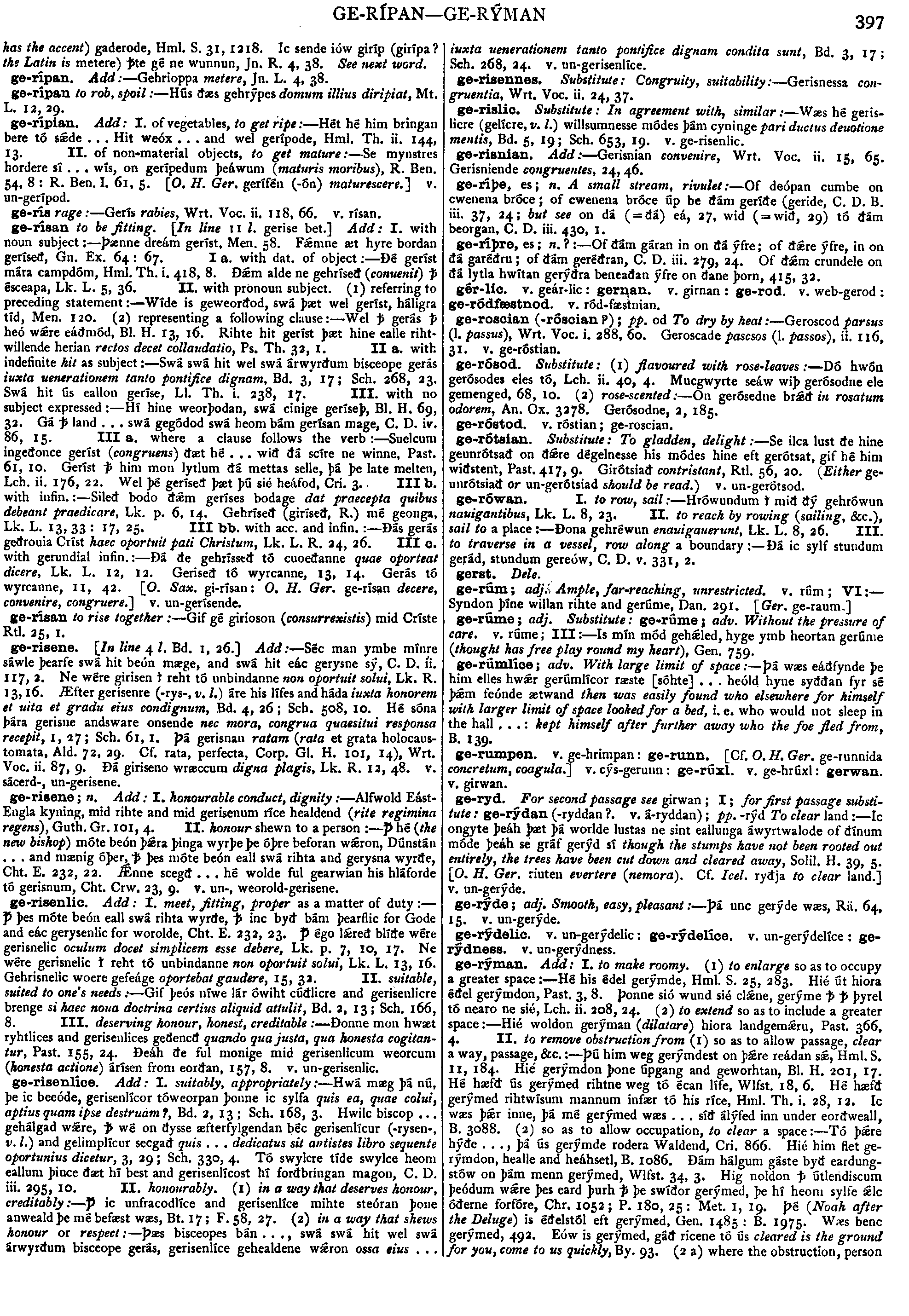
ge-rísan
to
be
fitting.
[In
line
11
2.
gerise
bet.]
Add:
I.
with
noun
subject
:--
þænne
dream
gerist.
Men.
58.
Fmne
ast
hyre
bordan
geríseð,
On.
Ex.
64
:
67.
I
a.
with
dat.
of
object
:--
Ðé
gerist
mára
campdom.
Hml.
Th.
i.
418,
8.
Dam
aide
ne
gehrtseð
(conuenil)
Ssceapa,
Lk.
L.
5,
36.
II.
with
pronoun
subject,
(1)
referring
to
preceding
statement
:--
Wide
is
geweorðod,
swá
þæt
wel
gerist,
haligra
tid,
Men.
120.
(2)
representing
a
following
clause
:--
Wel
ji
gerás
p
heó
wre
eáðmód,
Bl.
H.
13,
16.
Rihte
hit
gerist
bæt
hine
ealle
riht-willende
herian
rectos
decet
collaudatio,
Ps.
Th.
32,
II
a.
with
indefinite
hit
as
subject
:--
Swá
swá
hit
wel
swá
árwyrðum
bisceope
gerás
iuxta
uenerationem
tanto
pontifice
dignam,
Bd.
3,
17;
Sch.
268,
23.
Swá
hit
us
eallon
gerise,
Ll.
Th.
i.
238,
17.
III.
with
no
subject
expressed
:--
Hi
hine
weorþodan,
swá
cinige
geríseþ,
Bl.
H.
69,
32.
Gá
t>
land
.
.
.
swá
gegódod
swá
heom
bám
gerísan
mage,
C.
D.
ir.
86,
15.
Ill
a.
where
a
clause
follows
the
verb
:--
Suelcum
ingeðonce
gerist
(congruens)
ðæt
hé
.
.
.
wið
dá
scire
ne
winne,
Past.
61,
lo.
Gerist
t>
him
mon
lytlum
da
mettas
selle,
þá
þe
late
melten.
Lch.
ii.
176,
22.
Wel
þé
geríseð
þæt
þú
sié
heáfod,
Cri.
3.
.
III
b.
with
infin.
:--
Siled
bodo
ðm
geríses
bodage
dat
praecepta
quibus
debeant
praedicare,
Lk.
p.
6,
14.
Gehriseð
(giríseif,
R.
)
mé
geonga,
Lk.
L.
13,
33
:
17,
25.
Ill
bb.
with
acc.
and
infin.
:--
Ðás
gerás
geðrouia
Críst
haec
oportuit
pati
Christum,
Lk.
L.
R.
24,
26.
III
o.
with
gerundial
infin.
:--
Ðá
ðe
gehrísseð
tó
cuoeðanne
quae
oporteat
dicere,
Lk.
L.
12,
12.
Geriseð
tó
wyrcanne,
13,
14.
Gerás
tó
wyrcanne,
n,
42.
[O.
Sax.
gi-rísan:
O.
H.
Ger.
ge-rísan
decere,
convenire,
congruere.
"]
v.
| Result Page: |  |
Previous | 164 165 166 167 168 169 170 171 172 173 174 175 176 177 178 179 180 181 182 | Next |  |
Germanic Lexicon Project (main page)
This search system was written by
Sean Crist
Please consider
volunteering
to correct the data in these online dictionaries.
No rights reserved. Feel free to use these data in any way you please.